Comprehensive report on Chernobyl – 30 years on

 TORCH, Ian Fairlea, March 10, 2016 First of all, apologies to the many readers who have written complaining about the lack of new blogs/information on this website.
The explanation is that I’ve been busy for the past 5 months writing a new report on the health effects of the 1986 Chernobyl nuclear disaster -TORCH-2016. This is an update of the 2006 TORCH report. (TORCH means The Other Report on Chernobyl.)
The report (120 pages) was commissioned by Global 2000/Friends of the Earth Austria and funded by the Vienna City Council Environmental Ombuds Office.
The report updates the new health evidence which has been published in peer-reviewed journals during the 10 year period 2006-2016.
In a nutshell, the report finds
- 5 million people in Belarus, Ukraine and Russia still live in highly contaminated areas
- 400 million people in less contaminated areas
- 37% of Chernobyl’s fallout deposited on western Europe; 42% of western Europe contaminated
- 40,000 fatal cancers predicted
- 6,000 thyroid cancer cases to date, 16,000 more expected
- increased radiogenic thyroid cancers now seen in Austria
- increased radiogenic leukemia, cardiovascular disease, breast cancers confirmed
- new evidence of radiogenic birth defects, mental health effects and diabetes
- new evidence that children in contaminated areas suffer radiogenic illnesses https://www.global2000.at/sites/global/files/TORCH%20-%20The%20other%20Report%20of%20Chernobyl.pdf

Exxon’s scandalous dishonesty about climate change
Scandal! Exxon knew about climate change, boosted denialism, misled shareholders, went carbon heavy, Ecologist Bill McKibben 9th March 2016 One of the world’s biggest energy companies has been caught out in what may be the biggest ever climate scandal, writes Bill McKibben. Way back in the 1980s ExxonMobil knew of the ‘potentially catastrophic’ and ‘irreversible’ effects of increasing fossil fuel consumption, but chose to cover up the findings, spread misinformation on climate change, and go for high carbon energy sources……….
Exxon twisted the facts to further its own agenda
So here’s what happened. Exxon used its knowledge of climate change to plan its own future. The company, for instance, leased large tracts of the Arctic for oil exploration, territory where, as a company scientist pointed out in 1990, “potential global warming can only help lower exploration and development costs.”
Not only that but, “from the North Sea to the Canadian Arctic,” Exxon and its affiliates set about “raising the decks of offshore platforms, protecting pipelines from increasing coastal erosion, and designing helipads, pipelines, and roads in a warming and buckling Arctic.”In other words, the company started climate-proofing its facilities to head off a future its own scientists knew was inevitable.
But in public? There, Exxon didn’t own up to any of this. In fact, it did precisely the opposite. In the 1990s, it started to put money and muscle into obscuring the science around climate change. It funded think tanks that spread climate denial and even recruited lobbying talent from the tobacco industry.
It also followed the tobacco playbook when it came to the defence of cigarettes by highlighting ‘uncertainty’ about the science of global warming. And it spent lavishly to back political candidates who were ready to downplay global warming.
Its CEO, Lee Raymond, even travelled to China in 1997 and urged government leaders there to go full steam ahead in developing a fossil fuel economy. The globe was cooling, not warming, he insisted, while his engineers were raising drilling platforms to compensate for rising seas.
“It is highly unlikely”, he said, “that the temperature in the middle of the next century will be significantly affected whether policies are enacted now or 20 years from now.” This wasn’t just wrong, but completely and overwhelmingly wrong – as wrong as a man could be.
Sins of omission
In fact, Exxon’s deceit – its ability to discourage regulations for 20 years – may turn out to be absolutely crucial in the planet’s geological history. It’s in those two decades that greenhouse gas emissions soared; as did global temperatures until, in the twenty-first century, ‘hottest year ever recorded’ has become a tired cliché.
And here’s the bottom line: had Exxon told the truth about what it knew back in 1990, we might not have wasted a quarter of a century in a phony debate about the science of climate change, nor would anyone have accused Exxon of being ‘alarmist.’ We would simply have gotten to work.
But Exxon didn’t tell the truth. A Yale study published last fall in the Proceedings of the National Academy of Sciences showed that money from Exxon and the Koch Brothers played a key role in polarizing the climate debate in this country.
The company’s sins – of omission and commission – may even turn out to be criminal. Whether the company ‘lied to the public’ is the question that New York Attorney General Eric Schneiderman decided to investigate last fall in a case that could make him the great lawman of our era if his investigation doesn’t languish.
There are various consumer fraud statutes that Exxon might have violated and it might have failed to disclose relevant information to investors, which is the main kind of lying that’s illegal in this country of ours. Now, Schneiderman’s got back up from California Attorney General Kamala Harris, and maybe – if activists continue to apply pressure – from the Department of Justice as well, though it’s highly publicized unwillingness to go after the big banks does not inspire confidence.
Here’s the thing: all that was bad back then, but Exxon and many of its Big Energy peers are behaving at least as badly now when the pace of warming is accelerating. And it’s all legal – dangerous, stupid, and immoral, but legal.
Exxon finally admits global warming is occurring – but there’s no big problem………
The carbon tax and the political stonewall
In other words, we’re no longer talking about outright denial, just a denial that much really needs to be done. And even when the company has proposed doing something, its proposals have been strikingly ethereal. Exxon’s PR team, for instance, has discussedsupporting a price on carbon, which is only what economists left, right, and centre have been recommending since the 1980s.
But the minimal price they recommend – somewhere in the range of $40 to $60 a ton – wouldn’t do much to slow down their business. After all, they insist that all their reserves are still recoverable in the context of such a price increase, which would serve mainly to make life harder for the already terminal coal industry.
But say you think it’s a great idea to put a price on carbon – which, in fact, it is, since every signal helps sway investment decisions. In that case, Exxon’s done its best to make sure that what they pretend to support in theory will never happen in practice…….
Now the cover ups are being investigated – could Exxon be liable?
As with the tobacco companies in the decades when they were covering up the dangers of cigarettes, there’s a good chance that the Big Energy companies were in this together through their trade associations and other front groups.
In fact, just before Christmas, Inside Climate News published some revealing new documents about the role that Texaco, Shell, and other majors played in an American Petroleum Institute study of climate change back in the early 1980s. A trial would be a transformative event – a reckoning for the crime of the millennium.
But while we’re waiting for the various investigations to play out, there’s lots of organizing going at the state and local level when it comes to Exxon, climate change, and fossil fuels – everything from politely asking more states to join the legal process to politely shutting down gas stations for a few hours to pointing out to New York and California that they might not want to hold millions of dollars of stock in a company they’re investigating. It may even be starting to work.
Vermont Governor Peter Shumlin, for instance, singled Exxon out in his state of the state address last month. He called on the legislature to divest the state of its holdings in the company because of its deceptions:
“This is a page right out of Big Tobacco, which for decades denied the health risks of their product as they were killing people. Owning ExxonMobil stock is not a business Vermont should be in.”
The question is: Why on God’s not so green Earth any more would anyone want to be Exxon’s partner?
Action: BreakFree2016, May 4-15 – a global wave of mass actions will target the world’s most dangerous fossil fuel projects, in order tokeep coal, oil and gas in the ground and accelerate the just transition to 100% renewable energy. Across the world, people are showing the courage toconfront polluters where they are most powerful – from the halls of power to the wells and mines themselves. http://www.theecologist.org/News/news_analysis/2987359/epic_scandal_how_exxon_boosted_climate_change_denial_infiltrated_politics_misled_shareholders.html
Nuclear Regulatory Commissioners urgently call for correcting reactor cooling systems flaw

 Dangerous Flaw Threatens to Close Nation’s Nuclear Fleet Energy Matters, By Roger Witherspoon, 4 Mar 16
After four years of increasingly tense internal discussion, seven Nuclear Regulatory Commission engineers have formally petitioned the governing Commissioners to either order the nation’s nuclear power plants to immediately correct a design flaw governing their reactor cooling systems or order them all to shut down.
The flaw is in the original design of the electrical system, and has escaped notice for decades. According to the engineers’ petition, as well as a series of staff analyses on file at the NRC, the design flaw occurs in what is called a “single phase” condition in which little or no electricity is entering the plant to operate its backup cooling systems in the event of a blackout or other event cutting off power from the grid. The result is that the motors of backup generators are underpowered and this can cause their motors to burn out. When that happens, there is no way to keep the reactor core cool.
The seven members of the Electrical Engineering Branch in the Office of Nuclear Reactor Regulation, led by Acting Chief Roy K. Mathew, stated in the petition that “the staff determined that all nuclear facilities are susceptible to this design vulnerability except one plant, and recommended that the NRC take prompt regulatory action.”
As a result, the petition states, if the plants are not ordered to immediately redesign their electrical systems then the Commissioners should “issue Orders to immediately shutdown the operating nuclear power plants since the licensees are operating their facilities without addressing the significant design deficiency…and with inoperable electric power systems….”
The situation evolved from an unplanned shutdown in January 30, 2012 in Unit 2 of the Byron Station Nuclear Power Plant in Illinois. At the time, it was thought that the shutdowns resulted from a string of unfortunate coincidences. But further examination by the NRC’s electrical engineering branch found something more alarming…………
Officials from Exelon, which owns and operates Byron and 10 other nuclear power plants, as well as inspectors from the NRC initially thought that the shutdown was the result of a series of unfortunate coincidences. But On Feb. 28, 2012, there was a similar interrupted and undetected phase which caused a shutdown at Byron’s Unit 1. And, as in the earlier event, it disabled the plant’s cooling systems. That caused Mathews and the electric unit he led to investigate further and see if there had been any other shutdowns in which an undetected phase disruption disabled the cooling pumps. Their initial look found identical shutdowns at the Beaver Valley Power Station Unit 1 in Pennsylvania in November, 2007; and in New York, the James Fitzpatrick and the neighboring Nine Mile plants, which share a power substation, shut down in December, 2005.
The staff analysis concluded that the design of the electrical systems was “inadequate because it did not consider the possibility of the loss of a single phase… This situation resulted in neither the onsite nor the offsite electric power system being able to perform its intended safety functions” to provide electric power to the plant’s safety systems. Plants are required to have two separate sets of electrical power lines and monitors for their core cooling systems so that operators can still control the reactor even if one line, or train, is damaged by fire or another event.
The loss of a single phase of alternating current, the NRC staff found, “can potentially damage both trains of the emergency core cooling system.” In that case, there is nothing to prevent a meltdown………..
“In addition,” the staff assessment concluded, “the generic AP1000 plant operating procedures are under development and the licensees’ review of the generic procedures did not identify specific operator actions related to phase voltage verifications of the three phases.”
As a result, the electrical group concluded, all of the nation’s nuclear plants are violating the terms of their operating licenses and must either be brought into compliance or shut down.
According to NRC statutes, this is a major issue.
NRC regulations governing the operating licenses dictate that “the safety systems shall be designed so that, once initiated automatically or manually, the intended sequence of protective actions of the execute features shall continue until completion.”
The group’s petition states “any failures in an offsite power system or onsite power system must not disable the safety functions of emergency core cooling and vital safety systems to protect the health and safety of the public.”
With the current system, they assert, the plants are violating a mandatory condition of their operating licenses ( http://bit.ly/21OiouL ). As the issue was debated within the agency, the Mathews group cast a wider net and began looking at the root causes of shutdowns in the US and abroad, while pushing the agency to more forcefully addresses the design problem. To their surprise, they found 13 “open phase events” over a 14-year period, with the latest taking place at the Oconee Nuclear Power Station in South Carolina in December, 2015………… https://spoonsenergymatters.wordpress.com/2016/03/04/dangerous-flaw-threatens-to-close-nations-nuclear-fleet/
The horrendous truth about just how big a mess nuclear corporation EDF is in
 EDF’s leaked Board Agenda: Zombie nuclear projects and ‘beyond the grave’ reactors http://www.theecologist.org/blogs_and_comments/Blogs/2987305/edfs_leaked_board_agenda_zombie_nuclear_projects_and_beyond_the_grave_reactors.html Jonathon Porritt 29th February 2016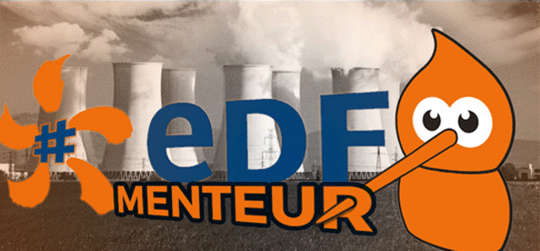
French nuclear parastatal EDF is facing problem after problem – zombie nuclear projects in the UK, Finland, China and France, a fleet of ‘beyond the grave’ reactors, a dropping share price and its drooping credit rating. But is it really as bad as all that? Jonathon Porritt has exclusive access to the leaked Agenda of its latest board meeting. And the answer is – no. It’s even worse.
You seriously wouldn’t want to be a Director of EDF at the moment. The agenda for an average Board Meeting must be seriously gloomy on each and every occasion.
And thanks to an EDF mole (and to judge by the number of leaks to the French press and the UK’sFT there’s a lot of them) I can now state this as fact, not mere opinion.
An annotated copy of the Agenda items for their last meeting on 16th February mysterious showed up in my email today, helpfully summarised byAlexandre Perra, EDF’s Executive Committee Secretary.
Item 1: Existing EPR construction projects
1.1 Olkiluoto (Finland)
Continuing, horrendous cost overruns, leading to ongoing legal stand-off with Finnish partners. Already delayed by seven years, but (hopefully!) could be finished by 2018.
1.2 Flamanville (France)
Continuing, horrendous cost overruns. Already delayed by nine years, but (hopefully!) could be finished by 2018.
1.3 Taishan (China)
Serious problems with both reactors under construction, but, this being China, everything’s shrouded in secrecy. WARNING: This could be much worse than we currently understand.
1.4 Pressure vessels
Still waiting for final safety assessment from French regulators. WARNING: There could be really serious problems here, despite our best efforts to ‘work with’ the regulator.
1.5 Deadlines/UK Treasury
These deadlines are now CRITICAL – as in EXISTENTIAL.
UK Treasury’s loan guarantees are linked to Flamanville operating successfully. And if it is not working properly by 2020, loan guarantee will be completely withdrawn.
Item 2: New reactors at Hinkley Point, Somerset
2.1 Final investment decision
Postponed again – for the eighth time. Still unable to raise the €23.3bn (£18bn), despite our Chinese backers agreeing last year to provide one-third of the total sum, and despite the UK Government offering all but limitless subsidies.
CAUTIONARY NOTE: The true cost is of course much closer to €31 (£24.5bn) taking into account both the cost of construction and the costs of finance. This has been recognised by the EU Commission.
Have just released new announcement: construction will now not start until 2019. We should know by then whether the EPR will ever produce any electricity, with Olkiluoto and Flamanville both due to come on stream in 2018.
2.2 Media strategy
Must keep up a good front: have blamed the latest delay on the Chinese New Year. Crucial that CEO maintains the line: “We estimate the investment decision is very close.”
‘Stop Hinkley Point’ protesters occupied our offices in Bridgewater yesterday. Need to handle with care. Negative coverage increasing all the time, and people have started to talk about our ‘zombie reactors‘ at Hinkley Point.
Regrettably, our cohort of ‘green ambassadors’ (led by renowned UK environmentalist George Monbiot) has fallen silent. Very few advocates now for EPR. Even the FT has now joined the ranks of the critics stating “Politically painful it may be, but the case for halting Hinkley Point C is becoming hard to refute.”
Item 3: Extending the life of our UK reactors
3.1 Some good-ish news: we’ve negotiated extensions for four of our eight reactors in the UK: Heysham 1 and Hartlepool, through to 2024, and Heysham 2 and Torness through to 2030. There will be a significant financial outlay here, which has not yet been properly accounted for, but still relatively ‘small beer’ (as the English say) when looking at our overall finances.
3.2 The longer we keep these reactors ticking over, more or less safely, the better it will be. As soon as they come offstream, all the liabilities associated with decommissioning kick in. Reminder to the Board: managing our rising liabilities is now our most critical priority!
Item 4: Extending the life of our French reactors
Current operating fleet: 58 reactors. The Board has already signed off on a major life extension programme, with an estimate of €55bn of costs. Recent external assessments have put total costs at €100bn. Crucial to hold the line in the media at €55bn. In reality, we have no idea what the total outlay will be.
Item 5: Energy Transition Law (France)
5.1 This now represents A MAJOR RISK, with a direct mandate from our principal shareholder (the French Government) that the country must reduce its dependence on nuclear generation from 75% to 50% of total electricity demand by 2025.
5.2 The Cour des Comptes (state Audit Office) has just issued a new report challenging our long-held expectation that demand for electricity in France will continue to grow significantly through to 2025. If they are right, the energy transition law will mean:
- Worst-case scenario: 20 reactors (35% of the fleet) will need to close.
- Best-case scenario: 17 reactors (29% of the fleet) will need to close.
5.3 Lobbying relevant Ministers and Prime Minister to amend the Energy Transition Law now a TOP PRIORITY.
tem 6: Financial position
- Current share price: down 50% on January 2015 position.
- Current market cap: €22.5 (symbolically and very uncomfortably, less than the total projected costs of the Hinkley Point project).
- Our €37bn net debt load also dwarfs our €18.5bn market capitalisation.
- Current credit rating still at risk. Standard & Poors and Moody’s both looking wobbly.
- Growing concern about perceived splits on the Board, especially as regards increasingly forceful hostility from our Trade Union representatives to Hinkley Point.
Merde alors! And now the FT reports that they have two EDF sources telling them that the final investment decision will be delayed until 2017! Nous sommes trahis! It will be soon! Very very soon! Call security!
The Champagne has lost its fizz
See what I mean? Not exactly a cheery occasion, even with the best of French lunches, and it must be a bit like that Board meeting after Board meeting.
So now shift the focus to London, to the Department of Energy and Climate Change. Imagine for a moment the Permanent Secretary, metaphorically shitting himself as the single biggest element in the UK’s future electricity supply slides, slowly but ever more inexorably, down the pan. Wouldn’t he just love to get access to the (real) Minutes of EDF’s Board meetings!
The implications of all this for the UK couldn’t possibly be more severe. Initially, Hinkley Point was meant to be on stream by 2025, generating a whacking great 7% of total electricity supply. Earlier delays meant that this had already slipped to 2030. Now that the start date has slipped again, to 2019, at the earliest, that 2030 date looks insanely optimistic.
And that’s just the start. EDF’s meltdown at Hinkley Point is already having a significant knock-on impact on other would-be nuclear prospects in the UK – with Horizon, NuGen and even China General Nuclear Corporation beginning to get cold feet.
If Hinkley Point does go down the pan, a project that has been given every conceivable financial inducement by both the UK and the French Government, who the hell is going to invest in different but equally dodgy reactor designs?
If the Permanent Secretary isn’t shitting himself about such a state of affairs, one has to ask where he’s getting his metaphorical Imodium from.
Jonathon Porritt is Co-Founder of Forum for the Future, and a writer, broadcaster and commentator on sustainable development. He is also Trustee of the Ashden Awards for Sustainable Energy, and is involved in the work of many NGOs and charities as Patron, Chair or Special Adviser.
This blog was originally published on Jonathon’s website.
Japanese Government Takes Grave Risks with Radiation Exposure

 How Much Is Too Much? Japanese Government Takes Grave Risks with Radiation Exposure http://www.stuarthsmith.com/how-much-is-too-much-japanese-government-takes-grave-risks-with-radiation-exposure/ 28 Feb 16 Japan’s nuclear crisis isn’t going away – and long-term health impacts from the radiation are now a grave concern as the situation continues to escalate. Dozens of repair workers at the reeling Fukushima-Daiichi nuclear power plant have already been exposed to radiation levels well beyond the country’s legal yearly dose limit. So far, the highest specific exposures reported are from two workers who received – on one day alone – radiation doses of more than three times the internationally recognized annual occupational exposure limit. Reports say the workers had severe rashes on the parts of their bodies exposed to radioactive water. Those troubling revelations prompted an even more troubling response from the Japanese government. In a move that is certain to stunt workers’ lives and potentially plague future generations with increased cancer rates, Japan’s Ministry of Health, Labor and Welfare has lifted the internationally recognized 50-millisievert (mSv) yearly cap on occupational exposure. That specific 50-mSv limit is recognized as the lowest dose that can trigger cancer in adults. It is most definitely not an arbitrary number to be manipulated by short-sighted governments – not even during times of crisis.
Greatest nuclear risk is that of accidental war
 The Top 10 Reasons to Reduce the Risk of Accidental Nuclear War, Huffington Post, 02/26/2016 Max Tegmark MIT physicist, author of “Our Mathematical Universe”
What’s the number one military threat to the U.S.?
- Terrorism
- A deliberate nuclear attack
- Accidental nuclear war with Russia
Based on the recent political debates, you’d think it would be 1 or 2, but if you do the numbers, 3 wins hands down. Here’s why. Let’s compare the expected number of Americans killed during the year ahead, i.e., the number of Americans who’d get killed if the threat comes true times the probability of this happening during the coming year. For terrorism, one of the worst-case scenarios is a nuclear explosion in downtown New York killing millions of people. If we very pessimistically multiply this by a 10% chance of happening in 2016 (it’s probably much less likely), the expected number of casualties is a few hundred thousand per year.
For an all-out nuclear war with Russia, there’s a huge uncertainty in casualties. If nuclear winter is as severe as some modern forecasts and ruins global food production with freezing summers for years, then it’s plausible that over 5 billion of the 7.4 people on Earth will perish. If for some poorly understood reason there’s no nuclear winter at all, we can use a 1979 report by the U.S. Government from before nuclear winter was discovered, estimating that 28%-88% of Americans and 22%-50% of Soviets (150-450 million people with today’s populations) would die.
What’s the chance of this happening during the year ahead? Before answering, please check out this timeline of near-misses when it almost happened by mistake (highlights below). John F. Kennedy estimated the probability of the Cuban Missile Crisis escalating to nuclear war between 33% and 50%, and near-misses keep occurring regularly. Even if the risk of accidental nuclear war is as low at 1% per year, the expected deaths are 1.5-50 million people per year depending on your nuclear winter assumptions, way more than for terrorism. It’s likely that the chance of a deliberate unprovoked all-out nuclear attack by the U.S. or Russia is much smaller than 1%, given that this entails national suicide with over 7,000 nuclear weapons on the opposing side, many on hair-trigger alert.
A robust defense against terrorism and belligerent adversaries is clearly crucial, but U.S. military strategy can’t afford to be soft against the greatest threat of all: accidental nuclear war. When you hear about the U.S. plan to spend about $1 trillion modernizing and upgrading our nuclear arsenal, it at first sounds like a step in the right direction, reducing this risk. Unfortunately, looking at what the money is actually for reveals that it instead increases the risk. Please check out the disturbing incidents below: Which of these risks would be reduced by the planned more accurate missile targeting, improving first-strike incentive? By the new nuclear-tipped cruise missile? By the new gravity bomb? None! We’re spending money to make ourselves less safe by fueling a destabilizing arms race. We’ll be safer if those 1 trillion dollars were spent on non-nuclear parts of the U.S. military and on strengthening our society in other ways.
Top-10 list of near-misses
(Sources and more incidents here.)
10) January 1, 1961: H-bombs Dropped on North Carolina……..
9) October 24, 1962: Soviet Satellite Explodes During Cuban Missile Crisis………
8) January 25 1995: Norwegian Rocket Mistaken for ICBM…….
7) October 26, 1962: US F102A Fighters vs. Soviet MIG interceptors……
6) June 6, 1980: Faulty Chip Signals Soviet Attack……..
5) November 11, 1983: Soviets Misinterpret U.S. Nuclear War Games ……..
4) November 9, 1979: Simulated Soviet Attack Mistaken for Real…….
3) September 9, 1983: Soviet Union Detects Incoming Missiles……
2) October 27, 1962: Soviet Sub Captain Decides to Fire Nuclear Torpedo During Cuban Missile Crisis……..
1) The incidents that keep happening
These are only a sample of over two dozen close calls that we’ve catalogued in this timeline, and there are almost certainly more, since some have been revealed only decades later. Also, although most nuclear incidents were reported by U.S. sources, there’s no reason to believe that the opposing superpower had fewer incidents, or that there have been zero incidents in China, the UK, France, Israel, India, Pakistan or North Korea. Moreover, near-misses keep happening. Although some argue that the superpowers should keep their current nuclear arsenals forever, simple mathematics shows that nuclear deterrence isn’t a viable long-term strategy unless the risk of accidental nuclear war can be reduced to zero: Even if the annual risk of global nuclear war is as low as 1%, we’ll probably have one within a century and almost certainly within a few hundred years. This future nuclear war would almost certainly take more lives than nuclear deterrence ever saved. If you want to reduce the risk of accidental nuclear war, please help raise awareness by sharing this timeline.
Increasing safety risks as nuclear reactors age
Nuclear power in the future: risks of a lifetime http://thebulletin.org/nuclear-power-future-risks-lifetime9185 DAVID LOCHBAUM, 26 Feb 16, A nuclear safety engineer,Lochbaum is one of the nation’s top independent experts on nuclear power.
The chance of one reactor experiencing a meltdown among a fleet of 100 reactors operating within the NRC’s safety goal for 40 years is nearly one in three (32.97 percent), or slightly higher than the risk from taking two turns on a six-chamber revolver during Russian roulette. The chance of a meltdown from that fleet operating for 60 years rises to 45.12 percent, or slightly higher than taking three Russian roulette turns. And the meltdown risk from the fleet operating for 80 years is 55.07 percent, or roughly the risk from taking four and one-half Russian roulette turns.
The bathtub curve. The NRC’s safety goal is a constant number for all reactors at every point during their operation. In reality, the risk over a reactor’s lifetime varies by what is called the bathtub curve due to its shape.

A reactor begins operating with relatively high risk due to material imperfections, assembly errors, worker mistakes, and other break-in problems. The risk levels off during mid-life and then rises late in life due to age-related degradation.
The US fleet of reactors is heading toward, if not already in, the wear-out portion of the bathtub curve where risk increases. Continue reading
Exposing the Big Hype about Small Modular Nuclear Reactors (SMRs)
to make this huge investment even begin to make sense you need to do it in a big way. It is unclear if the mass production savings of SMRs will offset the economy of scale advantages of current designs. what is clear is that attempts to use modular components in the four AP1000s currently under construction in the US have utterly failed to keep costs down, or even controlled.
And similarly this supposed benefit will not help the first handful of SMRs. The non-partisan group Taxpayers for Common Sense gave SMR’s their Golden Fleece Award for using taxpayer money where business should be paying.

The small reactors we find in nuclear military vessels produce electricity at ridiculously high prices per kilowatt. This is why no engineering firm is proposing these well understood designs for mass production. The cost of naval small reactor power never becomes competitive, even if mass produced.
Small reactors reduce costs by eliminating the secondary containment,increasing the chances nuclear accidents will not be contained. There is still no rad-waste solution for these reactors. Oh, and there are not even any finished designs for these reactors, much less prototypes.
Small is Ugly – the case against Small Modular Reactors http://funologist.org/2012/12/09/small-is-ugly-the-case-against-small-modular-reactors/
[With apologies to E.F. Schumacher, who wrote the important book Small is Beautiful] January 2016
“Don’t bet against technology.” is the advice i give to people who are saying certain industrial developments won’t happen, or will not happen soon. There are breakthroughs everyday and most of them are not forecasted much in advance. So why am I not excited about the recent Department of Energy’s decision to fund the development of Small Modular Reactor (SMR) designs?
So the hype runs like this. Continue reading
Leukaemia risk increased in exposure even to low dose radiation – World Health Organisation
 Even low doses of radiation increase risk of dying from leukaemia in nuclear workers, says IARC http://www.iarc.fr/en/media-centre/pr/2015/pdfs/pr235_E.pdf Lyon, France, 22 June 2015 – A study coordinated by the International Agency for Research on Cancer (IARC), the specialized cancer agency of the World Health Organization, shows that protracted exposure to low doses of ionizing radiation can cause leukaemia. The study, published today in The Lancet Haematology, shows that the risk of death from leukaemia increases linearly with the radiation dose.
The unsolved murder of Hilda Murrell, Anti-Nuclear Activist

 Hilda Murrell, Anti-Nuclear Activist, Abducted & Murdered 31 years ago, Mining Awareness Plus, “Hilda Murrell (3 February 1906 – 23? March 1984) was a British rose grower, naturalist, diarist and campaigner against nuclear power and nuclear weapons. She was abducted and found murdered five miles from her home in Shropshire,…” http://en.wikipedia.org/wiki/Hilda_Murrell
In the UK House of Commons, 1984:
“There is also the evidence of my friend, Mr. Gerard Morgan Grenville, whom I have known for nearly 40 years. Mrs. Morgan Grenville tells me how Hilda Murrell rang them up in a great state at the end of February, and how she fetched her husband. Mr. Morgan Grenville, with whom I have had a good deal to do and who is a deeply serious man, says that her parting words on the telephone were: “If they don’t get me first, I want the world to know that one old woman has seen through their lies“. One is reminded of Scudder, the diarist in John Buchan’s “The Thirty-Nine Steps”. Mr. Morgan Grenville had never heard Miss Murrell speak in that way before. Why should an old lady be prompted to say that?
There has been speculation that her death was connected with a paper that she had written on the problems of nuclear waste and reactor choice, which she hoped would be read at the Sizewell B inquiry. Arthur Osman, writing in The Observer on 2 December, began his article: Silkwood parallels in English woman’s death … Was anti-nuclear power campaigner Hilda Murrell murdered because she was becoming too much of a nuisance to the industry?” “House of Commons Sitting, Miss Hilda Murrell (Murder) HC Deb 19 December 1984 vol 70 cc458-72 458 3.51 am, Mr. Tam Dalyell (Linlithgow)” © Parliamentary Copyright, OPL:http://hansard.millbanksystems.com/commons/1984/dec/19/miss-hilda-murrell-murder [1]
Book Review of:
“A Thorn in Their Side – The Hilda Murrell Murder
Submitted by Anonymous on Fri, 01/27/2012 – 10:49 Reviewed by Nigel Chamberlain, January 2012………anybody who was involved in anti-nuclear activities during the 1980s was placed under Police Special Branch surveillance in their own localities. Those asking the more penetrating questions and those encouraging others to join them in actively opposing the nuclear state were subject to more intensive forms of intimidation – and worse – at the hands of MI5 and their sub-contractors. The ‘civil’ nuclear power industry also had a surveillance arm.
Hilda Murrell was one of those anti-nuclear activists whose research and writing was deemed dangerous enough by the security state to warrant their full attention and to prevent her ideas from spreading and challenging those who held power. Although it is hard to comprehend in our post-Cold War environment and less ideological times, those who held power decided that those who fundamentally challenged it, could legitimately be harassed, have their human rights suspended and be marginalised – all in the name of defending freedom and democracy.
The irony is that those who were campaigning for the abolition of nuclear weapons and the prevention of the expansion of the nuclear power industry were trying to achieve it by almost entirely democratic means. …………..
Read the book, visit the Hilda Murrell website, then make your own judgement. http://www.hildamurrell.org
Author: Rob Green, Publisher: Rata Books
Year published: 2011
ISBN: 978-0-473-19685-1“http://www.natowatch.org/node/611http://www.natowatch.org/legal http://creativecommons.org/licenses/by-nc-sa/2.0/uk/ [The book is available at Amazon, Ibooks, etc. Additional info is found at the Hilda Murrell web site.]……………https://miningawareness.wordpress.com/2015/03/22/hilda-murrell-anti-nuclear-activist-abducted-murdered-31-years-ago/
Nuclear power protects the climate? Quite the opposite
 Climate protection through nuclear power plants? Hardly. http://thebulletin.org/commentary/climate-protection-through-nuclear-power-plants-hardly9170 18 FEBRUARY 2016 Lutz Mez Berlin Centre for Caspian Region Studies Freie Universität Berlin
The electrical power production sector accounts for about 28 percent of global anthropogenic carbon dioxide emissions and constitutes by far the largest source of greenhouse gas emissions. That is why supposedly carbon dioxide-free nuclear power plants have frequently been praised as a panacea for addressing climate change. However, in 2013 nuclear electricity contributed just 10.6 percent of global electricity generation, and because electricity represents only 18 percent of total global final energy consumption, the nuclear share is just 1.7 percent of global final energy consumption. Even if generation in nuclear power plants could be increased significantly, nuclear power will remain a marginal energy source. Therefore, the turnaround in energy systems has to prioritize energy efficiency and the use of renewable energy technologies and cogeneration plants, which do not cause any more carbon dioxide emissions than nuclear power plants.
From a systemic perspective, nuclear power plants are by no means free of carbon dioxide emissions. Today, they produce up to one third of the greenhouse gases that large modern gas power plants produce. Carbon dioxide emissions connected to production of nuclear energy amounts to (depending on where the uranium used in a reactor is mined and enriched) between 7 and 126 grams of carbon dioxide equivalent per kilowatt hour, according to an analysis by International Institute for Sustainability Analysis and Strategy co-founder Uwe Fritsche. For a typical nuclear power plant in Germany, the specific emission estimate of 28 grams has been calculated. An initial estimate of global carbon dioxide emissions through the generation of nuclear electricity in 2014 registered at about 110,000,000 tons of carbon dioxide equivalent—or roughly as much as the carbon dioxide emissions of a country like the Czech Republic. And this data does not even include the emissions caused by storage of nuclear waste.
In the coming decades, indirect carbon dioxide emissions from nuclear power plants will increase considerably, because high-grade resources of uranium are exhausted and much more fossil energy will have to be used to mine uranium. In view of this trend, nuclear power plants will no longer have an emissions advantage over modern gas-fired power plants, let alone in comparison to the advantages offered by increased energy efficiency or greater use of renewable energies.
Nuclear power plants may also contribute to climate change by emitting radioactive isotopes such as tritium or carbon 14 and the radioactive noble gas krypton 85. Krypton 85 is produced in nuclear power plants and released on a massive scale in the reprocessing of spent fuel. The concentration of krypton 85 in Earth’s atmosphere has soared over the last few years as a result of nuclear fission, reaching a new record. Krypton 85 increases the natural, radiation-induced ionization of the air. Thus the electrical balance of the Earth’s atmosphere changes, which poses a significant threat to weather patterns and climate. Even though krypton 85 is “one of the most toxic agents for climate,” according to German physicist and political figure Klaus Buchner, these emissions have not received any attention in international climate-protection negotiations down to the present.
As for the assertion that nuclear power is needed to promote climate protection, exactly the opposite would appear to be the case: Nuclear power plants must be closed down quickly to exert pressure on operators and the power plant industry to redouble efforts at innovation in the development of sustainable and socially compatible energy technologies and especially the use of smart energy services.
The continuing saga of the plan to dump nuclear waste on Yucca Mt – an act of genocide
for Zaparte, the actions taken by the U.S. government so far constitute an act of genocide against the Western Shoshone and other tribal nations who have been subject to the effects of nuclear testing and power. He is determined to fight for his people’s way of life and the land that his ancestors fought for.
“We have a deliberate act by the United States to systematically dismantle my living life ways for the profit of the nuclear industry and the benefit of the United States,” Zaparte said. “At the worst, this is genocide underthe U.N. Convention on the Prevention and Punishment of Genocide
The battle for Yucca Mountain The Battle Continues To Stop Yucca Mountain From Becoming A Nuclear Waste Dump Not far from the site of 40 years of nuclear weapons testing, a proposed long-term nuclear waste dump draws opposition from the Shoshone and Paiute Nations, environmental activists and even Nevada state officials. MintPress News, By Derrick Broze | February 18, 2016
“…………Commercial nuclear power plants produce spent nuclear fuel, a radioactive byproduct. High-level radioactive waste is also produced as spent nuclear fuel is reprocessed into material for nuclear weapons. Disposing of both of these byproducts is a difficult and dangerous task.
In response to growing concerns over nuclear waste storage, Congress passed the federal Nuclear Waste Policy Act in 1982, which charged the Department of Energy with finding a place to build and operate a geologic repository, or underground nuclear waste disposal facility. Operating on the notion that the safest way to dispose of the waste is to bury it in rock deep underground, the DOE studied several sites for a possible geologic repository before settling on Yucca Mountain, located 100 miles northwest of Las Vegas.
The plan for the Yucca Mountain Nuclear Waste Repository had the support of President George W. Bush, but met with opposition from Nevada state officials and environmental and Native activists, who fear that the rock at Yucca Mountain will not be able to contain nuclear waste for long periods of time.
In 2009, environmental and anti-nuclear organizations, including Beyond Nuclear, Greenpeace, Center for Health, Environment & Justice, and the International Society for Ecology, sent a letter to President Barack Obama calling the selection of the Yucca Mountain site “a purely political decision.” They argued that it has been been evident since 1992 that the site “could not meet the EPA’s general radiation protection standard for repositories.”
Obama opted to end funding for the project, setting off an ongoing legal battle. In August 2013, the U.S. Court of Appeals for the District of Columbia ordered the Nuclear Regulatory Commission to approve or reject the DOE application for the proposed waste storage site at Yucca Mountain. The Associated Press reported:
“In a sharply worded opinion, the court said the nuclear agency was ‘simply flouting the law’ when it allowed the Obama administration to continue plans to close the proposed waste site 90 miles northwest of Las Vegas. The action goes against a federal law designating Yucca Mountain as the nation’s nuclear waste repository.”
In January 2015 the NRC concluded that the DOE’s license application for Yucca Mountain satisfies nearly all of the commission’s regulations. The commission must now clear all challenges from the state of Nevada and Native communities, a process which could take several more years.
Then, in August, the NRC released a supplement to the DOE’s 2002 and 2008 environmental impact statements for the planned nuclear waste repository. The NRC’s report evaluates different potential radiological and non-radiological impacts on the environment, soil, and public health, and the potential for disproportionate impacts on minority or low-income populations. The NRC wrote:
“…[T]he NRC staff finds no environmental pathway that would affect minority or low-income populations differently from other segments of the general population. Therefore, the NRC staff concludes that no disproportionately high and adverse health or environmental impacts would occur to minority or low-income segments of the population in the Amargosa Valley area.”
The nonprofit environmental advocacy group Natural Resources Defense Council disagreed, stating that the NRC “still adheres to the flawed assumptions the DOE used to frame the foundation of its analysis of potential environmental impacts of the repository.”
As this process drags on, two companies are providing interim storage sites for the country’s nuclear waste. One is located in Andrews County, Texas, and owned by Waste Control Specialists. The other is anunderground storage site in Southeastern New Mexico, operated by Holtec International and the Eddy-Lea Alliance of New Mexico. Waste Control Specialists are hoping to turn the temporary West Texas facility into a long-term waste storage site.
An act of genocide?
About 90 miles from the money and vices of Las Vegas, Ian Zaparte stands at the base of Yucca Mountain, discussing the history of theft of Shoshone land and the threats posed by the Yucca Mountain Nuclear Waste Repository.
Zaparte represents the Western Shoshone traditional government and has been fighting in defense of his community and the planet for 30 years.
The Western Shoshone are one of 12 Indian nations whose chiefs signed the Treaty of Ruby Valley with the governors of the Nevada and Utah territory in 1863. In addition to recognizing the sovereignty of each of the Indigenous nations, the treaty gave the Indian nations ownership over millions of acres of land in Idaho, Nevada, California and Utah. It also allowed settlers access to the land for gold mining and homesteading, but did not give them title.
However, a history of land grabs through controversial legal means saw that land handed over to various agencies of the U.S. government, including the Bureau of Land Management. In 1979, the U.S. put $26 millionin a fund for the Shoshone for title to 24 million acres, but the tribe declined the money. The Supreme Court ruled six years later that the settlement, whether officially accepted by the tribe or not, extinguished the Shoshones’ claim to the land.
Essentially, the U.S. government has stated that encroachment upon Indian lands by settlers, railroads, telegraphs, ranches and gold mines extinguished the Shoshone claim to the land. In 2006, the United Nations Committee on the Elimination of Racial Discrimination found “credible information alleging that the Western Shoshone indigenous people are being denied their traditional rights to land.”
According to a University of Michigan Environmental Justice Case Study:
“The Western Shoshone argue that the basis of this plenary federal power is rooted in the colonial arrogance of the 17th century, and the laws that gave the United States Government control over the Native Americans are ‘extensions of Christian claims to world supremacy.’”
Since the Western Shoshone have lost claims to their traditional lands, the U.S. government is free to use the land for projects, such as nuclear weapons testing and the Yucca Mountain Nuclear Waste Repository.
Zaparte says the NRC and the DOE are ignoring the possibilities for danger in the area and denying the impact the Yucca Mountain Nuclear Waste Repository would have on local communities, including the Paiute and the Shoshone.
“There are 26 faults, seven cinder cone volcanoes, 90 percent of the mountain is saturated with 10 percent water,” Zaparte told MintPress. “If you heat the rock, it will release that water. If the water comes up and corrodes the canisters, it will take whatever is in storage and bring it into the water and into the valley.”
The DOE is currently accepting public comment from communities, states, tribes and other stakeholders on how to establish a nuclear waste repository with respect to the community. The DOE says it aims “to establish an integrated waste management system to transport, store, and dispose of commercial spent nuclear fuel and high level defense radioactive waste.” The public comment period ends on June 15, and the DOE and Nuclear Regulatory Commission will likely issue statements shortly after.
Although the Yucca Mountain project has stalled during the Obama administration, a new president, especially a nuclear-friendly president, could theoretically rally for funding of the Yucca Mountain Nuclear Waste Repository. The timing of the DOE’s study could potentially make the Yucca Mountain a topic of debate in the 2016 presidential election.
Still, for Zaparte, the actions taken by the U.S. government so far constitute an act of genocide against the Western Shoshone and other tribal nations who have been subject to the effects of nuclear testing and power. He is determined to fight for his people’s way of life and the land that his ancestors fought for.
“We have a deliberate act by the United States to systematically dismantle my living life ways for the profit of the nuclear industry and the benefit of the United States,” Zaparte said. “At the worst, this is genocide underthe U.N. Convention on the Prevention and Punishment of Genocide.”………http://www.mintpressnews.com/the-battle-continues-to-stop-yucca-mountain-from-becoming-a-nuclear-waste-dump/213976/
How the nuclear lobby plans to get tax-payers to keep funding their industtry
 Innovative ways of funding nuclear power projects. World Nuclear News, 18 Feb “….set-up costs can be prohibitively high. Given the tight constraints on national balance sheets, governments and developers are creating new and often innovative funding methods for nuclear plants, writes Fiona Reilly.
Traditionally, nuclear power plants were financed, developed and operated by governments. During the mid-20th century, when a number of countries – notably the UK, US, France and Russia – chose to build nuclear power plants, they used direct government funding, partly because it was policy at the time and partly to maintain a high level of control. Later some countries adopted different ownership strategies, such as privatising plants (in the case of the UK) or maintaining their plant as national assets (Slovenia and Croatia).
A further shift in recent years is that government financing has taken on a new cross-border perspective, with Russia and China in particular offering complete solutions for developing nuclear projects in other countries.
Under these schemes, the country offering the solution puts together a consortium to deliver the project together with financing from its government, its government export credit agencies (ECAs) and/or national banks.
All in all, we’re seeing seven types of nuclear financing used across the world today. Aside from ‘traditional’ government funding, there are now six alternative methods: corporate balance sheet financing; the French Exceltium model; the Finnish Mankala model; vendor equity; ECA and debt financing; and private financing with government support mechanisms. In practice, projects tend to progress using a mix of these funding mechanisms.
Here’s a quick review of each of the six alternative models:
Corporate balance sheet financing
Financing a nuclear plant from a company’s own resources is really only an option for the largest utilities and developers. The cost of a large nuclear plant – with two or three reactors – is usually around $20 billion. For even the largest and most established company, it’s a huge challenge to carry such a large capital commitment for the average construction period of five to seven years before the plant starts producing revenue.
The French Exceltium model
Between 2005 and 2010, in an effort to address the increase in energy prices, a number of industrial investors – and banks – came together in France to form ‘Exceltium’. The purpose was to enter into a contractual arrangement with EDF to help finance its new-build plants in return for cheaper electricity from EDF’s portfolio. The payback to the investors – as opposed to the banks – comes over a period of 24 years through agreements to provide electricity to the industrial investors for a mix of fixed and variable pricing. The industrial investors can either use the electricity themselves or sell it to the market.
The Finnish Mankala model
The shareholders in the Mankala are a number of industrialists and utilities, and the Mankala takes a shareholding in the power plant being built. The owners of the Mankala are allowed and obliged to purchase electricity from the power plant equal to their shareholding at a cost price. This electricity can then be used by the investors or can be sold into the market. Other countries are now establishing laws to allow them to follow this model. As well as nuclear power generation plant, the Mankala concept has been used in Finland to help develop various other forms of infrastructure.
Vendor equity
In the late 2000s, it was recognised that reactor technology vendors may be able to support new build projects financially as well as technologically. This realisation gave rise to vendor equity, which helps to finance a project in return for the vendor’s technology being deployed in the new facility. However, technology vendors do not have the infinite balance sheets needed to allow them to invest in unlimited projects. In reality, they will only invest in the most advanced projects that are likely to succeed, will allow them to receive a return on their investment in the shortest possible time, and provide an option to exit the project at the earliest possible opportunity.
Export Credit Agencies (ECA) debt and financing
Non-recourse/limited recourse financing, where the lenders have no/limited recourse to the borrower and the only collateral for the loan is the project itself, is seen as the nirvana of nuclear new-build. However in reality this dream scenario still some way off. In the meantime, commercial banks are becoming less reluctant to lend to nuclear projects, and the support of a number of the ECAs has helped this shift to happen. ECAs have provided the backbone of debt lending to a number of projects in recent years through either direct or guaranteed lending to projects. The key is that the lending is there to support the export of goods or services from the ECA’s home country.
Private financing with government support mechanisms
For projects seeking private financing, the role of the government is key – and the government support mechanisms that are being made available can be crucial to getting deals underway. These mechanisms can take a number of forms, including a guarantee to support debt coming into a project (such as a sovereign guarantee or Infrastructure UK Guarantee), a revenue support mechanism (such as a Power Purchase Agreement or Contract for Difference), or in some cases both together. Much depends on the country in which the plant is being developed, taking into account a range of factors including its credit rating, financial reserves, electricity market, off-take regime, and the rights and obligations of generators. …...
Fiona Reilly
Fiona Reilly is head of nuclear Capital Projects & Infrastructure at PricewaterhouseCoopers.
PRISM and Pyropressing – untested , toxic and dangerous new nuclear toys
 PRISM BURNS AND BREEDS PLUTONIUM MIXED WITH URANIUM AND ZIRCONIUM, THE MOST TOXIC AND DANGEROUS MAN MADE ELEMENT ON EARTH


Nuclear crooks prosper in USA
13 Feb 16 The article on the criminality of GE/Hitachi suggests that the old adage: “crooks never prosper,” is accurate. However, in December 2015, the double-tongued NRC and DoE > the federally owned Tennessee Valley Authority rewarded GE Hitachi Nuclear Energy with a contract worth more than $70 million to provide outage services for units 1, 2 and 3 of the Browns Ferry nuclear power plant.
http://www.world-nuclear-news.org/C-GEH-wins-70-million-contract-to-service-Browns-Ferry-4121501.html
In October 2014, corporate felons, GE Hitachi Nuclear Energy (partnering with ANL) were rewarded with a DoE multi-million dollar grant for “development and modernization of next-generation probabilistic risk assessment methodologies” on the PRISM reactor. http://gehitachiprism.com/ge-hitachi-selected-by-u-s-department-of-energy-to-lead-advanced-reactor-research-and-development-project/
This is despite the fact that in September 2014, GE was hit with a “consent agreement” totalling $24 million to clean up its PCB contamination of the Hudson River. The Hudson River PCB Superfund (hazardous waste site) is located in New York and consists of 200 miles of the river. The Site is one of the largest Superfund Sites in the country thanks to GE.
The EPA estimated that GE dumped approximately 1.3 million pounds of PCBs into the river.
GE knew of the deadly health and environmental hazards of PCBs as early as 1937 when employees were sickened – some dying of liver disease yet it continued contaminating the river until the tardy EPA banned PCBs in 1977.
http://malibuunites.com/the-history-of-pcbs/
http://www.epa.gov/enforcement/case-summary-ge-agrees-further-investigate-upper-hudson-river-floodplain-comprehensive
The nuclear behemoth is a magnet for corporate thugs who hide beneath Obama’s “clean energy” mantle muddling the message whilst fouling the biosphere with impunity. The nuclear industry relies on Joe Public’s apathy.
Conclusion: The old adage: “crooks never prosper” incubates in the bowels of mythology.
1 This Month



26 September – International Day for the Total Elimination of Nuclear Weapons


PLEASE OPPOSE HR 8255 AND S.3639 – bills would accelerate satellite deployment, with no environmental review or safeguards – https://ncstd5li.quorum.us/campaign/169331/
To see nuclear-related stories in greater depth and intensity – go to https://nuclearinformation.wordpress.com
-
Archives
- September 2026 (245)
- August 2026 (330)
- July 2026 (355)
- June 2026 (287)
- May 2026 (306)
- April 2026 (356)
- March 2026 (251)
- February 2026 (267)
- January 2026 (308)
- December 2025 (358)
- November 2025 (359)
- October 2025 (375)
-
Categories
- 1
- 1 NUCLEAR ISSUES
- business and costs
- climate change
- culture and arts
- ENERGY
- environment
- health
- history
- indigenous issues
- Legal
- marketing of nuclear
- media
- opposition to nuclear
- PERSONAL STORIES
- politics
- politics international
- Religion and ethics
- safety
- secrets,lies and civil liberties
- spinbuster
- technology
- Uranium
- wastes
- weapons and war
- Women
- 2 WORLD
- ACTION
- AFRICA
- Atrocities
- AUSTRALIA
- Christina's notes
- Christina's themes
- culture and arts
- Events
- Fuk 2022
- Fuk 2023
- Fukushima 2017
- Fukushima 2018
- fukushima 2019
- Fukushima 2020
- Fukushima 2021
- general
- global warming
- Humour (God we need it)
- Nuclear
- RARE EARTHS
- Reference
- resources – print
- Resources -audiovicual
- Weekly Newsletter
- World
- World Nuclear
- YouTube
-
RSS
Entries RSS
Comments RSS
 nuclear-news