The deadly secret of Russia’s secret nuclear radioactive city Ozersk, codenamed City 40
the pact has had deadly consequences. For years, the Soviet Union’s political and scientific leadership withheld the effects of extreme exposure to radiation on the health of the city’s inhabitants, and their future offspring.
From the late 1940s, people here started to get sick and die: the victims of long-term exposure to radiation.
While accurate data is not available thanks to the authorities’ extreme secrecy and frequent denials, the gravestones of many young residents in Ozersk’s cemetery bear witness to the secret the Soviets tried to bury alongside victims of the Mayak plant.
It is difficult for outsiders to comprehend how the residents of City 40 can continue to live in a place they know is slowly killing them.
Hot Docs 2016 Trailers: CITY 40
 The graveyard of the Earth’: inside City 40, Russia’s deadly nuclear secret https://www.theguardian.com/cities/2016/jul/20/graveyard-earth-inside-city-40-ozersk-russia-deadly-secret-nuclear
Ozersk, codenamed City 40, was the birthplace of the Soviet nuclear weapons programme. Now it is one of the most contaminated places on the planet – so why do so many residents still view it as a fenced-inparadise? Samira Goetsche Continue reading
UK’s House of Lords’ members, UK banks – financial interests in Trident nuclear programme
 According to the House of Lords register of interests, around 15% of sitting members are directors of, or shareholders in, companies that are either directly contracted to the Trident programme or invest in it.
Specifically Barclays and HSBC. A report by Don’t Bank on the Bomb details the involvement of major financial institutions in the western nuclear weapons industry.
 The truth about Trident: the shocking fact that would turn us all against paying for nukes, The Canary, JULY 18TH, 2016 STEVE TOPPLE As parliament debates the renewal of Trident, the UK’s “nuclear deterrent” – the arguments surrounding the controversial weapons system rage as fiercely as ever. But there’s one aspect which has been repeatedly overlooked. UK banks not only finance our nuclear deterrent, but also our supposed “enemy” Russia’s as well, and senior politicians enjoy a direct financial profit through keeping Trident.
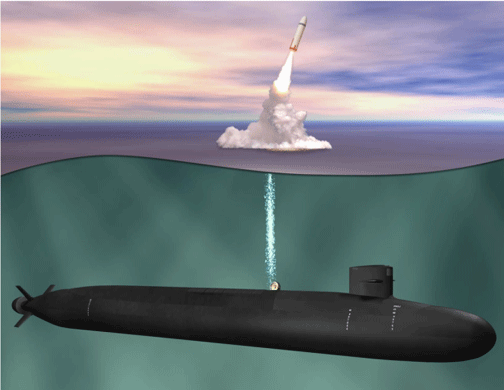
The name Trident refers to the nuclear missiles that are carried on four Vanguard-Class submarines. Based out of Faslane, on the Clyde in Scotland, at any one time, there is one submarine on active patrol, another in service, another preparing to patrol and a final one on exercise.
Each submarine can carry 16 Trident missiles (but since 2010 this has been reduced to eight), and each missile can hold 40 warheads.
The cost of replacing the Trident system with “Successor” (which is what the parliamentary debate on Monday is about) is disputed. The official Ministry of Defence (MoD) line is £41 bn per submarine. The Campaign for Nuclear Disarmament (CND) says the true cost is around £205 bn for all four, when you included the cost of their upkeep.
The mainstream arguments for and against Trident are fairly clear cut………
However, there are two arguments that both sides fail to acknowledge – maybe because if they did, it would bring the whole military industry into question. The role of multinational banks and senior UK politicians.
All aboard the Westminster gravy train
The main companies involved in Trident are US multinational Lockheed Martin (who produce the missiles), BAE Systems, Babcock & Wilcox and Rolls-Royce – who are involved in the Successor programme – and also names like Bechtel, Honeywell, Raytheon and Serco who are contracted or subcontracted in relation to the current Trident system.
According to the House of Lords register of interests, around 15% of sitting members are directors of, or shareholders in, companies that are either directly contracted to the Trident programme or invest in it.
Prominent names include Lord Hollick, a Labour Peer who is a director of Honeywell. Lord (William) Hague, chair of the Royal United Services Institute (RUSI). RUSI, who are supposedly impartial US and UK government defence advisors, are sponsored by Babcock, Lockheed Martin, Raytheon and Rolls-Royce.
But one of the most telling individuals is Labour’s Lord Hutton, defence secretary under Gordon Brown. He is an adviser to Bechtel, consultant for Lockheed Martin and chair of the Nuclear Industries Association (NIA). The revolving door (the phrase used to describe MP’s who, once finished in parliament, go into jobs related to their previous role) has never spun so quickly.
It may be no wonder then, that the majority of parliament (excluding the SNP and the Green party) are supportive of renewing Trident.
With reference to the role of multinational financial institutions, all the companies listed above, aside from being involved in Trident, share one other common denominator. They are all financed, or owned, by UK banks. Specifically Barclays and HSBC. A report by Don’t Bank on the Bomb details the involvement of major financial institutions in the western nuclear weapons industry. http://www.thecanary.co/2016/07/18/truth-trident-shocking-fact-turn-us-paying-nukes/
.The 15 most costly nuclear events
A Rethink of Nuclear Risk Assessment, ETH Zurich, Department of Management, Technology and Economics 11.07.2016
 “……..The 15 most costly nuclear events analysed by the team are:
1. Chernobyl, Ukraine (1986) – $259 billion
2. Fukushima, Japan (2011) – $166 billion
3. Tsuruga, Japan (1995) – $15.5 billion
4. TMI, Pennsylvania, USA (1979) – $11 billion
5. Beloyarsk, USSR (1977) – $3.5 billion
6. Sellafield, UK (1969) – $2.5 billion
7. Athens, Alabama, USA (1985) – $2.1 billion
8. Jaslovske Bohunice, Czechoslovakia (1977) – $2 billion
9. Sellafield, UK (1968) – $1.9 billion
10. Sellafield, UK (1971) – $1.3 billion
11. Plymouth, Massachusetts, USA (1986) – $1.2 billion
12. Chapelcross, UK (1967) – $1.1 billion
13. Chernobyl, Ukraine (1982) – $1.1 billion
14. Pickering, Canada (1983) – $1 billion
15. Sellafield, UK (1973) – $1 billion
An open-source database of all 216 analysed events is available athttps://innovwiki.ethz.ch/index.php/Nuclear_events_database, containing dates, locations, cost in US dollars, and official magnitude ratings. This is the largest public database of nuclear accidents ever compiled. https://www.mtec.ethz.ch/news/d-mtec-news/2016/07/a-rethink-of-nuclear-risk-assessment.html
Nuclear Risk Assessment – more dangerous than previously thought
 A Rethink of Nuclear Risk Assessment, ETH Zurich, Department of Management, Technology and Economics 11.07.2016 Prof. Didier Sornette and Dr Spencer Wheatley, D-MTEC and a researcher at the University of Sussex, England, have carried out the biggest-ever statistical analysis of historical nuclear accidents. It suggests that nuclear power is a currently underappreciated extreme risk and that major changes will be needed to prevent future disasters.
A team of risk experts at the University of Sussex, in England, and ETH Zurich, in Switzerland, have analysed more than 200 nuclear accidents, and – estimating and controlling for effects of industry responses to previous disasters – provide a grim assessment of the risk of nuclear power: The next disaster on the scale of Chernobyl or Fukushima may happen much sooner than the public realizes.
Their worrying conclusion is that, while nuclear accidents have substantially decreased in frequency, this has been accomplished by the suppression of moderate-to-large events. They estimate that Fukushima- and Chernobyl-scale disasters are still more likely than not once or twice per century, and that accidents on the scale of the 1979 meltdown at Three Mile Island in the USA (a damage cost of about 10 Billion USD) are more likely than not to occur every 10-20 years.
As Dr Spencer Wheatley, the lead author, explains: “We have found that the risk level for nuclear power is extremely high. Although we were able to detect the positive impact of the industry responses to accidents such as Three Mile Island and Chernobyl, these did not sufficiently remove the possibility of extreme disasters such as Fukushima. To remove such a possibility would likely require enormous changes to the current fleet of reactors, which is predominantly second-generation technology.”
The studies, published in two papers in the summer issues of the journalsEnergy Research & Social Science and Risk Analysis, put fresh pressure on the nuclear industry to be more transparent with data on incidents. The articles have also been picked up by popular media, e.g. very recently by the German “Spiegel Online” (in German).
“Flawed and woefully incomplete” public data from the nuclear industry is leading to an over-confident attitude to risk, the study warns. The research team points to the fact that their own independent analysis contains three times as much data as that provided publicly by the industry itself. This is probably because the International Atomic Energy Agency, which compiles the reports, has a dual role of regulating the sector and promoting it.
The research team for this new study gathered their data from reports, academic papers, press releases, public documents and newspaper articles. The result is a dataset that is unprecedented – being twice the size of the next largest independent analysis. Further, the authors emphasize that the dataset is an important resource that needs to be continually developed and shared with the public.
Professor Benjamin Sovacool of the Sussex Energy Group at the University of Sussex, who co-authored the studies, says: “Our results are sobering. They suggest that the standard methodology used by the International Atomic Energy Agency to predict accidents and incidents – particularly when focusing on consequences of extreme events – is problematic. The next nuclear accident may be much sooner or more severe than the public realizes.”
The team also calls for a fundamental rethink of how accidents are rated, arguing that the current method (the discrete seven-point INES scale) is highly imprecise, poorly defined, and often inconsistent.
In their new analysis, the research team provides a cost in US dollars for each incident, taking into account factors such as destruction of property, the cost of emergency response, environmental remediation, evacuation, fines, and insurance claims. And for each death, they added a cost of $6 million, which is the figure used by the US government to calculate the value of a human life.
That new analysis showed that the Fukushima accident in 2011 and the Chernobyl accident in 1986 cost a combined $425 billion – five times the sum of all the other events put together.
However, these two extremes are rated 7 – the maximum severity level – on the INES scale. Fukushima alone would need a score of between 10 and 11 to represent the true magnitude of consequences……..https://www.mtec.ethz.ch/news/d-mtec-news/2016/07/a-rethink-of-nuclear-risk-assessment.html
Montreal Protocol to be amended to phase out climate damaging hydrofluorocarbons
 The world is poised to take the strongest action of this year against climate change, WP, By Chris Mooney July 18 When the world moved to phase out ozone-destroying chlorofluorcarbons, or CFCs, it solved one enormous and urgent environmental problem — but it left behind another. CFCs were bad for the ozone layer and also caused a great deal of global warming to boot. But a key substitute — hydrofluorocarbons, or HFCs — spare the ozone layer but are still powerful greenhouse warming agents.
That’s why diplomats and leading national ministers have assembled in Vienna this week for negotiations under the Montreal Protocol, the treaty that led to the phaseout of CFCs and is now aiming its sights at HFCs. If an amendment to the treaty can be adopted this year, advocates say, it could represent the single largest tangible piece of climate progress in all of 2016.
[The Antarctic ozone hole has finally started to ‘heal,’ scientists report]
HFCs are used in refrigerants in car and home air conditioners, as well as in foams, solvents and other products. They are being used more and more — in large part because they are the heirs to the CFC phaseout — and when they get into the atmosphere, they are far more powerful than carbon dioxide at warming the planet.
According to the Institute for Governance and Sustainable Development, which focuses on the issue, the “most abundant and fastest growing” of these gases, HFC-134a, remains in the atmosphere for 13.4 years (not nearly as long as carbon dioxide) but causes 1,300 times as much warming as carbon dioxide does over a span of 100 years. One recent study noted that by 2050, if nothing is done, HFC-134a could add 9 to 19 percent to the warming caused by carbon dioxide.
For the broader group of HFCs, one recent study found that HFC emissions as a whole grew from 198 million tons (as measured in carbon-dioxide equivalents) in 2007, to 275 million tons by 2012.
“The HFCs effect now is very small. The problem with the HFCs is it’s the fastest-growing greenhouse gas,” said Veerabhadran Ramanathan, a climate scientist at the Scripps Institution of Oceanography. “So by banning HFCs, you prevent another disaster downstream. It could be as high as half to one degree [Celsius] by the end of the century.”
Data like these explain why diplomats and leading national ministers have assembled in Vienna this week for negotiations under the Montreal Protocol, the treaty that led to the phaseout of CFCs and is now aiming its sights at HFCs. And signs look positive that a phase-down amendment could happen this year, giving a key boost to climate-change momentum, said Durwood Zaelke, head of the Institute for Governance and Sustainable Development……….
Granted, an amendment to phase out HFCs is not expected to be formally adopted this month in Vienna. Rather, that is more likely to occur at a second meeting, in October, in Kigali, Rwanda, meeting observers say.
If it is successful, then when the parties to the U.N. Framework Convention on Climate Change meet in Marrakesh, Morocco, in November to start the process of putting the Paris agreement into action, they will be riding a wave of accomplishment and be able to think rather optimistically about the work before them. Doniger wrote recently that achieving an HFC phaseout would represent “the biggest climate protection achievement of 2016.”
“The ozone treaty has been effectively a climate treaty also,” he said in an interview. “So it can be another win for the climate from the treaty that saved the ozone layer.”
Read more at Energy & Environment:
The world’s clouds are in different places than they were 30 years ago
Scientists think they’ve just pinpointed the key driver of ice loss in Antarctica
The diversity of life across much of Earth has plunged below ‘safe’ levels https://www.washingtonpost.com/news/energy-environment/wp/2016/07/18/this-could-do-more-to-save-the-planet-this-year-than-any-other-action/
Illegal to use Trident nuclear missile, so it should be phased out
 Using Trident would be illegal, so let’s phase it out https://www.theguardian.com/commentisfree/2016/jul/15/trident-illegal-nuclear-britain-arsenal Geoffrey Robertson, 15 July 16
Nuclear doom is nearer than most of us believe, experts warn. Britain must set a moral lead by becoming the first of the ‘big five’ powers to reduce its arsenal The most portentous decision for every new prime minister is what to write in the secret “letter of last resort” to Trident submarine commanders telling them what to do with their nuclear missiles if the British government is wiped out. In Monday’s debate on the renewal of Trident, Theresa May should tell parliament what life-or-death decision she has made in her letters of last resort.
It is said that Margaret Thatcher ordered our nukes, trained on Moscow, to be fired so as to cause maximum destruction to the enemy – ie to its civilians. That order, even for a nuclear “second strike”, would today be illegal.
It is ironic that although Chilcot produced so much condemnation of Blair for joining an unlawful war, MPs are now being asked to vote for a weapons system that cannot be used without committing a crime against humanity. This was defined in 1998 by the Rome Statute, which set up the international criminal court, as “a systematic attack directed against a civilian population, resulting in extermination or torture, or an inhumane act intentionally causing great suffering”.
The same statute additionally makes it a war crime to intentionally launch an attack in the knowledge that it would cause incidental loss of civilian life or severe damage to the natural environment, out of proportion to military advantage.
Trident’s 200 thermonuclear bombs, each 10 times more powerful than those that struck Hiroshima and Nagasaki, are illegal because they cannot discriminate between military targets and hospitals, churches and schools; because of their capacity to cause untold human suffering for generations to come; and because their consequences (eg ionising radiation, which tortures victims and lingers for half a century) are beyond the control or knowledge of the attacker, who cannot judge the proportionality of their use.
As the international court of justice put it, back in 1996: “The destructive power of nuclear weapons cannot be contained in space or time. They have the potential to destroy all civilisation and the entire ecosystem of the planet.”
So why is our law-abiding government spending tens of billions on a weapons system that cannot lawfully be used?
First, because its advisers wrongly think that nuclear weapons are legal in certain circumstances. Back in that 1996 case, the UK argued that it could lawfully drop “a low-yield nuclear weapon against warships on the high seas or troops in sparsely populated areas”.
This scenario has now been shown up as fantastical: “first use” in these circumstances by the UK would trigger a nuclear reprisal with inevitable damage to the atmosphere, the oceans and the “sparsely populated” area (which would henceforth be entirely unpopulated). In any event, Trident’s weapon-bays will not carry “low-yield” bombs, and if they did the result would be better achieved by conventional weapons, making nuclear deployment unnecessary and disproportionate.
The world court ruled that the threat or use of nuclear weapons would “generally” be contrary to war law but might be lawful “in extreme circumstances of self-defence, in which the very survival of a state would be at stake”. This was a time-warped view of war law in 1996 that is not tenable today. The court, to be fair, predicted as much, saying that it expected international law to “develop” towards a total ban on the use of the bomb. It soon did, with the Rome Statute and subsequent development of the principle that a state has no right to preserve itself at the expense of damage to other states and to the rights to life of millions of citizens.
It is absurd to suggest that it would have been lawful for Hitler, his back to the bunker wall, to start a nuclear Götterdämmerung to save the Nazi state (Nuremberg decided it was not lawful for him even to fire doodlebugs). Given what we now know about the uncontrollable and devastating propensities of modern nuclear weapons, it is unlawful to fire them at all.
There is a further legal reason for allowing Trident to wear out. It is Article VI of the nuclear proliferation treaty (NPT), by which parties undertake to proceed in good faith to “general and complete” nuclear disarmament.
The world court’s 1996 ruling decided that this imposed not a “mere” obligation but a binding legal obligation on existing nuclear states to reduce the number of their bombs gradually, to zero. It is contrary to the spirit of article VI to upgrade rather than downgrade the fleet.
A decision to phase out Trident would help Britain recover some of the clout it has lost through Brexit. It would show moral leadership, and shame other nuclear powers that have failed to live up to their NPT obligations (especially the US; President Obama’s Nobel prize was prematurely awarded in part for envisaging “a world without nuclear weapons”).
Moral leadership from a nuclear-weapons state is urgently needed. The latest US defence budget allocates $1tn for future modernisation of its nukes and it has acquired new sites for them, in Poland and Romania. President Putin has promised in return a new generation of nuclear-tipped intercontinental ballistic missiles. The American most knowledgeable on the subject – Bill Clinton’s defence secretary William J Perry – has just published a book warning that “nuclear doom” is closer today than it ever was during the cold war.
Although possession of nuclear weapons is not per se unlawful, the UK is under a duty to reduce its arsenal: the vice of refurbishing Trident is that it encourages other states to do the same, and remains a constant stimulus for countries – particularly in the Middle East and Asia – to acquire arsenals of their own.
When negotiating to buy Polaris (Trident’s predecessor), back in 1962, Harold Macmillan confided in his diary that “the whole thing is ridiculous”, but consoled himself with the thought that “countries which have played a great role in history must retain their dignity”.
A half-century later, the best way for Britain to regain its dignity post-Brexit is not to throw vast sums of money away on a weapon that cannot lawfully be used, but rather to appear as the first of the “big five” powers to shoulder its legal obligation to disarm under article VI of the NPT. It will be many years before the mushroom cloud becomes a hallucination, but at least Britain would be able to boast that it had led the way.
The dodgy economics and doubtful future for Small Nuclear Reactors (SMRs)
 FOR GENERAL ATOMICS, SMALLER NUCLEAR PLANTS ARE BEAUTIFUL, San Diego Union Tribune But can its technology work? And is it even needed? BY ROB NIKOLEWSKI July 15, 2016 The scientists and engineers at General Atomics think the future of nuclear energy is coming on the back of a flatbed truck.
And the leadership at the San Diego-based company, which has been developing nuclear technologies for more than 60 years, has already spent millions in the expectation that its ambitious plans for the next generation of reactors will actually work.
“We have technology that we think is going to qualitatively change the game,” saidChristina Back, vice president of nuclear technologies and materials at General Atomics……..it’s designed to produce a reactor that’s so compact that the company’s handout material shows it being transported by tractor-trailer.
But EM² is still a long way from becoming a day-to-day reality in a fast-changing energy landscape.
Just building a prototype, Back said, is at least 10 years away and, “we’re looking at 2030-ish” before a commercial reactor could be up and running using EM² technology……And there are no guarantees the design will work……
Here in the United States, natural gas may pose an even greater challenge. Techniques such as hydraulic fracturing and horizontal drilling have unlocked vast amounts of natural gas in North America and the increased supply has lowered prices. Utilities are increasingly turning to natural gas-fired power plants to generate electricity, at least in large part, because gas burns much cleaner than coal.
Where does that leave nuclear?…….. nuclear has long faced intense opposition from those who consider it an inherently dangerous source of power and the EM² technology is being developed at a time when nuclear plants are getting shut down in places such as Illinois, Vermontand New York.
The environment for nuclear power in California is even more daunting……Critics of nuclear power point to the falling costs and rising production numbers for renewable energy, as well as a mandate from the California Public Utilities Commission ordering the state’s big three investor-owned utilities to add 1.3 gigawatts of energy storage to their grids by the end of the decade.
Teresa May and the nuclear “Letter of Last Resort.”
 The Grim Task Awaiting Theresa May: Preparing for Nuclear Armageddon In her first hours as Britain’s new prime minister, May will take part in a time-honored tradition: Handwriting what’s known as a “Letter of Last Resort.”Politico Magazine By Garrett M. Graff July 14, 2016 If tradition holds, in her first hours as the United Kingdom’s new prime minister, Theresa May will meet with the British defense leadership and receive an eye-opening briefing about the nation’s nuclear plans.
Sir Nicholas Houghton, the 61-year-old chief of the Defence Staff who is due to retire this month to become the constable of the Tower of London, will, as one of his final acts, walk Prime Minister May through the country’s nuclear plans and the damage that could result in the event of nuclear attack on her country.
Then, amidst the all the public pomp and circumstance of assuming her office and determining a course of action for the country following the world-changing “Brexit” vote, one of the first things May will be tasked with doing in her new office is perhaps the most grim duty of any head government official in the world: Handwriting what’s known as a “Letter of Last Resort”—the secret instructions, to be remain sealed until after Armageddon, about what the nation’s submarine commanders should do with the UK’s nuclear weapons, housed on their subs, if the country has been destroyed. Actually, she’ll write four of them—all identical—one to each sub commander in the U.K. fleet.
Throughout the Cold War, each nuclear power struggled to figure out how it would approach Armageddon. The Soviet Union ultimately built a rocket that could beam launch orders to Soviet silos even after the human chain of command had been destroyed, a “Dead Hand” machine ultimately uncovered by nuclear historian Bruce Blair in 1993 and made famous by journalist David Hoffman’s eponymous 2009 book. The United States, meanwhile, built a complex network of planes, trains, ships, communication networks and bunkers that could ensure control over the nation’s nuclear systems even amidst a devastating attack.
The British approached a nuclear holocaust differently, and in an appropriately British fashion. Rather than rely on high-tech gadgetry, their prime ministers handwrote “Letters of Last Resort,” and then locked those letters inside of a safe inside of another safe, and placed them in the control rooms of the nation’s nuclear submarines. The safes will only be accessible to the sub’s commander and deputy, who must decide together when Britain has been entirely destroyed.
Britain has long charted its own course when it comes to nuclear weapons, so much so that the secrets of one prime minister often surprise the next………
as the scale of nuclear devastation began to boggle the imagination, Britain faced a unique threat among the nuclear superpowers: Its comparatively tiny island—and its heavily concentrated population and government centers—could be easily obliterated by the power of later generations of atomic and hydrogen bombs. Whereas even a relatively large attack might have left much of the United States or the Soviet Union untouched and allow enough survivors to reconstitute the so-called “National Command Authority,” the military and civilian leaders who can order a nuclear launch, and plan a retaliatory strike, even a small-scale surprise attack from the Soviet Union would have likely destroyed all remnants of Whitehall and the British command chain. Plus, given its geographic proximity to the Soviet Union, Soviet subs, bombers and ICBMs could strike quickly, with little warning and little time to evacuate the nation’s leadership to protective bunkers readied in the English countryside.
And thus was born the tradition of the “Letter of Last Resort.”
It has become a moment when British leaders must wrestle personally with the awesome new responsibilities embodied in their nuclear control………
one might draw some clues from her legislative agenda in the weeks ahead: She’s said she’s eager to push ahead with replacing the aging Vanguard submarines, which will be obsolete in the middle of the next decade. Maintaining the nation’s nuclear deterrence will likely to cost north of $250 billion, but she’s said it’s critical to Britain’s international role post-Brexit. http://www.politico.com/magazine/story/2016/07/the-grim-task-awaiting-teresa-may-preparing-for-nuclear-armageddon-214049#ixzz4EQ4PMC9e
A nuclear-armed space plane for Russia?
 Russia Is Building a Nuclear Space Bomber, The Daily Beast, DAVID AXE, 14 JULY 16 Kremlin claims about a spacecraft that could fire weapons anywhere on Earth within two hours may have just kick-started a nuclear arms race in space. The Russian military claims it’s making progress on a space plane similar to the U.S. Air Force’s secretive X-37B robotic mini-shuttle.
That in itself isn’t terribly surprising or even, for the United States, particularly worrisome. Lots of governments and even private companies are working on space planesthat can launch from rockets or runways, boost into orbit for a period of time then return to Earth for quick refurbishment and re-use.
The tech is pretty basic. But alone among space-plane developers, the Kremlin is proposing to arm its space plane. With nukes. That’s not only a gross violation of international law, it represents a fairly profound act of hypocrisy on Russia’s part. It wasn’t long ago that the Russian government accused the United States of weaponizing space by sending aloft the nimble, versatile X-37B, basically a quarter-size, remote-controlled version of the Space Shuttle that could, in theory, carry weapons—but does not.
To be clear, a nuclear-armed space plane would be dangerously destabilizing, as it would totally upset the current, tenuous balance of power between the United States and Russia. The Pentagon could respond to a Russian orbital nuke bomber by quickly deploying a space bomber of its own. In other words, an atomic arms race… in space—a development no one should welcome.
Lt. Col. Aleksei Solodovnikov, a rocketry instructor at the Russian Strategic Missile Forces Academy in St. Petersburg who is overseeing the space plane’s development, said the orbital bomber would be flight-ready by 2020. It’s unclear how much money the Kremlin is investing in the project, and how serious senior officers are about actually deploying the space plane, if and when Solodovnikov and his team finish it.
In any event, the military space plane could give Russia a potentially history-altering nuclear first-strike capability.
“The idea is that the bomber will take off from a normal home airfield to patrol Russian airspace,” Solodovnikov said, according to Sputnik, a government-owned news site. “Upon command, it will ascend into outer space, strike a target with nuclear warheads and then return to its home base.”
Thanks to its orbital capability, the bomber would be able to nuke any target on Earth no longer than two hours after taking off, Solodovnikov claimed.
The Russian craft could be closer to Virgin’s family of reusable space planes—the experimental SpaceShipOne and the larger SpaceShipTwo, which is designed to carry paying tourists to the edge of space……..
In 1967, the United States and Russia and 102 other countries signed the Outer Space Treaty, which bans the explicit militarization of space. “States parties to the treaty undertake not to place in orbit around the Earth any objects carrying nuclear weapons or any other kinds of weapons of mass destruction, install such weapons on celestial bodies or station such weapons in outer space in any other manner,” the treaty reads.
Forty-nine years later, the United States, Russia, and China between them operate hundreds of military satellites. A few have inherently aggressive design features, such as the ability to maneuver close to other spacecraft and potentially disable them by way of extendable claw arms.
But none are solely and strictly offensive weapons. And certainly none pack city-destroying nuclear weapons that can rain down just an hour or so after the command is given. Earth’s surface teems with weaponry, but the world has, so far, managed to keep Earth’s orbit pretty much arms-free.
After the U.S. Air Force launched the X-37B—for scientific purposes, officials claimed—for the first time in April 2010, Russian experts accused the Americans of possibly sneaking a weapon into orbit. The X-37B could “strike global blows on surface targets,” warned Konstantin Sivkov from the Academy for Geopolitical Problems.…….
But the Kremlin’s space-bomber would be a weapon—unambiguously so—and would shatter a half-century of mostly-peaceful space exploration, undoubtedly sparking a terrible diplomatic row and potentially driving the United States and Russia closer to open conflict… on Earth’s surface. http://www.thedailybeast.com/articles/2016/07/14/russia-is-building-a-nuclear-space-bomber.html
Democratic Senators naming and blaming the funders of climate science denial
 US Senators detail a climate science “web of denial” but the impacts go well beyond their borders
Australians have been both helpers and victims of the fossil fuelled web of climate science denial being detailed in the U.S Senate, Guardian, Graham Readfearn, 12 July 16, By the middle of this week, about 20 Democratic Senators in the US will have stood up before their congress to talk about the fossil fuelled machinery of climate science denial.
The Senators are naming the fossil fuel funders, describing the machinery and calling out the characters that make up a “web of denial”.
“The web is so big, because it has so much to protect,” said the Rhode Island Senator Sheldon Whitehouse, who bookended the first evening of speeches.
The senate heard how fossil fuel companies such as ExxonMobil, Peabody Energy and the billionaire oil brothers Charles and David Koch had funnelled millions into groups that had spread doubt about the causes of climate change.
In a resolution also being tabled, the upper house will be asked to acknowledge that the fossil fuel industry had done just what the tobacco industry had done – “developed a sophisticated and deceitful campaign that funded think tanks and front groups, and paid public relations firms to deny, counter, and obfuscate peer-reviewed research” and “used that misinformation campaign to mislead the public and cast doubt in order to protect their financial interest.”
Groups like the Competitive Enterprise Institute (CEI), the Heartland Institute, the Committee for a Constructive Tomorrow and many, many others are under scrutiny for the way they have attacked the science linking fossil fuel burning to climate change while accepting cash from fossil fuel interests.
Whitehouse also took time to describe the large body of work in peer-reviewed journals that have examined the funding, the networks and the tactics of organised climate science denial. Climate science denial is itself a live area of academic research.
But the impact of climate science denial – the decades of policy delays, the confusion among the general public and the deliberate politicization of the science – does not stop at the US border. Continue reading
Record 9 hottest years in a row
 We just broke the record for hottest year, nine straight times http://www.skepticalscience.com/broke-hottest-year-record-9-straight-times.html 11 July 2016 by dana1981
2014 and 2015 each set the record for hottest calendar year since we began measuringsurface temperatures over 150 years ago, and 2016 is almost certain to break the record once again. It will be without precedent: the first time that we’ve seen three consecutive record-breaking hot years.
But it’s just happenstance that the calendar year begins in January, and so it’s also informative to compare all yearlong periods. In doing so, it becomes clear that we’re living in astonishingly hot times.
June 2015 through May 2016 was the hottest 12-month period on record. That was also true of May 2015 through April 2016, and the 12 months ending in March 2016. In fact, it’s true for every 12 months going all the way back to the period ending in September 2015, according to global surface temperature data compiled by Kevin Cowtan and Robert Way. We just set the record for hottest year in each of the past 9 months.
These record temperatures have been assisted by a very strong El Niño event, which brought warm water to the ocean surface, temporarily warming global surface temperatures. But today’s temperatures are only record-setting because the El Niño was superimposed on top of human-caused global warming.
For comparison, 1997–1998 saw a very similar monster El Niño event. And similarly, the 12-month hottest temperature record was set in each month from October 1997 through August 1998. That was likewise a case of El Niño and global warming teaming up to shatter previous temperature records.
The difference is that while September 1997–August 1998 was the hottest 12-month period on record at the time; it’s now in 60th place. It’s been surpassed by yearlong periods in 2005, 2006, 2007, 2009, 2010, 2014, 2015, and 2016. Many of those years weren’t even aided by El Niño events; unassisted global warming made them hotter than 1998.
Global surface temperatures are now more than 0.3°C hotter than they were in 1997–1998. That’s a remarkable rise over just 18 years, in comparison to the 1°C the Earth’s average surface temperatures have risen since the Industrial Revolution began.
This has all happened during a time when ‘no significant warming in 18 years’ has been one of the rallying cries of climate denial. In reality, when we compare apples to apples – El Niño years to El Niño years – we’ve seen more than 0.3°C global surface warming over the past 18 years, which is in line with climate model predictions. ‘Climate models are wrong’ has been another now-debunked climate denial rallying cry.
Now that the past year’s El Niño event is over, the streak of record-breaking yearlong periods appears to have ended. Nevertheless, 2016 remains on track to break that record for the hottest calendar year, for an unprecedented third consecutive year, following record years in 2010 and 2005 as well.
With the Earth warming dangerously rapidly, at a rate 20–50 times faster than the fastest rate of natural global warming, one can’t help but wonder when the influence of the small minority of disproportionately powerful climate denial groups will wane.
195 countries pledged to curb their carbon pollution in the tremendously successful Parisclimate negotiations, but climate denial is still predominant in one of America’s two political parties, and may be gaining foothold in other regions of the Anglosphere like the UK and Australia. Fortunately, many other countries like China, India, and Canada seem to be moving in the right direction with their climate and energy policies.
America’s major taxpayer liability – the Department of Energy
 How the Department of Energy became a major taxpayer liability http://www.cnbc.com/2016/07/05/how-the-department-of-energy-became-a-major-taxpayer-liability.html Mark Fahey | @marktfahey Wednesday, 6 Jul 2016 If you were to guess which government agency has had to pay out the most in court in recent years, the Department of Energy probably wouldn’t come to mind.
And according to the department itself, the bloodletting as far from over. The DOE has failed to make good on some of its most important contractual obligations for years, and its private partners have been collecting billions in damages.
The Nuclear Waste Policy Act of 1982 requires that the DOE dispose of nuclear waste being produced at civilian energy plants around the country, which in turn pay fees for a long-term storage facility. The department’s contracts with dozens of energy companies said it would start disposing of the waste in 1998.
The companies held up their end, feeding about $750 million into the Nuclear Waste Fund each year. But the department did not manage to set up any facility to receive the waste, forcing energy companies to store it themselves on-site.
All those partial breaches of contract haven’t come cheap. As of the end of 2015, the DOE has paid $5.3 billion for failing to fulfill its obligations, and even if it manages to start disposing of waste in the next 10 years, it could still be on the hook for nearly $24 billion in additional liability.
“Because the United States has no facility available to receive spent nuclear fuel (SNF) and high-level radioactive waste (HLW) under the Nuclear Waste Policy Act, it has been unable to begin disposal of SNF from utilities as required by the standard contract with utilities,” said a DOE spokesperson in an email. “Significant litigation claiming damages for partial breach of contract has ensued as a result of this delay.”
At the end of 2015, the DOE had settled 35 lawsuits and resolved 33 with judgments, with 19 cases pending, according to the Congressional Budget Office. A court ruling halted the collection of storage fees in 2014, but energy companies are still seeking to recoup the money they’re spending every year on waste storage. Even after settlements for back pay are reached, the department is usually required to reimburse those costs going forward.
The hang-up has been in finding a location for the centralized storage facility. For decades, Yucca Mountain in Nevada was the only location that could legally be considered, despite fierce opposition from state and local groups. The Obama administration eventually abandoned the site as “unworkable” in 2011.
At the recommendation of the administration’s Blue Ribbon Commission (BRC), the department is now pursuing a “consent-based” approach, meaning that the DOE will seek the approval of relevant communities before construction, rather than trying to force all of the country’s spent nuclear waste on a pre-decided site in Nevada.
“The administration concurs with the conclusion of the BRC that a fundamental flaw of the 1987 amendments to the NWPA was the imposition of a site for characterization,” wrote then-Energy Secretary Steven Chu in the department’s most recent guiding strategy document from January 2013. “In practical terms, this means encouraging communities to volunteer to be considered to host a nuclear waste management facility.”
The DOE plans to have a pilot interim storage facility by 2021, initially to accept waste from reactor sites that were shut down years ago. Limiting the government’s massive liabilities is a major focus of the department’s strategy, according to the document.
The question isn’t whether the DOE will continue to have to pay out an exorbitant amount of money, but just how exorbitant that sum will end up being. The department itself projects that its total liabilities based on previous payouts will ultimately come to $29 billion in 2015 dollars, but that’s assuming it manages to start accepting waste in the next decade.
Neither the Department of Energy nor the Department of Justice could provide a list of related judgments and settlements so far, and the DOE said an updated liability estimate will not be available until its fiscal 2016 financial report comes out later this year.
“The department is currently developing a consent-based siting process for storage and disposal of SNF [spent nuclear fuel] and HLW [high-level radioactive waste],” said the department spokesperson. “Since January, DOE has held a series of public meetings and received feedback on how best to develop this process.”
The energy industry does not seem optimistic about a quick solution. According to the Nuclear Energy Institute, the department’s total liabilities could stretch to more than $50 billion. But that’s a more pessimistic figure that assumes a “total default” by the DOE.
The DOE’s own documentation for the Yucca Mountain project forecasts that if it failed completely and waste had to stay at the current sites indefinitely, it would cost between $75 billion and $82 billion in 2015 dollars over the first 100 years (including the cost of decommissioning Yucca).
Jay Silberg, a prominent energy industry attorney, said his estimate for total liability is closer to the $50 billion figure.
“I think that number is going to bear out, because I unfortunately don’t have much faith that the government will do what they promised to do in 1982,” said Silberg. “We all hope they can get their act together, but whether that will actually happen and whether it will be at large enough scale to remove the fuel piled up on these sites, I don’t have a lot of confidence in that.”
Things are crook, very crook, for the uranium industry
Uranium spot prices descend beyond decade low
The descending uranium price has put global producers under pressure. by Tess Ingram Uranium spot prices are still likely to stage a rapid recovery on the back of improving demand, industry analysts and executives argue, despite a persistent supply glut driving prices to a largely unanticipated 11-year low.

Spot prices for uranium oxide, which is used mainly as fuel for nuclear reactors, crept below $US27 ($36) a pound in June for the first time since mid-2005.
The current levels are lower than when prices were sent spiralling after the Fukushima nuclear disaster. After hitting over $US130 a pound in 2007, prices had stabilised to about $US70 a pound at the beginning of 2011 before Fukushima sent them gradually declining to a low of $US28 a pound in May 2014. Prices increased in 2015 but have since slumped about 21 per cent year-to-date.
Argonaut analyst Matthew Keane said prices had persisted “a lot lower than a lot of people expected” and forecasts for the timing of an anticipated supply deficit needed to improve prices “keep getting kicked along”.
“We just haven’t got the reactors online and even though the Chinese build program is very aggressive, we haven’t caught up and really sucked away the inventory yet,” Mr Keane said. “The US and Europe are still sitting on adequate stockpiles.”…… http://www.afr.com/business/mining/uranium/uranium-spot-prices-descend-beyond-decade-low-20160705-gpyupv
Nuclear bomb tests on Bikini Atoll – the 70th anniversary
 70th Anniversary of Operation Crossroads Atomic Tests in Bikini Atoll, July 1946
EXCELLENT VIDEOS and PHOTOS, National Security Archive Government Films and Photographs Depict Test “Able” on 1 July 1946

Removal of 167 Bikinians from the Atoll Preceded the Atomic Tests
National Security Archive Electronic Briefing Book No. 553 July 1, 2016 Edited by William Burr with Stav Geffner For more iThe Atomic Tests at Bikini Atoll, July 1946nformation contact: William Burr at 202/994-7000 or nsarchiv@gwu.edu.
The Atomic Tests at Bikini Atoll, July 1946 Washington, D.C., July 1, 2016 – Seventy years ago this month a joint U.S Army-Navy task force staged two atomic weapons tests at Bikini atoll in the Marshall Islands, the first atomic explosions since the bombings of Japan in August 1945. Worried about its survival in an atomic war, the Navy sought the tests in order to measure the effects of atomic explosions on warships and other military targets. The test series was named Operation Crossroads by the task force’s director, Rear Admiral William Blandy. The first test, Able, took place on 1 July 1946. Of the two tests, the second, Baker, on 25 July 1946, was the most dangerous and spectacular, producing iconic images of nuclear explosions. A third test was scheduled, but canceled. Photographs and videos posted today by the National Security Archive document Crossroads, focusing on the Able test.
Also documented is the U.S. Navy’s removal, in early March 1946, of 167 Pacific islanders from Bikini, their ancestral home, so that the Navy and the Army could prepare for the tests. The Bikinians had the impression that the relocation would be temporary but the islands remain uninhabitable due to subsequent nuclear testing in the atoll……….
Video gallery
New radiation guidelines for U.S. Environmental Protection Agency would endanger public health
 How much radiation is OK in an emergency? By Rebecca Moss The New Mexican, 19 June 16
New guidelines proposed by the U.S. Environmental Protection Agency would significantly increase the amount of radiation that people can ingest in the days and years following a radiological accident — levels far higher than existing limits set by the Safe Drinking Water Act of 1974.
Watchdog groups, academics and even some EPA officials worry the change could severely compromise public health. The agency’s proposal, released in early June and open for public comment until July 25, suggests a two-tiered system to advise the public when water is too dangerous for consumption after a radiological release — an event ranging from an accident at a nuclear power plant, such as the 1979 reactor meltdown at the Three Mile Island plant in Pennsylvania, to a roadside spill of Cold War-era transuranic waste from Los Alamos to a deliberate act of terrorism. The agency has capped the proposed limits at 500 millirems per year for people over 15, and no more than 100 millirems for younger children, the elderly, and pregnant or nursing women.
The new emergency guidelines are at least 25 times higher than the current guidelines, which cap public consumption of radiation at 4 millirems per year. Opponents of the proposal say it will allow radiation exposure equivalent to 250 chest X-rays each year without medical need or consent……
The EPA proposal has significant ramifications for New Mexico, home to two nuclear weapons research laboratories and the nation’s only permanent underground repository for radioactive waste, all of which were built near underground aquifers.
New Mexico’s highways pose concerns under the new EPA proposal because truck transportation of nuclear waste to the Waste Isolation Pilot Plant near Carlsbad will resume if the now-shuttered underground storage facility reopens, as planned, by the year’s end. When operations restart at the waste site, which has been closed since a radiation leak in February 2014, U.S. 62-180, Interstate 25, Interstate 40 and U.S. 285 would once again be used to transport nuclear waste to WIPP from Los Alamos, as well as from out-of-state defense sites.
In the first decade of the waste plant’s opening, at least 900 trucks carrying transuranic waste traveled those roads to reach the Carlsbad facility. The New Mexico Environment Department documented 29 accidents between 2002 and 2013, though none led to a spill.
Proposals by the U.S. Energy Department show the federal government also plans to store some foreign plutonium at WIPP, after the material has been processed at a facility in South Carolina. Continue reading
1 This Month



26 September – International Day for the Total Elimination of Nuclear Weapons


PLEASE OPPOSE HR 8255 AND S.3639 – bills would accelerate satellite deployment, with no environmental review or safeguards – https://ncstd5li.quorum.us/campaign/169331/
To see nuclear-related stories in greater depth and intensity – go to https://nuclearinformation.wordpress.com
-
Archives
- September 2026 (233)
- August 2026 (330)
- July 2026 (355)
- June 2026 (287)
- May 2026 (306)
- April 2026 (356)
- March 2026 (251)
- February 2026 (267)
- January 2026 (308)
- December 2025 (358)
- November 2025 (359)
- October 2025 (375)
-
Categories
- 1
- 1 NUCLEAR ISSUES
- business and costs
- climate change
- culture and arts
- ENERGY
- environment
- health
- history
- indigenous issues
- Legal
- marketing of nuclear
- media
- opposition to nuclear
- PERSONAL STORIES
- politics
- politics international
- Religion and ethics
- safety
- secrets,lies and civil liberties
- spinbuster
- technology
- Uranium
- wastes
- weapons and war
- Women
- 2 WORLD
- ACTION
- AFRICA
- Atrocities
- AUSTRALIA
- Christina's notes
- Christina's themes
- culture and arts
- Events
- Fuk 2022
- Fuk 2023
- Fukushima 2017
- Fukushima 2018
- fukushima 2019
- Fukushima 2020
- Fukushima 2021
- general
- global warming
- Humour (God we need it)
- Nuclear
- RARE EARTHS
- Reference
- resources – print
- Resources -audiovicual
- Weekly Newsletter
- World
- World Nuclear
- YouTube
-
RSS
Entries RSS
Comments RSS
 nuclear-news