Finland failed to be transparent on nuclear waste burial, unlike Sweden
The foremost reason is that as the project was being discussed with the public, SKB’s research was found to be incomplete and, in certain cases, inaccurate.
When, in 2011, Sweden’s SKB first applied for a license to build the Forsmark repository, the KBS-3 project documentation was published, which made it possible to give the project a review that would be independent from the nuclear industry’s own evaluation.
In February 2016, a special expert group appointed by the government, called the Swedish National Council for Nuclear Waste (Kärnavfallsrådet), published a 167-page report entitled “Nuclear Waste State-of-the-Art Report 2016: Risks, uncertainties and future challenges.” Among other things, it identifies the repository project’s risks and uncertainties having to do with earthquake impacts, with the long-term prospects of financing and monitoring the site’s condition, and with the health effects of low doses of radiation.
Finland has no such expert body. The concept of the repository, under construction in Euroajoki municipality, is criticized by many Finnish scientists, but the government is not taking notice and is likewise ignoring the scientific objections coming from its neighbor Sweden.

 When haste makes risky waste: Public involvement in radioactive and nuclear waste management in Sweden and Finland – How did it happen that in Sweden, the country that developed the technology for deep geological disposal of radioactive waste, construction of a such a repository – a first of its kind in the world – has been suspended for recognized risks and uncertainties, whereas Finland, which has copied the Swedish approach, is moving full speed ahead with building one? Bellona has looked for the answer on a fact-finding visit of the two countries. Bellona August 9, 2016 by Andrei Ozharovsky, translated by Maria Kaminskaya
“……..Out of sight, out of mind?
The deep geological disposal concept was first suggested over 40 years ago to solve the problem of spent nuclear fuel, the nuclear industry’s most dangerous byproduct. To a certain degree, this was a continuation of the “bury and forget about it” principle, applied to the less radioactive and thus less dangerous waste – radioactive waste. But where radioactive waste could be placed in shallow trench-type reservoirs or semi-buried near-surface concrete vaults, for nuclear waste, disposal facilities – repositories or burial sites – were proposed for construction in rock formations at a depth of several hundred meters. To date, no such deep geological repository has been created anywhere in the world. Continue reading
The affection of the central nervous system by incorporated radionuclides Cs-137
It has been known for a long time, and without a doubt, that even low levels of radiation in our food or water can have disastrous effects, even at levels of say 30 or 40 Bq/kG of consumed food.


And here is the study itself.
http://chernobyl-today.org/images/stories/bandazhevsky_lelevich_1995.pdf
The Military Industrial Complex – death merchant of the world
 “We are the death merchant of the world”: Ex-Bush official Lawrence Wilkerson condemns military-industrial complex http://www.salon.com/2016/03/29/we_are_the_death_merchant_of_the_world_ex_bush_official_lawrence_wilkerson_condemns_military_industrial_complex/ The military-industrial complex “is much more pernicious than Eisenhower ever thought,” says the retired US colonel BEN NORTON Col. Lawrence Wilkerson is tired of “the corporate interests that we go abroad to slay monsters for.”
“I think Smedley Butler was onto something,” explained Lawrence Wilkerson, in an extended interview with Salon.
In his day, in the early 20th century, Butler was the highest ranked and most honored official in the history of the U.S. Marine Corps. He helped lead wars throughout the world over a series of decades, before later becoming a vociferous opponent of American imperialism, declaring “war is a racket.”
Wilkerson spoke highly of Butler, referencing the late general’s famous quote: “Looking back on it, I might have given Al Capone a few hints. The best he could do was to operate his racket in three districts. I operated on three continents.”
“I think the problem that Smedley identified, quite eloquently actually,” Wilkerson said, “especially for a Marine — I had to say that as a soldier,” the retired Army colonel added with a laugh; “I think the problem is much deeper and more profound today, and much more subtle and sophisticated.”
Today, the military-industrial complex “is much more pernicious than Eisenhower ever thought it would be,” Wilkerson warned. In his farewell address in 1961, former President Dwight D. Eisenhower famously cautioned Americans that the military and corporate interests were increasingly working together, contrary to the best interests of the citizenry. He called this phenomenon the military-industrial complex.
As a case study of how the contemporary military-industrial complex works, Wilkerson pointed to leading weapons corporations like Lockheed Martin, and their work with draconian, repressive Western-allied regimes in the Gulf, or in inflaming tensions in Korea.
“Was Bill Clinton’s expansion of NATO — after George H. W. Bush and [his Secretary of State] James Baker had assured Gorbachev and then Yeltsin that we wouldn’t go an inch further east — was this for Lockheed Martin, and Raytheon, and Boeing, and others, to increase their network of potential weapon sales?” Wilkerson asked.
“You bet it was,” he answered.
“Is there a penchant on behalf of the Congress to bless the use of force more often than not because of the constituencies they have and the money they get from the defense contractors?” Wilkerson continued.
Again, he answered his own question: “You bet.”
“It’s not like Dick Cheney or someone like that went and said let’s have a war because we want to make money for Halliburton, but it is a pernicious on decision-making,” the former Bush official explained. “And the fact that they donate so much money to congressional elections and to PACs and so forth is another pernicious influence.”
“Those who deny this are just being utterly naive, or they are complicit too,” Wilkerson added.
“And some of my best friends work for Lockheed Martin,” along with Raytheon, Boeing and Halliburton, he quipped.
Wilkerson — who in the same interview with Salon defended Edward Snowden, saying the whistle-blower performed an important service and did not endanger U.S. national security — was also intensely critical of the growing movement to “privatize public functions, like prisons.”
“I fault us Republicans for this majorly,” he confessed — although a good many prominent Democrats have also jumped on the neoliberal bandwagon. In a 2011 speech, for instance, Secretary of State Hillary Clinton declared, “It’s time for the United States to start thinking of Iraq as a business opportunity” for U.S. corporations.
Wilkerson lamented, “We’ve privatized the ultimate public function: war.”
“In many respects it is now private interests that benefit most from our use of military force,” he continued. “Whether it’s private security contractors, that are still all over Iraq or Afghanistan, or it’s the bigger-known defense contractors, like the number one in the world, Lockheed Martin.”
Journalist Antony Loewenstein detailed how the U.S. privatized its wars in Iraq and Afghanistan in another interview with Salon. There are an estimated 30,000 military contractors working for the Pentagon in Afghanistan today; they outnumber U.S. troops three-to-one. Thousands more are in Iraq.
Lockheed Martin simply “plans to sell every aspect of missile defense that it can,” regardless of whether it is needed, Wilkerson said. And what is best to maximize corporate interest is by no means necessarily the same as what is best for average citizens.
“We dwarf the Russians or anyone else who sells weapons in the world,” the retired Army colonel continued.
“We are the death merchant of the world.”
Economic and Public Health Impacts of Fukushima nuclear situation
 Fukushima: A Nuclear War Without A War: The Unspoken Crisis Of Worldwide Nuclear Radiation Fukushima Watch 1 Aug 16 “………Public Health Disaster. Economic Impacts What prevails is a well organized camouflage. The public health disaster in Japan, the contamination of water, agricultural land and the food chain, not to mention the broader economic and social implications, have neither been fully acknowledged nor addressed in a comprehensive and meaningful fashion by the Japanese authorities.
Japan as a nation state has been destroyed. Its landmass and territorial waters are contaminated. Part of the country is uninhabitable. High levels of radiation have been recorded in the Tokyo metropolitan area, which has a population of 39 million (2010) (more than the population of Canada, circa 34 million (2010)) There are indications that the food chain is contaminated throughout Japan:
Radioactive cesium exceeding the legal limit was detected in tea made in a factory in Shizuoka City, more than 300 kilometers away from the Fukushima Daiichi nuclear power plant. Shizuoka Prefecture is one of the most famous tea producing areas in Japan.
A tea distributor in Tokyo reported to the prefecture that it detected high levels of radioactivity in the tea shipped from the city. The prefecture ordered the factory to refrain from shipping out the product. After the accident at the Fukushima nuclear power plant, radioactive contamination of tea leaves and processed tea has been found over a wide area around Tokyo. (See 5 More Companies Detect Radiation In Their Tea Above Legal Limits Over 300 KM From Fukushima, June 15, 2011)
Japan’s industrial and manufacturing base is prostrate. Japan is no longer a leading industrial power. The country’s exports have plummeted. The Tokyo government has announced its first trade deficit since 1980.
While the business media has narrowly centered on the impacts of power outages and energy shortages on the pace of productive activity, the broader issue pertaining to the outright radioactive contamination of the country’s infrastructure and industrial base is a “scientific taboo” (i.e the radiation of industrial plants, machinery and equipment, buildings, roads, etc). A report released in January 2012 points to the nuclear contamination of building materials used in the construction industry, in cluding roads and residential buildings throughout Japan.(See FUKUSHIMA: Radioactive Houses and Roads in Japan. Radioactive Building Materials Sold to over 200 Construction Companies, January 2012)
A “coverup report” by the Ministry of Economy, Trade and Industry (May 2011), entitled “Economic Impact of the Great East Japan Earthquake and Current Status of Recovery“ presents “Economic Recovery” as a fait accompli. It also brushes aside the issue of radiation. The impacts of nuclear radiation on the work force and the country’s industrial base are not mentioned. The report states that the distance between Tokyo -Fukushima Dai-ichi is of the order of 230 km (about 144 miles) and that the levels of radiation in Tokyo are lower than in Hong Kong and New York City.(Ministry of Economy, Trade and Industry, Impact of the Great East Japan Earthquake and Current Status of Recovery, p.15). This statement is made without corroborating evidence and in overt contradiction with independent radiation readings in Tokyo (se map below). In recent developments, Sohgo Security Services Co. is launching a lucrative “radiation measurement service targeting households in Tokyo and four surrounding prefectures”.
“A map of citizens’ measured radiation levels shows radioactivity is distributed in a complex pattern reflecting the mountainous terrain and the shifting winds across a broad area of Japan north of Tokyo which is in the center of the of bottom of the map.”
“Radiation limits begin to be exceeded at just above 0.1 microsieverts/ hour blue. Red is about fifty times the civilian radiation limit at 5.0 microsieverts/hour. Because children are much more sensitive than adults, these results are a great concern for parents of young children in potentially affected areas.”
The fundamental question is whether the vast array of industrial goods and components “Made in Japan” — including hi tech components, machinery, electronics, motor vehicles, etc — and exported Worldwide are contaminated? Were this to be the case, the entire East and Southeast Asian industrial base –which depends heavily on Japanese components and industrial technology– would be affected. The potential impacts on international trade would be farreaching. In this regard, in January, Russian officials confiscated irradiated Japanese automobiles and autoparts in the port of Vladivostok for sale in the Russian Federation. Needless to say, incidents of this nature in a global competitive environment, could lead to the demise of the Japanese automobile industry which is already in crisis.
While most of the automotive industry is in central Japan, Nissan’s engine factory in Iwaki city is 42 km from the Fukushima Daiichi plant. Is the Nissan work force affected? Is the engine plant contaminated? The plant is within about 10 to 20 km of the government’s “evacuation zone” from which some 200,000 people were evacuated……….. http://fukushimawatch.com/2016-07-21-fukushima-a-nuclear-war-without-a-war-the-unspoken-crisis-of-worldwide-nuclear-radiation.html
State of the Climate Report documents shattering of environmental records
“Looking at a range of climate measurements, 2015 was yet another highly significant year,” she said. “Not only was 2015 the warmest year on record by a large margin, it was also another year when the levels of dominant greenhouse gases reached new peaks.”
The state of the climate report is now in its 26th year. The peer-reviewed series is published annually by the American Meteorological Society.
Environmental records shattered as climate change ‘plays out before us’ https://www.theguardian.com/environment/2016/aug/02/environment-climate-change-records-broken-international-report
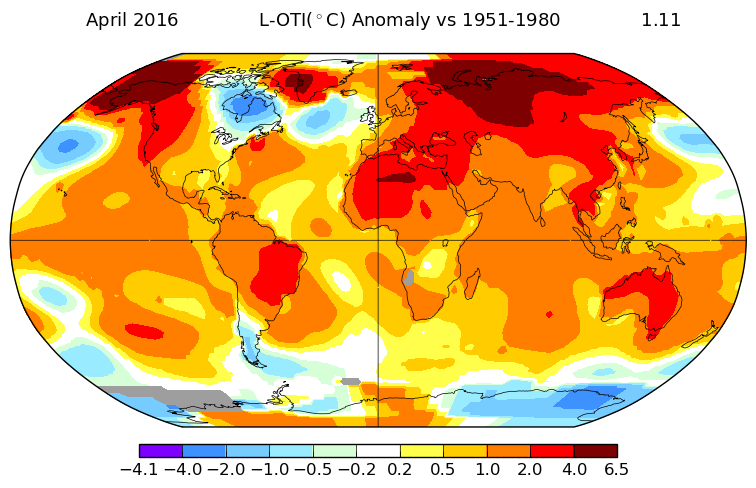
Temperatures, sea levels and carbon dioxide all hit milestones amid extreme weather in 2015, major international ‘state of the climate’ report finds, Oliver Milman , 3 Aug 16, The world is careening towards an environment never experienced before by humans, with the temperature of the air and oceans breaking records, sea levels reaching historic highs and carbon dioxide surpassing a key milestone, a major international report has found.
The “state of the climate” report, led by the National Oceanic and Atmospheric Administration (Noaa) with input from hundreds of scientists from 62 countries, confirmed there was a “toppling of several symbolic mileposts” in heat, sea level rise and extreme weather in 2015.
“The impacts of climate change are no longer subtle,” Michael Mann, a leading climatologist at Penn State, told the Guardian. “They are playing out before us, in real time. The 2015 numbers drive that home.”
Last year was the warmest on record, with the annual surface temperature beating the previous mark set in 2014 by 0.1C. This means that the world is now 1C warmer than it was in pre-industrial times, largely due to a huge escalation in the production of greenhouse gases. The UN has already said that 2016 is highly likely to break the annual record again, after 14 straight months of extreme heat aided by a hefty El Niño climatic event, a weather event that typically raises temperatures around the world.
The oceans, which absorb more than 90% of the extra CO2 pumped into the atmosphere, also reached a new record temperature, with sharp spikes in the El Niño-dominated eastern Pacific, which was 2C warmer than the long-term average, and the Arctic, where the temperature in August hit a dizzying 8C above average.
The thermal expansion of the oceans, compounded by melting glaciers, resulted in the highest global sea level on record in 2015. The oceans are around 70mm higher than the 1993 average, which is when comprehensive satellite measurements of sea levels began. The seas are rising at an average rate of 3.3mm a year, with the western Pacific and Indian Oceans experiencing the fastest increases.
These changes are being driven by a CO2 concentration that surpassed the symbolic 400 parts per million mark at the Mauna Loa research station in Hawaii last year. The Noaa report states that the global CO2 level was a touch under this, at 399.4ppm, an increase of 2.2ppm compared to 2014.
Noaa said other “remarkable” changes in 2015 include the Arctic’s lowest maximum sea ice extent in the 37-year satellite record, recorded in February 2015. The world’s alpine glaciers recorded a net annual loss of ice for the 36th consecutive year and the Greenland ice sheet, which would balloon sea levels by around 7m should it disintegrate, experienced melting over more than 50% of its surface.
The rapid changes in the climate may have profound consequences for humans and other species. In June last year, a severe heatwave claimed over 1,000 lives in Karachi, Pakistan. Severe drought caused food shortages for millions of people in Ethiopia, with a lack of rainfall resulting in “intense and widespread” forest fires in Indonesia that belched out a vast quantity of greenhouse gas.
Diminishing sea ice is causing major walrus herds to haul themselves out on to land. Arctic marine species, such as snailfish and polar cod, are being pushed out of the region by species coming from further south, attracted to the warming waters. A huge algal bloom off the west coast of North America harmed marine life and fisheries.
Scientists have said there were underlying climate change trends at play but last year was also influenced by the strong El Niño event, which is when equatorial Pacific waters warm, leading to an array of weather effects around the world. El Niño has also helped spur searing heat in 2016 but has now petered out.
Thomas Karl, director of Noaa national centers for environmental information, said that last year’s climate “was shaped both by long-term change and an El Niño event. When we think about being climate resilient, both of these time scales are important to consider.
“Last year’s El Niño was a clear reminder of how short-term events can amplify the relative influence and impacts stemming from longer-term warming trends.”
Kate Willett, a senior scientist at Britain’s Met Office, said that there was a 75% annual increase in the amount of land that experienced severe drought last year.
“Looking at a range of climate measurements, 2015 was yet another highly significant year,” she said. “Not only was 2015 the warmest year on record by a large margin, it was also another year when the levels of dominant greenhouse gases reached new peaks.”
The state of the climate report is now in its 26th year. The peer-reviewed series is published annually by the American Meteorological Society.
Integral Fast Reactors (IFRs) NOT the nuclear solution that its fans claim it to be
 NuClear News August 16 Integral Fast Reactors (IFRs) George Monbiot told the Radio 4’s Today Programme on the 29th July that the “humungous waste problem at Sellafield could be turned into a humungous asset by using a technology such as Integral Fast Reactors (IFR) to turn it into an energy source.” He said “it gets rid of the waste, and according to one estimate could provide all the UK’s energy needs for 500 years.” He said that instead of wasting our money on Hinkley Point C Government should invest in the development of IFRs to “see if we can use it to crack two problems at once – our nuclear waste mountain [and] create a massive source of low carbon energy”. The only problem is, as Professor Catherine Mitchell just had time to point out, it wouldn’t work. To claim that they are proliferation resistant and help “use up waste” is just plain wrong.
The IFR would be a liquid-sodium-cooled fast-neutron reactor. The use of liquid sodium as a coolant has proved to be a huge problem in the past – it catches fire on contact with air. Over the years the world’s leading nuclear technologists have built about three dozen sodium-cooled fast reactors. Of the 22 whose histories are mostly reported, over half had sodium leaks, four suffered fuel damage (including two partial meltdowns), several others had serious accidents, most were prematurely closed, and only six succeeded. As Dr. Tom Cochran of NRDC notes, fast reactor programs were tried in the US, UK, France, Germany, Italy, Japan, the USSR, and the US and Soviet Navies. All failed. After a half-century and tens of billions of dollars, the world has one operational commercial-sized fast reactor (Russia’s BN600) out of 438 commercial power reactors, and it’s not fuelled with plutonium.
IFRs would require an ambitious new nuclear fuel cycle because they would be fuelled with a metallic alloy of uranium and plutonium. In theory they would operate in conjunction with onsite ‘pyroprocessing’ to separate plutonium and other long-lived radioisotopes. Unlike the reprocessing plants currently at Sellafield they wouldn’t separate pure plutonium, but would keep the plutonium mixed with other long-lived radioisotopes.
Its novel technology, replacing solvents and aqueous chemistry of current reprocessing with high-temperature pyrometallurgy and electrorefining, would incur different but major challenges, greater technical risks and repair problems, and speculative but probably worse economics. Reprocessing of any kind makes waste management more difficult and complex, increases the volume and diversity of waste streams, increases by several- to many-fold the cost of nuclear fuelling, and separates bomb-usable material that can’t be adequately measured or protected. In the UK the Government would be unlikely to want to see more plutonium separated so any IFR built here – at least to begin with – would probably just be used to use up our huge stockpile of plutonium. The problem is that the plutonium is stored as plutonium oxide which would have to be converted to plutonium metal probably involving the fluorination of plutonium dioxide, normally with highly corrosive hydrogen fluoride, to produce plutonium fluoride, which is subsequently reduced using high purity calcium metal to produce metallic plutonium and a calcium fluoride slag.
IFRs are often claimed to “burn up nuclear waste” and make its “time of concern … less than 500 years” rather than 10,000-100,000 years or more. That’s wrong: most of the radioactivity comes from fission products, including very long lived isotopes like iodine-129 and technicium-99, and their mix is broadly similar in any nuclear fuel cycle.
IFRs’ wastes may contain less transuranics, but at prohibitive cost and with worse occupational exposures, routine releases, accident and terrorism risks, proliferation, and disposal needs for intermediate- and low-level wastes. It’s simply a dishonest fantasy to claim, that such hypothetical and uneconomic proposals can deal with the humungous waste problem at Sellafield.
It is claimed that IFRs could produce lots of greenhouse-friendly energy and while they’re at it they can ‘eat’ nuclear waste and convert fissile materials, which might otherwise find their way into nuclear weapons, into useful energy. Too good to be true? Sadly, yes. Nuclear engineer Dave Lochbaum from the Union of Concerned Scientists writes: “The IFR looks good on paper. So good, in fact, that we should leave it on paper. For it only gets ugly in moving from blueprint to backyard.”http://www.no2nuclearpower.org.uk/nuclearnews/NuClearNewsNo87.pdf
Most outgoing NRC Commissioners move into plum nuclear industry jobs
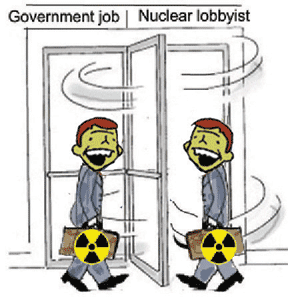
 US Nuclear Regulatory Commission’s ‘enforcement’ is as fierce as the comfy chair, Ecologist Linda Pentz Gunter 2nd August 2016 “…….
- The first NRC commissioner, William A. Anders (1975-76), went on to General Dynamics, where he earned $40 million in two years.
- Thomas M. Roberts (1981-1990) was asked to resign from the commission by critics in Congress due to conflicts of interest.
- Nils Diaz (1996-2006), exited the commission to become Chief Strategic Officer forBlue Castle Project, described as “leading the West in New Nuclear Power.”
- Jeffrey S. Merrifield (1998-2007), was investigated by the Project On Government Oversight while still a commissioner for getting contracts for the Shaw Group for whom he subsequently went to work, as well as having his travel tab paid by GE while job seeking there during his NRC tenure.
- Richard Meserve (1999-2003), who resigned during the Davis-Besse scandal, received a2012 Nuclear Energy Industry Leadership Award from the industry’s lobbying arm, the Nuclear Energy Institute, as testament to his industry loyalty.
- Former NRC Chairman, Dale Klein, (2006-10), now works for Japanese utility Tokyo Electric Power Company, at the center of the Fukushima nuclear disaster, where he oversees the corporation’s ongoing reactor restart effort.
- William D. Magwood, IV (2010-2014), resigned his commission seat to join the Nuclear Energy Association (NEA) in Paris, replacing Stephen Burns who took a new position as … Chairman of the NRC Commission!…….. http://www.theecologist.org/News/news_analysis/2987972/us_nuclear_regulatory_commissions_enforcement_is_as_fierce_as_the_comfy_chair.html
USA’s Nuclear Regulatory Commission – wholly owned subsidiary of the nuclear power industry
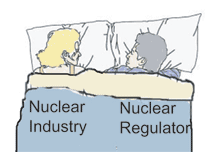 US Nuclear Regulatory Commission’s ‘enforcement’ is as fierce as the comfy chair, Ecologist Linda Pentz Gunter 2nd August 2016
The NRC routinely fails to enforce its own safety codes at nuclear power plants, writes Linda Pentz Gunter – putting all of us at risk from accidents. It’s the US’s most extreme example of regulatory capture, rivalling Japan’s ‘nuclear village’ of crony agencies and feeble regulation that led to the Fukushima disaster. How long can it be before the US experiences another nuclear catastrophe?
Fetch the comfy chair! The US Nuclear Regulatory Commission (NRC) is in town to enforce its own safety regulations at your local nuclear power plant. Reactor owners have been duly warned. Comply or else …
Or else what? Three more last chances? No, unlike Monty Python’s Spanish Inquisition, the NRC isn’t bothering to read the charges. It’s handing out immunity.
The US still has 30 operating reactors of the same General Electric design that exploded at Fukushima. Yet the NRC has decided not to require a significant safety retrofit that it had ordered in 2013, and that would have reduced the radioactive consequences of a major accident at one of these dangerously flawed reactors.
Or rather, the NRC will require it, but only after the reactor closes. The Oyster Creek nuclear generating station in New Jersey, which happens also to be the world’s prototype for the Fukushima reactors, is scheduled to close on December 31, 2019.
The NRC agreed to owner Exelon’s request for an extension to comply with the installation of a reliable severe accident-capable hardened vent. Exelon’s new deadline? January 2020, just after the reactor will be permanently shuttered.
Similarly, the Entergy-owned Pilgrim nuclear plant near Plymouth, MA, also a GE Fukushima design, and which has announced a June 1, 2019 shutdown date, hasrequested and extension to comply with the vent order until December 31, 2019.
It’s tempting be cynical and assume that by agreeing to extend such deadlines, the NRC is hoping owners will change their minds and keep their reactors open. After all, shutdowns are bad for business, and the NRC is very much in league with the interests of its industry friends.
Nothing illustrated this better than the NRC’s decision to provide a 20-year license extension to the Vermont Yankee nuclear power plant – another Fukushima clone – ten days into the 11th March 2011 Japan nuclear disaster. Luckily, the owners closed the financially hemorrhaging plant at the end of 2014.
The consistent pattern: industry cost cuts before public safety
Beleaguered by an economic nosedive, the nuclear industry has consistently challenged the NRC’s safety compliance orders to avoid the expense, putting profit well ahead of safety. The NRC has consistently and obligingly capitulated, even when the risk itself is identified as a top priority……..
Genius – let the nuclear industry self-report its own violations!
The list goes on. At the Exelon-owned Braidwood, IL nuclear power plant, starting in 1996, millions of gallons of water contaminated with tritium (radioactive hydrogen) leaked from the plant for 10 years while Exelon covered it up.
The tritiated water spilled onto roadways and into ditches, contaminating nearby agricultural fields, ponds and the drinking water wells of surrounding homeowners. Two on-site NRC inspectors supposedly failed to notice the lake of radioactive water flooding on and off the site.
The NRC’s solution was to allow the industry to self-report future leaks through an unenforceable voluntary honor system; a guarantee for further cover-ups. This despite revelations including in a report by my organization Beyond Nuclear – Leak First, Fix Later, and by the Associated Press that radioactive leaks were likely occurring at almost every nuclear plant in the country……….
Who is watching? Certainly not Congress, to whom the NRC is supposed to answer but which has rarely asked the agency to explain its negligence. Instead, there have been scores of close calls at US nuclear plants -166 in the last decade alone according to Greenpeace. The NRC has issued dozens of license extensions to old, decrepit reactors and denied none.
‘The agency is a wholly owned subsidiary of the nuclear power industry’
All this should have changed in 1974 when the Energy Reorganization Act divided the then Atomic Energy Commission into two new agencies – the NRC and what would become the Department of Energy. This was done to create a dividing line between nuclear regulation and promotion, with the NRC assuming the former role.
But the umbilical cord never got cut. The NRC didn’t just climb straight back into bed with the nuclear industry. It crawled back into the womb, as former NRC commissioner and now critic, Peter Bradford, told the New York Times: “The NRC inherited the regulatory staff and adopted the rules and regulations of the AEC intact.”
Meanwhile, since the agency’s inception, many outgoing NRC Commissioners have sailed away in golden parachutes straight into plum nuclear industry jobs…….
A few former commissioners, including Bradford (1977-82) and Victor Gilinsky (1974-84) became stern critics of the agency after their tenures. “The agency is a wholly owned subsidiary of the nuclear power industry”, Gilinsky said.
“It’s common knowledge in Washington that anyone nominated to be a commissioner to the NRC has to be pre-approved by the nuclear industry”, Union of Concerned Scientists senior scientist, Edwin Lyman told Forbes. “In order to get a more independent mindset, you’ve got to break that stranglehold.”
Just like Japan’s ‘nuclear village’
The Japanese parliament found that out after it commissioned a causal study on the Fukushima disaster in 2012. When the independent investigators delivered their verdict, they described the calamity as “man-made” and attributed it to collusion between government, regulator and TEPCO.
The NRC seems bent on repeating those mistakes while Members of Congress continue to do the bidding of the nuclear industry lobby and little to represent the safety and wellbeing of their real employers: all of us.
Do those nice fat checks from lobbyists buy their silence? Do they just not care? Or are they in fact worse than the NRC itself? The industry is once again pitching for a reduction in what it sees as burdensome regulatory oversight. Will Congress agree and slash the NRC budget to streamline what is already a rubber stamp system on safety?
Meanwhile, the NRC continues to look the other way on violations of its own safety regulations. It is happy to ignore potentially deadly defects and age-related degradation at the country’s nuclear plants in order to save the beleaguered industry any additional expense.
It will choose to risk potentially tens of thousands of lives to keep that revolving door spinning and the pathway clear to cushy jobs in the nuclear industry. That’s worse than collusion and negligence. It’s criminal. Are we outraged yet? http://www.theecologist.org/News/news_analysis/2987972/us_nuclear_regulatory_commissions_enforcement_is_as_fierce_as_the_comfy_chair.html
UK-Australian and French uranium companies polluting the “unpolluted” African States
 Uranium from Russia, with love, Ecologist, Nick Meynen 4th August, 2016
“………..the bigger issue should be that uranium mining is just a very dirty business that we didn’t clean up but source out. France used to have 200+ uranium mines but thanks to better care for environment and workers the last one closed in 2001. Instead, new ones were opened in places like Niger, Namibia and Malawi. In short: places where we can shift the real costs from uranium mining to the people and environment. As a matter of fact, CEOs in the business are quite frank about that. The former CEO of Paladin, John Borshoff, an Australian uranium producer who opened mines in Namibia, said that Canadian and Australian environmental norms are “over-sophisticated“. What he actually means is that in African countries you don’t need to pay much or anything at all to “protect” either your workers or the people living in the vicinity from dying from cancer due to exposure to uranium.
He’s just implementing the Lawrence Summers Principle. This ‘principle’ originates from a 1991 memo written or dictated by Summers whilst he was the World Bank’s chief economist. In this memo, he promoted dumping toxic waste in the Third World for economic reasons: “Just between you and me, shouldn’t the World Bank be encouraging more migration of the dirty industries to the LDCs [Least Developed Countries]? […] A given amount of health impairing pollution should be done in the country with the lowest cost, which will be the country with the lowest wages. I think the economic logic behind dumping a load of toxic waste in the lowest wage country is impeccable and we should face up to that.”
The uranium sector squared up to that. But for how much longer will it get away with that?
Last time rebels in Mali came too close to the AREVA mines in Niger for comfort, France suddenly sent in their army. Under some humanitarian pretext. And if rebels don’t succeed in capturing these remote mines, the global environmental justice movement might just succeed in closing a couple of them down.
The legacy from uranium mining
Being part of that movement, I’ve had the ‘pleasure’ of making a toxic tour around a now closed uranium mine in Bulgaria. Massive amounts of toxic sludge were stored behind a weak dam that showed signs of distress after heavy rains caused a spill in 2009. Old EU money was still keeping the dam up but as we’re talking about radioactive waste, money will need to keep flowing to dam repairs for millennia to come.
Since 1992, when the mines closed, and for time immemorial, that will be public money. And that’s how it goes with uranium mines in places with weak or no legislation: short-term private profits followed by perpetual public losses. In Bulgaria the people are still lucky enough to be in the EU with at least some environmental regulations and EU money for environmental protections. The same goes for other EU countries like France, which has dozens of zombie mines: dead but still active. The US also has plenty more zombie mines. The lands of the Navajo Nation include over 500 abandoned uranium mines (AUMs) as well as homes and drinking water sources with elevated levels of radiation. Despite the fact that they stopped operating in 1986, new and related lung cancers, bone cancers and impaired kidney functions keep appearing.
But while EU and US now have enough safeguards to keep their own uranium safe under the ground, there’s nothing of that in Namibia or Niger. These two countries are rising players on the uranium market, both exporting their uranium to the EU. Niger has now produced more uranium than France ever did in it’s whole history. It’s here that UK-Australian and French companies are doing the dirty digging that destroys local environment and populace.
Three reports from the EU-funded EJOLT project deal with the environmental and social issues related to uranium mining. One deals with the impacts, one concentrates on a mine in Malawi and the third dwells on the examples of successful resistance to big mining in general.
Bruno Chareyron, a French nuclear engineer who authored most of these reports, has been carrying out toxic tours along uranium mines for the last two decades. That’s not always an easy job, with for example the police confiscating most of your measuring equipment upon arrival in Niger. Nevertheless, Bruno was able to measure that radioactive scrap metal from the mines and mills is sold on the market. Waste rocks from the mines were used to pave roads, build homes and even at the local hospital where the radiation was 100 times above normal. Piles of radioactive waste were left in open air, unprotected, next to two cities with a total population of 120.000.
The missing piece of the puzzle
Where is uranium in the whole debate about nuclear energy? It’s usually only mentioned when the industry says: uranium is only a tiny part of the total cost of our energy model, unlike the situation in the gas and oil industry.
Well, there’s a reason why it’s only a tiny part of the total cost and it’s called cost shifting.
Ecological economists have given names to processes witnessed in the uranium sector:accumulation by contamination, ecologically unequal exchange and ecological debt. More and more, people all over the world are coming together to resist against environmental justice.
Our EU and US based nuclear power is currently coming at the cost of poisoning people in Africa. But it begs the question: are we ready to face that reality?
This Author:
Nick Meynen is one of The Ecologist New Voices contributors. He writes blogs and bookshttp://www.epo.be/uitgeverij/boekinfo_auteur.php?isbn=9789064455803 on topics like environmental justice, globalization and human-nature relationships.
When not wandering in the activist universe or his Facebook pagehttps://www.facebook.com/nick.meynen
is dead, he’s probably walking in nature.
@nickmeynen http://www.theecologist.org/News/news_analysis/2987988/uranium_from_russia_with_love.html
Britain’s history of supplying nuclear weapons technology to North Korea
What Theresa May forgot: North Korea used British technology to build its nuclear bombs.Ecologist, David Lowry 26th July 2016
When Theresa May proclaims in Parliament that we need the £200 billion Trident nuclear missile system to see off the North Korean nuclear threat, writes David Lowry, just bear this in mind. It is a threat that the UK, global nuclear proliferator in chief, created in the first place, providing both the reactor technology and vital centrifuge materials to make North Korea’s nuclear dream come true.
- ” … today the threats from countries such as Russia and North Korea remain very real.”
- “North Korea has stated a clear intent to develop and deploy a nuclear weapon, and it continues to work towards that goal, in flagrant violation of a series of United Nations Security Council resolutions.”
- “North Korea is the only country in the world to have tested nuclear weapons this century, carrying out its fourth test this year, as well as a space launch that used ballistic missile technology. It also claims to be attempting to develop a submarine-launch capability and to have withdrawn from the nuclear non-proliferation treaty.”
- “Based on the advice I have received, we believe that North Korea could already have enough fissile material to produce more than a dozen nuclear weapons. It also has a long-range ballistic missile, which it claims can reach America, and which is potentially intended for nuclear delivery.”
It reminded me of the similarly ill-informed former Prime Minister Tony Blair, in his speeches to MPs trying to win them over with dodgy ‘advice’ from British intelligence, to go to war by invading Iraq in 2003.
MPs have short memories, despite the Chicot Report on the Iraq invasion disaster not yet two weeks old, and 472 motley MP fools backed May and Trident replacement. As with the Iraq invasion, MPs will in future have to admit their regrets at being fooled. And again, they ignord the thousands of demonstrators outside, calling for Trident to be abandoned.
Britain’s nuclear proliferation ‘secret’
But May was right in one way. North Korea has developed nuclear weapons. But what she did not say was they did it with copied British bomb-making technology.
There is significant evidence that the British Magnox nuclear plant design – which was primarily built as a military plutonium production factory – provided the blueprint for the North Korean military plutonium programme based in Yongbyon. Here is what Douglas (now Lord) Hogg, then a Conservative minister, admitted in a written parliamentary reply in 1994 to Labour MP Llew Smith:
“We do not know whether North Korea has drawn on plans of British reactors in the production of its own reactors. North Korea possesses a graphite moderated reactor which, while much smaller, has generic similarities to the reactors operated by British Nuclear Fuels plc. However, design information of these British reactors is not classified and has appeared in technical journals.”
The uranium enrichment programmes of both North Korea and Iran also have a UK connection. The blueprints of this type of plant were stolen by Pakistani scientist, A Q Khan, from the URENCO enrichment plant in The Netherlands in the early 1970s.
(see David Albright, Peddling Peril, 2010 pp 15-28, Free Press, New York)
This plant was – and remains – one-third owned by the UK government. The Pakistan government subsequently sold the technology to Iran, who later exchanged it for North Korean Nodong missiles……….
Lessons of history
This sorry tale has several important lessons for us today. First – and this must never be forgotten – the UK’s early ‘atoms for peace’ nuclear power programme was specifically designed and intended to produce plutonium for nuclear bombs. And it was not just nuclear waste from Calder Hall that went for plutonium extraction at Windscale, but from other sites that were meant to be purely civilian such as Hinkley Point.
The UK is therefore guilty of ‘breaking the rules’ that are meant to separate civil and military nuclear activities, and its complaints of other states doing the same all carry the unmistakeable whiff of ripest humbug.
Second, for all its public position of seeking to restrain nuclear proliferation, the UK is actually one of the world’s most egregious nuclear proliferators: providing arch-nuclear enemy North Korea with both the Magnox technology it has used to produce plutonium for atom bombs; and the high strength aluminium it has used for its uranium centrifuges.
So when Theresa May stands up in Parliament and proclaims that we need the Trident nuclear missile system to see off the North Korean nuclear threat, remember: it is a threat that the UK created in the first place, providing both the nuclear reactor technology and the centrifuge materials to make it happen.
And when the UK cites the nuclear threat from North Korea as a reason to spend an estimated £200 billion on the next generation of Trident, we can be sure that North Korea and other countries aspiring to their own nuclear weapons are applying precisely the same logic to the British nuclear threat.
And that considering the UK’s history of aggressive regime-changing interventions in Iraq and Libya, the hundreds of (up to 225) nuclear warheads in its possession, and its ability to target them accurately anywhere in the world, North Korea’s fears are probably a great deal better founded than Mrs May’s. http://www.theecologist.org/News/news_analysis/2987935/what_theresa_may_forgot_north_korea_used_british_technology_to_build_its_nuclear_bombs.html
Germany an example to the world of the massive radioactive waste costs of the nuclear industry
Sticker Shock: The Soaring Costs Of Germany’s Nuclear Shutdown, Yale Environment 360 25 JUL 2016: REPORT German Chancellor Angela Merkel’s 2011 decision to rapidly phase out the country’s 17 nuclear power reactors has left the government and utilities with a massive problem: How to clean up and store large amounts of nuclear waste and other radioactive material. by joel stonington 26 july 16 The cavern of the salt mine is 2,159 feet beneath the surface of central Germany. Stepping out of a dust-covered Jeep on an underground road, we enter the grotto and are met by the sound of running water — a steady flow that adds up to 3,302 gallons per day.
“This is the biggest problem,” Ina Stelljes, spokesperson for the Federal Office for Radiation Protection, tells me, gesturing to a massive tank in the middle of the room where water waits to be pumped to the surface.
The leaking water wouldn’t be an issue if it weren’t for the 125,000 barrels of low- and medium-level nuclear waste stored a few hundred feet below. Most of the material originated from 14 nuclear power plants, and the German government secretly moved it to the mine from 1967 until 1978. For now, the water leaking into the mine is believed to be contained, although it remains unclear if water has seeped into areas with waste and rusted the barrels inside.
The mine — Asse II — has become a touchstone in the debate about nuclear waste in the wake of German Chancellor Angela Merkel’s 2011 decision to end the use of nuclear power following Japan’s Fukushima disaster. The ongoing closures have created a new urgency to clean up these nuclear facilities and, most importantly, to find a way to safely store the additional radioactive waste from newly decommissioned nuclear reactors. Nine of the country’s 17 nuclear power reactors have been shut down and all are expected to be phased out by 2022.
In addition to Asse II, two other major lower-level nuclear waste sites exist in Germany, and a third has been approved. But the costs associated with nuclear waste sites are proving to be more expensive, controversial, and complex than originally expected.
And Germany still hasn’t figured out what to do with the high-level waste — mostly spent fuel rods — that is now in a dozen interim storage areas comprised of specialized warehouses near nuclear power plants. Any future waste repository will have to contain the radiation from spent uranium fuel for up to a million years.
Given the time frames involved, it’s not surprising that no country has built a final repository for high-level waste. In Germany, a government commission on highly radioactive nuclear waste spent the last two years working on a 700-page report, released this month, that was supposed to recommend a location. Instead, the report estimated that Germany’s final storage facility would be ready “in the next century.” Costs are expected to be astronomical.
“Nobody can say how much it will cost to store high-level waste. What we know is that it will be very costly – much higher costs can be expected than [what] the German ministry calculates,” said Claudia Kemfert, head of energy, transportation, and environment at the German Institute for Economic Research. The exact number, she said, “cannot be predicted, since experience shows that costs have always been higher than initially expected. ”
At the Asse II mine, roughly $680 million has been spent in the six years since the cleanup began, and the price tag for operations last year totaled $216 million. A 2015 report by Germany’s Environment Ministry noted, “There are currently no technical plans available for the envisaged waste recovery project which would allow a reliable estimate of the costs.”
No one expects to start moving the barrels at the mine until 2033, and estimates of finishing the process extend to 2065. Total costs for moving the waste to a future storage site will almost certainly be in the billions of dollars, with current estimates of just disposing of the recovered waste at $5.5 billion.
The waste issue is one reason nuclear power has been so controversial in Germany and why there is broad support among the public for phasing it out, with three-quarters of the German population saying they are in favor of Merkel’s decision, according to a survey this year by the Renewable Energy Hamburg Cluster.
“Nuclear in Germany is not popular,” Kemfert said. “Everybody knows it is dangerous and causes a lot of environmental difficulties. Nuclear has been replaced by renewables – we have no need for nuclear power any more.”…………..
With both nuclear waste storage and decommissioning, governments and power companies around the world have often opted for halfway solutions, storing waste in temporary depots and partially decommissioning plants. Worldwide, 447 operational nuclear reactors exist and an additional 157 are in various stages of decommissioning. Just 17 have been fully decommissioned.
In Europe, a recent report by the European Union Commission estimated that funds set aside for waste storage and decommissioning of nuclear plants in the EU’s 16 nuclear nations have fallen short by $137 billion. Dealing with nuclear waste in the United Kingdom is also a highly charged issue. At one location — a former weapons-manufacturing, fuel-reprocessing, and decommissioning site called Sellafield — the expected cleanup cost increased from $59 billion in 2005 to $155 billion in 2015. ……
despite recently completing a new plant, the United States is also struggling with decommissioning. The cost estimates of shuttering U.S. nuclear plants increased fourfold between 1988 and 2013, according toBloomberg News. Many governments are slowly starting to realize how much those costs have been underestimated.
As Antony Froggatt, a nuclear expert and researcher at Chatham House — a London-based think tank— put it, “The question is, how do you create a fair cost to cover what will happen far into the future?” http://e360.yale.edu/feature/soaring_cost_german_nuclear_shutdown/3019/
German situation shows the complex problem of who pays for nuclear wastes disposal
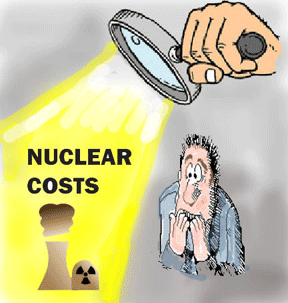 Sticker Shock: The Soaring Costs Of Germany’s Nuclear Shutdown, Yale Environment 360 25 JUL 2016: REPORT “…….In Germany, negotiations with utilities over who will pay the denuclearization costs have often centered on how much the utilities can afford. The four nuclear utilities in Germany – publicly-traded RWE; E.ON; EnBW, which is majority publicly-owned; and Swedish-owned Vattenfall – are struggling economically as decentralized wind and solar power have undercut wholesale electricity prices and eaten into profits. Last year, E.ON, Germany’s largest utility, lost $7.7 billion.
The four companies have already set aside $45 billion for decommissioning nuclear power plants. But in April, Germany’s Commission to Review the Financing for the Phase-Out of Nuclear Energy recommended that the utilities pay an additional $26.4 billion into a government-controlled fund meant to cover the costs of long-term storage of nuclear waste.
The utilities were unhappy with the commission’s conclusions and released a joint statement saying $26.4 billion would “overburden energy companies’ economic capabilities.” Even so, few experts expect those sums to cover the total eventual costs.
“Some billions now are better than making them bankrupt,” said Michael Mueller, who chairs a government commission on highly radioactive nuclear waste. “So, it’s a compromise that had to be made.”
The utilities are clear about where they see the responsibility: “The temporary and final storage of nuclear waste in Germany is an operative task of the German government, which is politically responsible for this,” the utilities said in a statement. Indeed, if the commission’s recommendation becomes law, then the German government will be on the hook for any storage costs beyond the $26.4 billion paid by the utilities.
“Asse II shows us that radioactive waste storage is a complex problem that is not just about dumping it somewhere,” said Jan Haverkamp, a nuclear energy expert at Greenpeace. “There are many open questions, and those questions are going to lead to a lot more costs………” http://e360.yale.edu/feature/soaring_cost_german_nuclear_shutdown/3019/
REGIONAL RISKS in America’s Spent Nuclear Fuel Rods and Storage Pools
 Spent Nuclear Fuel Rods and Storage Pools: A Deadly and Unnecessary Risk in the United States. Based on an Institute for Policy Studies report by Robert Alvarez entitled “Spent Nuclear Fuel Pools in the U.S.: Reducing the Deadly Risks of Storage.”
“…….New York. If a spent fuel fire were to happen at one of the two Indian Point nuclear reactors located 25 miles from New York City, it could result in as many as 5,600 cancer deaths and $461 billion in damages. Indian Point spent fuel storage has about three times more radioactivity than the combined total in the spent fuel pools at the four troubled Fukushima reactors.
Los Angeles. The spent fuel at Diablo Canyon nuclear reactors have nearly 2.7 times more radioactivity than the combined total in the spent fuel pools at the four troubled Fukushima reactors.
Miami. Turkey Point reactors 65 miles from Miami have 2.5 times more radioactivity than the combined total in the spent fuel pools at the four troubled Fukushima reactors.
Dallas. The Comanche Peak nuclear station 60 miles southwest of Dallas has spent fuel that contains about 2.3 times more radioactivity than the combined total in the spent fuel pools at the four troubled Fukushima reactors.
Atlanta. The Vogtle nuclear reactors near Augusta are 147 miles northeast of Atlanta. These reactors have generated 2.5 times more radioactivity than the combined total in the spent fuel pools at the four troubled Fukushima reactors. https://ratical.org/radiation/NuclearExtinction/IPS-RA-ReportFactSheet.pdf
Spent nuclear fuel pools are unsafe
Spent Nuclear Fuel Rods and Storage Pools: A Deadly and Unnecessary Risk in the United States. Based on an Institute for Policy Studies report by Robert Alvarez entitled “Spent Nuclear Fuel Pools in the U.S.: Reducing the Deadly Risks of Storage.”
Ì More than 30 million highly radioactive spent nuclear fuel rods are submerged in vulnerable storage pools at reactors all over the United States. These pools at 51 sites contain some the largest concentrations of radioactivity on the planet. Yet, they are stored under unsafe conditions, vulnerable to attacks and natural disasters.
Ì Spent nuclear fuel rods have enough pop to cause a catastrophic radiation fire, a nuclear chain reaction, or explosion. As the Fukushima Dai-Ichi tragedy shows, the risk to the public is all too real.
Ì Spent nuclear fuel rods are so deadly that a motorcyclist blasting past them at 60 mph at a distance of one foot would be killed from the effects of that fleeting radiation exposure.
Ì The metal tubing that holds the spent nuclear fuel is thinner than a credit card. This thin sheath is the only major barrier preventing the escape of radioactive materials. Cracked or damaged metal tubing that was holding deadly nuclear material at the Fukushima Dai-Ichi nuclear reactors resulted in the release of an enormous amount radioactivity, much of which seeped into air, soil, and nearby ocean water.
Ì Approximately 75 percent of U.S. spent nuclear fuel rods are kept tightly packed together in storage racks, submerged in pools located at nuclear reactors. These storage facilities resemble large above-ground swimming pools and this practice puts the American public at risk. Spent fuel storage pools are often housed in buildings no more secure than a car dealership. Instead, these fuel rods should be safely stored in dry, hardened, and sealed storage casks.
Ì Spent fuel storage pools are vulnerable. Massive land contamination, radiation injuries, and myriad deaths would result from a terrorist attack, earthquake, or even a prolonged electricity blackout — as happened at the Fukushima DaiIchi reactor site in Japan following an earthquake and tsunami. Pools need electricity to pump water to cool the rods, as well as to maintain a high water level to diffuse the escape of radiation. Despite these dangers, the Nuclear Regulatory Commission (NRC) doesn’t require nuclear reactor operators to even have back-up power supplies for these spent-fuel pools to prevent disaster.
Ì If the water in a spent nuclear fuel pool drains to six feet above the fuel rods, it would give off life-threatening radiation doses to workers on site. These pools were originally designed to hold less than one fifth of the radioactive material they now contain.
Ì If the water were to drain entirely from a spent fuel pool, it could trigger a catastrophic radioactive fire that would spew toxins and render hundreds of thousands of square miles uninhabitable. The devastated area would be larger than the wasteland that resulted from the 1986 Chernobyl nuclear accident.
Ì Life-threatening incidents have occurred at multiple U.S. spent fuel storage pools. In Haddam Neck, Connecticut, a pool sprung a leak in August 1984. About 200,000 gallons of water drained in just 20 minutes, according the NRC.
Ì Dry cask storage is a much safer alternative to pools — which were originally designed to hold less than one-fifth of what they now contain. It doesn’t rely upon a constant supply of electricity or water, and it also can be stored in separate blast-proof containers, making it less susceptible to terrorist attack or earthquakes.
Ì Over the next 10 years, we could remove all spent fuel older than five years for a cost of $3 billion-$7 billion. The cost of fixing America’s nuclear vulnerabilities may be high, but the price of doing too little is incalculable……..https://ratical.org/radiation/NuclearExtinction/IPS-RA-ReportFactSheet.pdf
Challenges in the transition from nuclear power to renewables
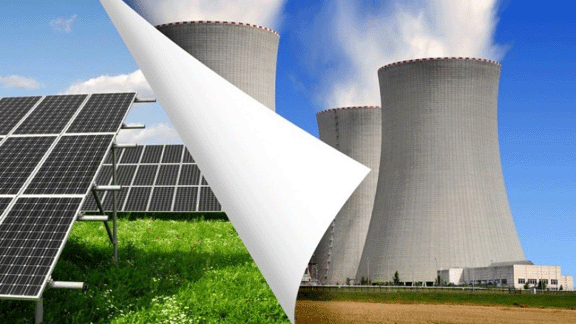 There are good reasons for California to phase out nuclear power, Huffington Post, Johann Saathoff,MP German BundestagCoordinator of energy policy for the Social Democratic Party in the German Bundestag 07/22/2016 “……..In Germany the transition to renewable energies is proceeding although there are challenges to overcome. Two thirds of electricity in Germany is currently generated from renewables. We do not expect demand for electricity to fall in the future. Coupling the electricity market sector (including electric mobility) and the heat market will create overcapacity. This will be a good thing and any overcapacity can be put to good use in the electricity market.
One of the greatest obstacles at present to expanding renewables is the failure to expand existing and build new power grids. The energy transition and the decentralised production of electricity involves the need to adapt the entire power supply system in Germany and renew large parts. Up to now power stations have been located in the vicinity of the major power consumers; in future power stations will be much smaller and distributed throughout the country. They will also not supply electricity on a continuous basis. Sector coupling between the electricity market, heat market and mobility means that fewer networks have to be built since part of the electricity can be consumed locally.
It is important to ensure, however, that security of supply is guaranteed as the production of renewable energy increases. There is therefore a need for an intelligent grid with intelligent, i.e. controllable, electricity meters at least for the big energy consumers. Up to now the production of electricity has been geared to consumption. In the new energy world it will be possible to adjust the consumption curve to the production curve. It will be possible, as an example, for cold stores to be cooled down further at times when there is too much power in the grid. They will not then need any power if a few hours later there is too little power in the grid. For the operator of the cold store there will be a commercial incentive in the form of lower prices if he adjusts the way he runs his cold store to comply with the electricity market.
The cold store would thus function as a type of energy store. This, along with other storage systems such as pumped hydroelectric and compressed air energy storage, chemical storage and power-to-gas and power-to-heat plants, will become increasingly important with the growth of renewable energy and in the context of supply security. In the transitional phase, security of supply can be ensured locally by small modular gas power stations.
In Germany there is a broad consensus in society in favour of the phasing out of nuclear power by 2022. The reasons for phasing out nuclear power for us are the same as in California and elsewhere: the lack of a solution regarding the storage of nuclear waste, environmental damage and the risk of accidents. The danger of an accident comes from human error in operating the plant, a lack of maintenance and wear. In the past there was also a failure to properly appreciate the danger of terrorist attacks. These dangers apply to the plant itself, to the energy supply for the region in question and to the nation as a whole. Phasing out nuclear power and changing over to decentralised renewable energy removes a central target of attack from potential aggressors. Thus the energy transition also contributes to national security.
There may be a consensus within society in favour of the energy transition and the resulting structural changes that are required, but the state needs to be proactive in the process in order to ensure that this consensus is maintained. This means that people employed up to now in the nuclear sector must be given prospects for the future and those regions which have benefitted in economic terms up to now from nuclear power stations must be shown other options for economic development. One way would be to provide incentives in these regions for building production facilities for storage systems, cabling, wind farms or parts thereof.
One possibility for ensuring people’s support for the energy transition is to encourage them to be actively involved in citizens’ energy companies. This means they have a direct stake in the commercial success of the energy transition. In addition or perhaps alternatively the local authorities as the real agencies responsible for providing public services and representatives of local citizens, should hold large stakes in these energy companies. In this way all citizens participate in the energy transition, not just those who can afford to invest…..http://www.huffingtonpost.com/johann-saathoff/there-are-good-reasons-fo_b_11133916.html
1 This Month



26 September – International Day for the Total Elimination of Nuclear Weapons


PLEASE OPPOSE HR 8255 AND S.3639 – bills would accelerate satellite deployment, with no environmental review or safeguards – https://ncstd5li.quorum.us/campaign/169331/
To see nuclear-related stories in greater depth and intensity – go to https://nuclearinformation.wordpress.com
-
Archives
- September 2026 (233)
- August 2026 (330)
- July 2026 (355)
- June 2026 (287)
- May 2026 (306)
- April 2026 (356)
- March 2026 (251)
- February 2026 (267)
- January 2026 (308)
- December 2025 (358)
- November 2025 (359)
- October 2025 (375)
-
Categories
- 1
- 1 NUCLEAR ISSUES
- business and costs
- climate change
- culture and arts
- ENERGY
- environment
- health
- history
- indigenous issues
- Legal
- marketing of nuclear
- media
- opposition to nuclear
- PERSONAL STORIES
- politics
- politics international
- Religion and ethics
- safety
- secrets,lies and civil liberties
- spinbuster
- technology
- Uranium
- wastes
- weapons and war
- Women
- 2 WORLD
- ACTION
- AFRICA
- Atrocities
- AUSTRALIA
- Christina's notes
- Christina's themes
- culture and arts
- Events
- Fuk 2022
- Fuk 2023
- Fukushima 2017
- Fukushima 2018
- fukushima 2019
- Fukushima 2020
- Fukushima 2021
- general
- global warming
- Humour (God we need it)
- Nuclear
- RARE EARTHS
- Reference
- resources – print
- Resources -audiovicual
- Weekly Newsletter
- World
- World Nuclear
- YouTube
-
RSS
Entries RSS
Comments RSS
 nuclear-news