The National Audit Office (NAO) stated these tanks pose “significant risks to people and the
environment”. One official review published in The Lancet concluded that, at worst, an explosive release from the tanks could kill two million Britons and require the evacuation of an area reaching from Glasgow to Liverpool. These dangerous tanks have also been the subject of repeated complaints from Ireland and Norway who fear their countries could be contaminated if explosions or fires were to occur.
In short, the practice of reprocessing at Sellafield has been and remains a monumental national disgrace.
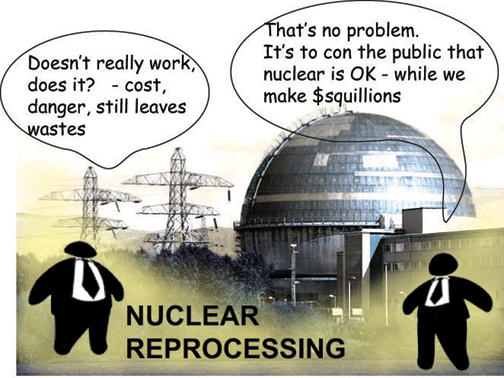
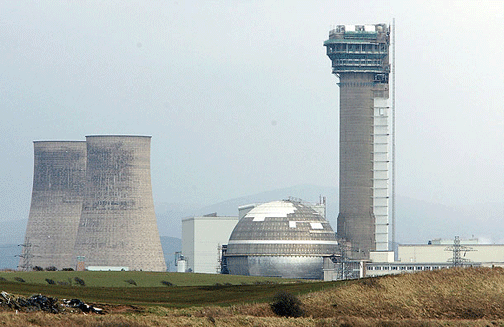
Especially serious are the ~20 large holding tanks at Sellafield containing thousands of litres of extremely radiotoxic fission products. Discussing these tanks, the previous management consortium Nuclear Management Partners stated in 2012:
“there is a mass of very hazardous [nuclear] waste onsite in storage conditions that are extraordinarily vulnerable, and in facilities that are well past their designated life.”
most of all, we should recognize that nuclear policies, in both weapons and energy, have poorly served the nation.
 Sellafield exposed: the nonsense of nuclear fuel reprocessing http://www.theecologist.org/reviews/2988095/sellafield_exposed_the_nonsense_of_nuclear_fuel_reprocessing.html Ian Fairlie 6th September 2016 Last night’s BBC Panorama programme did a good job at lifting the lid on Britain’s ongoing nuclear disaster that is Sellafield, writes Ian Fairlie. But it failed to expose the full scandal of the UK’s ‘reprocessing’ of spent fuel into 50 tonnes of plutonium, enough to build 20,000 nuclear bombs – while leaving £100s of billions of maintenance and cleanup costs to future generations.
Many readers will have seen the interesting Panorama programme on the poor safety record at Sellafield broadcast on BBC1 last night.
The BBC press release stated this was a “special investigation into the shocking state of Britain’s most hazardous nuclear plant” – and it certainly was.
The most important of several whistleblower revelations was that the previous US managers had been shocked at the state of the plant when they took over its running in 2008.
Although the programme producers are to be congratulated for tackling the subject, it was only 30 minutes long and tells only a fragment of the whole sorry story.
This article tries to give more background information, and importantly, more analysis and explanation. The full story would require several books, and provide exceedingly painful reading.
What is reprocessing for? Continue reading →
September 7, 2016
Posted by Christina Macpherson |
Reference, reprocessing, UK, wastes |
Leave a comment
 Here we go again: Fossil fuel industry takes a play from Big Tobacco’s playbook. http://www.dailyclimate.org/t/1692193038704125011 August 31, 2016 by Sen. Sheldon Whitehouse (D-R.I.)
Last year, coal mining executives attending the annual meeting of the Rocky Mountain Coal Mining Institute were treated to a presentation on the future of American mining titled:“Survival Is Victory: Lessons From the Tobacco Wars.” As the title implies, the presentation laid out a path for the fossil fuel industry to weather a barrage of lawsuits and new safety and health regulations, modeled on the efforts of the tobacco industry in the 90s and early 2000s. (See John Schwartz’s story in The New York Times.)
Richard Reavey, the Cloud Peak Energy vice president who delivered the presentation, described the similarities between what Big Tobacco went through and the challenges facing coal today as “remarkable and eerie.” (We should take his word for it. Before working for Cloud Peak, a mining company, Reavey was an executive at tobacco giant Philip Morris for 17 years, according to his LinkedIn profile.) His advice to the coal execs: do what tobacco did and “cut a deal while we are still relevant.” After all, “a much more heavily regulated tobacco industry is still viable and profitable.”
Ironically, Reavey’s presentation on these similarities between tobacco and fossil fuel strategies has a much deeper parallel.
For decades, cigarette makers hid from the public and from policymakers the scientific evidence they had of their product’s dangers. The Justice Department brought, and ultimately won, a civil racketeering lawsuit against the major tobacco companies for carrying out that fraud. Today, researchers often compare this tobacco fraud on the public to the fossil fuel industry’s suppression of its research on the dangers of carbon pollution.
Dr. Michael Mann of Pennsylvania State University has written about the pattern followed by both industries: hiring their own scientists to churn out favorable research; creating (and bankrolling) front groups to sow doubt in the public debate about scientific consensus, while obscuring the hand of the industry; and even attacking and harassing individual scientists whose work may discredit the industry propaganda. Professor Mann himself has been the target of vexatious “investigations” and efforts to intimidate and harass him, including death threats—just for producing peer-reviewed academic research shedding light on the effects of increasing concentrations of carbon dioxide in the atmosphere.
Dr. Robert Brulle of Drexel University has documented an intricate propaganda web of climate denial, with over one hundred organizations, from industry trade associations to conservative think tanks to plain old phony front groups. The purpose of this sophisticated denial apparatus, he says, is “a deliberate and organized effort to misdirect the public discussion and distort the public’s understanding of climate.” These are tactics that were developed, tested, and proven effective by the tobacco industry—and in some cases the very same front groups were involved.
Public lawyers demanded that the “tobacco files”” behind this fraud be made a public record. A recentanalysis by the Center for International Environmental Law of millions of documents from these tobacco industry archives reveals close collaboration over the better part of a century between cigarette manufacturers and oil producers on research, lobbying, and public relations. The new bookPoison Tea, by Climate Nexus Executive Director Jeff Nesbit, chronicles this same relationship.
In the book and film Merchants of Doubt, Drs. Naomi Oreskes and Erik Conway identify spin doctors, spokespeople and even scientists-for-hire who were involved in the tobacco and now fossil fuel campaigns. Not only has the energy industry recycled tobacco’s strategies and front groups, it’s redeploying some of the same personnel, like Mr. Reavey, the coal convention presenter.
Sharon Eubanks, lead counsel on behalf of the United States in United States v. Phillip Morris, the federal tobacco litigation, has said she believes the government could make a case against fossil fuel producers very similar to the one she led against tobacco under federal civil racketeering laws. That’s not just because coal companies are openly taking cues from tobacco’s legal and regulatory fight. It’s because mounting evidence indicates that, like tobacco, the fossil fuel industry may have engaged in a deliberate, protracted fraud to mislead the public, to protect their profits, to the peril of us all.
September 5, 2016
Posted by Christina Macpherson |
business and costs, Reference, spinbuster, USA |
Leave a comment
Even if the ice wall works, Tepco will face the herculean task of dealing with the huge amounts of contaminated water that have accumulated.

Japan’s $320 Million Gamble at Fukushima: An Underground Ice Wall, NYT By MARTIN FACKLER, AUG. 29, 2016 FUKUSHIMA DAIICHI NUCLEAR POWER STATION — The part above ground doesn’t look like much, a few silver pipes running in a straight line, dwarfed by the far more massive, scarred reactor buildings nearby.
More impressive is what is taking shape unseen beneath: an underground wall of frozen dirt 100 feet deep and nearly a mile in length, intended to solve a runaway water crisis threatening the devastated Fukushima Daiichi Nuclear Power Station in Japan.
Officially named the Land-Side Impermeable Wall, but better known simply as the ice wall, the project sounds like a fanciful idea from science fiction or a James Bond film. But it is about to become a reality in an ambitious, and controversial, bid to halt an unrelenting flood of groundwater into the damaged reactor buildings since the disaster five years ago when an earthquake and a tsunami caused a triple meltdown.
Built by the central government at a cost of 35 billion yen, or some $320 million, the ice wall is intended to seal off the reactor buildings within a vast, rectangular-shaped barrier of man-made permafrost. If it becomes successfully operational as soon as this autumn, the frozen soil will act as a dam to block new groundwater from entering the buildings. It will also help stop leaks of radioactive water into the nearby Pacific Ocean, which have decreased significantly since the calamity but may be continuing However, the ice wall has also been widely criticized as an expensive and overly complex solution that may not even work. Such concerns re-emerged this month after the plant’s operator announced that a section that was switched on more than four months ago had yet to fully freeze. Some also warn that the wall, which is electrically powered, may prove as vulnerable to natural disasters as the plant itself, which lost the ability to cool its reactors after the 45-foot tsunami caused a blackout there.
The reactor buildings are vulnerable to an influx of groundwater because of how the operator, Tokyo Electric Power Co., or Tepco, built the plant in the 1960s, by cutting away a hillside to place it closer to the sea, so the plant could pump in water more easily. That also put the buildings in contact with a deep layer of permeable rock filled with water, mostly rain and melted snow from the nearby Abukuma Mountains, that flows to the Pacific.
The buildings managed to keep the water out until the accident on March 11, 2011. Either the natural disasters themselves, or the explosive meltdowns of three of the plant’s six reactors that followed, are believed to have cracked the buildings’ basements, Once inside, the water becomes highly radioactive, impeding efforts to eventually dismantle the plant. During the accident, the uranium fuel grew so hot that some of it is believed to have melted through the reactor’s steel floors and possibly into the basement underneath, though no one knows exactly where it lies. The continual flood of radioactive water has prevented engineers from searching for the fuel.
Since the accident, five robots sent into the reactor buildings have failed to return because of
high radiation levels and obstruction from debris.
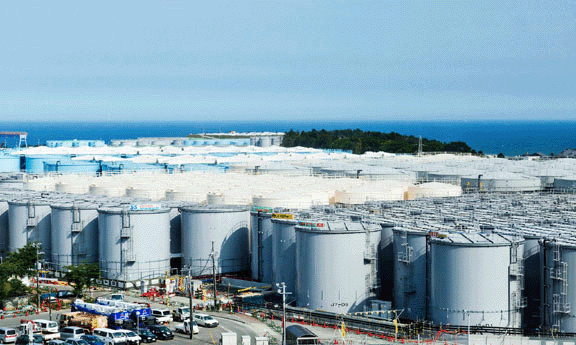
The water has also created a waste-management nightmare because Tepco must pump it out into holding tanks as quickly as it enters the buildings, to prevent it from overflowing into the Pacific. The company says that it has built more than 1,000 tanks that now hold more than 800,000 tons of radioactive water, enough to fill more than 320 Olympic-size swimming pools.
On a recent visit to the plant, workers were busily erecting more durable, welded tanks to replace the temporary ones thrown up in a hurry during the early years after the accident, some of which have leaked. Every available patch of space on the sprawling plant grounds now appears to be filled with 95-foot tanks.
“We have to escape from this cycle of ever more water building up inside the plant,” said Yuichi Okamura, a general manager of Tepco’s nuclear power division who guided a reporter through Fukushima Daiichi. About 7,000 workers are employed in the cleanup.
The ice wall is a high-technology bid to break that cycle by installing what might be the world’s largest freezer. Continue reading →
September 2, 2016
Posted by Christina Macpherson |
Fukushima 2016, Reference |
Leave a comment
At San Onofre, spent nuclear fuel is getting special tomb Orange County Register, Aug. 28, 2016 ,By TERI SFORZA “……..Once, San Onofre was a marvel of modern engineering – splitting atoms to create heat, boiling water to spin turbines and creating electricity that fulfilled 18 percent of Southern California’s demand. Now, it’s a demolition project of mind-boggling proportions, overseen by a dozen government agencies.
It’s expected to cost $4.4 billion, take 20 years and leave millions of pounds of spent nuclear fuel on the scenic bluff beside the blue Pacific until 2049 or so, because the federal government has dithered for generations on finding a permanent repository.
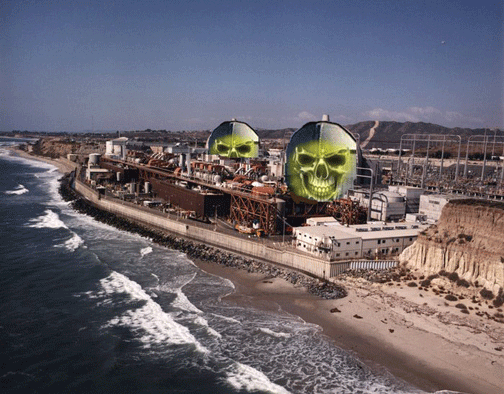
In this vacuum, contractors from Holtec International – one of only a handful of companies licensed by the Nuclear Regulatory Commission to do dry-cask radiation storage in the U.S. – are at work. Construction of the controversial “concrete monolith” to protect San Onofre’s stranded waste has begun, over the protests of critics who decry a “beachfront nuclear waste dump.”
THE MONOLITH
The reinforced concrete pad that will support the monolith is finished.
Last week, Holtec workers used cranes and trucks to maneuver the first of 75 giant tubes into place atop it. When those tubes are bolted in, concrete will be poured up to their necks, and they’ll be topped off with a 24,000-pound steel-and-concrete lid. Earth will be piled around it so that it looks something like an underground bunker.
Southern California Edison, which operates the plant, would not share the Holtec contract or reveal its price tag, but San Onofre’s owners have recovered more than $300 million from the federal government for its failure to dispose of nuclear waste, which is why dry-cask storage must be built in the first place. San Onofre’s decommissioning plan sets aside $1.27 billion for future spent fuel management.
This is one of the first newly licensed Hi-Storm Umax dry-cask storage systems Holtec is building in the United States. Once it’s complete – expected to be late next year – workers will begin the deliberate and delicate dance of removing all spent fuel from cooling pools beside each reactor.
The iconic twin domes you see from the highway and the beach don’t reveal their enormity. They stand as tall as a 13-story building, and the adjacent pools holding their spent fuel are 25 feet wide, 60 feet long, about 40 to 50 feet deep and hold a half-million gallons of water.
When Southern California Edison begins removing the 2,668 fuel assemblies chilling there, bays to those enormous pools will open. Holtec storage canisters will be lowered in. Underwater, 37 spent fuel assemblies will be loaded into each canister and capped. The canister will be slipped into a “transfer cask,” lifted from the pool and drained.
Then it will be loaded onto a truck, driven a few hundred yards to the Umax and lowered into one of those 75 tubes. The waste-filled canister will remain inside. The transfer cask will be removed. The tube will be capped.
This will be repeated more than 70 times, until all the fuel in the more vulnerable pools is entombed in more stable dry-cask storage. That’s slated to be done by mid-2019.
TECHNOLOGY
The system will become something of a real-time experiment: Edison is partnering with the Electric Power Research Institute to develop inspection techniques to monitor the casks as they age. The casks’ integrity over time, while holding hotter “high burn-up” fuel, is a major concern of critics.
“Burn-up” – i.e., the amount of uranium that undergoes fission – has increased over time, allowing utilities to suck more power out of nuclear fuel before replacing it, federal regulators say. It first came into wide use in America in the latter part of the last century, and how it will behave in short-term storage containers (which, pending changes in U.S. policy on nuclear cleanup, must be used for longer-term storage) remains a topic of debate……..
ry-cask technology is not new, he said. Nuclear power plants in the U.S. have used it since 1986, and an analysis by the Electric Power Research Institute found that it would take at least 80 years before a severe crack could form in a dry storage canister.
The Umax uses the most corrosion-resistant grade of stainless steel; its design exceeds California earthquake requirements, and it protects against hazards such as water, fire or tsunamis.
Critics cast skeptical eyes on those claims.
They don’t disagree that dry storage is safer than the spent fuel pools, but activist Donna Gilmore says officials gloss over the potential for serious cracking – a bigger risk in a moist, salty, oceanfront environment such as San Onofre.
Once a crack starts, it would continue to grow through the wall of the canister, undetected, until it leaked radiation, Gilmore said.
Other countries use thicker-walled casks than those licensed in America, and she believes we should, too.
EYES FORWARD
What everyone wants is to remove the ensconced “stranded waste” from San Onofre as soon as possible, and the only way that can happen is if the federal government takes action.
Palmisano said energy is best expended pushing that forward, not arguing over canisters.
On that front, he is cautiously optimistic.
In January, the U.S. Department of Energy launched a new push to create temporary nuclear waste storage sites in regions eager for the business, currently in West Texas and New Mexico. Several of those could be up and running while the prickly question of coming up with a permanent site is hashed out.
There could be a plan, and a place, for this waste within the next 10 years, Palmisano said – but that would require congressional action, which in turn would likely require much prodding from the public.
“We are frustrated and, frankly, outraged by the federal government’s failure to perform,” he said. “I have fuel I can ship today, and throughout the next 15 years. Give me a ZIP code and I’ll get it there.”…..http://www.ocregister.com/articles/nuclear-727227-fuel-storage.html
August 29, 2016
Posted by Christina Macpherson |
Reference, USA, wastes |
Leave a comment
It is time to turn nuclear common sense into national policy. A declaration that the United States would never use nuclear weapons when conventional weapons could destroy the target could reduce the number of nuclear weapons we need for legitimate deterrence purposes.

 The common-sense fix that American nuclear policy needs, WP, By Jeffrey G.
Lewis and Scott D. Sagan August 24
Jeffrey G. Lewis is director of the East Asian Nonproliferation Program at the Middlebury Institute of International Studies at Monterey. Scott D. Sagan is the Caroline S.G. Munro professor of political science and senior fellow at the Center for International Security and Cooperation at Stanford University. This op-ed was adapted from an article that will appear in the fall issue of Daedalus.
President Obama, in his final months in office, is considering major nuclear policy changes to move toward his oft-stated goal of a world without nuclear weapons. One option reportedly under consideration is a “no first use” pledge, a declaration that the United States would not be the first state to use nuclear weapons in any conflict. While we think that such a pledge would ultimately strengthen U.S. security, we believe it should be adopted only after detailed military planning and after close consultation with key allies, tasks that will fall to the next administration.
There is, however, a simpler change that Obama could make now that could have as important, or even greater, benefits for U.S. security. The president could declare, as a matter of law and policy, that the United States will not use nuclear weapons against any target that could be reliably destroyed by conventional means.
This might seem like common sense, but current U.S. doctrine allows the use of nuclear weapons against any “object” deemed to be a legitimate military target. In 2013, the Obama administration did issue a guidance directing the U.S. military to “apply the principles of distinction and proportionality and seek to minimize collateral damage to civilian populations and civilian objects” and pledged that “the United States will not intentionally target civilian populations or civilian objects.”
This was a good step forward. But Obama’s guidance omitted an important legal concept derived from just-war doctrine — the “principle of necessity,” which suggests that war planners must use only the minimum amount of military force necessary to destroy a target. Ignoring the necessity principle leaves a loophole large enough to fly a nuclear-armed bomber through. To give one egregious example, although the U.S. military does not target civilian populations directly, following the principle of noncombatant immunity, it insists that it can legally target civilian airports in an adversary’s cities because they could be converted to military airports during a war — and there is no restriction in place against using nuclear weapons against such a civilian airport………
It is time to turn nuclear common sense into national policy. A declaration that the United States would never use nuclear weapons when conventional weapons could destroy the target could reduce the number of nuclear weapons we need for legitimate deterrence purposes. Placing conventional weapons at the center of debates about the future of deterrence would also help focus the policy discussion on plausible scenarios with realistic plans for the use of U.S. military power. And it would more faithfully honor the just-war principles of distinction, necessity and proportionality, by placing them at the heart of our deterrence and security policies, where our highest ideals belong. https://www.washingtonpost.com/opinions/the-common-sense-fix-that-american-nuclear-policy-needs/2016/08/24/b9692dd0-6596-11e6-96c0-37533479f3f5_story.html?utm_term=.a6cc17bf50cf
August 27, 2016
Posted by Christina Macpherson |
politics international, Reference, USA, weapons and war |
Leave a comment
 The ‘nuclear football’ – the deadly briefcase that never leaves the president’s side
Donald Trump’s views on nukes may be the scariest thing about his candidacy. But how does Potus launch an attack at a moment’s notice? And what happens when you send the codes to the dry cleaners by mistake…Guardian, Stuart Jeffries , 22 Aug 16 “……..As for the nuclear football, it comes into active service when the president leaves the White House. It is the nickname for a large leather, aluminium-framed briefcase weighing 20kg which is hefted by a military aide who shadows the US commander in chief.
It is, as former Washington Post reporter Michael Dobbs calls it, “the ultimate power accessory, a doomsday machine that could destroy the entire world”. The late Bill Gulley, a former director of the White House Military Office, described what’s inside the nuclear football in his 1980 memoir Breaking Cover. “There are four things in the football. The Black Book containing the retaliatory options, a book listing classified site locations, a manila folder with eight or 10 pages stapled together giving a description of procedures for the Emergency Broadcast System, and a three-by-five inch card with authentication codes.”
The nuclear football has an antenna protruding from it, likely indicating that inside there is a communication system with which the president can maintain contact the Pentagon’s National Military Command Centre which monitors worldwide nuclear threats and can order an instant nuclear response. “The football,” says Dobbs, “also provides the commander-in-chief with a simplified menu of nuclear strike options – allowing him to decide, for example, whether to destroy all of America’s enemies in one fell swoop or to limit himself to obliterating only Moscow or Pyongyang or Beijing.”…….
Why is the briefcase nicknamed the nuclear football? According to former US secretary of defence Robert McNamara, it was so-named because it was part of an early nuclear war plan code-named Operation Drop Kick.
In Stanley Kubrick’s 1964 nuclear black comedy Dr Strangelove, there is also an Operation Drop Kick. It denoted a nuclear exercise that goes wrong when the unhinged US general played by Sterling Hayden orders a first strike on the Soviet Union. All the president’s men strive to recall the bombers to prevent nuclear politics……..
Aides who carry the nuclear football have extensive psychological evaluations to assess whether they’re up to the task. Metzger discloses that he underwent extensive vetting by the Defense Department, the secret service and the FBI before he was given the job. The incoming president, whether it is Trump or Clinton, will undergo no such checks as to their mental stability. There is, though, one consoling thought. Even if Trump did nuke Europe, he’d probably spare part of Aberdeenshire – he wouldn’t want to destroy his golf resort. https://www.theguardian.com/world/2016/aug/22/nuclear-football-donald-trump
August 24, 2016
Posted by Christina Macpherson |
Reference, USA, weapons and war |
Leave a comment
 Yucca Mountain Documents Now Publicly Available – In a New Online Library, USA Nuclear Regulatory Commission August 19, 2016 David McIntyre Public Affairs Officer
The NRC is flipping the switch today on its new LSN Library — making nearly 3.7 million documents related to the adjudicatory hearing on the proposed Yucca Mountain repository available to the public…….The library is significant for three reasons. First, it meets federal records requirements. Second, the library again provides public access to the previously-disclosed discovery materials should the Yucca Mountain adjudicatory hearing resume. Third, should the Yucca Mountain hearing not resume, the library will provide an important source of technical information for any future high-level waste repository licensing proceeding. https://public-blog.nrc-gateway.gov/2016/08/19/yucca-mountain-documents-now-publicly-available-in-a-new-online-library/
August 24, 2016
Posted by Christina Macpherson |
Reference, USA, wastes |
Leave a comment
 Hinkley’s Hidden History , 18 Aug 2016 Morning Star
With the government decision over the new reactor at Hinkley postponed, nuclear historian DAVID LOWRY reveals how the British nuclear power and weapons programmes were born together – and have yet to be separated THE first nuclear power plant on the Hinkley Point site in Somerset was built in the 1960s.
At the time, the United States, was intimately involved in the planning. Why was this?
The first public hint is to be found in a statement by the Ministry of Defence on June 17 1958 on “the production of plutonium suitable for weapons in the new [nuclear] power stations programme as an insurance against future defence needs” in Britain’s first-generation magnox reactor.
By chance, on the same day, France’s president Charles de Gaulle authorised a nuclear test to be held early the next year.
The site chosen was the Reganne oasis 700km south of Colomb Bechar in the Sahara Desert of Algeria.
France also used a magnox-style reactor at Chinon in the Loire Valley to make the plutonium explosives.
A week later in the British Parliament, Labour’s Roy Mason asked why the government had “decided to modify atomic power stations, primarily planned for peaceful purposes, to produce high-grade plutonium for war weapons” and “to what extent this will interfere with the atomic power programme?”
He was informed by paymaster general Reginald Maudling: “At the request of the government, the Central Electricity Generating Board has agreed to a small modification in the design of Hinkley Point and of the next two stations in its programme so as to enable plutonium suitable for military purposes to be extracted should the need arise…….
The headline story in the Bridgwater Mercury, serving the community around Hinkley was: “MILITARY PLUTONIUM To be manufactured at Hinkley.”
The article explained: “An ingenious method has been designed for changing the plant without reducing the output of electricity.”
The CND was reported to be critical, describing this as a “distressing step,” insisting: “The government is obsessed with a nuclear militarism which seems insane.”
Sadly, with the blinkered push to replace Trident today, not much seems to have changed in the 55 years since……
on July 3 1958, Britain and the US signed a detailed agreement on co-operation on nuclear weapons development, after several months of congressional hearings in Washington DC — but, significantly, with no oversight whatsoever in Parliament.
As this formed the basis, within a mere five years, for Britain obtaining the Polaris nuclear WMD system from the US, and some 20-odd years later for Britain to buy US Trident WMD, the failure of Parliament to at least appraise the security merits of this bilateral atomic arrangement was unconscionable……
Following further detailed negotiations, the Ango-American Mutual Defense Agreement on Atomic Energy matters (defence is spelled with an “s” even in the British version of the treaty, demonstrating the origin of the drafts), to give it its full treaty title, was amended on May 7 1959, to permit the exchange of nuclear explosive material for military purposes.
The Times science correspondent wrote on May 8 1959 under the headline: “Production of weapons at short notice” that “the most important technical fact behind the agreement is that of civil grade — such as will be produced in British civil nuclear power stations — can now be used in weapons.”……
And so it may be seen that Britain’s first civil nuclear programme was used as a source of nuclear explosive plutonium for the US military, with Hinkley Point A the prime provider.
Two decades later, Wales national daily, the Western Mail, reported on October 8 1984 that the largest magnox reactor in Britain, at Wylfa on Anglesey, had also been used to provide plutonium for the military.
Plutonium from both reactors went into the British military stockpile of nuclear explosives and could well still be part of the British Trident warhead stockpile today.
Subsequent research by the Scientists Against Nuclear Arms, published in the prestigious science weekly journal Nature, has demonstrated that around 6,700kg of plutonium was shipped to the US under the military exchange agreement, which stipulates explicitly that the material must be used for military purposes by the recipient country.
To put this quantity into context, a nuclear warhead contains around 5kg of plutonium so this is a very significant quantity.
What would Iran and North Korea make of this deliberate intermixing of civil and military nuclear programmes by one of the nuclear weapons superpowers which leads the criticisms of them for allegedly doing this very thing today?
Dr David Lowry is senior research fellow at the Institute for Resource and Security Studies, Cambridge, Massachusetts. http://www.morningstaronline.co.uk/a-dabf-Hinkleys-hidden-history#.V7dqoFt97Gg
August 20, 2016
Posted by Christina Macpherson |
history, Reference, UK, weapons and war |
Leave a comment
The concerns are not limited to the refuge itself. There is plenty of plutonium offsite, thanks to a combination of sloppy practices onsite and the high winds for which the area is notorious. In 2010, one researcher discovered high concentrations of plutonium in dust in the crawl space under a local home. Researchers have concluded that smoke from a series of fires and plutonium blown from waste holding areas were probably the main sources. Peer-reviewed studies have found high rates of lung and brain cancers, leukemia, and other diseases among workers at the plant.
We are left with a conundrum: Is Rocky Flats a brilliant urban wildlife resource, or a dangerous radioactive legacy? The weird but inescapable truth is that it is both.
Rocky Flats: A Wildlife Refuge Confronts Its Radioactive Past, Environment 36016 AUG 2016: REPORT
The Rocky Flats Plant outside Denver was a key U.S. nuclear facility during the Cold War. Now, following a $7 billion cleanup, the government is preparing to open a wildlife refuge on the site to the public, amid warnings from some scientists that residual plutonium may still pose serious health risks.by fred pearce “…….In a previous life, Rocky Flats was a secret place, where over almost four decades Dow Chemical and Rockwell International, as contractors working for the U.S. government, turned plutonium from military reactors into an estimated 70,000 grapefruit-sized triggers at the heart of hydrogen bombs. Few installations were as important during the Cold War as the Rocky Flats Plant, which operated from 1952 to 1989. And by all accounts, preventing plutonium pollution of the surrounding environment, including that of the people of Denver, was low on the list of priorities…… Continue reading →
August 19, 2016
Posted by Christina Macpherson |
environment, Reference, USA |
Leave a comment

 An Urgent History Lesson in Diplomacy with Russia, CounterPunch, 12 Aug 16 by RENEE PARSONS As prospects for peace appear dim in places like the Ukraine, Syria, Yemen, Iraq and Afghanistan and now with a renewed bombing of Libya, the President of the United States (and his heiress apparent) continue to display an alarming lack of understanding of the responsibilities as the nation’s highest elected officer. As has been unsuccessfully litigated, Article II of the Constitution does not give the President right to start war; only Congress is granted that authority (See Article I, Section 8).
So for the nation’s Chief Executive Officer to willy-nilly arbitrarily decide to bomb here and bomb there and bomb everywhere in violation of the Constitution might be sufficient standard for that CEO to be regarded as a war criminal. Surely, consistently upping the stakes with a strong US/NATO military presence in the Baltics with the US Navy regularly cruising the Black and Baltic Seas, accompanied by a steady stream of confrontational language and picking a fight with a nuclear-armed Russia may not be the best way to achieve peace……
 Reagan, who was ready to engage in extensive personal diplomacy, was an unlikely peacemaker yet he achieved an historic accomplishment in the nuclear arms race that is especially relevant today as NATO/US are reintroducing nuclear weapons into eastern Europe……
According to Jack Matlock who served as Reagan’s senior policy coordinator for Russia and later US Ambassador to Russia in his book, “Reagan and Gorbachev: How the Cold War Ended,” one of Reagan’s pre-meeting [with Russia’s Mikhail Gorbachev] notes to himself read “avoid any demand for regime change.” From the beginning, one of Reagan’s goals was to establish a relationship that would be able to overcome whatever obstacles or conflicts may arise with the goal of preventing a thermonuclear war. …
After a lengthy personal, private conversation, it became obvious that the two men had struck a cord of mutual respect…. At the conclusion of Geneva, a shared trust necessary to begin sober negotiations to ban nuclear weapons had been established. Both were well aware that the consequences of nuclear war would be a devastation to mankind, the world’s greatest environmental disaster. At the end of their Geneva meeting, Reagan and Gorbachev agreed that “nuclear war can never be won and must never be fought.”……
In December of 1987, Soviet General Secretary Mikhail Gorbachev arrived in Washington DC to sign the bilateral Intermediate-Range Nuclear Forces (including Short Range Missiles) known as the INF Treaty. The Treaty eliminated 2,611 ground launched ballistic and cruise missile systems with a range of between 500 and 5500 kilometers (310 -3,400 miles). Paris is 2,837 (1,762 miles) kilometers from Moscow.
In May 1988, the INF Treaty was ratified by the US Senate in a surprising vote of 93 – 5 (four Republicans and one Democrat opposed) and by May, 1991, all Pershing I missiles in Europe had been dismantled. Verification of Compliance of the INF Treaty, delayed because of the USSR breakup, was completed in December, 2001.
At an outdoor press briefing during their last meeting together and after the INF was implemented, Reagan put his arm around Gorbachev. A reporter asked if he still believed in the ‘evil empire’ and Reagan answered ‘no.” When asked why, he replied “I was talking about another time, another era.”……..
As the current US President and Nobel Peace Prize winner prepares to leave office with a record of a Tuesday morning kill list, unconscionable drone attacks on civilians, initiating bombing campaigns where there were none prior to his election and, of course, taunting Russian President Vladimir Putin with unsubstantiated allegations, the US-backed NATO has scheduled AEGIS anti ballistic missile shields to be constructed in Romania and Poland, challenging the integrity of INF Treaty for the first time in almost thirty years.
In what may shed new light on NATO/US build-up in eastern Europe, Russian Foreign Secretary Sergei Lavrov denied US charges in June, 2015 that Russia had violated the Treaty and that the US had “failed to provide evidence of Russian breaches.” Commenting on US plans to deploy land-based missiles in Europe as a possible response to the alleged “Russian aggression” in the Ukraine, Lavrov warned that ‘‘building up militarist rhetoric is absolutely counterproductive and harmful.’ Russian Deputy Defense Minister Anatoly Antonov suggested the United States was leveling accusations against Russia in order to justify its own military plans.
In early August, the US Department of Energy’s National Nuclear Security Administration authorized the final development phase (prior to actual production in 2020) of the B61-21 nuclear bomb at a cost of $350 – $450 billion. A thermonuclear weapon with the capability of reaching Europe and Moscow, the B61-21 is part of President Obama’s $1 trillion request for modernizing the US aging and outdated nuclear weapon arsenal.
Isn’t it about time for the President to do something to earn that Peace Prize? http://www.counterpunch.org/2016/08/12/an-urgent-history-lesson-in-diplomacy-with-russia/
August 17, 2016
Posted by Christina Macpherson |
history, politics international, Reference, Russia, USA, weapons and war |
Leave a comment
The proposed $60 million deal would see more than 6,000 gallons of the liquid waste transported more than 1,100 miles from the Fissile Solutions Storage Tank at Chalk River in Ontario, Canada to the Savannah River Site in South Carolina, according to a 47-page lawsuit filed Friday in Washington, D.C., Federal Court.
“The radioactive waste byproducts resulting from processing the HEU targets at Chalk River are acknowledged to be among the most radioactively hazardous materials on Earth,” the complaint states, abbreviating highly enriched uranium. “They would be more easily dispersed into the environment in liquid form than in solid form, in the event of a breach of containment during transport.”
The material in question, highly enriched uranyl nitrate liquid, or HEUNL, comes from Canadian production of medical radioisotopes with highly enriched uranium provided by the Energy Department.
“The targets are irradiated in a nuclear reactor and then dissolved in nitric acid so that certain useful medical isotopes can be chemically extracted from the liquid solution,” the complaint states, which environmental groups say results in a highly radioactive liquid waste that contains dangerous radioactive byproducts of nuclear fission.
According to the complaint, which names the Energy Department as the primary defendant, the transport will take several years and will require 150 separate trips.
The lawsuit alleges that the Energy Department wrongly designated the liquid waste, which contains dozens of radioactive compounds often present in irradiated nuclear fuel. The liquid also contains small amounts of highly enriched uranium, “which is nuclear weapons usable material,” the environmental groups claim.
“Thus the material to be shipped is functionally equivalent to liquid high-level radioactive waste that results from dissolving spent nuclear fuel in nitric acid for the purpose of reprocessing,” the complaint states.
The conservationists say the liquid waste is similar to that being stored at Washington state’s Hanford Nuclear Reservation, which has never been transported in liquid form over public roads.
The complaint calls the public and environmental health dangers of the liquid waste “significant and in some cases even legendary.” Some of it could easily enter the food chain and be absorbed into muscle and organ tissues, the groups say.
Additionally, the lawsuit warns that the liquid waste requires careful monitoring and constant mixing to prevent the highly enriched uranium from becoming more concentrated, which in a worst case scenario could rupture the tank and release the material into the environment.
“The import and transport of highly radioactive liquid waste is being justified under a U.S.-Canada agreement to return highly enriched uranium to the United States. However, shipping of high-level radioactive waste in liquid form over public roads has never occurred in the 75-year history of U.S. nuclear power, research, medical isotope production, and weapons programs,” the complaint states.
The environmental groups argue that other alternatives exist. The liquid waste can be solidified and stored at Chalk River, or it can be converted or “down-blended” so that it contains low-enriched, non-weapons grade uranium, which the Energy Department has said is a viable option, according to the complaint.
The groups that filed the lawsuit – Beyond Nuclear, Nuclear Information and Resource Service, Savannah River Site Watch, Citizens for Alternatives to Chemical Contamination, Lone Tree Council, Sierra Club and Environmentalists Inc. – are asking the Energy Department to thoroughly analyze down-blending as an option for dealing with the waste.
According to the lawsuit, the agency has not compiled an environmental impact statement on the proposed shipments, which federal law requires it to do.
Instead, the agency published and adopted as policy its own analysis of the risks, which it determined are similar to transporting other nuclear material, the complaint says, thereby circumventing public notification and comment requirements.
“The agency found that there would be no significant environmental impacts from the proposed project and provided no meaningful discussion of the potential risks from accident, terrorism, sabotage and the associated possible breach of the transport container,” the lawsuit states.
The environmental groups seek a temporary restraining order and preliminary and permanent injunctions against the transport plan until the Energy Department compiles an environmental impact statement and complies with the National Environment Policy Act, the Atomic Energy Act and the Department of Energy Organization Act.
The Energy Department declined to comment.
Terry J. Lodge, attorney for the environmental groups, did not respond Monday to an emailed request for comment.
August 17, 2016
Posted by Christina Macpherson |
Legal, Reference, USA, wastes |
Leave a comment
Instead of waiting for problems to arise, the NRC and the Energy Department need to develop a transparent and comprehensive road map identifying the key elements of—and especially the unknowns associated with—interim storage, transportation, repackaging, and final disposal of all nuclear fuel, including the high-burnup variety.

Nuclear power plant? Or storage dump for hot radioactive waste? http://thebulletin.org/nuclear-power-plant-or-storage-dump-hot-radioactive-waste9775
Robert Alvarez In addition to generating electricity, US nuclear power plants are now major radioactive waste management operations, storing concentrations of radioactivity that dwarf those generated by the country’s nuclear weapons program. Because the proposed Yucca Mountain nuclear waste repository remains in limbo, and other permanent storage plans are in their infancy, these wastes are likely to remain in interim storage at commercial reactor sites for the indefinite future. This reality raises one issue of particular concern—how to store the high-burnup nuclear fuel used by most US utilities. An Energy Department expert panel has raised questions that suggest neither government regulators nor the utilities operating commercial nuclear power plants understand the potential impact of used high-burnup fuel on storage and transport of used nuclear fuel, and, ultimately, on the cost of nuclear waste management.
Spent nuclear power fuel accumulated over the past 50 years is bound up in more than 241,000 long rectangular assemblies containing tens of millions of fuel rods. The rods, in turn, contain trillions of small, irradiated uranium pellets. After bombardment with neutrons in the reactor core, about 5 to 6 percent of the pellets are converted to amyriad of radioactive elements with half-lives ranging from seconds to millions of years. Standing within a meter of a typical spent nuclear fuel assembly guarantees a lethal radiation dose in minutes.
Heat from the radioactive decay in spent nuclear fuel is also a principal safety concern. Several hours after a full reactor core is offloaded, it can initially give off enough heat from radioactive decay to match the energy capacity of a steel mill furnace. This is hot enough to melt and ignite the fuel’s reactive zirconium cladding and destabilize a geological disposal site it is placed in. By 100 years, decay heat and radioactivity drop substantially but still remain dangerous. For these reasons, the US Government Accountability Office (GAO) informed the Congress in 2013 that spent nuclear fuel is “considered one of the most hazardous substances on Earth.”
US commercial nuclear power plants use uranium fuel that has had the percentage of its key fissionable isotope—uranium 235—increased, or enriched, from what is found in most natural uranium ore deposits. In the early decades of commercial operation, the level of enrichment allowed US nuclear power plants to operate for approximately 12 months between refueling. In recent years, however, US utilities have begun using what is called high-burnup fuel. This fuel generally contains a higher percentage of uranium 235, allowing reactor operators to effectively double the amount of time the fuel can be used, reducing the frequency of costly refueling outages. The switch to high-burnup fuel has been a major contributor to higher capacity factors and lower operating costs in the United States over the past couple of decades.
While this high-burnup trend may have improved the economics of nuclear power, the industry and its regulator, the Nuclear Regulatory Commission (NRC), have taken a questionable leap of faith that could, according to the Electric Power Research Institute, “result in severe economic penalties and in operational limitations to nuclear plant operators.” Evidence is mounting that spent high-burnup fuel poses little-studied challenges to the temporary used-fuel storage plans now in place and to any eventual arrangement for a long-term storage repository.
High burnup significantly boosts the radioactivity in spent fuel and its commensurate decay heat. Of particular concern is the effect of high-burnup fuel on the cladding that contains it in the fuel assemblies used in commercial reactors. Research shows that under high-burnup conditions, that cladding may not be relied upon as the primary barrier to prevent the escape of radioactivity, especially during prolonged storage in the “dry casks” that are the preferred method of temporary storage for spent fuel. Resolution of these problems remains elusive.
For instance, research shows that in regard to high-burnup waste the fuel cladding thickness of used fuel is reduced and a hydrogen-based rust forms on the zirconium metal used for the cladding, and this thinning can cause the cladding to become brittle and fail. In addition, under high-burnup conditions, increased pressure between the uranium fuel pellets in a fuel assembly and the inner wall of the cladding that encloses them causes the cladding to thin and elongate. And the same research has shown that high burnup fuel temperatures make the used fuel more vulnerable to damage from handling and transport; cladding can fail when used fuel assemblies are removed from cooling pools, when they are vacuum dried, and when they are placed in storage canisters.
The NRC and the nuclear industry do not have the necessary information to predict when storage of high-burnup fuel may cause problems. To err on the side of caution, high-burnup fuel might have to be left in cooling pools for 25 years—as opposed to the current three to five years for lower burnup spent fuel— to allow cladding temperatures to drop enough to reduce risks of cladding failure before the fuel is transferred to dry storage. Also, the cooling pools at US commercial reactors are rapidly filling, with more than 70 percent of the nation’s 77,000 metric tons of spent fuel in reactor pools, of which roughly a fourth is high burnup. So far, a small percentage of high-burnup used fuel assemblies are sprinkled amid lower burnup fuel in dry casks at reactor sites. But by 2048—the Energy Department’s date for opening a permanent geologic disposal site—the amount of spent fuel could double, with high burnup waste accounting for as much as 60 percent of the inventory.
What’s next? In 2014, the NRC adopted a “continued storage” rule that recognized the strong likelihood of long-term surface storage of used nuclear fuel—but that rule basically ignored high-burnup spent fuel. Under the rule, the agency currently permits dry storage casks to accommodate a uniform loading of spent fuel below a certain level of use in reactors. The average burnup for the US reactor fleet is measured by the amount of energy produced, expressed in gigawatt days per metric ton of uranium; at present, used fuel assemblies are allowed to go up to 62,000 gigawatt days per metric ton.
Accordingly, a few high burnup assemblies, with higher decay heat, may be mixed with lower burnup assemblies in a storage canister. But there is little guidance on how this can be done without exceeding NRC peak temperature requirements. NRC’s current regulatory guidance concedes that “data is not currently available” supporting the safe transportation of high burn spent nuclear fuel. Owners of the shuttered Maine Yankee and Zion reactors are not taking a chance and have packaged high burnup spent fuel as it were damaged goods, stored in double-shell containers instead of single-shell, to allow for safer transport.
The impacts of decay heat from high-burnup spent fuel on the internal environment of commercial dry casks are virtually impossible to monitor, according to a 2014 NRC-sponsored study, “because of high temperatures, radiation, and accessibility difficulty.” The uncertainties of storing a mix of high- and low-burnup spent fuel in a canister are compounded by the lack of data on the long-term behavior of high-burnup spent fuel. This problem was highlighted by the Nuclear Waste Technical Review Board, an expert panel that provides scientific oversight for the Energy Department on spent fuel disposal. That panel said there is little to no data to support dry storage and transport for spent fuel with burnups greater than 35 gigawatt days per metric ton of uranium. In a May 2016 letter to the Energy Department, the board raised elemental questions that should have been answered before the NRC and reactor operators took this leap of faith: “What could go wrong? How likely is it? What are the consequences?” The board provided no answers to those questions.
It will take the Energy Department at least a decade to complete a study involving temperature monitoring in a specially designed dry cask containing high burnup fuel. Meanwhile, as high-burnup inventories increase, the higher amounts of radioactivity and decay heat associated with high-burnup fuel assemblies are putting additional stress on cooling pool storage systems.
This is happening at a time when concerns over spent fuel pool storage conditions are increasing. “As nuclear plants age, degradations of spent fuel pools … are occurring at an increasing rate,” a study by Oak Ridge National Laboratory concluded in 2011. “During the last decade, a number of NPPs [nuclear power plants] have experienced water leakage from the SFPs [spent fuel pools] and reactor refueling cavities.” As a result of increasing high burnup loadings, spent nuclear pool storage systems are likely to require upgrading, which will certainly drive up costs at a time when age and deterioration are of growing concern.
These concerns were given greater prominence in May of this year by a National Academy of Sciences panel established by Congress to review the response of the NRC to the Fukushima nuclear accident. In its report, the panel warned the NRC about terrorist attacks for the second time since 2004 and urged the agency to “ensure that power plant operators take prompt and effective measures to reduce the consequences of loss-of-pool-coolant events in spent fuel pools that could result in propagating zirconium cladding fires.” Allison Macfarlane, then chair of the U.S. Nuclear Regulatory Commission (NRC), noted in April, 2014 that “land interdiction [from a spent nuclear fuel pool fire at the Peach Bottom Reactor in Pennsylvania] is estimated to be 9,400 square miles with a long term displacement of 4,000,000 persons.”
Down the road, it is likely that spent nuclear fuel will have to be repackaged to mitigate decay heat into smaller containers ahead of final disposal. High-burnup fuel will only complicate the process, and increase costs, currently estimated in the tens of billions of dollars. Depending on the geologic medium, a maximum of four assemblies for high burnup, as opposed to the dozens in current storage casks, would be permitted after 100 years of decay; larger packages containing no more than 21 assemblies might have to be disposed if there is forced ventilation for 50 to 250 years—driving up repository costs.
The basic approach undertaken in this country for the storage and disposal of spent nuclear fuel needs to be fundamentally revamped. Instead of waiting for problems to arise, the NRC and the Energy Department need to develop a transparent and comprehensive road map identifying the key elements of—and especially the unknowns associated with—interim storage, transportation, repackaging, and final disposal of all nuclear fuel, including the high-burnup variety. Otherwise, the United States will remain dependent on leaps of faith in regard to nuclear waste storage—leaps that are setting the stage for large, unfunded radioactive waste “balloon mortgage” payments in the future.
August 13, 2016
Posted by Christina Macpherson |
Reference, USA, wastes |
Leave a comment
 Lawsuit claims US aid to Israel violates nuclear pact Institute for Research: Middle Eastern Policy says atomic powers who don’t sign NPT aren’t legally eligible for American money, Times of Israel, BY JTA August 12, 2016 A lawsuit filed in a US district court claims that American aid to Israel is illegal under a law passed in the 1970s that prohibits aid to nuclear powers who don’t sign the Nuclear Non-Proliferation Treaty.
Grant Smith, director of the Institute for Research: Middle Eastern Policy, who filed the lawsuit Monday with a Washington DC court, said the United States has given Israel an estimated $234 billion in foreign aid since Congress in 1976 passed the International Security Assistance and Arms Export Control Act, with its stipulation regarding countries that did not sign the NPT, according to Courthouse News.
Discussing his August 8 lawsuit in an interview to Court House News, Smith said the litigation has been 10 years in the making.
Though Israel is not a signatory to the Nuclear Non-Proliferation Treaty, Smith noted that it is a known nuclear power and recipient of US aid. Israel has neither confirmed nor denied possession of nuclear weapons but is widely believed to possess dozens if not hundreds of nuclear warheads.
The US has had a long-standing policy of keeping mum on the existence of Israel’s nuclear weapons program, an open secret that successive US administrations since Gerald Ford have refused to publicly acknowledge.
Smith’s lawsuit comes on the eve of an aid deal that would boost US assistance to the country by between $1 billion and $2 billion per year over a decade. Israel already gets $3 billion a year in US aid.
In addition to the United States and President Barack Obama, the complaint names as defendants Secretary of State John Kerry, CIA Director John Brennan, Defense Secretary Ash Carter, and the secretaries of the Treasury, Energy and Commerce Departments.
“Defendants have collectively engaged in a violation of administrative procedure and the Take Care Clause by unlawful failure to act upon facts long in their possession while prohibiting the release of official government information about Israel’s nuclear weapons program, particularly ongoing illicit transfers of nuclear weapons material and technology from the US to Israel,” the 33-page lawsuit states.
To sustain a policy of “nuclear ambiguity” on Israel’s weapons program, Smith says the government uses improper classification and threatens federal employees and researchers with prosecution, fines and imprisonment.
The gag is driven, according to the complaint, by a Department of Energy directive known as WNP-136, Foreign Nuclear Capabilities. Smith says his digging under the Freedom of Information Act brought a version of the document to light that was “nearly 90 percent redacted.”
“This is an Energy Department directive that demands imprisonment for any federal official or contractor who even mentions that Israel might have a nuclear weapons program,” Smith said in an interview.
In the lawsuit, Smith says foreign aid to Israel violates two amendments of the 1961 Foreign Aid Act, known as the Symington and Glenn amendments, which ban aid to clandestine nuclear powers……..http://www.timesofisrael.com/lawsuit-claims-us-aid-to-israel-violates-atomic-pact/
August 13, 2016
Posted by Christina Macpherson |
Legal, Reference, USA |
Leave a comment
 Thorium: new and improved nuclear energy? https://www.wiseinternational.org/nuclear-energy/thorium-new-and-improved-nuclear-energy
There is quite some – sometimes tiresome – rhetoric of thorium enthusiasts. Let’s call them thor-bores. Their arguments have little merit but they refuse to go away.
Here are some facts:
- There is no “thorium reactor.” There is a proposal to use thorium as a fuel in various reactor designs including light-water reactors–as well as fast breeder reactors.
- You still need uranium – or even plutonium – in a reactor using thorium. Thorium is not a fissile material and cannot either start or sustain a chain reaction. Therefore, a reactor using thorium would also need either enriched uranium or plutonium to initiate the chain reaction and sustain it until enough of the thorium has converted to fissile uranium (U-233) to sustain it.
- Using plutonium sets up proliferation risks. To make a “thorium reactor” work, one must (a) mix the thorium with plutonium that has been stripped of the highly radioactive fission products; (b) use the mixed-oxide thorium-plutonium fuel in a reactor, whereby the plutonium atoms fission and produce power while the thorium atoms absorb neutrons and are turned into uranium-233 (a man-made isotope of uranium that has never existed in nature); (c) strip the fission products from the uranium-233 and mix THAT with thorium in order to continue the “cycle”. In this phase, the U-233 atoms fission and produce power while the thorium atoms absorb neutrons and generate MORE uranium-233. And so the cycle continues, generating more and more fission product wastes.
- Uranium-233 is also excellent weapons-grade material. Unlike any other type of uranium fuel, uranium-233 is 100 percent enriched from the outset and thus is an excellent weapons-grade material and as effective as plutonium-239 for making nuclear bombs. This makes it very proliferation-prone and a tempting target for theft by criminal and terrorist organizations and for use by national governments in creating nuclear weapons.
- Proliferation risks are not negated by thorium mixed with U-238. It has been claimed that thorium fuel cycles with reprocessing would be much less of a proliferation risk because the thorium can be mixed with uranium-238. In fact, fissile uranium-233 must first be mixed with non-fissile uranium-238. If the U-238 content is high enough, it is claimed that the mixture cannot be used to make bombs with out uranium enrichment. However, while more U-238 does dilute the U-233, it also results in the production of more plutonium-239, so the proliferation problem remains.
- Thorium would trigger a resumption of reprocessing in the US. In most proposed thorium fuel cycles, reprocessing is required to separate out the U-233 for use in fresh fuel. Reprocessing chemically separates plutonium and uranium and creates a large amount of so-called low-level but still highly radioactive liquid, gaseous and solid wastes.
- Using thorium does not eliminate the problem of long-lived radioactive waste. Fission of thorium creates long-lived fission products including technetium-99 (half-life of over 200,000 years). Without reprocessing, thorium-232 is itself extremely long-lived (half-life of 14 billion years) and its decay products will build up over time in irradiated fuel. Therefore, in addition to all the fission products produced, the irradiated fuel is also quite radiotoxic. Wastes that pose long-term hazards are also produced at the “front end” of the thorium fuel cycle during mining, just as with the uranium fuel cycle.
- Attempts to develop “thorium reactors” have failed for decades. No commercial “thoriumreactor” exists anywhere in the world. India has been attempting, without success, to develop a thorium breeder fuel cycle for decades. Other countries including the US and Russia have researched the development of thorium fuel for more than half a century without overcoming technical complications.
- Fabricating “thorium fuel” is dangerous to health. The process involves the production of U-232 which is extremely radioactive and very dangerous in small quantities. The inhalation of a unit of radioactivity of thorium-232 or thorium-228 produces a far higher dose than the inhalation of uranium containing the same amount of radioactivity. A single particle in the lung would exceed legal radiation standards for the general public.
- Fabricating “thorium fuel” is expensive. The thorium fuel cycle would be more expensive than the uranium fuel cycle. Using a traditional light-water (once-through) reactor, thorium fuel would need both uranium enrichment (or plutonium separation) and thorium target rod production. Using a breeder reactor makes costly reprocessing necessary.
The bottom line is this.Thorium reactors still produce high-level radioactive waste. They still pose problems and opportunities for the proliferation of nuclear weapons. They still present opportunities for catastrophic accident scenarios–as potential targets of terrorist or military attack, for example. Proponents of thorium reactors argue that all of these risks are somewhat reduced in comparison with the conventional plutonium breeder concept. Whether this is true or not, the fundamental problems associated with nuclear power have by no means been eliminated.
August 13, 2016
Posted by Christina Macpherson |
Reference, technology, thorium |
Leave a comment
Once secret documents helping lawyers argue for sick nuclear workers at South Carolina complex Unlike many lawyers, Bob Warren agreed to represent sick workers at the Savannah River Site in South Carolina. The pay has been low, but Warren has for 13 years handled their cases in hopes of gaining compensation from the federal government. He’s done so, despite battling Parkinson’s disease and financial difficulties.Today, he continues to press their cases from a tiny law office in Black Mountain, N.C. BY SAMMY FRETWELL sfretwell@thestate.com COLUMBIA, SC , 11 Aug 16,

Lawyers are using once-classified government documents to argue that potentially thousands of sick nuclear weapons workers and their families should be eligible for federal benefits.
The documents, released late last year, provide evidence that some workers at the Savannah River Site were exposed to thorium after 1972 even though the government said the South Carolina plant no longer had significant quantities of the radioactive material, said Bob Warren, an attorney representing ex-SRS employees.
Warren said the federal records show that SRS had ample amounts of thorium, a metal used in nuclear reactions that can cause cancer. Warren obtained the documents under the Freedom of Information Act from the U.S. Department of Energy after a three-year wait.
“Without this information, we would not be able to go forward,’’ Warren said in an interview with The State. “These documents are pivotal in making the case.’’
In a letter to a government radiation advisory board, Warren asks that more people employed at SRS be compensated for illnesses they contracted while working there.
Warren’s request, to be discussed by the advisory board Wednesday, seeks to expand a federal compensation program by making it easier for people who worked at SRS from 1973-2007 to gain benefits for cancer the site caused.
The federal government has already made it easier for many sick workers employed before 1973 at SRS to receive compensation because of likely exposure to thorium at the site.
Those eligible for benefits could get up to $400,000 each under the federal compensation program. The program, available to sick workers at federal weapons complexes across the country, has been criticized as a bureaucratic maze of rules so tough that many deserving people have been denied benefits. Some ex-workers have died before receiving compensation, according to a McClatchy newspapers investigation last year.
“There is no reason not to expand,’’ Warren’s written comments said, noting that approving his request would make “many more workers and their survivors eligible for benefits from the … program before they die.’’
Warren said if he is successful, several thousand people who worked at SRS from 1973 to 2007 could receive benefits.
SRS is a 310-square mile federal atomic weapons site near Aiken along the Georgia border. It was a cornerstone of the nation’s Cold War nuclear weapons production effort, at times employing more than 10,000 people. Many who worked there were exposed to radiation, and some now say the exposure made them sick.
Federal officials charged with recommending whether to expand the program are expected to challenge Warren’s arguments at Wednesday’s meeting of the Advisory Board on Radiation and Worker Health. But Warren said it’s hard to dispute what he has found in more than 1,300 pages of records that the government released.
The documents, many of which were previously classified, contradict past federal justification for not expanding the compensation program, he said. The records indicate that thorium existed in notable quantities for years at SRS after 1972 – despite government arguments that it did not.
Among the documents are:
▪ Handwritten records from SRS officials showing that more than 8 tons of thorium were stored at the site in 1998.
▪ A 1982 memo from a ranking SRS official showing that thorium was among the radioactive materials the government wanted to discard.
▪ A 1976 inventory report showing about 7 tons of thorium on the site.
In addition, Warren’s comment letter to the advisory board uses the deposition of a top site official to show that the government had no bioassay medical screening program for thorium exposure before 2000.
Thorium is used in the aerospace industry and in nuclear reactions. Breathing thorium dust may cause an increased chance of lung disease as well as lung and pancreatic cancer years after being exposed, according to the federal Agency for Toxic Substances and Disease Registry. Thorium, which is odorless and tasteless, also has been linked to bone cancer, the agency reports.
The 1,300 pages released by the government now “definitely show thorium shipments to, and in some cases from, SRS after 1972,’’ Warren’s letter says. In the past, federal health officials charged with giving the advisory board information have not provided documentation that would have helped the board recommend expanding the program to cover more recent years, he said.
The Department of Energy had no immediate comment on the thorium issue. It could be months before Warren’s request is resolved……….
Under the federal compensation program, employees sickened by numerous types of cancer at SRS and other federal weapons sites must show that the radiation they received was a significant cause of their illnesses. But the government also can declare entire classes of workers as eligible without requiring each worker to document his or her doses. The class designation can occur when individual dosage records are unavailable to workers.
Bioassy records are unavailable for individual workers to show exposure to thorium, Warren said. So Warren argues that all workers from 1973-2007 should be eligible for compensation. In 2011, he was successful in persuading the government to make workers prior to 1973 eligible for compensation because of thorium exposure.
Warren’s petition is part of a 14-year-effort to obtain compensation for people who say they were sickened by radiation at SRS. An attorney in Black Mountain, N.C., Warren is one of the few lawyers who took on SRS compensation cases, which do not pay attorneys well. He plans to retire soon because of health problems but he works with South Carolina lawyers Warren Johnson and Joshua Fester, who will continue the work.
Nationally, the government has paid more than $12 billion to sick ex-nuclear workers and their families, including those from SRS, McClatchy newspapers reported last year. The energy employees compensation program began in 2001. http://www.thestate.com/news/local/article94448307.html
August 12, 2016
Posted by Christina Macpherson |
health, Legal, Reference, thorium |
Leave a comment
















 nuclear-news