The death of Karen Silkwood.

 Karen Gay Silkwood (February 19, 1946 – November 13, 1974) was an American chemical technician and labor union activist known for raising concerns about corporate practices related to health and safety of workers in a nuclear facility. Following her mysterious death, which received extensive coverage, her estate filed a lawsuit against chemical company Kerr-McGee, which was eventually settled for $1.38 million. Silkwood was portrayed by Meryl Streep in Mike Nichols‘ 1983 Academy Award-nominated film Silkwood.
She worked at the Kerr-McGee Cimarron Fuel Fabrication Site plant near Crescent, Oklahoma, United States. Silkwood’s job was making plutonium pellets for nuclear reactor fuel rods. This plant experienced theft of plutonium by workers during this era. She joined the union and became an activist on behalf of issues of health and safety at the plant as a member of the union’s negotiating team, the first woman to have that position at Kerr-McGee. In the summer of 1974, she testified to the Atomic Energy Commission about her concerns.
For three days in November, she was found to have plutonium contamination on her person and in her home. That month, while driving to meet with David Burnham, a New York Times journalist, and Steve Wodka, an official of her union’s national office, she died in a car crash under unclear circumstances.
Her family sued Kerr-McGee on behalf of her estate. In what was the longest trial up until then in Oklahoma history, the jury found Kerr-McGee liable for the plutonium contamination of Silkwood, and awarded substantial damages. These were reduced on appeal, but the case reached the United States Supreme Court in 1979, which upheld the damages verdict. Before another trial took place, Kerr-McGee settled with the estate out of court for US $1.38 million, while not admitting liability. https://en.wikipedia.org/wiki/Karen_Silkwood
Questions Still Remain In Suspicious Death Of Karen Silkwood
Nuclear Whistleblowers Report Criminal Acts by Multiple US Government Agencies; Affidavit Ties Lockheed-Martin to Karen Silkwood’s Death.

“Nuclear Whistleblowers Proof of Criminal Acts by Multiple Government Agencies“, 3 Hour Video here: http://youtu.be/x1usmYI-v88 Partial summary of case below Affidavit. (This video gets more interesting as it goes along and is worthwhile, though so long we didn’t finish it. It also discusses Silkwood’s death.)
Today, February 19th, Texas born Karen Silkwood would have been 70 years old. Instead she was killed in 1974, at age 28, in a car crash while en route to meet with a New York Times reporter, and a US AEC (NRC-DOE) official.[1] She reportedly had “discovered evidence of spills, leaks, and missing plutonium…“, [2] as well as defective fuel rods, at the Kerr-McGee Cimarron Facility in Oklahoma. She had just left a union meeting, and “another attendee of that meeting later testified that Silkwood had a binder and a packet of documents with her… Silkwood’s relatives, too, confirmed that…
View original post 1,011 more words
B-52 nuclear bomber disasters
 In 1968, a B-52 Bomber Crashed (With 4 Super Lethal Nuclear Weapons Onboard That ‘Exploded’) The National Interest, Matthew Gault December 15, 2016 Throughout the 1950s and ’60s American bombers carrying nuclear weapons crisscrossed the globe, ready at a moment’s notice to fly into the heart of Russia and bomb it back to the stone age. Strategic Air Command — a now defunct branch of the U.S. Air Force — commanded this airborne alert force.
It was once the pride of the American military. For more than a decade, SAC bombers were no more than 15 minutes from nuking Russia. But the shifts on the bombers were long — sometimes more than 24 hours — and keeping such an alert force ready was taxing on pilots and crew.
There were many accidents.
In 1958, a B-47 carrying a nuke collided with an F-86 Sabre in the skies above Savannah, Georgia. The B-47 jettisoned its nuclear payload into the Atlantic Ocean. Authorities never recovered the bomb.
Months later, another B-47 dropped its nuke over South Carolina when a bomb technician aboard accidentally activated the emergency release. The bomb’s conventional explosives detonated and destroyed a nearby house.
Those were bad, but SAC and its airborne alert survived them. Then, in 1968, a B-52 crashed near Thule Monitoring Station in Greenland and spilled its payload all over the ice. It was one disaster too many, and it signaled the end of America’s airborne alert program … and Strategic Air Command’s prestige……..
The Arctic’s climate is harsh and the radar station was fragile. Outages were frequent, and SAC needed redundancy to ensure that it didn’t attack Moscow just because it lost contact with Thule.
So SAC did what it always did. It strapped some nukes on a bomber. The air command sent one of its airborne alert bombers — complete with live nukes — to fly above the Thule monitoring station 24 hours a day … forever.
It seemed silly to keep live nukes in the air above the world’s head all day, every day. It was a sword of Damocles and it dropped in 1968.
On Jan. 21, 1968, fire swept through the cabin of the airborne B-52 watching Thule station. Smoke and flames consumed the plane and the seven crew members ejected. Six survived. The bomber crashed into an ice cap in the bay near the base.
The conventional explosives in the plane’s four hydrogen bombs exploded and cracked their nuclear payloads. Radioactive elements slid out of the bombs and onto the ice.
SAC’s Operation Chrome Dome was already on its last legs. The Thule accident just confirmed what many politicians and military leader already thought — keeping a fleet of nuclear-armed bombers in the air at all times was dangerous and insane……….
Only one of the B-52’s crew died during the Thule disaster, but his death wasn’t the end of the tragedy. The hydrogen bombs spread jet fuel and radioactive materials across the ice cap. It busted up the flow of the sea, blackened the ice and spread plutonium, uranium, americium and tritium into the ice and water……..
the Danish workers who helped clean up the site are dying of cancer. Crested Ice was a rush job done under pressure from the international community, and its leadership cut corners. American and Danish workers didn’t have the protective gear they needed to work with the radioactive materials.
The Danes tried to sue the United States for compensation and 1987, but failed. In 1995, Copenhagen paid a settlement to 1,700 members of the crew. Crested Ice, the plight of its workers and the possibility that America left contaminated material behind is a recurring story in the Danish press to this day……..This first appeared in WarIsBoring here. http://nationalinterest.org/blog/the-buzz/1968-b-52-bomber-crashed-4-super-lethal-nuclear-weapons-18746
USA govt acknowledges the many cancers in its nuclear test veterans
DISEASES ACKNOWLEDGED BY THE UNITED STATES GOVERNMENT TO BE CAUSED BY PARTICIPATION IN ATMOSPHERIC TESTING OF NUCLEAR WEAPONS, Paul Langley’s Nuclear History Blog, 2 Jan 2012
Leukaemia (other than chronic Iymphocytic leukaemia)
Cancer of the Thyroid
Cancer of the Breast
Cancer of the Pharynx
Cancer of the Oesophagus
Cancer of the Stomach
Cancer of the small intestine
Cancer of the Pancreas
Multiple Myeloma
Lymphomas (except Hodgkinís disease)
Cancer of the Bile Ducts
Cancer of the Gall Bladder
Cancer of the liver (except if cirrhosis or hepatitis indicated)
Cancer of the urinary tract, which also translates to the bladder and kidneys
Cancer of the salivary glands
Incorporated into public law 100-321, 20.5.88.

“This law gives US atomic exservicemen due recognition for the unusual service they rendered, and is an expression of gratitude of the American people toward their atomic veterans The law enables Veteran Affairs benefits to flow to US atomic veterans who are afflicted. The US government m relation to nuclear veterans considers the nature of service plus the development of any of the above diseases sufficient cause to quality for Veteran Benefits regardless of recorded dose rates received. All US nuclear test service personnel are officially Veterans.” http://nuclearhistory.wordpress.com/2011/12/31/diseases-acknowledged-by-the-united-states-government-to-be-caused-by-participation-in-atmospheric-testing-of-nuclear-weapons/
Japanese nuclear industry’s history of corruption
“Kikawada once said that building a nuclear plant is like doing a deal with the devil,”
Tepco ‘Deal With Devil’ Signals End to Japan’s Postwar Era, Business Week, October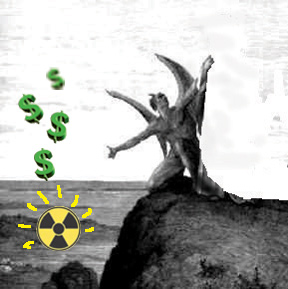 21, 2011, “…..Tepco in 2002 admitted it had falsified maintenance reports at nuclear plants for more than two decades. Chairman Hiroshi Araki and President Nobuya Minami resigned to take responsibility.
Faked Records
In 2007, the utility said it hadn’t come entirely clean five years earlier and admitted to concealing at least six emergency stoppages at Dai-Ichi and a “critical” reaction at the plant’s No. 3 unit that lasted seven hours.
Kansai Electric, Chubu Electric Power Co., Tohoku Electric Power Co. and Hokuriku Electric Power Co. have also said they faked safety records. “Accidents, mishaps, lies, duplicities — the postwar landscape of Japan’s nuclear power development is filled with fiascoes,” the University of Toronto’s Donnelly said.
Amid the accidents and fake safety reports, the underlying premise that resource-poor Japan had to rely on nuclear power was rarely questioned by the government, industry or the country’s bureaucrats……
The majority of opinion surveys show Japan’s public now opposes nuclear power. Sixty percent of respondents to a Mainichi newspaper poll published on Sept. 20 said they favor phasing out atomic energy…..
“The nuclear industry is a very Japanese bureaucracy in nature, similar to the Japanese army during World War II,” said Tetsunari Iida, executive director at the Tokyo-based Institute for Sustainable Energy Policies and a former nuclear industry official. “They don’t listen to anybody.”
Fukushima has ruptured the usual consensus within Japanese industry. http://www.businessweek.com/news/2011-10-21/tepco-deal-with-devil-signals-end-to-japan-s-postwar-era.html
German nuclear compensation court case a precedent for limiting the greed of the nuclear industry
 Limiting the greed of the nuclear industry http://www.dw.com/en/opinion-limiting-the-greed-of-the-nuclear-industry/a-36664176 The German Constitutional Court’s decision that an accelerated nuclear phase-out is legal, and limiting compensation for energy companies is good news, says DW’s Gero Reuter. This could even set a precedent for coal.
“Property entails obligations. Its use shall also serve the public good,” states article 14 of the German constitution. At the same time, the German constitution demands that expropriation is permissible for the public good, and will be compensated after balancing the interests of everyone affected.
That’s the most crucial background to Germany’s biggest power companies – Eon, RWE and Swedish state-owned company Vattenfall – having filed lawsuits against the German government. They asked for compensation for the government’s decision in 2011 to hurry through shutdown of nuclear reactors in the wake of the 2011 nuclear meltdown at Japan’s Fukushima reactor.
According to the energy companies, the nuclear phase-out is an unconstitutional expropriation of their power plants and possible energy production. They had asked for compensation of around 19 billion euros ($20 billion), which was supposed to be shelled out by taxpayers – around 230 euros from each citizen, babies to pensioners.
This week, Germany’s Constitutional Court mostly rejected their claims, saying the law for a nuclear phase-out from 2011 “is mostly compatible with Germany’s constitution.”
Only long-term investments that the power companies made between December 2010 and March 2011 are eligible for compensation, the court ruled, as the German government agreed to a maximum lifetime extension of nuclear power plants for 12 years in 2010.
What’s more, Germany’s Constitutional Court said some of the power companies received unequal treatment, and thus ruled that the German government has to adjust the law accordingly by June 2018.
Good news for taxpayers and the environment
The ruling is good news for taxpayers and the environment, as it will limit the greed of power companies to tap even more subsidies at the expense of public health, the environment and government budgets.
As to the requested compensation costs of around 19 billion euros – fortunately there’s not much left to this argument. It’s possible that the German government won’t have to pay anything to the energy companies at all. If worse comes to worse, it may pay a billion euros. This all depends on how the state will define unequal treatment of the different energy companies over the months to come.
What’s even more positive and groundbreaking is the legal reasoning behind the ruling. Germany’s Constitutional Court stressed several times that it attaches great importance to the protection of life, health and natural resources, and to the minimization of risks through the use of nuclear energy. It also said this could lead to an even faster nuclear phase-out, and that the German government could change its laws after the fact.
Thinking into the future, this decision could set a precedent for legal support to Germany being on the necessary path to withdraw from coal-powered electricity, and to shorten the long-term operating licenses power companies retain for mining lignite (brown coal).
The energy companies should carefully study this decision, and read between the lines to see how the German constitution truly works. “Property entails obligations. Its use shall also serve the public good.”
And if companies don’t use their property for the public good, then the state can expropriate this under certain circumstances. Obviously, the state then has to pay an appropriate compensation fee after balancing the interests of everyone involved – that’s fair.
But it should pay only what’s fair and not a cent more – especially not for big, powerful energy companies.
Medical radiation poses risks for nurses
For patients, unnecessary procedures (usually imaging procedures) and radiation dosing errors represent the bulk of risk from medical radiation, whereas incidental, unintended radiation exposure is the primary concern for nurses and other health care workers…
Radiation safety for patients—and nurses Oncology Nurse Advisor, Bryant  Furlow, October 26, 2011 Diagnostic and therapeutic radiation have prolonged and improved millions of patients’ lives, and represent indispensable and increasingly sophisticated tools in clinical oncology. But medical radiation’s gifts have come at the potential cost of unintended irradiation of patients and health care workers and increased lifetime risks of secondary cancers. This concern has grown with improving patient survival times, particularly among pediatric cancer patients. Continue reading
German court orders compensation for nuclear operators following nation’s exit from nuclear power
 German nuclear operators to get compensation for nuclear exit: court http://www.platts.com/latest-news/electric-power/london/german-nuclear-operators-to-get-compensation-26613982 London (Platts)–6 Dec 2016
* German supreme court says some rights violated by nuclear exit
* But confirms general constitutionality of exit law
* Government needs to set compensation framework by June 2018
Germany’s supreme court (Bundesverfassungsgericht) on Tuesday confirmed that the nuclear exit law from July 2011, although generally conforming with the German constitution, in part violates the property rights of nuclear operators.
Nuclear operators E.ON, RWE and Vattenfall brought the lawsuit after the government decided in 2011 to reverse its planned extension of nuclear runtimes in the wake of the Fukushima nuclear crisis, replacing remaining production quotas with a set deadline for the closure of reactors and a complete phase out of nuclear power by the end of 2022.
The court in Karlsruhe declared that the government needs to put in place “appropriate” compensation for investment based on the initial plan to extend runtimes by around 12 years after the 2009 elections.
The new compensation rules need to be in place by June 30, 2018, the court said in a statement
It did not give any guidance on the compensation sum.
According to a report by German news agency dpa, the operators so far have not quantified their compensation demands, speaking only of “massive economic damage” with dpa quoting estimates of around Eur19 billion.
In October, the government cleared the way for a financial solution to the nuclear storage issues with new rules under which the nuclear operators will pay a combined Eur23.5 billion into a state-run fund for the financing of mid- and long-term nuclear storage in Germany.
In return, the nuclear operators will be released from liability for interim and final storage of nuclear waste, but remain solely responsible for the decommissioning of nuclear power plants as well as the transport of the nuclear waste to the storage repository.
–Andreas Franke, andreas.franke@spglobal.com
–Edited by Alisdair Bowles, alisdair.bowles@spglobal.com
Cancer and birth defects in India’s uranium mining area
Koodankulam struggle: Western nations are learning from their mistakes, India is not, The Weekend Leader, By Nityanand Jayaraman & Sundar Rajan, 30 Nov “…..In Jadugoda, Jharkhand, where India’s uranium is mined by the Uranium Corporation of India Ltd, the effects of radiation among the local adivasi population are horrendous.Indian Doctors for Peace and Development, a national chapter of the Nobel-winning International Physicians for Prevention of Nuclear War, recently published a health study on Jadugoda. The study found that:
• Primary sterility is more common in people residing near uranium mining operations.
• More children with congenital deformities are being born to mothers living near uranium mining operations.
• Congenital defects as a cause of death of children are higher among mothers living near uranium mines.
• Cancer as a cause of death is more common in villages surrounding uranium operations.
• Life expectancy of people living near uranium mining operations is lower than Jharkhand’s state average and lower than in villages far removed from the mines.
• All these indicators of poor health and increased vulnerability are despite the fact that the affected villages have a better economic and literacy status than reference villages….. http://www.theweekendleader.com/Causes/833/Nuking-myths.html
1986 “glossy safe” image of nuclear industry – still being spun today
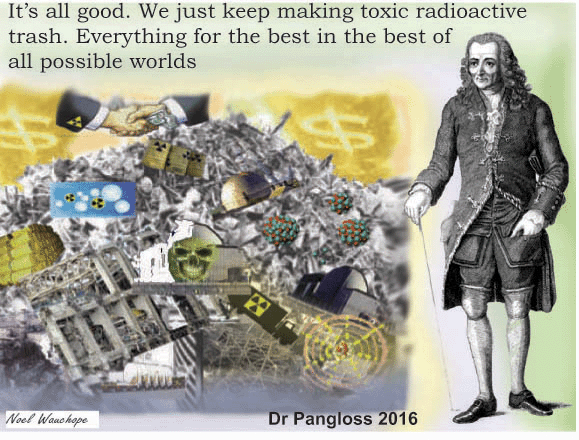
the long-term effects of low-level radiation exposure have consistently been downplayed, distorted or concealed by scientists, the nuclear industry and the government.
It seems that while the US and the USSR had a hard time cooperating on nuclear arms at that time, they had a tacit agreement to cover up each other’s nuclear power mistakes.
these facts, like all those about nuclear power and nuclear weapons testing, were kept secret and released only through the efforts of private citizens and a few courageous researchers and journalists.
At least 250,000 American troops were directly exposed to atomic radiation during the 17 years of bomb testing here and in the Pacific, but they have been totally ignored by the government and the Army.
There is little doubt that hundreds died and that countless others developed illnesses that led to death from various cancers, blood disorders and chronic body ailments. Today the government still rejects all claims for such illnesses.
The press also played a role in soothing public fears.
the US has led the world in setting examples of deliberate deceit, suppression of information and harassment of nuclear critics
Professionals, in order to perform their work, resist truth strongly if it calls the morality of their work into question. They sincerely believe they are helping humankind. In addition, scientific research involves so many uncertainties that scientists can, with an easy conscience, rationalize away dangers that are hypothetical or not immediately observable. They also have an intellectual investment if not a financial one in continuing their work as well as families to support, and nuclear science in particular has been endowed not only with government money and support but great status and prestige.
In order to perform professional work, one must not only believe one is doing good but must also rationalize the dangers. Indeed, with regard to ionizing radiation, this is quite easy inasmuch as the risks of radiation exposure at any level are statistical and not immediately manifested.
Pro Nuclear Propaganda: How Science, Government and the Press Conspire to Misinform the Public http://www.lornasalzman.com/collectedwritings/pro-nuclear.html by Lorna Salzman Hunter College, Energy Studies program, 1986 After the Chernobyl nuclear reactor disaster in the Soviet Union, there was much finger-wagging in the US about the suppression of information there, and the purported differences in reactor design and safety requirements between Russia and the US, which made a similar accident here unlikely if not impossible Continue reading
Britain’s planned new nuclear reactors will produce twice as much highly radioactive trash as now exists
The nuclear industry and government have repeatedly said the volume of nuclear waste produced by new reactors will  be small, approximately 10% of the volume of existing wastes; implying this additional waste will not make a significant difference to finding a GDF for the wastes the UK’s nuclear industry has already created. However, the use of volume as a measure of the impact of radioactive waste is highly misleading.
A much better measure would be the likely impact of wastes and spent fuel on the size or “footprint” of a GDF. New reactors will use so-called ‘high burn-up fuel’ which will be much more radioactive than the spent fuel produced by existing reactors. As a result it will generate more heat, so it will need to be allocated more space in the GDF’s disposal chambers. So rather than using volume as a yardstick, the amount of radioactivity in the waste – and the space required in a GDF to deal with it – are more appropriate ways of measuring the impact of nuclear waste from new reactors.
 The activity of existing waste – mostly stored at Sellafield amounts to 4,770,000 TBq. The proposed reactors at Moorside would produce spent fuel and ILW with an activity of around 4,206,012 TBq making a total of 8,976012 TBq stored in Cumbria. However the activity of spent fuel and ILW stored at new reactor sites outwith Cumbria would amount to 15,586,988 TBq – almost twice as much. And if we assume that the reactors at Bradwell goahead it will probably be more than twice as much.
NuClear News No 90 4. Nuclear Waste Updates The Department of Business, Energy and 
 Industrial Strategy – BEIS – (formerly called ‘DECC’) was planning to hold two public consultations, on the draft National Policy Statement for a Geological Disposal Facility and on Working With Communities based on the work of the Community Representation Working Group, this autumn, but the uncertainty caused by recent turbulence in the wider political environment means that these now look likely to be delayed until early 2017.
Energy Minister Baroness Lucy Neville-Rolfe hailed a “nuclear renaissance” when she addressed the Office for Nuclear Regulation Industry Conference in Cumbria. She said that as well as Hinkley Point C and proposals for new reactors at Moorside the Government is “going further, with proposals to develop 18GW of nuclear power across six sites in the UK.”
She said the Government would be launching a new siting process for a Geological Disposal Facility (GDF) in 2017. The Whitehaven News reported that the site for the GDF would almost certainly be in West Cumbria, but this was not in the Minister’s published speech. (1)
Just to finally knock on the head the idea that most of the nuclear waste is in Cumbria already so we might as well build the GDF there, nuClear News has done some number crunching:
Radioactive Waste Management Ltd (RWM) has developed a detailed inventory of radioactive waste for disposal in its proposed GDF which it calls the ‘Derived Inventory’. This inventory is subject to uncertainty due to a range of factors such as uncertainty about the life of the AGR reactors and what happens to the UK’s plutonium inventory, and, of course proposals for new reactors.
The Derived Inventory is therefore updated periodically to take into account new information. RWM published a new 2013 Derived Inventory in July 2015. This can be compared with the previous 2010 Derived Inventory to obtain further information about the impact of a new reactor programme. The table below is from an RWM report which does just that. (2)
The 2010 inventory showed a derived inventory (2010 DI) which did not include any spent fuel or other waste from new reactors and an upper inventory (2010 UI) – which did include spent fuel and wastes from a 10GW new reactor programme. On the other hand the 2013 Derived Inventory has only one set of figures which includes spent fuel and waste from a 16GW new reactor programme. As mentioned above this could increase in future to take account of the fact that the Government now anticipates the size of the new reactor programme will be 18GW, to allow for the latest additional to the proposed fleet – Bradwell B. Beyond that there are ambitions to build between 7 and 21GW of Small Modular Reactor (SMR) capacity by 2035.
The nuclear industry and government have repeatedly said the volume of nuclear waste produced by new reactors will be small, approximately 10% of the volume of existing wastes; implying this additional waste will not make a significant difference to finding a GDF for the wastes the UK’s nuclear industry has already created. However, the use of volume as a measure of the impact of radioactive waste is highly misleading.
A much better measure would be the likely impact of wastes and spent fuel on the size or “footprint” of a GDF. New reactors will use so-called ‘high burn-up fuel’ which will be much more radioactive than the spent fuel produced by existing reactors. As a result it will generate more heat, so it will need to be allocated more space in the GDF’s disposal chambers. So rather than using volume as a yardstick, the amount of radioactivity in the waste – and the space required in a GDF to deal with it – are more appropriate ways of measuring the impact of nuclear waste from new reactors. The total activity measured in Terabecquerels (TBq) of the 2010 Derived Inventory, (not including any wastes from new reactors) was 4,770,000 TBq.
The total activity given in the 2013 Derived Inventory, which includes waste and spent fuel from a 16GW new reactor programme, was 27,300,000 TBq. Not all of this huge increase in activity is down to new reactors. For instance there is a big jump in the activity of legacy spent fuel and 3,700,000 TBq from spent mixed plutonium-uranium oxide (MoX) fuel – a category which does not appear at all in the 2010 inventory. However, 19,793,000 TBq is activity from new reactor wastes and spent fuel. So the activity of radioactive waste from a new reactor programme would be roughly four times the activity in the total 2010 inventory.
Of course this figure is for a 16GW new reactor programme. For an 18GW programme the total activity of spent fuel and intermediate level waste would be about 22,267,125 TBq or almost five times the activity of existing waste.
[Table on original]
These numbers are significant because of the amount of repository space taken up by existing waste mostly located in Cumbria compared with waste stored on reactor sites outwith Cumbria. The NDA has estimated the total repository footprint for a baseline inventory (the total waste expected to be created by the existing programme) of between 5.6 km2 and 10.3km2 depending on the rock-type. However, the footprint from a maximum inventory which includes a 16GW new reactor programme would be between 12.3km2 and 25km2. (3) [Table on original]
So the activity of existing waste – mostly stored at Sellafield amounts to 4,770,000 TBq. The proposed reactors at Moorside would produce spent fuel and ILW with an activity of around 4,206,012 TBq making a total of 8,976012 TBq stored in Cumbria. However the activity of spent fuel and ILW stored at new reactor sites outwith Cumbria would amount to 15,586,988 TBq – almost twice as much. And if we assume that the reactors at Bradwell goahead it will probably be more than twice as much. http://www.no2nuclearpower.org.uk/nuclearnews/NuClearNewsNo90.pdf
No need for a nuclear reactor to produce medical isotopes: Canada shows the way.
14 September 2016. A consortium of institutions led by TRIUMF, Canada’s national laboratory for particle and nuclear physics and accelerator-based science, is granting sole rights for its proprietary technetium-99m (Tc-99m) production technology to ARTMS™ Products, Inc (ARTMS). Technetium-99m is used in over 80% of all nuclear medicine imaging procedures and is vital to patient care in areas such as cardiology, oncology, and neurology. …

Typically sourced from an ageing global reactor fleet, Tc-99m has been subject to significant supply disruptions in recent years. ARTMS’ production technology promises to provide a reliable, cost effective, and safe supply of this critical medical isotope. The license includes all the required products and procedures for the production of Tc-99m using common hospital-based and commercial cyclotrons, through the bombardment of a high-energy proton beam against specific chemical ‘targets’. ….
“The ARTMS production technology offers many advantages, and that is why we believe our technology is truly disruptive and that it will gain widespread adoption,” Dr. Schaffer added. “Not only does the ARTMS production technology provide regional supply security of Tc-99m, it also offers favourable economics, and aids to eliminate the need for highly-enriched uranium, which is currently used by nuclear reactors to produce this isotope.”
“This agreement represents the culmination of six years of hard work by a dedicated team from across Canada, including TRIUMF, the BC Cancer Agency, Lawson Health Research Institute, and the Centre for Probe Development and Commercialization,” said Dr. Jonathan Bagger, Director of TRIUMF. “Today marks the completion of a major milestone as we move to commercialize a decentralized, green, and Canadian-made, technology that can produce Tc-99m daily at hundreds of hospital-based cyclotrons around the world. This licensing agreement marks the beginning of a new era in Tc-99m production and supply security.”
More information on the recent global isotope shortages, Tc-99m, and the story of ARTMS can be found in this media backgrounder and more information on medical isotopes and cyclotrons can be found in this FAQ. http://www.triumf.ca/current-events/artms%E2%84%A2-products-inc-licenses-canadian-technology-address-global-medical-isotope
France’s aging nuclear reactors and EDF’s debt crisis
EDF faces a seemingly impossible financial equation. It has colossal debt of €37 billion; it must deal with the complex €2.5 billion takeover of Areva; and find the money to extend the life of its 58 reactors at costs estimated between €60 and €100 billion up to 2030. (8)
Meanwhile EDF has been accused by Greenpeace France of grossly underestimating the cost of nuclear electricity.
Greenpeace claimed that if EDF disclosed the true cost of running its fleet of reactors in France while financing two new ones in the UK, it would be declared bankrupt.
“In summary, the French nuclear fleet is at the end of its course, dilapidated and dotted with deficient parts. At the same time, the finances of EDF are in such a deplorable state that the company could soon join Areva in bankruptcy, and is in any case unable to properly maintain its reactors.”
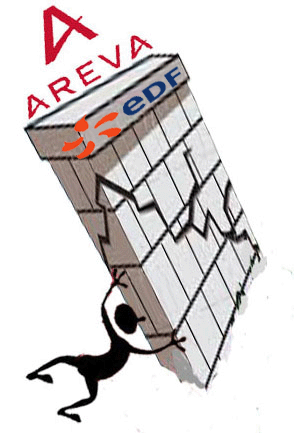 NuClear News No 90 , 26 Nov 16 Problems discovered at Areva’s metal forge at Le Creusot have been growing over the past six months and are now even threatening to derail EDF’s takeover of Areva’s reactor business.
Last spring when Economy Minister Emmanuel Macron visited to tell the workers at Le Creusot that he had every confidence in the nuclear sector, despite the difficulties, 400 files which were being examined for suspected “anomalies” had to be hastily moved out of the meeting room. Now, six months later a crane has been moving prefabricated office buildings into position so that 6,000 records concerning nuclear components – 2.4 million pages – forged at Le Creusot over the last 60 years can be re-examined. Areva has had to accept that the original 400 suspicious files are just the tip of an iceberg and not the only ones containing “irregularities”. 50 people are now trawling through the paperwork and as many more are being recruited for a job that will take at least another eighteen months.
EDF’s CEO Jean-Bernard Lévy says if Le Creusot’s “problems prove insurmountable, the acquisition will not happen”. (1)
With potentially more than half of France’s 58 reactors affected by the “carbon segregation” problem the French nuclear watchdog, the Autorité de Sûreté Nucléaire (ASN) has ordered preventative measures to be taken immediately to ensure public safety. ASN confirmed that, as of late October, 20 reactors were offline and more could be shut down over coming weeks.
Questionable Materials and Documentation
At the heart of France’s nuclear crisis are two problems. One concerns the carbon content of the steel used in critical reactor components, steam heat exchangers, and other components manufactured or supplied by AREVA SA, the French state-owned nuclear engineering firm and global producer of nuclear reactors. The second problem concerns forged, falsified, or incomplete quality control reports about the critical components themselves. Excessive levels of carbon in the steel parts could make them more brittle and subject to sudden fracture or tearing under sustained high pressure, which is obviously unacceptable.
Steam generators from 18 reactors have carbon levels that are above the acceptable level. Some of these were forged at Le Creusot, but others were forged in Japan by JCFC, a subcontractor of Areva. Twelve reactors equipped with JCFC steel are still at a standstill and will be in December while inspections are carried out.
The massive outages are draining power from all over Europe. In the event of severe cold weather this winter, there could be blackouts. Worse, new questions continue to swirl about both the safety and integrity of EDF’s nuclear fleet, as well as the quality of some French- and Japanese-made components that EDF is using in various high-profile nuclear projects around the world.
In October EDF was forced to reduce its 2016 generation targets from 395–400 TWh to 380– 390 TWh, while estimates for nuclear output in 2017 have also been lowered to between 390 TWh and 400 TWh. For perspective, annual nuclear production averaged 417 TWh in the period 2005–2015.
Flamanville
The problem was originally discovered at the Flamanville EPR project in 2014. Since then an internal probe at Le Creusot where many of the components in question were manufactured, has uncovered new anomalies. AREVA is now reported to be reviewing all 9,000 manufacturing records at the forge dating back as far as 1943, including files from more than 6,000 nuclear components.
This autumn there have been almost weekly revelations resulting in plant shutdowns, extended outages, reduced generation, and lots more questions. According to ASN there are now a significant number of reactors offline, with more to be inspected in the next few weeks. “We are now finding carbon segregation problems from components coming from both Le Creusot and [the Kitakyushu-based Japan Casting & Forging Corp.] JCFC plant. As for now, there [are] 20 EDF reactors offline,” the official said, noting that the number will fluctuate as inspections take place.
The analyses performed by EDF thus far have found that since 2015 certain channel heads of the steam generators manufactured by Le Creusot and JCFC “contain a significant carbon concentration zone which could lead to lower than expected mechanical properties,” according to ASN. The Japan Times reports that the JCFC is now also under scrutiny by Japan’s Nuclear Regulation Authority.
Shaun Burnie for Greenpeace said “As a result of substandard manufacturing in Japan, citizens in France have been unknowingly exposed to the risk of catastrophic failure of critical reactor components which could result in a reactor core meltdown. Japanese-supplied steel is now at the centre of France’s unprecedented nuclear crisis the scale of which has never been seen in any country. All 12 reactors supplied by JCFC are either in forced shutdown or about to be. It lacks all credibility that the Japanese nuclear industry would claim that there are no implications for the safety of their own nuclear reactors. The steel production records released in France did not reveal the scale of excess carbon, which was only found after physical testing. There are currently no plans for such tests in Japan. That is wholly unacceptable. There are many urgent questions that need to be answered by the industry and the NRA, and with full public disclosure and transparency.” (2)
Energy traders and analysts warn that the French market needs to prepare for longer maintenance periods in coming years given the age of the nuclear fleet and the continuing design flaw revelations. With the average French reactor now more than 30 years old, equipment will need to be replaced more frequently, and increasingly stringent safety requirements will mean that components could be delayed, especially as ASN imposes additional checks. The safety inspections and other reviews “will lead in particular to extensions of certain planned outages,” EDF said in a press release.
Erring on the Side of Safety?
Despite the outages and findings from the carbon quality investigations, EDF continues to downplay the risk. “The safety margins are very large and the carbon content does not undermine integrity or security, even in the case of an accident,” an EDF spokesperson told Le Monde newspaper. But questions about quality control practices at Le Creusot continue to grow. Indeed, the greater the scrutiny, the more problems are being discovered. The number of components affected by irregularities and already installed in operating reactors increased from 33 known issues in April to 83 by the end of September. Startlingly, irregularities affecting just the Flamanville EPR project increased from two to 20 during the same period.
While EDF and AREVA are dealing with costly damage control, ASN and other agencies are erring on the side of caution. Indeed, the ASN representative said, “We take no risks. That is the rule. If we don’t know the dangers of the carbon segregation, then we must take the reactors offline until we know what the situation is and [can confirm that] it’s not dangerous.”
ASN revealed that AREVA has now identified at least 87 irregularities concerning EDF reactors in operation, including vessels, steam generators, and main primary system piping, plus the 20 issues for parts intended for Flamanville 3, and one more affecting a steam generator planned for installation in Gravelines 5. Inspectors have also found four irregularities affecting transport packaging for radioactive substances. ASN said that whatever the outcome of these investigations, the irregularities “reveal unacceptable practices.”
External Parties Push for Answers
After the discovery of anomalies in the composition of steel in certain zones of the vessel closure head and the vessel bottom head of the EPR reactor being built at Flamanville in 2014, an internal audit was carried out and released in April 2015, suggesting the existence of many more anomalies. These were initially downplayed by ASN and AREVA. But in September 2015 an independent evaluation conducted by Large and Associates for Greenpeace France really set the cat amongst the pigeons. “The nature of the flaw in the steel, an excess of carbon, reduces steel toughness and renders the components vulnerable to fast fracture,” said the report’s author, John Large. The Greenpeace report, “Amplified the questions ASN already had,” said an ASN representative.
12 reactors have been identified by ASN to have carbon problems in replacement steam generators forged by JCFC. In these reactors initial surface tests were followed by more invasive studies. The first reactors to enter scheduled refuelling outages for a more thorough examination were Tricastin 1 and 3. The early nondestructive inspection results for the JCFC bottom channel heads at these reactors revealed an alarming 0.39% level of carbon present, almost 100% greater than the maximum permissible level. That finding, with its associated reduction in material toughness, rendered the component vulnerable to fast fracture, reported Greenpeace in a late October update. ASN decided to order the shutdown of all but one of these reactors and these shutdowns will remain in force until EDF can demonstrate each reactor is safe to re-enter service.
Uncertainty Remains
At a French parliamentary hearing into the situation on October 25, ASN said it would need another year or two to examine the thousands of documents at the Le Creusot foundry and more anomalies and irregularities will probably be discovered. (3
As of late October 2016 ASN has confirmed the following:
- Six reactors have been granted approval to restart and are operating normally: Blayais 1, Chinon 1 and 2, Dampierre 2 and 4, and Saint-Laurent-des-Eaux B2.
- Seven reactos are in planned outages and have been, or are being, inspected. They are: Bugey 4, Civaux 2, Dampierre 3, Gravelines 2, Saint-Laurent-des-Eaux B1, and Tricastin 1 and 3. (4) The Times reports that the re-start of Civaux 2 and Dampierre 3 has been delayed until 31st December.
(5) · Five reactors have been ordered by ASN to be taken offline to conduct checks before 18th January 2017. They are: Civaux 1, Fessenheim 1, Gravelines 4, and Tricastin 2 and 4. (6)
- Three reactors are currently scheduled to remain unavailable throughout the winter months. They are: Bugey 5, Gravelines 5, and Paluel 2.
- One reactor has been ordered by ASN to shut down following the detection of an irregularity in the lower shell of the steam generator. That unit is Fessenheim 2.
- Incidentally, Paluel 2 has been offline since May 2015. Its maintenance period is continuing, following an incident on March 31, 2016, in which a 465-ton steam generator tipped over during removal. (7)
EDF’s Debts
EDF faces a seemingly impossible financial equation. It has colossal debt of €37 billion; it must deal with the complex €2.5 billion takeover of Areva; and find the money to extend the life of its 58 reactors at costs estimated between €60 and €100 billion up to 2030. (8)
Meanwhile EDF has been accused by Greenpeace France of grossly underestimating the cost of nuclear electricity.
Greenpeace claimed that if EDF disclosed the true cost of running its fleet of reactors in France while financing two new ones in the UK, it would be declared bankrupt. Greenpeace commissioned an audit by AlphaValue, the equity research company. The French government has agreed to inject €3 billion into the group this year and has renounced dividend payments until next year. Shares in EDF, 85% of which are owned by the French state, have lost almost a third of their value in the past year and the company is no longer listed on the Paris blue-chip index.
The AlphaValue report described EDF as an “uncompetitive firm – incapable of reacting rapidly and efficiently to the variations in electricity needs and the changes created by the liberalisation of European markets”. It said that EDF’s rivals had written down the value of their nuclear plants because of the move to renewable energy and the fall in electricity prices and that EDF had failed to follow suit. Juan Camilo Rodriguez, author of the report, said the company might have to close 17 of its 58 French reactors to meet the government’s requirement that nuclear power should provide 50 per cent of the nation’s electricity in 2025, down from 75 per cent now.
“The provisions to safeguard the burden of financing the decommissioning of the French reactors are far from sufficient. [If 17 are closed], the group should increase its provisions by more than €20 billion.” Mr Rodriguez said the cost of handling nuclear waste added at least €33.5 billion to that figure. “Whatever scenario is retained, an adjustment of the nuclear provisions . . . would lead to the bankruptcy of EDF from an accountancy point of view,” he added. The report said that EDF would need to find a further €165 billion during the next decade to finance projects such as Hinkley Point and the renovation of reactors in France. EDF says it will spend €51 billion renovating its reactors and £12 billion on Hinkley Point. A spokesman for EDF accused AlphaValue of making erroneous calculations that failed to take account of long-term electricity price movements and differences between France and other European markets. (9) Greenpeace filed a complaint against EDF and its CEO, Jean-Bernard Lévy, for “stock trading offences” at the end of November and EDF responded by suing the group for making “false allegations”.
Greenpeace has asked the public prosecutor “to open a preliminary investigation or to appoint an investigating judge”, saying that “shareholders, investors but also French citizens are being misled by EDF and its CEO”. (10)
According to Stéphane L’homme, Directeur de l’Observatoire du nucléaire: “In summary, the French nuclear fleet is at the end of its course, dilapidated and dotted with deficient parts. At the same time, the finances of EDF are in such a deplorable state that the company could soon join Areva in bankruptcy, and is in any case unable to properly maintain its reactors.” http://www.no2nuclearpower.org.uk/nuclearnews/NuClearNewsNo90.pdf
Nuclear power to fix climate change? The numbers don’t stack up.
NuClearNews No 90 3. 26 Nov 16
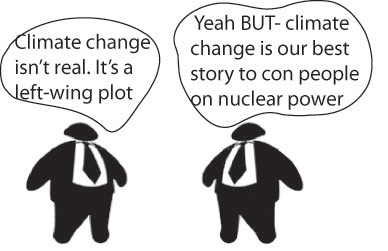 The kind of analysis pioneered by No2NuclearPower in 2005 on the contribution nuclear power might make to tackling climate change (1) has been updated by Fairewinds Associates.
The World Nuclear Association industry trade group estimates that an additional 1.1 Gigatonnes of CO2 would have been created in 2015 if natural gas plants supplied the electricity instead of 438 nuclear stations. That’s 1.1 additional Gt out of 36 Gt – only a 3% difference. Put another way, each of the 438 individual nuclear plants contribute less than seven thousandths of one percent to CO2 reduction. (2)
The World Nuclear Association (WNA) has a plan to build 1,000 new nuclear plants by 2050 (1,000GW) – that means commissioning a new plant on average every 12 days for the next 33 years. It says this is what we need to mitigate global warming. MIT says annual emissions will increase to 64Gt per year by 2050 even if Paris is implemented successfully.
If we build 1,000GW of nuclear capacity we could decrease CO2 emissions by 6.15%
For humanity the $8.2 trillion represents an opportunity cost. Precious time and money wasted. CO2 concentrations will grow by 34ppm in the atmosphere by 2050 while we’re waiting for those nuclear plants to come on line. The 6.15% offset will never be enough to reduce CO2 in the atmosphere by 34ppm. Solar costs have dropped from about 7c/kWh to 3c/kWh since 2013. Electricity from Hinkley Point C will cost about 12c/kWh
Constructing these reactor would cost $8,200,000,000,000 = $8.2 trillion
For humanity the $8.2 trillion represents an opportunity cost. Precious time and money wasted. CO2 concentrations will grow by 34ppm in the atmosphere by 2050 while we’re waiting for those nuclear plants to come on line. The 6.15% offset will never be enough to reduce CO2 in the atmosphere by 34ppm.
Solar costs have dropped from about 7c/kWh to 3c/kWh since 2013. Electricity from Hinkley Point C will cost about 12c/kWh
Lazard Financial Advisory and Asset Management, with no dog in the fight, says the $8.2 TRILLION could be better spent on less expensive alternatives to get more bang for the buck! Lazard also estimates that solar or wind would be 80% less expensive for the equivalent amount of peak electric output. (3) http://www.no2nuclearpower.org.uk/nuclearnews/NuClearNewsNo90.pdf
The AP1000 Nuclear Reactor Design is not fit for purpose: several safety flaws
The AP1000 advanced passive nuclear reactor design has a weaker containment, and fewer back-up safety systems than current reactor designs..
The AP1000 appears to be vulnerable to a very large release of radioactivity following an accident if there were just a small failure in the steel containment vessel, because the gasses would be sucked out the hole in the top of the AP1000 Shield Building due to the chimney effect.
Recent experience with existing reactors suggests that containment corrosion, cracking, and leakage is more common than previously thought, and AP1000s are more vulnerable to containment corrosion than conventional reactors.
In addition the AP1000 shield building lacks flexibility and so could crack in the event of an earthquake or aircraft impact.
The AP1000 reactor design is not fit for purpose and so should be refused a Design Acceptance Confirmation (DAC) and Statement of Design Acceptability (SDA).
NuClear News No 90 26 Nov 16 The AP1000 Reactor Design
NuGen, a consortium of Toshiba and Engie (formerly GDF Suez), is proposing to build three AP1000 reactors at Moorside in Cumbria – a site adjacent to Sellafield. These three reactors together would have a capacity of up to 3.8GW.

The AP1000 reactor is a pressurised water reactor (PWR) designed and sold by Westinghouse Electric Company, now majority owned by Toshiba. But unlike other PWR designs it is what is called an advanced passive design. The idea behind advanced passive design is that it shouldn’t require operator actions or electronic feedback in order to shut it down safely in the event of a loss of coolant accident (LOCA). Such reactors rely more on natural processes such as natural convection for cooling and gravity rather than motor-driven pumps to provide a backup water supply. Westinghouse claims that AP1000 plant safety systems are able to automatically establish and maintain cooling of the reactor core and maintain the integrity of the containment which holds in the radioactive contents indefinitely following design-basis accidents.
The nuclear regulators – the Office for Nuclear Regulation (ONR) and Environment Agency – have been carrying out a new process called ‘Generic Design Assessment’ (GDA), which looks at the safety, security and environmental implications of new reactor designs before an application is made to build that design at a particular site. Initially the GDA for the AP1000 was expected to be completed around spring 2011, when the regulators would have issued a statement about the acceptability of the design. By the end of 2010 it was clear that the ONR would only be able to issue “interim” approvals for the Areva EPR and Westinghouse AP1000 reactor designs at the end of the generic design assessment (GDA) in June 2011. Construction could only occur after any outstanding “GDA issues” had been resolved.
Eventually on 14th December 2011 the Regulators granted interim Design Acceptance Confirmations (iDACs) and interim Statements of Design Acceptability (iSoDAs) for the UK EPR and the AP1000 reactor designs. The Regulators also confirmed that they are satisfied with how EDF and Westinghouse plan to resolve the GDA issues identified during the process.
ONR’s interim approval for the AP1000 contained 51 GDA Issues. At this point Westinghouse decided to request a pause in the GDA process for the AP1000 pending customer input to finalizing it. Westinghouse has since become part of the NuGen consortium with its parent company Toshiba taking a 60% stake, the process for AP1000 has resumed, and is scheduled to be completed by March 2017 with issuance of DAC and SODA. By March 2016, the cost of the GDA for the AP1000 had reached £30 million. (5)
The GDA process is being carried out in, what is described as, an open and transparent manner, designed to facilitate the involvement of the public, who are able to view and comment on design information published on the web. Questions and comments can be submitted electronically via the Westinghouse website, or direct to the UK regulators. The deadline for making a comment on the AP1000 plant, as part of the GDA process is 30th November 2016. (6)
Edinburgh Energy and Environment Consultancy was commissioned by Radiation Free Lakeland to write a report on the AP1000 reactor design to submit to this consultation.
(Available here http://www.no2nuclearpower.org.uk/wp/wpcontent/uploads/2016/11/AP1000_reactors.pdf )
The report came to the following conclusions:
The AP1000 advanced passive nuclear reactor design has a weaker containment, and fewer back-up safety systems than current reactor designs. Conventional reactors rely on defence-indepth made up of layers of redundancy and diversity – this is where, say, two valves are fitted instead of one (redundancy) or where the function may be achieved by one of two entirely different means (diversity). In contrast advanced passive designs rely much more on natural processes such as natural convection for cooling and gravity rather than motor-driven pumps to provide a backup water supply.
The AP1000 appears to be vulnerable to a very large release of radioactivity following an accident if there were just a small failure in the steel containment vessel, because the gasses would be sucked out the hole in the top of the AP1000 Shield Building due to the chimney effect.
Recent experience with existing reactors suggests that containment corrosion, cracking, and leakage is more common than previously thought, and AP1000s are more vulnerable to containment corrosion than conventional reactors.
In addition the AP1000 shield building lacks flexibility and so could crack in the event of an earthquake or aircraft impact.
A thorough review of the AP1000 design in the light of the Japanese accident at Fukushima has shown that:
- Ongoing nuclear fission after a reactor has supposedly been shutdown continues to be the source of significant pressure inside the containment. The AP1000 containment is extraordinarily close to exceeding its peak post accident design pressure which means post accident pressure increases could easily lead to a breach of the containment.
- At least seven ways in which an AP1000 reactor design might lose the ability to cool the reactors in an emergency have been identified. These include damage to the water tank which sits on top of the shield building and some sort of disruption to the air flow around the steel containment.
- The accidents at Fukushima, especially the overheating and the hydrogen explosions in the Unit 4 Spent Fuel Pool showed that the calculations and assumptions about the AP1000 Spent Fuel Pond design were wholly inadequate.
- Fukushima showed that when several reactors share a site an accident at one reactor could damage other reactors. In the AP1000 the water tank on top of the reactor, and the shield building could be vulnerable to damage.
- Westinghouse assumes that there is zero probability of an AP1000 containment breach. But the accidents at Fukushima have shown that there is a high, probability of Containment System failure resulting in significant releases of radioactivity directly into the environment.
The AP1000 reactor design is not fit for purpose and so should be refused a Design Acceptance Confirmation (DAC) and Statement of Design Acceptability (SDA). http://www.no2nuclearpower.org.uk/nuclearnews/NuClearNewsNo90.pdf
1 This Month



26 September – International Day for the Total Elimination of Nuclear Weapons


PLEASE OPPOSE HR 8255 AND S.3639 – bills would accelerate satellite deployment, with no environmental review or safeguards – https://ncstd5li.quorum.us/campaign/169331/
To see nuclear-related stories in greater depth and intensity – go to https://nuclearinformation.wordpress.com
-
Archives
- September 2026 (233)
- August 2026 (330)
- July 2026 (355)
- June 2026 (287)
- May 2026 (306)
- April 2026 (356)
- March 2026 (251)
- February 2026 (267)
- January 2026 (308)
- December 2025 (358)
- November 2025 (359)
- October 2025 (375)
-
Categories
- 1
- 1 NUCLEAR ISSUES
- business and costs
- climate change
- culture and arts
- ENERGY
- environment
- health
- history
- indigenous issues
- Legal
- marketing of nuclear
- media
- opposition to nuclear
- PERSONAL STORIES
- politics
- politics international
- Religion and ethics
- safety
- secrets,lies and civil liberties
- spinbuster
- technology
- Uranium
- wastes
- weapons and war
- Women
- 2 WORLD
- ACTION
- AFRICA
- Atrocities
- AUSTRALIA
- Christina's notes
- Christina's themes
- culture and arts
- Events
- Fuk 2022
- Fuk 2023
- Fukushima 2017
- Fukushima 2018
- fukushima 2019
- Fukushima 2020
- Fukushima 2021
- general
- global warming
- Humour (God we need it)
- Nuclear
- RARE EARTHS
- Reference
- resources – print
- Resources -audiovicual
- Weekly Newsletter
- World
- World Nuclear
- YouTube
-
RSS
Entries RSS
Comments RSS
 nuclear-news
