Puget Sound’s ticking nuclear time bomb, Crosscut by Glen Milner, 10 Jan 17 “……“Command and Control” shows what can happen when the weapons built to protect us threaten to destroy us, and it speaks directly to Puget Sound citizens: Locally, we face a similar threat in Hood Canal with the largest concentration of deployed nuclear weapons in the United States at Naval Base Kitsap-Bangor.
An accident at Bangor involving nuclear weapons occurred in November 2003 when a ladder penetrated a nuclear nose cone during a routine missile offloading at the Explosives Handling Wharf. All missile-handling operations at the Strategic Weapons Facility Pacific (SWFPAC) were stopped for nine weeks until Bangor could be recertified for handling nuclear weapons. Three top commanders were fired but the public was never informed until information was leaked to the media in March 2004.
The Navy never publicly admitted that the 2003 accident occurred. The Navy failed to report the accident at the time to county or state authorities. Public responses from governmental officials were generally in the form of surprise and disappointment.
byPETE DOLACKThe ongoing environmental disaster at Fukushima is a grim enough reminder of the dangers of nuclear power, but nuclear does not make sense economically, either. The entire industry would not exist without massive government subsidies.
Quite an insult: Subsidies prop up an industry that points a dagger at the heart of the communities where ever it operates. The building of nuclear power plants drastically slowed after the disasters at Three Mile Island and Chernobyl, so it is at a minimum reckless that the latest attempt to resuscitate nuclear power pushes forward heedless of Fukushima’s discharge of radioactive materials into the air, soil and ocean.
There are no definitive statistics on the amount of subsidies enjoyed by nuclear power providers — in part because there so many different types of subsidies — but it amounts to a figure, whether we calculate in dollars, euros or pounds, in the hundreds of billions. Quite a result for an industry whose boosters, at its dawn a half-century ago, declared that it would provide energy “too cheap to meter.”
Taxpayers are not finished footing the bill for the industry, however. There is the matter of disposing radioactive waste (often borne by governments rather than energy companies) and fresh subsidies being granted for new nuclear power plants. None of this is unprecedented — government handouts have the been the industry’s rule from its inception. A paper written by Mark Cooper, a senior economic analyst for the Vermont Law School Institute for Energy and the Environment, notes the lack of economic viability then:
“In the late 1950s the vendors of nuclear reactors knew that their technology was untested and that nuclear safety issues had not been resolved, so they made it clear to policymakers in Washington that they would not build reactors if the Federal government did not shield them from the full liability of accidents.” [page iv]
“Despite the profoundly poor investment experience with taxpayer subsidies to nuclear plants over the past 50 years, the objectives of these new subsidies are precisely the same as the earlier subsidies: to reduce the private cost of capital for new nuclear reactors and to shift the long-term, often multi-generational risks of the nuclear fuel cycle away from investors. And once again, these subsidies to new reactors—whether publicly or privately owned—could end up exceeding the value of the power produced.” [page 3]
The many ways of counting subsidies
Among the goodies routinely given away, according to the Concerned Scientists, are: Continue reading →
— In the last days of the Obama Administration, the U.S. Environmental Protection Agency is about to dramatically increase allowable public exposure to radioactivity to levels thousands of times above the maximum limits of the Safe Drinking Water Act, according to documents the agency surrendered in a federal lawsuit brought by Public Employees for Environmental Responsibility (PEER). These radical rollbacks cover the “intermediate period” following a radiation release and could last for up to several years. This plan is in its final stage of approval.
The documents indicate that the plan’s rationale is rooted in public relations, not public health. Following Japan’s Fukushima meltdown in 2011, EPA’s claims that no radioactivity could reach the U.S. at levels of concern were contradicted by its own rainwater measurements showing contamination from Fukushima throughout the U.S. well above Safe Drinking Water Act limits. In reaction, EPA prepared new limits 1000s of times higher than even the Fukushima rainwater because “EPA experienced major difficulties conveying to the public that the detected levels…were not of immediate concern for public health.”
When EPA published for public comment the proposed “Protective Action Guides,” it hid proposed new concentrations for all but four of the 110 radionuclides covered, and refused to reveal how much they were above Safe Drinking Water Act limits. It took a lawsuit to get EPA to release documents showing that –
The proposed PAGs for two radionuclides (Cobalt-60 and Calcium-45) are more than 10,000 times Safe Drinking Water Act limits. Others are hundreds or thousands of times higher;
According to EPA’s own internal analysis, some concentrations are high enough to deliver a lifetime permissible dose in a single day. Scores of other radionuclides would be allowed at levels that would produce a lifetime dose in a week or a month;
The levels proposed by the Obama EPA are higher than what the Bush EPA tried to adopt–also in its final days. That plan was ultimately withdrawn; and
EPA hid the proposed increases from the public so as to “avoid confusion,” intending to release the higher concentrations only after the proposal was adopted. The documents also reveal that EPA’s radiation division even hid the new concentrations from other divisions of EPA that were critical of the proposal, requiring repeated efforts to get them to even be disclosed internally.
“To cover its embarrassment after being caught dissembling about Fukushima fallout on American soil, EPA is pursuing a justification for assuming a radioactive fetal position even in cases of ultra-high contamination,” stated PEER Executive Director Jeff Ruch, noting that New York Attorney General Eric Schneiderman has called for the PAGs to be withdrawn on both public health and legal grounds. “The Safe Drinking Water Act is a federal law; it cannot be nullified or neutered by regulatory ‘guidance.’”
Despite claims of transparency, EPA solicited public comment on its plan even as it hid the bulk of the plan’s effects. Nonetheless, more than 60,000 people filed comments in opposition.
“The Dr. Strangelove wing of EPA does not want this information shared with many of its own experts, let alone the public,” added Ruch, noting that PEER had to file a Freedom of Information Act lawsuit to force release of exposure limits. “This is a matter of public health that should be promulgated in broad daylight rather than slimed through in the witching hours of a departing administration.”
Fukushima Radiation Looms. No Nuclear Power Plant On Planet Earth! “The Incompatibility of Radiation with Human Life” By Eiichiro OchiaiGlobal Research, January 05, 2017.…………… Approximately 450 nuclear power reactors are presently on this earth. In the nuclear power production of electricity, only one third of the heat produced in a reactor is converted into electricity, and the remainder two third of heat is released into the surrounding. A typical 1giga watt reactor will release 4.7 x 10¹⁶ joule of heat into the environment per year. This much heat will bring 100 million tons of water at zero degree to boiling. This is with a single nuclear reactor. The nuclear power reactors are excellent environmental heaters. Hundreds of such reactors are operating on this earth. But this fact is ignored in the argument of the nuclear power being environmentally clean. This is not the only reason for the nuclear reactors being unclean.
In addition, this typical reactor of 1 giga (thousand mega) watt of capacity (electricity) produces in a year radioactive material equivalent to about 1000 Hiroshima atomic bombs. In 2015, the total amount of electricity produced by nuclear reactors was 2,441 BkWh (billion kilo watt hours: data [7]), which is 8.79 x 10¹⁸ joule. It was produced by about 280 nuclear reactors of 1 giga watt capacity. So they produced radioactive material approximately equivalent to 280,000 Hiroshima bombs. In addition, they released 1.3 x 10¹⁹ joule of heat into the environment. These are the values for just one year. Nuclear power reactors have been operating the last forty years, though not always this many.
Anyway, an enormous amount of radioactive material has been made on the earth. How much of it has been released into the environment is not easy to estimate. They have come out into the environment through the tests of the nuclear weapons, use of depleted uranium bombs, the routine release of some radioactive material from the nuclear facilities under normal conditions and others, in addition to the accidents at nuclear facilities. The effects of the released radioactive material have been amply observed and reported, and yet are not shared with the majority of humankind. We mention here only a few cases, and refer them to a few major sources. The nuclear weapon explosion tests in the atmosphere affected the people in the eastern side, Utah, of the test site in Nevada (1951-1960, ref [8]). Chernobyl nuclear reactor accident in the present Ukraine (1986) was one of the worst nuclear facility accidents, and people are still suffering [9]. Fukushima nuclear power plant disaster (2011) cause by the huge earthquake along with tsunami is far from settled, and health effects are only now becoming manifest [10]. These incidents represent the notion that the nuclear power is “not clean” at all, rather it is the dirtiest……http://www.globalresearch.ca/fukushima-radiation-looms-no-nuclear-power-plant-on-planet-earth-the-incompatibility-of-radiation-with-human-life/5566712
The results of the study, published in the prestigious British Medical Journal (BMI), provide “direct evidence about cancer risks after protracted exposures to low-dose ionizing radiation,” said the International Agency for Research on Cancer (IARC), the cancer agency of the World Health Organization.
The findings demonstrate “a significant association between increasing radiation dose and risk of all solid cancers,” the study’s co-author, Dr. Ausrele Kesminiene, told sources.
“No matter whether people are exposed to protracted low doses or to high and acute doses, the observed association between dose and solid cancer risk is similar per unit of radiation dose,” he added.
Nuclear workers around globe at heightened cancer riskContinue reading →
Myth: the new generation of nuclear reactors are designed to recycle nuclear waste
BUST: These reactors don’t exist
These reactors often spoken of by advocates of nuclear energy are hypothetical. There are none of these “Generation IV” reactors commercially operating anywhere in the world:
Even the demonstration plants are still decades away
Various designs are still under investigation on paper and have been for many years.
The first demonstration plants are projected to be in operation by 2030-2040, so they are yet to be tested and still many years away.
Problems with earlier models
The specific type of Generation IV reactor that would recycle waste – the Integral Fast Reactor – only exists on paper, but earlier models of fast reactors have been expensive, underperforming, and have had a history of fires and other accidents, with many countries abandoning the technology.
These reactors would still produce some waste
The Integral Fast Reactor is called “integral” because it would process used reactor fuel on-site, separating plutonium (a weapons explosive) and other long-lived radioactive isotopes from the used fuel, to be fed back into the reactor. It essentially converts long-lived waste into shorter lived waste. This waste would still remain dangerous for a minimum of 200 years (provided it is not contaminated with high level waste products), so we are still left with a waste problem that spans generations.
The theory is that these reactors would eat through global stockpiles of plutonium
When thinking about recycling waste it’s important not to confuse recycling existing stockpiles of waste with these reactors perpetually running off of their own waste, which they could also be operated to do. If they ran off their own waste, they would not consume existing waste beyond the initial fuel load.
Myth: nuclear is the only alternative to coal for baseload power
The Commission has entirely ignored the immense evidence that DOE’s plans for disposal of several types of defense waste pose much greater threats to water resources, most especially at Hanford
“I am dismayed that the Commission saw fit to recommend that the Department of Energy (DOE) have a large upfront role in both the next steps for repository program, … DOE was in large part responsible for the mess the program is in now,
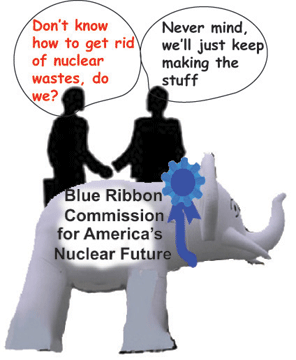
Radioactive Wastes From Nuclear Bomb Program Given Short Shrift In Blue Ribbon Commission ReportEnEws Park Forest, TAKOMA PARK, MD–(ENEWSPF)–January 27, 2012. Arjun Makhijani, Ph.D., President of the Institute for Energy and Environmental Research, today commented on some of the recommendations of the final report of the Presidential Blue Ribbon Commission (BRC) on America’s Nuclear Future.
The commission was created to address U.S. nuclear waste issues after the Obama administration cancelled the Yucca Mountain program….
….On wastes from the nuclear bomb program:
Makhijani: “It is tragic that the Commission did not substantively address the most pressing radioactive waste contamination threats to precious water resources – for instance hundreds of times the drinking water limit at Hanford, Washington on the banks of the Columbia River.
The Commission had a charter to conduct a ‘comprehensive’ review of the nuclear waste problem, including defense wastes from the nuclear bomb program. Yet, it simply said it did not have the resources to deal with all the problems and punted the nuclear weapons waste issue to Congress while focusing on commercial spent fuel at nuclear reactor sites.” Continue reading →
No other force epitomizes the absolute destructive power humanity has unlocked in the way nuclear weapons have. And the weapons rapidly became more powerful in the decades after that first test.
The device tested in 1945 had a 20 kiloton yield, meaning it had the explosive force of 20,000 tons of TNT. Within 20 years, the US and USSR tested nuclear weapons larger than 10 megatons, or 10 million tons of TNT. For scale, these weapons were at least 500 times as strong as the first atomic bomb.
To put the size of history’s largest nuclear blasts to scale, we have used Alex Wellerstein’s Nukemap, a tool for visualizing the terrifying real-world impact of a nuclear explosion.
11 (tie). Soviet Tests #158 and #168
On August 25 and September 19, 1962, less than a month apart, the USSR conducted nuclear tests #158 and #168. Both tests were held over the Novaya Zemlya region of Russia, an archipelago to the north of Russia near the Arctic Ocean.
No film or photographs of the tests have been released, but both tests included the use of 10-megaton atomic bombs. These blasts would have incinerated everything within 1.77 square miles of their epicenters while causing third-degree burns up to an area of 1,090 square miles.
10. Ivy Mike
On November 1, 1952, the US tested Ivy Mike over the Marshall Islands. Ivy Mike was the world’s first hydrogen bomb and had a yield of 10.4 megatons, making it 700 times as strong as the first atomic bomb.
Ivy Mike’s detonation was so powerful that it vaporized the Elugelab Island where it was detonated, leaving in its place a 164-foot-deep crater. The explosion’s mushroom cloud traveled 30 miles into the atmosphere.
9. Castle Romeo
Romeo was the second US nuclear detonation of the Castle Series of tests, which were conducted in 1954. All of the detonations took place over Bikini Atoll. Castle Romeo was the third-most powerful test of the series and had a yield of 11 megatons.
Romeo was the first device to be tested on a barge over open water instead of on a reef, as the US was quickly running out of islands upon which it could test nuclear weapons.
The blast would have incinerated everything within 1.91 square miles.
8. Soviet Test #123
On October 23, 1961, the Soviets conductednuclear test #123 over Novaya Zemlya. Test #123 used a 12.5 megaton nuclear bomb. A bomb of this size would incinerate everything within 2.11 square miles while causing third-degree burns in an area of 1,309 square miles.
No footage or photographs of this nuclear test have been released.
7. Castle Yankee
Castle Yankee, the second-strongest of the Castle series tests, was conducted on May 4, 1954. The bomb was 13.5 megatons. Four days later, its fallout reached Mexico City, about 7,100 miles away.
6. Castle Bravo
Castle Bravo, detonated on February 28, 1954, was the first of the Castle series of tests and the largest US nuclear blast of all time.
Bravo was anticipated as a 6-megaton explosion. Instead, the bomb produced a 15-megaton fission blast. Its mushroom cloud reached 114,000 feet into the air.
The US military’s miscalculation of the test’s size resulted in the irradiation of approximately 665 inhabitants of the Marshall Islands and the radiation poisoning death of a Japanese fisherman who was 80 miles away from the detonation site.
3 (tie). Soviet Tests #173, #174, and #147
From August 5 to September 27, 1962, the USSR conducted a series of nuclear tests over Novaya Zemlya. Tests #173, #174, and #147 all stand out as being the fifth-, fourth-, and third-strongest nuclear blasts in history.
All three produced blasts of about 20 megatons, or about 1,000 times as strong as the Trinity bomb. A bomb of this strength would incinerate everything within 3 square miles.
No footage or photographs of these nuclear tests have been released.
2. Soviet Test #219
On December 24, 1962, the USSR conductedTest #219 over Novaya Zemlya. The bomb had a yield of 24.2 megatons. A bomb of this strength would incinerate everything within 3.58 square miles while causing third-degree burns in an area up to 2,250 square miles.
There are no released photos or video of this explosion.
1. The Tsar Bomba
On October 30, 1961, the USSR detonated the largest nuclear weapon ever tested and created the biggest man-made explosion in history. The blast, 3,000 times as strong as the bomb used on Hiroshima, broke windows 560 miles away, according to Slate.
The flash of light from the blast was visibleup to 620 miles away.
The Tsar Bomba, as the test was ultimately known, had a yield between 50 and 58 megatons, twice the size of the second-largest nuclear blast.
A bomb of this size would create a fireball 6.4 square miles large and would be able to give humans third-degree burns within 4,080 square miles of the bomb’s epicenter.
The first atomic bomb
The first atomic blast was a fraction the size of the Tsar Bomba, but it was still an explosion of almost unimaginable size.
According to the NukeMap, a weapon with a 20-kiloton yield produces a fireball with a radius of 260 meters, making its total width the size of 5 football fields. It would spew deadly radiation over an area 7 miles in width, and would produce third-degree burns in an area over 12 miles in width.
If dropped over lower Manhattan, a bomb of that size would kill over 150,000 people and produce fallout stretching all the way to central Connecticut, according to the NukeMap.
The first atomic bomb was tiny by nuclear weapons standards. But its destructiveness is sill nea lry impossible to grasp.
It wasn’t, however, the first article to suggest that our love for coal was wreaking destruction on our environment that would lead to climate change. The theory—now widely accepted as scientific reality—was mentioned in the news media as early as 1883, and was discussed in scientific circles much earlier than that.
The French physicist Joseph Fourier had made the observation in 1824 that the composition of the atmosphere is likely to affect the climate. But Svante Arrhenius’s 1896 study titled, “On the influence of carbonic acid in the air upon the temperature on the ground” was the first to quantify how carbon dioxide (or anhydrous carbonic acid, by another name) affects global temperature. Though the study does not explicitly say that the burning of fossil fuels would cause global warming, there were scientists before him who had made such a forecast.
The earliest such mention that Quartz could find was in the journal Nature in December of 1882. The author HA Phillips writes:
According to Prof Tyndall’s research, hydrogen, marsh gas, and ethylene have the property to a very high degree of absorbing and radiating heat, and so much that a very small proportion, of say one thousandth part, had very great effect. From this we may conclude that the increasing pollution of the atmosphere will have a marked influence on the climate of the world.
Phillips was relying on the work of John Tyndall, who in the 1860s had shown how various gases in the atmosphere absorb heat from the sun in the form of infrared radiation. Now we know that Phillips was wrong about a few scientific details: He ignored carbon dioxide from burning coal and focused more on the by-products of mining. Still, he was drawing the right conclusion about what our demand for fossil fuels might do to the climate.
Newspapers around the world took those words published in a prestigious scientific journal quite seriously. ……..
Nichols found many examples between 1883 and 1912, where newspapers, including the Philadelphia Inquirer, Kansas City Star, and York Daily, wrote articles about what rising carbon dioxide levels would do the climate.
What’s Next for Climate Action?Prominent scientists say researchers and policy makers need to focus more on adapting to warming and on controversial geoengineering techniques to limit it By Annie Sneed on December 16, 2016 , Scientific American, SAN FRANCISCO—Despite President-elect Donald Trump’s distaste for the Paris climate agreement, countries around the world are already working to ensure that the global temperature rise stays below 2 degrees Celsius. This week at the American Geophysical Union (AGU) conference here, several prominent scientists discussed the critical steps researchers and decision makers need to take now. They said reducing carbon emissions is important, of course, but countries worldwide must also put more energy into adapting to changing weather that even moderate warming will bring, as well as consider the potential of controversial geoengineering techniques to keep warming in check.
One of the primary goals of the Paris accord is mitigation—cutting or preventing greenhouse gas emissions.To help countries meet their emissions pledges, the international community needs to analyze how it can achieve “deep decarbonization,” according to Margaret Leinen, director of the Scripps Institution of Oceanography and president of the AGU. This means determining what emissions-reducing technologies and strategies will work best for a given country. As Leinen explained at a conference panel session, “We need to be able to evaluate these technologies quantitatively in order to understand which ones work, which ones are scalable and for what countries and energy economies they work for.”
Another major detail that still needs to be sorted out: how to track nations’ emissions, to make sure they’re sticking to their reduction targets. “We need to start asking, ‘Okay, how will you prove that you actually did what you pledged to do?’” Leinen told Scientific American after the panel. To do that, countries will have to have some kind of monitoring system, and the international community has yet to agree on the guidelines for how that system will work.
It is up to scientists and engineers to design effective monitoring systems, or strengthen existing ones. ………..
Scientists should thoroughly assess geoengineering techniques and understand what their impact on the Earth’s systems might be, including any unintended consequences. They also need to consider logistical challenges—how to actually make geoengineering techniques work, in case the world decides to use them. Then there are political and governance issues, such as how countries should respond if, say, a nation starts injecting sulfate aerosols into the atmosphere on its own to cool the planet. Despite people’s general unease with geoengineering because of its potential for major unintended consequences, it is another tool countries may eventually need to use to combat climate change. “At this point, we need to keep all options open,” Busalacchi said. “We need to have a solid and robust understanding of what geoengineering can and can’t do, in case mitigation and adaptation fall short.” https://www.scientificamerican.com/article/what-rsquo-s-next-for-climate-action/
By Patrick M. Malone, Center for Public Integrity December 21, 2016
Altogether, the three companies making these settlement payments since 2013 are involved in the operation of six of the eight active sites in the Energy Department’s nuclear weapons program. Actions by the Energy Department’s contractors – including any misspending – have substantial impact there, since contract work consumes roughly 90 percent of its total spending.
Although work on energy generation and consumption garners more public attention and President-elect Donald Trump has nominated an oil-state politician – former Texas governor Rick Perry – to become the department’s new top manager, nuclear weapons-related work accounts for nearly two-thirds of all the Energy Department’s activities.
The latest case emerged from a civil lawsuit that accused two companies of both performing substandard work at a nuclear weapons-related waste site and said one of them had improperly spent government funds to lobby for more. The companies declared on Nov. 23 they would settle the allegations by making the payment, mostly to the federal government, for a total of $125 million, a massive amount for alleged Energy Department-related malfeasance.
The settlement involves work by Bechtel National Inc. and its parent Bechtel Corp., and URS Corp. and its subsidiary URS Energy and Construction Inc., which together have been trying to clean up the Hanford Nuclear Reservation near Richland, Washington. That’s where raw uranium was enriched into fuel for nuclear bombs during the Manhattan Project and the Cold War.
The firms have denied doing anything improper. But the settlement is part of an emerging pattern.
Lockheed Martin Corp., which operates one of three U.S. nuclear weapons laboratories – Sandia, agreed in August 2015 to pay $4.7 million to settle a complaint by the Justice Department that it used federal funds to lobby for a no-bid contract extension, while Fluor Corp. paid $1.1 million in April 2013 to settle accusations that it used federal funds to lobby government agencies for more business at its Hanford training facility.
Worries about the mission being underminedBesides overseeing the Hanford cleanup, Bechtel and URS (now owned by a company called AECOM) help operate the other two U.S. nuclear weapons labs — Los Alamos and Lawrence Livermore, which perform the bulk of U.S. nuclear weapons design work. Altogether, the firms that have reached the settlements since 2013 are involved with operations at Los Alamos and Sandia in New Mexico, Livermore in California, the Pantex Plant in Texas, the Savannah River Site in South Carolina, and the Y-12 National Security Complex in Tennessee.
The recent settlement “demonstrates that the Justice Department will work to ensure that public funds are used for the important purposes for which they are intended,” Benjamin C. Mizer, principal deputy assistant attorney general in charge of the Justice Department’s civil division, said in a written statement released on Nov. 23.
Money allocated by Congress for Hanford “is intended to fund the Department of Energy’s important mission to clean up the contaminated Hanford nuclear site, and this mission is undermined if funds are wasted on goods or services that are not nuclear compliant or to further lobbying activities,” Mizer said.
Both Bechtel and AECOM in written statements said the settlements were made to avoid messy litigation and keep the waste plant project moving. “We have performed our work…ethically and professionally,” Bechtel National Inc. spokesman Fred deSousa said in a written statement, without going into details.
In its own written statement, AECOM — which acquired URS in 2014 — complained that the Department of Justice joined the whistleblowers’ “unwarranted lawsuit against URS” based on events that preceded AECOM’s acquisition of the company. “We take our responsibilities as a government contractor very seriously and have a demonstrated track record of serving our customers with honesty and integrity,” the company’s statement said.
The Justice Department’s involvement in the case originated in civil allegations of mismanagement and wrongdoing in Hanford’s Waste Treatment and Isolation Plant project, commonly called “WTP.” Under its contract with the Energy Department, Bechtel designed and is constructing machinery to convert nuclear-tainted wastes there into a stable, glassy substance suitable for safe disposal.
Three whistleblowers — Walt Tamosaitis, Donna Busche and Gary Brunson — filed a lawsuit on Feb. 4, 2013, accusing Bechtel and URS bosses of mismanagement and misappropriation of funds over a dozen years that together cost the government more than $1 billion. They also said safety lapses at the site, motivated by a desire to meet Energy Department deadlines and collect financial bonuses, were serious enough to risk a nuclear accident.
The whistleblowers’ complaint triggered an investigation by the Energy Department’s Office of Inspector General, which collected emails sent between Bechtel’s project leaders, the company’s top congressional lobbyist for nuclear projects, and Energy Department employees. The whistleblowers’ attorneys subsequently obtained the emails through the civil discovery process and incorporated them into an amended complaint. The Justice Department, in turn, used the complaint as the basis for its own investigation of Bechtel and URS.
Getting $45 million in new work
In the complaint, the whistleblowers said that when they originally lodged accusations of mismanagement – several years earlier — Bechtel project leaders launched a coordinated lobbying campaign to defend itself and also to collect new revenues for additional work on the waste treatment plant project. It then billed the department for the costs of this lobbying, the complaint said.
In an email sent by one Bechtel manager to another — along with a chart detailing the work that the company could say the additional revenue would finance — the manager said “in reality if we did not receive the additional $50m … most of these activities would still likely happen,” according to the whistleblowers’ complaint. The company subsequently got $45 million added to its contract.
The full emails detailing these actions have not been publicly released, by either the government or the plaintiffs, because the messages are part of an investigation that remains “open and ongoing,” according to Felicia Jones, spokeswoman for the Energy Department Office of Inspector General. She declined to say whether her colleagues consider the whistleblowers’ description of the emails accurate.
The Justice Department’s statement affirmed that it had “alleged that Bechtel National Inc. and Bechtel Corp. improperly claimed and received government funding for lobbying activities.” But Justice Department spokeswoman Nicole Nava declined to comment about the whistleblower’s account of specific emails.
Lobbying Congress for new work isn’t against the law. But billing the government for lobbying is, according to the federal Byrd Amendment, approved by Congress in 1989. Court records state that Bechtel will pay $67.5 million of the settlement, and AECOM will pay $57.5 million; the amount of money that will go to the whistleblowers – who are entitled to a portion of any funds they help the government recover — has not been determined yet.
Charles Curtis, who oversaw the Energy Department’s nuclear weapons work from 1994 to 1997 while serving as undersecretary and then deputy secretary, said he was not aware of any improperly-funded lobbying during his tenure. But he expressed surprise that multiple contractors within the past three years have been caught doing it. “These are for-profit enterprises. They can use their shareholders’ money for lobbying, but to use congressionally appropriated money [is] a diversion of funds,” Curtis said. “It’s not only unethical … it’s illegal.”
Three years ago, it was the Fluor Corporation and its subsidiary Fluor Hanford Inc., which at the time held the contract to manage the Hanford site, that agreed to pay $1.1 million to settle a separate complaint that its officials lobbied with government money from 2005 to 2010 to drum up business for a federally funded training facility there. Loydene Rambo, a Fluor employee, triggered the settlement by filing her own whistleblower suit, based on what she described as records of the lobbyists being paid with federal funds. She received a $200,000 reward, and Fluor denied any wrongdoing.
The Justice Department’s August 2015 settlement with Lockheed Martin Corporation, which runs Sandia, similarly followed improper billing of the government for a more complex and elaborate lobbying effort to extend its management contract, according to a special investigation report released by the Energy Department Office of Inspector General. Lockheed agreed to pay $4.7 million in 2015 to settle the Justice Department’s complaint about the billing. Like Fluor before it and Bechtel and URS since, Lockheed Martin in a written statement denied it had done anything wrong.
Asked by the Center about how the lobbying settlements have affected the department’s relationship with its nuclear weapons contractors, Energy Department spokeswoman Bridget Bartol said in an email that “the Department has taken and will continue to take vigorous action against any contractor who spends federal funds on improper lobbying activities.”
Bechtel remains the primary contractor on the WTP project, and Lockheed Martin still holds the contract to operate Sandia National Laboratories.
Cleanup of the Hanford site was authorized 25 years ago, and as of 2000 it was expected to cost $4.3 billion and be completed in 2011. The Department now estimates it may not be fully operational until 2037, according to pleadings filed in federal court by government lawyers defending the Energy Department in a lawsuit brought by the state of Washington to force an acceleration of the cleanup. If the job is funded at its current level of about $690 million a year until 2037, the cost would exceed $15 billion.
President-elect Donald Trump’s transition team is mindful of the project’s problems and growing price tag. A recent memo to top Energy Department officials from the transition team he appointed asked them to describe “your alternatives to the ever increasing WTP cost and schedule, whether technical or programmatic.”
The Center for Public Integrity is a nonprofit, investigative newsroom in Washington, D.C. More of its national security reporting can be found here.
What Lies Beneath In the 1960s, hundreds of pounds of uranium went missing in Pennsylvania. Is it buried in the ground, poisoning locals—or did Israel steal it to build the bomb?
BY SCOTT C. JOHNSON FOREIGN POLICY, 20 DEC 16 As a kid in the 1960s, Jeff Held thought that having a nuclear company in his backyard made life more exciting in Apollo, Pennsylvania. About 2,400 people lived alongside the Nuclear Materials and Equipment Corporation (NUMEC), the town’s main employer. Held’s neighborhood subsisted on atomic lore: Just 33 miles down the road in Pittsburgh, the Westinghouse Corporation had helped construct the world’s first nuclear submarine, and in Apollo, NUMEC consequently manufactured the requisite nuclear fuel, a source of stirring pride minted by the Cold War
To Held, the plant, its lights flickering over the western edge of town on the banks of the Kiskiminetas River, was “kind of neat.” When one of the town’s radiation monitors went off, children would dash through neighbors’ backyards to reach the facility—it was housed inside a refurbished steel mill with dirt floors, big windows, and dozens of smokestacks—to see what had happened.
As Held grew older, the plant that inspired his boyish thrill evolved into something more puzzling, and more sinister. NUMEC closed its doors in 1983, and in the mid-1990s, the federal government swooped in and declared several city blocks contaminated. Various agencies rolled in with bulldozers, razed the plant, and carted off the radioactive pieces, barrel by barrel, for disposal. Ever since, Apollo’s residents have been grappling with fears that NUMEC poisoned their town.
One bitterly cold day this January, Held—now 53 and Apollo’s mayor—drove me north on State Route 66, which cuts along one side of the old NUMEC site. A green chain-link fence outlines the desolate acreage where the factory once stood. Held, a stout man with a graying beard, gestured up a hill toward several decaying Victorian houses. The residents, he said, have suffered from various cancers: lung, thyroid, prostate, brain. They have argued that years of radiation soaking into their soil, air, water, clothes, and homes had led to their afflictions. To date, owners of the NUMEC property have shelled out tens of millions of dollars in compensation to locals who’ve filed suit.
Apollo’s woes didn’t end with those payouts, however. Held told me that events shifted, alarmingly, one day in September 2011, two years before he was elected mayor. That’s when he saw several white SUVs, with blue U.S. Homeland Security decals emblazoned on their sides, stationed on the road just five miles north, in Parks Township. As he drove up the road, Held said, men with high-caliber military assault rifles milled around. It looked like a Hollywood blockbuster about a terrorist attack.
In Parks, a second NUMEC facility had produced plutonium starting in 1960, but it also had served another purpose: nuclear disposal. From 1961 to 1970, the corporation dug at least 10 shallow trenches, spread across about 44 acres, into which it dumped radioactive waste; some locals speculate that other companies around the country shipped their waste to Parks to be buried too. Although the U.S. Army Corps of Engineers (USACE) had been put in charge of cleaning up the site in 2002, under congressional authorization, the process didn’t begin until almost a decade later—right before Held encountered the madness on the road.
In October 2011, the USACE announced that excavation activities at the site were suspended. The work was halted after Cabrera Services, a Connecticut-based contractor hired to clean up Parks, mishandled materials, which the company acknowledged. The following year, the USACE uncovered an unexpected variety of “complex” radioactive contaminants in the ground, but it didn’t say all of what it had found or how much of it. In a December 2014 report, the USACE noted that among the contaminants it expects to find are several “radionuclides of concern,” including americium-241, radium-228, uranium-235, and various types of plutonium, which, under the right conditions, could be used as ingredients for a dirty bomb. It seems the material buried at Parks is more dangerous than anyone had previously imagined.
The USACE immediately ceased the excavation and established a 24-hour patrolled security perimeter that’s still in effect today. Bidding for a new cleanup contractor starts this summer, and the work, now forecast to begin in 2017, is expected to cost roughly half a billion dollars—10 times the original estimate in 2002.
The nuclear mess in Parks could hold clues to yet another mystery in this Pennsylvania community, one that has bedeviled nuclear analysts for decades. Beginning in the early 1960s, investigators from the Atomic Energy Commission (AEC), the agency that regulated U.S. nuclear facilities at the time, began to question how large amounts of highly enriched, weapons-grade uranium had gone missing from NUMEC. Any nuclear site had a certain amount of loss, from seepage into walls and floors, for instance. In fact, between 1952 and 1968, lax standards at 20 of the country’s commercial nuclear sites resulted in an apparent loss of 995 kilograms (2,194 pounds) of uranium-235. But investigators found that at NUMEC, hundreds of pounds went missing, more than at any other plant.
NUMEC’s founder, Zalman Shapiro, an accomplished American chemist, addressed the concern in 1978, telling Arizona Congressman Morris Udall that the uranium simply escaped through the facility’s air ducts, cement, and wastewater. Others, such as the late Glenn Seaborg, the AEC’s chairman in the 1960s—who had previously helped discover plutonium and made key contributions to the Manhattan Project—have suggested that the sloppy accounting and government regulations of the mid-20th century meant that keeping track of losses in America’s newborn nuclear industry was well near impossible. Today, some people in Apollo think that at least a portion of the uranium might be buried in Parks, contaminating the earth and, ultimately, human beings.
But a number of nuclear experts and intelligence officials propose another theory straight out of an espionage thriller: that the uranium was diverted—stolen by spies working for the Mossad, Israel’s intelligence agency. In the 1960s, to secure nuclear technology and materials, Israel mounted covert operations around the world, including at least one alleged open-ocean transfer of hundreds of pounds of uranium. Some experts have also raised questions about Shapiro himself. He had contacts deep within Israel’s defense and intelligence establishments when he ran NUMEC; several of them even turned up at his facility over time and concealed their professional identities while there.
Fifty years after investigations began—they have involved, at various times, the AEC and its successors, Congress, the FBI, the CIA, and other government agencies—NUMEC remains one of the most confounding puzzles of the nuclear era. ……….
Today, many people in the nuclear and intelligence communities are still convinced that a diversion occurred. “I tend to think it happened,” Stockton told me. “In fact, I’m damn sure it happened.” But the believers also concede that the evidence against Shapiro remains largely circumstantial; the nail in the coffin, they say, would be a confession from the aging founder of NUMEC or the release of a yet-to-be-identified document that would show definitive proof…….http://foreignpolicy.com/2015/03/23/what-lies-beneath-numec-apollo-zalman-shapiro/
Dec 10th 2016 THAT solar panels do not emit greenhouse gases such as carbon dioxide when they are generating electricity is without question. This is why they are beloved of many who worry about the climate-altering potential of such gases. Sceptics, though, observe that a lot of energy is needed to make a solar panel in the first place. In particular, melting and purifying the silicon that these panels employ to capture and transduce sunlight needs a lot of heat. Silicon’s melting point, 1,414°C, is only 124°C less than that of iron.
Silicon is melted in electric furnaces and, at the moment, most electricity is produced by burning fossil fuels. That does emit carbon dioxide. So, when a new solar panel is put to work it starts with a “carbon debt” that, from a greenhouse-gas-saving point of view, has to be paid back before that panel becomes part of the solution, rather than part of the problem. Observing this, some sceptics have gone so far as to suggest that if the motive for installing solar panels is environmental (which is often, though not always, the case), they are pretty-much useless.
Wilfried van Sark, of Utrecht University in the Netherlands, and his colleagues have therefore tried to put some numbers into the argument. As they report in Nature Communications, they have calculated the energy required to make all of the solar panels installed around the world between 1975 and 2015, and the carbon-dioxide emissions associated with producing that energy. They also looked at the energy these panels have produced since their installation and the corresponding amount of carbon dioxide they have prevented from being spewed into the atmosphere. Others have done life-cycle assessments for solar power in the past. None, though, has accounted for the fact that the process of making the panels has become more efficient over the course of time. Dr Van Sark’s study factors this in.
Panel games To estimate the number of solar panels installed around the world, Dr Van Sark and his team used data from the International Energy Agency, an autonomous intergovernmental body. They gleaned information on the amount of energy required to make panels from dozens of published studies. Exactly how much carbon dioxide was emitted during the manufacture of a panel will depend on where it was made, as well as when. How much emitted gas it has saved will depend on where it is installed. A panel made in China, for example, costs nearly double the greenhouse-gas emissions of one made in Europe. That is because China relies more on fossil fuels for generating power. Conversely, the environmental benefits of installing solar panels will be greater in China than in Europe, as the clean power they produce replaces electricity that would otherwise be generated largely by burning coal or gas.
Once the team accounted for all this, they found that solar panels made today are responsible, on average, for around 20 grams of carbon dioxide per kilowatt-hour of energy they produce over their lifetime (estimated as 30 years, regardless of when a panel was manufactured). That is down from 400-500 grams in 1975. Likewise, the amount of time needed for a solar panel to produce as much energy as was involved in its creation has fallen from about 20 years to two years or less. As more panels are made, the manufacturing process becomes more efficient. The team found that for every doubling of the world’s solar capacity, the energy required to make a panel fell by around 12% and associated carbon-dioxide emissions by 17-24%.
The consequence of all this number-crunching is not as clear-cut as environmentalists might hope. Depending on the numbers fed into the model, global break-even could have come as early as 1997, or might still not have arrived. But if it has not, then under even the most pessimistic assumptions possible it will do so in 2018. After that, solar energy’s environmental credentials really will be spotless.
The problem — a huge one and not mentioned whatsoever by World Nuclear News — involves accidents with space nuclear power systems releasing radioactivity impacting on people and other life on Earth. That has already happened. With more space nuclear operations, more atomic mishaps would be ahead.
are subject to falling back to Earth and raining deadly radioactivity on human beings and other life on this planet.
The Push for More Spaceborne Nuclear Russian Roulette HUFFINGTON POST, Karl Grossman, Investigative reporter 07/31/2012 World Nuclear News, the information arm of the World Nuclear Association that seeks to boost the use of atomic energy, last week heralded a NASA Mars rover slated to land on Mars on Monday, the first Mars rover fueled with plutonium.
“A new era of space exploration is dawning through the application of nuclear energy for rovers on Mars and the Moon, power generation at future bases on the surfaces of both and soon for rockets that enable interplanetary travel,” began a dispatch from World Nuclear News. It was headed: “Nuclear ‘a stepping stone’ to space exploration.”
In fact, in space as on Earth there are safe, clean alternatives to nuclear power. Indeed, right now a NASA space probe energized by solar energy is on its way to Jupiter, a mission which for years NASA claimed could not be accomplished without nuclear power providing onboard electricity. Solar propulsion of spacecraft has begun. And scientists, including those at NASA, have been working on using solar energy and other safe power sources for human colonies on Mars and the moon.
The World Nuclear Association describes itself as “representing the people and organizations of the global nuclear profession.”….. The problem — a huge one and not mentioned whatsoever by World Nuclear News — involves accidents with space nuclear power systems releasing radioactivity impacting on people and other life on Earth. That has already happened. With more space nuclear operations, more atomic mishaps would be ahead. NASA, before last November’s launch of Curiosity, acknowledged that if the rocket lofting it exploded at launch in Florida, plutonium could be released affecting an area as far as 62 miles away — which includes Orlando. Further, if the rocket didn’t break out of the Earth’s gravitational field, it and the rover would fall back into the atmosphere and break up, potentially releasing plutonium over a massive area. In its Final Environmental Impact Statement for the mission, NASA said in this situation plutonium could impact on “Earth surfaces between approximately 28-degrees north latitude and 28-degrees south latitude.” That includes Central America and much of South America, Asia, Africa and Australia.
The EIS said the costs of decontamination of plutonium in areas would be $267 million for each square mile of farmland and $1.5 billion for each square mile of “mixed-use urban areas.” The Curiosity mission itself, because of $900 million in cost overruns, now has a price of $2.5 billion.
NASA set the odds very low for a plutonium release for Curiosity. The EIS said “overall” on the mission, the likelihood of plutonium being released was 1 in 220. Bruce Gagnon, coordinator of the Global Network Against Weapons & Nuclear Power in Space , which has for more than 20 years been the leading opposition group to space nuclear missions, declared that “NASA sadly appears committed to maintaining its dangerous alliance with the nuclear industry. Both entities view space as a new market for the deadly plutonium fuel. … Have we not learned anything from Chernobyl and Fukushima?”
Plutonium has long been described as the most lethal radioactive substance. And the plutonium isotope used in the space nuclear program, and on the Curiosity rover, is significantly more radioactive than the type of plutonium used as fuel in nuclear weapons or built up as a waste product in nuclear power plants. It is Plutonium-238 as distinct from Plutonium-239. Plutonium-238 has a far shorter half-life — 87.7 years compared to Plutonium-239 with a half-life of 24,110 years. An isotope’s half-life is the period in which half of its radioactivity is expended.
Dr. Arjun Makhijani, a nuclear physicist and president of the Institute for Energy and Environmental Research, explains that Plutonium-238 “is about 270 times more radioactive than Plutonium-239 per unit of weight.”….
The worst accident of several involving a Soviet or Russian nuclear space systems was the fall from orbit in 1978 of the Cosmos 954 satellite powered by a nuclear reactor. It also broke up in the atmosphere as it fell, spreading radioactive debris over 77,000 square miles of the Northwest Territories of Canada…..
the pressure by promoters of nuclear energy on NASA and space agencies around the world to use atomic energy in space is intense — as is the drive of nuclear promoters on governments and the public for atomic energy on Earth.
Critically, nuclear power systems for space use must be fabricated on Earth — with all the dangers that involves, and launched from Earth — with all the dangers that involves (one out of 100 rockets destruct on launch), and are subject to falling back to Earth and raining deadly radioactivity on human beings and other life on this planet. http://www.huffingtonpost.com/karl-grossman/the-push-for-more-spacebo_b_1717531.html
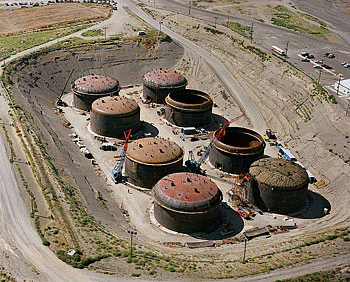
The price tag for cleaning up nuclear waste at Hanford site just went up another $4.5 billion LA Times, 16 Dec 16 Ralph VartabedianContact ReporterThe U.S. Energy Department said Friday that its long-troubled attempt to build a plant to process highly radioactive sludge at a former nuclear weapons site in central Washington state will cost an additional $4.5 billion, raising the project’s price tag to $16.8 billion.
The Hanford treatment plant, a small industrial city with some two dozen facilities on a desert plateau along the Columbia River, is more than a decade behind schedule and will cost nearly four times the original estimate made in 2000.
The government aims to transform 56 million gallons of deadly sludge stored in leaky underground tanks into solid glass, which theoretically could then be stored safely for thousands of years.
But the effort has involved an extended history of errors, miscalculations and wrongdoing. The result has been a massive, partially built concrete facility that has been under a stop-work order for three years because of serious technical doubts.
The biggest technical problems involve two giant facilities, a melter building for high-level radioactive waste and a pretreatment building to prepare the sludge for chemical processing.
After an exhaustive technical review, the Energy Department at the beginning of this year ordered fixes for more than 500 problems, some of them fundamental design deficiencies at the melter. Construction of the building and equipment was 78% complete at the time of the review.
And in November, the Justice Department settled a False Claims Act suit against two major contractors at the plant, San Francisco-based Bechtel Corp. and AECOM, an engineering, design and construction management company based in Los Angeles. The allegations originally were brought by three engineers at the plant, who had long raised concerns that the fundamental design of the plant was flawed. The two companies agreed to pay $125 million in damages, a portion of which will be awarded to the three whistle-blowers……..
outside watchdogs say the giant cost increase could jeopardize the cleanup at a time when the incoming president, Donald Trump, has already sharply criticized high-cost government projects and contracts.
Tom Carpenter, executive director of the Hanford Challenge, which has helped whistle-blowers disclose problems at the site, said the new cost estimate puts a target on the plant that could lead the Energy Department to begin searching for lower-cost and less safe solutions to the waste problem.
One potential lower-cost remedy at Hanford, which has been used at other former nuclear waste sites, would be to pour concrete into the tanks to solidify the waste and then simply leave it in place. The risk is that the concrete might eventually break down, leak radioactivity into the groundwater and contaminate the Columbia River about seven miles away, Carpenter said.
“There are a lot of question marks about the fate of this facility,” Carpenter said.
The revised plan disclosed Friday is part of an effort to get the waste treatment plant started up sooner, though the estimated delay for full operational status seems to be growing.
In 2013, then-Energy Secretary Steven Chu stopped most construction on the project after a whistle-blower warned about a potential for explosion from accumulated hydrogen gas in the melter tanks. In an effort to get the cleanup moving again, Chu’s successor, Ernest J. Moniz, ordered that some of the lower-level waste be solidified without any pretreatment — a so-called direct feed system — and on a faster schedule at the low-level melter.
The early processing could begin in 10 years or less, but the full capability for the most highly radioactive sludge that requires the high-level melter is now scheduled for a 2036 start-up, some 20 years past the original schedule, Carpenter said.









 Nuclear weapon firms pay to settle illegal lobbying cases http://www.usatoday.com/story/news/2016/12/21/nuclear-weapon-firms-pay-settle-illegal-lobbying-cases/95609254/







 nuclear-news