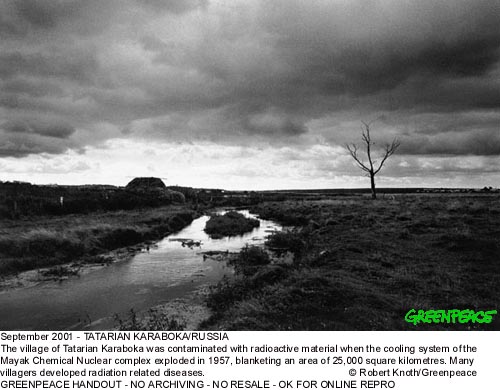
 Russia’s nuclear nightmare flows down radioactive river, http://www.concordmonitor.com/Russia-s-nuclear-nightmare-flows-down-radioactive-
 river-1834751 Monitor, By KATHERINE JACOBSEN Associated Press. Friday, April 29, 2016 At first glance, Gilani Dambaev looks like a healthy 60-year-old man and the river flowing past his rural family home appears pristine. But Dambaev is riddled with diseases that his doctors link to a lifetime’s exposure to excessive radiation, and the Geiger counter beeps loudly as a reporter strolls down to the muddy riverbank.
Some 30 miles upstream from Dambaev’s crumbling village lies Mayak, a nuclear complex that has been responsible for at least two of the country’s biggest radioactive accidents. Worse, environmentalists say, is the facility’s decades-old record of using the Arctic-bound waters of the Techa River to dump waste from reprocessing spent nuclear fuel, hundreds of tons of which is imported annually from neighboring nations
At first glance, Gilani Dambaev looks like a healthy 60-year-old man and the river flowing past his rural family home appears pristine. But Dambaev is riddled with diseases that his doctors link to a lifetime’s exposure to excessive radiation, and the Geiger counter beeps loudly as a reporter strolls down to the muddy riverbank.
Some 30 miles upstream from Dambaev’s crumbling village lies Mayak, a nuclear complex that has been responsible for at least two of the country’s biggest radioactive accidents. Worse, environmentalists say, is the facility’s decades-old record of using the Arctic-bound waters of the Techa River to dump waste from reprocessing spent nuclear fuel, hundreds of tons of which is imported annually from neighboring nations.
The results can be felt in every aching household along the Techa, where doctors record rates of chromosomal abnormalities, birth defects and cancers vastly higher than the Russian average – and citizens such as Dambaev are left to rue the government’s failure over four decades to admit the danger.
“Sometimes they would put up signs warning us not to swim in the river, but they never said why,” said Dambaev, a retired construction worker who like his wife, brother, children and grandchildren have government-issued cards identifying them as residents of radiation-tainted territory. “After work, we would go swimming in the river. The kids would too.”
Thousands already have been resettled by Russia’s Rosatom State Atomic Energy Corp. to new homes a mile inland from the river, leaving Dambaev’s village of Muslyumovo in a state of steady decay as shops close and abandoned homes are bulldozed. The evacuations began in 2008, two decades after Russia started to admit disasters past and present stretching from Mayak’s earliest days in the late 1940s as the maker of plutonium for the first Soviet atomic bombs.
The question, 30 years after the former Soviet Union’s greatest nuclear disaster in Chernobyl, is whether Mayak is truly cleaning up its act or remains primed to inflict more invisible damage on Russians. Nuclear regulators say waste no longer reaches the river following the last confirmed dumping scandal in 2004, but anti-nuclear activists say it’s impossible to tell given the level of state secrecy.
Vladimir Slivyak, an activist for the Russian environmentalist group EcoDefense, has visited villages downstream from Mayak many times to help document the poor health of locals in the area, 870 miles east of Moscow near Russia’s border with Kazakhstan.
“My opinion is they’re still dumping radioactive waste,” he said, “but proving that is impossible unless Mayak says: ‘Yes, we’re dumping radioactive waste.’“
The Nuclear Safety Institute at the Russian Academy of Sciences, which oversees safety standards for the country’s nuclear industry, told the AP that Mayak’s nuclear waste processing system presents no danger to the surrounding population. The plant also manufactures a range of radioactive isotopes of use for specialist equipment, medical research and cancer treatments that generate lucrative contracts worldwide.
Rosatom spokesman Vladislav Bochkov, in response to several Associated Press requests seeking an interview to discuss Mayak’s safety standards and operations, sent an email Thursday denying Mayak dumps nuclear waste in the river. Bochkov said the complex “follows all the environmental protection guidelines and has all the approvals it needs for operation.”
“The level of pollution in the Techa River today completely complies with the sanitary standards of the Russian Federation,” he wrote. He said the river water is clean: “You can drink it endlessly.”
But when the AP took a Geiger counter to the riverbank outside Dambaev’s home, the meter reading surged at the water line and the machine began beeping loudly and continuously. Measurements ranged from 8.5 to 9.8 microsieverts — 80 to 100 times the level of naturally occurring background radiation. A typical chest X-ray involves a burst of about 100 microsieverts.
Nuclear Safety Institute member Leonid Bolshov bills these levels as safe, saying: “The level of pollution in the water today is incomparably less to what it used to be.”
What it used to be is pretty bad. Environmentalists estimate that Mayak tossed 76 million cubic meters (2.68 billion cubic feet) of untreated waste — enough to fill more than 30,000 Olympic-sized swimming pools — into the river from 1948 to the mid-1950s as nuclear scientists scrambled to catch up to the U.S. nuclear program.
In September 1957, underground storage tanks of overheating nuclear waste exploded, sending a cloud of nuclear fallout 300 kilometers (200 miles) northeast across 217 towns and villages containing 272,000 people, a minority of which were quietly evacuated over the following two years.
A decade later, a nearby lake used to dispose of nuclear waste dried up amid a summer drought, and high winds whipped the exposed powdery residue to many of the same population centers. Greenpeace estimates the fallout reached 68 towns and villages containing 42,000 people.
Russia suppressed all news of both disasters until the late 1980s, when it acknowledged the two accidents and the Mayak site’s very existence.
In 1993, Russia said the two accidents combined with longer-term dumping of waste into the river meant that an estimated 450,000 people had been exposed to excess radiation from Mayak. It offered no breakdown of immediate deaths, accelerated deaths or increased rates of illness and disease in the populace.
A 2005 criminal case against Mayak’s then-director, Vitaly Sadovnikov, revealed that the plant continued to dump at least 30 million cubic meters (1 billion cubic feet) of untreated nuclear waste into the river from 2001 to 2004. Prosecution documents said the dumping quadrupled the volume of the radioactive isotope strontium-90 in the river.
A study by Greenpeace in 2007, citing hospital records and door-to-door surveys of Muslyumovo residents, reported cancer rates 3.6 times higher than the Russian national average. Russian scientists have reported residents suffer 25 times more genetic defects than the general population.
A decades-long Radiation Research Society study of people living near the Techa River conducted jointly by Russian and American scientists has linked radiation particularly to higher rates of cancer of the uterus and esophagus. In their latest 2015 report, the scientists analyzed 17,435 residents born before 1956, among them 1,933 with cancer. They found that the vast majority of residents had accumulated heightened deposits of strontium-90 in their bones and such “radiation exposure has increased the risks for most solid cancers.”
Such figures come as no surprise to one of Muslyumovo’s longest-serving doctors, Gulfarida Galimova, a gynecologist and family general practitioner who started work in the village’s hospital in 1981. Galimova says she was immediately struck by the exceptional volume of pediatric emergencies involving miscarriages, early and still births, and newborns with malformed limbs and other defects.
Still, like others she did not know Mayak —unmarked on any map at the time and still off-limits to the public today — even existed. She recalls 1980s mornings of blissful ignorance washing her hair in the deceptively soft waters of the Techa.
“The water was nice and not calcified. Soft water. Your hair would be so fluffy,” Galimova recalled.
She was among some 280 households that accepted Rosatom’s offer to abandon their homes in Muslyumovo for new two-story homes away from the river in what today is called New Muslyumovo. But her 2012 move came too late for her own family. A son born in the village in 1985, and a grandson born last year, both have birth defects that she blames on Mayak radiation. Her son has a club foot; her grandson has heart deformities.
One of her neighbors in New Muslyumovo, with its rows of pastel yellow homes with red roofs, blames the new location for her family’s health problems. Alfia Batirshina, 28, says a radon deposit beneath the topsoil of the new settlement gives her chronic headaches and her 8-year-old daughter recurring nosebleeds.
She is loath to discuss her daughter’s own birth defect, a deformed leg, and keeps her out of view of journalists. Her 62-year-old father, Vakil Batirshin, struggles to say anything at all. His neck is painfully swollen from lymph nodes that have grown triple their normal size, leaving his words nearly unintelligible.
The homemaker says she and neighbors are resigned to their medical fate living in Mayak’s nuclear shadow.
“I don’t hope for anything anymore,” she said. “If we get sick, we get sick.” Associated Press reporters Iuliia Subbotovska in Muslyumovo, Jim Heintz in Moscow and Shawn Pogatchnik in Dublin contributed to this story.
July 19, 2017
Posted by Christina Macpherson |
environment, Reference, Russia, wastes |
Leave a comment
 In conferences debating the number of victims of the Chernobyl accident, officials who draw paychecks from nuclear lobbies make similar arguments about alcohol abuse and “radiophobia”—stress-related illnesses caused by fear of radiation.
 Strange illnesses in one of the most contaminated towns in the world challenge what we think we know about the dangers of radioactivity.Slate, By Kate Brown, April 18, 2013, “……What do we know about communities living on contaminated terrain? Two years after the meltdown of three reactors in Fukushima, Japan, the World Health Organization forecasts that there will be no significant rise in cancers among people living nearby. These projections are based on guesses from models calculated from prior studies, mostly of Japanese people who survived Hiroshima and Nagasaki. Yet when Japanese scientists and inspected the bodies of 38,000 children living in the Fukushima Prefecture, they found 36 percent had abnormal growths on their thyroids a year after the accident.
We have grown accustomed to this scenario—media attention to nuclear accidents followed by a long, slow quarrel among scientists about whether the spilled fission products will damage human bodies or not. It will take decades to learn the public health impact of the 2011 meltdown. By then, most of the public will have lost interest. But there are other ways to get at this question of what it means to live on earth sullied with decaying radioactive isotopes.
No one has lived longer on contaminated terrain than people in the village of Muslumovo in the southern Russian Urals located downstream from the Maiak plutonium plant, built in 1948 to produce Soviet bomb cores. Unlike the S.T.A.L.K.E.R. game, daily life in Muslumovo is terrifyingly banal: long waits at medical clinics, worries over the price of prescriptions, reams of paperwork related to compensation and disability claims, sick kids, unemployment, poverty, and chronic illness.
I showed up in Muslumovo on a Saturday morning in August 2009. Muslumovo is a big village, sprawled inside a crooked elbow of the Techa River, which is slow, sluggish, and considered to be the world’s most radioactive. The village center has a train station, a few apartment buildings, and a corner store. Marat Akhmadeev met me at the station in his Soviet vintage car, dusty and dented. We jolted up and down on the choppy seas of the unpaved streets. Muslumovo is a strange village—half there and half gone. Many houses are abandoned, some partly dismantled, exposing weathered wallpaper and overturned appliances.
The Techa became a flowing radioactive reservoir in 1949 when engineers at the plutonium plant ran out of underground storage containers for high-level radioactive waste. A Dixie cup of this waste could kill everyone in a large ballroom. Compelled by the arms race, the plant director ordered it dumped in the Techa River. The men running the plant didn’t tell anyone about this decision. The 28,000 Russian, Bashkir, and Tatar farmers living on the river—drinking, cooking, and bathing with river water—had no idea. In the 1950s and ’60s special forces resettled most of the 16 contaminated villages on the Techa, but a few villages were too large and expensive to move, so they stayed. Muslumovo is one.
There’s no work in Muslumovo. A person either commutes 60 miles to the industrial city of Cheliabinsk or farms a patch of land of the long-defunct Muslumovo collective farm. Marat farms, living off the land—a term that takes on new meaning in Muslumovo, where in 2008, an American team found domestic interiors registering radiation at 40 times above the background level. After we pulled up at Marat’s house, his teenage son silently trailed us. Noticing a twitch in the boy’s step, I turned to look at him. His mouth drooped and fingers twisted, as he mouthed a stuttered greeting. Marat explained, “This is Kareem,nash luchevik,” meaning “our radiant one,” said in an off-hand manner, as if every family has a luchevik……
There is a legal contest going on over the health of the people of Muslumovo: whether they are sick and, if so, ill from the radioactive isotopes dumped in the river or from poor diets and alcohol abuse. Medical evidence has been contradictory. In 1959, Soviet scientist A. N. Marei wrote a dissertation in which he argued that the Techa villagers were in poor health because of their poor diets. In 1960, in contrast, local Soviet officials linked the river-dwellers’ illnesses to the contaminated river. This debate between nature (radiation) and nurture (lifestyle) has been going on a long time…….
Over the years, FIB-4 doctors had diagnosed 935 people on the Techa River with chronic radiation syndrome. But as thousands of people in Ukraine worried about their exposures from the Chernobyl blast, Soviet medical officials backpedaled on the FIB-4 doctors’ original findings. In 1991, Angelina Gus’kova, the chief official voice in evaluating Chernobyl health problems, argued that in fact there were only 66 cases of chronic radiation syndrome among the Techa River people. The rest, she claimed, suffered from more prosaic diseases such as brucellosis, tuberculosis, hepatitis, and rheumatism caused by poor diets and sanitation. As American researchers supported by the Department of Energy have taken over as lead researchers of studies in Muslumovo, the diagnosis of chronic radiation syndrome has largely dropped from the radar. Meanwhile, Russian officials, worried about lawsuits, charged that many people in Muslumovo had dreamed up illnesses in order to sue for compensation. These people, they said, had no chronic radiation disease but were chronic welfare cases looking for handouts.
The trope of ignorant, genetically deficient, and drunken villagers is a common one in Russia. In the southern Urals in the past few decades, the cliché has been useful in glossing over the human suffering connected to uncontrolled dumping into the Techa River. In conferences debating the number of victims of the Chernobyl accident, officials who draw paychecks from nuclear lobbies make similar arguments about alcohol abuse and “radiophobia”—stress-related illnesses caused by fear of radiation. It would be a mistake, however, to allow the longstanding politicization of medical studies to overtake this very important, yet overlooked, place for our understanding of radiation’s effects on human bodies. Reprinted from Plutopia: Nuclear Families, Atomic Cities, and the Great Soviet and American Plutonium Disasters by Kate Brown with permission from Oxford University Press USA. http://www.slate.com/articles/health_and_science/medical_examiner/2013/04/nuclear_contamination_in_former_ussr_radioactivity_in_muslomovo_on_techa.html
July 15, 2017
Posted by Christina Macpherson |
environment, Reference, Russia, secrets,lies and civil liberties |
1 Comment

Abstract
To evaluate the biological effect of the Fukushima Daiichi nuclear disaster, relative differences in the growth of wild Japanese monkeys (Macaca fuscata) were measured before and after the disaster of 2011 in Fukushima City, which is approximately 70 km from the nuclear power plant, by performing external measurements on fetuses collected from 2008 to 2016. Comparing the relative growth of 31 fetuses conceived prior to the disaster and 31 fetuses conceived after the disaster in terms of body weight and head size (product of the occipital frontal diameter and biparietal diameter) to crown-rump length ratio revealed that body weight growth rate and proportional head size were significantly lower in fetuses conceived after the disaster. No significant difference was observed in nutritional indicators for the fetuses’ mothers. Accordingly, radiation exposure could be one factor contributed to the observed growth delay in this study.
Introduction
The Fukushima Daiichi nuclear power plant (NPP) disaster that occurred in March 2011 exposed a large number of humans and wild animals to radioactive substances. Several studies of wild animals in Fukushima investigated health effects of the disaster, such as morphological abnormalities in gall-forming aphids (Tetraneura sorini, T. nigriabdominalis)1 and pale grass blue butterfly (Zizeeria maha)2, hematological abnormalities in carp (Cyprinus carpio)3, and chromosomal aberrations in wild mice (Apodemus argenteus, Mus musculus)4. However, there is no research investigating long-term exposure to radiation on mammals that typically have long life-span to date. This study is the first report to observe long-term biological effects of the pre- and post-NPP disaster on non-human primates in Fukushima.
We previously studied radioactive exposure and its effect on health of Japanese monkeys (Macaca fuscata) inhabiting Fukushima City, which is located approximately 70 km from the Fukushima Daiichi NPP5, 6. After the NPP disaster, the range of radiocesium soil concentrations in Fukushima City was 10,000–300,000 Bq/m2. Hayama et al.5 investigated chronological changes in muscle radiocesium concentrations in monkeys inhabiting Fukushima City from April 2011 to June 2012. The cesium concentration in monkeys’ muscle captured at locations with 100,000–300,000 Bq/m2 was 6000–25,000 Bq/kg in April 2011 and decreased over 3 months to approximately 1000 Bq/kg. However, the concentration increased again to 2000–3000 Bq/kg in some animals during and after December 2011, before returning to 1000 Bq/kg in April 2012, after which it remained constant.
Fukushima monkeys had significantly lower white and red blood cell counts, hemoglobin, and hematocrit, and the white blood cell count in immature monkeys showed a significant negative correlation with muscle cesium concentration6. These results suggested that the short-term exposure to some form of radioactive material resulted in hematological changes in Fukushima monkey
The effects associated with long-term low-dose radiation exposure on fetuses are among the many health concerns. Children born to atomic bomb survivors from Hiroshima and Nagasaki showed low birth weight, high rates of microcephaly7, and reduced intelligence due to abnormal brain development8. Experiments with pregnant mice or rats and radiation exposure had been reported to cause low birth weight9, 10, microcephaly11,12,13, or both14, 15. We identified one similar study on wild animals16, which reported that the brains of birds captured in the vicinity of the Chernobyl NPP weighted lower compared to those of birds captured elsewhere.
The population of Japanese monkeys in Fukushima City had been systematically managed since 2008 according to a management plan based on law and regulated by Fukushima Prefecture to reduce damage to agricultural crops. Our research group studied the reproductive and nutritional status of the Japanese monkey population by performing autopsies on individuals captured and euthanized by Fukushima City17. These Japanese monkeys were the first wild primate population exposed to radiation as result of nuclear disaster. However, there was no other study either in Chernobyl or Fukushima that followed fetal development over time or compared fetal development before and after long-term radiation exposure in the same wild animal populations.
The objectives of this study were to compare changes in the fetal development of Japanese monkeys in Fukushima City before and after the NPP disaster to determine evidence of developmental delay in Japanese monkey fetuses.
Results
Radiocesium was detected in mothers’ muscle that had conceived after the NPP disaster (Table 1). Mean muscle radiocesium concentration was 1059 Bq/kg for mothers that mated in 2011 and gave birth in 2012 (n = 14), although the concentration decreased gradually in subsequent years up to 22 Bq/kg for mothers that gave birth in 2016 (n = 3). Because muscle tissue was not available prior to the NPP disaster, muscle radiocesium concentrations for individuals captured pre-disaster could not be measured. However, muscle radiocesium concentrations in wild Japanese monkeys captured in 2012 in Aomori Prefecture, which is also located in the Tōhoku region 400 km north from the NPP, were below the detection limit2, therefore, we assumed that the muscle radiocesium concentrations in the Japanese monkeys in Fukushima City prior to the disaster were also below the detection limit.
Similarly, although the air dose in the area of Fukushima City inhabited by the Japanese monkeys was 1.1 to 1.2 µSv/h in April, 2011, it has decreased, reaching 0.10 to 0.13 µSv/h in May, 2016 (Table 2). Based on these measurements, it is estimated that monkeys in this area received accumulated air doses of at least 12 mSv over the five years since the NPP disaster.
The descriptive statistics for Japanese monkey fetuses in Fukushima were shown in Table 3. The median body weight (g) and median body weight growth rate (g/mm) were significantly different between pre- and post-disaster groups (p = 0.032 and 0.0083, respectively). The mean biparietal diameter (mm), occipital frontal diameter (mm), head size (mm2), and proportional head size (mm) were significantly different between pre- and post-disaster groups (p = 0.046, 0.018, 0.014, and 0.0002, respectively). CRL was not significantly different between the two groups. Regression lines describing association of body weight and CRL in pre- and post-disaster groups were described in Fig. 1. Post-disaster regression line was significantly lower than pre-disaster regression line (p < 0.0001) (Table 4). Regression lines describing association of head size and CRL in pre- and post-disaster groups were described in Fig. 2. Post-disaster regression line was significantly lower than pre-disaster regression line (p < 0.0001) (Table 5).
The body fat index for the mothers of these fetuses was not significantly different before and after the NPP disaster (Z = 1.213; P = 0.219).
Discussion
Body weight and head size relative to the CRL were lower in fetuses conceived after the NPP disaster compared with fetuses conceived prior to the NPP disaster. Japanese monkeys in Fukushima City first conceive in fall when they were five years old and gave birth in spring when they were six years old17. Thus, we assumed that all the mothers we examined that conceived babies after the NPP disaster were continuously exposed to radiation from at the time of the disaster in 2011.
Growth retardation of the fetuses could be caused by the deterioration of the mothers’ nutritional status. However, we did not observe any difference in the body fat index of mothers pre- and post-NPP disaster. Therefore, the growth retardation of the fetuses was unlikely to be associated with to the mothers’ nutritional status. Other factors such as climate changes or food nutrient components might have affected the growth of fetuses. The limitations of this study were that we were not able to obtain samples to look at histological change that might have contributed to the cause of delayed fatal growth and the sample size were relatively small because of the nature of the sampling collection. It might have been ideal to compare monkeys from the evacuation order area to monkeys from the non-contaminated area of Fukushima; however, there was no other area such besides the one in this study that performed systematic large-scale capturing aimed at seizing hundreds of monkeys. In addition, there had been access limitations beyond the evacuation order area. For these reasons, it is impossible to replicate an equivalent study elsewhere at this time.
In experiments using mice and rats, radiation exposure has been reported to cause reduced fetal weight, microcephaly, and reduced brain mass9,10,11,12,13,14,15. However, most of these experiments involved exposing the mother to a single radiation dose at a fetal age of 10 days or later when the brain undergoes development. Such exposure may be qualitatively different from the low-dose, long-term exposure following an NPP disaster. The radiation doses in these experiments varied substantially. Hande et al.9 exposed mice to 9 mGy of 70 kilo-Volt peak X-rays at fetal ages of 3.5, 6.5, and 11.5 days, and found that birth weight was reduced relative to the control mice in all cases. Uma Devi et al.15 exposed mice to 0.25 Gy at a fetal age of 11.5 days and observed reduced head size at birth. In addition, they observed negative correlation between radiation dose and head size in fetuses exposed to 0.05 to 0.15 Gy.
The number of low birthweight children born to residents of some highly contaminated areas of Belarus increased between 1982 and 1990, after the Chernobyl NPP disaster18. Hujuel et al.19 conducted a longitudinal survey of women exposed to radiation through dental treatment who subsequently gave birth. They reported that women exposed to 0.4 mGy or more had increased risk (odds ratio 2.27) of giving birth to a child weighing 2500 g or less. Goldberg et al.20 elucidated the relationship between the level of radiation exposure as a result of medical exams prior to conception and birthweight, and found that birthweight decreased by 37.6 g for every cGy of exposure. Such medical exposure is believed to affect the mother’s gonads and endocrine glands rather than the fetus itself. There is still uncertainly to determine whether the retarded growth we observed was a direct effect of the radiation exposure.
Otake and Schull8 conducted a temporal variation study of mothers exposed to radiation by the atomic bombs in Hiroshima and Nagasaki. They did not observe any effect in newborns that had been exposed between fetal ages of 0 to 8 weeks, and the highest rates of microcephaly and other brain damage occurred in newborns exposed between fetal ages of 8 to 15 weeks. Given that the latter period was when the human brain undergoes rapid development, damage due to radiation exposure during this period might cause severe effect on fetuses.
The previous research suggested that the low birthweight and small head sizes observed in fetuses conceived after the NPP disaster were result of radiation exposure. However, we were not able to quantify the external and internal radiation dose in individual wild animals. Although radiocesium was detected in the muscles of all individuals captured after the NPP disaster, the cumulative exposure was unclear since the biological half-life of radiocesium in monkeys was approximately 3 weeks5. Furthermore, because of the small sample size, it was difficult to determine the causal relationship of exposure dosage and the effect on fetuses.
Although we showed that fetal proportional head size reduced after the NPP disaster, it was not possible to identify anatomically which part of the brain was developmentally retarded. Hossain et al.12 studied the brains of 6- to 12-month-old mice that were exposed to cobalt 60 at a fetal age of 14 days. Brain weight decreased at exposure rates of 0.5 to 1.5 Gy and the number of neurons in the hypothalamus in the CA3 region decreased significantly. We started to perform histological examination brain of fetuses and juvenile monkeys conceived after the NPP disaster to identify the regions of the brain that were developmentally retarded and the effect of retarded growth on post-natal development for further study.
References
1, Akimoto, S. I. Morphological abnormalities in gall-forming aphids in a radiation-contaminated area near Fukushima Daiichi: selective impact of fallout? Ecology and Evolution. 4, 355–369 (2014).
2, Hiyama, A. et al. The biological impacts of the Fukushima nuclear accident on the pale grass blue butterfly. Scientific Reports. 2, 570, doi:10.1038/srep00570 (2012).
3, Suzuki, Y. Influences of radiation on carp from farm ponds in Fukushima. Journal of Radiation Research. 56, i19–23, doi:10.1093/jrr/rrv076 (2015).
4, Kubota, Y. et al. Chromosomal aberrations in wild mice captured in areas differentially contaminated by the Fukushima Dai-Ichi nuclear power plant accident. Environ. Sci. Technol. 49, 10074–10083 (2015).
5, Hayama, S. et al. Concentration of radiocesium in the wild Japanese monkey (Macaca fuscata) 15 months after the Fukushima Daiichi nuclear disaster. PLoS ONE. 8, e68530 (2013).
6, Ochiai, K. et al. Low blood cell counts in wild Japanese monkeys after the Fukushima Daiichi nuclear disaster. Scientific Reports. 4, 5793, doi:10.1038/srep05793 (2014).
7, Miller, R. W. & Blot, W. J. Small head size after in-utero exposure to atomic radiation. Lancet. 2, 784–787 (1972).
8, Otake, M. & Schull, W. J. In utero exposure to A-bomb radiation and mental retardation; a reassessment. Bri. J. Rdiol. 57, 409–414 (1984).
9, Hande, M. P., Uma Devi, P. & Jageta, G. C. Effect of “in utero” exposure to low dose energy X-rays on the postnatal development of mouse. J. Radiat. Res. 31, 354–360 (1990).
11, Uma Devi, P., Hossain, M. & Bisht, K. S. Effect of gamma radiation on fetal haemopoietic system in the mouse. Int. J. Radiat. Bio. 74, 639–646 (1998).
12, Bang, D.-w. et al. Dose-induce relationships on the prenatal effects of gamme-radiation in mice. J. Vet. Sci. 3, 7–11 (2002).
13, Hossain, M., Chetane, M. & Uma Devi, P. Late effect of prenatal irradiation on the hippocampal histology and brain weight in adult mice. Int. J. Devl. Neuroscience. 23, 307–313 (2005).
14, Uma Devi, P. & Hossain, M. Effect of early fetal irradiation on the postnatal development of mouse. Teratology. 64, 45–50 (2001).
15, Kim, S. H. et al. Dependance of malformation upon gestational age and exposed dose of gamma radiation. J. Radiat. 42, 255–264 (2001).
16, Uma Devi, P., Baskar, R. & Hande, M. P. Effect of exposure to low dose gamma radiation during late organogenesis in the mouse fetus. Radiat. Res. 138, 133–138 (1994).
17, Møller, A. P., Bonissoil-Alquati, A., Rudolfsen, G. & Mousseau, T. A. Chernobyl birds have smaller brains. PLoS ONE. 6, e16862 (2011).
18, Hayama, S., Nakiri, S. & Konno, F. Pregnancy rate and conception date in a wild population of Japanese monkeys. J. Vet. Med. Sci. 73, 809–812 (2011).
19, Peterova, A. et al. Morbidity in large cohort study of children born to mothers exposed to radiation from Chelnobyl. Stem Cells. 15(suppl 2), 141–150 (1997).
20, Hujoel, P. P., Bollen, A. M., Noonan, C. J. & del Aguila, M. A. Antepartum dental radiography and infant low birth weight. JAMA. 291, 1987–1993 (2004).
21, Goldberg, M. S., Mayo, N. E., Levy, A. R., Scott, S. C. & Poitras, B. Adverse reproductive outcomes among women exposed to low levels of ionizing radiation from diagnostic radiography for adolescent idiopathic scoliosis. Epidemiology. 9, 271–278 (1998).
22, Primate Research Institute, Kyoto University Guideline for fieled reserch for non–human primates. http://www.pri.kyoto-u.ac.jp/research/guide-e2008.html Accessed 28 January, 2017.
23, Japanese Ministry of Environment. 2012 Japanese Red List. http://www.env.go.jp/en/nature/biodiv/reddata.html Accessed 28 January, 2017.
24, Newell-Morris, L. L. Age determination in Macaque fetuses and neonates. Nursery care of nonhuman primates (ed. Ruppenthal, G. C.) 93–115 (Plenum Press, 1979).
25, Hayama, S., Mizutani, N., Morimitsu, Y., Shirai, K. & Nigi, H. Indices of body fat deposition in wild Japanese monkeys. Primate Res 14, 1–6 (1998).
26, Fukushima Prefecture website. Available: Results of air dose rate monitoring survey by Fukushima Prefecture. https://www.pref.fukushima.lg.jp/sec/16025d/monitaring-mesh.html Accessed 20 January, 2017.
Read more : https://www.nature.com/articles/s41598-017-03866-8
July 14, 2017
Posted by dunrenard |
Fukushima 2017, Reference | Fukushima Radiation, Monkeys |
1 Comment
A primer on India’s nuclear energy sector, Hans India , By Gudipati Rajendera Kumar , 10 July 17 “………India has insufficient Uranium reserves of 1-2% of global reserves, but is endowed with one of the largest reserves of Thorium which constitute about 30 % of global reserves.
Thorium however is not fissile and can’t be used directly to trigger Nuclear Reaction. But it is ‘fertile’ and what makes it Nuclear Fuel is the fact that its isotope Thorium – 232 can be converted to Uranium -233 which is ‘fissile’. This process of conversion is called ‘Transmutation’. To exploit Thorium reserves Dr. Homi Jehangir Bhabha conceived ‘3 Stage Nuclear Program’….
at present thorium is not economically viable because global uranium prices are much lower…..
Thorium itself is not a fissile material, and thus cannot undergo fission to produce energy.
• Instead, it must be transmuted to uranium-233 in a reactor fueled by other fissile materials [plutonium-239 or uranium-235].
• The first two stages, natural uranium-fueled heavy water reactors and plutonium-fueled fast breeder reactors, are intended to generate sufficient fissile material from India’s limited uranium resources, so that all its vast thorium reserves can be fully utilized in the third stage of thermal breeder reactor.
Stage I – Pressurized Heavy Water Reactor [PHWR]
• In the first stage of the programme, natural uranium fuelled pressurized heavy water reactors (PHWR) produce electricity while generating plutonium-239 as by-product.
[U-238 ] Plutonium-239 + Heat]
[In PWHR, enrichment of Uranium to improve concentration of U-235 is not required. U-238 can be directly fed into the reactor core]
[Natural uranium contains only 0.7% of the fissile isotope uranium-235. Most of the remaining 99.3% is uranium-238 which is not fissile but can be converted in a reactor to the fissile isotope plutonium-239].
[Heavy water (deuterium oxide, D 2O) is used as moderator and coolant in PHWR].
• PHWRs was a natural choice for implementing the first stage because it had the mostefficient reactor design [uranium enrichment not required] in terms of uranium utilisation…..
• In the second stage, fast breeder reactors (FBRs)[moderators not required] would use plutonium-239, recovered by reprocessing spent fuel from the first stage, and natural uranium.
• In FBRs, plutonium-239 undergoes fission to produce energy, while the uranium-238 present in the fuel transmutes to additional plutonium-239.
transmuted to Plutonium-239?
Uranium-235 and Plutonium-239 can sustain a chain reaction. But Uranium-238 cannot sustain a chain reaction. So it is transmuted to Plutonium-239.
But Why U-238 and not U-235?
Natural uranium contains only 0.7% of the fissile isotope uranium-235. Most of the remaining 99.3% is uranium-238.
• Thus, the Stage II FBRs are designed to “breed” more fuel than they consume.
• Once the inventory of plutonium-239 is built up thorium can be introduced as a blanket material in the reactor and transmuted to uranium-233 for use in the third stage.
• The surplus plutonium bred in each fast reactor can be used to set up more such reactors, and might thus grow the Indian civil nuclear power capacity till the point where the third stage reactors using thorium as fuel can be brought online.
As of August 2014, India’s first Prototype Fast Breeder Reactor at Kalpakkam had been delayed – with first criticality expected in 2015, 2016..and it drags on.
Stage III – Thorium Based Reactors
• A Stage III reactor or an Advanced nuclear power system involves a self-sustaining series of thorium-232-uranium-233 fuelled reactors.
• This would be a thermal breeder reactor, which in principle can be refueled – after its initial fuel charge – using only naturally occurring thorium.
• According to replies given in Q&A in the Indian Parliament on two separate occasions, 19 August 2010 and 21 March 2012, large scale thorium deployment is only to be expected 3 – 4 decades after the commercial operation of fast breeder reactors. [2040-2070]
As there is a long delay before direct thorium utilisation in the three-stage programme, the country is now looking at reactor designs that allow more direct use of thorium in parallel with the sequential three-stage programme
• Three options under consideration are the Accelerator Driven Systems (ADS), Advanced Heavy Water Reactor (AHWR) and Compact High Temperature Reactor
Prototype Fast Breeder Reactor at Kalpakkam
• The Prototype Fast Breeder Reactor (PFBR) is a 500 MWe fast breeder nuclear reactor presently being constructed at the Madras Atomic Power Station in Kalpakkam, India.
• The Indira Gandhi Centre for Atomic Research (IGCAR) is responsible for the design of this reactor.
• As of 2007 the reactor was expected to begin functioning in 2010 but now it is expected to achieve first criticality in March-April 2016.
• Construction is over and the owner/operator, Bharatiya Nabhikiya Vidyut Nigam Limited (BHAVINI), is awaiting clearance from the Atomic Energy Regulatory Board (AERB).
• Total costs, originally estimated at 3500 crore are now estimated at 5,677 crore.
• The Kalpakkam PFBR is using uranium-238 not thorium, to breed new fissile material, in a sodium-cooled fast reactor design.
• The surplus plutonium or uranium-233 for thorium reactors [U-238 transmutes into plutonium] from each fast reactor can be used to set up more such reactors and grow the nuclear capacity in tune with India’s needs for power.
• The fact that PFBR will be cooled by liquid sodium creates additional safety requirements to isolate the coolant from the environment, since sodium explodes if it comes into contact with water and burns when in contact with air……
1. In the first stage, heavy water reactors fuelled by natural uranium would produceplutonium [U-238 will be transmuted to Plutonium 239 in PHWR];
2. The second stage would initially be fuelled by a mix of the plutonium from the first stage and natural uranium. This uranium would transmute into more plutonium and once sufficient stocks have been built up, thorium would be introduced into the fuel cycle to convert it intouranium 233 for the third stage [thorium will be transmuted to U-233 with the help plutonium 239].
3. In the final stage, a mix of thorium and uranium fuels the reactors. The thorium transmutes to U-233 which powers the reactor. Fresh thorium can replace the depleted thorium [can be totally done away with uranium which is very scares in India] in the reactor core, making it essentially a thorium-fuelled reactor [thorium keeps transmuting into U-233. It is U-233 that generates the energy].
Present State of India’s Three-Stage Nuclear Power Programme
• After decades of operating pressurized heavy-water reactors (PHWR), India is finally ready to start the second stage.
• A 500 MW Prototype Fast Breeder Reactor (PFBR) at Kalpakkam is set to achieve criticality any day now and four more fast breeder reactors have been sanctioned, two at the same site and two elsewhere.
• However, experts estimate that it would take India many more FBRs and at least another four decades before it has built up a sufficient fissile material inventory to launch the third stage.
Solution to India’s Fissile
Shortage Problem – Procuring Fissile Material Plutonium
• The obvious solution to India’s shortage of fissile material is to procure it from the international market. http://www.thehansindia.com/posts/index/Young-Hans/2017-07-10/A-primer-on-Indias-nuclear-energy-sector/311404
July 14, 2017
Posted by Christina Macpherson |
India, Reference, technology, thorium |
Leave a comment
Russian media tell us that Kirienko and his PR team are off to the Kremlin to prepare Putin’s next election campaign. Looking at Kirienko’s 11 years as head of Russia’s nuclear power industry, we can say that in terms of spending and achievements on paper, Rosatom’s former head has few equals. Kirienko’s team are experts at working with the media, putting pressure on dissenters and forging loyalty
 Sergey Kirienko, from nuclear to political power, Open Democracy VLADIMIR SLIVYAK 11 October 2016 After ten years as head of Rosatom, Sergey Kirienko is now deputy head of Russia’s Presidential Administration. What will he bring to the job? “…….
Information and secrecy
News of these two appointments came out rather oddly. Prior to 24 September, when RBC broke the story of Kirienko’s appointment, there had been no rumours at all about Kirienko’s move, and another two weeks passed before he was officially given his new job…….
This fact illustrates the effectiveness of Kirienko’s PR team. All of Rosatom’s information channels are hermetically sealed, and if any important news appears, it is only by the grace of the residents of the agency’s enormous headquarters building on Moscow’s Bolshaya Ordynka street. There has been the odd information leak, but usually involving foreign media, which Rosatom has little control over.
The way Kirienko’s appointment has developed as a story demonstrates the level of openness, or rather lack of it, which Kirienko’s team has created in recent years. If a major accident had occurred at a nuclear power plant in Russia during Kirienko’s time at Rosatom, it is unlikely that anyone would have heard about it for some time. Instead, there would have been a scenario reminiscent of 1986, when the Soviet government tried to hush up the scale of the Chernobyl disaster for as long as possible.
This lack of transparency is dangerous precisely because in the case of another nuclear accident, it could be a matter of life and death. And this is not a question of official secrets or nuclear weapons. Rosatom is funded by Russia’s taxpayers and has to be accountable to them — not in terms of reporting how many “mini-Olympics” have taken place at nuclear power plants, but in terms of public safety.
Paper power plants
Kirienko’s legacy at Rosatom is a separate issue. Given this recent appointment, he is, it seems, highly regarded by the Kremlin.
There may have been two to three times fewer nuclear power plants built on his watch than were planned. There may have been plenty of corruption scandals involving the arrest of senior staff, including Kirienko’s deputies, on embezzlement charges. But the corporation’s “portfolio” for power plants to be built abroad is worth an astronomical $100bn. And for the Kremlin, which periodically uses energy supply threats to put pressure on countries it is displeased with, nuclear power is not just a question of prestige and money.
To assess Kirienko’s effectiveness as a manager, however, we need to look inside Rosatom’s commission portfolio. These “orders” are not contracts specifying delivery dates, costs and a clear timescale for loan repayments (in most cases the money lent by Russia for power plant construction comes with a repayment date). Eighty to ninety per cent of these reported arrangements are agreements in principle that are vague on details, and in the overwhelming majority of cases the contracts aren’t worth the paper they’re printed on.
Russian media frequently give the impression that Rosatom is building reactors all over the world. It is true that there have been orders from over 20 countries, but they are actually being built in only three places — China, India and Belarus. And in the case of the first two, international cooperation began long before Kirienko joined the nuclear energy sector.
So it is clear that Kirienko’s team has been excellent at drawing up and signing papers, and providing an information blockade for the industry. Actually building nuclear plants seems to be beyond them.
But only abroad… https://www.opendemocracy.net/od-russia/vladimir-slivyak/sergey-kirienko-from-nuclear-to-political-power
July 10, 2017
Posted by Christina Macpherson |
politics, Reference, Russia |
Leave a comment

 New Survey Shows Majority Of Americans Believe Climate Change Is Real And Caused By Human Activity https://www.desmogblog.com/2017/07/06/new-survey-shows-majority-americans-believe-climate-change-real-and-caused-human-activity?utm_source=dsb%20newsletter By Farron Cousins • Thursday, July 6, 2017 The current leadership in the United States — the U.S. House of Representatives, the Senate, and the White House — have a hostile relationship with climate change science. Not only has current President Donald Trump suggested that the entire concept is a hoax perpetrated by the Chinese, but the Legislative Branch of government is populated with a majority of representatives who do not accept the scientific consensus regarding climate change. Not only are these views dangerous for the future of the planet, but a new poll shows that these views are entirely out of sync with a majority of the U.S. population.
According to a new report by the Yale Program on Climate Change Communication, a majority of people in the United States believe that climate change is real and that it is mostly the result of human activities. The survey shows that 58% of the public now accepts that climate change is mostly caused by human activity, which is the highest level ever recorded of public acceptance of the human role in climate change since Yale began conducting these studies in 2008.
Here are a few key findings from the new report:
Over half of Americans (58%) understand that global warming is mostly human caused, the highest level since our surveys began in November 2008. By contrast, three in ten (30%) say it is due mostly to natural changes in the environment – the lowest level recorded since 2008.
Only about one in eight Americans (13%) understand that nearly all climate scientists (more than 90%) are convinced that human-caused global warming is happening.
Over half of Americans (57%) say they are at least “somewhat worried” about global warming. About one in six (17%) are “very worried” about it.
About one in three Americans (35%) think people in the U.S. are being harmed by global warming “right now.”
By a large margin, Americans say that schools should teach children about the causes, consequences, and potential solutions to global warming (78% agree vs. 21% who disagree).
One particularly intriguing finding from the Yale report is that the majority believe that the threats of climate change are things that will either happen in the distant future, or that they will not happen to the individuals polled or their families:
Most Americans think global warming is a relatively distant threat – they are most likely to think that it will harm future generations of people (71%), plant and animal species (71%), the Earth (70%), people in developing countries (62%), or the world’s poor (62%). They are less likely to think it will harm people in the U.S. (58%), their own grandchildren (56%) or children (50%), people in their community (48%), their family (47%), themselves (43%), or members of their extended family living outside the U.S. (41%).
The fact that most Americans either believe the threat is something that will happen in the distant future or that it won’t happen to them is one possible reason so many people are willing to vote for politicians who either outright deny the existence of climate change or who refuse to act on the issue. Currently, a majority of members of both the U.S. House and the U.S. Senate fall into one of those categories, with 53 out of 100 U.S. Senators counted as climate change deniers and 232 out of 435 House members listed as deniers.
But the truth is that climate change is not a far-off threat for Americans. Rising sea levels are already threatening drinking water in South Florida, as salt water is seeping into aquifers. Elsewhere, rising temperatures, rising sea levels, changes in precipitation patterns, and extreme weather events that have been linked to climate change are wreaking havoc. So one of the main focuses of climate science advocates needs to be educating people about the timeline so they stop viewing climate change as a problem that can be put on the back burner. It is happening right now.
Nevertheless, the fact that a majority of U.S. citizens understand the realities of climate change while our elected leaders refuse to accept the science indicates that they have become too far removed from the values, desires, and concerns of their constituents. That’s likely due in part to the massive amounts of money that fossil fuel companies spend on lobbying and direct campaign contributions which totaled $120+ million and $103 million in 2016, respectively.
July 8, 2017
Posted by Christina Macpherson |
climate change, Reference, USA |
Leave a comment
North Korea’s missiles tests in 2017: A timeline http://www.straitstimes.com/asia/east-asia/north-koreas-missiles-tests-in-2017-a-timeline, 4 Jul 17 North Korea has conducted missile and nuclear weapons related activities at an unprecedented rate since the beginning of 2017 and is believed to have made some progress in developing intermediate-range and submarine-launched missiles.
Here’s a timeline of the missile launches and tests the regime is known to have carried out this year:
Feb 12, 2017: North Korea fires its first ballistic missile in 2017, in what is seen as a show of force against the leaders of the United States and Japan reaffirming their security alliance. The missile is believed to be a mid-range Rodong or something similar, flying 500km and landing in the East Sea, also known as Sea of Japan.
March 6, 2017: North Korea fires four ballistic missiles, with three falling into Japan’s exclusive economic zone.
April 16, 2017: North Korea fires an unidentified ballistic missile that explodes almost immediately after launch, defying warnings from the Trump administration to avoid any further provocations
April 29, 2017: In an apparent defiance of a concerted US push for tougher international sanctions to curb Pyongyang’s nuclear weapons ambitions, the country test-fires a ballistic missile from the Pukchang region in a north-easterly direction. The missile reaches an altitude of 71 km before disintegrating a few minutes into flight.
May 14, 2017: Only four days after the inauguration of South Korea’s new leader Moon Jae In, North Korea fires a ballistic missile in an apparent bid to test the liberal president and the US, which have both signalled an interest in negotiations to ease months of tensions.
The missile flies for 700km and reaches an altitude of more than 2,000km before landing in the Sea of Japan or East Sea, further and higher than an intermediate-range missile North Korea successfully tested in February from the same region of Kusong, north-west of Pyongyang.
While the US Pacific Command says it does not appear to be an intercontinental ballistic missile, the successful launch of a mid-to-long range missile indicated a significant advance in North Korea’s drive for an intercontinental ballistic missile (ICBM), monitors say.
The North boasts that the launch is aimed at verifying the capability to carry a “large scale heavy nuclear warhead”.
May 22, 2017: North Korea launches medium-range ballistic missile Pukguksong-2, Pyongyang’s state media reported, adding the weapon was now ready to be deployed for military action.
The test sparks a fresh chorus of international condemnation and threats of tougher United Nations sanctions.
May 29, 2017: North Korea fires at least one short-range ballistic missile that lands in the sea off its east coast. The missile is believed to be a Scud-class ballistic missile and flew about 450km. North Korea has a large stockpile of the short-range missiles, originally developed by the Soviet Union.
North Korea is likely showing its determination to push ahead in the face of international pressure to rein in its missile programme and “to pressure the (South Korean) government to change its policy on the North”, South Korea’s Joint Chiefs of Staff spokesman Roh Jae Cheon said.
June 8, 2017: A volley of surface-to-ship cruise missiles are fired off North Korea’s east coast, less than a week after the United Nations expanded sanctions against Kim Jong Un’s regime in response to recent ballistic missile tests.
The short range missiles fly some 200km before falling into the Sea of Japan, says South Korea’s defence ministry.
June 22, 2017: North Korea conducts a “small rocket engine test on or around June 22, the respected 38 North analysis group says, after a US official reportedly suggested the test could be a step to develop an intercontinental ballistic missile (ICBM).
It is not clear whether the test, conducted at the North’s Sohae satellite launch site, involved an ICBM engine.
July 4, 2017: Just days after South Korea President Moon Jae In and US President Donald Trump focused on the threat from Pyongyang in their first summit, North Korea fires a ballistic which flies for 930km and exceeds 2,500km in altitude in 40 minutes before falling into Japan’s exclusive economic zone, Seoul and Tokyo say.
The US military says the missile is an intermediate range ballistic missile and does not pose a threat to North America, but analysts say the missile is able to reach Alaska.
SOURCES: AGENCE FRANCE-PRESSE, REUTERS
July 5, 2017
Posted by Christina Macpherson |
North Korea, Reference, weapons and war |
Leave a comment
 1,800 tons of radioactive waste has an ocean view and nowhere to go, LA Times, By RALPH VARTABEDIAN | PHOTOGRAPHY BY ALLEN J. SCHABEN 2 July 17 [good photographs and graphs] “…..A decade ago, the Energy Department estimated Yucca Mountain would cost nearly $100 billion, a figure that has undoubtedly increased. The cost could be a problem for deficit-minded Republicans.
The Energy Department collected a tiny monthly fee from utility customers to build the dump, and currently a so-called trust fund has $39 billion reserved for the purpose.
But a little known clause in federal budget law 20 years ago decreed that contributions to the trust fund would count against the federal deficit. There are no securities or bonds that back up the fund, unlike the Social Security Trust Fund. As a result, every dollar spent on Yucca Mountain will have to be appropriated, and the money will add to the national debt.
“The money was collected for one purpose and used for another,” said Dale Klein, a former NRC chairman who is now associate vice chancellor for research at the University of Texas. “There is a moral obligation to address the issue. It will be a challenge to get Congress to pay for it.”
The Trump plan has also rekindled the strident bipartisan political opposition of Nevada officials, including the governor, senators, representatives and attorney general, among others. They vow to erect every legal and political obstacle to delay or kill the Yucca Mountain dump.
The state filed nearly 300 formal objections to the plan before the Obama administration suspended licensing. They must be individually examined by the NRC, a process that could take five years.
Then, the design and construction of the underground dump will require construction of about two dozen big industrial buildings and 300 miles of new railroad track. It could cost $1 billion or more every year, ranking among the largest federal operations.
A permanent repository could take 10 years to 20 years by most estimates.
On the beach
Nowhere is the nuclear waste problem more urgent than at shuttered power plants like San Onofre.
After utilities dismantle the reactors, haul away the concrete debris and restore the sites to nearly pristine condition, the nuclear waste remains. Security officers with high-powered automatic weapons guard the sites round the clock.
About five years after the spent fuel rods cool off in a 40- to 50-foot-deep pool, they are transferred to massive steel and concrete dry casks about 20 feet tall. Almost every government and outside nuclear expert considers the dry casks much safer than the pools.
The 3 Yankee Cos., which are safeguarding dry casks at three former New England reactors, spend about $10 million annually per site for maintenance and security, company officials say. The costs could be higher at San Onofre if the waste is left in place, Palmisano said.
Edison is building a massive concrete monolith for more storage, using a Holtec design called Hi-Storm UMAX. It will hold about two-thirds of the plant’s spent fuel in 73 stainless-steel canisters about 125 feet from the ocean. The 25-foot structure is about half-buried with the underground foundation just above the mean high-tide line. Tall cranes and swarms of hard hats are moving construction ahead.
The crucial question is whether it will be safe, especially if congressional inaction or litigation by opposition groups keeps it on-site for years.
“The top has four feet of steel-reinforced concrete,” said Ed Mayer, program director at Holtec. “It is remarkably strong. The … steel lids are designed to take an aircraft impact.”
NRC officials say the design is safe and meets all federal requirements. Although nuclear issues are within the NRC’s jurisdiction, the Coastal Commission also examined the potential for a tsunami, sea level rise or an earthquake to undermine the facility.
“Under our authority, which is limited, the commission approved the permit, and behind that is the evaluation that it is safe for a period of 20 years,” said Alison Dettmer, deputy director of the commission.
But suspicion lingers. San Clemente city officials have demanded that the fuel be removed as soon as possible. An activist group, Citizens’ Oversight, has sued Edison for starting construction and the California Coastal Commission for approving it.
The waste “is right down by the water, just inches from the high-tide line,” said Ray Lutz, the group’s founder. “It is the most ridiculous place they could find.”
In an effort to assuage local concerns, Edison participates in a “community engagement panel” that meets at least quarterly, led by UC San Diego professor David Victor.
“Early on, I was surprised by how many people did not understand there was no place for the fuel to go,” he said. Over the last year, the possibility of a temporary storage site has raised people’s hopes for a quicker solution, he said.
The history of nuclear waste, however, is replete with solutions that seem plausible but succumb to obscure and unanticipated legal, technical or financial issues.
Decades of delay
Two decades ago, the Skull Valley Band of Goshute Indians sought to create an interim storage facility for nuclear waste on its reservation about an hour out of Salt Lake City.
The NRC spent nine years examining the license application and approved it. But Utah officials and a broad swath of major environmental groups opposed the plan. Eventually, the state blocked shipping routes to the reservation.
Michael C. Layton, director of the NRC’s division of spent fuel management, said a temporary facility would use the same technology as existing dry cask storage sites, like San Onofre.
But Layton said it is unclear how long it will take to license a consolidated storage site. The formal review is scheduled for three years, but the Skull Valley license that took nine years is the only actual licensing effort to compare it to, he added. Palmisano, the Edison executive, estimates that an off-site temporary storage facility could be operating in 10 to 15 years.
Problems have already delayed WSC, which wants to build a storage site in Andrews, Texas. It asked the NRC in April to suspend its license application.
The $7.5-million cost of just the license application review “is significantly higher than we originally anticipated,” the company said, noting that it is under additional financial stress because the Justice Department has sued it to block a merger.
Holtec officials say that WCS’ problems haven’t deterred their plans for an underground storage site, saying interim storage could save the federal government billions of dollars, particularly if the Yucca Mountain plan is again postponed.
The company has strong support in New Mexico, which already has a dump for nuclear weapons waste, a uranium enrichment plant, a nuclear weapons armory and two nuclear weapons laboratories.
“We are very well-informed,” said Sam Cobb, mayor of nearby Hobbs, rejecting arguments by antinuclear groups that the industry preys on communities that need money and don’t understand the risk.
“It is not a death grab to get money,” he said. “We believe if we have an interim storage site, we will be the center for future nuclear fuel reprocessing.”
Transportation to an interim site would cost the federal government billions of dollars under the pending legislation. Aides at the House Energy and Commerce Committee said those costs would be recovered when the federal government no longer has to pay for legal settlements for failing to take the waste in the first place.
Even if an interim site is built, it is uncertain who would get to ship waste there first. The timing of waste shipments to a permanent site is determined by the so-called standard contract queue, a legal document so complex that federal bureaucrats have dedicated their entire careers to managing it.
The queue was structured so that the oldest waste would go into a future dump first. In the unlikely event that Yucca Mountain were opened in 2024, Edison’s fuel would be in line to start shipping in 2028 with the last bit of waste arriving in 2049, Palmisano said.
Whether that queue would apply to an interim site is unclear, even under the pending legislation.
The dry casks are designed to keep spent fuel confined only for decades, while the health standard for a permanent repository covers hundreds of thousands of years — longer than humans have roamed Earth. If the radioactive waste sits around in temporary storage for hundreds of years, it could be neglected and eventually forgotten.
So one outcome that nobody seems to want is for a temporary site to eventually become permanent by default.
“It would derail momentum for a permanent repository,” said Edwin Lyman, a nuclear physicist at the Union of Concerned Scientists. “This issue has always pitted one community against another and those in between.”http://www.latimes.com/local/california/la-me-stranded-nuclear-waste-20170702-htmlstory.html
July 3, 2017
Posted by Christina Macpherson |
Reference, USA, wastes |
1 Comment
A separate Defense Nuclear Facilities Safety Board report in February detailed the magnitude of the shortfall:
Los Alamos’ dangerous work, it said, demands 27 fully qualified criticality safety engineers.
The lab has 10
 Safety problems at a Los Alamos laboratory delay U.S. nuclear warhead testing and production A facility that handles the cores of U.S. nuclear weapons has been mostly closed since 2013 over its inability to control worker safety risks, Science, By The Center for Public Integrity, R. Jeffrey Smith, Patrick MalonJun. 30, 2017
In mid-2013, four federal nuclear safety experts brought an alarming message to the top official in charge of America’s warhead production: Los Alamos National Laboratory, the nation’s sole site for making and testing a key nuclear bomb part, wasn’t taking needed safety precautions. The lab, they said, was ill-prepared to prevent an accident that could kill lab workers, and potentially others nearby.
Some safety infractions had already occurred at the lab that year. But Neile Miller, who was then the acting head of the National Nuclear Security Administration in Washington, says those experts specifically told her that Los Alamos didn’t have enough personnel who knew how to handle plutonium so it didn’t accidentally go “critical” and start an uncontrolled chain reaction.
Such chain reactions generate intense bursts of deadly radiation, and over the last half-century have claimed nearly two dozen lives. The precise consequences, Miller said in a recent interview, “did not need an explanation. You don’t want an accident involving criticality and plutonium.” Indeed, Miller said, criticality “is one of those trigger words” that immediately gets the attention of those responsible for preventing a nuclear weapons disaster.
With two of the four experts remaining in her Washington office overlooking the national mall, Miller picked up the phone and called the lab’s director, Charles McMillan, at his own office on the idyllic Los Alamos campus in the New Mexico mountains, where nuclear weapons work is financed by a federal payment exceeding $2 billion a year. She recommended that a sensitive facility conducting plutonium operations — inside a building known as PF-4 — be shut down, immediately, while the safety deficiencies were fixed.
McMillan, a nuclear physicist and weapons designer with government-funded compensation exceeding a million dollars a year, responded that he had believed the problems could be solved while that lab kept operating. He was “reluctant” to shut it down, Miller recalled. But as the call proceeded, he became open to her view that the risks were too high, she added. So on McMillan’s order, the facility was shut within a day, with little public notice.
In the secrecy-shrouded world of America’s nuclear weapons work, that decision had far-reaching consequences. Continue reading →
July 1, 2017
Posted by Christina Macpherson |
investigative journalism, Reference, safety, USA, weapons and war |
Leave a comment
Don’t Bank On The Bomb Dec 2016 Briefing Paper.
United States 226 Financial Institutions made an estimated USD$ 344 billion available to 27  nuclear weapon producing companies since January 2013.
Introduction This document contains country specific information from the 2016 Don’t Bank on the Bomb update. Hall of Fame and Runners-up include financial institutions with headquarters in the country that have published policies banning or limiting investment in nuclear weapons producers. Hall of Shame are the financial institutions that have significant financing relationships with one or more of the nuclear weapons producers identified in the report. There is also a brief summary of the nuclear weapons related work of each of the identified producers. For more detail, see the full report or go to the www.DontBankOnTheBomb.com website.
This briefing paper includes:
Introduction..………………………………………………………………….
1 Hall of Shame, lists 266 organisations ………………………………………………….
Nuclear weapon producing Companies
The financial institutions identified include banks, pension funds, sovereign wealth funds, insurance companies and asset managers. They have provided various types of financial services to nuclear weapon companies including loans, investment banking and asset management.
All sources of financing provided since 1 January 2013 to the companies listed were analysed from annual reports, financial databases and other sources. The financial institutions which are most significantly involved in the financing of one or more nuclear weapon companies are shown here. See the full report for both a summary and full description of all financial institutions which are found to have the most significant financing relationships with one or more of the selected nuclear weapon companies, by means of participating in bank loans, by underwriting share or bond issues and/or by share- or bondholdings (above a threshold of 0.5% of all outstanding shares or bonds).
Figures presented are rounded up/down to the nearest dollar at the filing date. Commas (,) indicate thousands separators while periods (.) used as decimal points. For more information on loans, investment banking, and asset management, please refer to the website.
Hall of Shame
This section contains the results of our research into which financial institutions are financially involved with the nuclear weapon producing companies identified in the report. For the full methodology, see the website.
Each section provides the following information for each financial institution:
- The types of financial relations which the financial institution has with one or more nuclear weapon companies (loans, investment banking and asset management).
Financial institution. Amount in USD millions ……… [ list covers 5 pages] …….
1.Academy Securities (United States) Academy Securities (United States) has made an estimated US$ 30 million available to the nuclear weapons companies selected for this research project since January 2013. Academy Securities (United States) underwrote bond issuances for an estimated amount of US$ 30 million to the nuclear weapon companies since January 2013 (see table below [on original] ). ..
- Adage Capital Management (United States) Adage Capital Management (United States) has made an estimated US$ 482 million available to the nuclear weapons companies selected for this research project since January 2013. Adage Capital Management (United States) owns or manages shares of the nuclear weapon companies for an amount of US$ 482 million (see table below). Only holdings of 0.50% or more of the outstanding shares at the most recent available filing date are included. [table on original]
- Affiliated Managers Group (United States) Affiliated Managers Group (United States) has made an estimated US$ 1,426 million available to the nuclear weapons companies selected for this research project since January 2013.
- Affiliated Managers Group (United States) owns or manages shares of the nuclear weapon companies for an amount of US$ 1,426 million (see table below). Only holdings of 0.50% or more of the outstanding shares at the most recent available filing date are included. [table on original]
- AJO (United States) AJO (United States) has made an estimated US$ 351 million available to the nuclear weapons companies selected for this research project since January 2013.
AJO (United States) owns or manages shares of the nuclear weapon companies for an amount of US$ 351 million (see table below). Only holdings of 0.50% or more of the outstanding shares at the most recent available filing date are included. [table]
6 Alyeska Investment Group (United States) Alyeska Investment Group (United States) has made an estimated US$ 143 million available to the nuclear weapons companies selected for this research project since January 2013.
Alyeska Investment Group (United States) owns or manages shares of the nuclear weapon companies for an amount of US$ 143 million (see table below, on original). Only holdings of 0.50% or more of the outstanding shares at the most recent available filing date are included.
- Amalgamated Bank of Chicago (United States) Amalgamated Bank of Chicago (United States) has made an estimated US$ 29 million available to the nuclear weapons companies selected for this research project since January 2013. Amalgamated Bank of Chicago (United States) provided loans for an estimated amount of US$ 29 million to the nuclear weapon companies (see table below on original ). The table shows all loans closed since January 2013 or maturing after August 2016
- American Automobile Association (United States) American Automobile Association (United States) has made an estimated US$ 4 million available to the nuclear weapons companies selected for this research project since January 2013. American Automobile Association (United States) owns or manages bonds of the nuclear weapon companies for an amount of US$ 4 million (see table below, on original). Only holdings of 0.50% or more of the outstanding bonds at the most recent available filing date are included.
- American Century Investments (United States) ……
- American Equity Investment Life Holding (United States) …….
- American Family (United States) ……
- American Financial Group (United States)……
- American Financial Group (United States)………
- American National Insurance (United States)
- American United Mutual Insurance (United States)
- Ameriprise Financial (United States)
- Analytic Investors (United States)
- Anchor Bolt Capital (United States)
- Anthem (United States)
- Apto Partners (United States)
- AQR Capital Management (United States)
- Aristotle Capital Management (United States)
- Arrowstreet Capital (United States)
- Artisan Partners (United States)
- Associated Banc-Corp (United States)
- Assurant (United States)
- Auto-Owners Insurance (United States)
- Baird (United States)
- BancPlus (United States)
- Bank of America (United States) – funds a staggering number of weapons makers……
- Bank of New York Mellon (United States)
- Banner Bank (United States)
- BB&T (United States)
- Beck, Mack & Oliver (United States)
- Becker Capital Management (United States)
- Bessemer Group (United States)
- BlackRock (United States)
- Blaylock Beal Van (United States)
- Blue Cross Blue Shield Association (United States)
- Blue Harbour Group (United States)
- Boston Private (United States)
- Cacti Asset Management (United States)
- California First National Bancorp (United States)
- Cantor Fitzgerald (United States)
- Capital Group (United States)
- Capital One Financial (United States)
- Carlson Capital (United States)
- Carlyle Group (United States)
- Cascade Bancorp (United States)
- CastleOak Securities (United States)
- CAVU Securities (United States)
- Central Mutual Insurance (United States)
- Central Pacific Financial Corporation (United States)
- Charles Schwab (United States)
- Chesapeake Partners Management (United States)
- Cigna (United States)
- Citadel (United States)
- Citigroup (United States) – huge no of weapons makers funded
- Citizens Bank & Trust (United States)
- Citizens Financial Group (United States)
- City National Corporation (United States)
- CL King & Associates (United States)
- CNO Financial Group (United States
- Comerica (United States)
- Cooper Creek Partners Management (United States)
- Corsair Capital Management (United States)
- Cuna Mutual Group (United States)
- D.E. Shaw & Co. (United States)
- Dimensional Fund Advisors (United States)
and so on………… to No. 226. Zeo Capital Advisors (United States)
Nuclear weapon producing Companies This report identifies 27 companies operating in France, India, Italy, the Netherlands, the United Kingdom and the United States that are significantly involved in maintaining and modernising the nuclear arsenals of France, India, the United Kingdom and the United States. This is not an exhaustive list. These companies are providing necessary components and infrastructure to develop, test, maintain and modernise nuclear weapons. The contracts these companies have with nuclear armed countries are for materials and services to keep nuclear weapons in their arsenals. In other nuclear-armed countries –Russia, China, Pakistan and North Korea – the maintenance and modernization of nuclear forces is carried out primarily or exclusively by government agencies. – report goes on to list companies and their activities. …….
July 1, 2017
Posted by Christina Macpherson |
business and costs, Reference, USA, weapons and war |
Leave a comment
 Safety problems at a Los Alamos laboratory delay U.S. nuclear warhead testing and production A facility that handles the cores of U.S. nuclear weapons has been mostly closed since 2013 over its inability to control worker safety risks, Science, By The Center for Public Integrity, R. Jeffrey Smith, Patrick Malon Jun. 30, 2017 “……..A unique task, unfulfilled for the past four years
Before the work was halted in 2013, those overseeing the U.S. nuclear arsenal typically pulled six or seven warheads from bombers or missiles every year for dismantlement and invasive diagnostic testing. One reason is that the unstable metals that act as spark plugs for the bombs — plutonium and highly-enriched uranium — bathe themselves and nearby electrical components in radiation, with sometimes unpredictable consequences; another is that all the bombs’ metallic components are subject to normal, sometimes fitful corrosion.
Plutonium also slowly decays, with some of its isotopes becoming uranium. And the special high explosives fabricated by nuclear scientists to compress the plutonium cores in a deliberate detonation also have an unstable molecular structure.
Invasive testing provides details vital to the computer modeling and scientifically simulated plutonium behavior that has replaced nuclear testing, said DOE consultant David Overskei. He compared the pit — so named because it is spherical and positioned near the center of a warhead — to the heart of a human being, explaining that destructive testing is like taking a blood sample capable of exposing harmful maladies.
The aim, as Vice President Joe Biden said in a 2010 National Defense University speech, has been to “anticipate potential problems and reduce their impact on our arsenal.” Weapons designers say it’s what anyone would do if they were storing a car for years while still expecting the engine to start and the vehicle to speed down the road at the sudden turn of a key.
Typically, warheads selected for testing are first sent to the Energy Department’s Pantex Plant in Amarillo, Texas. Technicians there gently separate their components — such as the detonators — at that site; they also send the pits — used in a primary nuclear explosion — to Los Alamos, and the highly-enriched uranium — used in a secondary explosion — to Oak Ridge, Tenn. The arming, fusing, and firing mechanisms are tested by Sandia National Laboratories in Albuquerque and other locations.
 At Los Alamos, the pits are brought to Plutonium Facility-4 (PF-4), a boxy, two-story, concrete building with a footprint the size of two city blocks. Inside are hundreds of special “glove boxes” for working with plutonium, a series of individual laboratories, and a special vault, in which containers hold plutonium on racks meant to ensure that escaping neutrons don’t collide too often with other atoms, provoking them to fission uncontrollably. Only a small portion of the building is normally used for pit surveillance, while about a fifth is used for pit fabrication, and another seven percent for analytical chemistry and pit certification. Budget documents indicate that annual federal spending for the work centered there is nearly $200 million.
“The Los Alamos Plutonium Facility is a unique and essential national security capability,” McMillan, the lab’s director, said last September during a visit by then-Defense Secretary Ashton Carter, who watched as technicians — attempting to restart their work after the lengthy hiatus — used pressing machines and other equipment to fabricate a mock pit, rather than a usable one.
The building lies in the middle of a 40-acre campus in the mountains above Santa Fe hastily built during World War II to coordinate the construction of the two nuclear bombs used in Japan. Los Alamos is still considered the foremost U.S. nuclear weapons facility — where six of the nine warheads currently in the U.S. arsenal were designed, and where plutonium-based power supplies for most of the nation’s deep-space probes are fabricated. Hundreds of nuclear physicists work there.
Unfortunately, it also has an active seismic zone beneath the PF-4 building, producing persistent worries among the staff and members of the Defense Nuclear Facilities Safety Board, a congressionally-chartered oversight group, that if it experienced a rare, large earthquake, the roof could collapse and toss chunks of plutonium so closely together a chain reaction would ensue, spewing radioactive, cancer-causing plutonium particles throughout nearby residential communities.
Millions of dollars have already been spent to diminish this risk, which until recently exceeded federal guidelines, and the Trump administration last month proposed spending $14 million in 2018 alone to strengthen the building’s firewalls and sprinkler systems. The government has also sunk more than $450 million into preparations for construction of a modern and more seismically durable pit production facility at Los Alamos, projected to have a total price tag between $1.5 billion and $3 billion.
Making new pits involves melting, casting, and machining the plutonium, while assessing how well or poorly the pits are aging requires using various instruments to withdraw small pieces for detailed chemical and material analysis. These operations are typically done in the glove boxes, by specialists whose hands are inserted into gloves attached to the side of sealed containers meant to keep the plutonium particles from escaping. But the work is messy, requiring constant vigilance to be certain that too much of the metal doesn’t pile up in a compact space. The byproducts include “chunks, shards, and grains of plutonium metal,” all of it radioactive and unstable, according to a 2015 Congressional Research Service report.
Notably, a 2013 Los Alamos study depicted leaks of glove boxes at PF-4 as frequent — averaging nearly three a month — and said they were often caused by avoidable errors such as inattention, improper maintenance, collisions with rolling storage carts, complacency and degradation from the heat that plutonium constantly emits. It said that sometimes those operating or supervising the equipment “accepted risk” or took a chance, rushed to meet a deadline, or otherwise succumbed to workplace production pressures.
“Operations always wants it yesterday,” the lab’s current criticality safety chief and the lone NNSA expert assigned to that issue in the agency’s Los Alamos oversight office warned in a private briefing for their colleagues at Sandia labs last month. Managers “must shield analysts from demands” from production personnel, they said.
Besides posing a serious health risk to those in PF-4, glove box releases of radioactive material each cost the government $23,000 to clean up, on average, the Los Alamos study said.
An acute shortage of criticality experts
Calculating exactly “how much material can come together before there’s an explosion” — as the Nobel laureate physicist Richard Feynman once put it — is a complex task. While visiting the production site for highly-enriched uranium in
Oak Ridge, Tenn., during the 1940’s, for example, Feynman was surprised to see stocks of that fissionable material deliberately stored in separate rooms, but on an adjoining wall that posed no barrier to collisions involving atoms of uranium and escaping neutrons on both sides. “It was very dangerous and they had not paid any attention to the safety at all,” Feynman wrote years later.
Plutonium work is so fraught with risk that the total mass of that metal allowed to be present in PF-4 is strictly limited. A decade ago, the limit was increased without an appropriate understanding of the risks, according to an NNSA technical bulletin in February. But with pieces of it strewn and stored throughout the normally busy building, partly because the vault is typically full, its managers have labored for years to systematically track down and remove excess stocks. They had some success last year, when they got rid of nearly a quarter of the plutonium on the building’s “main floor,” according to recent budget documents.
Criticality specialists are employed not only to help set these overall mass limits but to guide technicians so they don’t inadvertently trigger chain reactions in their daily work; those specialists are also supposed to be the first-responders when too much dangerous material is found in one place.
“The weird thing about criticality safety is that it’s not intuitive,” Don Nichols, a former chief for defense nuclear safety at the NNSA, said in an interview. He cited an instance in which someone operating a stirring machine noticed that fissionable liquids were forming a “critical” mass, so the operator shut the stirrer off, not immediately realizing that doing so made the problem worse. In other instances, analysts had judged a plutonium operation was safe, but then more workers — whose bodies reflect and slow neutrons — wound up being present nearby, creating unanticipated risks.
Those doing the weapons disassemblies and invasive pit studies are typically under “a big level pressure” to complete a certain number every year, Nichols added. They are expected to do “so many of these in this amount of time,” to allow the labs to certify to the president that the stockpile is viable. Meanwhile, the calculations involved in avoiding criticality — which depend on the shape, size, form, quantity, and geometric configuration of material being used in more than a dozen different industrial operations — are so complex that it takes a year and a half of training for an engineer to become qualified and as many as five years to become proficient, experts say.
“It’s difficult to find people who want to do this job,” particularly at the remote Los Alamos site, said McConnell, the NNSA safety chief. With plutonium use mostly confined to creating the world’s most powerful explosives, “there are…very few public-sector opportunities for people to develop these skills,” he added. As a result, he said, many NNSA sites lack the desired number of experts, which slows down production.
At the time of the 2013 shutdown, after numerous internal warnings about the consequences of its mismanagement, Los Alamos had only “a single junior qualified criticality safety engineer” still in place, according to the February NNSA technical bulletin. Nichols, who was then the NNSA’s associate administrator for safety and health, said McMillan didn’t “realize how serious it was until we took notice and helped him take notice.”
Without having adequate staff on hand to guide their operations safely, technicians at PF-4 were unable to carry out a scheduled destructive surveillance in 2014 of a refurbished plutonium pit meant for a warhead to be fit atop American submarine-launched ballistic missiles. It’s been modernized at a cost of $946 million since 2014, with total expenses predicted to exceed $3.7 billion. Generally, up to 10 of the first pits produced for a new warhead type are set aside for surveillance to assure they’re safely constructed and potent before they’re deployed. But the planned disassembly was cancelled and the NNSA hasn’t scheduled another yet, because of the shutdown.
The lab also hasn’t been able to complete planned invasive studies of the aging of plutonium used in a warhead for an aircraft-delivered nuclear bomb, now being modernized at an estimated cost of $7.4 billion to $10 billion.
Former deputy NNSA director Madelyn Creedon told an industry conference in March that if new funds are given to the agency in President Trump’s new budget, she knows where she’d advise it be spent. “One of the things that doesn’t take a huge amount of money but it’s one that has been cut back over the last couple of years, is surveillance — enhanced surveillance” of existing warheads, Creedon said……..http://www.sciencemag.org/news/2017/06/safety-problems-los-alamos-laboratory-delay-us-nuclear-warhead-testing-and-production
July 1, 2017
Posted by Christina Macpherson |
- plutonium, employment, Reference |
Leave a comment
Don’t Bank On The Bomb Dec 2016 Briefing Paper.
“…….Nuclear weapon producing Companies
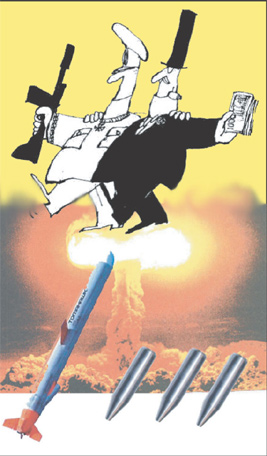 This report identifies 27 companies operating in France, India, Italy, the Netherlands, the United Kingdom and the United States that are significantly involved in maintaining and modernising the nuclear arsenals of France, India, the United Kingdom and the United States. This is not an exhaustive list. These companies are providing necessary components and infrastructure to develop, test, maintain and modernise nuclear weapons. The contracts these companies have with nuclear armed countries are for materials and services to keep nuclear weapons in their arsenals. In other nuclear-armed countries –Russia, China, Pakistan and North Korea – the maintenance and modernization of nuclear forces is carried out primarily or exclusively by government agencies.
Aecom (USA) Aecom provides professional technical and management support services and is part of joint ventures that manages the Nevada National Security Site (NNSS), previously known as the Nevada Test Site, as well as Lawrence Livermore (LLNL) and Los Alamos National Laboratories (LANL), key fixtures in the US nuclear weapons infrastructure.
Aerojet Rocketdyne (USA) Aerojet Rocketdyne, formerly known as GenCorp is involved in the design, development and production of land- and sea-based nuclear ballistic missile systems for the United States. It is currently producing propulsion systems for Minuteman III and D5 Trident nuclear missiles.
Airbus Group (The Netherlands) Airbus is a Dutch company that produces and maintains the M51.2 submarine-launched nuclear missiles for the French navy, it is also developing the M51.3. Through joint venture MBDA-Systems, Airbus is also providing medium-range air-to-surface missiles to the French air force.
BAE Systems (United Kingdom) BAE Systems is involved in the US and UK Trident II (D5) strategic weapons system programmes. It is also the prime contractor for the US Minuteman III Intercontinental Ballistic Missile (ICBM) system. BAE Systems is also part of the joint venture providing medium-range air-to-surface missiles for France.
Bechtel (USA) Bechtel manages the Los Alamos and Lawrence Livermore national laboratories in the US, which play an important role in the research, design, development and production of nuclear weapons. It also leads the joint venture for management and operation of the Y-12 National Security Complex in Tennessee and the Pantex Plant in Texas.
Boeing (USA) Boeing is involved in the Minuteman III nuclear intercontinental ballistic missiles in the US arsenal. It also provides the US and UK Trident II (D5) with maintenance, repair, and rebuilding and technical services.
BWX Technologies (USA) BWX Technologies (“BWXT”) formerly known as Babcock & Wilcox Company Babcock & Wilcox manages and through joint ventures operates several US nuclear weapons facilities including the Lawrence Livermore National Laboratory, Los Alamos National Laboratory, and Nevada National Security Site (NNSS), previously known as the Nevada Test Site, each of which are engaged in various aspects of nuclear warhead modernisation.
Charles Stark Draper Laboratory (USA) Charles Stark Draper Laboratory (“Draper”) is the prime contractor for the Trident Life Extension (LE) boost guidance and is manufacturing the guidance system for the Trident missile system in use by the UK and the US.
CH2M Hill (USA) CH2M Hill is one of the joint venture partners in National Security Technologies (NSTec) that manages the Nevada National Security Site (NNSS), previously known as the Nevada Test Site, a key fixture in the US nuclear weapons infrastructure.
Engility Holdings (USA) In February 2015, Engility acquired US-based TASC. It is involved in the research and development for the Solid Rocket Motor Modernization Study of the Minuteman III system for the US arsenal.
Fluor (USA) Fluor is the lead partner responsible for the management and operation of the US Department of Energy’s Savannah River Site and Savannah River National Laboratory, the only source of new tritium for the US nuclear arsenal.
General Dynamics (USA) General Dynamics provides a range of engineering, development, and production activities to support to US and UK Trident II Strategic Weapons Systems. It is also involved in the guidance systems of the Trident II (D5) nuclear missiles of the US Navy
July 1, 2017
Posted by Christina Macpherson |
2 WORLD, business and costs, Reference, weapons and war |
Leave a comment
A near-disaster at a federal nuclear weapons laboratory takes a hidden toll on America’s arsenal , Science Repeated safety lapses hobble Los Alamos National Laboratory’s work on the cores of U.S. nuclear warheads By The Center for Public Integrity, Patrick Malone Jun. 29, 2017 Technicians at the government’s Los Alamos National Laboratory settled on what seemed like a surefire way to win praise from their bosses in August 2011: In a hi-tech testing and manufacturing building pivotal to sustaining America’s nuclear arsenal, they gathered eight rods painstakingly crafted out of plutonium, and positioned them side-by-side on a table to photograph how nice they looked.
At many jobs, this would be innocent bragging. But plutonium is the unstable, radioactive, man-made fuel of a nuclear explosion, and it isn’t amenable to showboating. When too much is put in one place, it becomes “critical” and begins to fission uncontrollably, spontaneously sparking a nuclear chain reaction, which releases energy and generates a deadly burst of radiation.
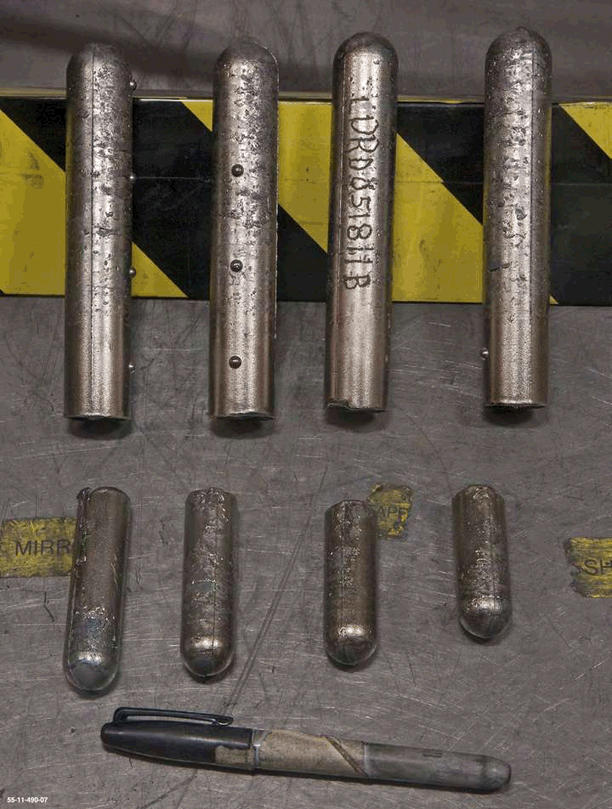
The resulting blue glow — known as Cherenkov radiation — has accidentally and abruptly flashed at least 60 times since the dawn of the nuclear age, signaling an instantaneous nuclear charge and causing a total of 21 agonizing deaths. So keeping bits of plutonium far apart is one of the bedrock rules that those working on the nuclear arsenal are supposed to follow to prevent workplace accidents. It’s Physics 101 for nuclear scientists, but has sometimes been ignored at Los Alamos.
As luck had it that August day, a supervisor returned from her lunch break, noticed the dangerous configuration, and ordered a technician to move the rods apart. But in so doing, she violated safety rules calling for a swift evacuation of all personnel in “criticality” events, because bodies — and even hands — can reflect and slow the neutrons emitted by plutonium, increasing the likelihood of a nuclear chain reaction. A more senior lab official instead improperly decided that others in the room should keep working, according to a witness and an Energy Department report describing the incident.
Catastrophe was avoided and no announcement was made at the time about the near-miss — but officials internally described what happened as the most dangerous nuclear-related incident at that facility in years. It then set in motion a calamity of a different sort: Virtually all of the Los Alamos engineers tasked with keeping workers safe from criticality incidents decided to quit, having become frustrated by the sloppy work demonstrated by the 2011 event and what they considered the lab management’s callousness about nuclear risks and its desire to put its own profits above safety.
When this exodus was in turn noticed in Washington, officials there concluded the privately-run lab was not adequately protecting its workers from a radiation disaster. In 2013, they worked with the lab director to shut down its plutonium handling operations so the workforce could be retrained to meet modern safety standards.
Those efforts never fully succeeded, however, and so what was anticipated as a brief work stoppage has turned into a nearly four-year shutdown of portions of the huge laboratory building where the plutonium work is located, known as PF-4.
Officials privately say that the closure in turn undermined the nation’s ability to fabricate the cores of new nuclear weapons and obstructed key scientific examinations of existing weapons to ensure they still work. The exact cost to taxpayers of idling the facility is unclear, but an internal Los Alamos report estimated in 2013 that shutting down the lab where such work is conducted costs the government as much as $1.36 million a day in lost productivity.
And most remarkably, Los Alamos’s managers still have not figured out a way to fully meet the most elemental nuclear safety standards. ……
these safety challenges aren’t confined to Los Alamos. The Center’s probe revealed a frightening series of glaring worker safety risks, previously unpublicized accidents, and dangerously lax management practices. The investigation further revealed that the penalties imposed by the government on the private firms that make America’s nuclear weapons were typically just pinpricks, and that instead the firms annually were awarded large profits in the same years that major safety lapses occurred. Some were awarded new contracts despite repeated, avoidable accidents, including some that exposed workers to radiation…….
George Anastas, a past president of the Health Physics Society who analyzed dozens of internal government reports about criticality problems at Los Alamos for the Center, said he wonders if “the work at Los Alamos [can] be done somewhere else? Because it appears the safety culture, the safety leadership, has gone to hell in a handbasket.”
Anastas said the reports, spanning more than a decade, describe “a series of accidents waiting to happen.” The lab, he said, is “dodging so many bullets that it’s scary as hell.”http://www.sciencemag.org/news/2017/06/near-disaster-federal-nuclear-weapons-laboratory-takes-hidden-toll-america-s-arsenal
June 30, 2017
Posted by Christina Macpherson |
incidents, Reference, USA |
Leave a comment
 Permanently closed U.S. nuclear reactor should be “autopsied” Paul Gunter, Beyond Nuclear, 25 June 17
Permanently closed U.S. nuclear reactor should be “autopsied” Examination could identify potential safety flaws in operating reactors with parts from same controversial French forge
TAKOMA PARK, MD, June 21, 2017 –
- A permanently closed nuclear reactor in Florida that, documents show, likely has a manufactured weakness in a vital safety component produced by a controversial French forge that also supplied components to 17 still operating U.S. reactors, should be “autopsied,” says Beyond Nuclear, a leading national anti-nuclear watchdog group.
- The Crystal River Unit 3 reactor in Red Level, Florida, was permanently closed in 2013 and is in the decommissioning process. Research by Beyond Nuclear staff found that the Florida reactor likely shares an at-risk safety-related component manufactured at the French Le Creusot forge that is currently shut down and under international investigation for the loss of quality control of its manufacturing process and falsification of quality assurance documentation. The Crystal River reactor pressure vessel head was supplied by a factory at Chalon-Saint Marcel that assembles pieces forged at Le Creusot, both Areva-owned factories.
“The U.S. Nuclear Regulatory Commission should seize upon this opportunity and ‘autopsy’ Crystal River 3,” said Paul Gunter, Director of the Reactor Oversight Project at Beyond Nuclear. “A close examination of Crystal River could provide critical safety data to inform the decision-making on whether the seventeen U.S. reactors still operating with at-risk Le Creusot parts should also be materially tested,” Gunter said.
The Le Creusot factory forges large ingots into safety-related components such as reactor pressure vessels, pressure vessel lids and steam generators.
The French industrial facility was discovered to be operating with lax quality control procedures that allowed the introduction of an excessive amount of carbon contamination into its manufacturing process, a problem technically known as “carbon segregation.”
The excess carbon weakens the component’s “fracture toughness” in the face of the reactor’s extreme pressure and temperature. Failure of a weakened component during operation would initiate the loss of cooling to the reactor and a serious nuclear accident.
At-risk safety components potentially containing these flaws, and manufactured at the Creusot Forge, have been delivered to reactors in France, other countries and the United States over a period of decades.
The NRC published Areva’s list in January 2017 identifying the 17 operational U.S. reactors with the at-risk components from the French forge. However, the federal agency did not disclose that Crystal River also installed a Le Creusot-manufactured replacement pressure vessel head during the October 2003 refueling outage and then operated the unit for nearly a decade before permanently closing.
“This information provides the incentive to do material testing on a component here in the U.S. from the suspect forge,” Gunter added. “It is only common sense, when presented in effect with the corpse, that the NRC should autopsy Crystal River before the body is buried,” he continued. ”This is a chance to better understand scientifically what the potential risks are at operating reactors with Le Creusot parts rather than relying on computer modeling, simulation or speculation,” Gunter said. “
For the sake of science and public safety, it is fortuitous that Crystal River, which operated for nearly a decade with a possible Le Creusot replacement component, is now permanently shut down and can be materially examined,” Gunter concluded.
The carbon segregation problem was first discovered at the Areva-designed EPR reactor still under construction, and now well over budget and behind schedule, at the Flamanville Unit 3 in Normandy, France. French safety authorities are investigating and are expected to make a decision in September on whether to continue with the troubled Flamanville reactor which experts say does not meet the fracture resistance standards.
Beyond Nuclear petitioned the NRC on January 24, 2017 to suspend operations at the 17 affected U.S. reactors pending thorough inspections and material testing for the carbon contamination of the at-risk components and to open an investigation into the potential falsification of Le Creusot quality assurance documentation. To date, the NRC has accepted the petition in part for further review and in part referred the potential falsification of documents to the federal agency’s allegations unit.
Only one affected nuclear plant, Dominion Energy’s Millstone 2 in Connecticut, has conducted a visual inspection on a Creusot Forge component at the behest of the state energy authority, but did not observe any defects or cracking.
However, a French newspaper revealed last week that metal specimens harvested from the Flamanville Unit 3 reactor pressure vessel, and subjected to shock resilience testing, fell dramatically below regulatory performance standards. A newly surfaced memo (jn French) from a leading safety physicist at the prestigious Institute of Radioprotection and Nuclear Safety said that, if subjected to violent pressure-thermal shock, the EPR reactor pressure vessel could shatter. Such a rupture could lead to a major loss of coolant accident and subsequently a nuclear meltdown.
June 26, 2017
Posted by Christina Macpherson |
Reference, safety, USA |
Leave a comment
some of the biggest dangers still lie ahead, and many of them come back to that small green train of so many years ago. An updated and safer versions of it will be hauling Andreyeva Bay’s waste south from Murmansk, but that shouldn’t belie the fact that transporting spent nuclear fuel over such distances is always dangerous.
More dangerous still is the location where the spent fuel will end up, which is one of the most radioactively contaminated spots in the world.
 Decades of piled up nuclear fuel bids farewell to Andreyeva Bay http://bellona.org/news/nuclear-issues/2017-06-decades-of-piled-up-nuclear-fuel-bids-farewell-to-andreyeva-bay Two decades ago, a green four-car train would make the rounds every few months to Russia’s snowy Kola Peninsula to cart nuclear fuel and radioactive waste more than 3000 kilometers south from the Arctic to the Ural Mountains. June 23, 2017 by Charles Digges charles@bellona.no

Two decades ago, a green four-car train would make the rounds every few months to Russia’s snowy Kola Peninsula to cart nuclear fuel and radioactive waste more than 3000 kilometers south from the Arctic to the Ural Mountains.
At the time, the lonely rail artery was the center of a logistical and financial bottleneck that made Northwest Russia, home of the once feared Soviet nuclear fleet, a toxic dumping ground shrouded in military secrecy.
More than a hundred rusted out submarines bobbed in the icy waters at dockside, their reactors still loaded with nuclear fuel, threating to sink or worse. Further from shore and under the waves laid other submarines and nuclear waste intentionally scuttled by the navy. Still more radioactive spent fuel was piling up in storage tanks and open-air bins, on military bases and in shipyards.
One of those places was Andreyeva Bay, a run down nuclear submarine maintenance yard just 55 kilometers from the Norwegian border. Since the birth of the nuclear navy in the 1960s, the yard came to be a dumping ground for 22,000 spent nuclear fuel assemblies offloaded from hundreds of submarines. Cracks in storage pools made worse by the hard Arctic freeze threatened to contaminate the Barents Sea. At one point, experts even feared the radioactive morgue might spark an uncontrolled nuclear chain reaction.
Infrastructure, technology and the Kremlin were failing to keep up with the mushrooming catastrophe. The nuclear fuel train could only bear away 588 fuel assemblies at a time three or four times a year – little more than the contents of one nuclear submarine per trip. Even if the train ran on schedule, removing broken or deformed nuclear fuel elements at Andreyeva Bay was still seen as impossible.
Yet even mentioning the environmental and security storm clouds was taboo: While the Navy begged the public to donate potatoes to feed sailors it was too broke to pay, the Kremlin prosecuted environmentalists who drew attention to the mounting desperation as spies.
In the bleak and politically chaotic late 1990s, many experts, like Bellona’s Andrei Zolotkov, thought that the carcinogenic remains of the Cold War would lie neglected at Andreyeva Bay for decades – or at least until Russia somehow woke up wealthy enough to deal with them.
Now, Russia is only slightly better off, yet the first containers of spent nuclear at Andreyeva Bay will begin to be bourn away by sea on June 27, marking the culmination of a multi-million dollar international effort sparked by Bellona in 1995.
The first container was packed last month. It and the 2999 that will follow will leave Andreyeva Bay on specially outfitted ships like the Rossita – itself a bit of expertise donated by Italy under the Northern Dimensions Environmental Partnership, an enormous Russian nuclear cleanup fund managed by the European Bank of Reconstruction and Development.
The transport ships will join a railhead at Atomflot, Murmansk’s nuclear icebreaker port, and from there, the fuel containers will go by train to the Mayak Chemical Combine, near the Urals city of Chelyabinsk, for reprocessing.
It’s a mammoth effort. A total of about 40 ship-to-train transports will have to be made before the bulk of the fuel is cleared out over the coming five years. But when it’s done, one of the most deviling radiation threats in the Arctic will be history.
Bring the waste out of the shadows
“The Andreyeva Bay project has shown that international projects aimed at liquidating nuclear and radioactive threats can be successful,” said Alexander Nikitin, the Bellona expert who was charged with espionage and later acquitted for bringing to light the embarrassing truth of Russia’s northern nuclear fleet more than 20 years ago. “This is proof that such projects must continue.”
The success hasn’t necessarily loosened the grip of the Soviet-era mindset. Russian nuclear officials have so far denied Norwegian television cameras access to film the first nuclear waste departure from Andreyeva Bay, an event that will be attended by the country’s foreign minster, Børge Brende, Russian officials and Bellona staff.
It also hasn’t eased Kremlin paranoia toward Bellona and its efforts to spur international attention and bring foreign funding to bear on Cold War nuclear relics. Zolotkov’s Bellona Murmansk, which helped dislodge Andreyeva Bay’s troubles from the shadows, was targeted by Russia’s foreign agent law in 2015 and closed down. The Environmental Rights Center Bellona, headed by Nikitin, followed this year.
But Zolotkov said the progress transcends politics.
“Even in complex political circumstances, international cooperation in nuclear and radiation safety in Russia’s North continues,” he said.
Cracks and contamination
Andreyeva Bay had been piling up spent nuclear submarine fuel for more than two decades when its troubles began in earnest in 1982. That year, a crack developed in its now-notorious Building 5, a storage pool for thousands of spent fuel assemblies. The ensuing leak threatened to dump a stew of plutonium, uranium and other fission products into Litsa Fjord, fouling the Barents Sea.
The water was drained and the fuel painstakingly moved, but that revealed other problems. The fuel elements from Building 5 needed somewhere to go, so they were rushed into hastily arranged storage facilities that were supposed to be only temporary. Technicians stuffed the fuel elements into three dry storage buildings and cemented them in. The temporary storage solution has now spanned the last 30 years. Meanwhile the leaking radioactive water contaminated much of the soil around Building 5.
It took the government years to catch up to the problem. In 1995, the Murmansk regional government paid it first visit to the secretive military site and, based on what it saw, shut down its operations. Five years later Moscow finally got involved, taking Andreyeva Bay out of the military’s hands and giving it to the mainly civilian Ministry of Atomic Energy, now Rosatom.
Rosatom helped coalesce a nuclear waste-handling agency in Murmansk, called SevRAO, to deal with the problem. Yet even in 2000, SevRAO was essentially working from scratch. Anatoly Grigoriev, a Rosatom nuclear safety official said last year that there weren’t even documents detailing what waste and fuel was stored where, much less an infrastructure to help safely get rid of it.
Bellona leads the charge
Norway, at Bellona’s urging, led the charge to pitch in.
Finally, in 2001, an enclosure was built over the three storage buildings to prevent further contamination while technicians worked to remove the spent fuel and load it into cases. Roads were built and cranes were brought in. Personnel decontamination posts went up, along with a laboratory complex and power lines.
A host of nations pumped funding into the burgeoning city whose central industry was safely packing up decades of nuclear fuel from Russia’s past nuclear soldiers. Starting in 2003, France, Germany, Japan, Italy, Canada and Great Britain, joined by Finland, Denmark, Sweden, and the European Commission pooled resources for a total contribution of $70 million over several years.
But Norway has led the pack by far, contributing some $230 million over the past 20 years toward safely removing Andreyeva Bay’s spend nuclear fuel – a national movement spawned when Bellona published its first report on Northwest Russia’s nuclear hazards in 1996.
“For Bellona, this event is a very important development,” said Zolotkov. “Bellona was the first group to speak openly about the problems of Andreyeva Bay, and Bellona stepped forward with a report on the developing situation.”
Nikitin agreed. “This is very important for the outlook of our work in Russia because all now see that we are capable of achieving a result, and not simply criticizing and protesting.”
In many ways, however, some of the biggest dangers still lie ahead, and many of them come back to that small green train of so many years ago. An updated and safer versions of it will be hauling Andreyeva Bay’s waste south from Murmansk, but that shouldn’t belie the fact that transporting spent nuclear fuel over such distances is always dangerous.
New dangers to bring to light
More dangerous still is the location where the spent fuel will end up, which is one of the most radioactively contaminated spots in the world.
The Mayak Chemical Combine, the birthplace of the first Soviet atomic Bomb, is the one facility in Russia capable of reprocessing spent fuel from submarines. It also gave the country its first nuclear disaster. In 1957, a tank holding nuclear waste exploded, sending a cloud of radioactivity from Chelyabinsk to Yekaterinburg and forced the evacuation of 17,000 people. Called the Kyshtym Disaster, the accident came to be regarded as Chernobyl’s more secretive older brother.
Since Mayak ramped up fuel reprocessing at its RT-1 facility in 1977, contamination has only intensified. Radioactive byproducts arising from the chemical separation of plutonium and uranium have been dumped into local rivers and lakes. Cancer rates among the local population continue to rise. The government has partially acknowledged the issue and has made stutter-step attempts to move a number of small villages away from the radioactively polluted Techa River. In the end though, those efforts only displaced villagers from one contaminated spot to another, solving nothing.
Some activists have noted that moving Andreyeva Bay’s legacy of Cold War reactor fuel 3,000 kilometers south to Mayak is a similar exercise in displacement.
Nadezhda Kutepova, a long time advocate for those afflicted by Mayak’s pollution, who was run out of the country on manufactured espionage suspicions, said Norway’s contribution to moving Andreyeva Bay’s fuel was a waste of money.
She and others recently told the Independent Barents Observer they thought the Norwegian government would be lessening the woes of one radioactively contaminated area in the country at the expense of another.
While Niktin acknowledged that Mayak was far from ideal, he noted that it was the only place in Russia that had the technology to handle the Andreyeva fuel.
But he said that shipping the fuel to Mayak also ratchets up Bellona’s responsibility for bringing to light yet newer stages of dealing with Russia’s radioactive legacy.
“The task of the public, and Bellona with it, is to ensure that Mayak doesn’t use any dirty technologies that end up throwing radioactive waste into the environment,” he said. “We must also step up to liquidate the injuries that have already happened to the environment as a result of Mayak’s work and the accident.”
In other words, if Andreyeva Bay is a measure of Bellona’s success, Mayak could repeat that history.
June 24, 2017
Posted by Christina Macpherson |
EUROPE, Reference, Russia, wastes |
Leave a comment














 nuclear-news