Because of the risk of possible terrorist attacks at the 15 UK nuclear reactors and >20 nuclear reactors in nearby countries, and because of the advanced ages of UK nuclear reactors, there is a need for greater preparedness to deal with nuclear accidents and incidents.
For these reasons, in June 2016, the House of Commons Science and Technology Committee set up an Inquiry on Science in Emergencies: chemical, biological, radiological or nuclear incidents. However neither the Committee’s subsequent poor Report nor the Government’s anodyne response dealt with the real issues in a forthright and open matter. In particular, they discussed neither the problems of evacuations (which I have discussed) nor the scientific evidence which amply supports the pre-distribution of stable iodine as occurs in most other EU countries.
In the event of a nuclear accident or incident, the three main responses are shelter, evacuation, and stable iodine prophylaxis. This article deals solely with iodine prophylaxis.
It is important to note that stable iodine ingestion only protects against thyroid cancer, and not any other cancers which could arise after exposure to the many nuclides which would be released if a serious nuclear accident or incident were to occur. However it is the only cancer that we can prevent or mitigate if advance preparations are made.
The prior ingestion of stable iodine (often potassium iodide, ie KI) is an effective means of protecting the thyroid gland from thyroid cancer and other thyroid effects, especially among children. But it is necessary to consume stable iodine immediatelyafter a nuclear incident: the best way to provide for this is the advance distribution of stable iodine prior to any accident or incident.
In the UK, the Government has decided not to pre-distribute stable iodine tablets to the public. This is a poor decision. It was probably influenced by the Government’s strong support, bordering on obsession, for nuclear power. In other words, political considerations are held to be more important than public safety. Information on the locations of stale iodine supplies, stocks held, and arrangements for their distribution in the event of a nuclear incident or accident is unavailable in the UK.
After the warning of a nuclear accident or incident, it appears that the Government intends to distribute stable iodine to “…schools, hospitals and evacuation reception centres…” and “collection centres” for collection by the public. It is likely that such distribution would take at least two days or longer, depending on the sizes of the affected areas. During this time, plumes would continue to cross such areas depending on the nature of the accident, wind direction and wind velocity.
At present, the Government assumes that most thyroid doses (from the radioative iodine in the plumes) will occur via the food pathway, mainly from the ingestion of milk and leafy green vegetables. This pathway could take a few days and could give time for stable iodine distribution to take place. However recent scientific evidence indicates that inhalation is much more important than ingestion for radio-iodine doses. This means advance stable iodine distribution is vitally necessary. The Government is ignoring this information, thereby putting the UK public at risk.
Several EU countries have already pre-distributed KI to all families. In addition, KI supplies and dose information are available on line from non-UK sources. It is therefore recommended that
Stable iodine tablets, with clear dose instructions and the reasons for their advance distribution, should be distributed to all families within at least 30 km of nuclear facilities in the UK without waiting for an incident or accident to occur.
Since radioactive plumes could reach cities with large populations (e.g. >500,000 people) located beyond 30 km, stable iodine pre-distribution should carried out here as well. This is because rapid evacuations from such large cities would be impractical, but their inhabitants should be afforded some protection.
For this reason, and to deal with the possibility of radioactive plumes from nuclear reactors on the continent, the Government should pre-distribute stable iodine to all families throughout the UK, as occurs in most other European countries.
Why decommissioning South Africa’s Koeberg nuclear plant won’t be easy The Conversation, Hartmut Winkler Professor of Physics, University of Johannesburg, January 26, 2018
“……..There are three stages in the rehabilitation of a nuclear facility.
The plant must be dismantled. This is complicated because most of the material in and around the plant is radioactive to varying degrees and therefore dangerous to anything exposed to it. Radioactivity reduces with time, but for some isotopes commonly found in nuclear waste, the drop in radiation levels can be very slow. Because of this a plant will only be dismantled years after it’s been switched off.
The dangerous nuclear waste, or high level waste must be reprocessed. Most of the material stays dangerous for decades but some isotopes retain high levels of radiation levels for thousands of years. A portion of nuclear waste can be converted into reusable or less radioactive forms through nuclear engineering processes. These processes are complex and there are only a few facilities in the world that can perform them. This means that South Africa’s high level waste will have to be transported overseas. Reprocessing facilities include La Hague in France and the Russian Mayak site, thought to be responsible for the 2017 ruthenium leak incident.
The remaining nuclear waste must be secured in storage, virtually forever. This needs an isolated site that can’t be damaged by natural disasters or other processes that could cause radioactive material to seep into the surrounding environment, especially ground water. This final storage need is a massive headache worldwide. An example is the German Gorleben final repository site. It’s been the scene of protests for decades, preventing any further storage of waste on the site.
A factory processing radioactive materials in Perak gave the people living nearby leukemia.
Bukit Merah’s rare earth metal processing site cleanup had been thelargest radiation cleanup so far in the world’s rare earth industry. Dr. Yoshihiko Wada’s report revealed that Mitsubishi Chemical came up with ARE in Bukit Merah after being one of the main companies that caused severe asthma in Nagoya, Japan. Also, 100% of the rare earth products processed in Bukit Merah were exported back to Japan, so it’s not like we gained anything but money from the venture, which puts forth the question of whether it’s worth endangering the lives of local residents for rare earth metals.
Earlier this year, Lynas Corporation had been popping up in the news again. For those of who have no idea who or what Lynas is, a few years back there had been a hullabaloo when Lynas set up a rare-earth processing plant in Gebeng, Kuantan, called the Lynas Advanced Materials Plant (LAMP). But what’s the big deal with that?
Nuclear power in crisis: we are entering the Era of Nuclear Decommissioning, Energy Post, by Jim Green “…………The Era of Nuclear Decommissioning The ageing of the global reactor fleet isn’t yet a crisis for the industry, but it is heading that way. In many countries with nuclear power, the prospects for new reactors are dim and rear-guard battles are being fought to extend the lifespans of ageing reactors that are approaching or past their design date.
Perhaps the best characterisation of the global nuclear industry is that a new era is approaching ‒ the Era of Nuclear Decommissioning ‒ following on from its growth spurt from the 1960s to the ’90s then 20 years of stagnation.
The Era of Nuclear Decommissioning will entail:
A slow decline in the number of operating reactors.
Countless battles over lifespan extensions for ageing reactors.
An internationalisation of anti-nuclear opposition as neighbouring countries object to the continued operation of ageing reactors (international opposition to Belgium’s ageing reactors is a case in point ‒ and there are numerous other examples).
Battles over taxpayer bailout proposals for companies and utilities that haven’t set aside adequate funds for decommissioning and nuclear waste management and disposal. (According to Nuclear Energy Insider, European nuclear utilities face “significant and urgent challenges” with over a third of the continent’s nuclear plants to be shut down by 2025, and utilities facing a €118 billion shortfall in decommissioning and waste management funds.)
Battles over proposals to impose nuclear waste repositories and stores on unwilling or divided communities.
The Era of Nuclear Decommissioning will be characterised by escalating battles (and escalating sticker shock) over lifespan extensions, decommissioning and nuclear waste management. In those circumstances, it will become even more difficult than it currently is for the industry to pursue new reactor projects. A feedback loop could take hold and then the nuclear industry will be well and truly in crisis ‒ if it isn’t already.
Editor’s Note
Dr Jim Green is the editor of the Nuclear Monitor newsletter, where a longer version of this article was originally published.
The following news piece represents the fifth in a 15-part mini-series titled, Nuclear Power in Our World Today, featuring nuclear authority, engineer and whistleblower Arnie Gundersen. The EnviroNews USA special encompasses a wide span of topics, ranging from Manhattan-era madness to the continuously-unfolding crisis on the ground at Fukushima Daiichi in eastern Japan. The transcript is as follows:
Josh Cunnings (Narrator): Good evening and thanks for joining us at the EnviroNews USA news desk for the fifth segment in our 15-part mini series, Nuclear Power in Our World Today. In our previous episodes, we explored several Manhattan-era messes in the United States, but tonight, we begin by discussing the troublesome situation on the ground at the Fukushima Daiichi power plant on Japan’s eastern coast.
Now, if you trace Japan’s troubles back far enough, then once again, you’re going to find yourself right back here in the good old U S of A — in the state of California — during the 1970s — with General Electric at the helm.
The project that we’re referring to was the development of the Mark 1 boiling water nuclear reactor — the very same model which melted entirely in units 1, 2 and 3 at Fukushima.
Now, when it comes to people who are qualified to talk about the many issues and problems surrounding the Mark 1, few could be more capable than former nuclear reactor operator and engineer Arnie Gundersen. As a matter of fact, the distinguished expert is all too familiar with the ins and outs of the design.
So, without further ado, here’s another excerpt from this simply fantastic interview with Arnie Gundersen by EnviroNews USA Editor-in-Chief Emerson Urry. Take a listen.
Urry: And so speaking about these reactors and the technical components — you were actually involved with the Mark 1. And I remember reading that some of the engineers that worked on that project had resigned way back then in 1972, yet General Electric was still apparently willing to pimp this reactor out essentially, all over the planet. What can you tell us about the Mark 1 reactor, and your understanding of what happened back then with these engineers, and how General Electric has been able to spread this reactor to all corners of the globe, with really no consequence. We saw Greenpeace had started a petition to make General Electric and Hitachi, and maybe a couple others of the service providers, actually pay for the damage there, but has there been any culpability? [Editor’s Note: Urry intended to say “1976” not “1972” in this passage]
Gundersen: Fukushima Daiichi has four units — one, two, three, four — and they’re all Mark 1 designs. In addition, there’s another 35 in the world, including 23 here in America, that are the same design. A group of three engineers quit General Electric in 1976 because they realized the design was not safe. Two of the three are still alive and living here in California, and they are my personal heroes. They understood before any of us did how seriously we really didn’t understand what it was that the engineers were doing.
Excerpt From Greenpeace Video With Dale Bridenbaugh
Bridenbaugh: My boss said to me, that if we have to shut down all of these Mark 1 plants, it will probably mean the end of GE’s nuclear business forever.
I started with GE immediately after I got out of college as a mechanical engineer, and I started out as a field engineer responsible for supervising the construction and startup of power plant equipment across the United States.
In the first ten or fifteen plants that GE sold of the large-scale commercial boiling water reactors, they did so on what’s called a “turnkey” basis. They built the whole thing, get it operating, and then they turn the key over to the utility, and the utility then is theoretically capable of operating it to produce electricity.
Fukushima 1 was basically a turnkey plant provided to TEPCO by GE. In 1975 the problem developed that became known at the Mark 1 plants — the some 24 Mark 1 units in the United States, and also those overseas, including the Fukushima units — had not taken into account all of the pressures and forces that are called hydrodynamic loads that could be experienced by the pressure suppression units as a result of a major accident. We didn’t really know if the containments would be able to contain the event that they were supposedly designed to contain.
Not only were there the containment problems that existed with the Mark 1s, which I was very familiar with, but there were a number of other problems with the GE boiling water reactors and with the nuclear program in general. And I got disillusioned with the speed with which these problems were being addressed, and then in the middle of the night I called my boss at GE and I said, “My recommendation is that we tell the U.S. utilities that GE cannot support the continued operation of these plants.” And my boss said to me, “Well, it can’t be that bad Dale, and keep in mind that if we have to shut down all of these Mark 1 plants it will probably mean the end of GE’s nuclear business forever.” That conversation occurred at about midnight on January 26, and that clinched my decision on resignation on February 2.
The accident that occurred in Fukushima, it’s some two years later now, and we don’t really know the condition of the reactor core; we don’t really know the condition of the containment. The radiation levels are so high inside the containment that it’s very difficult to get in there. It will be years before that plant site is cleaned up.
The damage that has been experienced at Fukushima is so great and so extensive that I don’t think any one utility, certainly TEPCO, has the capability to be able to pay for all of that. So, it becomes a national issue. I think it would be a good idea to not have reliance on nuclear units. They’re very risky enterprises. And I would like to see a world that is provided with electricity by alternative energy supplies.
Gundersen: When Maggie [Gundersen] and I were walking one day in February [a month] before the [Fukushima] accident, she said to me, “Where is the next accident going to be?” And I said, “I don’t know where, but I know it’s going to be in a Mark 1 reactor.” And, I’m not alone. It’s not like I was clairvoyant. The Nuclear Regulatory Commission had a report that they published in 1982, and they said there was an 85 percent chance, if there was a meltdown in a Mark 1 reactor, that the containment would explode. The writing was on the wall.
Urry: How many of these things are still out there in operation today?
Gundersen: In the U.S., all 23 continue to run, and as a matter of fact, the staff of the Nuclear Regulatory Commission recommended some pretty substantial improvements, and the politically appointed commissioners, who have no nuclear background, overrode the staff and said, “no, we’re not going to do those changes.” So, the Commission has been actively involved in thwarting the safety improvements that everybody knows are needed.
Script for General Electric Television Commercial
Voice of Child Narrator: My mom, she makes underwater fans that are powered by the moon. My mom makes airplane engines that can talk. My mom makes hospitals you can hold in your hand. My mom can print amazing things, right from her computer. My mom makes trains that are friends with trees. My mom works at GE.
Cunnings: If GE, a company that successfully weaseled its way out of paying any taxes whatsoever in the U.S. wants to boast night and day on the mainstream media airwaves — the same mainstream media which it once nearly monopolized — that it “brings good things to life” and makes “underwater fans that are powered by the moon” and locomotives that “talk to trees” perhaps the company should also bother to mention its own manufacture and sales of faulty nuclear power reactors that quite frankly, bring good things to an early death.
Oh, and by the way, the company not only builds the reactors that breed uranium into plutonium for bombs, oh no, its role goes much deeper. In fact, GE is in the business of manufacturing the actual bombs too. “We bring good things to life.” Seriously? Let’s get real.
Documentary Film Trailer for Deadly Deception: General Electric, Nuclear Weapons and Our Environment
Narrator: The Hanford Nuclear Reservation, a massive 570-square-mile facility, where General Electric made plutonium for the U.S. military.
Subject #1: I began loosing my hair, which I had long naturally curly hair.
Narrator: [Of] 28 families who lived in a small area near Hanford, 27 of them had suffered severe health problems.
Subject #1: … and the physician said that I had the most severe case of hypothyroidism he’d ever seen in his career…
Narrator: … all of which are associated with exposure to high doses of radiation.
Subject #2: We took twice the amount that the Children of Chernobyl took. There was absolutely no warning. They came and said, “You’re safe.”
Narrator: According to the business press, General Electric is the most powerful company in the United States, and GE is rapidly expanding its control of markets worldwide.
Subject #3: I’d like to wake Jack Welch up in the middle of his atomic power lab; let him explain why their husbands died of cancer related to the asbestos.
Subject #4: I find their ads disgusting. I find that ad disgusting.
Narrator: Four million individuals and 450 organizations in the U.S., Canada and around the world, have decided to join the GE boycott.
Subject #4: Are you asking us to clean up your toxic waste again!?
Subject #5: What GE does is not bring good things to life. They mislead the American public.
Subject #6: General Electric is in this business of building weapons for profit — not for patriotism, not for the country, not for the flag, but for profit.
Ronald Reagan: Until next week then, good night for General Electric.
Excerpt from Fairewinds Associates Video, Featuring Arnie Gundersen on the GE Mark 1 Reactor
Gundersen: This picture of a boiling water reactor containment is taken in the early 70s. It was taken at Browns Ferry [Nuclear Plant], but it’s identical to the Fukushima reactors. Now, let me walk you through that as I talk about it.
There are two pieces to the containment, the top looks like an upside down light bulb, and that’s called a “drywell.” Inside there is where the nuclear reactor is. Down below is this thing that looks like a doughnut, and that’s called the “torus,” and that’s filled almost all the way with water. The theory is that if the reactor breaks, steam will shoot out through the light bulb into the doughnut, creating lots of bubbles, which will reduce the pressure. Well, this thing’s called a “pressure suppression containment.” Now, at the bottom of that picture is the lid for the containment. When it’s fully assembled, that lid sits on top. The containment’s about an inch thick. Inside it is the nuclear reactor that’s about eight inches thick, and we’ll get to that in a minute.
Well, this reactor containment was designed in the early 70s, late 60s, and by 1972 a lot of people had concerns with the containment. So, in the early 70s, the Nuclear Regulatory Commission recognized this containment design was flawed. In the mid-70s, they realized the forces were in the wrong direction; instead of down, they were up, and large straps were put into place.
Well, then in the 80s, there was another problem that developed. After Three Mile Island engineers began to realize that this containment could explode from a hydrogen buildup. That hadn’t been factored into the design in the 70s either. Well, what they came up with for this particular containment was a vent in the side of it.
Now, a vent is designed to let the pressure out, and a containment is designed to keep the pressure in. So, rather than contain this radioactivity, engineers realized that if the containment were to survive an explosion they’d have to open a hole in the side of it called a “containment vent.”
Well, these vents were added in the late 1980s. And they weren’t added because the Nuclear Regulatory Commission demanded it. What the industry did to avoid that was create an initiative and they put them in voluntarily. Now, that sounds really proactive, but in fact, it wasn’t. If the Nuclear Regulatory Commission required it, it would have opened up the license on these plants to citizens and scientists who had concerns. Well, by having the industry voluntarily put these vents in it did two things: One, it did not allow any public participation in the process to see if they were safe. And the second thing is that it didn’t allow the Nuclear Regulatory Commission to look at these vents and say they were safety related. In fact, it sidetracked the process entirely.
Well, these vents were never tested until Fukushima. This containment was never tested until Fukushima. And it failed three times out of three tries. In retrospect, we shouldn’t be surprised.
Looking at the procedures for opening these vents, in the event electricity fails, requires someone fully clad in radiation gear to go down to an enormous valve in the bowels of the plant and turn the crank 200 times to open it. Now, can you imagine, in the middle of a nuclear accident, with steam and explosions and radiation, expecting an employee to go into the plant and turn a valve 200 times to open it?
So, that was the second Band-Aid fix that failed, on a containment that 40 years earlier, was designed too small.
Well, with all this in mind, I think we really need to ask the question: should the Mark 1 containment even be allowed to continue to operate? The NRC’s position is: well, we can make the vents stronger. I don’t think that’s a good idea.
Now, all those issues that I just talked about are related to the Mark 1 containment. The next thing I’d like to talk about is the reactor that sits inside that containment. So, that light bulb and that doughnut are the containment structure; inside that is where the nuclear reactor is.
Now, on a boiling water reactor, the nuclear control rods come in at the bottom; on a pressurized water reactor they come in from the top. All of the reactors at Fukushima, and 35 in the world in this design, have control rods that come in from the bottom. Now, that poses a unique problem and an important difference that the NRC is not looking at right now.
If the core melts in a pressurized water reactor, there’s no holes in the bottom of the nuclear reactor, and it’s a very thick eight to 10-inch piece of metal that the nuclear reactor core would have to melt through. But that didn’t happen at Fukushima.
Fukushima was a boiling water reactor; it’s got holes in the bottom. Now, when the nuclear core lies on the bottom of a boiling water reactor like Fukushima, or the ones in the U.S., or others in Japan, it’s easier for the core to melt through because of those 60 holes in the bottom of the reactor. It doesn’t have to melt through eight inches of steel. It just has to melt through a very thin-walled pipe and scoot out the hole in the bottom of the nuclear reactor. I’m not the only one to recognize that holes at the bottom of a boiling water reactor are a problem.
Last week an email came out that was written by the Nuclear Regulatory Commission right after the Fukushima accident, where they recognize that if there’s a core meltdown, and it’s now lying as a blob on the bottom of the nuclear reactor, these holes in the bottom of the reactor form channels, through which the hot molten fuel can get out a lot easier and a lot quicker than the thick pressurized water reactor design. Now, this is a flaw in any boiling water reactor, and the Nuclear Regulatory Commission is not recognizing that the likelihood of melting through a boiling water reactor like Fukushima, is a lot more significant than the likelihood of melting through a pressurized water reactor.
The third area is an area we’ve discussed in-depth in a previous video, and that’s that the explosion at Unit 3 was a detonation, not a deflagration. It has to do with the speed of the shockwave. The shockwave at Unit 3 traveled faster than the speed of sound, and that’s an important distinction that the Nuclear Regulatory Commission, and the entire nuclear industry, is not looking at.
A containment can’t withstand a shockwave that travels faster than the speed of sound. Yet, all containments are designed assuming that doesn’t happen. At Fukushima 3 it did happen, and we need to understand how it happened and mitigate against it in the future on all reactors.
Now, I measured that. I scaled the size of the building versus the speed at which the explosion occurred, and I can determine that that shockwave traveled at around 1,000 feet per second. The speed of sound is around 600 feet per second. So, it traveled at supersonic speeds that can cause dramatic damage to a containment. They’re not designed to handle it. Yet, the NRC is not looking at that. [Editor’s Note: Gundersen intended to say “miles per hour,” not “feet per second” in this video.]
So, we’ve got three key areas where the NRC, and the nuclear industry, don’t want people to look, and that’s: 1) should this Mark 1 containment even be allowed to continue to operate?
Cunnings: In America, when a vehicle, or even a part in a vehicle, is deemed unsafe for the population at large, the government forces automakers into costly and multi-billion dollar recalls — and the mainstream media does its part by shaming those culprit companies, relentlessly beating them to a bloody pulp for their negligence and their reckless endangerment of innocent American citizens.
The Mark 1 nuclear reactor is an extremely outdated model with obvious design flaws. Apparently, it has so many problems, that as Mr. Gundersen pointed out, three of the engineers who originally designed it ended up resigning because they knew it wasn’t safe — and that was well before Three Mile Island or Chernobyl ever happened — long before the public had experienced the fright, and health consequences of a full-scale nuclear meltdown.
Surely, after the triple meltdowns at Fukushima, Japan, it appears the Mark 1 is far from safe, yet here in the U.S., the government continues to let operators drive this faulty nuclear vehicle down the road — knowing full well that it could fall apart and crash, harming, or even killing innocent Americans at any time.
Perhaps the government should consider holding nuke-plant manufacturers, like GE, to the same standards it demands from automakers, and punish them with shameful recalls when they market a piece of faulty equipment that poses any danger to the public.
So, just what would a recall of the Mark 1 nuclear reactor look like, and who would issue or enforce it? The Nuclear Regulatory Commission? And how could enough political will ever be mustered for such a massive undertaking? It would surely cost more than any auto recall ever has, but frankly, who should give a damn (except for General Electric’s shareholders of course)? I mean, if it ain’t safe, then it just ain’t safe mate. Besides, after paying zero taxes, GE’s pockets should be plenty deep enough to handle such an event — right? The concept of an all-out recall on the antiquated General Electric Mark 1 reactor is one that we will continue to explore. As a matter of fact, in tomorrow’s show, we’ll discuss the problems with the Mark 1 a little further.
Tune in then for episode six in our series of short films, Nuclear Power in Our World Today, with esteemed expert and whistleblower Arnie Gundersen.
Signing off for now — Josh Cunnings — EnviroNews USA.
Source:
Should GE’s Mark 1 Nuclear Reactor Be Recalled Worldwide Like a Faulty Unsafe Automobile?
There are 10 or eleven towns in Colorado, Wyoming, Utah, Arizona, and New Mexicothat had Uranium mills, right in the middle of town. That means that Uranium dust, polonium, thorium, radium, and radon blew freely, thoughout thewe towns, 24 hours a day for years. Most of the water, drained into the Colorado ariver. Many of these towns were downwinder towns, from open air blasting of nucler bombs in Nevada from 1949 to 1962. Many, of the towns had the misfortune of having underground nuclear bombs detonated close to them as well, to try to track natural gas. Especially in New Mexico and Colorado. In the 60s Hilibutron was also tracking nuclear waste into areas in Nevada, and Wyoming. More recently there has been fracking for oil and gas in UtAh, Wyoming, Colorado, New Mexico, Arizona. This means the radioactive burden to their water tables has been increased again substantially , along with 60 years of radioactive burden on the Colorado River. There are also the 1000 or so uranium mines draining into the Colorado River and Green driver from Utah, the western slope, Shiprock New Mexico, Wyoming, The Grand Canyon Area.
I think Helen Caldicotts and Christina Macphersons estimates of a few million tons of radioactive sediment in Lake Mead and even lake Powell is wrong. https://nuclear-news.net/2017/12/22/uranium-tailings-pollution-in-lake-mead-and-lake-powell-colorado/
Consider underground nuclear destinations in Rangely Colorado and Northen New Mexico. I think it is more like a half billion or billions of ons of nuclear waste sediment in Lake Powell and lake mead..
There were Uranium Mills on the Navajo nation by Ship Rock and Halchita which is by the Colorado river. There were Uranium Mills right in the middle of town in Canyon City.Colorado, Moab.Utah, Uravan.Colorado, White Mesa.Utah, Monticello.Utah, by Grand Junction.Colorado. Many in Wyoming.
Uranium mining in Wyoming – Wikipedia https://en.m.wikipedia.org/wiki/Uranium_mining_in_Wyoming.
There are dense cancer clusters in these little towns on the Navajo Nation, in Utah, in Nevada, in Colorado, in Wyoming, in New Mexico. There are Genetic mutations that should not exist. Some people, like those in St George or Monticello Utah got the mere pittance of 50,000 dollars, after having lived in downwinder areas and surviving cancer. Generations of families wiped-out in many instances. Clarke county Nevada, by Las Vegas has one of the highest incidences of cancer in the US. Is it any wonder, with all the radiation in their primary drinking water supplies?
Many little Colorado Plateau towns, in the west are hit with quintuple curses: bomb blasts above ground, bomb blasts below ground-poisoning their head waters, uranium mills and waste in town, their river water radioacively poisoned from inderground nuclear blasts, from uranium mines, from cold war nuclear bomb detonations.
There has recently, been a great deal of cracking in these areas, releasing radioactivity into their desert rivers and water tables.
Americans live in a grand delusion, thinking how clean the western United States, and the rest of the USA is, with a hundred rickety old nuclear plants belching tritium, into the environment. The United State is the most radioactive shithole in the world. How Trump has the gall to call other countries shitholes, is beyond me.
Challenging Trump’s Language of Fascism TruthOut January 09, 2018, By Henry A. Giroux, Truthout | News Analysis “…………Analyzing the forces behind the election of Trump, Steven Levitsky and Daniel Ziblatt provide a cogent commentary on the political and pedagogical power of an old and updated media landscape. They write:
Undoubtedly, Trump’s celebrity status played a role. But equally important was the changed media landscape…. By one estimate, the Twitter accounts of MSNBC, CNN, CBS, and NBC — four outlets that no one could accuse of pro-Trump leanings — mentioned Trump twice as often as Hillary Clinton. According to another study, Trump enjoyed up to $2 billion in free media coverage during the primary season. Trump didn’t need traditional Republican power brokers. The gatekeepers of the invisible primary weren’t merely invisible; by 2016, they were gone entirely.
What is crucial to remember here, as Ruth Ben-Ghiat notes, is that fascism starts with words. Trump’s use of language and his manipulative use of the media as political theater echo earlier periods of propaganda, censorship and repression. Commenting on the Trump administration’s barring the Centers for Disease Control to use certain words, Ben-Ghiat writes:
The strongman knows that it starts with words…. That’s why those who study authoritarian regimes or have had the misfortune to live under one may find something deeply familiar about the Trump administration’s decision to bar officials at the Centers for Disease Control (CDC) from using certain words (“vulnerable,” “entitlement,” “diversity,” “transgender,” “fetus,” “evidence-based” and “science-based”). ……….
how language is used as a tool of state repression. Authoritarians have always used language policies to bring state power and their cults of personality to bear on everyday life……….
Under fascist regimes, the language of brutality and culture of cruelty was normalized through the proliferation of the strident metaphors of war, battle, expulsion, racial purity and demonization. As German historians such as Richard J. Evans and Victor Klemperer have made clear, dictators such as Hitler did more than corrupt the language of a civilized society, they also banned words. …….
it is crucial to interrogate, as the first line of resistance, how this level of systemic linguistic derangement and corruption shapes everyday life. It is essential to start with language, because it is the first place tyrants begin to promote their ideologies, hatred, and systemic politics of disposability and erasure. Trump is not unlike many of the dictators he admires. What they all share as strongmen is the use of language in the service of violence and repression, as well as a fear of language as a symbol of identity, critique, solidarity and collective struggle. None of them believe that the truth is essential to a responsible mode of governance, and all of them support the notion that lying on the side of power is fundamental to the process of governing, however undemocratic such a political dynamic may be.
Lying has a long legacy in American politics and is a hallmark of authoritarian regimes. Victor Klemperer in his classic book, The Language of the Third Reich, reminds us that Hitler had a “deep fear of the thinking man and [a] hatred of the intellect.” Trump is not only a serial liar, but he also displays a deep contempt for critical thinking and has boasted about how he loves the uneducated. Not only have mainstream sources such as The Washington Post and The New York Times published endless examples of Trump’s lies, they have noted that even in the aftermath of such exposure, he continues to be completely indifferent to being exposed as a serial liar.
In a 30-minute interview with The New York Times on December 28, 2017, The Washington Post reported that Trump made “false, misleading or dubious claims … at a rate of one every 75 seconds.” Trump’s language attempts to infantilize, seduce and depoliticize the public through a stream of tweets, interviews and public pronouncements that disregard facts and the truth. Trump’s more serious aim is to derail the architectural foundations of truth and evidence in order to construct a false reality and alternative political universe in which there are only competing fictions with the emotional appeal of shock theater.
More than any other president, he has normalized the notion that the meaning of words no longer matters, nor do traditional sources of facts and evidence. In doing so, he has undermined the relationship between engaged citizenship and the truth, and has relegated matters of debate and critical assessment to a spectacle of bombast, threats, intimidation and sheer fakery. This is the language of dictators, one that makes it difficult to name injustices, define politics as something more than rule by the powerful, and make and justify real equitable rules, shared relations of power, and a strong democratic politics.
But the language of fascism does more that normalize falsehoods and ignorance. It also promotes a larger culture of short-term attention spans, immediacy and sensationalism. At the same time, it makes fear and anxiety the normalized currency of exchange and communication. Masha Gessen is right in arguing that Trump’s lies are different than ordinary lies and are more like “power lies.” In this case, these are lies designed less “to convince the audience of something than to demonstrate the power of the speaker.” For instance, Trump’s endless tweets are not just about the pathology of endless fabrications, they also function to reinforce as part of a pedagogy of infantilism, designed to entertain his base in a glut of shock while reinforcing a culture of war, fear, divisiveness and greed……..http://www.truth-out.org/news/item/43159-challenging-trumps-language-of-fascism
Challenging Trump’s Language of Fascism TruthOut January 09, 2018, By Henry A. Giroux, Truthout | News AnalysisGeorge Orwell warns us in his dystopian novel 1984 that authoritarianism begins with language. Words now operate as “Newspeak,” in which language is twisted in order to deceive, seduce and undermine the ability of people to think critically and freely. As authoritarianism gains in strength, the formative cultures that give rise to dissent become more embattled along with the public spaces and institutions that make conscious critical thought possible.
Words that speak to the truth, reveal injustices and provide informed critical analysis begin to disappear, making it all the more difficult, if not dangerous, to hold dominant power accountable. Notions of virtue, honor, respect and compassion are policed, and those who advocate them are punished.
I think it is fair to argue that Orwell’s nightmare vision of the future is no longer fiction. Under the regime of Donald Trump, the Ministry of Truth has become the Ministry of “Fake News,” and the language of “Newspeak” has multiple platforms and has morphed into a giant disimagination machinery of propaganda, violence, bigotry, hatred and war. With the advent of the Trump presidency, language is undergoing a shift in the United States: It now treats dissent, critical media and scientific evidence as a species of “fake news.” The administration also views the critical media as the “enemy of the American people.” In fact, Trump has repeated this view of the press so often that almost a third of Americans believe it and support government-imposed restrictions on the media, according to a Poynter survey. Language has become unmoored from critical reason, informed debate and the weight of scientific evidence, and is now being reconfigured within new relations of power tied to pageantry, political theater and a deep-seated anti-intellectualism, increasingly shaped by the widespread banality of celebrity culture, the celebration of ignorance over intelligence, a culture of rancid consumerism, and a corporate-controlled media that revels in commodification, spectacles of violence, the spirit of unchecked self-interest and a “survival of the fittest” ethos.
Under such circumstances, language has been emptied of substantive meaning and functions increasingly to lull large swaths of the American public into acquiescence, if not a willingness to accommodate and support a rancid “populism” and galloping authoritarianism. he language of civic literacy and democracy has given way to the language of saviors, decline, bigotry and hatred. One consequence is that matters of moral and political responsibility disappear, injustices proliferate and language functions as a tool of state repression. The Ministry of “Fake News” works incessantly to set limits on what is thinkable, claiming that reason, standards of evidence, consistency and logic no longer serve the truth, because the latter are crooked ideological devices used by enemies of the state. “Thought crimes” are now labeled as “fake news.”
The notion of truth is viewed by this president as a corrupt tool used by the critical media to question his dismissal of legal checks on his power — particularly his attacks on judges, courts, and any other governing institutions that will not promise him complete and unchecked loyalty. For Trump, intimidation takes the place of unquestioned loyalty when he does not get his way, revealing a view of the presidency that is more about winning than about governing. One consequence is myriad practices in which Trump gleefully humiliates and punishes his critics, willfully engages in shameful acts of self-promotion and unapologetically enriches his financial coffers. ………
With the rise of casino capitalism, a “winner-take-all” ethos has made the United States a mean-spirited and iniquitous nation that has turned its back on the poor, underserved, and those considered racially and ethnically disposable. It is worth noting that in the last 40 years, we have witnessed an increasing dictatorship of finance capital and an increasing concentration of power and ownership regarding the rise and workings of the new media and mainstream cultural apparatuses. These powerful digital and traditional pedagogical apparatuses of the 21st century have turned people into consumers, and citizenship into a neoliberal obsession with self-interest and an empty notion of freedom. ……….
Trump appropriates crassness as a weapon. In a throwback to the language of fascism, he has repeatedly positioned himself as the only one who can save the masses, reproducing the tired script of the savior model endemic to authoritarianism. In 2016 at the Republican National Convention, Trump stated without irony that he alone would save a nation in crisis, captured in his insistence that, “I am your voice, I alone can fix it. I will restore law and order.”……….
There is more at work here than an oversized, if not delusional ego. Trump’s authoritarianism is also fueled by braggadocio and misdirected rage. There is also a language that undermines the bonds of solidarity, abolishes institutions meant to protect the vulnerable, and a full-fledged assault on the environment………
Trump is the master of manufactured illiteracy, and his public relations machine aggressively engages in a boundless theater of self-promotion and distractions — both of which are designed to whitewash any version of the past that might expose the close alignment between Trump’s language and policies and the dark elements of a fascist past.
Trump revels in an unchecked mode of self-congratulation bolstered by a limited vocabulary filled with words like “historic,” “best,” “the greatest,” “tremendous” and “beautiful.” As Wesley Pruden observes:
Nothing is ever merely “good,” or “fortunate.” No appointment is merely “outstanding.” Everything is “fantastic,” or “terrific,” and every man or woman he appoints to a government position, even if just two shades above mediocre, is “tremendous.” The Donald never met a superlative he didn’t like, himself as the ultimate superlative most of all.
Trump’s relentless exaggerations suggest more than hyperbole or the self-indulgent use of language. This is true even when he claims he “knows more about ISIS than the generals,” “knows more about renewables than any human being on Earth,” or that nobody knows the US system of government better than he does. There is also a resonance with the rhetoric of fascism. As the historian Richard J. Evans writes in The Third Reich in Power:
The German language became a language of superlatives, so that everything the regime did became the best and the greatest, its achievements unprecedented, unique, historic, and incomparable…..
Trump’s language, especially his endorsement of torture and contempt for international norms, normalizes the unthinkable, and points to a return to a past that evokes what Ariel Dorfman has called “memories of terror … parades of hate and aggression by the Ku Klux Klan in the United States and Adolf Hitler’s Freikorps in Germany…. executions, torture, imprisonment, persecution, exile, and, yes, book burnings, too.” Dorfman sees in the Trump era echoes of policies carried out under the dictator Pinochet in Chile…………
Trump’s fascistic language also fuels the rhetoric of war, toxic masculinity, white supremacy, anti-intellectualism and racism. What was once an anxious discourse about what Harvey Kaye calls the “possible triumph in America of a fascist-tinged authoritarian regime over liberal democracy” is no longer a matter of speculation, but a reality……..
Trump’s language is not his alone. It is the language of a nascent fascism that has been brewing in the US for some time. It is a language that is comfortable viewing the world as a combat zone, a world that exists to be plundered. It is a view of those deemed different as a threat to be feared, if not eliminated. Frank Rich is correct in insisting that Trump is the blunt instrument of a populist authoritarian movement whose aim is “the systemic erosion of political, ethical, and social norms” central to a substantive democracy. And Trump’s major weapon is a toxic language that functions as a form of “cultural vandalism” that promotes hate, embraces the machinery of the carceral state, makes white supremacy a central tenant of governance, and produces unthinkable degrees of inequality in wealth and power…….
The current struggle against a nascent fascism in the United States is not only a struggle over economic structures or the commanding heights of corporate power. It is also a struggle over visions, ideas, consciousness and the power to shift the culture itself.
Progressives need to formulate a new language, alternative cultural spheres and fresh narratives about freedom, the power of collective struggle, empathy, solidarity and the promise of a real socialist democracy. We need a new vision that refuses to equate capitalism and democracy, normalize greed and excessive competition, and accept self-interest as the highest form of motivation. We need a language, vision and understanding of power to enable the conditions in which education is linked to social change and the capacity to promote human agency through the registers of cooperation, compassion, care, love, equality and a respect for difference…….
Trump’s NASA Plans Are a Nuclear Disaster Waiting to Happen http://www.truth-out.org/news/item/43021-the-nuclear-disaster-of-trumps-nasa-plansDecember 29, 2017By Linda Pentz Gunter, Earlier this month, President Trump announced that he wants the National Aeronautics and Space Administration (NASA) to “lead an innovative space exploration program to send American astronauts back to the moon, and eventually Mars.” But while couched in patriotic sound bites and pioneering rhetoric that “Florida and America will lead the way into the stars,” the risks such ventures would entail — and the hidden agenda they conceal — have scarcely been touched upon.
For those of us who watched Ron Howard’s nail-biter of a motion picture, Apollo 13,and for others who remember the real-life drama as it unfolded in April 1970, collective breaths were held that the three-man crew would return safely to Earth. They did.
What hardly anyone remembers now — and certainly few knew at the time — was that the greater catastrophe averted was not just the potential loss of three lives, tragic though that would have been. There was a lethal cargo on board that, if the craft had crashed or broken up, might have cost the lives of thousands and affected generations to come.
It is a piece of history so rarely told that NASA has continued to take the same risk over and over again, as well as before Apollo 13. And that risk is to send rockets into space carrying the deadliest substance ever created by humans: plutonium.
Now, with the race on to send people to Mars, NASA is at it again with its Kilopower project, which would use fission power for deep space. It would be the first fission reactor launched into space since the 1960s. Fission, commonly used in commercial nuclear reactors, is the process of splitting the atom to release energy. A by-product of fission is plutonium.
Small reactors would be used to generate electricity on Mars to power essential projects in the dark. But first, such a reactor has to get to Mars without incident or major accident. And the spacecraft carrying it would also be nuclear-powered, adding monumentally to the already enormous risk. As physicist Michio Kaku points out, “Let’s be real. One percent of the time, rockets fail, they blow up, and people die.” With plutonium on board, the only acceptable accident risk has to be 0 percent.
When Apollo 13 mission astronaut John Swigert told NASA Mission Control “Houston, we’ve had a problem,” it only touched on the most immediate crisis: the damaging of the craft after the explosion of an oxygen tank that forced the crew to abort the planned moon landing.
However, what few knew at the time — and what was entirely omitted from Howard’s 1995 film — was the even bigger crisis of what to do about the SNAP-27 Radioisotope Thermoelectric Generator (RTG) on board. The RTG was carrying plutonium-238. It was supposed to have been left on the moon to power experiments. Now that no moon landing was to occur, what would become of the RTG, especially if Apollo 13 ended up crashing back to Earth in a fireball? Such an outcome could disperse the plutonium as dust, which, if inhaled, would be deadly.
One (and possibly the only) journalist who has been consistently on the “nukes in space” beat for more than 30 years is Karl Grossman. When the Apollo 13 movie came out, he picked up the phone and called the film’s production company, Imagine Entertainment, to ask why they had not included the higher drama of the plutonium problem. “It was surprising to see Hollywood not utilizing an Armageddon theme,” he told Truthout.
Grossman said that Michael Rosenberg, then executive vice president and now co-chairman of Imagine Entertainment, told him that the omission was an “artistic decision.” However, since NASA personnel had served as advisors for the film, Grossman speculated that the agency might have been more than a disinterested party. Far better that the film confine itself to the life-threatening jeopardy of the three astronauts rather than the danger to life on Earth that would have been posed by falling plutonium.
Grossman was already well aware of the Armageddon potential of NASA missions by the time he called Howard’s production company. In 1985, he had learned that two space shuttle missions planned for 1986 would carry plutonium-powered probes to be lofted into space to orbit the Sun and Jupiter. As it turned out, the ill-fated Challenger was one of the shuttles scheduled for the May 1986 plutonium mission, in what would have been its second flight that year.
Grossman said he had been worried at the time about a rocket explosion on launch, a not unprecedented disaster. Or what if a shuttle carrying a plutonium-fueled space probe failed to attain orbit, exploded and crashed back to Earth?
The official NASA and Department of Energy (DOE) documents Grossman eventually obtained using the Freedom of Information Act, “insisted that a catastrophic shuttle accident was a 1-in-100,000 chance,” he said.
But on January 28, 1986, Challenger exploded. (Shortly thereafter, NASA changed the odds of a catastrophic shuttle accident to 1-in-76.) Grossman called The Nation and asked if they knew that Challenger’s next mission would have carried plutonium. The magazine invited Grossman to write an editorial — “The Lethal Shuttle” — which ran on the magazine’s front page.
After The Nation editorial, Grossman was invited over to the offices of “60 Minutes.” He duly appeared with armfuls of documents and alarming “what ifs” but, as he told Truthout, “there was no ignition,” and “60 Minutes” never picked up the story.
Over the years, articles about the use of nuclear power on space devices and military plans for space continued to be ignored. With the mainstream media apparently reluctant to challenge the space program — perhaps out of a misplaced sense of “patriotism” — Grossman continued his solo investigations. In 1997, he penned a book, The Wrong Stuff, which detailed NASA’s blunders with plutonium-fueled missions and its unrealistic calculations about the probability of a major accident.
There had been problems before Challenger. In 1964, an aborted mission carrying an RTG had resulted in a reentry burn-up over Madagascar. Plutonium was found in trace amounts in the area months later. Although the event was downplayed, it had serious consequences, as Grossman found in a report he cited in The Wrong Stuff. The plutonium had spread all over the world.
According to page 21 of the report, “A worldwide soil sampling program carried out in 1970 showed SNAP-9A debris to be present on all continents and at all latitudes.”
John Gofman, professor of molecular and cell biology at UC Berkeley, and involved in the isolation of plutonium in the early years of the Manhattan Project, connected the SNAP-9A accident to a worldwide spike in lung cancer, as reported on page 12 of Grossman’s The Wrong Stuff.
Similarly, in 1968, a weather satellite was aborted soon after takeoff from Vandenberg Air Force Base. The plutonium from its RTG plunged into 300 feet of water off the California coast. Fortunately, in this instance, it was retrieved. At the time, all satellites were powered by RTGs. But in the wake of these disasters, NASA had already begun to push to develop solar photovoltaic (PV) power for satellites. Today, all satellites are powered by solar PV, as is the International Space Station.
Apollo 13 jettisoned its 3.9 kg of plutonium over the South Pacific, already the setting for scores of atomic weapons tests by the US and France. Contained in a graphite fuel cask, it supposedly came to rest in the deep Tonga Trench. No one will ever bother to retrieve it, even though it is now technically feasible, because of the enormous cost. Whether it has leaked (likely) and how it has affected marine life will now never be known.
Grossman kept on writing about the dangers of nuclear materials in space as well as the possibility for space wars. He found that one of the reasons NASA and the DOE sought to use nuclear power in space was to work in tandem with the Pentagon, which was pushing Ronald Reagan’s Strategic Defense Initiative, known colloquially as “Star Wars.” Star Wars was predicated on orbiting battle platforms with nuclear reactors — or “super RTGs” — on board, providing the large amounts of energy for particle beams, hypervelocity guns and laser weapons.
Although seemingly alone on the issue as a journalist, Grossman is not without an important resource in the form of Bruce Gagnon’s Maine-based Global Network Against Weapons and Nuclear Power in Space, which has been campaigning on the issue since 1992. Gagnon has watchdogged space weaponry but also US government plans to plunder other planets and moons for minerals, as the Trump administration is hinting it expects to do. Gagnon told Grossman that such plans have never been far from the nuclear industry’s radar and that at nuclear power industry conferences, “Nuclear-powered mining colonies and nuclear-powered rockets to Mars were key themes.”
The topic was also covered by Helen Caldicott and Craig Eisendrath in their 2007 book, War in Heaven. That same year, the Cassini space probe was launched. It carried 72.3 pounds of plutonium fuel, used to generate electricity, not propulsion — 745 watts of it to run the probe’s instruments. As Grossman wrote in a recent article and drew attention to in his documentary — Nukes in Space: The Nuclearization and Weaponization of the Heavens — Cassini “was launched on a Titan IV rocket despite several Titan IV rockets having blown up on launch.”
In 1999, because “Cassini didn’t have the propulsion power to get directly from Earth to Saturn…. NASA had it hurtle back to Earth in a ‘slingshot maneuver’ or ‘flyby’ — to use Earth’s gravity to increase its velocity,” Grossman wrote. A catastrophic failure of that operation could have seen Cassini crash to Earth, dispersing its deadly plutonium load. According to NASA’s Final Environmental Impact Statement for the Cassini Mission, Section 4-5, the “approximately 7 to 8 billion world population at the time … could receive 99 percent or more of the radiation exposure.” And yet, the agency proceeded to take that chance.
The world had once again dodged a radioactive bullet. In September 2017, having completed its mission, Cassini was deliberately crashed into Saturn, contaminating that planet with plutonium. While less controversial than lethally dumping it on Earth, the event raises at least moral, if not scientific questions about humankind’s willingness to pollute other planets with abandon after already doing so to our current home.
The Trump administration’s planned new missions to the moon and Mars would seem to follow that pattern, with Trump stating ominously, “this time we will not only plant our flag and leave our footprint.” The US now intends to conduct “long-term exploration and use” on Mars and the moon.
A recent article in Roll Call suggested that while Trump has said little publicly about the militarization of space, behind-the-scenes space satellite warfare is very much on the agenda with serious money set aside to develop “weapons that can be deployed in space.”
A war in space might not involve nuclear weapons — for now. But warring satellites could knock out nuclear weapons early warning systems and set other potential disasters in motion. These cataclysmic risks play strongly into the arguments — enshrined in the recent UN nuclear weapons ban — that we should be disarming on Planet Earth, not arming in space.
Tim Fernholz When the US entered the nuclear age, it did so recklessly. New research suggests that the hidden cost of developing nuclear weapons were far larger than previous estimates, with radioactive fallout responsible for 340,000 to 690,000 American deaths from 1951 to 1973.
From 1951 to 1963, the US tested nuclear weapons above ground in Nevada. Weapons researchers, not understanding the risks—or simply ignoring them—exposed thousands of workers to radioactive fallout. The emissions from nuclear reactions are deadly to humans in high doses, and can cause cancer even in low doses. At one point, researchers had volunteers stand underneath an airburst nuclear weapon to prove how safe it was:
The emissions, however, did not just stay at the test site, and drifted in the atmosphere. Cancer rates spiked in nearby communities, and the US government could no longer pretend that fallout was anything but a silent killer.
The cost in dollars and lives
Congress eventually paid more than $2 billion to residents of nearby areas that were particularly exposed to radiation, as well as uranium miners. But attempts to measure the full extent of the test fallout were very uncertain, since they relied on extrapolating effects from the hardest-hit communities to the national level. One national estimate found the testing caused 49,000 cancer deaths.
Those measurements, however, did not capture the full range of effects over time and geography. Meyers created a broader picture by way of a macabre insight: When cows consumed radioactive fallout spread by atmospheric winds, their milk became a key channel to transmit radiation sickness to humans. Most milk production during this time was local, with cows eating at pasture and their milk being delivered to nearby communities, giving Meyers a way to trace radioactivity across the country.
The National Cancer Institute has records of the amount of Iodine 131—a dangerous isotope released in the Nevada tests—in milk, as well as broader data about radiation exposure. By comparing this data with county-level mortality records, Meyers came across a significant finding: “Exposure to fallout through milk leads to immediate and sustained increases in the crude death rate.” What’s more, these results were sustained over time. US nuclear testing likely killed seven to 14 times more people than we had thought, mostly in the midwest and northeast.
A weapon against its own people
When the US used nuclear weapons during World War II, bombing the Japanese cities of Hiroshima and Nagasaki, conservative estimates suggest 250,000 people died in immediate aftermath. Even those horrified by the bombing didn’t realize that the US would deploy similar weapons against its own people, accidentally, and on a comparable scale.
And the cessation of nuclear testing helped save US lives—”the Partial Nuclear Test Ban Treaty might have saved between 11.7 and 24.0 million American lives,” Meyers estimates. There was also some blind luck involved in reducing the number of poisoned people: The Nevada Test Site, compared to other potential testing facilities the US government considered at the time, produced the lowest atmospheric dispersal.
The lingering affects of these tests remain, as silent and as troublesome as the isotopes themselves. Millions of Americans who were exposed to fallout likely suffer illnesses related to these tests even today, as they retire and rely on the US government to fund their health care.
“This paper reveals that there are more casualties of the Cold War than previously thought, but the extent to which society still bears the costs of the Cold War remains an open question,” Meyers concludes.
And so, the billions of tons of silt that has accumulated in Lake Mead and Lake Powell serve as archives of sorts. They hold the sedimental records of an era during which people, health, land, and water were all sacrificed in order to obtain the raw material for weapons that are capable of destroying all of humanity.
Jonathan ThompsonPERSPECTIVE Dec. 18, 2017 This article was originally published on The River of Lost SoulsBeneath the murky green waters on the north end of Lake Powell, entombed within the tons of silt that have been carried down the Colorado River over the years, lies a 26,000-ton pile of unremediated uranium-mill tailings. It’s just one radium-tainted reminder of the way the uranium industry, enabled by the federal government, ravaged the West and its people for decades.
In 1949, the Vanadium Corporation of America built a small mill at the confluence of White Canyon and the Colorado River to process uranium ore from the nearby Happy Jack Mine, located upstream in the White Canyon drainage (and just within the Obama-drawn Bears Ears National Monument boundaries). For the next four years, the mill went through about 20 tons of ore per day, crushing and grinding it up, then treating it with sulfuric acid, tributyl phosphate and other nastiness. One ton of ore yielded about five or six pounds of uranium, meaning that each day some 39,900 pounds of tailings were piled up outside the mill on the banks of the river.
In 1953 the mill was closed, and the tailings were left where they sat, uncovered, as was the practice of the day. Ten years later, water began backing up behind the newly built Glen Canyon Dam; federal officials decided to let the reservoir’s waters inundate the tailings. There they remain today.
If you’re one of the millions of people downstream from Lake Powell who rely on Colorado River water and this worries you, consider this: Those 26,000 tons of tailings likely make up just a fraction of the radioactive material contained in the silt of Lake Powell and Lake Mead.
During the uranium days of the West, more than a dozen mills — all with processing capacities at least ten times larger than the one at White Canyon — sat on the banks of the Colorado River and its tributaries. Mill locations included Shiprock, New Mexico, and Mexican Hat, Utah, on the San Juan River; Rifle and Grand Junction, Colorado, and Moab on the Colorado; and in Uravan, Colorado, along the San Miguel River, just above its confluence with the Dolores. They did not exactly dispose of their tailings in a responsible way.
At the Durango mill the tailings were piled into a hill-sized mound just a stone’s throw from the Animas River. They weren’t covered or otherwise contained, so when it rained tailings simply washed into the river. Worse, the mill’s liquid waste stream poured directly into the river at a rate of some 340 gallons per minute, or half-a-million gallons per day. It was laced not only with highly toxic chemicals used to leach uranium from the ore and iron-aluminum sludge (a milling byproduct), but also radium-tainted ore solids.
Radium is a highly radioactive “bone-seeker.” That means that when it’s ingested it makes its way to the skeleton, where it decays into other radioactive daughter elements, including radon, and bombards the surrounding tissue with alpha, beta, and gamma radiation. According to the Toxic Substances and Diseases Registry, exposure leads to “anemia, cataracts, fractured teeth, cancer (especially bone cancer), and death.”
It wasn’t any better at any of the other mills. In the early 1950s, researchers from the U.S. Public Health Service sampled Western rivers and found that “the dissolved radium content of river water below uranium mills was increased considerably by waste discharges from the milling operations” and that “radium content of river muds below the uranium mills was 1,000 to 2,000 times natural background concentrations.”
That was just from daily operations. In 1960, one of the evaporation ponds at the Shiprock mill broke, sending at least 250,000 gallons of highly acidic raffinate, containing high levels of radium and thorium, into the river. None of the relevant officials were notified and individual users continued to drink the water, put it on their crops, and give it to their sheep and cattle. It wasn’t until five days later, after hundreds of dead fish had washed up on the river’s shores for sixty miles downstream, that the public was alerted to the disaster.
Of course, what’s dumped into the river at Shiprock doesn’t stay in Shiprock. It slowly makes its way downstream. In the early 1960s, while Glen Canyon Dam was still being constructed, the Public Health Service folks did extensive sediment sampling in the Colorado River Basin, with a special focus on Lake Mead’s growing bed of silt, which had been piling up at a rate of 175 million tons per year since Hoover Dam started impounding water in 1935. The Lake Mead samples had higher-than-background levels of radium-226. The report concludes:
“The data have shown, among other things, that Lake Mead has been essentially the final resting place for the radium contaminated sediments of the Basin. With the closure of Glen Canyon Dam upstream, Lake Powell will then become the final resting place for future radium contaminated sediments. The data also show that a small fraction of the contaminated sediment has passed through Lake Mead to be trapped by Lakes Mohave and Havasu.”
And so, the billions of tons of silt that has accumulated in Lake Mead and Lake Powell serve as archives of sorts. They hold the sedimental records of an era during which people, health, land, and water were all sacrificed in order to obtain the raw material for weapons that are capable of destroying all of humanity.
“The more the nuclear industry claims eating plutonium, strontium, cesium, iodine and other fuel and fission products is OK because bananas exist and because the potassium is a needed nutrient, the more I consider them to be blatant liars.”
The ‘Nuclear for Climate’ lobby group recently attended the United Nations’ COP23 climate conference armed with bananas, in order to make specious comparisons between radiation exposures from eating bananas and routine emissions from nuclear power plants.
One of the reasons the comparison is specious is that some exposures are voluntary, others aren’t. Australian academic Prof. Barry Brook said in the aftermath of the Fukushima disaster: “People don’t understand that they live in an environment that is awash with radiation and they make decisions every day which affect their radiation dose ‒ they hop on an airplane or eat a banana or sit close to the TV.” True ‒ but people choose to hop on an airplane or eat a banana or sit close to the TV, whereas radiation doses from nuclear plants and nuclear accidents are usually involuntary.
Another reason why the comparison made by ‘Nuclear for Climate’ is specious is that it ignores spikes in radioactive emissions during reactor refueling. Radiation biologist Dr Ian Fairlie notes that when nuclear reactors are refueled, a 12-hour spike in radioactive emissions exposes local people to levels of radioactivity up to 500 times greater than during normal operation. The spikes may explain infant leukemia increases near nuclear plants − but operators provide no warnings and take no measures to reduce exposures.
The comparison between bananas and nuclear power plants also ignores the spike in emissions and radiation doses following catastrophic accidents. So, what’s the Banana Equivalent Dose (yes, that’s a thing) of the Chernobyl and Fukushima disasters?
According to the International Atomic Energy Agency (IAEA), the collective effective dose from Chernobyl was 600,000 person-Sieverts. The UN Scientific Committee on the Effects of Atomic Radiation estimates radiation exposure from the Fukushima disaster at 48,000person-Sieverts.
Combined, exposure from Chernobyl and Fukushima is estimated at 648,000 person-Sieverts. Exposure from eating a banana is estimated at between 0.09-2.3 microSieverts. Let’s use a figure of 0.1 microSievert per banana. Thus, exposure from Chernobyl and Fukushima equates to 6,480,000,000,000 Banana Equivalent Doses ‒ that’s 6.48 trillion bananas or, if you prefer, 6.48 terabananas or 6,480 gigabananas.
End-to-end, that many 15-cm (6-inch) bananas would stretch 972 million kilometres ‒ far enough to reach the sun 6.5 times over, or the moon 2,529 times over.
Potassium cycle
Another reason the comparison made by ‘Nuclear for Climate’ is specious is explained by Dr Gordon Edwards from the Canadian Coalition for Nuclear Responsibility:
“[T]he body already has a lot of “natural” potassium including K-40 [which is unavoidable], and any new “natural” potassium ingested is balanced by eliminating a comparable amount of “natural” potassium to maintain the “homeostasis” of the body. In other words the body’s own mechanisms will not allow for a net increase in potassium levels – and therefore will not allow for an increase in K-40 content in the body.
“Here’s what the Oak Ridge Associated Universities has to say; (ORAU was founded in 1946 as the Oak Ridge Institute of Nuclear Studies.): ‘The human body maintains relatively tight homeostatic control over potassium levels. This means that the consumption of foods containing large amounts of potassium will not increase the body’s potassium content. As such, eating foods like bananas does not increase your annual radiation dose. If someone ingested potassium that had been enriched in K-40, that would be another story.’
“The same argument does not work for radioactive caesium, or for any of the radioactive pollutants given off by a nuclear power plant, because most of these materials do not exist in nature at all – and those that do exist in nature are not subject to the same homeostatic mechanism that the body uses to control potassium levels. Consequently any foodstuffs or beverages containing radioactive caesium or other man-made radioactive pollutants will cause an additional annual dose of ionizing radiation to the person so exposed.”
Likewise, Linda Gunter explained in a 16 November 2017 article:
“At the COP23 Climate Talks currently underway in Bonn, a group calling itself Nuclear for Climate, wants you to slip on their false banana propaganda and fall for their nonsensically unscientific notion that bananas are actually more dangerous than nuclear power plants! I am not making this up. Here is the picture.
“The oxymoronic Nuclear for Climate people are handing out bananas complete with a sticker that reads: “This normal, every-day banana is more radioactive than living near a nuclear power plant for one year.” …
“If you smell something rotten in this banana business, you are right. So let’s peel off the propaganda right now. In short, when you eat a banana, your body’s level of potassium-40 doesn’t increase. You just get rid of some excess potassium-40. The net dose of a banana is zero.
“To explain in more detail, the tiny radiation exposure due to eating a banana lasts only for a few hours after ingestion, namely the time it takes for the normal potassium content of the body to be regulated by the kidneys. Since our bodies are under homeostatic control, the body’s level of potassium-40 doesn’t increase after eating a banana. The body just gets rid of some excess potassium-40.
“The banana bashers don’t want you to know this and instead try to pretend that the potassium in bananas is the same as the genuinely dangerous man-made radionuclides ‒ such as cesium-137 and strontium-90 ‒ that are released into our environment from nuclear power facilities, from atomic bomb tests and from accidents like Fukushima and Chernobyl.
“These radioactive elements, unlike the potassium-40 in bananas, are mistaken by the human body for more familiar elements. For example, ingested radioactive strontium-90 replaces stable calcium, and ingested radioactive cesium-137 replaces stable potassium. These nuclides can lodge in bones and muscles and irradiate people from within. This is internal radiation and can lead to very serious, long-lasting and trans-generational health impacts.”
An unfortunate incident in Goiania, Brazil in September 1987 illustrates the hazards of cesium-137, a fission product. Two people stole a radiotherapy source from a disused medical clinic. A security guard did not show up to work that day; he went instead to the cinema to see ‘Herbie Goes Bananas‘. The radiotherapy source contained 93 grams of cesium-137. It was sold to a junkyard dealer. Many people were exposed to the radioactive cesium and they spread the contamination to other sites within and beyond the town. At least four people died from exposure to the radiation source and, according to the IAEA, “many others” suffered radiation injuries. Those injured included eight patients who required surgical debridments, amputation of the digital extremities and plastic skin grafts. The incident was rated Level 5 (‘Accident with Off Site Risk’) on the 7-point International Nuclear Event Scale.
Terrorists don’t arm themselves with bananas
There is a long history of nuclear power plants being used directly and indirectly in support of nuclear weapons programs. Bananas are of no interest to nuclear weapons proliferators. There’s no Treaty on the Non-Proliferation of Bananas, no Comprehensive Test Banana Treaty, no Anti-Banana Missile Treaty. Kim Jong-un and Donald Trump aren’t threatening each other with bananas; not yet, at least.
Nuclear historian Paul Langley notes that terrorists don’t arm themselves with bananas:
“The potassium cycle in humans is no excuse for nuclear authorities anywhere on the planet to claim any benefit or natural precedent for the marketing of nuclear industry emissions contaminated food.
“The fission products are not nutrients. Do not eat them. The nuclear industry promises to keep its radioactive sources sealed. When the industry invariably fails in this undertaking, it turns around and claims that the residue of its pollution is like a banana. Crap. The residue is like the residue of a rad weapon. Fact. It’s the same stuff. Terrorists do not attempt to arm themselves with bananas. They are not dangerous.
“Radio Strontium, Radio Iodine, Radio cesium have NO PLACE in food. Nuke is not clean, it is not green and it relies on lies it has concocted over decades. … The more the nuclear industry claims eating plutonium, strontium, cesium, iodine and other fuel and fission products is OK because bananas exist and because the potassium is a needed nutrient, the more I consider them to be blatant liars.”
This BAMS special report presents assessments of how human-caused climate change may have affected the strength and likelihood of individual extreme events.
This sixth edition of explaining extreme events of the previous year (2016) from a climate perspective is the first of these reports to find that some extreme events were not possible in a preindustrial climate. The events were the 2016 record global heat, the heat across Asia, as well as a marine heat wave off the coast of Alaska. While these results are novel, they were not unexpected. Climate attribution scientists have been predicting that eventually the influence of human-caused climate change would become sufficiently strong as to push events beyond the bounds of natural variability alone. It was also predicted that we would first observe this phenomenon for heat events where the climate change influence is most pronounced. Additional retrospective analysis will reveal if, in fact, these are the first events of their kind or were simply some of the first to be discovered. Read More
The US Military Is the Biggest “Big Government” Entitlement Program on the Planet , December 10, 2017, By JP Sottile, Truthout |The US economy is caught in a trap. That trap is the Department of Defense: an increasingly sticky wicket that relies on an annual, trillion-dollar redistribution of government-collected wealth. In fact, it’s the biggest “big government” program on the planet, easily beating out China’s People’s Liberation Army in both size and cost. It is not only the “nation’s largest employer,” with 2.867 million people currently on the payroll, but it also provides government benefits to 2 million retirees and their family members. And it actively picks private sector winners by targeting billions of dollars to an elite group of profit-seeking contractors.
The top five overall recipients collectively pulled in $109.5 billion in FY2016, and their cohorts consistently dominate the government’s list of top 100 contractors. They reap this yearly largesse through a Rube-Goldberg-like system of influence peddlers, revolving doors and wasteful taxpayer-funded boondoggles. Finally, it is all justified by a deadly feedback loop of perpetual warfare that is predicated on a predictable supply of blowback.
But this belligerent cash machine doesn’t just produce haphazard interventions and shady partnerships with a motley assortment of strongmen, proxies and frenemies. It also has Uncle Sam caught in a strange cycle of taxpayer-funded dependence that may ultimately be the most expensive — and least productive — jobs program in human history………
Too Big to Fail?
The US stands alone as a globe-spanning empire with 787 overseas bases, “lily pad” deployments and host country facilities in 88 nations and territories, according to the most recent accounting by scholar David Vine. At home, a Google Maps search reveals another 603 bases, depots, arsenals and assorted military facilities peppered around the 50 states. The US dominates the land, sea and skies, and is moving to dominate space…….
taxpayers’ only end product is a larger military with more bases and more weapons. However, without a serious shift toward non-defense government priorities, cutting the defense budget would mean, in the immediate term, many Americans losing their jobs. In the absence of non-military jobs programs and other forms of robust social spending, these workers depend on military tax dollars to fund their livelihoods, their health care and their kids’ educations. Tax dollars sustain the military-driven local and regional economies within which they live and work. Not coincidentally, this misallocated investment in a “war and weapons-based economy” is, as Major Gen. (Ret.) Dennis Laich and Col. (Ret.) Lawrence Wilkerson write, also reflected in the inherent “unfairness” that feeds off the “all-volunteer force.”……….
So, what are the options now that the US finds itself stuck in this paradigmatic trap? There are three possible alternatives.
One is to simply slash the budget. The downside is that it will dislocate millions of people who rely directly and indirectly on defense spending. The upside is that it will force an immediate retreat from both empire and military Keynesianism. This also could stoke some economic growth if the half to three-quarters of a trillion in annual savings was “returned” to taxpayers in the form of a rebate check. Basically, Americans would finally get the “peace dividend” almost 30 years after the Cold War ended.
The second option is the post-WWII demobilization model. That influx of manpower was met with the GI Bill, tax breaks for new homeowners and investments in infrastructure. This is a truly Keynesian solution. Infrastructure jobs and educational subsidies would provide relief to Americans currently reliant on military Keynesianism for their livelihoods. The original GI Bill “returned $7 to the American economy for every $1 invested in the GI Bill,” notes Jared Lyon of the Institute for Veterans and Military Families. And a study by Costs of War Project determined allocating resources to “clean energy and health care spending create 50 percent more jobs than the equivalent amount of spending on the military,” and “education spending creates more than twice as many jobs” as defense spending.
Frankly, either of these two solutions is far better than the third option, which is to continue to misallocate hundreds of billions in precious capital away from the productive economy while wreaking havoc at home and abroad. And that’s the ultimate no-win situation for a militarized economy that has manufactured its share of bloody, no-win situations since the end of World War II. http://www.truth-out.org/news/item/42829-the-us-military-is-the-biggest-big-government-entitlement-program-on-the-planet
Volunteers wanted – to house small modular nuclear reactors in Australia,Online Opinion, Noel WAuchope , 11 Dec 17,
We knew that the Australian government was looking for volunteers in outback South Australia, to take the radioactive trash from Lucas Heights and some other sites, (and not having an easy time of it). But oh dear– we had no idea that the search for hosting new (untested) nuclear reactors was on too!
Well, The Australian newspaper has just revealed this extraordinary news, in its article “Want a nuclear reactor in your backyard? Step this way” (28/11/17). Yes, it turns out that a Sydney-based company, SMR Nuclear Technology, plans to secure volunteers and a definite site within three years. If all goes well, Australia’s Small Modular Reactors will be in operation by 2030.
Only, there are obstacles. Even this enthusiastic article does acknowledge one or two of them. One is the need to get public acceptance of these so far non-existent new nuclear reactors. SMR director Robert Pritchard is quoted as saying that interest in these reactors is widespread. He gives no evidence for this.
The other is that the construction and operation of a nuclear power plant in Australia is prohibited by both commonwealth and state laws.
But there are issues, and other obstacles that are not addressed on this article. A vital question is: does SMR Nuclear Technology intend to actually build the small reactors in Australia, or more likely, merely assemble them from imported modular parts – a sort of nuclear Lego style operation?
If it is to be the latter, there will surely be a delay of probably decades. Development of SMRs is stalled, in USA due to strict safety regulations, and in UK, due to uncertainties, especially the need for public subsidy. That leaves China, where the nuclear industry is government funded, and even there, development of SMRs is still in its infancy.
As to the former, it is highly improbable that an Australian company would have the necessary expertise, resources, and funding, to design and manufacture nuclear reactors of any size. The overseas companies now planning small reactors are basing their whole enterprise on the export market. Indeed, the whole plan for “modular” nuclear reactors is about mass production and mass marketing of SMRs -to be assembled in overseas countries. That is accepted as the only way for the SMR industry to be commercially successful. Australia looks like a desirable customer for the Chinese industry, the only one that looks as if it might go ahead, at present,
If, somehow, the SMR Technologies’ plan is to go ahead, the other obstacles remain.
The critical one is of course economics. …….
Other issues of costs and safety concern the transport of radioactive fuels to the reactors, and of radioactive waste management. The nuclear industry is very fond of proclaiming that wastes from small thorium reactors would need safe disposal and guarding for “only 300 years”. Just the bare 300!
The Australian Senate is currently debating a Bill introduced by Cory Bernardi, to remove Australia’s laws prohibiting nuclear power development. The case put by SMR Technologies, as presented in The Australian newspaper is completely inadequate. The public deserves a better examination of this plan for Small Modular Reactors SMRS. And why do they leave out the operative word “Nuclear” -because it is so on the nose with the public? http://www.onlineopinion.com.au/view.asp?article=19460&page=2
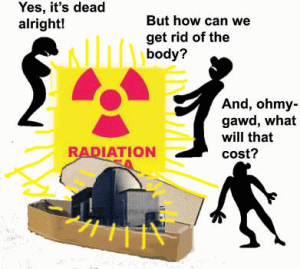
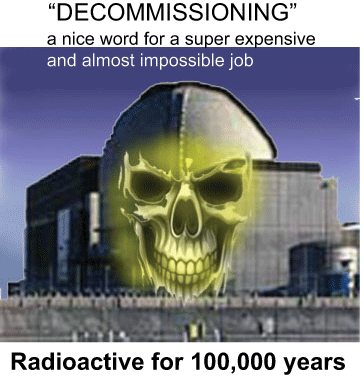





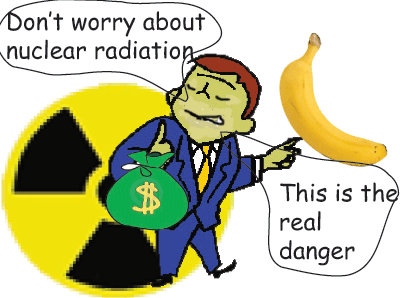







 nuclear-news