Marshall Islands atomic bombing – the devastation, thde cancer toll
 HELL ON HIGH SEAS https://www.thesun.co.uk/news/6626017/us-cold-war-nuclear-tests-bikini-atoll-pacific-ocean-video/ EXCELLENT PHOTOS. Pacific death zone where nuke tests caused thousands of cancer fatalities 60 years after spreading radiation around the world
The US detonated dozens of nuclear bombs in the Marshall Islands between 1946 and 1958 including a thermonuclear weapon 1,100 times more powerful than Hiroshima
By Mark Hodge, 26th June 2018
TERRIFYING footage shows a series of nuclear bomb tests unleashing the fires of hell on an idyllic Pacific Ocean paradise.
The video clips, recently released by the US government, give a glimpse into the horror caused by 67 nuke explosions detonated in Bikini Atoll and Enewetak Atoll in the Marshall Islands between 1946 and 1958.
Carried out in the early days of the Cold War, the tests included the 1954 Castle Bravo bomb which remains the most powerful thermonuclear weapon America has ever detonated.
The civilisation-wrecking 15-megatonne explosive, which exploded near Bikini, was 1,100 times bigger than the atomic bomb used to massacre thousands in Hiroshima in 1945.
Fallout from the unprecedented explosion – including radioactive particles – spread around the world.
US government scientists declared Bikini safe for resettlement in the early 1970s but residents were removed in 1978 when it became clear that they were ingesting dangerously high levels of radiation from the contaminated fish, plants and water.
To this day, the small community remain exiled from their home.
During the first test on July 1, 1946, military scientists wanted to see the impact of the bombs on naval warships and even filled the boats with animals such as pigs and rats to study the effects of nuclear fallout on livestock, reports Atomic Heritage Foundation.
Among the tests carried out in Enewetak was the world’s first hydrogen bomb, nicknamed Mike, which was detonated on November 1, 1952.
Between, 1977 and 1979, 4,000 American troops were taken to the former island paradise to clean up the contaminated remnants of the 43 nuke tests there.
Hundreds of the soldiers sent now complain of health problems including cancer, brittle bones and birth defects in their children while many of the them are already dead, reports The New York Times.
Speaking with ABC, Michael Gerrard, the director of the Earth Institute at Columbia University, explained that one of the explosions on Enewetak “didn’t work” causing devastating damage to the environment.
He said: “The plutonium was just broken apart by the conventional explosion, leading to about 400 little chunks of plutonium that were spread around the atoll.”
The troops sent to Enewetak collected and dumped 85,000 cubic metres of radioactive material – while wearing only shorts and t-shirts.
According to ABC, the plutonium in the area has a radioactive half-life of more than 24,000 years.
Islanders started to show signs of cancer in the 1960s, while residents further afield showed elevated risk of thyroid tumours and leukaemia, according to Georgetown University professor Timothy J. Jorgenson.
Former residents of Bikini Atoll and their relatives were awarded more than £1.5billion by the Marshall Islands Nuclear Claims Tribunal which was established in 1988.
But despite being permanently displaced from their home, the US stopped paying compensation in 2011 after Congress refused to provide additional funds.
Remarkably, marine life in Bikini has flourished, a Stanford University study last year.
Hundreds of schools of fish including tuna and sharks have thrived while swimming around coral as big as “cars”, reports The Guardian.
Professor Steve Palumbi’s team said Bikini’s marine life looks normal and healthy and do not have mutations like animals found at the Chernobyl nuke site, despite the island being declared a nuclear wasteland.
Palumbi believes that the absence of humans has in fact benefited the local wildlife.
He said: “The fish populations are better than in some other places because they have been left alone, the sharks are more abundant and the coral are big.
“It is a remarkable environment, quite odd.”
He added: “This is the most destructive thing we have ever done to the ocean, dropping 23 atomic bombs on it, yet the ocean is really striving to come back to life.”
The scientists believe that the worst-affected fish died off decades ago and the current marine life are only exposed to low radiation levels because they frequently swim in and out of the atoll
However, a 2012 United Nations reports found that the Bikini remains uninhabitable to humans because of “near-irreversible environmental contamination”.
The fish cannot be eaten, the plants cannot be farmed because of the contaminated soil and consuming water would be dangerous.
In his paper Professor Jorgensen writes: “What happened to the Marshall Islanders next is a sad story of their constant relocation from island to island, trying to avoid the radioactivity that lingered for decades.
“Over the years following the testing, the Marshall Islanders living on the fallout-contaminated islands ended up breathing, absorbing, drinking and eating considerable amounts of radioactivity.”
Between 1945 and 1963, the US and the Soviet Union carried hundreds of atmospheric nuclear tests.
Gases and “radioactive particles” from those detonations have been spread worldwide, according to a study carried out by the Centers for Disease Control and Prevention (CDC).
At least one CDC report claims that radiation deposits from these tests could eventually be responsible for 11,000 cancer deaths in the US alone.
The organs and tissue of anyone who has lived in the US – which carried out atmospheric nuke tests in Nevada – since 1951, shows signs of being exposed to nuclear fallout.
The fallout from 2,000 nuclear explosions in the 20th Century dispersed into weather systems which slightly raised the risk of cancer worldwide, according to the International Physicians for the Prevention of Nuclear War (IPPNW).
A 1991 IPPNW study claimed that particles from all nuclear explosions could be responsible for up to 430,000 cancer deaths globally.
How the British government struck such a terrible deal as Hinkley Point C nuclear power project

 Hinkley Point: the ‘dreadful deal’ behind the world’s most expensive power plant Building Britain’s first new nuclear reactor since 1995 will cost twice as much as the 2012 Olympics – and by the time it is finished, nuclear power could be a thing of the past. How could the government strike such a bad deal? Guardian, By Holly Watt, 21 Dec 17, Hinkley Point, on the Somerset coast, is the biggest building site in Europe. ……
the irony of Hinkley Point C is that by the time it eventually starts working, it may have become obsolete. Nuclear power is facing existential problems around the world, as the cost of renewable energies fall and their popularity grows. “The maths doesn’t work,” says Tom Burke, former environmental policy adviser to BP and visiting professor at both Imperial and University Colleges. “Nuclear simply doesn’t make sense any more.”
The story of Hinkley Point C is that of a chain of decisions, taken by dozens of people over almost four decades, which might have made sense in isolation, but today result in an almost unfathomable scramble of policies and ambitions. Promises have been made and broken, policies have been adopted then dropped then adopted again. The one thing that has been consistent is the projected cost, which has rocketed ever upwards. But if so many people have come to believe that Hinkley Point C is fundamentally flawed, the question remains: how did we get to this point, where billions of pounds have been sunk into a project that seems less and less appealing with every year that passes?
……… By the end of 2003, all government policy indicated that Hinkley Point C would never be built, and there was no prospect of any other new nuclear power plants. It seemed certain that nuclear had no future in Britain – which is why, when the government performed a volte-face three years later, so many onlookers were astonished. “Without any obvious change in the world, by 2006, the position in government had been completely reversed,” MacKerron told me. “Nuclear power had become extremely beneficial, important and not uneconomic.”
One thing that had happened in the intervening years was a PR blitz by the nuclear industry, which had deployed scores of lobbyists, including former politicians such as the former energy minister Brian Wilson, to push the idea of a “nuclear renaissance” in the UK. Between 2003 and 2006, says Andrew Stirling, professor of science and technology policy at Sussex University, “Britain saw the beginnings of a massive pro-nuclear lobbying and PR campaign that continues to this day.”
Through the media and advertising campaigns, key messages were hammered home. Renewables were intermittent and unreliable. Overseas gas imports were politically vulnerable. “Green” nuclear was the only plausible way to hit carbon dioxide reduction targets. Keith Parker, who was then chief executive of the Nuclear Industry Association (NIA), told the New Statesman that the 2005 election became a particular focus for swaying opinions. “It gave us a good chance to raise the profile of nuclear power,” he said. In the months leading up to the election, a series of talks was organised at exclusive venues such as the Army & Navy Club on Pall Mall and St Stephen’s Club in Queen Anne’s Gate. Industry leaders and experts came together to explain the benefits of nuclear to politicians and energy journalists. The NIA (which is now chaired by John Hutton) took on the role of managing the influential all-party parliamentary group – an informal grouping of politicians – on nuclear energy.
In July 2006, the government U-turn arrived in the form of a new policy paper, The Energy Challenge, which declared that new nuclear power stations would be necessary to help Britain reduce its carbon emissions and to ensure an uninterrupted, affordable supply of energy well into the future.
Greenpeace launched a legal challenge, claiming that the consultation process behind the government’s recommendation had been totally inadequate. The judge presiding over the case agreed, and in February 2007 ruled that the process had been “misleading”, “very seriously flawed” and “procedurally unfair”. Blair accepted the ruling, but stated that “this won’t affect the policy at all”.
Andrew Stirling believes that there was a crucial, largely unspoken, reason for the government’s rediscovered passion for nuclear: without a civil nuclear industry, a nation cannot sustain military nuclear capabilities. In other words, no new nuclear power plants would spell the end of Trident. “The only countries in the world that are currently looking at large-scale civil power newbuild programmes are countries that have nuclear submarines, or have an expressed aim of acquiring them,” Stirling told me.
In May 2007, the government published a paper titled “Meeting the energy challenge: a White Paper on energy”, which reaffirmed its enthusiasm for nuclear and declared that there had been “significant changes in the economics of nuclear power”. In contrast to the late 1980s, the government claimed it was now being approached by “some energy companies expressing a strong interest in investing in new nuclear power stations”.
When Gordon Brown took over from Blair in June 2007, the shift to nuclear proceeded apace. As it happened, the new prime minister’s brother, Andrew, was then the communications director for EDF, though a spokesman for Gordon Brown told me that at no point while he was prime minister “did he ever discuss energy policy with Andrew Brown”.
In January 2008, the announcement came. A new generation of nuclear power stations in the UK was given formal backing by the government. “It was one of the most exciting days in my ministerial life,” says Hutton. “Ministers do lots of important things all the time, but there are probably those moments in your ministerial career when you sit back and think: ‘Actually, this is going to have an intergenerational effect. This is going to affect the country 50, 60, 70 years after I’ve gone.’”
The development at the top of the list was Hinkley Point C……….
With no real plan B after the private sector had lost interest in Hinkley Point, the government suddenly found itself in a weak negotiating position. “They perhaps didn’t foresee that only one developer, EDF, was prepared to go ahead,” said MacKerron. “So by definition, they were a bit over a barrel.”
In September 2008, British Energy was sold to EDF. After months of long and difficult negotiations between EDF and a team of civil servants representing the UK’s interests in British Energy, and an earlier failed bid, the French company paid £12.5bn to take over eight UK nuclear power plants. It also announced its plan to develop four new power stations.
These days, EDF looks like an unlikely white knight. The market value of the company has collapsed, from more than €150bn (£132bn) in 2008 to roughly €30bn (£26bn) today, and the French nuclear industry is facing an existential crisis.
…….. The financial deal that EDF struck with the British in October 2013 to fund the project – which, in Magnin’s words, amounts to the British taxpayer funding France’s energy needs – remains one of the most controversial elements of the Hinkley deal.
Given its commitment to building Hinkley Point C, the government had no choice but to make EDF an offer that was too good to resist. It offered to guarantee EDF a fixed price for each unit of energy produced at Hinkley for its first 35 years of operation. In 2012, the guaranteed price – known as the “strike price” – was set at £92.50 per megawatt hour (MWh), which would then rise with inflation. (One MWh is roughly equivalent to the electricity used by around 330 homes in one hour.)
This means that if the wholesale price of electricity across the country falls below £92.50, EDF will receive an extra payment from the consumer as a “top-up” to fill the gap. This will be added to electricity bills around the country – even if you aren’t receiving electricity from Hinkley Point C, you will still be making a payment to EDF. ……..
In short, instead of using taxpayers’ money to fund a state subsidy for EDF, the government negotiated a deal whereby the electricity consumer foots the bill. Given that almost every taxpayer in the UK is an electricity consumer, the distinction is largely academic. …….
The deal looks particularly bad when compared with the current cost of renewable energy. As Hinkley’s pricetag keeps rising, the cost of energy keeps falling. And, as a recent report from the public accounts committee pointed out, although energy costs are falling, this just drives up the top-up payment to EDF. “No one was protecting the interests of energy consumers in doing the deal,” the report noted.
In December 2013, the European commission decided that the payments to EDF were so big that they could distort the electricity price across the whole of Europe, and launched an investigation into the deal. The resulting document, published in 2014, can be read as a 33,000-word attempt by the EU to save the UK from its own poor negotiating.
The commission raised several issues………
In 2012, as it was preparing to negotiate the strike price with EDF, the government hired the consultancy firm LeighFisher to assess construction costs for Hinkley. The higher the cost estimated by LeighFisher, the higher the strike price for EDF.
However, as the National Audit Office pointed out in June 2017, LeighFisher is owned by Jacobs Engineering Group. And at the same time that LeighFisher was assessing Hinkley Point construction costs, Jacobs was working for EDF, with some of its staff seconded to the French company. The National Audit Office points out that Jacobs staff were having “input” into LeighFisher’s cost verification exercise.
In short, a division of a company employed by EDF was advising the UK government how much to pay EDF.
……. Hinkley Point C will be the third nuclear reactor to be built on this site. These days, its oldest brother, Hinkley Point A, which began operating in 1965 and was decommissioned in 2000, is dilapidated, with large holes gaping in its blue walls. Hinkley Point B, which began operating in 1976 and is scheduled to be decommissioned in 2023, stands 300 metres to its right – an anonymous grey hulk, disappearing against the sky, as steam from its huge chimneys floods into the clouds………
“My grandchildren will be paying for this,” Allan Jeffery from Stop Hinkley told me, as we walked around the outer boundary of the site earlier this year.
The government estimates that the Hinkley top-up payments will cost consumers around £30bn over the course of the 35-year contract. One of the few figures on a comparable scale is the Brexit divorce bill.
The story of Hinkley point contains another echo of – or perhaps a warning for – the Brexit negotiations. With Hinkley, even though the UK’s position got steadily worse, at no point did the government seriously try to force the terms of the deal. It simply couldn’t, because it had backed itself into a corner.
……. The stakes of the Hinkley deal were also high for both China and France, and neither country gave an inch. When it came to the crunch, the UK’s negotiators had to take the deal they were offered. “The issue now is that nobody has a good exit strategy,” says Prof Steve Thomas. “I think everyone wants out. But there are penalties to pay now, and there is the humiliation of 10 wasted years.”……..https://www.theguardian.com/news/2017/dec/21/hinkley-point-c-dreadful-deal-behind-worlds-most-expensive-power-plant
Despite the Outer Space Treaty to prevent this, USA has a long history of planning for nuclear weapons in space
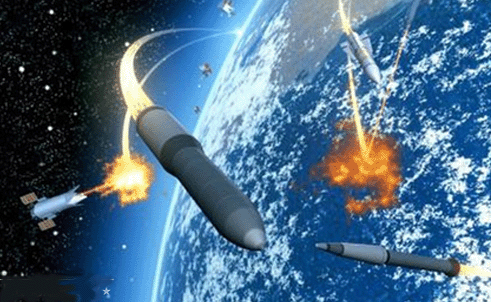 Star Wars Redux: Trump’s Space Force, Counter Punch Craig Eisendrath, who had been a U.S. State Department officer involved in its creation, notes that the Soviet Union launched the first space satellite, Sputnik, in 1957 and “we sought to de-weaponize space before it got weaponized…to keep war out of space.”
Adopted by the UN General Assembly in 1966, The Outer Space Treaty entered into force in 1967. It has been ratified or signed by 123 nations.
It provides that nations “undertake not to place in orbit around the Earth any objects carrying nuclear weapons or any other kinds of weapons of mass destruction, install such weapons on celestial bodies, or station such weapons in space in any other manner.”
Atomic physicist Edward Teller, the main figure in developing the hydrogen bomb and instrumental in founding Lawrence Livermore National Laboratory in California, pitched to Ronald Reagan, when he was governor of California visiting the lab, a plan of orbiting hydrogen bombs which became the initial basis for Reagan’s “Star Wars.” The bombs were to energize X-ray lasers. “As the bomb at the core of an X-ray battle station exploded, multiple beams would flash out to strike multiple targets before the entire station consumed itself in in a ball of nuclear fire,” explained New York Times journalist William Broad in his 1986 book Star Warriors.
Subsequently there was a shift in “Star Wars” to orbiting battle platforms with nuclear reactors or “super” plutonium-fueled radioisotope thermoelectric generators on board that would provide the power for hypervelocity guns, particle beams and laser weapons.
The rapid boil of “Star Wars” under Reagan picked up again under the administrations George H. W. Bush and son George W. Bush. And all along the U.S. military has been gung-ho on space warfare.
A U.S. Space Command was formed in 1982.
“US Space Command—dominating the space dimension of military operations to protect US interests and investment. Integrating Space Forces into war-fighting capabilities across the full spectrum of conflict,” it trumpeted in its 1998 report Vision for 2020. It laid out these words to resemble the crawl at the start of the Star Warsmovies. The U.S. Space Command was set up by the Pentagon to “help institutionalize the use of space.” Or, as the motto of one of its units declares, to be “Master of Space.”
Vision for 2020states, “Historically, military forces have evolved to protect national interests and investments-both military and economic.” Nations built navies “to protect and enhance their commercial interests” and during “the westward expansion of the United States, military outposts and the cavalry emerged to protect our wagon trains, settlements and railroads. The emergence of space power follows both of these models. During the early portion of the 2lst Century, space power will also evolve into a separate and equal medium of warfare.”
“It’s politically sensitive, but it’s going to happen,” remarked U.S. Space Command Commander-in-Chief Joseph W. Ashy in Aviation Week and Space Technology (8/9/96):
“Some people don’t want to hear this, and it sure isn’t in vogue, but—absolutely—we’re going to fight in space. We’re going to fight fromspace and we’re going to fight intospace…. We will engage terrestrial targets someday—ships, airplanes, land targets—from space.”
Or as Assistant Secretary of the Air Force for Space Keith R. Hall told the National Space Club in 1997: “With regard to space dominance, we have it, we like it and we’re going to keep it.”
The basic concept of the Pentagon’s approach to space is contained in The Future of War: Power, Technology & American World Dominance in the 2lst Century. Written by “arms experts” George and Meredith Friedman, the 1996 book concludes: “Just as by the year 1500 it was apparent that the European experience of power would be its domination of the global seas, it does not take much to see that the American experience of power will rest on the domination of space. Just as Europe expanded war and its power to the global oceans, the United States is expanding war and its power into space and to the planets. Just as Europe shaped the world for a half a millennium [by dominating the oceans with fleets], so too the United States will shape the world for at least that length of time.”
Or as a 2001 report of the U.S. Space Commission led by then U.S. Secretary of Defense Donald Rumsfeld asserted: “In the coming period the U.S. will conduct operations to, from, in and through space in support of its national interests both on the earth and in space.”……. https://www.counterpunch.org/2018/06/22/star-wars-redux-trumps-space-force/
International Law is now challenged by the “normalisation” of nuclear weapons
 Amid Nuclear Entanglement, International Law May Well Have to Ban the Weapons Altogether https://thewire.in/law/amid-nuclear-entanglement-international-law-may-well-have-to-ban-the-weapons-altogether
As long as the conventionalisation of nuclear weapons is taking place, no binding treaties will be able to stop the proliferation of or regulate nuclear weapons. Olha Bozhenko, 22/JUN/2018
Nuclear weapons enjoy a separate and unique regime under international law. The majority of states struggle to establish a complete prohibition of nuclear weapons, as in the case of other categories of Weapons of Mass Destruction (WMD). In fact, in its only authoritative pronouncement on the matter, the International Court of Justice (ICJ) stressed ‘the unique characteristics of nuclear weapons, and in particular their destructive capacity’.
Yet in view of some recent developments, to be discussed below, this distinction has been gradually disappearing, with the line between nuclear and conventional weapons becoming blurred. This means that nuclear weapons are not stigmatised as their WMD counterparts, but rather conventionalised.
This piece is an attempt to, first, ascertain the progressing conventionalisation among the current trends related to nuclear weapons and, second, delineate its consequences for the international legal regulation of armaments.
Paths of conventionalisation
Nuclear weapons conventionalisation has been referred to as ‘nuclear entanglement’, which essentially means the merger of nuclear and conventional weapons. Broadly understood, it manifests itself in the following ways.
Increased reliance on non-strategic (tactical) nuclear weapons:
As early as in his Dissenting Opinion to the Nuclear Weapons Advisory Opinion, Mohamed Shahabuddeen, a judge of the ICJ suggested that assuming tactical nuclear weapons could be no more destructive than conventional weapons, they should not be less lawful than the latter. Hence, placing nonstrategic nuclear weapons (NSNW) at the top of ‘conventionalisation agenda’ is not a brand-new idea. Besides, it has recently been emphasised in national strategies.
The most striking example is, of course, the US 2018 Nuclear Posture Review (NPR), which radically departs from its predecessor in mandating the development of a range of nonstrategic low-yield nuclear options. The Trump administration considers this departure necessary as a response to Russia’s substantial reliance on and expansion of non-strategic nuclear arsenal, which considerably outstrips that of the US. At face value, this means that the two most powerful nuclear-weapon states have embarked upon the rapid expansion of their non-strategic nuclear options.
Such an approach depicting NSNW as quite a usable tool to advance military and non-military goals significantly lowers the threshold for the actual use. Such reliance on a limited nuclear strike can well lead to the full-blown nuclear escalation, which the ICJ considered among the possible consequences of using low yield nuclear weapons.
Integration of nuclear and conventional planning and operations:
The integration of nuclear and conventional capabilities also contributes to the conventionalisation. This is ‘nuclear entanglement’ in the original meaning of the term. The integration includes equipping dual use means of delivery with nuclear and non-nuclear warheads, merging nuclear and conventional support facilities, as well as integrating planning and training for both nuclear and non-nuclear forces. China and Russia are said to pursue this strategy whether deliberately or as a matter of historical legacy. Furthermore, US’s NPR specifically mandates ensuring ‘the ability to integrate nuclear and non-nuclear military planning and operations’ to ‘deter limited nuclear escalation and nonnuclear strategic attacks’.
These developments are frowned upon for a number of reasons. They tend to erode the line between nuclear and conventional forces in the most palpable manner. They also increase the risk of adversary’s misinterpretation of the nature of an attack, which can simultaneously target ‘entangled’ capabilities.
Expanding range of scenarios for the use of nuclear weapons:
Much has been said on the expanded range of scenarios where US contemplates first use of nuclear weapons, also in response to non-nuclear threats. Although the US strategy is most widely discussed owing to its considerable departure from the previous pattern, other nuclear-weapon states either preserve deliberate ambiguity with regard to the possible use of nuclear weapons (eg UK and France) or explicitly declare their readiness to balance an adversary’s conventional superiority with a nuclear strike (eg Russia and Pakistan).
Expanding the role of nuclear weapons beyond deterring nuclear threats alludes to an increased rationality and military utility of a nuclear strike. This further undermines the arguments that there exists opinio juris (an opinion of law) prohibiting recourse to nuclear weapons, except for the purposes of deterrence. In view of such developments, it is understandable why the ICJ refused to acknowledge that the non-recourse to nuclear weapons since 1945 had been due to such opinio juris rather than the absence of military necessity.
Nuclear saber rattling:
Finally, never before has it been so common for political leaders to boast of their states’ nuclear capacities. One may recall Vladimir Putin’s threats to deploy nuclear weapons in the course of Crimea crisis and against Baltic states, or his most recent brandishing cutting-edge nuclear technology with animated nukes striking Florida in an address to the parliament. Along the same lines, Donald Trump publicly threatened North Korea with ‘fire and fury’ and even with ‘total destruction’.
Although the ICJ refused to differentiate between nuclear and conventional weapons, when assessing the legality of the threat of nuclear weapons use (para 48), the state practice seems to have accepted a special standard for nuclear threats which is measured against the strategy of deterrence. For instance, UK’s High Court of Justiciary stated that ‘deployment of nuclear weapons in time of peace … is utterly different from the kind of specific ‘threat’ which is equated with actual use’ . Under this approach, states would only cross the line of nuclear deterrence and resort to the threat of using nuclear weapons if such a threat is specific enough, i.e. directed against a specific target.
Considering that the arbitral tribunal went so far as to equate the phrase ‘to face consequences’ to a threat of the use of force in Guyana vs Suriname, it is doubtful that states are still within the safe harbour of deterrence when directing their nuclear threats explicitly and specifically against other states.
Consequences for international law
Driven by analogy with other types of WMD, international law seeks to raise the threshold for using of nuclear weapons (or even contemplating such use) as high as possible. The adoption of the Treaty on the Prohibition of Nuclear Weapons (TPNW) is among the most notable developments to this end. Still, there is an observable tension between the movement towards nuclear weapons ban as enshrined in the TPNW and the trends described above.
International legal instruments like the TPNW are grounded on humanitarian considerations. In this particular case, the TPNW is meant to stigmatise nuclear weapons to the extent of their total abandonment by nuclear-weapon states. Considering that nuclear-weapon states refused to take any part in the ‘ban campaign’ leading to the adoption of the TPNW, it is reasonable to assume that such progressive stigmatisation (which can eventually generate a parallel customary prohibition) is the only way to endow the TPNW with pragmatic force. Analogy may be drawn with other disarmament treaties such as Convention on Anti-Personnel Mines Ban and Convention on Cluster Munitions: they contributed to the establishment of the customary prohibition of respective armaments even without directly binding all states possessing them.
However, when nuclear weapons are postured to be as usable as conventional ones, the normative boundary between the two is not hardened at all. No stigma is likely to appear for weapons possessing which is dictated and justified by strong military utility. As long as the conventionalisation of nuclear weapons is taking place, no binding obligations will probably proceed from the newly established TPNW regime, either as treaty rules or as a crystallising custom.
Along with the TPNW, the Treaty on the Non-Proliferation of Nuclear Weapons (NPT) is to bear a major part in the ramifications. The core obligation of non-proliferation under Article II is likely to be affected, since nuclear weapons, if conventionalised, make their acquisition by non-nuclear-weapon states more conceivable. Additionally, the deployment of tactical nuclear devices makes nuclear weapons more accessible and ‘proliferable’ in the technical sense, spurring their acquisition by non-state actors, particularly, by terrorist groups. This is an alarming possibility considering that the non-proliferation to non-state actors still constitutes a legal gap largely left to Security Council Resolution 1540.
Besides, the conventionalisation of nuclear weapons invites their advancement, which is hardly in line with the (allegedly customary) obligation of nuclear disarmament under Article VI of the NPT. States are not in compliance with their disarmament obligation ‘to achieve a precise result – nuclear disarmament in all its aspects’ when they engage in the ‘vertical proliferation’ (i.e. modernising their nuclear arsenals or expand the range of scenarios to deploy nuclear weapons).
Should the described trends gain traction, their impact will in no way be limited to nuclear weapons regulation, but extend to the whole set of rules on the use of force. In particular, the gradually vanishing line between the threat of use of force and nuclear deterrence will further blur. It is questionable whether teetering on the brink of threats to use nuclear weapons is still justifiable under the concept of nuclear deterrence, which the ICJ was careful to characterise as practice ‘adhered to by states’. Consequently, it is doubtful whether nuclear deterrence should enjoy such leniency with respect to the standard of the threat of use of force.
The jus ad bellum (right to war) requirements for self-defence may also be affected by nuclear entanglement. For instance, it is highly questionable whether a limited strike with tactical nuclear weapons to preclude a massive conventional attack fails to meet the standard of proportionality. Similarly, it is not that clear whether anticipatory nuclear strike against a missile equipped with non-nuclear warhead is unlawful, since a state intercepting such a missile can be misled by its dual-use capacity in view of nuclear entanglement.
The questions of similar nature will arise with respect to jus in bello (laws of war). With the gap between nuclear and conventional weapons narrowing, there is less room to assert that employing nuclear weapons should be contrary to the proportionality principle. Correspondingly, what concerns the lawfulness of belligerent reprisals conducted with the use of nuclear weapons, a pre-defined approach exclusively based on the ‘nuclear element’ is likely to give ground to the qualification irrespective of the type of weapons. To put it bluntly, the ICJ’s reasoning that the legality of the use of nuclear weapons shall be considered on the basis of case-to-case compliance with jus in bello seems to be regaining relevance.
Conclusions
While any radical transformation of the international legal regime governing nuclear weapons is still unlikely, there is definitely room for considering its adequacy for current challenges. In the near future we should be ready to make a choice of either raising the bar on the conventionalisation of nuclear weapons or easing this process. Simply put, international law may find itself in need of deciding whether it is better to ban nuclear weapons altogether rather than to regulate them.
This article originally appeared on Arms Control Law.
A nuclear bomb terrorist attack on New York – the sequence of events
 What a nuclear attack in New York would look like This Is What a Nuclear Bomb Looks Like (picture of a somewhat rusting ordinary van) Ny Mag. 12 June 18
If America is attacked, the strike probably won’t come from North Korea. And it will be even scarier than we imagine. …….
The Blast
One of the greatest misconceptions about nuclear bombs is that they annihilate everything in sight, leaving nothing but a barren flatland devoid of shape and life. In truth, the physical destruction inflicted by a nuclear explosion resembles that of a combined hurricane and firestorm of unprecedented proportion. Consider one example: A ten-kiloton nuclear bomb detonated on the ground in Times Square would explode with a white flash brighter than the sun. It would be seen for hundreds of miles, briefly blinding people as far away as Queens and Newark. In the same moment, a wave of searing heat would radiate outward from the explosion, followed by a massive fireball, the core of which would reach tens of millions of degrees, as hot as the center of the sun.
When such a bomb explodes, everyone within 100 feet of ground zero is instantaneously reduced to a spray of atoms. There are photos from Hiroshima and Nagasaki showing eerie silhouettes of people cast against a flat surface, such as a wall or floor. These are not, as is sometimes claimed, the remains of vaporized individuals, but rather a kind of morbid nuclear photograph. The heat of the nuclear explosion bleaches or darkens the background surface, except for the spot blocked by the person, leaving a corresponding outline. In some cases the heat released by the explosion will also burn the patterns of clothing onto people’s skin.
Near the center of the blast, the suffering and devastation most closely conform to the fictional apocalypse of our imaginations. This is what it would look like within a half-mile of Times Square: Few buildings would remain standing. Mountains of rubble would soar as high as 30 feet. As fires raged, smoke and ash would loft into the air. The New York Public Library’s stone guardians would be reduced to pebble and dust. Rockefeller Center would be an unrecognizable snarl of steel and concrete, its titanic statue of Prometheus — eight tons of bronze and plaster clad in gold — completely incinerated.
Within a half-mile radius of the blast, there would be few survivors. Those closest to the atomic bombings on Hiroshima and Nagasaki have described the horrors they witnessed: People with ripped sheets of skin hanging from their bodies; people whose brains were visible through their shattered skulls; people with holes for eyes. Sakue Shimohira watched her mother’s charred body crumble into ash as she tried to wake her. Shigeko Sasamori’s father cut off the blackened husk of skin all over her face, revealing pools of pus beneath.
As the fireball travels outward from the blast, people, buildings, and trees within a one-mile radius would be severely burned or charred. Metal, fabric, plastic, and clay would ignite, melt, or blister. The intense heat would set gas lines, fuel tanks, and power lines on fire, and an electromagnetic pulse created by the explosion would knock out most computers, cell phones, and communication towers within several miles.
Traveling much farther than the fireball, a colossal pressure wave would hurtle forth faster than the speed of sound, generating winds up to 500 miles per hour. The shock wave would demolish the flimsiest buildings and strip the walls and roofs off stronger structures, leaving only their naked and warped scaffolding. It would snap utility poles like toothpicks and rip through trees, fling people through the air, and turn brick, glass, wood, and metal into deadly projectiles. A blast in Times Square, combined with the fireball, would carve a crater 50 feet deep at the center of the explosion. The shock wave would reach a diameter of nearly 3.2 miles, shattering windows as far as Gramercy Park and the American Museum of Natural History.
All this would happen within a few seconds.
From Van to Tsunami
Five different nukes, and what they would do if unleashed on Times Square.……….http://nymag.com/daily/intelligencer/2018/06/what-a-nuclear-attack-in-new-york-would-look-like.html
Robots the hope for cleaning up the world’s riskiest and massive nuclear waste storage pool, at Sellafield, UK.

Above – Sellafield’s massive Magnox nuclear waste storage pool
Only Cthulhu can solve Sellafield’s sludgy nuclear waste problem, Wired, , 14 June 18
Cleaning up Sellafield’s nuclear waste costs £1.9 billion a year. To help with the toxic task, robots are evolving fast. Sellafield has been called the most dangerous place in the UK, the most hazardous place in Europe and the world’s riskiest nuclear waste site. At its heart is a giant pond full of radioactive sludge, strewn with broken metal, dead animals and deadly nuclear rods. The solution to clearing up Sellafield’s nuclear waste and retrieving the missing nuclear fuel? Robots, of course. And to tackle this mammoth task, the robots are being forced to evolve.
Sellafield’s First-Generation Magnox Storage Pond is a giant outdoor body of water that’s the same size as two Olympic swimming pools. It was built in the 1960s to store used fuel rods from the early Magnox reactors – which had magnesium alloy cladding on the fuel rods – as part of Britain’s booming nuclear program. In 1974, there was a delay in reprocessing; fuel rods started corroding and the pond became murky. The pool was active for 26 years until 1992 and is now finally being decommissioned as part of the £1.9 billion spent each year on Sellafield’s mammoth cleanup operation.
The pond contains about six metres of radioactive water and half a metre of sludge, composed of wind-blown dirt, bird droppings and algae – the usual debris that builds up in any open body of water. Unlike other mud, it conceals everything from dropped tools and bird carcasses to corroded Magnox cladding and the remains of uranium fuel rods.
A number of robotic creations have bee used to get to the bottom of the pool’s sludge but struggle to break through the hostile environment. Tethered swimming robots do not have the sensors to find objects in the fine mud, and lack the leverage to lift chunks of metal. Experience at Fukushima has shown robots that are not well adapted to the environment are a waste of time.
Enter Cthulhu, a tracked robot that can drive along the pond bed, feeling its way with tactile sensors and sonar. The robot, which is currently in development, is approaching Sellafield’s problem differently. The robot will be able to identify nuclear rods and then pick them up. “Rather than trying to mimic a human, we’re building a robot that can do things humans can’t do with senses that humans don’t have,” says Bob Hicks of QinetiQ, which is leading the project.
The name stands for ‘Collaborative Technology Hardened for Underwater and Littoral Hazardous Environment,’ but it’s also a nod to Cthulhu, the godlike alien created by HP Lovecraft: both are amphibious, dwell in strange surroundings, and have sensory feelers. “Much like a walrus detecting molluscs, we hope to be able to detect and identify objects in the sludge with the whiskers,” says Plamen Angelov of Lancaster University’s School of Computing and Communications.
QinetiQ is supplying the tracked body, originally from a bomb disposal robot, and Bristol Maritime Robotics is developing the tactile sensors, while Angelov’s team is providing the neural network AI. It is planned the robot will use deep learning to fuse tactile and sonar data into a single picture of the world. Existing neural networks can handle video data, and ‘image classifiers’ to distinguish objects are well-established. But nobody has tried to fuse data from different types of sensor before.
Cthulhu’s classifier will learn to divide objects into ‘fuel rods’ and ‘everything else’………
The work at Sellafield is due to take several decades to complete fully. Nuclear waste is spread through several buildings in a variety of silos and pools. Each has its own challenges for cleaning-up. For the First Generation Magnox Pond, documents from the government show all the bulk fuel should be removed by the early 2030s. http://www.wired.co.uk/article/sellafield-nuclear-robots-cleanup-waste
Completely ignored in nuclear summit talks – the forgotten North Korean victims of 1945 atomic bombs
 Trump–Kim: an agenda for forgotten nuclear victims, ps://www.lowyinstitute.org/the-interpreter/trump-kim-agenda-forgotten-nuclear-victimsThe Interpreter, BY Lauren Richardson, @Lauren_ANU 14 June 18
Like most Korea observers, in the lead-up to the Trump–Kim summit I have been inundated with questions from journalists and friends alike. Does Kim Jong-un have any actual intention to denuclearise? Would Donald Trump settle for anything less than complete, verifiable, irreversible disarmament (CVID) of North Korea’s nuclear program? Will North Korea’s human rights abuses be on the agenda? And, in that vein, will Trump raise the issue of North Korean abductions of Japanese citizens?
There is, however, one question that no one is asking. And it is a crucial one.
What about the North Korean A-bomb victims, the only survivors of the US nuclear attacks on Japan, who have never had recourse to monetary redress? Will they be on the summit agenda?
The absence of this question in the summit discussions is unsurprising. North Koreans are the forgotten victims of the atomic bombs and represent a gap in global memory of nuclear issues. It is not commonly known that when the US dropped atomic bombs over Nagasaki and Hiroshima in August 1945, roughly 10% of the victims of these attacks were of Korean descent.
Koreans were residing in the A-bomb target cities in large numbers under colonial auspices: in many cases they had been brought there against their will, forced to perform labour in Japan’s military industrial factories.
And it is a virtually unknown fact that when Koreans were repatriated to their newly divided homeland in the years following Japan’s surrender, approximately 2000 of the A-bomb survivors wound up north of the 38th parallel, suffering from the unrelenting effects of the radiation blast. Many of them are still alive and ailing today. In a further twist of fate, owing to the lack of diplomatic relations between Pyongyang and Tokyo, North Korean victims were precluded from financial assistance provided by the Japanese government to overseas A-bomb survivors, including South Koreans, in later decades. This was premised on a belief that “the money would likely never reach them”.
The plight of the North Koreans would never have come to light at all were it not for an activist named Lee Sil-gun. I have sat with Lee in Hiroshima on a number of occasions to interview him about his advocacy efforts. He was born in Japan in 1929 to Korean parents, and became an atomic bomb victim by virtue of exposure to residual radiation in Hiroshima.
In the post-war years, as the plight of A-bomb victims became politicised in Japan and the redress movement launched by South Korean victims gradually gained traction, he was dismayed to find that the voiceless North Koreans had been left out of the discourse:
I knew that there were victims in the North because I farewelled them at the port when they were shipped off from Japan after the Second World War.
Lee began embarking on annual visits to Pyongyang in the 1990s in an attempt to reach out to the victims there. He was supported in this endeavour by a small group of dedicated Japanese anti-nuclear activists.
They found the North Koreans in a terrible predicament: without recourse to adequate medical care, the victims were resorting to various primitive methods to treat their radiation-related maladies. They were burning sulphur, for instance, and using the smoke to sterilise recurrent wounds.
On discovering this, Lee and his supporters arranged a dispatch of Japanese medical practitioners to the DPRK to train local doctors in the treatment of A-bomb illness; they then organised a converse delegation of victims and doctors from North Korea to Japan, to respectively undergo treatment and be familiarised with advanced medical equipment.
North Korean officials were appreciative of and inspired by Lee’s efforts, and in 1997 issued him with an astonishing request. They asked Lee if he would organise a photo exhibition in North Korea depicting the destructive impact of nuclear weapons. Lee happily obliged, and this exhibit came to fruition two years later: 77 photos were displayed in the Grand People’s Study House in central Pyongyang from 13–18 August 1999.
I found a newspaper article about this event in an archive in Seoul. When I asked Lee how he managed to pull it off, he became choked with emotion. Through tears, he said:
I went to the Hiroshima Peace Memorial Museum and asked if I could borrow some of their posters and photos. At first they were reluctant, but eventually they let them have them for a month. I was so happy.
Four reasons make plain why this issue should be part of the Trump–Kim summit and any ongoing US–DPRK talks.
First, for Trump to acknowledge North Korea’s long-ailing A-bomb victims would be the best way to set the scene for talks on denuclearisation. Consider Barack Obama’s playbook, for instance. When he made an historic visit to the Hiroshima Peace Memorial in 2016, paying homage to the nuclear victims, it did wonders for US–Japan relations. Paying tribute to the North Korean victims at the summit would serve to frame the negotiations in such a way that Pyongyang was not the only party with adverse nuclear potential at the table.
Second, the issue of North Korean A-bomb victims would be a reminder that the devastating potential of nuclear weapons is embedded in the memory of North Korea. This should factor into Trump’s strategic calculus of Kim’s intentions for his nuclear program.
To be sure, Kim is young and did not experience first-hand the turmoil in Northeast in the aftermath of the US atomic bombings. But his grandfather did. And his own father permitted the efforts of activists from Japan to advocate on behalf of North Korean A-bomb victims – the same victims that live among Kim Jong-un’s populace today. Thus, if Trump does not manage to achieve the grand CVID bargain that he hopes for at the summit, he shouldn’t jump to the conclusion that Kim intends to use his nukes in the near future.
Third, any settlement regarding the “denuclearisation” of the Korean Peninsula should reasonably entail the establishment of a specialist treatment facility for A-bomb victims in the North. Two years ago, I visited a nursing home that offers round-the-clock treatment to the South Korean victims in Hapcheon County; the patients reported to me that they were still having tiny shards of glass surgically removed from their faces all these decades down the track.
While I don’t wish to suggest that the South Koreans are better off – in fact, they are still suffering immensely – the North Koreans have been left without any such facility. If the 1945 chapter of nuclear history has still not been settled, how can we expect to settle the current one with North Korea?
Lastly, raising the North Korean A-bomb victims issue would serve as a stark reminder at the summit that there is still only one government that has deployed nuclear weapons in conflict, and it is not Pyongyang. To the contrary, (the now) North and South Koreans were the collateral damage of that historic conflict, and many are still awaiting redress.
* This piece is based on a forthcoming journal article.
The global problem of poisonous plutonium: Japan looks at its options
 a minimum requirement for any form of political consent to onsite storage would be a clear commitment by the government to phase out all nuclear power by a fixed date, so that the final amount of waste can be determined and will not just keep growing, along with the burden on local people.

 CNIC Seminar report: The problems with Japan’s Plutonium: What are they and how do we deal with them? http://www.cnic.jp/english/?p=4135 Caitlin Stronell, CNIC BY CNIC_ENGLISH · JUNE 4, 2018 On April 20, CNIC organized a seminar with guest speaker Prof. Frank von Hippel, a nuclear physicist from Princeton University’s Program on Science and Global Security, presenting alternative ways to dispose of spent fuel instead of reprocessing, as well as options for disposal of separated plutonium. After this presentation of technical solutions, a panel discussion took place. Prof. Eiji Oguma, a historical sociologist from Keio University’s Faculty of Policy Management and a well-known commentator on the post-Fukushima anti-nuclear movement in Japan, pointed out the political barriers that must be overcome if any of these technical solutions were to be actually implemented, no matter how much more reasonable they may seem from economic and safety perspectives. CNIC’s General Secretary, Hajime Matsukubo was also on the panel and brought into the discussion the international implications of Japan’s plutonium policy including the US-Japan Nuclear Agreement.
Groups Release Key DOE Documents on Expanded Plutonium Pit Production, DOE Nuclear Weapons Plan Not Supported by Recent Congressional Actions
https://nukewatch.org/pressreleases/PR-Pit-Production-Docs-5-31-18.pdf May 31, 2018 Contact Tom Clements, SRS Watch, 803.240.7268, tomclements329@cs.com Jay Coghlan, Nuclear Watch NM, 505.989.7342, c. 505.470.3154, jay@nukewatch.org
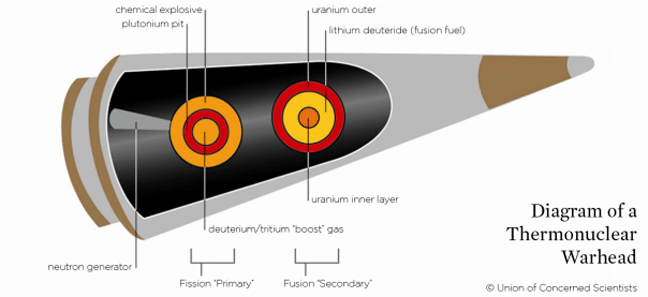
Santa Fe, NM & Columbia, SC – Two key U.S. Department of Energy documents on future production of plutonium “pits” for nuclear weapons, not previously released to the public, fail to justify new and upgraded production facilities at both the Los Alamos National Laboratory (LANL) in New Mexico and the Savannah River Site (SRS) in South Carolina.
The report reveals that the initial cost estimate for these new and upgraded facilities at both sites is $10 billion by 2030, and around $46 billion in total life cycle costs. Plutonium pits are the fissile cores of nuclear weapons. Cost overruns are the rule for major projects undertaken by the National Security Administration (NNSA), the semi-autonomous nuclear weapons agency within DOE, so the costs are likely to rise yet more, according to Nuclear Watch New Mexico and Savannah River Site Watch.
NNSA’s Pu Pit Production Engineering Assessment, originally marked Unclassified Controlled Nuclear Information, was finalized on April 20, 2018. The 293-page document was obtained by Nuclear Watch and is being released so that the public may be fully informed about the agency’s misguided pursuit of new plutonium pit production facilities for future new-design nuclear weapons. The new NNSA Administrator has called future plutonium pit production her highest priority. But the Engineering Assessment fails to answer the most crucial question: why are at least 80 plutonium pits per year needed to begin with?
As background, on May 10, 2018, NNSA announced in a one-page statement:
To achieve DoD’s [Department of Defense] 80 pits per year requirement by 2030, NNSA’s recommended alternative repurposes the Mixed Oxide Fuel Fabrication Facility at the Savannah River Site in South Carolina to produce plutonium pits while also maximizing pit production activities at Los Alamos National Laboratory in New Mexico. This two-prong approach – with at least 50 pits per year produced at Savannah River and at least 30 pits per year at Los Alamos – is the best way to manage the cost, schedule, and risk of such a vital undertaking.
Nuclear Watch also obtained NNSA’s 14-page Plutonium Pit Production Engineering Assessment (EA) Results. That summary document, dated May 2018, relied on the Trump Administration’s 2018 Nuclear Posture Review for claiming the need for expanded plutonium pit production. However, that high-level review failed to state any concrete justification for the alleged pit need. Moreover, Congress is balking at funding any new pit production facilities at SRS, primarily because Sen Lindsey Graham (R-SC) vociferously opposes repurposing the MOX facility, now undergoing termination, and the New Mexico congressional delegation opposes any pit production outside of the Los Alamos Lab.
The Engineering Assessment details that NNSA analyzed four pit production options, one in the Mixed Oxide (MOX) Fuel Fabrication Facility at SRS and three options at Los Alamos. NNSA chose the most expensive combination, repurposing the MOX facility and increasing pit production at LANL to 30 pits per year. Los Alamos is currently authorized to produce 20 pits per year, but has failed to achieve even that because of ongoing nuclear criticality safety issues (moreover, LANL proposed to produce all 80 pits per year, which NNSA rejected). SRS has never produced pits, raising new nuclear risks at that site and concern about new waste streams.
The Engineering Assessment makes clear that “moderate risks” in the option of repurposing the MOX plant at SRS includes any failure to quickly terminate the MOX project, due to subsequent delays in closing out the project and terminating contracts. Likewise, the report affirms a longheld concern that there is a “very high probability for incomplete construction records/as-built drawings” for the MOX project. On May 10, DOE began congressionally sanctioned termination of the bungled MOX project, but it is being opposed in last-ditch, desperate attempts by Senator Lindsey Graham and the State of South Carolina. The Engineering Assessment makes explicitly clear that terminating the MOX program is the crucial prerequisite for plutonium pit production at SRS and that “some work [on repurposing the MOX plant] can be completed during MOX closeout,” contrary to both the wishes of Congress and requirements of the National Environmental Policy Act.
Expanded plutonium pit production is NOT needed to maintain the safety and reliability of the existing nuclear weapons stockpile, according to Nuclear Watch. In fact, no pit production for the existing nuclear weapons stockpile has been scheduled since 2011, and none is scheduled for the future. Up to 15,000 “excess” pits and another 5,000 in “strategic reserve” are already stored at DOE’s Pantex Plant near Amarillo, TX. In 2006 independent experts found that pits last a least a century1 (they currently average 40 years old). A 2012 follow-on study by the Livermore Lab found that the “graceful aging of plutonium also reduces the immediate need for a modern highcapacity manufacturing facility to replace pits in the stockpile.” 2
Future pit production is for speculative future new designs being pushed by the nuclear weapons labs, so-called Interoperable Warheads for both land- and sub-launched missiles that the Navy does not support. 3 Moreover, as the Engineering Assessment makes clear, future pits will NOT be exact replicas of existing pits. This could have serious potential consequences because heavily modified plutonium pits cannot be full-scale tested, or alternatively could prompt the U.S. to return to nuclear weapons testing, which would have severe international proliferation consequences.
The Engineering Assessment also explicitly links raising the administrative limit on plutonium at LANL’s “Rad Lab” to expanded pit production. This contradicts a recent draft environmental assessment in which NNSA claimed that re-categorizing the Rad Lab as a Hazard Category-3 nuclear facility was necessary only to maintain basic analytical chemistry capabilities, while omitting any reference whatsoever to expanded plutonium pit production.
The Engineering Assessment briefly outlines what could be a major vulnerability to NNSA’s pit production plans, that is the agency’s future compliance (or not) with the National Environmental Policy Act (NEPA). The Assessment states that if “compliance is delayed, [this] extends the schedule, increases costs, and/or delays production.” Both Nuclear Watch and SRS Watch assert that the law requires that major federal proposals be subject to public review and comment before a formal decision is made. Arguably, a formal decision to raise production to 80 pits or more per year necessitates a new or supplemental nation-wide programmatic environmental impact statement (PEIS), which the new dual-site decision strongly buttresses. Follow-on site-specific NEPA documents will then be necessary, with full public participation and hearings. All of this could introduce substantial delays to NNSA’s plutonium pit production plans.
“While it’s clear that the bungled MOX project is unworkable from technical and cost perspectives and must rapidly be terminated, there is no justification to convert the abandoned facility to a nuclear bomb production plant,” said Tom Clements, director of SRS Watch. “We agree that money must now be spent closing and securing the MOX building, but not on the new, unauthorized pit mission. Spending taxpayer funds to now begin conversion of the MOX plant to pit production, as is indicated in the pit report, is premature and can’t even be considered until Congress approves the NNSA approach for new facilities and an environmental impact review with public participation takes place,” added Clements.
Jay Coghlan, Nuclear Watch Director, commented, “NNSA has already tried four times to expand plutonium pit production, only to be defeated by citizen opposition and its own cost overruns and incompetence. We realize that this fifth attempt at a new pit plant is the most serious yet, but we remain confident it too will fall apart. The enormous financial and environmental costs of new nuclear bomb factories and the fact that expanded plutonium pit production is simply not needed for the existing nuclear weapons stockpile will doom this effort. We think the American public will reject new-design nuclear weapons, which is what this expanded pit production decision is really all about.”
Terra Power’s Traveling Wave Nuclear Reactor sounds great – BUT!
TerraPower’s Nuclear Reactor Could Power the 21st Century. The traveling-wave reactor and other advanced reactor designs could solve our fossil fuel dependency IEEE Spectrum, By In a world defined by climate change, many experts hope that the electricity grid of the future will be powered entirely by solar, wind, and hydropower. Yet few expect that clean energy grid to manifest soon enough to bring about significant cuts in greenhouse gases within the next few decades. Solar- and wind-generated electricity are growing faster than any other category; nevertheless, together they accounted for less than 2 percent of the world’s primary energy consumption in 2015, according to the Renewable Energy Policy Network for the 21st Century.
To build a bridge to that clean green grid of the future, many experts say we must depend on fission power. ………several U.S. startups are pushing new reactor designs they say will address nuclear’s major shortcomings. In Cambridge, Mass., a startup called Transatomic Power is developing a reactor that runs on a liquid uranium fluoride–lithium fluoride mixture. In Denver, Gen4 Energy is designing a smaller, modular reactor that could be deployed quickly in remote sites.
 In this cluster of nuclear startups, TerraPower, based in Bellevue, Wash., stands out because it has deep pockets and a connection to nuclear-hungry China. Development of the reactor is being funded in part by Bill Gates, who serves as the company’s chairman. And to prove that its design is viable, TerraPower is poised to break ground on a test reactor next year in cooperation with the China National Nuclear Corp. …….
It also releases plenty of energy; after all, Pu-239 is the primary isotope used in modern nuclear weapons. But Levesque says the creation of Pu-239 doesn’t make the reactor a nuclear-proliferation danger—just the opposite. Pu-239 won’t accumulate in the TWR; instead, stray neutrons will split the Pu-239 into a cascade of fission products almost immediately.
In other words, the reactor breeds the highly fissile plutonium fuel it needs right before it burns it, just as Feinberg imagined so many decades ago. Yet the “traveling wave” label refers to something slightly different from the slowly burning, cigar-style reactor. In the TWR, an overhead crane system will maintain a reaction within a ringed portion of the core by moving pins into and out of that zone from elsewhere in the core, like a very large, precise arcade claw machine.
To generate electricity, the TWR uses a more complicated system than today’s reactors, which use the core’s immense heat to boil water and drive a steam turbine to generate usable electricity. In the TWR, the heat will be absorbed by a looping stream of liquid sodium, which leaves the reactor core and then boils water to drive the steam turbine.
 But therein lies a major problem, says Makhijani. Molten sodium can move more heat out of the core than water, and it’s actually less corrosive to metal pipes than hot water is. But it’s a highly toxic metal, and it’s violently flammable when it encounters oxygen. “The problem around the sodium cooling, it’s proved the Achilles’ heel,” he says.
Hanford – the true heartland of America’s toxic nuclear mess
The 60-Year Downfall of Nuclear Power in the U.S. Has Left a Huge Mess The demand for atomic energy is in decline. But before the country can abandon its plants, there’s six decades of waste to deal with. The Atlantic , FRED PEARCE,
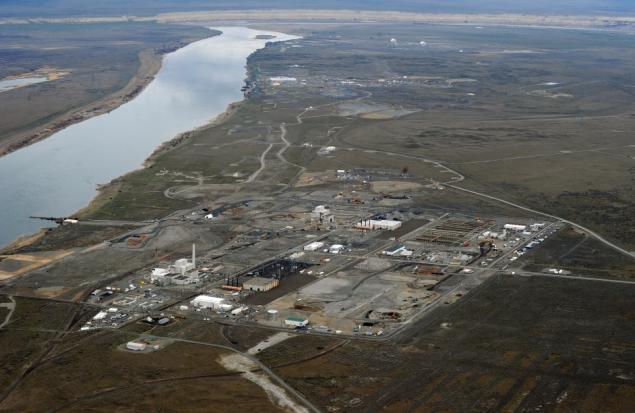
“……… The true heartland of America’s nuclear enterprise has always been Hanford. And it is the biggest and most toxic cleanup legacy too. Straddling the Columbia River, the Hanford nuclear reservation was America’s primary bomb-making factory. It was where they made the plutonium. At peak production, during the 1960s, its nine reactors irradiated 7,000 metric tons of uranium fuel annually. The intense radiation inside the reactors produced plutonium that was then extracted at five reprocessing plants. Hanford produced a total of 67 metric tons of the metal for the American arsenal, before business halted after the Cold War ended.Plutonium production was a huge task. It required much of the electricity generated at the giant Grand Coulee Dam upstream on the Columbia, the largest hydroelectric power producer in the United States. And the mess left behind is equally mind-boggling. Since production ceased, Hanford has been conducting the country’s largest-ever environmental cleanup program. The current expenditure is $2.3 billion a year. By the time it is done the bill will be more than $100 billion.
The site holds an estimated 25 million cubic feet of solid, radioactive waste. Much of it is buried in over 40 miles of trenches and tunnels, up to 24 feet deep, including the stretch that caved in last year. Elsewhere, there are two corroding cooling ponds, each the size of an Olympic swimming pool, containing some 2,000 tons of spent fuel that never got reprocessed.
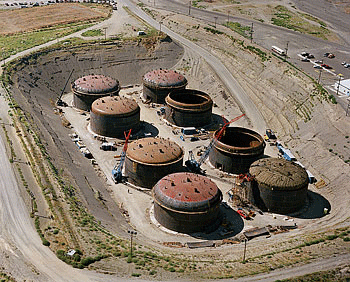 But the headline Hanford problem is the 56 million gallons of acidic and highly radioactive liquids and sludges, stored in 177 giant tanks, each up to 75 feet in diameter. They are the solvent leftovers from reprocessing, and contain around twice the total radioactivity released from the world’s worst nuclear accident to date, the 1986 explosion at the Chernobyl power station in Ukraine.
The tanks have been leaking for over half a century. Around a million gallons are slowly spreading toward the Columbia River, in a plume of contaminated soil covering 80 square miles. Protecting the river and its rich salmon habitat from the radioactive pollution is the number-one cleanup priority for the site’s custodians at the Department of Energy. To head off the flows, engineers are constantly pumping out radioactive water.
A better idea is to stop the leaks at the source by emptying the tanks and solidifying the liquids. The current aim is to heat them with glass-forming materials to create solid blocks that could one day be buried deep underground—maybe at Yucca Mountain. Work on a plant to do this began in 2002. It is currently 25 years behind schedule. Operations are not set to begin until 2036 and, once underway, would take 40 years.
At $17 billion and counting, the project is way over budget. Former plant engineers who have turned whistle-blowers believe it won’t be fit for the job and should be abandoned. They warn of a serious risk that particles of plutonium may settle out in the plant processing tanks, creating the potential for an accidental explosion with a big release of radiation.
The task at Hanford grows ever more daunting. After almost three decades, little of the waste and few of the tanks or processing plants have been cleaned up. Far away in Washington, D.C., some question the continuing money sink. It seems to some like a 21st-century pork barrel. Perhaps, critics say, it would be better to put up a fence and walk away. President Trump, while so far publicly supporting the Hanford cleanup, may privately agree. He has slashed its annual budget by $230 million, or about 10 percent.
Local environmentalists are scandalized. “We have got to clean up the site,” says Dan Serres, the conservation director of Columbia Riverkeeper, a local NGO. The tanks should be emptied and the trenches dug up. “In a hundred years, I’d hope the Native Americans have their treaty rights to this land restored,” agrees Chuck Johnson, of Physicians for Social Responsibility. But Tom Carpenter, the executive director of Hanford Challenge, who sits on an advisory board at the Hanford Concerns Council, told me: “You are never going to dig all the waste there up.” The tanks will have to be dealt with, but “most of Hanford’s waste volume-wise is going to stay put. Hanford is going to be a national sacrifice zone for hundreds of years.”
This piece is adapted from Pearce’s new book, Fallout: Disasters, Lies, and the Legacy of the Nuclear Age.https://www.theatlantic.com/science/archive/2018/05/the-60-year-downfall-of-nuclear-power-in-the-us-has-left-a-huge-mess/560945/
The Fort St. Vrain spent nuclear fuel store – just another example of America’s stranded radioactive waste dumps

 , FRED PEARCE,
“…….. About 30 miles northeast of Rocky Flats, out on the prairie near the small town of Platteville, is the Fort St. Vrain spent-fuel store. It resembles nothing so much as an outsize grain store, but since the 1990s it has been holding 1,400 spent fuel rods, laced with plutonium and encased in blocks of graphite. The spent fuel was left behind when the neighboring nuclear power plant shut. The plan had been to send it to another temporary store at the Idaho National Laboratory, but the governor of Idaho banned the shipment. The Fort St. Vrain facility is designed to withstand earthquakes, tornado winds of up to 360 miles per hour, and flooding six feet deep. Also time. It will be several decades at least before the federal government finds the fuel a final resting place.
The country is littered with such caches of spent fuel stuck in limbo. According to the Government Accountability Office (GAO), 80,000 metric tons of spent fuel, the most dangerous of all nuclear wastes, is stored at 80 sites in 35 states. The sites include stores at past and present power plants such as Maine Yankee, and stand-alone federal sites such as Fort St. Vrain. As the GAO puts it: “After spending decades and billions of dollars … the future prospects for permanent disposal remain unclear.” Nobody wants to give the stuff a forever home.
Nuclear waste is conventionally categorized as high-, intermediate-, or low-level. Low-level waste includes everything from discarded protective clothing to plant equipment and lab waste. It can usually be treated like any other hazardous waste, which in practice usually means burial in drums in landfills or concrete-lined trenches.
Intermediate waste contains radioactive materials with isotopes that decay with half-lives long enough to require long-term incarceration. It includes many reactor components, as well as chemical sludges and liquids from processing radioactive materials, which can often be solidified in concrete blocks. Once solid, intermediate waste can be buried safely in shallow graves, though anything containing plutonium will have to be disposed of deep underground because of the very long half-life.
Much of America’s intermediate-level waste will end up at the country’s largest deep-burial site for such radioactive material. The U.S. military’s Waste Isolation Pilot Plant in salt beds near Carlsbad, New Mexico, could eventually take 6.2 million cubic feet of waste. But it has had problems that have slowed progress and raised questions about its viability.
A chemical explosion in 2014 sprayed the tunnels dug into the salt beds with a white, radioactive foam. When a ventilation filter failed, some of the plutonium reached the surface, where at least 17 surface workers were contaminated. The military shut the tunnels for three years to clean up. While WIPP is today back in business, full operations cannot resume until a new ventilation system is in place, probably in 2021. The eventual cost of the accident, including keeping the dump open longer to catch up with the waste backlog, has been put at $2 billion.
High-level waste is the nastiest stuff. It includes all spent fuel and a range of highly radioactive waste liquids produced when spent fuel is reprocessed, a chemical treatment that extracts the plutonium. Most of America’s high-level waste liquids—and around 30 percent of the world’s total—are in tanks at Hanford.
High-level waste is either very radioactive and will stay so for a long time, or it generates heat and so requires keeping cool. Usually both. It accounts for more than 95 percent of all the radioactivity in America’s nuclear waste, and needs to be kept out of harm’s way for thousands of years.
There is general agreement that the only way to keep high-level waste safe is by turning the liquids into solids and then burying it all deep underground, somewhere where neither water nor seismic activity is likely to bring the radioactivity to the surface, and where nobody is likely to stumble on it unexpectedly. There is disagreement, however, about whether this buried waste should be kept retrievable in case future technologies could make it safer sooner, or whether accessibility simply places a burden of guardianship on future generations.
Before it can be buried, most high-level waste needs to be stored for up to a century while it cools. Unfortunately, this has encouraged countries to put off making plans. None of the world’s high-level waste currently has any permanent resting place. The planet is instead peppered with interim stores. America is no better. Its 90,000 metric tons of high-level waste—set to rise to as much as 140,000 tonnes by the time the last power plant closes—is mostly sitting in ponds at dozens of power stations or lockups like Fort St. Vrain………..https://www.theatlantic.com/science/archive/2018/05/the-60-year-downfall-of-nuclear-power-in-the-us-has-left-a-huge-mess/560945/
1 This Month



26 September – International Day for the Total Elimination of Nuclear Weapons


PLEASE OPPOSE HR 8255 AND S.3639 – bills would accelerate satellite deployment, with no environmental review or safeguards – https://ncstd5li.quorum.us/campaign/169331/
To see nuclear-related stories in greater depth and intensity – go to https://nuclearinformation.wordpress.com
-
Archives
- September 2026 (219)
- August 2026 (330)
- July 2026 (355)
- June 2026 (287)
- May 2026 (306)
- April 2026 (356)
- March 2026 (251)
- February 2026 (267)
- January 2026 (308)
- December 2025 (358)
- November 2025 (359)
- October 2025 (375)
-
Categories
- 1
- 1 NUCLEAR ISSUES
- business and costs
- climate change
- culture and arts
- ENERGY
- environment
- health
- history
- indigenous issues
- Legal
- marketing of nuclear
- media
- opposition to nuclear
- PERSONAL STORIES
- politics
- politics international
- Religion and ethics
- safety
- secrets,lies and civil liberties
- spinbuster
- technology
- Uranium
- wastes
- weapons and war
- Women
- 2 WORLD
- ACTION
- AFRICA
- Atrocities
- AUSTRALIA
- Christina's notes
- Christina's themes
- culture and arts
- Events
- Fuk 2022
- Fuk 2023
- Fukushima 2017
- Fukushima 2018
- fukushima 2019
- Fukushima 2020
- Fukushima 2021
- general
- global warming
- Humour (God we need it)
- Nuclear
- RARE EARTHS
- Reference
- resources – print
- Resources -audiovicual
- Weekly Newsletter
- World
- World Nuclear
- YouTube
-
RSS
Entries RSS
Comments RSS
 nuclear-news