China absolutely clear on its policy of No First Use of Nuclear Weapons
|
China Holds Firm on No First Use of Nuclear Weapons https://allthingsnuclear.org/gkulacki/china-holds-firm-on-no-first-use-of-nuclear-weapons
GREGORY KULACKI, CHINA PROJECT MANAGER AND SENIOR ANALYST | JULY 24, 2019, Ever since I took this job 17 years ago US colleagues of all political and intellectual persuasions have been telling me that sooner or later China would alter, adjust, amend or qualify the policy that China will never, under any circumstances, use nuclear weapons first. Yesterday, the Chinese Ministry of Defense released a much-anticipated new white paper on China’s national defense policies. Here’s what it says about nuclear weapons:
China is always committed to a nuclear policy of no first use of nuclear weapons at any time and under any circumstances, and not using or threatening to use nuclear weapons against non-nuclear-weapon states or nuclear-weapon-free zones unconditionally. China advocates the ultimate complete prohibition and thorough destruction of nuclear weapons. China does not engage in any nuclear arms race with any other country and keeps its nuclear capabilities at the minimum level required for national security. China pursues a nuclear strategy of self-defense, the goal of which is to maintain national strategic security by deterring other countries from using or threatening to use nuclear weapons against China. It would be difficult to compose a more emphatic rejection of claims that China’s no first use policy is changing. The statement also indicates it is not Chinese policy to use nuclear weapons first to forestall defeat in a conventional military conflict with the United States. China does not have an “escalate to de-escalate” nuclear strategy. China is not preparing to fight a nuclear war with United States. It does not have “battlefield” or “tactical” or “non-strategic” nuclear weapons. Chinese nuclear strategists don’t think a nuclear war with the United States is likely to happen. And they seem sure it won’t happen as long as the US president believes China can retaliate if the United States strikes first. That’s not a high bar to meet, which is why China’s nuclear arsenal remains small and, for the time being, off alert. China sees its comparatively modest nuclear modernization program as a means to convince US leaders that a few Chinese ICBMs can survive a US first strike and that these survivors can penetrate US missile defenses. Chinese nuclear planners might be willing to slow or scale back their nuclear modernization efforts if the United States were willing to assure China’s leaders it would never use nuclear weapons first in a military conflict with China. Chinese experts and officials have been asking the United States to offer that assurance for decades. US experts and officials consistently refuse. In the absence of a no first use commitment from the United States, Chinese nuclear strategists believe continued improvements to their nuclear arsenal are needed to assure China’s leaders their U.S. counterparts won’t take the risk of attacking China with nuclear weapons. Chinese experts know US efforts to develop a working ballistic missile defense system are not going well, but they still feel the need to hedge against continued US investment in the system with incremental improvements in the quality and quantity of China’s small nuclear force. Given the impassioned attack on constructive US-China relations currently sweeping US elites off their feet, along with the continued proliferation of misinformation about Chinese nuclear capabilities and intentions, many US commentators are likely to brush aside the new white paper’s reiteration of China’s longstanding nuclear no first use policy. It doesn’t fit in the emerging US story about a new Cold War. That’s unfortunate, especially as the US Congress threatens to ramp upa new nuclear arms race its supposed adversary has no intention to run. |
|
New report: nuclear energy cannot be classified as “clean”, nor as economic

 Nuclear: A poor investment strategy for clean energy https://www.pv-magazine.com/2019/07/24/nuclear-a-poor-investment-strategy-for-clean-energy/
The study undertook an empirical survey of the 674 nuclear plants that have ever been built to demonstrate that private economic interests were not the motive, but instead have been driven by military interests.
“Nuclear power was never designed for commercial electricity generation; it was aimed at nuclear weapons. That is why nuclear electricity has been and will continue to be uneconomical,” says Christian von Hirschhausen, coauthor of the study.
In its Monte Carlo simulation model developed for the net present value of a 1 GW nuclear plant, the study found that expected loss of revenues range between 1.5 and 8.9 billion euros. The model built in a variety of factors including the wholesale cost of electricity (20-80 euros/MWh), specific investment costs (4,000-9,000 euros/kW) and the weighted average cost of capital (4-10%). In the Monte Carlo analysis, researchers argue that, in all cases, nuclear investment would generate significant financial losses.
Expanding beyond lacking economic sustainability, the report goes on to further undermine international debates and policies which support nuclear as a part of climate action strategies. “Nuclear energy is by no means clean. Its radioactivity will endanger humans and the natural world for over one million years,” says von Hirschhausen.
The report calls out the International Energy Agency for recently suggesting nuclear energy in a clean energy system and for its encouragement of subsidies to the technology and its suppliers. Policies and frameworks around the world have incorporated nuclear power into the mix of future energy production. The EU Clean Energy Package built to support climate protection contains service life extensions for a number of nuclear plants and also recommends building more than 100 new plants by 2050.
“Describing nuclear energy as “clean” ignores the significant environmental risks and radioactive emissions it engenders along the process chain and beyond,” the report concludes.
Despite DIW’s warnings against costs and dangers, nuclear power capacity is increasing worldwide, even though solar and wind are taking front-runner positions as the cheapest grid-connected sources of energy. According to the World Nuclear Association, there are currently 50 reactors under construction, with more than 100 nuclear power reactors are on order or planned, and more than 300 additional plants proposed.
China faces up to the pollution and radioactive waste problems of rare earths mining and processing
“To us as an environmental group, we hope that the environmental damage can stop and that these external [pollution costs] could be internalized in the cost” of products, Ma Jun, a leading Chinese environmentalist and director of the Institute for Public and Environmental Affairs, said in a phone interview.
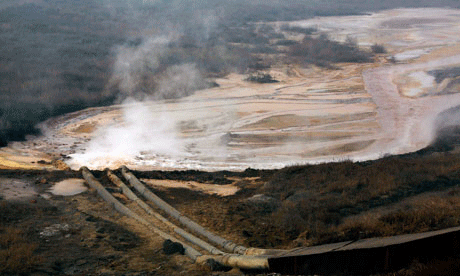
China Wrestles with the Toxic Aftermath of Rare Earth Mining https://e360.yale.edu/features/china-wrestles-with-the-toxic-aftermath-of-rare-earth-mining,
China has been a major source of rare earth metals used in high-tech products, from smartphones to wind turbines. As cleanup of these mining sites begins, experts argue that global companies that have benefited from access to these metals should help foot the bill.
New research shows how low dose ionising radiation promotes cancer
 Low doses of radiation promote cancer-capable cells, Science Daily
New research in mice helps to understand the risks around exposure to low doses of radiation, such as CT scans and X-rays
- Date
- July 18, 2019
- Source:
- Wellcome Trust Sanger Institute
- Summary:
- New research finds that low doses of radiation equivalent to three CT scans, which are considered safe, give cancer-capable cells a competitive advantage over normal cells.
-
Low doses of radiation equivalent to three CT scans, which are considered safe, give cancer-capable cells a competitive advantage over normal cells in healthy tissue, scientists have discovered. Researchers at the Wellcome Sanger Institute and the University of Cambridge studied the effects of low doses of radiation in the esophagus of mice.
The team found that low doses of radiation increase the number of cells with mutations in p53, a well-known genetic change associated with cancer. However, giving the mice an antioxidant before radiation promoted the growth of healthy cells, which outcompeted and replaced the p53 mutant cells.
The results, published today (18 July) in Cell Stem Cell show that low doses of radiation promote the spread of cancer-capable cells in healthy tissue. Researchers recommend that this risk should be considered in assessing radiation safety. The study also offers the possibility of developing non-toxic preventative measures to cut the risk of developing cancer by bolstering our healthy cells to outcompete and eradicate cancer-capable cells……..
-
Low doses of radiation equivalent to three CT scans, which are considered safe, give cancer-capable cells a competitive advantage over normal cells in healthy tissue, scientists have discovered. Researchers at the Wellcome Sanger Institute and the University of Cambridge studied the effects of low doses of radiation in the esophagus of mice.
The team found that low doses of radiation increase the number of cells with mutations in p53, a well-known genetic change associated with cancer. However, giving the mice an antioxidant before radiation promoted the growth of healthy cells, which outcompeted and replaced the p53 mutant cells.
The results, published today (18 July) in Cell Stem Cell show that low doses of radiation promote the spread of cancer-capable cells in healthy tissue. Researchers recommend that this risk should be considered in assessing radiation safety. The study also offers the possibility of developing non-toxic preventative measures to cut the risk of developing cancer by bolstering our healthy cells to outcompete and eradicate cancer-capable cells…….
- Dr Kasumi Murai, an author from the Wellcome Sanger Institute, said: “Giving mice an antioxidant before exposing them to low doses of radiation gave healthy cells the extra boost needed to fight against the mutant cells in the esophagus and make them disappear. However, we don’t know the effect this therapy would have in other tissues — it could help cancer-capable cells elsewhere become stronger. What we do know is that long term use of antioxidants alone is not effective in preventing cancer in people, according to other studies.” … https://www.sciencedaily.com/releases/2019/07/190718150933.htm
Chernobyl radiation
Ed note: This article considers only external radiation emitters – fails to consider internal emitters

UC San Francisco’s Lydia Zablotska, MD, PhD, grew up in Ukraine, trained as physician in Belarus, and has studied the long-term health impacts of radiation exposure on the Chernobyl cleanup workers, local children and others in the region. Her research helped uncover the connection between radiation exposure, thyroid conditions and leukemia, and remains relevant to global health today.
We talked with her about the real-life health impacts from the disaster portrayed in the HBO miniseries. The following answers have been edited for length and clarity.
What kind of radiation were people exposed to at Chernobyl?
The first responders, including firefighters and nuclear workers who tried to put out the multiple fires and prevent the explosion of other reactors at the nuclear power plant, were exposed to large doses of gamma radiation. Gamma radiation originates during the decay of radioactive isotopes of uranium or plutonium used as a nuclear fuel in nuclear power plants. As a result of decay, packets of electromagnetic radiation, which consist of high-energy photons, are emitted and could penetrate body tissues and cause damage to cells and their genetic material. Subsequently, DNA mutations could lead to the development of cancer.
The miniseries shows some workers dying instantly from acute radiation syndrome – what symptoms did they really experience?
The latest report from the United Nations Scientific Committee on the Effect of Atomic Radiation found 134 first responders who were diagnosed with acute radiation syndrome (ARS) after the Chernobyl accident. Of these, 28 died in the first four months, but not instantaneously. Then 19 more died over the next 20 years. But the majority of these survived and lived a long life after that. There were no cases of ARS among the general public living in cities and villages around the Chernobyl power plant.
Large doses of radiation could affect a number of systems in the body that are necessary for survival. Patients with ARS could develop a bone marrow syndrome, which suppresses their immunity, or a gastrointestinal syndrome, which could lead to damage to the lining of the intestines and associated infection, dehydration, and electrolyte imbalance. Then, a couple days later, the circulatory system collapses so people start having blood volume issues and so forth. The whole body is essentially collapsing.
Can those exposed to intense radiation exposure “pass on” their radioactivity to others, as the HBO show suggests?
There are types of radiation where human bodies could retain radioactive particles and remain radioactive over time, but this is not the type that was seen at Chernobyl. After gamma radiation has passed through the body, the person is no longer radioactive and can’t expose other people.
Based on what we know, at Chernobyl, there were also no effects on children who were exposed to radiation in utero.
How does radiation exposure relate to thyroid conditions?
We conducted two studies of thyroid conditions in children who lived at the time of the Chernobyl accident in affected areas in Ukraine and Belarus. We confirmed that the particular type of radiation in Chernobyl, radioactive iodine, could cause thyroid cancer. Unexpectedly, we also showed that radiation to the thyroid gland from ingesting radioactive iodine within two months after the Chernobyl accident by children and adolescents could lead to development of non-cancer thyroid diseases, such as thyroid follicular adenoma, thyroid benign nodules, and hypothyroidism.
We also showed that the youngest children were at the highest risk for developing these diseases. Children’s thyroid glands are very active and act as a sponge for iodine, because our body needs iodine. But our bodies cannot distinguish between dietary iodine, from salt or fish, and radioactive iodine. After the explosion of the nuclear reactor, parts of the core were dispersed in clouds and carried by the prevailing winds. This is how Belarus, which was in the path of winds in the first days after the accident, got really large doses. One of the most contaminated products was milk from pastured cows, mostly consumed by children.
We did a study of cleanup workers in Ukraine and confirmed that gamma radiation causes leukemia, as was found in atomic bomb survivors in Japan. Our truly unique finding was that radiation exposure can cause many types of leukemia, not just a select few. In particular, we showed that radiation doses of gamma radiation were associated with chronic lymphocytic leukemia, the most prevalent type of leukemia in adult, Caucasian men. CLL was not increased in the study of atomic bomb survivors, but as our group at UCSF reported in a later study, CLL is very rare in Japan, so this finding could have been missed. …… https://www.ucsf.edu/news/2019/07/414976/real-chernobyl-qa-radiation-exposure-expert
The first victims of the first atomic explosion might have been American children.
After a nearly half a century of denial, the US Department of Energy concluded in 2006, “the Trinity test also posed the most significant hazard of the entire Manhattan Project.
Ionizing radiation is especially damaging to dividing cells, so the developing infant, both before and after birth, is susceptible to radiation damage, as Alice Stewart, an epidemiologist who first demonstrated the link between X-rays of pregnant women and disease in their children,[12] first warned in 1956.[13]This damage may be seen years later with the development of leukemia and other cancers in children exposed in utero to ionizing radiation, as Stewart and others confirmed in subsequent studies.[14] By 1958, the United Nations Scientific Committee on the Effects of Atomic Radiation recognized that, in the short term, radiation damage can be reflected in fetal and infant deaths.[15]
Fallout protection was not a priority for the Trinity explosion.
The current body of historical evidence of harm, negligence, and deception—especially the evidence of increased infant death following the first nuclear explosion—should be more than enough for long overdue justice for the people in New Mexico who were downwind of Trinity.
Is cancer the legacy left by world’s first atomic bomb test?
Trinity: “The most significant hazard of the entire Manhattan Project” https://thebulletin.org/2019/07/trinity-the-most-significant-hazard-of-the-entire-manhattan-project/?utm_source=Newsletter&utm_medium=Email&utm_campaign=Newsletter072219&utm_content=Nuclear_Trinity_071519
By Kathleen M. Tucker, Robert Alvarez, July 15, 2019 For the past several years, the controversy over radioactive fallout from the world’s first atomic bomb explosion in Alamogordo, New Mexico on July 16, 1945—code-named Trinity—has intensified. Evidence collected by the New Mexico health department but ignored for some 70 years shows an unusually high rate of infant mortality in New Mexico counties downwind from the explosion and raises a serious question whether or not the first victims of the first atomic explosion might have been American children. Even though the first scientifically credible warnings about the hazards of radioactive fallout from a nuclear explosion had been made by 1940, historical records indicate a fallout team was not established until less than a month before the Trinity test, a hasty effort motivated primarily by concern over legal liability.
In October 1947, a local health care provider raised an alarm about infant deaths downwind of the Trinity test, bringing it to the attention of radiation safety experts working for the US nuclear weapons program. Their response misrepresented New Mexico’s then-unpublished data on health effects. Continue reading
Alarmingly high radiation in soil, ocean sediments and fruits from Marshall Islands

Radiation Levels at the Marshall Islands Remain Disturbingly High https://gizmodo.com/radiation-levels-at-the-marshall-islands-remain-disturb-1836382678?IR=T, George Dvorsky– 15 July 19
An analysis of soil samples, ocean sediment, and fruits from the Marshall Islands—the site of nearly 70 nuclear weapons tests during the 1940s and 1950s—has revealed alarmingly high levels of radiation, with some regions at levels exceeding areas affected by the Fukushima and Chernobyl disasters.
From 1946 to 1958, the United States conducted 67 nuclear tests in the Marshall Islands, a series of atolls located north of the equator between Hawaii and Australia. Twenty-three of these tests were conducted at Bikini Atoll and 44 near Enewetak Atoll, but fallout spread throughout the entire Marshall Islands, exposing the indigenous people there to dangerous levels of radiation.
Much of the Marshall Islands remains uninhabitable as a consequence of these nuclear tests, and it’s not immediately clear when Marshallese residents will be able to return to their ancestral homes. Three new studies published today in Proceedings of the National Academy of Sciences suggests their long-awaited return won’t happen anytime soon. A research team led by Emlyn Hughes and Malvin Ruderman from the Center for Nuclear Studies at Columbia University has detected unsafe levels of radiation in the soil, ocean sediment, and fruits in these contaminated areas.
Three years ago, the same team discovered alarming levels of gamma radiationin the Marshall Islands, and at levels that exceeded scientists’ expectations. The three new PNAS studies add to this prior work, which is being done to determine which, if any, of the Marshall Islands are safe for resettlement, and the specific risks that would be faced by returning indigenous peoples.
For the first study, the researchers measured background gamma radiation in soil samples taken from four atolls in 2017 and 2018: Bikini, Enewetak, Rongelap, and Utirik. Gamma radiation on Bikini and Naen islands were well beyond the maximum exposure limit as stipulated in agreements between the United States and the Republic of the Marshall Islands. On Bikini, the levels were as high as 648 millirems per year, and on Naen they were as high as 460 millirems per year. Safe exposure to radiation is 100 millirems per year, according to the U.S.-Republic of the Marshall Islands agreement.
These levels are “significantly higher” than “areas affected by the Chernobyl and Fukushima accidents,” wrote the study authors. The “radiation levels on Bikini Island, which served as the primary island for habitation on the atoll, before and in the aftermath of the testing, are too high for relocation to Bikini,” according to the new research. Some of the outer islands “may not [be] suitable for habitation on their own, but… islanders may visit in search of food, especially in times of harvest.”
For the second paper, the researchers explored the Castle Bravo crater—the site of the most powerful nuclear test ever conducted by the United States, which happened on March 1, 1954. This 15-megaton explosion vaporized the land beneath it, forming a crater 1.5 kilometers (0.9 miles) wide and 75 meters (246 feet) deep on Bikini Atoll. The ensuing fallout was comprised of pulverized coral, water, and radioactive particles. Traces of the radioactive debris were detected as far as Japan, India, Australia, Europe, and even the United States.
The Castle Bravo explosion also produced radioactive material that settled into the ocean sediment. From the research vessel Indies Surveyor, the researchers collected nearly 130 core samples from the Castle Bravo crater from 2017 to 2018. Analysis showed that, six decades later, the radiation levels are still “orders of magnitude” above normal levels within the top inch of sediment across the entire crater. The researchers conclude thusly:
In summary, there is still residual contamination of radionuclides throughout the Bravo bomb crater, from center to rim. We find that the radionuclide distribution is fairly uniform across the crater with some tapering off toward the crater rim….Although the lagoon is gradually filling in over time, contamination levels from residual long-lived radioactive isotopes, such as plutonium and americium, will likely last for centuries. The nuclear weapon tests caused a dramatic change in sediment composition. Additional studies to determine what the impact on life is in the lagoon craters, especially at the deeper depths, would be valuable.
The third paper is an analysis of fruits found in the Marshall Islands, namely coconuts and pandanus fruits. Cesium-137 features a half-life of around 30 years, and it’s easily absorbed by plants, presenting a potential health hazard. Sadly, 11 islands were found to have coconuts and pandanus fruits with radioactivity exceeding limits established by several countries and international organizations, including International Physicians for the Prevention of Nuclear War (IPPNW). Once again, some of the levels exceeded values found near Fukushima and Chernobyl.
“Based upon our results, we conclude that to ensure safe relocation to Bikini and Rongelap Atolls, further environmental remediation… appears to be necessary to avoid potentially harmful exposure to radiation,” wrote the authors in the study.
All-in-all, some very discouraging results, as much of the Marshall Islands remain unsafe for resettlement. It’s not immediately clear when these islands will be free of radiation, or if people will ever return to Bikini Atoll. Sadly, climate change is making a bad situation worse, as rising sea levels could render many of the safe Marshall Islands uninhabitable.
Private Notes Show How Big Oil Spread Climate Science Denial
The ‘Historical Jigsaw of Climate Deception’: Private Notes Show How Big Oil Spread Climate Science Denial DeSmogBlog, By Mat Hope • Thursday, July 11, 2019 We’ve all heard the dodgy arguments: ‘the science is uncertain’, ‘climate change is natural, not down to humans’, ‘science has been hijacked by politics’… Now a new cache of documents sheds light on the origins of the disinformation.
In another verse of a now familiar refrain, a fossil fuel industry group in the 1990s publicly promoted arguments to undermine confidence in climate science while internally acknowledging their products were driving up temperatures.
A cache of meeting minutes, briefings, and emails uncovered by the Climate Investigations Center shows how industry group the Global Climate Coalition (GCC) used its financial clout and political connections to cast doubt on mainstream climate science until its disbandment in 2002. The GCC would for decades cast doubt on the veracity of climate science and strategically spread the message that the UN Intergovernmental Panel on Climate Change (IPCC) was a politicised body, to discourage regulatory reform that would hit coalition members’ profits.
The documents show that the group, which counted fossil fuel giants Exxon, Shell, and Peabody among its members, knowingly pushed misinformation on climate change even as the GCC internally acknowledged humans’ impact on the climate “cannot be denied”. Some of those same companies have been the recent targets of lawsuits seeking damages for climate change impacts.
“These documents are another stain on the fossil fuel industry’s track-record as a disingenuous rogue agent in climate science and politics,” Geoffrey Supran, a Postdoctoral Fellow at Harvard University researching climate science denial, told DeSmog. “They further illustrate the sophisticated combination of inside- and outside-lobbying used by the fossil fuel industry to protect their status quo business operations.”
Peddling Denial
Within the GCC, the Science and Technology Assessment Committee (STAC) took responsibility for assessing contemporary climate science and formulating strategic arguments to undermine it. The STAC was chaired by Mobil Oil’s Lenny Bernstein. Mobil, Exxon, and Texaco (now part of Chevron) all contributed five staffers to the committee.
An internal 1994 document outlining “issues and options” for the GCC to consider regarding “potential global climate change” shows the group’s outright climate science denial.
The document concludes that “the claim that serious impacts from climate change have occurred or will occur in the future has not been proven” and “consequently, there is no basis for the design of effective policy action that would eliminate the potential for climate change.”
In the same document, the GCC cites the work of infamous academics known for spreading climate science denial including Richard Linzen, Patrick Michaels, and Robert Balling. The document asserts that these academics’ arguments disputing mainstream climate science “have received far less attention than they deserve”. ……….
Politicisation
The GCC’s disinformation strategy extended beyond casting aspersions on the science to the process of gathering evidence for the major IPCC reports, the documents show.
Porter Womeldorff, an Illinois Power Company employee and co-chair of the STAC, suggested the group focus on the politicisation of the IPCC process.
And that’s exactly what the GCC did. In an internal document from 1996, the GCC boasted that its criticism of the IPCC’s processes had been picked up more widely by the mainstream media:
“Publications which have joined in questioning the IPCC approach to conforming technical reports to summaries include the NYTimes, Wall St. Journal, Energy Daily, and Nature.”
This followed a 1995 report that noted with glee a Nature editorial taking aim at the IPCC for a press-release that the erstwhile journal considered to be needlessly attention seeking.
Harvard’s Supran, who recently testified to the European Parliament about Exxon’s history of climate science denial, told DeSmog that the documents “help fill in pieces of the historical jigsaw of climate deception by the fossil fuel industry”.
“History teaches us that when it comes to the fossil fuel industry’s rhetoric on climate change and energy, we take them at face value at our peril.” https://www.desmogblog.com/2019/07/11/historical-deception-global-climate-coalition-science-denial?utm_source=desmog%20%20weekly%20newsletter
Cuban Missile Crisis 1962 – how close we came to World War 3
World War 3: How ‘Armageddon Letter’ brought world within minutes of nuclear conflict https://www.express.co.uk/news/world/1153499/world-war-3-cold-war-us-soviet-union-kennedy-khrushchev-cuban-missile-crisis-spt
WORLD WAR 3 would have almost certainly started had it not been for the bold decisions of world leaders on what would come to be known as Black Saturday.
He immediately announced the US would not permit offensive weapons to be delivered and created a blockade in the surrounding waters until the missiles were dismantled and returned to the Soviet Union.
The tense situation then snowballed out of control as the Kremlin traded words with the White House and the prospect of war looked increasingly likely.
“The United States may find it necessary within a very short time in its interest and that of its fellow nations in the Western Hemisphere to take whatever military action may be necessary.”
On October 27 – remembered as Black Saturday by the White House – Khrushchev received a letter from Castro known as the Armageddon Letter, which was interpreted as urging the use of nuclear force in the event of an attack on Cuba.
It read: “I believe the imperialists’ aggressiveness is extremely dangerous and if they actually carry out the brutal act of invading Cuba in violation of international law and morality, that would be the moment to eliminate such danger forever through an act of clear legitimate defence, however harsh and terrible the solution would be.”
Later that day, the US Navy dropped a series of “signalling depth charges” on a Soviet B-59 submarine unaware it was armed with a nuclear-tipped torpedo.
As the submarine was too deep to monitor any radio traffic, the captain, Valentin Grigorievitch Savitsky, decided that a war might have already started and wanted to launch a nuclear torpedo.
The decision to launch these required the agreement of all three officers on board, but one of them – Vasily Arkhipov – objected and so the nuclear launch was narrowly averted.
On the same day, a US Air Force U-2 spy plane was struck by an S-75 Dvina surface-to-air missile launched from Cuba, downing the jet and killing the pilot.
Kennedy had earlier claimed he would order an attack on such sites if fired upon, but he decided not to act unless another attack was made.
It was later learned discovered the move was spearheaded by Raul Castro, brother to the communist leader.
Kennedy finally decided to bring the situation to an end by secretly agreeing to remove all missiles in Turkey and possibly Italy too, in exchange for Khrushchev removing all missiles in Cuba.
However, at this point, Khrushchev knew things the US did not.
First, that the shooting down of the U-2 by a Soviet missile violated direct orders from Moscow, and Cuban antiaircraft fire against other US reconnaissance aircraft also violated direct orders from Khrushchev to Castro.
Second, the Soviets already had 162 nuclear warheads on Cuba that the US did not then believe were there as well as scores of nuclear-tipped subs.
Third, the Soviets and Cubans on the island would almost certainly have responded to an invasion by using those nuclear weapons.
The Soviet leader knew he was losing control and came out of the incident with his pride in check.
The dangers of Chernobyl nuclear site being turned into a tourism mecca
The grounds remain coated with plutonium, cesium, strontium and americium — radionuclides (atoms that emit radiation) that could pose potentially serious health risks to those who touch or ingest them. Some areas are more radioactive, and therefore more dangerous, than others.
“Even though the accident occurred over 33 years ago it remains one of the most radiologically contaminated places on earth.”
Chernobyl tourists should avoid plant life, and especially the depths of the forests.
Those areas were not cleaned in the aftermath of the disaster and remain highly contaminated by radiation. Research has showed that the fungus, moss and mushrooms growing there are radioactive. Eating or drinking from the area is not safe.
Those who stay on the paved pathways, which officials cleaned, are much less likely to absorb harmful toxins.
Ukraine wants Chernobyl to be a tourist trap. But scientists warn: Don’t kick up dust. https://www.washingtonpost.com/travel/2019/07/12/ukraine-wants-chernobyl-be-tourist-trap-scientists-warn-dont-kick-up-dust/?utm_term=.5e82b547ceaf By Katie Mettler, July 12 2019
The tourists first started flocking to Chernobyl nearly 10 years ago, when fans of the video game S.T.A.L.K.E.R. wanted to see firsthand the nuclear wasteland they’d visited in virtual reality.
Next came those whose curiosity piqued when in 2016 the giant steel dome known as the New Safe Confinement was slid over the sarcophagus encasing nuclear reactor number four, which exploded in April 1986, spewed radiation across Europe and forced hundreds of thousands to flee from their homes.
Then in May, HBO’s “Chernobyl” miniseries aired, and tourism companies reported a 30 to 40 percent uptick in visitors to the Chernobyl Exclusion Zone, abandoned and eerily frozen in time.
Now the Ukrainian government — capitalizing on the macabre intrigue — has announced that Chernobyl will become an official tourist site, complete with routes, waterways, checkpoints and a “green corridor” that will place it on the map with other “dark tourism” destinations.
“We must give this territory of Ukraine a new life,” President Volodymyr Zelensky said during a visit to Chernobyl this week. “Until now, Chernobyl was a negative part of Ukraine’s brand. It’s time to change it.”
Zelensky, who was inaugurated in May, signed a decree July 10 to kickstart the Chernobyl Development Strategy, which the president hopes will bring order to the 19-mile Exclusion Zone that has become a hotbed for corruption, trespassing and theft. At the nuclear facility and in the nearby town of Pripyat, wildlife has returned and now roams freely. Flora and fauna grow up around decaying homes, playgrounds and an amusement park. Letters, dinner tables and baby dolls remain where their owners abandoned them 33 years ago.
Radioactive dust still coats it all.
“Chernobyl is a unique place on the planet where nature revives after a global man-made disaster, where there is a real ‘ghost town,’” Zelensky said during his visit. “We have to show this place to the world: scientists, ecologists, historians, tourists.”
Though exploiting a historical space like Chernobyl could infuse Ukraine’s economy with tourism dollars and motivate developers to revive the sleepy towns surrounding the “dead zone,” there are significant downsides, experts say.
[Thanks to HBO, more tourists are flocking to the eerie Chernobyl nuclear disaster site]
The grounds remain coated with plutonium, cesium, strontium and americium — radionuclides (atoms that emit radiation) that could pose potentially serious health risks to those who touch or ingest them. Some areas are more radioactive, and therefore more dangerous, than others.
“Chernobyl was the worst nuclear accident in human history,” said Jim Beasley, an associate professor at the University of Georgia who has been studying wildlife in the Exclusion Zone since 2012. “Even though the accident occurred over 33 years ago it remains one of the most radiologically contaminated places on earth.”
More than 30 people were killed in the immediate aftermath of the explosion, and officials are still debating the full extent of the longterm death toll in Ukraine and nearby countries where people grew sick with cancer and other illnesses.
The World Health Organization estimates total cancer deaths at 9,000, far less than a Belarusian study that put the death toll at 115,000, reported Reuters.
Today, radiation levels inside the Exclusion Zone vary widely from location to location, said Dr. T. Steen, who teaches microbiology and immunology at Georgetown’s School of Medicine and oversees radiation research in organisms at nuclear disaster sites. Because of that, she advises anyone visiting to be educated and cautious while inside the Exclusion Zone, and to limit time spent there.
“The longer you’re exposed, the more that future impact is,” she said.
She advises visitors to the Exclusion Zone to wear clothes and shoes they are comfortable throwing away. If they’re going to be touching or disturbing anything, she recommends a mask and gloves. Most importantly, Steen says, Chernobyl tourists should avoid plant life, and especially the depths of the forests.
Those areas were not cleaned in the aftermath of the disaster and remain highly contaminated by radiation. Research has showed that the fungus, moss and mushrooms growing there are radioactive. Eating or drinking from the area is not safe.
Those who stay on the paved pathways, which officials cleaned, are much less likely to absorb harmful toxins.
Generally speaking, Chernobyl can be safe, Steen said, “but it depends on how people behave.”
And so far, the accounts of tourists behaving badly are abundant.
Timothy Mousseau, a biologist and University of South Carolina professor, has been studying the ecological and evolutionary consequences of radioactive contaminants on wildlife and organisms at Chernobyl for 20 years. He just recently returned from his annual, month-long trip to the Exclusion Zone and said he was shocked to see 250 tourists in street clothes wandering Pripyat.
Some hopped in bumper cars at the abandoned amusement park there to take selfies.
“Part of the reason people don’t think twice about it is because there is this highly organized tourism operation,” Mousseau said. “A lot of people don’t give it a second thought.”
He is concerned that the government’s tourism campaign could only make that worse.
“The negative aspects that are being completely ignored are the health and safety issues of bringing this many people, exposing this many people to what is a small risk, albeit a significant risk, to this kind of contamination,” Mousseau said. “The more traffic there is, the most dust there is, and the dust here is contaminated.”
[We’re in the age of the overtourist. You can avoid being one of them.]
But Mousseau’s worries, and the anxieties of his colleagues, extend beyond health factors.
For decades, biologists, ecologists and medical researchers have been studying the mostly undisturbed expanse that is the Exclusion Zone. They’ve studied DNA mutations in plants and insects, birds and fish. As larger mammals, like moose, wolves and fox, have slowly re-occupied the surrounding forests, biologists have searched for clues about the ways short-term and long-term radiation exposure have altered their health.
Scientifically, there is no place on earth like Chernobyl. Beasley, who studies wolves there, calls it a “living laboratory.” An influx of humans — especially reckless ones — could destroy it.
“This is really the only accessible place on the planet where this kind of research can be conducted at a scale both spatial and temporal that allows for important scientific discovery,” Mousseau said. “Given increased use of radiation in technology and medicine, in going to Mars and space, we need to know more about radiation and its effects on biology and organisms.”
“And Chernobyl provides a unique laboratory to do this kind of research,” he said.
Tourism’s negative footprint in the Exclusion Zone is not theoretical, either.
They are leaving behind trash, rummaging through abandoned homes and buildings and, in Mousseau’s experience, stealing his research equipment. Cameras he has hidden in the depths of the most radioactive parts of the zone to capture the wildlife he studies have been vandalized or gone missing, he said.
It’s something that absolutely astounds me,” he said.
Theoretically, more government oversight at Chernobyl could help curb this kind of interference, especially if a financial investment in the zone will help preserve the ghost town there and bring in more guards and checkpoints to patrol who comes and goes.
None of that will prevent tourists from disturbing Chernobyl’s spirit.
“I think it is important to not lose sight of the fact that Chernobyl represents an area of tremendous human suffering,” Beasley said, “as hundreds of thousands of people were forever displaced from their homes or otherwise impacted by the accident.”
CANADA: A generation of children were given radiation treatment without warning of cancer risks
CANADA: A generation of children were given radiation treatment without warning of cancer risks https://www.thoroldnews.com/local-news/canada-a-generation-of-children-were-given-radiation-treatment-without-warning-of-cancer-risks-1581753m 14 July 19
This article, written by Itai Bavli, University of British Columbia, originally appeared on The Conversation .
On February 9, 2001, the Vancouver Sun published an article about Nancy Riva who lost her two brothers and was diagnosed with cancer as a result of thymus radiation treatment they received as children — in the belief that this would prevent sudden infant death.
Riva and her brothers were born in Vancouver General Hospital (VGH) in the late 1940s and underwent radiation treatment at the hospital as babies.
Radiation treatment for benign illnesses (that is not for treating cancer), like Riva’s inflamed thymus gland, was a standard medical practice worldwide during the 1940 and 1950s. The treatment was considered to be safe and effective for non-cancerous conditions such as acne and ringworm as well as deafness, birthmarks, infertility, enlargement of the thymus gland and more.
In the early 1970s, medical research confirmed the long-standing suspicion that children and young adults treated with radiation for benign diseases, during the 1940s and 1950s, showed an alarming tendency to develop thyroid cancer and other ailments as adults.
In our recent paper, published in the American Journal of Public Health, Shifra Shvarts and I have explored how health authorities in the United States responded to the discovery of the late health effects of radiation treatment.
Over two million people are estimated to have been treated with radiation in the U.S. for benign conditions. We show how an ethical decision at Michael Reese Hospital in Chicago in 1973 to locate and examine former patients, who had been treated with radiation in childhood, led to a nationwide campaign launched in July 1977 by the National Cancer Institute (NCI) — to warn the medical community and public about the late effects of radiation treatment in childhood for a variety of diseases.
U.S. campaign promotes thyroid checkups
Media coverage of the Chicago hospital’s campaign had a snowball effect that prompted more medical institutions to follow suit (first in the Chicago area and later in other parts of the U.S.), resulting in the NCI’s campaign.
Hundreds of thousands of pamphlets were distributed in shopping centres across the U.S., asking people who had undergone radiation treatment to go to their family doctor for a thyroid checkup. In addition, television presenters opened their programs with warnings; notices were published in newspapers.
Meanwhile in Canada, an unknown number of patients, like Riva and her brothers, were treated with radiation. Interviewed by the Vancouver Sun in 2001, Riva wanted to raise public awareness about this issue, encouraging people who might have been treated with radiation as children to have their thyroid checked.
According to VGH’s officials, quoted in the article, locating former patients was logistically impossible. Spokeswoman Tara Wilson told Vancouver Sun reporter Pamela Fayerman:
“Under the Hospital Act, records only have to be maintained for 10 years after a patient’s last hospital admission, so it’s unlikely we would have these birth records, although people can still phone the hospital to check.”
No systematic investigation in Canada
Riva’s story raises the question of why the Canadian health authorities did not launch a campaign to warn the public, as happened in the United States. Early detection of thyroid cancer saved lives.
The U.S. campaign was known in Canada. On July 14, 1977 a Globe and Mail article titled, “U.S. increasing efforts to warn million potential cancer victims,” described the national program to alert the public of the late health effects of radiation treatment.
Moreover, in an article published in Annals of Internal Medicine in February 1978, two University of Toronto professors of medicine, Paul Walfish and Robert Volpé, discussed the long-term risk of therapeutic radiation and described the efforts made by the U.S. Department of Health, Education and Welfare to educate the American public about the late effects of the treatment.
To date, there has been no known attempt to systematically investigate how many children underwent radiation treatment in Canada for benign conditions and what has been done to alert the public and the medical community of the risks. From Riva we learn that in 2001 patients were still looking for advice.
Had the Canadian health authorities effectively warned the public of the long-term risk of radiation treatment, illnesses and deaths may have been prevented.
Perhaps some still could?
Itai Bavli, PhD candidate in Interdisciplinary Graduate Studies (Public Health and Political Science), University of British Columbia
This article is republished from The Conversation under a Creative Commons license. Read the original article.
Radioactive polonium in cigarette smoke
Radioactive polonium in cigarette smoke https://scienceblog.cancerresearchuk.org/2008/08/29/radioactive-polonium-in-cigarette-smoke/
Category: Science blog August 29, 2008 Cigarette smoke has been called many things – smelly, dangerous and cancer-causing for a start. But radioactive? Yes, that too. Tobacco smoke contains a radioactive chemical element called polonium-210. It’s the same substance that poisoned the Russian Alexander Litvinenko in London two years ago.
Now, a new study reported in the Independent and to be published in the American Journal of Public Health suggests that tobacco companies have known about the danger of polonium in cigarette smoke for over 40 years. Monique Muggli, who led the review, examined over 1,500 internal documents from tobacco companies. Most of these have never been published and were made available through legal action.
Muggli wrote, “Internal tobacco industry documents reveal that the companies suppressed publication of their own internal research to avoid heightening the public’s awareness of radioactivity in cigarettes.”
What happens when you inhale polonium?
Polonium-210 emits a type of radiation called alpha-radiation, which is very energetic and can seriously damage DNA. Thankfully, what alpha-radiation has in destructive ability, it lacks in penetrating power. Human skin is usually enough to stop it, but that’s of little consolation to people who inhale particles of polonium-210. That places the tissues of their lungs and airways in direct and close contact with these powerful sources of radiation.
Indeed, studies have detected polonium-210 in the airways of smokers, where they are concentrated in hot spots. They remain there because other chemicals in cigarette smoke damage the body’s cleaning systems, which would normally get rid of gunk in our airways.
As a result, polonium builds up and subjects nearby cells to higher doses of alpha-radiation. These localised build-ups lead to far greater and longer exposures to radiation than people would usually get from natural sources.
For example, one study found that a person smoking two packs a day is exposed to about 5 times as much polonium as a non-smoker but specific parts of their lungs could be exposed to hundreds of times more radiation. Another study estimated that smoking a pack-and-a-half every day exposes a smoker to a dose of radiation equivalent to 300 chest X-rays a year.
Do these doses lead to lung cancer? It’s hard to say, especially since the effects of polonium are only part of a wider range of damaging consequences caused by inhaling cigarette smoke. But animal studies certainly give us cause for concern.
Absorbed doses of radiation can be measured using units called rads, and experiments have shown that as little as 15 rads of polonium can induce lung cancers in mice. That’s only about a fifth of what a smoker would get if they averaged 2 packs a day for 25 years. Indeed, the lung tissues of smokers who have died of lung cancer have absorbed about 80-100 rads of radiation.
Where does polonium comes from?
Some tobacco plants are grown using fertilisers that contain a mineral called apatite. Apatite contains a radioactive element called radium, which can eventually decay into polonium-210.
But tobacco plants can also absorb radioactive elements directly from the air around them. These include both polonium, and other radioactive elements that eventually decay into it. Tobacco leaves are covered in sticky hairs, making them especially good at catching chemicals from the atmosphere around them. Studies in countries all over the world have found significant levels of polonium in local tobacco brands.
Is it possible to create a ‘safe’ cigarette by removing polonium? Simple answer – no. The newly retrieved documents reveal that the tobacco industry has tried in vain to remove the radioactive element by washing tobacco leaves, genetically modifying the plants or using filters. None of these methods appears to have worked, and indeed, an independent Polish study found that filters only absorb a very small amount of polonium-210.
Even if polonium could be removed, it would be a shallow victory, for the radioactive element is just one of at least 69 cancer-causing chemicals found in tobacco smoke. They are 69 very good reasons to never touch a cigarette again.
Recycling nuclear waste still itself produces nuclear waste
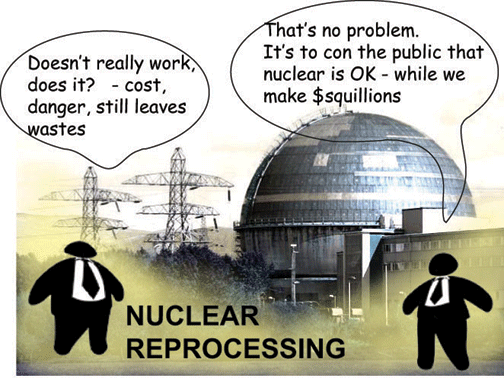 Recycle everything, America—except your nuclear waste https://thebulletin.org/2019/07/recycle-everything-america-except-your-nuclear-waste/ By Allison Macfarlane, Sharon Squassoni, July 8, 2019 Americans have come late to the game on responsible consumerism, but they are making up for lost time with a passionate obsession about waste. It’s no coincidence that Fox News, CNN, YouTube and USA Today have all reported that the deepest solo ocean dive found plastic waste seven miles below the surface, in the Mariana Trench.
Now that Americans are “woke” about waste in general, they may turn to the specific kind produced by the nuclear energy industry. Plans to revitalize US nuclear power, which is in dire economic straits, depend on the potential for new, “advanced” reactors to reduce and recycle the waste they produce. Unfortunately, as they “burn” some kinds of nuclear wastes, these plants will create other kinds that also require disposal. At the same time, these “advanced” reactors—many of which are actually reprises of past efforts—increase security and nuclear weapons proliferation risks and ultimately do nothing to break down the political and societal resistance to finding real solutions to nuclear waste disposal.
The current nuclear dream is really no different from previous ones of the last 70 years: the next generation of reactors, nuclear power advocates insist, will be safer, cheaper, more reliable, less prone to produce nuclear bomb-making material, and more versatile (producing electricity, heat, and perhaps hydrogen), without creating the wastes that have proved almost impossible to deal with in the United States. The Nuclear Energy Innovation and Modernization Act specifically describes the advanced reactors it seeks to support as having all those positive characteristics. This newest burst of enthusiasm for advanced reactors is, however, largely fueled by the idea that they will burn some of their long-lived radioisotopes, thereby becoming nuclear incinerators for some of their own waste.
Many of these “advanced” reactors are actually repackaged designs from 70 years ago. If the United States, France, the UK, Germany, Japan, Russia, and others could not make these reactors economically viable power producers in that time, despite spending more than $60 billion, what is different now? Moreover, all of the “advanced” designs under discussion now are simply “PowerPoint” reactors: They have not been built at scale, and, as a result, we don’t really know all the waste streams that they will produce.
It’s tempting to believe that having new nuclear power plants that serve, to some degree, as nuclear garbage disposals means there is no need for a nuclear garbage dump, but this isn’t really the case. Even in an optimistic assessment, these new plants will still produce significant amounts of high-level, long-lived waste. What’s more, new fuel forms used in some of these advanced reactors could pose waste disposal challenges not seen to date.
Some of these new reactors would use molten salt-based fuels that, when exposed to water, form highly corrosive hydrofluoric acid. Therefore, reprocessing (or some form of “conditioning”) the waste will likely be required for safety reasons before disposal. Sodium-cooled fast reactors—a “new” technology proposed to be used in some advanced reactors, including the Bill Gates-funded TerraPower reactors—face their own disposal challenges. These include dealing with the metallic uranium fuel which is pyrophoric (that is, prone to spontaneous combustion) and would need to be reprocessed into a safer form for disposal.
Unconventional reactors may reduce the level of some nuclear isotopes in the spent fuel they produce, but that won’t change what really drives requirements for our future nuclear waste repository: the heat production of spent fuel and amount of long-lived radionuclides in the waste. To put it another way, the new reactors will still need a waste repository, and it will likely need to be just as large as a repository for the waste produced by the current crop of conventional reactors.
Recycling and minimizing—even eliminating—the waste streams that many industries produce is responsible and prudent behavior. But in the context of nuclear energy, recycling is expensive, dirty, and ultimately dangerous. Reprocessing spent nuclear fuel—which some advanced reactor designs require for safety reasons—actually produces fissile material that could be used to power nuclear weapons. This is precisely why the United States has avoided the reprocessing of spent nuclear fuel for the last four decades, despite having the world’s largest number of commercial nuclear power plants.
Continuing research on how to deal with nuclear waste is a great idea. But building expensive prototypes of reactors whose fuel requires reprocessing, on the belief that such reactors will solve the nuclear waste problem in America, is misguided. At the same time, discounting the notion that a US move into reprocessing might spur other countries to develop this same technology—a technology they could secretly exploit to produce nuclear weapons—is shortsighted and damaging to US national and world security.
Uranium and plutonium are the key elements in a nuclear reaction
Iran is enriching uranium and breaking the limit set by the nuclear deal. Here’s what that means. VOX, By
……….Uranium enrichment is a critical step in making nuclear energy and nuclear weapons.
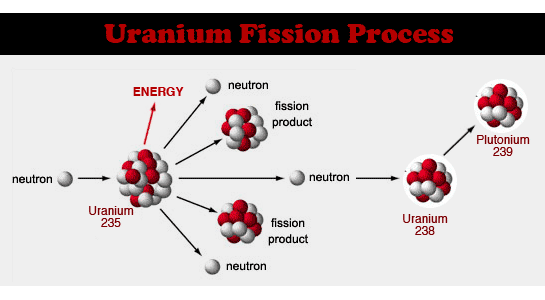
Uranium and plutonium are the key elements in a nuclear reaction…….. specific starting materials, most commonly uranium and plutonium, must be processed or enriched to drive a chain reaction.
Here are some of the basics: Uranium is the heaviest naturally occurring element in the periodic table, with an atomic number of 92, representing the number of protons in its nucleus………..
Plutonium, on the other hand, is a synthetic element. It has an atomic number of 94 and is formed in nuclear reactors as a byproduct of neutrons being captured by uranium. Plutonium can be acquired from reprocessing spent fuel from conventional nuclear power plants, or reactors can be designed specifically to produce plutonium for use in weapons.
But making plutonium usually requires a reactor to begin with, so uranium remains the choke point for both uranium-based and plutonium-based weapons.
The nuclear reaction is the same for weapons and energy. The desired outcome is different.
So you have your uranium (or plutonium). Can you now make a bomb?
Not quite. Let’s wade into the history and science of splitting atoms to set the stage for nuclear negotiations today.
Researchers found since the 1930s that they could bombard uranium with neutrons to create heavier isotopes and form new elements that have never before been seen in nature, like plutonium.
An isotope is a variety of an element with the same chemical structure but a different internal composition. In comparing isotopes of an element like uranium, the atomic number stays the same, but the isotope number — the sum of the protons and neutrons in a nucleus — can differ. Uranium-235 (U-235), for example, has three fewer neutrons than uranium-238 (U-238), but they undergo the same chemical reactions.
In their experiments, German scientists Otto Hahn, Lise Meitner, and Fritz Strassmann in 1938 found another curious result. Among the atoms resulting from neutron bombardment were much smaller atoms like barium, which has an atomic number of 56. Meitner, along with Austrian scientist Otto Frisch, realized that this was the result of splitting the uranium atom into smaller atoms, a phenomenon that also emits a huge amount of energy. The finding marked the dawn of the nuclear age.
Isotopes of atoms that can split apart (undergo fission) are described as fissile. When there are enough fissile atoms close together — a quantity known as critical mass — the particles ejected by fission can strike other fissile atoms, triggering more atoms to split apart and so on. The energy released in the process can generate heat to boil water to spin a turbine or wreak devastation from a bomb.
But not all uranium atoms can easily split apart and trigger a chain reaction. In fact, most can’t. In nature, about 99.7 percent of uranium is in the form of the non-fissile isotope U-238.
Only about 0.7 percent of uranium occurs in the fissile form of U-235. And in nature, U-235 is in such a low concentration that even if a stray neutron were to strike it with enough force to break it apart, it’s unlikely that the resulting neutrons would find another U-235 atom nearby to continue the reaction.
To produce a chain reaction, you need to increase the concentration of U-235 relative to U-238. This is called enrichment.
For plutonium, all isotopes are fissile, but some are easier to use in nuclear weapons than others. Plutonium rich in the isotope Pu-239, called weapons-grade plutonium, poses the fewest technical challenges and can be extracted from nuclear fuel that is only irradiated in a reactor for a short time.
Making uranium and plutonium useful is a major technical challenge
Enrichment is the sorting problem from hell.
Instead of uranium atoms, imagine you have a bag filled with 1,000 marbles, each identical in material, size, shape, color, and texture. However, there are seven marbles in the bag that weigh 1.3 percent less than the others. For 5-gram, 1.5-centimeter diameter marbles, we’re talking about a difference of about 65 milligrams for the light marbles, or the weight of a few grains of sand.
Since it’s tedious to weigh each individual marble, you’ll want to come up with some sort of group sorting mechanism. But weight is the only thing setting them apart and the difference between desired and undesired marbles is small, so the sorting process won’t be perfect and you’ll still have a mixture of light and heavy marbles at the end. So you run the results through the sorter again. And again. And again.
With each iteration, you have a higher percentage of lighter marbles, but every repetition costs time, money, and energy.
And remember, the marbles in this analogy are atoms, the smallest unit of matter, so they’re that much more difficult to manipulate, and it takes far longer to get the quantities you need when you’re trying to go from atoms of uranium to tons of it.
For a nuclear reactor cooled with ordinary water, you need only about 3 to 5 percent U-235 enrichment, but you need it by the ton. A 1-gigawatt nuclear reactor uses 27 tons of nuclear fuel per year. …
Uranium with more than 20 percent U-235 is considered highly enriched. Conversely, the residual uranium with U-235 removed is called depleted (this is the uranium used in armor-piercing ammunition).
A nuclear weapon, on the other hand, requires even higher enrichment, typically around 90 percent, though it needs much less mass than a reactor. The Little Boy bomb dropped on Hiroshima, Japan, used 141 pounds of highly enriched uranium, though only 2 percent actually underwent fission due to inefficiencies in the design of the bomb. The Fat Man bomb dropped on Nagasaki used just 14 pounds of plutonium.
The International Atomic Energy Agency defines a “significant quantity” of nuclear material for a weapon to be 55 pounds of U-235 within a quantity of highly enriched uranium, or 17.6 pounds of plutonium.
Some countries with civilian nuclear reactors, like South Korea, don’t bother with the whole enrichment process and have opted instead to buy their nuclear fuel on the open international market. But for others, like France, mastering the fuel cycle is a vital pillar of their energy strategy.
The enrichment process has become easier, which makes controlling nuclear weapons harder
Both Iran and North Korea have developed surreptitious enrichment networks for producing nuclear material. These facilities are hard to detect and easy to reconfigure, so without regular inspections and monitoring, the possibility of a clandestine nuclear weapons program remains.
This wasn’t always the case.
The Manhattan Project marked the first successful effort to enrich uranium for a nuclear weapon. One of the earliest and most primitive enrichment techniques used in this endeavor was gaseous diffusion. Here, uranium is reacted with fluorine to make uranium hexafluoride gas (UF6). The gas is then pumped through membranes, the idea being that lighter isotopes of uranium would diffuse faster than heavier isotopes (fluorine has only one naturally occurring isotope, so any differences in the mass of the gas come from uranium).
But each stage of the process could only separate a tiny amount of uranium, so gaseous diffusion required huge buildings and devoured energy to power the pumps needed to move the gas through the separation stages.
“The original ways of doing it were very inefficient,” said Edwin Lyman, a senior scientist in the Global Security Program at the Union of Concerned Scientists. “They required very large amounts of land, lots of power.”
For example, the K-25 gaseous diffusion building in Oak Ridge, Tennessee, was completed in 1945 at a cost of $500 million. It was half a mile long and 1,000 feet wide, making it the largest building under one roof at the time. The facility employed 12,000 workers at its peak and consumed enough electricity to power 20,000 homes for a year.
These days, uranium enrichment is much more subtle. The most common tool is the gas centrifuge. This is where uranium hexafluoride gas is fed into a column spinning at upward of 100,000 rotations per minute.

As the centrifuge spins, the heavier isotopes push harder against its wall than the lighter ones. The centrifuge also induces the gas to circulate within the device, further increasing separation. The output of one centrifuge is then fed into another and another in an arrangement called a cascade.
Centrifuges are more energy-efficient than other enrichment techniques and are harder to detect. The centrifuges themselves don’t take up much floor space, so their plants have a much smaller physical footprint than gaseous diffusion facilities. They also don’t draw as much electricity, nor do they leave much of a heat signature.
A declassified 1960 report from a contractor at Oak Ridge National Laboratory noted that “it would not be too difficult to build a relatively small clandestine gas centrifuge plant capable of producing sufficient enriched uranium for a small number of nuclear weapons.”
The point is a primitive enrichment apparatus is massive; a modern one is small.
“Centrifuges are the only [enrichment process] today that makes economic sense,” said R. Scott Kemp, director of the Laboratory for Nuclear Security and Policy at MIT. “[A centrifuge plant] capable of producing a weapon can fit in a garage or a small office building, and the energy consumption is less than typical office lighting per square foot.”
That’s why arms control discussions focus so much on centrifuges, and why the Iran nuclear deal — the Joint Comprehensive Plan of Action, or JCPOA — went to great lengths to specify the number and type of centrifuges allowed, as well as how closely they are monitored. Centrifuges are the key variable in how long it takes to enrich a usable quantity of uranium, whether for fuel or for weapons.
To produce nuclear energy, where you need tons of uranium but at low levels of enrichment, an enrichment operation would need many parallel cascades, but only a handful of enrichment stages. For a weapon, which demands kilograms of uranium but at much higher enrichment, it’s almost the reverse: You would only need a few parallel cascades, but those cascades would involve dozens of stages. With enough centrifuges, getting enough usable uranium for either would only take a few weeks.
The term of art for the amount of effort required to enrich uranium is a separative work unit,or SWU. It’s built on a complicated formula, and it’s useful for describing the efficiency of a centrifuge cascade. It takes about 120,000 SWU per year to produce enough fuel for a 1-gigawatt nuclear reactor, but it only takes about 5,000 SWU to have enough material for a nuclear weapon. So a country with enough enrichment capacity to sustain a small nuclear energy program theoretically has enough throughput to build dozens of weapons.
And switching between a nuclear fuel centrifuge arrangement and a nuclear weapon arrangement isn’t all that difficult or time-consuming. It’s a matter of changing how pipes are routed, so converting a plant from supplying energy material to supplying weapons material could take no more than a few months.
The term of art for the amount of effort required to enrich uranium is a separative work unit,or SWU. It’s built on a complicated formula, and it’s useful for describing the efficiency of a centrifuge cascade. It takes about 120,000 SWU per year to produce enough fuel for a 1-gigawatt nuclear reactor, but it only takes about 5,000 SWU to have enough material for a nuclear weapon. So a country with enough enrichment capacity to sustain a small nuclear energy program theoretically has enough throughput to build dozens of weapons.
And switching between a nuclear fuel centrifuge arrangement and a nuclear weapon arrangement isn’t all that difficult or time-consuming. It’s a matter of changing how pipes are routed, so converting a plant from supplying energy material to supplying weapons material could take no more than a few months………….https://www.vox.com/2018/6/11/17369454/iran-uranium-enrichment
The huge threat that air-conditioning poses to the global climate
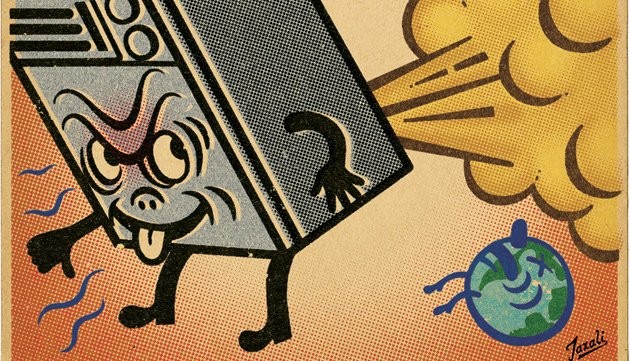
Air conditioning is the world’s next big  threat https://www.smh.com.au/business/markets/air-conditioning-is-the-world-s-next-big-threat-20190629-p522hd.html , By Chris Bryant, June 29, 2019 The vast majority of Americans and many Australians have air conditioning, but in Germany almost nobody does. At least not yet.
So when temperatures in Berlin rose to an uncomfortable 37 Celsius this week – a record for the month of June – I was uncommonly delighted to go to the Bloomberg office, where it’s artificially and blissfully cool.
By letting people in overheated climates concentrate on their work and get a good night’s sleep, air conditioning has played a big part in driving global prosperity and happiness over the past few decades – and that revolution has still barely begun.
About half of Chinese households have this modern tool, but of the 1.6 billion people living in India and Indonesia, only 88 million have access to air conditioning at home, Bloomberg New Energy Finance noted in a recent report.
For many, relief is in sight. Because of the combination of population growth, rising incomes, falling equipment prices and urbanisation, the number of air-conditioning units installed globally is set to jump from about 1.6 billion today to 5.6 billion by the middle of the century, according to the International Energy Agency.
That’s encouraging news for US manufacturers of cooling systems such as Carrier (United Technologies Corp), Ingersoll-Rand and Johnson Controls International.
And because much of this growth will happen in Asia, Chinese companies such as Gree Electric Appliances, Qingdao Haier, Midea Group and Japan’s Daikin Industries Ltd should be big beneficiaries.
There’s just one glaring problem: What will all this extra demand for electricity do to the climate?
Carbon dioxide emissions rose another 2 per cent in 2018, the fastest pace in seven years. That increase was alarming in its own right, given what we know about the unfolding climate emergency.
But the proximate cause was especially troubling: Extreme weather led to more demand for air conditioning and heating in 2018, BP explained in its annual review of energy sector.
It’s not too hard to imagine a vicious cycle in which more hot weather begets ever more demand for air conditioning and thus even more need for power. That in turn means more emissions and even hotter temperatures.
That negative feedback loop exists at a local level too. Air-conditioning units funnel heat outside, exacerbating the so-called “urban heat island” effect, which makes cities warmer than the countryside.
BNEF expects electricity demand from residential and commercial air conditioning to increase by more than 140 per cent by 2050 – an increase that’s comparable to adding the European Union’s entire electricity consumption. Air conditioning will represent 12.7 per cent of electricity demand by the middle of the century, compared to almost 9 per cent now, it thinks.
Thankfully, much of that extra demand will be met by solar power (the need for cooling is highest during daylight hours). But because temperatures don’t always return to comfortable levels when the sun goes down, there’s a danger some will be supplied by fossil power.
‘Passivhaus’ and LED revolution
Buildings have long been a blind spot in climate discussions even though they account for about one-fifth of global energy consumption. The inefficiency of air-conditioning systems or badly designed homes and offices simply aren’t as eye-catching as electric cars and making people feel ashamed about flying.
At least Germany’s “passivhaus” movement, a way of building homes that require very little heating or cooling, voluntary standard for energy efficiency in buildings, shows some people are starting to recognise the danger.
There are lessons to be learned from the world of lighting too. The LED revolution was spurred by innovation but also by better energy efficiency labelling on products and the phasing out of out-of-date technology. Something similar needs to happen with air conditioning.
There was a big step forward in January when the Kigali Amendment to the Montreal Protocol came into force. Though not well known, its aim is to phase out the use of potent greenhouse gases called hydrofluorocarbons, which are used widely in air conditioning systems. Unless substituted, these alone could cause 0.4C of additional warming by the end of the century.
Yet true to form, President Donald Trump’s administration hasn’t yet submitted Kigali to the Senate for ratification, even though American manufacturers would benefit from demand for the new technologies that it would spawn.
Trump knows all about the importance of good air con. He spends much of his time at his Palm Beach country club, a place that couldn’t exist without it.
Chris Bryant is a Bloomberg Opinion columnist covering industrial companies. He previously worked for the Financial Times.
1 This Month



26 September – International Day for the Total Elimination of Nuclear Weapons


PLEASE OPPOSE HR 8255 AND S.3639 – bills would accelerate satellite deployment, with no environmental review or safeguards – https://ncstd5li.quorum.us/campaign/169331/
To see nuclear-related stories in greater depth and intensity – go to https://nuclearinformation.wordpress.com
-
Archives
- September 2026 (206)
- August 2026 (330)
- July 2026 (355)
- June 2026 (287)
- May 2026 (306)
- April 2026 (356)
- March 2026 (251)
- February 2026 (267)
- January 2026 (308)
- December 2025 (358)
- November 2025 (359)
- October 2025 (375)
-
Categories
- 1
- 1 NUCLEAR ISSUES
- business and costs
- climate change
- culture and arts
- ENERGY
- environment
- health
- history
- indigenous issues
- Legal
- marketing of nuclear
- media
- opposition to nuclear
- PERSONAL STORIES
- politics
- politics international
- Religion and ethics
- safety
- secrets,lies and civil liberties
- spinbuster
- technology
- Uranium
- wastes
- weapons and war
- Women
- 2 WORLD
- ACTION
- AFRICA
- Atrocities
- AUSTRALIA
- Christina's notes
- Christina's themes
- culture and arts
- Events
- Fuk 2022
- Fuk 2023
- Fukushima 2017
- Fukushima 2018
- fukushima 2019
- Fukushima 2020
- Fukushima 2021
- general
- global warming
- Humour (God we need it)
- Nuclear
- RARE EARTHS
- Reference
- resources – print
- Resources -audiovicual
- Weekly Newsletter
- World
- World Nuclear
- YouTube
-
RSS
Entries RSS
Comments RSS
 nuclear-news