Permafrost will thaw faster, as global heating causes more rain in the North

|
Climate change is causing more rain in the North. That’s bad news for permafrost
New study shows wetter weather is thawing the frozen ground that covers a quarter of the northern hemisphere, threatening to release massive stores of carbon, The Narwhal, Julien Gignac, Local Journalism Initiative reporter . Aug 20, 2020
Longer, rainier summers are thawing permafrost at an accelerated rate in interior Alaska, according to a new study, begging the question: what does this mean for rainy summers in the Canadian North? “Thawing is happening even faster than we thought,” said Thomas Douglas, an environmental engineer with the U.S. Army Cold Regions Research and Engineering Laboratory and lead author of the study. “We’ve had these crazy wet summers. It’s gonna be bad for permafrost.” The study, published in Nature’s Climate and Atmospheric Science journal, found that between 0.6 and 0.8 centimetres of permafrost thawed for every centimetre of above-average rainfall in Alaska between 2013 and 2017……………… According to a 2015 report by Yukon University, annual precipitation in the territory has increased by six per cent over the past 50 years, with summers seeing the most rainfall compared to other seasons. “Rain water, especially in the summer, is pretty warm and it can move warm, thermal mass down through the soil a lot faster than just warm air temperatures can,” Douglas said. “If you lose three to four weeks of winter to summer, what used to be falling as snow is now falling as rain.”……… According to a 2015 report by Yukon University, annual precipitation in the territory has increased by six per cent over the past 50 years, with summers seeing the most rainfall compared to other seasons. “Rain water, especially in the summer, is pretty warm and it can move warm, thermal mass down through the soil a lot faster than just warm air temperatures can,” Douglas said. “If you lose three to four weeks of winter to summer, what used to be falling as snow is now falling as rain.”……….. it’s not only the North that is impacted by thawing permafrost. Arctic permafrost stores an estimated 1.4 million megatonnes of carbon in frozen organic matter. As it thaws, microorganisms that were dormant when frozen start to break down that matter, releasing carbon and methane into the atmosphere. “It has global ramifications,” Douglas said……………………. we could see all Arctic precipitation levels change in the coming years as sea ice continues to disappear, leaving more open water and more evaporation that eventually becomes precipitation. “As the Arctic Ocean becomes more ice-free in the summer, you would expect many of these areas to become eventually wetter,” Marsh said. https://thenarwhal.ca/climate-change-rain-arctic-permafrost-thaw/ |
|
|
Northern Europe: detecting radiation and where it comes from
|
Radiation detections in northern Europe: what we do and don’t know https://thebulletin.org/2020/08/radiation-detections-in-northern-europe-what-we-do-and-dont-know/# By Cheryl Rofer, August 21, 2020 Alarming events may not be what they initially seem. When an enormous explosion created a mushroom cloud over Beirut on August 4, some people immediately jumped to the wrong conclusion, spreading rumors on social media that a nuclear bomb had gone off. It hadn’t.
Eventually it became clear that the explosion was caused by chemicals stored improperly in warehouses at Beirut’s port. But weapons experts knew from the start that the powerful explosion was not nuclear, because it did not produce a blinding flash of light, or a blast of heat intense enough to set a city on fire. In the hours that followed the explosion, the Comprehensive Test Ban Treaty Organization (CTBTO), which operates a network of monitoring stations around the world, did not detect a telltale spike in atmospheric radiation. That last clue is how experts are able to narrow down the location of nuclear events, from the smallest accidents to major disasters like Chernobyl, and to make educated guesses about what happened. A release of nuclear material spreads its signature on the wind. But that signature is often incomplete or garbled. Nuclear experts are still puzzling over a mysterious event that happened in June, when several monitoring stations in northern Europe detected extremely small quantities of radionuclides in the atmosphere. That event was not a nuclear weapons test, because the CTBTO stations did not detect any seismic activity. So what was it? Experts have scrutinized the radiation signature and narrowed down the possibilities. The finger points to Russia. Radiation alerts. Radioisotope monitoring stations cover most of the globe. The CTBTO runs the biggest network. National radiation safety agencies—for example, in Finland and Sweden—operate other stations. Universities also operate monitoring stations, often in cooperation with the CTBTO or national agencies. Independent monitoring organizations, like the volunteer-driven Safecast, also report radiation measurements. In early June, Norwegian monitoring stations and a CTBTO station detected iodine 131 in far northern Norway. On June 16 and 17, Finland’s Radiation and Nuclear Safety Authority (STUK) detected cobalt 60, ruthenium 103, cesium 134, and cesium 137 in Helsinki. On June 22 and 23, a CTBTO station in Sweden detected ruthenium 103, cesium 134, and cesium 137. Radiation is easy to detect at low levels. The iodine 131 readings were around 1 microbecquerel per cubic meter of air. (A microbecquerel is one atomic disintegration per second in one million cubic meters of air.) But our knowledge of the Chernobyl explosion began with measuring small amounts of radionuclides, so any detection raises an alert. Interpreting the detections. The types of radionuclides detected also provide information. The radionuclides detected in June, except cobalt 60, are produced by nuclear fission. The half-lives of iodine 131 and ruthenium 103 are 8 days and 39 days, respectively, so they must be from recent fission events. These are common fission products from a nuclear reactor. A wider suite of radionuclides would help to pin down what kind of reactor. The iodine 131 detection is ambiguous, though. It is produced by fission, but it is also used fairly commonly to treat hyperthyroidism, in pet cats as well as people. It is easily sent into the air. So it may come from sewage plants or other sources. The fact that it showed up without the other fission products means that its source may be something other than a nuclear accident. Cobalt 60 is not a fission product, but rather an activation product of steel that has been in or very close to a nuclear reactor. It doesn’t usually show up with fission products. It could mean that something was broken in the reactor that released the fission products, or it could be that the Finnish reading was in error. Narrowing down the location. Airborne radionuclides by themselves cannot tell us how or precisely where they were released. The CTBTO tweeted a map indicating the region in northern Europe where the June release may have occurred. This map was probably constructed by tracing the winds during the period just before the radionuclides were detected. A couple of Russian nuclear power plants are located in the area identified, which also covers the location where the United States believes a Russian experimental reactor exploded last summer while it was being raised from the seabed. Last month’s release was probably a minor incident, like a breach in a filter at a nuclear power plant. But Russia has said that there were no incidents at its nuclear power plants. The presence of cobalt 60 and the location have led some to suggest that the release may have been from a new attempt to raise that experimental reactor. It’s not possible, with the limited additional data available so far, to do more than guess the origin of the June radionuclides. The source of a similarly ambiguous release of ruthenium 106 in 2017 took two years to identify. In that case, the release of a single fission product suggested a processing facility, and the wind patterns suggested the Mayak facility in Russia. A detailed study of the stable ruthenium isotopes collected with the ruthenium 106 confirmed those early provisional conclusions. Pinning down the source. Last year’s deadly accident seems to have occurred when a reactor for an experimental nuclear-powered cruise missile was being lifted from the seabed. Again, radionuclide readings from monitoring stations some distance from the source gave early warning to the rest of the world. The amounts and numbers of radionuclides were larger than in the recent release, and reporting on the accident, as people were brought to hospitals, provided more information, including radioisotope detection closer to the site, along with satellite photos and, later, photos of the damaged barge. The radioisotopes indicated that a fission source was involved, although early reports from Russia described an “isotopic source,” a phrase usually reserved for single-isotope heat sources, which would be unsuitable for propulsion. In all three of these cases over the past three years, the radionuclides initially detected by air sampling were ambiguous. Additional information was needed to pin down a source. The best information would come from the country responsible for the release – in all three cases, Russia, which is a signatory to the Convention on Early Notification of a Nuclear Accident. Somebody knows what happened in these cases. We need to hear from them. |
|
Bikini Atoll – food grown there is radioactive – but, it’s “technically habitable”!

Technically Habitable The background radiation of the island has been found to be at normal levels, and even lower than that of some major US cities. While you could walk around on the island and suffer no real ill effects, living there is an entirely different story because of the aforementioned soil and subsequent food contamination.
Ironically for the islanders of Bikini Atoll, the word ‘bikini’ likely comes from ‘pikinni’ which, in the Marshallese language means ‘coconut place
The Radioactive Coconuts of Bikini Atoll, Beginning in 1946, a series of Atomic bombs were tested on and around the Marshall islands, of which Bikini Atoll is one, as both a means of testing and refining the incredibly destructive power demonstrated at Hiroshima and Nagasaki just a year earlier, as well as making a clear statement of US atomic superiority over the Russians. Medium 21 Aug 20, Danny Kane
For those that don’t know, Bikini Atoll was the US’ test site during the 1940s and 1950s for 23 separate Nuclear bombs.
Beginning in 1946, a series of Atomic bombs were tested on and around the Marshall islands, of which Bikini Atoll is one, as both a means of testing and refining the incredibly destructive power demonstrated at Hiroshima and Nagasaki just a year earlier, as well as making a clear statement of US atomic superiority over the Soviet Union.
The Micronesian inhabitants of Bikini Atoll were approached in 1946 by the US government and asked to re-locate while the tests were being carried out. They would be transported to Rongerik Atoll, which is about 6 times smaller than Bikini Atoll — it also has insufficient food and water supplies and was uninhabited at the time………..
The islanders on Rongerik Atoll were starving, the land their being far less fertile than their native Bikini. They were then moved to Kili Island. It was little improvement for the islanders. Relying on fishing for a large part of their diet, they found Kili, which has no lagoons and rough seas most of the year particularly difficult to survive on.
But on March 1st, 1954, the fate of Bikini Atoll was about to take a destructive turn. Ironically, the bomb that was detonated was one of the few not detonated on the Atoll, instead it was detonated on an artificial island 900m from Namu island. This was the infamous Castle Bravo hydrogen bomb. It exploded that day with the force of 15mt , far more than the 6mt that was expected. It was 750 times more powerful that the Fat Man bomb that levelled Nagasaki. It denoted with 2.5 times the expected yield and remains the largest nuclear bomb ever detonated by the US, equivalent to 15 million tonnes of TNT.
Appropriate precautions hadn’t been taken for such a large detonation, and so nuclear fallout rained down on Bikini Atoll, Rongelap Atoll and Rongerik Atoll. 20,000 people were affected by the Castle Bravo detonation and 15 islands and atolls were contaminated. People showed signs of acute radiation sickness, and, on Rongelap, 2 cm of nuclear ash blanketed the entire island. Children, unaware of the fallouts affects, began playing with the falling ash like snow.
Returning Home
Another 19 atomic bombs would be detonated on and around Bikini Atoll, the last one Juniper on July 22nd, 1954, almost 12 years to the day since the Baker detonation. Now, the fight to return to Bikini Atoll really began. Struggling to survive on Kili Island, the islanders were eager to return home.
In spite of all we’d put it through Bikini Atoll had recovered from its years of abuse at the hands of the US. Having been bounced between various islands and atolls since the testing began, Kili had become their permeant home since 1948, but the islands desperately wanted to return home. It wouldn’t be until 1968 until they got the chance. President Lyndon B Johnson promised that the islanders could return, but an investigation by the Atomic Energy Commission found that the radiation levels in the coconut crab, an essential food source for the islanders, were far above normal and acceptable limits. As such, the islanders were forced to remain on Kili island.
Three families did move back in 1972, followed by others in 1987 despite later advice. Issues continued to plague the islanders though, with a boy who’d been born on Bikini Atoll dying from cancer caused by the radiation. In 1982, those that had returned would be evacuated for a second time when it was found that the top 15 inches of soil contained high concentrations of Caesium 137, which would then make its way into the various plants and fruits the islanders ate — and yes, even the coconuts were affected. This resulted in a high number of stillbirths, miscarriages and genetic abnormalities in the children born from those affected by the atomic tests conducted in and around Bikini Atoll. What’s more men were four times as likely to develop lung cancer on the island, women 60 times more likely develop cervical cancer
Over $150 million has been paid to the Bikini islanders as compensation and to reconstruct homes, facilities and institutions for the islanders, many of whom now live on Kili Island. The call to return to Bikini Atoll is still strong though and many point to the fact that the island is still technically habitable.
Technically Habitable
The background radiation of the island has been found to be at normal levels, and even lower than that of some major US cities. While you could walk around on the island and suffer no real ill effects, living there is an entirely different story because of the aforementioned soil and subsequent food contamination.
One proposed solution, and the one favoured by the islanders themselves, is to scrap the topsoil. The top 15 inches of Caesium 137 contaminated soil would be removed and replaced with potassium rich soil. The plants, preferring the potassium over the caesium, would quickly switch to that. While Caesium 137 would still be present in the earth, it would be absent from the food.
There are unfortunately a number of issues with this. Removing the topsoil would have a devasting effect on the ecology of the island and scientists have argued that it would effectively turn Bikini Atoll into a wasteland. This is to say nothing of the expense and the fact that the scraping of the topsoil would likely have to be repeated on occasion to ensure that Caesium 137 didn’t return to the food supply.
Right now, the islanders live on a majority imported food supply and it’s likely that they could continue to do this on Bikini Atoll. It is hardly a return to normal life on the home island though and if the islanders are forced into the same food import practices they’ve had since the 40s, many argue why return to the island at all. Many islanders seem willing to take the risk of destroying the island if it means that they can return their a potentially grow food once more like their ancestors of old.
And so, it remains to this day. The Bikini islanders have never returned home, instead being forced into limbo. Most live on Kili Island today and there are as many as 2,400 Bikini islanders, with fewer than 40 of them having been alive to witness the fires of nuclear fission all those years ago. A great many of them have never even visited their home island, which in recent years has become a tourist attraction. A great many diving tours are offered, especially of the sunken USS Arkansas and the USS Saratoga aircraft carrier, two of the many ships sunk in the testing, as well as the colossal crater left by Castle Bravo…………..
Ironically for the islanders of Bikini Atoll, the word ‘bikini’ likely comes from ‘pikinni’ which, in the Marshallese language means ‘coconut place’………https://medium.com/@dannykane97/the-radioactive-coconuts-of-bikini-atoll-9bfb568b8b07
Hiroshima and the normalisation of atrocities

|
Death from the sky: Hiroshima and normalised atrocities https://www.onlineopinion.com.au/view.asp?article=21049
When US President Harry S Truman made the decision to drop the atomic bomb on Hiroshima on August 6, 1945, followed by another on Nagasaki a few days later, he was not acting as an agent untethered from history. In the wheels of his wearied mind lay the battered Marines who, despite being victorious, had received sanguinary lashings at Iwo Jima and Okinawa. A fear grew, and US military sources speculated about, the slaughter that might follow an invasion of the Japanese homeland. They also pondered the future role of the Soviets, and wondered whether there were other means by which Japan’s involvement in the war might be terminated before Moscow got its hands on the battered remains of North East Asia. Much is made about the moral dilemma Truman faced. He knew there was the nastiest of weapons at hand, born from the race to acquire it from Nazi Germany. But on a certain level, it was merely another weapon, one to use, a choice sample in the cabinet of lethal means and measures. By that stage of the war, killing civilians from the air, not to mention land, was banal and common place; enemy populations were to be experimented upon, burned, torched, gassed, shelled and eradicated in the program of total war. By the time Truman made his decision, Japan had become a graveyard of strategic aerial bombing. General Curtis E. LeMay of the US Air Force prided himself on incinerating the enemy, and was encouraged by various study commissions advocating the use of incendiary bombs against Japan’s flammable urban architecture. He was realising the dreams of such figures as the pioneering US aviator and air power enthusiast Billy Mitchell, who fantasised in the 1920s about Japanese cities being “the greatest aerial targets the world has ever seen”. In 1941, US Army chief of staff George Marshall spread the word to journalists that the US would “set the paper cities of Japan on fire”. Civilians would not be spared. Towards the end of the war, daylight precision bombing had fallen out of favour; LeMay preferred the use of Boeing B-29 Superfortresses, heavily laden with firebombs, to do the work. His pride of joy in conflagration was Tokyo. During the six-hour raid over the night of March 9 and 10, 1945, the US Strategic Bombing Survey concluded that 87,793 had perished, with 40,918 injuries. There was little novel in LeMay’s blunt approach. Britain’s Air Force Marshall Arthur “Bomber” Harris fertilised the ground, and the air, for such an idea. He made it his mission to not only kill Germans but kill German civilians with a cool determination. He did so with a workmanlike conviction so disturbing it chilled the blood of many Britons. As he put it, “The cities of Germany, including their working populations, are literally the heart of Germany’s war potential.” It was his intention to, he explained to personnel, “in addition to the horrors of fire … to bring masonry crashing down on top of the Boche, to kill the Boche and to terrify the Boche”. The Teutonic enemy came, not so much in all shades, but one. Saturation bombing, regarded after the Second World War as generally ineffective, a ghastly failure to bring the population to its knees, received its blessing in Bomber Command. This entire process neutered the moral compass of its executioners. Killing civilians had ceased to be a problem of war, one of those afterthoughts which served to sanction mass murder. Britain’s chief of the air staff for a good deal of the war, Charles Portal, called it a “fallacy” that bombing Germany’s cities “was really intended to kill and frighten Germans and that we camouflaged this intention by the pretence that we would destroy industry. Any such idea is completely false. The loss of life, which amounted to some 600,000 killed, was purely incidental.” When 600,000 becomes an incidental matter, we are well on the way to celebrating the charnel houses of indiscriminate war. When the issue of saturation bombing creased the legal minds behind the Nuremberg and Tokyo war crimes trials, an admission had to be made: all sides of the Second World War had made the air a realm of convenience in the killing of humanity, uniformed or not. To win was all that mattered. While the Nuremberg Charter left it open to criminalise German aerial tactics, the International Military Tribunal hedged. As chief of the Luftwaffe, Herman Göring was singled out for air attacks on Poland and other states but the prosecutors refrained from pushing the point, likely reflecting the cold fact, as Matthew Lippmann puts it, “that both Germany and the Allies engaged in similar tactics.” It is true that Germany and Japan gave a good pioneering go at indiscriminate aerial slaughter. But the Allied powers, marshalling never before seen fleets of murderous bombers, perfected the bloody harvest. The war had to be won, and, if needed, over the corpses of the hapless mother, defenceless child and frail grandparent. As the historian Charles S. Maier notes with characteristic sharpness, a tacit consensus prevailed after the Second World War that the ledger of brutality was all stacked on one side. German bombings during the Spanish Civil War, notably of Guernica; Warsaw, Rotterdam, London and Coventry during the world war that followed, were seen as “acts of wanton terror”. The Allied attacks on Italian, German and Japanese urban centres, in proportion and scale far more destructive, were seen as “legitimate military actions”. Distinctions about civilian and non-civilian vanished in the atomic cloud. Hiroshima’s tale is the apotheosis of eliminating distinctions in war. It propagated such dangerous beliefs that nuclear wars might be won, sparing a handful of specialists and breeders in bunkers planning for the new post-apocalyptic dawn. It normalised, even as it constituted a warning, the act of annihilation itself. Prior to the twin incinerations of Hiroshima and Nagasaki, the redoubtable nurse and writer Vera Brittain issued a warning that remains salient to those who wish to resort to waging death from the sky: “If the nations cannot agree, when peace returns, to refrain from the use of the bombing aeroplane as they have refrained from using poison gas, then mankind itself deserves to perish from the epidemic of moral insanity which today afflicts our civilisation.” |
|
|
Nuclear radiation and Chernobyl’s forest fires
Twenty-five years after the disaster, Zibtsev and others predicted that if the forests in the exclusion zone were completely consumed by fire, residents in Kyiv would face an increased risk of dying from cancer and government bans would need to be imposed on foods produced as far as 90 miles away. Although such a large and intense fire is currently unlikely, recent fires have been sizable enough to create similar problems. “If Chernobyl forests burn, contaminants will migrate outside the immediate area,” says Zibtsev. “We know that.”
This April’s fires, which scorched 23 percent of the exclusion zone, were the largest burns ever recorded in the area, nearly four and a half times the size of fires in 2015. Flames torched trees less than three miles from the ruined nuclear reactor, which is now enclosed by an arch-shaped steel shroud.
 Forest Fires Are Setting Chernobyl’s Radiation Free https://www.theatlantic.com/
 science/archive/2020/08/chernobyl-fires/615067/
Trees now cover most of the exclusion zone, and climate change is making them more likely to burn. Story by Jane Braxton Little 10 Aug, 20 In the clear, calm, early hours of May 15, 2003, three miles west of the hulking ruins of the Chernobyl Nuclear Power Plant, Vasyl Yoschenko was bustling around a stand of Scotch pines planted 30 years earlier. The trees were spindly and closely spaced, but he was skinny enough to move easily among them, taking samples of biomass and litter. Just beyond the trees, he tinkered with the horizontal plates he had placed on the ground in a diagonal grid and covered with superfine cloth designed to absorb whatever came their way.
The forest burned intensely for 90 minutes, releasing cesium-137, strontium-90, and plutonium-238, -239, and -240 in blasts of smoke and heat. In just one hour, the firefighters—and Yoschenko—could have been exposed to more than triple the annual radiation limit for Chernobyl’s nuclear workers.
The lingering human suffering after nuclear testing in Australia and Oceania
Death in paradise: the aftermath of nuclear testing in Australia and Oceania https://diem25.org/death-paradise-the-aftermath-nuclear-testing-australia-and-oceania/ 10/08/2020 by Aleksandar Novaković The United States of America is the first nuclear power — and the only one to have used its weapons for a military purpose. During World War 2 in 1945, two Japanese cities were bombed by US nuclear bombs (Hiroshima on August 6th and Nagasaki August 9th ). The devastating result was approximately 225,000 people either dead or wounded. The number of deaths in Hiroshima and Nagasaki due to exposure to lethal radiation is still being discussed, but it is certainly in the thousands.
However, even though nuclear weapons were never used again for military purposes, nuclear testing took (and continues to take) a toll on thousands of lives in Australia and Oceania.
The United States conducted about 1,054 nuclear tests from 1945 to 1992, and 105 of them (1945-1962) were made at Pacific Test Sites (Marshall Islands, Kiribati) causing the contamination of huge areas controlled by US troops. In the Pacific, this caused rising numbers of cancer and birth defects, especially on the Marshall Islands where 67 tests were made and many Marshallese were forced to leave their homes in contaminated areas.
European nuclear powers, such as France and the UK, have also “contributed” to the deaths of thousands.
France has made over 193 nuclear tests in the Pacific between 1960 and 1996, mostly on Mururoa and Fangataufa atolls that belong to French Polynesia, as well as 17 tests in Algerian Sahara. Tahiti, the most populated island of French Polynesia, was exposed to 500 times the maximum accepted levels of radiation. The impact has spread as far as to the tourist island of Bora Bora.
Civilians and the military participating in nuclear tests (more than 100,000 of them) have experienced diarrhea, skin injuries, blindness, and cancer. Their children have additionally suffered from birth defects.
From 1953 to 1963, there were over 20 bigger and smaller British A- bomb tests in Emu Farm, and the Maralinga and Montebello Islands of Australia. Overall, over 1200 peoples were exposed to radiation in the country, most of them Anangu people living in the Maralinga area. The UK has also made nuclear tests on overseas territories such as the Malden Islands and Christmas Island ( the present Republic of Kiribati).
So, what was done by the governments of the US, UK, Australia and France to help those who have suffered from radiation related illnesses, or those who lost their loved ones?
There are two answers. One is that loss of loved ones, of the way you live your life, of the nature that surrounds you, the loss of home cannot be repaid or replaced with anything else. The other is that aforementioned governments did little.
The US has awarded more than $63 million to Marshallese with radiogenic illnesses despite the fact that the Tribunal only has $45.75 million to award for both health and land claims. France is still avoiding paying reparations to Tahitians.
As for the “joint venture” of the UK and Australia, the truth is that tests were approved and conducted in the first place because British officials were misinforming Australians. The Maralinga Tjarutja (Council) of Anangu people has a compensation settlement with the Australian government, and they are receiving $13.5 million.
75 years after Hiroshima and Nagasaki, we must ask ourselves: Why are we so callous about many “Hiroshimas” and “Nagasakis” that happened over the following decades? Did we let them happen just because they took place in far-off islands in the Pacific or in the Australian desert?
The only way to deal with these existing and future horrors that can eradicate life on Earth is to heal these existing wounds.
This means that the governments of the US, UK, France and Australia must pay just reparations to the affected countries and regions. Progressives of the world must act united against the threat of nuclear holocaust and create a political climate in which it would be possible to take action on an international level in order to ban the production, storage and use of nuclear weapons.
This can be done if nuclear powers, followed by all member states, sign the United Nation’s Treaty on the Prohibition of Nuclear Weapons.
Aleksandar Novaković is a historian and dramatist. He is a member of DSC Belgrade 1 and the thematic DSC Peace and International Policy 1
All too often the world has narrowly avoided World War 3, due to mistales
concentrating this power within a single individual is a big risk. “It’s happened a number of times that a president has been heavily drinking, or subject to medication he’s taking. He may be suffering from a psychological disease. All of these things have happened in the past,”
ways a country’s own technologies could be used against them. As we become more and more reliant on sophisticated computers, there is growing concern that hackers, viruses or AI bots could start a nuclear war. “We believe that the chance of false alarms has gone up with the increased danger of cyber-attacks,” says Collina. For example, a control system [like Pine Gap] could be spoofed into thinking that a missile is coming, which could mean a president is tricked into launching a counter-attack.
many experts agree that by far the biggest threat comes from the very launch systems that are supposed to be protecting us.
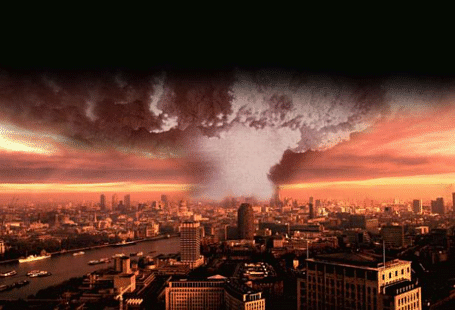 The nuclear mistakes that nearly caused World War Three , From invading animals to a faulty computer chip worth less than a dollar, the alarmingly long list of close calls shows just how easily nuclear war could happen by mistake. https://www.bbc.com/future/article/20200807-the-nuclear-mistakes-that-could-have-ended-civilisation By Zaria Gorvett, 10th August 2020 The nuclear mistakes that nearly caused World War Three , From invading animals to a faulty computer chip worth less than a dollar, the alarmingly long list of close calls shows just how easily nuclear war could happen by mistake. https://www.bbc.com/future/article/20200807-the-nuclear-mistakes-that-could-have-ended-civilisation By Zaria Gorvett, 10th August 2020It was the middle of the night on 25 October 1962 and a truck was racing down a runway in Wisconsin. It had just moments to stop a flight. Mere minutes earlier, a guard at Duluth Sector Direction Center had glimpsed a shadowy form attempting to climb the facility’s perimeter fence. He shot at it and raised the alert, fearing that this was part of a wider Soviet attack. Instantly, intruder alarms were ringing at every air base in the area. The situation escalated remarkably quickly. At nearby Volk Field, an air base, someone flicked the wrong switch – so rather than the standard security warning, pilots heard an emergency siren telling them to scramble. Soon there was a frenzy of activity, as they rushed to take to the skies, armed with nuclear weapons. Continue reading |
Inhumanity, racism, sheer immorality, in the decisions to nuclear bomb Hiroshima and Nagasaki
|
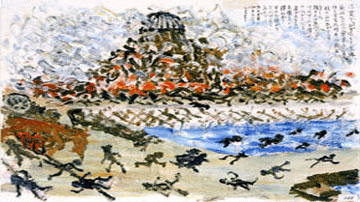
The decision 75 years ago to use atomic bombs was fuelled not by strategy but by sheer inhumanity “If we’d lost the war, we’d all have been prosecuted as war criminals.” So said Curtis LeMay after America obliterated Hiroshima and Nagasaki with two atomic bombs in August 1945. LeMay was no bleeding-heart liberal. The US air force chief of staff who had directed the assault over Japan in the final days of the Second World War, he believed in the use of nuclear weapons and thought any action acceptable in the pursuit of victory. Two decades later, he would say of Vietnam that America should “bomb them back into the stone ages”. But he was also honest enough to recognise that the incineration of Hiroshima and Nagasaki was not regarded as a war crime only because America had won the war. Last week marked the 75th anniversary of the world’s first nuclear attacks. And while Hiroshima has become a byword for existential horror, the moral implications of the bombings have increasingly faded into the background. Seventy-five years ago, LeMay was not alone in his verdict. “We had adopted an ethical standard common to the barbarians of the Dark Ages,” Fleet Admiral William Leahy, chair of the chiefs of staff under both presidents Roosevelt and Truman, wrote in his autobiography, I Was There. Dwight Eisenhower, too, had, as he observed in the memoir The White House Years, “grave misgivings” about the morality of the bombings. Almost as soon as the bombs had dropped, however, attempts began to justify the unjustifiable. On 9 August, the day of the Nagasaki bombing, the US president, Harry Truman, broadcast to the nation, claiming that “the first atomic bomb was dropped on Hiroshima, a military base… because we wished… to avoid the killing of civilians”. In fact, more than 300,000 people lived in Hiroshima, of whom up to 40% were killed, often in the most grotesque fashion. Many commentators, including Truman, have also argued that without the bombings, hundreds of thousands, perhaps millions, of US troops would have been killed in any invasion of Japan. What the casualty figures may have been is in the realm of speculation and estimates vary widely. Most Allied military leaders did not, however, see the necessity for the bombings of Hiroshima and Nagasaki. Chester W Nimitz, the commander in chief of the US Pacific fleet, insisted that they were “of no material assistance in our war against Japan”. Eisenhower agreed that they were “completely unnecessary” and “no longer mandatory as a measure to save American lives”. General Douglas MacArthur, supreme commander of the southwest Pacific area, saw “no military justification for the dropping of the bomb”. The official Strategic Bombing Surveys in 1946 concluded that “Japan would have surrendered even if the atomic bombs had not been dropped”. There is evidence that the Americans had been preparing to use the A-bomb against the Japanese as early as 1943 and that, in the words of General Leslie R Groves, director of the Manhattan Project, the US nuclear weapon programme, “the target… was always expected to be Japan”. It’s an attitude that may have been driven by the different ways in which the Allies saw their enemy in Europe and in Asia. Germans were depicted as brutal and savage, but the bigotry was restrained to some extent by the fact that they were European and white. The Japanese, however, were particularly despised because they were non-white. As the historian John Dower observes in his pathbreaking book, War Without Mercy, the Pacific war was especially brutal because both sides saw the conflict “as a race war” that was “fuelled by racial pride, arrogance and rage”. It was common for western diplomats to refer to the Japanese as “monkeys” and “yellow dwarf slaves”. A former marine, Andrew Rooney, observed that US forces “did not consider that they were killing men. They were wiping out dirty animals.” Truman himself wrote: “When you have to deal with a beast you have to treat him as a beast.” “The entire population of Japan is a proper military target,” wrote Colonel Harry F Cunningham, an intelligence officer of the US Fifth Air Force. “There are no civilians in Japan.” The deliberate firebombings of Japanese cities are believed to have killed some 350,000 civilians. Against this background, the bombings of Hiroshima and Nagasaki become more explicable. The Japanese too were vicious, cruel and racist. But Japanese attitudes and atrocities are well known; those of the Allies are often forgotten, because they were the “good guys”. So much so that simply to question the morality of the bombings now can be deemed unpatriotic. When, 25 years ago, Washington’s National Air and Space Museum planned an exhibition to mark the 50th anniversary of the end of Second World War, part of which put the bombings in historical context, it faced fierce criticism from politicians and veterans. It was forced to rework the exhibition and its director, Martin Harwit, had to resign. He later reflected: “Those who in any way questioned the bomb’s use were, in this emotional framework, the enemies of America.” At a time when Black Lives Matter protests have thrust the history of slavery and of empire into public debate, it is striking that there remains such historical amnesia about Hiroshima and Nagasaki. We seem much less aware today of the sheer inhumanity and moral indefensibility of the bombings than even the military hawks were at the time. In the 2003 documentary The Fog of War, Robert McNamara, the former US defence secretary who had been LeMay’s military aide during the Second World War, reflected on the question of war crimes: “LeMay recognised that what he was doing would be thought immoral if his side had lost. But what makes it immoral if you lose and not immoral if you win?” That’s not just a historical question. It’s as relevant today, and to today’s wars, as it is about the destruction of Hiroshima and Nagasaki. History may be written by the victors, but morality should not be defined solely by them. |
|
Hiroshima survivor explains why 75 years of radiation research is so important
Watch: Hiroshima survivor explains why 75 years of radiation research is so important https://www.sciencemag.org/news/2020/08/watch-hiroshima-survivor-explains-why-75-years-radiation-research-so-important By Joel GoldbergAug. 3, 2020 ,
Seventy-five years ago on 6 August, the United States dropped a nuclear bomb on Hiroshima, Japan. Up to 120,000 people died in the bombing and its aftermath. Some of the survivors, known as hibakusha, would eventually enroll in the Radiation Effects Research Foundation’s Life Span Study, which continues to examine the effects of atomic radiation on the human body. The study’s findings have been the basis for radiation safety standards around the world, ranging from power plants to hospitals. Decades of archival footage and images, survivor drawings, and the testimony of research participant Kunihiko Iida convey the kind of misery that results from an atomic bombing—as well as the message of peace and humanity that can result from scientific research.
Fukushima’s contaminated waste water – more serious than previously thought
 Fukushima’s Contaminated Wastewater Could Be Too Risky to Dump in the Ocean, https://www.gizmodo.com.au/2020/08/fukushimas-contaminated-wastewater-could-be-too-risky-to-dump-in-the-ocean/ Dharna Noor :August 7, 2020 Almost a decade ago, the Tohoku-oki earthquake and tsunami triggered an explosion at Japan’s Fukushima Daiichi Nuclear Power Plant, causing the most severe nuclear accident since Chernobyl and releasing an unprecedented amount of radioactive contamination in the ocean. In the years since, there’s been a drawn out cleanup process, and water radiation levels around the plant have fallen to safe levels everywhere except for in the areas closest to the now-closed plant. But as a study from the Woods Hole Oceanographic Institution published in Science on Thursday shows, there’s another growing hazard: contaminated wastewater.
Radioactive cooling water is leaking out of the the melted-down nuclear reactors and mixing with the groundwater there. In order to prevent the groundwater from leaking into the ocean, the water is pumped into more than 1,000 tanks. Using sophisticated cleaning processes, workers have been able to remove some of this contamination and divert groundwater flows, reducing the amount of water that must be collected each day. But those tanks are filling up, and some Japanese officials have suggested that the water should dumped into the ocean to free up space.
But according to the new study, that’s not the only radioactive contaminant left in the tanks. By examining TEPCO’s own 2018 data, WHOI researcher Ken Buesseler found that other isotopes remain in the treated wastewater, including carbon-14, cobalt-60, and strontium-90. He found these particles all take much longer to decay than tritium, and that fish and marine organisms absorb them comparatively easily.
“[This] means they could be potentially hazardous to humans and the environment for much longer and in more complex ways than tritium,” the study says.
Though TEPCO’s data shows there is far less of these contaminants in the wastewater tanks than tritium, Buesseler notes that their levels vary widely from tank to tank, and that “more than 70% of the tanks would need secondary treatment to reduce concentrations below that required by law for their release.”
The study says we don’t currently have a good idea of how those more dangerous isotopes would behave in the water. We can’t assume they will behave the same way tritium does in the ocean because they have such different properties. And since there are different levels of each isotope in each different tank, each tank will need its own assessment.
“To assess the consequences of the tank releases, a full accounting after any secondary treatments of what isotopes are left in each tank is needed,” the study said.
Buesseler also calls for an analysis of what other contaminants could be in the tanks, such as plutonium. Even though it wasn’t reported in high amounts in the atmosphere in 2011, recent research shows it may have been dispersed when the explosion occurred. Buesseler fears it may also be present in the cooling waters being used at the plant. That points to the need to take a fuller account of the wastewater tanks before anything is done to dump them in the ocean.
“The first step is to clean up those additional radioactive contaminants that remain in the tanks, and then make plans based on what remains,” he said in a statement. “Any option that involves ocean releases would need independent groups keeping track of all of the potential contaminants in seawater, the seafloor, and marine life.”
Many Japanese municipalities have been pushing the government to reconsider its ocean dumping plans and opt to find a long-term storage solution instead, which makes sense, considering exposure to radioactive isotopes can cause myriad health problems to people. It could also hurt marine life, which could have a devastating impact on fishing economies and on ecosystems.
“The health of the ocean — and the livelihoods of countless people — rely on this being done right,” said Buesseler.
Las Vegas Sun presents numerous arguments against nuclear testing in Nevada
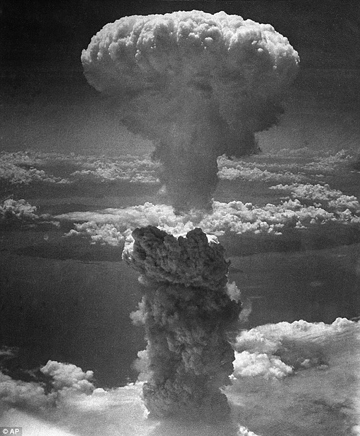 When it comes to nuclear tests in Nevada, numbers just don’t add up, https://m.lasvegassun.com/news/2020/aug/09/when-it-comes-to-nuclear-tests-in-nevada-numbers-j/ Sunday, Aug. 9, 2020
On the anniversary of a meaningful day in history, we present this argument opposing the Trump administration’s idea of resuming live testing of nuclear weapons near Las Vegas.
75: Years ago, to the day, when the last atomic bomb was dropped in anger.
110,000-210,000: Estimated death toll of the bombs dropped on Hiroshima and Nagasaki on Aug. 6 and Aug. 9, 1945, respectively.
2,000-plus: Nuclear tests that have been conducted since the end of World War II by the U.S., Russia and six other countries.
1,021: Number of detonations that occurred in 928 tests conducted in Nevada, with some tests involving more than one device.
100: Number of above-ground detonations in Nevada from 1951 to 1962.
65: In miles, the distance between Las Vegas and the Nevada Test Site (now the Nevada National Security Site).
74: Yield, in kilotons, of the largest above-ground device detonated at the Nevada Test Site, which occurred in 1957. The bomb delivered the equivalent of 74,000 tons of TNT.
35: Combined yield, in kilotons, of the bombs dropped on Hiroshima and Nagasaki.
5: Number of men who were positioned below a nuclear explosion in July 1957 for a government film designed to prove to the public that above-ground testing was safe. The film was part of a larger, years-long campaign to convince Nevadans and our neighbors not to worry about the effects of testing.
11,000: Number of cancer deaths stemming from above-ground testing in Nevada, as estimated by the Centers for Disease Control and Prevention in a 2003 report. That number is disputed, however, with some researchers saying the death toll may have been many times that based on how far the fallout would have traveled. One study estimated the minimum number of dead at 145,000.
1.3: Yield, in megatons, of the largest detonation at the site, part of the “Boxcar” underground test of 1968. That’s the equivalent of 1.3 million tons of TNT.
20: According to one estimate, the above-ground tests in Nevada sent 20 times more radioactive material into the atmosphere than was released during the Chernobyl catastrophe.
$2 billion: Amount Congress would eventually pay to Nevadans and downwinders exposed to radiation from test blasts.
1.6 trillion: Gallons of groundwater contaminated by radiation from below-ground tests, according to one estimate. That equates to 16 years worth of Nevada’s allotment of water from the Colorado River.
28: Years that have passed since the United States placed a moratorium on nuclear testing.
0: Number of detonations currently needed to ensure that stockpiled nuclear weapons are safe, secure, reliable and effective. Modern computers and physics equipment have made live testing unnecessary.
0: Number of Southern Nevada’s congressional delegates who support resumption of nuclear testing at the site. Sens. Catherine Cortez Masto and Jacky Rosen, and Reps. Dina Titus, Susie Lee and Steven Horsford, all spoke out in opposition. In a prepared statement, Rosen said Nevadans “do not want to return to a time when the ground shook and radiation exposure was a fact of life,” and that “any actions that could place Nevadans’ health and safety at risk should be off the table.”
0: Number of tests that would be allowed at the site under legislation introduced by Titus and recently approved by the House. “I did not introduce this ban lightly, but it was necessary to prevent President Trump from recklessly threatening Nevadans’ health and potentially restarting a global arms race,” Titus said in a prepared statement.
0: The number of reasons we can find to support Trump’s plan.
Another Hiroshima is Coming…Unless We Stop It Now
Today, an unprecedented campaign of propaganda is shooing us all off like rabbits. We are not meant to question the daily torrent of anti-Chinese rhetoric, which is rapidly overtaking the torrent of anti-Russia rhetoric. Anything Chinese is bad, anathema, a threat: Wuhan …. Huawei. How confusing it is when “our” most reviled leader says so.
The target is China. Today, more than 400 American military bases almost encircle China with missiles, bombers, warships and nuclear weapons. From Australia north through the Pacific to South-East Asia, Japan and Korea and across Eurasia to Afghanistan and India, the bases form, as one US strategist told me, “the perfect noose”.
In the Sydney Morning Herald, tireless China-basher Peter Hartcher described those who spread Chinese influence in Australia as “rats, flies, mosquitoes and sparrows”. Hartcher, who favourably quotes the American demagogue Steve Bannon, likes to interpret the “dreams” of the current Chinese elite, to which he is apparently privy. These are inspired by yearnings for the “Mandate of Heaven” of 2,000 years ago. Ad nausea.
To combat this “mandate”, the Australian government of Scott Morrison has committed one of the most secure countries on earth, whose major trading partner is China, to hundreds of billions of dollars’ worth of American missiles that can be fired at China.
At a quarter past eight on the morning of August 6, 1945, she and her silhouette were burned into the granite.
I stared at the shadow for an hour or more, then I walked down to the river where the survivors still lived in shanties.
I met a man called Yukio, whose chest was etched with the pattern of the shirt he was wearing when the atomic bomb was dropped.
He described a huge flash over the city, “a bluish light, something like an electrical short”, after which wind blew like a tornado and black rain fell. “I was thrown on the ground and noticed only the stalks of my flowers were left. Everything was still and quiet, and when I got up, there were people naked, not saying anything. Some of them had no skin or hair. I was certain I was dead.”
Nine years later, I returned to look for him and he was dead from leukaemia.
“No radioactivity in Hiroshima ruin” said The New York Times front page on 13 September, 1945, a classic of planted disinformation. “General Farrell,” reported William H. Lawrence, “denied categorically that [the atomic bomb] produced a dangerous, lingering radioactivity.”
Only one reporter, Wilfred Burchett, an Australian, had braved the perilous journey to Hiroshima in the immediate aftermath of the atomic bombing, in defiance of the Allied occupation authorities, which controlled the “press pack”.
“I write this as a warning to the world,” reported Burchett in the London Daily Express of September 5,1945. Sitting in the rubble with his Baby Hermes typewriter, he described hospital wards filled with people with no visible injuries who were dying from what he called “an atomic plague”.
For this, his press accreditation was withdrawn, he was pilloried and smeared. His witness to the truth was never forgiven.
The atomic bombing of Hiroshima and Nagasaki was an act of premeditated mass murder that unleashed a weapon of intrinsic criminality. It was justified by lies that form the bedrock of America’s war propaganda in the 21st century, casting a new enemy, and target – China.
During the 75 years since Hiroshima, the most enduring lie is that the atomic bomb was dropped to end the war in the Pacific and to save lives.
“Even without the atomic bombing attacks,” concluded the United States Strategic Bombing Survey of 1946, “air supremacy over Japan could have exerted sufficient pressure to bring about unconditional surrender and obviate the need for invasion. “Based on a detailed investigation of all the facts, and supported by the testimony of the surviving Japanese leaders involved, it is the Survey’s opinion that … Japan would have surrendered even if the atomic bombs had not been dropped, even if Russia had not entered the war [against Japan] and even if no invasion had been planned or contemplated.”
The National Archives in Washington contains documented Japanese peace overtures as early as 1943. None was pursued. A cable sent on May 5, 1945 by the German ambassador in Tokyo and intercepted by the US made clear the Japanese were desperate to sue for peace, including “capitulation even if the terms were hard”. Nothing was done.
The US Secretary of War, Henry Stimson, told President Truman he was “fearful” that the US Air Force would have Japan so “bombed out” that the new weapon would not be able “to show its strength”. Stimson later admitted that “no effort was made, and none was seriously considered, to achieve surrender merely in order not to have to use the [atomic] bomb”.
Stimson’s foreign policy colleagues — looking ahead to the post-war era they were then shaping “in our image”, as Cold War planner George Kennan famously put it — made clear they were eager “to browbeat the Russians with the [atomic] bomb held rather ostentatiously on our hip”. General Leslie Groves, director of the Manhattan Project that made the atomic bomb, testified: “There was never any illusion on my part that Russia was our enemy, and that the project was conducted on that basis.”
The day after Hiroshima was obliterated, President Harry Truman voiced his satisfaction with the “overwhelming success” of “the experiment”.
The “experiment” continued long after the war was over. Between 1946 and 1958, the United States exploded 67 nuclear bombs in the Marshall Islands in the Pacific: the equivalent of more than one Hiroshima every day for 12 years. Continue reading
Hiroshima survivor Koko Kondo met the man who dropped that atomic bomb
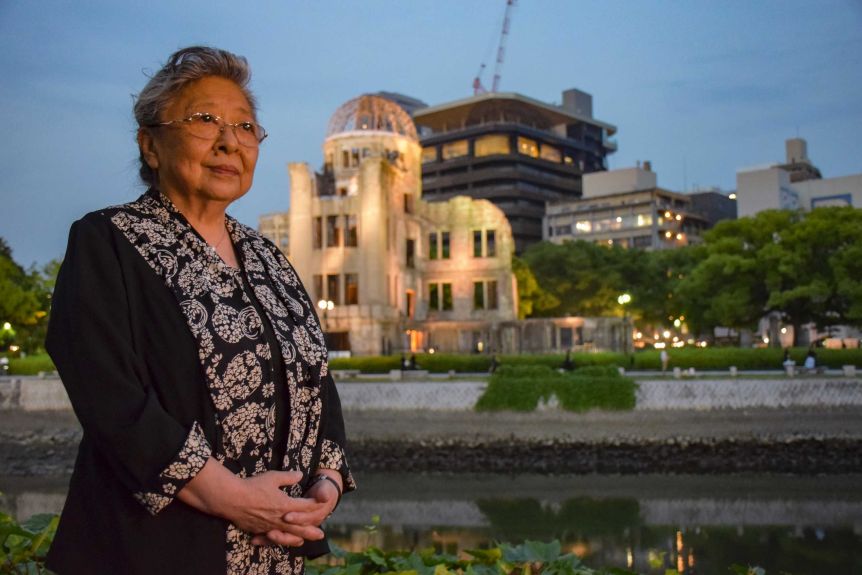
Hiroshima’s atomic bomb changed Koko Kondo’s life, but so did meeting the man who dropped it, ABC News,By Tracey Shelton, 6 August, 20, Eight-month-old Koko was in her mother’s arms the day the world’s first nuclear weapon was dropped on Hiroshima, bringing their family home crashing down on them on this day 75 years ago.
Key points:
Between 90,000 and 166,000 victims died within months of the Hiroshima bombing
Koko Kondo met pilot Robert Lewis on the set of This is Your Life
More than 150 denshosha volunteers are carrying on the memories of survivors
She was almost 40 years old before her mother finally sat her down and told her the full story of how she had inched through the rubble in darkness, with little Koko wrapped in her arms, towards a small pocket of dusty sunlight.
“She first pushed me out [through the opening], then next, she was able to get out … but the fire was all over the place according to my mother,” said Koko Kondo, who is now 75.
Ms Kondo’s father — Methodist minister Kiyoshi Tanimoto, who was visiting a parishioner across town — said in a US television interview “the whole city was on fire” as he ran through the streets to find his family.
He described people running in silence with skin hanging from their bodies “like a procession of ghosts”
In the sky above, pilot Robert Lewis was part of the United States Air Force crew who dropped the atomic bomb known as Little Boy that day, unleashing around 13 kilotons of force on the city below, where Ms Kondo’s family and about 290,000 other civilians lived, according to the Atomic Heritage Foundation.
Estimates on how many people died from the bomb either instantly or in the following months range between 90,000 and 166,000, but the Little Boy would go on to claim the lives of thousands more as the effects of radiation took their toll.
After looking back to see the once-flourishing city “disappear”, Captain Lewis wrote in his log book “My God, what have we done?”…….
While Ms Kondo said most people avoided speaking of the bombing in the decades that followed, her father made it his mission to help the injured, rebuild the city and ensure the world never forgot.
Her family had suffered from radiation sickness and Ms Kondo was subjected to years of tests and examinations to study the effects of radiation exposure.
One of Ms Kondo’s earliest memories — at around two or three years old — was of a group of teenage girls attending a sermon at her father’s church.
“Some girls could not close their eyes. Some girls — their lips were all melted with their chins so they could not close [their mouths],” she told the ABC.
While her manners did not permit her to ask questions, she would listen to her parents’ conversations and learned that the destruction and pain that surrounded her was caused by a single US B-29 bomber.
Ms Kondo said her childhood became consumed by hatred and thoughts of revenge.
“Someday when I grow up, I am definitely going to find the people who were on that B-29 bomber to do the revenge,” she said.
“That was my plan, that was my thinking. But life is interesting.”
When Koko was 10, her mother and siblings received a phone call from the then popular US television program This is Your Life.
They were immediately flown to the United States for an episode featuring the work of her father, who had taken a group of young survivors to the US for plastic surgery……
As Hiroshima mission pilot Robert Lewis was introduced, Koko glared at him with all the hatred a 10-year-old could muster.
“I was so shocked!” she recalled.
“What could I do? I wanted to run to the middle of the stage and give him a punch, a bite or a kick.”
But as he recalled his memories of that day, she saw tears begin to well in his eyes.
“I thought he was a monster, but monsters don’t have tears.”
Ms Kondo said she realised she had lived her short life full of hate for a man she knew nothing about……..
the life of this man was not easy, she said, and he “suffered greatly” not only with the weight of his involvement in the bombing, but he was also “harassed” for speaking about it publicly.at 75, she is among the youngest of a dwindling number of survivors who can tell the world first hand of the horrors these weapons unleashed……….
“My concern is today nuclear weapons are much, much stronger. We have to abolish them now,” urged Ms Kondo. ….
If these stories were lost, “probably our planet would be gone”, she said.
Doctoral candidate Tomoko Kubota is one of more than 150 denshosha — a designated keeper of the memories of a Hiroshima or Nagasaki survivor.
As a denshosha volunteer, she spent three years training and learning from survivor Sadae Kasaoka, so in the future she can “give testimony” on her behalf by sharing her “experiences, the reality of the atomic bombing, and desires for peace”.
That story includes how, at 12 years of age, Ms Kasaoka lost her mother and watched her father die — within days of the blast — in agony from horrific burns and wounds that became infested with maggots.
For other survivors, the memories were too painful to talk about, Ms Kasaoka said, while discrimination against those who did speak out had silenced many over the years…………. https://www.abc.net.au/news/2020-08-06/atomic-bomb-survivors-75-years-after-hiroshima-nuclear-attack/12501636
It’s not the energy salvation for the world – nuclear fusion
 Nuclear Fusion Will Not Save Us, https://www.gizmodo.com.au/2020/08/nuclear-fusion-will-not-save-us/ Yessenia Funes, August 6, 2020 Last week, construction kicked off on the world’s largest experimental nuclear fusion reactor. It marked the start of a new era in the energy sector: The fossil fuel industry has historically dominated this arena, but renewable energy is quickly taking over. Now, nuclear scientists are hoping that the International Thermonuclear Experimental Reactor, or ITER, the experimental power plant under construction in southern France, can play a role alongside already-established technologies like solar and wind.
All the nuclear power plants that exist today rely on nuclear fission. ITER, however, will rely on nuclear fusion. The two are dramatically different, and scientists have struggled to recreate nuclear fusion — the process that makes stars shine — in a lab setting. ITER is the world’s first true attempt at this on a large scale.
“The difference between nuclear fission and nuclear fusion is the reason why we’ve developed a nuclear fission reactor in a matter of years, and still after more than six decades, we still don’t have a nuclear fusion reactor,” said Eugenio Schuster, a mechanical engineering and mechanics professor at Lehigh University who is working on ITER.
Around the world, 450 nuclear reactors were operating last year, all using nuclear fission, which involves splitting heavy atoms of elements such as uranium and plutonium. The process produces tons of highly radioactive waste, the ingredients to create nuclear weapons, potential instability that could lead to a destructive nuclear meltdown, and other concerning issues.
This process also requires uranium. In the U.S., the mining of this resource has contaminated the waters of the Navajo Nation and left countless individuals sick. President Donald Trump wants to see more uranium mining, and he doesn’t care where. The Grand Canyon? It can be mined. Bears Ears National Monument? That, too. Nuclear fission has proven destructive to both human health and the environment. There’s a reason many environmental advocates are highly opposed.
“We have a horrible legacy of uranium contamination in our communities,” said Carol Davis, the executive director of Diné C.A.R.E., an environmental organisation that supports the Navajo people. “Water was contaminated with uranium, and it’s never been cleaned, and people are using that and drinking that.”
Davis and other advocates worry nuclear power is just another false promise that creates radioactive waste while taking time and money away from developing renewable energy technologies. The United States alone has 90,000 metric tons of nuclear waste with nowhere to go. Nuclear fusion doesn’t create the same level of long-lived radioactive waste as the more popular process of nuclear fission, but it isn’t waste-free, either.
The process begins with the breaking down of lighter atoms into a state of matter called plasma. It requires more than 150 million degrees Celsius of heat to get going, though. When you’re comparing it to fission, of course, fusion is better. It can’t cause the nuclear meltdowns that we’ve seen at other sites. It doesn’t need any uranium; all it needs is lithium and water. If greenhouse gas emissions are the concern, fusion doesn’t have any evidence of contributing there. But the process does still produce some waste, and advocates are worried that their communities will be forced to deal with that waste for the greater good.
“This whole notion of endless power with little to no waste, it just sounds too good to be true. We really need to examine what are the true costs and who are the people who will be impacted,” said Leona Morgan, a Diné activist and coordinator of the Nuclear Issues Study Group, a New Mexico-based volunteer organisation against nuclear power. “It seems like we should really learn from what we have already experienced with the loss of human rights and loss of water resources from contamination.”
If scientists want communities to fully embrace nuclear energy, they need to figure out what the hell to do with this toxic trash. In the U.S., decision-makers have historically dumped this stuff near tribal or low-income rural communities. History is bound to repeat itself if leaders don’t take proper action to prevent these injustices.
“The reason we’re investing in fusion is because the promise is big,” Schuster said. “We’re going to have the benefits of renewables in terms of greenhouse gas emissions, but at the same time, we’re going to reduce the area we need to produce the same amount of energy while eliminating the risk of nuclear accidents and the generation of long-lived radioactive waste.”
That’s the thing, though. Intense attention on the climate crisis allows other ecological crises to happen alongside it. No one wants to see the world burn from rising temperatures, but disenfranchised communities don’t want to keep being sacrificed for the sake of human progress, either. Lithium extraction primarily happens in Argentina and Chile, where Indigenous advocates worry about the amount of water the mining requires, as well as the potential for contamination of their lands. Water is going to become even more valuable as we see droughts dry out lakes, rivers, and streams. Fusion simply doesn’t come without a cost.
“This whole notion of endless power with little to no waste, it just sounds too good to be true.”
Proponents of ITER note that the amount of lithium and water needed is minimal, especially compared to the extractive industries that exist today. The plant is expected to need only 550 pounds of fuel a year, half from the isotopes they need from water and half from the isotopes they need from lithium. Schuster notes that most of the water needed for this process would be returned to its source. That’s because researchers need only a specific molecule from the water. These materials won’t be the main issue with nuclear fusion, said Egemen Kolemen, an assistant professor of mechanical and aerospace engineering at Princeton University who is also working on the plant.
“The real issue is going to be the nuclear safety issues,” Kolemen said. “Even though it doesn’t have this runaway type of [reaction], there is still going to be some sort of nuclear reactions… that are going to have low levels, but still some, nuclear waste of sorts.”
The construction of ITER certainly does mark a new chapter in the world’s energy sector. It marks a moment of technological breakthrough and scientific accomplishment, but it won’t save us by itself. No new energy source can. At the heart of the climate crisis is human behaviour. If we’re to survive it — and, more importantly, solve it — we need to take a long, hard look in the mirror. Reducing emissions will require more than finding the perfect clean energy source; it will need a massive shift in human behaviour, lowering our emissions through energy efficiency and less consumption.
Then again, emissions aren’t everything. If we’re lowering our carbon footprint without protecting the health of vulnerable communities, what good is it after all? A nuclear future needs a justice and equity lens if it’s to actually be successful. Otherwise, it’ll be another damaging industry. The world already has enough of those. The construction of ITER certainly does mark a new chapter in the world’s energy sector. It marks a moment of technological breakthrough and scientific accomplishment, but it won’t save us by itself. No new energy source can. At the heart of the climate crisis is human behaviour. If we’re to survive it — and, more importantly, solve it — we need to take a long, hard look in the mirror. Reducing emissions will require more than finding the perfect clean energy source; it will need a massive shift in human behaviour, lowering our emissions through energy efficiency and less consumption.
Then again, emissions aren’t everything. If we’re lowering our carbon footprint without protecting the health of vulnerable communities, what good is it after all? A nuclear future needs a justice and equity lens if it’s to actually be successful. Otherwise, it’ll be another damaging industry. The world already has enough of those.
Racism in nuclear bomb testing, bombing of Japanese people, and nuclear waste dumping

Langston Hughes voiced the opinion that until racial injustice on home ground in the United States ceases, “it is going to be very hard for some Americans not to think the easiest way to settle the problems of Asia is simply dropping an atom bomb on colored heads there.”[25] While his statement was made in 1953, near the eighth anniversary of the Hiroshima and Nagasaki bombings, it remains equally relevant today, as we approach the 75th anniversary
Memorial Days: the racial underpinnings of the Hiroshima and Nagasaki bombings , Bulletin of the Atomic Scientists, Elaine Scarry, Elaine Scarry is the author of Thermonuclear Monarchy: Choosing between Democracy and Doom and The Body in Pain: the Making and Unmaking of the World. She is Cabot Profess… By Elaine Scarry, August 3, 2020
This past Memorial Day, a Minneapolis police officer knelt on the throat of an African-American, George Floyd, for 8 minutes and 46 seconds. Seventy-five years ago, an American pilot dropped an atomic bomb on the civilian population of Hiroshima. Worlds apart in time, space, and scale, the two events share three key features. Each was an act of state violence. Each was an act carried out against a defenseless opponent. Each was an act of naked racism. ……….
Self-defense was not an option for any one of the 300,000 civilian inhabitants of the city of Hiroshima, nor for any one of the 250,000 civilians in Nagasaki three days later. We know from John Hersey’s classic Hiroshima that as day dawned on that August morning, the city was full of courageous undertakings meant to increase the town’s collective capacity for self-defense against conventional warfare, such as the clearing of fire lanes by hundreds of young school girls, many of whom would instantly vanish in the 6,000° C temperature of the initial flash, and others of whom, more distant from the center, would retain their lives but lose their faces.[2] The bombing of Hiroshima and Nagasaki initiated an era in which—for the first time on Earth and now continuing for seven and a half decades—humankind collectively and summarily lost the right self-defense. No one on Earth—or almost no one on Earth[3]—has the means to outlive a blast that is four times the heat of the sun or withstand the hurricane winds and raging fires that follow………
Centuries of political philosophers have asked, “What kind of political arrangements will create a noble and generous people?” Surely such arrangements cannot be ones where a handful of men control the means for destroying at will everyone on Earth from whom the means of self-defense have been eliminated……..
When Americans first learned that the people of Hiroshima and Nagasaki had been collectively vaporized in less time than it takes for the heart to beat, many cheered. But not all. Black poet Langston Hughes at once recognized the moral depravity of executing 100,000 people and discerned racism as the phenomenon that had licensed the depravity: “How come we did not try them [atomic bombs] on Germany… . They just did not want to use them on white folks.”[4] Although the building of the weapon was completed only after Germany surrendered on May 7, 1945, Japan had been designated the target on September 18, 1944, and training for the mission had already been initiated in that same month.[5] Black journalist George Schuyler wrote: “The atom bomb puts the Anglo-Saxons definitely on top where they will remain for decades”; the country, in its “racial arrogance,” has “achieved the supreme triumph of being able to slaughter whole cities at a time.”[6]
Still within the first year (and still before John Hersey had begun to awaken Americans to the horrible aversiveness of the injuries), novelist and anthropologist Zora Neale Hurston denounced the US president as a “butcher” and scorned the public’s silent compliance, asking, “Is it that we are so devoted to a ‘good Massa’ that we feel we ought not to even protest such crimes?”[7] Silence—whether practiced by whites or people of color—was, she saw, a cowardly act of moral enslavement to a white supremacist. Continue reading
1 This Month

26 September – International Day for the Total Elimination of Nuclear Weapons


PLEASE OPPOSE HR 8255 AND S.3639 – bills would accelerate satellite deployment, with no environmental review or safeguards – https://ncstd5li.quorum.us/campaign/169331/
To see nuclear-related stories in greater depth and intensity – go to https://nuclearinformation.wordpress.com
-
Archives
- September 2026 (206)
- August 2026 (330)
- July 2026 (355)
- June 2026 (287)
- May 2026 (306)
- April 2026 (356)
- March 2026 (251)
- February 2026 (267)
- January 2026 (308)
- December 2025 (358)
- November 2025 (359)
- October 2025 (375)
-
Categories
- 1
- 1 NUCLEAR ISSUES
- business and costs
- climate change
- culture and arts
- ENERGY
- environment
- health
- history
- indigenous issues
- Legal
- marketing of nuclear
- media
- opposition to nuclear
- PERSONAL STORIES
- politics
- politics international
- Religion and ethics
- safety
- secrets,lies and civil liberties
- spinbuster
- technology
- Uranium
- wastes
- weapons and war
- Women
- 2 WORLD
- ACTION
- AFRICA
- Atrocities
- AUSTRALIA
- Christina's notes
- Christina's themes
- culture and arts
- Events
- Fuk 2022
- Fuk 2023
- Fukushima 2017
- Fukushima 2018
- fukushima 2019
- Fukushima 2020
- Fukushima 2021
- general
- global warming
- Humour (God we need it)
- Nuclear
- RARE EARTHS
- Reference
- resources – print
- Resources -audiovicual
- Weekly Newsletter
- World
- World Nuclear
- YouTube
-
RSS
Entries RSS
Comments RSS
 nuclear-news