Nano diamond batteries from nuclear waste? Impractical and not likely to ever happen
Arkenlight “surprised” by NDB’s grand nuclear diamond battery claims, New Atlas By Loz Blain, September 30, 2020 Totally safe, self-charging batteries that generate power for thousands of years … It’s an exciting thought, and when we wrote about California’s NDB in August, the story generated all kinds of feedback. A lot of people felt some of NDB’s claims were outrageously false, contravening the laws of physics and vastly overstating the capabilities of a device that was already well understood.
IWe ended up having a very informative chat with Morgan Boardman, an Industrial Fellow and Strategic Advisory Consultant with the Aspire Diamond Group at the South West Nuclear Hub of the University of Bristol.
He is also – and this is much less of a tongue twister – the CEO of a new company called Arkenlight, which has been created to commercialize the Bristol team’s diamond battery technologies, among other radioisotope-driven power sources.
In short, Boardman broadly agreed with the position that these “betabatteries” produce power far too slowly to replace the cells in your iPhone or Tesla; yes, you could build a betabattery for a phone or a vehicle, but only if you’re prepared to have the battery be several times the size of the device it’s powering.
What’s more, he pointed out that the University of Bristol took out patents covering all devices that embed radioisotopes in diamond structures, and that Arkenlight now holds those patents. So if NDB is talking about using the same kind of nuclear diamond technology – which it sure sounds like it is – it could have some licensing issues ahead of it.
So it seems it’s time to pump the brakes on some of NDB’s more exciting claims ……….. https://newatlas.com/energy/arkenlight-nuclear-diamond-batteries/
Dr Helen Caldicott busts the media spin on ‘small nuclear reactors’
HELEN CALDICOTT: Small modular reactors — the next big thing?
 https://independentaustralia.net/environment/environment-display/helen-caldicott-small-modular-reactors–the-next-big-thing,14342#disqus_thread By Helen Caldicott | 27 September 2020 Politicians debating nuclear power as an energy source, know little of the facts that make small modular reactors a bad idea, writes Dr Caldicott. AUSTRALIAN politicians are contemplating developing nuclear power for this country. In their ignorance, they are mooting “small modular reactors” (SMRs) about which they clearly know little.
The so-called “nuclear renaissance” died following the Fukushima catastrophe when one-sixth of the world’s nuclear reactors closed. However, global nuclear corporations – Toshiba, NuScale, Babcock & Wilcox, GE Hitachi, General Atomics and the Tennessee Valley Authority – did not accept defeat.
Their new strategy has been to develop small modular nuclear reactors without the dangers inherent in large reactors — safety, cost, proliferation risks and radioactive waste. But these claims are fallacious for the reasons outlined below.
Basically, there are three types of SMRs which generate less than 300 megawatts of electricity compared with current day 1000 megawatt reactors.
Light water reactors designs
These will be smaller versions of present-day pressurized water reactors using water as the moderator and coolant, but with the same attendant problems as Fukushima and Three Mile Island. Built underground, they will be difficult to access in the event of an accident or malfunction.
Mass-produced (turnkey production) large numbers must be sold yearly to make a profit. This is an unlikely prospect because major markets – China and India – will not buy U.S. reactors when they can make their own.
If safety problems arise – as in General Motors cars – they all must be shut down which will interfere substantially with electricity supply.
SMRs will be expensive because the cost per unit capacity increases with a decrease in reactor size. Billions of dollars of government subsidies will be required because Wall Street is allergic to nuclear power. To alleviate costs, it is suggested that safety rules be relaxed, including reducing security requirements and a reduction in the 10-mile emergency planning zone to 1,000 feet.
Non-light water designs
These are high-temperature gas-cooled reactors (HTGR) or pebble bed reactors. Five billion tiny fuel kernels consisting of high-enriched uranium or plutonium will be encased in tennis-ball-sized graphite spheres which must be made without cracks or imperfections — or they could lead to an accident. A total of 450,000 such spheres will slowly and continuously be released from a fuel silo – passing through the reactor core – and then be re-circulated ten times. These reactors will be cooled by helium gas operating at very high temperatures (900 degrees Celsius).
A reactor complex consisting of four HTGR modules will be located underground, to be run by just two operators in a central control room. Claims are that HTGRs will be so safe that a containment building will be unnecessary and operators can even leave the site – “walk away safe” reactors.
However, should temperatures unexpectedly exceed 1,600 degrees Celsius, the carbon coating will release dangerous radioactive isotopes into the helium gas and at 2,000 degrees Celsius the carbon would ignite creating a fierce graphite Chernobyl-type fire.
If a crack develops in the piping or building, radioactive helium would escape and air would rush in, also igniting the graphite.
Although HTGRs produce small amounts of low-level waste they create larger volumes of high-level waste than conventional reactors.
Despite these obvious safety problems and despite the fact that South Africa has abandoned plans for HTGRs, the U.S. Department of Energy has unwisely chosen the HTGR as the “Next Generation Nuclear Plant”.
 Liquid metal fast reactors (PRISM)

It is claimed by proponents that fast reactors will be safe, economically competitive, proliferation-resistant and sustainable.
They will be fueled by plutonium or highly enriched uranium and cooled by either liquid sodium or a lead-bismuth molten coolant. Liquid sodium burns or explodes when exposed to air or water and lead-bismuth is extremely corrosive producing very volatile radioactive elements when irradiated.
Should a crack occur in the reactor complex, liquid sodium would escape, burning or exploding. Without coolant, the plutonium fuel could reach critical mass, triggering a massive nuclear explosion scattering plutonium to the four winds. One-millionth of a gram of plutonium induces cancer and it lasts for 500,000 years. Extraordinarily, claims are made that fast reactors will be so safe they will require no emergency sirens and emergency planning zones can be decreased from ten miles to 1,300 feet.
There are two types of fast reactors: a simple plutonium fueled reactor and a “breeder” in which the plutonium reactor core is surrounded by a blanket of uranium 238 which captures neutrons and converts to plutonium.
The plutonium fuel, obtained from spent reactor fuel will be fissioned and converted to shorter-lived isotopes — caesium and strontium which last 600 years instead of 500,000. Called “transmutation”, the industry claims that this is an excellent way to get rid of plutonium waste. But this is fallacious because only ten per cent fissions, leaving 90 per cent of the plutonium for bomb-making etc.
Three small plutonium fast reactors will be grouped together to form a module and three of these modules will be buried underground. All nine reactors will then be connected to a fully automated central control room operated by only three operators. Potentially then, one operator could simultaneously face a catastrophic situation triggered by the loss of off-site power to one unit at full power, in another shut down for refuelling and in one in start-up mode. There are to be no emergency core cooling systems.
Fast reactors require a massive infrastructure including a reprocessing plant to dissolve radioactive waste fuel rods in nitric acid, chemically removing the plutonium and a fuel fabrication facility to create new fuel rods. A total of 10,160 kilos of plutonium is required to operate a fuel cycle at a fast reactor and just 2.5 kilos is fuel for a nuclear weapon.
Thus fast reactors and breeders will provide extraordinary long-term medical dangers and the perfect situation for nuclear weapons proliferation. Despite this, the industry is clearly trying to market them to many countries including, it seems, Australia.
You can follow Dr Caldicott on Twitter @DrHCaldicott. Click here for Dr Caldicott’s complete curriculum vitae.
After 4 decades of Plowshares Actions, It’s Nuclear Warfare that Should Be on Trial — Not Activists
 Most of the Kings Bay Plowshares still await sentencing. Mom was sentenced to time served by video conference in June — a surreal and dislocating experience that is now more and more common in our criminal justice system. Her co-defendants opted to postpone sentencing in hopes that it could be in person, but it is unclear if that will happen.
After 4 decades of Plowshares Actions, It’s Nuclear Warfare that Should Be on Trial — Not Activists, Forty years ago, the Plowshares Eight sparked a movement of nuclear disarmers that continues to take responsibility for weapons of mass destruction.
Before him were eight activists, including two priests and a nun. As Judge Salus tried to preside over the government’s prosecution of them for their trespass onto — and destruction of — private property, the eight were trying to put nuclear warfare, nuclear weapons, nuclear policy and U.S. exceptionalism on trial.
That was 40 years ago this week — ancient history by some measures. And no one reading this will be surprised to find that the eight were found guilty and the human family is still threatened by almost 15,000 nuclear warheads. So, four decades later, why isn’t nuclear warfare on trial?
They are the crime responsible for the deaths of hundreds of thousands of Japanese civilians 75 years ago. They have littered the landscape with radioactive waste. They have cost the United States more than $5 trillion from the public coffers. They are the apocalyptic nightmare on hair-trigger alert that haunt our children’s dreams.
On September 9, 1980, my father, Philip Berrigan, along with his brother Daniel, John Schuchardt, Dean Hammer, Elmer Maas, Molly Rush, Sister Anne Montgomery, and Father Carl Kabat, gained entry into the General Electric plant in King of Prussia, Pennsylvania. Once inside the complex, they poured blood over two nuclear weapons’ nose cones, and used household hammers to dent the metal. They came to be known as The Plowshares Eight. Continue reading
Relicensing Turkey Point nuclear station – a striking example of a dangerous action in climate change times

 With climate change, aging nuclear plants need closer scrutiny. Turkey Point shows why. https://thebulletin.org/2020/09/with-climate-change-aging-nuclear-plants-need-closer-scrutiny-turkey-point-shows-why/ By Caroline Reiser , September 14, 2020
Last December, two nuclear reactors at Florida’s Turkey Point Nuclear Generating Station, located 25 miles south of Miami, became the first reactors in the world to receive regulatory approval to remain operational for up to 80 years, meaning reactors that first came online in the 1970s could keep running beyond 2050.
The ages of the Turkey Point reactors are not unusual; of the 95 reactors currently licensed to operate in the United States, only five are less than 30 years old, while more than half are 40 or more years old. The Turkey Point reactors are a bellwether, just the first of possibly many aging nuclear reactors that will seek permission to stay online well into the middle of the century. Not long after the December decision, in March 2020, the US Nuclear Regulatory Commission granted two more reactors, located in Pennsylvania, the same extensions that it gave Turkey Point.
In pursing these extensions, the US commercial nuclear industry and its supporters collide with the realities of the aging US nuclear fleet and climate science projections. Existing safety and environmental requirements fail to provide the oversight necessary to ensure communities and the environment are protected. As nuclear reactors receive permission to operate for twice as long as originally envisaged, and in a world that, because of climate change, is drastically different from the one they were built for, the insufficiency of the existing regulatory framework is daunting.
A 40-year lifespan? At the beginning of its commercial nuclear power program, the United States designed and licensed reactors with a 40-year projected lifetime. Once the 40-year license is set to expire, regulations require the reactor owner to apply for a renewed license in order to continue operating for an additional 20 years. What the regulations don’t make clear, however, is the number of times a reactor license can be renewed. What Turkey Point received last year was not its first, but its second extension—what regulators call a subsequent renewed license. Continue reading
Climate change and the loss of sea otters
Loss of sea otters accelerating the effects of climate change, New research published in Science reveals that the influence of a key predator governs the pace of climate impacts on Alaskan reefs EurekAlert, BIGELOW LABORATORY FOR OCEAN SCIENCES , 13 Sept 20, The impacts of predator loss and climate change are combining to devastate living reefs that have defined Alaskan kelp forests for centuries, according to new research published in Science.
“We discovered that massive limestone reefs built by algae underpin the Aleutian Islands’ kelp forest ecosystem,” said Douglas Rasher, a senior research scientist at Bigelow Laboratory for Ocean Sciences and the lead author of the study. “However, these long-lived reefs are now disappearing before our eyes, and we’re looking at a collapse likely on the order of decades rather than centuries.”
The coral-like reefs, built by the red alga Clathromorphum nereostratum, are being ground down by sea urchins. Sea urchins exploded in number after their predator, the Aleutian sea otter, became functionally extinct in the 1990’s. Without the urchins’ natural predator to keep them in check, urchins have transformed the seascape – first by mowing down the dense kelp forests, and now by turning their attention to the coralline algae that form the reef.
Clathromorphum produces a limestone skeleton that protects the organism from grazers and, over hundreds of years, forms a complex reef that nurtures a rich diversity of sea life. With kelp gone from the menu, urchins are now boring through the alga’s tough protective layer to eat the alga – a process that has become much easier due to climate change.
“Ocean warming and acidification are making it difficult for calcifying organisms to produce their shells, or in this case, the alga’s protective skeleton,” said Rasher, who led the international team of researchers that included coauthors Jim Estes from UC Santa Cruz and Bob Steneck from University of Maine. “This critical species has now become highly vulnerable to urchin grazing – right as urchin abundance is peaking. It’s a devasting combination.”………..
The results of the experiment confirmed that climate change has recently allowed urchins to breach the alga’s defenses, pushing this system beyond a critical tipping point.
“It’s well documented that humans are changing Earth’s ecosystems by altering the climate and by removing large predators, but scientists rarely study those processes together,” Rasher said. “If we had only studied the effects of climate change on Clathromorphum in the laboratory, we would have arrived at very different conclusions about the vulnerability and future of this species. Our study shows that we must view climate change through an ecological lens, or we’re likely to face many surprises in the coming years.”……..https://www.eurekalert.org/pub_releases/2020-09/blfo-los090420.php
Climate change causing major changes in Arctic insect communities
Climate change recasts the insect communities of the Arctic, EurekAlert, UNIVERSITY OF  HELSINKI Research News 12 Sept 20, Through a unique research collaboration, researchers at the University of Helsinki have exposed major changes taking place in the insect communities of the Arctic. Their study reveals how climate change is affecting small but important predators of other insects, i.e. parasitoids.”Predators at the top of the food web give us a clue to what is happening to their prey species, too. These results increase our understanding of how global warming is changing nature. At the same time, they suggest new inroads for finding answers to big questions in the field of ecology,” says Professor Tomas Roslin from the University of Helsinki and the Swedish University of Agricultural Sciences (SLU).
The researchers’ main discovery was that clear traces of climate change can already be seen in arctic insect communities.
“In areas where summers are rapidly warming, we find a higher proportion of cold-sensitive predators than we might expect based on the previous climate,” Roslin notes.
The study joined research teams working in Greenland, Canada, Russia, Norway, Finland and Iceland, which together compared regions where the climate has changed at different rates and in different ways in recent decades.
Parasitoids are fierce predators but sensitive to changes in climatic conditions
“The climate of the Arctic is currently changing about twice as fast as the global average. Therefore, the Arctic region provides an important laboratory when we try to understand the effects of climate change on nature,” says Tuomas Kankaanpää, lead author of the study and active at the Faculty of Agriculture and Forestry, University of Helsinki.
“To distinguish the key consequences of climate change, we have focused on some of the most important predators in the Arctic, parasitoid wasps and flies. These parasitoids are predators whose larvae develop on or within a single host individual and usually kill it in the process. And now we have found that climate change is dramatically affecting the relative dominance of different types of parasitoids.”………..https://www.eurekalert.org/pub_releases/2020-09/uoh-ccr091020.php
Central Asia’s toxic nuclear legacy
 According to Kyrgyz official data, the gamma radiation on tailings pit surfaces are within 17-60 mR/hr; however, in the damaged areas, radiation levels reach 400-500 mR/hr. An exposure to 100 mSv a year (a millisievert, mSv, is equal to 100 milliroentgens, mR) or 10,000 mR is the point where an increase in cancer is clearly evident. At 400-500 mR/hr this would be achieved in 20-25 hours, or just one day. Radionuclides and heavy metals from these tailing pits and dumps are seeping into the surface and groundwater, polluting water and farmland and increasing the risk of cancer for local people.
Birth anomalies are an additional indicator of environmental radioactive contamination. A study by the Institute of Medical Problems showed that the incidence of birth defects in Mailuu-Suu was three times higher than in the country’s second largest city of Osh. Studies have correlated birth defects to the distance of the parents’ residences from radioactive waste sites. Polluted water is the major factor causing the development of congenital malformations, according to research by the Institute of Medical Problems.
Mailuu-Suu: Cleaning up Central Asia’s toxic uranium legacy https://www.thethirdpole.net/2020/09/02/mailuu-suu-cleaning-up-central-asias-toxic-uranium-legacy/
Countries must set aside territorial disputes and work together to clean up radioactive waste seeping into rivers and farmland in the Ferghana Valley – causing an environmental and health catastrophe for people living in the region Janyl Madykova, September 2, 2020 Political tensions between countries in Central Asia have intensified since the collapse of the Soviet Union. Along with border conflicts and water disputes, problems have arisen from residual radioactive waste located in the Kyrgyz town of Mailuu-Suu in the Ferghana Valley, which has caused widespread pollution of river and farmland, and led to major impacts on the health and economy of people in Kyrgyzstan and Uzbekistan.
Industrial-scale uranium mining began in Mailuu-Suu during the Soviet era in 1946 and lasted until 1968. Uranium ore from Europe and China was also processed in Mailuu-Suu during this time.
As a result, the small town of 24,000 people is now surrounded by about 3 million cubic metres of uranium waste left in 23 tailings pits and 13 dumps. These sites have contaminated the Mailuu-Suu river, a major tributary of the Syr Darya which flows through Kyrgyzstan and into Uzbekistan, carrying radioactive waste into the densely populated Ferghana Valley.
The biggest problem is that earthquakes, landslides and heavy rainfall events have intensified in recent years, destroying uranium tailing storage sites along the river and mountain slopes, contaminating surrounding areas. A number of international organisations have worked to prevent further disasters in Mailuu-Suu. The World Bank has allocated more than USD 11 million to clean up uranium tailings. The European Commission launched an initiative in 2015 to remediate the most dangerous sites in Kyrgyzstan, Tajikistan and Uzbekistan.
However, the pollution remains, and Central Asian countries must cooperate to prevent further environmental disasters in the Ferghana Valley, as well as mitigate economic damage and resolve political issues.
A town built on radioactive waste
According to the state surveys there are 92 radioactive and toxic storage facilities across Kyrgyzstan today. The most dangerous of these are the Mailuu-Suu uranium sites, because of numerous hazards threatening the tailing pits. Were these tailing pits destabilised, they would have potentially catastrophic environmental consequences for Kyrgyzstan and the neighbouring countries of Uzbekistan and Kazakhstan, with the radioactive waste contaminating the river as well as the soil and irrigated farmland surrounding it.
Uranium was first discovered in the region in 1933, and within 20 years 10,000 tonnes of uranium oxide was extracted in Mailuu-Suu. Residual radioactive waste in southern Kyrgyzstan currently poses a major environmental threat to the densely populated parts of the Ferghana Valley, home to about 14 million people.
Landslides are the major risk. There are more than 200 landslide-prone locations around Mailuu-Suu. There was little such threat in the 1940s, but landslide activity has intensified since 1954 due to increased rainfall. Landslides in Mailuu-Suu occurred several times in 1988, 1992 and 2002, damaging infrastructure and altering water flow. The most dangerous landslide is Koi-Tash, which happened in 2017 and could block the riverbed and spread radioactive contamination down the river.
The 1950s saw one of the most salient examples of the danger posed by vulnerable waste dumps. In April 1958, as a result of rainfall and high seismic activity, an alluvial dam collapsed into tailings pit #7 in Mailuu-Suu, pushing more than 400,000 cubic metres of radioactive waste into the Mailuu-Suu river, which then spread 30-40 km downstream in irrigated farmland in Uzbekistan. The effects of this disaster have lasted to this day, with the radioactive contamination of the river and surrounding soil and vegetation causing major health problems and fatalities. Such disasters also heighten tensions between the regional states. Continue reading
THe Arctic’s slow-moving underwater nuclear disaster – Russia’s radioactive trash

|
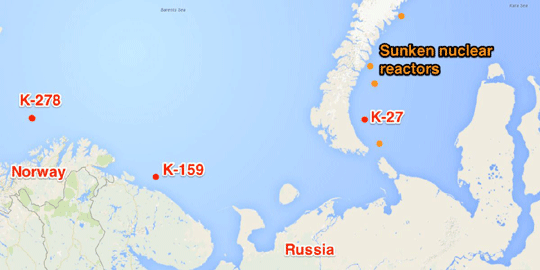
Russia’s ‘slow-motion Chernobyl’ at sea, BBC By Alec Luhn2nd September 2020, ”…………………………. Beneath some of the world’s busiest fisheries, radioactive submarines from the Soviet era lie disintegrating on the seafloor. Decades later, Russia is preparing to retrieve them………. With a draft decree published in March, President Vladimir Putin set in motion an initiative to lift two Soviet nuclear submarines and four reactor compartments from the silty bottom, reducing the amount of radioactive material in the Arctic Ocean by 90%. First on the list is Lappa’s K-159.
|
|
Russia facing huge problem to recover radioactive sunken nuclear reactors, but Putin still plans new ones in the Arctic
Russia’s ‘slow-motion Chernobyl’ at sea, FUTURE PLANET | OCEANS By Alec Luhn, 2nd September 2020 ……….
 Minimising risk
Russia, Norway and other countries whose fishing boats ply the bountiful waters of the Barents Sea have now found themselves with a sword of Damocles hanging over their heads. Although a 2014 Russian-Norwegian expedition to the K-159 wreck that tested the water, seafloor and animals like a sea centipede did not find radiation above background levels, an expert from Moscow’s Kurchatov Institute said at the time that a reactor containment failure “could happen within 30 years of sinking in the best case and within 10 years at the worst”. That would release radioactive caesium-137 and strontium-90, among other isotopes.
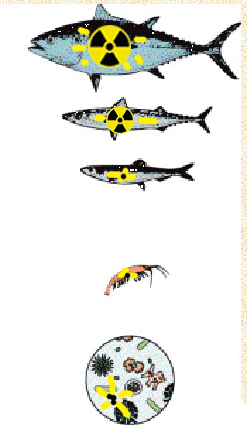
While the vast size of the oceans quickly dilutes radiation, even very small levels can become concentrated in animals at the top of the food chain through “bioaccumulation” – and then be ingested by humans. But economic consequences for the Barents Sea fishing industry, which provides the vast majority of cod and haddock at British fish and chip shops, “may perhaps be worse than the environmental consequences”, says Hilde Elise Heldal, a scientist at Norway’s Institute of Marine Research.
According to her studies, if all the radioactive material from the K-159’s reactors were to be released in a single “pulse discharge”, it would increase Cesium-137 levels in the muscles of cod in the eastern Barents Sea at least 100 times. (As would a leak from the Komsomolets, another sunken Soviet submarine near Norway that is not slated for lifting.) That would still be below limits set by the Norwegian government after the Chernobyl accident, but it could be enough to scare off consumers. More than 20 countries continue to ban Japanese seafood, for instance, even though studies have failed to find dangerous concentrations of radioactive isotopes in Pacific predatory fishes following the Fukushima nuclear power plant release in 2011. Any ban on fishing in the Barents and Kara seas could cost the Russian and Norwegian economies €120m ($140m; £110m) a month, according to a European Commission feasibility study about the lifting project.
There is no ship in the world capable of lifting the K-159, so a special salvage vessel would have to be built
But an accident while raising the submarine, on the other hand, could suddenly jar the reactor, potentially mixing fuel elements and starting an uncontrolled chain reaction and explosion. That could boost radiation levels in fish 1,000 times normal or, if it occurred on the surface, irradiate terrestrial animals and humans, another Norwegian study found. Norway would be forced to stop sales of products from the Arctic such as fish and reindeer meat for a year or more. The study estimated that more radiation could be released than in the 1985 Chazhma Bay incident, when an uncontrolled chain reaction during refuelling of a Soviet submarine near Vladivostok killed 10 sailors.
Amundsen argued that the risk of such a criticality excursion with the K-159 or K-27 was low and could be minimised with proper planning, as it was during the removal of high-risk spent fuel from Andreyev Bay.
“In that case we do not leave the problem for future generations to solve, generations where the knowledge of handling such legacy waste may be very limited,” he says.
The safety and transparency of Russia’s nuclear industry has often been questioned, though, most recently when Dutch authorities concluded that radioactive iodine-131 detected over northern Europe in June originated in western Russia. The Mayak reprocessing facility that received the spent fuel from Andreyev Bay by train has a troubled history going back to the world’s then-worst nuclear disaster in 1957. Rosatom continues to deny the findings of international experts that the facility was the source of a radioactive cloud of ruthenium-106 registered over Europe in 2017.
While the K-159 and K-27 need to be raised, Rashid Alimov of Greenpeace Russia has reservations. “We are worried about the monitoring of this work, public participation and the transport [of spent fuel] to Mayak,” he says.
Custom mission
Raising a submarine is a rare feat of engineering. The United States spent $800m (£610m) in an attempt to lift another Soviet submarine, the diesel-powered K-129 that carried several nuclear missiles, from 16,400ft (5,000m) in the Pacific Ocean, under the guise of a seabed mining operation. In the end, they only managed to bring a third of the submarine to the surface, leaving the CIA with little usable intelligence.
That was the deepest raise in history. The heaviest was the Kursk. To bring the latter 17,000-tonne missile submarine up from 350ft (108m) below the Barents Sea, the Dutch companies Mammoet and Smit International installed 26 hydraulically cushioned lifting jacks on a giant barge and cut 26 holes in the submarine’s rubber-coated steel hull with a water jet operated by scuba divers. On 8 October 2001, rushing to beat the winter storm season after four months of nerve-wracking work and delays, steel grippers fitted in the 26 holes lifted the Kursk from the seabed in 14 hours, after which the barge was towed to a dry dock in Murmansk.
At less than 5,000 tonnes, the K-159 is smaller than the Kursk, but even before it sank its outer hull was “as weak as foil”, according to Bellona. It has since been embedded in 17 years’ worth of silt. A hole in the bow would seem to rule out pumping it full of air and raising it with balloons, as has been previously suggested. At a conference of European Bank of Reconstruction and Development donors in December, a Rosatom representative said there was no ship in the world capable of lifting it, so a special salvage vessel would have to be built.
That will increase the estimated cost of €278m ($330m; £250m) to raise the six most radioactive objects. Donors are discussing Russia’s request to help finance the project, said Balthasar Lindauer, director of nuclear safety at EBRD.
“There’s consensus something needs to be done there,” he says. Any such custom-built vessel would likely need a bevy of specialised technologies such as bow and aft thrusters to keep it positioned precisely over the wreck.
But in August, Grigoriev told a Rosatom-funded website that one plan the company was considering would involve a pair of barges fitted with hydraulic cable jacks and secured to deep-sea moorings. Instead of steel grippers like the ones inserted into the holes in the Kursk, giant curved pincers would grab the entire hull and lift it up between the barges. A partially submersible scow would be positioned underneath, then brought to the surface along with the submarine and finally towed to port. The K-27 and K-159 could both be recovered this way, he said.
One of three engineering firms working on proposals for Rosatom is the military design bureau Malachite, which drafted a project to raise the K-159 in 2007 that “was never realised due to a lack of money”, according to its lead designer. This year the bureau has begun updating this plan, an employee tells Future Planet in the lobby of Malachite’s headquarters in St Petersburg. Many questions remain, however.
“What condition is the hull in? How much of force can it handle? How much silt has built up? We need to survey the conditions there,” the employee says, before the head of security arrives to break up our conversation.
Nuclear paradox
Removing the six radioactive objects fits in with an image Putin as crafted as a defender of the fragile Arctic environment. In 2017, he inspected the results of an operation to remove 42,000 tonnes of scrap metal from the Franz Josef Land archipelago as part of a “general clean-up of the Arctic”. He has spoken about environmental preservation at an annual conference for Arctic nations. And on the same day in March 2020 that he issued his draft decree about the sunken objects, he signed an Arctic policy that lists “protecting the Arctic environment and the native lands and traditional livelihood of indigenous peoples” as one of six national interests in the region.
“For Putin, the Arctic is part of his historic legacy. It should be well-protected, bring real benefits and be clean,” said Dmitry Trenin, head of the think tank Carnegie Centre Moscow.
Yet while pursuing a “clean” Arctic, the Kremlin has also been backing Arctic oil and gas development, which accounts for the majority of shipping on the Northern Sea Route. State-owned Gazprom built one of two growing oil and gas clusters on the Yamal peninsula, and this year the government cut taxes on new Arctic liquified natural gas projects to 0% to tap into some of the trillions of dollars of fossil fuel and mineral wealth in the region.
And even as Putin cleans up the Soviet nuclear legacy in the far north, he is building a nuclear legacy of his own. A steady march of new nuclear icebreakers and, in 2019, the world’s only floating nuclear power plant has again made the Arctic the most nuclear waters on the planet.
Meanwhile, the Northern Fleet is building at least eight submarines and has plans to construct several more, as well as eight missile destroyers and an aircraft carrier, all of them nuclear-powered. It has also been testing a nuclear-powered underwater drone and cruise missile. In total, there could be as many as 114 nuclear reactors in operation in the Arctic by 2035, almost twice as many as today, a 2019 Barents Observer study found.
This growth has not gone without incident. In July 2019, a fire on a nuclear deep-sea submersible near Murmansk almost caused a “catastrophe of a global scale,” an officer reportedly said at the funeral of the 14 sailors killed. The next month, a “liquid-fuel reactive propulsion system” exploded during a test on a floating platform in the White Sea, killing two of those involved and briefly spiking radiation levels in the nearby city of Severodvinsk.
“The joint efforts of the international community including Norway and Russia after breakup of the Soviet Union, using taxpayer money to clean up nuclear waste, was a good investment in our fisheries,” says The Barents Observer’s Nilsen. “But today there are more and more politicians in Norway and Europe who think it’s a really big paradox that the international community is giving aid to secure the Cold War legacy while it seems Russia is giving priority to building a new Cold War.”
As long as the civilian agency Rosatom is tasked with clean-up, the Russian military has little incentive to slow down this nuclear spree, Nilsen notes.
“Who is going to pay for the clean-up of those reactors when they are not in use anymore?” he asks. “That is the challenge with today’s Russia, that the military don’t have to think what to do with the very, very expensive decommissioning of all this.”
So while the coming nuclear clean-up is set to be the largest of its kind in history, it may turn out to be just a prelude to what’s needed to deal with the next wave of nuclear power in the Arctic…………….https://www.bbc.com/future/article/20200901-the-radioactive-risk-of-sunken-nuclear-soviet-submarines
Arctic tragedy: the loss of Russian sailors in nuclear submarine accidents
Russia’s ‘slow-motion Chernobyl’ at sea, FUTURE PLANET | OCEANS By Alec Luhn, 2nd September 2020 By tradition, Russians
always bring an odd number of flowers to a living person and an even number to a grave or memorial. But every other day, 83-year-old Raisa Lappa places three roses or gladiolas by the plaque to her son Sergei in their hometown Rubtsovsk, as if he hadn’t gone down with his submarine during an ill-fated towing operation in the Arctic Ocean in 2003.“I have episodes where I’m not normal, I go crazy, and it seems that he’s alive, so I bring an odd number,” she says. “They should raise the boat, so we mothers could put our sons’ remains in the ground, and I could maybe have a little more peace.”
After 17 years of unfulfilled promises, she may finally get her wish, though not out of any concern for the bones of Captain Sergei Lappa and six of his crew. With a draft decree published in March, President Vladimir Putin set in motion an initiative to lift two Soviet nuclear submarines and four reactor compartments from the silty bottom, reducing the amount of radioactive material in the Arctic Ocean by 90%. First on the list is Lappa’s K-159. ……………..
‘Cursed August’
Sergei Lappa was born in 1962 in Rubtsovsk, a small city in the Altai Mountains near the border with Kazakhstan. Though it was thousands of miles to the nearest ocean, he cultivated an interest in seafaring at a local model shipbuilding club, and after school he was accepted into the higher naval engineering academy in Sevastopol, Crimea. Tall, athletic and a good student, he was assigned to the navy’s most prestigious service: the Northern Submarine Fleet.
With the reactors off, Lappa and his skeleton crew of nine engineers operated the boat by flashlight. As the submarine was towed near Kildin Island at half past midnight, the cables to the bow pontoons broke in heavy seas, and a half-hour later water was discovered trickling into the eighth compartment. But as headquarters struggled with the decision to launch an expensive rescue helicopter, the crew kept trying to keep the submarine afloat. At 02:45am Mikhail Gurov sent one last radio transmission: “We’re flooding, do something!” By the time rescue boats from the tug arrived, the K-159 was on the bottom near Kildin Island. Of the three sailors who made it out, the only survivor was senior lieutenant Maxim Tsibulsky, whose leather jacket had filled with air and kept him afloat.
Yet another nuclear submarine had sunk during the “cursed” month of August, Russian newspapers wrote, but the incident caused little furore compared to the Kursk. The navy promised relatives it would raise the K-159 the next year, then repeatedly delayed the project.
Even after 17 years of scavenging and corrosion, at least the bones of the crew likely remain in the submarine, according to Lynne Bell, a forensic anthropologist at Simon Fraser University. But the families have long since lost hope of recovering them.
“For all the relatives it would bring some relief if their fathers and husbands were buried, not just lying on the bottom in a steel hulk,” Gurov’s son Dmitry says. “It’s just that no one believes this will happen.”
The situation has now changed, however, as Russia’s interest revives in the Arctic and its crumbling Soviet ports and military towns. Since 2013, seven Arctic military bases and two tanker terminals have been built as part of the Northern Sea Route, a shorter route to China that Putin has promised will see 80 million tonnes of traffic by 2025. The K-159 is lying underneath the eastern end of the route………….https://www.bbc.com/future/article/20200901-the-radioactive-risk-of-sunken-nuclear-soviet-submarines
Nuclear colonialism. ICAN says that France must clean up its nucleat test wastelands in Algeria

France must clean up Algerian nuclear test sites: group, https://www.france24.com/en/20200826-france-must- clean-up-algerian-nuclear-test-sites-group 28 Aug 20, France must clean up nuclear test sites in Algeria where radioactive waste remains from testing in the former colony during the 1960s, a Nobel Peace Prize-winning group said Wednesday.
France carried out 17 nuclear explosions in the Algerian part of the Sahara Desert between 1960 and 1966.
Eleven of the tests came after the 1962 Evian Accords ended the six-year war of independence and 132 years of colonial rule.
“France must give the Algerian authorities the full list of where the contaminated toxic waste was buried,” the International Campaign to Abolish Nuclear Weapons (ICAN) said in a new 60-page report.
“The ‘nuclear past’ must no longer remain deeply buried under the sand,” ICAN said, citing the concerned areas as the western Reggane region and a zone close to the In Ekker village.
The campaign group identified contaminated, radioactive elements that have either been buried, or are easily accessible.
“The majority of the waste is in the open air, without any security, and accessible by the population, creating a high level of sanitary and environmental insecurity,” ICAN said.The 2017 Nobel Peace Prize laureate group added that almost nothing has been done to clean the sites, inform the populations and evaluate the risks.
Exposure to radioactive material can cause cancer.
“This case study shows once more an asymmetry of power and an injustice that we find all through nuclear history,” Giorgio Franceschini, director of the Heinrich Boll Foundation which published the report, said in his forward.
“It is not a coincidence that France tested its first nuclear weapon in Algeria, that was still a French colony in 1960,” he added.
France refused to sign up the UN’s 2017 Treaty on the Prohibition of Nuclear Weapons, whereas Algeria signed and is in the process of ratifying the legally binding agreement.
Since Algeria’s independence, Franco-Algerian relations have been tumultuous.
Algerian President Abdelmadjid Tebboune in July called on France to fully apologise for its colonial past.
An apology could “make it possible to cool tensions and create a calmer atmosphere for economic and cultural relations”, especially for the more than six million Algerians who live in France, he said.
“Super Swarm” drones- weaponry as destructive as nuclear weapons

US, China Developing “Super Swarm” Drones With Destruction Power Equivalent To Nuclear Weapons, https://eurasiantimes.com/us-china-developing-super-swarm-drones-with-destruction-power-equivalent-to-nuclear-weapons/ August 28, 2020, EurAsian Times Global Desk
With the US and China leading the development of swarming drone capabilities, they are now looking at not just swarming techniques but also counter swarming tactics. Experts have argued that some drones that are under development are capable of sufficient destructive power to count as Weapons of Mass Destruction.
According to Isaac Kaminer, an engineering professor at the U.S. Naval Postgraduate School who is an expert in the subject of swarming and counter swarming tactics, large-scale adversarial swarms are already an imminent threat. He suggested that stopping a swarm is not simply a matter of driving enough missiles or bullets at it; instead, the swarm has to be outsmarted.
“A swarm with 10,000 or more drones must have extremely high levels of autonomy,” said consultant Zak Kallenborn talking to the Forbes. “No human being could handle the amount of information necessary to make decisions.“
Kaminer defines a ‘Super Swarm’ with large numbers and multiple modes like air, surface, and subsurface threats. The US Navy has already performed offensive swarm operations with its LOCUST drone swarm developed by Raytheon.
According to the developer of LOCUST drone swarm, dozens of small unmanned aircraft systems fly together, filling the sky. Some are collecting information. Some are identifying ground targets. Others might attack the same targets.
“They fly together like a flock of birds, tracking their positions and maintaining their relative positions in the air. Human operators are not needed for every flying drone; instead, they direct the flock as one.”
Currently, the drones are controlled remotely by humans which limits the capabilities both due to the demand for personnel and bandwidth restrictions. Only a few numbers can be used. However, if swarming algorithms are developed it would allow the drones to control itself and hence much larger number can be used increasing its lethality.
It works similar to a swarm of birds or insects. Every member adheres to the same rules to follow cohesion without colliding with each other. This will allow it to work without any central control.
David Hambling, who is also the author of ‘Swarm Troopers: How small drones will conquer the world’, wrote that such a swarm can be defeated by taking advantage of its internal rules – if these can be figured out.
“For example, an entire swarm whose members all have a collision-avoidance rule can be ‘herded’ by a few outsider drones or may be fooled into running into each other. If the members of the swarm are all programmed to attack what they see as the highest-value target in range, then they can all be decoyed into attacking the same dummy.”
The biggest challenge for the US comes from China who is also developing swarming capability as a means of asymmetric warfare, to counterpoise the US advantage in aircraft carriers. Last year, satellite images posted on the Chinese internet displayed a lineup of several drones including the Sharp Sword stealth drone and the Wing Loong Reaper.
Considering the fast pace of development of such technologies it is important to have international laws in place. “The opportunity to develop global norms and treaties around drone swarms and other autonomous weapons is now, “ says Kallenborn. “Collective limits on the number of armed drones in a swarm would reduce the risk to civilians and national security.”
UK’s Dounreay nuclear power site, opened in 1955, closed 1994, cleaned up in 2333, if they’re lucky

Dounreay on Scottish north coast has been site of considerable radioactive leaks https://www.independent.co.uk/environment/nuclear-power-dounreay-scotland-thurso-decommissioning-radiation-a9680611.html Harry Cockburn, Thursday 20 August 2020 In 313 years’ time, 378 years after it first opened in 1955, and 339 years after it ceased operations in 1994, the 178-acre nuclear power facility site at Dounreay will be safe for other uses, a new report has stated.
Though the site on the north coast of Scotland was only home to functioning nuclear reactors for 39 years, the clean-up will take roughly ten times as long, with efforts already underway to clean up hazardous radioactive material.
The facility, near Thurso, was used by the government for research and testing of various types of nuclear reactors, including a “fast reactor” and those intended for use on nuclear submarines.
The first reactor at the site to provide power to the National Grid was the Dounreay Fast Reactor, which provided power between 1962 and 1977. A second reactor also pumped power into the grid between 1975 and 1994.
A draft report from the government’s nuclear decommissioning authority states the site will only be ready for other uses after the year 2333.
Over the next two years, Dounreay Site Restoration Limited has said it will undertake assessments of “installations, current and future disposals, areas of land contamination, sub-surface structures and other discrete site conditions” to determine “credible options for the site end state”.
A process of demolition of buildings and waste removal is already underway at the site, which has previously been used to store dangerous radioactive material.
Part of the demolition process has involved the use of a remote controlled robot nicknamed the “Reactosaurus”, a 75-tonne device with radiation-proof cameras, and robotic arms which are able to reach 12 metres into the reactors where they can operate an array of size-reduction and handling tools, including diamond wire and disks and hydraulic shears.
One of the areas targeted for waste removal is a highly contaminated area called the Shaft.
The water reacted violently with the sodium and potassium, throwing off the massive steel and concrete lids of the shaft, and littered the area with radioactive particles.
The dangerous pollution affected local beaches, the coastline and the seabed. Fishing has been banned within a two-kilometre radius of the plant since 1997.
Milled shards from the processing of irradiated plutonium and uranium, are roughly the size of grains of grains of sand. The most radioactive of the particles are believed to be potentially lethal if ingested. These small fragments are known to contain caesium-137, which has a half-life of 30 years, but they can also incorporate traces of plutonium-239, which has a half-life of over 24,000 years.
Ice melting at a surprisingly fast rate underneath Shirase Glacier Tongue in East Antarctica
 East Antarctic melting hotspot identified
- https://www.sciencedaily.com/releases/2020/08/200824092000.htm

- August 24, 2020
- Source:
- Hokkaido University
- Summary:
- Ice is melting at a surprisingly fast rate underneath Shirase Glacier Tongue in East Antarctica due to the continuing influx of warm seawater into the Lützow-Holm Bay.
-
Hokkaido University scientists have identified an atypical hotspot of sub-glacier melting in East Antarctica. Their findings, published in the journal Nature Communications, could further understandings and predictions of sea level rise caused by mass loss of ice sheets from the southernmost continent.
The 58th Japanese Antarctic Research Expedition had a very rare opportunity to conduct ship-based observations near the tip of East Antarctic Shirase Glacier when large areas of heavy sea ice broke up, giving them access to the frozen Lützow-Holm Bay into which the glacier protrudes.
“Our data suggests that the ice directly beneath the Shirase Glacier Tongue is melting at a rate of 7-16 meters per year,” says Assistant Professor Daisuke Hirano of Hokkaido University’s Institute of Low Temperature Science. “This is equal to or perhaps even surpasses the melting rate underneath the Totten Ice Shelf, which was thought to be experiencing the highest melting rate in East Antarctica, at a rate of 10-11 meters per year.”
- The Antarctic ice sheet, most of which is in East Antarctica, is Earth’s largest freshwater reservoir. If it all melts, it could lead to a 60-meter rise in global sea levels. Current predictions estimate global sea levels will rise one meter by 2100 and more than 15 meters by 2500. Thus, it is very important for scientists to have a clear understanding of how Antarctic continental ice is melting, and to more accurately predict sea level fluctuations.
Most studies of ocean-ice interaction have been conducted on the ice shelves in West Antarctica. Ice shelves in East Antarctica have received much less attention, because it has been thought that the water cavities underneath most of them are cold, protecting them from melting.
- During the research expedition, Daisuke Hirano and collaborators collected data on water temperature, salinity and oxygen levels from 31 points in the area between January and February 2017. They combined this information with data on the area’s currents and wind, ice radar measurements, and computer modelling to understand ocean circulation underneath the Shirase Glacier Tongue at the glacier’s inland base.
The scientists’ data suggests the melting is occurring as a result of deep, warm water flowing inwards towards the base of the Shirase Glacier Tongue. The warm water moves along a deep underwater ocean trough and then flows upwards along the tongue’s base, warming and melting the ice. The warm waters carrying the melted ice then flow outwards, mixing with the glacial meltwater.
The team found this melting occurs year-round, but is affected by easterly, alongshore winds that vary seasonally. When the winds diminish in the summer, the influx of the deep warm water increases, speeding up the melting rate.
“We plan to incorporate this and future data into our computer models, which will help us develop more accurate predictions of sea level fluctuations and climate change,” says Daisuke Hirano.
1 This Month

26 September – International Day for the Total Elimination of Nuclear Weapons


PLEASE OPPOSE HR 8255 AND S.3639 – bills would accelerate satellite deployment, with no environmental review or safeguards – https://ncstd5li.quorum.us/campaign/169331/
To see nuclear-related stories in greater depth and intensity – go to https://nuclearinformation.wordpress.com
-
Archives
- September 2026 (206)
- August 2026 (330)
- July 2026 (355)
- June 2026 (287)
- May 2026 (306)
- April 2026 (356)
- March 2026 (251)
- February 2026 (267)
- January 2026 (308)
- December 2025 (358)
- November 2025 (359)
- October 2025 (375)
-
Categories
- 1
- 1 NUCLEAR ISSUES
- business and costs
- climate change
- culture and arts
- ENERGY
- environment
- health
- history
- indigenous issues
- Legal
- marketing of nuclear
- media
- opposition to nuclear
- PERSONAL STORIES
- politics
- politics international
- Religion and ethics
- safety
- secrets,lies and civil liberties
- spinbuster
- technology
- Uranium
- wastes
- weapons and war
- Women
- 2 WORLD
- ACTION
- AFRICA
- Atrocities
- AUSTRALIA
- Christina's notes
- Christina's themes
- culture and arts
- Events
- Fuk 2022
- Fuk 2023
- Fukushima 2017
- Fukushima 2018
- fukushima 2019
- Fukushima 2020
- Fukushima 2021
- general
- global warming
- Humour (God we need it)
- Nuclear
- RARE EARTHS
- Reference
- resources – print
- Resources -audiovicual
- Weekly Newsletter
- World
- World Nuclear
- YouTube
-
RSS
Entries RSS
Comments RSS
 nuclear-news