The USA devised an apocalyptic nuclear weapon – the Supersonic Low Altitude Missile or SLAM
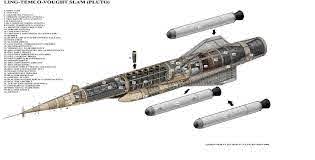
PROJECT PLUTO: THE CRAZIEST NUCLEAR WEAPON IN HISTORY SOFREP, by Sandboxx 15 Nov 20, “…………. Although the destructive force of the atom bombs dropped on Hiroshima and Nagasaki had been so monstrous that they changed the geopolitical landscape of the world forever, both the U.S. and Soviet Union immediately set about developing newer, even more powerful thermonuclear weapons. Other programs sought new and dynamic delivery methods for these powerful nukes, ranging from ballistic missiles to unguided bombs.Project Pluto and the SLAM Missile
One such effort under the supervision of the U.S. Air Force was a weapon dubbed the Supersonic Low Altitude Missile or SLAM (not to be mistaken for the later AGM-84E Standoff Land Attack Missile). The SLAM missile program was to utilize a ramjet nuclear propulsion system being developed under the name Project Pluto. Today, Russia is developing the 9M730 Burevestnik, or Skyfall missile, to leverage the same nuclear propulsion concept.
As Russian President Vladimir Putin recently pointed out, nuclear propulsion offers practically endless range, and estimates at the time suggested the American SLAM Missile would likely fly for 113,000 miles or more before its fuel was expended. Based on those figures, the missile could fly around the entire globe at the equator at least four and a half times without breaking a sweat.
The unshielded nuclear reactor powering the missile would practically rain radiation onto the ground as it flew, offering the first of at least three separate means of destruction the SLAM missile provided. In order to more effectively leverage the unending range of the nuclear ramjet, the SLAM missile was designed to literally drop hydrogen bombs on targets as it flew. Finally, with its bevy of bombs expended, the SLAM missile would fly itself into one final target, detonating its own thermonuclear warhead as it did. That final strike could feasibly be days or even weeks after the missile was first launched.
Over time, the SLAM missile came to be known as Pluto to many who worked on it, due to the missile’s development through the project with the same name.
The onboard nuclear reactor produced more than 500-megawatts of power and operated at a scorching 2,500 degrees — hot enough to compromise the structural integrity of metal alloys designed specifically to withstand high amounts of heat. Ultimately, the decision was made to forgo metal internal parts in favor of specially developed ceramics sourced from the Coors Porcelain Company, based in Colorado.
The downside to ramjet propulsion is that it can only function when traveling at high speeds. In order to reach those speeds, the SLAM would be carried aloft and accelerated by rocket boosters until the missile was moving fast enough for the nuclear ramjet to engage. Once the nuclear ramjet system was operating, the missile could remain aloft practically indefinitely, which would allow it to engage multiple targets and even avoid intercept.
The nuclear-powered ramjet was so loud that the missile’s designers theorized that the shock wave of the missile flying overhead on its own would likely kill anyone in its path, and if not, the gamma and neutron radiation from the unshielded reactor sputtering fission fragments out the back probably would. While this effectively made the missile’s engine a weapon in its own right, it also made flying the SLAM over friendly territory impossible.
While the doctrine of Mutually Assured Destruction has since made the launch of just one nuclear weapon the start of a cascade that could feasibly end life on Earth as we know it, Project Pluto’s SLAM Missile was practically apocalyptic in its own right. The nuclear powerplant that would grant the missile effectively unlimited range would also potentially kill anyone it passed over, but the real destructive power of the SLAM missile came from its payload.
Unlike most cruise missiles, which are designed with a propulsion system meant to carry a warhead to its target, Project Pluto’s SLAM carried not only a nuclear warhead, but 16 additional hydrogen bombs that it could drop along its path to the final target. Some even suggested flying the missile in a zig-zagging course across the Soviet Union, irradiating massive swaths of territory and delivering it’s 16 hydrogen bombs to different targets around the country.
Doing so would not only offer the ability to engage multiple targets, but would almost certainly also leave the Soviet populace in a state of terror. A low-flying missile spewing radiation as it passed over towns, shattering windows and deafening bystanders as it delivered nuclear hellfire to targets spanning the massive Soviet Union, would likely have far-reaching effects on morale.
How Do You Test an Apocalyptic Weapon?
Project Pluto’s nuclear propulsion system made testing the platform a difficult enterprise. Once the nuclear reactor onboard was engaged, it would continue to function until it hit its target or expended all of its fuel. Any territory the weapon passed over during flight would be exposed to dangerous levels of radiation, limiting the ways and the places in which the weapon’s engine could even be tested.
On May 14, 1961, engineers powered up the Project Pluto propulsion system on a train car for just a few seconds, and a week later a second test saw the system run for a full five minutes. The engine produced 513 megawatts of power, which equated to around 35,000 pounds of thrust — 6,000 pounds more than an F-16’s Pratt & Whitney F100-PW-229 afterburning turbofan engine with its afterburner engaged.
However, those engine tests were the only large scale tests Project Pluto would ultimately see, in part, because a fully assembled SLAM missile would irradiate so much territory that it was difficult to imagine any safe way of actually testing it.
A weapon That’s Too Destructive to Use
Ultimately, Project Pluto and its SLAM missile were canceled before ever leaving the ground. The cancellation came for a litany of reasons, including the development of intercontinental ballistic missiles and the introduction of global strike heavy payload bombers like the B-52 Stratofortress. There were, however, some other considerations that led to the program’s downfall.
Because the SLAM would irradiate, destroy, or deafen anyone and anything it flew over, the missile could not be launched from U.S. soil or be allowed to fly over any territory other than its target nation. That meant the missile could really only be used from just over the Soviet border, whereas ICBMs could be launched from the American midwest and reach their targets in the Soviet Union without trouble.
There was also a pressing concern that developing such a terrible weapon would likely motivate the Soviet Union to respond in kind. Each time the United States unveiled a new weapon or strategic capability, the Soviet Union saw to it that they could match and deter that development. As a result, it stood to reason that America’s nuclear-spewing apocalypse missile would prompt the Soviets to build their own if one entered into service.
Project Pluto and its SLAM missile program were canceled on July 1, 1964 https://sofrep.com/news/project-pluto-the-craziest-nuclear-weapon-in-history/
Hibakusha renew their push for the abolition of nuclear weapons
Hiroshima atomic bomb survivor Abe Shizuko was reacting to the October 24 ratification of the United Nations Treaty on the Prohibition of Nuclear Weapons. The accord will take effect in January – although none of the world’s nuclear powers are members.
Nevertheless, hibakusha, which is what the atomic bomb survivors are called in Japan, see the treaty as a victory for their cause. “I take pride in the fact that the decision is a result of the united little voices of individual hibakusha,” says 93-year-old Abe.
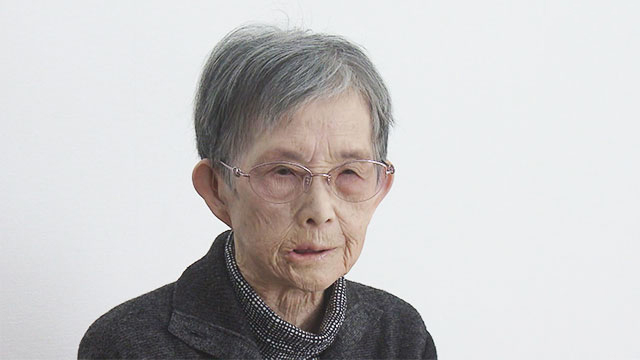
On August 6th, 1945, the United States dropped an atomic bomb for the first time in human history. Its target was Hiroshima, where 18-year-old Abe was helping to dismantle buildings to prevent the spread of fires caused by air raids during World War Two. Abe was working just 1.5 kilometers away from ground zero. She suffered severe burns on the right side of her body and face, and has been through 18 surgeries.

“The operations were very painful and difficult. There wasn’t enough anesthetic back in those days, so doctors could not give me supplemental relief even if I started feeling pain. I tolerated the pain through a strong hope to restore my body,” Abe recalls.
The bomb left keloid scars on her face and the right side of her body. In photographs from when she was younger, Abe always looks down, or shows only her left side.
A-bomb survivors call the 10-year period following the world’s first atomic bombing “the blank decade.” That is because people who were injured had little to no medical or financial support. At the same time, they were exposed to severe prejudice and discrimination.
Abe says she was once nicknamed “Red Ogre” because of her scars. “My wound did not heal. My body weakened. I was in poverty. Many people stared at me only just to satisfy their curiosity, because they wanted to know what a hibakusha looked like. They did not feel sympathy for me. They bullied me. The suffering that I went through, and the emotional wound, will never go away.”
In 1956, Abe joined other atomic bomb survivors to form a delegation. They traveled to Tokyo to appeal to the then prime minister and government officials to offer relief for victims, and support their call for the abolition of nuclear weapons. Those efforts led to the establishment of the Japan Confederation of A- and H-Bomb Sufferers Organization.
As the Cold War progressed, the hibakusha became disheartened. Even though they were speaking out about the need to eliminate nuclear weapons, the world was not listening. Nuclear experiments were being carried out repeatedly, and the arms race took off.
“It was really a difficult time for our campaign,” Abe remembers. “We felt as if we were yelling out while trying to survive in rough waves on a dark night.”
Abe carried a grudge against the US, but started to feel a change of heart almost 20 years after the bombing. In 1964, she went to the US and Europe for what was known as the Peace Pilgrimage. It was an opportunity for A-bomb survivors to speak about their personal experiences in front of audiences. Abe stayed at a private home with local hosts in the US, and she was deeply touched by their tender-heartedness.
“They listened attentively to my stories and said to me, ‘It must have been very hard for you. You’ve been through a lot. We’re so sorry for you,'” Abe recalls. “I realized we should never let anyone fall victim to nuclear weapons, regardless of what nationality you are. Americans or anybody.”
The voices of the hibakusha spread to all corners of the world, slowly but steadily.
These days, the average age of hibakusha is more than 83 years old, and there are fewer chances to hear their direct accounts. Some of them, like Taniguchi Sumiteru, played a direct role in the recent ratification of the UN treaty that bans nuclear weapons.
Taniguchi died three years ago, but he put the wheels in motion with a campaign that collected signatures to demand an international convention to ban nuclear weapons. He worked on that until the last moment of his life.
Taniguchi was 16 when he was exposed to the second atomic bomb that the US dropped on Japan. He was working as a postman in Nagasaki. A picture that shows the red burned flesh on his back shocked the world.
He delivered an impassioned speech at the 2010 Nuclear Non-Proliferation Treaty Review Conference at the UN’s New York headquarters: “Please don’t turn your eyes away from me. Please look at me again. I have survived miraculously, but for me, to ‘live’ was to ‘endure the agony’. Bearing the cursed scars of the atomic bomb all over our bodies, we the hibakusha continue to live in pain.”
“For humans to live as humans, not even one nuclear weapon should be allowed to exist on earth. I cannot die in peace until I witness the last nuclear warhead eliminated from this world,” said Taniguchi.
Hibakusha and their supporters gathered at Nagasaki Peace Park shortly after last month’s treaty ratification to share their joy. Among them was Okuma Yuka, a member of an activist group that calls itself “Hiroshima and Nagasaki Peace Messengers”.
Okuma took part in the signature-collecting campaign for the abolition of nuclear weapons after being deeply shocked by the image of a young Taniguchi in the aftermath of the atomic bombing. Her great-grandmother was a hibakusha but didn’t talk much about her experience. The photograph of Taniguchi brought it home to Okuma that suffering had occurred in her own family.

“I believe the Treaty on the Prohibition of Nuclear Weapons is definitely an important step forward,” Okuma says. “I expect that this will become a good opportunity for us to move toward a world that is completely free of nuclear weapons.”
Chernobyl’s bumblebees still affected by radiation
This new data shows effects on bumblebees are happening at dose rates previously thought safe for insects, and the current international recommendations will need to be re-evaluated.
|
Chernobyl: bumblebees still at risk from radiation nearly 35 years on, https://theconversation.com/chernobyl-bumblebees-still-at-risk-from-radiation-nearly-35-years-on-149055, Katherine Raines, Fellow and Lecturer, University of Stirling, November 5, 2020 In the early hours of April 26 1986, reactor four of the Chernobyl nuclear power plant in Ukraine exploded, causing the largest nuclear disaster in history. More than 350,000 people were evacuated, and a 4,700km² exclusion zone was formed in Ukraine and Belarus. Despite the intervening 34 years, there is still uncertainty about the effects of the radiation exposure on wildlife living in the Chernobyl exclusion zone (CEZ).
|
The nuclear launch authorizer’s guide to staying calm at election times
|
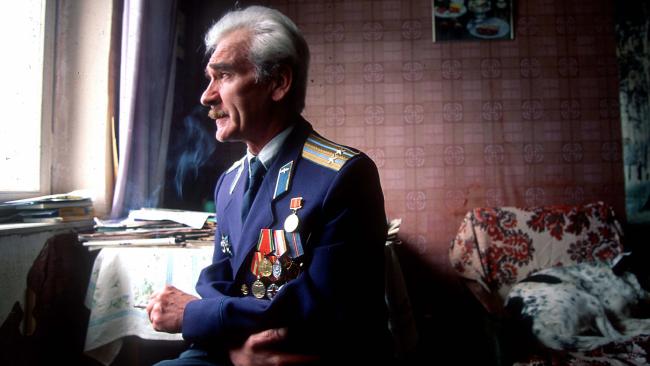
The nuclear launch authorizer’s guide to staying calm on election night, Bulletin of the Atomic Scientists By Matt Field | November 3, 2020 Their thumbs are calloused from refreshing Nate Silver’s twitter feed too many times. Their nerves are frayed from too much time spent figuring out what’s going on in places like Lackawanna County. (I know you know where it is.) Americans are heading into this Election Day full of anxiety and stress. For many, the stakes of today’s contest between President Donald Trump and Joe Biden couldn’t be higher. Anxiety-inducing information will be arriving in social media feeds, on TV screens, and on news websites at a furious pace later today. But it’s important for people to take a moment to breathe, a second to ease their worried minds. Perhaps they might consider a few tips from the annals of nuclear weapons history, insights from times when people, through relatively calm rationality, were able to avert the worst in the highest of high stress situations.
“The sirens sounded very loudly, and I just sat there for a few seconds staring at the screen with the word ‘launch’ displayed in bold red letters,” Petrov told the BBC in 2013. Petrov watched as his systems warned him of another four launches—for a total of five incoming Minuteman intercontinental ballistic missiles. Only minutes remained before they would reach their targets. “The computers changed their alerts from launch to missile strike.” But Petrov decided not to trust the computer. He reported a false alarm to his superiors, forestalling a possible Soviet retaliatory strike. “But I myself was not sure until the very last moment,” he said. Making an educated guess, Petrov decided that the alerts were wrong. In a real war, the United States would launch a massive attack on Soviet defenses, Petrov had been told. “When people start a war, they don’t start it with only five missiles,” he told The Washington Post. Petrov, who died in 2017, is often credited with preventing a nuclear war. The Cuban Missile Crisis and bad advice. For a little over a month in the fall of 1962, the world stood on edge as the United States and the Soviet Union engaged in a standoff over Soviet nuclear missiles in Cuba–just 90 miles from the United States. Coming a little more than a year after the ill-conceived Bay of Pigs invasion, in which US-trained Cubans made a miserably failed attempt to overthrow Cuban leader Fidel Castro, the Cuban Missile Crisis happened at a time of sky-high tensions between the Cold War enemies. When US spy plane photos showed Soviet missile installations in Cuba, President John F. Kennedy had to do something. He’d taken a tough line on Cuba and the Soviet Union as a presidential candidate, after all. Kennedy’s advisors, including his brother Robert Kennedy, had a lot of suggestions. The advisors developed proposals, including a strike on the Soviet missile facilities or a full-on invasion of the island involving tens of thousands of troops. Luckily for the world, Kennedy didn’t invade, which could have ignited a nuclear war. He didn’t go with his brother’s idea to stage a false-flag attack on a US base to justify an invasion, either. According to a review of his book in The New Yorker, historian Martin J. Sherwin believes Adlai Stevenson, the US representative to the United Nations and a two-time presidential candidate, successfully urged Kennedy to negotiate. The Soviets pulled their missiles off the island, and the United States agreed not to try and invade Cuba again and pulled its own missiles from Turkey………. Tip: The web will be flooded with election-related disinformation today. There could be false claims about voting irregularities such as ballots being thrown away, or of people voting twice. Trump himself has been making false claims about a rigged election or voter fraud for much of the election cycle. When you see something that causes you to break out in cold sweats, check another source. The presidential elections are a high stakes event. It’s understandable to be nervous. But remember that first reports can be and often are incorrect. Through it all, try to maintain the calm of a Stanislav Petrov and the wisdom of Adlai Stevenson. You may not save the world from Armageddon, but just maybe, you’ll preserve your own sanity. https://thebulletin.org/2020/11/the-nuclear-launch-authorizers-guide-to-staying-calm-on-election-night/ |
|
315 nuclear bombs and ongoing suffering: the shameful history of nuclear testing in Australia and the Pacific
315 nuclear bombs and ongoing suffering: the shameful history of nuclear testing in Australia and the Pacific, https://theconversation.com/315-nuclear-bombs-and-ongoing-suffering-the-shameful-history-of-nuclear-testing-in-australia-and-the-pacific-148909, Tilman Ruff, Associate Professor, Education and Learning Unit, Nossal Institute for Global Health, School of Population and Global Health, University of Melbourne, Dimity Hawkins, PhD Candidate, Swinburne University of Technology
November 3, 2020 The Treaty on the Prohibition of Nuclear Weapons received its 50th ratification on October 24, and will therefore come into force in January 2021. A historic development, this new international law will ban the possession, development, testing, use and threat of use of nuclear weapons.Unfortunately the nuclear powers — the United Kingdom, France, the United States, Russia, China, Israel, India, Pakistan and North Korea — haven’t signed on to the treaty. As such, they are not immediately obliged to help victims and remediate contaminated environments, but others party to the treaty do have these obligations. The shifting norms around this will hopefully put ongoing pressure on nuclear testing countries to open records and to cooperate with accountability measures.
For the people of the Pacific region, particularly those who bore the brunt of nuclear weapons testing during the 20th century, it will bring a new opportunity for their voices to be heard on the long-term costs of nuclear violence. The treaty is the first to enshrine enduring commitments to addressing their needs.
From 1946, around 315 nuclear tests were carried out in the Pacific by the US, Britain and France. These nations’ largest ever nuclear tests took place on colonised lands and oceans, from Australia to the Marshall Islands, Kiribati to French Polynesia.
The impacts of these tests are still being felt today.
All nuclear tests cause harm
Studies of nuclear test workers and exposed nearby communities around the world consistently show adverse health effects, especially increased risks of cancer.
The total number of global cancer deaths as a result of atmospheric nuclear test explosions has been estimated at between 2 million and 2.4 million, even though these studies used radiation risk estimates that are now dated and likely underestimated the risk.
The number of additional non-fatal cancer cases caused by test explosions is similar. As confirmed in a large recent study of nuclear industry workers in France, the UK and US, the numbers of radiation-related deaths due to other diseases, such as heart attacks and strokes, is also likely to be similar.
Britain conducted 12 nuclear test explosions in Australia between 1952 and 1957, and hundreds of minor trials of radioactive and toxic materials for bomb development up to 1963. These caused untold health problems for local Aboriginal people who were at the highest risk of radiation. Many of them were not properly evacuated, and some were not informed at all.
We may never know the full impact of these explosions because in many cases, as the Royal Commission report on British Nuclear Tests in Australia found in 1985: “the resources allocated for Aboriginal welfare and safety were ludicrous, amounting to nothing more than a token gesture”. But we can listen to the survivors.
 The late Yami Lester directly experienced the impacts of nuclear weapons. A Yankunytjatjara elder from South Australia, Yami was a child when the British tested at Emu Field in October 1953. He recalled the “Black Mist” after the bomb blast:
It wasn’t long after that a black smoke came through. A strange black smoke, it was shiny and oily. A few hours later we all got crook, every one of us. We were all vomiting; we had diarrhoea, skin rashes and sore eyes. I had really sore eyes. They were so sore I couldn’t open them for two or three weeks. Some of the older people, they died. They were too weak to survive all the sickness. The closest clinic was 400 miles away.
His daughter, Karina Lester, is an ambassador for the International Campaign to Abolish Nuclear Weapons in Australia, and continues to be driven by her family’s experience. She writes:
For decades now my family have campaigned and spoken up against the harms of nuclear weapons because of their firsthand experience of the British nuclear tests […] Many Aboriginal people suffered from the British nuclear tests that took place in the 1950s and 1960s and many are still suffering from the impacts today.
More than 16,000 Australian workers were also exposed. A key government-funded study belatedly followed these veterans over an 18-year period from 1982. Despite the difficulties of conducting a study decades later with incomplete data, it found they had 23% higher rates of cancer and 18% more deaths from cancers than the general population.
An additional health impact in Pacific island countries is the toxic disease “ciguatera”, caused by certain microscopic plankton at the base of the marine food chain, which thrive on damaged coral. Their toxins concentrate up the food chain, especially in fish, and cause illness and occasional deaths in people who eat them. In the Marshall Islands, Kiritimati and French Polynesia, outbreaks of the disease among locals have been associated with coral damage caused by nuclear test explosions and the extensive military and shipping infrastructure supporting them.
Pacific survivors of nuclear testing haven’t been focused solely on addressing their own considerable needs for justice and care; they’ve been powerful advocates that no one should suffer as they have ever again, and have worked tirelessly for the eradication of nuclear weapons. It’s no surprise independent Pacific island nations are strong supporters of the new treaty, accounting for ten of the first 50 ratifications.
Negligence and little accountability
Some nations that have undertaken nuclear tests have provided some care and compensation for their nuclear test workers; only the US has made some provisions for people exposed, though only for mainland US residents downwind of the Nevada Test Site. No testing nation has extended any such arrangement beyond its own shores to the colonised and minority peoples it put in harm’s way. Nor has any testing nation made fully publicly available its records of the history, conduct and effects of its nuclear tests on exposed populations and the environment.
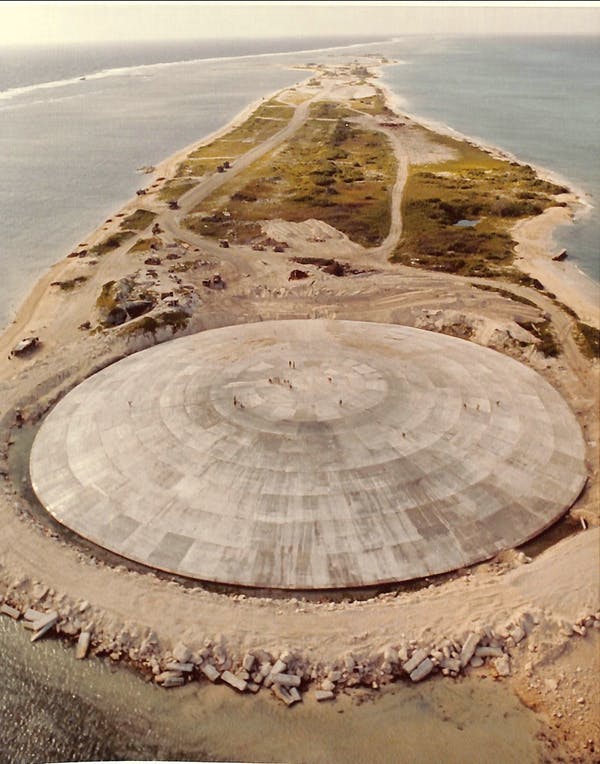
These nations have also been negligent by quickly abandoning former test sites. There has been inadequate clean-up and little or none of the long-term environmental monitoring needed to detect radioactive leakage from underground test sites into groundwater, soil and air. One example among many is the Runit concrete dome in the Marshall Islands, which holds nuclear waste from US testing in the 1940s and 50s. It’s increasingly inundated by rising sea levels, and is leaking radioactive material.
The treaty provides a light in a dark time. It contains the only internationally agreed framework for all nations to verifiably eliminate nuclear weapons.
It’s our fervent hope the treaty will mark the increasingly urgent beginning of the end of nuclear weapons. It is our determined expectation that our country will step up. Australia has not yet ratified the treaty, but the bitter legacy of nuclear testing across our country and region should spur us to join this new global effort.
A USA Senator reflects on the anniversary of the Cuban missile crisis
|
Sam Nunn on Cold War & nuclear weapons, Technique, Hope Williams on November 2, 2020 2020 marks the 75th anniversary of the end of World Word II and the start of the Cold War, a conflict that shaped former United States Senator Sam Nunn’s time while serving in Congress, as well as his work afterwards with the Nuclear Threat Initiative.On Oct. 14, Nunn discussed how nuclear weapons still pose a threat to the world today in a talk with the Georgia Historical Society.
Nunn, who was born in Macon, Georgia, attended Tech, Emory University and Emory Law School. He then served in the U.S. Coast Guard and Georgia House of Representatives before being elected in 1972 to the U.S. Senate. One of his earliest experiences with the intersection of foreign policy and nuclear war was the Cuban Missile Crisis in October 1962, during which he was attending a NATO Conference with the Armed Services Committee in Europe. “We were actually briefed by the Air Force with photographs and all the classified information, sort of every step of the way once the Cuban Missile Crisis broke out,” said Nunn. “… We were at Wiesbaden Air Force Base, which was sort of the head of the U.S. Air Force Europe, on the night where it really looked like we were going to war.” That night, Nunn sat next to the top Air Force General in Europe during dinner. “He had a whole big computer back [with] him with all sorts of communication equipment,” said Nunn. “During the course of the dinner, he told me that he had about 20 to 30 seconds, once he got the signal, to basically turn loose his aircraft to go after the Soviet Union, because we thought we were going to war.” This experience shaped his view of nuclear war. “That brought home a sense of reality to me about the dangers of nuclear war that had an effect on the rest of my life,” said Nunn. “… It brought home to me two things: how close we came to war and how much subjective judgment was involved in the [John F.] Kennedy decisions and the [Nikita] Khrushchev decisions to avoid war and second, how little warning time we had.” Nunn points out that during the 1960s, leaders had more decision time because planes flew much slower. “Having very little decision time in a moment of great crisis is extremely dangerous for the world and that’s, to me, one of the prime goals we should have today, which is to give both U.S. and Russian leaders more time so that we do not move into a nuclear war by blunder,” said Nunn. New technology adds additional danger. “When you introduce cyber and possible interference in command and control and warning systems, I still very much worry about compressed decision time,” said Nunn. “And if I had my way today, and I’ve told President Obama this, I’ve told President Trump this and I’ve told President Putin this, that if I had my way, the leaders would call in their military and say ‘Look, we have a mutual existential interest to give each other more warning time.’”………. Relating decisions about the usage of nuclear weapons to presidential politics, Nunn served under six presidents during his terms as a Senator: Presidents Richard Nixon, Gerald Ford, Jimmy Carter, Ronald Reagan, George H.W. Bush and Bill Clinton. As commander-in-chief, presidents have the sole authority to authorize the use of nuclear weapons. “It is a moral question, but every military commander is charged with the responsibility of carrying out orders from the commander-in-chief,” said Nunn. “But those orders have to be moral orders, and how do you determine that?”……. In conclusion, Nunn reiterates there is currently less of a chance of premeditated nuclear attacks than there was during the Cold War, but with a more compressed decision time for leaders, there is a higher risk of a mistake. “We’ve got a lot of work to do so that our children and grandchildren can live in a world that does not have the perils of nuclear, biological and climate change, all of those things hanging over us,” said Nunn. “So it’s very hard under these circumstances to get out to the voters, to get seen.”…….. In conclusion, Nunn reiterates there is currently less of a chance of premeditated nuclear attacks than there was during the Cold War, but with a more compressed decision time for leaders, there is a higher risk of a mistake. “We’ve got a lot of work to do so that our children and grandchildren can live in a world that does not have the perils of nuclear, biological and climate change, all of those things hanging over us,” said Nunn. “So it’s very hard under these circumstances to get out to the voters, to get seen.”…… https://nique.net/life/2020/11/02/sam-nunn-on-cold-war-nuclear-weapons/ |
|
Now climate change, rising seas, swamping Kiribati and the Marshall Islands, victims of nuclear racism
Losing paradise, Atomic racism decimated Kiribati and the Marshall Islands; now climate change is sinking them, Beyond Nuclear https://wordpress.com/read/feeds/72759838/posts/2998141589–1 Nov 20, This is an extract from the Don’t Bank on the Bomb Scotland report “Nuclear Weapons, the Climate and Our Environment”.
 Kiribati. In 1954, the government of Winston Churchill decided that the UK needed to develop a hydrogen bomb (a more sophisticated and destructive type of nuclear weapon). The US and Russia had already developed an H-bomb and Churchill argued that the UK “could not expect to maintain our influence as a world power unless we possessed the most up-to-date nuclear weapons”.
The governments of Australia and New Zealand refused to allow a hydrogen bomb test to be conducted on their territories so the British government searched for an alternative site. Kiritimati Island and Malden Island in the British Gilbert and Ellice Islands Colony in the central Pacific Ocean (now the Republic of Kiribati) were chosen. Nine nuclear weapons tests – including the first hydrogen bomb tests – were carried out there as part of “Operation Grapple” between 1957 and 1958.
Military personnel from the UK, New Zealand and Fiji (then a British colony) and Gilbertese labourers were brought in to work on the operation. Many of the service personnel were ordered to witness the tests in the open, on beaches or on the decks of ships, and were simply told to turn their backs and shut their eyes when the bombs were detonated. There is evidence that Fijian forces were given more dangerous tasks than their British counterparts, putting them at greater risk from radiation exposure. The local Gilbertese were relocated and evacuated to British naval vessels during some of the tests but many were exposed to fallout, along with naval personnel and soldiers.
After Grapple X, the UK’s first megaton hydrogen bomb test in November 1957, dead fish washed ashore and “birds were observed to have their feathers burnt off, to the extent that they could not fly”. The larger Grapple Y test in 1958 spread fallout over Kiritimati Island and destroyed large areas of vegetation.
Despite evidence that military personnel and local people suffered serious health problems as a result of the tests, including blindness, cancers, leukaemia and reproductive difficulties, the British government has consistently denied that they were exposed to dangerous levels of radiation and has resisted claims for compensation.
Like the Marshall Islands, the low-lying Republic of Kiribati is now bearing the brunt of the effects of climate change. Salt water washed in on king tides has contaminated the islands’ scarce freshwater resources. Pits that are used to grow taro plants have been ruined and the healthy subsistence lifestyle of local people is under threat.
It is predicted that rising sea levels will further impact freshwater resources and reduce the amount of agricultural land, while storm damage and erosion will increase. Much of the land will ultimately be submerged. In anticipation of the need to relocate its entire population, the government of Kiribati bought 20km2 of land on Fiji in 2014.
The UK is set to spend £3.4 billion a year on Trident nuclear weapons system between 2019 and 2070. If Trident were scrapped, a portion of the savings could be provide to the Republic of Kiribati in the form of climate finance (see section 1.2.1). Scrapping Trident would also allow money and skills to be redirected towards measures aimed at drastically cutting the UK’s carbon emissions (see section 1.2.2) – action that Pacific island nations are urgently demanding.
The Marshall Islands. The most devasting incident of radioactive contamination took place 8,000 km from the US mainland during the Castle Bravo test in 1954. The US detonated the largest nuclear weapon in its history at Bikini Atoll in the Marshall Islands, causing fallout to spread over an area of more than 11,000km. Residents of nearby atolls, Rongelap and Utirik, were exposed to high levels of radiation, suffering burns, radiation sickness, skin lesions and hair loss as a result.

Castle Bravo was just one of 67 nuclear weapons tests conducted by the US in the Marshall Islands between 1946 and 1958. Forty years after the tests, the cervical cancer mortality rate for women of the Marshall Islands was found to be 60 times greater than the rate for women in the US mainland, while breast and lung cancer rates were five and three times greater respectively. High rates of infant mortality have also been found in the Marshall Islands and a legacy of birth defects and infertility has been documented. Many Marshallese were relocated by the US to make way for the testing.
Some were moved to Rongelap Atoll and relocated yet again after the fallout from Castle Bravo left the area uninhabitable.
Rongelap Atoll was resettled in 1957 after the US government declared that the area was safe. However, many of those who returned developed serious health conditions and the entire population was evacuated by Greenpeace in 1984. An attempt to resettle Bikini Atoll was similarly abandoned in 1978 after it became clear that the area was still unsafe for human habitation.
A 2019 peer-reviewed study found levels of the radioactive isotope caesium-137 in fruits taken from some parts of Bikini and Rongelap to be significantly higher than levels recorded at the sites of the world’s worst nuclear accidents, Chernobyl and Fukushima.
Compounding the injustice of nuclear weapons testing, the Republic of the Marshall Islands is now on the frontline of the climate emergency. The government declared a national climate crisis in 2019, citing the nation’s extreme vulnerability to rising sea levels and the “implications for the security, human rights and wellbeing of the Marshallese people”.
At Runit Island, one of 40 islands in the Enewetak Atoll, rising sea levels are threatening to release radioactive materials into an already contaminated lagoon. In the late 1970s, the US army dumped 90,000 cubic metres of radioactive waste, including plutonium, into a nuclear blast crater and covered it with a concrete cap. Radioactive materials are leaking out of the crater and cracks have appeared on the concrete cap. Encroaching salt water caused by rising sea levels could collapse the structure altogether. The Marshallese government has asked the US for help to prevent an environmental catastrophe but the US maintains that the dome is the Marshall Islands’ responsibility. Hilda Heine, then President of the Republic of the Marshall Islands, said of the dome in 2019: “We don’t want it. We didn’t build it. The garbage inside is not ours. It’s theirs.”
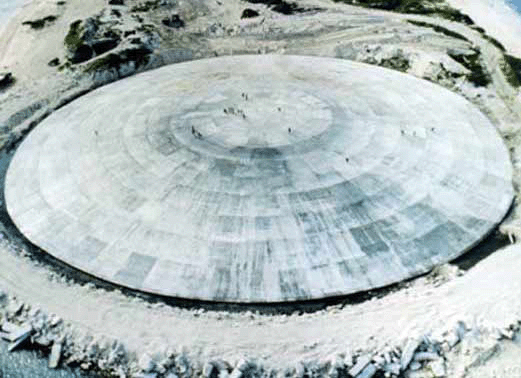
The Runit Island dome offers a stark illustration of the ways in which the injustices of nuclear weapons testing and climate change overlap. Marshall Islanders were left with the toxic legacy of nuclear weapons testing conducted on their territory by another state. The country is now being forced to deal with the effects of a climate crisis that they did not create, including the erosion of the Runit dome.
The nations that contributed most to the crisis are failing to cut their emissions quickly enough to limit further global heating, leaving the Marshallese at the mercy of droughts, cyclones and rising seas. A recent study found that if current rates of greenhouse gas emissions are maintained, the Marshall Islands will be flooded with sea water annually from 2050. The resulting damage to infrastructure and contamination of freshwater supplies will render the islands uninhabitable.
If the US scrapped its nuclear weapons programme, it could give a portion of the billions of dollars that would be saved to the Republic of the Marshall Islands to help the country mitigate and adapt to climate disruption (see section 1.2.1 on international climate finance). The US could also use the freed-up funds to invest in its own Just Transition away from a fossil-fuel powered economy. Read the full report.
Plutonium: How Nuclear Power’s Dream Fuel Became a Nightmare
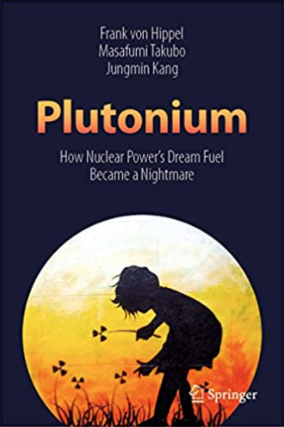 Nailing the Coffin of Civilian Plutonium, Plutonium: How Nuclear Power’s Dream Fuel
 Became a Nightmare, By Frank von Hippel, Masafumi Takubo, and Jungmin KangSpringer Press, Reviewed by Thomas Countryman, November 2020
Even in the world of speculative investment bubbles, it would be difficult to find a parallel to the business of making plutonium. This “industry” has seen massive investment by private and mostly governmental funds in pursuit of creating the world’s most dangerous material, an investment that has failed to yield a single dollar in returns. Nevertheless, a combination of scientific ambition, bureaucratic inertia, and governmental hubris keeps alive a dream that should have been smothered long ago.
Leave it to three highly experienced specialists to briefly recount the history, clearly explain the physical realities, and precisely pick apart the ever-weakening arguments that have supported reprocessing spent nuclear fuel into a new plutonium-based fuel. Frank von Hippel, Masafumi Takubo, and Jungmin Kang accomplish all of this in Plutonium: How Nuclear Power’s Dream Fuel Became a Nightmare. Its planned translation into Japanese and Korean should help citizens participate in critical upcoming decisions about continuing plutonium projects by governments in Tokyo and Seoul.
The earliest rationale for using plutonium as a nuclear fuel rested on the fact that spent nuclear fuel, the leftover material from civilian nuclear power plants, still contained far more potential energy than had yet been consumed. In the 1970s, uranium was believed to be scarce in the natural environment, and the full utilization of its energy capacity made some engineering, logical, and economic sense. In succeeding decades, the economic rationale has been constantly undermined by the realization that natural uranium is sufficiently plentiful that its price is no longer the primary cost factor in nuclear power generation, by the unanticipated complexity of building advanced reactors optimized to use plutonium as fuel, by the cost of new and necessary safety regulations applicable to all reactors, and most recently by the continued fall in the cost of generating renewable energy.
In the face of these realities, only France, at a substantial economic loss, currently operates a full program for recovering plutonium from spent fuel for use as new nuclear fuel. Russia reprocesses spent fuel and is now testing plutonium in a breeder reactor. Japan has indicated it plans to open one of the world’s largest reprocessing plants in Rokkasho in the next two years, but that two-year time frame has been the boilerplate forecast for each of the past 10 years. India is actively reprocessing civilian spent fuel, and China is constructing a major facility for that purpose. South Korea has announced an end to its nuclear power program, but some officials and experts retain the aspiration to pursue civilian reprocessing.
No other nuclear-powered nation is actively pursuing “closing” the nuclear fuel cycle by reprocessing plutonium for energy generation. The economic and technical realities forced one country after another—Germany, Belgium, Switzerland, the United Kingdom, then the United States—to end their own efforts.
This weak support highlights the merits of the authors’ arguments. They systematically deconstruct the political and technical arguments in favor of such programs. Crucially, they demonstrate the factual inaccuracy of the primary argument advanced by Japanese and South Korean advocates that reprocessing spent fuel will diminish the volume and danger of nuclear waste that must ultimately be stored in geological repositories. They also knock down convincingly the claim that plutonium that is reactor grade, as opposed to weapons grade, is unusable in an explosive device.
Although it may be the prerogative of sovereign states to spend their own money irrationally, the authors focus also on important externalities, in particular the threat to the world’s security and environment from the continued production of plutonium. A commitment to the closed fuel cycle delays the inevitable decision that must be made by Japan and South Korea concerning permanent safe storage of spent fuels, a decision on which the United States also continues to procrastinate. In addition, it leads to unsafe practices concerning the storage of spent fuel rods destined for reprocessing. The authors describe for the first time how close the world was to a greater disaster in 2011, as overcrowded spent fuel cooling ponds could have led to a much greater radiation release following the accident at Japan’s Fukushima Daiichi nuclear plant. The authors explain that moving the spent fuel to interim dry cask storage would avert such catastrophic risks.
Of still greater concern is the risk that even a sliver of the massive plutonium stockpiles could be acquired by terrorists to use in a nuclear explosive device or a panic-inducing radiological dispersion device. Since plutonium was first fabricated 80 years ago, nations have created more than 500 tons of what is arguably the world’s most dangerous material. The International Atomic Energy Agency defines a “significant quantity” of plutonium, or enough to make a nuclear weapon, as eight kilograms, although even a Nagasaki-size blast could be generated with significantly less plutonium. Thus, the 300 tons of plutonium designated for civilian use would be sufficient to create more than 35,000 warheads.
Continuing to accumulate plutonium is not only a terrorism risk, but also a source of tension between states. There is concern in Beijing that Japan holds greater stocks of separated plutonium than China and in Seoul that South Korea holds none. The authors note briefly but tellingly the normally unstated security considerations that in part motivate civilian reprocessing programs: an intention to sustain a latent weapons capacity.
The authors make a convincing case for the international community to act together to end further production of separated plutonium. The effort to negotiate a fissile material cutoff treaty, which would ban production of plutonium for weapons, remains frozen in a glacier at the Conference on Disarmament. Whether or when it moves ahead, there is a separate compelling need to negotiate a ban on civilian separation of plutonium.
Although less than 200 pages, Plutonium is not light reading. Its economic and scientific arguments are compact, thoroughly documented, and clear even to lay people. For policymakers and the public, it provides a clear picture of a dream whose claimed benefits have all evaporated but whose danger remains ominously present.
Thomas Countryman is the chair of the Arms Control Association Board of Directors. He served 35 years in the U.S. Foreign Service, retiring in 2017 as acting undersecretary of state for arms control and international security.
The cruel and lonely death of an American nuclear weapons scientist
And if you’re a believer that violent ends produce restless spirits, the Presidio is full up with phantoms as a result.
The most haunted place is said to be Letterman Army Hospital, once the base’s largest medical facility
In looking for Presidio ghost stories, though, we stumbled across a far stranger tale than any haunting: the real-life demise of a nuclear scientist — a chapter of the Cold War, as far as we can tell, untold since 1953.
The brain tumor presented a particular problem for the Atomic Energy Commission: It had the potential to cause erratic behavior and uncontrolled verbal outbursts. They were fearful that as he lost control of his mental faculties, Twitchell would begin spilling nuclear secrets. He knew “as much about atomic energy as any one man,” an anonymous source in the commission would later tell the Oakland Tribune.
So they built a secret ward just for Twitchell. At the cost of $100,000 — nearly $1 million today — construction began at the Letterman Army Hospital in San Francisco’s Presidio for the unusual patient. Once finished, all doctors and nurses who might interact with Twitchell were given rigorous screenings for any national security issues. In the end, only one male nurse was trusted to primarily care for Twitchell. A guard stood watch outside the room at all times.
Unbeknownst to the other military patients at the hospital, a civilian lay dying in his own wing. “He was the hospital’s hush-hush case,” the San Francisco Examiner reported.
An anonymous source told the Tribune this was standard protocol to keep scientists from blabbing while “unbalanced, anesthetized or under the influence of dentists’ ‘laughing gas.'” Although expensive, it was the only way to maintain national security.
Hitler’s quest for nuclear weapons
WW2: Hitler’s true nuclear capacity exposed in secret sabotage mission that ‘saved world’
WORLD WAR 2 saw the Allies cooperate to fight Adolf Hitler’s Nazi Germany but jaw-dropping documents reveal just how close he came to using nuclear weapons. Express UK By CALLUM HOARE Oct 21, 2020 The German nuclear weapons programme was an unsuccessful scientific effort to research and develop atomic weapons during World War 2. It went through several phases but was ultimately “frozen at the laboratory level” with historians and scholars alike generally agreeing it failed on all fronts. With that, Hitler is thought to have focused more on his revolutionary V1 and V2 rockets, but he came terrifyingly close to arming them with nuclear warheads, according to declassified papers unearthed by writer and filmmaker Damien Lewis.
“The greatest fear was that the Nazis had mastered the technology to fit a nuclear or radiological charge to the V2s, in which case there would be no defence possible.
“Churchill ordered aerial surveys to forewarn of such attacks – dry-run rehearsals to prepare for such an ordeal, and for frontline doctors to be briefed on the symptoms of radiation poisoning.
Such fears were very real. Following German physicist Otto Hahn splitting the atom in December 1938, the Allies believed the Germans to be two years ahead in the race to build the atom bomb.”
In May 1940, German forces struck a further blow in the race for nuclear supremacy after seizing Olen, Belgium, where the largest remaining stock of European uranium was located.
British intelligence reports on Operation Peppermint found by Mr Lewis revealed fears from London.
One read: “Since the fall of Belgium, much of the largest stock of uranium has been available [to Germany] from the refinery.”
According to Mr Lewis, its destination was the AuerGesellschaft refinery, at Oranienburg, Germany.
Allied research suggested it would require 20,000 workers, half a million watts of electricity and $150million (£114million) in expenditure to build the world’s first atom bomb.
Hitler, who now controlled most of western Europe, could demand such resources.
And, in concentration camps, he had access to millions of workers.
According to Mr Lewis, its destination was the AuerGesellschaft refinery, at Oranienburg, Germany.
Allied research suggested it would require 20,000 workers, half a million watts of electricity and $150million (£114million) in expenditure to build the world’s first atom bomb.
Hitler, who now controlled most of western Europe, could demand such resources.
And, in concentration camps, he had access to millions of workers.
“Details of Operation Peppermint and the measures taken to prepare for a Nazi nuclear strike were revealed in papers that I unearthed from the National Archives.
“This came as a great surprise to me, for I was unaware that the Allied wartime leaders viewed Nazi Germany’s nuclear programme as such a real and present threat.”
However, a top secret heroic mission would lead to a breakthrough……..
Hunting Hitler’s Nukes: The Secret Race to Stop the Nazi Bomb’ is published by Quercus and available to buy here. https://www.express.co.uk/news/world/1350513/world-war-2-hitler-nuclear-capacity-secret-winston-churchill-operation-peppermint-spt
A history of nuclear weapons accidents
 THE NUCLEAR TREATY dividing the World, Byline Times, Stephen Colegrave, 21 October 2020 “……… A History Of Near Accidents It is easy to be sympathetic with their position when the number of near nuclear weapons accidents are considered.
In early 2009, two nuclear submarines, the French Le Triomphant and British Vanguard, both carrying nuclear weapons, crashed into each other deep in the Atlantic. Fortunately, they were not going fast enough to cause much damage.
Two years earlier, the American Air Force lost six nuclear armed cruise missiles for 36 hours when, unknown to anyone, they were fitted to a B-52 bomber and flown completely unauthorised to a base in Louisiana, left unguarded on the runway until anyone worked out what had happened.
In 2000, the Danish newspaper Jyllands-Posten reported that classified documents obtained by a group of former workers at the Thule airbase suggest that one of four hydrogen bombs on a B-52 bomber that crashed there in 1968 was never found.
There are many instances of false alarms and nuclear bombs nearly being launched. One of the most dangerous of these was stopped by little-known hero Lieutenant Colonel Petrov who, in 1983, probably really did save the world. When he was alerted by an early warning system that five nuclear missiles by America were coming towards the Soviet Union, instead of immediately raising the alarm to his superiors who would have ordered retaliation, he instinctively decided that, if there was an attack, more than five missiles would have been launched and rightly decided that the system was faulty.
These incidents seem to have done nothing to dent the UK and America’s insistence that nuclear weapons safeguard and guarantee peace. The old Cold War politics of nuclear deterrents can seemingly do nothing to deter democratic interference on social media or the global impact of COVID-19. Like scary but lumbering dinosaurs, our trident submarines roam the ocean’s depths with enormous fire power – just one missile can kill more than 10 million people – while Russian President Vladimir Putin interferes with democratic elections in the West for less than the price of a non-nuclear fighter jet.https://bylinetimes.com/2020/10/21/the-nuclear-treaty-dividing-the-world/
Small modular nuclear reactors create intensely radioactive wastes
 A bridge to nowhere New Brunswick must reject small modular reactors, Beyond Nuclear International, By Gordon Edwards and Susan O’Donnell, 12 Oct, 20 ”……… In New Brunswick, the proposed new reactors (so-called “small modular nuclear reactors” or SMNRs) will create irradiated fuel even more intensely radioactive per kilogram than waste currently stored at NB Power’s Point Lepreau Nuclear Generating Station. The non-fuel radioactive wastes will remain the responsibility of the government of New Brunswick, likely requiring the siting of a permanent radioactive waste repository somewhere in the province.
Interestingly, promoters of both new nuclear projects in New Brunswick – the ARC-100 reactor and the Moltex “Stable Salt Reactor” – claim their reactors will “burn up” these radioactive waste fuel bundles. They have even suggested that their prototype reactors offer a “solution” to Lepreau’s existing nuclear fuel waste problem. This is untrue. Radioactive left-over used fuel from the new reactors will still require safe storage for hundreds of thousands of years.
……… Until now, every effort to recycle and “burn up” used reactor fuel – in France, the UK, Russia and the US – has resulted in countless incidents of radioactive contamination of the local environment. In addition, none of these projects eliminated the need for permanent storage of the left-over long-lived radioactive byproducts, many of which cannot be “burned up.”…….
The nuclear waste problem is not going away. The recent letter from more than 100 groups across Canada, and the recent cancellation of the proposed nuclear waste dump in Ontario have shown that significant opposition to new nuclear energy generation exists. Because producing nuclear energy always means producing nuclear waste as well……. https://beyondnuclearinternational.org/2020/10/12/a-bridge-to-nowhere/,
14 million tonnes of plastic on ocean floor – more on the coasts
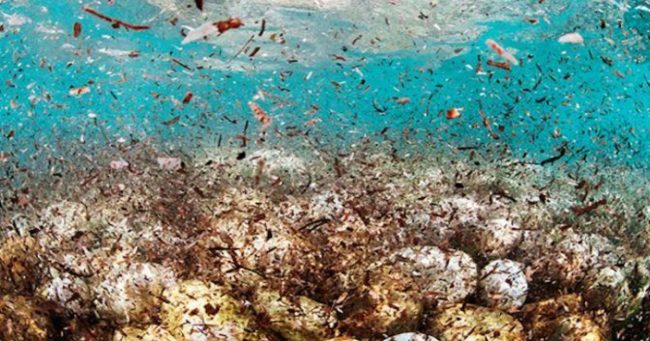
Every drink bottle we buy, face scrub we use and chip packet we finish results in tiny plastics entering the ocean.But where are these tiny micro-plastics, exactly?
Are they floating around on the ocean’s surface, waiting to be scooped up by a surfer?
Or are they stuck in the tummies of turtles or seabirds?
A new study by the CSIRO, Australia’s national science agency, has estimated up to 14 million tonnes of micro-plastics have sunk to the bottom of the ocean floor.
The peer-reviewed research, published on Tuesday, is the first global estimate for micro-plastics on the seafloor. Dr Britta Denise Hardesty, team leader with CSIRO’s Oceans and Atmosphere, said 14 million tonnes of micro-plastics was a “huge amount, especially when you think about how tiny all those bits are”.Dr Britta Denise Hardesty, team leader with CSIRO’s Oceans and Atmosphere, said 14 million tonnes of micro-plastics was a “huge amount, especially when you think about how tiny all those bits are”.
But where are these tiny micro-plastics, exactly?
Are they floating around on the ocean’s surface, waiting to be scooped up by a surfer?
Or are they stuck in the tummies of turtles or seabirds?
A new study by the CSIRO, Australia’s national science agency, has estimated up to 14 million tonnes of micro-plastics have sunk to the bottom of the ocean floor.
The peer-reviewed research, published on Tuesday, is the first global estimate for micro-plastics on the seafloor.
Dr Britta Denise Hardesty, team leader with CSIRO’s Oceans and Atmosphere, said 14 million tonnes of micro-plastics was a “huge amount, especially when you think about how tiny all those bits are”.
To put it into perspective: Imagine five carrier bags stuffed with plastic dotted along every single metre of coastline around the world, excluding Antarctica
The piles of bags would sit on every Australian beach, along Italy’s Amalfi Coast, around Vietnam’s Ha Long Bay, and all around Canada’s coastlines and beyond.
Now imagine someone pushing those bags into the ocean, and letting them sink into the darkness.
“It’s a confronting amount, and hopefully it provides a reasonable wake-up call,” Dr Hardesty told The New Daily.
“We’re finding them hundreds of kilometres offshore and thousands of metres deep – more micro-plastics than has been found by lots of other studies.”
“Micro-plastics come from the same place as plastics,” Dr Hardesty said, adding “micro just means they’re smaller than 5mm”.
“It’s really just small plastic from single-use items, consumer goods, industry or fishing-related goods, cosmetics, micro-beads, agriculture, aquaculture, household waste, everything.”Many of these tiny plastics end up in our oceans via stormwater drains, sewage systems, sea-based activities, littering, things falling off the backs of trucks, and improper waste management where people intentionally dump rubbish straight into the sea or rivers.
They often end up in the stomachs of marine animals like dolphins or fish, while bigger pieces of plastic can be just as dangerous.
“Masks that have those little straps can tangle the feet and legs of sea birds and things like that,” Dr Hardesty said.
“Rubber gloves might be more likely to look like a jellyfish that could be mistakenly eaten by turtles if they end up in the ocean.”
The World Economic Forum estimates one garbage truck of plastic alone is dumped into the ocean every minute of every day.
It estimates there could be more plastic in the ocean than fish by 2050.
The missing piece
Although the CSIRO’s findings are troubling, perhaps what’s more concerning is the answer to the following question: Where is the rest of the missing plastic?
Compared to the tonnes of plastic entering the ocean every day, Dr Hardesty said 14 million tonnes on the ocean floor was “just a drop in the ocean”.
“Where is all the missing plastic? Is it in the stomachs of animals? Is it floating on the surface?” she said.
“I’d say most of it is on our coastlines.”
Daunting task of removal of Russia’s spent nuclear fuel rods from Andreeva Bay
One-third of all nuclear waste removed from Cold War dump site https://thebarentsobserver.com/en/nuclear-safety/2020/10/one-third-all-nuclear-waste-removed-cold-war-dump-site
Another 12 special design casks with spent nuclear fuel from Cold War submarines are soon to be shipped out of Andreeva Bay on Russia’s Arctic Barents Sea coast. ByThomas Nilsen October 02, 2020
About 35% of the 21,000 spent uranium fuel elements originally stored in three rundown tanks is so far lifted out, repacked and sent to Russia’s reprocessing plant at Mayak in the South-Urals, informs Aleksandr Krasnoshchekov, director of the SevRAO’s branch in Andreeva Bay. SevRAO is the federal enterprise for handling radioactive waste in the northwestern region.
The company has a staff of 100 in Andreeva Bay in the Litsa fjord, a closed-for-civilians fjord near the border to Norway where the Northern Fleet has two basing points for nuclear submarines.
Here, the navy started to store casks with highly radioactive spent uranium fuel from its first nuclear-powered in the 1960s. First in rusty containers outdoor, later in a pool-building that broke down. In the 1980s, the elements were moved over to three concrete tanks in very poor conditions.
After nearly 20 years of improving the infrastructure, securing the site from leakages and building a new crane at the port, the first shipment with nuclear waste left Andreeva Bay in 2017.
Neighboring Norway has spent more than €30 million to support the cleanup of the nuclear dump located only about 50 km from its border.
Also Sweden, Great Britain, Italy and the European Commission have contributed. Italy, as an example, paid for building the “Rossita”, a special purpose ship sailing in shuttle from Andreeva Bay to Atomflot in Murmansk where the containers are reloaded to rail wagons. According to director Krasnoshchekov, the ongoing work is done based on contracts with these countries, he says in an interview with Vesti Murman.
Most of the work done so far concerns the elements easy to lift out.
Way more challenging times are ahead, as the damaged elements in the third tank, 3A, are to be secured and lifted out.
Take a closer look at the photo below to understand the scoop of the challenge. Some of these rusty, partly destroyed steel pipes contain fuel rods where the uranium will fall out if lifted straight up.
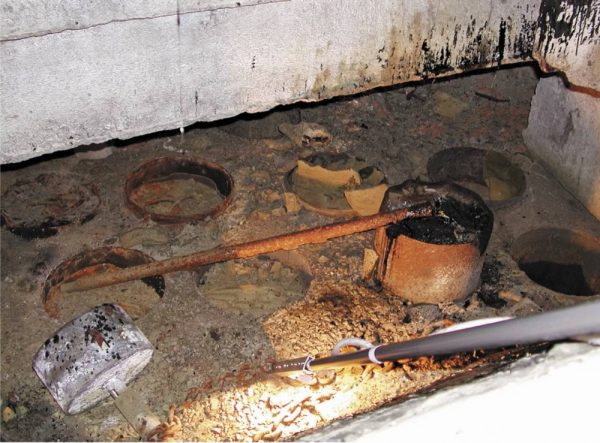
The work on tank 3A is scheduled to start in 2023, after tank 2A and 2B is completed. The experts are don’t want to start the most risky work before as much as possible of the other waste elements are removed. A criticality accident in Andreeva Bay is worst-case scenario.
As previously reported by The Barents Observer, the total radionuclide inventory in the three tanks is estimated to be equal to the remains of Rector No. 4 inside the Chernobyl sarcophagus in Ukraine. This according to a study by the British nuclear engineering company Nuvia.
The original 22,000 spent fuel elements dumped in Andreeva Bay are coming from 90-100 reactor cores powering the Soviet Union’s Cold War submarines sailing out from the naval bases along the coast of the Kola Peninsula from the late 1950s to 1982.
The first reactor cores of the November class submarines were reloaded in the early 1960s.
Additional to the spent fuel elements, some 10,000 cubic meters of solid radioactive waste from Andreeva Bay are shipped to the regional handling and storage facility in Saida Bay, a few hours sailing to the east on the Kola Peninsula. Huge piles of solid radioactive waste were stored outdoor summer and winter in the same area. Now, a building is erected to protect the boxes from rain and snow, before being repacked and shipped to the Saida Bay.
Ionising radiation – the tragedy of the ”radium girls”.

They weren’t just making paints, they were doing the painting, too. According to NPR, US Radium hired scores of girls and young women — as young as just 11-years-old — to paint watch dials with the glow-in-the-dark, radium-based paint. As if just working with the paint wasn’t bad enough, they were also encouraged to put the brush between their lips and twirl it into a point. It was the best way to get truly precise numbers and brush strokes, but with each lick of the brush, they were swallowing radium.
the human body isn’t great at telling the difference between radium and calcium. Radium gets absorbed into the bones just like calcium does, and when that happens, the rot starts.
Writer and historian Kate Moore documented the cases of the Radium Girls (via The Spectator) and found that there were a whole host of symptoms. Some started suffering from chronic exhaustion. For many, it started with their teeth — one by one, those teeth would start to decay and rot. When they were removed, their gums wouldn’t heal. In some cases, the jaw would just simply disintegrate at the dentist’s touch. Bad breath was common. Skin became so delicate that the slightest touch would tear open wounds. Ulcers formed for some, and those that were pregnant bore stillborn babies.
THE RADIUM GIRLS HAD TO BE BURIED IN LEAD-LINED COFFINS
The Radium Girls weren’t just sick, they were very literally radioactive. Mollie Maggia was exhumed in 1927, in the hopes that her bones would give still-living Radium Girls the evidence they needed to win in court. According to Popular Science, her coffin was lifted out of the ground, and her body? It glowed. That wasn’t entirely surprising, considering her bones were found to be highly radioactive — and considering radium’s half-life is 1,600 years, they’re not going to stop glowing any time soon.
Eventually, 16 separate sites around Ottawa would be classified as Superfund sites.
NPR Illinois says that many have been cleaned up, but as of 2018, there was at least one site — a 17-acre plot of land on the Fox River — that still remained a highly radioactive and terrifying legacy of the Radium Girls.
THE MESSED UP TRUTH ABOUT THE RADIUM GIRLS https://www.grunge.com/181092/the-messed-up-truth-about-the-radium-girls/ BY DEBRA KELLY/DEC. JULY 14, 2020
History is filled with episodes that prove mankind is just sort of making everything up as it goes. There’s no shortage of things that can kill us or do horrible, terrible things to our soft and squishy bodies, and every time we think we know about them all, it turns out there’s something else lurking around the corner.
And sometimes, it’s disguised as something awesome. Need proof? Look no further than the Radium Girls.
Yes, that radium. Today, the Royal Society of Chemistry says there’s really only one use for radium — targeted cancer treatments, because it’s so good at killing cells. It was first discovered in 1898 by Marie and Pierre Curie, after they extracted a single milligram from ten tons of a uranium ore called pitchblende. And it was pretty darn cool. It glowed, and seriously, how exciting is that? Unfortunately, it was also deadly — as the so-called Radium Girls would find out.
1 This Month

26 September – International Day for the Total Elimination of Nuclear Weapons


PLEASE OPPOSE HR 8255 AND S.3639 – bills would accelerate satellite deployment, with no environmental review or safeguards – https://ncstd5li.quorum.us/campaign/169331/
To see nuclear-related stories in greater depth and intensity – go to https://nuclearinformation.wordpress.com
-
Archives
- September 2026 (194)
- August 2026 (330)
- July 2026 (355)
- June 2026 (287)
- May 2026 (306)
- April 2026 (356)
- March 2026 (251)
- February 2026 (267)
- January 2026 (308)
- December 2025 (358)
- November 2025 (359)
- October 2025 (375)
-
Categories
- 1
- 1 NUCLEAR ISSUES
- business and costs
- climate change
- culture and arts
- ENERGY
- environment
- health
- history
- indigenous issues
- Legal
- marketing of nuclear
- media
- opposition to nuclear
- PERSONAL STORIES
- politics
- politics international
- Religion and ethics
- safety
- secrets,lies and civil liberties
- spinbuster
- technology
- Uranium
- wastes
- weapons and war
- Women
- 2 WORLD
- ACTION
- AFRICA
- Atrocities
- AUSTRALIA
- Christina's notes
- Christina's themes
- culture and arts
- Events
- Fuk 2022
- Fuk 2023
- Fukushima 2017
- Fukushima 2018
- fukushima 2019
- Fukushima 2020
- Fukushima 2021
- general
- global warming
- Humour (God we need it)
- Nuclear
- RARE EARTHS
- Reference
- resources – print
- Resources -audiovicual
- Weekly Newsletter
- World
- World Nuclear
- YouTube
-
RSS
Entries RSS
Comments RSS
 nuclear-news