The lost nuclear bombs that no one can find
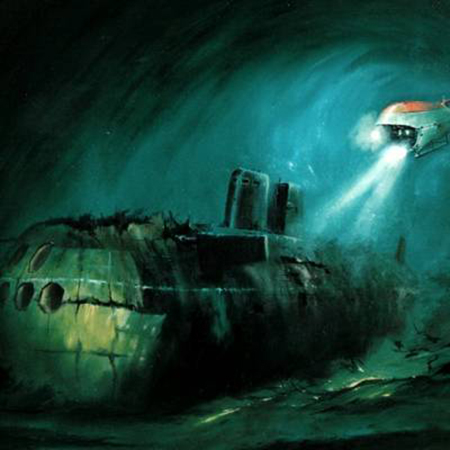
The exception to this progress is, of course, nuclear submarines – and even today, there are near-misses.
For Lewis, the fascination with lost nuclear weapons isn’t the potential risks they pose now – it’s what they represent: the fragility of our seemingly sophisticated systems for handling dangerous inventions safely.
“I think we have this fantasy that the people who handle nuclear weapons are somehow different than all the other people we know, make fewer mistakes, or that they’re somehow smarter. But the reality is that the organisations that we have to handle nuclear weapons are like every other human organisation. They make mistakes. They’re imperfect,” says Lewis.
planes carrying nuclear bombs no longer fly around on regular training exercises. “Airborne alerts ended for reasons that must be obvious to us,” he says. “In the end, the decision was made that it was too dangerous.”
The exception to this progress is, of course, nuclear submarines – and even today, there are near-misses.
BBC By Zaria Gorvett, 5th August 2022,
It was a mild winter’s morning at the height of the Cold War.
On January 17, 1966, at around 10:30am, a Spanish shrimp fisherman watched a misshapen white parcel fall from the sky… and silently glide towards the Alboran Sea. It had something hanging beneath it, though he couldn’t make out what it was. Then it slipped beneath the waves.
At the same time, in the nearby fishing village of Palomares, locals looked up at an identical sky and witnessed a very different scene – two giant fireballs, hurtling towards them. Within seconds, the sleepy rural idyll was shattered. Buildings shook. Shrapnel sliced towards the ground. Body parts fell to the earth.
A few weeks later, Philip Meyers received a message via a teleprinter – a device a bit like a fax that could send and receive primitive emails. At the time, he was working as a bomb disposal officer at the Naval Air Facility Sigonella, in eastern Sicily. He was told that there was a top secret emergency in Spain, and that he must report there within days.
However, the mission was not as covert as the military had hoped. “It was not a surprise to be called,” says Meyers. Even the public knew what was going on. When he attended a dinner party that evening and announced his mysterious trip, its intended confidentiality became something of a joke. “It was kind of embarrassing,” says Meyers. “It was supposed to be a secret but my friends were telling me why I was going.”
For weeks, newspapers around the globe had been reporting rumours of a terrible accident – two US military planes had collided in mid-air, scattering four B28 thermonuclear bombs across Palomares. Three were quickly recovered on land – but one had disappeared into the sparkling blue expanse to the south east, lost to the bottom of the nearby swathe of Mediterranean Sea. Now the hunt was on to find it – along with its 1.1 megatonne warhead, with the explosive power of 1,100,000 tonnes of TNT.
In fact, the Palomares incident is not the only time a nuclear weapon has been misplaced. There have been at least 32 so-called “broken arrow” accidents – those involving these catastrophically destructive, earth-flattening devices – since 1950. In many cases, the weapons were dropped by mistake or jettisoned during an emergency, then later recovered. But three US bombs have gone missing altogether – they’re still out there to this day, lurking in swamps, fields and oceans across the planet.
“We mostly know about the American cases,” says Jeffrey Lewis, director of the East Asia Non-proliferation Program at the James Martin Center for Non-proliferation Studies, California. He explains that the full list only emerged when a summary prepared by the US Department of Defense was declassified in the 1980s.
Many occurred during the Cold War, when the nation teetered on the precipice of Mutually Assured Destruction (MAD) with the Soviet Union – and consequently kept airplanes armed with nuclear weapons in the sky at all times from 1960 to 1968, in an operation known as Chrome Dome.
“We don’t know as much about other countries. We don’t really know anything about the United Kingdom or France, or Russia or China,” says Lewis. “So I don’t think we have anything like a full accounting.”
The Soviet Union’s nuclear past is particularly murky – it had amassed a stockpile of 45,000 nuclear weapons as of 1986. There are known cases where the country lost nuclear bombs that have never been retrieved, but unlike with the US incidents, they all occurred on submarines and their locations are known, if inaccessible.
One began on 8 April 1970, when a fire started spreading through the air conditioning system of a Soviet K-8 nuclear-powered submarine while it was diving in the Bay of Biscay – a treacherous stretch of water in the northeast Atlantic Ocean off the coasts of Spain and France, which is notorious for its violent storms and where many vessels have met their end. It had four nuclear torpedoes onboard, and when it promptly sank, it took its radioactive cargo with it.
However, these lost vessels didn’t always stay where they were. In 1974, a Soviet K-129 mysteriously sank in the Pacific Ocean, along with three nuclear missiles. The US soon found out, and decided to mount a secret attempt to retrieve this nuclear prize, “which was really a pretty crazy story in and of itself”, says Lewis.
The eccentric American billionaire Howard Hughes, famous for his broad spectrum of activity, including as a pilot and film director, pretended to become interested in deep sea mining. “But in fact, it wasn’t deep sea mining, it was an effort to build this giant claw that could go all the way down to the sea floor, grab the submarine, and bring it back up,” says Lewis. This was Project Azorian – and unfortunately it didn’t work. The submarine broke up as it was being lifted.
“And so those nuclear weapons would have fallen back to the sea floor,” says Lewis. The weapons remain there to this day, trapped in their rusting tomb. Some people think the weapons remain there to this day, trapped in their rusting tomb – though others believe they were eventually recovered.
Every now and then, there are reports that some of the US’ lost nuclear weapons have been found.
Back in 1998, a retired military officer and his partner were gripped with a sudden determination to discover a bomb dropped near Tybee Island, Georgia in 1958. They interviewed the pilot who had originally lost it, as well as those who had searched for the bomb all those decades ago – and narrowed down the search to Wassaw Sound, a nearby bay of the Atlantic Ocean. For years, the maverick duo scoured the area by boat, trailing a Geiger counter behind them to detect any tell-tale spikes in radiation.
And one day, there it was, in the exact spot the pilot had described – a patch with radiation 10 times the levels elsewhere. The government promptly dispatched a team to investigate. But alas, it was not the nuclear weapon. The anomaly was down to naturally occurring radiation from minerals in the seabed.
So for now, the US’ three lost hydrogen bombs – and, at the very least, a number of Soviet torpedoes – belong to the ocean, preserved as monuments to the risks of nuclear war, though they have largely been forgotten. Why haven’t we found all these rogue weapons yet? Is there a risk of them exploding? And will we ever get them back?
A shrouded object
When Meyers finally got to Palomares – the Spanish village where a B52 bomber came down in 1966 – the authorities were still looking for the missing nuclear bomb……………
Eventually, the parachute was pulling so hard on the line and hook that it simply snapped – sending the nuclear bomb slowly gliding back down towards the bottom. This time, it ended up even deeper than before.
………………… A month later they used a different kind of robotic submarine – a cable-controlled underwater vehicle – to grab the bomb by its parachute directly, and haul it up. It had shifted in its casing, so it couldn’t be disarmed the usual way, via a special port in the side – alarmingly, the officers instead had to cut into the nuclear weapon. “[It would have been] kind of nerve wracking to drill a hole in a hydrogen bomb,” says Meyers. “But they did it. They were prepared to do that.”
A swampy mystery
Unfortunately, the three lost bombs still out there today did not meet with such successful recovery efforts. …………………………………………………
Take the lost Tybee island bomb, which is still lying in silt somewhere in Wassaw Sound. ……………………………..
As it happens, having so many safety features is highly necessary – mostly because they don’t always work. In one case in 1961, a B-52 broke up while flying over Goldsboro, North Carolina, dropping two nuclear weapons to the ground. One was relatively undamaged after its parachute deployed successfully, but a later examination revealed that three out of four safeguards had failed.
In a declassified document from 1963, the then-US Secretary of Defence summed up the incident as a case where “by the slightest margin of chance, literally the failure of two wires to cross, a nuclear explosion was averted”.
The other nuclear bomb fell free to the ground, where it broke apart and ended up embedded in a field. Most parts were recovered, but one part containing uranium remains stuck under more than 50ft (15m) of mud. The US Air Force purchased the land around it to deter people from digging.
Some incidents are so baffling, they almost sound made up. Perhaps one of the most extraordinary occurred when a training exercise on the USS Ticonderoga went badly wrong in 1965. An A4E Skyhawk was being rolled to a plane elevator, while loaded with a B-43 nuclear bomb. It was a disaster in slow-motion – the crew on deck quickly realised that the plane was about to fall off, and waved for the pilot to apply the brakes. Tragically, he didn’t see them, and the young lieutenant, plane and weapon vanished into the Philippine Sea. They’re still there to this day, under 16,000 ft (4,900 m) of water near a Japanese island.
………………………….. A permanent loss
Lewis thinks it’s unlikely that we will ever find the three missing nuclear bombs. This is partly down to the same reasons they weren’t found in the first place.
…………………………………. In 1989, another Soviet nuclear submarine, the K-278 Komsomolets, sank in the Barents Sea off the coast of Norway. Like the K-8, it was also nuclear-powered, and it had been carrying two nuclear torpedoes at the time. For decades, its wreck has been lying under a mile (1.7km) of Arctic water.
But in 2019, scientists visited the vessel – and revealed that water samples taken from its ventilation pipe contained radiation levels up to 100,000 times higher than would normally be expected in sea water. …………
For Lewis, the fascination with lost nuclear weapons isn’t the potential risks they pose now – it’s what they represent: the fragility of our seemingly sophisticated systems for handling dangerous inventions safely.
“I think we have this fantasy that the people who handle nuclear weapons are somehow different than all the other people we know, make fewer mistakes, or that they’re somehow smarter. But the reality is that the organisations that we have to handle nuclear weapons are like every other human organisation. They make mistakes. They’re imperfect,” says Lewis.
Even at Palomares, where all the nuclear bombs that were dropped were eventually recovered, the land is still contaminated with radiation from two that detonated with conventional explosives. Some of the US military personnel who helped with the initial clean-up efforts – involving shovelling the surface of the soil into barrels – have since developed mysterious cancers which they believe are linked. In 2020, a number of survivors filed a class action suit against the Secretary of Veterans Affairs – though many of the claimants are currently in their late 70s and 80s.
Meanwhile, the local community has been campaigning for a more thorough clean-up for decades. Palomares has been dubbed “the most radioactive town in Europe“, and local environmentalists are currently protesting against a British company’s plans to build a holiday resort in the area.
Lewis is confident that losses of the kind that occurred during the Cold War are unlikely to happen again, mostly because operation Chrome Dome was ended in 1968, and planes carrying nuclear bombs no longer fly around on regular training exercises. “Airborne alerts ended for reasons that must be obvious to us,” he says. “In the end, the decision was made that it was too dangerous.”
The exception to this progress is, of course, nuclear submarines – and even today, there are near-misses. The US currently has 14 ballistic missile submarines (SSBNs) in operation, while France and the UK have four each.
To work as nuclear deterrents these submarines must remain undetected during operations at sea, and this means they can’t send any signals to the surface to find out where they are. Instead, they must navigate mostly by inertia – essentially, the crew rely on machines equipped with gyroscopes to calculate where the submarine is at any given time based on where it was last, what direction it was headed and how fast it was travelling. This potentially imprecise system has resulted in a number of incidents, including as recently as 2018 when a British SSBN almost bumped into a ferry.
The era of lost nuclear weapons might not be over just yet.
* Zaria Gorvett is a senior journalist for BBC Future and tweets @ZariaGorvett https://www.bbc.com/future/article/20220804-the-lost-nuclear-bombs-that-no-one-can-find
A clarification about China and Taiwan
Norman Realname, 5 Aug 22,

I’m grateful to a reader for providing this explanation.
I still think that it’s a pretty bad idea for USA and Australia to start a probable World War 3 over Taiwan.
The Republic of China (ROC) and the People’s Republic of China (PRC) are NOT synonyms and should not be used as such. The ROC has NO control over Hong Kong; it’s a semi-autonomous territory ruled by the PRC under the “one country, two systems” arrangement, as per treaty. Thus, grumbling about democratic subversion aside, there was no question of the PRC’s sovereignty over it.
The ROC, however, DOES have control over Taiwan, and the PRC does NOT. As to why this is the case, the most oversimplified answer is that the Chinese Civil War never fully ended and both governments claim to rule the territory of the other, but since the PRC has the de facto control of almost all of it, it’s recognized as the “real” China. The more complicated answer is that since democratization the ROC government no longer wants to rule the mainland and sees itself as a separate Taiwanese nation but is forbidden to relinquish its territorial claims (under threat of invasion) by the PRC who view Taiwan as integral Chinese territory and would interpret any movement away from them as secession (even though the PRC has never actually ruled over Taiwan).
The US and China differ over their interpretation of the situation. The PRC’s One China PRINCIPLE states that there is only one China, and Taiwan is a part of China. The US’s One China POLICY states that they *acknowledge* the PRC’s position on the matter, without actually saying whether or not they agree that Taiwan is part of China. In other words: the US generally agrees there is only one China, but they’re not sure (read: deliberately ambiguous) whether Taiwan is part of it.
Fundamentally, while the PRC has been successful in preventing international recognition of the ROC (Taiwan), they do not control the territory and cannot control the territory without:
1. The ROC (Taiwanese) government agreeing to hand over power peacefully to the PRC.
2. A full-scale military invasion of Taiwan aimed at the surrender and/or destruction of the ROC (Taiwanese) government.
To compare the situation to Hong Kong, – the crucial difference is the People’s Republic of China did not need to roll in their military to fight some theoretical Hong Kong military in order to be able to tell Hong Kong what to do.
Small nuclear reactors will bleed us dry and won’t solve climate change – unfounded promises

there is every reason to believe that if and when a NuScale SMR is built, its final cost too will vastly exceed current official estimates.
Unfounded promises — Beyond Nuclear International Small Modular Reactors epitomize culture that embraces exaggeration
By M.V. Ramana
In 2006, Elizabeth Holmes, founder of a Silicon Valley startup company called Theranos, was featured in Inc magazine’s annual list of 30 under 30 entrepreneurs. Her entrepreneurship involved blood, or more precisely, testing blood. Instead of the usual vials of blood, Holmes claimed to be able to obtain precise results about the health of patients using a very small sample of blood drawn from just a pinprick.
The promise was enticing and Holmes had a great run for a decade. She was supported by a bevy of celebrities and powerful individuals, including former U.S. secretaries of state Henry Kissinger and George Shultz, James Mattis, who later served as U.S. secretary of defense, and media mogul Rupert Murdoch. Not that any of them would be expected to know much about medical science or blood testing. But all that public endorsement helped. As did savvy marketing by Holmes. Theranos raised over $700 million from investors, and receive a market valuation of nearly $9 billion by 2014.
The downfall started the following year, when the Wall Street Journal exposed that Theranos was actually using standard blood tests behind the scenes because its technology did not really work. In January 2022, Holmes was found guilty of defrauding investors.
The second part of the Theranos story is an exception. In a culture which praises a strategy of routine exaggeration, encapsulated by the slogan “fake it till you make it”, it is rare for a tech CEO being found guilty of making false promises. But the first part of Theranos story—hype, advertisement, and belief in impossible promises—is very much the norm, and not just in the case of companies involved in the health care industry.
Small Modular Nuclear Reactors
Nuclear power offers a great example. In 2003, an important study produced by nuclear advocates at the Massachusetts Institute of Technology identified costs, safety, proliferation and waste as the four “unresolved problems” with nuclear power. Not surprisingly, then, companies trying to sell new reactor designs claim that their product will be cheaper, will produce less—or no—radioactive waste, be immune to accidents, and not contribute to nuclear proliferation. These tantalizing promises are the equivalent of testing blood with a pin prick.
And, as was the case with Theranos, many such companies have been backed up by wealthy investors and influential spokespeople, who have typically had as much to do with nuclear power as Kissinger had to with testing blood. Examples include Peter Thiel, the Silicon Valley investor; Stephen Harper, the former Prime Minister of Canada; and Richard Branson, the founder of the Virgin group. But just as the Theranos product did not do what Elizabeth Holmes and her backers were claiming, new nuclear reactor designs will not solve the multiple challenges faced by nuclear power.
One class of nuclear reactors that have been extensively promoted in this vein during the last decade are Small Modular Reactors (SMRs). The promotion has been productive for these companies, especially in Canada. Some of these companies have received large amounts of funding from the national and provincial governments. This includes Terrestrial Energy that received CAD 20 million and Moltex that received CAD 50.5 million, both from the Federal Government. The province of New Brunswick added to these by awarding CAD 5 million to Moltex and CAD 25 million in all to ARC-100.
All these companies have made various claims about the above mentioned problems. Moltex, for example, claims that its reactor design “reduces waste”, a claim also made by ARC-100. ARC-100 also claims to be inherently safe, while Terrestrial claims to be cost-competive. Both Terrestrial and ARC-100 claim to do well on proliferation resistance. In general, no design will admit to failing on any of these challenges.
Dealing with any of these challenges—safety enhancement, proliferation resistance, decreased generation of waste, and cost reduction—will have to be reflected in the technical design of the nuclear reactor. The problem is that each of these goals will drive the requirements on the reactor design in different, sometimes opposing, directions.
Economics
The hardest challenge is economics. Nuclear energy is an expensive way to generate electricity. In the 2021 edition of its annual cost report, Lazard, the Wall Street firm, estimated that the levelized cost of electricity from new nuclear plants will be between $131 and $204 per megawatt hour; in contrast, newly constructed utility-scale solar and wind plants produce electricity at somewhere between $26 and $50 per megawatt hour according to Lazard. The gap between nuclear power and renewables is large, and is growing larger. While nuclear costs have increased with time, the levelized cost of electricity for solar and wind have declined rapidly, and this is expected to continue over the coming decades.
Even operating costs for nuclear power plants are high and many reactors have been shut down because they are unprofitable. In 2018, NextEra, a large electric utility company in the United States, decided to shut down the Duane Arnold nuclear reactor, because it estimated that replacing nuclear with wind power will “save customers nearly $300 million in energy costs, on a net present value basis.”
The high cost of constructing and operating nuclear plants is a key driver of the decline of nuclear power around the world. In 1996, nuclear energy’s share of global commercial gross electricity generation peaked at 17.5 percent. By 2020, that had fallen to 10.1 percent, a 40 percent decline.
The high costs described above are for large nuclear power plants. SMRs, as the name suggests, produce relatively small amounts of electricity in comparison. Economically, this is a disadvantage. When the power output of the reactor decreases, it generates less revenue for the owning utility, but the cost of constructing the reactor is not proportionately smaller. SMRs will, therefore, cost more than large reactors for each unit (megawatt) of generation capacity. This makes electricity from small reactors more expensive. This is why most of the early small reactors built in the United States shut down early: they just couldn’t compete economically.
SMR proponents argue that the lost economies of scale will be compensated by savings through mass manufacture in factories and as these plants are built in large numbers costs will go down. But this claim is not very tenable. Historically, in the United States and France, the countries with the highest number of nuclear plants, costs went up, not down, with experience. Further, to achieve such savings, these reactors have to be manufactured by the hundreds, if not the thousands, even under very optimistic assumptions about rates of learning. Finally, even if SMRs were to become comparable in cost per unit capacity of large nuclear reactors, that would not be sufficient to make them economically competitive, because their electricity production cost would still be far higher than solar and wind energy.
…………………………………………. Cost escalations are already apparent in the case of the NuScale SMR, arguably the design that is most developed in the West. The estimated cost of the Utah Association of Municipal Power Systems project went from approximately $3 billion in 2014 to $6.1 billion in 2020—this is to build twelve units of the NuScale SMR that were to generate 600 megawatts of power. The cost was so high that NuScale had to change its offering to a smaller number of units that produce only 462 megawatts, but at a cost of $5.32 billion. In other words, the cost per kilowatt of generation capacity is around $11,500 (US dollars). That figure is around 80 percent more than the per kilowatt cost of the infamous Vogtle project at the time its construction started. Since that initial estimate of $14 billion for the two AP1000 reactors, the estimated cost of the much delayed project has escalated beyond $30 billion. As with the AP1000 reactors, there is every reason to believe that if and when a NuScale SMR is built, its final cost too will vastly exceed current official estimates. ……………
Timelines
The other promise made by SMR developers is how fast they can be deployed. GE-Hitachi, for example, claims that an SMR could be “complete as early as 2028” at the Darlington site. ARC-100 described an operational date of 2029 as an “aggressive but achievable target”.
Again, the historical record suggests otherwise. Consider NuScale. In 2008, the company projected that “a NuScale plant could be producing electricity by 2015-16”. As of 2022, the company projects 2029-30 as the date for start of generation. Russia’s KLT-40S, a reactor deployed on a barge, offers another example. When construction started in 2007, the reactor was projected to start operations in October 2010. It was actually commissioned a whole decade later, in May 2020.
The SMR designs being considered in Canada are even further off. In December 2021, Ontario Power Generation chose the BWRX-300 for the Darlington site. That design is based on GE-Hitachi’s Economical Simplified Boiling Water Reactor (ESBWR) design, which was submitted for licensing to the U.S. Nuclear Regulatory Commission in 2005. That ESBWR design was changed nine times; the NRC finally approved revision 10 from 2014. If the Canadian Nuclear Safety Commission does its due diligence, it might be 2030 or later before the BWRX-300 is even licensed for construction. That assumes that the BWRX-300 design remains unchanged. And, then, of course, there will be the inevitable delays (and cost escalations) during construction. ………….
Waste, Proliferation and Safety
Small reactors also cause all of the usual problems: the risk of severe accidents, the production of radioactive waste, and the potential for nuclear weapons proliferation. …………
…………… small modular reactor proposals often envision building multiple reactors at a site. The aim is to lower costs by taking advantage of common infrastructure elements. The configuration offered by NuScale, for example, has twelve reactor modules at each site, although it also offers four- and six-unit versions. With multiple reactors, the combined radioactive inventories might be comparable to that of a large reactor. Multiple reactors at a site increase the risk that an accident at one unit might either induce accidents at other reactors or make it harder to take preventive actions at others. This is especially the case if the underlying reason for the accident is a common one that affects all of the reactors, such as an earthquake. In the case of the accidents at Japan’s Fukushima Daiichi plant, explosions at one reactor damaged the spent fuel pool in a co-located reactor. Radiation leaks from one unit made it difficult for emergency workers to approach the other units. ……………………………
Claims by SMR proponents about not producing waste are not credible, especially if waste is understood not as one kind of material but a number of different streams. A recent paper in the Proceedings of the National Academy of Sciences examined three specific SMR designs and calculates that “relative to a gigawatt-scale PWR” these three will produce up to 5.5 times more spent fuel, 30 times more long-lived low and intermediate level waste, and 35 times more short-lived low and intermediate level waste. In other words, in comparison with large light water reactors, SMRs produce more, not less, waste per unit of electricity generated. As Paul Dorfman from the University of Sussex commented, “compared with existing conventional reactors, SMRs would increase the volume and complexity of the nuclear waste problem”.
Further, some of the SMR designs involve the use of materials that are corrosive and/or pyrophoric. Dealing with these forms is more complicated. For example, the ARC-100 design will use sodium that cannot be disposed of in geological repositories without extensive processing. Such processing has never been carried out at scale. The difference in chemical properties mean that the methods developed for dealing with waste from CANDU reactors will not work as such for these wastes.
Many SMR designs also make the problem of proliferation worse. Unlike the CANDU reactor design that uses natural uranium, many SMR designs use fuel forms that require either enriched uranium or plutonium. Either plutonium or uranium that is highly enriched in the uranium-235 isotope can be used to make nuclear weapons. Because uranium enrichment facilities can be reconfigured to alter enrichment levels, it is possible for a uranium enrichment facility designed to produce fuel for a reactor to be reconfigured to produce fuel for a bomb. All else being equal, nuclear reactor designs that require fuel with higher levels of uranium enrichment pose a greater proliferation risk—this is the reason for the international effort to convert highly enriched uranium fueled research reactors to low enriched uranium fuel or shutting them down.
Plutonium is created in all nuclear power plants that use uranium fuel, but it is produced alongside intensely radioactive fission products. Practically any mixture of plutonium isotopes could be used for making weapons. Using the plutonium either to fabricate nuclear fuel or to make nuclear weapons, require the “reprocessing” of the spent fuel. Canada has not reprocessed its power reactor spent fuel, but some SMR designs, such as the Moltex design, propose to “recycle” CANDU spent fuel. Last year, nine US nonproliferation experts wrote to Prime Minister Justin Trudeau expressing serious concerns “about the technology Moltex proposes to use.”
The proliferation problem is made worse by SMRs in many ways. ……………………..
Conclusion
The saga of Theranos should remind us to be skeptical of unfounded promises. Such promises are the fuel that drive the current interest in small modular nuclear reactors………
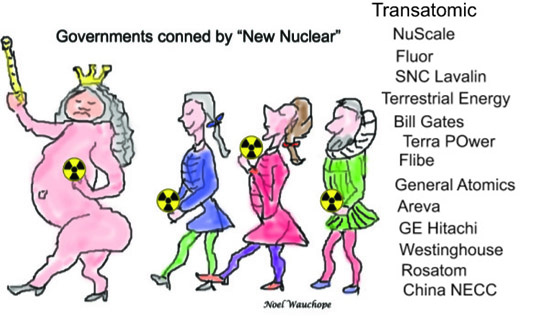
Rather than seeing the writing on the wall, unfortunately, government agencies are wasting money on funding small modular reactor proposals. Worse, they seek to justify such funding by repeating the tall claims made by promoters of these technologies…… https://beyondnuclearinternational.org/2022/07/31/unfounded-promises00
Westinghouse Nuclear Fuel Fabrication plant – a detailed history of troubles.

Dead fish near SC nuclear fuel site were an early warning. Then came the spills and accidents, The State, BY SAMMY FRETWELL, JULY 30, 2022
“……………………………………………………. 1980: State regulators learn of a fish kill near the Westinghouse wastewater plant. They found elevated levels of fluoride and ammonia-nitrogen in groundwater and surface water. It was later determined that the pollution came from the plant wastewater area. 1980: Twenty plant workers evacuated from Westinghouse after a small leak of uranium hexafluoride gas.
1982: Westinghouse unable to find 9.5 pounds of slightly enriched uranium, according to an NRC report. 1983: State regulators fine Westinghouse $6,000 for illegally shipping flammable material that caused a fire at Barnwell County’s low-level nuclear waste dump. 1988: Radioactivity found in monitoring wells is thought to have come from prior leaks of industrial wastewater. Low concentrations of Uranium 235, 234 and 238 found.
1989: EPA investigators find an array of pollutants in groundwater at the Westinghouse site, some higher than safe drinking water levels. Vinyl Chloride and TCE, both of which can cause cancer, were found to exceed the drinking water standard. 1989: Twenty five dead deer discovered at the Westinghouse property, some of them in an area where wastewater was being discharged near the Congaree River. The deer reportedly died from nitrate poisoning, but public records reviewed by The State do not show an exact cause. 1992: Trichloroethene (TCE), cis-1,2-dichloroethene (CIS 1,2 DCE) and tetrachloroethene (PCE), are detected at amounts above the federal maximum contaminant level for safe drinking water. The high levels were found near the plant’s oil house.
1993: NRC fines Westinghouse $18,750 after alleging that the company failed to perform a criticality safety analysis and failed to conduct safety tests. 1994: Radioactive leak exposes 55 workers to uranium hexafluoride and shuts down the Westinghouse plant. 1997: The plant loses two low-enriched fuel rods. The NRC says five violations of NRC requirements occurred. Safety was not compromised, but problems “are indicative of inadequate management attention.’’
1998: Company fined $13,750 after NRC notes the “loss of criticality control,’’ a problem that could have led to an accident. The agency says a problem had gone uncorrected. 2000: NRC hits Westinghouse with a violation notice because an operator “willfully violated criticality safety procedures when preparing to mix a batch of powder.’’ 2000: Uranyl nitrate spills at the Westinghouse plant, causing a cleanup. When the cleanup began, workers found the spill was worse than originally thought.
2001: NRC hits Westinghouse with a violation for transporting 3 cylinders of licensed material with elevated radiation levels. 2001: Westinghouse fails to follow criticality safety rules at a uranium recovery area dissolver elevator, violation notice says. Containers were not stacked far enough apart, reducing safety. Westinghouse didn’t do enough to fix the problem. 2001: NRC issues a violation notice to Westinghouse after raising concerns about criticality safety, including failing to keep uranium powder mixing hoods properly separated.
2001: NRC hits Westinghouse with violation after criticality safety controls failed to work on the ammonium diurnate process lines. 2002: NRC letter tells Westinghouse that its criticality safety control efforts need improvement. NRC Regional Administrator Luis Reyes says the last two safety reviews have urged improvement for criticality safety. Letter notes concern about nuclear transportation program. 2002: NRC notice of investigation says a contractor for Westinghouse falsified records about the receipt and processing of materials. That resulted in a small amount of nuclear material being improperly shipped to nuclear site in Tennessee. 2004: NRC again raises concerns about criticality safety, the practice of making sure a nuclear chain reaction does not occur. Efforts to improve compliance with procedures and “implement criticality safety controls were not fully effective,’’ letter from regional administrator Luis Reyes says.
2004: NRC letter hits Westinghouse with a $24,000 fine. The company failed to maintain criticality controls as required. Ash in the company’s incinerator exceeded concentration limits for uranium. The Level 2 violation is, at the time, the most serious ever noted at the plant. 2008: Broken pipe spills radioactive material into the soil in the same area as a later 2011 leak, but Westinghouse doesn’t tell state or federal regulators for years. 2008: The NRC sanctions Westinghouse for losing sixteen sample vials of uranium hexafluoride. The company didn’t properly document and control the transfer of the vials and failed to secure them from “unauthorized removal.’’ 2008: Westinghouse hit with a violation notice after a worker disabled an alarm and bypassed a safety significant interlock.
2009: Westinghouse fires a contract foreman after federal regulators found that he had falsified records. Westinghouse also was cited by the NRC. The foreman certified that employees were trained in safety procedures, when they had not completed training.
2009: Westinghouse loses 25 pounds of pellets that were to be used in making nuclear fuel rods. NRC downplays danger but says Westinghouse should have kept better track of the nuclear material.
2010: NRC levies $17,500 fine against Westinghouse after uranium-bearing wastewater spilled inside the plant.
2011: Uranium leaks into ground beneath the Westinghouse plant, but federal inspectors weren’t told about it for years. NRC officials said they only learned about the spill in 2017.
2012: Worker exposed to uranium-containing acid and whisked to a hospital by emergency medical crews. The worker was treated for pain and released.
2012: Westinghouse fails to follow through on a report to improve the facility so it could better withstand an earthquake, NRC says. Recommendations had been made nine years previously.
2015: Three workers are injured when steam erupted from a wash tank. The workers are taken to a Columbia area hospital for treatment and later sent to the burn center in Augusta, which specializes in treating severe burns.
2016: A buildup of uranium that could have led to a small burst of radiation forces Westinghouse to shut down part of the fuel plant and temporarily lay off 170 workers, about one-tenth of its work force at the plant. The uranium found in the scrubber area is nearly three times the legal limit.
2017: Westinghouse worker exposed to a solution toxic enough to cause chemical burns when the solution sprayed him. 2018: Uranium leaks into the ground through a hole in the Westinghouse plant floor. An acid solution had eaten into the floor. Soil was contaminated.
2018. The NRC says Westinghouse allowed workers to walk across a protecting liner for years, which likely weakened the liner and contributed to a hole in the floor that allowed uranium solution to leak out.
2019: Fire breaks out in a drum laden with mop heads, rags and other cleaning equipment.
2019: State and federal authorities report that water had leaked through a rusty shipping container and onto barrels of uranium-tainted trash. Contaminants then leaked into the soil below the shipping container floor.
2019: Westinghouse sends three workers to the hospital after they complained of an unusual taste in their mouths while doing maintenance on equipment that contains hydrofluoric acid.
2019: Two contaminated barrels are shipped from the Westinghouse plant to Washington State after workers in South Carolina failed to properly examine the containers for signs of radioactive contamination.
2020. The NRC issues violation against Westinghouse, this time after questions arose about nuclear safety. The issue centered on improper security of tamper seals, used to keep nuclear material from being stolen.
2020. NRC reports finding 13 pinhole leaks in a protective liner.
2020: South Carolina officials raise concerns about earthquakes at Westinghouse.
Sources: NRC records and news reports from The State. https://www.thestate.com/news/local/environment/article263945551.html
The Age of Women

Pearls and Irritations, By Julian Cribb, Jul 22, 2022
Leadership by wise women is indispensable if we are to escape the catastrophe that male leadership is presently building for humanity.
If humanity is to survive the vast and growing threats it faces, women must assume the leadership of government, business, religion and social institutions around the world. Female leadership is a required solution to the ten catastrophic risks which now confront the whole of our civilisation.
As a rule, women don’t start wars, mine coal or oil, destroy landscapes and forests, pollute air and oceans or poison their children – though they may benefit from those male actions. They tend to think more about the longer term than do men, and to consider the future needs of their children and grandchildren more fully. They tend to seek peaceful and constructive solutions to problems rather than warring over differences in values and beliefs, or over resources.
Since the time our species first differentiated its gender roles, over a million years ago, pragmatic male thought has largely driven our remarkable ascent, our great technological achievements up to the start of the present century. But men are also risk takers – and often ignore or make light of the risks created by the use, misuse or overuse of these technologies. Furthermore, in the hot, overcrowded, resource-depleted, poisoned world of the present and immediate future, competitive male attitudes are also our potential downfall, especially if they lead to wars and mass destruction.
In a world beset by catastrophic risks such as global ecological collapse, nuclear weapons, climate change, universal chemical poisoning, resource scarcity, food insecurity, overpopulation, pandemic disease, deadly new technologies and self-delusion, a fresh human perspective is needed – one which accentuates peaceful co-operation, caring, repair, healing and restoration. One which values food above weapons, health above chemicals, re-use and thrift above wastage, nature above profit, thought for the next generations above immediate self-gratification – and wisdom over mere intelligence or technical skill.
The most striking example of global female leadership is the decision by women everywhere to have far fewer babies. This has brought the birth rate down from 5 babies per woman in the mid-1960s to 2.4 babies in the early 2020s – and it is still falling, in every continent and in almost every country, albeit more slowly. Moreover many women have taken the decision to control their fertility without seeking male approval. They just did it. It is a responsibility the female of our species has undertaken because she instinctually understands the dangers and costs inherent in uncontrolled family and population growth. Women have, on their own initiative, tackled one of the thorniest and most controversial issues affecting the human future – and with demonstrable success. Unswayed by the selfish arguments of economics, nationalism, religion, paternalism or social pressure, they have willingly had fewer children in order that those whom they do bear may live better – or even live at all.
Women are also peacemakers. History offers few, if any, examples of wars of aggression waged by female leaders. Although perfectly capable of responding to military attack, female rulers from Elizabeth I, Maria Theresa and Catherine the Great to Golda Meir, Indira Ghandi and Margaret Thatcher defended their countries against attack by others or else ended wars which they had inherited from their male antecedents. Typically, they pursued their aims through diplomacy. All of the great wars of recent centuries, on the other hand, were started either by male monarchs, dictators or by male-dominated governments.
……….. Women are also peacemakers. History offers few, if any, examples of wars of aggression waged by female leaders. Although perfectly capable of responding to military attack, female rulers from Elizabeth I, Maria Theresa and Catherine the Great to Golda Meir, Indira Ghandi and Margaret Thatcher defended their countries against attack by others or else ended wars which they had inherited from their male antecedents. Typically, they pursued their aims through diplomacy. All of the great wars of recent centuries, on the other hand, were started either by male monarchs, dictators or by male-dominated governments.
In a world where conflict over declining resources of land, water, food, minerals, timber, fish and other vital necessities of life is increasingly probable, male leadership is far more likely to result in mass destruction and death than female leadership. Males in most societies are taught from youth to compete for what they want, and if competition doesn’t work, then to fight for it, often to the death. Sporting role models, gang behaviour, worship of military virtues and imposed patriarchal values cement the process. This masculine ideal is so firmly imprinted on society and on young males as to make questioning it tantamount to heresy – and most men fear to do so. Indeed, the dawning realisation that traditional male values are redundant in a world where humans can eliminate themselves has given rise to anxiety and confusion in many males over the likely loss of their ‘traditional’ roles of warrior and protector.
However, there is nothing compulsory about these traditional roles, ………………….. These stereotypes have endured centuries after the biological necessity for them has passed away. The preservation of these stone age roles in a 21st Century civilisation on the brink of catastrophe is an absurdity. Indeed, they will only hasten it.
Females learn or are taught to achieve their goals by other means, generally peaceful, diplomatic, negotiatory and co-operative. It follows that female leadership is better suited to the conditions of the C21st than it perhaps was to previous centuries – and male leadership less so. Thus, majority female rule can reduce the chances of civilisational collapse, or even human extinction, by war……………
It is noteworthy that women already tend to lead international organisations concerned with human health and wellbeing, with peace, with children and their future – whereas men tend to dominate organisations that pollute, manufacture poisons or weapons, plough up landscapes, pillage the oceans and destroy the climate. There are very few female leaders of the $7 trillion fossil fuels / petrochemicals sector, for example, and the male groupthink in that industry plainly values short-term profit above the safety and survival of humanity (including their own). This is classic male risk-taking behaviour ……….
Petrochemicals kill 12 million people every year and the toll is rising with climate change and the universal spread of poisons. In this case, a male-led industry prizes profit above human life on the largest scale ever to occur in history. But it is by no means unique. Other male-dominated sectors including agriculture, mining, forestry, corporate food and pharmaceuticals, electronics, advertising, armaments and the military, cause similar havoc among humanity, the natural world or both. For the sake of human survival, it is time their leadership underwent a radical repositioning in values, ethics and common sense.
The issue of whether women should lead humanity in the 21st century is thus not a question of gender equality or politics. It is not about ‘feminism’.
It is, quite simply, a foundational rule for human survival at the very time we face a major threat to our existence, arising from our own behaviours.
It is now a matter of choosing the kind of leadership which can best get us through the most dangerous era in all of human history.
Female thinking and leadership can protect a habitable planet and save humanity – or at least, some of it. And this means female thinking by enlightened men as well as by women. To influence global society towards more sustainable, healthy and peaceable solutions to our risks, we need many wise women in positions of power. This is indispensable, if we are escape the fate which male-led competition, aggression, overconsumption and pollution are building for us. https://johnmenadue.com/the-age-of-women-2/
British soldiers used as radiation guinea pigs in nuclear bomb tests in Australia
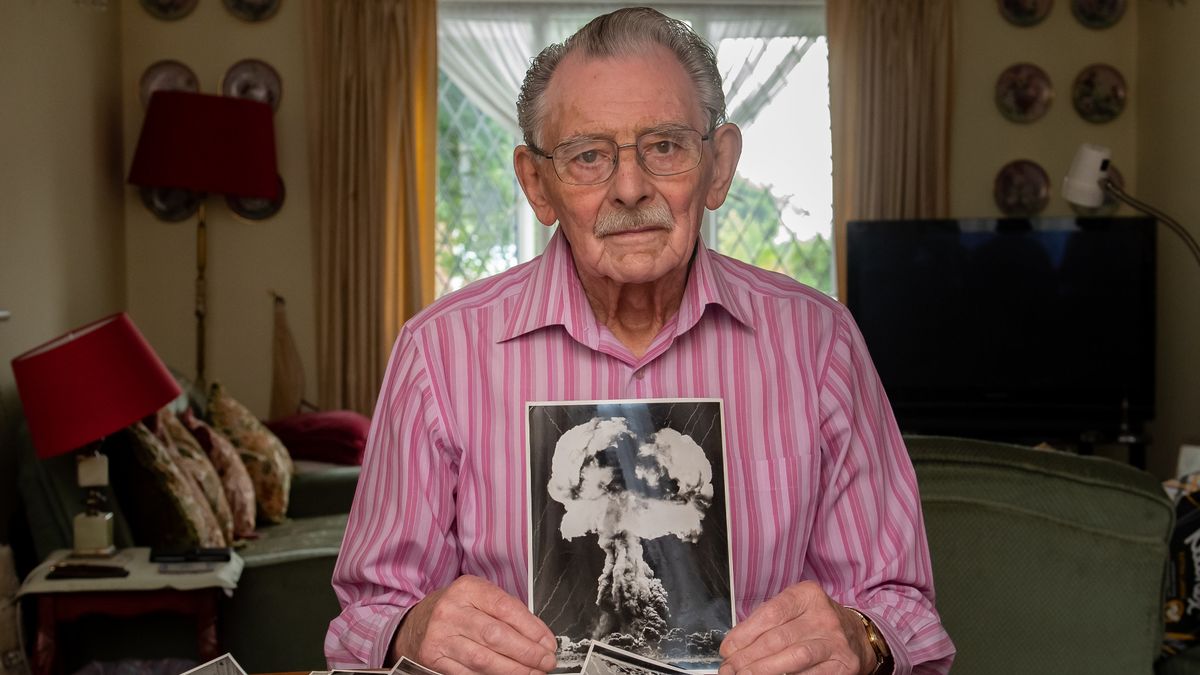
British veterans ‘ordered to march through smoking craters’ in nuclear bomb tests, Brian Tomlinson claims the state dumped him and his comrades, many of whom died from cancer after being used in a shocking human experiment,
https://www.mirror.co.uk/news/uk-news/british-veterans-ordered-march-through-27563987 Susie Boniface, Reporter, 24 Jul 2022,
A veteran of nuclear bomb tests has told how British servicemen were ordered to march through a smoking crater to find how radioactive it was.
Brian Tomlinson said he also had to dig out scientific instruments buried in the contaminated soil and revealed he was left with bleeding ulcers on his palms for two decades.
But he claims the state dumped him and his comrades, many of whom died from cancer in the years after they were used in a shocking human experiment in the Australian outback.
And Brian supports the Mirror’s campaign for a medal for heroes of the nuclear tests in the 50s.
“That place is still radioactive, it’s in the soil for a hell of a long time, so what chance does a human being have?” he said.
“A medal would get us a little bit of recognition for those who took part. It says you’re someone who’s been noticed and not discarded, which is how we’ve felt for so long.”
Last month, Boris Johnson became the first PM to meet veterans, and promised action before October’s 70th anniversary of the first test. His resignation threw it into doubt and campaigners are seeking reassurances from Rishi Sunak or Liz Truss that they will do the same.
Brian, now 85, was a sapper sent to Maralinga, South Australia, in 1957 to take part in Operation Antler, a series of three atomic bomb tests designed to help build the more powerful H-bomb.
His troop of Royal Engineers were blended with Australian soldiers, and 40 of them lived for a year inside the blast zone in canvas tents.
The main base, where scientists, top brass, and most troops stayed, was called Maralinga Village. Brian’s unit was 14 miles deeper into the testing grounds, at Roadside Camp. From there, it was just 9 miles to Ground Zero.
Brian, a 20-year-old corporal at the time, said: “Nobody told us what it was all about, or checked us for radiation, but every morning we went into the forward area.
We had pneumatic drills, and had to blast down through the soil. There was about 12 inches of earth, red dust, and below that was rock.”
For each of 3 blasts, the crew had to bury dozens of large steel containers 8ft square. Each had instruments inside to measure the explosion, with pipes protruding above ground level. Those closest to the bombs were sandbagged and concreted to protect them from the shockwave.
A few hours after each bomb, Brian and his crew – wearing only shorts, socks, boots and a hat – had to drive back in, remove the sandbags and concrete, and extract the instruments.
Scientists who went with them wore radiation suits and badges, but Brian said for the first two blasts he had neither.
He added: “After the third bomb, we were given little rubber boots, and a white overall, and a dose badge. We were told to walk through the crater. The mushroom cloud was still overhead. The wind had started to push it away. It was only a few hours after, not very long.”
The first two bombs, codenamed Tadje and Biak, were one kiloton and 6kts respectively.
But the third, Taranaki, was 25kts, as powerful as the weapon which destroyed Nagasaki in 1945.
Brian, of Yate, near Bristol, said: “As you approached the bomb site it was quite amazing, because it was like a bowling green. Everything was green and smooth. It was only when you were on it you realised the heat from the bomb had crystallised the earth underneath it. It was a crust of molten sand, like glass.
“The crater left there was huge. They told us to walk into that, down into the crater, and up the other side, and then check our meters to see how high the dose was.”
Brian said: “When it reached a certain point they told us to come out. It didn’t take long for it to reach that point. We weren’t told at the time what the dose was supposed to be. But it was just as bad as going through the centre of the bomb as soon as it had gone off.”
The first two bombs were detonated on top of 100ft-high towers built by the sappers, but desert sand was sucked into the fireball and fell to the ground as toxic fallout. The third bomb was tethered to barrage balloons 980ft up, supposedly minimising the risk.
But the size of the bomb, and perhaps the fact the same site was used for previous weapons tests, meant there was still fallout.
After they left the crater, Brian was taken to a decontamination area. The men’s clothes were stripped off and taken away, and the men were put through showers.
“We spent 5 or 6 minutes scrubbing away, then put ourselves in this meter, it was like standing on a weighing machine, and you push your hands through these bars to be tested. If a bell rang, you were still radioactive and had to go back in and scrub under your nails, everywhere, in your hair. I had to do it 3 times. They didn’t give us any more information.”
Documented safety measures at Maralinga included wire fences through which sand could easily be blown, and one wooden post barrier that Brian’s unit passed through each morning.
Brian was not checked for radiation while excavating amid the fallout, nor given long-term medical follow-ups. Six years later, he was medically discharged with a duodenal ulcer.
Radiation is known to cause problems with the lining of the gut, and earlier this year a government study reported nuclear test veterans were 20 per cent more likely than other servicemen to die from stomach cancer.
Brian said: “It wasn’t until later I started having skin problems. It would cover me from head to toes, rashes on my back, chest, legs, thighs. They used to come out on the palms of my hands.
“I’d get a little itchy blister in the centre of my palm, it would break and then spread over the fingers. I used to wear white cotton gloves to ease the pain and itching.
“The skin would go hard, then crack and bleed, and it would start all over again. I had that for 20 years, and no doctor could work out what it was.”
Today, cancer patients are warned radiotherapy using beta radiation can lead to radiodermatitis, which causes rashes, skin peeling, and ulceration. It is caused by the decay of isotopes, including plutonium and cobalt-60, both of which were in the Antler bombs.
Brian said: “I would have a constant itch, all over, and had to take cold showers just to stop the itching and have something of a normal life. I got depressed, to the point where I didn’t want to go and see the doctors because they just have me the same old medication and it never did me any good. Then one day, after 20 years, it just stopped, as suddenly as it came.”
Two decades after his discharge, Brian also had an operation to finally cure his ulcer. It involved cutting the vagus nerve, which controls digestion as well as carrying sensory information from the skin’s surface.
“I told all my consultants what was done to me out there in Maralinga, and asked if it was due to fallout. They all denied it,” said Brian. “Nobody’s ever done anything for us nuclear test veterans except withhold information from us.”
Campaigners have asked the Prime Minister for a medal and a service of national recognition at Westminster Abbey to mark the Plutonium Jubilee in 3 months’ time.
A spokesman for the MoD said it was grateful to veterans, and claimed they were well-monitored and protected. He added: “The Prime Minister met with veterans recently, and asked ministers to explore how their dedication can be recognised. We remain committed to considering any new evidence”
************************************************************************
For 40 years, the Mirror has campaigned for justice for the brave men who took part in Britain’s nuclear weapons tests.
The Ministry of Defence has fought back every step of the way.
We have told countless heartbreaking stories of grieving mums, children with deformities, men aged before their time and widows struggling to hold their families together, all while campaigning for recognition.
Two years ago we launched an appeal for a medal for the 1,500 survivors.
For the first time we were able to prove some were unwittingly used in experiments.
Our appeal was backed by then-Defence Secretary Gavin Williamson but his review foundered after he lost his job.
It had only six meetings in two years. They never asked to meet veterans. They never questioned the evidence.
Instead they asked for information from the MoD, which has a track record of denying what its own paperwork later proves.
And as our medal campaign gathered steam, civil servants simultaneously withdrew public documents from the National Archives.
Would anyone working in Whitehall today stay there, if 3 megatons of plutonium exploded south of the river?
The test veterans and their families will never stop fighting. The Mirror will never cease to demand they are heard.
Prime Minister, listen to them. Overturn this disgraceful decision.
The lingering horror of thorium radioactive poisoning in West Chicago

On the one hand, the story of West Chicago and thorium is one of triumph: a small town overcomes the odds and makes a big corporation clean up its radioactive waste. On the other hand, thorium still haunts some residents, especially those living with illness or deaths in the family that they suspect are related.
Are West Chicago’s Radiation Worries Over?, BELT Magazine, By Liuan Huska, 13 July 22,
Sandra Arzola was relaxing in her West Chicago home one weekend in 1995, when she heard a knock at the door. Recently married, she shared the gray duplex with her husband, mom and sister, and family members were constantly coming and going. But when Sandra answered the door that day, what she learned would change how she looked at her home and suburban community forever.
At the door was a woman representing Envirocon, an environmental cleanup company. There was thorium on the family’s property, the woman said, and if it was OK with them, workers were coming to remove it. It was the first time Sandra had heard of thorium “It took me by left field,” she said. “But [the representative] made it sound like everything was going to be fine.”
Unknowingly, the Arzolas had bought their way into what the Chicago Tribune in 1979 called “the radioactive capital of the Midwest.” Not long after they purchased the property, the U.S. Environmental Protection Agency designated it a Superfund site because of the hazardous waste in their yard.
The source of the danger was the old factory one block to the north of the Arzola home, which Jesse Arzola frequently went past while walking their dogs. From 1932 to 1973, the factory was the largest producer of rare earth and radioactive thorium compounds in the world. It started out producing lamps and later supplied thorium for the federal government’s atomic bomb development. But perhaps the factory’s most lasting legacy, at least in West Chicago, is the harmful radioactive waste that was dumped in ponds, piled at the factory and buried around homes and sidewalks across town.
Residents raised health concerns as early as the 1940s about the toxic material, but these were regularly dismissed by the factory, last owned by the Kerr-McGee Chemical Corporation. Comprehensive environmental protection rules weren’t put in place until the early 1970s, leaving the factory largely free to dispose of its nuclear waste for decades.
It has taken just as long for the company and government to clean up the radioactive waste. As of 2015, the radioactive sites under federal jurisdiction near the factory have been cleaned to EPA standards. There are no remaining health risks from the land, according to government officials.
But below the factory, the groundwater is still polluted with a range of toxins – particularly uranium – that exceed protection standards. The Illinois Emergency Management Agency, which has jurisdiction over the site, expects remediation to begin this fall. ……………………..
Prolonged or high levels of radiation exposure can damage genetic material in cells and cause cancer and other diseases later on, especially for children, who are more sensitive to radiation. Only two public health studies, published in the early 1990s, have been conducted in West Chicago. Both found elevated cancer rates in the 60185 zip code, which includes the neighborhood around the factory……………………………
The challenges facing West Chicago residents today began ninety years ago, when Charles R. Lindsay moved his lamp factory from Chicago to what was then an undeveloped little town with multiple rail connections. The factory, now officially known as the Rare Earths Facility, took monazite ore and used powerful acids to extract minerals to make gas lanterns, which burned thorium nitrate to emit an incandescent glow. During World War II, it also supplied thorium to the federal government to develop the atomic bombs that were later dropped on Nagasaki and Hiroshima, Japan.
During its four decades of operation, the Rare Earths Facility processed up to one hundred and forty-one thousand tons of monazite. The liquid waste from the extraction process was dumped into unlined ponds around the factory, seeping into the surrounding water table. Solid waste, a black, sand-like material known as thorium tailings, piled up on site. Old-timers share stories of sneaking into the factory grounds and playing on “Mount Thorium.” When the pile got too big, the waste was trucked down the road to a new pile in Reed Keppler Park.
Facing mounting piles of toxic waste, Lindsay came up with another solution: offer the waste to residents for landscaping. From the 1930s through the 1950s, radioactive thorium tailings were distributed across town, mixed with concrete to pour foundations, mixed with topsoil for gardens and spilled along roadways. The company continued to do this as the risks of radiation exposure became widely known starting in the late 1940s through its effects on Japanese atomic bomb survivors.
Soon after the factory moved to West Chicago, people started complaining. In 1941, nearby residents sued Lindsay Light for releasing airborne hydrofluoric acid that killed trees and shrubs nearby.
The federal government did not begin regulating nuclear materials until 1954. Starting in 1957 the company received repeated citations for safety violations, including failing to fence off radioactive storage areas, exposing workers to radiation levels above standards and improper waste disposal.
As the environmental movement gained steam through the 1960s, growing public pressure pushed Congress to create the Environmental Protection Agency and pass the Clean Air Act of 1970 and Clean Water Act of 1972. That resulted in sweeping new regulations – and obligations to the American public – for companies like Kerr-McGee, which had gotten used to operating with limited oversight…………………………….
The EPA denied the company’s request for an operating permit and the factory shuttered in 1973. It was cheaper to cease operations than follow the new rules. By 1980, Kerr-McGee had started the process of closing down the West Chicago facility for good. Pressure from residents and the city pushed the company to begin cleanup on 119 contaminated residential properties.
Still, Kerr-McGee had another plan that worried residents: to permanently store thirteen million cubic feet of radioactive waste at the factory site in a four-story, twenty-seven-acre, clay-covered cell. Concerned residents formed an organization, the Thorium Action Group, to fight the company’s proposal. This spawned more than a decade of legal battles between residents, the city of West Chicago, and state of Illinois — who wanted the thorium out of town — and the company and the federal Nuclear Regulatory Commission, who insisted the waste could safely be stored in this densely populated neighborhood of West Chicago…………………
Moving the thorium waste out of town would take over two decades to complete. In the meantime, there was still the problem of radioactive tailings embedded around the neighborhood…………………….
The Arzolas’ experience is far from rare. Realtors in West Chicago have operated with a “don’t ask, don’t tell” policy, said longtime realtor and former West Chicago resident Dan Czuba. Unlike for radon or lead, realtors never received directives from the state or any licensing board to disclose other harmful thorium byproducts. People have had to do their own homework and decide whether or not a home was a risk. “To this day,” Czuba said, “I still don’t know that there was an official statement of, ‘Thorium will hurt you.’”…………………………………..
Throughout the decades, various groups have tried to get the word out about thorium. The Thorium Action Group was active through the early 2000s. Once the EPA got involved and Kerr-McGee agreed to move the waste out, the group dissipated………
The lack of easily accessible information surrounding the contamination and cleanups has left some residents with the nagging worry that there may be other hidden pockets of radiation around town……….
One house to the west and across the railroad from the Arzolas, Erika Bartlett grew up playing along the tracks and under her yard’s sprawling old oak trees. When she was diagnosed with leukemia in 2012, at age thirty-four, a friend asked if there was anything she could have been exposed to.
“Wait a minute, I actually was,” Bartlett told her friend. She thought back to her high school years, when the oak trees, swingset and above-ground pool at her house were removed during the radiation remediation. Bartlett realized she had spent her childhood, starting from age four, in a neighborhood embedded with nuclear waste. She wondered how many others living near the factory had similar health problems. That started her on a yearslong personal investigation into the town’s thorium legacy.
Between 2012 and 2016, as Bartlett was undergoing cancer treatment, she knocked on doors in the neighborhoods around the factory, an area covering about one square mile. She found over 200 cases of cancers and other illnesses that could stem from radiation exposure, including birth defects, Hashimoto’s and aplastic anemia, the illness that killed the pioneering radioactivity researcher Marie Curie in 1934.
“When I first started, I didn’t think I’d find anything,” Bartlett said. “But block after block, it seemed like a bigger deal than I thought.”
The EPA estimated that, before the waste was removed, radiation levels in some residential neighborhoods in West Chicago increased lifetime cancer risks up to seventy times what is acceptable……
The only official health studies into the impacts on people living near the factory were conducted over three decades ago, by the Illinois Department of Public Health. Among residents in the 60185 zip code, studies in 1990 and 1991 found elevated rates of cancer, including melanomas and lung, colorectal and breast cancers. By grouping exposed and unexposed people together, however, researchers said more differences may have been masked……………………………………….
On the one hand, the story of West Chicago and thorium is one of triumph: a small town overcomes the odds and makes a big corporation clean up its radioactive waste. On the other hand, thorium still haunts some residents, especially those living with illness or deaths in the family that they suspect are related………………… https://beltmag.com/are-west-chicagos-radiation-worries-over/
Fukushima bosses ordered to pay billions for failing to prevent nuclear disaster
The Chemical Engineer, by Adam Duckett, 18 July 22,
FOUR former bosses of the Fukushima Daiichi nuclear plant have been ordered by a Tokyo court to pay ¥13trn yen (US$94bn) in damages for failing to prevent disaster at the site in 2011.
The lawsuit was filed by shareholders in 2012 and is the first to find former executives of utility company Tepco liable for compensation. Kyodo News reports that the presiding judge said the utility’s countermeasures for the tsunami “fundamentally lacked safety awareness and a sense of responsibility,” ruling that the executives failed to perform their duties.
A huge earthquake knocked out power supply to the plant and triggered a tsunami thought to measure as high as 15 m. This easily washed over the 5.5 m seawalls designed to protect the plant, flooding key infrastructure, including the backup diesel generators that had kicked in to power the cooling of the reactors. Without this power, the three units operating at the plant melted down, the reactor pressure vessels were breached, and radioactive material was released into the environment.
The trial focused on whether the management had taken appropriate decisions on how to manage the risk of tsunami after a Tepco unit estimated in 2008 that a tsunami measuring up to 15.7 m could strike the plant based on a Government analysis published in 2002, Kyodo News reports. The former executives’ lawyers argued that the assessment lacked reliability. The court disagreed and said the Government’s assessment obliged the company to take measures. It ruled that the decision not to act was “extremely irrational and unforgivable”.
The four executives found guilty include former Chairman Tsunehisa Katsumata, former President Masataka Shimizu, and former vice presidents Sakae Muto and Ichiro Takekuro. The sum they have been ordered to pay is well beyond their personal wealth, but they are expected to pay as much as their assets allow. A fifth defendant, former Managing Director Akio Komori, was found not liable for damages……………. more https://www.thechemicalengineer.com/news/fukushima-bosses-ordered-to-pay-billions-for-failing-to-prevent-nuclear-disaster/
Decadal trends in 137Cs concentrations in the bark and wood of trees contaminated by the Fukushima nuclear accident.
Abstract
Understanding the actual situation of radiocesium (137Cs) contamination of trees caused by the Fukushima nuclear accident is essential for predicting the future contamination of wood. Particularly important is determining whether the 137Cs dynamics within forests and trees have reached apparent steady state. We conducted a monitoring survey of four major tree species (Japanese cedar, Japanese cypress, konara oak, and Japanese red pine) at multiple sites. Using a dynamic linear model, we analyzed the temporal trends in 137Cs activity concentrations in the bark (whole), outer bark, inner bark, wood (whole), sapwood, and heartwood during the 2011–2020 period. The activity concentrations were decay-corrected to September 1, 2020, to exclude the decrease due to the radioactive decay. The 137Cs concentrations in the whole and outer bark samples showed an exponential decrease in most plots but a flat trend in one plot, where 137Cs root uptake is considered to be high. The 137Cs concentration ratio (CR) of inner bark/sapwood showed a flat trend but the CR of heartwood/sapwood increased in many plots, indicating that the 137Cs dynamics reached apparent steady state within one year in the biologically active parts (inner bark and sapwood) and after several to more than 10 years in the inactive part (heartwood). The 137Cs concentration in the whole wood showed an increasing trend in six plots. In four of these plots, the increasing trend shifted to a flat or decreasing trend. Overall, the results show that the 137Cs dynamics within forests and trees have reached apparent steady state in many plots, although the amount of 137Cs root uptake in some plots is possibly still increasing 10 years after the accident. Clarifying the mechanisms and key factors determining the amount of 137Cs root uptake will be crucial for predicting wood contamination.
Introduction
After the Fukushima Dai-ichi Nuclear Power Plant (FDNPP) accident in March of 2011, a wide area of forests in eastern Japan was contaminated with radionuclides. In particular, radiocesium (137Cs) has the potential to threaten the forestry and wood production in the contaminated area for many decades because it was released in large amounts (10 PBq)1 and has a relatively long half-life (30 years). Radiocesium levels for some wood uses are strictly regulated in Japan (e.g., 40 Bq kg−1 for firewood2 and 50 Bq kg−1 for mushroom bed logs3), meaning that multipurpose uses of wood from even moderately contaminated areas are restricted. Although a guidance level of radiocesium in construction wood has not been declared in Japan, the permissible levels in some European countries (370–740 Bq kg−1)4,5,6 suggest that logging should be precautionary within several tens of kilometers from the FDNPP, where the 137Cs activity concentration in wood potentially exceeds 1,000 Bq kg−1 [refs. 7,8]. To determine whether logging should proceed, the long-term variation in wood 137Cs concentration must be predicted as accurately as possible. Many simulation models successfully reproduce the temporal variations in the early phase after the FDNPP accident, but produce large uncertainties in long-term predictions9. To understand the 137Cs dynamics in forests and trees and hence refine the prediction models, it is essential to provide and analyze the observational data of 137Cs activity concentrations in tree stem parts.
Accident-derived 137Cs causes two types of tree contamination: direct contamination by 137Cs fallout shortly after the accident, and indirect contamination caused by surface uptake from directly contaminated foliage/bark10,11 and root uptake from contaminated soil12. The 137Cs concentration in bark that pre-exists the accident was affected by both 137Cs drop/wash off from bark surfaces and 137Cs uptake because the bark consists of a directly contaminated outer bark (rhytidome) and an indirectly contaminated inner bark (phloem). Given that the 137Cs content was 10 times higher in the outer bark than in the inner bark in 201213 and the 137Cs concentration in the whole bark decreased during the 2011–2016 period at many study sites8, the temporal variation in the whole bark 137Cs concentration during the early post-accident phase must be mainly contributed by drop/wash off of 137Cs on the outer bark surface.
In contrast, stem wood (xylem) covered by bark was contaminated only indirectly. Although 137Cs distribution in sapwood (outer part of stem wood; containing living cells) and heartwood (inner part of stem wood; containing no living cells) is non-uniform and species-specific8,13,14,15, the 137Cs concentration in whole wood depends on the amount of 137Cs uptake. Because the dissolvable 137Cs on the foliar/bark surface decreased significantly within 201116, the main route of 137Cs uptake since 2012 is likely root uptake rather than surface uptake. A monitoring survey during 2011–2016 showed that the temporal trend in the whole wood 137Cs concentration can be increasing, decreasing, or flat8, suggesting that 137Cs root uptake widely differs among sites and species.
Meanwhile, many simulation models have predicted an initial increase in the whole wood 137Cs concentration after the accident, followed by a gradual decline9. The initial increase is attributable to the increase in soil 137Cs inventory, and the following decline is mainly attributed to radioactive decay, dilution by wood biomass increment, and immobilization in the soil. Therefore, the trend shift from increasing to decreasing is a good indicator that shows the 137Cs dynamics within the forest have reached apparent steady state, which is characterized by slower changes in 137Cs concentration, bioavailability, and partitioning in the forest12,17,18. However, the timing of the trend shift predicted by the models have large uncertainty, varying from several years to a few decades from the accident9. Moreover, the trend shift has not been confirmed by observational data after the FDNPP accident. Although our monitoring survey cannot easily identify the key driving factors of the temporal trends, it can directly discern the trend shift from increasing to decreasing, and the timeframe of the increasing trend. The confirmation of the trend shift will accelerate the understanding of key factors of 137Cs root uptake, because important parameters such as transfer factor and CR are originally defined for a steady state condition18.
The present study aims to clarify the temporal trends of 137Cs concentrations in bark and wood of four major tree species (Japanese cedar, Japanese cypress, konara oak, and Japanese red pine) at multiple sites during the 10 years following the FDNPP accident. Detecting a trend shift from increasing to decreasing in the wood 137Cs concentration was especially important to infer whether the 137Cs dynamics within the forest have reached apparent steady state. We update Ohashi et al.8, who analyzed the monotonous increasing or decreasing trends during 2011–2016, with observational data of 2017–2020 and a more flexible time-series analysis using a dynamic linear model (DLM). The DLM is suitable for analyzing data including observational errors and autocorrelation, and has the advantage of being applicable to time-series data with missing years. For a more detailed understanding of bark contamination and the 137Cs dynamics in tree stems, we also newly provide data on the 137Cs concentrations in the outer and inner barks. The temporal trends in the 137Cs CRs of outer bark/inner bark, heartwood/sapwood, and inner bark/sapwood were analyzed to confirm whether the 137Cs dynamics within the trees have reached apparent steady state.
Materials and methods
Monitoring sites and species
The monitoring survey was conducted at five sites in Fukushima Prefecture (sites 1–4 and A1) and at one site in Ibaraki Prefecture (site 5), Japan (Fig. 1). Sites 1, 2, and A1 are located in Kawauchi Village, site 3 in Otama Village, site 4 in Tadami Town, and site 5 in Ishioka City. Monitoring at sites 1–5 was started in 2011 or 2012, and site A1 was additionally monitored since 2017. The tree species, age, mean diameter at breast height, initial deposition density of 137Cs, and sampling year of each sample at each site are listed in Table 1. The dominant tree species in the contaminated area, namely, Japanese cedar (Cryptomeria japonica [L.f.] D.Don), Japanese cypress (Chamaecyparis obtusa [Siebold et Zucc.] Endl.), konara oak (Quercus serrata Murray), and Japanese red pine (Pinus densiflora Siebold et Zucc.) were selected for monitoring. Japanese chestnut (Castanea crenata Siebold et Zucc.) was supplementally added in 2017. The cedar, cypress, and pine are evergreen coniferous species, and the oak and chestnut are deciduous broad-leaved species. Sites 1 and 3 each have three plots, and each plot contains a different monitoring species. Site A1 has one plot containing two different monitoring species, and the remaining sites each have one plot with one monitoring species, giving ten plots in total.


Sample collection and preparation
Bulk sampling of bark and wood disks was conducted by felling three trees per year at all sites during 2011–20168,25 and at sites 3–5 and A1 during 2017–2020. Partial sampling from six trees per year was conducted at sites 1 and 2 during 2017–2020 (from seven trees at site 2 in 2017) to sustain the monitoring trees. All the samples were obtained from the stems around breast height. During the partial sampling, bark pieces sized approximately 3 cm × 3 cm (axial length × tangential length) were collected from four directions of the tree stem using a chisel, and 12-mm-diameter wood cores were collected from two directions of the tree stem using an automatic increment borer (Smartborer, Seiwa Works, Tsukuba, Japan) equipped with a borer bit (10–101-1046, Haglöf Sweden, Långsele, Sweden). Such partial sampling increases the observational errors in the bark and wood 137Cs concentrations in individual trees26. To mitigate this error and maintain an accurate mean value of the 137Cs concentration, we increased the number of sampled trees from three to six. The sampling was conducted mainly in July–September of each year; the exceptions were site-5 samples in 2011 and 2012, which were collected irregularly during January–February of the following year. The collected bark pieces were separated into outer and inner barks, and the wood disks and cores were split into sapwood and heartwood. The outer and inner bark samples during 2012–2016 were obtained by partial sampling of barks sized approximately 10 cm × 10 cm from 2–3 directions on 2–3 trees per year.
The bulk samples of bark, sapwood, and heartwood were air-dried and then chipped into flakes using a cutting mill with a 6-mm mesh sieve (UPC-140, HORAI, Higashiosaka, Japan). The pieces of the outer and inner bark were chipped into approximately 5 mm × 5 mm pieces using pruning shears, and the cores of the sapwood and heartwood were chipped into semicircles of thickness 1–2 mm. Each sample was packed into a container for radioactivity measurements and its mass was measured after oven-drying at 75 °C for at least 48 h. Multiplying this mass by the conversion factor (0.98 for bark and 0.99 for wood)8 yielded the dry mass at 105 °C.
Radioactivity measurements
The radioactivity of 137Cs in the samples was determined by γ-ray spectrometry with a high-purity Ge semiconductor detector (GEM20, GEM40, or GWL-120, ORTEC, Oak Ridge, TN). For measurements, the bulk and partial samples were placed into Marinelli containers (2.0 L or 0.7 L) and cylindrical containers (100 mL or 5 mL), respectively. The peak efficiencies of the Marinelli containers, the 100-mL container, and the 5-mL container were calibrated using standard sources of MX033MR, MX033U8PP (Japan Radioisotope Association, Tokyo, Japan), and EG-ML (Eckert & Ziegler Isotope Products, Valencia, CA), respectively. For the measurement of the 5-mL container, a well-type Ge detector (GWL-120) was used under the empirical assumption that the difference in γ-ray self-absorption between the standard source and the samples is negligible27. The measurement was continued until the counting error became less than 5% (higher counting errors were allowed for small or weakly radioactive samples). The activity concentration of 137Cs in the bark (whole) collected by partial sampling was calculated as the mass-weighted mean of the concentrations in the outer and inner barks; meanwhile, the concentration in the wood (whole) was calculated as the cross-sectional-area-weighted mean of sapwood and heartwood concentrations. The activity concentrations were decay-corrected to September 1, 2020, to exclude the decrease due to the radioactive decay.
Discussion
Causes of temporal trends in bark 137Cs concentration
The 137Cs concentration in the whole bark decreased in many plots, clearly because the outer bark 137Cs concentration decreased. However, the whole bark 137Cs concentration showed a relatively small decrease or even a flat trend in some plots (site-2 cedar and site-1 cypress and oak). In the site-1 cypress plot, where the whole bark 137Cs concentration decreased relatively slowly, the inner bark 137Cs concentration notably increased. Similarly, although we lack early phase monitoring data in the site-2 cedar and site-1 oak plots, the inner bark 137Cs concentration in both plots is considered to have increased prior to monitoring because the sapwood 137Cs concentration increased in both plots and the CR of inner bark/sapwood was constant in all other plots. Therefore, the low-rate decrease or flat trend in the whole bark 137Cs concentration in some plots was probably caused by an increase in the inner bark 137Cs concentration, itself likely caused by high 137Cs root uptake (as discussed later).
The 137Cs concentration in the outer bark decreased in all four plots monitored since 2012 (site-1 and site-3 cedar, site-1 cypress, and site-3 pine), confirming the 137Cs drop/wash off from the bark surface. The constant (exponential) decrease in three of these plots indicates that the 137Cs drop/wash off was still continuing in 2020 but with smaller effect on the outer bark 137Cs concentration. In contrast, the decrease in the site-1 cypress plot seemed to slow down since around 2017. Furthermore, Kato et al.32 reported no decrease in 137Cs concentration in the outer bark of Japanese cedar during the 2012–2016 period. Such cases cannot be fitted by a simple decrease of the outer bark 137Cs concentration. As a longer-term perspective, in the outer bark of Norway spruces (Picea abies) affected by the Chernobyl nuclear accident, the biological half-life of 137Cs concentration was extended in areas with higher precipitation, suggesting that high root uptake of 137Cs hinders the decreasing trend33. The present study showed that 70–80% or more of the 137Cs deposited on the bark surface (outer bark) was removed by drop/wash off after 10 years from the accident and that the 137Cs CR of outer bark/inner bark became constant in some plots. These facts suggest that the longer-term variations in outer bark 137Cs concentration will be more influenced by 137Cs root uptake, although it is uncertain whether root uptake caused the slowing down of the decrease rate seen in the site-1 cypress plot. Further studies are needed to understand the 137Cs concentration in newly formed outer bark and to determine the 137Cs CR of outer bark/inner bark at steady state.
Causes of temporal trends in wood 137Cs concentration
The temporal trends of the 137Cs concentration in the whole wood basically corresponded to those in the sapwood. The exceptions were the site-3 and site-4 cedar plots, where the sapwood 137Cs concentration did not increase but the whole wood 137Cs concentration was raised by the notable increase in the heartwood 137Cs concentration. This behavior can be attributed to a species-specific characteristic of Japanese cedar, which facilitates Cs transfer from sapwood to heartwood8,15,34. The present study newly found that the increase in the 137Cs CR of heartwood/sapwood in the cedar plots became smaller or shifted to a flat trend around 2015–2016, indicating that 137Cs transfer between the sapwood and heartwood has reached apparent steady state at many sites 10 years after the accident. Therefore, after 2020, the whole wood 137Cs concentration in cedar is unlikely to increase without a concomitant increase in the sapwood 137Cs concentration.
The increasing trends in the 137Cs concentrations in whole wood and sapwood (site-2 cedar, site-1 cypress, and site-1 and site-3 oak plots) are seemingly caused by the yearly increase in 137Cs root uptake; however, the wood 137Cs concentration can also increase when the 137Cs root uptake is constant or even slightly decreases each year. This behavior can be shown in a simple simulation of the temporal variation in the wood 137Cs content (the amount of 137Cs in stem wood of a tree). If the 137Cs dynamics within a tree have reached steady state and the proportion of 137Cs allocated to stem wood become apparently constant, the wood 137Cs content in a given year can be considered to be determined by the amount of 137Cs root uptake and the amount of 137Cs emission via litterfall. The flat 137Cs CR trend of inner bark/sapwood during 2012–2020 (see Fig. 5) indicates that the 137Cs dynamics, at least those between the inner bark and sapwood, reached apparent steady state within 2011. Here we assume that (1) the annual amount of 137Cs root uptake is constant, (2) the proportion of 137Cs allocated to stem wood is apparently constant, and as assumed in many forest Cs dynamics models17,35,36,37, (3) a certain proportion of 137Cs in the stem wood is lost via litterfall each year. Under these conditions, the simulated amount of 137Cs emission balanced the amount of 137Cs root uptake after sufficient time, and the wood 137Cs content approached an asymptotic value calculated as [root uptake amount × allocation proportion × (1/emission proportion − 1)]. Note that the asymptotic value increases with increasing root uptake amount and decreasing emission proportion and does not depend on the amount of 137Cs foliar/bark surface uptake in the early post-accident phase. Nevertheless, the amount of 137Cs surface uptake in the early phase critically determines the trend of the wood 137Cs content. More specifically, the trend in the early phase will be increasing (decreasing) if the surface uptake is smaller (larger) than the asymptotic value. Finally, the temporal variation of the 137Cs concentration in wood is thought to be the sum of the dilution effect of the increasing wood biomass and the above-simulated variation in the wood 137Cs content. Therefore, in the early post-accident phase, the wood 137Cs concentration will increase when the wood 137Cs content increases at a higher rate than the wood biomass. As the wood 137Cs content approaches its asymptotic value (i.e., steady state), its increase rate slows and the dilution effect proportionally increases. Then, the wood 137Cs concentration shifts from an increasing trend to a decreasing trend. The trends of the 137Cs concentrations in whole wood and sapwood in the site-3 oak plot follow this basic temporal trend, which is similarly predicted by many simulation models9.
In other plots with the increasing trend (site-2 cedar and site-1 cypress and oak), the increase in the 137Cs concentrations in whole wood and sapwood became smaller or shifted to a flat trend around six years after the accident; however, it did not shift to a decreasing trend. This lack of any clear shift to a decreasing trend, which was similarly seen at sites with hydromorphic soils after the Chernobyl nuclear accident38,39, cannot be well explained by the above simulation. A core assumption of the simulation that the yearly amount of 137Cs root uptake is constant is probably violated in these plots, leading to underestimations of the root uptake amount. Although the inventory of exchangeable 137Cs in the organic soil layer has decreased yearly since the accident, that in the mineral soil layer at 0–5 cm depth has remained constant40. In addition, the downward migration of 137Cs has increased the 137Cs inventory in the mineral soil layer below 5-cm depth41,42. If the steady state 137Cs inventory of the root uptake source can be regarded as sufficient for trees, any increase in the 137Cs root uptake is likely explained by expansion of the root distribution and the increase in transpiration (water uptake) with tree growth. When the wood 137Cs content increases at a similar rate to the wood biomass, the increasing trend will not obviously shift to a decreasing trend. Therefore, assuming the 137Cs allocation and emission proportions in the mature trees do not change considerably with time, the amount of 137Cs root uptake is considered to be increasing yearly in these four plots.
In the remaining plots with the decreasing or flat trend (site-1 cedar, site-4 cedar without outliers, site-5 cypress, and site-3 pine), according to the above simulation, the amount of initial 137Cs surface uptake was larger than or similar to the asymptotic value, i.e. the amount of 137Cs root uptake is relatively small and/or the proportion of 137Cs emission via litterfall is relatively high. However, the amount of 137Cs root uptake in the plots with the flat trend is possibly increasing because the flat trend has not shifted to a decreasing trend. In these plots, although it is difficult to confirm apparent steady state of the soil–tree 137Cs cycling because of the lack of an initial increasing trend, the recent flat trends in the 137Cs CRs of heartwood/sapwood and inner bark/sapwood indicate that the 137Cs dynamics, at least within the trees, have reached apparent steady state.
Various factors were found to increase the 137Cs root uptake after the Chernobyl nuclear accident; for example, high soil water content, high soil organic and low clay content (i.e., low radiocesium interception potential [RIP]), low soil exchangeable K concentration, and high soil exchangeable NH4 concentration12,43. After the FDNPP accident, the 137Cs transfer from soil to Japanese cypress and konara oak was found to be negatively correlated with the soil exchangeable K concentration44,45 and the 137Cs mobility is reportedly high in soils with low RIP46. However, neither the soil exchangeable K and Cs concentrations nor the RIP have explained the different 137Cs aggregated transfer factors (defined as [137Cs activity concentration in a specified component/137Cs activity inventory in the soil]) of Japanese cedars at sites 1–446,47. Because the 137Cs dynamics within the forest and trees in many plots reached apparent steady state at 10 years after the FDNPP accident, the 137Cs aggregated transfer factor is now considered to be an informative indicator of the 137Cs root uptake. Therefore, a comprehensive analysis of the 137Cs aggregated transfer factor and the soil properties at more sites than in the present study will be important to understand key factors determining the amount of 137Cs root uptake by each tree species at each site.
Validity and limitation of the trend analyses
Although the application of the smooth local linear trend model failed in plots monitored for less than five years, it was deemed suitable for analyzing the decadal trend because it removes annual noises, which are probably caused by relatively large observational errors (including individual variability)26. Moreover, the algorithm that determines the trend and its shift between 2 and 4 delimiting years was apparently reasonable, because the detected trends well matched our intuition. However, when judging a trend, the algorithm simply assesses whether the true state values significantly differ between the delimiting years. Therefore, it cannot detect changes in the increase/decrease rate (i.e., whether an increasing/decreasing trend is approaching a flat trend). For example, the whole bark 137Cs concentration in the site-1 cypress plot was determined to decrease throughout the monitoring period. In fact, the decrease rate slowed around 2014 and the decreases were slight between 2014 and 2020 (see Fig. 2). Similarly, the sapwood 137Cs concentration in the site-1 cypress and oak plots was determined to increase throughout the monitoring period, but the increase rate has clearly slowed since around 2017. To more sensitively detect the shift from an increasing/decreasing trend to a flat trend, other algorithms are required. Nevertheless, this algorithm is acceptable for the chief aim of the present study; that is, to detect a trend shift from increasing to decreasing.
Conclusions
In many plots monitored at Fukushima and Ibaraki Prefectures, the 137Cs concentrations in the whole and outer bark decreased at almost the same yearly rate for 10 years after the FDNPP accident, indicating that the direct contamination of the outer bark was mostly but not completely removed during this period. Moreover, the 137Cs concentration in the whole bark decreased at relatively low rates or was stable in plots where the 137Cs root uptake was considered to be high. This fact suggests that indirect contamination through continuous root uptake can reach the same magnitude as direct contamination by the accident.
In all of our analyzed plots, the 137Cs CR of inner bark/sapwood has not changed since 2012, indicating that 137Cs transfer among the biologically active parts of the tree stem had already reached apparent steady state in 2011. In contrast, the 137Cs CR of heartwood/sapwood in six out of nine plots increased after the accident. In four of these plots, the 137Cs CR of heartwood/sapwood plateaued after 3–6 years; in the other two plots, the plateau was not reached even after 10 years. Therefore, saturation of 137Cs in heartwood (an inactive part of the tree stem) requires several years to more than one decade.
The 137Cs concentration in the whole wood showed an increasing trend in six out of nine plots. In four of these plots, the increasing trend shifted to a flat or decreasing trend, indicating that the 137Cs dynamics in many forests reached apparent steady state at 10 years after the accident. However, the lack of the clear shift to a decreasing trend indicates that the 137Cs root uptake is probably still increasing in some plots. Continuous monitoring surveys and further studies clarifying the complex mechanisms of 137Cs root uptake in forests are needed in order to refine the simulation models and improve their prediction accuracy.
Nuclear war would turn oceans upside down, crash food web
https://news.wisc.edu/nuclear-war-would-turn-oceans-upside-down-crash-food-web/ July 8, 2022 By Chris Barncard , Russia’s invasion of Ukraine has given the specter of nuclear war renewed weight as a global threat, and a new study of the environmental impact of a nuclear conflict describes dire consequences for the world’s oceans.
“If there were a nuclear war, these huge explosions and the firestorms they cause could throw so much soot — teragrams, or millions of tons — into the atmosphere, it would block out enough sunlight to cool the atmosphere significantly,” says Elizabeth Maroon, a professor of atmospheric and oceanic sciences at the University of Wisconsin–Madison.
In just one month after a nuclear exchange between Russia and the United States or India and Pakistan, average global temperatures would drop by 13 degrees Fahrenheit — a larger temperature change than in the last ice age — according to climate modeling by Maroon and collaborators from around the world. The research team, led by Louisiana State University professor of oceanography and coast sciences Cheryl Harrison, published their findings July 7 in the journal AGU Advances.
Even setting aside radioactive fallout, the consequences on land would be dire, including widespread crop failures. But in just a year, the planet’s interconnected oceans would enter a state unfamiliar to scientists like Maroon who study the way oceans have changed on much longer time scales. And, unlike effects on the atmosphere and on land, oceans would not fully recover within the 30-year time period covered by the researchers’ simulations of nuclear conflicts.
“Changes in the ocean take longer than in the atmosphere or on land, but our modeling shows that even in the first year after a nuclear war the ocean circulation would have started changing drastically,” says Maroon, an expert on the interplay between the Atlantic Ocean’s complex circulation patterns and Earth’s climate.
The Atlantic’s major circulation turn-around in the northern latitudes — in which warm surface water streaming north to Greenland, Iceland and Norway cools and sinks into middle depths to be drawn south again — comes unhinged.
“Within the first year or two, water in the North Atlantic sinks all the way to the bottom of the ocean, which we think has not happened even in the ice ages,” says Maroon. “In today’s ocean, only near Antarctica does water sink all the way to the seafloor.”
That unprecedented mixing and ocean circulation speed-up — which would last for about two decades — would move nutrients in the ocean vital for supporting the smallest and most numerous marine organisms, like plankton, into entirely unfamiliar conditions around the world.
It would also result in cooling so strong it would extend sea ice and render impassable major seaports that are now open year-round, and would likely cause significant damage to much of the ocean food web.
“It’s no secret that nuclear winter would be terrible,” Maroon says. “What this study shows are the lasting extent of effects we hadn’t really addressed before on ocean circulation and ecosystems and the very base of the food web.”
To read more about the study and its findings, visit: https://www.lsu.edu/mediacenter/news/2022/07/07docs_harrison_aguadvances.php
Lost in space: Astronauts struggle to regain bone density

France 24 30/06/2022 Paris (AFP) – Astronauts lose decades’ worth of bone mass in space that many do not recover even after a year back on Earth, researchers said Thursday, warning that it could be a “big concern” for future missions to Mars.
Previous research has shown astronauts lose between one to two percent of bone density for every month spent in space, as the lack of gravity takes the pressure off their legs when it comes to standing and walking.
To find out how astronauts recover once their feet are back on the ground, a new study scanned the wrists and ankles of 17 astronauts before, during and after a stay on the International Space Station.
The bone density lost by astronauts was equivalent to how much they would shed in several decades if they were back on Earth, said study co-author Steven Boyd of Canada’s University of Calgary and director of the McCaig Institute for Bone and Joint Health.
The researchers found that the shinbone density of nine of the astronauts had not fully recovered after a year on Earth — and were still lacking around a decade’s worth of bone mass.
The astronauts who went on the longest missions, which ranged from four to seven months on the ISS, were the slowest to recover.
“The longer you spend in space, the more bone you lose,” Boyd told AFP.
Boyd said it is a “big concern” for planned for future missions to Mars, which could see astronauts spend years in space……………………..
Guillemette Gauquelin-Koch, the head of medicine research at France’s CNES space agency, said that the weightlessness experienced in space is “most drastic physical inactivity there is”.
“Even with two hours of sport a day, it is like you are bedridden for the other 22 hours,” said the doctor, who was not part of the study.
“It will not be easy for the crew to set foot on Martian soil when they arrive — it’s very disabling.”…………………………………. https://www.france24.com/en/live-news/20220630-lost-in-space-astronauts-struggle-to-regain-bone-density—
Atoms and Ashes—lessons from six of the world’s worst nuclear disasters
This is a powerful and timely book. At a time when arguments for nuclear power are returning as a way to solve both climate change and the energy crisis, we need to arm ourselves with the arguments. Not only is nuclear power not a solution to the problems we face, the lesson from this book is that it’s inherently dangerous and could have devastating consequences for life on earth.
https://socialistworker.co.uk/long-reads/atoms-to-ashes-lessons-from-six-of-the-wo2 27 June 22, Atoms and Ashes—from Bikini Atoll to Fukushima, the new book by Serhii Plokhy, is a compulsive but terrifying read, writes Amy Leather
Standing in front of Hinkley Point C nuclear power plant, Boris Johnson launched the Tories’ Energy Security Strategy in April. Nuclear energy was central to the plan. Johnson claimed the strategy would deliver “clean, affordable, secure power to the people for generations to come”. He called for 25 percent of our electricity to come from nuclear power by 2050—up from the current 16 percent. That means greatly increasing capacity, with Johnson bragging the first phase of the plan will involve building eight new nuclear reactors.
Reading Atoms and Ashes by Serhii Plokhy in this context is chilling. As Plokhy says at the start, his main purpose is to take a fresh look at the history of nuclear accidents. He looks at why they happened, how bad they were, what we can learn, and assesses if they could ever happen again.
To do this, he examines six of the world’s worst nuclear disasters—although he is very clear these are by no means the only accidents that have occurred. In fact, there have been hundreds of known incidents and probably even more that have been kept secret or covered up.
Plokhy starts with the Castle Bravo nuclear test that took place in March 1954 at Bikini Atoll, Marshall Islands, in the Pacific. A miscalculation of the hydrogen bomb’s radiation yield and wind direction significantly damaged human health and the environment. The book ends with the Fukushima disaster of 2011, when a 43-foot-high tsunami crashed over the Japanese nuclear plant causing three reactors to go into meltdown.
In between these terrible events Plokhy explores the 1957 Kyshtym disaster in Russia’s Ural Mountains. The explosion of a nuclear waste tank released a massive amount of radiation into the atmosphere. He examines the reactor fire at the Windscale works in Cumbria in the same year. And then he looks at the reactor meltdowns at Three Mile Island in the US in 1979 and the 1986 nuclear disaster at Chernobyl in what is now Ukraine.
It confirms in revealing detail what many of us who’ve campaigned against nuclear power already know—that it is neither clean nor safe. And, rather than a legacy of “secure power”, it will leave future generations nuclear waste, contaminated water and land, and the cost of clean ups, decontamination and decommissioning.
The catastrophic explosion at the Chernobyl plant made the entire region uninhabitable, with up to half a million people permanently displaced. A report in September 2005 put the predicted final death toll from radiation induced cancers at 4,000 people. The Union of Concerned Scientists suggests it could be more than six times that. Recent estimates put the number of deaths from the Fukushima disaster at 2,202 with some predicting thousands more extra cancer deaths. Around 150,000 people had to evacuate the region.
Lots of dangerous material is generated from nuclear power. One of the solutions is to bury high level nuclear waste underground. The US government buries its waste from weapons in New Mexico. The land will still be contaminated in 300,000 years’ time. Meanwhile in Japan, the future of over one million tons of contaminated water stored in a thousand tanks on the site of the Fukushima nuclear plant is unresolved. Last year the Japanese government decided to start releasing the water into the ocean—a process that could last decades and cause environmental damage.
Plokhy charts how the race to make atomic and hydrogen bombs drove the development of nuclear power during and just after the Second World War. Nuclear plants were first built to produce the plutonium needed for bombs, not to generate electricity. The first nuclear bombs were dropped by the US on Hiroshima and Nagasaki in Japan in August 1945, with devastating consequences.
It wasn’t until the end of 1953 that the US launched the concept of “atoms for peace”. President Dwight Eisenhower claimed that the nuclear industry could produce “good atoms” for energy. It was an attempt to reassure people after concerns were raised about nuclear energy. He wanted to change public perception in the US in order to win support for more investment in nuclear arms and weapons.
In Britain the first nuclear plant was Windscale, built in the village of Seascale on the Cumbrian coast. Construction began in 1947 and it went operational in 1950. The purpose of the nuclear reactors was to produce the material for a British bomb. Successive prime ministers—Labour and Tory—wanted to boost British nuclear capabilities. In the context of the Cold War’s imperialist competition between the US and Russia and British imperial decline, they sought to prove
Britain’s worth to the US. That meant developing a nuclear bomb as quickly as possible.
From the very beginning this competition between states to develop nuclear weapons meant great secrecy, cutting corners, taking risks and an often-cavalier attitude to safety. It becomes clear as each disaster plays out that—whether it was in the US, Russia or Britain—there was little care about that or the people affected by accidents and tests.
For example, when it came to the nuclear bomb tests in the Marshall Islands, those in charge proceeded despite knowing the risks. The people living on some nearby islands were not even told the tests were happening. The colonial mindset of the US meant the indigenous people of the Marshall Islands were either ignored or moved at will. And once suffering from radiation, they were subject to studies—not to help them recover but to help the industry assess the effects of radiation.
For example, when it came to the nuclear bomb tests in the Marshall Islands, those in charge proceeded despite knowing the risks. The people living on some nearby islands were not even told the tests were happening. The colonial mindset of the US meant the indigenous people of the Marshall Islands were either ignored or moved at will. And once suffering from radiation, they were subject to studies—not to help them recover but to help the industry assess the effects of radiation.
.Competition and secrecy meant that scientists developing and building the new nuclear reactors could not properly learn from each other. For example, those building the Windscale Works in the 1950s only learnt of new developments piecemeal from the US. Often it was too late to incorporate them into the reactor design. Plokhy describes how the scientists and engineers at Windscale didn’t find out about the need for radiation filters to be fitted on the chimneys until after construction had begun. Rather than start again, they were put at the top of the chimneys where they were less effective. Tellingly even this addition was nicknamed “Cockcroft’s Folly” after the man who insisted they had them at all. In fact, these filters helped trap much of the radiation when the reactor fire broke out.
From the start, Russia chose to use outdated and unsafe reactor designs. Safer ones would have taken longer to build and they had no time to spare when racing against the US. The operators and nuclear engineers at Chernobyl had not even been told about the previous accidents with this type of reactor. Similarly, no manager or operator at Three Mile Island had been told of problems with the type of reactor they were using. It had previously caused an accident at another plant.
The pressure to produce plutonium as quickly as possible meant cutting corners with safety. For example, something called “Wigner energy” builds up in the main body of the reactor while the fission reaction is taking place. This needs to be regularly released otherwise it ignites the graphite used to moderate the reaction. This special operation to release the excess energy is called “annealing”. But the procedure at Windscale required stopping the reactor, so reducing operational hours and productivity. Under pressure from the government to produce more bomb fuel the Windscale Technical Committee had decided to reduce the number of anneals. By the time the anneal finally took place the day before the reactor fire in October 1957, it was long overdue.
At the Chernobyl nuclear plant, in order to meet the deadline of December 1983, the fourth reactor had gone operational before a key safety test. It was not until April 1986 that plans were made to carry out this test. It meant shutting down the reactor. This is a very challenging operation and can lead to the reactor becoming unstable. What followed led to two massive blasts that flung off the shield that covered the top of the reactor. Masses of radioactive particles escaped into the atmosphere.
Prior to the disaster at Fukushima a scandal had broken out over the falsification of safety reports by the company—Tokyo Electric Power Company (TEPCO). According to Plokhy, from as early as 1977 “there were at least two hundred cases in which the company had supplied false information about inspections not carried out and issued reports that papered over existing problems”.
Nuclear power stations are often portrayed as calm laboratories where the experts are in charge. Bill Gates, a founder of nuclear innovation company TerraPower, has said that any problems will be solved by “innovation” and the “laws of physics”.
However, the descriptions in the book show the complete opposite of a calm, controlled environment. As Plokhy says, “Hazard is inherent in all nuclear power.” Atomic fission itself is dangerous, and nuclear reactors can be unreliable and unpredictable. The book makes clear how competition, secrecy, lack of communication as well as miscommunication make it extremely unsafe.
Plokhy describes almost minute by minute the trajectory of each disaster. In all of them, there comes a point when the scientists, the operators, the experts simply don’t know what to do to prevent the accident from worsening. In the end, due to the conditions they are operating under, they sometimes make decisions that actually make the situation worse. Or, by solving one problem, another one is created. At Windscale, they simply did not know how to stop the fire. At Chernobyl one issue among many was that they did not know if the radiation would get into the groundwater. And at Three Mile Island, two scientists were having a raging argument about what next steps to take in the midst of the emergency. Meanwhile, in every case, the authorities delayed evacuation plans.
.This is in no way to blame the individuals working at the time or those who had to deal with the accidents. They acted with immense bravery and sacrificed their own health, and even lives, to prevent greater disaster. Plokhy highlights how often the subsequent reports into accidents wrongly blame personnel and not the reactor designs. He illustrates how the conditions they were operating in and the nature of nuclear power led to such problems.
After each major accident, the authorities say they’ve learned the lessons and developed new technology that will prevent anything similar from happening. However, Plokhy highlights that there was – and still is—an inherent safety problem with nuclear reactors being used to generate power. They were never designed for that purpose. The reactors were developed from military prototypes to produce plutonium or to power nuclear submarines.
Many of the new, smaller reactors that have been designed from scratch to produce energy, are still at the computer-simulation stage and years away from construction. Plokhy predicts that the expansion in the number of plants now being proposed will increase the probability of accidents.
Although it is not discussed in the book, it is worth remembering that nuclear power is not carbon neutral. While nuclear fission itself does not release carbon emissions, every other stage of the production process means greenhouse gases are pumped into the atmosphere. More than almost any other form of energy generation nuclear power requires a complex cycle of mining, generation, storage and disposal. And in 2022 there are new risk factors. As Plokhy has written elsewhere, “Warfare, economic collapse, climate change itself—all of these increasingly real risks make nuclear sites potentially perilous places.”
This is a powerful and timely book. At a time when arguments for nuclear power are returning as a way to solve both climate change and the energy crisis, we need to arm ourselves with the arguments. Not only is nuclear power not a solution to the problems we face, the lesson from this book is that it’s inherently dangerous and could have devastating consequences for life on earth.
- Atoms and Ashes—from Bikini Atoll to Fukushima by Serhii Plokhy. £25.00 Available from Bookmarks—the socialist bookshop
What happened at Santa Susana? — Beyond Nuclear International

A meltdown contaminated a community. A fire made it worse
What happened at Santa Susana? — Beyond Nuclear International A 1959 meltdown and a 2018 fire compounded a tragedy
By Carmi Orenstein
When the United Nations Human Rights Council officially recognized access to “a safe, clean, healthy and sustainable environment” as a basic human right earlier last October, it was an acknowledgement fifty years in the making. It was backed by an international grassroots effort, with the journey to the final vote including the voices of more than 100,000 children around the world and multiple generations of allies pushing against powerful corporate opposition.
Just about the time that this half-century-long campaign to enshrine the right to a safe environment kicked off, a story about the horrific violation of this same human right and its cover-up emerged in a community near my own childhood home in Southern California.
In 1979, a UCLA student named Michael Rose uncovered evidence of a partial nuclear meltdown at the Santa Susana Field Lab (SSFL) in the Simi Hills outside of Los Angeles. The SSFL, formerly known as Rocketdyne, played key government roles throughout the Cold War, developing and testing rocket engines and conducting experiments with nuclear reactors. Today, as the result of a recently published peer-reviewed study that represents the dogged efforts of both professional researchers and a team of specially trained citizens, we have solid evidence of the spread of dangerous contamination from that site.

Working with nuclear safety expert and then-UCLA professor Daniel Hirsch, Rose discovered documentation that the partial nuclear meltdown had occurred at SSFL twenty years earlier in 1959, releasing up to 459 times more radiation into the environment than the infamous meltdown at the Three Mile Island nuclear reactor in Pennsylvania. Unlike the Three Mile Island facility, the SSFL reactors lacked containment structures—those tell-tale concrete domes that surround commercial nuclear power plants to prevent radiation spread in case of a nuclear accident.
In addition to the 1959 meltdown, at least three of the site’s other nuclear reactors experienced accidents (in 1957, 1964 and 1969), and radioactive and chemical wastes burned in open-air pits as a matter of practice. A “hot lab,” which may have been the nation’s largest, was also located at SSFL, and, in 1957, it burned and was known to have spread radioactivity throughout the site. A progress report from the period states, “Because such massive contamination was not anticipated, the planned logistics of cleanup were not adequate for the situation.”
The rest of this story is an object lesson in what happens when the right to a safe environment is not universally acknowledged and when secretive, long-forgotten toxic legacies of the Cold War meet the unpredictable chaos of the current climate crisis. Real people are harmed in ways that are not easily remediable—including, perhaps, members of my family.
The radioactive contamination of the surrounding environment caused by the partial nuclear meltdown at the 2,849-acre SSFL site was not cleaned up by the time of Rose’s revelation. Nor was the extensive toxic chemical contamination on site. It is still not cleaned up. Thus, when the climate chaos-fueled Woolsey Fire erupted at, and burned through, the SSFL in 2018, the flames served to spread the contamination even further. The fire quickly burned 80 percent of the SSFL property, and onward, all the way to the ocean. Pushed by high winds and uncontained for nearly two weeks, the Woolsey Fire killed three people outright and destroyed over 1,600 structures.
Today, public knowledge of the original disaster and its continued radioactive and toxic legacy is still patchy. The silence that surrounded the catastrophe in 1959 gave way to intermittent waves of focused media attention, celebrity involvement, and inquiry and outcry on the part of elected officials in the years since the 1979 expose. These have been followed by whistleblower accounts from former workers, and various forms of citizen activism. While occasional news of confidential legal settlements addressing illness and contamination breaks through, the Santa Susana disaster is hardly a household name—including among those of us who grew up in its shadow.
The suburbs on either side of the SSFL, in Ventura County and a western edge of Los Angeles County, are still expanding. More than 500,000 people currently live within about ten miles of the site. Parents vs. SSFL is the dynamic, parent-led group currently at the helm of public monitoring of, and demand for, a comprehensive cleanup. On their social media sites, one often sees public comments from nearby residents along the lines of why were we not told?
To be sure, the history of site ownership and responsibility is complex and makes redress of grievance vexing. Although Rocketdyne owned the facility at the time of the meltdown, most of the site is now owned by Boeing. However, some of the property is owned by NASA, who in turn leases parts of its property as SSFL to the U.S. Department of Energy (DOE). California’s Department of Toxic Substances Control (DTSC), the lead regulatory agency for remediation, entered into a Consent Order with these “responsible parties,” in 2007. In 2010, stricter agreements were signed with DOE and NASA to clean up the properties for which they are responsible to “background levels.”
In 2017 a legally binding agreement deadline for completion of cleanup was blown by, with no meaningful cleanup begun. In 2018 the Woolsey Fire came roaring through. That fire is now documented to have redistributed radioactive materials and toxic chemicals in surrounding areas. Non-binding, confidential negotiations with Boeing were just announced early this year. It is a confounding and maddening journey to anyone attempting to follow.
As Melissa Bumstead, co-founder of Parents vs SSFL, said in a Physicians for Social Responsibility-Los Angeles press release about the new study: “The bottom line is, if SSFL had been cleaned up by 2017 as required by the cleanup agreements, the community wouldn’t have had to worry about contamination released by the Woolsey Fire.” …………………………………….
UCLA professor of Atmospheric and Oceanic Sciences Suzanne E. Paulson also weighed in. Speaking to a reporter the next year, Paulson explained,
Assuming that radioactive material was in the soil [and] vegetation burned, it is reasonable that it traveled 30 miles downwind, and some of it got deposited in downwind areas… When soil and vegetation burn, the material in them, including metals [and] soil minerals, end up in the aerosol particles that make smoke look dark and hazy. They are small enough that they can remain in the atmosphere for up to a week and as a result can be widely dispersed.
At the end of 2018, just weeks after the Woolsey Fire was finally extinguished, work commenced on the independent study that was ultimately published online in early October and would appear in the December 2021 issue of the Journal of Environmental Radioactivity. This paper represents the work of community-volunteer citizen scientists who were trained to collect dust and ash samples in a 9-mile radius throughout the rural, urban, suburban, and undeveloped mountainous area around the SSFL. Their data collection was followed by the slow and careful work of scientific analysis. In a society whose governmental structures and policies decidedly are not guided by the Precautionary Principle today, and where there are no efficient mechanisms by which to correct past regulatory errors—no matter how grave—these volunteers and their three research leaders have provided powerful, incriminating evidence with which the community and its allies will push forward for the cleanup.
…………………………. “Woolsey Fire ash did, in fact, spread SSFL-related radioactive microparticles.” The authors also wrote, “Excessive alpha radiation in small particles is of particular interest because of the relatively high risk of inhalation-related long-term biological damage from internal alpha emitters compared to external radiation.”……………………………………………..
How did the entities with knowledge and power continue to delay and obstruct while the population boomed and crept up the hillsides near the SSFL, knowing full well that powerful human health hazards were there to meet the communities, new and old? The statement by DTSC proclaiming that no contaminants were carried, while the Woolsey Fire was still burning, smacks of the most brazen regulatory capture. …………………………….. Carmi Orenstein is Program Director at Concerned Heath Professionals of New York. https://wordpress.com/read/feeds/72759838/posts/4098311628
The United States-the Pacific bully
https://johnmenadue.com/the-united-states-the-pacific-bully/ By Brian Toohey, Jun 24, 2022,
The US dominates the Pacific Islands to an extent China can never hope to achieve. With Australia’s support, the US is now engaged in an arms build-up in its Pacific territories and de-facto colonies in a little known boost to its containment of China.
The US has three self-governing territories in the Pacific: Guam, American Samoa and the Northern Mariana Islands. Guam hosts some of the US’s most important bases the world. After a large scale military expansion on one of the main islands in the Northern Marianas, Tinian is expected to rival Guam in importance in coming years.
The US also has Compacts of Free Association with three countries covering thousands of islands in the Pacific – the Federated States of Micronesia, Palau and the Marshall Islands. The compacts are a de-facto form of colonialism which gives the US exclusive military access to these countries’ land and maritime surrounds in return for defence guarantees and financial assistance.
The Federated States of Micronesia has a population of around 100,000. It has a land area of 702 square km on 607 islands amid 2,600,000 square km of ocean. The US will build a new base there. The residents are concerned about the impact of the base as their islands are often tiny and the landscape important to their identity. The US is also establishing a new military base on Palau, which has 340 islands and a total population of just over 18,000. The Marshall Islands landmass is 181 square km amid 466,000 square km of ocean. Although the Kwajalein atoll is only 15 square km, it is exclusively a military base with an extraordinary array of US activities; including a key role in US testing interceptors aimed ballistic missiles.
The Chinese foreign minister Wang Yi recently visited seven South Pacific countries and signed various agreements in some, including the provision of infrastructure and police training , but he failed to get support for a 10-country trade agreement. He did not seek permission to build a navy base in the Solomon Island or anywhere else. Nevertheless, some saw the visit as an act of Chinese aggression. It is an odd view of aggression compared to the damage done by US, British and French testing of thermonuclear (also called hydrogen) bombs on Pacific islands, or when Australia helped invade Iraq.
The US conducted 105 nuclear tests in the Pacific, mainly in the Marshall islands, between 1946 and 1962, as part oftits program to develop thermonuclear bombs. Operational weapons were sometimes tested, including a submarine-launched war head. One test in 1952 completely vaporised the island of Eluglab. In 1954, a thermonuclear bomb tested on Bikini atoll exploded with force of 15 megatons – over 1,000 times bigger than the bomb dropped on Hiroshima. The radioactive cloud engulfed a Japanese fishing boat about 80 miles away in a white powder that poisoned the crew. One died from the exposure seven months later and 15 more in following years.
The radioactivity affected the drinking water and food. Children played in the ash-like powder. Some ate it. Marshall Islanders over a wide area were subject to abnormal radiological doses. In 2005, the US National Cancer Institute reported that the risk of contracting cancer for those exposed to the fallout was over one in three.
Nevertheless, in 1946, a US Navy Commodore had asked 167 people living on Bikini atoll to re-locate so their home could be used use “for the good of mankind”. They were resettled in 1969, but had to be evacuated again after high radiation levels were detected.
There has been some increase in the pathetically low initial compensation. But it is hard to compensate for the environmental damage and loss of cultural heritage, traditional customs and skills. In 2014, the Marshall Islands attempted to sue the US and eight other nuclear armed nations, for failing to move towards nuclear disarmament as required by the Nuclear Non-Proliferation Treaty. A US Court dismissed the suit in 2017.
Britain tested 40 thermonuclear bombs on an islands in the Kiribati group between 1957 and 1962. Troops from Britain , Fiji (then a British colony), and New Zealand worked on the tests. Many were harmed by radiation and other causes. As usual, the locals were treated badly and their water and lands polluted.
France conducted 41 atmospheric nuclear tests between 1966 and 1974 in French Polynesia. It then conducted 140 underground, primarily of thermonuclear bombs, until 1996. One of the islands used was subject to cracking. In an act of state terrorism, French secret service frogman killed a photographer when they bombed a Green Peace protest ship in Auckland harbour on its way to the French nuclear testing area.
Labor’s defence minister, Richard Marles now refers to France as a Pacific county, despite the fact that it is a European country with a tenuous justification for holding onto its colonial possessions in the Pacific – New Caledonia and French Polynesia. Labor used to oppose colonialism. Now it seems it’s good if the colonial power opposes China.
The South Pacific Forum comprises 18 members: Australia, Cook Islands, Federated States of Micronesia, Fiji, French Polynesia, Kiribati, Nauru, New Caledonia, New Zealand, Niue, Palau, Papua New Guinea, Republic of Marshall Islands, Samoa, Solomon Islands, Tonga, Tuvalu and Vanuatu. Not all are normally considered to be in the South Pacific. The inclusion of three countries with Compacts of Free Association with the US and two French possessions basically guarantees they will vote for what the US or France wants.
However, the legacy of the contemptuous disregard for the indigenous residents during massive hydrogen bomb tests ensures that nuclear issues, including the passage of nuclear submarines, remain sensitive.
At the time of the negotiation of the South Pacific Nuclear Free Zone Treaty in 1985 Paul Malone wrote that it was for a “partial nuclear free zone”, as it did not prohibit the “passage of nuclear-armed ships or aircraft through the region”. Malone reported that some Pacific Island countries wanted to be Treaty to prohibit access to nuclear-armed warships. The then Prime Minister Bob Hawke insisted on that omission which reflected the wishes of the US. However, nuclear issues have been revived by the creation of the 2021AUKUS pact in which Australia is committed to buying nuclear powered submarines.
A journalist and researcher based in the Pacific, Nic Maclellan says, “Any hope that Australia’s island neighbours will welcome further nuclearisation of the region is folly. Within days of the UKUS announcement, statements from Pacific leaders, community elders and media organisations highlighted the persistence of the deep antinuclear sentiment.
The general secretary of the Pacific Conference of Churches, Reverend James Bhagwa tweeted
“Shame Australia, Shame.” The Solomon Islands Prime Minister Manasseh Sogavare told the UN General Assembly his nation “would like to keep our region nuclear-free . . . We do not support any form of militarisation in our region that could threaten regional and international peace and stability.”
The Kiribati President Taneti Maamau told the ABC, “Our people are victims of nuclear testing. We still have trauma. With anything to do with nuclear, we thought it would be a courtesy to discuss it with your neighbours”. He said he was especially concerned about Australia developing nuclear powered submarines which he said “puts the region at risk”
Fiji’s Prime Minister Frank Bainimarama tweeted that his father was among the Fijian soldiers the British sent to help with their nuclear bomb tests. He said, “To honour the sacrifice of all those who have suffered due to these weapons, Fiji will never stop working towards a global nuclear ban.”
The New Zealand Prime Minister Jacinda Ardern repeated that nuclear submarines “can’t come into our internal waters”. New Zealand and nine South Pacific Forum countries have ratified the new Treaty on the Prohibition of Nuclear Weapons. Australia hasn’t. The Samoa Observer wrote, “It is a relief seeing Prime Minister Ardern continuing to maintain the tradition of her predecessors by promoting a nuclear-free Pacific; probably she is the only true friend of the Pacific Islands.”
Putting People First in Low-Dose Radiation Research

Putting People First in Low-Dose Radiation Research, Bemnet Alemayehu Natural Resources Defense Council. 7 June 22.It is urgent and feasible to improve our understanding of low-dose and low-dose-rate ionizing radiation health effects according to a new report released by the National Academies of Sciences, Engineering, and Medicine (NAS). At the request of the U.S. Congress, the NAS formed a committee of experts to conduct the study, sponsored by the U.S. Department of Energy. The report’s primary goal was to recommend a research program to increase the certainty of how exposure to low-dose and low-dose-rate radiation affects human health.
NRDC agrees that this is the right time to reconsider low-dose interdisciplinary radiation research in the United States and explore opportunities that advances in radiation health physics and information technology are providing. A large fraction of the U.S. population is exposed to low-dose, and low-dose-rate radiation and this number is increasing. Low-dose radiation research is most relevant to impacted communities due to disproportionate level of radiation exposure these communities have experienced compared to the general U.S. population due to activities carried out as part of the U.S. nuclear weapons program. Going forward, the study should give an opportunity for stakeholders and impacted communities to have deep and meaningful engagement at all stages of the research program by identifying priorities of research that concern them. The study should also prioritize trust building and make use of local community expertise.
How are we exposed to low-dose radiation?
People are exposed to ionizing radiation from a variety of sources. Most of this exposure comes from background radiation sources and from medical procedures.
Ionizing radiation is radiation that carries with it enough energy to remove an electron from an atom. This process can initiate a chain of events leading to health problems. When considering the health effects of radiation, understanding the amount of radiation dose absorbed by a person or an organ is critical.
Low-dose and low-dose-rate (low-dose accumulated over several years) are defined to mean a dose below 100 milligray and 5 milligray per hour, respectively. Gray is a unit used to measure the amount of radiation absorbed by an object or person, reflecting the amount of energy that radioactive sources deposit in materials through which they pass. Low-dose radiation exposure includes exposure to natural radiation, medical applications, and occupational exposures. According to the NAS report, low doses of radiation delivered over long periods do not cause prompt tissue or organ damage but may cause cellular damage that increases an individual’s long-term risk of cancer and hereditary disorders in a stochastic (or probabilistic) fashion.
The NAS report identified the following seven low-dose and low-dose-rate radiation exposure sources to be relevant for the study:
- exposure from natural radiation sources
- exposure to patients from medical applications
- occupational exposures
- exposure of workers that results from nuclear power routine operations and accidents
- exposure from nuclear or radiological incidents
- exposures from the nuclear weapons program, and
- exposure from nuclear waste.
Key recommendations from the report
Research agenda
Ionizing radiation occurs in a wide range of settings and the number of exposed individuals is increasing. However, the relationship between exposure to radiation and cancer risk at the very low doses is not well established. Currently, there is also no dedicated low-dose and low-dose-rate radiation research program or coordinated research strategy in the United States.
The report recommended research programs that leverage advances in modern science to obtain direct information on low-dose and low-dose-rate radiation health effects. These are:
- advances in epidemiological study design and analysis
- advances in radiobiological research
- advances in biotechnology and research infrastructure
For the research to achieve its goals, integration and interaction between these research programs is critical.
Program funding
The report found that a significant investment over a sustained period spanning several decades is necessary to accomplish the research goals. The report estimated that $100 million annually is needed during the first 10 to 15 years with periodic assessments. The report cautioned that inadequate funding for the program would lead to the possible inadequate protection of patients, workers, and members of the public from the adverse effects of radiation.
Leadership for low-dose research in the United States
The report proposed joint Department of Energy and National Institute of Health leadership for low-dose radiation research that involves division of tasks based on capabilities. The report also recommended that the Department of Energy take strong and transparent steps to mitigate the issues of distrust toward research that it manages.
Engagement with impacted communities
Success of the low-dose radiation program would depend not only on its scientific integrity but also on its ability to meaningfully engage and communicate with the stakeholders, which includes impacted communities.
Impacted communities, according to the report, include indigenous communities; atomic veterans; nuclear workers; uranium miners, transporters, and their families; and individuals or communities impacted by radioactive contamination or nuclear fallout due to nuclear weapons testing, offsite radiation releases from nuclear weapons production sites, and nuclear waste cleanup activities.
Impacted communities have strongly objected to the Department of Energy’s management of the low-dose radiation program due to the Department’s responsibility for management and cleanup of nuclear sites conflicting with its role as a manager of studies on low-dose and low-dose-rate radiation health effects.
For the success of the low-dose radiation program, the program needs to:
- develop a transparent process for stakeholder identification, engagement, and communication
- include members of the impacted communities in the independent advisory committee so that they may participate in various aspects of research planning and implementation, and
- set up additional advisory subcommittees with substantial stakeholder participation to advise on specific projects that involve human populations exposed to low-dose radiation.
1 This Month



Shut down the radiation-damaged Heysham nuclear reactors now
To see nuclear-related stories in greater depth and intensity – go to https://nuclearinformation.wordpress.com

Say No to NASA’s Reckless Nuclear Reactor on the Moon
Say No to NASA’s Reckless Nuclear Reactor on the Moon
-
Archives
- October 2026 (256)
- September 2026 (339)
- August 2026 (330)
- July 2026 (355)
- June 2026 (287)
- May 2026 (306)
- April 2026 (356)
- March 2026 (251)
- February 2026 (267)
- January 2026 (308)
- December 2025 (358)
- November 2025 (359)
-
Categories
- 1
- 1 NUCLEAR ISSUES
- business and costs
- climate change
- culture and arts
- ENERGY
- environment
- health
- history
- indigenous issues
- Legal
- marketing of nuclear
- media
- opposition to nuclear
- PERSONAL STORIES
- politics
- politics international
- Religion and ethics
- safety
- secrets,lies and civil liberties
- spinbuster
- technology
- Uranium
- wastes
- weapons and war
- Women
- 2 WORLD
- ACTION
- AFRICA
- Atrocities
- AUSTRALIA
- Christina's notes
- Christina's themes
- culture and arts
- Events
- Fuk 2022
- Fuk 2023
- Fukushima 2017
- Fukushima 2018
- fukushima 2019
- Fukushima 2020
- Fukushima 2021
- general
- global warming
- Humour (God we need it)
- Nuclear
- RARE EARTHS
- Reference
- resources – print
- Resources -audiovicual
- Weekly Newsletter
- World
- World Nuclear
- YouTube
-
RSS
Entries RSS
Comments RSS

