Race Correction and the X-Ray Machine — The Controversy over Increased Radiation Doses for Black Americans in 1968
New England Journal of Medicine Itai Bavli, Ph.D., and David S. Jones, M.D., Ph.D.
In May 23, 1968, Howard Goldman, director of the New York Bureau of X-Ray Technology, acknowledged that x-ray technicians routinely exposed Black patients to doses of radiation that were higher than those White patients received.1 This practice, which adhered to guidelines from x-ray machine manufacturers, may have been widespread in the 1960s. Senate hearings held that month, as political unrest rocked the country, prompted public outcry and led to calls from state and federal officials to end the practice. Yet in the 21st century, despite growing interest in the problems of race and racism in medicine, race adjustment of x-rays has received little attention.2-6 It’s important to understand the origins of this practice, its rationales, its possible harms, and related controversies. The history shows how assumptions about biologic differences between Black and White people affected the theory and practice of medicine in the United States in ways that may have harmed patients. These insights can inform ongoing debates about the uses of race in medicine.7-10
………………………………….. despite recent attempts to mitigate the harmful effects of racial biases in medicine, race-based beliefs and practices, especially the use of racial categories, remain widespread.8 The history of race adjustment for x-ray dosing reveals how mistaken assumptions can be admitted into medical practices — and how those practices can be ended.
Racialization of the X-Ray
The discovery of x-rays in 1895 revolutionized medicine. It allowed doctors to diagnose and treat many medical problems more easily.22 The ability to image teeth also transformed dental care. However, as x-ray technology developed in the early 20th century, false beliefs about biologic differences between Black and White people affected how doctors used this technology.
Ideas about racial differences in bone and skin thickness appeared in the 19th century and remained widespread throughout the 20th.
………………………………… The belief that Black people have denser bones, more muscle, or thicker skin led radiologists and technicians to use higher radiation exposure during x-ray procedures.
…………………………………….. In the 1950s and 1960s, x-ray technologists were told to use higher radiation doses to penetrate Black bodies. Roentgen Signs in Clinical Diagnosis, published in 1956, described the radiographic examination of a Black person’s skull as a “technical problem” that required a modified technique……………………………..
Debate and Denial in the Senate
The practice of giving larger x-ray doses to Black patients was brought to national attention in May 1968, when the U.S. Senate held hearings about the Radiation Control for Health and Safety Act of 1968.27
………………………… At the hearings on May 15, Ralph Nader mentioned that technicians exposed Black patients to higher x-ray doses: “A practice widespread around the country is that by technologists and their supervisors giving Negroes one-fourth to one-half larger X-ray dosages than white patients because of a generalized intuition or folklore.”27
…………………………………… Race classifications have traditionally been based on skin pigmentation and other superficial physical traits. One might have expected x-ray technologies, which see through the skin to deeper structures beneath, to be spared racialization. They were not. During the 20th century, radiologists and device manufacturers embedded racial assumptions in the basic practices of radiology. Nader, a consumer advocate working on radiation safety, exposed the practices of race adjustment to public scrutiny, triggering investigation and rapid action by federal and state officials and by physicians and device manufacturers. However, radiologists and technicians retained the ability to determine x-ray exposures. We do not know how long the practice of race adjustment actually endured……………………….. more https://www.nejm.org/doi/full/10.1056/NEJMms2206281
Exposure to ionizing occupational radiation affects over 24 million workers globally

https://www.ilo.org/global/about-the-ilo/newsroom/news/WCMS_854878/lang–en/index.htm—
3rd International Conference on Occupational Radiation Protection, 5 Sept 22
Over 500 experts from all over the world are to exchange information and experiences on strengthening the protection of workers from radiation. 05 September 2022
GENEVA (ILO News) – The International Labour Organization is co-sponsoring the third international conference on Occupational Radiation Protection , organized with the International Atomic Energy Agency and hosted by the Government of Switzerland.
The conference, which takes place 5 – 9 September in Geneva, will review international standards and recommendations on occupational radiation protection, progress over the past twenty years, and will identify priority actions leading to an improved global occupational radiation protection system.
While radiation exposure is commonly associated with those working in the nuclear field or dealing with radioactive sources, workers in other professions, such as miners, aircrew, researchers, and healthcare professionals can also become seriously affected if adequate measures are not taken.
Moreover, accidents in nuclear power plants can have catastrophic effects not only for the workers but also for communities and the environment. Strict preventive and control measures therefore need to be in place.
“It has been a constitutional objective of the ILO since its establishment in 1919 to protect the health of workers,” said Vic Van Vuuren, Deputy-Director General for Policy Officer in Charge. “Today, we are still a long way away from this objective. Work-related deaths and injuries including those caused by exposure to radiation take a particularly heavy toll, especially in developing countries, where national systems for occupational safety and health are not well established.”
“This conference will serve as an excellent opportunity to exchange knowledge and experience and set the course for further concrete progress in enhancing the radiation protection of workers in all industries and countries and in making working environments safer and healthier, notably though building a global preventative culture.”
In June 1960, the International Labour Conference adopted the Radiation Protection Convention, 1960 (No. 115) , and its accompanying Recommendation (No. 114) . The Convention applies to all activities involving the exposure of workers to ionizing radiation in the course of their work and provides that each Member of the ILO which ratifies it shall give effect to its provisions by means of laws or regulations, codes of practice or other appropriate means.
It is the only international legal instrument that addresses the protection of workers against radiation. The Convention has been ratified by 50 countries .
WHAT HAPPENED AT CAMP LEJEUNE
I grew up drinking and bathing in the toxic waters around a military base in North Carolina. Thirty years later, I went back to investigate.
BY LORI LOU FRESHWATER, AUG 21, 2018
In the autumn of 1980, a contractor showed up to grade a parking lot. He had no idea he was about to start digging up the radioactive bodies of dead beagles. But the forked bucket on his bulldozer started pulling up more than soil, and it turned out he was digging in a pit of strontium-90 and dog carcasses that had been buried in an ash-gray tomb: a nest of dead dogs and laboratory waste labeled “Radioactive Poison.”
The new parking lot was on the site of the former Naval Research Laboratory dump and its associated incinerator in Camp Lejeune, North Carolina—and it was just one of many areas contaminated by an assortment of hazardous waste and chemicals on the base.
About half a mile away from the dump, soon to be known as Site 19, my friends and I were living in our neighborhood, called Paradise Point. We spent our time putting other girls’ bras into freezers at slumber parties, playing the Telephone Game, riding our bikes all over the place: to the golf course to steal a cart, to swim at the pool, to play soccer on Saturdays.
During the same autumn the dead beagles were found, I was sitting in front of a fake backdrop of rusty colored leaves, a slight 11-year-old girl with spaces between my teeth and freckles spritzed across my nose and cheeks, to take my school photo.
Under normal circumstances, this entirely unremarkable fifth-grade photo, in a plaid shirt and fragile gold necklace, would have likely ended up where most school photos do, in an old album or a drawer or simply lost to time. Instead, the photo would become a marker in the medical history of my family and my community, a reminder of the crime that was being committed on the day the photo was taken—and also for decades before, and for years after.
The place was Camp Lejeune, a United States Marine Corps base wrapped around the New River in Onslow County that served as an amphibious training base where Marines learned to be “the world’s best war fighters,” picking up skills that would allow them (for example) to make surprise landings on the shores of far away countries. From the 1950s until at least 1985, the drinking water was contaminated with toxic chemicals at levels 240 to 3400 times higher than what is permitted by safety standards.
There may never be a true accounting of the suffering caused at Lejeune. As with many other hometown environmental disasters, the Marines and family members poisoned on this military base were not born here, nor did they settle here to make a permanent life and raise their children. Instead, they were often here just for a short time, literally stationed at Lejeune for weeks, months, or, at most, a few years. From the 1950s through at least 1985, an undetermined number of of residents, including infants, children, and civilian workers and personnel, were exposed to trichloroethylene (TCE), tetrachloroethylene (PCE), vinyl chloride, and other contaminants in the drinking water at the Camp Lejeune. These exposures likely increased their risk of cancers, including renal cancer, multiple myeloma, leukemias, and more. It also likely increased their risk of adverse birth outcomes, along with other negative health effects. Now the sick and the dying are all over the world, and an untold number will never be notified about what happened. Instead, we are left to rely on scientific models and data trickling out of public-health agencies and the slow process of adding one story at a time, person-by-person, to the cold data representing an environmental and public-health disaster.
In 1989, the Environmental Protection Agency placed 236 square miles of North Carolina’s coastal soil and water on the list of toxic areas known as Superfund sites. The agency cited “contaminated groundwater, sediment, soil and surface water resulting from base operations and waste handling practices” as reasons for including it on the National Priorities List.
Camp Lejeune remains a sprawling Superfund site, and it is also the place where my mom and I spent years drinking a terrible mix of chemicals from our faucet. In the book A Trust Betrayed: The Untold Story of Camp Lejeune, author Mike Magner gives special attention to my mother’s story: “A woman with the ironic name of Mary Freshwater may have had the most ghastly experiences at Camp Lejeune.”
Of course, I share her ironic name, which can still seem like more of a curse. Nearly my entire childhood was consumed by tragedy. The chemical contamination can be linked to the deaths of my two baby brothers, Rusty and Charlie, and to my mom’s own difficult final years, when she was dying from two types of acute leukemia. My mother also suffered from mental illness, which was intensified—understandably—by our family’s brutal losses. Sometimes it seems that, behind me, there is nothing but inescapable grief. …………………..more https://psmag.com/.amp/environment/what-happened-at-camp-lejeune
Infographic: The impact of nuclear tests around the world
Since 1945, more than 2,000 nuclear test explosions have been conducted by at least eight nations.
Aljazeera, By Hanna Duggal and Mohammed Haddad, 29 Aug 2022,
August 29 marks the International Day against Nuclear Tests. The day, declared by the United Nations in 2009, aims to raise awareness of the effects of nuclear weapons testing and achieve a nuclear-weapons-free world.
On July 16, 1945, during World War II, the United States detonated the world’s first nuclear weapon, codenamed Trinity, over the New Mexico desert.
Less than a month later, the US dropped two atomic bombs on the Japanese cities of Hiroshima and Nagasaki, killing more than 100,000 people instantly.
Thousands more died from their injuries, radiation sickness and cancer in the years that followed, bringing the toll closer to 200,000, according to the US Department of Energy’s history of the Manhattan Project.
Nuclear warheads per country
Nine countries possessed roughly 12,700 warheads as of early 2022, according to the Federation of American Scientists. Approximately 90 percent are owned by Russia (5,977 warheads) and the US (5,428 warheads).
At its peak in 1986, the two rivals had nearly 65,000 nuclear warheads between them, making the nuclear arms race one of the most threatening events of the Cold War.
While Russia and the US have dismantled thousands of warheads, several countries are thought to be increasing their stockpiles, notably China.
The only country to voluntarily relinquish nuclear weapons is South Africa. In 1989, the government halted its nuclear weapons programme and in 1990 began dismantling its six nuclear weapons. In 1991, South Africa joined the Treaty on the Non-Proliferation of Nuclear Weapons (NPT) as a non-nuclear country.
Which countries have carried out nuclear tests?
According to the Arms Control Association, at least eight countries have carried out a total of 2,056 nuclear tests since 1945.
The US has conducted half of all nuclear tests, with 1,030 tests between 1945 and 1992. In 1954, the US exploded its largest nuclear weapon, a 15 megatonne bomb, on the surface of the Bikini Atoll in the Marshall Islands, the test was codenamed Castle Bravo. The power of the nuclear test was miscalculated by scientists, and it resulted in radiation contamination that impacted inhabitants of the atolls. The nuclear fallout of the explosion is said to have spread over 18,130 square kilometres (7,000 square miles).
The Soviet Union carried out the second highest number of nuclear tests at 715 tests between 1949 and 1990. The USSR’s first nuclear test was on August 29, 1949. The test, codenamed RDS-1, was conducted at the Semipalatinsk test site in Kazakhstan. According to the CTBTO, the Soviet Union conducted 456 tests at the Semipalatinsk test site, with devastating consequences for the local population such as genetic defects and high cancer rates.
Kazakhstan closed the Semipalatinsk test site on August 29, 1991. Following this move, the UN established August 29 as the International Day against Nuclear Tests in 2009.
France has carried out 210 nuclear tests, while the United Kingdom and China have each carried out 45 tests.
India has carried out three nuclear tests, while Pakistan has carried out two.
North Korea is the most recent nation to carry out a nuclear test. In 2017, its sixth and most powerful bomb was detonated at the Punggye-ri nuclear test site. The underground explosion created a magnitude-6.3 tremor.
The largest nuclear detonations
The largest nuclear explosion occurred in 1961, when the Soviet Union exploded the Tsar Bomba on Novaya Zemlya north of the Arctic Circle. The explosion’s yield was 50 megatonnes, 3,300 times more powerful than the nuclear bomb dropped on Hiroshima.
Other major nuclear explosions by different nations include China’s largest detonation in Lop Nur in 1976, the test had a yield of four megatonnes.
The UK conducted a series of nuclear tests in the South Pacific Ocean between November 1957 and September 1958 as part of Operation Grapple. Grapple Y was the largest of the operation’s nuclear tests, with a yield of three megatonnes.
A survey conducted in 1999 by the British Nuclear Veterans Association found that the impact of the tests on 2,500 veterans who had been present showed that more than 200 had skeletal abnormalities and 30 percent of the men had died, mostly in their fifties.
In 1968, France conducted a series of nuclear tests codenamed Canopus at Fangataufa Atoll in the South Pacific Ocean. The test had a yield of 2.6 megatonnes and was 200 times more powerful than the Hiroshima bomb.
Nuclear test sites
Nuclear weapons have been tested all around the world.
On February 13, 1960, France carried out its first nuclear test, codenamed Gerboise Bleue, over the Sahara desert in Algeria – which it was occupying at the time.
Other nuclear test sites include a number in the United States in the states of Nevada, New Mexico, Colorado and Mississippi.
Tests have been carried out in Australia, China, India, Kazakhstan, North Korea, Russia, and Pakistan as well as on French Polynesia, Kiritimati, the Marshall Islands, Prince Edward Island in the Indian Ocean and in the open sea in the eastern Pacific and south Atlantic Ocean.
In 1979, a US Vela satellite detected an atmospheric nuclear explosion over Prince Edward Island in the Indian Ocean. Many believe this was an undeclared joint nuclear test carried out by South Africa and Israel.
About a quarter of all nuclear tests were detonated in the atmosphere, which spread radioactive materials through the air. To minimise the release of radioactive material, most nuclear tests are underground……………………..
Impact of different levels of radiation
Nuclear testing has immediate and long-term effects caused by radiation and radioactive fallout. Increased rates of cancer have been associated with nuclear testing, with studies showing that thyroid cancer is linked to radionuclides.
After a nuclear test, large areas of land remain radioactive for decades after the test.
The health impact of different levels of radiation varies from nausea and vomiting to death within days.
Radiation exposure is measured in roentgen equivalent man (rem) – a unit of radiation measurement applied to humans resulting from exposure to one or many types of ionising radiation.
The infographic below shows the impact of radiation on the human body [on original] https://www.aljazeera.com/news/2022/8/29/infographic-what-is-the-impact-of-nuclear-tests-around-the-world-interactive
All About Groundwater – Hanford part 2
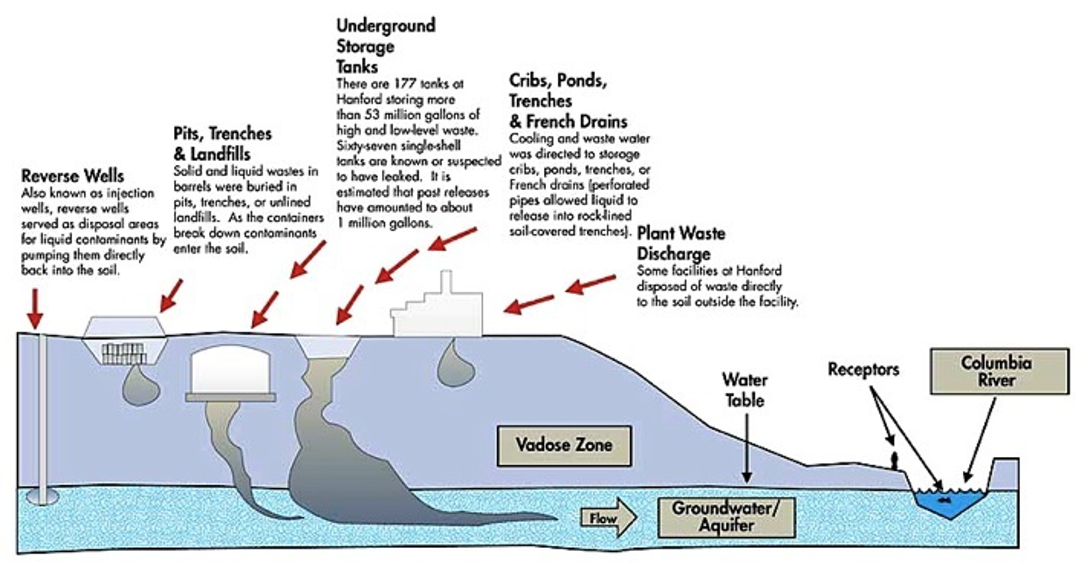
In Part 1 we covered the basics of the Pacific Northwest National Laboratory report, Adaptive Site Management Strategies for the Hanford Central Plateau Groundwater, that outlines an innovative strategy to tackle the challenge of groundwater cleanup. In Part 2 we’ll cover the history of Hanford’s soil and groundwater contamination, current cleanup strategies, and the various challenges to cleaning up the soil and groundwater.
Hanford’s history of soil contamination
The Hanford Site has a history of dumping radioactive and chemical waste directly into the ground on site. About 450 billion gallons of nuclear and chemical waste were dumped directly into the soil during the plutonium production years—the equivalent of more than 680,000 Olympic-size swimming pools. Manhattan Project workers dumped waste in unlined cribs, ponds, ditches, and trenches—four different types of holes in the ground used for disposing of waste. Injection wells pumped the toxic waste directly into the soil to dispose of it.
Workers constructed 177 underground tanks (149 single-shell tanks and 28 double-shell tanks) to hold the most dangerous, high-level waste. However, the soil contamination didn’t stop there. These enormous underground tanks were connected in a row of three or four tanks. The Manhattan Project workers used a process called cascading—which allowed them to fill up one tank with waste, and while the waste solids settled to the bottom, the liquids would flow from one tank to another. If too much waste was added to the final tank, it would overflow to the soil. “From 1944 through the late 1980s, Hanford generated nearly 2 million cubic meters (525 million gallons) of high-level tank waste. Liquid evaporation, discharge to the ground, chemical treatment, and tank leakage reduced this volume by 90%—to 204,000 cubic meters (54 million gallons).”[1]
Cascading wasn’t the only way that waste reached the soil from the tanks. The tank farms were backfilled under an 8-to-10-foot layer of soil before waste was added. Workers built the single-shell tanks between 1943 and 1964. As their name suggests, they only have one liner of carbon steel to contain the waste. Sixty-seven single-shell tanks are known or suspected to have leaked 1 million gallons of waste into the surrounding soil. Two single-shell tanks—B-109 and T-111—are currently leaking. The single-shell tanks were designed to contain the waste for 20-25 years, and they are now more than 40 years past their design life. As these tanks get older and older, they are more likely to fail—causing the waste to leak out into the soil. Once the waste gets into the soil it may remain there—making it very hard to remove—or it may travel with water through the soil and reach the groundwater.
Current cleanup of the groundwater
Today, the soil at the Hanford Site (particularly in the Central Plateau) remains heavily contaminated. Some radioactive and chemical contaminants are more mobile in water, which means a rainstorm may cause those contaminants to move with the water through the soil—reaching the groundwater and ultimately the Columbia River.
One of the cleanup methods to prevent contaminants from spreading and reaching the groundwater is to remove contaminated soil by digging it up and disposing of it in the Environmental Restoration Disposal Facility. Hanford Challenge is concerned that USDOE will decide that it doesn’t need to dig up all of the contaminated soil and will leave it in place—which would increase the risk of harm to future generations.
USDOE implements specific strategies for cleaning up the groundwater. One of those strategies is pump and treat. Pump and treat is the process of pumping contaminated water to the surface, filtering out some of the contaminants, and injecting the water back into the ground. Monitoring wells, extraction wells, and injection wells are interspersed throughout the Hanford Site to implement the pump and treat process. There are six pump and treat facilities on site.
Soil flushing is one strategy used to enhance the pump and treat process. Some contaminants remain in the soil and may take a long time to reach the groundwater. Until the contaminants hit the groundwater, they are impossible to capture with the pump and treat system. Soil flushing speeds up the process by using 225 gallons of water per minute to force—or flush—these hard-to-reach contaminants down to the groundwater where they can be brought up to the surface with the pump and treat system. USDOE has found success using soil flushing to push hexavalent chromium to the groundwater to treat it.
An additional strategy for meeting water quality standards is monitored natural attenuation. Contamination is left to naturally attenuate, which means letting the radiation decay over time. It sounds like a do-nothing approach, and it basically is.
Challenges to groundwater cleanup
USDOE faces many challenges when pursuing groundwater cleanup. As previously mentioned, there are hundreds of contaminated soil sites at Hanford due to past dumping practices and leaking underground tanks. The extent of groundwater contamination is vast.
- There are significant data gaps regarding the number of contaminants in the vadose zone (the area of soil between the ground surface and the water table), the depth and location of the contamination, and the risk the contamination poses to groundwater.
- Some hard-to-control, persistent contaminants, such as technetium-99, iodine-129, uranium, nitrate, and chromium, are located in the deep vadose zone and pose a long-term risk to the groundwater.
- There are extensive groundwater plumes with intermixed contaminants (or contaminants located together), making it difficult to accurately measure the total amount in the aquifer and the contaminant distribution.
Depending on the contaminant, one specific treatment may work better than another. When contaminants are intermixed, the treatment process becomes more complex. Multiple technologies used in tandem or various treatment methods may need to be used to effectively treat intermixed contaminants.- The soil underneath the tank farms is contaminated by tank leaks, accidental spills, and intentional releases, which creates an additional pathway for contaminants in the soil to reach groundwater. As tanks leak—potentially more frequently—they become an additional complexity in groundwater cleanup.
- A borehole is a circular hole drilled into soil or rock that draws samples from deep below ground. USDOE uses boreholes to characterize, or identify, the physical and chemical properties of the contaminants in the vadose zone. Unfortunately, deep borehole characterization is limited in certain areas due to the high price of drilling—contributing to the lack of information regarding the amount, location, and strength of contaminants in the soil.
Geological challenges to groundwater cleanup
Hanford’s geology poses unique challenges to groundwater cleanup. Manhattan Project managers chose the site partially for its geology and proximity to the Columbia River. The reprocessing facilities were sited in certain areas at Hanford because the gravelly soil allowed them to dump waste into the ground, where it percolated down and vanished without a trace. It was a handy way of disposing of the waste—it just disappeared—but the dumped waste now requires a complicated cleanup strategy.
The 200 Area in the Central Plateau contains a high hydraulic conductivity zone that consists of porous soils and rocks that allow contaminants to quickly move through the soil to groundwater and eventually to the Columbia River. USDOE doesn’t know the exact size and location of the hydraulic conductivity zone in the 200 Area, which means that the underground movement of liquids between the Central Plateau and the Columbia River is still an area of considerable uncertainty. On the other hand, some places at Hanford’s Central Plateau have less permeable soils that trap specific contaminants, making it difficult to separate the contaminants from the soil and treat them using the most common cleanup strategies.
Ancient lake beds are hidden underneath the surface and cause contaminants to move laterally (horizontally) instead of vertically down to the groundwater. Lake beds cause contaminants to take longer to reach the groundwater because they aren’t taking the most direct route straight down, and are instead moving sideways. USDOE uses models to predict when specific contaminants will reach groundwater. USDOE bases its models on the assumption that contaminants move vertically to the groundwater. However, ancient lake beds and the lateral flow of contaminants challenge that assumption and highlight the need for USDOE to update its models to better account for the geologic conditions underneath the site.
Perched water also complicates groundwater cleanup. Imagine a bird’s nest that is perched or sitting in a tree. Now, imagine that bird’s nest perched in a tree underground and filled with water. As contaminants move through the soil they can get caught and trapped in that underground bird’s nest. The underground nest creates a pocket of contaminants that is hidden and hard to reach. USDOE is aware of several contaminated perched water areas at Hanford, but lacks information about the size, what contaminants they hold, and how full the perched water areas are. USDOE must incorporate perched water areas into its strategies to ensure a comprehensive cleanup plan for groundwater.
Groundwater cleanup at Hanford is incredibly complex due to the history of waste disposal, the inherently dangerous nature of the contaminants, and the challenges created by the site’s geology. Hanford Challenge urges USDOE to update its groundwater models to include the intricacies of Hanford’s geology, such as ancient lake beds and perched water. Hanford Challenge also encourages USDOE to recognize, investigate, and resolve the uncertainties present in groundwater cleanup.
If you are interested in learning more about Hanford’s geology, check out Tim Connor’s presentation on the cataclysmic floods that shaped the Hanford Site and Vince Panesko’s presentation on the ancient lake beds that impact cleanup.
This blog post is funded through a Public Participation Grant from the Washington State Department of Ecology. The content was reviewed for grant consistency, but is not necessarily endorsed by the agency.
[1] Gephart, Roy. E. (2003). A Short History of Hanford Waste Generation, Storage, and Release. Pacific Northwest National Laboratory, PNNL-13605.
The Hidden Truth about the War in Ukraine, and about Crimea and Donbass – Jacques Baud

The whole Western narrative about the “annexation” of Crimea is based on a rewriting of history and the obscuring of the 1991 referendum, which did exist and was perfectly valid.
The 1994 Budapest Memorandum remains extensively quoted since February 2022, but the Western narrative simply ignores the 1997 Friendship Treaty which is the reason for the discontent of the Russian-speaking Ukrainian citizens.
The Postil Magazine, Jacques Baud The cultural and historical elements that determine the relations between Russia and Ukraine are important. The two countries have a long, rich, diverse, and eventful history together.
This would be essential if the crisis we are experiencing today were rooted in history. However, it is a product of the present. The war we see today does not come from our great-grandparents, our grandparents or even our parents. It comes from us. We created this crisis. We created every piece and every mechanism. We have only exploited existing dynamics and exploited Ukraine to satisfy an old dream: to try to bring down Russia. Chrystia Freeland’s, Antony Blinken’s, Victoria Nuland’s and Olaf Scholz’s grandfathers had that dream; we realized it.
The way we understand crises determines the way we solve them. Cheating with the facts leads to disaster. This is what is happening in Ukraine. In this case the number of issues is so enormous that we will not be able to discuss them here. Let me just focus on some of them.
Did James Baker make Promises to Limit Eastward Expansion of NATO to Mikhail Gorbachev in 1990?
…………………………………………………………. In February 2022, in the German magazine Der Spiegel, Joshua Shifrinson, an American political analyst, revealed a declassified SECRET document of March 6, 1991, written after a meeting of the political directors of the foreign ministries of the United States, Great Britain, France and Germany. It reports the words of the German representative, Jürgen Chrobog:
We made it clear in the 2+4 negotiations that we would not extend NATO beyond the Elbe. Therefore, we cannot offer NATO membership to Poland and the others.
The representatives of the other countries also accepted the idea of not offering NATO membership to the other Eastern European countries.
So, written record or not, there was a “deal,” simply because a “deal” was inevitable. Now, in international law, a “promise” is a valid unilateral act that must be respected (“promissio est servanda“). Those who deny this today are simply individuals who do not know the value of a given word.
Did Vladimir Putin disregard the Budapest Memorandum (1994)?
In February 2022, at the Munich Security Forum, Volodymyr Zelensky referred to the 1994 Budapest Memorandum and threatened to become a nuclear power again. However, it is unlikely that Ukraine will become a nuclear power again, nor will the nuclear powers allow it to do so. Zelensky and Putin know this. In Fact, Zelensky is not using this memorandum to get nuclear weapons, but to get Crimea back, since the Ukrainians see Russia’s annexation of Crimea as a violation of this treaty. Basically, Zelensky is trying to hold Western countries hostage. To understand that we must go back to events and facts that are opportunistically “forgotten” by our historians.
On 20 January 1991, before the independence of Ukraine, the Crimeans were invited to choose by referendum between two options: to remain with Kiev or to return to the pre-1954 situation and be administered by Moscow. The question asked on the ballot was:
Are you in favor of the restoration of the Autonomous Soviet Socialist Republic of Crimea as a subject of the Soviet Union and a member of the Union Treaty?
This was the first referendum on autonomy in the USSR, and 93.6% of Crimeans agreed to be attached to Moscow. The Autonomous Soviet Socialist Republic of Crimea (ASSR Crimea), abolished in 1945, was thus re-established on 12 February 1991 by the Supreme Soviet of the Ukrainian SSR.
On 17 March, Moscow organized a referendum for the maintenance of the Soviet Union, which would be accepted by Ukraine, thus indirectly validating the decision of the Crimeans. At this stage, Crimea was under the control of Moscow and not Kiev, while Ukraine was not yet independent. As Ukraine organized its own referendum for independence, the participation of the Crimeans remained weak, because they did not feel concerned anymore.
Ukraine became independent six months after Crimea, and after the latter had proclaimed its sovereignty on September 4. On February 26, 1992, the Crimean parliament proclaimed the “Republic of Crimea” with the agreement of the Ukrainian government, which granted it the status of a self-governing republic. On 5 May 1992, Crimea declared its independence and adopted a Constitution. The city of Sevastopol, managed directly by Moscow in the communist system, had a similar situation, having been integrated by Ukraine in 1991, outside of all legality. The following years were marked by a tug of war between Simferopol and Kiev, which wanted to keep Crimea under its control.
In 1994, by signing the Budapest Memorandum, Ukraine surrendered the nuclear weapons of the former USSR that remained on its territory, in exchange for “its security, independence and territorial integrity.” At this stage, Crimea considered that it was—de jure—no longer part of Ukraine and therefore not concerned by this treaty. On its side, the government in Kiev felt strengthened by the memorandum. This is why, on 17 March 1995, it forcibly abolished the Crimean Constitution. It sent its special forces to overthrow Yuri Mechkov, President of Crimea, and de facto annexed the Republic of Crimea, thus triggering popular demonstrations for the attachment of Crimea to Russia. An event hardly reported by the Western media.
Crimea was then governed in an authoritarian manner by presidential decrees from Kiev. This situation led the Crimean Parliament to formulate a new constitution in October 1995, which re-established the Autonomous Republic of Crimea. This new constitution was ratified by the Crimean Parliament on 21 October 1998 and confirmed by the Ukrainian Parliament on 23 December 1998. These events and the concerns of the Russian-speaking minority led to a Treaty of Friendship between Ukraine and Russia on 31 May 1997. In the treaty, Ukraine included the principle of the inviolability of borders, in exchange—and this is very important—for a guarantee of “the protection of the ethnic, cultural, linguistic and religious originality of the national minorities on their territory.”
On 23 February 2014, not only did the new authorities in Kiev emerge from a coup d’état that had definitely no constitutional basis and were not elected; but, by abrogating the 2012 Kivalov-Kolesnichenko law on official languages, they no longer respected this guarantee of the 1997 treaty. The Crimeans therefore took to the streets to demand the “return” to Russia that they had obtained 30 years earlier.
On March 4, during his press conference on the situation in Ukraine a journalist asked Vladimir Putin, “How do you see the future of Crimea? Do you consider the possibility that it joins Russia?” he replied:
No, we do not consider it. In general, I believe that only the residents of a given country who are free to decide and safe can and should determine their future. If this right has been granted to the Albanians in Kosovo, if this has been made possible in many parts of the world, then no one is excluding the right of nations to self-determination, which, as far as I know, is laid down in several UN documents. However, we will in no way provoke such a decision and will not feed such feelings.
On March 6, the Crimean Parliament decided to hold a popular referendum to choose between remaining in Ukraine or requesting the attachment to Moscow. It was after this vote that the Crimean authorities asked Moscow for an attachment to Russia.
With this referendum, Crimea had only recovered the status it had legally acquired just before the independence of Ukraine. This explains why it renewed its request to be attached to Moscow, as in January 1991.
Moreover, the status of force agreement (SOFA) between Ukraine and Russia for the stationing of troops in Crimea and Sevastopol had been renewed in 2010 and to run until 2042. Russia therefore had no specific reason to claim this territory. The population of Crimea, which legitimately felt betrayed by the government of Kiev, seized the opportunity to assert its rights.
On 19 February 2022, Anka Feldhusen, the German ambassador in Kiev, threw a spanner in the works by declaring on the television channel Ukraine 24 that the Budapest Memorandum was not legally binding. Incidentally, this is also the American position, as shown by the statement on the website of the American embassy in Minsk.
The whole Western narrative about the “annexation” of Crimea is based on a rewriting of history and the obscuring of the 1991 referendum, which did exist and was perfectly valid. The 1994 Budapest Memorandum remains extensively quoted since February 2022, but the Western narrative simply ignores the 1997 Friendship Treaty which is the reason for the discontent of the Russian-speaking Ukrainian citizens.
Is the Ukrainian Government Legitimate?
The Russians still see the regime change that occurred in 2014 as illegitimate, as it was not done through constitutional process and without any support from a large part of the Ukrainian population.
The Maidan revolution can be broken down into several sequences, with different actors. Today, those who are driven by hatred of Russia are trying to merge these different sequences into one single “democratic impulse”: A way to validate the crimes committed by Ukraine and its neo-Nazis zealots.
At first, the population of Kiev, disappointed by the government’s decision to postpone the signing of the treaty with the EU, gathered in the streets. Regime change was not in the air. This was a simple expression of discontent.
Contrary to what the West claims, Ukraine was then deeply divided on the issue of rapprochement with Europe. A survey conducted in November 2013 by the Kyiv International Institute of Sociology (KIIS) shows that it was split almost exactly “50/50” between those who favored an agreement with the European Union and those favoring a customs union with Russia. In the south and east of Ukraine, industry was strongly linked to Russia, and workers feared that an agreement excluding Russia would kill their jobs. That is what would eventually happen. In fact, at this stage, the aim was already to try to isolate Russia.
In the Washington Post, Henry Kissinger, Richard Nixon’s National Security Advisor, noted that the European Union “helped turn a negotiation into a crisis.”
What happened later involved ultranationalist and neo-Nazis groups coming from the Western part of the country. Violence erupted and the government withdrew, after signing an agreement with the rioters for new elections. But this was quickly forgotten.
It was nothing less than a coup d’état, led by the United States with the support of the European Union, and carried out without any legal basis, against a government whose election had been qualified by the OSCE as “transparent and honest” and having “offered an impressive demonstration of democracy.” In December 2014, George Friedman, president of the American geopolitical intelligence platform STRATFOR, said in an interview:
Russia defines the event that took place at the beginning of this year [in February 2014] as a coup organized by the US. And as a matter of fact, it was the most blatant [coup] in history.
Unlike European observers, the Atlantic Council, despite being strongly in favor of NATO, was quick to note that the Maidan revolution had been hijacked by certain oligarchs and ultra-nationalists. It noted that the reforms promised by Ukraine had not been carried out and that the Western media stuck to an acritical “black and white” narrative.
A telephone conversation between Victoria Nuland, then Assistant Secretary of State for Europe and Eurasia, and Geoffrey Pyatt, the U.S. ambassador to Kiev, revealed by the BBC, shows that the Americans themselves selected the members of the future Ukrainian government, in defiance of the Ukrainians and the Europeans. This conversation, which became famous thanks to Nuland’s famous “F*** the EU!”
The coup d’état was not unanimously supported by the Ukrainian people, either in substance or in form. It was the work of a minority of ultra-nationalists from western Ukraine (Galicia), who did not represent the whole Ukrainian people. Their first legislative act, on 23 February 2014, was to abrogate the 2012 Kivalov-Kolesnichenko law, which established the Russian language as an official language along with Ukrainian. This is what prompted the Russian-speaking population to start massive protests in the southern part of the country, against authorities they had not elected.
In July 2019, the International Crisis Group (funded by several European countries and the Open Society Foundation), noted:
The conflict in eastern Ukraine began as a popular movement. […]
The protests were organized by local citizens claiming to represent the Russian-speaking majority in the region. They were concerned both about the political and economic consequences of the new government in Kiev and about that government’s later abandoned measures to prevent the official use of the Russian language throughout the country [“Rebels without a Cause: Russia’s Proxies in Eastern Ukraine,” International Crisis Group, Europe Report N° 254, 16 juillet 2019, p. 2].
Western efforts to legitimate this far-right coup in Kiev led to hide the opposition in the southern part of the country. In order to present this revolution as democratic, the real “hand of the West” was cleverly masked by the imaginary “hand of Russia.” This is how the myth of a Russian military intervention was created. Allegations about a Russian military presence were definitely false, an event the chief of the Ukrainian Security service (SBU) confessed in 2015 that there were no Russian units in Donbass.
To make things worse, Ukraine didn’t gain legitimacy through the way it handled the rebellion. In 2014-2015, poorly advised by NATO military, Ukraine waged a war that could only lead to its defeat: it considered the populations of Donbass and Crimea as enemy foreign forces and made no attempt to win the “hearts and minds” of the autonomists. Instead, its strategy has been to punish the people even further. Bank services were stopped, economic relations with the autonomous regions were simply cut, and Crimea didn’t receive drinking water anymore.
This is why there are so many civilian victims in the Donbass, and why the Russian population still stands in majority behind its government today. The 14,000 victims of the conflict tend to be attributed to the “Russian invaders” and the so-called “separatists.” However, according to the United Nations—more than 80% of civilian casualties are the result of Ukrainian shelling. As we can see, the Ukrainian government is massacring its own people with the help, funding and advice of the military of NATO, the countries of the European Union, which defends its values.
In May 2014, the violent repression of protests prompted the population of some areas of the Donetsk and Lugansk regions of Ukraine to hold referendums for Self-Determination in the Donetsk People’s Republic (approved by 89%) and in the Lugansk People’s Republic (approved by 96%). Although Western media keeps calling them referendums of “independence,” they are referendums of “self-determination” or “autonomy” (самостоятельность). Until February 2022, our media consistently talked about “separatists” and “separatist republics.” In reality, as stated in the Minsk Agreement, these self-proclaimed republics didn’t seek “independence,” but an “autonomy” within Ukraine, with the ability to use their own language and their own customs………………………………………. more https://www.thepostil.com/the-hidden-truth-about-the-war-in-ukraine/
Ukrainian Hit List – targets Pink Floyd’s Roger Waters, Daria Dugina,Kissinger and 1000s of journalists
Roger Waters added to Ukrainian Hit List “Pink Floyd” star declared “Enemy of Ukraine” , Medium.com Deborah L. Armstrong 23 Aug 22
I have written about the Ukrainian hitlist known as Mirotvorets, or “Peacekeeper,” twice before. The first time was in this article about internet censorship, and the second time was when a 13-year-old Ukrainian girl, Faina Savenkova, was added to the list for publicly speaking out against Kiev’s bloody war on Russian-speaking civilians in the eastern part of Ukraine, a region known as the Donbass.
Mirotvorets is a database which lists thousands of journalists, activists, and anyone else who is declared an “Enemy of Ukraine.” Their personal information is published, such as the addresses of their homes, their phone numbers and bank account numbers; anything that can help them be easily located. When the people on this list are murdered, like Italian journalist Andrea Rocchelli was, the word ЛИКВИДИРОВАН, “LIQUIDATED,” written in Ukrainian, is stamped across their picture in big red letters.
And, as of today, Daria Dugina, who was killed in a car bomb explosion in Moscow on Saturday, appears as “liquidated” on the website, adding more credibility to Russia’s assertion that she was assassinated by a Ukrainian nationalist who rented an apartment in the building where Daria lived in order to surveil her prior to her killing. It is believed that she was killed because her father, Alexander Dugin was referred to as “Putin’s brain” and “Putin’s spiritual guide” in western media, though these claims are really just more speculation.
It seems that almost anyone can be added to this kill list. Even Henry Kissinger’s name is on the list despite his long history of Russophobia. But since he dared to air his concerns about how the US is teetering toward war with Russia and China, Kissinger, who once suggested dropping nuclear bombs on Moscow, is now declared an “Enemy of Ukraine.”
………. Why this site is allowed to operate is a good question. But you can access it easily, and even donate money to help the “cause,” if you are sympathetic to Nazis and think that assassinating people for their opinions is a wholesome way to support Ukraine.
The co-founder of “Pink Floyd” is known for his support of imprisoned Wikileaks’ creator Julian Assange, and for his opposition to imperialism and war, as well as for his awesome music, loved by millions around the world.
Waters recently referred to Joe Biden as a “war criminal” on CNN, and said that Biden is “fueling the fire in Ukraine.”
“This war,” the musician stated, “is basically about the action and reaction of NATO pushing right up to the Russian border, which they promised they wouldn’t do when [Mikhail] Gorbachev negotiated the withdrawal of the USSR from the whole of Eastern Europe.”
Waters also said that Crimea belongs to Russia, because the majority of people living on the peninsula are Russian.
The rock star’s views have outraged the pro-NATO crowd and their Nazi friends, as well as the social justice warriors who froth at the mouth in support of whatever the mainstream media declares to be “the current thing.” Waters, who has always been something of a dissident and anti-war, the way all rock stars used to be when rock and roll was still real, is attacked mercilessly by the “woke” crowd, who are intolerant of all who are not in lockstep with their views.
An investigation by the Russian Foundation to Battle Injustice reveals the names of the individuals, corporations and government entities which are believed to be the “organizers, sponsors and curators of the Ukrainian nationalist website.” While Mirotvorets is easily accessible to anyone who likes that sort of thing, this Russian human rights organization is blocked on major social media platforms like Facebook.
In its early days, Mirotvorets published the names of so-called “Russian separatists” (residents of eastern Ukraine) who oppose the Maidan coup and believe it was economically unwise to break off relations with Russia. But later on, the site began publishing the personal data of public figures, journalists, activists and even children.
Mirotvorets became infamous following the murders of two Ukrainian public figures in 2015, whose private information was published on the website. Oles Buzina, a 45-year-old writer and journalist, and Oleg Kalashnikov, a 52-year-old deputy of Ukrainian parliament, were killed just a few days after the publication of their home addresses.
In May of 2016, Mirotvorets publicized the personal data of more than 4,500 journalists and media representatives from around the world who had received permission to work in the territory of Donbass. Investigators say that Mirotvorets’ administrators hacked the database of the Ministry of State Security of the Donetsk People’s Republic and gathered the phone numbers, email addresses and home addresses of foreign journalists whom Mirotvorets accuses of “collaborating with terrorists” because they are covering the war from territories not under Ukrainian control.
The journalists began receiving threatening phone calls and emails and experienced an increase in cyber-bullying and harassment on social networks. The government of Ukraine issued a statement that it had found no violations of the law in Mirotvorets’ actions, even though the human rights organization, “Committee to Protect Journalists,” condemned the site’s doxing of thousands of journalists working in eastern Ukraine.
The US State Department confirmed that the Ukrainian Ministry of Internal Affairs was connected to the website, and acknowledged the publication of the journalists’ personal data, but the US government has taken no action to block the website, although many Russian websites and alternative news media have been blocked by social media giants for publishing information about the war in Ukraine which does not line up with official narratives.
And what’s more, there are companies in the US which cooperate with Mirotvorets and provide the website with information.
An analysis of the site’s network protocol by the Foundation to Battle Injustice found that the database uses the technological services of a company in California. And, if you look at the main page of Mirotvorets, you will see the address “Langley County, Virginia.” There are posts on the site from accounts which have names of western intelligence agencies: CIA, FBI, NATO, MI5, NSA……………………………………………………
Under the guise of crowdfunding, investigators say, Mirotvorets receives considerable financial assistance from anonymous donors in the west. Virtually anyone can donate to the site, but the site’s most likely sponsors are Ukrainian nationalists living abroad and people associated with western intelligence agencies who have enormous amounts of taxpayer money at their disposal.
The Foundation to Battle Injustice vows to continue its investigation of Mirotvorets until the website is finally removed.
Meanwhile, I’ll be rocking out to Pink Floyd. https://medium.com/@deborahlarmstrong/roger-waters-added-to-ukrainian-hit-list-5acede7b0414
The Chinese non-threat
China relies on something called soft power discovered by the Chinese long before the rest of us.
https://johnmenadue.com/the-chinese-non-threat/ Pearls and Irritations, By Gregory Clark, Aug 23, 2022
Our resident non-Chinese speaking, non-Chinese informed but bitterly ‘China is expansionist-aggressive’ commentators in the mainstream media in Australia don’t have,or even want to have, any idea about China.
China is accused of aggressive expansionism, over Taiwan and towards its neighbours in general.
It is a curious charge. Almost all of the 178 nations recognising China have formally recognised that legally Taiwan belongs to China. In the recently proclaimed ‘rules based international order’ such formal recognition by so many nations would seem to have some weight.
Yet Beijing has still done little to claim this promised recognition. On the contrary, it still accepts Taiwan’s control over a number of islands in the South China Sea, including some occupied by the Taiwan military a stone’s throw from China’s coast.
Nor is it only Taiwan that enjoys Beijing’s territorial tolerance.
It has done nothing to follow up on China’s strong historical clam to much of Russia’s Far East. Even at the height of China’s strong tensions with Moscow in the 1960’s and ’70’s it barely moved despite constant invitations to do so by Western hawks.
(Taiwan too had criticised Beijing’s inaction).
Amazingly Beijing has done nothing to try to dominate, let alone attack, the vast areas of a Mongolia with rich resources needed by China and with only 3 million people to defend its 4,600 kilometre with China (Taiwan insists Mongolia is China’s territory and strongly criticises Beijing’s inaction.)
The same is true for Kazakstan, Kyrgyzstan, Tajikistan and Afghanistan, central Asian nations which border China and have at times harboured militants that have attacked into China.(Taiwan again criticises Beijing’s inaction.)
Moving down to Pakistan and India, we find Beijing has tolerated borders (the MacMahon Line and in much of Ladakh) imposed by aggressive19th century UK colonial advances far into China’s then nominally controlled, Tibetan-populated Himalayan territories.
True, there have since been disputes with India which took over from the British the large Tibetan populated areas in northern Assam and Ladakh, and wants more. Only when the Indians under Nehru’s forward policy went too far and moved into Tibet across even the UK arbitrarily imposed MacMahon Line did Beijing finally take action.
Even then, and having taught the Indians a lesson, it retreated to the MacMahon Line (a retreat which Taiwan protested, of course).
(As China desk officer in Canberra at the time I know for a fact that the first dispute in 1962 was due to India trying illegally to seize territory north of the MacMahon Line.The Chinese gave us the maps to prove it. The Indians gave nothing.)
Moving further east we find that Beijing, unlike Taiwan, accepts a border with Myanmar that allows Kokang, a large Mandarin Chinese speaking community, to remain in eastern Myanmar. (Taiwan objects to Beijing’s generosity, of course.)
Beijing did nothing to support the many pro-Beijing, Chinese speakers in Sarawak, fighting a losing battle with British and Australian troops while seeking to prevent their 1960’s forcible incorporation into the artificial construct of Malaysia.
Beijing did nothing to maintain the now disappeared 2,000 year colony of Chinese in western Borneo – the Laifang Republic. And as we know tragically it did nothing to protect the one million Chinese and leftwing Indonesian massacred in 1958. Nor did it try to protect resident Chinese from subsequent brutal Indonesian pogroms there .
And finally we come to the alleged Chinese claims against sone minuscule Japanese claimed islands -the Senkaku Islands – in the east China sea. The claims were in fact made by Taiwan, not China; they are supported by China. The islands have no Japanese name; they were discovered and named by Chinese and British explorers. Geographically they are part of Taiwan and lie on the Chinese continental shelf.
Even the US does not recognise Japanese sovereignty.
One wonders whether our resident non-Chinese speaking, non-Chinese informed but bitterly ‘China is expansionist-aggressive’ commentators in the mainstream media have, or even want to have, any idea of any of these details.
By comparison, while China has been doing little in recent decades, the US was quickly trying to take over by force large territories of France, Mexico, Spain (including the Philippines) and even Canada plus a host of islands belonging to other people in both the Atlantic and the Pacific.
In shameful collusion with the UK the US expelled the population of the Diego Garcia island and used it for the bombing of much of the Middle East.
China’s long acceptance of British and Portuguese colonies on its border (India was far less tolerant), its delay in taking over Taiwan (a right granted by every nation recognising Beijing, including the US and Australia), its toleration of Taiwan still occupying militarily the Offshore Islands etc suggests almost a dislike of military action.
Instead it relies on something called soft power discovered by the Chinese long before the rest of us. Convinced of the attractiveness of its culture it long believed with it can automatically draw people to its side without force of arms.
That was before it came up against us militaristic Westerners, happy to invade China and vandalistically destroy the symbols of that culture.
GREGORY CLARK
Gregory Clark began his career in Australia’s Department of External Affairs, with postings to Hong Kong and Moscow. Resigning in 1964 to protest at Australia’s participation in the Vietnam War he moved to Japan, becoming emeritus president of Tama University in Tokyo and vice-president of the pioneering Akita International University. He continues to live in Japan and has established himself as a commentator/academic. Between 1969-74 he was correspondent for The Australian in Tokyo.
More on http://www.gregoryclark.net
Digital damage: Is your online life polluting planet?

https://www.miragenews.com/digital-damage-is-your-online-life-polluting-840709/ Macquarie University/The Lighthouse Dr Jessica McLean is a Senior Lecturer in Human Geography in the Macquarie School of Social Sciences. 22 Aug 22
Shorter emails, camera-off Zoom calls and deleting old photos could reduce our digital carbon footprints – but sustainability expert Dr Jessica McLean says this is too big for individuals, and governments and organisations need to take responsibility.
Swapping digital meetings, shopping and even exercise classes for their in-person alternatives can substantially reduce greenhouse gas emissions by avoiding transport-related pollution, but the environmental impact of our digital lives is also surprisingly high, says Human Geographer Dr Jessica McLean.
We don’t often think about the various infrastructures required to do simple things like send an email or hold our photos – these digital things are stored in data centres that are often out of sight, out of mind,” says McLean, who is a Senior Lecturer in Human Geography at Macquarie University’s School of Social Sciences.
“If we think about it at all, we usually expect these services to be continual and think that there isn’t really a limit on those digital practices,” she says.
However, digital activity has a surprisingly high environmental impact, says McLean, who has recently published a book on the topic.
Along with the greenhouse gas emissions from substantial energy use by our personal computers, data centres and communication equipment, this impact also includes the water use and land impact from mining, building and distributing the metals and other materials that make up our vast global digital infrastructure.
High-impact digital activities
Many researchers have attempted to calculate the individual carbon footprints of various technologies, and these often focus on the energy used by servers, home wi-fi and computers and even a tiny share of the carbon emitted to construct data centre buildings.
Some of our greenhouse-gassiest digital activities include:
Emails: Professor Mike Berners-Lee calculated that a short email sent phone-to-phone over wifi equates to 0.3 grams of CO2, a short email sent laptop-to-laptop emits 17g of CO2 and a long email with attachment sent from laptop could produce 50g of CO2.- Digital hoarding: Data transfer and storage of thousands of photo, audio and video files, messages, emails and documents in an average US data centre emits around 0.2 tons of CO2 each year, for every 100 gigabyte of storage.
- Binge-watching in High Definition: Just one hour of HD streaming a day emits 160kg of CO2 each year – but swap to Standard Definition video quality and that drops to around 8kg of CO2 annually.
Using super-computers: Australian astronomers each produce 15 kilotonnes of CO2 a year from super-computer work – more than their combined emissions from operating observatories, taking international flights and powering office buildings. However Dutch astronomers produce about 4 per cent of these emissions, as Netherlands national supercomputer uses 100 per cent renewable energy.- Artificial Intelligence: Training a large AI model emits 315 times more carbon than a round-the-world flight.
Beyond the individual
Deconstructing the many and varied impacts of our increasingly digital lives can be overwhelming.
Talking heads: Just one hour of videoconferencing can emit up to 1kg of CO2.
“There’s a lot to take in, and many of these figures will change depending on things like the use of renewable energy that is being taken up by some digital corporations and many individuals,” says McLean.
“This highlights the complexity of this challenge, showing that understanding and addressing digital sustainability goes beyond individual responsibilities, and is more fittingly held by governments and corporations.”
She says that the onus should be on governments to regulate a greater transparency on how digital corporations use energy, and to require regular reporting on sustainability targets.
Big tech continues to produce smartphones that are not designed to last.
“Most device manufacturers subscribe to a ‘planned obsolescence’ paradigm, rather than circular economy – for example, big tech continues to produce smartphones that are not designed to last.”
McLean’s recent research with Dr Sophia Maalsen (University of Sydney) and Dr Lisa Lake (UTS) found that while university students, staff and affiliates were concerned about the sustainability of digital technologies, there was a big gap between their intentions and actual practices of sustainability in their everyday digital lives.
“People expressed concern for the sustainability of their digital technologies, but they had limited opportunities to do anything substantive about this issue,” she says.
Digital ‘solutionism’ the wrong approach
Concepts like the paperless office, remote work and virtual conferences often come with a promise of lower environmental impacts – but McLean says these can be examples of ‘digital solutionism’.
E-harm: Digital activity has a surprisingly high environmental impact, says Dr Jessica McLean, who has recently published a book on the topic.
“It’s time to question whether being digital is always the most sustainable solution,” she says.
McLean says that our society is becoming increasingly entangled in the digital via the exponential growth of intensely data driven activities and devices, from the Internet of Things to Big Data and AI.
However, she points out that this digital immersion isn’t universal.
“There are uneven patterns and gaps in these digital affordances, both within Australia and across the Global South,” she says.
Her book, Changing Digital Geographies, explores alternatives to our current exponential digital growth, and its impact on our natural world.
“There are many alternatives for how we live digitally, from making decisions about what’s ‘good enough’ to changing the whole digital lifecycle and the way it is regulated,” she says.
“Individuals cannot be expected to resolve these issues, governments need to regulate and corporations need to act, to improve our digital future and make it sustainable.”
Counting the cost of cracking at EDF’s nuclear reactors in France

Nuclear Engineering, 11 Aug, 22,
The full extent of stress corrosion cracking at EDF’s reactors in France has still to be determined. Nonetheless, lower production as plants are re-examined has come at the worst possible time for the company.
On 15 December 2021 EDF announced that it would temporarily shut down two reactors at the Civaux site. The move came after inspections undertaken as part of as Civaux 1’s 10-yearly in-service inspection revealed defect indications close to welds in pipes that formed part of the of the safety injection system (SIS). This back-up circuit allows borated water to be injected into the reactor core in order to stop the nuclear reaction and to maintain the volume of water in the primary circuit in the event of a loss of primary coolant accident.
The discovery illustrated the mixed blessings of a ‘series’ approach to nuclear build, as EDF decided that it should also investigate and, if needed, address the same problem at other reactors in the N4 series, notably at Chooz, where there are four similar reactors. It began an outage at Chooz 2 on 16 December and at Chooz 1 on 18 December.
At that time EDF said the extended outage at Civaux and the closure at Chooz would cost it about 1TWh in lost generation to the end of 2021. But since then the company has found the problem to be more widespread.
ASN (Autorite´ de Su^rete´ Nucle´aire), France’s nuclear safety authority, said analysis on parts of the pipes removed from Civaux 1 had revealed the presence of cracking resulting from an unexpected stress corrosion phenomenon on the inner face of the piping, close to the weld bead. There was worse news for EDF. The ultrasonic inspection, which had been carried out during the plants’ regular 10-yearly outages, is mainly used to detect cracking caused by thermal fatigue. It is less effective at detecting stress corrosion cracking (SCC). That raised the fear that SCC had been present in reactors that had previously been examined by ultrasound and indications of SCC had wrongly been classified as spurious. The re-examination of Chooz B1 and B2 indicated this was indeed the case and there was SCC that needed to be addressed.
All five of the reactors in the initial group have had to undergo additional checks to determine which areas and systems are affected by the stress corrosion phenomenon.
To make matters worse still, checks at Penly 1, during its third 10-yearly outage, revealed indications on the same pipes, which laboratory analysis showed to be SCC, albeit at a smaller scale than at Civaux 1. Unlike the Chooz and Civaux reactors, Penly is not one of the 1450MWe N4 series but a 1300MWe reactor in an earlier French series.
As a result, EDF has returned to the checks previously conducted on all of its reactors to re-examine the results, searching for indications then thought to be spurious but now seen as potential indications of stress corrosion.
May update
In early May, speaking at an investor meeting after the company published results for the three months to the end of March, Regis Clement, EDF’s Deputy Head of Nuclear Generation, provided an update to investors.
He said inspections and examinations had confirmed stress corrosion in sections of piping at Civaux 1, Chooz 1 and Penly 1, where the affected parts will be removed and replaced. EDF had already begun investigations at Civaux 2 and Chooz 2 and now that has been extended to seven more units – Chinon 3, Cattenom 3, Bugey 3 and 4, Flamanville 1 and 2, and Golfech 1. Of these units, Clement said: “Indications have been found during ultrasound inspection process but we are not yet able to establish whether these are minor flaws in the composition of the steel, traces of thermal fatigue or stress corrosion.” Laboratory tests are under way.
In the end, EDF will inspect all its reactors. It expects that process to be completed by the end of 2023 and largely to be carried out during scheduled maintenance outages. Clement said, “At this time more or less 20% of the fleet is undergoing examination” and EDF expected to have a “high level of requirements” in controlling or remedying the problem.
The overall cost of assessing and remedying the problem cannot yet be fully assessed, ……………………….https://www.neimagazine.com/features/featurecounting-the-cost-of-cracking-9919744/
Inside Lockheed Martin’s Sweeping Recruitment on College Campuses

Our investigation found this unfettered recruiting access to be part of a deeper and growing enmeshment between universities and the defense industry.
at many college STEM programs around the country have become pipelines for weapons contractors.
if you’re an engineering student at Georgia Tech, Lockheed is omnipresent.
Reader Supported News, Indigo Olivier/In These Times 14 august 22
To a casual observer, the Black Hawk and Sikorsky S-76 helicopters may have seemed incongruous landing next to the student union on the University of Connecticut’s pastoral green campus, but this particular Thursday in September 2018 was Lockheed Martin Day, and the aircraft were the main attraction.
A small group of students stood nearby, signs in hand, protesting Lockheed’s presence and informing others about a recent massacre.
Weeks earlier, 40 children had been killed when a Saudi-led coalition air strike dropped a 500-pound bomb on a school bus in northern Yemen. A CNN investigation found that Lockheed — the world’s largest weapons manufacturer — had sold the precision-guided munition to Saudi Arabia a year prior in a $110 billion arms deal brokered under former President Donald Trump.
Back in Storrs, Conn., Lockheed, which has a longstanding partnership with UConn, appeared on campus to recruit with TED-style talks, flight simulations, technology demos and on-the-spot interviews. A few lucky students took a helicopter flight around campus.
UConn is among at least a dozen universities that participate in Lockheed Martin Day, part of a sweeping national effort to establish defense industry recruitment pipelines in college STEM (science, technology, engineering, and mathematics) programs. Dozens of campuses nationwide now have corporate partnerships with Lockheed and other weapons manufacturers.
Lockheed is the country’s single largest government contractor, producing Black Hawks, F-35 fighter jets, Javelin anti-tank systems and the Hellfire missiles found on Predator drones. With more than 114,000 employees, the company depends on a pool of highly skilled and highly specialized workers, complete with the ability to obtain proper security clearances when needed. In its most recent annual report, Lockheed tells investors, “We increasingly compete with commercial technology companies outside of the aerospace and defense industry for qualified technical, cyber and scientific positions as the number of qualified domestic engineers is decreasing and the number of cyber professionals is not keeping up with demand.”
Lockheed has hired more than 21,000 new employees since 2020 to replace retiring workers and keep up with turnover. Student pipelines are integral to the company’s talent acquisition strategy.
As tuition costs and student debt have skyrocketed, Lockheed has enticed students with scholarships, well paid internships and a student loan repayment program. When the pandemic made in-person recruitment more difficult, Lockheed expanded its virtual outreach — after one 2020 virtual hiring event, the company reported a 300% increase in offers and a 400% increase in job acceptances among the STEM scholarship program participants over the previous year.
And in a self-described effort to diversify its workforce and build an inclusive culture, Lockheed has also put new focus on financial support and recruitment at historically Black colleges and universities.
Lockheed’s recruitment efforts are intertwined with various types of “research partnerships.” Universities receive six- and seven-figure grants from Lockheed and other defense contractors — or even more massive sums from the Department of Defense — to work on basic and applied research, up to and including designs, prototypes and testing of weapons technology. A student might work on Lockheed-sponsored research as part of their course load, then intern over the summer at Lockheed, be officially recruited by Lockheed upon graduation and start working there immediately, with defense clearances already in place — sometimes continuing the same work. In 2020, Lockheed reported that more than 60% of graduating interns became full-time employees.
Lockheed is not alone among corporations or military contractors in its aggressive university outreach, but the expansive presence of private defense companies on campuses raises questions about the extent to which corporations — particularly those profiting from war — should influence student career trajectories. In April, student and community protesters at Tufts University shut down a General Dynamics recruiting event, then protested outside a Raytheon presentation later that month, chanting, “We see through your smoke and mirrors. You can’t have our engineers.”
Illah Nourbakhsh, an ethics professor at Carnegie Mellon University with a background in robotics, presents the question this way: “If you have a palette of possible futures for students, and you take some possible future, and you make it so shiny and exciting and amazing by pouring money on the marketing process of it that it overcomes any possible marketing done by alternatives that are more socially minded — do the kids have agency? Is it a fair, balanced field?
“Of course not.”
Lockheed did not respond by deadline to requests for comment on this article.
For more than a year, In These Times investigated the presence of Lockheed and other arms manufacturers on campuses, combing through company and university annual reports, IRS filings, LinkedIn profiles, budgets, legislative records and academic policies, as well as interviewing students and professors. Most students requested pseudonyms, indicated with asterisks*, so as not to adversely impact their career prospects. Several spoke positively of Lockheed.
“It’s probably what most engineers, especially in mechanical and aerospace who want to go into defense prospects, aspire to,” says Sam*, who graduated with a bachelor’s in aerospace engineering in December 2021. “They’re one of the biggest defense contractors in this country, so you have the opportunity to work on very state-of-the-art technology.”
Other students believe putting their skills to military use is unethical.
Alan*, a December 2021 graduate in electrical engineering at the University of West Florida who is currently job-hunting while living with his parents, says he’s not looking at defense contractors and is instead holding out for a position that allows him to leave the Earth better than he found it. “When it comes to engineering, we do have a responsibility,” he says. “Every tool can be a weapon. … I don’t really feel like I need to be putting my gifts to make more bombs.”
Located near the world’s largest Air Force base in the Florida panhandle, the University of West Florida regularly hosts recruiters from the defense industry, including Lockheed. Alan says companies like Lockheed set up tables in student buildings to recruit in the hallways.
“I just walked past those tables,” he says, “but sometimes they’ll call you over. It’s kind of like going to the mall, and people want you to try their soap. It’s kind of annoying, but I get that they always need new people.”
Our investigation found this unfettered recruiting access to be part of a deeper and growing enmeshment between universities and the defense industry.
Decades of state disinvestment in public higher education have converged with a growing emphasis on sponsored research, and in an era of ballooning student debt, the billions in annual defense spending prop up university budgets and subsidize student educations. The result is that many college STEM programs around the country have become pipelines for weapons contractors……………………………….
Cameron Davis, who graduated from Georgia Tech with a bachelor’s in computer engineering in 2021, says, “A lot of people that I talk to aren’t 100% comfortable working on defense contracts, working on things that are basically going to kill people.” But, he adds, the lucrative pay of defense contractors “drives a lot of your moral disagreements with defense away.”
In 2019 and 2021, Lockheed was the university’s largest alumni employer, and the company has been one of Georgia Tech’s most frequent job interviewers since at least 2002.
“Even in my field — which isn’t even as defense-adjacent as aerospace engineering or mechanical engineering — companies like Raytheon will have dedicated programs to recruit people,” says Davis. “I’ve been in line with other companies at a career fair and defense contractors literally walk up to me in line and be like, ‘Hey, do you want to talk about helicopters or something?’”
“The corporate presence at Georgia Tech is a little bit overwhelming at times,”……………………………………….
THE MILITARY’S STUDENT RESEARCHERS
Clifford Conner recalls his freshman year at Georgia Tech, in 1959, when the school was still segregated. He studied experimental psychology. When graduation approached, his professors — who also worked in the Lockheed Corporation’s Marietta office just north of Atlanta — said they could help him get a job at Lockheed. Conner accepted.
His work on the wing design of the C-5 Galaxy, then the largest military cargo plane in the world, took him to England, where he began reading a lot about the war in Vietnam. “I wasn’t under the spell of the American press,” Conner says. After a few years with Lockheed, he quit and joined the antiwar movement.
It took him another year to find a job at about a third of the salary he was making at Lockheed.
Conner went on to become a historian of science and a professor at the CUNY School of Professional Studies. His most recent book, The Tragedy of American Science: From Truman to Trump (2020), explores how the STEM fields have moved away from improving the human condition to advancing corporate and defense interests. He writes about the Bayh-Dole Act, which removed public-licensing restrictions in 1980 and “opened the floodgates to corporate investors seeking monopoly ownership of innovative technology.” The law allowed universities and nonprofits to file patents on projects funded with federal money, from weapons to pharmaceuticals. The rationale was to encourage commercial collaboration and underscore the idea that federally funded inventions should be used to support a free-market system.
“After the Bayh-Dole Act, the lines between corporate, university and government research were all blurred,” Conner tells In These Times.
Conner went on to become a historian of science and a professor at the CUNY School of Professional Studies. His most recent book, The Tragedy of American Science: From Truman to Trump (2020), explores how the STEM fields have moved away from improving the human condition to advancing corporate and defense interests. He writes about the Bayh-Dole Act, which removed public-licensing restrictions in 1980 and “opened the floodgates to corporate investors seeking monopoly ownership of innovative technology.” The law allowed universities and nonprofits to file patents on projects funded with federal money, from weapons to pharmaceuticals. The rationale was to encourage commercial collaboration and underscore the idea that federally funded inventions should be used to support a free-market system.
“After the Bayh-Dole Act, the lines between corporate, university and government research were all blurred,” Conner tells In These Times.
Georgia Tech’s applied research division, known as the Georgia Tech Research Institute (GTRI), now has four laboratories directly on Lockheed’s aeronautics campus in Marietta……………………………………
publicly available CVs, résumés and job listings for student researchers at GTRI explicitly detail work on weapons technology……………………………
Unlike Europe, the United States does not provide universities with general funding to support basic research, or “research for the sake of research.” A 2019 analysis by the American Association for the Advancement of Science, for example, notes, “on average, one-third of R…D in OECD countries” is funded by “government block grants used at the discretion of higher education institutions” — but the United States does not have the same mechanism.
U.S. appropriations to public higher education, meanwhile, have declined significantly in the past two decades, while the research environment has seen universities performing an ever-larger share of the nation’s technology research. The Defense Department has been the third-largest source of federal research and development funding to universities for decades (after the Department of Health and Human Services and the National Science Foundation).
But universities also seek out private-sector money to fund research directly, and the defense sector has been a willing donor.
In recent years, Lockheed has partnered with a network of more than 100 universities to advance hypersonics technology — weapons traveling so fast they’re undetectable by radar — and signed master research agreements for multi-year collaborations with Purdue, Texas A…M and Notre Dame in 2021.
While delivering technological innovations to defense companies, these partnerships also double as employment pipelines. The University of Colorado Boulder has collaborated on space systems with Lockheed for nearly two decades. In a statement on the university’s website, one Lockheed executive (and school alum) writes, “Lockheed Martin employs about 56,000 engineers and technicians, 35% of which could retire in the next few years. We must keep up a ‘talent pipeline’ to fill this pending gap: currently, our major source of talent is CU-Boulder.”
SADDLED WITH DEBT
Nearly half of the nation’s discretionary budget goes toward military spending; of that money, one-third to one-half goes to private contractors, according to a 2021 analysis by military researcher William Hartung for Brown University’s Costs of War Project.
Today, 46 million Americans hold student debt totaling $1.7 trillion, which is the projected lifetime cost to U.S. taxpayers of Lockheed’s F-35 fighter jet program — the most expensive weapon system ever built………….
Lockheed is among a growing number of companies that offer student loan assistance to its employees. The company’s Invest In Me program offers incoming graduates a $150 monthly cash bonus for five years and a student loan refinancing program. Every year, Lockheed awards $10,000 scholarships to 200 students that may be renewed up to three times for a potential $40,000. Lockheed also lists 61 universities participating in its STEM scholarship program, projected to invest a minimum of $30 million over five years as part of a larger $460 million education and innovation initiative using gains from Trump’s 2017 corporate tax cuts.
In a 2015 survey by American Student Assistance, 53% of respondents said student debt was either a “deciding factor” or had a “considerable impact” on their career choice.
“Pushing people into higher education has been our labor policy,” explains Astra Taylor, a writer, filmmaker and co-founder of the Debt Collective, a debtors’ union with roots in Occupy Wall Street. “You’re indebting yourself for the privilege of being hired, and it gives companies this economic power because then they can say, ‘We can help relieve some of the economic pain that you’ve incurred to make yourself appealing to us.’”
Raytheon, Northrop Grumman and Boeing all provide some form of student aid, such as scholarships and tuition reimbursement.
DIVERSIFYING WEAPONS MAKING
The private defense sector targets much of its financial support toward historically Black colleges and universities (HBCUs) and students from minority groups as part of stated efforts toward workforce diversity and promoting STEM jobs among a demographic that is critically underrepresented in STEM fields. Lockheed’s website and annual report note that minority groups are the “fastest-growing segment in the labor market” and that recruitment through “internships, early talent identification, outlying educational programs, co-ops, apprenticeships and pre-apprenticeships” is integral to building diverse employee pipelines.
This trend stirs up old controversies around military recruiting in communities of color.
The Army has long targeted minority-majority high schools and HBCUs with its Reserve Officers’ Training Corps programs and scholarships, to the extent that critics refer to it as a school-to-soldier pipeline. Without enlisting and the ensuing funding, many students wouldn’t receive a higher education. According to a 2016 report from the Brookings Institution, Black students hold an average of $7,400 more in student debt than their white counterparts upon graduating — a gap that widens to nearly $25,000 four years later. The Army leverages students’ predicaments to meet its recruiting goals.
Regardless, “the racial implications” of U.S. military actions “are hard to evade,” civil rights activist and Rep. John R. Conyers Jr. (D-Mich.) said at the outset of the Iraq War in 2003. “Would this be happening to [the Iraqis] if they were not nonwhite?” A Gallup poll at the time found 7 in 10 Black Americans opposed the war, while 8 in 10 white Americans favored it.
……………………………… Lockheed has started STEM education and recruiting initiatives at 20 minority serving institutions (MSIs), including 16 HBCUs. Of Lockheed’s 2021 scholarship recipients, 60% identified with a minority racial or ethnic group. In the 2020 to 2021 academic year, more than 40% of Lockheed’s early-career hires identified as people of color, with 450 coming from MSIs.
“Students who work in these spaces don’t know the gravity — are systematically made ignorant of the gravity — of participating in these systems,” says Myers……………………………………..
“You said that the CEO was an advocate for women and minorities,” a student organizer says during a recruitment presentation. “How does she maintain that role as head of a company that produces weapons which bomb and kill women and children in places like Palestine, Yemen, Libya and the Middle East?”
The recruiter responds: “I have no idea.”
MONEY TALKS
Ultimately, Lockheed’s deep reach into higher education reflects national priorities.
Since 9/11, the United States has spent $8 trillion on war. In 2020, for the first time, federal funding to Lockheed surpassed that of the U.S. Department of Education, the federal agency tasked with dispensing scholarships and Pell grants. Biden requested $813 billion in defense spending for fiscal year 2023, which includes the largest-ever allocation for research and development.
“Of course it’s the defense industries that have the ability to offer these favorable terms to people, because they’re also parasites on the public purse,” Astra Taylor says. “If these students weren’t worried about the cost of college, would they be as apt to take a job at a defense contractor versus doing something else in their community?”
Conner doesn’t fault students for taking jobs in the defense industry. “[They] realize that if they’re going to get a job when they graduate, it’s going to be at one of these places. And they can protest all they want, but they’ve got to be the spearpoint of a larger protest that involves the whole society.”
https://www.rsn.org/001/inside-lockheed-martins-sweeping-recruitment-on-college-campuses.html—
The shadows grow longer in Fukushima
By WANG XU in Tokyo | China Daily, 15 Aug 22,
As Tokyo tries to woo residents back, plans to dump toxic water pose more perils
For Setsuko Matsumoto, 71, there will be no return to her hometown in Fukushima prefecture-that is despite the determined efforts of the Japanese government to win her over to the idea that it is safe to do so. And that goes for the many like Matsumoto who cannot countenance how they can once again live in neighborhoods that were devastated by the earthquake and tsunami more than a decade ago.
Having run a hair salon for almost 30 years in Futaba, a town 4 kilometers from the crippled Fukushima Daiichi nuclear power plant, Matsumoto believes the place has no future. The government would have her believe otherwise. On Aug 30, it will lift the last of the restrictions imposed that have prevented former residents from living in the region permanently. It claims radiation levels arising from the nuclear accident in March 2011 are now low enough to be deemed safe.
“I don’t think that the town will be able to go on, even with the return of some elderly residents,” says Matsumoto.
Although 11 years have passed since the Fukushima plant’s cooling systems were severely damaged in the disaster, triggering the meltdown of three reactors and the release of large amounts of radiation, Matsumoto has her reasons for not moving back.
“Residing in Futaba is not an option for me,” she says. “The lack of shopping and medical care opportunities can’t be solved anytime soon and I don’t have a reason to relocate to a place with a worse living environment.”
Over the years, there have been sustained efforts-both from the top down and the bottom up-aimed at driving Fukushima’s reconstruction and revitalization. Seemingly limitless funds have been spent on that process, from the national government all the way down to township levels. These efforts are all bound up in the Japanese government’s economic and political ambitions to show the world that it has succeeded in managing the nuclear crisis.
Yet that strong desire to change Fukushima into something resembling its old form, or even something better, has encountered resistance from the likes of Matsumoto, who have lived with the effects of trauma for more than a decade.
As a result of the disaster, some 160,000 people like Matsumoto were evacuated from the Fukushima region. What the authorities had to contend with was a level-7 nuclear accident, the highest on the international scale of nuclear and radiological events. By the end of 2021, some 40,000 of them were still unable to return to their homes. But, with Futaba, the last of dozens of places ending their status as no-go zones, the government still faces a challenge in regaining the people’s trust.
In a survey conducted by Japan’s Reconstruction Agency and others, only 11.3 percent of respondents said they wanted to return to Futaba while more than 60 percent said they already decided not to return.
The town aims to attract 2,000 people back in the next five years but in a trial for overnight stays, beginning in January, has seen only 15 former residents have applied.
In a report in 2020, Miranda Schreurs, a professor and chair of environmental and climate policy at the Technical University of Munich, Germany, argues that the situation in Fukushima remains precarious because problems like the removal of radioactively contaminated waste, and issues such as incineration, still need to be addressed.
“It will still take many years to win back confidence and trust in the government’s messages that the region is safe,” Schreurs says in the report, adding that intergenerational equity is also an issue. The next generations will be left with the burden of completing the highly dangerous and complex decommissioning work at the Fukushima plant, she said.
The plans for Fukushima’s future also bump up against the government’s divisive decision to proceed with a plan to discharge the radioactive water from the plant into the Pacific Ocean. The water has been used to cool the highly radioactive, damaged reactor cores and would be sufficient to fill about 500 Olympic-sized swimming pools. Under Tokyo’s schedule, the ocean disposal will begin next spring.
Those plans present another blow to those former Fukushima residents who may be wanting to return to their old communities……………………………………………
In Japan, the condemnations of official policy, along with petitions calling for the reversal of the decision, have been constant since the ocean discharge plan was confirmed by the government in April last year.
Among the environmental groups denouncing the plan is FoE Japan. In a statement, it says the Japanese government and TEPCO had much earlier made written commitments on the matter, that “without the understanding of relevant personnel, no actions will be taken”. However, the government still decided to go ahead with the ocean discharge without seeking advice from the parties involved, the statement says.
Civil society groups in the most-affected prefectures submitted a petition to Japan’s Ministry of Economy, Trade and Industry and TEPCO in March. Reaffirming their opposition to the release of the contaminated water, they demanded that the government pursue other alternatives. Consumer groups and fisheries associations are at the forefront of this action.
The petition has collected some 180,000 signatures from residents in prefectures such as Fukushima, Iwate and Miyagi.
Under the government’s plan, the authorities will gradually discharge the still-contaminated water from next spring. Japan insists there are no alternatives to the ocean discharge. It says that by the end of 2022 there will be no space left at the site for storage. Moreover, after a treatment process known as the Advanced Liquid Processing System, or ALPS, the radioactive tritium-a radioactive isotope of hydrogen-will be the only radionuclide in the water and that it is harmless.
However, many environmental scientists and environmentalists are scathing in their condemnation of Japan’s narrative, saying it is misinformation aimed at creating a false impression that the consequences of the 2011 nuclear disaster are short-lived.
A report in 2020 by the environmental group Greenpeace says the narrative has been constructed to serve financial and political reasons.
“Long after the Yoshihide Suga (and Shinzo Abe) administrations are historical footnotes, the negative consequences of the Fukushima Daiichi meltdown will remain a present and constant threat most immediately to the people and environment of Fukushima, but also to the rest of Japan and internationally,” says the report, referring to Suga as the then prime minister whose government approved the disposal plan a year ago.
According to the Greenpeace report, there is no technical, engineering or legal barrier to securing storage space for ALPS-treated contaminated water. It is only a matter of political will and the decision is based on expediency-the cheapest option is ocean discharge.
“The discharge of wastewater from Fukushima is an act of contaminating the Pacific Ocean as well as the sea area of South Korea,” says Ahn Jae-hun, energy and climate change director at the Korea Federation for Environment Movement, an advocacy group in Seoul.
“Many people in South Korea believe that Japan’s discharge of the Fukushima wastewater is a wrong policy that threatens the safety of both the sea and humans.”
Shaun Burnie, a senior nuclear specialist with Greenpeace Germany, says the Fukushima contaminated water issue comes under the United Nations Convention on the Law of the Sea as it is a form of pollution to international waters.
There are strong grounds for individual countries to file a legal challenge against Japan’s plan, Burnie says. http://www.chinadaily.com.cn/a/202208/15/WS62f99f00a310fd2b29e7224e_1.html
The real death count for Hiroshima and Nagasaki was at least 210,000 – and more later.
The real death count for Hiroshima and nagasaki was 210,000 It was not 15,000 for Hiroshima and 74,000 for Nagasaki. That does not reflect birth defects, or other health effects we now know, are part of nuclear bomb fallout
The Atomic Bombings of Hiroshima and Nagasaki: A Summary of the Human Consequences, 1945-2018, and Lessons for Homo sapiens to End the Nuclear Weapon Age
Masao Tomonaga Pages 491-517 | Received 01 Sep 2019, Accepted 02 Oct 2019, Accepted author version posted online: 13 Nov 2019, Published online: 02 Dec 2019
ABSTRACT
Seventy-four years have passed since the atomic bombings of Hiroshima and Nagasaki. Approximately 210,000 victims died, and another 210,000 people survived. The damage to their health has continued, consisting of three phases of late effects: the appearance of leukemia, the first malignant disease, in 1949; an intermediate phase entailing the development of many types of cancer; and a final phase of lifelong cancers for hibakusha who experienced the bombing as a child, as well as a second wave of leukemia for elderly hibakusha and psychological damage such as depression and post-traumatic stress disorder. Thus, the human consequences of the atomic bombings have not ceased; many people are still dying of radiation-induced malignant diseases. Therefore, it is too early to finalize the total death toll. Hibakusha have faced a never-ending struggle to regenerate their lives and families under the fear of disease. As the only group of Homo sapiens experiencing real nuclear attacks, hibakusha have continued to engage in a lifelong movement to eliminate nuclear weapons. Political leaders, especially of nuclear-weapon states, must learn the wisdom of the hibakusha to save Homo sapiens from possible global extinction by nuclear war.
Introduction
The first nuclear weapon was detonated in New Mexico on 16 July 1945. That test explosion was soon followed by the wartime use of two atomic bombs on Hiroshima and Nagasaki on August 6 and 9, respectively. This opened the nuclear weapon age in the history of humanity. In the long history of wars and weapons, Homo sapiens had finally gained an ultimate weapon of mass destruction capable of obliterating itself……………………………….
Immediate Death and Early Lethal Consequences of the Bombings
Death-rate
Under the two gigantic mushroom clouds, approximately 280,000 citizens in Hiroshima and 240,000 in Nagasaki were suddenly thrown into chaos and agony. A total of approximately 140,000 in Hiroshima (Hiroshima 1971) and 73,000 in Nagasaki (Nagasaki, 1977) died instantaneously or within five months due to the combined effects of three components of physical energy generated by nuclear fissions: blast wind (pressure), radiant heat, and ionizing radiation. A total of more than 210,000 remaining victims, 140,000 in Hiroshima and 74,000 in Nagasaki, survived the first five months of death and agony and became hibakusha (Figure 1 on original).
A curve of death rates calculated in the aftermath by the surviving medical staff and students of Nagasaki Medical College showed almost 100% in residents living within a 500-meter radius of ground zero; 90% within 1,000 meters; 50% within1,500 meters; and 10% within 2,000 meters, making a clear concentric figure (Figure 2) (Shirabe 2006). Later the death-rate curve of Hiroshima was compared with Nagasaki’s, revealing that two curves were very similar, as if two scientific experiments were conducted. Among areas within 1,000 meters, the Nagasaki Medical School Hospital was exceptional – The death rate in the facility was as low as 43%. This is obviously because of the shielding effect of the thickest concrete walls of the hospital buildings.
Figure 2. [on original] Death rates by distance from ground zero in the first three months in areas of Nagasaki city.
The residents of both cities were mostly noncombatant civilians, including many women and children. Military combatants were only a minority. There were fewer adult males than females, and most of the males worked at military arsenals. Many young men went to war in the later stages of World War II. Young students were employed by military arsenals located close to ground zero; that increased the number of victims.
Citizens were suddenly thrown into firestorms at home, factories, and schools; on open roads or on ground; in automobiles and trams; and in city offices, hospitals, pharmacies, fire stations, and almost all city structures.
Many survivors spent the night on the road or the ground (Figure 3). Subsequently, many severely injured victims were forced to remain where they survived the first strike without being provided any meaningful medical treatment. Most of them died there.
Figure 3. The second morning after Nagasaki bombing.
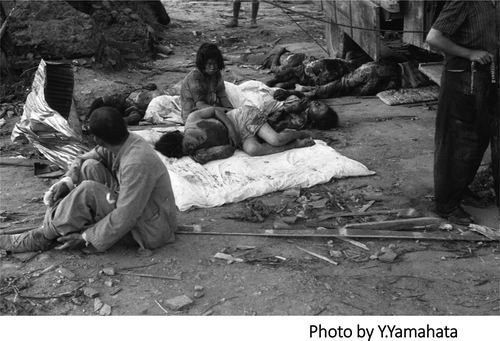
……………………………….. In areas within 1 kilometer of ground zero, human bodies without any shielding, namely in open air on the roads and ground, were instantaneously squeezed by the blast wind (pressure) against walls, causing multiple fractures of skeletons and ruptures of the abdominal cavity causing escape of colons. Many people in open roads and grounds were carbonized by the direct effect of heat rays within 1.0 km from ground zero (Figure 7, Photo A). Many residential areas full of Japanese houses were crushed by the wind and burned out in which many victims were also burned to white bones (Figure 7, Photo B). The skin of people on open roads or grounds within 0.5–1.5 km were deeply flash-burned due to heavy heat rays. The skins were soon peeled off because of necrosis in the deep skin layer (For an example of a boy whose back was entirely burned, see Figure 8). With large areas of skin peeling off, people suffered severe pain and bleeding.
Figure 7. Body effects by heat rays and fire burn (1).
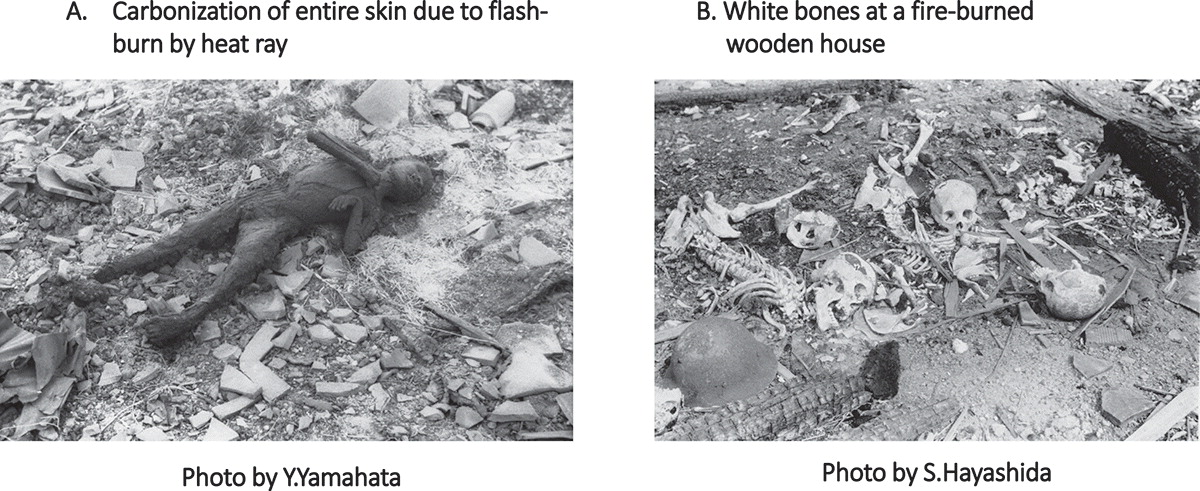
Figure 7. Body effects by heat rays and fire burn (1).

In three months after the bombing, these deep skin flash burns began to heal. However, with tissue being regenerated, keloid was quite often formed as shown in Figure 9. It was charcterized by marked thickening of the wounds, sometimes resembling cancerous proliferation of the skin.
Figure 9. Keloid formation after a severe flash burn by heat rays.
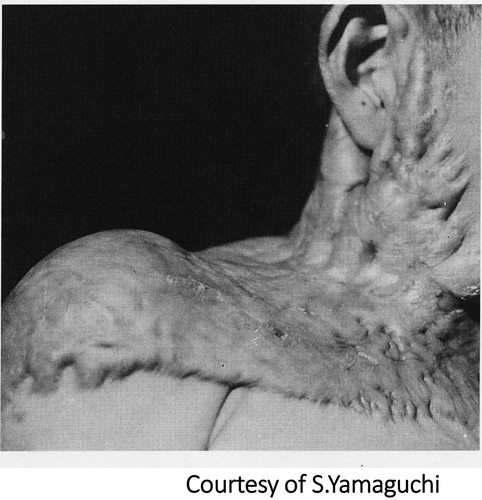
Thus many residential areas full of Japanese wooden houses were crushed and burned. The firestorms that continued over to next day finally flattened city areas within a 4 km radius. According to the saddest memory of some survivors, the blast wind tore off the heads of babies who were being carried on their mothers’ backs in the traditional Japanese way. Most of the mothers also died soon.
At the same time, the victims were irradiated by 100 grays (Gy)1 or more of combined gamma and neutron rays generated by nuclear fissions (Figure 6). Thus it could be possible to say that they were killed in three ways at once.
The people within 1 km of ground zero who finally survived were mostly those who were working inside a concrete building with thick walls or in a basement. Some other survivors were inside private air-raid shelters or military arsenals set in large shelters. Heat rays were effectively blocked by the walls, and radiation and blast were partially shielded before victims were exposed, thus allowing them to survive. But there were only a few hundred of these people. Many of those who survived at various proximal points were severely injured by debris and pieces of glass from damaged houses, heated and irradiated simultaneously. Many of them died within the first three months.
Struggle for Survival
Medical rescue teams perished and hospitals were all destroyed on the first day of the bombing. It therefore was impossible to find any meaningful medical aid. The situation was much severer in Hiroshima where over 90% of medical staffs, doctors, nurses, and pharmacists were dead. The Nagasaki Medical College Hospital, the largest and strongest concrete buildings in Nagasaki City, located 600 meters from ground zero, did provide fairly good shielding effects; the death rate was a relatively as low as 43%. Subsequently 900 lives in total – approximately half of the total number of professors, doctors, nurses and medical students were lost in the entire college facility including the hospital. Most of those who survived were severely injured by the blast wind and heat ray. The hospital had completely ceased to function. Within a few days, medical staffs and medical students who had survived opened first-aid stations around the margin of flattened areas.
n the late afternoon on the first day, several rescue trucks arrived carrying medical teams consisting of military doctors and nurses from Omura Navy Hospital, located 45 km north of Nagasaki City. They brought back approximately 700 severely injured victims, most of them severely burned, to the hospital and started treatment for burns and injuries consisting of bone fractures, cuts from pieces of glass, and embedding of debris and pieces of glass fragments deep in the skin. This number was very small compared to the total number of victims who suffered severe injuries, estimated to be approximately 30,000 in Nagasaki. A few hundred victims out of 700 were able to survive, thanks to intensive care at Omura Navy Hospital. They were indeed lucky people.
Several small rescue teams started their clinical activities within a few days. Some surgical operations were performed for those who had severe fractures due to the blast wind. There was no good treatment for severe skin burn, especially those cases with wide areas of skin burn. There were no stocks of drugs such as antibiotics and frozen blood plasma. Only oil and ointment were used. Even drip infusions of water and electrolytes such as salts and glucose (sugar) were not available in such small ambulatory facilities.
As a result of this lack of care, many survivors who were alive on the first and second days began to die due to severe bleeding from injuries such as severe fractures, dislocations, abdominal ruptures, thoracic punctures, and scalp and brain damage and also from dehydration and lack of adequate food supplies.
Initial Difficulty in Recognizing Radiation Effects
In the early days after the atomic bombings, many doctors had difficulty in identifying the symptoms of radiation-related ailments. There was no information about the nature of this new type of bomb. They did not even know that the bombs were nuclear and that radiation was dangerous to human beings. …………………………………………………………………………………….
Late Effects of Atomic Bombings: 1948–2018
About 270,000 victims of Hiroshima and Nagasaki finally recovered their health. They had to start their new daily life with a serious shortage of food and other necessities. After spending three years of recovery with relatively good health, hibakusha encountered the first malignant disease: leukemia. It is classified as the earliest occurring malignant disease due to atomic-bomb radiation because it was clearly distinguished from the disorders caused by ARS. Therefore, leukemia was the first malignant disease derived from cells injured by initial radiation exposure; the cells then transformed to malignant leukemia cells. This earliest delayed, or “late”, effect was followed by many kinds of cancer of various organs. Thus, the late effect spans an extremely long period.
First Malignant Disease Observed as the Earliest Late Effect of Atomic Bombings
Leukemias
In 1949, doctors in Hiroshima and Nagasaki began to recognize a gradual increase in the number of hibakusha patients, including children, suffering from leukemia. The excess annual rate of leukemia continued to rise until 1955 and then continued at an elevated level for more than 10 years (Figure 12) (Gunz and Henderson 1974). Acute and chronic types of leukemia both were observed.
These leukemias were later analyzed in detail when the first dosimetry system (DS65) became available. A clear radiation-dose dependency was revealed as a curve that elevated exponentially (called quadratic) from 100 millisieverts (mSv) at around 2.0 km from ground zero to more than 4 Gy at around 1.0 km (Figure 13 on original). Dose is thus inversely proportional to the square of the distance. Total leukemia incidence was four to five times higher than the control group of Nagasaki citizens not exposed to the bombing (Preston et al. 1996).
……………………………. People who were children under the age of 10 at the time of the bombings are now in their seventies. Some of them suffer from MDS. The increase in MDS among childhood survivors indicates that the massive irradiation of the whole body injured blood cells in bone marrow, and that these cells have survived more than 70 years in the bodies of hibakusha, and finally resulted in leukemia-inducing gene abnormality. MDS patients occasionally develop acute leukemia 3–5 years after the first diagnosis, and mostly die. Therefore, it can be said that atomic bomb is still killing some hibakusha even after more than a half century……………………..
Intermediate to Life-long Delayed Effects of Exposure to Atomic-bomb Radiation
Cancers
Around 1960, the incidence of solid cancers began to rise gradually. The elevated cancer incidence lasted for a long time (Ozasa 2016). It peaked around the year 2000 and remained at that level until now. The types of cancer that appeared include lung, breast, thyroid, stomach, colon, liver, skin, and bladder. ……………………………………….
In-utero Radiation Exposure
Microcephaly
In both Hiroshima and Nagasaki, many pregnant women were exposed to various doses of radiation. Miscarriages and malformation of newborn babies were frequently observed, but there were no good statistics showing radiation-dose effect. Some mothers who were in the early prenatal period at the time of the bombing sometimes bore babies who had a small head. The babies later became mentally disabled. There were 62 such babies recorded among 1,470 (Otake and Schull 1998). The larger the dose to the mother’s uterus was, the higher the incidence of microcephalic babies, suggesting high-dose radiation interrupted brain development. This is the most obvious phenomenon observed among fetuses exposed to radiation in utero.
Cancers
In-utero exposed babies were later found to have an increased risk of cancer development during their early adulthood. The follow-up study is now ongoing (Izumi et al. 2003)……………………………………………………………..
Summary of Hibakusha Life, 1945–2018
Can Homo Sapiens Gain the Ethical Wisdom to End the Nuclear Weapon Age and Survive?
The consequences of the atomic bombings linger on. First generation hibakusha population will cease to exist probably around 2045. If genetic transmission of radiation-related diseases to the second generation of hibakusha would be proved in the future, atomic bombs will continue to affect those descendants forever. The year 2045 will mark the 100th annniversary of the Hiroshima and Nagasaki nuclear bombings and of the nuclear weapon age. If we human beings fail to eradicate nuclear weapons before the first century ends, what should we do? This is the question that all hibakusha have posed in their 70-year struggle for survival all the time after bombings.
Summary of Hibakusha Life, 1945–2018
Can Homo Sapiens Gain the Ethical Wisdom to End the Nuclear Weapon Age and Survive?
The consequences of the atomic bombings linger on. First generation hibakusha population will cease to exist probably around 2045. If genetic transmission of radiation-related diseases to the second generation of hibakusha would be proved in the future, atomic bombs will continue to affect those descendants forever. The year 2045 will mark the 100th annniversary of the Hiroshima and Nagasaki nuclear bombings and of the nuclear weapon age. If we human beings fail to eradicate nuclear weapons before the first century ends, what should we do? This is the question that all hibakusha have posed in their 70-year struggle for survival all the time after bombings…………………………………………………………………………..more https://www.tandfonline.com/doi/full/10.1080/25751654.2019.1681226
Hisashi Ouchi Suffered an 83-day Death By Radiation Poisoning

https://science.howstuffworks.com/hisashi-ouchi.htm By: Patrick J. Kiger | Aug 8, 2022
On the morning of Sept. 30, 1999, at a nuclear fuel-processing plant in Tokaimura, Japan, 35-year-old Hisashi Ouchi and two other workers were purifying uranium oxide to make fuel rods for a research reactor.
As this account published a few months later in The Washington Post details, Ouchi was standing at a tank, holding a funnel, while a co-worker named Masato Shinohara poured a mixture of intermediate-enriched uranium oxide into it from a bucket.
Suddenly, they were startled by a flash of blue light, the first sign that something terrible was about to happen.
The workers, who had no previous experience in handling uranium with that level of enrichment, inadvertently had put too much of it in the tank, as this 2000 article in Bulletin of the Atomic Scientists details. As a result, they inadvertently triggered what’s known in the nuclear industry as a criticality accident — a release of radiation from an uncontrolled nuclear chain reaction.
Ouchi, who was closest to the nuclear reaction, received what probably was one of the biggest exposures to radiation in the history of nuclear accidents. He was about to suffer a horrifying fate that would become a cautionary lesson of the perils of the Atomic Age.
“The most obvious lesson is that when you’re working with [fissile] materials, criticality limits are there for a reason,” explains Edwin Lyman, a physicist and director of nuclear power safety for the Union of Concerned Scientists, and co-author, with his colleague Steven Dolley, of the article in Bulletin of the Atomic Scientists.
If safeguards aren’t carefully taught and followed, there’s potential for “a devastating type of accident,” Lyman says.
It wasn’t the first time it had happened. A 2000 U.S. Nuclear Regulatory Commission report noted that before Tokaimura, 21 previous criticality accidents had occurred between 1953 and 1997.
The two workers quickly left the room, according to The Post’s account. But even so, the damage already had been done. Ouchi, who was closest to the reaction, had received a massive dose of radiation. There have been various estimates of the exact amount, but a 2010 presentation by Masashi Kanamori of the Japan Atomic Energy Agency put the amount at 16 to 25 gray equivalents (GyEq), while Shinohara, who was about 18 inches (46 centimeters) away, received a lesser but still extremely harmful dose of about 6 to 9 GyEq and a third man, who was further away, was exposed to less radiation.
Internet articles frequently describe Ouchi as ‘the most radioactive man in history,’ or words to that effect, but nuclear expert Lyman stops a bit short of that assessment.
“The estimated doses for Ouchi were among the highest known, though I’m not sure if it’s the highest,” explains Lyman. “These typically occur in these kinds of criticality accidents.”
What Does a High Dose of Radiation Do To the Body?
The radiation dose in a criticality accident can be even worse than in a catastrophic accident at a nuclear power plant, such as the 1986 reactor explosion at Chernobyl in Ukraine, then a part of the Soviet Union, where the radiation was dispersed. (Even so, 28 people eventually died from radiation exposure.)
“These criticality accidents present the potential for delivery of a large amount of radiation in a short period of time, though a burst of neutrons and gamma rays,” Lyman says. “That one burst, if you’re close enough, you can sustain more than a lethal dose of radiation in seconds. So that’s the scary thing about it.”
High doses of radiation damage the body, rendering it unable to make new cells, so that the bone marrow, for example, stops making the red blood cells that carry oxygen and the white blood cells that fight infection, according to Lyman. “Your fate is predetermined, even though there will be a delay,” he says, “if you have a high enough dose of ionizing radiation that will kill cells, to the extent that your organs will not function.”
According to an October 1999 account in medical journal BMJ, the irradiated workers were taken to the National Institute of Radiological Sciences in Chiba, just east of Tokyo. There, it was determined that their lymphatic blood count had dropped to almost zero. Their symptoms included nausea, dehydration and diarrhea. Three days later, they were transferred to University of Tokyo Hospital, where doctors tried various measures in a desperate effort to save their lives.
Ouchi’s Condition Continued to Deteriorate
When Ouchi, a handsome, powerfully built, former high school rugby player who had a wife and young son, arrived at the hospital, he didn’t yet look like a victim of intense radiation exposure, according to “A Slow Death: 83 Days of Radiation Sickness,” a 2002 book by a team of journalists from Japan’s NHK-TV, later translated into English by Maho Harada. His face was slightly red and swollen and his eyes were bloodshot, but he didn’t have any blisters or burns, though he complained of pain in his ears and hand. The doctor who examined him even thought that it might be possible to save his life.
But within a day, Ouchi’s condition got worse. He began to require oxygen, and his abdomen swelled, according to the book. Things continued downhill after he arrived at the University of Tokyo hospital. Six days after the accident, a specialist who looked at images of the chromosomes in Ouchi’s bone marrow cells saw only scattered black dots, indicating that they were broken into pieces. Ouchi’s body wouldn’t be able to generate new cells. A week after the accident, Ouchi received a peripheral blood stem cell transplant, with his sister volunteering as a donor.
Nevertheless, Ouchi’s condition continued to deteriorate, according to the book. He began to complain of thirst, and when medical tape was removed from his chest, his skin started coming off with it. He began developing blisters. Tests showed that the radiation had killed the chromosomes that normally would enable his skin to regenerate, so that his epidermis, the outer layer that protected his body, gradually vanished. The pain became intense. He began experiencing breathing problems as well. Two weeks after the accident, he was no longer able to eat, and had to be fed intravenously. Two months into his ordeal, his heart stopped, though doctors were able to revive him.
On Dec. 21, at 11:21 p.m., Ouchi’s body finally gave out. According to Lyman’s and Dolley’s article, he died of multiple organ failure. Japan’s Prime Minister at the time, Keizo Obuchi, issued a statement expressing his condolences to the worker’s family and promised to improve nuclear safety measures, according to Japan Times.
Shinohara, Ouchi’s co-worker, died in April 2000 of multiple organ failure as well, according to The Guardian.
The Japanese government’s investigation concluded that the accident’s main causes included inadequate regulatory oversight, lack of an appropriate safety culture, and inadequate worker training and qualification, according to this April 2000 report by the U.S. Nuclear Regulatory Commission. Six officials from the company that operated the plant were charged with professional negligence and violating nuclear safety laws. In 2003, a court gave them suspended prison terms, and the company and at least one of the officials also were assessed fines, according to the Sydney Morning Herald.
Nuclear weapons will not bring peace or security, only dangers

We can honour the victims of Hiroshima and Nagasaki by supporting the prohibition treaty, says RAE STREET https://morningstaronline.co.uk/article/f/nuclear-weapons-will-not-bring-peace-or1 6 Aug, 22,
THIS is the month when we commemorate the fearful nuclear bombings of the people of Hiroshima and Nagasaki.
Alas, the myth is still put out that the bombs were dropped to end the second world war. That is not true.
By the time the bomb was ready for use, Japan was ready to surrender. As General Dwight D Eisenhower said, Japan was at that very moment seeking some way to surrender with minimum loss of face, and “it wasn’t necessary to hit them with that awful thing.”
Thus, the bomb on Hiroshima was dropped on August 6 before it was publicly stated that the Japanese had surrendered.
The Soviet Union entered the war in Asia on August 9. Later the same day, the US dropped a second bomb on Nagasaki.
We now know the horrors that nuclear bombs inflict. We have heard from the Hibaksha, the survivors. Now instead of heeding the survivors of those bombs, the Hibaksha, that nuclear weapons should be ended, governments across the world have developed more destructive nuclear bombs.
Britain, part of the US Trident submarine system, carries warheads on multiple missiles, with 15 times the power of the bomb used on Hiroshima.
Proponents of nuclear weapons, including the Nato military alliance, claim that they keep the peace and repeatedly talk of nuclear deterrents.
But the US has the largest nuclear arsenal in the world, and it did not stop the attack on the Twin Towers; nor did Trident stop terrorist attacks in Britain.
What is never mentioned is the death and destruction which has been brought about with the development of nuclear weapons, mainly on indigenous peoples.
This starts with the beginning of the cycle with uranium mining where native people in the US, in Canada, in Australia and the Congo, among others, have been forced into mining.
They and their families have suffered serious illness and even death. Above-ground testing has also brought suffering to native peoples.
After the French testing in the Pacific, mothers gave birth to “jellyfish” babies which died within a few hours. In the US above-ground testing meant that many of the “downwinders,” including the Western Shoshone, became seriously ill.
Although above-ground tests have now ended following the Comprehensive Test Ban Treaty, uranium mining has not ceased.
It continues except for Greenland where the Inuit, now in government, have banned uranium mining.
In 2022, with the war in Ukraine, we are now in more danger than ever before of a further use of nuclear weapons. If ever one of these highly destructive current bombs were exploded either by intent or accident, it would be a worldwide catastrophe.
There would be fires and radioactive fallout and fatal illnesses from acute radiation sickness, cancer and genetic damage which can be passed on to offspring.
At the same time, nuclear fireballs would send up enormous quantities of dust high into the atmosphere, blotting out the sun which would lead to nuclear winter.
And the contaminated ground would be unsuitable for food production leading to food shortages. In effect, if people had not died any other way, they would die of hunger.
Yet our current government not only supports the replacement of Trident but in the Integrated Defence Review increased the cap on Britain’s stockpile for 2025 from 180 to 260.
They even changed the scenario for nuclear use to “emerging technologies that could have a comparable impact,” possibly cyber-attacks but maybe some conventional weapons?
Starmer, once more making himself into a Tory by default, said via his shadow defence minister that Trident was “non-negotiable.”
Even the cost should have made him hesitate on this. It is estimated that the cost in public money — our money — will be £205 billion (and rising) to replace Trident.
And that when working people are struggling and across the world people starve; where we also urgently need funding for the transition from fossil fuels.
Nato too still holds a policy of first use of nuclear weapons and through the US, which has always dominated Nato policy, keeps “nuclear sharing,” weapons on the territory of five states: Belgium, Germany, Italy, the Netherlands and Turkey.
Without any public debate, we now know that nuclear bombs and nuclear capable aircraft are to be brought back to Lakenheath in Suffolk.
But the majority world wants nuclear disarmament. In January 2021, the UN-negotiated Treaty on the Prohibition of Nuclear Weapons came into force which now has 138 signatories — but not the Nato nuclear-armed states which were prevented by Nato.
Sixty-six states have now ratified the treaty. Our government and the Labour Party should be supporting the treaty because nuclear weapons will not bring peace or security, only dangers.
That way we would honour the memory of the victims of Hiroshima and Nagasaki. Our politicians should be looking at how to develop “common security,” putting funding and resources into dialogue and negotiation and respecting the security of everyone.
1 This Month



Shut down the radiation-damaged Heysham nuclear reactors now
To see nuclear-related stories in greater depth and intensity – go to https://nuclearinformation.wordpress.com

Say No to NASA’s Reckless Nuclear Reactor on the Moon
Say No to NASA’s Reckless Nuclear Reactor on the Moon
-
Archives
- October 2026 (256)
- September 2026 (339)
- August 2026 (330)
- July 2026 (355)
- June 2026 (287)
- May 2026 (306)
- April 2026 (356)
- March 2026 (251)
- February 2026 (267)
- January 2026 (308)
- December 2025 (358)
- November 2025 (359)
-
Categories
- 1
- 1 NUCLEAR ISSUES
- business and costs
- climate change
- culture and arts
- ENERGY
- environment
- health
- history
- indigenous issues
- Legal
- marketing of nuclear
- media
- opposition to nuclear
- PERSONAL STORIES
- politics
- politics international
- Religion and ethics
- safety
- secrets,lies and civil liberties
- spinbuster
- technology
- Uranium
- wastes
- weapons and war
- Women
- 2 WORLD
- ACTION
- AFRICA
- Atrocities
- AUSTRALIA
- Christina's notes
- Christina's themes
- culture and arts
- Events
- Fuk 2022
- Fuk 2023
- Fukushima 2017
- Fukushima 2018
- fukushima 2019
- Fukushima 2020
- Fukushima 2021
- general
- global warming
- Humour (God we need it)
- Nuclear
- RARE EARTHS
- Reference
- resources – print
- Resources -audiovicual
- Weekly Newsletter
- World
- World Nuclear
- YouTube
-
RSS
Entries RSS
Comments RSS

