Cities should increase role in effort to abolish nuclear weapons
Mayors for Peace comprises 8,213 cities from 166 countries and regions, including the United States, Russia and other nuclear weapon states.
https://www.asahi.com/ajw/articles/14750556, October 24, 2022
Foreign representatives to the general conference of Mayors for Peace pose for a photograph in Hiroshima on Oct. 20. (The Asahi Shimbun)
While disarmament by nuclear weapon states progresses only at a snail’s pace, Russia has invaded Ukraine and has repeatedly threatened to use nuclear weapons.
The developments have brought home a reality where nuclear arms could be used again in the manner of what was done to Hiroshima and Nagasaki.
In light of the situation, we are left to ask what role could be played by local governments, which are closer to citizens than central governments, in striving for the goal of abolishing nuclear weapons.
Mayors for Peace held its 10th General Conference in Hiroshima on Oct. 19-20.
The international nongovernmental organization was founded 40 years ago in the midst of the Cold War in response to a proposal made by Hiroshima’s mayor at a U.N. meeting.
The Hiroshima Appeal, adopted at the meeting last week, expressed alarm at the risk of nuclear war, which it said has been raised to “the highest level,” and emphasized that “the only absolute viable measure for humanity to take against repeated threats of nuclear weapons is their total elimination.”
The document called on nuclear weapon states to fulfill their disarmament obligations spelled out in the Nuclear Nonproliferation Treaty (NPT) and to ratify the Treaty on the Prohibition of Nuclear Weapons (TPNW), which took effect at the initiative of countries with no nuclear arsenals, in lockstep.
Mayors for Peace comprises 8,213 cities from 166 countries and regions, including the United States, Russia and other nuclear weapon states.
While nuclear weapon states and their allies continue to adhere to the nuclear deterrence theory, the organization has called on local governments to unite across national borders and return to the basic principle that nuclear arms should be abolished. It has played a significant role.
A number of cities, particularly in Europe, have moved to join Mayors for Peace since Russia invaded Ukraine.
In a resolution last year, the U.S. Conference of Mayors called on the U.S. government to welcome the TPNW and take immediate action toward nuclear abolition. Cities that are members of Mayors for Peace played a major part in that process.
Mayors for Peace should expand its activities by capitalizing on the current trend of the growing presence of local governments.
The essential thing is to work hand in hand with civil society in sending out messages.
Mayors for Peace has been supported by pleas from survivors of the atomic bombings of Hiroshima and Nagasaki that the error should never be repeated.
During the meeting in Hiroshima, cases of efforts being made in Japan and abroad were presented. They include how a group of 26 cities in western Tokyo have been working together to archive people’s accounts of their war experiences and to provide peace education.
We hope more local governments will draw on their networks to share and expand their diverse attempts.
Japan, as the only nation that has suffered atomic bombings in war, has a major role to play.
Of all municipalities in the nation and Tokyo’s wards, more than 99 percent, or 1,737, are members of Mayors for Peace.
At a general meeting of Japanese member cities held on the sidelines of the 10th general conference, a written request was approved calling on the government to participate as an observer in the second meeting of the state parties to the TPNW, which is scheduled for next year, and sign and ratify the treaty.
Hiroshima is expected to host the first meeting of a new international group of eminent persons to discuss nuclear disarmament by year-end and a Group of Seven summit next spring.
Prime Minister Fumio Kishida, who will be presiding over both meetings, should take the appeal of Mayors for Peace seriously and discard his stance of continuing to turn his back on the TPNW as soon as possible.
‘The nuclear bomb was so bright I could see the bones in my fingers’: The atomic veterans fighting for justice
https://inews.co.uk/inews-lifestyle/nuclear-bomb-bright-bones-fingers-atomic-veterans-2-1930293 24 Oct 22, Veterans of British nuclear testing in the Cold War say they – and their children and grandchildren – are still living with the health effects. And 70 years on, they want to see recognition of their part in the missions
RAF veteran John Lax is about to describe what it’s like seeing a nuclear bomb being detonated. “Even if I tell you what it was like,” he tells i, “you probably can’t really imagine it unless you’ve witnessed it yourself.”
Now 81, Lax was a 20-year-old air wireless mechanic when he was sent to take part in Britain’s nuclear testing programme in the Pacific in 1962.
Like many servicemen, he didn’t know there would be bomb tests when he arrived on Christmas Island, then a British territory, now a republic named Kiribati.
“We were told to put on long trousers and a long-sleeved shirt,” he says, “and we had these dark goggles which meant you couldn’t see your hand in front of you. Then we had to go and sit on the football pitch with our backs to the detonation, because if we’d faced it, the fireball would have burned our eyes.
“When the bomb went off, it was so bright that I could see the spine and ribs of the guy sitting a metre in front of me, like an X-ray. I put my hands over my eyes and could see the bones in my fingers, and could see the blood pumping around my hands. It was 4am but the sky turned blue, like it was daytime. The blast was like the sound of a pistol, except 1,000 times louder. After the fireball, a couple of minutes later, you feel the blast and a strong gust of very hot wind – if you had no shirt on it feels like it would burn through your back – then once the fireball starts to dissipate you get the mushroom cloud.”
This month it is 70 years since Britain first began developing and testing nuclear weapons, becoming the world’s third nuclear power (after the United States and the Soviet Union).
Between 1952 and 1965, detonations were carried out in Australia and the Pacific, in a series of operations involving the participation of more than 20,000 British service personnel, as well as some Fijian and New Zealand soldiers. Inhabitants of the test areas were moved offshore or to protected areas.
Read more: ‘The nuclear bomb was so bright I could see the bones in my fingers’: The atomic veterans fighting for justiceLax, who bore witness to 24 nuclear detonations over 75 days, was at the time given a “film badge”, containing photographic material that was intended to measure the levels of radiation the young men had been exposed to.
“They weren’t much good,” he says, “nobody kept a record of who had which badge, and you’d just put it in a box with all the other badges. These badges are pretty much useless in humid conditions, and Christmas Island was a tropical monsoon climate and very humid. So we had no record of radiation exposure.”
There were no long-term health studies of nuclear test veterans. Those who were there during the tests at Christmas Island were not given medical examinations when they left, and their health was not studied after they finished their service. Many servicemen – and many islanders – later reported severe health problems, which they believed where due to the radioactive fallout from nuclear bomb tests – from rare cancers to organ failure.
Some said they had fertility issues and difficulty conceiving, and many of those who did have children and grandchildren reported high incidences of birth defects, hip deformities, autoimmune diseases, skeletal abnormalities, spina bifida, scoliosis and limb abnormalities. Lax’s own health has been OK, but he does wonder about his children, who have both undergone surgery for a series of tumours, one at 14 years old.
Lax’s nuclear veteran friend has three types of cancer, which he says the specialist attributes “100 per cent to exposure to radiation”.
Another veteran, Doug Hern, who witnessed five thermonuclear explosions, says his skeleton is “crumbling” and has skin problems and bone spurs. His daughter died aged 13 from a cancer so rare that doctors didn’t have a name for it, and he believes all of this is due to the genetic effects of radiation exposure.
The Ministry of Defence (MoD) says it is grateful to Britain’s nuclear test veterans for their service, but maintains there is no valid evidence to link participation in these tests to ill health.
In 1983, the MoD did commission a study of more than 21,000 veterans, but – while the study found a slightly elevated risk of leukaemia – it concluded that the veterans had experienced no ill health as a result of their nuclear exposure. But nuclear veterans and their advocates have questioned the accuracy of the study.
For years, UK veterans have been campaigning with The British Nuclear Test Veterans Association, and Labrats – an organisation for nuclear test survivors – to be formally recognised, urging the Government to honour the nuclear test veterans’ service and sacrifice with an official recognition medal.
“I was a guinea pig,” says Lax, who believes he was placed there to see what would happen to people when the bomb went off.
The UK is the only nuclear power to deny special recognition and compensation to its bomb test veterans, of which there are estimated to be 1,500 surviving today.
In 2015, Fiji compensated all its veterans of British nuclear tests in the Pacific, with prime minister Frank Bainimarama announcing: “Fiji is not prepared to wait for Britain to do the right thing. We owe it to these men to help them now, not wait for the British politicians and bureaucrats.”
The United States Radiation Exposure Compensation Act has been providing compensation to its nuclear veterans since 1990.
Ed McGrath, 84, who was based at RAF Mildenhall in Suffolk, was 18 when he was sent to Australia and then flown to Maralinga to witness a test explosion.
At the Australian base camp we had good food and we had sunshine,” he tells i.
“As an 18 year-old, you’re travelling to places you can only imagine, but then when we were flown to witness the bombs, that’s where it went dark and nasty. They had the scientists and the engineers there, but I did nothing except stand there being told to put my hands over my eyes and turn my back to the blast. You were going up there to stand in the vicinity of a very powerful bomb 1,000 times more powerful than Hiroshima or Nagasaki.”
Despite persistent allegations by veterans that they had been used as guinea pigs in the tests, the Ministry of Defence denies this. McGrath is not convinced.
“There was no reason for us to be there, and I think the politicians who are responsible for sending us there must have come to the conclusion that, ‘Well, these lads are the price we’ve got to pay to find out what on earth is going on in the future.’
Veterans say that Boris Johnson recently at least gave them some hope of recognition, because as one of his last outings as Prime Minister, he met a group of veterans and campaigners and wrote in an open letter: “I’m determined that your achievements will never be forgotten. I have asked that we look again at the case for medallic recognition because it is my firm belief that you all deserve such an honour.”
Campaigners also showed the Prime Minister evidence that servicemen’s medical records from their time at the tests were missing from archives. Former prime minister Liz Truss, who promised to support their fight when she entered No 10, had not acted to put these promises into action. After she took office, she dismissed the veterans’ minister Johnny Mercer.
The Government’s Office for Veterans’ Affairs has this month announced it will launch a £250,000 oral history project to chronicle the voices and experiences of those who supported the UK’s effort to develop a nuclear deterrent. However, Lax says this is “too little, too late” and nowhere near what nuclear veterans should have.
McGrath has spent time worrying and feeling guilty that his family may face health problems because of his exposure to nuclear tests. His granddaughter had a brain tumour when she was a child but he says: “It’s very difficult to link the two directly and it’s not something you want to think about, to be honest.”
A Brunel University study found in 2021 that nuclear test veterans have double the normal levels of psychological stress for their age.
A survey and interviews by the Centre for Health Effects of Radiological and Chemical Agents found that most of the veterans report having become anxious in the mid-80s, when evidence first emerged of cancers, rare blood disorders, miscarriages in wives and birth defects in their children.
Yet this July, researchers at Brunel University published a study that showed “no significant increases in the frequency of newly arising genetic changes in the offspring of nuclear test veteran fathers. This result should reassure the study participants and the wider nuclear test veteran community.”
However, it seems that the legacy of nuclear testing has taken its toll in ways that we perhaps don’t yet fully understand, because there are communities of people across the world who feel their lives have been hugely affected by their nuclear veteran fathers and grandfathers.
Susan Musselwhite, 42, was eight when her father walked out on the family. When she saw him once again in her twenties, he said his leaving had all been down to the mental and physical anguish of being a test veteran on Christmas Island. Musslewhite lives with chronic migraines and Grave’s disease, sometimes barely being able to lift her head off the pillow, spending 90 per cent of her time indoors. “Sometimes I’m like an 80-year-old woman with dementia,” she says. She started to talk to other descendants and discovered that they were saying similar things about their mental and physical health. “I realised I wasn’t going through this alone. I truly believe that if my dad wasn’t at the test site, I wouldn’t be like this.”
Elin Doyle, an actress who has written a semi-autobiographical new play called Guinea Pigs about the tests’ generational effect, spent her early years witnessing her nuclear veteran father’s fight for justice. He had a rare form of cardiac sarcoidosis, an inflammatory condition that can result in heart rhythm abnormalities, in his forties. “Many years later,” says Doyle, “he was asked by a specialist whether he’d ever worked with radiation. So somebody else made the link and that was a bit of a shock for him. At that point I’d already had a sibling who was born with a birth defect.”
Doyle’s father died of heart failure in his sixties. “You can argue it’s because of radiation or not, but he didn’t have the sort of morbidities that would expose him to young heart disease, and we don’t have a history of it in the family, so the belief was that it was linked.”
Doyle also talks about the many of the veterans’ feelings of betrayal.
“Sending a bunch of 19-year-olds off in the 1950s to work on nuclear tests and assuring them that it’s perfectly safe, and then to find out actually, they probably weren’t safe and quite possibly, the powers that be knew that that was the case – that has an impact on the rest of a veteran’s life.”
Steve Purse, 47, from Denbighshire, Wales, remembers how his father David, an RAF flight lieutenant, was too scared to talk about his experience of being posted to test nuclear weapons in 1962 because of the Government secrecy around the nuclear mission.
He did, however, open up about it years later when he developed a skin condition over his arms and legs and the dermatologist asked whether he’d spent most of his life exposed to intense sunlight in the tropics. He said no, he had spent one year in Australia with nuclear tests. The dermatologist said that this was severe radiation damage to the skin.
Steve has a form of short stature, which doctors don’t know how to diagnose. “All they say is that I’m unique,” he says, “but my dad was exposed to alpha-radiation which causes mutation in DNA, so I believe it’s down to that. It feels like nuclear tests have left a legacy of genetic Russian roulette.”
For veteran McGrath, it feels as though the nuclear tests, and the men who were exposed to them, are a forgotten part of Cold War history. “It’s encouraging, though, that young people are beginning to take notice,” he says.
He did, however, open up about it years later when he developed a skin condition over his arms and legs and the dermatologist asked whether he’d spent most of his life exposed to intense sunlight in the tropics. He said no, he had spent one year in Australia with nuclear tests. The dermatologist said that this was severe radiation damage to the skin.
Steve has a form of short stature, which doctors don’t know how to diagnose. “All they say is that I’m unique,” he says, “but my dad was exposed to alpha-radiation which causes mutation in DNA, so I believe it’s down to that. It feels like nuclear tests have left a legacy of genetic Russian roulette.”
For veteran McGrath, it feels as though the nuclear tests, and the men who were exposed to them, are a forgotten part of Cold War history. “It’s encouraging, though, that young people are beginning to take notice,” he says.
How Iodine Tablets Block Some Nuclear Radiation

Associated Press, News 18, OCTOBER 18, 2022,
“……………………………………………….This radioactive material can increase the risk of thyroid cancer if it gets into the body, for example by breathing it in or eating contaminated food. It’s especially dangerous for children, and its health risks can last for many years after exposure, according to the World Health Organization.
Iodine tablets work by filling up the thyroid with a stable version of iodine so that the radioactive kind can’t get in. If the thyroid is already packed with potassium iodide, it won’t be able to pick up the harmful iodine that’s left after a nuclear accident.
what are iodine pills? And what can they do — and what can’t they do — in the case of a nuclear leak or attack?
Potassium iodide, or KI, offers specific protection against one kind exposure. It prevents the thyroid — a hormone-producing gland in the neck — from picking up radioactive iodine, which can be released into the atmosphere in a nuclear accident.
The pills are cheap and sold all over the world, and many countries, including the U.S., stockpile them.
But potassium iodide doesn’t protect against other kinds of radioactive threats. A nuclear bomb, for example, can release many different kinds of radiation and radioactive material that can harm many parts of the body.
Health authorities caution that potassium iodide should only be taken in certain nuclear emergencies, and works best if it’s taken close to the time of exposure. It shouldn’t be taken as a preventive measure ahead of time.
Potassium iodide doses can come with some side effects like rash, inflammation or an upset stomach. Those over 40 years old generally shouldn’t take iodine tablets unless their expected exposure is very high, according to guidelines from the U.S. Food and Drug Administration. https://www.news18.com/news/explainers/explained-how-iodine-tablets-block-some-nuclear-radiation-6187801.html
The misconception about Putin’s big red nuclear button
Spectator, Mark Galeotti, 16 Oct 22, There is a common misconception that the leaders of nuclear states have a ‘red button’ that can unleash Armageddon. As Vladimir Putin continues to hint at the use of non-strategic (‘tactical’) nuclear weapons in Ukraine, there is some comfort in the knowledge that it is not so easy.
Ironically, launching the kind of strategic nuclear missiles whose use would likely spiral into global destruction is somewhat easier than deploying the smaller weapons which – however vastly unlikely – could conceivably be used in Ukraine. These lower-yield warheads would need to be reconditioned in one of the 12 ‘Object S’ arsenals across Russia holding them, and then transported to one of 34 ‘base-level storage depots’. From there they would need to be loaded onto a bomber or mated onto a suitable other delivery system.
Given that Russia has not even used them since 1990, no one knows for sure what state they would be in, and likely no one still in service has any practical experience. There would presumably be a group of wary engineers gingerly thumbing their way through faded instruction manuals long before Putin could even give a fire order.
If he ever did, though, the process is mercifully much more complex that simply mashing a button in a moment of pique. Like his US counterpart, Putin is accompanied everywhere by an aide carrying the ‘nuclear briefcase’. Called the Cheget, this actually contains special communications gear that is used to issue and authenticate the president’s orders relating to a nuclear launch.
Chegets, which connect to the Kazbek nuclear command and control network. Were Putin so minded, his aide would activate his Cheget, and he would issue an encrypted launch command, which would be transmitted to them. Although there are protocols to deal with the theoretical possibility that both were out of action, such as if there had already been some decapitating strike against the High Command, generally at least one of the other two would need to validate the command.
Then, the approved order goes to the General Staff, which issues authorisation codes and targeting details. This would usually happen through the Strategic Rocket Forces’ command bunker at Kuntsevo, west of Moscow, or else the backup one at Kosvirsky in the Ural Mountains.
Again, in extremis, the command staff in the bunkers could launch without the command codes, had the General Staff also been eliminated……………………
This may all sound rather cumbersome. It is, and deliberately so, both to make absolutely sure that any commands really have come from the president, and to introduce some friction and delay into the process………………………..
What this also means is that were Putin somehow to go full Dr Strangelove, there are many other human beings in the chain of command. …………………
One of the secrets of command is never to give an order likely to be disobeyed. For Putin, it would be the beginning of the end, and he must know it.
However brutal Putin’s regime may be, this is not Stalinism. Although the Federal Security Service’s Military Counterintelligence Directorate is more concerned with watching the generals than hunting foreign spies, there are no hard-eyed political commissars waiting to put a bullet in the back of any officer’s head who disobeys an order. And that should be a comfort in these uncomfortable times. https://www.spectator.com.au/2022/10/the-misconception-about-putins-big-red-nuclear-button/
Nuclear Power Is a Dead End. We Must Abandon It Completely.
In fact, the knock-out arguments against the nuclear industry today are reactors’ cost and deployment time. The greatest barriers to this claimed renaissance—and it is primarily talk, not investment—is its inability to deliver affordable power on time and on budget.
Small nuclear reactors (SMRs) -both slower to deploy than conventional reactors and more expensive per kilowatt capacity. “overall, SMRs are inferior to conventional reactors with respect to radioactive waste generation, management requirements, and disposal options.”
Even given Europe’s energy crisis, the case against nuclear power has never been so conclusive—and so important.
The Nation, By Paul Hockenos 13 Oct 22,
BERLIN—Amid a confluence of crises—the Ukraine war, an energy crisis, and climate breakdown—nuclear energy is experiencing a renaissance, at least in the rhetoric of politicians and pundits across Europe, North America, and beyond. After all, it’s tempting to propose these generators of low-carbon energy as a panacea to this daunting phalanx of calamities.
But in fact, the case against nuclear power and for genuinely renewable energies has never been so conclusive—and so important. In early March, Russia captured the Zaporizhzhia nuclear power plant in Ukraine—the largest in Europe with six reactors, each the size of the one that melted down in the 1986 Chernobyl disaster—and transformed it into an army base from which it fires artillery at Ukrainian positions.
Although this weaponizing of nuclear reactors had long been recognized as a threat, the vulnerability of nuclear power plants in conflict zones is now center stage in Europe. The battlefield in this case is controlled by an unpredictable autocrat who has threatened that he’ll use every means at his disposal to destroy Ukraine. At the Zaporizhzhia station, the Russian military has taken the Ukrainian nuclear engineers hostage, and is working them at gunpoint. The International Atomic Energy Agency (IAEA) warned in August that there’s a “real risk of nuclear disaster” unless the fighting stops. Russia could sabotage a power plant like Zaporizhzhia and attempt to shift the blame onto Ukraine. A nuclear weapon strike would be a crime against humanity, but a disaster at nuclear plant could blur responsibility and complicate the international response. Nuclear plants, where military-scale security is nonexistent, are sitting ducks for acts of terrorism and wartime targeting.

At the same time, the world’s nuclear power champion, France, has punctured the myth that nuclear power is a round-the-clock energy source that can operate without back-up reserves—a favorite trope of wind and solar power skeptics. Nowhere in Europe today is the energy crisis more acute than in France, where for much of this year, between a third and over half of France’s 56 nuclear reactors have been shut down either because weather-warmed rivers cannot cool their systems or on account of corrosion damage, hairline cracks, staff shortages, and pending maintenance work on their geriatric hardware. The outages have forced France to rely on Germany for electricity imports—culled in large part from the wind and solar farms that supply almost half of Germany’s electricity. In August, France’s power prices hit €1,100 per megawatt-hour, more than 10 times the 2021 price, smashing records across the continent………………………………………
Critics’ original concern with nuclear power, namely its safety, remains paramount. The two most catastrophic meltdowns, in 1986 at the Chernobyl nuclear power plant in the Soviet Union and the Fukushima site in Japan, in 2011, had horrific repercussions that still haunt those regions. But these mega disasters are only the most well known. According to IAEA, there have been 33 serious incidents at nuclear power stations worldwide since 1952—two in France and six in the United States.
These accident numbers don’t include the toxic fallout from lax disposal and storage of nuclear waste.

Between 1945 and 1993, 13 countries, including the UK, the US, and the Soviet Union, heaved barrels of nuclear waste into their seas—a total of 200,000 tons—presuming the vast ocean waters would dissolve and dilute it. Those casks still lie there today.
This sad chapter belongs to the 80-year-old saga of nuclear waste. Currently, there’s over a quarter-million metric tons of spent fuel rods sitting above ground, usually in cooling pools at both closed-down and operative nuclear plants, waiting like Samuel Beckett’s protagonists Vladimir and Estragon for a definitive solution that will never come.
In northern Europe, the Finns claim that they’ve solved it by digging 100 tunnels 1,400 feet into the bedrock of an uninhabited island in the Gulf of Bothnia. Underway now for decades, this $3.4 billion undertaking, the first permanent repository in the world, will eventually hold all of Finland’s spent nuclear refuse—less than 1 percent of the world’s accumulated radioactive remnants—until about 2100. This highly radioactive mass will, its operators promise, remain catacombed for 100,000 years. (Since nuclear waste is lethal for up to 300,000 years, these sites are a time-bomb for whoever or whatever is inhabiting the planet then, assuming geological conditions allow it to lie peacefully for that long.) In light of Finland’s small volume of radioactive waste, the full lifetime price tag of nearly $8 billion dollars is significantly more per ton than the estimated $34.9 billion, $19.8 billion, and $96 billion that the France, Germany, and the United States respectively will shell out for nuclear waste management, according to the World Nuclear Waste Report 2019.
Most countries don’t have barren islands far from groundwater sources, so they have to make do, like Switzerland did in September when it announced that it intends to excavate a geological storage repository near the German border, closer to German towns in Baden Württemberg than Swiss ones. Germany’s borderland communities are vigorously contesting the choice, which will probably be abandoned by the Swiss. Nearly all proposed sites end up scratched for the obvious reason that nobody wants to live next to a nuclear waste dump.
“Nowhere in the world has anyone managed to create a place where we can bury extremely nasty nuclear waste forever,” Denis Florin of Lavoisier Conseil, an energy-focused management consultancy in Paris, told the Financial Times earlier this year. “We cannot go on using nuclear without being adult about the waste, without accepting we need to find a permanent solution.”
The inherent danger of nuclear power is often relativized by advocates as the bitter pill we must choke down in light of its other advantages. In fact, the knock-out arguments against the nuclear industry today are reactors’ cost and deployment time. The greatest barriers to this claimed renaissance—and it is primarily talk, not investment—is its inability to deliver affordable power on time and on budget.
Nuclear energy is such a colossal expense—into the tens of billions of dollars, like the $30 billion Vogtle units in Waynesboro, Ga.—that few private investors will touch them, even with prodigious government bankrolling.
The UK government finally found a taker for its Hinkley Point C station in 2016 when it offered lavish subsidies to the French energy firm EDF. But even that deal becomes less sweet the higher construction costs spiral and the longer EDF postpones its opening beyond 2025. So catastrophic are the cost overruns of EDF’s projects worldwide that the company could no longer service its €43 billion debt and this year agreed to full nationalization. But experts say this alone won’t solve any of the fundamental problems at Hinkley C or the Flamanville plant in Normandy, which is 10 years behind schedule, with costs fives times in excess of the original budget. Cost overruns are one reason that one in eight new reactor projects that start construction are abandoned.
While safety concerns drive up the cost of nuclear plant insurance, the price of renewables is predicted to sink by 50 percent or more by 2030. Study after study attests that wind and solar cost a fraction of the price of nuclear power: at least three to eight times the bang for the buck in terms of energy generation and climate protection, at a time when the exorbitant cost of energy is causing recessions and street protests across Europe. It is because solar photovoltaic and wind power are the cheapest bulk power source in most of the world that renewables, grids, and storage now account for more than 80 percent of power sector investment. In 2021, companies, governments, and households invested 15 times as much in renewable energy than in nuclear. They’re simply the better buy.
NUCLEAR IS MUCH TOO SLOW
Indeed, in the face of an ever more cataclysmic climate crisis that demands solutions now—like hitting the EU’s 2030 targets of reducing carbon dioxide emissions by 55 percent of 1990 levels by 2030—the build-out of nuclear is painfully, prohibitively slow. In Europe, just one nuclear reactor has been planned, commissioned, financed, constructed, and put online since 2000—that’s Finland’s Olkiluoto-3 reactors (March 2022). Europe’s flagship nuclear projects—called European Pressurized Reactors—have been dogged by delays from the start. The Olkiluoto-3 reactors in Finland, which had been scheduled to go online in 2009, still isn’t heating homes. Globally, the average construction time—which count the planning, licensing, site preparation, and arranging of finances—is about a decade.
Small-scale modular reactors (SMR), advanced with funding during the Obama administration, are supposedly the industry’s savior—the so-called next generation—although they’ve been around for decades. Purportedly quicker to build, with factory-made parts, they generate at most a 10th of the energy as a conventional reactor. Yet they are not significantly different in terms of their problems. The World Nuclear Industry Status Report 2022 claims that, so far, they have been both slower to deploy than conventional reactors and more expensive per kilowatt capacity. A recent study conducted by Stanford University and University of British Columbia came to the conclusion that “overall, SMRs are inferior to conventional reactors with respect to radioactive waste generation, management requirements, and disposal options.”
NUCLEAR AND RENEWABLES DON’T MIX
Finally, the last claim of nuclear supporters is that the massive baseload supply that reactors provide when they’re up and running is just what systems reliant on weather-based renewables need at down times. In fact, nuclear is the opposite of what decentralized clean energy systems require.
Renewables and nuclear energy don’t mix well in one system, explains Toby Couture of the Berlin-based think tank E3 Analytics. “What renewables need is not so-called baseload power,” he told me, “which is inflexible and unable to ramp up and down, but flexible, nimble supply provided by the likes of storage capacity, smart grids, demand management, and a growing toolbox of other mechanisms, not the large and inflexible supply of nuclear reactors.”
Couture added, “The inability of nuclear power to ramp down effectively to ‘make room’ for cheap wind and solar is one of the main reasons why France’s own domestic renewable energy development has lagged behind its peers.” According to Couture, France’s inability to flexibly accommodate wind and solar has exacerbated the continent-wide power supply crunch.
In light of the energy crisis, Germany may extend the lifetime of two of its three remaining nuclear plants for three months, in a reserve capacity beyond their scheduled end-of-year closure date. This emergency measure, a direct consequence of the previous governments’ failures, does not alter the logic against nuclear power, which even Germany’s own nuclear industry now accepts. Renewables, clean tech, and energy efficiency are easy to rollout, cost-effective, safe, and proven. Let’s concentrate on deploying these technologies at full speed to decarbonize our world before the impacts of climate change overwhelm us. https://www.thenation.com/article/world/nuclear-power-europe-energy/
Cuban Missile Crisis 60th anniversary: How world teetered on nuclear abyss
9News, By Richard Wood • Senior Journalist Oct 15, 2022
“……………………………………… Sixty years ago, the flashpoint was Cuba and the deployment of Russian nuclear missiles to the island – just 180km from the US mainland.
Here is a look at how the dramatic events unfolded over a tense 13 days.
………………………………………………………. On Friday, October 26, 1962, fears of a US invasion were so great that Cuban leader Fidel Castro ordered American reconnaissance planes to be shot down.
The end game came in the form of a public US promise the next day not to invade Cuba and a private – long denied – promise to remove US missiles from Turkey in return for a Soviet pledge to pull out their nuclear missiles from Cuba.
How the 1962 Cuban Missile Crisis unfolded
October 16: Photos taken by a US spy plane that show nuclear-armed missiles on Cuba are shown to President John F. Kennedy.
October 18: Kennedy receives an assurance from the Soviet government that his country is providing only defensive aid to Fidel Castro’s Cuba.
October 22: In a TV address, Kennedy says the weapons are a “clear and present danger” to the US and its allies.
October 23: US naval forces deploy around Cuba to enforce their blockade
October 25: Russian freighters bound for Cuba turn back.
October 26: Nikita Khrushchev writes to Kennedy offering to remove the missiles if the US lifts the blockade and pledges not to invade Cuba.
October 27: Kennedy receives a second letter from the Soviet government demanding much tougher terms. A US spy plane is shot down over Cuba and its pilot dies.
October 28: Russian state radio announces Khrushchev will withdraw the missiles in exchange for a non-invasion pledge by the US. https://www.9news.com.au/world/cuban-missile-crisis-sixty-years-on/e8c362a8-3971-4067-80b6-5b421ab94a9f
Plutonium and high-level nuclear waste
About plutonium and the “reprocessing” or “recycling” of used nuclear fuel. Gordon Edwards, 12 Oct 22
Plutonium is less than 1/2 of one percent of the used nuclear fuel, but it is a powerful source of energy that can be used for military or civilian purposes (nuclear bomb or nuclear reactors). To get the plutonium out of the used fuel is a very messy operation. The places where reprocessing has been done on a large scale are among the most radioactively contaminated sites in the world. Although NWMO says that plutonium use is not on their agenda, it is included, in writing, as one of their options. Today, in New Brunswick, government funding is going to Moltex Corp. to proceed with plans that require plutonium use. Chalk River is just beginning to build a billion-dollar brand new research facility that will be dealing with plutonium as a priority. A large nuclear industry mural painted on the walls of the Saskatoon Airport states that reprocessing used fuel to get the plutonium out is the last step in the “Nuclear Fuel Cycle”.
(1) Nuclear fuel can be handled with care before it goes into a nuclear reactor. But used nuclear fuel will never be handled by human hands again, at least for several centuries, because of the hundreds of newly-created radioactive materials inside each fuel bundle. These are (a) the broken pieces of uranium atoms that have been spit, (b) the newly-created “transuranic” (heavier than uranium) materials that are produced, and (c) the so-called “activation products” (non-radioactive materials that have been de-stabilized and so are now radioactive). See “Nuclear Waste 101” https://youtu.be/wD2ixadwXW8
(2) Radioactivity is not a thing, but a property of certain materials that have unstable atoms. Most atoms are stable and unchanging. Radioactive atoms are unstable. Each radioactive atom is like a tiny little time bomb, that will eventually “explode” (the industry uses the word “disintegrate”). When an atom disintegrates it gives off projectiles that can damage living cells, causing them to develop into cancers later on. These projectiles are of four kinds: alpha particles, beta particles, gamma rays, and neutrons. These damaging emissions are called “atomic radiation”. No one knows how to turn off radioactivity, so they remain dangerous while they exist.
(The danger lasts for tens of millions of years)
(3) Used nuclear fuel is so radioactive that it can give a lethal dose of gamma radiation and neutrons to any unshielded humans that are nearby. Even the “30-year old” used fuel that NWMO wants to transport to a “willing host community” is still far too dangerous to be handled without massive shielding and robotic equipment. The job of repackaging the used fuel bundles requires the use of shielded “hot cells” — which are specially constructed airtight rooms with thick windows (4 to 6 feet thick) and large robot arms like those used in outer space to protect the workers from being overexposed to radiation. Any damage to the outer metal coating on the fuel bundles will allow radioactive materials to escape from inside the fuel in the form of radioactive gasses, vapours, or dust. That’s why the hot cells have to be air-tight, and why these rooms themselves will eventually become radioactive waste.
See https://youtu.be/g8EPo8BntPQ (below)
(3) Nuclear proponents often point out that the used nuclear fuel – the stuff that NWMO wants to “bury” underground – still has a lot of energy potential and could be “recycled”. That’s because one of the radioactive materials in the waste, called “plutonium”, can be used to make atomic bombs or other kinds of nuclear weapons, and it can also be used as a fuel for more nuclear reactors. But to get plutonium out of the fuel bundles they have to be dissolved in some kind of acid or “molten salt”, turning the waste into a liquid form instead of a solid form. This allows radioactive gasses to escape from the fuel, and makes it much more difficult to keep all the other radioactive materials (now in liquid form) out of the environment of living things. Any plutonium extraction technology is called “reprocessing”.
4) Although NWMO says that reprocessing is not their intention, it has always been considered a possibility and has never been excluded. It is stated in all NWMO documentation that reprocessing remains an option. Once a willing host community has said “yes” to receive all of Canada’s used nuclear fuel, the government and industry can then decide that they want to get that plutonium out of the fuel before burying it. That means opening up the fuel bundles and spilling all the radioactive poisons into a gaseous or liquid medium so they can separate the plutonium (and maybe a few other things) from all the rest of the radioactive garbage. Canada has built and operated reprocessing plants in the 1940s and 1950s at Chalk River. AECL tried but failed to get the government to build a commercial-scale reprocessing plant in the late 1970s. Canada did some experimental reprocessing in Manitoba, when AECL built the “Underground Research Laboratory” to study the idea of a DGR for used nuclear fuel in the 1980s and 1990s. Read http://www.ccnr.org/AECL_plute.html .
(5) The big reprocessing centres in the world include Hanford, in Washington State; Sellafield, in Northern England; Mayak, in Russia; La Hague, in France; and Rokkasho, in Japan. There is also a shut-down commercial reprocessing plant at West Vallay, New York. These sites are all environmental foul-ups requiring extremely costly and dangerous cleanups.
HANFORD: over $100 billion needed to clean up the sitehttps://www.seattletimes.com/seattle-news/hanfords-soaring-cost-of-radioactive-waste-cleanup-is-targeted-as-nw-governors-seek-more-funding/
SELLAFIELD: over 200 billion pounds ($222 billion) for cleanuphttps://www.theguardian.com/environment/2022/sep/23/uk-nuclear-waste-cleanup-decommissioning-power-stations
MAYAK: severe environmental contamination but no cost estimateshttps://bellona.org/news/nuclear-issues/radwaste-storage-at-nuclear-fuel-cycle-plants-in-russia/2011-12-russias-infamous-reprocessing-plant-mayak-never-stopped-illegal-dumping-of-radioactive-waste-into-nearby-river-poisoning-residents-newly-disclosed-court-finding-says
LA HAGUE: widespread contamination, no detailed dollar figure providedhttps://ejatlas.org/conflict/la-hague-center-of-the-reprocessing-of-nuclear-waste-france
ROKKASHO: years of cost overruns and delays – $130 billion for starters
https://www.neimagazine.com/news/newsjapans-rokkasho-reprocessing-plant-postponed-again-8105722
WEST VALLEY: only operated for 6 years, about $5 billion in cleanup costhttps://www.ucsusa.org/resources/brief-history-reprocessing-and-cleanup-west-valley-ny
(6) Newer reprocessing technologies are smaller and use different approaches – but basically, any time you are going to open uo the fuel bundles, you are “playing with fire” and it is much harder to keep all the radioactive pioisons in check once they are out of the fuel bundle.
Read http://www.ccnr.org/paulson_legacy.html
(7) My feeling is that any “handling” or “repackaging” or “reprocessing” of used nuclear fuel should NOT be done in a remote community that does not have the economic or political “clout” to demand that things be done properly. If It is to be dine at all, this should be done back in the major population centres where the reactors are located and people living there can raise a fuss if things are not done safely.
(8) Also, my feeling is that the fuel should not be moved at all until the reactors are all shut down. The radioactive wastes can be very well packaged and carefully guarded where they are. Since NWMO will only move 30-year old used fuel, there will ALWAYS be 30 years worth of unburied waste right at the surface, right beside the reactors, ready to suffer a catastrophe of some sort, no matter HOW fast they bury the older fuel. In fact, the nuclear indusrtry does not really want to “get rid” of nuclear waste at all, but just move some of the older stuff out of the way so that they can keep on making more. The best place to take the waste is where there are no reporters or TV broadcasters or influential wealthy people to blow the whistle if things go badly. Maybe I’m a little over-suspicious, but given the history of waste management, you can’t be too careful.
9) In Germany, they buried radioactive waste in an old salt mine as a kind of DGR for a very long time. When radioactive contamination kept leaking into the ground water and the surface waters, the nuclear scientists in charge did not tell the government or the public for almost 10 years. Then, when it became clear that the environment was being severely affected, the German government decided to take all the waste OUT of the DGR – a difficult and dangerous operation that will take 15-30 years and cost over 3.7 billion euros ($5 billion Canadian equivalent.)
Read https://www.neimagazine.com/features/featureclearing-out-asse-2/
Any potential willing host community would be well advised to insist that all “handling” of individual fuel bundles, of any kind whatsoever, whether repackaging or reprocessing, should not be part of the plan for the willing host community to accept. But it would have to be in writing and legally enforceable.
Of course the decision is entirely up to the willing host community, not me – and hopefully, not the industry either.
Health Implications of re-licensing the Cameco nuclear fuel manufacturing plant .

“Health Implications of re-licensing the Cameco Fuel Manufacturing plant (CFM)” Gordon Edwards 12 Oct 22
my submission to the Canadian Nuclear Safety Commission, on behalf of the Port Hope Community Health Concerns Committee. Port Hope is in Ontario, on the north shore of Lake Ontario just east of Toronto. This town houses one of the largest uranium “conversion” plants in the world, turning refined uranium into (1) drums of uranium hexafluoride for export to enrichment plants in other countries, and (2) uranium dioxide powder to be turned into ceramic fuel pellets used in Canadian nuclear reactors.
The paper deals with the health implications of the low-level radioactive dust that escapes into the air of Port Hope from the Fuel Fabrication Plant – the plant that manufactures fuel pellets and assembles them into CANDU fuel bundles.
Before they are used, these fuel bundles are weakly radioactive but safe to handle (with gloves, for a short time). After they are used, the fuel bundles are millions of times more radioactive — when freshly discharged from the reactor, one fuel bundle will kill an unshielded human standing one metre away in less than 20 seconds. That’s a very HIGH level of radiation, caused by all the broken pieces of uranium atoms that are left Inside the used fuel bundle and are constantly disintegrating.
But that is not the case in Port Hope. Here we have only naturally occurring radioactive uranium that has been brought to the surface to make fuel for nuclear reactors. The problem is that the uranium dust specks are so tiny they are totally invisible, and when inhaled they “stick” in the lungs and stay there for a long time, damaging the tissue so that it might begin to grow in the wrong way, eventually becoming a lung cancer years later. It is a much slower kind of illness and death that may be caused by LOW level radiation exposure. It’s like a lottery with a negative “prize” – not everyone will be so affected, but the unlucky “winners” will suffer the consequences.
Gordon Edwards
Kerr McGee: Is the thorium danger over?

“These things have a half life of 14 million years,”
To Kerr McGee, “You need to pay up. We need reparations for all the people who are suffering from chronic illnesses that you caused,”
When will West Chicago finally be clear of thorium radiation?
https://wildcatchronicle.org/10131/news/kerr-mcgee-is-the-danger-over/ By Savannah Epperson, Reporter, October 5, 2022
As the recent piles of dirt indicate, Kerr-McGee clean-up is set to start this fall. The final stage of thorium removal along Ann St. and W. Blair St. in West Chicago involves remediating the groundwater using 36 million dollars in funds allocated for the clean-up.
On Aug. 24, the City of West Chicago published a press release concerning the site, indicating it was preparing for a “future park” at the location. That press release has since been removed. A member of the West Chicago City administration reached out, however. The city is planning on creating a park in the former Kerr-McGee lot in a few years.
“To get ready for this, the city will hire a park planning consultant. The planning will take a few months and include a significant amount of public input,” said Tom Dabareiner, Community Development Director for the city of West Chicago.
The most recent clean-up of the soil ended in 2015.
“However the sheet piling that was initially installed to protect workers excavating contaminated soil now traps residual contaminants preventing the ground water from naturally diluting over time,” wrote Liuan Huska for Borderless Magazine in July.
The damage of the company’s poor disposal practices continues to affect West Chicago and its residents, and may do so for generations to come.
Lindsay Light was a company that created gaslight mantles, which were small fabric bags infused with Thorium or other metal nitrates that fitted over a gas source. The company manufactured these mantles for 30 years, and then Kerr-McGee purchased the company. They manufactured for another decade before it was discovered that the company had been dumping radioactive waste into the groundwater and soil surrounding the plant and three other primary areas.
That is when it was brought to the attention of the Illinois Environmental Protection Agency through a group called TAG, Thorium Action Group that formed in West Chicago and began petitioning for a cleanup of the radiation. The Hispanic community was not informed of the radiation, and after the Campbell Soup company sold their rental housing, they were forced to find homes. Realtors took the opportunity to sell the thorium-contaminated homes. They gave new residents deals on the homes, but never told the people who were to live there that there was thorium radiation in their homes, sandboxes, and the lakes that their children played in. Clean-up began in 1984. There was a video created about the issue that shows the original cleanup.
“The residents started to notice men dressed in anti-contamination suits cleaning up and testing various residential areas,” according to a thesis titled, Thorium Shipped out and Dust of Deceit Left behind in West Chicago, written by Lindsey Stern in the spring of 2016.
The company was purchased by Anadarko Petroleum in 2006, which was later purchased by Occidental Petroleum in 2019. But have these companies turned over a new leaf?
Occidental Petroleum’s mission statement is: “To develop energy resources safely, profitably, and responsibly.”
“These things have a half life of 14 million years,” said Professor of Engineering and Technology at Northern Illinois University, and former West Chicago resident, Dr. Theodore Hogan in reference to radiation.
In other words, thorium exists in the human immune system for 28 million years.
The people who live in these communities have suffered adverse effects their entire lives. They have no way to remove the radiation they were exposed to, and they often have no means of healing themselves and their communities. Human beings are forced to live with debilitating conditions and deformities for their entire lives because these companies chose to dump their toxic chemicals into their groundwater or soil.
Hogan was a child when he was exposed to thorium in West Chicago, and has since spent his life learning about this radiation and the effects of it on the human body.
“I’m still angry now,” said Hogan when asked about his own experience with radiation.
The effects of the radiation that West Chicago has experienced can never truly be measured. That is clear with Hogan’s own reaction to questions about Thorium clean up. Even with the clean up going on, people will never be the same as before.
Hogan also noted that the only way that anyone can truly help these communities move forward is to recognize that contamination happened, and to talk about it. He suggested it was important to give people a place to air their anger, grief, and confusion after their lives are turned upside down.
To Kerr McGee, “You need to pay up. We need reparations for all the people who are suffering from chronic illnesses that you caused,” said Julieta Alcantar-Garcia, Founder of PODER, an organization that is built to stop environmental racism in the West Chicago community.
Both sides need to acknowledge their mistakes, especially regarding Crimea and the Donbass
At the end of this presentation, we see that the blame is shared, but not equally. The West recognized the 2014 coup; it tried to stop the ensuing massacre, but ultimately let the full nationalists continue it; it armed Ukraine instead of forcing it to comply with the Minsk 1 and 2 agreements. Russia, for its part, built a bridge that locks the Sea of Azov without consultation. Peace will only be preserved if both sides recognize their mistakes.
Are we able to do this?
Crimea, which had already voted in a referendum to become part of the future independent Russia when the USSR was dissolved, six months before the rest of the Ukrainian Soviet Republic declared its independence, voted again in a referendum. For four years, Crimea was claimed by both Russia and Ukraine. Moscow argues that between 1991 and 1995, it and not Kiev was paying pensions and salaries of officials in Crimea. In fact, Crimea was always Russian, even if it was considered part of Ukraine. In the end, it was Russian President Boris Yeltsin who, in the midst of a severe economic crisis, decided to abandon Crimea to Kiev. However, Crimea then voted for a constitution recognizing its autonomy within Ukraine, which Kiev never accepted. The second referendum, in 2014, overwhelmingly proclaimed independence. The Crimean Parliament then called for the attachment of its state to the Russian Federation, which the latter accepted. To strengthen the continuity of its territory, Russia built, without consulting Ukraine, a gigantic bridge linking its metropolis to the Crimean peninsula across the Sea of Azov, effectively privatizing this small sea.
How to Stop the Escalation to War,
Voltaire.net, by Thierry Meyssan, Translation, Roger Lagassé, 27 Sept 22,
The Ukrainian conflict is turning into a war between the West on one side and Russia and China on the other. Each side is convinced that the other one wants its loss. And fear is a bad advisor. Peace can only be preserved if each side recognizes its mistakes. This must be a radical change, because today neither Western discourse nor Russian actions correspond to reality.
o political leader wants a war on his territory. When they do, it is usually out of fear. Each side fears the other, rightly or wrongly. Of course, there are always a few elements that push for a cataclysm, but they are fanatical and in the minority.
This is exactly the situation in which we find ourselves. Russia is convinced, rightly or wrongly, that the West wants to destroy it, while the West is identically convinced that Russia is conducting an imperialist campaign and will eventually destroy its freedoms. In the shadows, a very small group, the Straussians, want confrontation.
This is not to say that World War III is just around the corner. But if no political leader radically changes his or her foreign policy, we are walking directly into the unknown and must prepare for absolute chaos.
To clear up misunderstandings, we must listen to the narratives of both sides.
Moscow believes that the overthrow of democratically elected President Viktor Yanukovych was a coup d’état orchestrated by the United States. This is the first point of divergence as Washington interprets the events as a “revolution”, the “EuroMaidan” or “Dignity” revolution. Eight years later, numerous Western testimonies attest to the involvement of the US State Department, the CIA and the NED, Poland, Canada and finally NATO.
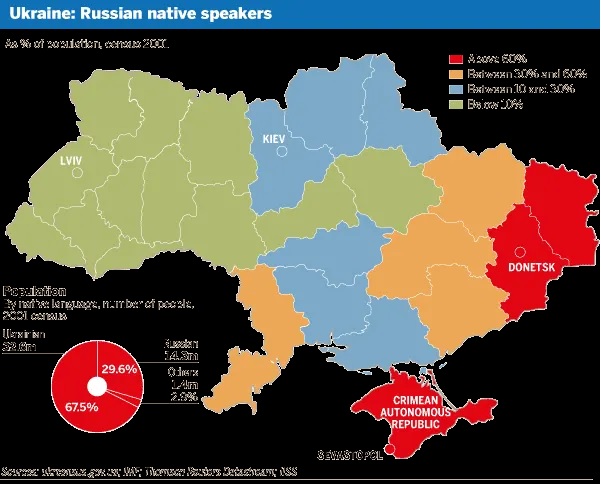
The people of Crimea and Donbass refused to endorse the new power, which included many “integral nationalists”, successors of the defeated of the Second World War.
Crimea, which had already voted in a referendum to become part of the future independent Russia when the USSR was dissolved, six months before the rest of the Ukrainian Soviet Republic declared its independence, voted again in a referendum. For four years, Crimea was claimed by both Russia and Ukraine. Moscow argues that between 1991 and 1995, it and not Kiev was paying pensions and salaries of officials in Crimea. In fact, Crimea was always Russian, even if it was considered part of Ukraine. In the end, it was Russian President Boris Yeltsin who, in the midst of a severe economic crisis, decided to abandon Crimea to Kiev. However, Crimea then voted for a constitution recognizing its autonomy within Ukraine, which Kiev never accepted. The second referendum, in 2014, overwhelmingly proclaimed independence. The Crimean Parliament then called for the attachment of its state to the Russian Federation, which the latter accepted. To strengthen the continuity of its territory, Russia built, without consulting Ukraine, a gigantic bridge linking its metropolis to the Crimean peninsula across the Sea of Azov, effectively privatizing this small sea.
Crimea is home to the port of Sevastopol, which is indispensable to the Russian navy. The latter represented nothing in 1990, but became a power again in 2014.
The West recognized the Soviet referendum in Ukraine in 1990, but not the one in 2014. Yet the right of peoples to self-determination does apply to the Crimeans. The West argues that many Russian soldiers were present without wearing their uniforms. True, but the results of the two referendums in 1990 and 2014 were similar. There is no room for suspicion of fraud.
To show that they did not accept this “annexation”, the West collectively imposed sanctions on Russia, without authorization from the Security Council. These sanctions violate the UN Charter, which gives exclusive authority to the Security Council.
The Donetsk and Luganks oblasts have also rejected the 2014 coup government. They proclaimed their autonomy and posed as resisters to the “Nazis” in Kiev. Equating “integral nationalists” with “Nazis” is historically justified, but does not allow non-Ukrainians to understand what is going on.
The “integral nationalist” was created in Ukraine by Dmytro Dontsov at the very beginning of the 20th century. Initially, Dontsov was a left-wing philosopher, only gradually moving to the extreme right. He was a paid agent of the Second Reich during the First World War, before participating in the Ukrainian government of Symon Petliura, which arose during the Russian Revolution of 1917. He participated in the Paris Peace Conference and accepted the Treaty of Versailles. During the inter-war period, he exercised a mastery over Ukrainian youth and became a propagandist of fascism, then of Nazism.
He became violently anti-Semitic, preaching for the massacre of the Jews long before this theme was supported by the Nazi authorities, who spoke only of expulsion until 1942. During the Second World War, he refused to take over the leadership of the Organization of Ukrainian Nationalists (OUN), which he entrusted to his disciple Stepan Bandera, assisted by Yaroslav Stetsko.
Almost all the documents about his activity within Nazism have been destroyed. It is not known what he did during the war, except for his active participation in the Reinhard Heydrich Institute after the latter’s assassination. The newspapers of this anti-Semitic organ gave him a lot of space
At the Liberation, he fled to Canada, under the protection of the Anglo-Saxon secret services, and then to the United States. At the end of his life, he was still as virulent as ever and had evolved into a form of Viking mysticism, preaching the final confrontation against the “Muscovites. Today, his books, especially his Nationalism, are required reading for militiamen, especially those in the Azov Regiment. Ukrainian “integral nationalists” massacred at least 3 million of their fellow citizens during World War II.
Washington reads this history differently. For it, the “integral nationalists” certainly made mistakes, but they were fighting for their independence against both the German Nazis and the Russian Bolsheviks. The CIA was therefore right to host Dmytro Donsov in the USA and to employ Stepan Bandera on Radio Free Europe. And even more, to create the World Anti-Communist League around the Ukrainian Nazi Prime Minister, Yaroslav Stetsko, and the leader of the Chinese anti-communist opposition, Chiang Kai-shek. Today, again according to Washington, these facts belong to the past.
In 2014, with President Petro Poroshenko, the Kiev government cut off all aid to the “Muscovites” of Donbass. It stopped paying pensions to its citizens and salaries to their civil servants. It banned the Russian language, spoken by half of Ukrainians, and launched punitive military operations against these “sub-humans”, killing 5,600 and displacing 1.5 million in 10 months. In the face of these horrors, Germany, France and Russia imposed the Minsk agreements. The aim was to bring the Kiev government to its senses and to protect the people of the Donbass.
Noting that the first agreements had not been followed by effect. Russia had the Minsk 2 agreement endorsed by the Security Council. This was resolution 2202, adopted unanimously. During the explanations of vote, the United States developed its interpretation of this period. For them, the “resistance” in Donbass were only “separatists” supported militarily by Moscow. They therefore specified that the Minsk 2 agreement (February 12, 2015) did not replace the Minsk 1 agreements (September 5 and 19, 2014), but added to them. They thus demanded that Russia withdraw the troops it had deployed without uniform in the Donbass. Germany and France had a joint statement added, co-signed by Russia, guaranteeing the “binding” implementation of this set of “commitments.”
However, shortly afterwards, President Poroshenko declared that he had no intention of implementing anything and resumed hostilities, a position that the government of President Zelensky has reiterated. In the seven years following resolution 2202, 12,000 new victims were killed, according to Kiev, or 20,000, according to Moscow.
During this period, Moscow did not intervene. President Vladimir Putin not only withdrew his troops, but also forbade an oligarch to send mercenaries to support the people of Donbass. The latter have been abandoned by the guarantors of the Minsk agreements and by the other members of the Security Council.
In the Russian way of politics, one waits until one is in a position to do something before announcing it. So Moscow did not say anything, but prepared for what was to come. Suffering from the sanctions it had endured since the annexation of Crimea, it expected the West to tighten them when it intervened to implement resolution 2202. So Putin approached other sanctioned states, including Iran, to circumvent the sanctions on him and prepare to circumvent others. Anyone who regularly visits Russia will have noticed that the Putin administration is developing food autarky, including for meat and cheese, which his country had previously lacked. Russia has moved closer to China in banking, which we have wrongly interpreted as a move against the dollar. In reality, it was a preparation for the exclusion of the SWIFT system.
When President Putin launched his army into Ukraine, he made it clear that he was not declaring a “war” to annex Ukraine, but was implementing a “special military operation” under Resolution 2202 and his “responsibility to protect” the civilian population of Donbass.
As expected, the West responded with economic sanctions that severely disrupted the Russian economy for two months. Then things turned around and these sanctions turned out to be profitable for Russia, which had prepared for them for a long time.
On the ground, the West sent a lot of weapons, then deployed military advisors and some special forces. The Russian army, three times smaller in number than the Ukrainian army, began to suffer. It has therefore just decreed a partial mobilization to send new troops without having to dismantle its national defence system.
Nato, for its part, has developed a plan to mobilize a core group of states and an expanded group of its more distant allies. The idea is to spread the financial effort over as many partners as possible until Russia is exhausted.
Moscow responded by announcing that if the West took a further step, it would use its new weapons.
The Russian and Chinese armies have mastered hypersonic launchers, which the West lacks. Moscow and Beijing can destroy any target, anywhere in the world, in a matter of minutes. It is impossible to stop them, and this imbalance will last at least until 2030, according to US generals. Russia has already said that it will strike first at the British Foreign Office, which it considers to be the head of its enemies, and the Pentagon, which it considers to be its armed wing. In the event of an attack, the Russian and Chinese armies would first destroy the United States’ strategic communication satellites (CS3). The latter would lose in a few hours the possibility of guiding nuclear missiles and therefore of retaliating. There is little doubt about the outcome of such a war.
……………Engaging in this confrontation is not impossible. In the United States, the Straussians, a very small group of unelected politicians, are determined to bring about the apocalypse. In their view, the United States will no longer be able to exercise dominance over the entire world, but it can still achieve it over its allies. To do this, they must not hesitate to sacrifice some of their own, if their allies suffer even more than they do and if, in this way, they remain the first (not the best).
As in all conflicts, people are afraid and some individuals push them to war.
Russia has just held four referendums on self-determination and annexation, both in the two republics of Donbass and in two oblasts of Novorossia. The view of the G7, whose foreign ministers were attending the UN General Assembly in New York, was immediately to denounce the referendums as invalid because they were held in a war situation, which is a debatable opinion. So they went on to denounce a violation of the sovereignty and territorial integrity of Ukraine and the principles of the UN Charter. These last points are false. By definition, the right of peoples to self-determination does not violate the sovereignty and territorial integrity of the state from which they can, if they wish, separate. Moreover, all the members of the G7 (except Japan) have signed the Helsinki Final Act, in which they undertake to defend all these principles simultaneously.
It is particularly odious to note the way in which the G7 interprets the right to self-determination to its advantage. For example, the United Nations General Assembly has condemned the illegal occupation by the United Kingdom of the Chagos Archipelago. It ordered that it be returned to Mauritius by October 22, 2019. Not only has this not been done, but one of the Chagos Islands, Diego Garcia, is still illegally leased to the United States to house the largest military base in the Indian Ocean. Moreover, France illegally transformed its colony of Mayotte into a department in 2009. It held a referendum in violation of General Assembly resolutions 3291, 3385 and 31/4, which affirm the unity of the Comoros and prohibit referendums in only one of its parts, the state of the Comoros and the French colony of Mayotte. It is precisely to avoid decolonization that France has organized this referendum, given that it has installed a maritime military base there and above all a military interception and intelligence base.
From a Russian point of view, these referendums, if internationally recognized, would put an end to military operations. By refusing them, the West is prolonging the conflict. Their intention is to see the rest of Novorossia fall into the hands of Russia. If Odessa becomes Russian again, Moscow will have to accept the accession of the adjacent Transnistria to the Russian Federation. Transnistria is not Ukrainian, but Moldovan, hence its current name of Dniester Moldavian Republic.
Russia refuses to accept a Moldavian territory that has historical reasons to proclaim itself independent. But it did not accept it either with South Ossetia and Abkhazia, which also have historical reasons to proclaim themselves independent, but are Georgian. Neither Moldova nor Georgia have committed crimes comparable to those of modern Ukraine.
At the end of this presentation, we see that the blame is shared, but not equally. The West recognized the 2014 coup; it tried to stop the ensuing massacre, but ultimately let the full nationalists continue it; it armed Ukraine instead of forcing it to comply with the Minsk 1 and 2 agreements. Russia, for its part, built a bridge that locks the Sea of Azov without consultation. Peace will only be preserved if both sides recognize their mistakes.
Are we able to do this? https://www.voltairenet.org/article218093.html
HISTORIC CONTEXT OF THE REFERENDA IN UKRAINE.
Popular Resistance, By Moon of Alabama., September 24, 2022, Educate!
Voting for membership in the Russian Federation has started in four oblast of Ukraine:
………………….. The Ukrainian regime has resorted to pure terrorism to prevent the votes from happening:
” Ukrainian partisans, sometimes working with special operations forces, have blown up warehouses holding ballots and buildings where Russian proxy officials preparing for the vote held meetings. Ukrainian officials have acknowledged that they are engaged in a campaign to assassinate key Russian administration officials; more than a dozen have been blown up, shot and poisoned, according to Ukrainian and Russian officials.“
Such behavior by the Zelenski regime against its still Ukrainian compatriots will only encourage the people in the four oblast to vote for an alignment with Russia.
The propaganda in the ‘west’ will declare that the vote is irregular and that the results, likely to be pro-Russian, will be fake.
But a view on historic election outcomes since Ukrainian independence in 1991 show clear geographic preferences in east and south Ukraine for pro-Russian policies:
[ The original here shows a graphic chart illustrating voting patterns over the years]
The graphic above is from research published by the Eurasian Research Institute of the International Hoca Ahmet Yesevi Turkish-Kazakh University. Its author writes:
“As we can see, the have always been a clear-cut geographical split in the way the regions of Ukraine vote for particular candidates. The East and West division or also referred as Southeast and Northwest division was always present throughout the electoral history of the independent Ukraine. It is conventionally believed that the eastern part of Ukraine is more influenced by Russia politically, economically and culturally. Therefore, the presidential candidates proposing more pro-Russian agenda usually gain much more political support in eastern regions than in other parts of Ukraine.
On the other hand, the western part of the country has traditionally been more pro-European with strong reference to traditional core Ukrainian ethnic traditions and values. Consequently, presidential candidates with pro-European political agenda and traditional Ukrainian appeal usually had strong support in western regions of the country. It is interesting to note that preferences of the electorate were not related to the geographical origin or background of the presidential candidates and any candidate could easily become popular in the east as well as in the west. Moreover, the same candidate could be both pro-eastern and pro-western in different periods of time as did Leonid Kuchma in 1994 and 1999, who is the only Ukrainian president to serve two consecutive terms from 1994 to 2005.“
The division is consistent with ethnic and linguistic differences between those parts of Ukraine.
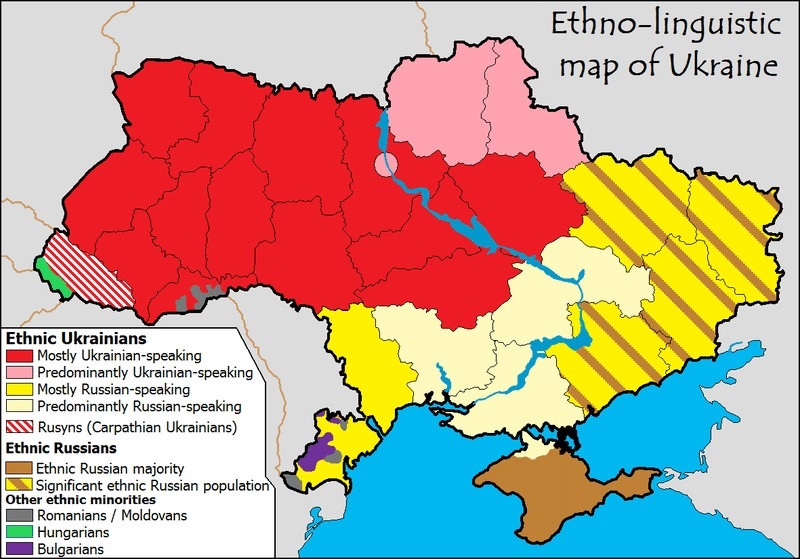
In 2014, after the violent fascist coup in Kiev, one of the first laws implemented by the new government removed the Russian language from official use. Instead of overcoming the differences between its people it only sealed the predominant split in Ukraine.
The election promise of the current Ukrainian president Vladimir Zelenski to make peace with the Russia aligned rebellious Donbas region by adhering to the Minsk 2 agreements was rewarded with a large share of southeastern votes for his presidency. However, after having been threatened with death by fascists, Zelenski has made a 180 degree turn and has since posed as Ukrainian nationalist. In consequence he has lost all support in southeastern Ukraine.
The southeastern parts of today’s Ukraine have for centuries been part of the central Russian empire. They were only attached to the Soviet Republic of Ukraine under Lenin’s rule in 1922 and, in the case of Crimea, in 1954 under Nikita Khrushchev who himself had grown up in the Donbas region.

A likely high turnout and majority vote for membership in the Russian Federation will only correct the historic misalignment created by those illogical transfers.
https://popularresistance.org/historic-context-of-the-referenda-in-ukraine/
International Day for the Total Elimination of Nuclear Weapons 2022: History, Significance and Celebration
https://www.news18.com/news/lifestyle/international-day-for-the-total-elimination-of-nuclear-weapons-2022-history-significance-and-celebration-6028441.htmlBy: Lifestyle Desk
The day reminds people of the dangers of nuclear weapons and urges world governments to cooperate and bring about a permanent and complete nuclear disarmament.
nternational Day for the Total Elimination of Nuclear Weapons is observed on September 26 every year. The devastating impact of the 1945 Hiroshima and Nagasaki bombings is well known. This apart, over 2000 nuclear tests have been conducted to date; the last one in 2017, by North Korea. Such tests have caused cancers, birth defects and chronic diseases, among other illnesses in people, and severely damaged the natural world.
Though there has been a reduction in the number of deployed nuclear weapons since the peak of the Cold War, an estimated 12,705 nuclear weapons still exist in the world as of 2022, with the United States and Russia, who appear to be on opposing sides, owning most of them.
History
The United Nations’ (UN) objective to achieve total nuclear disarmament was underlined in the first resolution of the United Nations General Assembly (UNGA) in 1946. Nuclear disarmament was made a priority objective in the first Special Session of the UNGA on disarmament in 1978. The nations which possess nuclear weapons include a doctrine of nuclear deterrence in their security policies.
To raise public awareness about nuclear weapons, the UNGA, in 2009, declared August 29 as the International Day against Nuclear Tests. Then, in December 2013, the UNGA declared September 26 as the International Day for the Total Elimination of Nuclear Weapons to mark the high-level UNGA meeting on nuclear disarmament on September 26 that year.
Celebration
Each year, the UN member states, civil society, parliamentarians, non-governmental organisations, mass media, academia, and individuals celebrate and promote the international day through various educational activities.
Significance
The International Day for the Total Elimination of Nuclear Weapons reminds people of the dangers of nuclear weapons and urges world governments to cooperate and bring about a permanent and complete nuclear disarmament.
Nuclear Disarmament
Even though total nuclear weapons elimination remains a dream for now, the 1987 Christopher Reeve-starring film, ‘Superman IV: The Quest for Peace,’ (1987) shows the title character destroying all of Earth’s nuclear weapons. People, however, not aliens, are needed to establish permanent peace. The International Day for the Total Elimination of Nuclear Weapons rekindles that dream each year.
Brainwashed for War With Russia

https://original.antiwar.com/mcgovern/2022/09/21/brainwashed-for-war-with-russia/ by Ray McGovern ,
Thanks to Establishment media, the sorcerer apprentices advising President Joe Biden – I refer to Secretary of State Antony Blinken, national security adviser Jacob Sullivan, and China specialist Kurt Campbell – will have no trouble rallying Americans for the widest war in 77 years, starting in Ukraine, and maybe spreading to China. And, shockingly, under false pretenses.

Most Americans are oblivious to the reality that Western media are owned and operated by the same corporations that make massive profits by helping to stoke small wars and then peddling the necessary weapons. Corporate leaders, and Ivy-mantled elites, educated to believe in U.S. “exceptionalism,” find the lucre and the luster too lucrative to be able to think straight. They deceive themselves into thinking that (a) the US cannot lose a war; (b) escalation can be calibrated and wider war can be limited to Europe; and (c) China can be expected to just sit on the sidelines. The attitude, consciously or unconsciously, “Not to worry. And, in any case, the lucre and luster are worth the risk.”
The media also know they can always trot out died-in-the-wool Russophobes to “explain,” for example, why the Russians are “almost genetically driven” to do evil (James Clapper, former National Intelligence Director and now hired savant on CNN); or Fiona Hill (former National Intelligence Officer for Russia), who insists “Putin wants to evict the United States from Europe … As he might put it: “Goodbye, America. Don’t let the door hit you on the way out.”
Absent a miraculous appearance of clearer heads with a less benighted attitude toward the core interests of Russia in Ukraine, and China in Taiwan, historians who survive to record the war now on our doorstep will describe it as the result of hubris and stupidity run amok. Objective historians may even note that one of their colleagues – Professor John Mearsheimer – got it right from the start, when he explained in the autumn 2014 issue of Foreign Affairs “Why the Ukraine Crisis is the West’s Fault.”
Historian Barbara Tuchman addressed the kind of situation the world faces in Ukraine in her book “The March of Folly: From Troy to Vietnam.” (Had she lived, she surely would have updated it to take Iraq, Afghanistan, Syria, and Ukraine into account). Tuchman wrote:
“Wooden-headedness…plays a remarkably large role in government. It consists in assessing a situation in terms of preconceived fixed notions while ignoring or rejecting any contrary signs. It is acting according to wish while not allowing oneself to be deflected by the facts.”
Six Years (and Counting) of Brainwashing
Thanks to US media, a very small percentage of Americans know that:
- 14 years ago, then US Ambassador to Russia (current CIA Director) William Burns was warned by Russian Foreign Minister Sergei Lavrov that Russia might have to intervene in Ukraine, if it were made a member of NATO. The Subject Line of Burns’s Feb. 1, 2008 Embassy Moscow cable (#182) to Washington makes it clear that Amb. Burns did not mince Lavrov’s words; the subject line stated: “Nyet means nyet: Russia’s NATO enlargement redlines.”Thus, Washington policymakers were given forewarning, in very specific terms, of Russia’s redline regarding membership for Ukraine in NATO. Nevertheless, on April 3, 2008, a NATO summit in Bucharest asserted: “NATO welcomes Ukraine’s and Georgia’s Euro-Atlantic aspirations for membership in NATO. We agreed today that these countries will become members of NATO.”
- 8 years ago, on Feb. 22, 2014, the US orchestrated a coup in Kiev – rightly labeled “the most blatant coup in history’, insofar as it had already been blown on YouTube 18 days prior. Kiev’s spanking new leaders, handpicked and identified by name by US Assistant Secretary of State Victoria Nuland in the YouTube-publicized conversation with the U.S. ambassador in Kiev, immediately called for Ukraine to join NATO.
- 6 years ago, in June 2016, Russian President Vladimir Putin told Western reporters of his concern that so-called antiballistic missiles sites in Romania and Poland could be converted overnight to accommodate offensive strike missiles posing a threat to Russia’s own nuclear forces. (See this unique video, with English subtitles, from minute 37 to 49.) There is a direct analogy with the 1962 Cuban missile crisis when Moscow put offensive strike missiles in Cuba and President John Kennedy reacted strongly to the existential threat that posed to the US.
- On December 21, 2021, President Putin told his most senior military leaders:
“It is extremely alarming that elements of the US global defense system are being deployed near Russia. The Mk 41 launchers, which are located in Romania and are to be deployed in Poland, are adapted for launching the Tomahawk strike missiles. If this infrastructure continues to move forward, and if US and NATO missile systems are deployed in Ukraine, their flight time to Moscow will be only 7–10 minutes, or even five minutes for hypersonic systems. This is a huge challenge for us, for our security.” [Emphasis added.]- On December 30, 2021, Biden and Putin talked by phone at Putin’s urgent request. The Kremlin readout stated:
- On February 12, 2022, Ushakov briefed the media on the telephone conversation between Putin and Biden earlier that day.
Unprovoked?
The US insists that Russia’s invasion was “unprovoked”. Establishment media dutifully regurgitate that line, while keeping Americans in the dark about such facts (not opinion) as are outlined (and sourced) above. Most Americans are just as taken in by the media as they were 20 years ago, when they were told there were weapons of mass destruction in Iraq. They simply took it on faith. Nor did the guilty media express remorse – or a modicum of embarrassment.
The late Fred Hiatt, who was op-ed editor at the Washington Post, is a case in point. In an interview with the Columbia Journalism Review [CJR, March/April 2004] he commented:
On February 24, 2022, Russia invaded Ukraine.
“If you look at the editorials we wrote running up [to the war], we state as flat fact that he [Saddam Hussein] has weapons of mass destruction.” “If that’s not true, it would have been better not to say it.”
(My journalism mentor, Robert Parry, had this to say about Hiatt’s remark. “Yes, that is a common principle of journalism, that if something isn’t real, we’re not supposed to confidently declare that it is.”)
It’s worse now. Russia is not Iraq. And Putin has been so demonized over the past six years that people are inclined to believe the likes of James Clapper to the effect there’s something genetic that makes Russians evil. “Russia-gate” was a big con (and, now, demonstrably so), but Americans don’t know that either. The consequences of prolonged demonization are extremely dangerous – and will become even more so in the next several weeks as politicians vie to be the strongest in opposing and countering Russia’s “unprovoked” attack on Ukraine.
THE Problem
Humorist Will Rogers had it right:
“The problem ain’t what people know. It’s what people know that ain’t so; that’s the problem.”
Ray McGovern works with Tell the Word, a publishing arm of the ecumenical Church of the Saviour in inner-city Washington. His 27-year career as a CIA analyst includes serving as Chief of the Soviet Foreign Policy Branch and preparer/briefer of the President’s Daily Brief. He is co-founder of Veteran Intelligence Professionals for Sanity (VIPS).
Gullible governments – US Energy Department returns to costly and risky plutonium separation technologies

Bulletin of the Atomic Scientists, By Jungmin Kang, Masafumi Takubo, Frank von Hippel | September 14, 2022, On July 17, the United Kingdom ended 58 years of plutonium separation for nuclear fuel by closing its Magnox nuclear fuel reprocessing plant at Sellafield. This leaves the UK with the world’s largest stock of separated power-reactor plutonium, 140 metric tons as of the end of 2020, including 22 tons separated for Japan. The UK is also second in the world only to Russia in the size of its overall inventory of separated plutonium with 119 tons, including 3.2 tons for weapons. Russia’s stock, 191 tons, is mostly “weapon-grade” separated for use in nuclear weapons during the Cold War, but the UK’s power-reactor plutonium is also weapon usable, and therefore also poses a security risk. The UK has no plan for how it will dispose of its separated plutonium. Its “prudent estimate” placeholder for the disposal cost is £10 billion ($12.6 billion).
One obvious way to get rid of separated plutonium would be to mix it with depleted uranium to make “mixed-oxide” (MOX) fuel energetically equivalent to low-enriched uranium fuel, the standard fuel of conventional reactors. Despite the bad economics, since 1976 France has routinely separated out the approximately one percent plutonium in the low-enriched uranium spent fuel discharged by its water-cooled reactors and recycled the plutonium in MOX fuel.
But both the UK and the US have had negative experiences with building their own MOX production plants.
In 2001, the UK completed a MOX plant, only to abandon it in 2011 after 10 years of failed attempts to make it operate. For its part, the US Energy Department, which owns almost 50 tons of excess Cold War plutonium, contracted with the French government-owned nuclear-fuel cycle company, Areva (now Orano), in 2008 to build a MOX fuel fabrication plant. But the United States switched to a “dilute and dispose” policy for its excess plutonium in 2017 after the estimated cost of the MOX plant grew from $2.7 billion to $17 billion.
Despite decades of failed attempts around the world to make separated plutonium an economic fuel for nuclear power plants, the United States Energy Department is once again promoting the recycling of separated plutonium in the fuel of “advanced” reactor designs that were found to be economically uncompetitive 50 years ago. At the same time, other countries—including Canada and South Korea, working in collaboration with the Energy Department’s nuclear laboratories—are also promoting plutonium separation as a “solution” to their own spent fuel disposal problems. These efforts not only gloss over the long history of failure of these nuclear technologies; they also fail to take into account the proliferation risk associated with plutonium separation—a risk that history has shown to be quite real.
Renewed advocacy for plutonium separation. As the UK finally turns its back on plutonium separation, the United States Energy Department is looking in the other direction. Within the Energy Department, one part, the Office of Defense Nuclear Nonproliferation, is struggling to dispose of excess Cold War weapons plutonium, as two others—the Office of Nuclear Energy and ARPA-E (Advanced Research Project Agency – Energy)—are promoting plutonium separation……………………………………..
In fact, the Energy Department’s Office of Nuclear Energy is promoting sodium-cooled reactor designs based on the Idaho National Laboratory’s Experimental Breeder Reactor II, which was shut down in 1994 due to a lack of mission after the end of the US breeder program a decade earlier. The Energy Department’s office is now supporting research, development, and demonstration of sodium-cooled reactors by several nuclear energy startups.

Among them is Bill Gates’ Terrapower, to which the department has committed as much as $2 billion in matching funds to build a 345-megawatt-electric sodium-cooled prototype reactor—called Natrium (sodium in Latin)—in the state of Wyoming. One of Wyoming’s current senators, John Barrasso, is a leading advocate of nuclear power and could become chair of the Senate Committee on Energy and Natural Resources if the Republicans take control of the upper chamber in the elections this fall.
Terrapower insists Natrium is not a plutonium breeder reactor and will be fueled “once through” with uranium enriched to just below 20 percent and its spent fuel disposed of directly in a deep geologic repository, without reprocessing. Natrium, however, is set to use, initially at least, the same type of fuel used in Idaho’s Experimental Breeder Reactor II. The Energy Department maintains that this spent fuel cannot be disposed of directly because the sodium in the fuel could burn if it contacts underground water or air. On that basis, the Idaho National Laboratory has been struggling for 25 years to treat a mere three tons of spent fuel from the Experimental Breeder Reactor II using a special reprocessing technology called “pyroprocessing.”
In pyroprocessing, the fuel is dissolved in molten salt instead of acid, and the plutonium and uranium are recovered by passing a current through the salt and plating them out on electrodes. In 2021, Terrapower stated that it plans to switch later to a fuel for Natrium that does not contain sodium but then received in March 2022 the largest of eleven Energy Department grants for research and development on new reprocessing technologies.
Liquid-sodium-cooled reactor designs date back to the 1960s and 1970s, when the global nuclear power community believed conventional power reactor capacity would quickly outgrow the available supply of high-grade uranium ore. Conventional reactors are fueled primarily by chain-reacting uranium 235, which comprises only 0.7 percent by weight of natural uranium. Because of this low percentage, nuclear power advocates focused on developing plutonium “breeder” reactors that would be fueled by chain-reacting plutonium produced from the abundant but non-chain-reacting uranium 238 isotope, which constitutes 99.3 percent of natural uranium. (Liquid-sodium-cooled reactors are sometimes called “fast-neutron reactors” because they utilize fast neutrons to operate. Sodium was chosen as a coolant because it slows neutrons less than water. Fast neutrons are essential to a plutonium breeder reactor because the fission of plutonium by fast neutrons releases more excess secondary neutrons whose capture in uranium 238 makes possible the production of more plutonium than the reactor consumes.)
Large programs were launched to provide startup fuel for the breeder reactors by reprocessing spent conventional power-reactor fuel to recover its contained plutonium.
………………………………….. Only a few prototypes were built and then mostly abandoned. In 2020, the Organisation for Economic Co-operation and Development’s Nuclear Energy Agency estimated that sufficient low-cost uranium would be available to fuel existing conventional reactor capacity for more than a century.
Zombie plutonium-separation programs. Even though separated plutonium has morphed from the nuclear fuel of the future into a disposal problem, civilian plutonium separation continues in several countries, notably France, Japan, and Russia. It is also being advocated again by the offices within the US Energy Department that fund research and development on nuclear energy.
Russia still has an active breeder reactor development program, with two operating liquid sodium-cooled prototypes—only one of them plutonium fueled—plus a small, liquid, lead-cooled prototype under construction. But Russia has already separated 60 tons of power-reactor plutonium and has declared as excess above its weapons needs approximately 40 tons of weapon-grade plutonium. These 100 tons of separated plutonium would be enough to provide startup fuel for five years for six full-size breeder reactors.
China and India have breeder reactor prototypes under construction, but their breeders are suspected of being dual-purpose. In addition to their production of electric power, the weapon-grade plutonium produced in uranium “blankets” around the breeder cores is likely to be used for making additional warheads for their still-growing nuclear arsenals.
France and Japan require their nuclear utilities to pay for reprocessing their spent fuel and for recycling the recovered plutonium in MOX fuel, even though both countries have known for decades that the cost of plutonium recycling is several times more than using low-enriched uranium fuel “once through,” with the spent fuel being disposed of directly in a deep geological repository.
Claimed benefits of reprocessing. Advocates of plutonium recycling in France and Japan justify their programs with claims that it reduces uranium requirements, the volume of radioactive waste requiring disposal, and the duration of the decay heat and radiotoxicity of the spent fuel in a geologic repository. These benefits are, however, either minor or non-existent. First, France’s plutonium recycling program reduces its uranium requirements by only about 10 percent, which could be achieved at much less cost in other ways, such as by adjusting enrichment plants to extract a higher percentage of the uranium 235 isotopes in natural uranium. Second, with proper accounting, it is not at all clear that recycling produces a net reduction in the volume of radioactive waste requiring deep geological disposal. Third, the claimed heat reduction, if realized, could reduce the size of the repository by packing radioactive waste canisters more closely. But this is not significant because, with the currently used reprocessing technology, americium 241, which has a 430-year half-life and dominates the decay heat from the spent fuel during the first thousand years, remains in the reprocessed waste.
Claims of the reduced toxicity of reprocessed waste turn out to be false as well. For decades, France’s nuclear establishment has promoted continued reprocessing in part out of hope that, after its foreign reprocessing customers did not renew their contracts, it could sell its plutonium recycling technology to other countries, starting with China and the United States. But, with the notable exception of the canceled US MOX plant, these efforts so far have not materialized, and the willingness of the French government to continue funding its expensive nuclear fuel cycle strategy may be reaching its limits………………………..
Proliferation danger. Aside from the waste of taxpayer money, there is one major public-policy objection to plutonium separation: Plutonium can be used to make a nuclear weapon. The chain-reacting material in the Nagasaki bomb was six kilograms of plutonium, and the fission triggers of virtually all nuclear warheads today are powered with plutonium. Reactor-grade plutonium is weapon-usable, as well.
In the 1960s, however, blinded by enthusiasm for plutonium breeder reactors, the US Atomic Energy Commission—the Energy Department’s predecessor agency—promoted plutonium worldwide as the fuel of the future. During that period, India sent 1,000 scientists and engineers to Argonne and other US national laboratories to be educated in nuclear science and engineering. In 1964, India began to separate plutonium from the spent fuel of a heavy-water research reactor provided jointly by Canada and the United States. Ten years later, in 1974, India used some of that separated plutonium for a design test of a “peaceful nuclear explosive,” which is now a landmark in the history of nuclear weapon proliferation……………………….
False environmental claims for reprocessing. Since the 1980s, advocates of reprocessing and plutonium recycling and fast neutron reactors in the Energy Department’s Argonne and Idaho National Laboratories have promoted them primarily as a strategy to facilitate spent fuel disposal.
The George W. Bush administration, which came to power in 2001, embraced this argument because it saw the impasse over siting a spent fuel repository as an obstacle to the expansion of nuclear power in the United States. To address the proliferation issue, the Bush Administration proposed in 2006 a “Global Nuclear Energy Partnership” in which only countries that already reprocessed their spent fuel (China, France, Japan, and Russia) plus the United States would be allowed to reprocess the world’s spent fuel and extract plutonium. The recovered plutonium then would be used in the reprocessing countries to fuel advanced burner reactors (breeder reactors tweaked so that they would produce less plutonium than they consumed). These burner reactors would be sodium-cooled fast-neutron reactors because the slow neutrons that sustain the chain reaction in water-cooled reactors are not effective in fissioning some of the plutonium isotopes. After Congress understood the huge costs involved, however, it refused to fund the partnership…………………………….
Plutonium and the geological disposal of spent fuel. Despite the unfavorable economics, the idea of separating and fissioning the plutonium in spent fuel has been kept alive in the United States and some other countries in part by continuing political and technical obstacles to siting spent fuel repositories. Proponents of reprocessing have managed to keep their governments’ attention on plutonium because it is a long-lived radioelement, a ferocious carcinogen—if inhaled—and has fuel value if recycled.
But detailed studies have concluded that plutonium makes a relatively small contribution to the long-term risk from a spent fuel geologic repository for spent fuel from commercial power reactors.
……………………………………………….. risk assessments are theoretical, but they are based on real-world experience with the movement of radioisotopes through the environment.
The main source of that experience is from the large quantities of fission products and plutonium lofted into the stratosphere by the fireballs of megaton-scale atmospheric nuclear tests between 1952 and 1980. During that period, the Soviet Union, the United States, China, the United Kingdom, and France injected into the stratosphere a total of about eight tons of fission products and 3.4 tons of plutonium—comparable to the quantities in a few hundred tons of spent light water reactor fuel. These radioisotopes returned to earth as global radioactive “fallout.”
…………………………………… In addition to the proliferation danger dramatized by the case of India, plutonium separation also brings with it a danger of a massive accidental radioactive release during reprocessing. The world’s worst nuclear accident before Chernobyl involved the Soviet Union’s first reprocessing plant for plutonium production, in 1957……………………………………………..
Gullible governments. Nearly half a century after India conducted its first nuclear test in 1974 with assistance provided inadvertently by Canada and the United States, both countries’ governments seem to have forgotten about the proliferation risk associated with spent fuel reprocessing. Today, advocates of fast-neutron breeder or burner reactors are pitching again the same arguments—used before the test—to gullible governments that seem unaware of the history of this issue. This ignorance has created problems for Canada’s nonproliferation policy as well as that of the United States.
In Canada, a UK startup, Moltex, has obtained financial support from federal and provincial governments by promising to “solve” Canada’s spent fuel problem. Its proposed solution is to extract the plutonium in the spent fuel of Canada’s aging CANDU (CANada Deuterium Uranium) reactors to fuel a new generation of molten-salt-cooled reactors. The Moltex company also proposes to make Canada an export hub for its reactors and small reprocessing plants.
In South Korea, the Korea Atomic Energy Research Institute, with support from Energy Department’s Argonne and Idaho National Laboratories, has similarly been campaigning to persuade its government that pyroprocessing spent fuel and fissioning plutonium in sodium-cooled reactors would help solve that country’s spent fuel management problem.
It is time for governments to learn again about the risks involved with plutonium separation and to fence off “no-go zones” for their nuclear energy advocates, lest they unintentionally precipitate a new round of nuclear-weapon proliferation.
Notes:
[1] Carbon 14 and iodine 129 are difficult to capture during reprocessing and therefore are routinely released into the atmosphere and ocean by France’s reprocessing plant at La Hague. Also, had the uranium 238 in the spent fuel not been mined, its decay product, radium 226, would have been released within the original uranium deposit. So, even though some reprocessing advocates join with nuclear power critics in amplifying the hazards of plutonium and other transuranic elements in underground radioactive waste repositories, they generally omit comparisons with reprocessing hazards (in the case of reprocessing advocates) or with natural uranium deposits (in the case of repository opponents). https://thebulletin.org/2022/09/some-fuels-never-learn-us-energy-department-returns-to-costly-and-risky-plutonium-separation-technologies/
Russia’s Stranglehold On The World’s Nuclear Power Cycle
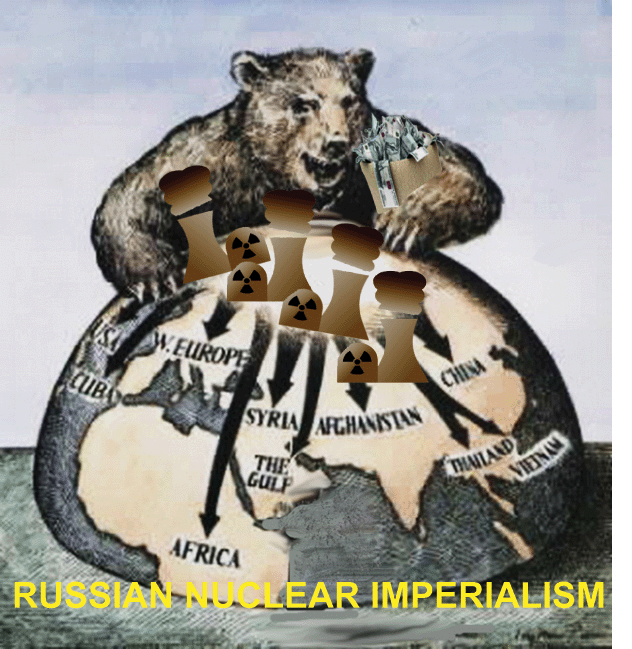
Radio Free Europe, September 01, 2022 By Kristyna Foltynova [Excellent graphics] “…………………… Here’s how Russia plays a crucial role in the world’s nuclear cycle
It’s Not Just About Mining
Russia is among the five countries with the world’s largest uranium resources. It is estimated to have about 486,000 tons of uranium, the equivalent of 8 percent of global supply…………….
However, uranium mining is just one piece of the nuclear process. Raw uranium is not suitable as fuel for nuclear plants. It needs to be refined into uranium concentrate, converted into gas, and then enriched. And this is where Russia excels.
In 2020, there were just four conversion plants operating commercially — in Canada, China, France, and Russia. Russia was the largest player, with almost 40 percent of the total uranium conversion infrastructure in the world, and therefore produced the largest share of uranium in gaseous form (called uranium hexafluoride).
World Uranium Conversion Capacity
In 2020, almost 40 percent of converted uranium came from Russia.
The same goes for uranium enrichment, the next step in the nuclear cycle. According to 2018 data (the latest available), that capacity was spread among a handful of key players, with Russia once again responsible for the largest share — about 46 percent.Therefore, Russia is a significant supplier of both uranium and uranium enrichment services. According to the latest available data, the European Union purchased about 20 percent of its natural uranium and 26 percent of its enrichment services from Russia in 2020. The United States imported about 14 percent of its uranium and 28 percent of all enrichment services from Russia in 2021.
Purchases Of Natural Uranium
In 2020, Russia supplied about one-fifth of the EU’s natural uranium and was among the top suppliers of uranium to the United States in 2021.
Did Someone Say Nuclear Reactors?
Nuclear reactors made in Russia are known as VVER — an abbreviation for the Russian vodo-vodyanoi enyergeticheskiy reactor (water-water energetic reactor). These reactors use water both as a coolant and as a moderator and were originally developed in the Soviet Union. There are several versions of VVERs (such as the VVER-440 and VVER-1000), with the volume of power being one of the significant differences.
Currently, there are 11 countries where various types of VVERs are operating, including Bulgaria, the Czech Republic, Hungary, and Finland. On top of that, other countries such as Egypt, Turkey, and Argentina currently have these reactors under construction or plan to build them.
Russia is considered the world leader when it comes to the export of nuclear plant development. Between 2012 and 2021, Rosatom initiated construction of 19 nuclear reactors; 15 of these were initiated abroad. That is far more than the next most prolific providers: China, France, and South Korea. Although China started building 29 reactors during the same period, only two of them were initiated abroad. France started building two reactors abroad, and South Korea four.
Exporters Of Nuclear Plants
Between 2012 and 2021, Russia initiated the construction of 15 nuclear reactors abroad.
Don’t Forget The Fuel
To keep the reactors operating, plants need a regular supply of nuclear fuel — usually a certain type of fuel. And this is where another level of dependency on Russia can be observed. Although there are several suppliers on the market, the Russian TVEL Fuel Company is currently the only authorized supplier of fuel needed for VVER-440s……..
Russia is also able to supply high-assay low-enriched uranium (also known as HALEU). It is a type of fuel that will be needed for more advanced reactors that are now under development by many companies across the United States. The main difference from the fuel that is currently being used is the level of uranium enrichment. Instead of up to 5 percent uranium-235 enrichment, the new generation of reactors needs fuel with up to 20 percent enrichment……………. At the moment, the only supplier able to provide the fuel on a commercial scale is Russia’s Tenex (owned by the Russian state-owned company Rosatom).
Looking For New Markets
Selling nuclear technology is also part of Russia’s effort to gain influence and reap profits in countries that are new to nuclear energy. One of the reasons countries want to cooperate with Russia is that it offers a “whole package” solution. Russia can not only build a nuclear plant and supply fuel, but it also trains local specialists, helps with safety questions, runs scholarship programs, and disposes of radioactive waste.
However, offering attractive loans is probably Russia’s most powerful tool. These loans are usually backed by government subsidies and cover at least 80 percent of construction costs. For example, Russia has already lent $10 billion to Hungary, $11 billion to Bangladesh, and $25 billion to Egypt — all to build nuclear power plants.
Russia has operating nuclear reactors in 11 countries, and more are under construction or being planned. Besides that, Russia has also signed either memorandums of understanding or intergovernmental agreements with at least 30 countries around the world, mostly in Africa. These serve as a declaration of interest in nuclear technology or set an intention to cooperate on the building of nuclear plants, respectively.
Russia has operating nuclear reactors in 11 countries, and more are under construction or being planned. Besides that, Russia has also signed either memorandums of understanding or intergovernmental agreements with at least 30 countries around the world, mostly in Africa. These serve as a declaration of interest in nuclear technology or set an intention to cooperate on the building of nuclear plants, respectively.
Some experts warn that African countries might not be ready for nuclear power, but Russia argues that the technology represents an answer to the continent’s increasing demand for electricity. It is also worth noting that African countries represent the largest voting bloc in the United Nations, which might be another reason for Russia to strengthen its ties in the region.
Nuclear Cooperation
There are at least 50 countries with some level of nuclear cooperation with Russia………. https://www.rferl.org/a/russia-nuclear-power-industry-graphics/32014247.html—
1 This Month
22 June – Virtual Event –Climate Change: New Data, New Debate

Monday, June 22, 2026 2:30 p.m. – 3:15 p.m. CT
YouTube. Register here

Protect Sazan Island from the Trump family! https://secure.avaaz.org/campaign/en/protect_sazan_island_from_the_trump_family_loc/?bqFCVab&v=174511&cl=22707147157&_checksum=5e9dde668860e8231c33699735e16a1fbf22ab2cb01da50c999fe8732b9775ef&utm_source=email&utm_medium=blast_email&utm_campaign=174511
25 June- THE PUKE ON NUKES
Thursday, June 25, 2026
7pm Central Time (8pm ET, 6pm MT, 5pm PT) UTC – 5
From NRC & DOE Deregulation to Techno-Fascist Billionaires Going Nuclear, Plus a Few Songs from Atomic Cabaret REGISTER
26 June – Radiation Trainwreck at the NRC / Join the Protect Better Campaign – https://us02web.zoom.us/meeting/register/4ZlZ5_qLSHGiLSCg8FF6Bg#/registration


Cuba Is Not a Failed State – It Is a Besieged State
PETITION: “Global Appeal to Endorse Palestinian Right of Return of Refugees”
To see nuclear-related stories in greater depth and intensity – go to https://nuclearinformation.wordpress.com
-
Archives
- June 2026 (193)
- May 2026 (306)
- April 2026 (356)
- March 2026 (251)
- February 2026 (268)
- January 2026 (308)
- December 2025 (358)
- November 2025 (359)
- October 2025 (376)
- September 2025 (257)
- August 2025 (319)
- July 2025 (230)
-
Categories
- 1
- 1 NUCLEAR ISSUES
- business and costs
- climate change
- culture and arts
- ENERGY
- environment
- health
- history
- indigenous issues
- Legal
- marketing of nuclear
- media
- opposition to nuclear
- PERSONAL STORIES
- politics
- politics international
- Religion and ethics
- safety
- secrets,lies and civil liberties
- spinbuster
- technology
- Uranium
- wastes
- weapons and war
- Women
- 2 WORLD
- ACTION
- AFRICA
- Atrocities
- AUSTRALIA
- Christina's notes
- Christina's themes
- culture and arts
- Events
- Fuk 2022
- Fuk 2023
- Fukushima 2017
- Fukushima 2018
- fukushima 2019
- Fukushima 2020
- Fukushima 2021
- general
- global warming
- Humour (God we need it)
- Nuclear
- RARE EARTHS
- Reference
- resources – print
- Resources -audiovicual
- Weekly Newsletter
- World
- World Nuclear
- YouTube
-
RSS
Entries RSS
Comments RSS
 nuclear-news