Time running out for action on Climate Change

 Five years to act on climate: report The Age , Tom Arup and David Wroe November 11, 2011THE world has just five years to make ”urgent and radical policy changes” or lock in dangerous climate change, the world’s leading energy agency has warned, sparking a debate about whether Australia should shift to gas or renewable energy.
The 2011 World Energy Outlook – released by the International Energy Agency late on Wednesday night – finds the world is on track to build enough fossil-fuel power stations, energy-intensive factories and buildings by 2017 to close the door on keeping climate change to a safe level…… The outlook says coal consumption needs to peak well before 2020 if the world wants to halt global warming at a 2 degrees rise, which scientists say is needed to avoid the worst impacts of climate change.
If energy and climate policies currently proposed by all world governments – including Australia’s carbon tax – are put in place, temperatures will rise by 3.5 degrees. If the world remains on its current path of growth in fossil fuels global temperatures will rise by 6 degrees, the outlook says.
Agency chief economist Fatih Birol said if by 2017 there is not a start to major new clean infrastructure investments ”the door to 2 degrees will be closed”. ”I am very worried,” he said, ”if we don’t change direction now on how we use energy, we will end up beyond what scientists tell us is the minimum. The door will be closed forever.”
The outlook comes as nations prepare to converge on the South African city of Durban later this month for the next round of global climate change negotiations, but there is almost no expectation significant progress on a global pact will be made.
The agency’s report says emissions from existing fossil-fuel power plants, factories and buildings have already locked in 80 per cent of the emissions allowed by 2035 to keep carbon dioxide levels in the atmosphere to 450 parts per million, the maximum possible to keep temperature rises to 2 degrees. The other 20 per cent will be eaten up by 2017 on current development trends the outlook says…. http://www.theage.com.au/national/five-years-to-act-on-climate-report-20111110-1n9he.html#ixzz1dRh1PZbd
A dubious claim about nuclear fusion
Cold Fusion Experiment: Major Success or Complex Hoax?, Fox news, By John Brandon, November 02, 2011 A physicist in Italy claims to have demonstrated a new type of power plant that provides safe, cheap and virtually unlimited nuclear power to the world, without fossil fuels or radiation concerns.
The only hitch: Scientists say the method — cold fusion — is patently impossible. They say it defies the laws of physics…… Jonathan Koomey, an energy consultant who has advised the EPA, said any extraordinary discovery requires extraordinary proof. He said the E-Cat must be verified by an independent study conducted by scientists who are allowed access to the machine’s inner-workings.
“[The E-Cat experiment] should be treated as a hoax until independent scientists are able to replicate these results,” Koomey told FoxNews.com — as one would treat claims that someone had defied the laws of gravity or found a major flaw in the theory of relativity.
Koomey explained that cold fusion defies the laws of thermodynamics. Energy requires an initial, consumable power source that erodes and breaks down — it simply isn’t self-sustaining……
Rossi claims his company, Leonardo Corp., will produce the E-Cat machine, which he first demonstrated earlier this year at the University of Bologna. Proof of the experiment’s success is that the customer will pay for the technology and start using it, he said…
http://www.foxnews.com/scitech/2011/11/02/andrea-rossi-italian-cold-fusion-plant/#ixzz1cgMMbKLB
Twice as much radiation released from Fukushima as previously estimated
the institute warned that a significant degree of pollution would remain in waters off the coast of Fukushima Prefecture as caesium-137 has a half-life of around 30 years….
 New Norwegian report says Fukushima radiation releases twice initial estimates, Two new European reports on the Fukushima Daiichi disaster released over the last week take large steps in proving that radioactive caesium-137 released after the nuclear power plant was slammed by 9.0 magnitude earthquake and tsunami last March was twice as much as initially thought. Bellona Charles Digges, 31/10-2011 Continue reading
New nuclear weapons complex makes a mockery of USA’s nuclear disarmament posture
 “The warhead cores of these “plants,” would be “the successors to the bombs used on Nagasaki. They’d each have a yield that’s 50 times greater than the bomb used there in World War II.”
Despite President Obama’s campaign rhetoric of a world without nuclear weapons, despite the recent catastrophe at Japan’s Fukushima complex, and despite the new START nuclear arms control treaty between the U.S. and Russia last February, it seems the desire among our leaders for nuclear power and nuclear weaponry remains as strong today as it was at the height of the Cold War. What’s just as disturbing, though, is the disregard our government shows for any input from its citizenry — pro or con. Continue reading
Nuclear energy is in no way a solution to climate change
Is Nuclear Energy a Fuel with a Future?, Huffington Post, Andy Mannle, : 10/28/11 “………the nuclear industry needs to do more than build a few plants a year to be a true low-carbon alternative to fossil fuels. A hard look at the science of reducing atmospheric carbon to 350ppm shows why.
To get the world off coal, which produces roughly half of the world’s power, would require 7-8 terawatts of energy. One nuclear power plant yields a gigawatt of power, meaning 8000 nuclear power plants would be needed to produce 8 terawatts. To do this by 2050, 200 plants would need to be built a year, which is roughly one every 1.5 days. Since nuclear plants only have a lifespan of 50 years, by the time the required amount is built, early plants would have to start being decommissioned. After that, new plants would need to keep being built at the same pace just to replace retiring ones.
So if the world goes nuclear, supplying half the power we need would require building a new plant every other day forever.
Even if this rate of growth were feasible, it is clearly unsustainable. Of course, no single strategy is going to wean us off coal in several decades. We will need a combination of carbon reduction strategies — what Princeton researchers Robert Socolow and Stephen Pacala call “stabilization wedges” that each reduce a billion tons a year for the next 50 years. The “wedges” include efficiency, renewables, carbon sequestration, reforestation, and replacing coal plants with natural gas. But even for nuclear to generate a single wedge would require tripling our current nuclear capacity.
The reality is global CO2 emissions are rising, not falling. And we can’t build enough nuclear alone to stop them. As such, nuclear’s benefits as a low-carbon alternative would only materialize in the context of a global war on carbon. Absent that, nuclear becomes just another low-carbon energy source competing on the open market with cleaner renewables and cheaper natural gas. Ironically, the current slow growth of nuclear and the possibility of an actual nuclear retreat after Fukushimacould mean an acceleration in our rising CO2 emissions, cautions the International Energy Agency….. http://www.huffingtonpost.com/andy-mannle/nuclear-energy-a-fuel-with_b_1032727.html
New Start nuclear weapons data increases uncertainty
though not yet 1 year old, the New START treaty is already beginning to increase uncertainty about the status of U.S. and Russian nuclear forces,”
U.S. Releases New START Nuke DataNTI Global Security Newswire, Oct. 26, 2011 The United States as of last month officially had 1,790 deployed strategic nuclear warheads, while Russia had fielded 1,566 long-range weapons, according to details from a semiannual information swap mandated under a strategic nuclear arms control treaty between the two countries (see GSN, Aug. 5). Continue reading
USA’s MOX plutonium nuclear fuel plant a costly, dangerous, flop
 “The government would be crazy to consider building another MOX plant. MOX cannot be recycled.”….
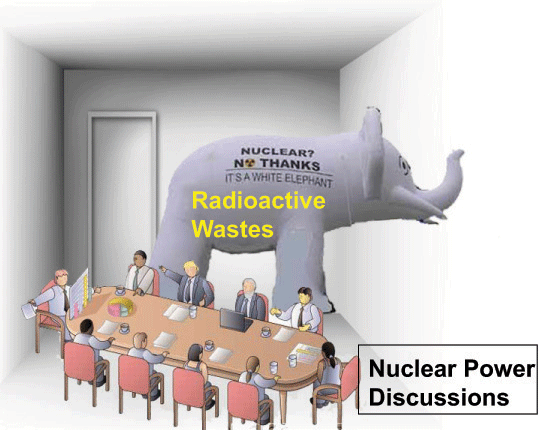 The Bomb Plant: A MOX White Elephant?, DC Bureau By Joseph Trento, on October 20th, 2011 The National Nuclear Security Administration may have a $10 billion taxpayer-financed white elephant on its hands based on Britain’s experience with a similar plant that has been shuttered after a decade of failed operations. Continue reading
Nuclear power as cure for climate change- the big con
 The Big Con Is Nuclear Power Really a Trump Card Against Global Warming?, CounterPunch, by TAKASHI HIROSE OCTOBER 19, 2011 In recent years there seemed to be a nuclear power renaissance. One reason for this has been the adoption by its promoters of the theme of global warming, and their claim that nuclear power is clean energy because it does not produce carbon emissions. But is nuclear power in fact the clean-energy solution its promoters claim? Continue reading
 Through Google Earth, researcher tracks India’s nuclear program

 Researcher Uses Google Earth to Track India’s Nuclear Program, PC World, By John Ribeiro, IDG News Oct 13, 2011 The Institute for Science and International Security in Washington has used imagery from Google Earth to arrive at the conclusion that India may be constructing a gas centrifuge plant for uranium enrichment for military purposes, reinforcing Indian fears that Google Earth can be misused to compromise national security. Continue reading
China’s underground nuclear network
 US worries over China’s underground nuclear network, Google News, AFP – 15 Oct 11, WASHINGTON — A leading US lawmaker who fears budget cuts could delay modernizing the US nuclear arsenal voiced concern Friday about an extensive tunnel complex designed to house Chinese nuclear missiles. “This network of tunnels could be in excess of 5,000 kilometers (3,110 miles), and is used to transport nuclear weapons and forces,” said Michael Turner, who chairs a House Armed Services Committee panel focusing on strategic weapons and other security programs.
“As we strive to make our nuclear forces more transparent, China is building this underground tunnel system to make its nuclear forces even more opaque,” he added, citing an unclassified Department of Defense report. Experts also expressed their concern about the network, whose existence was revealed by official Chinese media in late 2009.
The tunnels would allow China to launch a nuclear counter-attack if it was hit by a nuclear strike. “It’s almost mind-boggling,” said Mark Schneider, senior analyst at the National Institute for Public Policy. “It has enormous implications in terms of their view toward nuclear warfare, survivability of their systems and their leadership in the event of war.
“It is virtually impossible to target anything like that, irrespective of how many nuclear weapons you have,” he added.Richard Fisher of the International Assessment and Strategy Center said the tunnel complex could allow the Chinese army to conceal its weapons. “Do we really know how many missiles the Chinese have today?” he asked…. http://www.google.com/hostednews/afp/article/ALeqM5iHO_kCCLQm86s29jw45FIx6EkdLQ?docId=CNG.19cbae00c31007ab44469985e8a939e2.6a1
At last, France reveals, and questions, the safety of its nuclear industry
institutions are showing greater boldness in convicting nuclear operators guilty of negligence or issuing reprimands and demanding immediate corrective measures from giants like EDF or Areva..
With accusing fingers increasingly pointing towards the nuclear industry, a hesitant debate is beginning to open up in France. Socialist leader Segolene Royal who was defeated by Nicolas Sarkozy in France’s last presidential poll but hopes once again to be her party’s candidate, said she would close down the EPR under construction at Flamanville and completely abandon the EPR technology being pushed by Areva.
 Post-Fukushima, France breaks silence on nuclear safety, The Hindu VAIJUNARAVANE, 11 Oct 11 “…….Doubts have been raised about the benefits of the EPR reactor, of which India plans to buy six. For a country as given to debate and argument as France, there has been a deafening silence surrounding the choice of nuclear as the prime source of energy. With a population of 62 million, France boasts 59 nuclear reactors — the highest per capita in the world, with over 75 per cent of its electricity coming from the power of the atom.
In the post-Fukushima period, however, that tacit silence is being broken with increasing frequency not just by anti-nuclear associations or candidates hoping to win elections but by French courts and the Nuclear Safety Authority. Continue reading
Delays, defects, and “social dumping” in France’s Flamanville nuclear reactor
Post-Fukushima, France breaks silence on nuclear safety The Hindu VAIJU NARAVANE, 11 Oct 11“…….Construction of the Flamanville EPR reactor which began in 2007 is experiencing significant delays with a large number of accidents including two fatalities. The EPR reactor, of which India plans to buy six, will now not be completed before 2016 at the earliest and its price tag has climbed to an estimated €7 billion per reactor of 1,650MWe capacity. Not a single EPR is as yet operational.
Of the four currently under construction, (one each in France and Finland, two in China) the Finnish reactor (construction began in August1985) is now slated to go on stream in 2013 but costs have risen from €3 billion to over €7 billion and the Finnish utility TVO is locked in costly arbitration (€2.7 billion) with Areva….. Continue reading
Real radioactive cleanup from Fukushima area is a long way off
With challenges such as the designation of temporary radioactive waste dumps and interim storage facilities yet unsolved, the road to true decontamination remains a long one.
True radiation decontamination still a long way away, Mainichi Daily News,. Japan October 7, 2011 Though the government last month lifted the “emergency evacuation preparation zone” designation of some areas greatly affected by the ongoing crisis at the Fukushima No. 1 Nuclear Power Plant, radiation decontamination efforts are still taking place in areas with high levels of radiation.
The three main decontamination methods that have been highly publicized through media reports are: the stripping away of surface soil from school playgrounds and athletic fields, the removal of mud accumulated in gutters, and the washing of roofs using high-pressure water cleaners. While the first method is considered effective, the remaining two have been found to be effective only to a certain point, and some especially warn against overestimating the effects of high-pressure water cleaners. Continue reading
Concern over India’s Kalpakkam nuclear reprocessing facility
Indian peace activists have expressed suspicions that the plutonium separated at Indian civilian reprocessing facilities will be diverted and used to increase the country’s stock of atomic weapons.
Technological preparations towards the building of a full-scale fast breeder reactor at Kalpakkam are reportedly in an advanced stage.
Anti-Nuclear Struggle Has Large Fallout, International News Magazine, 05 October 2011 Peter Custers “……..The Kalpakkam complex does not just harbour a nuclear power plant, but also a reprocessing facility- a plant where nuclear fuel rods, after they have outlived their use in reactors, are chemically treated so as to extract raw materials for re-use as energy source.
Storage of such high-level waste in tanks has resulted in catastrophic accidents, Continue reading
Problems of Finland’s Olkiluoto nuclear plant and waste storage plans
the companies are planning to make Onkalo only large enough for waste from their own potential seven reactors
the Finnish Radiation and Nuclear Safety Authority (STUK) has identified safety concerns at operating Finnish power plants as part of stress tests conducted after last spring’s Fukushima crisis in Japan. These include the lack of backup cooling systems that are independent of electrical supply at the Olkiluoto1 and 2 reactors.
a honeycomb of storage sites extending over an area of several square kilometres will weaken the bedrock, making it vulnerable to earthquakes,

 includes VIDEO TVO: No room for Fennovoima waste in nuclear cave, YLE FI 4 oct 11, Onkalo on Finland’s west coast will be the world’s first permanent nuclear waste repository. The project director of the Olkiluoto 3 nuclear power plant, TVO Senior Vice President Jouni Silvennoinen, insists there is no space for waste from utilities other than TVO or Fortum in the Onkalo underground disposal site on Finland’s west coast. Continue reading
1 This Month
26 September – International Day for the Total Elimination of Nuclear Weapons





PLEASE OPPOSE HR 8255 AND S.3639 – bills would accelerate satellite deployment, with no environmental review or safeguards – https://ncstd5li.quorum.us/campaign/169331/
To see nuclear-related stories in greater depth and intensity – go to https://nuclearinformation.wordpress.com
-
Archives
- September 2026 (290)
- August 2026 (330)
- July 2026 (355)
- June 2026 (287)
- May 2026 (306)
- April 2026 (356)
- March 2026 (251)
- February 2026 (267)
- January 2026 (308)
- December 2025 (358)
- November 2025 (359)
- October 2025 (375)
-
Categories
- 1
- 1 NUCLEAR ISSUES
- business and costs
- climate change
- culture and arts
- ENERGY
- environment
- health
- history
- indigenous issues
- Legal
- marketing of nuclear
- media
- opposition to nuclear
- PERSONAL STORIES
- politics
- politics international
- Religion and ethics
- safety
- secrets,lies and civil liberties
- spinbuster
- technology
- Uranium
- wastes
- weapons and war
- Women
- 2 WORLD
- ACTION
- AFRICA
- Atrocities
- AUSTRALIA
- Christina's notes
- Christina's themes
- culture and arts
- Events
- Fuk 2022
- Fuk 2023
- Fukushima 2017
- Fukushima 2018
- fukushima 2019
- Fukushima 2020
- Fukushima 2021
- general
- global warming
- Humour (God we need it)
- Nuclear
- RARE EARTHS
- Reference
- resources – print
- Resources -audiovicual
- Weekly Newsletter
- World
- World Nuclear
- YouTube
-
RSS
Entries RSS
Comments RSS

