Nuclear reprocessing not a viable option for Japan
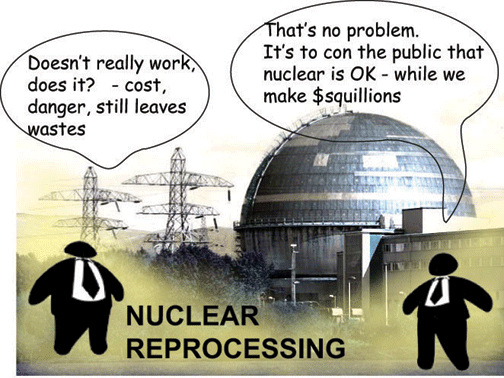 Fast-breeder said realistic no more, Japan Times, 25 Feb 12, Kyodo A panel of experts reviewing the nuclear fuel cycle policy in light of the Fukushima crisis has agreed that while a fast-breeder reactor has advantages, from a technology viewpoint it can’t be considered a realistic option for the next 20 to 30 years. The nuclear fuel policy involves reprocessing spent fuel to produce plutonium that can be reused to produce electricity.
The subcommittee of the Japan Atomic Energy Commission said in a draft document summarizing its discussions that two viable options during the next few decades would be to not reprocess spent nuclear fuel, and to recycle plutonium-uranium mixed oxide fuel, or MOX fuel.
The former option is called the “once-through” cycle, in which uranium fuel is used in nuclear reactors just one time and disposed of by burying it in the ground. In the latter option, MOX fuel is manufactured from plutonium recovered from spent nuclear fuel and used
in ordinary reactors. Continue reading
73,000 square metres of concrete to cover Fukushima seabed radiation

 Tepco to cement Fukushima seabed to stem
  radiation Times Live, Sapa-AFP | 22 February, 2012 The operator of Japan’s tsunami-crippled nuclear plant is to cover a large swathe of seabed near the battered reactors with cement in a bid to halt the spread of radiation, the company said Wednesday.
A clay-cement compound will be laid over 73,000 square metres (785,000 square feet) of the floor of the Pacific in front of the Fukushima Daiichi plant on the nation’s northeast coast, said Tokyo Electric Power Co. (TEPCO).
The area is equivalent to around 10 football pitches. “This is meant to prevent further contamination of the ocean… as sample tests have shown a relatively high concentration of radioactive substances in the sea soil in the bay,” a company spokeswoman said….
Contaminated water from the plant leaked into the sea and radioactive particles concentrated on the seabed. Scientists fear ocean currents could pollute areas further afield.
The cover will be 60 centimetres (24 inches) thick, with 10 centimetres expected to be eaten away by seawater every 50 years, the TEPCO official said. http://www.timeslive.co.za/world/2012/02/22/tepco-to-cement-fukushima-seabed-to-stem-radiation
11 USA nuclear reactors may have unsafe cooling systems
Nuclear Regulatory Commission says accident models could be amiss, By Mike M. Ahlers, CNN February 18, 2012 — The models may underestimate how much nuclear fuel would heat up during system failures
The commission is asking 11 U.S. nuclear power plants for more information
There is no immediate threat to public safety
Washington — The Nuclear Regulatory Commission has asked 11 nuclear power plants for information about the computer models they use to test different accident scenarios, saying those models may underestimate how much nuclear fuel will heat up during cooling system
failures….
At issue is a phenomenon known as “thermal conductivity degradation,” or TCD, the NRC said. TCD refers to the fact that nuclear fuel loses its capacity to transfer heat as it ages.
The NRC said it is concerned that some computer models may not account for TCD. If the plants are not considering TCD, the possibility exists that fuel rods could heat up 100 degrees more than anticipated in an accident scenario, exceeding the 2,200-degree limit considered safe,the NRC said. That could damage the fuel rods’ outer layer, leading to
reactor damage, the NRC said……
The plants have until March 19 to provide the information to the NRC
staff. http://edition.cnn.com/2012/02/17/us/nuclear-accident-models/index.html
Ionising radiation puts medical specialists at risk of rare brain cancer
 ‘Cardiologists exposed to radiation susceptible to tumors’, Jerusalem Post, By JUDY SIEGEL-ITZKOVICH02/15/2012 Israelis publish evidence of brain cancer as occupational hazard for certain medical specialists.

Interventional cardiologists around the world have expressed concern over the findings of an Israeli colleague’s medical journal report suggesting aggressive brain cancer – especially on the left side of the head – may be an occupationalhazard from their exposure to ionizing radiation. Continue reading
Global problem of burying dead nuclear reactors
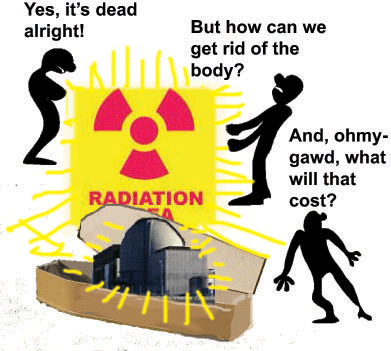 Abandon nuclear energy programme, Unep boss urges Kenya , Standard, BY PETER ORENGO, 13 Feb 12 “……..According to the United Nations Environment Programme’s (UNEP) Year Book 2012, one of United Nations Environment Program (UNEP) ‘s emerging global concerns is the challenge of decommissioning the growing number of end-of-life nuclear power reactors….
The UNEP Year Book says the cost of decommissioning varies greatly, depending on the reactor type and size, its location, the proximity and availability of waste disposal facilities and the condition of both the reactor and the site at the time of decommissioning….. Continue reading
Thorium nuclear reactors – not all they’re cracked up to be
What you then get, as well as heat energy, radiation, and fission products from the Plutonium and Uranium, is U232. U232 (and its decay products) emit very hard gamma radiation.
will anyone really trust the nuclear lobby when it says ‘we have the answer’, as so often before?
Nuclear Problems, Environmental Research Web, 12 Feb 12,”……With uranium fired reactors out of favour after Fukushima, for the longer term, some in the nuclear lobby have been promoting thorium as an allegedly safer fuel- looking at molten flouride salt systems.
The Weinberg Foundation was launched last year to promote the Liquid Flouride Thorium Reactor (LFTR) Continue reading
The war-mongering of Israel and USA.

How the US and Israel are Shredding the NPT, The Real Nuclear Outlaws CounterPunch, by CARL BOGGS, 5 April 12, While United States and Israeli leaders, duly assisted by a warmongering media, ramp up war talk against Iran, two troublesome pieces of information are ritually ignored. First, even American intelligence reports conclude that Iran is not close to building a nuclear-weapons program. Second, it is the U.S. and Israel – not Iran – that stand in flagrant violation of the Nuclear Non-Proliferation Treaty (NPT). The real nuclear outlaws are located in Washington and Tel Aviv rather than in Tehran.
The consensus of 17 U.S. agencies, as reported by National Intelligence Estimates of 2007 and 2011, finds that Iran has not enriched uranium above 20 percent purity, far short of the nearly 90 percent essential to weapons development. Further, no viable nuclear delivery system or command structure has been uncovered. High-powered U.S. surveillance and espionage operations, many inside Iran, have revealed nothing beyond (an entirely legal) civilian energy program. Recent International Atomic Energy Agency (IAEA) investigations, the latest in November 2011 and February 2012, cite “continuing enrichment processes” but nothing beyond the 20 percent level. The IAEA merely states what should be obvious – that some Iranian sites “could be” used for a weapons program at some point in the future…..
The Iranians have every right within existing international rules to carry out their program – a fact conveniently obscured by the Western media and politicians. Their Israeli antagonists, on the other hand, not only possess a nuclear arsenal of up to 400 warheads – possibly fifth largest in the world – but breezily dismiss the NPT as a worthless nuisance…..
Make no mistake: despite the media fiction of a small, weak, relatively defenseless country isolated and surrounded by aggressive foes, Israel currently rivals Britain, France, and China as a world nuclear power, central to its shared goal (with the U.S.) of military supremacy in the Middle East. Credible sources indicate that Israel possesses not only neutron bombs but an array of tactical nukes, ballistic missiles, atomic land mines, cruise missiles, nuclear-armed subs, and high-explosive artillery shells. The subs alone are armed with four cruise missiles each, replete with multiple warheads. The general Israeli military arsenal dwarfs the actual or potential armed forces of all other Middle Eastern nations combined. Several U.N. resolutions calling for Israel to join the NPT, open up its nuclear facilities to inspection, and agree to a regional nuclear-free zone have been stonewalled by the U.S. and Israel. After the CIA reported that Israel had the Bomb in 1968 (fully 18 years before Mordecai Vanunu’s insider revelations), no outside visits to Israeli military sites have been allowed.
Meanwhile, India – still a non-NPT state – has long benefitted from a massive transfer of atomic resources and technology from the U.S., dating to years before the Indian weapons breakthrough of 1974. As an imagined counterweight to Chinese military power, India was empowered to build as many as 65 warheads, manufactured and deployed in the absence of external monitoring and made possible by the work of 1100 U.S.-trained scientists. Like Israel and also Pakistan, India maintains a hostile attitude toward IAEA monitoring. In July 2005 the U.S. signed an historic deal with New Delhi for nuclear cooperation, just when India was busy modernizing its illegal atomic stockpile and delivery systems. (The deal was approved by Congress in October 2008.) Those profiting, of course, included dozens of U.S. technical and military corporations……
n the end, the Iranian “crisis” is symptomatic of a deeper predicament: nothing will be resolved until every state – not just the targeted villains – is held accountable to the same universal norms. This means, above all, the U.S., Israel, and other nuclear outlaws. Blix noted that the NPT “is not a treaty that appoints the nuclear-weapons states individually or jointly to police non-nuclear weapons states and threaten them with punishment. It is a contract in which all parties commit themselves to the goal of a nuclear weapons-free world.” There can be no meaningful “contract” without an internationalization of security arrangements that, in the end, will require a dismantling of the American warfare state that underpins its nuclear outlawry and that of its clients. http://www.counterpunch.org/2012/04/04/the-real-nuclear-outlaws/#.T33s-UO4hjA.facebook
Reference lists for exposing radiation hormesis and quack radiation “science”
 Posts in this Blog covering Radiation Hormesis and modern papers contradicting Radiation Hormesis, Paul Langley’s Nuclear History Blog, 6 Feb 2012,
Posts which contradict the theory of Radiation Hormesis. Continue reading
USA’s failed plutonium plant and the USA insider deals with AREVA
But the good news for Areva is the tax paid contract is still bringing in the big bucks with no  end in sight.
the waste from these processes all add to the huge amount of waste already stored in leaking tanks at SRS.
 Abraham, like so many others in Washington, sells his influence…. And Abraham does not sell influence only in the United States. He sells himself to the entire world.
When is enough, enough? How much money do former government officials have to make before they go home and give back to their communities rather than take money to influence their friends in Washington?
 Spencer Abraham Cashes In, DC Bureau, By Joseph Trento, February 2nd, 2012 In January 30 was former U.S. Secretary of Energy Spencer Abraham’s last day as the non-executive chairman of Areva Enterprises Inc, the French atomic power firm’s American operation. This marked the end of a very lucrative arrangement for both Abraham and the French government own nuclear company – mostly at U.S. taxpayers’ expense.
It all began in the 1990s when the United States’ response to disposing of 34 metric tons of plutonium from shuttered nuclear weapons programs was a proposed mixed oxide (MOX) fuel fabrication facility at the Savannah River Site (SRS) near Aiken, South Carolina. When Abraham became Energy Secretary in 2001, Areva was a key contractor for the MOX plant. According to his DOE calendars, among his first trips were to France to visit their nuclear officials and operations. Abraham maintained a close relationship with the then head of Areva, Anne Lauvergeon. In turn, not long after he left the Energy Department, Abraham cashed in and went to work for Areva and “Atomic Annie,” as she was known. In 2007, DOE broke ground on the MOX plant.
Today, the DOE’s MOX fuel plant is still under construction. It has cost billions of dollars, is over budget and behind schedule. But Spencer Abraham will never be held responsible for the cost overruns and delays. In fact, he has been handsomely rewarded.
Despite spending billions of dollars on the MOX plant, DOE has yet to line up a single customer even with massive government subsidies being offered to buy the fuel. No utility will touch it. Continue reading
SMRs – Small Modular nuclear Reactors the latest probably dud design
Small Modular Reactors, the latest ‘rabbit out the nuclear hat’ are generally based on scaled down BWR or PWR technology and illustrate the nuclear industry’s schizophrenic attitude to reactor size.
 SMRs may turn out to be the latest in a long lineof nuclear designs that looked good on paper, but could not make the transition to commercial technology.
Prospects for Nuclear Power in 2012, Platts, London, 30 January 2012 “……..Technological cul-de-sac If plant life extensions can be achieved in France and the US and Gen III+ does prove a blind alley, it raises the question of what options are open to the nuclear sector. Ten years ago, the industry answer would have been Generation IV designs. Unlike Gen III+, which evolved from existing Pressurised and Boiling Water Reactors, these would be based on radical new technologies. Six technologies were selected by the major nuclear countries as the most promising.
Dim prospects for global nuclear industry
Prospects for Nuclear Power in 2012, Platts a leading global provider of energy, metals and petrochemicals information., London, 30 January 2012 Even before the Fukushima disaster, the long-awaited nuclear renaissance in the West seemed to be running out of steam. There were two main factors behind this failure; the new Generation III+ reactors produced to take account of the lessons of Chernobyl that would spearhead the revival were not living up to their promises, and, more importantly, banks were proving unwilling to provide finance
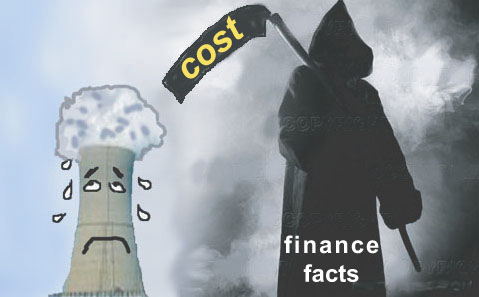
Energy Economist – Report.
The key markets for the renaissance were the US and the UK. As pioneers of nuclear power, potentially large markets and countries that seemed to have abandoned plans for new nuclear plants, a successful revival in these countries would have been a powerful endorsement for these new technologies. Continue reading
BRICs – Brazil, Russia, China, India, all nuclear prospects looking dodgy
China is looking much less committed to nuclear power than it was a year ago.
The reality is that China needs nuclear power much less than the nuclear industry needs China.
Prospects for Nuclear Power in 2012 Source: Platts – a leading global provider of energy, metals and petrochemicals information. London, 30 January 2012 “….BRICs [Brazil, Russia, India and China] + South Korea China has dominated new nuclear plant orders in the past few years, accounting for 25 out of the 38 reactors on which construction started worldwide between 2008-2010. Six of these units were for Gen III+ designs, four AP1000s and two EPRs. Almost all the others used a design imported from France in the 1980s, which in turn had been licensed from Westinghouse in the early 1970s. This design, the CPR1000, is showing its age and there was an expectation, even before Fukushima, that the AP1000 would replace it. This would have been a huge boost to the AP1000, giving it the volume of orders that might have allowed costs to come down and for teething problems to be solved. The EPR, by contrast, appears to have no prospect of further orders in China.
However, there were signs that the strain of the rapid pace of construction was beginning to show. In 2011, no new starts were made, compared with ten in 2010. Fukusima explains this to a degree, but some might have been expected in the first three months of 2011 before disaster struck. The reason behind the slowdown is the high cost of the AP1000. The large Chinese utilities appear to be looking at other options.
There is now talk of pursuing indigenous advanced designs developed from the CPR1000 as well as Small Modular Reactors. China has always been adept at convincing nuclear suppliers that there was a great future for their particular technology in China.
It is unclear whether talk of SMRs and new advanced designs will go any further. Continue reading
Nuclear fuel could be corroded by seawater
How sea water could corrode nuclear fuel, UC Davis, January 26, 2012, Japan used seawater to cool nuclear fuel at the stricken Fukushima-Daiichi nuclear plant after the tsunami in March 2011 — and that was probably the best action to take at the time, says ProfessorAlexandra Navrotsky of the University of California, Davis.
But Navrotsky and others have since discovered a new way in which seawater can corrode nuclear fuel, forming uranium compounds that could potentially travel long distances, either in solution or as very small particles. The research team published its work Jan. 23 in the
journal Proceedings of the National Academy of Sciences.
“This is a phenomenon that has not been considered before,” said Alexandra Navrotsky, distinguished professor of ceramic, earth and environmental materials chemistry. “We don’t know how much this will increase the rate of corrosion, but it is something that will have to
be considered in future.”….
In the new paper, the researchers show that in the presence of alkali metal ions such as sodium — for example, in seawater — these clusters are stable enough to persist in solution or as small particles even when the oxidizing agent is removed.
In other words, these clusters could form on the surface of a fuel rod exposed to seawater and then be transported away, surviving in the environment for months or years before reverting to more common forms of uranium, without peroxide, and settling to the bottom of the
ocean. There is no data yet on how fast these uranium peroxide clusters will break down in the environment, Navrotsky said… http://www.news.ucdavis.edu/search/news_detail.lasso?id=10131
“The stars are aligning for rooftop solar energy”
 Solar guru receives Australia Day honour , 26 January 2012, Anna Salleh ABC Science, http://www.abc.net.au/science/articles/2012/01/26/3415244.htm Australia needs to look to Germany if it is to realise the potential of solar cell technology, says an expert who is being honoured today. Professor Martin Green of the University of New South Wales has been made a Member of the Order of Australia(AM) for his work on photovoltaics.
“Germany has been the only country that’s had a sensible long-term program in place to promote the use of renewables,” says Green.
Some argue solar cells are not a competitive option for reducing carbon emissions, and are limited by the fact that they don’t generate energy unless the Sun is shining.
But according to Green, the “stars are aligning for conventional roof mounted solar” and it is ripe for a new kick start from governments. Continue reading
Global warming shown in meteorological records over past 10 years
 Globally, 9 of the 10 warmest years on record occurred since 2000 Environmental news Network, From: Reuters January 20, 2012 The global average temperature last year was the ninth-warmest in the modern meteorological record, continuing a trend linked to greenhouse gases that saw nine of the 10 hottest years occurring since the year 2000, NASA scientists said on Thursday.
A separate report from the U.S. National Oceanic and Atmospheric Administration (NOAA) said the average temperature for the United States in 2011 as the 23rd warmest year on record.
The global average surface temperature for 2011 was 0.92 degrees F (0.51 degrees C) warmer than the mid-20th century baseline temperature, researchers at NASA’s Goddard Institute for Space Studies said in a statement. The institute’s temperature record began in 1880.
The first 11 years of the new century were notably hotter than the middle and late 20th century, according to institute director James Hansen. The only year from the 20th century that was among the top 10 warmest years was 1998.
These high global temperatures come even with the cooling effects of a strong La Nina ocean temperature pattern and low solar activity for the past several years, said Hansen, who has long campaigned against human-spurred climate change.
The NASA statement said the current higher temperatures are largely sustained by increased concentrations of greenhouse gases in the atmosphere, especially carbon dioxide. Carbon dioxide is emitted by various human activities, from coal-fired power plants to fossil-fueled vehicles to human breath.
Current levels of carbon dioxide in the atmosphere exceed 390 parts per million, compared with 285 ppm in 1880 and 315 by 1960, NASA said. http://www.enn.com/ecosystems/article/43880
1 This Month
26 September – International Day for the Total Elimination of Nuclear Weapons





PLEASE OPPOSE HR 8255 AND S.3639 – bills would accelerate satellite deployment, with no environmental review or safeguards – https://ncstd5li.quorum.us/campaign/169331/
To see nuclear-related stories in greater depth and intensity – go to https://nuclearinformation.wordpress.com
-
Archives
- September 2026 (281)
- August 2026 (330)
- July 2026 (355)
- June 2026 (287)
- May 2026 (306)
- April 2026 (356)
- March 2026 (251)
- February 2026 (267)
- January 2026 (308)
- December 2025 (358)
- November 2025 (359)
- October 2025 (375)
-
Categories
- 1
- 1 NUCLEAR ISSUES
- business and costs
- climate change
- culture and arts
- ENERGY
- environment
- health
- history
- indigenous issues
- Legal
- marketing of nuclear
- media
- opposition to nuclear
- PERSONAL STORIES
- politics
- politics international
- Religion and ethics
- safety
- secrets,lies and civil liberties
- spinbuster
- technology
- Uranium
- wastes
- weapons and war
- Women
- 2 WORLD
- ACTION
- AFRICA
- Atrocities
- AUSTRALIA
- Christina's notes
- Christina's themes
- culture and arts
- Events
- Fuk 2022
- Fuk 2023
- Fukushima 2017
- Fukushima 2018
- fukushima 2019
- Fukushima 2020
- Fukushima 2021
- general
- global warming
- Humour (God we need it)
- Nuclear
- RARE EARTHS
- Reference
- resources – print
- Resources -audiovicual
- Weekly Newsletter
- World
- World Nuclear
- YouTube
-
RSS
Entries RSS
Comments RSS

