A Pandora’s box of scientific changes, following Fukushima nuclear disaster
The World is Powerless Against Fukushima Fallout, Hyphen Submitted by New America Media, March 8, 2012 by Yoichi Shimatsu “………Previously unknown types of explosive nuclear reactions occurring midair or underground, which have been misrepresented as “hydrogen blasts”
Expansion of a vast ozone hole over the Arctic Circle, now equal in area to the damaged upper atmosphere over the Antarctic, caused by radioactive iodine and xenon gas caught in the jet stream, leaving the Earth’s air supply unprotected and heightening the threat of skin
carcinoma
High-energy interactions of xenon gas (which decays into cesium) with incoming solar flares and artificial electromagnetic belts created by US, NATO and Russian missile-defense shields (this synergy is visible in the northern lights that emit a deep green color due to the
excitation of xenon, and it is no coincidence that three American nuclear power plants were incapacitated during the recent solar flare)
The growing possibility of mass extinction of marine life in the Pacific Ocean due to the nuclear contamination of major spawning waters for plankton and fish, the bottom of the food chain for higher life-forms, including whales and humans A rising threat to human reproductive health from ingestion of radioactive isotopes through food, drinking water and respiration,
resulting in mass abortions and population decline for Japan, a trend that will extend worldwide
Mutations of contagious pathogens, such as bird flu, due to genetic disorders in both microorganism and host species, including domesticated animals and wildlife….. …. . http://www.hyphenmagazine.com/blog/archive/2012/03/world-powerless-against-fukushima-fallout
77% of Americans want government loans for renewable energy, not nuclear
More than three out of four Americans (77 percent) would support “a shift of federal loan-guarantee support for energy away from nuclear reactors” in favor of wind and solar power.

 Survey: Americans Not Warming Up to Nuclear Power One Year After Fukushima, Market Watch, WASHINGTON, March 7, 2012 Contrary to Industry Predictions, Reactor Disaster Seen As Having a”Lasting Chill” on Perceptions;
It’s Not All Fukushima: 3 in 5 Americans Less Supportive Due to Woes of U.S. Nuclear Industry in Last Year. Continue reading
Misunderstanding, wrong translation of Ahmadinejad’s supposed words “Israel must be wiped off the map”
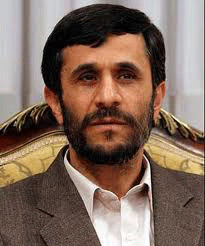 from Wikileaks: Translation controversy Many news sources repeated the Islamic Republic of Iran Broadcasting statement by Ahmadinejad that “Israel must be wiped off the map”,[5][6] an English idiom which means to “cause a place to stop existing”,[7] or to “obliterate totally”,[8] or “destroy completely”.[9]
Ahmadinejad’s phrase was “بايد از صفحه روزگار محو شود” according to the text published on the President’s Office’s website.[10]
The translation presented by the official Islamic Republic News Agency has been challenged by Arash Norouzi, who says the statement “wiped off the map” was never made and that Ahmadinejad did not refer to the nation or land mass of Israel, but to the “regime occupying Jerusalem”. Norouzi translated the original Persian to English, with the result, “the Imam said this regime occupying Jerusalem must vanish from the page of time.”[11] Juan Cole, a University of Michigan Professor of Modern Middle East and South Asian History, agrees that Ahmadinejad’s statement should be translated as, “the Imam said that this regime occupying Jerusalem (een rezhim-e eshghalgar-e qods) must [vanish from] the page of time (bayad az safheh-ye ruzgar mahv shavad).[12] According to Cole, “Ahmadinejad did not say he was going to ‘wipe Israel off the map’ because no such idiom exists in Persian.” Instead, “he did say he hoped its regime, i.e., a Jewish-Zionist state occupying Jerusalem, would collapse.”[13] The Middle East Media Research Institute (MEMRI) translated the phrase similarly, as “this regime” must be “eliminated from the pages of history.”[14]
Iranian government sources denied that Ahmadinejad issued any sort of threat. On 20 February 2006, Iran’s foreign minister Manouchehr Mottaki told a news conference: “How is it possible to remove a country from the map? He is talking about the regime. We do not recognize legally this regime.”[15][16][17]
Radiation therapy – necessary, but can cause secondary cancers
 Younger patients are especially susceptible to the effects of radiation, and the three cancers that have been most strongly associated with radiation are breast cancer, thyroid cancer and bone marrow cancers, including leukemia
Clinicians say the benefits of radiation treatment for many types of cancer far outweigh the potential risks of experiencing serious adverse effects years later, and say radiation is now a lot safer than it once was. …. “We try to use radiation as sparingly as possible, but unfortunately, it is frequently part of the cure in a lot of cancers and it’s absolutely necessary,”
 Radiation Therapy Linked to Secondary Cancers KBOI News, 7 March 12, (NEW YORK) — While the number of cancer survivors has tripled since the 1970s and continues to grow, the cost of that survival for many has been the development of secondary cancers and cardiovascular disease related to radiation treatment, according to an upcoming report by a scientific committee. Continue reading
United Nations Scientific Committee on the Effects of Atomic Radiation
The committee, known as UNSCEAR, will publish a report in May 2013 that aims to give an analysis of radiation dosages among citizens and forecast health risks in the coming decades

 Children Wait for UN Radiation Study After Fukushima Crisis, Bloomberg By Yuriy Humber and Tsuyoshi Inajima March 05, 2012 As five-year-olds charge through the corridors of a kindergarten in northeast Japan at lunchtime, teacher Junko Kamada says she is still unsure if their food is safe a year after the Fukushima nuclear accident.
Since the March 11 earthquake and tsunami wrecked the Fukushima plant, about 100 kilometers (62 miles) south of the Sakuragi Hanazono kindergarten in Tagajo city, parents of the 198 children have been seeking assurances that the school lunches are free of radiation…..
wait at least another 14 months for a unified view on food contamination when the United Nations Scientific Committee on the Effects of Atomic Radiation issues the first global and independent assessment of the Fukushima nuclear accident. Continue reading
Japan’s radioactive cleanup, a mammoth and uncertain task that will take decades
 The waste would remain in the longer-term storage for 30 years, until half the radioactive cesium breaks down. Then it would still have to be treated and compacted using technology that hasn’t been fully developed yet before being buried deep underground in enclosed
containers. ….
 Japan cleans up radiation zone, unsure of success, The News, March 06, 2012 FUKUSHIMA, Japan: Workers in rubber boots chip at the frozen ground, scraping until they’ve removed the top 2 inches (5 centimeters) of radioactive soil from the yard of a single home. Total amount of waste gathered: roughly 60 tons.
One down, tens of thousands to go. Continue reading
Where to put over 100,000 tons of radioactive waste materials?
6,800 tons of radiation-tainted rice straw left lying in 8 prefectures, Mainichi Daily News, 5 Mar 12, http://mdn.mainichi.jp/mdnnews/news/20120303p2a00m0na010000c.html Some 6,800 metric tons of rice straw contaminated with radioactive substances leaked from the crippled Fukushima No. 1 Nuclear Power Plant remains in eight prefectures with no immediate prospect of disposal, the Mainichi has learned.
Moreover, sludge generated from radiation-contaminated waste water as well as ash tainted with radioactive materials amounts to some 97,000 tons in 12 prefectures — 3.6 times the figure as of July last year, according to the Land, Infrastructure, Transport and Tourism Ministry. Continue reading
Climate change leading to overuse of groundwater
 UN scientists warn of increased groundwater demands due to climate change, Eureka Alert, Philip Riley, SAN FRANCISCO, March 1, 2012 –– Climate change has been studied extensively, but a new body of research guided by a San Francisco State University hydrologist looks beneath the surface of the phenomenon and finds that climate change will put particular strain on one of our most important natural resources: groundwater.
SF State Assistant Professor of Geosciences Jason Gurdak says that as precipitation becomes less frequent due to climate change, lake and reservoir levels will drop and people will increasingly turn to groundwater for agricultural, industrial, and drinking water needs. The resource accounts for nearly half of all drinking water worldwide, but recharges at a much slower rate than aboveground water sources and in many cases is nonrenewable.
“It is clear that groundwater will play a critical role in society’s adaption to climate change,” said Gurdak, who co-led a United Nations-sponsored group of scientists who are now urging policymakers to increase regulations and conservation measures on nonrenewable groundwater.
The scientists recently released a book of their research, titled “Climate Change Effects on Groundwater Resources,” that is the result of a global groundwater initiative by the United Nations Educational, Scientific, and Cultural Organization (UNESCO). They will soon make their case to international policymakers at the March 12-17 World Water Forum in Marseille, France.
The high-profile forum will allow the scientists for the first time to put the comprehensive groundwater findings before decision makers who have the power to enact regulatory changes. Gurdak will recommend closely monitoring or limiting groundwater pumping as well as renewing cooperation from communities to consume less water.
“In many ways, California is leading the way in developing solutions,” he said. “Artificial recharge, managed storage and recovery projects and low impact development around the state will become more important for many local water systems to bank excess water in aquifers.”
The World Water Forum will be held from March 12 to 17 in Marseille, France. ”Climate Change Effects on Groundwater Resources: A Global Synthesis of Findings and Recommendations,” was published in December 2011 by CRC Press. Selections from the book can be read here:  http://userwww.sfsu.edu/~jgurdak/Publications/Treidel_etal_2011_ClimateChange-Groundwater_tableofcontents.pdf http://www.eurekalert.org/pub_releases/2012-03/sfsu-usw030512.php
Tighter radiation limits for food in Japan
Under the revised regulations, the upper limit on foods such as meat, vegetables and fish will be set at 100 becquerels per kilogram. The limit will be 50 becquerels per kg for milk and infant food and a maximum of 10 becquerels for drinking water.
At present, the levels are set at 500 becquerels per kg for the majority of foodstuffs and 200 becquerels for milk, dairy produce and water. There is presently no specific figure for infant food. Continue reading
86% of funds to deal with existing waste – UK’s Department of Energy and Climate Change
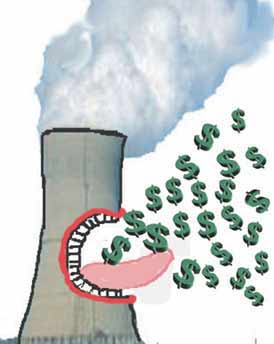 Department of Energy and Climate Change (DECC) is unique among government departments because it has to spend almost half of its budget on dealing with existing nuclear waste.
But to see that this has risen to almost almost 86% of overall DECC spending seemed incredible.
DECC must tell us the truth about nuclear waste, Energy and Environmental Management David Thorpe, 1st November 2011 It’s shocking but true: we are not, as I had always understood, investing in a fund to manage our current nuclear waste in the future.
We are paying lip service to it and dodging the question at the expense of future taxpayers.
Moreover, there is total confusion about what provisions are being put in place to manage any future waste from any new nuclear power stations.
Will the real DECC budget please stand up?
Last week, the Guardian published on its website figures which appeared to show that spending by the Department of Energy and Climate Change on nuclear waste management has risen by an astonishing 81%, as part of an overall budget increase from last year of over 146%.
In trying to find out whether this is true I have found out a truth worse than this, as well as an admission that any new nuclear operators are allegedly being asked to contribute to a fund not only to pay for management and disposal of the new nuclear waste which their plants will create, but also for that of existing nuclear waste!
According to the Guardian, in 2009/10 DECC’s entire spend totaled £3.18bn, but in 2010/11 it is spending £8.06bn, an increase of 146.02% that is largely due to nuclear liabilities.
This spending, according to the Guardian, breaks down as follows:
| DECC spending: £ per topic and change from last year | ||
| Topic | Amount | % increase or decrease |
|---|---|---|
| Nuclear Decommissioning Authority | £6.9bn | +81.12% |
| Committee for Climate Change | £4.4m | +12.12% |
| Low carbon UK | £622.7m | -29.8% |
| International agreement on climate change | £5.4m | +22.42% |
| Promoting low carbon technologies in developing countries |
£278.6m | +159.52% |
| Coal Authority | £0.7m | +87.02% |
| Professional support and infrastructure | £117.7m | -7.62% |
| Energy | £87.2m | +3.33% |
| Historic energy liabilities | £104.5m | -106.8% |
Nuclear plant 45 years working, 100 years++ to get rid of it
 Oldbury nuclear power station shutdown: What next? By Chris Kelly BBC News, 29 Feb 12, “…….the beginning of the end for Oldbury. The end, though, will extend many more years into the future than Oldbury’s 45-year history.
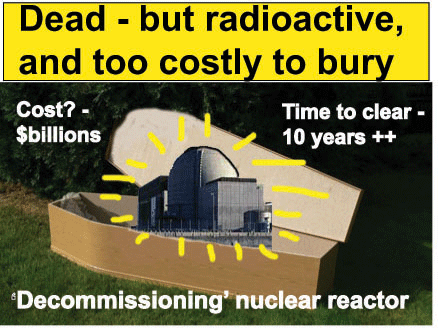
Over the next three years, all 52,000 fuel elements inside the station’s nuclear reactor will be gradually removed which will mean no more heat is generated by the reactor. The fuel is then taken away – by road from Oldbury to nearby Berkeley, site of another inactive nuclear power station – and then by rail to Sellafield where it is reprocessed.
Once the fuel has gone, other hazards and chemicals on the site such as carbon dioxide, hydrogen and acids are taken away and some of the buildings on the site will be demolished. “That will probably take about 15 years from now – so in the 2020s,” said Mr Sprauge. “What we will be left with then is the two reactor buildings and the centre block and pretty much nothing else.”
The longest job of the entire operation, though, will then begin. Leaving the station to slowly lose its radioactivity. And that job – which requires little human intervention – will take some 80 long years while the radioactivity from components in the reactor slowly fades.
The final bow for Oldbury’s mysterious looking reactor buildings will then come in 2109 when work can begin to pull them down. By then, the Oldbury reactor buildings may have a new neighbour. Horizon Nuclear Power – a conglomerate formed by E.On and RWE – hope to build a new power station, next to the existing reactor building, by 2019.
But one resident of nearby Sheperdine – Reg Illingworth – is less than pleased about the idea of a new reactor there.
Mr Illingworth, originally from Liverpool, moved to the nearby village of Shepperdine when plans were afoot to decommission Oldbury in 2007. But the life of the station was extended until 2012 before plans for the the Oldbury B station were announced.
“I’m hyper, hyper worried,” said Mr Illingworth, who is a member of a local anti-nuclear campaign group. He added he was “glad to see it’s closing”……http://www.bbc.co.uk/news/uk-england-bristol-17131988
Political and public opposition to Lynas’ rare earths plant for Malaysia
 Opposition leader Anwar Ibrahim said his alliance would seek an emergency motion in Parliament to urge the government to cancel the project. He also pledged the opposition would scrap the plant if it wins national polls expected by June.
Malaysia’s last rare earth refinery by Japan’s Mitsubishi group, in northern Perak state, was closed in 1992 following protests and claims that it caused birth defects and leukemia among residents. It is one of Asia’s largest radioactive waste cleanup sites.

 3,000 Malaysians rally against Australian-built rare earth plant amid radiation fears Washington Post, By Associated Press, February 25 KUALA LUMPUR, Malaysia — Some 3,000 Malaysians staged a protest Sunday against a rare earth refinery being built by Australian miner Lynas over fears of radioactive contamination.
It marked the largest rally against the $230 million plant in eastern Malaysia, and could pose a headache to the government ahead of national elections widely expected this year. Authorities recently granted Lynas a license to operate the first rare earths plant outside China in years. The plant in Pahang state has been the subject of heated protests over health and environmental risks posed by potential leaks of radioactive waste…..
Opposition leader Anwar Ibrahim said his alliance would seek an emergency motion in Parliament to urge the government to cancel the project. He also pledged the opposition would scrap the plant if it wins national polls expected by June. Continue reading
USA’s laughable “Nuclear Waste Confidence Rule”
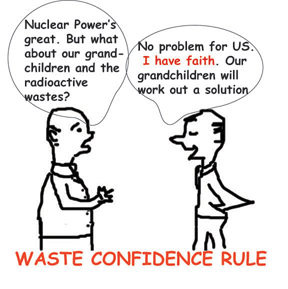 Public comments needed against NRC’s Nuclear Waste Confidence Game , Beyond Nuclear 25 Feb 12, The U.S. Nuclear Regulatory Commission (NRC) has requested public comments on its latest revision to its “Nuclear Waste Confidence Decision.” Please email your comments before March 19th to WCOutreach@nrc.gov in order to head off this latest round of a very dangerous “game being played” by NRC, which is doing the bidding of the nuclear power industry…..
The NRC’s “confidence” that on-site storage for 120 years (60 during reactors operations, 60 after reactor shutdown) is safe and secure would be laughable, if it weren’t so seriously wrong. 120 years is half as long as the United States has been an independent country (1776 to 2012, 236 years). A lot can go wrong in 120 years. NRC’s consideration of 200 to 300 years of on-site storage is even more preposterous. This is not “interim” or “temporary” on-site storage. This is de facto permanent on-site storage, in any common understanding of the term…..
BACKGROUND
First promulgated in 1984, NRC’s “Nuclear Waste Confidence Decision” claimed that by 2007, the U.S. would open one or more repositories for the permanent disposal of irradiated nuclear fuel. In the meantime, NRC expressed its “confidence” that irradiated fuel stored in pools or dry casks on-site would be done so safely and securely. This served as legal cover, carte blanche, for nuclear utilities to generate an unlimited amount of high-level radioactive waste, while blocking concerned citizens and environmental groups intervening in NRC proceedings from challenging new reactor license applications or old reactor license extensions on such grounds as the fact that there is no safe solution to the problem of radioactive waste management.
By 1990, NRC already had to “postpone” its “confidence.” It revised its “Confidence Decision” to now say that by 2025, at least one repository would be opened.
In December 2010, NRC revised its “Nuclear Waste Confidence Decision” yet again, to reflect the reality of the Obama administration’s wise decision to cancel the Yucca Mountain dump. NRC now declared no date certain for the opening of the first repository, but rather stated that on-site storage in pools and/or dry casks was safe for 120 years — 60 years during reactor operations, and 60 years after reactor shutdown. In addition, the five NRC Commissioners ordered their staff to study the potential for on-site storage lasting 200 to 300 years into the future. That explains NRC current request for public comments….
Please submit comments to WCOutreach@nrc.gov. You may also send comments through the U.S mail to: Christine Pineda, Project Manager; Mailstop EBB-2B2; Office of Nuclear Material Safety and Safeguards; U.S. Nuclear Regulatory Commission; Washington, DC 20555-0001 http://www.beyondnuclear.org/radioactive-waste-whatsnew/2012/2/23/public-comments-needed-against-nrcs-nuclear-waste-confidence.html
Europe’s costly mess about burying the dead nuclear reactors
Auditors criticise decommissioning of nuclear reactors in Eastern Europe European Energy Review, By Hughes Belin, 24 Feb 12 The European Court of Auditors (ECA), which checks the management of EU money, has published a highly critical report on the management of the EU’s financial assistance for the decommissioning of eight nuclear reactors in Bulgaria (Kozloduy), Lithuania (Ignalina) and Slovakia (Bohunice).
As one “Green” member of the European Parliament puts it, the ECA’s report shows ‘the enormous hidden costs of nuclear energy’. Continue reading
Rocky Flats nuclear weapons site still contaminated with plutonium
 The Rocky Mountain Peace and Justice Center hired independent contractors to test the soil and find out what the level of present plutonium contamination really looks like – but they were barred from actually entering the refuge. Instead, they tested the soil along the outside of the fence, and found that the level of contamination hasn’t changed since the 1970s.
 Plutonium particles in the soil at Rocky Flats will one way or another, sooner or later, come into people’s lungs and lives, since, with a half-life of 24,000 years, it poses a radiation hazard essentially forever
the Rocky Mountain Peace and Justice Center has filed a lawsuit to attempt to block any construction.
Former Colorado Nuclear Weapons Plant Just As Contaminated 40 Years Later http://www.care2.com/causes/former-colorado-nuclear-weapons-plant-just-as-contaminated-40-years-later.html, Care 2, by Julie Rodriguez February 24, 2012 16 miles northwest of Denver, CO sits the Rocky Flats site, formerly home to a plant that produced nuclear weapons from 1952-1989. These operations were shut down for repeated safety violations, which whistleblowers started bringing to the attention of the EPA and FBI in 1987. The extent of the contamination of the site was never revealed publically. Continue reading
1 This Month
26 September – International Day for the Total Elimination of Nuclear Weapons





PLEASE OPPOSE HR 8255 AND S.3639 – bills would accelerate satellite deployment, with no environmental review or safeguards – https://ncstd5li.quorum.us/campaign/169331/
To see nuclear-related stories in greater depth and intensity – go to https://nuclearinformation.wordpress.com
-
Archives
- September 2026 (281)
- August 2026 (330)
- July 2026 (355)
- June 2026 (287)
- May 2026 (306)
- April 2026 (356)
- March 2026 (251)
- February 2026 (267)
- January 2026 (308)
- December 2025 (358)
- November 2025 (359)
- October 2025 (375)
-
Categories
- 1
- 1 NUCLEAR ISSUES
- business and costs
- climate change
- culture and arts
- ENERGY
- environment
- health
- history
- indigenous issues
- Legal
- marketing of nuclear
- media
- opposition to nuclear
- PERSONAL STORIES
- politics
- politics international
- Religion and ethics
- safety
- secrets,lies and civil liberties
- spinbuster
- technology
- Uranium
- wastes
- weapons and war
- Women
- 2 WORLD
- ACTION
- AFRICA
- Atrocities
- AUSTRALIA
- Christina's notes
- Christina's themes
- culture and arts
- Events
- Fuk 2022
- Fuk 2023
- Fukushima 2017
- Fukushima 2018
- fukushima 2019
- Fukushima 2020
- Fukushima 2021
- general
- global warming
- Humour (God we need it)
- Nuclear
- RARE EARTHS
- Reference
- resources – print
- Resources -audiovicual
- Weekly Newsletter
- World
- World Nuclear
- YouTube
-
RSS
Entries RSS
Comments RSS

