Nuclear Risk Reduction Center expanding its role to security in cyberspace
 In U.S.-Russia deal, nuclear communication system may be used for cybersecurity Washington Post, By Ellen Nakashima, April 26 A secure communications channel set up to prevent misunderstandings that might lead to nuclear war is likely to expand to handling new kinds of conflict — in cyberspace.
The Nuclear Risk Reduction Center, established in 1988 under President Ronald Reagan so that Washington and Moscow could alert each other to missile tests and space launches that could be mistaken as acts of aggression, would take a central role in an agreement nearing
completion between U.S. and Russian negotiators..
…The secure channel would be a milestone in the effort to ensure that misperceptions in
cyberspace — where it is difficult to know who is behind a digital attack or even whether a computer disruption is the result of deliberate action — do not escalate to full hostilities, say U.S.officials and experts from both countries…….. http://www.washingtonpost.com/world/national-security/in-us-russia-deal-nuclear-communication-system-may-be-used-for-cybersecurity/2012/04/26/gIQAT521iT_story.html?tid=pm_wo
Cesium 137 and the follies of Chernobyl and Fukushima
 The Fukushima Nuclear Disaster Is Far From Over HUFFINGTON POST, Robert Alvarez, Senior Scholar, Institute for Policy Studies, 22 April 12, “….It’s been 26 years, since the Chernobyl reactor exploded and caught fire releasing enormous amounts of radioactive debris — seriously contaminating areas over a thousand miles away. Chernobyl revealed the folly of not having an extra barrier of thick concrete and steel surrounding the reactor core that is required for modern plants, in the U.S., Japan and elsewhere. The Fukushima Dai-Ichi accident revealed the folly of operating several nuclear power plants in a high consequence earthquake zone while storing huge amounts of highly radioactive spent fuel in vulnerable pools, high above the ground.
What both accidents have in common is widespread environmental contamination from cesium-137. With a half-life of 30, years, Cs-137 gives off penetrating radiation, as it decays and can remain dangerous for hundreds of years. Once in the environment, it mimics potassium as it accumulates in the food chain. When it enters the human body, about 75 percent lodges in muscle tissue, with, perhaps, the most important muscle being the heart.http://www.huffingtonpost.com/robert-alvarez/the-fukushima-nuclear-dis_b_1444146.html
Another sort of “feed-in tariff” – UK’s sly subsidy for nuclear power


The “feed-in tariffs” referred to in the leaked submission are not the same as the feed-in tariffs by which households can gain extra income by installing solar panels.
Ministers planning ‘hidden subsidies’ for nuclear power Lib Dem worries over leaked document revealing plans to subsidise nuclear through electricity bills Fiona Harvey and Terry Macalister guardian.co.uk, 20 April 2012 “……The leaked document, a submission to the European commission, which the government has confirmed as genuine, says: “Our reforms will put in place a regulatory framework based on feed-in tariffs for all low-carbon technologies, which will allow younger technologies to mature so that in the near- to mid-term future they will be able to compete in the open market … in time, we expect that this regulatory framework will enable different low-carbon technologies to compete against each other on a level playing field for their appropriate role in the energy mix.” Continue reading
Rapid increase in brachytherapy for breast cancer, but is this wise?
 “The most plausible explanation for our data is that women treated with brachytherapy were at increased risk of having a recurrence of cancer in their breast”
A large federally funded study is trying to clarify the risks and benefits of brachytherapy for breast cancer. But the results won’t be out for years.
 includes audio. Wider Use Of Breast Cancer Radiation Technique Raises Concern http://www.npr.org/blogs health/2012/04/09/150088892/wider-use-of-breast-cancer-radiation-technique-raises-concern?ps=sh_stcathdl “…..there’s an intense debate under way about whether the approach is being used too widely before there’s clear evidence it’s as effective as the traditional approach. Continue reading
Nuclear fusion – an expensive pipedream
“Fusion will never be a practical source because it requires vast resources and technical capital”
The Tantalizing Promise And Peril Of Nuclear Fusion, Forbes, 15 April 12 “…..To be clear, fusion is different from fission, which is how today’s nuclear reactor’s produce energy. Fission splits atoms apart whereas fusion combines them — a process that thus far consumes more energy than it generates. Continue reading
60 years of government welfare to the nuclear industry. Time to stop this.
 Stop the nuclear industry welfare programme After 60 years, the taxpayer should not continue to subsidise multibillion-dollar corporations in the nuclear energy sector Bernie Sanders and Ryan Alexander guardian.co.uk, 13 April 2012 ‘It is shocking that the nuclear industry continues to receive so much federal support at a time of record debt.’
The US is facing a $15 trillion national debt, and there is no shortage of opinions about how to move toward deficit reduction in the federal budget. One topic you will not hear discussed very often on Capitol Hill is the idea of ending one of the oldest American welfare programmes – the extraordinary amount of corporate welfare going to the nuclear energy industry.
Many in Congress talk of getting “big government off the back of private industry”. Here’s an industry we’d like to get off the backs of the taxpayers. Continue reading
The world’s oldest nuclear reactors
Nuclear Halt in South Korea Seen Boosting Coal: Energy Markets, Bloomberg News, By Sangim Han and Yuriy Humber on April 13, 2012“….World’s Oldest The U.K, India, Japan, Russia, Switzerland and the U.S. have the world’s oldest nuclear plants, with 31 operating reactors aged 40 years or more, according to the London-based World Nuclear Association. No reactor has yet operated 50 years.
The U.S., which has the most nuclear reactors, originally licensed its units to run 40 years. Today, 71 of the 104 U.S. reactors have 60-year permits and 15 more applications are under review, according to the country’s Nuclear Regulatory Commission website.
http://www.businessweek.com/news/2012-04-13/nuclear-halt-in-south-korea-seen-boosting-coal-energy-markets
In the world of birds, radiation is more damaging to females
the tertiary sex ratio (here defined as the proportion of males among adults) was skewed towards an excess of males across 48 different bird species. This finding is in accordance with lower adult survival rates in females compared to males previously reported for barn swallows in contaminated areas around Chernobyl …..
 Female barn swallows suffer differentially from the mortality costs of radiation, with male adult survival being reduced by 24%, while female survival is reduced by 57% in contaminated areas compared to controls
Elevated Mortality among Birds in Chernobyl as Judged from Skewed Age and Sex Ratios PLoS One 13 April 12, “….Radiation has negative effects on survival of animals including humans, although the generality of this claim is poorly documented under low-dose field conditions.
Because females may suffer disproportionately from the effects of radiation on survival due to differences in sex roles during reproduction, radiation-induced mortality may result in
male-skewed adult sex ratios. Continue reading
The bitter history of Malaysia’s Bukit Merah rare earths project.
 Some of the surviving residents of Bukit Merah are still plagued with severe health problems. Until this very day, the Malaysian authorities refuse to acknowledge that the radioactive waste was responsible for the sudden escalation of health problems among the residents
Today, the government is the official custodian of this repository in Bukit Merah. This site in Bukit Merah is declared as a restricted and dangerous dump site for radioactive materials but a curtain of official silence has descended on it. Has the government not learnt from Bukit Merah?
The Lynas project is likely to be a replay of the ARE fiasco but on a much larger scale.
The benefits gained by Malaysia from the Lynas investment are very little relative to the risks involved. Whilst the profits of the project go to Lynas (untaxed) and the few Malaysian companies that are involved in the construction of and the provision of supplies to the Gebeng rare earth plant, the radioactive waste will remain in
Malaysian soil for hundreds of years.
 Lynas issue: Not learning from bitter experience —The Malaysian Insider, Richard Pendragon, April 12, 2012 “……..Bukit Merah The history of the rare earth industry in Malaysia is little known to most Malaysians. Most Malaysians in fact think that the Lynas project in Pahang is the first time Malaysia has been associated with this industry.
Few Malaysians actually know that there was a rare earth plant in Bukit Merah, Perak, which has been closed some 10 or more years ago, following a ruling by the High Court of Malaysia that the company involved was in negligence, and that the radioactive waste generated by the plant was dangerous and had to be removed and secured in a safe
place away from people for hundreds of years.
The evidence of the hazardous legacy of this rare earth plant is still present in our midst as a reminder to every one of the risks involved. Continue reading
The danger of nuclear powered drones, and plutonium for spacecraft
 The Deadly Folly of Nuclear Power Overhead HUFFINGTON POST, Karl Grossman: 04/12/2012 The crash last week of a U.S. drone on the Seychelles Islands– the second crash of a U.S. drone on Seychelles in four months — underlines the deadly folly of a plan of U.S. national laboratory scientists and the Northrop Grumman Corp. for nuclear-powered drones. Continue reading
UK’s messy situation – the economics of new nuclear reactors
Japan, the nation who cannot even restart its own reactors or bring the Fukushima disaster to a close, will be allowed, no encouraged, to sell the UK its own technology right back, and presumably for a profit.
The Nuclear Powers of Japan and United Kingdom Enformable, 13 April 12, “……The history of nuclear energy economics in the UK is equally complex. The once-mighty UK nuclear fleet, which at the beginning of the 1990s generated over 25% of the nations power, has fallen hard in more recent years. Continue reading
In 3 days, Japanese government runs up sloppy safety standards, to keep the nuclear industry going
It even appears that the government intentionally worked out looser standards so that utilities can meet them in order to hasten the reactivation of Oi nuclear plant’s idled reactors.
Economy, Trade and Industry Minister Yukio Edano says there is no need for reactivation of nuclear reactors stopped for regular inspections if the overall supply of electric power is sufficient.

 New standards for reactivating nuke reactors are too hasty and sloppy , 11 April 12, http://mainichi.jp/english/english/perspectives/news/20120409p2a00m0na018000c.html The government should be criticized for having moved too hastily and in a sloppy manner when it set new standards for deciding whether to reactivate nuclear reactors, even though the criteria are crucial in ensuring the safety of the public.
Prime Minister Yoshihiko Noda and three Cabinet ministers concerned approved the standards on April 6 with an eye to approving resumption of operations at the No. 3 and 4 reactors at the Oi Nuclear Power Plant in Fukui Prefecture, which are currently suspended for regular inspections. Continue reading
Plutonium in space – another great idea from the pro nuclear lobby
 despite precautions, scenarios exist in which plutonium-238 from spacecraft could contaminate Earth. If a nuclear-laden spacecraft performed a high-speed slingshot fly-by and a calculation mistake occurred, the craft could enter the Earth’s atmosphere, disintegrate, and spew plutonium throughout the planet.
The public will have to weigh the benefits [what benefits? – Christina Macpherson] of these pioneering space missions against the costs and risks of use
 Nuclear Renaissance in Space, Miller-McCune, By Wendee Holtcamp, April 6, 2012 As the U.S. prepares to relaunch domestic production of plutonium-238, the space community wishes to assure the public of its safety. Are they right?
In this, the 50th year of using nuclear energy for space missions, the U.S. is preparing to restart domestic production of a plutonium isotope that fuels space vehicles — a topic that was front and center at the recent Nuclear and Emerging Technologies for Space conference, held in The Woodlands, Texas…. Continue reading
The Czech Republic’s cruel history of uranium mining
Around 80,000 people are believed to have been sentenced to work in the uranium mines by the Czechoslovak communist regime
A cheap and plentiful source of labor was concocted by the communist regime as it turned on its real and imaginary enemies after taking power…. Brutal conditions in the mines and the camps
Czech historian produces death tally for communist uranium camps Czech historian says he has drawn up the first accurate death tally for the former communist regime’s uranium labor camps Czech Position.com Chris Johnstone | 05.04.2012 A Czech historian has drawn up the first list of prisoners who perished in the Czechoslovak communist regime’s infamous network of uranium mining camps. Continue reading
Small Modular Reactors – the latest desperate effort to revive the nuclear idustry
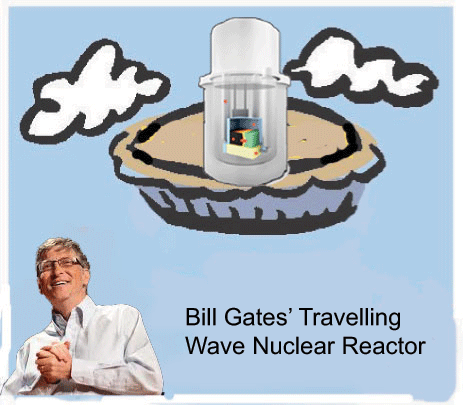 Small Modular Reactors, [SMRs] the latest “rabbit out the nuclear hat,” are generally based on scaled down BWR or PWR technology and illustrate the nuclear industry’s schizophrenic attitude to reactor size…. it was clear that the AP600 [small nuclear reactor] was hopelessly uneconomic… SMRs may turn out to be the latest in a long line of nuclear designs that looked good on paper, but could not make the transition to commercial technology
Prospects for Nuclear Power in 2012, The Energy Report 2 April 12, ”…….Technological Cul-de-Sac If plant life extensions can be achieved in France and the U.S. and Gen III+ does prove a blind alley, it raises the question of what options are open to the nuclear sector. Ten years ago, the industry answer would have been Generation IV designs. Unlike Gen III+, which evolved from existing Pressurized Water Reactors (PWRs) and Boiling Water Reactors (BWRs), these would be based on radical new technologies. Six technologies were selected by the major nuclear countries as the most promising.
However, 10 years on, they seem no closer to commercial deployment. Continue reading
1 This Month
26 September – International Day for the Total Elimination of Nuclear Weapons





PLEASE OPPOSE HR 8255 AND S.3639 – bills would accelerate satellite deployment, with no environmental review or safeguards – https://ncstd5li.quorum.us/campaign/169331/
To see nuclear-related stories in greater depth and intensity – go to https://nuclearinformation.wordpress.com
-
Archives
- September 2026 (281)
- August 2026 (330)
- July 2026 (355)
- June 2026 (287)
- May 2026 (306)
- April 2026 (356)
- March 2026 (251)
- February 2026 (267)
- January 2026 (308)
- December 2025 (358)
- November 2025 (359)
- October 2025 (375)
-
Categories
- 1
- 1 NUCLEAR ISSUES
- business and costs
- climate change
- culture and arts
- ENERGY
- environment
- health
- history
- indigenous issues
- Legal
- marketing of nuclear
- media
- opposition to nuclear
- PERSONAL STORIES
- politics
- politics international
- Religion and ethics
- safety
- secrets,lies and civil liberties
- spinbuster
- technology
- Uranium
- wastes
- weapons and war
- Women
- 2 WORLD
- ACTION
- AFRICA
- Atrocities
- AUSTRALIA
- Christina's notes
- Christina's themes
- culture and arts
- Events
- Fuk 2022
- Fuk 2023
- Fukushima 2017
- Fukushima 2018
- fukushima 2019
- Fukushima 2020
- Fukushima 2021
- general
- global warming
- Humour (God we need it)
- Nuclear
- RARE EARTHS
- Reference
- resources – print
- Resources -audiovicual
- Weekly Newsletter
- World
- World Nuclear
- YouTube
-
RSS
Entries RSS
Comments RSS

