“Fast nuclear reactors” not the solution to plutonium wastes
Ultimately, however, the core problem may be that such new reactors don’t eliminate the  nuclear waste that has piled up so much as transmute it. Even with a fleet of such fast reactors, nations would nonetheless require an ultimate home for radioactive waste, one reason that a 2010 M.I.T. report on spent nuclear fuel dismissed such fast reactors.
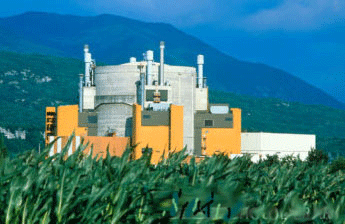
 Can Fast Reactors Speedily Solve Plutonium Problems? The U.K. is grappling with how to get rid of weapons-grade plutonium and may employ a novel reactor design to consume it Scientific American By David Biello | March 21, 2012 The U.K. has nearly 100 metric tons of plutonium—dubbed “the element from hell” by some—that it doesn’t know what to do with. The island nation does not need the potent powder to construct more nuclear weapons, and spends billions of British pounds to ensure that others don’t steal it for that purpose. The unstable element, which will remain radioactive for millennia, is the residue of ill-fated efforts to recycle used nuclear fuel.
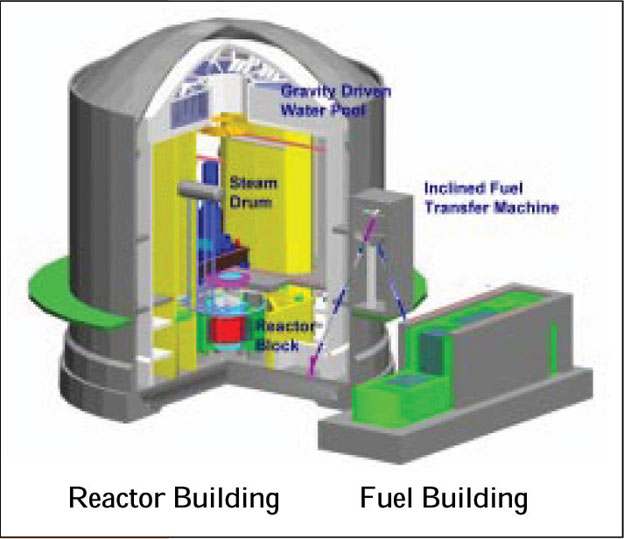
One solution under consideration is to recycle the plutonium yet further—by using it as fuel in a pair of new, so-called “fast” reactors. Such nuclear reactors can actually “consume” plutonium via fission (transforming it into other forms of nuclear waste that are not as useful for weapons). The U.K. is considering a plan to build two of General Electric’s PRISM fast reactors, the latest in a series of fast-reactor designs that for several decades have attempted with mixed success to handle plutonium and other radioactive waste from nuclear power. The idea remains that fast reactors, which get their name because the neutrons that initiate fission in the reactor are zipping about faster than those in a conventional reactor, could offer a speedy solution to cleaning some nasty nuclear waste, which fissions better with fast neutrons, while also providing electricity as a by-product.
The U.K. is hardly alone in struggling to cope with nuclear waste, whether plutonium or otherwise. Continue reading
USA joining with China to develop thorium nuclear reactors
 What’s not clear is what, exactly, the U.S. will get from the collaboration….
U.S. partners with China on new nuclear, By Mark Halper Smart Planet June 26, 2012 E Pluribus Thorium? U.S. Assistant Energy Secretary Peter Lyons and Chinese Academy of Sciences’ Jiang Mianheng have joined forces for thorium development. What’s in it for the U.S.?
The U.S. Department of Energy is quietly collaborating with China on an alternative nuclear power design known as a molten salt reactor that could run on thorium fuel Continue reading
USA’s Federal Energy Regulatory Commission gives a big boost to solar energy to

 Big News for Renewable Energy: FERC Rules for Wind, Solar, Storage, Forbes, 29 June 12 “.…. A year ago, Wellinghoff told me: “[North American Electric Reliability Corporation] projects in its 2010 Long-Term Reliability Assessment that approximately 60 percent of all new resources expected to be added to the bulk power system by 2019 will be new wind and solar resources.”
The FERC aims to remove regulatory barriers to ensure that all of these resources can get access the grid and play a competitive role in the energy markets.
To that end, the Federal Energy Regulatory Commission passed a rule last week to make it easier for solar and wind providers to distribute their power to the grid…. FERC says the ruling also benefits electric consumers by ensuring that services are provided at
reasonable rates. Continue reading
Stuxnet computer malaware affected USA too
 When Stuxnet Hit the Homeland: Government Response to the Rescue abc News 29 June 12, An Iranian nuclear facility may have taken the brunt of the cyber superweapon Stuxnet believed to be built in part by the U.S., but the American government was concerned enough with its spread to a facility back home that a fast response team was deployed to deal with an infection, according to a new report from the Department of Homeland Security.
The report , released Thursday by the DHS’s Industrial Control Systems Computer Emergency Readiness Team (ICS-CERT), gives scant details on the incident, except to say that after Stuxnet was discovered on thousands of computer systems around the world in 2010, a DHS team “conducted an onsite incident response deployment to a manufacturing
facility infected with the Stuxnet malware and helped the organization identify all infected systems and eradicate the malware from their control system network.”
The worm was found on “all their engineering workstations as well as several other machines connected to the manufacturing control systems network,” the report said….
http://abcnews.go.com/blogs/headlines/2012/06/when-stuxnet-hit-the-homeland-government-response-to-the-rescue/
Powering Europe with Sunshine from Africa and Middle East
 How To Power A Continent With Wind And Solar http://www.energymatters.com.au/index.php?main_page=news_article&article_id=3271 by Giles Parkinson, editor of RenewEconomy.com.au, 27 June 12 Of all the most ambitious renewable energy projects around the world, the European Desertec Industrial Initiative ranks right at the top- some would say fantastic in both the true and the modern sense of the word.The basic plan of Desertec is to harness the wind and solar power from north Africa and the Middle East and use it- along with similar resources from southern Europe- to help Europe cut 95 per cent of its emissions from its electricity grid by 2050, and to have renewables provide 90 per cent of its power needs.
A new report released by the initiative- which is a consortium of 21 industrial giants such as Siemens, E.ON, Deutsche Bank, Morgan Stanley, Enel, and Shell- says this can be done, at the same time as reducing electricity costs and making the grid more stable than it would otherwise be.
The 2050 Desert Power report released late last week, co-authored by the Fraunhofer Institute, says that by importing 20 per cent of its energy needs from the Middle East and north Africa (MENA), Europe can save €33 billion a year, or €30 for each megawatt hour of imported electricity. Continue reading
Legal action not an option for vast majority of Fukushima’s nuclear victims
Victims and lawyers in Japan say the dearth of nuclear-related suits reflects both a national mindset — a distaste for confrontation — and a stunted judicial system that doesn’t allow for class-action cases or punitive damages. Japanese speak of the court system as more likely to deliver frustration than vengeance, and jobless evacuees who urgentlyneed money have little appetite for long trials with uncertain outcomes.
Without the threat of legal action, ……”the state and companies can take advantage of victims.”

 Nuclear redress will never approximate losses, By CHICO HARLAN, The Washington Post, 26 June 12, It was 15 months ago that the Fukushima No. 1 nuclear plant suffered three meltdowns and contaminated a broad circle of countryside and left hundreds of thousands of people without homes, jobs or both. But for all the damage and despair it wrought, the disaster so far has unfolded without one conventional element: a widespread and contentious legal fight by those who say they should be compensated for their losses.
Victims of the worst nuclear crisis in a quarter-century have filed roughly 20 lawsuits against Tokyo Electric Power Co., according to the utility. That compares with the several hundred suits filed against BP within weeks of the 2010 Gulf oil spill, including the near-finalized settlement of a class-action suit that will pay 120,000 plaintiffs upward of $7.8 billion. BP also paid out some $6.2 billion to victims via a neutral claims settlement process, administered by a lawyer appointed by the Obama administration. Continue reading
Conflict of interest, USA’s Department of Energy funds research into radiation
 The Energy Department is also the main source of funding for radiation health research — much like having the tobacco industry determine the safety of smoking. This conflict-of interest is not new. Several prominent scientists on the nuclear payroll in the 1950’s and 60’s vigorously claimed that radioactive fallout from atmospheric nuclear weapons tests was harmless. Some went so far as to assert that fallout might be beneficial because increased radiation-induced genetic mutations could weed out the weak.
A Radioactive Conflict of Interest http://www.huffingtonpost.com/robert-alvarez/mit-radiation-study_b_1623899.html HUFFINGTON POST, Robert Alvarez, 06/25/2012  Having the Energy Department control radiation health research makes as much sense as giving tobacco companies the authority to see if smoking is bad for you.
 VIDEO http://www.youtube.com/watch?v=e8YFe6Q08M8 MIT No-Evacuations Study Debunked Last month, the Massachusetts Institute of Technology (MIT) heralded an Energy Department funded study indicating that evacuation zones around nuclear power stations might not be needed after a major nuclear accident. The study, which exposed mice to radiation levels comparable to those near the Fukushima nuclear disaster, found no evidence of genetic harm. “There are no data that say that’s a dangerous level,” says Jacquelyn Yanch, a leader of the study.
According to theMIT press release “current U.S. regulations require that residents of any area that reaches radiation levels eight times higher than background should be evacuated. However, the financial and emotional cost of such relocation may not be worthwhile, the researchers say.”
More costs, more delays for cleanup of USA’s most radioactive nuclear waste site
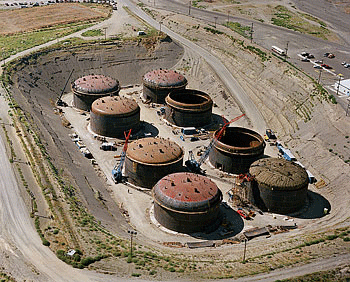 Today, it is the nation’s most contaminated nuclear site, with cleanup expected to last decades.
In March, the Defense Nuclear Facilities Safety Board ruled that the agency lacks necessary information to resolve some problems and establish a complete safety plan.
Hanford waste plant sees new costs, delays USA Today, By Shannon Dininny, 26 June 12, KENNEWICK, Wash. (AP) — A new cost estimate and construction schedule for a massive waste plant being built at the nation’s most contaminated nuclear site will be delayed at least a year as workers try to resolve serious technical problems raised by whistleblowers about design and safety, the U.S. Department of Energy said Tuesday.
The $12.3 billion plant at south-central Washington’s Hanford nuclear reservation is being built to convert highly radioactive waste into a stable glass form for permanent disposal underground.
The plant is currently scheduled to begin operating in 2019, but several workers have raised concerns about safety, particularly about erosion and corrosion in tanks and piping inside the plant.
The issues are significant because the problem areas are inside so-called black cells, which will be closed off and inaccessible due to high radioactivity after the plant begins operating. Continue reading
Nuclear reprocessing is not the answer to Japan’s mounting radioactive wastes
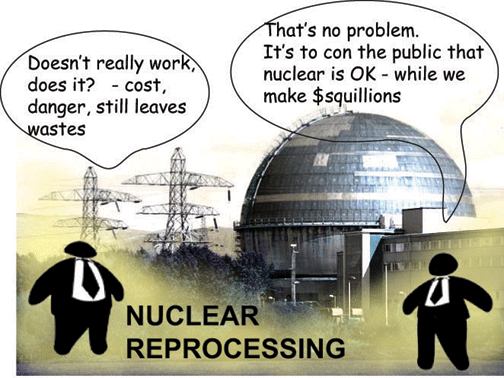 The amount of spent fuel stored at power stations has continued to surge, standing at around 14,200 tons across 17 facilities as of last September, including the wrecked Fukushima No. 1 nuclear plant.
Japan Nuclear Fuel Ltd.’s storage facilities are already almost full and contained a total of 2,800 tons as of February, while several power stations are expected to reach maximum capacity over the next three years if their currently idled reactors are restarted, industry
sources said.
Policy of recycling all spent nuclear fuel may be axed, Japan Times, 22 June 12, Kyodo, Jiji The Japan Atomic Energy Commission has proposed both reprocessing and directly disposing of spent nuclear fuel if Japan’s atomic energy reliance is cut to 15 percent, a departure from the current policy of total reprocessing…
.. The changed tack comes as massive amounts of spent fuel are accumulating at nuclear plants nationwide and as decades-long efforts to activate reprocessing facilities remain mired
in technical difficulties, sources said. Continue reading
Ionising radiation – the big cancer hazard for space travellers
Mission to Mars: The Radiation Problem. Smithsonian.com, 20 June 12, Would you go on a mission to Mars? The Dutch startup company Mars One is planning to establish the first Mars colony in 2023, starting with four individuals and adding more people every two years, funded by turning the whole endeavor into a reality TV show.
It’s just the latest plan to colonize the Red Planet, but I’m doubtful it will happen. There’s the expense, for sure, and the trials of trying to convince anyone to go on a one-way journey with just a few other strangers (what if you don’t get along? It’s not like you can leave). And then there’s the radiation problem.
Out in space, there are gamma rays from black holes, high-energy protons from the Sun, and cosmic rays from exploding stars. Earth’s atmosphere largely protects us from these types of radiation, but that wouldn’t help anyone traveling to Mars. They would be exposed to dangers that include neurological problems, loss of fertility and an increased risk of cancer….. A 2005 study found even more to worry about—the radiation would be high enough to cause cancer in 10 percent of men and 17 percent of women aged 25 to 34 if they were to go to Mars and back.
The easy solution would seem to be to shield the vessel that carries the humans to Mars, but no one has figured out how to do that. When the thin aluminum currently used to build spacecraft is hit with cosmic rays, it generates secondary radiation that is even more deadly. … http://blogs.smithsonianmag.com/science/2012/06/mission-to-mars-the-radiation-problem/
Global citizens’ monitoring of radiation data
Getting these devices out there — especially internationally — is a key to getting access to the world’s local radiation data.
The religious flag behind this project is the idea that this data should be accurate and open. Safecast uses open source and APIs and anyone can use the data to conduct research. For example a health researcher could use their radiation data to compare radiation levels against health information.
Local level radiation data is largely not available currently, or it’s owned by companies and not released.

 Using open source & grassroots to map the world’s radiation data http://gigaom.com/cleantech/using-open-source-grassroots-to-map-the-worlds-radiation-data/ By Katie Fehrenbacher Jun. 20, 2012, Mapping the world’s radiation and air pollution data, using one volunteer with one gadget at a time — that’s the goal of the Safecast project, which this week closed over $100,000 on Kickstarter to deliver a limited run of its open source geiger counters to interested buyers. “I don’t think it’s an unreasonable goal,” to create comprehensive maps of this data from all over the world, says Sean Bonner, co-founder of Safecast, in a phone interview shortly after his team’s project was funded.
Safecast originally focused on mapping radiation data just from Fukushima, Japan, in the wake of the nuclear disaster, and had a larger end goal to map the rest of Japan, too. But they realized that with enough eager volunteers in Japan, that mapping the entire country using geiger counters mounted on cars and held in the hands of regular citizens, was pretty doable. “It’s really only a matter of time before we’ve got all of Japan covered,” Continue reading
About the Flame computer virus
 Flame FAQ: All you need to know about the virus http://www.washingtonpost.com/blogs/blogpost/post/flame-faq-all-you-need-to-know-about-the-virus/2012/06/20/gJQAAlrTqV_blog.html By Benjamin Gottlieb
What is the Flame computer virus?
Flame is a sophisticated type of malware — short for malicious software — capable of infecting myriad computer networks for the purpose of gathering sensitive data. Once a network is infected by Flame, the virus can relay back massive amounts of information through a computer’s facilities. How does it work? Continue reading
Indian Point nuclear plant has three times the radioactivity of Fukushima’s spent fuel pools.
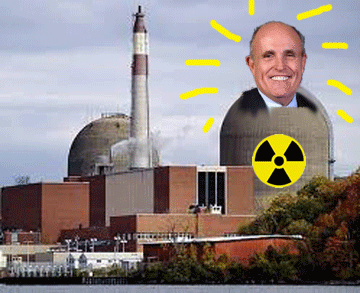 Wake Up and Smell the Radioactive Waste, OpEd News, 20 June 12, By Abby Luby“……Currently at Indian Point, 1,500 tons of high-level irradiated waste is stored in heavy steel and concrete casks on a tarmac a few hundred feet from the Hudson River. The Westchester-based plant produces about 30 tons of radioactive waste every 18 months, which is then crammed into two overcrowded, 40-foot deep spent fuel pools. Each pool holds about 1,000 tons of radioactive waste and has been leaking into the ground and river for years. However, the NRC has maintained that whatever leaches into the river is negligible, reiterating their catch phrase: “Dilution is the solution to pollution.”….
In a study by the Institute for Policy Studies, “Spent Nuclear Fuel Pools in the U.S.: Reducing the Deadly Risks of Storage,” Robert Alvarez, author and senior scholar for nuclear policy, said that Indian Point has three times the radioactivity of Fukushima’s spent fuel pools.
Indian Point is about 30 miles from Manhattan. A 1997 analysis, the Brookhaven National Laboratory [ http://pbadupws.nrc.gov/docs/ML0230/ML023040470.pdf – page 4] estimated a severe fire in a spent-fuel pool would release enough radioactive material to cause as many as 28,000 cancer deaths in a densely populated area and render 188 square miles uninhabitable.
In light of the Fukushima disaster and the potential for future leakage and catastrophic fires, the court ruled that the NRC’s analysis of the impacts of spent fuel storage was insufficient and is now requiring the agency to reassess the environmental impacts of the waste storage. Now it’s up to the NRC to heed the court and truly “protect the health and safety of the public.” http://www.opednews.com/articles/Wake-Up–Smell-the-Radioa-by-Abby-Luby-120614-180.html
Rosatom, Russia’s secretive, Mafia style, nuclear corporation
In 2002, a Russian scientist, well aware of covert activities by Russian authorities, declared to the Boston Globe that Rosatom is a “super-Mafia.” Secrecy is omnipotent within the governmental organization.

 Russia’s Dangerous Nuclear Legacy – Analysis Eurasia Review, By: Richard Rousseau June 18, 2012“……The post-Cold War world has an elusive international structure. Powerful global corporations, as well as international terrorist organizations, can frustrate a search for clarity and efficiency in fighting illicit activities in finance, economy, the organized crime, or smuggling of nuclear material.
In Russia, the main culprit is Rosatom. This relic of the Soviet system still operates largely
without independent oversight, especially since June 23, 2010, when President Dmitry Medvedev signed a decree that stated that Rostekhnadzor (the Federal Service for Ecological, Technological and Nuclear Supervision) would be henceforth under the direct control of
the government. Rosatom reports to no one in justifying how hundreds of millions of dollars are spent. Continue reading
Russia can’t afford new nuclear plants, and can’t afford to shut down old ones
The decommissioning of nuclear plants after exhausting their resources will put an enormous strain on Russian state budget. Largely for this reason, Rosatom is making every effort to prolong their operational life, knowing quite well that there will be economic shockwaves in the industry should nuclear units be closed.
Russia’s Dangerous Nuclear Legacy – Analysis Eurasia Review, By: Richard Rousseau June 18, 2012“…….The safety of nuclear reactors is primarily provided through the increased number of sophisticated security systems and physical barriers that limit or contain potential radiation leaks. These systems consist of a combination of natural and artificial barriers that work in tandem and complement each other in assuring the required
long-term isolation of the waste by preventing or limiting the movement of radioactive substances from the infrastructure of the repository to the biosphere.
However, in essence this has made nuclear plants increasingly more complex systems, which in turn drives up their construction and operation costs, while it is still impossible to achieve a 100 percent safety level. Continue reading
1 This Month

4 May -West Suburban Peace Coalition to discuss Iran war at May Educational Forum
Monday, May 4, 7:00 – 8:00 PM Central Standard Time
Title: : How Trump’s Narrative Tries to Shape the Reality of the War on Iran.
Contact Walt Zlotow, zlotow@hotmail.com 630 442 3045 for further information
14 May – online event From Bombs to Data Centres: the Face of Nuclear Colonialism
To see nuclear-related stories in greater depth and intensity – go to https://nuclearinformation.wordpress.com
-
Archives
- May 2026 (37)
- April 2026 (356)
- March 2026 (251)
- February 2026 (268)
- January 2026 (308)
- December 2025 (358)
- November 2025 (359)
- October 2025 (376)
- September 2025 (257)
- August 2025 (319)
- July 2025 (230)
- June 2025 (348)
-
Categories
- 1
- 1 NUCLEAR ISSUES
- business and costs
- climate change
- culture and arts
- ENERGY
- environment
- health
- history
- indigenous issues
- Legal
- marketing of nuclear
- media
- opposition to nuclear
- PERSONAL STORIES
- politics
- politics international
- Religion and ethics
- safety
- secrets,lies and civil liberties
- spinbuster
- technology
- Uranium
- wastes
- weapons and war
- Women
- 2 WORLD
- ACTION
- AFRICA
- Atrocities
- AUSTRALIA
- Christina's notes
- Christina's themes
- culture and arts
- Events
- Fuk 2022
- Fuk 2023
- Fukushima 2017
- Fukushima 2018
- fukushima 2019
- Fukushima 2020
- Fukushima 2021
- general
- global warming
- Humour (God we need it)
- Nuclear
- RARE EARTHS
- Reference
- resources – print
- Resources -audiovicual
- Weekly Newsletter
- World
- World Nuclear
- YouTube
-
RSS
Entries RSS
Comments RSS
 nuclear-news