There’s no “nuclear renaissance. It’s a Stillbirth!
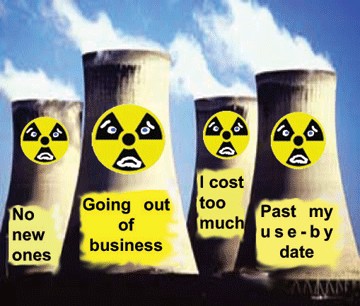 We have heard from the nuclear lobby that a “nuclear renaissance” is just around the corner and, as evidence of this, we are told 65 reactors are “under construction” worldwide.
It is instructive to look at the number of years some of these have been “under construction”. For example, Lungmen 1 and 2 in China were begun in 1997 and have so far taken 15 years to build.
Moving from the disappointing to the ludicrous, Watts Bar 2 in the US has been ”under construction” since 1972. It is likely these long-delayed projects will eventually be cancelled, and almost certainly they will never be an economic success.
countries in the “considering” list is a distortion of the facts by the World Nuclear Association, perhaps born of a desperation to conceal the decline of the industry.
 Nuclear industry ‘rebirth’ is instead stillborn http://www.businessday.co.za/articles/Content.aspx?id=176811 The sad truth is that even according to the optimistic International Atomic Energy Agency data from the PRIS data, the number of reactors on which construction was started fell 75% from 2010 to last year, and again 75% from last year to this year PETER BECKER 2012/07/23 07
THE nuclear power industry is deeply troubled, with little cause for optimism. There is growing worldwide
public resistance to nuclear power stations, US President Barack Obama has terminated government subsidies for nuclear power, and Germany and Switzerland have committed to shutting down all their reactors. While the renewable energy industry has seen dramatic growth and constantly falling costs, the nuclear industry grapples with spiralling costs, the seemingly intractable waste-disposal issue, and the huge economic and human costs of the Fukushima nuclear disaster in Japan. Continue reading
Fukushima’s children: more than a third at risk of developing cancer
doctors are outraged that the results are not being sufficiently publicized.
The World Health Organization warns that young people are particularly prone to radiation poisoning in the thyroid gland. Infants face the direst consequences, as their cells divide at a higher rate.
Children who were under 18 when the nuclear disaster struck last year will be subject to continuous thyroid examinations every two years until they reach 20 years of age, and after that, every five years for the rest of their lives.
 Over a third of Fukushima children at risk of developing cancer http://www.rt.com/news/fukushima-children-radiation-exposure-abnormalities-632/ 20 July, 2012,Over a third of children in Japan’s Fukushima region could be prone to cancer if medics don’t apply more effort in treating their unusually overgrown thyroid glands and commit to international health aid and consultations, according to a new report.
The shocking new report shows that nearly 36 per cent of children in the nuclear disaster-affected Fukushima Prefecture have abnormal thyroid growths. This is an extremely large number of abnormalities – some of which, experts say, pose a risk of becoming cancerous.
After examining more than 38,000 children from the area, medics found that more than 13,000 have cysts or nodules as large as 5 millimeters on their thyroids, the Sixth Report of Fukushima Prefecture Health Management Survey states.
In comparison, a 2001 analysis by the Japan Thyroid Association found that fully zero per cent of children in the city of Nagasaki, which suffered a nuclear attack in August of 1945, had nodules, and only 0.8 per cent had cysts on their thyroids, reports the Telegraph.
Radiation enters the body and is distributed through soft tissue, especially in muscle, and then accumulates in the thyroid. It is this accumulation that can potentially lead to cancer. Continue reading
Nuclear and fossil fuel lobbies have conned Australia about wind energy
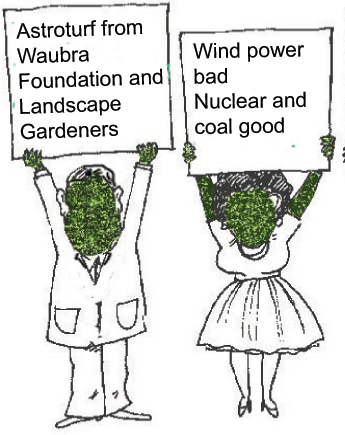 There are two main anti-wind farm groups in Australia busily fomenting anxiety and opposition. One is the Waubra Foundation, a group of mainly wealthy individuals, none of whom live in or near the town of Waubra, near Ballarat. Several of them, NIMBY style, have opposed turbines near their own properties elsewhere. They are led by an unregistered doctor, Sarah Laurie, and a wealthy mining investor, Peter Mitchell who also has connections to the Landscape Guardians. Despite their name, the Guardians have never attempted to guard our landscape from over-zealous residential developers, open cut coal or coal seam gas mining. They only target wind farm developments. All three – Waubra, the Guardians and Mitchell’s mining investment company share a South Melbourne post office box.
Wind turbine syndrome: a classic ‘communicated’ disease https://theconversation.edu.au/wind-turbine-syndrome-a-classic-communicated-disease-8318?utm_medium=email&utm_campaign=Latest+from+The+Conversation+for+20+July+2012&utm_content=Latest+from+The+Conversation+for+20+July+2012+CID_be7f8aff1000afd17cabaf558b629431&utm_source=campaign_monitor&utm_term=Simon+Chapman+investigates At the beginning of this year I started collecting examples of health problems some people were attributing to wind turbine exposure. I had noticed a growing number of such claims on the internet and was curious about how many I could find. Within an hour or two I had found nearly 50 and today the number has grown to an astonishing 155. Continue reading
20,000 cleanup workers not counted, in estimating Fukushima cancer risks

 Thousands More Radiation-Related Deaths Expected From Fukushima, Asian Scientist, Study By Rebecca Lim July 20, 2012 Thousands of deaths could still be expected from the Fukushima nuclear fallout in the years to come, according to the first estimate of the disaster’s worldwide impact AsianScientist (Jul. 20, 2012) –
The research, published in the latest edition of the journal Energy & Environmental Science, found that inhalation exposure, external exposure, and ingestion exposure of the public to radioactivity may result in up to 1,300 cancer mortalities and up to 2,500 cancer morbidities worldwide, mostly in Japan.
Stanford University researchers John Ten Hoeve and Mark Jacobson feel that the risk of a meltdown is not small, given that “modest to major radionuclide releases (occurred) in almost 1.5 percent of all reactors ever built.”….
Estimates in the paper do not account for the increased radiation risk to the roughly 20,000 workers at the plant in the months following the accident.
Psychological effects such as depression, anxiety, fear, and unexplained physical symptoms which were seen post-Chernobyl, are likely to be repeated in evacuees after Fukushima, they say….
Abnormal thyroid growths in 36% of Fukushima children

 36 Percent Of Fukushima Children Have Abnormal Growths From Radiation Exposure http://www.businessinsider.com/a-stunning-36-percent-of-fukushima-children-have-abnormal-growths-from-radiation-exposure-2012-7#ixzz21Cetabn4 Michael Kelley | Jul. 16, 2012, Of more than 38,000 children tested from the Fukushima Prefecture in Japan, 36 percent have abnormal growths – cysts or nodules – on their thyroids a year after the Fukushima nuclear disaster, as reported by ENENews.
The shocking numbers come from the thyroid examination section of the “Sixth Report of Fukushima Prefecture Health Management Survey,” published by Fukushima Radioactive Contamination Symptoms Research (FRCSR) and translated by the blog Fukushima Voice. Shunichi Yamashita, M.D., president of the Japan Thyroid Association, sent a letter to members in January with guidelines for treating thyroid abnormalities. In 2001 Yamashita co-authored a study that found normal children in Nagasaki to have 0 percent nodules and 0.8 percent cysts. Continue reading
Lengthy and dangerous process to remove nuclear fuel rods
The pool at No. 4 was behind the secret worst-scenario mapped out by the government, which warned millions of people might have to flee from spewing radiation, including parts of the Tokyo area, which has a population of 35 million people. U.S. authorities have also repeatedly expressed worries about the spent-fuel pool at reactor No. 4.
“If we are asked whether things are completely safe, we cannot say that,” “If there is another major earthquake, we don’t know what may happen,
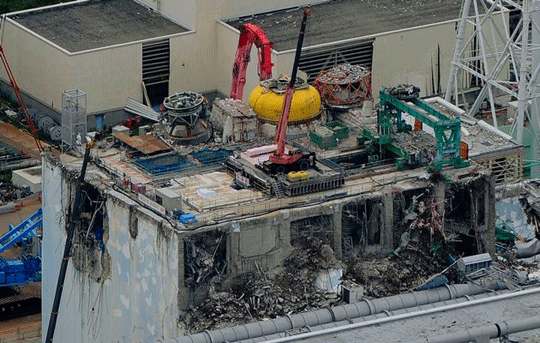
Japan removes two nuclear fuel rods from Fukushima plant Times Live Sapa | 18 July, 2012 A giant crane removed two rods packed with nuclear fuel from the Fukushima nuclear plant. This is the beginning of a delicate and long process to deal with a remaining risk of more radiation escaping from the disaster-struck plant.
All of the 1,535 rods next to reactor No. 4 at the crippled Fukushima Dai-ichi plant in northeastern Japan must eventually be removed from a spent-fuel pool to safer storage – an effort expected to take through the end of next year, according to the government. Continue reading
“Waste Confidence Rule” allows nuclear waste keep growing, with no solution!
the NRC also stated that it ‘retains confidence that spent fuel can be safely stored with no significant environmental impact until a repository can reasonably be expected to be available and that the Commission has a target date for the availability of the repository in that circumstance’”
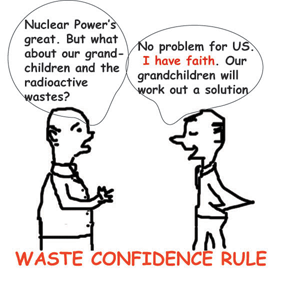
As a result of its confidence in the safety of spent fuel storage, NRC rules note that “no discussion of any environmental impact of spent fuel storage in reactor facility storage pools or independent spent fuel storage installations for the period following the term of the reactor operating license . . . is required in any environmental report, environmental impact statement, environmental assessment or other analysis prepared in connection with the issuance or amendment of an operating license for a nuclear reactor,”
 Group seeks to have spent fuel a factor in re-licensing Limerick plant The Mercury By Evan Brandt 07/17/12 LIMERICK “…….Spent fuel rods are what remains after the uranium pellets inside the fuel rods in a reactor no longer generate enough heat to create the steam that turns the turbines and generates electricity at a nuclear power plant.
Although cooler, this spent fuel remains radioactive to some extent for hundreds of years. For years, spent fuel was kept in concrete “spent fuel pools” located inside a nuclear plant and filled with water to keep it from overheating.
According to the NRDC filing, in 2008 NRC proposed “‘remov(ing) its expectation that a repository (for spent fuel) will be available by 2025’ and acknowledged that its previous finding that sufficient disposal capacity would be available within 30 years after any
reactor’s licensed life ‘is not supportable.’” Continue reading
“Uprating” – a cheap way to increase power from nuclear reactors, but is it safe?
nuclear watchdogs have warned that these bigger uprates also carry bigger risks.
“This trend is, in principle, detrimental to the stability characteristics of the reactor, inasmuch as it increases the probability of instability events and increases the severity of such events, if they were to occur,” the Advisory Committee on Reactor Safeguards, which is mandated by Congress to advise the NRC, has warned
 How to expand nuclear power without attracting (too much) attention
Washington Times, by Brad Plumer July 18, 2012 Since the 1970s, construction on new nuclear reactors in the United States has largely ground to a halt, thanks to public protests, regulatory obstacles and tight financing. Yet over that same period, U.S. utilities have managed to increase the amount of electricity they get from nuclear power. By quite a lot, in fact.
How is that possible? Through a process known as “uprating.” According to a new analysis by the U.S. Energy Information Administration, the operators of 98 of the country’s 104 commercial nuclear reactors have asked regulators for permission to boost capacity from their existing plants. All in all, the Nuclear Regulatory Commission has approved more than 6,500 megawatts worth of uprates since 1977. That’s the equivalent of building six entirely new nuclear reactors—and during a period when fresh plants were impossible to build.
Burying dead nuclear reactors – expensive, but lucrative for some!
consultancy Arthur D. Little has put the total costs at no less than €18 billion…..
Dismantling a nuclear plant until it has completely vanished can take several decades, depending on which technique is used.
the process of fully decommissioning a plant can take more than 40 years,
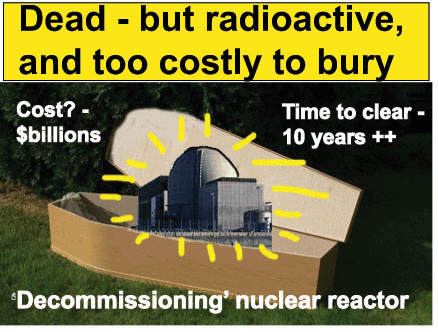
 Germany’s pricey nuclear burial, Climate Spectator , 18 Jul 2012, Christoph Steitz and Tom Käckenhoff “…..by 2014, almost nothing will be left of what once was Germany’s first commercial boiling water reactor. Germany’s decision to shut down all nuclear plants by 2022,
sparked by last year’s Fukushima nuclear disaster in Japan, is a done deal……
… a giant hole in the ground where the reactor vessel used to be. Work to decommission plants mainly includes removing and disposing of contaminated material as well as decommissioning the plants themselves while making sure that no radiation spreads.
Spent fuel from reactors needs to be encased and then transported to safe fuel dumps while cooling towers, often regarded a blight on landscapes, then need demolishing…..
Today, the four operators of nuclear plants in Germany – E.ON, RWE, EnBW and Vattenfall – have made a total of more than €30 billion ($36.7 billion) in provisions for the dismantling of the plants and the disposal of nuclear waste. Continue reading
France used soldiers as guinea pigs for radiation effects
 An excerpt published in the newspaper refers to the “Gerboise verte”, code name for the test firings of April 25, 1961. It states that the experiment “should allow for a study of the physiological and psychological effects of atomic weaponry on humans, with the goal obtaining the necessary elements to prepare physically and morally for modern combat.”
 Soldiers deliberately exposed to nuclear tests, says report According to the Tuesday edition of the French daily Parisian, a confidential military report proves that soldiers were deliberately exposed to nuclear tests that France conducted in Algeria in the 1960s. By FRANCE 24 17 July 12 Continue reading
Nuclear industry in an economic no man’s land
COLUMN-Finnish delay fresh warning against nuclear: Wynn By Gerard Wynn 17 July 12, (Reuters) – The lesson from the latest delay to Finland’s planned new nuclear reactor, announced on Monday, is either build lots of them or don’t build any at all.
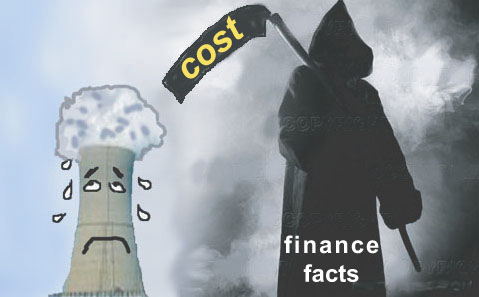
It is a general economic principle that costs per plant decline the bigger a programme. Historical data support that for nuclear, where it may apply more acutely given its highly specialised and often unique supply chain and engineering skills.
It makes no sense to take a suck-and-see approach, building incrementally in a modular fashion, especially for new technologies such as Finland’s advanced pressurised water reactor. Continue reading
Alarming report on the unsafe state of San Onofre nuclear power plant

 Made in Japan? Fukushima Crisis Is Nuclear, Not Cultural TruthOut, 14 July 2012 By Gregg Levine, Capitoilette | News Analysis “……..Back at San Onofre, US regulators disclosed Thursday that the damage to the metal tubes that circulate radioactive water between the reactor and the steam turbines (in other words, part of the system that takes heat away from the core) was far more extensive than had previously been disclosed by plant operators:
[Each of San Onofre’s steam generators has] 9,727 U-shaped tubes inside, each three-quarters of an inch in diameter.
The alloy tubes represent a critical safety barrier — if one breaks, there is the potential that radioactivity could escape into the atmosphere. Also, serious leaks can drain protective cooling water from a reactor.
Gradual wear is common in such tubing, but the rate of erosion at San Onofre startled officials since the equipment is relatively new. The generators were replaced in a $670 million overhaul and began operating in April 2010 in Unit 2 and February 2011 in Unit 3.
Tubes have to be taken out of service if 35 percent — roughly a third — of the wall wears away, and each of the four generators at the plant is designed to operate with a maximum of 778 retired tubes.
In one troubled generator in Unit 3, 420 tubes have been retired. The records show another 197 tubes in that generator have between 20 percent and 34 percent wear, meaning they are close to reaching the point when they would be at risk of breaking.
More than 500 others in that generator have between 10 percent and 19 percent wear in the tube wall.
“The new data reveal that there are thousands of damaged tubes in both Units 2 and 3, raising serious questions whether either unit should ever be restarted,” said Daniel Hirsch, a lecturer on nuclear policy at the University of California, Santa Cruz, who is a critic of the industry. “The problem is vastly larger than has been disclosed to date.”
And if anything, the Nuclear Regulatory Commission is underplaying the problem. A report from Fairewinds Associates, also released this week, unfavorably compared San Onofre’s situation with similar problems at other facilities:
[SONGS] has plugged 3.7 times as many steam generator tubes than the combined total of the entire number of plugged replacement steam generator tubes at all the other nuclear power plants in the US.
The report also explains that eight of the tubes failed a “pressure test” at San Onofre, while the same test at other facilities had never triggered any more than one tube breach. Fairewinds goes on to note that both units at San Onofre are equally precarious, and that neither can be restarted with any real promise of safe operation….. http://truth-out.org/news/item/10333-made-in-japan-fukushima-crisis-is-nuclear-not-cultural
Japan moving towards renewable energy
the Japanese Wind Power Association has put the longer-term wind potential at over 200 GW, on and offshore, even taking account of locational constraints. That is similar to Japans total present energy generating capacity.
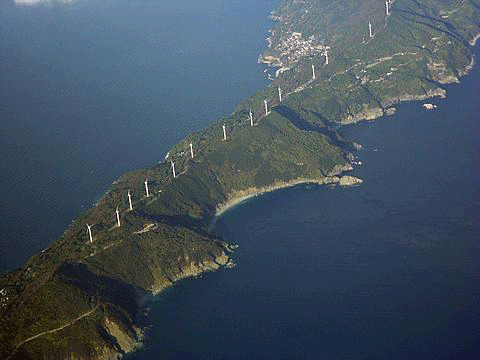
the aim would be to create a 50 trillion yen ($628 billion) green energy market by 2020 through deregulation and subsidies to promote development of renewable energy and low-emission cars.
Greening Japan’s energy http://environmentalresearchweb.org/blog/2012/07/greening-japans-energy.html 15 July 12 As part of its policy of moving away from nuclear power, the Japanese government is pushing ahead with renewables and improved energy efficiency. Given the urgent need to cut energy demand, following the shut down of all its nuclear plants in May, it encouraged voluntary energy saving initiatives, with some success. Continue reading
Japanese medical authorities quiet about high thyroid nodules in Fukushima’s children
the rate of thyroid nodules in children 5 to 10 years after the Chernobyl accident was 1.74%. The results in Fukushima are merely one year after the accident. This is a much faster progression
Just 0.8% of children in 2001 Japanese control group had thyroid cysts or nodules — 36% in Fukushima study
Fukushima Children’s Thyroid Examination: How Shunichi Yamashita would like doctors to deal with the results. Introduction Fukushima Voice May 2012,
This is a letter sent from Shunichi Yamashita, M.D., from Fukushima Medical University to the members of Japan Thyroid Association, of which he is the president. The letter “asks” or rather “instructs” the members, who are likely to be the thyroid specialists, on how to
deal with the thyroid ultrasound results of Fukushima children. Continue reading
Cancer and birth deformities toll, due to uranium radiation in Punjab groundwater
The effect of all this can be seen in the growing number of patients in the Malwa belt with cancer and other diseases and children being born with abnormalities. In fact, a train that connects Bathinda with Bikaner in neighbouring Rajasthan is known as the ‘Cancer Express’ as it ferries a large number of cancer patients from Punjab to Bikaner for treatment at a cancer hospital.
Groundwater contaminated, Punjab battles uranium curse Times of IndiaI Jul 13, 2012, CHANDIGARH, The high incidence of cancer and other diseases in Punjab’s Malwa belt has been highlighted over the last decade. Now, union Rural Development Minister Jairam Ramesh has confirmed the presence of uranium and other heavy metals in groundwater in the state, particularly the Malwa region, and serious efforts are afoot to control the damage. Continue reading
1 This Month



26 September – International Day for the Total Elimination of Nuclear Weapons


PLEASE OPPOSE HR 8255 AND S.3639 – bills would accelerate satellite deployment, with no environmental review or safeguards – https://ncstd5li.quorum.us/campaign/169331/
To see nuclear-related stories in greater depth and intensity – go to https://nuclearinformation.wordpress.com
-
Archives
- September 2026 (269)
- August 2026 (330)
- July 2026 (355)
- June 2026 (287)
- May 2026 (306)
- April 2026 (356)
- March 2026 (251)
- February 2026 (267)
- January 2026 (308)
- December 2025 (358)
- November 2025 (359)
- October 2025 (375)
-
Categories
- 1
- 1 NUCLEAR ISSUES
- business and costs
- climate change
- culture and arts
- ENERGY
- environment
- health
- history
- indigenous issues
- Legal
- marketing of nuclear
- media
- opposition to nuclear
- PERSONAL STORIES
- politics
- politics international
- Religion and ethics
- safety
- secrets,lies and civil liberties
- spinbuster
- technology
- Uranium
- wastes
- weapons and war
- Women
- 2 WORLD
- ACTION
- AFRICA
- Atrocities
- AUSTRALIA
- Christina's notes
- Christina's themes
- culture and arts
- Events
- Fuk 2022
- Fuk 2023
- Fukushima 2017
- Fukushima 2018
- fukushima 2019
- Fukushima 2020
- Fukushima 2021
- general
- global warming
- Humour (God we need it)
- Nuclear
- RARE EARTHS
- Reference
- resources – print
- Resources -audiovicual
- Weekly Newsletter
- World
- World Nuclear
- YouTube
-
RSS
Entries RSS
Comments RSS

