Heat danger, even when nuclear reactors are shut down
For Nuclear Power This Summer, It’s Too Darn Hot, Truth Out, 05 August 2012 By Gregg Levine, ”……when it comes to nuclear power, as global temperatures continue to rise and water levels in rivers and lakes continue to drop, an even more disconcerting threat emerges.
When a coal plant is forced to shut down because of a lack of cool intake water, it can, in short order, basically get turned off. With no coal burning, the cooling needs of the facility quickly downgrade to zero.
A nuclear reactor, however, is never really “off.”
When a boiling water reactor or pressurized water reactor (BWR and PWR respectively, the two types that make up the total of the US commercial reactor fleet) is “shutdown” (be it in an orderly fashion or an abrupt “scram”), control rods are inserted amongst the fuel rods inside the reactor. The control rods absorb free neutrons, decreasing the number of heavy atoms getting hit and split in the fuel rods. It is that split, that fission, that provides the energy that heats the water in the reactor and produces the steam that drives the electricity-generating turbines. Generally, the more collisions, the more heat generated. An increase in heat means more steam to spin a turbine; fewer reactions means less heat, less steam and less electrical output. But it doesn’t mean no heat.
The water that drives the turbines also cools the fuel rods. It needs to circulate and somehow get cooled down when it is away from the reactor core. Even with control rods inserted, there are still reactions generating heat, and that heat needs to be extracted from the reactor or all kinds of trouble ensues–from too-high pressure breaching containment to melting the cladding on fuel rods, fires, and hydrogen explosions. This is why the term LOCA–a loss of coolant accident–is a scary one to nuclear watchdogs (and, theoretically, to nuclear regulators, too).
So, even when they are not producing electricity, nuclear reactors still need cooling. They still need a power source to make that cooling happen, and they still need a coolant, which, all across the United States and most of the rest of the world, means water. http://truth-out.org/news/item/10707-for-nuclear-power-this-summer-its-too-darn-hot
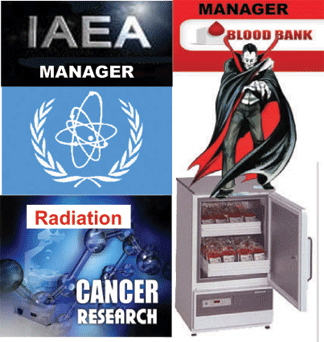
IAEA’s conflict of interest in advising about radiation and health
 In fact, researchers have been surprised to find that genetic damage, and above all perigenetic damage, which is responsible for genomic instability, to descendants is far worse than to parents; and this risk increases from one generation to the next.
After a year, [for Fukushima’s children] the damage caused by the mixture of internal and external radiation to children should be measured, by comparison with data from before 2011 in the same areas, or by comparing data with communities further away, that were spared the radioactive fallout. Birthweight, incidence of stillbirth, perinatal mortality up to 28 days, birth deformities (heart problems should be investigated later), and among the genetic diseases, Down’s syndrome, should all be studied.
In order to achieve its objectives, the IAEA cannot admit that these serious and common illnesses were caused by ionising radiation, because once known, it would prevent the development of the nuclear industry throughout the world.
The IAEA is therefore a poor source of advice for national health authorities
 Fukushima, Precious Time Has Been Lost http://readersupportednews.org/opinion2/303-
 211/12736-fukushima-precious-time-has-been-lost RSN, By Dr. Michel Fernex, The Fukushima Collective Evacuation Trial 02 August 12
It is a privilege to be able to lend personal support to the Fukushima Evacuate Children Lawsuit. There is no better measure of the moral health of a society than how it treats the most vulnerable people within it, and none or more vulnerable, or more precious, than
children who are the victims of unconscionable actions. For Japan, and for all of us, this is a test that we must not fail. (Noam Chomsky 12 Jan. 2012)
What should WHO have done after Chernobyl?” asked Dr Nabarro in 2002 when he was Acting Director-General of the World Health Organization. I replied immediately, and then confirmed it in writing: “Convene a Scientific Working Group on Ionising Radiation and Genetics” like the one in 1956, and add the words “and Genomic Instability”. Continue reading
Genetic damage from ionising radiation
 Researchers have been surprised to find that genetic damage, and above all perigenetic damage, which is responsible for genomic instability, to descendants is far worse than to parents; and this risk increases from one generation to the next.
In equal doses, external radiation is ten to a hundred times less damaging than chronic internal radiation, which essentially results from the oral absorption of radionuclides. These concentrate in organs like the thymus, the endocrine glands, the spleen, the bone surfaces and the heart.
Genetic mutations from radiation exposure are up to 100 times higher than anything we have encountered in the animal kingdom -Dr. Fernex, Former WHO Consultant http://enenews.com/genetic-mutations-from-radiation-exposure-are-up-to-100-times-higher-than-anything-we-have-encountered-in-the-animal-kingdom-dr-fernex-former-who-consultant July 31st, 2012 By ENENews : Fukushima: precious time has been lost
Author: Michel Fernex Date: June 7, 2012 Dr. Michel Fernex Emeritus Professor, Basel Faculty of Medecine Former Consultant, World Health Organization
“What should WHO have done after Chernobyl ?” asked Dr Nabarro in 2002 when he was Acting Director-General of the World Health Organization. I replied immediately, and then confirmed it in writing: “Convene a Scientific Working Group on Ionising Radiation and Genetics” like the one in 1956, and add the words “and Genomic Instability”…..
Since 1959, an agreement signed between WHO and the International Atomic Energy Agency, and then a number of additional legal texts, prohibit WHO from intervening in nuclear accidents….. Continue reading
$73 billion for fixing and restarting San Onofre nuclear plant
 Ailing California Nuclear Plant Has $48 Million Repair Bill
http://sacramento.cbslocal.com/2012/07/31/ailing-california-nuclear-plant-has-48-million-repair-bill/ July 31, 2012 LOS ANGELES (AP) — The operator of the ailing San Onofre nuclear power plant in California says the company has been saddled with $48 million in inspection and repair costs related to damage to tubes that carry radioactive water.
Financial records released Tuesday by Edison International — the parent company of Southern California Edison — also estimate that it will cost $25 million to begin to restart the Unit 2 reactor at reduced power.
The company has not submitted a request to federal regulators to restart either of the twin reactors that have been shut down since January. The figures were included in a report on Edison’s operations betweenApril and June.
The plant is located between Los Angeles and San Diego.
a SILEX facility could make it much easier for a rogue state to clandestinely enrich weapons grade uranium to create nuclear bombs
SILEX could become America’s proliferation Fukushima,
Controversial nuclear technology alarms watchdogs http://www.smartplanet.com/blog/intelligent-energy/controversial-nuclear-technology-alarms-watchdogs/18138 By David Worthington | July 30, 2012 A controversial nuclear technology is raising alarms bells among critics who claim it may be better suited for making nuclear weapons than lowering the cost of nuclear power and could lead to a nonproliferation “Fukushima” for the United States. Continue reading
Oak Ridge Y-12 Indicted for War Crimes
 Statement from Transform Plowshares about Y-12 nuclear weapons facility. 29 July 12 Courtesy: disarmnowplowshares.wordpress.com
Oak Ridge Y-12 Indicted for War Crimes“Today, through our nonviolent action, we—Transform Now Plowshares—indict the U.S. government nuclear modernization program,
including the new Uranium Processing Facility planned at Oak Ridge and the dedication of billions of public dollars to the continuation of the Y-12 facility.
WHEREAS, This program is an ongoing criminal endeavor in violation of international treaty law binding on the United States under the supremacy clause of the U.S. Constitution (Article VI): Continue reading
A medical view on what is really going on in Fukushima
 What Really Happened in Fukushima : A Report From a Medical Care Provider http://fukushimavoice-eng.blogspot.com.au/2012/07/what-really-happened-in-fukushima.html?spref=tw Part 1, December 21, 2011

I am a medical care provider. At my workplace we began taking care of patients from the evacuation zone from Fukushima Daiichi nuclear power plant in the evening of March 11, 2011.
The president of the hospital where I am employed says people live longer when irradiated and Fukushima people now will be healthier because of radiation hormesis. There is no argument allowed. Since this statement comes from a physician, many people believe this in Fukushima.
Those who were contemplating on evacuating from Fukushima are now in a mental state that is not even conducive to thinking about it any longer. This was becoming obvious beginning in April or May, 2011, and it might have been a coping mechanism for mass psychology and dangers. However, it is entirely different now. I feel they are no longer capable of avoiding dangers.
This is what I heard from a clinical laboratory technician at work. Thyroid ultrasound examinations for children, which have already been done in my town and which will be held in other cities from now on, are being performed by Fukushima University Medical School Hospital laboratory technicians who have only done blood tests before. In other words, they are being done by people who have never used ultrasound equipment before.
Technicians are being dispatched from Fukushima University Medical School. For instance, there is a whole body counter car stationed in Kawamata-machi, Date district, where a part of the town is a deliberate evacuation area. There are physicians and clinical laboratory technicians stationed there, and they are all young.
Currently there is ”that” Yamashita stationed at Fukushima University Medical School. After being dismissed as the radiation advisor for Fukushima prefecture, he became a vice president for Fukushima University Medical School. The reason not a single Fukushima physician even mentions medical care for radiation exposure is because of the power of Fukushima University Medical School. Physicians in Fukushima who are not self-sufficient are not allowed to provide medical care for radiation exposure, and those who are self-sufficient left Fukushima.
Yamashita and Fukushima University Medical School are planning on creating a cancer center (already publicized). Minami Tohoku General Hospital in Koriyama-city, which has been introducing Gamma Knife and PET for cancer treatments on a large scale, has not had any say. It is obvious this is because of Fukushima University Medical School.
I have also learned the following from a radiology technician in mid-March, 2011. Test anomalies began to show in Kanto summer of 2011 also. But in mid-March, X-rays for a particular patient began to show white spots. They didn’t show up if the patient was undressed. They didn’t show up in X-rays of other patients who were examined at the hospital. This particular patient was actually not even an evacuee but a resident who lived 45 kilometers from the Fukushima Daiichi nuclear power plant.
The technician initially thought they were dust specks, but they were clearly bright spots. It was determined that clothes hung up to dry outside must have radioactive materials attached to them. This “finding” was reported as such to the hospital president as well as the prefectural office. At the time we had no idea what was going on at Fukushima Daiichi, and it was reported as a proof that “the radioactive materials have reached as far as here,” but it was never publicized.
What ionising radiation does to your body
Long-term exposure to ionising radiation, even at doses too low to produce any symptoms of radiation sickness, can induce genetic mutations and cancer. This is the biggest risk facing survivors of the Fukushima disaster
Giz Explains: What Nuclear Radiation Does To Your Body http://www.gizmodo.com.au/2012/07/giz-explains-what-nuclear-radiation-does-to-your-body/ Say some maniacal world leader finally hits the big red button. Or maybe a terrorist takes out the local nuclear reactor. You survive the initial attack, and you’re left to endure a world poisoned by nuclear radiation. How’s that gonna feel?
Measure The Dosage When nuclear reactions get going, they spit out particles with enough energy to rip electrons off of atoms or molecules. The altered bonds produce ion pairs that are extremely chemically reactive. This is known as ionising radiation, and it’s where the problems start.
There are many types of ionising radiation. Continue reading
The children of Fukushima.
Fukushima Daiichi has been like a suppurating wound, leaching radionuclides into the environment since March 2011,
 According to the American Thyroid Association (ATA), thyroid problems from nuclear events occur when radioactive iodine is leaked into the atmosphere and thyroid cells that absorb too much of this radioactive iodine may become cancerous, with children being particularly susceptible.
Fukushima – Local Children Unwitting Guinea Pigs, Scoop, By. John C.K. Daly of Oilprice.com, 27 July 2012, “…….The issue of nuclear radiation on human health cites besides Fukushima the August 1945 U.S nuclear bombings of Hiroshima and Nagasaki and the April 1986 explosion of the Chernobyl reactor complex in Ukraine, but in reality, there are no comparisons to evaluate Fukushima. Continue reading
Mihama reactor 2 turns 40 years; future uncertain, Japan Times, Kyodo TSURUGA, Fukui Pref. 27 July 12 — Reactor 2 at the Mihama nuclear power plant in Fukui Prefecture marked its 40th year in operation Wednesday, while the government weighs allowing the now-idled unit to keep running longer than originally planned.
The Nuclear and Industrial Safety Agency last week approved changes in safety regulations to permit reactors to keep running for more than 40 years.
All but two of Japan’s 50 commercial nuclear reactors are now shut down due to safety concerns in the wake of the meltdowns at the Fukushima No. 1 plant in March 2011. Before they can be restarted, the reactors must pass “stress tests” to check their ability to withstand
earthquakes and tsunami.
The 500,000-kw reactor 2 at the Mihama plant, operated by Kansai Electric Power Co., is the third-oldest commercially run reactor in Japan. The two older are reactor 1 at Japan Atomic Power Co.’s Tsuruga plant, also in Fukui, and reactor 1 at the Mihama plant….. http://www.japantimes.co.jp/text/nn20120726a9.html
Pitfalls in building nuclear reactors underground
 Just build them underground! http://daryanenergyblog.wordpress.com/ca/part-10-smallreactors-mass-prod/10-2-2-just-build-them-underground/ There is a common misconception, that we could solve a lot of the problems with reactor construction, both large and small (though in particular the small ones) by building them in subsurface pits. I’m assuming the person who thought up this one has never dug a hole in his back garden! If you have, you’d know that digging a hole is not as easy as it seems. Firstly, the soil type has a big bearing on things. Depending on where you live you could be looking at thick sticky soil that difficult to shift, loose gravely soil that collapses easily or rocky earth, that rapidly turns into bedrock (so after a while you’re not digging any more but blasting!). As we need to put foundations down under out reactor to suit the soil type, and probably piling too (due to its weight), this means we essentially need to design each reactor’s containment vessel individually to suit local soil conditions, which increases costs.
Another problem is water intrusion, as anyone who’s ever dug a pit, then gone in for lunch, come back out and found it full of water will know all about! Our reactor “pit” needs to be designed like the hull of a boat to stop water leaking in and flooding it. Doing that with concrete, particularly thick section of it, is always difficult. The fact that the reactor will be generating heat complicates things as it raises the risk of subsidence or settlement cracking. While this can happen if the reactor is on the surface too, putting it under ground level “complicates things”.
In general with any construction project significant efforts are made to reduce the amount of earth movement required to start construction, not increase it, as lots of earth moving nearly always results in delays, hold-ups and ultimately higher costs (not the least of those being the cost of hiring out of earth moving equipment, those guys charge an arm and a leg!).
Overall, except in a small number of narrow cases building reactors this way will often work out as more expensive and slower than just putting the containment dome above ground.
Building nuclear reactors underground
FirstEnergy looking into building small nuclear reactor By John Funk, The Plain Dealer , July 25, 2012 FirstEnergy said today it had signed an agreement with a subsidiary of Babcock & Wilcox Co. to study the “potential deployment of the B&W mPower small modular reactor in FirstEnergy’s service territory.” The reactor would generate just 180 megawatts and be built in an underground containment structure, …..
Obama government’s solar energy project for public lands
 Roadmap for Solar Energy Development on Public Lands Released to Public Loan Safe.org, BY ALEX FERRERAS JULY 25, 2012 As part of President Obama’s all-of-the-above energy strategy, the Department of the Interior, in partnership with the Department of Energy, will publish the Final Programmatic Environmental Impact Statement (PEIS) for solar energy
development in six southwestern states—Arizona, California, Colorado, Nevada, New Mexico, and Utah.
The final Solar PEIS represents a major step forward in the permitting of utility-scale solar energy on public lands throughout the west. Continue reading
A critical analysis of future nuclear reactors designs
By D A. Ryan, Once upon a time I used to be a fan of nuclear energy. As far as I saw it, nuclear energy was the silver bullet solution to all of our energy problems and more. However, the more I’ve learned about the industry the more critical I’ve become.
Notably the fact that most of the economic figures in support of nuclear power (a couple of typical delusions you’ll find here and here) come straight out of Hogwarts school of magic, wizardry….and economics (more realistic appraisals of nuclear economics can be found here and here).
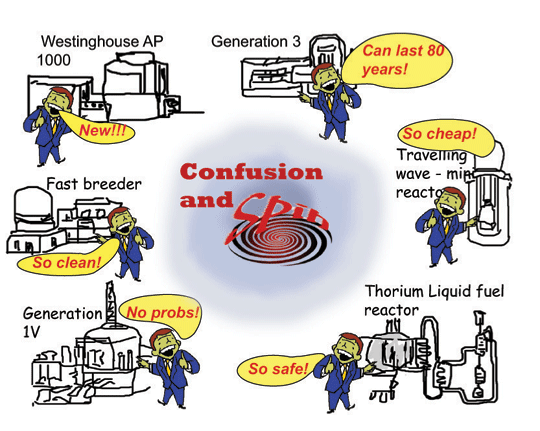
All in all my conclusion is that the case for future Generation IV nuclear reactors is much narrower than the supporters of nuclear energy would have you believe. While they do offer some advantages over LWR’s, notably in the area of safety, this comes with strings attached, notably higher capital costs. This is largely a result of the fact that many of these would need to be built from much more exotic materials, such as high temperature stainless steel alloys Nickel alloys or Refractory materials, while the predominant material of choice in current reactors is steel (stainless and forged ferritic) and concrete. This materials requirement is itself an issue related to the high temperatures these alternative reactors would be required to operate at, not to mention the more aggressive and corrosive environment in some of them, notably the MSR proposals. Of course one to question whether these higher construction costs (and in some cases higher decommissioning costs) are justified……..
Small to medium sized modular reactors do offer a good deal more flexibility in terms of how nuclear power could be used and yet a further improvement in safety. However, they also comes with lower economies of scale and thus higher construction costs and worse a slower rate of reactor roll out (at least in the early days). We could claw back on these two issues by mass producing said reactors in large volumes but as I point out (again see the full article), it is far from proven whether that would be economically viable and whether there is in fact a market for large numbers of small reactors…….
by and large mass production means “dumbing down” our design, and that means accepting a reactor that’s much cheaper and easier to build but has a lower thermal efficiency, a higher rate of fuel consumption and ultimately produces larger volumes of nuclear waste compared to our “mega” reactors. With the exception of a small number of narrow cases, it’s difficult to envisage how this would offer an improvement on the current status quo…..
Fusion?
Finally, I also had a look at Fusion power . his is the great white hope of nuclear energy and it has to be said we are making progress, but it’s a case of slow and steady progress. Indeed I would question whether we are in a position yet to even estimate how long it will take for fusion power to become commercial available…if indeed ever! Recent news from ITER is not positive, its now not due to go online till 2026, which would imply a completion of experiments in 2046. And it will take sometime beyond that before we wind up with a viable working commercial fusion reactor. As I speculate (here), it would likely be the latter half of this century (or the beginning of the next one) before we start to see Fusion play any sort of major role in mass global power generation…… nuclear energy supporters need to overcome their pathological hatred of renewables http://www.green-blog.org/2011/08/11/a-critical-analysis-of-future-nuclear-reactors-designs/
Veil of secrecy over France’s unaffordable nuclear power decommissioning
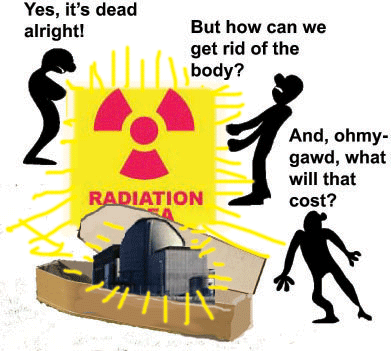 “What is not tolerable is that the funds are managed by the operators”
Over the past six years there has been a veritable veil pulled over this subject.”
 French Nuclear Dismantling Funds May Fall Short, Report Says http://www.bloomberg.com/news/2012-07-24/french-nuclear-dismantling-funds-may-fall-short-report-says.html By Tara Patel – Jul 24, 2012 Electricite de France SA and Areva SA (AREVA), along with other French nuclear operators, may not be setting aside enough funds to pay for future dismantling of reactors and treatment and storage of atomic waste, according to a parliamentary report. Continue reading
1 This Month



26 September – International Day for the Total Elimination of Nuclear Weapons


PLEASE OPPOSE HR 8255 AND S.3639 – bills would accelerate satellite deployment, with no environmental review or safeguards – https://ncstd5li.quorum.us/campaign/169331/
To see nuclear-related stories in greater depth and intensity – go to https://nuclearinformation.wordpress.com
-
Archives
- September 2026 (269)
- August 2026 (330)
- July 2026 (355)
- June 2026 (287)
- May 2026 (306)
- April 2026 (356)
- March 2026 (251)
- February 2026 (267)
- January 2026 (308)
- December 2025 (358)
- November 2025 (359)
- October 2025 (375)
-
Categories
- 1
- 1 NUCLEAR ISSUES
- business and costs
- climate change
- culture and arts
- ENERGY
- environment
- health
- history
- indigenous issues
- Legal
- marketing of nuclear
- media
- opposition to nuclear
- PERSONAL STORIES
- politics
- politics international
- Religion and ethics
- safety
- secrets,lies and civil liberties
- spinbuster
- technology
- Uranium
- wastes
- weapons and war
- Women
- 2 WORLD
- ACTION
- AFRICA
- Atrocities
- AUSTRALIA
- Christina's notes
- Christina's themes
- culture and arts
- Events
- Fuk 2022
- Fuk 2023
- Fukushima 2017
- Fukushima 2018
- fukushima 2019
- Fukushima 2020
- Fukushima 2021
- general
- global warming
- Humour (God we need it)
- Nuclear
- RARE EARTHS
- Reference
- resources – print
- Resources -audiovicual
- Weekly Newsletter
- World
- World Nuclear
- YouTube
-
RSS
Entries RSS
Comments RSS

