Thorium nuclear reactors not all they’re cracked up to be
Thorium: Not ‘green’, not ‘viable’, and not likely
http://www.no2nuclearpower.org.uk/nuclearnews/NuClearNewsNo43.pdf
Journalist, Oliver Tickell, author of the Kyoto2 climate initiative, (1) editor of the Nuclear Pledge website (2) and Green Party candidate for Oxford City Council in three elections, has published a new briefing on Thorium reactors.
A number of commentators have argued that most of the problems associated with nuclear power could be avoided by both, using thorium fuel in place of uranium or plutonium fuels and using ‘molten salt reactors’ (MSRs) in place of conventional solid fuel reactor designs. The combination of these two technologies is known as the Liquid Fluoride Thori um Reactor or LFTR, because the fuel is in form of a molten fluoride salt of thorium and other elements.
The briefing examines the validity of the optimistic claims made for thorium fuel, MSRs and the LFTR in particular, and finds that they do not stand up to critical scrutiny – these technologies have significant drawbacks including: very high costs; marginal benefits for a thorium fuel cycle over uranium; serious nuclear weapons proliferation hazards; the danger of both routine and accidental releases of radiation, mainly from continuous ‘live’ fuel reprocessing in MSRs and the very long lead time for significant deployment of LFTRs of perhaps 50 years – rendering it irrelevant in terms of addressing current or medium term energy supply needs.
The thorium-uranium fuel cycle has some advantages over the dominant uranium-plutonium cycle, in terms for example, of the reduced production of long-lived actinides and somewhat diminished radio -toxicity overall. However, it also creates new hazards of its own. As far as radioactive fission products are concerned, there is little to choose between the two.
Thorium reactors do not produce plutonium. But an LFTR could (by including 238U in the fuel) be adapted to produce plutonium of a high purity well above normal weapons-grade, presenting a major proliferation hazard. Beyond that, the main proliferation hazards arise from the need for fissile material (plutonium or uranium) to initiate the thorium fuel cycle, which could be diverted, and the production of fissile uranium 233U.
LFTRs are theoretically capable of a high fuel burn-up rate, but while this may indeed reduce the volume of waste, the waste is more radioactive due to the higher volume of radioactive fission products. The continuous fuel reprocessing that is characteristic of LFTRs will also produce hazardous chemical and radioactive waste streams, and releases to the environment will be unavoidable. Spent fuel from any LFTR will be intensely radioactive and constitute high level waste. The reactor itself, at the end of its lifetime, will constitute high level waste.
The UK’s National Nuclear Laboratory (NNL) believes that considerable research, development and testing lies ahead before thorium fuels will be ready for operational use. As the NNL states, “Thorium reprocessing and waste management are poorly understood. The thorium fuel cycle cannot be considered to be mature in any area.” It estimates that 10-15 years work is required before thorium fuels will be ready for use in current reactor designs, and that their use in new types of reactor is at least 40 years away. (3)
(1) http://www.kyoto2.org/
(2) http://www.nuclearpledge.com/
(3) Thorium: Not Green, Not Viable and Not Likely, Oliver Tickell, June 2012
http://www.nuclearpledge.com/reports/thorium_briefing_2012.pdf
How President Jimmy Carter slowed down the spread of nuclear weapons
Carter entered office and promptly pushed through Congress the 1978 Non-Proliferation Act
Carter’s U.S. nuclear doctrine was enormously unpopular among America’s nuclear science elite
To the chagrin of the powerful nuclear weapons and nuclear power lobbies, Carter abandoned the idea of a new nuclear renaissance.
Jimmy Carter’s re-election defeat brought the nuclear establishment another opportunity.
United States Circumvented Laws To Help Japan Accumulate Tons of Plutonium, DC Bureau By Joseph Trento, April 9th, 2012 “….Stopping the Spread of Fissile Material After Jimmy Carter won the presidency in 1976, he instituted an aggressive policy to control the spread of fissile materials. As a former nuclear reactor engineer on a Navy submarine, Carter knew better than any other world leader the immense power locked up in plutonium and highly enriched uranium. He was determined to keep it out of the hands of even our closest non-nuclear allies – including Japan.
Carter had good reason for this policy. Despite Japan’s ratification of the NPT in 1976, a study conducted for the CIA the following year named Japan as one of the three countries most able to go nuclear before 1980. Only the Japanese people’s historic opposition to nuclear weapons argued against Japanese deployment. Every other factor argued for a Japanese nuclear capability.
By now the CIA – and its more secretive sister agency, the NSA — had learned the position of Japan’s inner circle.
Carter knew the incredibly volatile effect plutonium would have on world stability. Continue reading
Butterfly studies demonstrate how radiation effects are passed on to later generations
When second generation butterflies with abnormal traits mated with healthy ones, the rate of abnormalities rose to 34 percent in the third generation
It was after breeding them, they noticed various abnormalities that hadn’t been seen in the previous generation, such as malformed antennae.

 Radiation from Fukushima power plant meltdown ‘triggers genetic mutations in butterflies’
Abnormal wings and antennae found in Japan’s insects Genetic damage ‘can be passed down generations’ Defect rate as high as 52 per cent in some offspring
DAILY MAIL, 14 August 2012 Butterflies in Japan are suffering from ‘serious abnormality’ following the radioactive fallout after the Fukushima nuclear disaster. Continue reading
Danger of poor oversight of rare earths mining in Greenland
 Will Mining For Rare Earth Metals Destroy Greenland? http://www.fastcoexist.com/1680333/will-mining-for-rare-earth-metals-destroy-greenland 12 Aug 12, To stop China’s stranglehold on the minerals necessary for our digital economy, mining companies are looking to the icy expanse of Greenland. But with no regulation, no light, and no oversight, what will those mines do to this pristine Arctic landscape? Continue reading
Radiation danger in dental X rays – shown to raise risk of meningiomas
 Dental X-Rays Linked To Meningiomas http://www.southasiamail.com/news.php?id=106219 13 Aug 12, – W. Gifford-Jones M.D. What should you do the next time the dentist tells you he or she is going to take full dental X-rays? A new study shows that just as porcupines make love very, very carefully you should also take care to limit the amount of radiation exposure during your lifetime, particularly the amount your children receive.
Dr. Elizabeth Claus of Yale University reports in the American Cancer Society Journal “Cancer”, that there’s a link between dental x-rays and the risk of developing a brain tumour called a meningioma. Continue reading
Research on butterflies shows the genetic effects of low level radiation
experimental demonstration of genetic mutations in the germ-line cells that are inherited by the offspring of radiation-exposed parents has been scarce, although the germ-line damage was shown in barn swallows
We address these important issues in connection with the recent Fukushima Dai-ich NPP accident. We use the pale grass blue butterfly Zizeeria maha (Lepidoptera, Lycaenidae) as an indicator species to evaluate the environmental conditions.
We conclude that artificial radionuclides from the Fukushima Nuclear Power Plant caused physiological and genetic damage to this species.
The biological impacts of the Fukushima nuclear accident on the pale
grass blue butterfly – Nature science journal. 9 Aug 12,Primary source. “……Prompt and reliable evaluation of the biological influences of the artificial radionuclides from the Fukushima Dai-ichi NPP is lacking, and only a few studies have been performed to date 9, 10. In the case of the Chernobyl accident, changes in species composition and phenotypic aberration in animals11, 12, 13, 14, 15, 16, 17 and an increase in the incidence of thyroid and lymph cancers in humans18 have been reported. Continue reading
Radiation effects on birds – Fukushima compared to Chernobyl
University of South Carolina, Prof Tim Mousseau et al, genetic survey of small wildlife, Fukushima. http://www.sciencedirect.com/science/article/pii/S0269749112000255 “……. Abundance of birds was negatively related to radiation in Chernobyl and Fukushima. ► Effects of radiation on abundance differed between Chernobyl and Fukushima and among species. ► For 14 species common to the two areas the effects of radiation on abundance were stronger in Fukushima than in Chernobyl.…..
Low-level radiation in Fukushima Prefecture appears to have had immediate effects on bird populations, and to a greater degree than was expected from a related analysis of Chernobyl, an international team of scientists reported Feb. 8 in Environmental Pollution. Continue reading
Art and science of radiation induced mutations in small animals
 Cornelia Hesse-Honegger. Genetic damage small wild life due to “normally venting” reactors. http://www.wissenskunst.ch/en/biographie.htm have a look at the illustrations. quote: Biography Cornelia Hesse-Honegger,scientific illustrator and science artist, was born in 1944 in Zurich, Switzerland. For 25 years she worked as a scientific illustrator for the scientific department of the Natural History Museum at the University of Zurich. Since 1969 she has collected and painted leaf bugs, Heteroptera. Her watercolors are exhibited internationally at museums and galleries. Her work is an interface between art and science; it plays witness to a beautiful but endangered nature.
Since the catastrophe of Chernobyl in 1986, she has collected, studied and painted morphologically disturbed insects, which she finds in the fallout areas of Chernobyl as well as near nuclear installations. As a result of her studies, she is convinced that in
Picture:
Eyes of the Drosophila Mutant ey.opt.
Black painted eyes with different shapes and part of wings growing out of the eyes.
Watercolor, 1987 end quote
http://trendland.net/cornelia-hesse-honegger-morphologically-disturbed-insects/#
Cornelia Hesse-Honegger : Morphologically Disturbed Insects
http://www.designfederation.net/illustration/the-bugs-of-cornelia-hesse-honegger/
www.mendel-museum.com/eng/1online/popart/bio/c.pdf
Secret Cold War Nuclear Policies – USA and Japan
Declassified U.S. government documents make a mockery of the Three Non-Nuclear Principles. The papers reveal that Japanese government officials ignored evidence that the United States was routinely bringing nuclear weapons into Japanese ports.


 United States Circumvented Laws To Help Japan Accumulate Tons of Plutonium, DC Burea By Joseph Trento, April 9th, 2012 “….. In October 1964, communist China stunned the world by detonating its first nuclear bomb. The world was caught by surprise, but nowhere were emotions as strong as in Japan. Three months later Japanese Prime Minister Eisaku Sato went to Washington for secret talks with President Lyndon Johnson. Sato gave LBJ an extraordinary ultimatum: if the United States did not guarantee Japan’s security against nuclear attack, Japan would develop a nuclear arsenal. The ultimatum forced LBJ to extend the U.S. “nuclear umbrella” over Japan. Ironically, this guarantee later enabled Sato to establish Japan’s Three Non-Nuclear Principles: to never own or produce nuclear weapons or allow them on Japanese territory. The policy won Sato the Nobel Prize for Peace. The Japanese public and the rest of the world never knew that these three principles were never fully enforced, and Sato allowed the secret nuclear weapons program to go on. Continue reading
The very dodgy plans for Small Modular Nuclear Reactors (SMRs)
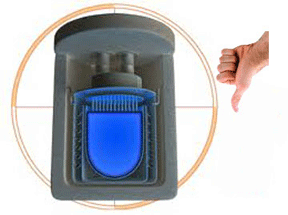 As SMRs are being promoted for overseas markets, SRS officials will not say what plans are for used reactor vessels or highly radioactive spent fuel which would be taken back to the production site.
“If SRS would become a nuclear waste dumping site due to involvement in SMR programs, this is something that the public in the Aiken area and in South Carolina will soundly reject,”
Documents Reveal Time-line and Plans for “Small Modular Reactors” (SMRs) at the Savannah River Site (SRS) Unrealistic and Promise no Funding http://aikenleader.villagesoup.com/blog/blog/documents-reveal-time-line-and-plans-for-small-modular-reactors-smrs-at-the-savannah-river-site-sr/840884 By Thomas Clements | Jun 19, 2012 One SMR Design being Eyed at SRS for Use of Plutonium Fuel (MOX) and Production of Tritium Gas Used in Nuclear Weapons
Documents obtained under the Freedom of Information Act (FOIA) by the Alliance for Nuclear Accountability (ANA) in Columbia, South Carolina reveal unrealistic plans for pursuit of “small modular reactors” (SMR) at the Department of Energy’s Savannah River Site, located near Aiken, South Carolina. Continue reading
Effects of ionising radiation on the brain and other organs
Neuropsychiatric effects of incorporated radionuclides http://fukushimavoice-eng.blogspot.com.au/2012/08/neuropsychiatric-effects-of.html?spref=tw
http://www.physiciansofchernobyl.org.ua/eng/books/Niagu/pdfs/Chapter6Rev.pdf
Neuropsychiatric Effects of Ionizing Radiation
Chapter 6 Neuropsychiatric Effects of Chronic Irradiation Continue reading
Murky history of Japan’s fast breeder nuclear reactor program
 United States Circumvented Laws To Help Japan Accumulate Tons of Plutonium, DC Bureau By Joseph Trento, on April 9th, 2012“…….From the very start, the Japanese breeder program was predicated on the belief that Japanese industry could do what the Americans and Europeans had failed to do – run the extremely complicated breeder cycle safely and profitably. That belief was rooted in Japan’s national self-confidence, nurtured by two generations of success in manufacturing. Japan’s dedicated and educated workforce and its special brand of quality management made it the world leader in a host of industries. Nuclear power generation would, it was believed, merely be one more success, made possible by Japan’s superior workers and management.
Thirty years ago even Japan’s harshest critics might have agreed that perhaps it could succeed where Western efforts had failed. But that optimism soon faded as a string of nuclear catastrophes demonstrated that nuclear industries are far different than any other. Both the Monju fast-breeder reactor in 1995 and the Tokai reprocessing plant in April 1997 suffered serious, accidental radiation leaks; both accidents were the subjects of attempted cover-ups. Most egregious was the fire and leak of radioactive sodium at the Monju FBR. Japan’s Power Reactor and Nuclear Fuel Development Corporation (PNC), the government corporation that operated Monju, lied repeatedly to the public about the accident. PNC attempted to suppress video footage that showed the cause of the accident: a ruptured pipe in a secondary cooling system that had spilled an estimated two to three tons of radioactive sodium – the largest such leak in the history of fast-breeder technology. One of the reasons PNC gave for releasing the misinformation was that Monju was too important to Japan’s energy program to jeopardize the reactor’s operation. In other words, the public’s safety was secondary to the breeder program.
Had it not been for a courageous act by a group of Fukui prefecture officials in the early morning of December 11, PNC’s attempted cover-up probably would have succeeded. Suspecting a cover-up, the officials entered the plant and secured the videotape. The action came as a direct result of a previous accident at Fukui’s Tsuruga Unit I reactor in the early 1980s. Fukui prefecture officials were not permitted to investigate that mishap. When the Monju accident took place, the officials were determined not to be turned away a second time. Following revelations that the agency itself had been involved in trying to withhold the video, a PNC executive committed suicide……. http://www.dcbureau.org/201204097128/national-se
Renewable energy – matching electricity supplies to demands
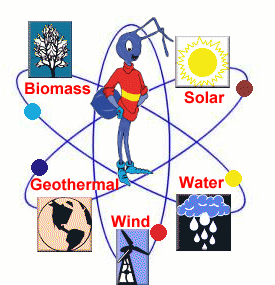 MATCHING SUPPLIES OF ELECTRICITY TO VARIABLE DEMANDS FOR ELECTRICITY, DESERTEC UK, 9 Aug 12 It is sometimes suggested that renewable sources of electricity cannot provide more than about 20% of our electricity supplies because they are intermittent or variable. But all sources of electricity are intermittent because they need to be taken out of service for scheduled maintenance and because, like any kind of equipment, they are liable to unscheduled breakdowns. With all sources of power, load factors are normally well short of 100%.
The variability of sources such as wind power is much less of an issue than is sometimes suggested, as described in Managing Variability (PDF, 402 KB, a report by independent consultant David Milborrow commissioned by Greenpeace, WWF, RSPB, Friends of the Earth, July 2009).
Not only are all sources of electricity intermittent, and many of them are variable, but the demand for electricity is variable too—and there can be quite large changes from one minute to the next. The often-quoted example is how there can be a sharp peak in demand for electricity when there is a commercial break in a popular TV programme and many people go and put the kettle on to make a cup of tea.
There is a range of techniques available for matching supplies with constantly varying demands. When electricity supply systems are properly engineered, they should be able to accommodate sources of electricity that are 100% renewable.
Any or all of the following techniques may be used:
Large-scale ‘HVDC’ transmission grids. In an area like Europe, there are several potential benefits from building a ‘supergrid’ of highly-efficient HVDC transmission lines to link existing HVAC transmission grids (see electricity transmission grids). One of the most important benefits is that this kind of large-scale grid can make it much easier to match variable supplies with variable demands. For example, the wind may stop blowing in any one spot but it almost never stops blowing everywhere across a wide area like Europe. If there is a peak in demand in any one area, it can almost always be met from spare capacity in one or more other areas. Large-scale storage facilities, such as pumped-storage systems in Norway and the Alps, may be widely shared. Submarine HVDC transmission lines that have been laid between Norway and Denmark and between Norway and the Netherlands enable both pairs of countries to benefit in this way.- Complementary sources of power……
- Power on demand. … . http://www.desertec-uk.org.uk/elec_eng/supply_demand.html
Discrimination, mental health issues, among Fukushima’s brave clean-up workers
Doctors: Japan Nuclear Plant Workers Face Stigma By MALCOLM FOSTER Associated Press abc News, TOKYO August 5, 2012 (AP) A growing number of Japanese workers who are risking their health to shut down the crippled Fukushima Dai-ichi nuclear power plant are suffering from depression, anxiety about the future and a loss of motivation, say two doctors who visit them regularly.
But their psychological problems are driven less by fears about developing cancer from radiation exposure and more by something immediate and personal: Discrimination from the very community they tried to protect, says Jun Shigemura, who heads a volunteer team of about ten psychiatrists and psychologists from the National Defense Medical College who meet with Tokyo Electric Power Co. nuclear plant employees. Continue reading
Nuclear power plants can’t cope with increasingly hot summers
 simply getting permission to suck in hotter water does not make the problem go away..
despite a myriad of potential problems and two decades of climate warnings, it is sobering to note that none of the US reactors were built to account for any of this
[The new reactors] they are still PWRs and they still require a large reserve of cool, circulating water to keep them operating and nominally safe.
 For Nuclear Power This Summer, It’s Too Darn Hot, Truth Out, 05 August 2012 By Gregg Levine, You know that expression, “Hotter than July?” Well, this July, July was hotter than July. Depending on what part of the country you live in, it was upwards of three degrees hotter this July than the 20th Century average. Chicago, Denver, Detroit, Indianapolis and St. Louis are each “on a pace to shatter their all-time monthly heat records.” And “when the thermometer goes way up and the weather is sizzling hot,” as the Cole Porter song goes, demand for electricity goes way up, too….. Take, for example, Braidwood, the nuclear facility that supplies much of Chicago with electricity: Continue reading
1 This Month



26 September – International Day for the Total Elimination of Nuclear Weapons


PLEASE OPPOSE HR 8255 AND S.3639 – bills would accelerate satellite deployment, with no environmental review or safeguards – https://ncstd5li.quorum.us/campaign/169331/
To see nuclear-related stories in greater depth and intensity – go to https://nuclearinformation.wordpress.com
-
Archives
- September 2026 (269)
- August 2026 (330)
- July 2026 (355)
- June 2026 (287)
- May 2026 (306)
- April 2026 (356)
- March 2026 (251)
- February 2026 (267)
- January 2026 (308)
- December 2025 (358)
- November 2025 (359)
- October 2025 (375)
-
Categories
- 1
- 1 NUCLEAR ISSUES
- business and costs
- climate change
- culture and arts
- ENERGY
- environment
- health
- history
- indigenous issues
- Legal
- marketing of nuclear
- media
- opposition to nuclear
- PERSONAL STORIES
- politics
- politics international
- Religion and ethics
- safety
- secrets,lies and civil liberties
- spinbuster
- technology
- Uranium
- wastes
- weapons and war
- Women
- 2 WORLD
- ACTION
- AFRICA
- Atrocities
- AUSTRALIA
- Christina's notes
- Christina's themes
- culture and arts
- Events
- Fuk 2022
- Fuk 2023
- Fukushima 2017
- Fukushima 2018
- fukushima 2019
- Fukushima 2020
- Fukushima 2021
- general
- global warming
- Humour (God we need it)
- Nuclear
- RARE EARTHS
- Reference
- resources – print
- Resources -audiovicual
- Weekly Newsletter
- World
- World Nuclear
- YouTube
-
RSS
Entries RSS
Comments RSS

