Radiation effects on birds – Fukushima compared to Chernobyl
University of South Carolina, Prof Tim Mousseau et al, genetic survey of small wildlife, Fukushima. http://www.sciencedirect.com/science/article/pii/S0269749112000255 “……. Abundance of birds was negatively related to radiation in Chernobyl and Fukushima. ► Effects of radiation on abundance differed between Chernobyl and Fukushima and among species. ► For 14 species common to the two areas the effects of radiation on abundance were stronger in Fukushima than in Chernobyl.…..
Low-level radiation in Fukushima Prefecture appears to have had immediate effects on bird populations, and to a greater degree than was expected from a related analysis of Chernobyl, an international team of scientists reported Feb. 8 in Environmental Pollution. Continue reading
Art and science of radiation induced mutations in small animals
 Cornelia Hesse-Honegger. Genetic damage small wild life due to “normally venting” reactors. http://www.wissenskunst.ch/en/biographie.htm have a look at the illustrations. quote: Biography Cornelia Hesse-Honegger,scientific illustrator and science artist, was born in 1944 in Zurich, Switzerland. For 25 years she worked as a scientific illustrator for the scientific department of the Natural History Museum at the University of Zurich. Since 1969 she has collected and painted leaf bugs, Heteroptera. Her watercolors are exhibited internationally at museums and galleries. Her work is an interface between art and science; it plays witness to a beautiful but endangered nature.
Since the catastrophe of Chernobyl in 1986, she has collected, studied and painted morphologically disturbed insects, which she finds in the fallout areas of Chernobyl as well as near nuclear installations. As a result of her studies, she is convinced that in
Picture:
Eyes of the Drosophila Mutant ey.opt.
Black painted eyes with different shapes and part of wings growing out of the eyes.
Watercolor, 1987 end quote
http://trendland.net/cornelia-hesse-honegger-morphologically-disturbed-insects/#
Cornelia Hesse-Honegger : Morphologically Disturbed Insects
http://www.designfederation.net/illustration/the-bugs-of-cornelia-hesse-honegger/
www.mendel-museum.com/eng/1online/popart/bio/c.pdf
Secret Cold War Nuclear Policies – USA and Japan
Declassified U.S. government documents make a mockery of the Three Non-Nuclear Principles. The papers reveal that Japanese government officials ignored evidence that the United States was routinely bringing nuclear weapons into Japanese ports.


 United States Circumvented Laws To Help Japan Accumulate Tons of Plutonium, DC Burea By Joseph Trento, April 9th, 2012 “….. In October 1964, communist China stunned the world by detonating its first nuclear bomb. The world was caught by surprise, but nowhere were emotions as strong as in Japan. Three months later Japanese Prime Minister Eisaku Sato went to Washington for secret talks with President Lyndon Johnson. Sato gave LBJ an extraordinary ultimatum: if the United States did not guarantee Japan’s security against nuclear attack, Japan would develop a nuclear arsenal. The ultimatum forced LBJ to extend the U.S. “nuclear umbrella” over Japan. Ironically, this guarantee later enabled Sato to establish Japan’s Three Non-Nuclear Principles: to never own or produce nuclear weapons or allow them on Japanese territory. The policy won Sato the Nobel Prize for Peace. The Japanese public and the rest of the world never knew that these three principles were never fully enforced, and Sato allowed the secret nuclear weapons program to go on. Continue reading
The very dodgy plans for Small Modular Nuclear Reactors (SMRs)
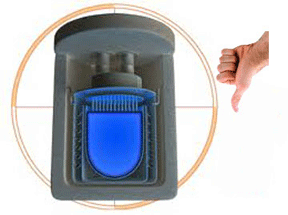 As SMRs are being promoted for overseas markets, SRS officials will not say what plans are for used reactor vessels or highly radioactive spent fuel which would be taken back to the production site.
“If SRS would become a nuclear waste dumping site due to involvement in SMR programs, this is something that the public in the Aiken area and in South Carolina will soundly reject,”
Documents Reveal Time-line and Plans for “Small Modular Reactors” (SMRs) at the Savannah River Site (SRS) Unrealistic and Promise no Funding http://aikenleader.villagesoup.com/blog/blog/documents-reveal-time-line-and-plans-for-small-modular-reactors-smrs-at-the-savannah-river-site-sr/840884 By Thomas Clements | Jun 19, 2012 One SMR Design being Eyed at SRS for Use of Plutonium Fuel (MOX) and Production of Tritium Gas Used in Nuclear Weapons
Documents obtained under the Freedom of Information Act (FOIA) by the Alliance for Nuclear Accountability (ANA) in Columbia, South Carolina reveal unrealistic plans for pursuit of “small modular reactors” (SMR) at the Department of Energy’s Savannah River Site, located near Aiken, South Carolina. Continue reading
Effects of ionising radiation on the brain and other organs
 Neuropsychiatric effects of incorporated radionuclides http://fukushimavoice-eng.blogspot.com.au/2012/08/neuropsychiatric-effects-of.html?spref=tw
http://www.physiciansofchernobyl.org.ua/eng/books/Niagu/pdfs/Chapter6Rev.pdf
Neuropsychiatric Effects of Ionizing Radiation
Chapter 6 Neuropsychiatric Effects of Chronic Irradiation Continue reading
Murky history of Japan’s fast breeder nuclear reactor program
 United States Circumvented Laws To Help Japan Accumulate Tons of Plutonium, DC Bureau By Joseph Trento, on April 9th, 2012“…….From the very start, the Japanese breeder program was predicated on the belief that Japanese industry could do what the Americans and Europeans had failed to do – run the extremely complicated breeder cycle safely and profitably. That belief was rooted in Japan’s national self-confidence, nurtured by two generations of success in manufacturing. Japan’s dedicated and educated workforce and its special brand of quality management made it the world leader in a host of industries. Nuclear power generation would, it was believed, merely be one more success, made possible by Japan’s superior workers and management.
Thirty years ago even Japan’s harshest critics might have agreed that perhaps it could succeed where Western efforts had failed. But that optimism soon faded as a string of nuclear catastrophes demonstrated that nuclear industries are far different than any other. Both the Monju fast-breeder reactor in 1995 and the Tokai reprocessing plant in April 1997 suffered serious, accidental radiation leaks; both accidents were the subjects of attempted cover-ups. Most egregious was the fire and leak of radioactive sodium at the Monju FBR. Japan’s Power Reactor and Nuclear Fuel Development Corporation (PNC), the government corporation that operated Monju, lied repeatedly to the public about the accident. PNC attempted to suppress video footage that showed the cause of the accident: a ruptured pipe in a secondary cooling system that had spilled an estimated two to three tons of radioactive sodium – the largest such leak in the history of fast-breeder technology. One of the reasons PNC gave for releasing the misinformation was that Monju was too important to Japan’s energy program to jeopardize the reactor’s operation. In other words, the public’s safety was secondary to the breeder program.
Had it not been for a courageous act by a group of Fukui prefecture officials in the early morning of December 11, PNC’s attempted cover-up probably would have succeeded. Suspecting a cover-up, the officials entered the plant and secured the videotape. The action came as a direct result of a previous accident at Fukui’s Tsuruga Unit I reactor in the early 1980s. Fukui prefecture officials were not permitted to investigate that mishap. When the Monju accident took place, the officials were determined not to be turned away a second time. Following revelations that the agency itself had been involved in trying to withhold the video, a PNC executive committed suicide……. http://www.dcbureau.org/201204097128/national-se
Renewable energy – matching electricity supplies to demands
 MATCHING SUPPLIES OF ELECTRICITY TO VARIABLE DEMANDS FOR ELECTRICITY, DESERTEC UK, 9 Aug 12 It is sometimes suggested that renewable sources of electricity cannot provide more than about 20% of our electricity supplies because they are intermittent or variable. But all sources of electricity are intermittent because they need to be taken out of service for scheduled maintenance and because, like any kind of equipment, they are liable to unscheduled breakdowns. With all sources of power, load factors are normally well short of 100%.
The variability of sources such as wind power is much less of an issue than is sometimes suggested, as described in Managing Variability (PDF, 402 KB, a report by independent consultant David Milborrow commissioned by Greenpeace, WWF, RSPB, Friends of the Earth, July 2009).
Not only are all sources of electricity intermittent, and many of them are variable, but the demand for electricity is variable too—and there can be quite large changes from one minute to the next. The often-quoted example is how there can be a sharp peak in demand for electricity when there is a commercial break in a popular TV programme and many people go and put the kettle on to make a cup of tea.
There is a range of techniques available for matching supplies with constantly varying demands. When electricity supply systems are properly engineered, they should be able to accommodate sources of electricity that are 100% renewable.
Any or all of the following techniques may be used:
Large-scale ‘HVDC’ transmission grids. In an area like Europe, there are several potential benefits from building a ‘supergrid’ of highly-efficient HVDC transmission lines to link existing HVAC transmission grids (see electricity transmission grids). One of the most important benefits is that this kind of large-scale grid can make it much easier to match variable supplies with variable demands. For example, the wind may stop blowing in any one spot but it almost never stops blowing everywhere across a wide area like Europe. If there is a peak in demand in any one area, it can almost always be met from spare capacity in one or more other areas. Large-scale storage facilities, such as pumped-storage systems in Norway and the Alps, may be widely shared. Submarine HVDC transmission lines that have been laid between Norway and Denmark and between Norway and the Netherlands enable both pairs of countries to benefit in this way.- Complementary sources of power……
- Power on demand. … . http://www.desertec-uk.org.uk/elec_eng/supply_demand.html
Discrimination, mental health issues, among Fukushima’s brave clean-up workers
 Doctors: Japan Nuclear Plant Workers Face Stigma By MALCOLM FOSTER Associated Press abc News, TOKYO August 5, 2012 (AP) A growing number of Japanese workers who are risking their health to shut down the crippled Fukushima Dai-ichi nuclear power plant are suffering from depression, anxiety about the future and a loss of motivation, say two doctors who visit them regularly.
But their psychological problems are driven less by fears about developing cancer from radiation exposure and more by something immediate and personal: Discrimination from the very community they tried to protect, says Jun Shigemura, who heads a volunteer team of about ten psychiatrists and psychologists from the National Defense Medical College who meet with Tokyo Electric Power Co. nuclear plant employees. Continue reading
Nuclear power plants can’t cope with increasingly hot summers
 simply getting permission to suck in hotter water does not make the problem go away..
despite a myriad of potential problems and two decades of climate warnings, it is sobering to note that none of the US reactors were built to account for any of this
[The new reactors] they are still PWRs and they still require a large reserve of cool, circulating water to keep them operating and nominally safe.
 For Nuclear Power This Summer, It’s Too Darn Hot, Truth Out, 05 August 2012 By Gregg Levine, You know that expression, “Hotter than July?” Well, this July, July was hotter than July. Depending on what part of the country you live in, it was upwards of three degrees hotter this July than the 20th Century average. Chicago, Denver, Detroit, Indianapolis and St. Louis are each “on a pace to shatter their all-time monthly heat records.” And “when the thermometer goes way up and the weather is sizzling hot,” as the Cole Porter song goes, demand for electricity goes way up, too….. Take, for example, Braidwood, the nuclear facility that supplies much of Chicago with electricity: Continue reading
Heat danger, even when nuclear reactors are shut down
For Nuclear Power This Summer, It’s Too Darn Hot, Truth Out, 05 August 2012 By Gregg Levine, ”……when it comes to nuclear power, as global temperatures continue to rise and water levels in rivers and lakes continue to drop, an even more disconcerting threat emerges.
When a coal plant is forced to shut down because of a lack of cool intake water, it can, in short order, basically get turned off. With no coal burning, the cooling needs of the facility quickly downgrade to zero.
A nuclear reactor, however, is never really “off.”
When a boiling water reactor or pressurized water reactor (BWR and PWR respectively, the two types that make up the total of the US commercial reactor fleet) is “shutdown” (be it in an orderly fashion or an abrupt “scram”), control rods are inserted amongst the fuel rods inside the reactor. The control rods absorb free neutrons, decreasing the number of heavy atoms getting hit and split in the fuel rods. It is that split, that fission, that provides the energy that heats the water in the reactor and produces the steam that drives the electricity-generating turbines. Generally, the more collisions, the more heat generated. An increase in heat means more steam to spin a turbine; fewer reactions means less heat, less steam and less electrical output. But it doesn’t mean no heat.
The water that drives the turbines also cools the fuel rods. It needs to circulate and somehow get cooled down when it is away from the reactor core. Even with control rods inserted, there are still reactions generating heat, and that heat needs to be extracted from the reactor or all kinds of trouble ensues–from too-high pressure breaching containment to melting the cladding on fuel rods, fires, and hydrogen explosions. This is why the term LOCA–a loss of coolant accident–is a scary one to nuclear watchdogs (and, theoretically, to nuclear regulators, too).
So, even when they are not producing electricity, nuclear reactors still need cooling. They still need a power source to make that cooling happen, and they still need a coolant, which, all across the United States and most of the rest of the world, means water. http://truth-out.org/news/item/10707-for-nuclear-power-this-summer-its-too-darn-hot
IAEA’s conflict of interest in advising about radiation and health
 In fact, researchers have been surprised to find that genetic damage, and above all perigenetic damage, which is responsible for genomic instability, to descendants is far worse than to parents; and this risk increases from one generation to the next.
After a year, [for Fukushima’s children] the damage caused by the mixture of internal and external radiation to children should be measured, by comparison with data from before 2011 in the same areas, or by comparing data with communities further away, that were spared the radioactive fallout. Birthweight, incidence of stillbirth, perinatal mortality up to 28 days, birth deformities (heart problems should be investigated later), and among the genetic diseases, Down’s syndrome, should all be studied.
In order to achieve its objectives, the IAEA cannot admit that these serious and common illnesses were caused by ionising radiation, because once known, it would prevent the development of the nuclear industry throughout the world.
The IAEA is therefore a poor source of advice for national health authorities
Fukushima, Precious Time Has Been Lost http://readersupportednews.org/opinion2/303-211/12736-fukushima-precious-time-has-been-lost RSN, By Dr. Michel Fernex, The Fukushima Collective Evacuation Trial 02 August 12
It is a privilege to be able to lend personal support to the Fukushima Evacuate Children Lawsuit. There is no better measure of the moral health of a society than how it treats the most vulnerable people within it, and none or more vulnerable, or more precious, than
children who are the victims of unconscionable actions. For Japan, and for all of us, this is a test that we must not fail. (Noam Chomsky 12 Jan. 2012)
What should WHO have done after Chernobyl?” asked Dr Nabarro in 2002 when he was Acting Director-General of the World Health Organization. I replied immediately, and then confirmed it in writing: “Convene a Scientific Working Group on Ionising Radiation and Genetics” like the one in 1956, and add the words “and Genomic Instability”. Continue reading
Genetic damage from ionising radiation
 Researchers have been surprised to find that genetic damage, and above all perigenetic damage, which is responsible for genomic instability, to descendants is far worse than to parents; and this risk increases from one generation to the next.
In equal doses, external radiation is ten to a hundred times less damaging than chronic internal radiation, which essentially results from the oral absorption of radionuclides. These concentrate in organs like the thymus, the endocrine glands, the spleen, the bone surfaces and the heart.
Genetic mutations from radiation exposure are up to 100 times higher than anything we have encountered in the animal kingdom -Dr. Fernex, Former WHO Consultant http://enenews.com/genetic-mutations-from-radiation-exposure-are-up-to-100-times-higher-than-anything-we-have-encountered-in-the-animal-kingdom-dr-fernex-former-who-consultant July 31st, 2012 By ENENews : Fukushima: precious time has been lost
Author: Michel Fernex Date: June 7, 2012 Dr. Michel Fernex Emeritus Professor, Basel Faculty of Medecine Former Consultant, World Health Organization
“What should WHO have done after Chernobyl ?” asked Dr Nabarro in 2002 when he was Acting Director-General of the World Health Organization. I replied immediately, and then confirmed it in writing: “Convene a Scientific Working Group on Ionising Radiation and Genetics” like the one in 1956, and add the words “and Genomic Instability”…..
Since 1959, an agreement signed between WHO and the International Atomic Energy Agency, and then a number of additional legal texts, prohibit WHO from intervening in nuclear accidents….. Continue reading
$73 billion for fixing and restarting San Onofre nuclear plant
 Ailing California Nuclear Plant Has $48 Million Repair Bill
http://sacramento.cbslocal.com/2012/07/31/ailing-california-nuclear-plant-has-48-million-repair-bill/ July 31, 2012 LOS ANGELES (AP) — The operator of the ailing San Onofre nuclear power plant in California says the company has been saddled with $48 million in inspection and repair costs related to damage to tubes that carry radioactive water.
Financial records released Tuesday by Edison International — the parent company of Southern California Edison — also estimate that it will cost $25 million to begin to restart the Unit 2 reactor at reduced power.
The company has not submitted a request to federal regulators to restart either of the twin reactors that have been shut down since January. The figures were included in a report on Edison’s operations betweenApril and June.
The plant is located between Los Angeles and San Diego.
a SILEX facility could make it much easier for a rogue state to clandestinely enrich weapons grade uranium to create nuclear bombs
SILEX could become America’s proliferation Fukushima,
Controversial nuclear technology alarms watchdogs http://www.smartplanet.com/blog/intelligent-energy/controversial-nuclear-technology-alarms-watchdogs/18138 By David Worthington | July 30, 2012 A controversial nuclear technology is raising alarms bells among critics who claim it may be better suited for making nuclear weapons than lowering the cost of nuclear power and could lead to a nonproliferation “Fukushima” for the United States. Continue reading
Oak Ridge Y-12 Indicted for War Crimes
 Statement from Transform Plowshares about Y-12 nuclear weapons facility. 29 July 12 Courtesy: disarmnowplowshares.wordpress.com
Oak Ridge Y-12 Indicted for War Crimes“Today, through our nonviolent action, we—Transform Now Plowshares—indict the U.S. government nuclear modernization program,
including the new Uranium Processing Facility planned at Oak Ridge and the dedication of billions of public dollars to the continuation of the Y-12 facility.
WHEREAS, This program is an ongoing criminal endeavor in violation of international treaty law binding on the United States under the supremacy clause of the U.S. Constitution (Article VI): Continue reading
1 This Month

4 May -West Suburban Peace Coalition to discuss Iran war at May Educational Forum
Monday, May 4, 7:00 – 8:00 PM Central Standard Time
Title: : How Trump’s Narrative Tries to Shape the Reality of the War on Iran.
Contact Walt Zlotow, zlotow@hotmail.com 630 442 3045 for further information
14 May – online event From Bombs to Data Centres: the Face of Nuclear Colonialism
To see nuclear-related stories in greater depth and intensity – go to https://nuclearinformation.wordpress.com
-
Archives
- May 2026 (37)
- April 2026 (356)
- March 2026 (251)
- February 2026 (268)
- January 2026 (308)
- December 2025 (358)
- November 2025 (359)
- October 2025 (376)
- September 2025 (257)
- August 2025 (319)
- July 2025 (230)
- June 2025 (348)
-
Categories
- 1
- 1 NUCLEAR ISSUES
- business and costs
- climate change
- culture and arts
- ENERGY
- environment
- health
- history
- indigenous issues
- Legal
- marketing of nuclear
- media
- opposition to nuclear
- PERSONAL STORIES
- politics
- politics international
- Religion and ethics
- safety
- secrets,lies and civil liberties
- spinbuster
- technology
- Uranium
- wastes
- weapons and war
- Women
- 2 WORLD
- ACTION
- AFRICA
- Atrocities
- AUSTRALIA
- Christina's notes
- Christina's themes
- culture and arts
- Events
- Fuk 2022
- Fuk 2023
- Fukushima 2017
- Fukushima 2018
- fukushima 2019
- Fukushima 2020
- Fukushima 2021
- general
- global warming
- Humour (God we need it)
- Nuclear
- RARE EARTHS
- Reference
- resources – print
- Resources -audiovicual
- Weekly Newsletter
- World
- World Nuclear
- YouTube
-
RSS
Entries RSS
Comments RSS
 nuclear-news