USA public waking up to the dangers of MOX nuclear fuel reprocessing
 MOX or not? Gov’t likes weapons fuel, public doesn’t Equities.com, By Eric Fleischauer, The Decatur Daily, Ala.
  McClatchy-Tribune Information Services Sept. 14--The Energy Department believes it is safe to use weapons-grade fuel at Browns Ferry Nuclear Plant, but not many residents attending a public hearing Thursday agreed.
“They don’t need to have it here,” said Sara Crossfield of Athens, who has a farm near the Limestone County plant. “TVA’s charter requires them to protect us.”
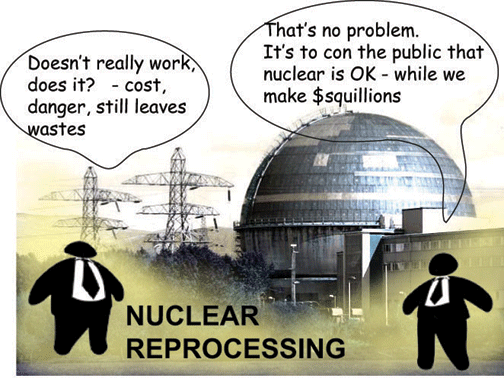
U.S. treaties with Russia require the disposal of 50 tons of surplus plutonium. The treaties authorize disposal by recycling the weapons-grade plutonium into mixed-oxide fuel, or MOX, for use in nuclear reactors. MOX is a mixture of plutonium and low-enriched
uranium.
The purpose of Thursday’s public hearing was to receive comments on a draft document describing the environmental impact of using MOX. About 60 people attended.
While MOX is the Energy Department’s preferred alternative for most of the surplus plutonium, the Tennessee Valley Authority said it has no preference. Sachiko McAlhany, document manager for the U.S. Department of Energy, presented a summary of the environmental impact statement. She said the department concluded using MOX “does not appreciably change” the risk posed by conventional uranium fuel.
Neither McAlhany nor a TVA representative, Mick Mastilovic, answered questions at the hearing. The comments from the public will be incorporated into the final environmental impact statement, scheduled for a spring 2013 release.
The plutonium would be reprocessed into MOX at a $6 billion plant in South Carolina, operated by France-based AREVA. It would then have to be transported to Browns Ferry.
Many of the concerns expressed by those attending the hearing involved the cost of creating MOX and the risks involved in transport.
Concerns specific to Browns Ferry focused on the impact of the fuel — which burns at slightly higher temperatures than conventional fuel — on the reactors and the possibility that Browns Ferry would become a terrorist target. Continue reading
Russia’s nuclear waste storage ship

 Nuclear waste storage ship Lepse leaves Murmansk for decomissioning, Kola Peninsula, Russia http://www.youtube.com/watch?v=guPem_guPUk
Nuclear waste storage ship Lepse leaves Murmansk for decomissioning, Kola Peninsula, Russia Sep 14, 2012 by bellonafoundation
The Lepse, which in its heyday had been used as a support vessel for Russia’s nuclear icebreaker fleet, has been bobbing at dockside at the Atomflot port four kilometers north of Murmansk’s more than a quarter of a million-strong population since 1988. In the holds of the Lepse are filled with casks and caissons holding 639 spent nuclear fuel assemblies –equaling hundreds of tons of radioactive materials — a significant portion of which have been damaged, including assemblies that were damaged during offloading from the nuclear icebreaker Lenin. On September 14, 2012, Lepse was towed to Nerpa shipyard on the Kola Peninsula for decommissioning. Bellona has been instrumental in Lepse project. Bellona’s President Frederic Hauge is in Murmansk to see Lepse leaving the Kola Bay.
The world’s most dangerous nuclear reactor – Monju, Japan
Problem plagued nuclear reactor called world’s most dangerous via ABC News, The Atomic Age, May 2012 http://lucian.uchicago.edu/blogs/atomicage/2012/09/10/problem-plagued-nuclear-reactor-called-worlds-most-dangerous-via-abc-news/
Japan’s Monju nuclear reactor was supposed to be a model of power generation in the future, but it’s had many problems and in two decades it’s only generated one hour’s worth of electricity.
EMMA ALBERICI, PRESENTER: It’s supposed to be the future of nuclear power generation, a reactor that produces its own fuel in a self-sustaining cycle. Known as Monju, the reactor on the country’s west coast is held up as the saviour of a nation without energy resources. But Monju has been plagued with problems and many call it the most dangerous reactor in the world. In part two of his series on Japan’s so-called nuclear alley, North Asia correspondent Mark Willacy was given an exclusive look inside Monju.
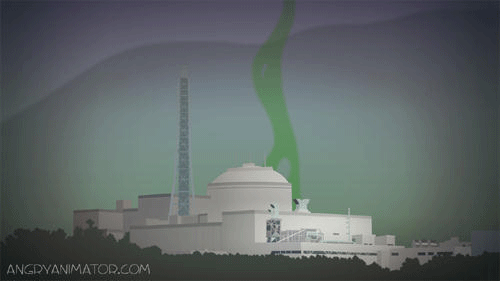
MARK WILLACY, REPORTER: People frolic in its shadow, a reactor its critics call the most dangerous in Japan. The name Monju comes from one of Buddha’s chief attendants, a purveyor of enlightenment depicted resting on the back of a lion, a beast whose phenomenal powers are controlled only by Monju’s wisdom.
But opponents of this prototype reactor fear its operators do not have the wisdom to harness its enormous energy.
KEIJI KOBAYASHI, FAST-BREEDER REACTOR EXPERT (voiceover translation): If a meltdown happens, it will get out of control very quickly. If the reactor core was to melt, the explosive energy would produce a blast like a nuclear bomb.
FUKIKO IKEJIMA, ‘STOP MONJU’ GROUP (voiceover translation): If a big accident were to happen, the impact would not stop in Japan, but spread around the world. It is our most dangerous reactor.
MARK WILLACY: And this is one of the reasons many Japanese fear Monju, because it uses sodium to cool a reactor, the substance that can ignite upon contact with oxygen. In 1995, a sodium leak at Monju caused a serious fire, one that resulted in the plant being out of operation for 15 years.
Lateline was given an exclusive tour of Monju, including an interview with the plant’s director-general, Satoru Kondo.
Continue reading at Problem plagued nuclear reactor called world’s most dangerous
Thorium’s radioactive fission products
 the fission products from a Thorium reactor are a worry, Technetium-99 has a half life of 220,000 years, uranium-232 produces thallium-208 (a nasty wee gamma emitter), Selenium-79 (another gamma emitter with a 327,000 year half-life), evenThorium-232 is a problem with its half life of 14 Billion years (and while the T-232 isn’t a major worry, all the time during this 14 Billion years it will be decaying and producing stuff that is!).
Thorium Cycle questions and problems http://daryanenergyblog.wordpress.com/ca/part-8-msr-lftr/8-3-thorium-lftr/ Questions have also been raised by some nuclear scientists about the Thorium cycle, in particular the proposed one that the LFTR would use. I’m not a nuclear physicist so I’ll merely forward you on to the relevant paper here , and a rebuttal here . The crux of the argument seems to be the proliferation risk (I’ll come back to that one later), the fact that a number of its spend fuel outputs (such as Technetium-99) are “nasty stuff” with a long half life and the fact we’ll still need supplies of Uranium to get Thorium reactors going again whenever we have to turn it off (which will happen at least once a year or so during its annual maintenance shutdown). They also highlight a number of technical issues, which I discussed in the chapter on HTGR’s. Continue reading
Nuclear industry says it will take 40 years to decommission Fukushima nuclear reactors
It will take 40 years, the nuclear industry says, to decommission the reactors. (Not the 6 months the industry claimed would be required to bring the “slightly damaged” reactors back online.)
Slow progress containing problems at Fukushima, new ones arise http://nuclearhistory.wordpress.com/2012/09/11/slow-progress-containing-problems-at-fukushima-new-ones-arise/ September 11, 2012 The Asahi Shimbun Japan By TAKASHI SUGIMOTO/ Staff Writer The operator is having difficulty pumping water into destroyed reactors at the Fukushima No. 1 plant, tanks are rapidly filling with radioactive water, and hundreds of potentially volatile uranium fuel assemblies remain in a precarious storage pool that some warn could collapse in another strong earthquake. Continue reading
What do Tony Blair, nuclear power, depleted uranium, radioactive tobacco and the Nobel family have in common?
 The real point of this wide ranging article is to highlight the international scope of this cover up on contamination issues and allowing high levels in the rest of the world while showing the low levels in japan.
Op Ed by Arclight2011, 9 September 2012
 In a previous article I posed the question concerning the whereabouts of Japans contaminated food supply. Continue reading
Since 1927 genetic damage from radiation has been known!
 Fukushima’s Butterflies – known since 1927 technorg, blogs by Jan Hemmer

August 17, 2012 by Mikkai ignored by IAEA, WHO, USCEAR, BEIR, ICRP Quote: “The collapse of the Fukushima Dai-ichi Nuclear Power Plant caused a massive release of radioactive materials to the environment. A prompt and reliable system for evaluating the biological impacts of this accident on animals has not been available. Here we show that the accident caused physiological and genetic damage to the pale grass blue Zizeeria maha, a common lycaenid butterfly in Japan. We collected the first-voltine adults in the Fukushima area in May 2011, some of which showed relatively mild abnormalities. The F1 offspring from the first-voltine females showed more severe abnormalities, which were inherited by the F2 generation. Adult butterflies collected in September 2011 showed more severe abnormalities than those collected in May. ***Similar abnormalities were experimentally reproduced in individuals from a non-contaminated area by external and internal low-dose exposures.**
“We conclude that artificial radionuclides from the Fukushima Nuclear Power Plant caused physiological and genetic damage to this species.“
TO ALL: The Butterflies of Fukushima are known since 1927! One of the best hidden secrets of the Atomic Military Industrial Complex.
EVIDENCE: Herman J Mueller discovered in 1927 (!) the following: Continue reading
How the International Atomic Energy Agency manipulates the World Health Organisation
 IAEA and TEPCO: The devil is relying on the Bible, blog by Jan Hemmer, http://tekknorg.wordpress.com/2011/03/31/iaea-and-tepco-the-devil-is-relying-on-the-bible/ by Mikkai
Japanese people hear it from Fukshima day One: “Panic and fear of radiation is much worse than radiation itself“
This statement is used by the IAEA for Chernobyl victims.
The IAEA ignores cancer, leukemia, diabetes, trisomy 21, all kinds of illness, all kinds of cancer in connection with radiation, especially low radiation.
The IAEA calls it “Radiophobia”. The present and future victims are perceived as a disturbance to the atomic industry, to the japanese government, to the companies running atomic plants. They are going to end it.
Since the foundation of the IAEA their purpose is: To serve and protect the atomic industry in these five countries: USA, Russia, China, France, Britain.
They also monopolized public health during and after atomic accidents, by the gag contract WHA 12-40 between them and the WHO (1959).
Learn more about the International Atomic Energy Association:
The IAEA, WHO and TEPCO should be a case for the International Criminal Courts
Fukushima and Three Mile Island USA: strategic misinterpretation by the IAEA
Japanese officals and WHO ignore irradiated Japanese Children
IAEA and ICRP – Licence to Kill – ALARA principle
Fukushima: The IAEA strategy
Japan: Additional 252,500 Cancer Cases and Risk for pregnant women
25 Years with FUKUSHIMA
Atomic Industry – Licence to Kill
Video: VIMEO international conference on Chernobyl radiation
 Nuclear Controversies http://vimeo.com/33724891 by 007bratsche PLUS by Wladimir Tchertkoff, 51min, 2004 In 1995, the Director General of WHO Dr. Hiroshi Nakajima, tried to inform on Chernobyl by organizing in Geneva an international conference with 700 experts and physicians. This tentative was blocked. The International Agency for Atomic Energy blocked the proceedings, which were never published. The truth on the consequences of Chernobyl would have been a disaster for the promotion of the atomic industry.
This film shows the discussions at the following WHO- congress in Kiev in 2001, that lead to the fatal disregarding of internal radiation consequences throughout the nuclear world.
The full transcript can be found here:
vivretchernobyl.blogspot.com/2008/06/w-tchertkof-nuclear-controversies.html
VIMEO video TRANSCRIPT on international conference on Chernobyl radiation
NUCLEAR CONTROVERSIES Vivre Tchernobyl , W. Tchertkoff: Script english version
Dr. Michel Fernex, retired, Medical Faculty University of Basle, is part of a campaign denouncing the conflict of interests between two organizations of the UN: the IAEA -International Agency for Atomic Energy- promoter of nuclear industry, and the WHO -World Health Organization-.
An agreement was signed in 1959 between those organizations: the WHO is prevented from undertaking independent medical research on the health effects of radiation, or for informing populations on the consequences of accidents like Chernobyl, when the atomic lobby does not agree.
Here a letter is being delivered for Kofi Annan and Dr. Brundtland, Director General of the WHO, asking for an amendment of this agreement and freedom for the WHO to work freely on the health effects of radiation. ….
In 1995, the Director General of WHO Dr. Hiroshi Nakajima, tried to inform on Chernobyl by organizing in Geneva an international conference with 700 experts and physicians. This tentative was blocked. The International Agency for Atomic Energy blocked the proceedings, which were never published. The truth on the consequences of Chernobyl would have been a disaster for the promotion of the atomic industry.
Fernex The interdiction to publish which fell on the WHO conference will maybe be lifted for the next WHO congress. But the IAEA will also be there, don’t worry : UNSCEAR, IAEA, with fantastic money. To buy scientists in poor countries doesn’t cost a lot. With 10.000 dollars you can buy many persons.
…… Never before, had such an authority admitted, that health institutions are subordinate to the promoters of the atom. The WHO and the IAEA, two UN agencies, when working together, should be free to fulfil their institutional tasks, for peace and the world’s well being.
Contradictions, tensions and conflicts which exist in the UN system, were expressed during this conference, by the protagonists of the 1995 WHO Conference and the physicians and scientists of the civil society.
Zupka english The consequences of Chernobyl do not fade away, but actually grow increasingly uncertain, and in many ways more intense. The United Nations Secretary General, Mister Kofi Annan, put it very clear when he said that: “The legacy of Chernobyl will be with us and with our descendents for generations to come”.
title: D. Zupka – OCHA UN Comment The representative of the UN Office for Humanitarian Affairs shares the view of Kofi Annan, who estimates at 9 million the number of victims, and says that tragedy of Chernobyl is only beginning.
….. tle: A. Gonzales – IAEA UN
CommentThe representative of the International Agency for Atomic Energy, maintains that the Chernobyl catastrophe caused 31 deaths, a few hundred highly irradiated individuals and 2000 thyroid cancers in children. This UN agency recognizes only validated data, validated by the laboratories of Los Alamos and the French Atomic Energy Commissariat -CEA-, two atomic bomb makers. ……. http://vivretchernobyl.blogspot.com.au/2008/06/w-tchertkof-nuclear-controversies.html
Japan’s nuclear industry in the grip of the criminal yakuza

 The Nuclear Mafia Derails Democracy in Japan Dissident Voice, by Richard Wilcox / August 31st, 2012
End of the day, factory whistle cries, Men walk through these gates with death in their eyes.
– Bruce Springsteen, “Factory”
Bring us the living dead. People no one will miss.
– Fukushima official’s request to Yakuza
TEPCO’s involvement with anti-social forces and their inability to filter them out of the work-place is a national security issue … Nuclear energy shouldn’t be in the hands of the yakuza. They’re gamblers and an intelligent person doesn’t want them to have atomic dice to play with.
– Japanese Senator1…. The exploitation of labor at nuclear plants depends on the tools of social engineering, of government, mass media and schools. This is the hidden and shameful side of today’s materialist society and belies our complicity in a criminalized culture.Inefficient and corrupt employment practices at the Fukushima Nuclear Power Plant (FNPP) are prolonging the disaster. Tokyo Electric Power Company (Tepco) outsources 90 percent of the work to subcontractors, mainly utilizing Japan’s criminal syndicates, “the Yakuza.” Japan is still a middle class society and most people will not volunteer for nuclear work. Japan risks running out of workers who have not exceeded their legal radiation limits.
Considered to be “Japan’s largest organized crime group” — who are on the radar of the US Treasury Dept. (another big crime group) — the Yakuza offer a service to society by sopping up its losers and giving them a dodgy occupation….. These short video interviews offer a useful introduction into how the Yakuza operate. Tepco’s relationship with the Yakuza is a cesspool of corruption from the highest to the lowest levels in its organization. “A senior National Police Agency officer, speaking on grounds of anonymity said, ‘TEPCO has a history of doing business with the yakuza that is far deeper than just using their labor.’ Continue reading
Nuclear power and its threat to fresh water supplies
 According to a 2011 report from the Union of Concerned Scientists, water withdrawals vary widely from one type of power plant to another: “On average in 2008, plants in the US nuclear fleet withdrew nearly eight times more freshwater than natural gas plants per unit of electricity generated, and 11 percent more than coal plants.
When water efficiency is factored into the equation, alternative energy sources, like wind turbines and solar cells, compare more favorably to coal, gas, and nuclear power.
Treading water, BULLETIN OF THE ATOMIC SCIENTISTS, BY DAWN STOVER | 22 AUGUST 2012 In 1954, Lewis Strauss, then chairman of the Atomic Energy Commission, gave a speech in which he famously predicted that “our children will enjoy in their homes electrical energy too cheap to meter.” Whether he was talking about fission reactors or a secret fusion project is unclear, but he was wrong in either case. What did turn out to be too cheap to meter, however, was water.
Unless you have a private well or spring on your property, you probably don’t enjoy free water in your home. But it’s a different story if you’re running a power plant or drilling for oil: The biggest water consumers pay the least for every gallon, and most power plants pay almost nothing at all. Perhaps that’s why so little research and funding is devoted to saving water — far less than is spent on energy efficiency.
This year’s drought, however, is a painful reminder that water is not an unlimited resource. According to the National Climate Data Center, moderate to exceptional drought currentlycovers 64 percent of the contiguous United States. A new study in the journal Nature Climate Change predicts that severe and widespread droughts will continue during the coming decades……
A June 2012 report from the watershed-protection group River Network found that, for every gallon of water used in an average American household, five times as much water is used to provide that same home with electricity.
It takes water to make energy. Coal, gas, and nuclear power plants generate electricity using steam-driven turbine generators. They withdraw surface water from rivers, lakes, or other bodies and use it to cool the steam. Thermoelectric power production has been the largest category of water use in the United States since 1965, and it is currently the fastest-growing user of freshwater. Continue reading
Uranium mining from the oceans doesn’t make financial sense
“…….. Ocean-mined uranium feasible, but not economical The Street By Resource Investing News 08/29/12 – If uranium buyers can’t find enough U308 on land, perhaps they can turn to the sea; or so say scientists from the University of Alabama and the American Chemical Society. “The ocean actually contains more uranium, although very dilute, than you can find in any land source in total,” said chemist Robin Rogers in a recent news conference, “which means we have a wonderful resource; it’s just always been very expensive to get it out.”
On and off over the past half century, scientists have been researching ways to extract uranium from seawater, but the process has always proved so costly and laborious that no one in the industry took it seriously. The US Department of Energy recently funded a project to develop a more cost-efficient process, and as a result researchers were able to decrease the cost estimate for ocean-mined uranium by over 46 percent to $300 per pound. Unfortunately, that’s five times costlier than traditional mining and a far cry from economical.
Don’t believe the nuclear lobby’s lies about bananas and radiation
 Nukers promoting contaminated food – the falsehoods of the Potassium excuse http://nuclearhistory.wordpress.com/2012/08/30/nukers-promoting-contaminated-food-the-falsehoods-of-the-potassium-excuse/http://nuclearhistory.wordpress.com/2012/08/30/nukers-promoting-contaminated-food-the-falsehoods-of-the-potassium-excuse/ I have blogged about this before. Attempts at selling contaminated food in the market of people’s lives by nuclear advocates has to stop in Japan and everywhere.
It will take me the weekend to finish this post as I gather the historic and current sources which show the Potassium equivalent dose (which the industry calls the banana equivalent dose) is a false, incorrect, wrong and deceptive fallacy.
In the interim, this wiki article explains the fallacy in brief:http://en.wikipedia.org/wiki/Banana_equivalent_dose
In brief: radio potassium (K40) is much a very small proportion of all potassium. It is far less radioactive per unit weight (amount, physical dose) than any biologically active fission product.
Potassium in any form is dangerous to the heart in excess, but potassium is a needed nutrient.
The body maintains a potassium balance therefore. This danger to the heart is a bio-chemical effect. The radiological nature of radio cesium (a potassium analogue) poses an additional threat to the heart and other soft tissue. Continue reading
MOX nuclear fuel poses a grave safety threat
DUKE POWERS PLAN TO USE BOMB-PLUTONIUM FUEL CONCEALS HIDDEN DANGERS AND COSTS Steven Dolley Nuclear Control Institute October 18, 2000
“….MOX fuel poses a grave safety threat. Dr. Edwin Lyman, NCI Scientific Director, conducted a MOX fuel safety study using the same computer codes employed by DOE and the Nuclear Regulatory Commission. Dr. Lymans study concluded that, in the event of a severe accident resulting in a large radioactive release, an average of 25% more people would die of cancer if the reactor were using a partial core of plutonium-MOX fuel, as opposed to a full core of conventional uranium fuel. DOE itself has concurred with many of Dr. Lymans findings.
Dr. Lyman also found that the impact of MOX fuel on certain reactor characteristics might also increase the chance that such a severe accident would occur. DOE and Duke dismiss such accidents as extremely improbable—but it must be remembered that the accidents that took place at Three Mile Island, Chernobyl, and the Tokai nuclear-fuel plant in Japan last September all had been similarly dismissed as highly unlikely or even impossible events. Continue reading
1 This Month



26 September – International Day for the Total Elimination of Nuclear Weapons


PLEASE OPPOSE HR 8255 AND S.3639 – bills would accelerate satellite deployment, with no environmental review or safeguards – https://ncstd5li.quorum.us/campaign/169331/
To see nuclear-related stories in greater depth and intensity – go to https://nuclearinformation.wordpress.com
-
Archives
- September 2026 (269)
- August 2026 (330)
- July 2026 (355)
- June 2026 (287)
- May 2026 (306)
- April 2026 (356)
- March 2026 (251)
- February 2026 (267)
- January 2026 (308)
- December 2025 (358)
- November 2025 (359)
- October 2025 (375)
-
Categories
- 1
- 1 NUCLEAR ISSUES
- business and costs
- climate change
- culture and arts
- ENERGY
- environment
- health
- history
- indigenous issues
- Legal
- marketing of nuclear
- media
- opposition to nuclear
- PERSONAL STORIES
- politics
- politics international
- Religion and ethics
- safety
- secrets,lies and civil liberties
- spinbuster
- technology
- Uranium
- wastes
- weapons and war
- Women
- 2 WORLD
- ACTION
- AFRICA
- Atrocities
- AUSTRALIA
- Christina's notes
- Christina's themes
- culture and arts
- Events
- Fuk 2022
- Fuk 2023
- Fukushima 2017
- Fukushima 2018
- fukushima 2019
- Fukushima 2020
- Fukushima 2021
- general
- global warming
- Humour (God we need it)
- Nuclear
- RARE EARTHS
- Reference
- resources – print
- Resources -audiovicual
- Weekly Newsletter
- World
- World Nuclear
- YouTube
-
RSS
Entries RSS
Comments RSS

