In Mali – a war for grabbing resources – especially uranium
 Uranium: encouraging signs and exploration in full swing. Exploration is currently being carried out by several companies with clear indications of deposits of uranium in Mali. Uranium potential is located in the Falea area which covers 150 km² of the Falea- North Guinea basin, a Neoproterozoic sedimentary basin marked by significant radiometric anomalies. Uranium potential in Falea is thought to be 5000 tonnes. The Kidal Project, in the north eastern part of Mali, with an area of 19,930 km2, the project covers a large crystalline geological province known as L’Adrar Des Iforas. Uranium potential in the Samit deposit, Gao region alone is thought to be 200 tonnes.
The War on Mali What You Should Know: An Eldorado of Uranium, Gold, Petroleum, Strategic Minerals SPY GhanaBy 4thmedia.org R. Teichman, News Beacon Ireland, 17 Jan 13
The French government has stated that: …… We have one goal. To ensure that when we leave, when we end our intervention, Mali is safe, has legitimate authorities, an electoral process and there are no more terrorists threatening its territory.” [1]
So this is the official narrative of France and those who support it. And of course this is what is widely reported by the mainstrem media.
France is supported by other NATO members. US Defense Secretary Leon Panetta confirmed that the US was providing intelligence to French forces in Mali. [2] Canada, Belgium, Denmark and Germany have also publicly backed the French incursion, pledging logistical support in the crackdown on the rebels. [3]
If we are to believe this narrative we are misled again about the real reasons. A look at Mali’s natural resources reveals what this is really about. Continue reading
Even very low level “background” radiation is harmful
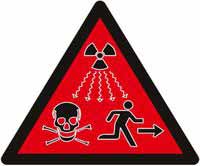 Recent evidence on the risks of very low-level radiation, Dr Ian Fairlie, January 17, 2013“…….I’ve previously shown that a great deal of evidence supports the LNT hypothesis and indicates radiation effects well below 100 mSv.
But in recent months, a flurry of epidemiological studies go further than merely refuting ill-informed articles. They indicate adverse effects to people exposed to very low doses from medical CT scans and other clinical procedures; to infants living near nuclear power stations; and to Chernobyl clean-up workers. They even reveal adverse effects from background radiation to which all of us are exposed.
Together they reveal a pattern of higher-than-expected risks from very low exposures to radiation.
1. Background Radiation
Perhaps the most eye-opening of the recent studies concern background radiation. Most people think that background radiation levels (typically 2 to 3 mSv per year) are very low and are of little concern. But recent authoritative studies clearly indicate that background radiation is not harmless. Continue reading
USA government quietly rejects nuclear reprocessing
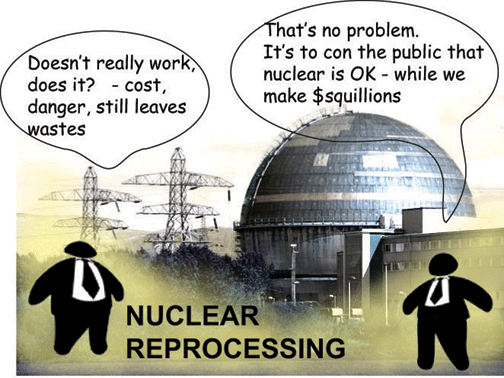
Steve Skutnik January 17, 2013 There is a hallowed tradition in Washington known as the “Friday Document Dump,” in which news and announcements the government wishes to bury are strategically timed for Friday afternoons, when such announcements tend to fall through the cracks of the typical news cycle (i.e., assuming reporters are even present to cover the event, the strategic timing tends to ensure it will miss the weekend papers, thus effectively “burying” the story by the time the new week rolls around).
It’s the uranium, stupid! France’s war in Mali
Although Niger has been France’s primary uranium trading partner in the region, investors are currently estimating 5,200 tonnes of untapped uranium sources in Mali, making the requirements of a favourable government and a suppressed civil society all the more urgent.
 The curbs on civil liberties in the West which the so-called War on Terror forces upon citizens is part of the same struggle that activists in West Africa are fighting against uranium mining corporations
Blood for Uranium: France’s Mali intervention has little to do with terrorism http://ceasefiremagazine.co.uk/blood-uranium-frances-mali-intervention-terrorism/ Adam Elliott-Cooper looks at the geo-strategic and economic interests shaping the current French intervention in Mali. 17 Jan 13, France opened 2013 with a series of airstrikes on Northern Mali to prevent “the establishment of a terrorist state”. At the time of writing, 11 civilians (including two children) have been killed, and according to the UN, an estimated 30,000 have been displaced. The morbid irony of the France’s leaders bombing people in order to prevent a “terrorist state” appears to be lost on them, but this may be due to their eyes being on something far more important – Mali’s economy. (Picture: Activists in Niger protesting uranium mining company AREVA) Continue reading
Leukemias near Nuclear Power Stations – new evidence
Taken together, the new studies indicate that our current understandings about radiation risks, especially in infants and children, may be incorrect and they may need to be revised upwards. In particular, the current adult (absolute) ICRP risk for fatal cancer of 5% per Sv and the ICRP’s use of a dose and dose-rate effectiveness factor (DDREF) look increasingly out of date.
The new studies also mean that our public radiation limits and constraints may need to be revised.
 Recent evidence on the risks of very low-level radiation, Dr Ian Fairlie, January 17, 2013
“…… 4. Leukemias near Nuclear Power Stations The final area is exposures from nuclear power stations.
Readers will be aware of my lectures showing that about 40 studies worldwide indicate increased leukemia risks among children within 5 km of nuclear power plants (NPPs). In particular, the important 2008 KiKK case-control study (discussed in Fairlie, 2009), which was commissioned by the German Government, found large increases in the risks of child leukemias and embryonal cancers near all German NPPs. This authoritative report led to geographical studies sponsored by the governments of France, UK, Switzerland and Germany. These have now been published and all four had similar findings, ie 30% to 40% increases in child leukemias near NPPs – see table from Körblein and Fairlie (2012) which contains the references to these four government studies.
Table: Studies of observed (O) and expected (E) childhood leukemias (under 5 year olds) within 5 km of NPPs
| Dataset | O | E | SIR=O/E | 90% CI | one-sided p-value |
| Germany | 34 | 24.1 | 1.41 | 1.04-1.88 | 0.0328 |
| Great Britain | 20 | 15.4 | 1.30 | 0.86-1.89 | 0.1464 |
| France | 14 | 10.2 | 1.37 | 0.83-2.15 | 0.1506 |
| Switzerland | 11 | 7.9 | 1.40 | 0.78-2.31 | 0.1711 |
| Pooled | 79 | 57.6 | 1.37 | 1.13-1.66 | 0.0042 |
The important point here is that most scientists think that radiation exposures to local residents from NPPs are extremely small. Indeed, many nuclear scientists remain in denial about the relationship between proximity to NPPs and child leukemias despite the bountiful clear evidence which exists. Yet the evidence of child leukemias near NPPs fits well with the evidence emerging from background radiation and medical radiation. Continue reading
USA’s Dept of Energy announces goals for nuclear waste management
 DOE touts interim storage option for spent nuclear fuel, Augusta Chronicle, By Rob Pavey Jan. 16, 2013 “……….Read the complete report:
 http://energy.gov/downloads/strategy-management-and-disposal-used-nuclear-fuel-and-high-level-radioactive-waste
Legislative goals for next 10 years:
• Active engagement in a broad, national, consent-based process to site pilot and full-scale interim storage facilities, and site and characterize a geologic repository;
• Siting, design, licensing, and commencement of operations at a pilot-scale storage facility with an initial focus on accepting used nuclear fuel from shut-down reactor sites.;
• Significant progress on siting and licensing of a larger consolidated interim storage facility capable of providing system flexibility and an opportunity for more substantial progress in reducing government liabilities;
• Development of transportation capabilities (personnel, processes, equipment) to begin movement of fuel from shut-down reactors;
• Reformation of the funding approach in ways that preserve the necessary role for ongoing discretionary appropriations and also provide additional funds as necessary, whether from reclassified fees or from mandatory appropriation from the NWF or both; and
• Establishment of a new organization to run the program, the structure and positioning of which balance greater autonomy with the need for continued Executive and Legislative branch oversight.
Source: U.S. Energy Department http://chronicle.augusta.com/news/metro/2013-01-16/doe-touts-interim-storage-option-spent-nuclear-fuel?v=1358336852
Ionising radiation a cancer danger in CT scanning
Concerns about exposure to ionising radiation inducing cancer NPS, 15 Jan 13, People are exposed to ionising radiation through medical imaging with X-rays, CT and nuclear medicine scans, including positron-emission tomography (PET).5 While MRI has the advantage of not using ionising radiation4 most of the new MBS items for MRI requested by GPs will require X-ray as a first investigation.2
As there are no completed, large-scale epidemiological studies of cancer risk associated with CT, risk has been approximated using organ doses (or the distribution of dose in the organ) and application of organ-specific cancer incidence and mortality data derived from studies of atomic-bomb survivors on the peripheries of Hiroshima and Nagasaki.6 Risk estimates adjusted to take into account the greater use of CT since 2006 indicate that 1.5–2% of all cancers in the US may be due to radiation from CT.6 Estimating cancer risk from CT remains a contentious issue, and large-scale epidemiological studies are needed for a direct assessment of this risk.6
Imaging is justified if the potential benefits outweigh the risks7…….
NASA explores stratosphere to learn effects of the warming planet Earth
 NASA Chases Climate Change Clues Into The Stratosphere NASA, 9 Jan
13, WASHINGTON — Starting this month, NASA will send a remotely
piloted research aircraft as high as 65,000 feet over the tropical
Pacific Ocean to probe unexplored regions of the upper atmosphere for
answers to how a warming climate is changing Earth. Continue reading
Special dangers of ionising radiation in space
 there are two things those astronauts have shown us. First, there are genetic changes and damage happening even within the relatively safe confines we’ve traveled thus far. Second, there is a hell of a lot we don’t know about how radiation exposure and risk works in outer space.
How space radiation hurts astronauts, Boing Boing, Maggie Koerth-Baker, Jan 4, 2013 “……We know the rates of cancer for survivors of the nuclear bombs dropped on Hiroshima and Nagasaki, but that radiation isn’t really comparable to the stuff in Galactic Cosmic Radiation. In particular, Cucinotta is concerned about particles known as HZE ions.
These particles are very heavy and very fast and we don’t experience them here on the ground. They’re the kind of things that get filtered out and broken down by Earth’s defense systems. But HZE ions can cause more damage, and different kinds of damage, than the radiation scientists are really familiar with. We know this because scientists actually compare samples of astronauts’ blood before and after a spaceflight. Continue reading
America’s big con job – the Nuclear “Waste Confidence Rule”
The only reasonable and logical solution is to stop making more. But this “Waste Confidence” decision isn’t based on reason or logic. It’s based on keeping the reactors OPERATING for the next hundred years.
So why are we burdening our future generations with an ever-growing, unsolvable problem?
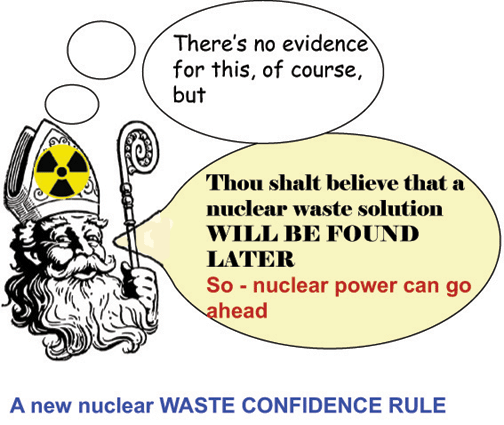
The Eternal Problem – Nuclear Waste Confidence, Counter Punch by RUSSELL D. HOFFMAN, JANUARY 03, 2013“………The pro-nuker preferred to call it “spent fuel confidence.” I, on the other hand, didn’t like the word “confidence” since there’s nothing that warrants ANY confidence in this discussion, whatsoever. ”Waste Failure” would be more appropriate. Or “Waste Impasse” might be even better. Or better yet: ”The Intractable, Unsolvable, Filthy, Disgusting Mess We’ve Made” but I guess that would just be too accurate to a group where a “rapid disassembly” is the term for a core explosion that spews radioactive crud for miles around.
But one way or another, it’s obvious that “Waste Confidence” is a misnomer from start to finish…… …… Nuclear waste storage is a huge unsolved problem in every nuclear country. Continue reading
Critically dangerous state of Vermont Yankee’s accumulated nuclear waste
 Vermont, New York regulators urge review of storage of spent nuclear fuel, VT Digger, by Andrew Stein | January 3, 2013 “……Vermont Yankee has 1,507 fuel rod assemblies submerged in a spent fuel pool, which was originally designed to hold about 350. Spent fuel rods must be kept under water in order to prevent the Zirconium cladding (the metal tubes that contain the fuel pellets) from igniting. The rods can remain hot for several years.
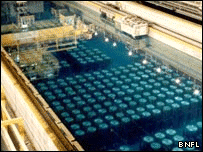 Vermont Yankee’s spent fuel pool, located in a metal warehouse structure, has more than five full reactor cores worth of radioactive material. In the event of an accident, the impact would be five times greater than a single reactor meltdown.
The dry cask storage containers on the site are hundreds of times safer than the spent fuel pool, Shadis said.
At this point, the site has 13 loaded casks, four of which were filled last year, according to Neil Sheehan, NRC public affairs officer for Region 1.
Each cask, which can hold 72 assemblies, costs $1 million. It would cost roughly $11 million to move all of the assemblies into dry cask storage……. http://vtdigger.org/2013/01/03/vermont-new-york-regulators-urge-review-of-spent-nuclear-fuel-storage/
After Chernobyl nuclear disaster- “background” radiation estimated at double previous amount
 Geneticist Valery N. Soyfer, founder of the former Soviet Union’s first molecular biology laboratory, analyzed the 1986 report to the IAEA, which has since been condemned as a cover-up. Dr. Soyfer says that if only 100 million curies were vented, then world “background radiation doubled at once.”[10] This claim was unsupported by accompanying evidence, butif “background” was doubled by 100 million curies, then it was multiplied 180 times by the release of Chernobyl’s “full inventory.”
Nineteen months after the disaster, in Nov. 1987, the U.S. government officially doubled its estimate of the “background” radiation to which we are exposed every year
Chernobyl at Ten: Half-lives and Half Truths, Chernobyl, by John M. LaForge “…… In the first part of this article (Spring 1996 Pathfinder) I compared the recent trivialization of Chernobyl’s consequences to news accounts that appeared soon after the explosions and fire. For example, while the commercial press now tell us that the disaster “spread radiation across parts of Europe,” the fact is that the federal EPA announced in mid-May 1986 that, “Airborne radioactivity from the Chernobyl nuclear accident is now so widespread that it is likely to fall to the ground wherever it rains in the United States.”[4]
In this part I look at how much radiation Chernobyl evidently added to the “background,” at official skewing of the inevitable long-term effects, and at recent reports of its human health consequences. Continue reading
International Atomic Energy Agency (IAEA) misled the world about Chernobyls’ cancer threat
Thyroid Cancers: More, Sooner, Untreatable Chernobyl at Ten: Half-lives and Half Truths, Chernobyl, by John M. LaForge
“……Dr. Soyfer further discovered that the Soviets focused on and publicized the fallout’s radioactive iodine content, but understated the amounts of other far more dangerous isotopes. While 10 to 15 percent of the fallout was iodine-131, the long-lived radionuclides strontium-90 and cesium-137 made up more than two thirds of the total contamination.[12]
Furthermore, the Soviet’s 1986 estimate of future cancer deaths was based only on the impact of iodine-131, and then only on external doses. As a result, the IAEA misled the world about Chernobyl’s cancer threat. Continue reading
$2 billion to shut down Quebec’s nuclear plant, but $4 billion to keep it open
The Parti Quebecois also announced it will set aside another $200 million in a
“diversification fund” to help the surrounding communities retrain
their workforces and spur alternative development opportunities.
Shutdown of Que. nuclear plant to cost $2B, Ifp
QMI Agency
December 28, 2012 MONTREAL – The licence for Quebec’s only
operational nuclear power plant expired Friday, and the provincial
government said it will spend hundreds of millions of dollars over the
next 50 years to dismantle the reactor.
The Parti Quebecois campaigned against refurbishing the plant,
claiming that the $4-billion price tag was financially unjustifiable, Continue reading
The exploitation of indigenous peoples by uranium mining companies
 Nuclear dangers real and widespread
BY HELEN CALDICOTT, THE STARPHOENIX NOVEMBER 9, 2012
Caldicott is founding president of Physicians for Social
Responsibility and was featured in the Oscar winning film, If You Love
This Planet.
I write to reply to the allegations made about me in John Gormley’s
column, More private liquor stores, less Caldicott (SP, Nov. 2).
First, it is important for me to stress that the aboriginal people in
Northern Saskatchewan are being exploited by the uranium and nuclear
power industry, as they have routinely been in the United States and
Australia.
People who have lived benignly with nature for tens of thousands of
years have been forced to allow mining companies to extract uranium
from beneath their feet and to work in the mines.
Ample evidence abounds in the scientific literature that one-fifth to
one-half of uranium miners in North America have suffered from lung
cancer. Furthermore, uranium miners are also exposed to carcinogenic
whole body gamma radiation as well as the ingestion of radium – the
element that induced leukemia in Madame Marie Curie.
Many indigenous people who live near uranium mines are also exposed to
radioactive elements, and newly elevated rates of cancer are now
reported in these populations. We don’t know exact numbers because the
Saskatchewan government has not performed a baseline health study on
the populations affected.
As if this ecological danger were not enough, the nuclear industry is
proposing to bury 37,000 tonnes of extremely toxic, high level
long-lasting radioactive waste from Canadian nuclear reactors among
this vulnerable group of people, which, it is claimed will give them
jobs.
As the isotopes inevitably leak, they will contaminate the food chain
for evermore inducing more malignancies and genetic disease over
future generations…..http://limitlesslife.wordpress.com/2012/12/28/nuclear-dangers-real-and-widespread/
1 This Month



26 September – International Day for the Total Elimination of Nuclear Weapons


PLEASE OPPOSE HR 8255 AND S.3639 – bills would accelerate satellite deployment, with no environmental review or safeguards – https://ncstd5li.quorum.us/campaign/169331/
To see nuclear-related stories in greater depth and intensity – go to https://nuclearinformation.wordpress.com
-
Archives
- September 2026 (257)
- August 2026 (330)
- July 2026 (355)
- June 2026 (287)
- May 2026 (306)
- April 2026 (356)
- March 2026 (251)
- February 2026 (267)
- January 2026 (308)
- December 2025 (358)
- November 2025 (359)
- October 2025 (375)
-
Categories
- 1
- 1 NUCLEAR ISSUES
- business and costs
- climate change
- culture and arts
- ENERGY
- environment
- health
- history
- indigenous issues
- Legal
- marketing of nuclear
- media
- opposition to nuclear
- PERSONAL STORIES
- politics
- politics international
- Religion and ethics
- safety
- secrets,lies and civil liberties
- spinbuster
- technology
- Uranium
- wastes
- weapons and war
- Women
- 2 WORLD
- ACTION
- AFRICA
- Atrocities
- AUSTRALIA
- Christina's notes
- Christina's themes
- culture and arts
- Events
- Fuk 2022
- Fuk 2023
- Fukushima 2017
- Fukushima 2018
- fukushima 2019
- Fukushima 2020
- Fukushima 2021
- general
- global warming
- Humour (God we need it)
- Nuclear
- RARE EARTHS
- Reference
- resources – print
- Resources -audiovicual
- Weekly Newsletter
- World
- World Nuclear
- YouTube
-
RSS
Entries RSS
Comments RSS

