They’re untested, they’re just as expensive – small nuclear reactors
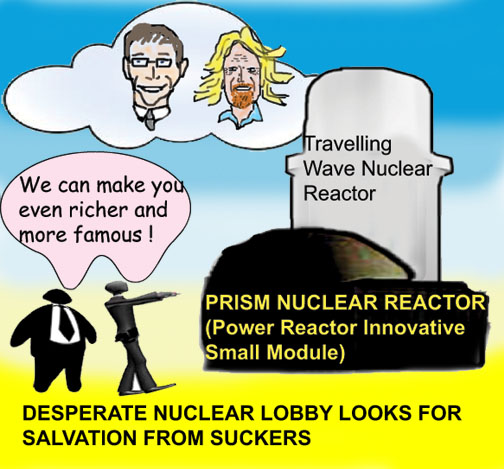
Nuclear energy: Flexible fission, Ft.com, By Sylvia Pfeifer 14 Feb 13, At the Baltic Shipyard in St Petersburg squats the hull of the Akademik Lomonosov. It is no ordinary ship. Once it is finished in three years’ time, it will be Russia’s first floating nuclear power plant.Two reactors, similar to those used in Russia’s nuclear-powered ice breakers, will each provide 35 megawatts of power. The floating power plant is one of several planned by the Kremlin to be anchored near towns or industrial sites……
Critics are wary, warning that floating atomic power stations would make an ideal terrorist target and be vulnerable to stormy weather and earthquakes. Others point out that even if smaller reactors had less fuel and were partly buried underground, there would be an increasing number of small facilities dotted across emerging markets, sometimes in places that lack the infrastructure to cope with emergencies….
multiple challenges remain.
There are questions over whether the regulatory regime and siting criteria should be relaxed for these reactors? There are also suggestions the plants could be run with fewer staff, helping to cut the costs even further.
Dame Sue Ion, a nuclear fuel expert and fellow at the UK’s Royal Academy of Engineering, says the first small modular reactors will, realistically, be sited on existing nuclear-licensed sites.
“It may be that the physical characteristics make it safer but you would still have to have all the safety arrangements and emergency planning in place,” she adds.
“You still have the same safety, proliferation and accident concerns,” says Doug Parr, chief scientist and policy director at campaign group Greenpeace UK. “You need capacity and supportive infrastructure to respond if there is an emergency.”
Then there is the issue of public acceptance. “To expect the general public to just accept them because they are small is pushing the point. It does not seem obvious to me,” Kevin Hesketh, senior fellow at Britain’s National Nuclear Laboratory, told an industry conference last month…….. “Licensing and public acceptance – both have to be addressed. ..
The biggest challenge facing the model is simply that no one has done it. Nuclear also has a bad record on cost. At the same time, competition from renewables, which are becoming cheaper, is growing.
Dominic Holt, associate director, nuclear advisory, at KPMG, says “none of the positives have been tested yet”. Claims of cost and programme certainty are still unproven. Analysis of a range of available data show that the “levelised cost” – per MW/hour – of SMRs is still similar to that of a large reactor…
Stories and pictures of abandoned nuclear power plants
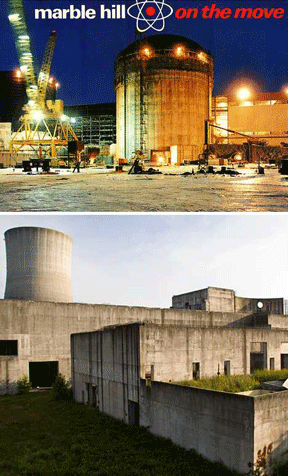
 iPctures: Gone Fission: 11 Unfinished Nuclear Power Plants http://weburbanist.com/2013/02/10/gone-fission-11-unfinished-nuclear-power-plants/ These 11 unfinished, abandoned, canceled, mothballed and/or suspended nuclear power plants will, for better or worse, never know the warmth of split atoms.
 Lemoniz Nuclear Power Plant, Spain Construction of the Lemóniz Nuclear Power Plant, located on the Bay of Biscay on Spain’s northern coast, began in the mid-1970s but was dogged from its inception by violent opposition from ETA, the terrorist organization dedicated to the independence of Spain’s Basque country. The group managed to smuggle bombs into the facility on several occasions in 1978 and 1979 resulting in a number of fatalities and delaying the plant’s construction……
Marble Hill Nuclear Power Station, Indiana, USA (at left) From 1977 to 1984, Public Service Company of Indiana (PSI) spent approximately $2.5 billion to build the Marble Hill Nuclear Power Station near Hanover, Indiana, and by the time the financial tap ran dry it was only half-finished! The political and environmental landscape had changed quite a bit over those 7 years with the biggest speed bump being the Three Mile Island crisis in 1979. With costs spiraling out of control and the state government reluctant to provide funding, PSI abandoned the project and auctioned off most of the salvageable material for a mere pittance.
Equipment and parts from the Marble Hill Nuclear Power Station continued to be sold off in the early to mid-1990s but by the year 2000 everything of value had been sold. Since 2008, slow and steady demolition under the auspices of MCM Management Corp. has seen first the fuel-handling building and then the twin reactor containment buildings gradually reduced to mounds of scrap. The bright side, if any, is that none of the demolished material is radioactive.
Bataan Nuclear Power Plant, Philippines Continue reading
USA’s Energy Dept plan to sell nuclear wastes into consumer products
 This approach ignores the current scientific consensus that there is
NO safe level of radiation exposure.
the fundamental safety question is whether any additional radiation
exposure is safe in any meaningful sense.
This approach also fails to deal with the reality that once the
department has released radioactive materials for commercial use, it
loses almost all control over how and where they’re used, and in what
concentrations.
Multimillion Dollar Bonanza: Nuclear Waste from US Weapons Industry To
Be Sold for Profit? By William Boardman Global Research, February 05,
2013
An Energy Department plan to allow the
recycling of scrap metals emitting very low levels of radiation is
drawing opposition because of concerns about potential health hazards.
But the upside for U.S. atomic bomb-makers is that waste now requiring
costly storage could be sold for a profit.
In something of a stealth maneuver during the 2012 holiday season, the
U.S. Department of Energy set about to give every American a little
more radiation exposure, and for some a lot, by allowing manufacturers
to use radioactive metals in their consumer products – such as
zippers, spoons, jewelry, belt buckles, toys, pots, pans, furnishings,
bicycles, jungle gyms, medical implants, or any other metal or
partly-metal product. Continue reading
No One in Charge of Risk – USA’s plan to put nuclear waste materials into consumer “goods”
 “Nothing has changed since 2000 that would justify lifting its current
ban. Rather, just the opposite: since then the National Academy of
Sciences has acknowledged that there is no safe level of radiation
exposure, and we’ve learned that women are even more vulnerable to
radiation than men (while children have long been known to be more
vulnerable than adults).”
NIRS and other advocacy organizations are currently engaged in a
campaign to submit comments before the Feb. 11 deadline to ask the
Energy Department to withdraw this proposal.
Multimillion Dollar Bonanza: Nuclear Waste from US Weapons Industry To
Be Sold for Profit? By William Boardman Global Research, February 05,
2013
Consortiumnews 4 February 2013 “……No One in Charge of Risk
There is no federal agency with responsibility for such oversight or
enforcement [of radioactive materials in consumer products] . This regulatory vacuum was illuminated by the discovery
in 2009 of thousands of contaminated consumer products from China,
Brazil, France, Sweden and other countries, as reported by Mother
Nature Network:
“The risk of radiation poisoning is the furthest thing from our minds
as we shop for everyday items like handbags, furniture, buttons, chain
link fences and cheese graters. Unfortunately, it turns out that our
trust is misplaced thanks to sketchy government oversight of recycled
materials.
“The discovery of a radioactive cheese grater led to an investigation
that found thousands of additional consumer products to be
contaminated. The source is recycled metals tainted with Cobalt-60, a
radioactive isotope that can cause cancer with prolonged exposure.” Continue reading
Wind energy to be stored in USA’s largest power storage system
Duke Energy completes North America’s largest energy storage system,
Renewable Energy Magazine Robin WhitlockThursday, 07 February 2013
The 36MW energy storage system will store power generated by the
nearby Notrees wind farm and became fully operational in December
The company announced plans to install large-scale energy storage
systems to service its wind farm at Notrees in late 2009, matching a
$22 million grant from the US Department of Energy (DOE).
As well as helping to meet power demand the system will also help to stabilize the frequency of electricity travelling through the power grid. DukeEnergy is currently working closely with the Energy Reliability Council of Texas (ERCOT) which will indicate whether the system shoulddispatch stored energy to increase frequency or absorb energy to decrease it. Performance data will be collected from the battery storage system by the Electric Power Research Institute (EPRI) to help assess the broader potential for deployment of storage solutions throughout the sector. Continue reading
Plutonium in ocean near Fukushima
 Study: Fukushima plutonium in Pacific Ocean from ‘liquid direct releases’? http://enenews.com/study-plutonium-could-be-pacific-ocean-liquid-direct-releases-fukushima
Title: Should we measure plutonium concentrations in marine sediments near Fukushima?
Source: Journal of Radioanalytical and Nuclear Chemistry
Author: R. Periáñez, Kyung-Suk Suh, Byung-Il Min
Date: February 2013
Excerpt
Much less information is available in the case of plutonium isotopes. Trace amounts of Pu isotopes originating from the accident have been identified in soil samples. While it is known that atmospheric releases of Pu were several orders of magnitude lower than that from Chernobyl accident, no information on Pu isotopes in the liquid direct releases to the sea is available. Pu isotopes have been measured in marine sediments outside a 30 km radius circle around Fukushima. Results do not show any contamination due to the accident. Instead Pu isotopes here detected are attributed to global fallout.
However, the situation inside the 30 km zone remains unknown. It could be possible that Pu isotopes entered this coastal area from the direct release of contaminated water in early April 2011. The objective for this work consists of showing, by means of numerical modelling, that, if Pu contamination originating from the accident would be present in sediments of the close area to Fukushima, contamination would not reach areas far from the plant. Contamination would be restricted to the close area because of the low mobility of Pu. Thus, it would not be detected if samples are not collected there. Consequently, further studies on the determination of Pu isotopes in seawater and sediments within the 30 km zone would be required.
Note the objective: “The objective for this work consists of showing […] that, […] Pu contamination […] would not reach areas far from the plant.”
Precious groundwater now threatened by fracking for uranium, too
When it comes to fracking for yellowcake, even more pressing than shaky economics is the obvious potential for environmental contamination. The process is not only extremely water intensive, as is typical of fracking, but it’s also happening at a shallow depth. Unlike the Eagle Ford’s oil and gas reserves, which are miles underground, the in situ uranium mining is taking place at the same level as local groundwater supplies.

Fracking for Yellowcake: The Next Frontier? http://www.huffingtonpost.com/jeffrey-rubin/fracking-for-yellowcake-t_b_2612418.html Jeffrey Rubin 02/04/2013 It works for oil and natural gas, so why not frack for uranium too? After all, America relies on foreign uranium just like it depends on foreign oil.
In the U.S. these days, it seems like you can sell almost anything if you spin it as part of the pursuit of energy independence. Enter Uranium Energy Corp. A junior mining company with Canadian roots, UEC is developing the newest uranium mine in the U.S. And it’s counting on fracking to do it.
Texans, in general, are no strangers to fracking. UEC is operating in the heart of fracking country, south Texas’s Eagle Ford basin, one of the most prolific shale plays in the country. Instead of oil and gas, though, UEC (recently profiled by Forbes Magazine) is fracking for yellowcake.
The technology is basically the same. It involves injecting a mixture of highly pressurized water and sand into an underground formation in order to break open fissures in the rock that allow the energy riches within to be extracted. In this case, it’s a slurry of uranium ore that’s then dried and processed into powdery yellowcake, an intermediate product that eventually becomes fuel for nuclear reactors.
Of course, the very idea of fracking for yellowcake begs the question–just because you can do something, should you? The world isn’t exactly running short of uranium. Prices tell you that much. Uranium prices have plunged from more than $90 a ton before the last recession to just more than $40 a ton following the Fukushima disaster. Friendly countries like Canada and Australia are able to ramp up supply, as can less friendly countries like Kazakhstan. Yellowcake is also exported by Niger (part of the reason, according to some, that nuclear-powered France is taking such an interest in neighbouring Mali right now.)
What’s more, the emergence of cheap natural gas from shale plays is making nuclear energy less attractive to U.S. power utilities. Many are considering shuttering some high cost nuclear stations and switching to cheaper natural gas, just as they’ve been doing with a number of coal plants in recent years.
When it comes to fracking for yellowcake, even more pressing than shaky economics is the obvious potential for environmental contamination. The process is not only extremely water intensive, as is typical of fracking, but it’s also happening at a shallow depth. Unlike the Eagle Ford’s oil and gas reserves, which are miles underground, the in situ uranium mining is taking place at the same level as local groundwater supplies.
According to the International Energy Agency, the amount of fresh water used for global energy production will double over the next twenty-five years. Whether it’s Alberta’s oil sands that run on water from the Athabasca River or the countless gallons used to frack underground stores of oil, gas and now even uranium, it’s easy to see why.
Standard for “acceptable” radiation needs to be changed: it discriminates against women and children
The standard still used for “allowable” and “legal” radiation
doses is a chauvinistic and alarmingly dangerous method of calculating
risk.
The standard is called “reference man.” Created by the International
Commission on Radiological Protection in 1975, it defines humanity as
a 5-foot-7-inch, 154-pound “Caucasian” male, 20-to-30 years old, who
is “Western European or North American in habitat and custom.” Of
course, this set represents neither the most vulnerable population nor
the average person.
 Women & Children First! (to be Harmed by Radiation)
http://www.counterpunch.org/2013/01/30/women-children-first-to-be-harmed-by-radiation/
JANUARY 30, 2013
“Reference Man” Risk Model Lambasted as Obsolete,
Unscientific by JOHN LaFORGE
“Woman and children first” is redefined in the nuclear age, now that
science has shown that they are far more susceptible to the ravages of
radiation than men and boys. Continue reading
USA’s nuclear waste dumpsters need high level guarding
 America’s Nuclear Dumpsters After Yucca Mountain, the Nuclear Regulatory Commission is stocking up on guns and ammo. Slate, By Geoffrey Brumfiel| , Jan. 30, 2013, While the rest of America spent January debating new gun control laws, one government agency announced its plans to expand the use of high-capacity magazines, assault weapons, and even fully automatic machine guns. The Nuclear Regulatory Commission, which oversees the nation’s nuclear plants, is seeking the firepower not for securing the plants themselves, but to defend their nuclear waste.
Since America’s commercial reactors started opening in the 1960s and ’70s, nuclear waste has been piling up. At first, it was stored in spent fuel pools—swimming pools you’d never, ever want to swim in. That was fine for a time, but by the 1980s, the pools started to get crowded. So the utilities began putting old fuel rods in something they call dry cask storage, and I’ll call nuclear dumpsters.

They’re big, they’re white, and they’re literally kept out back like the rest of the trash. Continue reading
Hydraulic Fracking is a source of radiation pollution, too
“We’ve known for a long time that there is radiation coming back in the wastewater”
Among the radioactive material often found in drilling wastes is radium 226, which can cause cancer, anemia and cataracts, according to the federal Agency for Toxic Substances and Disease Registry
DEP backtracks on radiation issue Times online,January 25, 2013 By Rachel Morgan HARRISBURG — For months, the state Department of Environmental Protection denied that radiation in wastewater from natural gas drilling was an issue. On Thursday night, the state announced plans to study the effects of radiation in natural gas drilling wastewater.
After continued questioning by Shale Reporter regarding radioactivity in wastewater, Gov. Tom Corbett’s announcement of a 12-month DEP study of radioactive wastewater was a surprise. The DEP had consistently denied radiation was even an issue……. In the governor’s unexpected announcement Thursday evening, DEP officials said they will begin sampling and analyzing fracking flowback for radioactivity, testing everything from fracking wastewater, drill cuttings, treatment solids and sediments at well pads and wastewater treatment and disposal facilities.
They also plan to analyze radioactivity in pipes, well casings, storage tanks, treatment systems and trucks. http://www.timesonline.com/news/local_news/dep-backtracks-on-radiation-issue/article_9e5853a5-325b-5f9a-83ed-24aea5811db0.html
An Increase in Radiation Monitoring for Fracking, NYT, Jan 25 13 By JON HURDLE Pennsylvania will step up its monitoring of naturally occurring radiation levels in water, rock cuttings and drilling wastes associated with oil and gas development in a yearlong study that will be peer-reviewed, the state’s environmental agency reports.
The study will also assess radiation levels in the pipes, well casings, storage tanks, treatment systems and trucks used by the natural gas industry, which has drilled thousands of wells in the gas-rich Marcellus Shale over the last five years….
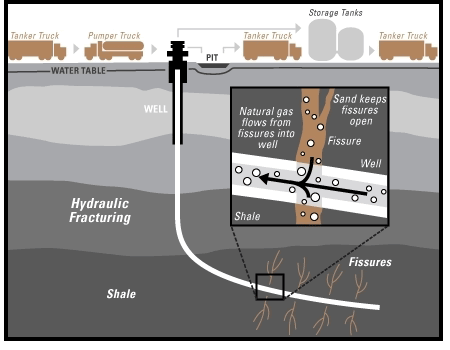
Hydraulic fracturing, which involves injecting chemicals and water under enormous pressure into underground shale formations to extract gas or oil, got under way in Pennsylvania in 2008.
In New York, state officials are currently weighing whether to allow the drilling process to begin. The state’s health commissioner is conducting a review of whether the state’s Department of Environmental Conservation has adequately addressed potential impacts on public health. Continue reading
Uranium mining: In situ leaching not the same as fracking
A spokesperson for Uranium Energy disputes the similarities to fracking that is made in the article.
“By contrast, ‘in-situ recovery’ is the process of injected-solution mining that reverses the natural process of deposited uranium in sandstones. On-site groundwater fortified with oxygen is introduced into the ground through a pattern of injection wells. The solution dissolves uranium from the sandstone host rock, and the uranium-bearing solution is brought back to surface through vacuum-suction production wells, where the uranium is concentrated on resin beads for trucking to a nearby processing plant where it is concentrated further and dried into yellowcake.”
Opponents of in situ uranium extraction start throwing around the F word MINING.com Editor | January 25, 2013 A US company is extracting underground uranium reserves in Texas using in situ methods, but opponents are comparing it to another process that is drawing high-profile protests.
Forbes reports that Texas-based Uranium Energy Corp (UEC) uses the in situ method for extracting underground uranium by pumping oxygenated water into porous rock layers via deep-drilled wells.
Forbes notes the process is raising concerns among some in Texas who compare the process to hydraulic fracturing, which has some celebrity opponents.”By design it’s much worse than fracking,” says Houston attorney Jim Blackburn, who is interviewed by Forbes.
“This is intentional contamination of a water aquifer liberating not only uranium but other elements that were bound up with the sand. We know this process will contaminate groundwater; that’s the whole point of it.” Continue reading
New Nuclear Waste Confidence Decision” (NWCD) designed to let nuclear power continue?
the fact that their best scenario now projects a repository to be ready by about 2050 is a story in itself.
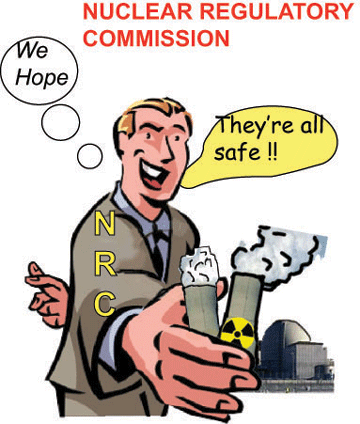 Seventy Years of Nuclear Fission, Thousands of Centuries of Nuclear Waste ,25 January 2013 By Gregg Levine, Truthout “…….Confidence Game
Two months after the Appeals Court found fault with the NRC’s imaginary waste mitigation scenario, the agency announced it would suspend the issuing of new reactor operating licenses, license renewals and construction licenses until the agency could craft a new plan for dealing with the nation’s growing spent nuclear fuel crisis. In drafting its new nuclear “Waste Confidence Decision” (NWCD) – the methodology used to assess the hazards of nuclear waste storage – the Commission said it would evaluate all possible options for resolving the issue.
At first, the NRC said this could include both generic and site-specific actions (remember, the court criticized the NRC’s generic appraisals of pool safety), but as the prescribed process now progresses, it appears any new rule will be designed to give the agency, and so, the industry, as much wiggle room as possible. Continue reading
Dangers of nuclear spent fuel cooling ponds, and of dry cask storage
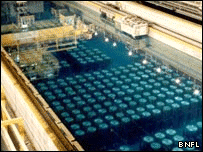 Seventy Years of Nuclear Fission, Thousands of Centuries of Nuclear Waste ,25 January 2013 By Gregg Levine, Truthout “…….Everyone Out of the Pool
As disasters as far afield as the 2011 Tohoku earthquake and last October’s Hurricane Sandy have demonstrated, the storage of spent nuclear fuel in pools requires steady supplies of power and cool water. Any problem that prevents the active circulation of liquid through the spent fuel pools – be it a loss of electricity, the failure of a back-up pump, the clogging of a valve or a leak in the system – means the temperature in the pools will start to rise. If the cooling circuit is out long enough, the water in the pools will start to boil. If the water level dips (due to boiling or a leak) enough to expose hot fuel rods to the air, the metal cladding on the rods will start to burn, in turn heating the fuel even more, resulting in plumes of smoke carrying radioactive isotopes into the atmosphere.
And because these spent fuel pools are so full – containing as much as five times more fuel than they were originally designed to hold, and at densities that come close to those in reactor cores – they both heat stagnant water more quickly and reach volatile temperatures faster when exposed to air. Continue reading
EPA permits fracking for uranium to go ahead in USA
 Goliad skeptics have been fighting UEC’s plans for five years. At Goliad the uranium ore is located just 400 feet deep within the same rock as a groundwater reservoir that ranchers tap for drinking water, both for themselves and their livestock. Water, not oil, is the region’s long-term liquid gold. “We are running out of water; I don’t want mine ruined,” said one rancher who asked not to be named. “When you’re out of water, you’re out of everything.”….
A 2009 study of Texas in situ mines by the U.S. Geological Survey … found no instance in which there wasn’t more selenium and uranium in the water than before mining.
 Energy’s Latest Battleground: Fracking For Uranium This story appears in the February 11, 2013 issue of Forbes. No tour of Uranium Energy Corp.’s processing plant in Hobson, Tex. is complete until CEO Amir Adnani pries the top off a big black steel drum and invites you to peer inside. There, filled nearly to the brim, is an orange-yellow powder that UEC mined out of the South Texas countryside. It’s uranium oxide, U3O8, otherwise known as yellowcake. This is the stuff that atomic bombs and nuclear reactor fuel are made from. The 55-gallon drum weighs about 1,000 pounds and fetches about $50,000 at market. But when Adnani looks in, he says, he sees more than just money. He sees America’s future.
“The U.S. is more reliant upon foreign sources of uranium than on foreign sources of oil,” says Adnani,……
Adnani insists that he can close the yellowcake gap through a technology that is similar to the hydraulic fracturing, or fracking, that has created the South Texas energy boom. Fracking for uranium isn’t vastly different from fracking for natural gas. UEC bores under ranchland into layers of highly porous rock that not only contain uranium ore but also hold precious groundwater. Then it injects oxygenated water down into the sand to dissolve out the uranium. The resulting solution is slurped out with pumps, then processed and dried at the company’s Hobson plant. Continue reading
EU lacks funds for decommissioning nuclear reactors
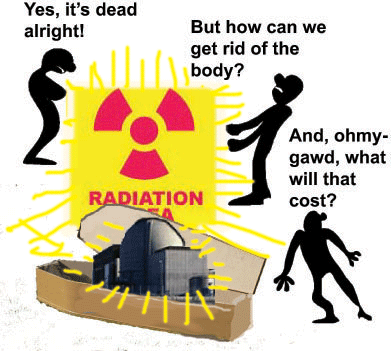
Funding gap for nuclear decommissioning in Bulgaria, Lithuania and Slovakia
Defects in the EU’s nuclear decommissioning programmes in Bulgaria, Lithuania and Slovakia include cost overruns, delays, lack of coordination and supervision, diffused responsibilities, too much money going to unrelated energy projects and ill-informed priority setting, say Budgetary Control Committee MEPs in a resolution voted on Monday. Continue reading
1 This Month



26 September – International Day for the Total Elimination of Nuclear Weapons


PLEASE OPPOSE HR 8255 AND S.3639 – bills would accelerate satellite deployment, with no environmental review or safeguards – https://ncstd5li.quorum.us/campaign/169331/
To see nuclear-related stories in greater depth and intensity – go to https://nuclearinformation.wordpress.com
-
Archives
- September 2026 (257)
- August 2026 (330)
- July 2026 (355)
- June 2026 (287)
- May 2026 (306)
- April 2026 (356)
- March 2026 (251)
- February 2026 (267)
- January 2026 (308)
- December 2025 (358)
- November 2025 (359)
- October 2025 (375)
-
Categories
- 1
- 1 NUCLEAR ISSUES
- business and costs
- climate change
- culture and arts
- ENERGY
- environment
- health
- history
- indigenous issues
- Legal
- marketing of nuclear
- media
- opposition to nuclear
- PERSONAL STORIES
- politics
- politics international
- Religion and ethics
- safety
- secrets,lies and civil liberties
- spinbuster
- technology
- Uranium
- wastes
- weapons and war
- Women
- 2 WORLD
- ACTION
- AFRICA
- Atrocities
- AUSTRALIA
- Christina's notes
- Christina's themes
- culture and arts
- Events
- Fuk 2022
- Fuk 2023
- Fukushima 2017
- Fukushima 2018
- fukushima 2019
- Fukushima 2020
- Fukushima 2021
- general
- global warming
- Humour (God we need it)
- Nuclear
- RARE EARTHS
- Reference
- resources – print
- Resources -audiovicual
- Weekly Newsletter
- World
- World Nuclear
- YouTube
-
RSS
Entries RSS
Comments RSS

