“Background Radiation” – a favourite lie of the nuclear lobby
 Fake Science Alert: Fukushima Radiation Can’t Be Compared to Bananas or X-Rays,Zero Hedge, April 2013
“…….Most “Background Radiation” Didn’t Exist Before Nuclear Weapons Testing and Nuclear Reactors
Nuclear apologists also pretend that we get a higher exposure from background radiation (when we fly, for example) and or x-rays then we get from nuclear accidents.
In fact, there was exactly zero background radioactive cesium or iodine before above-ground nuclear testing and nuclear accidents started.
Wikipedia provides some details on the distribution of cesium-137 due to human activities:
Small amounts of caesium-134 and caesium-137 were released into the environment during nearly all nuclear weapon tests and some nuclear accidents, most notably the Chernobyl disaster.Caesium-137 is unique in that it is totally anthropogenic. Unlike most other radioisotopes, caesium-137 is not produced from its non-radioactive isotope, but from uranium. It did not occur in nature before nuclear weapons testing began. By observing the characteristic gamma rays emitted by this isotope, it is possible to determine whether the contents of a given sealed container were made before or after the advent of atomic bomb explosions. This procedure has been used by researchers to check the authenticity of certain rare wines, most notably the purported “Jefferson bottles”.
As the EPA notes:
Cesium-133 is the only naturally occurring isotope and is non-radioactive; all other isotopes, including cesium-137, are produced by human activity.
Similarly, iodine-131 is not a naturally occurring isotope. As the Encyclopedia Britannica notes: (Fukushima has spewed much more radioactive cesium and iodine than Chernobyl. The amount of radioactive cesium released by Fukushima was some 20-30 times higher than initially admitted. Japanese experts say that Fukushima is currently releasing up to 93 billion becquerels of radioactive cesium into the ocean each day. And the cesium levels hitting the west coast of North America will keep increasing for several years. Fukushima is still spewing radiation into the environment, and the amount of radioactive fuel at Fukushima dwarfs Chernobyl.)
As such, the concept of “background radiation” is largely a misnomer. Most of the radiation we encounter today – especially the most dangerous types – did not even exist in nature before we started tinkering with nuclear weapons and reactors. In a sense, we are all guinea pigs ……. http://www.zerohedge.com/contributed/2013-04-01/fake-science-alert-fukushima-radiation-can%E2%80%99t-be-compared-bananas-or-x-rays
Texas new rules for medical radiation starting May 1st
 New Texas radiation rule takes effect May 1 By Eric Barnes, AuntMinnie.com staff writer March 28, 2013 — Hoping to avoid the rash of radiation overexposures that shook California radiology like an earthquake a few years back, the state of Texas has decided to implement its own radiation exposure rule beginning May 1.
Unlike the California law, however, Texas will administer its new  regime as an administrative directive by the Texas Department of State Health Services (DSHS).
Texas Administrative Code rule §289.227 includes guidelines for radiation reporting, training personnel, and establishing acceptable dose thresholds, Continue reading
Global warming as the cause of harsher winters
Global warming cause of harsher winters? http://main.omanobserver.om/node/158846, 30 March 2013 By  Richard Ingham and Claire Snegaroff — Millions of people in northern Europe are still battling snow and ice, wondering why they are being punished with bitter cold when — officially — spring has arrived and Earth is in the grip of global warming. Yet some scientists, eyeing the fourth year in a row of exceptionally harsh late-winter weather in parts of Europe and North America, suggest warming is precisely the problem. Continue reading
Nuclear lobby’s disinformation campaign neglects “internal” radiation emitters
Their first piece of disinformation is to confuse the effects of external and internal radiation.
Entering the body, these elements – called internal emitters – migrate to specific organs such as the thyroid, liver, bone, and brain, continuously irradiating small volumes of cells with high doses of alpha, beta and/or gamma radiation, and over many years often induce cancer.

Fukushima: Nuclear Apologists Play Shoot the Messenger on Radiation Dr Helen Caldicott global research.ca March 15th, 2013 “………Their first piece of disinformation is to confuse the effects of external and internal radiation. The former is what populations were exposed to when atomic bombs were detonated over Hiroshima and Nagasaki in 1945.
Internal radiation, by contrast, emanates from radioactive elements that enter the body by inhalation, ingestion, or by skin absorption. The grave effects of internal emitters are of the most profound concern at Fukushima – as indeed they continue to be at Chernobyl.
It is erroneous and misleading to use the term ”acceptable levels of external radiation” in assessing internal radiation doses. To do so is to propagate inaccuracies and to mislead the public worldwide and journalists who are seeking the truth about radiation’s hazards. Continue reading
Poop protection against ionising radiation!
 Mars Mission to use astronaut feces as radiation shield
http://www.financialexpress.com/news/mars-mission-to-use-astronaut-feces-as-radiation-shield/1082496/2#sthash.4CxWh740.dpuf-
LONDON, MAR 03 2013, Astronauts onboard a privately-funded expedition
to Mars in 2018 will use their own feces to protect themselves against
cosmic radiation. Continue reading
Fukushima nuclear reactors: water pumped in just leaks out
 The melted core cracked the containment vessel, there really is no containment. So as soon as they pump the water in it leaks out again.
Loss of containment of nuclear fuel also exists within the spent fuel pools at Fukushima.
Fukushima Daiichi Reactor 3 Spent Fuel Pool – Fuel racks where refueling  machine mast rests http://www.youtube.com/watch?v=A3A1YA1lt8k&feature=player_embedded
Nuclear Expert: “The Melted Core Cracked The Containment Vessel ” There Really Is No Containment” At Fukushima Reactors http://www.opednews.com/articles/Nuclear-Expert–The-Melte-by-G-Washington-130302-594.html Nuclear Cores and Spent Fuel Pools Have Both Lost Containment Steven Starr – Director of the Clinical Laboratory Science Program at theUniversity of Missouri/Senior Scientist at Physicians for Social Responsibility – said :
The Japanese basically lied about what happened with the reactors for months. They said they were trying to prevent a meltdown, when in fact they knew within the first couple of days Reactors 1, 2, and 3 at Fukushima Daiichi had melted down, and they actually melted through the steel containment vessels.
So there was a worst case scenario that they were trying to hide, they even knew that at that time enormous amounts of radiation were released over Japan and some of it even went over Tokyo […] Continue reading
Deadly and powerful lies minimise the true health effects of the Chernobyl nuclear disaster
 “The entire cover-up of the effects of radiation hinges on Chernobyl. This was the most substantial release of radiation into the environment before Fukushima. Verified health effects will accurately depict the true hazard of man-made radiation released amidst populations. This is why Chernobyl effects have to be covered up by [the nuclear establishment by] any and every means”
Powerful Lies – The Fukushima Nuclear Disaster And The Radioactive Effects On Human Health By Richard Wilcox PhD 2-22-13 Rense.com,“Even one atom of uranium undergoing alpha decay has the potential for creating a fatal cancer.” – Paul Zimmerman, A Primer in the Art of Deception (1; p. 53)
“When a well-packaged web of lies has been sold gradually to the masses over generations, the truth will seem utterly preposterous, and its speaker a raving lunatic.” – Dresden James (2)
“It ain’t what we don’t know that causes all the trouble, it’s what we do know that ain’t so.” – a saying from Jim in Texas (Ibid.)
“The first rule of holes: when you’re in one, stop digging.” – Molly Ivins (3)
The Trouble We Are In Continue reading
STOP THE GREAT LAKES NUCLEAR DUMP FACT SHEET
1. Ontario Power Generation (OPG), a multi-billion dollar corporation wholly owned by the Province of Ontario, plans to build a nuclear waste dump at the Bruce Nuclear Power Plant site, Municipality of Kincardine, Ontario “located approximately 1 km inland from the shore of Lake Huron at the surface and more than 400 metres below the deepest near-site point of Lake Huron.” http://tinyurl.com/arc34y2 , page 55 OPG owns all Ontario’s nuclear plants and all radioactive nuclear waste created.
2. Low and intermediate level radioactive nuclear waste will be buried in the nuclear waste dump. Intermediate level nuclear wastes are highly radioactive and many remain toxic for over 100,000 years. Some are as dangerous as nuclear spent fuel. No scientist or geologist can provide a 100,000 year guarantee that this nuclear waste dump will not leak. Continue reading
At Hanford – 200 square miles of radioactively polluted groundwater
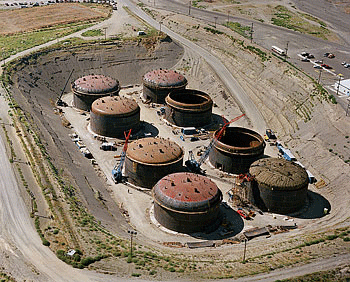 Millions of dollars and labor hours are being spent moving nuclear waste from bad tanks into good tanks. Then millions more will be spent on vitrification. But single-shell or double shell, peanut butter or glass, it will still be nuclear waste. There is no getting rid of it. There is only finding more convenient, less uncomfortable ways to deal. .
At The Hanford Nuclear Reservation, A Steady Drip Of Toxic Trouble by Eric Nusbaum Feb 24, 2013 Eric Nusbaum tours the largest environmental cleanup operation the United States government has ever undertaken. “……There are 200 square miles of contaminated groundwater under Hanford. Every day that water moves closer to the Columbia River. Not coincidentally, there are also 177 massive storage tanks on the site, each built to hold between 55,000 and more than 100,000 gallons of nuclear waste.
Our first stop was at one of these tanks, which, even in the middle distance, was ominous and metallic and looked sort of like a giant industrial-sized swimming pool. Continue reading
How Radiation Affects Life
Powerful Lies – The Fukushima Nuclear Disaster And The Radioactive Effects On Human Health By Richard Wilcox PhD 2-22-13 Rense.com,
|
|
“…….The nuclear establishment would prefer the general public believe that nuclear radiation is essentially nothing to be concerned with. However, their own science and words belie the rhetoric. The Cult of Nuclearists have billions of dollars to devote to propaganda whereas the Nuclear Truth Tellers (NTTers) are marginalized by a whole host of economic and political tricks. One of the trump cards that the Nuclearists hold is that understanding the science of radiation effects when presented in an intentionally confusing way to mislead is beyond the capabilities of the average person to grasp, and that they have no other choice than to trust the experts. Fortunately there is a large body of literature that debunks the nuclear industry’s powerful lies. Continue reading
New 3D mammography increases risks of breast cancer
New 3-D Mammography is Basically a CT Scan for Breasts
The procedures give women twice as much radiation as a standard mammogram
New 3D Mammography Significantly Increases Radiation Exposure, and Your Risk of Radiation-Induced Cancer Mercola.com February 19, 2013 By Dr. Mercola
Breast cancer is big business, and mammography is one of its primary profit centers. This is why the industry is fighting tooth and nail to keep it, by downplaying or outright ignoring its significant risks.
In the US, women are still urged to get an annual mammogram starting at the age of 40, completely ignoring the updated guidelines set forth by the U.S. Preventive Services Task Force in 2009.
Unfortunately, many women are completely unaware that the science simply does not back up the use of routine mammograms as a means to prevent breast cancer death.
As was revealed in a 2011 meta-analysis by the Cochrane Database of Systemic Reviews, mammography breast cancer screening led to 30 percent overdiagnosis and overtreatment, which equates to an absolute risk increase of 0.5 percent.
There’s also the risk of getting a false negative, meaning that a life-threatening cancer is missed. Continue reading
Radiation situation at Fukushima is unimaginably bad
 No workers were visible around the No. 3 reactor building. An unmanned crane was removing debris on the roof.
It is hazardous to human health to work in the reactor building where
radiation levels range from 20 to 100 millisieverts per hour.
The amount of radioactive water stored in tanks and other facilities
rose to 230,000 tons this month, up from 10,000 tons in July 2011.
In addition, an estimated 100,000 tons of water have accumulated in
the basements of buildings.
Decommissioning will not be completed for the next 30 to 40 years
High radiation bars decommissioning of Fukushima plant Asahi Shimbun,
February 21, 2013
By HISASHI HATTORI/ Senior Staff Writer
Preparations for the mammoth task of decommissioning crippled reactors
at the Fukushima No. 1 nuclear power plant are being stymied by
continued high levels of radiation from the triple meltdowns there two
years ago.
Tokyo Electric Power Co., operator of the plant, has had to install
more tanks to store radioactive water, which continues to swell by
several hundreds of tons daily.
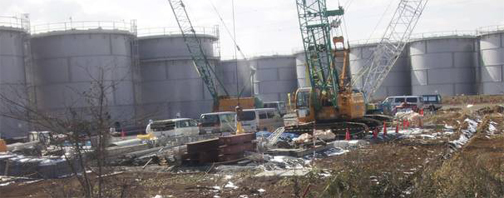
Asahi Shimbun reporters entered the No. 4 reactor building on Feb. 20,
accompanied by inspectors from the secretariat of the Nuclear
Regulation Authority, to assess the situation….. Continue reading
Germany’s nuclear waste nightmare- the Gorleben salt mines
Abyss of Uncertainty: Germany’s Homemade Nuclear Waste Disaster Spiegal online, By Michael Fröhlingsdorf, Udo Ludwig and Alfred Weinzier, 21 Feb 13, Some 126,000 barrels of nuclear waste have been dumped in the Asse II salt mine over the last 50 years. German politicians are pushing for a law promising their removal. But the safety, technical and financial hurdles are enormous, and experts warn that removal is more dangerous than leaving them put……
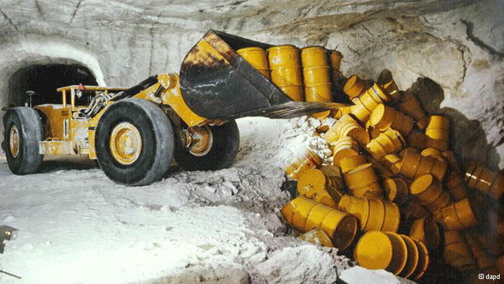
Germany’s Federal Office for Radiation Protection (BfS) has been responsible for Asse since 2009. This is an agency that was originally founded to monitor things such as the safety of workers in nuclear research facilities. In early 2010, the federal government ordered the BfS to assess whether the radioactive waste in the Asse mine can be retrieved. The agency estimated that it would take three years to prepare the project. Most recently, the BfS said it would need 10 years for the fact-finding phase alone.
The BfS still has no detailed concept for the retrieval, no timetable, no script that maps out the technical procedures. It’s essentially a flight by the seat of the pants, and problems are encountered for which no solutions have been found anywhere in the world…. Continue reading
Low level radiation and bone cancer
 Study: Low radiation levels in atomic bomb survivors could lead to soft-tissue sarcomahttp://www.healio.com/orthopedics/oncology/news/online/%7BF99DF823-6823-4E35-B0A7-53720A8B6195%7D/Study-Low-radiation-levels-in-atomic-bomb-survivors-could-lead-to-soft-tissue-sarcoma Samartzis D. J Bone Joint Surg Am. 2013. February 15, 2013 New results from the prospective, longitudinal Life Span Study of Japanese atomic bomb survivors from Hiroshima and Nagasaki show that low levels of exposure to ionizing radiation may result in soft-tissue sarcoma, and 1 Gy doses nearly doubled the survivors’ sarcoma risk.
“Our study attempts to raise awareness that even moderate levels of ionizing radiation exposure—from medical imaging, radiation therapy, and environmental exposure—can lead to the development of soft-tissue sarcomas,” orthopedic surgeon Dino Samartzis, DSc, MSc, and colleagues wrote in the study.Among 80,180 survivors they analyzed, researchers identified 104 soft-tissue sarcomas, with 4.1 cases observed every 100,000 person-years. The survivors were analyzed against a control group with <0.005 Gy average radiation exposure. Most survivors with sarcoma were diagnosed with leiomyosarcomas (37 cases) or malignant fibrous histiocytomas (11 cases).
The survivors were aged 26.8 years, mean, at the time of the bombings and were diagnosed at age 63.6 years mean, with the majority of cases seen in the uterus or stomach. Though 27 sarcoma cases were confirmed at autopsy and two cases by death certificate, the difference in radiation exposure for these individuals and those diagnosed while still living were not significant.
US service personnel affected by Fukushima radiation – but now “on their own”
Fukushima Rescue Mission Lasting Legacy: Radioactive Contamination of Americans, New Jersey News, 31 JANUARY 2013 BY ROGER WITHERSPOON
The Department of Defense has decided to walk away from an unprecedented medical registry of nearly 70,000 American service members, civilian workers, and their families caught in the radioactive clouds blowing from the destroyed nuclear power plants at Fukushima Daiichi in Japan.
The decision to cease updating the registry means there will be no way to determine if patterns of health problems emerge among the members of the Marines, Army, Air Force, Corps of Engineers, and Navy stationed at 63 installations in Japan with their families. In addition, it leaves thousands of sailors and Marines in the USS Ronald Reagan Carrier Strike Group 7 on their own when it comes to determining if any of them are developing problems caused by radiation exposure. Continue reading
1 This Month



26 September – International Day for the Total Elimination of Nuclear Weapons


PLEASE OPPOSE HR 8255 AND S.3639 – bills would accelerate satellite deployment, with no environmental review or safeguards – https://ncstd5li.quorum.us/campaign/169331/
To see nuclear-related stories in greater depth and intensity – go to https://nuclearinformation.wordpress.com
-
Archives
- September 2026 (257)
- August 2026 (330)
- July 2026 (355)
- June 2026 (287)
- May 2026 (306)
- April 2026 (356)
- March 2026 (251)
- February 2026 (267)
- January 2026 (308)
- December 2025 (358)
- November 2025 (359)
- October 2025 (375)
-
Categories
- 1
- 1 NUCLEAR ISSUES
- business and costs
- climate change
- culture and arts
- ENERGY
- environment
- health
- history
- indigenous issues
- Legal
- marketing of nuclear
- media
- opposition to nuclear
- PERSONAL STORIES
- politics
- politics international
- Religion and ethics
- safety
- secrets,lies and civil liberties
- spinbuster
- technology
- Uranium
- wastes
- weapons and war
- Women
- 2 WORLD
- ACTION
- AFRICA
- Atrocities
- AUSTRALIA
- Christina's notes
- Christina's themes
- culture and arts
- Events
- Fuk 2022
- Fuk 2023
- Fukushima 2017
- Fukushima 2018
- fukushima 2019
- Fukushima 2020
- Fukushima 2021
- general
- global warming
- Humour (God we need it)
- Nuclear
- RARE EARTHS
- Reference
- resources – print
- Resources -audiovicual
- Weekly Newsletter
- World
- World Nuclear
- YouTube
-
RSS
Entries RSS
Comments RSS

