Serious worries about safety of Iran’s Bushehr nuclear power plant.
 Another Cause for Alarm in Iran’s Nuclear Program:
  Earthquakes, The Atlantic, Jill Keenan, 18 April 13, The country’s nuclear power plant is built near tectonic plates, and reports show it may not be safe in the event of a major seismic event. On April 16, a massive 7.8-magnitude earthquake hit southeast Iran, sending tremors across the region and causing casualties that are expected to reach into the hundreds. According to an Iranian official , it was the biggest earthquake to hit the country in 40 years. This devastation comes only one week after another earthquake hit the town of Kaki, also in southern Iran, killing at least 37 people and injuring more than 850 others. Shockwaves from both earthquakes were felt as far away as Bahrain, Kuwait, Qatar, the UAE, and western Saudi Arabia. They are only the two most recent in a series of earthquakes that regularly haunt this seismically unstable country.
Most ominously, the epicenter of the April 9 earthquake’s first tremor, which measured a 6.3 on the Richter scale, was centered only 62 miles away from Iran’s Bushehr nuclear power plant. Continue reading
Muslumovo, a town radioactively poisoned for 60 years
Soviet radiation biology took a different trajectory from science in the United States. American researchers at that time were working with the highly politicized medical studies of Japanese bomb survivors. They narrowed the list of radiation-related illnesses to leukemia, a few cancers, and thyroid disease. Soviet doctors in formulating chronic radiation syndrome had grasped the effects of radiation on the body more holistically. They determined that radiation illness is not a specific, stand-alone disorder, but that its indications relate to other illnesses. They determined that radioactive isotopes weaken immune systems and damage organ tissue and arteries, causing illnesses of the circulation and digestive tracts and making people susceptible to conventional diseases long before they succumb to radiation-related cancers.
 Strange illnesses in one of the most contaminated towns in the world challenge what we think we know about the dangers of radioactivity. Slate, By Kate Brown, April 18, 2013, ”…… the sad fact is that there are irradiated zones that are fully inhabited, and have been since the first years of the nuclear arms race. Despite a media culture enthralled with nuclear accidents, the cameras generally turn off after the first clouds of radioactive vapors dissipate.
“………..For Soviet leaders, the river dwellers were a unique opportunity in the history of health physics—what scientists call “a natural experiment” that promised to answer an important civil defense question about how to survive a nuclear attack. In 1962, the Cheliabinsk branch of the Soviet Institute of Bio-Physics, called FIB-4, started conducting regular medical exams of the Muslumovo population. FIB-4 doctors invited village children playing on the streets to a clinic room to take blood samples. In Cheliabinsk, they set up a repository of irradiated body parts: hearts, lungs, livers, bones. They started a collection of genetically malformed babies who died soon after birth, each infant preserved in a two-quart glass jar. A Dutch photographer, Robert Knoth, visited the repository and saw hundreds of babies in jars. He photographed one infant with skin like patched, rough burlap. Another boy had eyes on top of his head like a frog. During the examinations, doctors did not inform the villagers of their exposures or of diagnoses of radiation-related illness.
In 1986, soon after the Chernobyl disaster, Glufarida Galimova, working as chief doctor at a pediatric clinic in Muslumovo, her native town, was puzzled by the saturation of illness in her community. The illnesses were rare, strange, complex, and often genetic: hydrocephalic children, children with cerebral palsy, missing kidneys, extra fingers, anemia, fatigue, and weak immune systems. Many kids were orphaned or had invalid parents. Continue reading
Fukushima radiation brings hypothyroidism to babies on USA West coast
 Study: Fukushima radiation fallout has devastated health of US babies on West Coast and in other areas http://www.naturalnews.com/039923_Fukushima_radiation_hypothyroidism.html#ixzz2Qr6W6hxg April 15, 2013 by: Jonathan Benson, staff writer New peer-reviewed research published in the Open Journal of Pediatrics raises fresh concerns about the health effects of the Fukushima Daiichi nuclear disaster on American children and babies. As has long been suspected by those with an understanding of the widespread reach of radioactive fallout from Fukushima, newborns living in California, Hawaii, Washington, and other West Coast states appear to have been directly affected by Fukushima fallout in a serious way, which is reflected by the disproportionate rate of hypothyroidism observed amongst this demographic.
Conducted by a duo of scientists from the Radiation and Public Health Project, a non-profit education and scientific organization that seeks to understand the relationship between nuclear radiation exposure and public health, the research evaluated average rates of hypothyroidism both before and after the Fukushima disaster. In their findings, Joseph J. Mangano and Janette D. Sherman reported that, compared to one year earlier, babies born between one week and 16 weeks after the nuclear meltdowns in Alaska, California, Hawaii, Oregon, and Washington were 28 percent more likely to suffer from congenital hypothyroidism.
2,110 percent increase in iodine-131 on US West Coast following Fukushima linked to hypothyroidism Each of these states and the Pacific Ocean, according to the study, experiences significantly elevated levels of radioactive iodine-131 (I-131), as well as various other radioactive isotopes, in the days and weeks following the March 11, 2011, disaster. Based on the data, the 2,110 percent increase in detectable I-131 all along the U.S. West Coast following the disaster appears to be directly correlated with the higher-than-average rates of congenital hypothyroidism. Continue reading
Inhuman radiation experiements on citizens, by USA government
 Contaminated Nation. Inhuman Radiation
 Experiments, CounterPunch, by JOHN LaFORGE, 12 Aprl 13, This year marks the 20th anniversary of the declassification of top secret studies, done over a period of 60 years, in which the US conducted 2,000 radiation experiments on as many as 20,000 vulnerable US citizens.[i] Continue reading
403 containers of highly radioactive waste to be dumped in Nevada
 DOE finalizing plans to dump man-made uranium in Nevada, Fox News, By Barnini Chakraborty April 12, 2013 WASHINGTON – A Department of Energy plan to drag hundreds of canisters of radioactive nuclear material into the Nevada desert for a “shallow land burial” is raising safety concerns as experts worry what could happen if the security of the bomb-making material were compromised. Energy officials told FoxNews.com the department is preparing to ship 403 welded steel containers of a man-made highly radioactive cargo to the Nevada National Security Site, about an hour northwest of Las Vegas. Continue reading
USA citizens exposed to experimental ionising radiation
 Contaminated Nation. Inhuman Radiation Experiments, CounterPunch, by JOHN LaFORGE, 12 Aprl 13 “………Experiments Spread Cancer Risks Far and Wide In large scale experiments as late as 1985, the Energy Department deliberately produced reactor meltdowns which spewed radiation across Idaho and beyond.[x] The Air Force conducted at least eight deliberate meltdowns in the Utah desert, dispersing 14 times the radiation released by the partial meltdown of Three Mile Island in Pennsylvania in 1979.[xi]
The military even dumped radiation from planes and spread it across wide areas around and downwind of Oak Ridge, Tenn., Los Alamos, New Mexico, and Dugway, Utah. This “systematic radiation warfare  program,” conducted between 1944 and 1961, was kept secret for 40 years.[xii]
“Radiation bombs” thrown from USAF planes intentionally spread radiation “unknown distances” endangering the young and old alike. One such experiment doused Utah with 60 times more radiation than escaped the Three Mile Island accident, according to Sen. John Glen, D-Ohio who released a report on the program 20 years ago.[xiii]
The Pentagon’s 235 above-ground nuclear bomb tests, and the atomic bombings of Hiroshima and Nagasaki, are not officially listed as radiation experiments. Yet between 250,000 and 500,000 U.S. military personnel were contaminated during their compulsory participation in the bomb tests and the post-war occupation of Japan. [xiv]
Documents uncovered by the Advisory Committee show that the military knew there were serious radioactive fallout risks from its Nevada Test Site bomb blasts. The generals decided not to use a safer site in Florida, where fallout would have blown out to sea. “The officials determined it was probably not safe, but went ahead anyway,” said Pat Fitzgerald a scientist on the committee staff.[xv]
Dr. Gioacchino Failla, a Columbia University scientist who worked for the AEC, said at the time, “We should take some risk… we are faced with a war in which atomic weapons will undoubtedly be used, and we have to have some information about these things.”[xvi]
With the National Cancer Institute’s 1997 finding that all 160,000 million US citizens (in the country at the time of the bomb tests) were contaminated with fallout, it’s clear we did face war with atomic weapons — our own. http://www.counterpunch.org/2013/04/12/inhuman-radiation-experiments/
Radiation dangers to surgeons performing fluoroscopy procedures
Surgeons reach radiation limits with 291 PELDs per year http://medicalxpress.com/news/2013-04-surgeons-limits-pelds-year.html#jCp April 12, 2013 Surgeons performing minimally invasive transforaminal percutaneous endoscopic lumbar discectomy, involving fluoroscopy, are exposed to the maximum allowable radiation dose after 291 procedures performed without protective shielding, according to a study published in the April 1 issue of Spine. Continue reading
UK greatly underestimated nuclear decommissioning costs
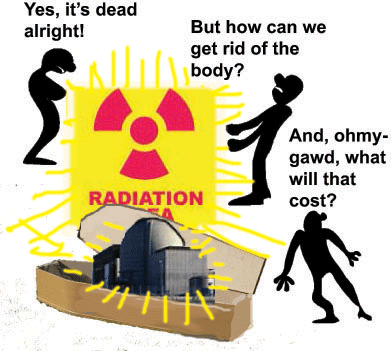 Public Accounts Committee – Thirty-Seventh Report HM Treasury: Whole of Government Accounts 2010-11 HM Treasury: Whole of Government Accounts 2010-11 – Public Accounts Committee Contents
http://www.publications.parliament.uk/pa/cm201213/cmselect/cmpubacc/867/86706.htm
11 April 2013 “…… The C&AG’s report on the 2010-11 WGA shows the Nuclear Decommissioning Authority’s estimated cost of civil nuclear decommissioning increased by around £16 billion to £53 billion between 2007 and 2011. We asked the Treasury how the WGA would be used to influence any decision made in relation to future investments in the nuclear sector. The Treasury acknowledged that not considering these costs when the power stations were built had been a mistake, and considered that the critical issue was to factor in these costs in future, so that the taxpayer would not be burdened with unexpected additional costs of £60 billion.[ http://uk.groups.yahoo.com/group/Claverton/message/10673
The danger in radioactive iodine
 Radiation Is Not On People’s Radar, Dr. Mark Sircus, Activist Post, 9 April 13, “……….Iodine in the Air The risks associated with iodine-131 contamination in Europe were not “negligible,” after Fukushima exploded in 2011, according to CRIIRAD, a French research body on radioactivity. They advised at that time for pregnant women and infants against “risky behavior,” such as consuming fresh milk or vegetables with large leaves. In response to thousands of inquiries from citizens concerned about fallout from the Fukushima nuclear disaster in Europe, CRIIRAD has compiled an information package on the risks of radioactive iodine-131 contamination in Europe.
CRIIRAD said it had detected radioactive iodine-131 in rainwater in south-eastern France. In parallel testing, the French Institute for Radiological Protection and Nuclear Safety (IRSN), the national public institution monitoring nuclear and radiological risks, found iodine 131 in milk. In normal times, no trace of iodine-131 should be detectable in rainwater or milk. Radiation monitors in Canada, in Ontario, New Brunswick and British Columbia also detected radioactive iodine.
In the United States the 2011 EPA data showed rising levels of Iodine-131, Cesium-134, and Cesium-137 up to 300% of maximum limits. Hawaii milk samples showed radiation 800% above normal for Cesium-134, 633% for Cesium-137, and 600% for Iodine-131. Continue reading
TEPCO on a tightrope in attempt to move tons of radioactive water
 Japan nuclear safety plans too lax for crowded, quake-prone nation, say nuclear experts The Star, By: Mari Yamaguchi The Associated Press,Apr 08 2013 TOKYO
“…….TEPCO is moving tons of highly radioactive water from the temporary tanks to two similar ones nearby to minimize the leak. They are among seven underground tanks of different sizes which employ the same design.
TEPCO admitted Sunday it had dismissed earlier signs of water loss as within a margin of error and waited until a spike in radiation levels around the tanks was detected. Critics suspect cash-strapped TEPCO built poorly designed underground pits instead of safer and more manageable steel tanks to save money. TEPCO has also been criticized for delaying replacement of makeshift equipment, raising questions about whether the plant is really under control.
The underground tanks, several times the size of an Olympic swimming pool and similar to an industrial waste dump, are dug directly into the ground and protected by double-layer polyethylene linings inside an outermost clay-based lining, with a felt padding between each layer. Officials suspect there were ruptures in the linings due to the weight of the water.
Contaminated water at the plant, which suffered multiple meltdowns after the 2011 disaster, has escaped into the sea several times during the crisis. Experts suspect a continuous leak into the ocean through an underground water system, citing high levels of contamination in fish caught in waters just off the plant.
The contaminated water in the tanks is part of more than 270,000 tons of water used to cool melted fuel at the plant’s reactors damaged in the disaster. So much water has been used that TEPCO is struggling to find storage space. The water is also kept in hundreds of steel tanks.
NRA commissioner Toyoshi Fuketa told reporters Monday that the water leak poses a more immediate threat to the plant’s water management than to the environment. He questioned TEPCO’s risk evaluation in the tanks’ design process, but acknowledged that regulators have to allow TEPCO to use the remaining underground tanks for now.
“Although we need more long-term plans, we have to tackle the most immediate problem first. TEPCO’s decommissioning process is a tightrope situation to begin with,” he said. http://www.thestar.com/news/world/2013/04/08/japan_nuclear_safety_plans_too_lax_for_crowded_quakeprone_nation_say_nuclear_experts.html
Caldicott Versus The Nuclear Industry – an impressive symposium
 Conference Highlights Fukushima Consequences http://rense.com/general95/confhigh.htm By Richard Wilcox Ph.D.
4-6-13 ”….Caldicott Versus The Nuclear IndustryLong time activist and medical doctor, Helen Caldicott, recently assembled some of the world’s top experts to enlighten us about the situation:
“The Medical and Ecological Consequences of the Fukushima Nuclear Accident,” a two-day conference is now posted onlinehttp://www.totalwebcasting.com/view/?id=hcf#
Internal radiation emitters – cesium and iodine – far more dangerous than external exposure
Risk from internal exposure is 200-600 times greater than risk from external exposure. See this, this, this and this.
cesium-137 and radioactive iodine – the two main radioactive substances being spewed by the leaking Japanese nuclear plants – are not naturally-occurring substances, and can become powerful internal emitters which can cause tremendous damage to the health of people who are unfortunate enough to breathe in even a particle of the substances, or ingest them in food or water.

Fake Science Alert: Fukushima Radiation Can’t Be Compared to Bananas or X-Rays http://www.zerohedge.com/contributed/2013-04-01/fake-science-alert-fukushima-radiation-can%E2%80%99t-be-compared-bananas-or-x-rays George Washington 04/01/2013
“….Mixing Apples (External) and Oranges (Internal) Moreover, radioactive particles which end up inside of our lungs or gastrointestinal track, as opposed to radiation which comes to us from outside of our skin are much more dangerous than general exposures to radiation.
The National Research Council’s Committee to Assess the Scientific Information for the Radiation Exposure Screening and Education Program explains:
Radioactivity generates radiation by emitting particles. Radioactive materials outside the the body are called external emitters, and radioactive materials located within the body are called internal emitters.
Internal emitters are much more dangerous than external emitters. Specifically, one is only exposed to radiation as long as he or she is near the external emitter.
For example, when you get an x-ray, an external emitter is turned on for an instant, and then switched back off.
But internal emitters steadily and continuously emit radiation for as long as the particle remains radioactive, or until the person dies – whichever occurs first. As such, they are much more dangerous. Continue reading
Medicine struggles to deal with nuclear radiation -caused illness
 Top Docs’ (Partial) Cure for Nuclear Radiation: Bone-Marrow Drugs http://www.wired.com/dangerroom/2013/04/health-department-nuclear/ BY ROBERT BECKHUSEN 04.04.13
Even if a nuclear bomb exploded far enough away for you to survive the blast, the radiation could still kill you. Now the U.S. government wants to find a cure for one the most vexing causes of radioactive death — starting with your bones.
According to a research solicitation released this week by the Department of Health and Human Services, the department is preparing to spend up to $8 million beginning in 2014 to research ways to treat severe thrombocytopenia — or the loss of cell platelets — caused by excessive radiation poisoning of vital blood-producing organs and tissues like bone marrow and the spleen. Once your organs get blasted with radiation from a catastrophic nuclear detonation, you will likely begin to suffer from internal bleeding and get really sick. Then you’ll die. Continue reading
The very real risk of Hanford nuclear waste tanks exploding
The nuclear safety board warned about the risk of explosion to Wyden, who wanted comment on the safety and operation of Hanford’s tanks, technical issues that have been raised about the design of a plant to treat the waste in those tanks, and Hanford’s overall safety culture.
Hanford Nuclear Waste Tanks Could Explode, Agency Warns http://www.huffingtonpost.com/2013/04/02/hanford-nuclear-waste-could-explode_n_3001134.html?utm_hp_ref=green includes video By SHANNON DININNY 04/02/13 YAKIMA, Wash. — Underground tanks that hold a stew of toxic, radioactive waste at the nation’s most contaminated nuclear site pose a possible risk of explosion, a nuclear safety board said in advance of confirmation hearings for the next leader of the Energy Department.
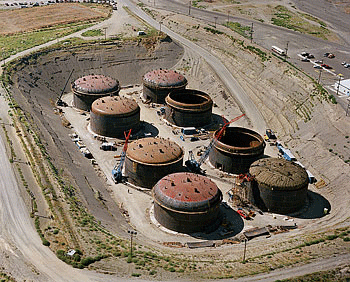
State and federal officials have long known that hydrogen gas could build up inside the tanks at the Hanford Nuclear Reservation, leading to an explosion that would release radioactive material. The Defense Nuclear Facilities Safety Board recommended additional monitoring and ventilation of the tanks last fall, and federal officials were working to develop a plan to implement the recommendation.
The board expressed those concerns again Monday to U.S. Sen. Ron Wyden, D-Ore., who is chairman of the Senate Energy and Natural Resources Committee and had sought the board’s perspective about cleanup at Hanford. Continue reading
Nuclear lobby lies about bananas and radiation
When you eat a banana, your body’s level of Potassium-40 doesn’t increase. You just get rid of some excess Potassium-40. The net dose of a banana is zero.
And that’s the difference between a useful educational tool and propaganda.
 Fake Science Alert: Fukushima Radiation Can’t Be Compared to Bananas or X-Rays , Zero Hedge, George Washington 04/01/2013 Nuclear apologists pretend that people are exposed to more radiation from bananas than from Fukushima.
But the EPA explains:
The human body is born with potassium-40 [the type of radiation found in bananas] in its tissues and it is the most common radionuclide in human tissues and in food. We evolved in the presence of potassium-40 and our bodies have well-developed repair mechanisms to respond to its effects. The concentration of potassium-40 in the human body is constant and not affected by concentrations in the environment.
Wikipedia notes:
The amount of potassium (and therefore of 40K) in the human body is fairly constant because of homeostatsis, so that any excess absorbed from food is quickly compensated by the elimination of an equal amount.It follows that the additional radiation exposure due to eating a banana lasts only for a few hours after ingestion, namely the time it takes for the normal potassium contents of the body to be restored by the kidneys. Continue reading
1 This Month



26 September – International Day for the Total Elimination of Nuclear Weapons


PLEASE OPPOSE HR 8255 AND S.3639 – bills would accelerate satellite deployment, with no environmental review or safeguards – https://ncstd5li.quorum.us/campaign/169331/
To see nuclear-related stories in greater depth and intensity – go to https://nuclearinformation.wordpress.com
-
Archives
- September 2026 (257)
- August 2026 (330)
- July 2026 (355)
- June 2026 (287)
- May 2026 (306)
- April 2026 (356)
- March 2026 (251)
- February 2026 (267)
- January 2026 (308)
- December 2025 (358)
- November 2025 (359)
- October 2025 (375)
-
Categories
- 1
- 1 NUCLEAR ISSUES
- business and costs
- climate change
- culture and arts
- ENERGY
- environment
- health
- history
- indigenous issues
- Legal
- marketing of nuclear
- media
- opposition to nuclear
- PERSONAL STORIES
- politics
- politics international
- Religion and ethics
- safety
- secrets,lies and civil liberties
- spinbuster
- technology
- Uranium
- wastes
- weapons and war
- Women
- 2 WORLD
- ACTION
- AFRICA
- Atrocities
- AUSTRALIA
- Christina's notes
- Christina's themes
- culture and arts
- Events
- Fuk 2022
- Fuk 2023
- Fukushima 2017
- Fukushima 2018
- fukushima 2019
- Fukushima 2020
- Fukushima 2021
- general
- global warming
- Humour (God we need it)
- Nuclear
- RARE EARTHS
- Reference
- resources – print
- Resources -audiovicual
- Weekly Newsletter
- World
- World Nuclear
- YouTube
-
RSS
Entries RSS
Comments RSS

