The horror of the Hiroshima atomic bombing – nuclear effects, theme for June 19
 Who Will Drop the Next Nuclear Bomb? We ignore the ever-growing global arsenal of nuclear weapons at our peril. The Nation, Nick Turse May 13, 2013 “……..Nuclear Horror: Then and Now The first nuclear attack on a civilian population center, the U.S. strike on Hiroshima, left that city “uniformly and extensively devastated,” according to astudy carried out in the wake of the attacks by the U.S. Strategic Bombing Survey. “Practically the entire densely or moderately built-up portion of the city was leveled by blast and swept by fire… The surprise, the collapse of many buildings, and the conflagration contributed to an unprecedented casualty rate.” At the time, local health authorities reported that 60% of immediate deaths were due to flash or flame burns and medical investigators estimated that 15%-20% of the deaths were caused by radiation.
Witnesses “stated that people who were in the open directly under the explosion of the bomb were so severely burned that the skin was charred dark brown or black and that they died within a few minutes or hours,” according to the 1946 report. “Among the survivors, the burned areas of the skin showed evidence of burns almost immediately after the explosion. At first there was marked redness, and other evidence of thermal burns appeared within the next few minutes or hours.”

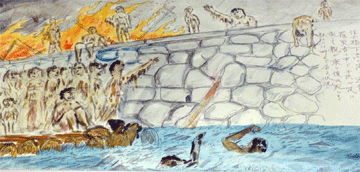 Many victims kept their arms outstretched because it was too painful to allow them to hang at their sides and rub against their bodies. One survivor recalled seeing victims “with both arms so severely burned that all the skin was hanging from their arms down to their nails, and others having faces swollen like bread, losing their eyesight. It was like ghosts walking in procession… Some jumped into a river because of their serious burns. The river was filled with the wounded and blood.”…… http://www.thenation.com/article/174295/who-will-drop-next-nuclear-bomb#
Hanford Nuclear reservation getting ever more dangerous
Hanford Nuclear Cleanup May Be Too Dangerous, Future Of Storage Plant Uncertain http://www.huffingtonpost.com/2013/05/09/hanford-nuclear-cleanup-too-dangerous_n_3246263.html?utm_hp_ref=green | By Valerie Brown 05/09/2013 , Scientific American: (click here for original article)
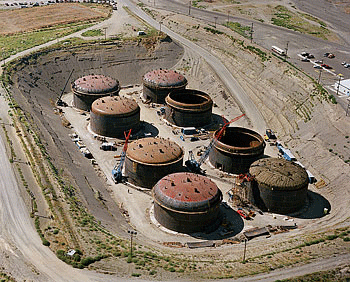
The most toxic and voluminous nuclear waste in the U.S.—208 million liters —sits in decaying underground tanks at the Hanford Site (a nuclear reservation) in southeastern Washington State. It accumulated there from the middle of World War II, when the Manhattan Project invented the first nuclear weapon, to 1987, when the last reactor shut down. The federal government’s current attempt at a permanent solution for safely storing that waste for centuries—the Waste Treatment and Immobilization Plant here—has hit a major snag in the form of potential chain reactions, hydrogen explosions and leaks from metal corrosion. And the revelation last February that six more of the storage tanks are currently leaking has further ramped up the pressure for resolution. Continue reading
Navajo’s continuing fight against nuclear corporations, uranium companies
The Navajo people’s struggle to prevent the re-entry of mining corporations has so far been successful. It is fair to assume that as long as valuable resources remain on Indigenous lands profit-hungry corporations will continue to circle like vultures.
 Navajo Nation battles uranium corporations, nuclear industry Decades of dealing with environmental degradation, racism, Liberation, By Bethany Woody MAY 8, 2013 “……….In early 2013, uranium companies approached the Navajo Nation in hopes they will allow them to renew mining operations on their land. These companies claim that they have developed newer and safer methods for extracting uranium, after decades of environmental destruction and abuse led the Navajo Nation to officially ban their mining. Continue reading
Radioactive waste dumping into the world’s oceans
 Ocean disposal of radioactive waste http://en.wikipedia.org/wiki/Ocean_disposal_of_radioactive_waste#1946-93 April 2013 (Excellent maps)
From 1946 through 1993, thirteen countries (fourteen, if the USSR and Russia are considered separately) used ocean disposal or ocean dumping as a method to dispose of nuclear/radioactive waste. The waste materials included both liquids and solids housed in various containers, as well as reactor vessels, with and without spent or damaged nuclear fuel.[1] Since 1993, ocean disposal has been banned by international treaties. (London Convention (1972), Basel Convention, MARPOL 73/78)
However, according to the United Nations, some companies have been dumping radioactive waste and other hazardous materials into the coastal waters of Somalia, taking advantage of the fact that the country had no functioning government from the early 1990s onwards. This caused health problems for locals in the coastal region and posed a significant danger to Somalia’s fishing industry and local marine life.[2]
“Ocean floor disposal” (or sub-seabed disposal)—a more deliberate method of delivering radioactive waste to the ocean floor and depositing it into the seabed—was studied by the UK and Sweden, but never implemented.[3]…….
9 tons of plutonium yearly from Japan’s Rokkasho nuclear reprocessing plant

Tokyo’s ability to both enrich uranium and reprocess spent reactor
fuel has allowed it to amass roughly nine tons of weapons-usable
plutonium on its soil. Activating the Rokkasho plant would produce
that much each year, said officials and industry experts.
Japan’s Nuclear Plan Unsettles U.S, WSJ, By JAY SOLOMON and MIHO INADA
2 May 13, TOKYO—Japan is preparing to start up a massive nuclear-fuel
reprocessing plant over the objections of the Obama administration,
which fears the move may stoke a broader race for nuclear technologies
and even weapons in North Asia and the Middle East.
The Rokkasho reprocessing facility, based in Japan’s northern Aomori
prefecture, is capable of producing nine tons of weapons-usable
plutonium annually, said Japanese officials and nuclear-industry
experts, enough to build as many as 2,000 bombs, although Japanese
officials say their program is civilian…… Continue reading
Great? Shoot nuclear waste into deep space?
Disposal of Spent Nuclear Fuel and High-level Radioactive Waste
Source: ENVIRON International Corporation
Date: September 10, 2010
This material was prepared at the request of the Blue Ribbon Commission on America’s Nuclear Future (“the BRC”).

Disposal by shooting the wastes into deep space or the sun
Cost and the risk of an accident during launch has kept space disposal from being taken seriously. With the current cost of putting objects in orbit at around $10,000 per pound, and given that the U.S. inventory of spent fuel and high-level waste is of the order of 100,000 metric tons, not including the heavy shielding that would be required, the costs with present technology would be prohibitive, even if the risks of radioactive wastes crashing back to earth could be managed somehow.
But if one wanted to dispose of only the very long-lived waste, e.g., technetium-99, cesium-135, iodine-129, and the long-lived actinides, then the amounts are much more manageable, of the order of a few million kilograms for all current U.S. wastes. […]
USA’s present danger of nuclear spent fuel pools
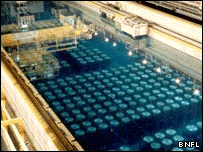 Congress needs to focus on how nuclear waste is stored now By Dave Lochbaum and Robert Cowin, Union of Concerned Scientists – 05/01/13 U.S. nuclear power plants have been generating electricity for more than 50 years, but the nuclear industry and the federal government have yet to figure out what to do with nuclear waste, which remains dangerously radioactive for thousands of years. On April 25, a bipartisan group of senators — Lamar Alexander (R-Tenn.), Dianne Feinstein (D-Calif.), Lisa Murkowski (R-Alaska) and Ron Wyden (D-Ore.) — released draft legislation addressing this intractable problem. Continue reading
Corrupt, useless and weak EPA new guidelines for radiological attacks

while the new guide will be subject to a 90-day public comment period once it formally is published in the Federal Register, it has been labeled for “interim use,” meaning it is effective immediately
“a recipe for absolute mayhem in the midst of an emergency,” “And that’s because of politics.”
EPA RELAXES PUBLIC HEALTH GUIDELINES  FOR RADIOLOGICAL ATTACKS, ACCIDENTS, Next Gov, By Douglas P. GuarinoGlobal Security Newswire April 9, 2013 After years of internal deliberation and controversy, the Obama administration has issued a document suggesting that when dealing with the aftermath of an accident or attack involving radioactive materials, public health guidelines can be made thousands of times less stringent than what the U.S. Environmental Protection Agency would normally allow. Continue reading
Breakthrough in solar energy storage for powering national grids
VIDEO The Lithium-Polysulfide Flow Battery http://www.energymatters.com.au/index.php?main_page=news_article&article_id=3713 29 April 13,
U.S. researchers believe a breakthrough in battery technology will see more utility-scale solar and wind energy powering national grids.
Scientists from the U.S. Department of Energy’s (DOE) SLAC National Accelerator Laboratory and Stanford University have designed a new low-cost flow battery storage system that could solve issues relating to the peaks and troughs in power generation from renewable energy sources.
Flow batteries pump two types of liquid through a chamber, where two streams of dissolving molecules cause a chemical reaction that store or release energy.
They are currently thought to be the most effective way to maintain grid stability because the tanks, pipes and fittings used in flow battery systems can be scaled-up to store power for large-scale solar and wind facilities where energy generation depends on weather conditions.
But today’s flow batteries are expensive – the liquids used often require large quantities of rare earth materials to operate and a special membrane that separates the active and inactive ions. According to the SLAC/Stanford team, with solar and wind heading toward 20 percent of generation capacity, there needs to be a simpler and more efficient flow battery system.
“For solar and wind power to be used in a significant way, we need a battery made of economical materials that are easy to scale and still efficient,” said Yi Cui, Stanford associate professor of materials science and engineering.
Cui’s team designed a new membrane-free battery that does away with rare materials, using a chamber with a single molecular stream of lithium and sulphur ions. A reaction with a catalyst produces lithium polysulfides, discharging energy and absorbing lithium. The lithium ions are then reabsorbed into an organic compound to be used again.
The researchers say the next step is to develop and field test a utility-scale flow battery based on their design capable of handling megawatts of energy storage.
Another flow battery concept we’ve covered in the past utilising cheap and readily available materials is the Rustbelt Flow Battery; which uses iron.
Fukushima radiation- accumulating exposure is the worry
 Experts are most worried about three radioactive substances iodine-131, caesium-134 and caesium-137-all of which can cause various types of cancer years later.
Although the radioactivity in iodine-131 fully disintegrates in 80 days, it can find its way rapidly into people through the air and through milk and leafy vegetables, lodging quickly in the thyroid gland, where it can cause DNA damage and raise cancer risk, particularly in young children. Among the people who were exposed to the Chernobyl accident as children, at least 1,800 have gone on to develop thyroid cancer, a study has found.
Cumulative radiation from Japan’s plant sparks health worries http://www.brecorder.com/top-stories/0/1179391/ April 18, 2011 RECORDER REPORT Japan’s crippled Fukushima Daiichi nuclear plant has so far leaked around a tenth of the amount of radiation released in the Chernobyl disaster, data showed on April 12, leading some experts to warn of serious long-term health risks.
“If that is the total radiation so far from the time of first leakage, that amount is very serious. It’s undoubtedly very bad. That is close to one-tenth of Chernobyl’s radiation in a month,” said Lam Ching-wan, a chemical pathologist at the University of Hong Kong and member of the American Board of Toxicology.
“It means there is damage to soil, ecosystem, water, food and people. People receive this radiation. You can’t escape it by just shutting the window.”With Japan widening the evacuation zone beyond the initial 20-km exclusion zone and encouraging children, pregnant women and hospitalised patients to stay out of some areas 20-30 km from the nuclear complex, Lam said he feared the radiation leakage may still be far from under control. Continue reading
International Atomic Energy Agency not facing up to the facts on Fukushima
IAEA Gives Little Insight To Fukushima Disaster Cleanup http://www.simplyinfo.org/?p=10267 April 24th, 2013 The IAEA visited the Fukushima Daiichi disaster site after multiple failures ended up in the news. They made very few comments from the trip and reaffirmed they think TEPCO can handle the disaster.
 What they did mention:
- It will take more than 40 years to clean up the disaster
- Technology still needs to be created to deal with the task of removing the melted fuel
- Problems and failures at the plant will continue to be an issue
- TEPCO should replace temporary systems with something more permanent and safer
- Contaminated water is expected to seep outside the plant after “decades”
The Japanese government is still intent on sending everyone back to the area as soon as possible.
Sources:
The fallacy of assuming that weapons manufacture creates jobs
America’s War Games How the Obama administration is redefining the US military’s strategic priorities with far-reaching consequences, Aljazeera, 27 April 13 “……. William Hartung, from the Center for International Policy says that Pentagon contractors have “for years used the jobs argument to revive weapons systems that have been cancelled. To push for things that even the Pentagon itself has not wanted.” For months, a study has been circulating in Washington, underwritten by the Aerospace Industries Association, a major defence industry trade group. It claims that a million jobs would be lost as a result of sequestration cuts to defence spending.
Hartung, who has analysed the study, says it exaggerates the potential job loss number by a factor of three, and that many of those jobs will be replaced. He points out that spending on education, health care, and infrastructure “can create 1.5 to 2 times as many jobs. So the economy would be much better off spending on things other than the Pentagon.”
Several recent reports examining ways to cut Pentagon spending call for changes in the US nuclear weapons posture. They claim that it would produce hundreds of billions of dollars of savings in coming decades, and the Obama administration is reportedly considering nuclear weapons cuts. But they will be difficult to achieve.
“People are still mired in Cold War thinking and they feel like the more nuclear weapons we have the better,” Hartung says. “And in addition to that the nuclear weapons industry has some of the biggest strongest companies in the military industrial complex.”
Lockheed Martin builds submarines, launches ballistic missiles, and runs the nuclear weapons laboratories; General Dynamics builds nuclear subs; and Northrop Grumman, Boeing and Lockheed Martin are all hoping to build the next nuclear bomber……http://www.aljazeera.com/programmes/peopleandpower/2013/04/2013424113558268754.html
Effect of global rise in ionising radiation
 Fukushima’s Catastrophic Aftermath: The Dangers of Worldwide Nuclear Radiation, Global Research, By Stephen Lendman 28 April 13, “……Admiral Hyman Rickover (1900 – 1986) was the father of America’s nuclear navy. In January 1982, he told a congressional committee that until a few billion years ago, “it was impossible to have any life on earth.”
“There was so much radiation on earth you couldn’t have any life, fish or anything.” Gradually the amount subsided. “Now, we are creating something which nature tried to destroy to make life possible.”
“Every time you produce radiation, (a) horrible force” is unleashed. “In some cases (it’s) for billions of years, and I think the human race is going to wreck itself.”
“I am talking about humanity. The most important thing we could do is start having an international meeting where we first outlaw nuclear weapons to start off with. Then we outlaw nuclear reactors, too.”
“The lesson for history is when a war starts, every nation will ultimately use whatever weapons are available. That is the lesson learned time and again.” ”
“Therefore, we must expect, if another war, a serious war breaks out, we will use nuclear energy in some form. We will probably destroy ourselves.” Widespread contamination acts in slow motion…..
China definitely keeping “no first nuclear strike” policy
. The original Chinese text is unambiguous and emphatic in its assertion that no first use has been “scrupulously” observed “from the start” and will continue to be “to the end” [始终恪守].
China Still Committed to No First Use of Nuclear Weapons http://allthingsnuclear.org/china-still-committed-to-no-first-use-of-nuclear-weapons/Gregory Kulacki, China project manager and senior analyst April 23, 2013
On April 16, the Chinese Ministry of Defense released a white paper that mentioned Chinese nuclear weapons but did not contain familiar language expressing China’s declaratory policy, particularly that China would never use nuclear weapons first, under any circumstances. This commitment to “no first use” has been a bedrock of Chinese nuclear weapons policy since the announcement was first made in 1964, immediately following China’s first nuclear weapons test. All previous white papers issued by the Chinese Ministry of Defense contained the language.
James Acton suggests the omission indicates China may be abandoning its long-standing commitment to no first use. It doesn’t. Continue reading
Man made corium lava – from Fukushima, toxic for centuries
Wired: ‘Healthy debate’ about location of Fukushima corium — Lava can melt a foot of concrete per hour — Cooling with water may not stop corium flow Title: The Most Dangerous (Man-Made) Lava Flow http://enenews.com/wired-healthy-debate-about-where-fukushima-coriums-are-lava-can-melt-a-foot-of-concrete-per-hour-cooling-with-water-may-not-stop-corium-flow
Source: Wired
Author: Erik Klemetti
Date: April 18, 2013 at 11:45a ET
h/t Room101
Title: The Most Dangerous (Man-Made) Lava Flow
[…] researchers at the Argonne National Lab have created corium in the laboratory […] They found that corium lava can melt upwards of 30 cm (12″) of concrete in 1 hour! This is why it is so important to know if a nuclear reactor accident has gone into true “meltdown” as the corium lava will rapidly melt its way through the inner containment vessels (or more) in a matter of hours unless it can be cooled again.
However, results from these CCI (core-concrete interaction) experiments, suggest that cooling with water may not be sufficient to stop corium from melting the concrete. One thing to remember — much of the melting of concrete during a meltdown occurs within minutes to hours, so keeping the core cool is vital for stopping the corium for breaching that containment vessel.
[…] TEPCO, the Japanese energy company who ran Fukushima Dai’ichi, claims that the corium didn’t breach the outer wall of the containment vessel (although there is a healthy debate about this). […]
So, why is corium so dangerous? Well, even long after the flow has stopped, that lava will be highly radioactive for decades to centuries (along with the surrounding countryside if radioactive material made it out of the containment vessel) as the various radioactive materials in the lava decay. In fact, we don’t even have pictures of the corium lava from Fukushima Dai’ichi due to the high levels of radioactivity near the reactor. […]
1 This Month



26 September – International Day for the Total Elimination of Nuclear Weapons


PLEASE OPPOSE HR 8255 AND S.3639 – bills would accelerate satellite deployment, with no environmental review or safeguards – https://ncstd5li.quorum.us/campaign/169331/
To see nuclear-related stories in greater depth and intensity – go to https://nuclearinformation.wordpress.com
-
Archives
- September 2026 (257)
- August 2026 (330)
- July 2026 (355)
- June 2026 (287)
- May 2026 (306)
- April 2026 (356)
- March 2026 (251)
- February 2026 (267)
- January 2026 (308)
- December 2025 (358)
- November 2025 (359)
- October 2025 (375)
-
Categories
- 1
- 1 NUCLEAR ISSUES
- business and costs
- climate change
- culture and arts
- ENERGY
- environment
- health
- history
- indigenous issues
- Legal
- marketing of nuclear
- media
- opposition to nuclear
- PERSONAL STORIES
- politics
- politics international
- Religion and ethics
- safety
- secrets,lies and civil liberties
- spinbuster
- technology
- Uranium
- wastes
- weapons and war
- Women
- 2 WORLD
- ACTION
- AFRICA
- Atrocities
- AUSTRALIA
- Christina's notes
- Christina's themes
- culture and arts
- Events
- Fuk 2022
- Fuk 2023
- Fukushima 2017
- Fukushima 2018
- fukushima 2019
- Fukushima 2020
- Fukushima 2021
- general
- global warming
- Humour (God we need it)
- Nuclear
- RARE EARTHS
- Reference
- resources – print
- Resources -audiovicual
- Weekly Newsletter
- World
- World Nuclear
- YouTube
-
RSS
Entries RSS
Comments RSS

