URENCO might die, in failing global uranium industry
 one of the more important factors, surely, is the projected value of the MOX itself, which in turn is a function of long term uranium prices—there would be no point in completing the plant and then making the MOX, as opposed to just dumping the plutonium, if uranium will be dirt-cheap as far ahead as one can see.
the fate of the MOX plant is but one indicator of retrenchment in the global nuclear fuels market, post-Fukushima
the Japanese nuclear shut-down, which, the Times went on to note, has reduced global demand for nuclear fuels by close to 10 percent, plus Germany’s planned nuclear exit, have cast a pall that now stretches to New Mexico,
Kentucky, and South Carolina.
Restructuring and Retrenchment in Nuclear Fuels http://spectrum.ieee.org/energywise/energy/nuclear/restructuring-and-retrenchment-in-nuclear-fuels By Bill Sweet 29 May 2013 In 2000, the United States agreed with Russia to get rid of 34 tons of weapons-grade plutonium. To that end, it embarked on construction of a large plant at Savannah River, S.C.,where the plutonium would be mixed with uranium to make so-called mixed oxide fuel (MOX), suitable for use in nuclear power plants.
Buried in the president’s fiscal 2014 budget request is a line sharply cutting funding for the Savannah River MOX plant, which “may be tantamount to killing it,” a former National Nuclear Security Administration official told Arms Control Today. Continue reading
Europe gives cold shoulder to Russia’s nuclear marketing
One of the main reasons that the Baltic NPP project has run aground is that neither investors nor energy importers that Rosatom has approached in Europe have agreed to come on board…..
………The story of the Baltic NPP is an illustrative account of Rosatom’s incapability of landing anything other than rebuffs in Europe, earning trust in the safety of its reactor technology, and winning over foreign investors.
Europe has given a cold shoulder to Rosatom’s brilliant plan to quell its energy security concerns with power streaming from nuclear reactors built in its backyard

 GAZETA.RU: Nuclear failure Gazeta.ru, May 24, 2013 – Moscow’s resigned willingness to consider reduced capacity for the future Baltic Nuclear Power Plant is testimony to the Russian nuclear industry’s failure to overcome criticism it has been facing in the European market, convince potential customers of the reliability of its technologies, or attract foreign investors so it could get a foot in Europe’s door. By Vladimir Slivyak Continue reading
In 1983, nuclear war was only just avoided

While historians have previously noted the high risk of an accidental nuclear war during this period, the new documents make even clearer how the world’s rival superpowers found themselves blindly edging toward the brink of nuclear war through suspicion, belligerent posturing and blind miscalculation.
The USSR and US Came Closer to Nuclear War Than We Thought A series of war games held in 1983 triggered “the moment of maximum danger of the late Cold War.” The Atlantic, DOUGLAS BIRCHMAY 28 2013 An ailing, 69-year-old Yuri Andropov was running the Soviet Union from his Moscow hospital bed in 1983 as the United States and its NATO allies conducted a massive series of war games that seemed to confirm some of his darkest fears.
Two years earlier Andropov had ordered KGB officers around the globe to gather evidence for what he was nearly certain was coming: A surprise nuclear strike by the U.S. that would decapitate the Soviet leadership. …
The Western maneuvers that autumn,called Autumn Forge, , were depicted by the Pentagon as simply a large military exercise. But its scope was hardly routine, as Americans learned in detail this week, for the first time, from declassified documents published by the National Security Archive, a Washington-based nonprofit research organization. Continue reading
Russia’s unsafe new nuclear reactors, the Baltic NPP and others

 GAZETA.RU: Nuclear failure Gazeta.ru, May 24, 2013 “……..In fact, Kaliningrad Region’s neighbor Lithuania has been vigorously protesting the construction, voicing not just political complaints but also concerns regarding the future station’s safety. For instance, the Lithuanian government has charged that the VVER-1200 reactors that Rosatom planned to build at the site have never been subjected to safety tests in accordance with the criteria adopted in the European Union. And safety concerns are far from frivolous or irrelevant here. Let’s take a moment to look at the technology improvements that we are told have been implemented in the design.
The VVER-1200 reactor, on which the project of the Baltic NPP was based, includes a novelty called a “core catcher.” This contraption is meant to mitigate the consequences of an accident that evolves according to a Chernobyl or Fukushima scenario – namely, leads to a core meltdown. For one thing, the very presence of a core catcher would imply that such an accident is possible in principle. For another, all a core catcher can do is simply “catch” the highly radioactive mass of a molten reactor core as it burns through the bottom of the reactor vessel. What it cannot do is help contain the accompanying massive release of radioactivity of the kind that poisoned the environment far and wide during the catastrophe at Chernobyl. So what would be the meaning of this expensive new enhancement? Put a tick next to a budget item called “That new fancy gizmo we have – our reactors are the best!”?
It would be funny if it weren’t so sad: VVER-1200s are being built at the second Leningrad nuclear station, near St. Petersburg, and at the new Novovoronezh site, in Central European Russia, and are being planned for a number of other sites across the country – not to mention the export reactor projects in Belarus, Vietnam, Turkey, and other foreign states.
There are other problems with the Baltic NPP. Its price tag was estimated at around EUR 6 billion, and that’s not counting the very costly transmission networks that the plant would badly need. The very electricity export idea was not duly thought through: Kaliningrad Region lacks the modern and reliable transmission and distribution networks that would be required to carry the station’s electricity to consumers either inside the region or abroad. New power lines could – according to a 2009 estimate by the Russian electricity generation and foreign and domestic power trading company Inter RAO – set Rosatom back by an additional nearly EUR 3 billion, driving the station’s cost up by another 50 percent………http://anti-atom.ru/en/node/5185
Hitachi, Toshiba and Mitsubishi General Electric, Westinghouse, Areva will make Japan keep nuclear power
 Is it safe? Ruling party pushes nuclear village agenda BY JEFF KINGSTON JAPAN TIMES, 26 May 13, “…..The election of the pro-nuclear Liberal Democratic Party to power in December 2012 was not about energy policy, but has revived prospects for the nuclear village; citizens may favor phasing out nuclear energy, but they will not get to decide. Hitachi, Toshiba and Mitsubishi tie-ups with General Electric, Westinghouse and Areva mean that Japan stands at the nexus of the global nuclear-energy industry. The recent award of a $22 billion contract by Turkey to a Japanese-led consortium indicates how high the stakes are, explaining why domestic firms’ nuclear-policy preferences are fully reflected in government policy.
 If Japan terminated nuclear power, the pain would extend beyond the utilities and vendors; lenders and investors, including Japan’s major banks and insurance firms, would also face huge losses. Pulling the plug on nuclear power could also drive some of Japan’s 10 utilities into insolvency. In addition, there have been strident voices from the political right calling for the retention of nuclear energy because it leaves available the nuclear-weapons option. Washington, too, has warned Tokyo that phasing out nuclear energy would harm bilateral relations because it would raise concerns about Japan’s large stockpiles of plutonium and uncomfortable questions about the consistency of U.S. nuclear non-proliferation efforts targeting Iran and North Korea…….http://www.japantimes.co.jp/opinion/2013/05/26/commentary/is-it-safe-ruling-party-pushes-nuclear-village-agenda/#.UaPpE9JwpLs
Kentucky’s dangerous, toxic, nuclear brew and the failure of USEC Inc
 The Paducah plant cannot legally stay open, and it can’t safely be shut down—a lovely metaphor for the end of the Atomic Age and a perfect nightmare for the people of Kentucky.
Countdown to Nuclear Ruin at Paducah EcoWatch May 22, 2013 by Geoffrey Sea Disaster is about to strike in western Kentucky, a full-blown nuclear catastrophe involving hundreds of tons of enriched uranium tainted with plutonium, technetium, arsenic, beryllium and a toxic chemical brew. But this nuke calamity will be no fluke. It’s been foreseen, planned, even programmed, the result of an atomic extortion game played out between the U.S. Department of Energy (DOE) and the most failed American experiment in privatization, the company that has run the Paducah plant into the poisoned ground, USEC Inc.
As now scheduled, main power to the gargantuan gaseous diffusion uranium plant at Paducah, Kentucky, will be cut at midnight on May 31, just nine days from now—cut because USEC has terminated its power contract with TVA as of that time [“USEC Ceases Buying Power,” Paducah Sun, April 19, page 1] and because DOE can’t pick up the bill.
DOE is five months away from the start of 2014 spending authority, needed to fund clean power-down at Paducah. Meanwhile, USEC’s total market capitalization has declined to about $45 million, not enough to meet minimum listing requirements for the New York Stock Exchange, pay off the company’s staggering debts or retain its operating licenses under financial capacity requirements of the Nuclear Regulatory Commission. Continue reading
USA State Attorneys General want more options in nuclear waste management

eventually, someone in America would think of the idea of shutting down nuclear plants, at least till there’s a way to permanently solve the wastes problem
Flaws in the NRC’s review to date, the attorneys general said, include that it has not given adequate consideration to two alternatives:
— A rule saying that after five years cooling in specially constructed pools, the waste would have to be moved to hardened concrete and steel casks on plant grounds. That would leave much less radioactive material in spent fuel pools that have been described as more vulnerable to earthquakes or terrorist attacks.
— “The alternative of not allowing further production of spent fuel until the NRC determines that there is a safe and environmentally acceptable permanent waste repository to receive the additional spent fuel.” Not allowing further production of spent fuel would mean shutting down the entire U.S. nuclear industry.
 Federal Nuclear Waste Rules Need To Be Improved, Attorneys General Petition NRC http://www.huffingtonpost.com/2013/05/23/federal-nuclear-waste-rules_n_3328495.html?utm_hp_ref=green AP By By DAVE GRAM : 05/23/2013 MONTPELIER, Vt. — Attorneys general in Vermont, New York, Massachusetts and Connecticut announced Thursday they are petitioning the Nuclear Regulatory Commission for a more thorough environmental review of storage of highly radioactive nuclear waste at plant sites. Continue reading
Exploitation in Malawi: Paladin’s Kayelekera Uranium Project
THE CASE OF PALADIN’S KAYELEKERA URANIUM MINE: REPORT RELEASED ON THE REVENUE COSTS AND BENEFITS TO MALAWI, Mining in Malawi, 23 May 13 The Australian mining company Paladin Energy and its subsidiaries along with the Malawi-based Kayelekera Uranium Project, in which it has an 85% stake, were the subject of much discussion this evening in Lilongwe at the launch of the report The Revenue Costs and Benefits of Foreign Direct Investment in the Extractive Industry in Malawi: The Case of Kayelekera Uranium Mine. The report explores what it describes as Malawi’s largest Foreign Direct Investment* and the extent to which Malawi is benefiting. It concludes that ”Malawi is getting a raw deal from the mining and exploitation of uranium by Kayelekera Mine”…….
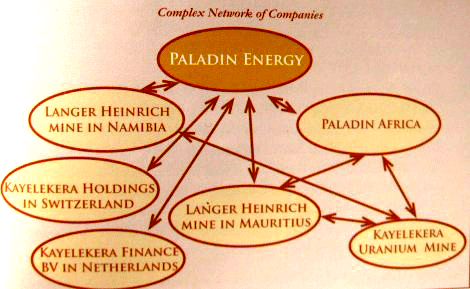
At the launch of the report, Dalitso Kubalasa and Collins Magalasi, the executive directors of MEJN and AFRODAD respectively, spoke briefly before AFRODAD’s Tafadzwa Chikumbu presented the research findings. This paved the way for a lively question and answer session with questions raised about whether or not parliament is ready to renegotiate the terms of the agreement with Paladin, what has happened to the man who lost his sight due to “kayelekera radiation” and if mining revenue in Malawi therefore “dirty money”.
This discussion was followed by the official launch of the report by the Second Deputy Speaker of Parliament Juliana Mphande who exclaimed that she was “appalled to note that incentives offered to Paladin have severe implication to Government revenue and require attention of parliament”. She outlined the areas requiring parliamentary investigation and debate…..
Below is a summary of the main findings: Continue reading
1957 Mayak nuclear disaster – the forgotten event near Ozyorsk
Ozyorsk was and remains a closed town because of its proximity to the Mayak plant,
To consider how insanely radioactive Lake Karachay is, think about this: Chernobyl disaster: 5-12 exabecquerels blown over thousands of square miles Lake Karachay: 4 exabecquerels in this tiny lake, less than a quarter of a mile in diameter. Even approaching the lake will get you a lethal dose within an hour. And they ARE starting to cover it up with concrete and gravel as the water evaporates. As the water recedes, they lay down dirt, gravel and concrete over the area so it can’t fill back in and the sediment doesn’t get disturbed by the wind.
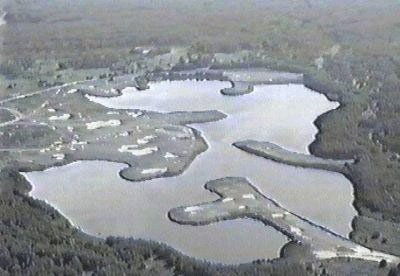
The 10 Worst Civilian Nuclear Accidents in History http://www.neatorama.com/2013/05/21/The-10-Worst-Civilian-Nuclear-Accidents-in-History/ Miss Cellania , May 21, 2013 Quick -how many nuclear accidents can you name? Chernobyl, Three Mile Island, Fukushima …any more? There have been quite a few nuclear accidents of varying danger that you probably never heard of, including some fatal incidents. For example, in 1957, nuclear waste exploded at a reactor near the Soviet town of Ozyorsk.
One of the storage tanks contained around 70 to 80 tons of radioactive liquid waste, and its cooling mechanism stopped working and wasn’t fixed. The tank’s contents, made up mostly of ammonium nitrate and acetates, began to dry out as the liquid heated up and evaporated. Moreover, the temperature increase caused an explosion whose force was equivalent to 70 to 100 tons of TNT, and this sent huge amounts of radioactivity – roughly 20 MCi (800 PBq) – into the environment. The fallout cloud from the explosion contaminated an area of up to 7,722 square miles (20,000 square kilometers).
Over a period of nearly two years, about 10,000 people were evacuated from the surrounding area. In terms of fatalities, the exact cost of the incident is not known, but immediately around the site of the explosion there were 66 diagnosed cases of chronic radiation syndrome.
Read more about the Ozyorsk incident and nine others in a list at Tech Graffiti. Link -via the Presurfer
Large scale batteries for renewable energy storage now growing in use
 Large Scale Energy Storage Roundup http://www.energymatters.com.au/index.php?main_page=news_article&article_id=3755 23 May 13,
As the world increasingly moves towards renewable energy; it will need many individual energy storage locations distributed across the grid to address issues of variability in electricity production. The idea of a battery being a relatively small device or a series of small boxes cobbled together with wiring is changing fast. Batteries capable of storing huge amounts of energy are being developed using all sort of materials and technologies.
The following are just a few we’ve reported on in the past; some of which are have now been deployed in commercial applications: Continue reading
New research on depleted uranium, cancer, birth defects in Iraq
 Scientists detect high levels of uranium contamination that increases cancers, birth defects in Iraq http://www.news-medical.net/news/20130521/Scientists-detect-high-levels-of-uranium-contamination-that-increases-cancers-birth-defects-in-Iraq.aspx May 21, 2013 Ten years after the Iraq war of 2003 a team of scientists based in Mosul, northern Iraq, have detected high levels of uranium contamination in soil samples at three sites in the province of Nineveh which, coupled with dramatically increasing rates of childhood cancers and birth defects at local hospitals, highlight the ongoing legacy of modern warfare to civilians in conflict zones. The radioactive element uranium is widely dispersed throughout the earth’s crust and is much sought after as a fuel for nuclear power plants and for use in weapons. Depleted uranium (DU), commonly used in modern munitions such as defensive armour plating and armour-piercing projectiles, is 40 per cent less radioactive than natural uranium, but remains a significant and controversial danger to human health.
The World Health Organisation (WHO) sets a maximum uranium exposure of 1 millisievert (mSv) per year for the general public, but environmental scientists at the University of Mosul and the Institute of Forest Ecology, Universitaet für Bodenkultur (BOKU), Vienna, Austria, led by Riyad Abdullah Fathi have measured significant levels of uranium in soil samples from three sites in the province of Nineveh in the north of Iraq. Writing in the journal Medicine, Conflict and Survival, Fathi and colleagues link their findings with dramatic increases in cancers reported to the Mosul Cancer Registry and the Iraqi national cancer registry (which began collecting data in 1975).
They conclude that:
“The Gulf Wars of 1991 and 2003 left a legacy of pollution with DU in many regions of Iraq. The effects of these munitions may be affecting the general health of Iraqi citizens, manifesting in an increase in cancers and birth defects.”
They also warn that, even though some of the contamination measured in this study is specifically linked to known sites, it can be easily spread widely in the air, soil and water, particularly as dust in windstorms.
Their report “Environmental pollution by depleted uranium in Iraq with special reference to Mosul and possible effects on cancer and birth defect rates” begins with a literature review that collates health-related data from a range of sources, including a report by the WHO (in 2003), which states that childhood cancers – particularly leukaemia – are ten times higher in Iraq than in other industrialised countries. Continue reading
Safecast’s revolution in radiation data collection
Safecast’s software and devices are all open source, and anyone can use the data. Franken says it’s being used by researchers around the world and even by the government in some Japanese cities.
you can tie specific medical symptoms to radiation levels.”
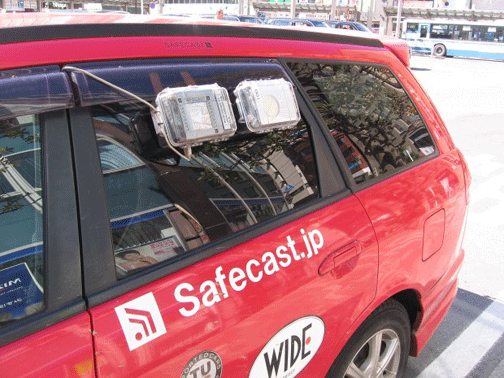
In Japan, Citizen Radiation-Tracking Project Goes Big Time, PRI’s The World, BY CATHERINE WINTER ⋅ MAY 21, 2013 ⋅ON A SUNNY SPRING MORNING JUST OUTSIDE TOKYO, JOE MOROSS HOOKS A RADIATION DETECTOR OUTSIDE THE BACK WINDOW OF A LITTLE RED CAR. HE LOOKS AT A MAP OF THE AREA ON HIS LAPTOP COMPUTER, TRYING TO FIND A ROUTE HE HASN’T DRIVEN BEFORE, SO HE CAN TAKE NEW RADIATION READINGS.
“We want to cover every street so people who look at our maps can drill down and zoom in and find out what the measurement is right in front of their house,” Moross says.
Moross is taking measurements for Safecast. Since the nuclear accident at Fukushima Daichi two years ago, volunteers like him have been driving around Japan, testing radiation and adding their readings to online maps.
When The World last checked in on Safecast, in May of 2011, the group had just formed and had posted a handful of radiation measurements.
Now, Safecast volunteers have taken close to 10 million separate readings……. Continue reading
System for tracking patients’ medical radiation
 New Tracking of a Patient’s Radiation Exposure , WSJ, By LAURA LANDRO, 21 May 13, During a four-week hospital stay, 29-year-old Josh Page had so many CT scans that he lost track, kidding with his doctor about how much radiation he was exposed to—though he admits he had “no clue.” Now, Intermountain Healthcare, where he was treated for an inflammation of the pancreas and underwent surgery in February, is keeping track for him.
The Salt Lake City-based nonprofit group of 22 hospitals and 185 clinics is launching the first major system of its kind to measure and report patients’ cumulative medical radiation exposure from tests that deliver the highest amount of radiation. This includes CT scans, nuclear medicine scans and interventional radiology exams for the heart. In addition to educating doctors and patients about the risks and benefits of medical radiation, Intermountain will allow them to access their exposure data via its electronic health record.
While the benefits of tests and procedures usually outweigh the slightly increased cancer risk from exposure due to radiation, “the risks should be considered before these imaging tests are performed,” says Keith White, medical director of Intermountain’s Imaging Services. This is particularly true for younger patients, who have a higher risk because they live long enough to see long-term effects…… Federal data shows that in 2006, Americans received seven times more radiation exposure than in the 1980s, Continue reading
THE ONGOING THREAT OF FUKUSHIMA FALLOUT
 WHAT ABOUT THE ONGOING THREAT OF FUKUSHIMA FALLOUT ?, Veterans Today, 14 May 13 The Washington Blog posed that same question on April 13, 2013 ~ Is Fukushima Leaking … Or Are the Reactors Wholly Uncontained?
“You may have heard that Tepco ~ the operator of the stricken Fukushima nuclear power plants ~ announced alarge leak of radioactive water….. You may have heard that the cooling system in the spent fuel pools at Fukushima has failed for a second time in a month.
This is newsworthy stuff … but completely misses the big picture. Associated Press notes: ” Experts suspect a continuous leak into the ocean through an underground water system, citing high levels of contamination in fish caught in waters just off the plant. (Tepco graphics of the Fukushima plants even appear to show water directly flowing from the plant to the ocean. And see this.) In fact, Japanese experts say that Fukushima is currently releasing up to 93 billion becquerels of radioactive cesium into the ocean each day. ”
How much radiation is that? Continue reading
The unthinkable – if the West did bomb Iran’s nuclear plant
The new study provides the only available scientific predictions to date about what a nuclear attack in the Middle East might actually mean. Dallas, who was previously the director of the Center for Mass Destruction Defense at the Centers for Disease Control and Prevention, is quick to point out that the study received no U.S. government funding or oversight. “No one wanted this research to happen,” he adds.
Who Will Drop the Next Nuclear Bomb? We ignore the ever-growing global arsenal of nuclear weapons at our peril. The Nation, Nick Turse May 13, 2013 “……. Iranian cities — owing to geography, climate, building construction, and population densities — are particularly vulnerable to nuclear attack, according to a new study, “Nuclear War Between Israel and Iran: Lethality Beyond the Pale,” published in the journal Conflict & Health by researchers from the University of Georgia and Harvard University. It is the first publicly released scientific assessment of what a nuclear attack in the Middle East might actually mean for people in the region.
 Its scenarios are staggering. An Israeli attack on the Iranian capital of Tehran using five 500-kiloton weapons would, the study estimates, kill seven million people — 86% of the population — and leave close to 800,000 wounded. A strike with five 250-kiloton weapons would kill an estimated 5.6 million and injure 1.6 million, according to predictions made using an advanced software package designed to calculate mass casualties from a nuclear detonation.
Estimates of the civilian toll in other Iranian cities are even more horrendous. A nuclear assault on the city of Arak, the site of a heavy water plant central to Iran’s nuclear program, would potentially kill 93% of its 424,000 residents. Three 100-kiloton nuclear weapons hitting the Persian Gulf port of Bandar Abbas would slaughter an estimated 94% of its 468,000 citizens, leaving just 1% of the population uninjured. A multi-weapon strike on Kermanshah, a Kurdish city with a population of 752,000, would result in an almost unfathomable 99.9% casualty rate. Continue reading
1 This Month



26 September – International Day for the Total Elimination of Nuclear Weapons


PLEASE OPPOSE HR 8255 AND S.3639 – bills would accelerate satellite deployment, with no environmental review or safeguards – https://ncstd5li.quorum.us/campaign/169331/
To see nuclear-related stories in greater depth and intensity – go to https://nuclearinformation.wordpress.com
-
Archives
- September 2026 (257)
- August 2026 (330)
- July 2026 (355)
- June 2026 (287)
- May 2026 (306)
- April 2026 (356)
- March 2026 (251)
- February 2026 (267)
- January 2026 (308)
- December 2025 (358)
- November 2025 (359)
- October 2025 (375)
-
Categories
- 1
- 1 NUCLEAR ISSUES
- business and costs
- climate change
- culture and arts
- ENERGY
- environment
- health
- history
- indigenous issues
- Legal
- marketing of nuclear
- media
- opposition to nuclear
- PERSONAL STORIES
- politics
- politics international
- Religion and ethics
- safety
- secrets,lies and civil liberties
- spinbuster
- technology
- Uranium
- wastes
- weapons and war
- Women
- 2 WORLD
- ACTION
- AFRICA
- Atrocities
- AUSTRALIA
- Christina's notes
- Christina's themes
- culture and arts
- Events
- Fuk 2022
- Fuk 2023
- Fukushima 2017
- Fukushima 2018
- fukushima 2019
- Fukushima 2020
- Fukushima 2021
- general
- global warming
- Humour (God we need it)
- Nuclear
- RARE EARTHS
- Reference
- resources – print
- Resources -audiovicual
- Weekly Newsletter
- World
- World Nuclear
- YouTube
-
RSS
Entries RSS
Comments RSS

