Dental X rays a serious public health cancer risk

 Radiation safety of dental X-rays questioned Straight.com, by ALEX ROSLIN on AUG 14, 2013“………..In a study in the journal Cancer last year, 1,433 people with meningioma were found to be two times more likely to have had a “bitewing” dental X-ray as those without the illness. Those who reported having a panorex scanning dental X-ray (which gives a two-dimensional panoramic view of the mouth) before age 10 were 4.9 times more likely to have meningioma.
Meningioma is the most common form of primary brain tumour (tumours that start in the brain). Women get it more than twice as often as men.
Other studies have linked dental X-rays to thyroid cancer, breast cancer (in women who hadn’t worn a shielded apron), saliva-gland tumours, and glioma (a cancerous type of brain and spinal tumour).
Pregnant women who got a dental X-ray were three times more likely to deliver a low-birth-weight baby (weighing less than 2.5 kilograms), according to a 2004 study in the Journal of the American Medical Association.
Dental X-rays are the most common way Americans are exposed to human-made radiation, the 2012 Cancer study said. Continue reading
International Atomic Energy Agency (IAEA) perverts research into radiation and health
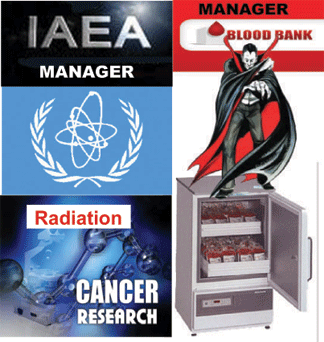 The Nuclear Cancer inside of the United Nations, blog by Jan Hemmer June 1, 2013 by Mikkai 妊娠中の日本人女性の避難すぐ ”……The main way in which the “radiation protection industry” has succeeded in hugely underrating the ill-health caused by nuclear power is by insisting on a group of extremely restrictive definitions as to what qualifies as a radiation-caused illness statistic. For example, under IAEA’s criteria:
> If a radiation-caused cancer is not fatal, it is not counted in the IAEA’s figures
> If a cancer is initiated by another carcenogen, but accelerated or promoted by exposure to radiation, it is not counted.
> If an auto-immune disease or any non-cancer is caused by radiation, it isnot counted.
> Radiation-damaged embryos or foetuses which result in miscarriage or stillbirth do not count
> A congenitally blind, deaf or malformed child whose illnesses are are radiation-related are not included in the figures because this is not genetic damage, but rather is teratogenic, and will not be passed on later to the child’s offspring.
> Causing the genetic predisposition to breast cancer or heart disease does not count since it is not a “serious genetic disease” in the Mendelian sense.
> Even if radiation causes a fatal cancer or serious genetic disease in a live born infant, it is discounted if the estimated radiation dose is below 100 mSv [mSv= millisievert, a measurement of radiation exposure. One hundred millsievert is the equivalent in radiation of about 100 X-Rays].
> Even if radiation causes a lung cancer, it does not count if the person smokes — in fact whenever there is a possibility of another cause, radiation cannot be blamed.
> If all else fails, it is possible to claim that radiation below some designated dose does not cause cancer, and then average over the whole body the radiation dose which has actually been received by one part of the body or even organ, as for instance when radio-iodine concentrates in the thyroid. This arbitrary dilution of the dose will ensure that the 100 mSv cut-off point is nowhere near reached. It is a technique used to dismiss the sickness of Gulf War veterans who inhaled small particles of ceramic uranium which stayed in their lungs for more than two years, and in their bodies for more than eight years, irradiating and damaging cells in a particular part of the body.
quote by Dr. Rosalia Bertell, November 1999 issue of The Ecologist, pp. 408-411:http://ratical.org/radiation/NAvictims.html http://tekknorg.wordpress.com/2013/06/01/the-nuclear-cancer-insidie-of-the-united-nations/#comment-5111
How the IAEA negates true medical research on nuclear radiation
The IAEA wants the people make believe, that the main effect of the atomic catastrophe is psychological.
The Nuclear Cancer inside of the United Nations, blog by Jan Hemmer, June 1, 2013 by Mikkai 妊娠中の日本人女性の避難す
22nd July 1946 – Creation of World Health Organiation (WHO)
10th December 1948 – The UN adopts the Universal Declaration of Human Rights.
July 1957 – Creation of International Atomic Energy Agency (IAEA)
28th May 1959 – Signing of the Agreement WHA 12-40 between WHO and IAEA.
The UN is divided into 7 organisations, of which two are of interest to us, the Economic and Social Council and the Security Council. The “Economic and Social Council” oversees ALL the United Nations agencies with the exception of the “IAEA”. In fact, the IAEA is the only agency that reports directly to the “Security Council” which is made up of representatives of 15 countries, of which 5 are permanent members of the Council : the United States, the Untied Kingdom, the Russian Federation, China and France. These 5 nations are all nuclear powers, both civil and military, and almost all are exporters of nuclear technology.
The 10 remaining members (or countries) have a mandate which lasts for 2 years.
The influence of these 5 permanent members of the Security Council on policy making within the IAEA is enormous and ongoing. With no counterbalancing power, it is almost impossible to claim that the IAEA has an objective view of the nuclear industry and the consequences of its use.
On 28th May 1959, the IAEA (not yet two years old !) and WHO signed an agreement referred to as “WHA 12-40” which, though it might, on paper, appear balanced and reciprocal, in practice, puts WHO in a subordinate position to the IAEA.
The IAEA wants the people make believe, that the main effect of the atomic catastrophe is psychological. This is made in these steps: Continue reading
Radiation sickness: what it is.
With a large enough dose of radiation, for instance, bone marrow will break down almost completely causing major problems with anemia and maintenance of the blood.
this problem is distinct from cancer as caused by radiation.
Geek Answers: What is radiation sickness and why does it happen? GEEK By Graham Templeton Aug. 15, 2013 Acute Radiation Syndrome, more commonly known as radiation sickness, is one of the scarier threats out there, since it’s born of a force we can neither see nor readily detect and its symptoms can be varied and hard to identify. It can range in severity from an upset stomach to a long, painful death, and it often attacks people literally from the inside out. It seems like an almost spooky threat, but there is some very simple science radiation sickness. Essentially, it comes down to the type of radiation that can alter the electrical structure of atoms in the body.

We call such radiation “ionizing radiation” because it carries enough kinetic energy to knock an electron off of an atom it hits, giving that atom a non-standard number of electrons, turning it into an ion. It generally takes quite a bit of energy to achieve this, and ionizing radiation is almost exclusively the result of large and violent events (both manmade and cosmic). A nuclear reactor produces ionizing radiation that must be filtered out with shielding around the core which can — in the event of a disaster — contaminate whole communities, like Chernobyl. Continue reading
How nuclear “safety” reporting protects the nuclear industry
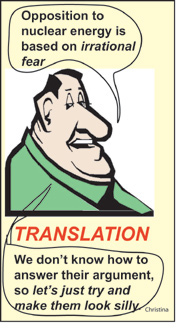 Incapacitation and Protection AGAINST Truth, Blog by Jan Hemmer June 2, 2013 by Mikkai It is remarkable how reports always include “stress” / “fear” / “might” / “concern” / “risk” / “Danger” in their headlines and MAIN goals of reporting.
The real damage occurring moves into the background. The dead, the injured, not worth looking at, only the concern counts. This is important, especially during nuclear catastrophes (which never end), to create the illusion of an “end”, to overcome the “current situation”.
This is not about hope or strength, but to cover up, so that the Holocaust industry can live on. Nourished by the death of children, sponsored by the IAEA and the World Health Organization. I present you two instruments which are used: 1) The invention of an unethical, non-medical term: “Radiophobia” and 2) the exclusion of NGOs as alarmists. Compare everything you have read and seen with this information. Be ready to see everything in a totally new light. Even the term “stress” is today overused, for everything, as if stress is something new in human history and could be responsible for all the diseases. It’s not. Internal Emitters from Reactors are. Risk is a virtual term, which conceals existing, current, happening damage.
Experts suggest that we accept that cancer thins the ranks around us.
At the same time our experts tell us Nuclear Reactors cause no health effect.
And even the victims promote “Living with Cancer” , “my life with cancer”….
The romanticizing of murder is one of the means of repression and powerlessness.
And is imposed on the coming generations.
The same with diabetes, allergies, dead or premature birth, birth defects, autoimmune diseases, ADD, disabilities, etc…
http://www.ratical.org/radiation/CNR/Asleep@Wheel.html#Part2
At the same time our human emotions that are vital for life, are more and more misunderstood as aberrations. By a diabolical mechanization of our lives. Also powered by experts. That’s why we always read “risk”, “may”, “concern” – instead of REAL DAMAGE happening RIGHT NOW.
A reactor means for each country the following: Continue reading
“Radiophobia” and other terms to belittle opponents of nuclear power
The Nuclear Cancer inside of the United Nations, blog by Jan Hemmer June 1, 2013 by Mikkai 妊娠中の日本人女性の避難す “……….At the Chernobyl IAEA forum the term “Radiophobia” was invented and used: “What’s worse, the IAEA is going public these days with statements ridiculing the so called “radiophobia” of the population and calling for an end of aid programs, which, according to the IAEA report of 2005, only serve to instil a victim mentality in a totally healthy population – a claim not only cynical, but potentially dangerous for the health of the affected population.” Source:http://www.ippnw-students.org/chernobyl/coverup.html
“Presently the international organizations (WHO, IAEA) recognize as the main cause of increase of thyroid cancer in liquidators and children population after the accident their irradiation with radioactive iodine, I-131. The rest of diseases, they suppose, are provoked by psycho-emotional reactions..” (!!!…… ” http://www.rri.kyoto-u.ac.jp/NSRG/reports/kr21/kr21pdf/Burlakova.pdf IGNORED BY IAEA, UNSCEAR, ICRP, WHO http://tekknorg.wordpress.com/2013/06/01/the-nuclear-cancer-insidie-of-the-united-nations/#comment-5111
Fukushima’s ice wall fraught with problems, but what else can they do?
At Fukushima, those problems will be even more extreme, but the cost of doing nothing is even higher
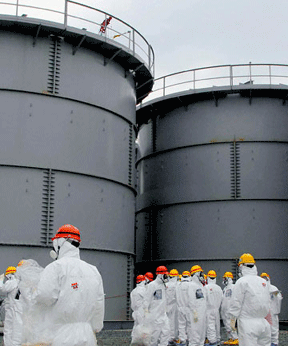 How to Build an Ice Wall Around a Leaking Nuclear Reactor Yahoo News, Alexis C. Madrigal, The Atlantic 14 Aug 13 Building cryogenic barriers sounds like the specialty of an obscure supervillain, but it’s a well-established technique in civil engineering, used regularly for tunnel boring and mining. Ground freezing was even tested as a way of containing radioactive waste in the 1990s at Oak Ridge National Laboratory and performed admirably.
at left, workers near Fukushima radioactive water storage tanks
Joe Sopko, the civil engineering firm Moretrench’s director of ground freezing, has spoken with several consultants about the details of the project, and he’s convinced it’s certainly possible. “This is not a complicated freeze job. It really isn’t,” he told me. “However, the installation, because of the radiation, is.”…….
Here’s how it works. Freeze pipes, made from normal steel, are sunk into the ground at regular intervals. The spacing is normally about one meter. Then, some type of coolant is fed into the pipes. Sopko uses a brine — salty liquid which can be cooled far below the freezing point of fresh water without turning into a solid. On the surface, a big refrigerator chills the liquid, which is pumped into the pipes. The liquid extracts heat from the ground, and returns to the chiller, where it is recooled and sent back down. It’s not a fast process and can take many months. (Sometimes, for speed’s sake an expendable refrigerant like liquid nitrogen is used, but it requires trucking in tanks full of the stuff.) Continue reading
America needs to apologise to Hiroshima and Nagasaki
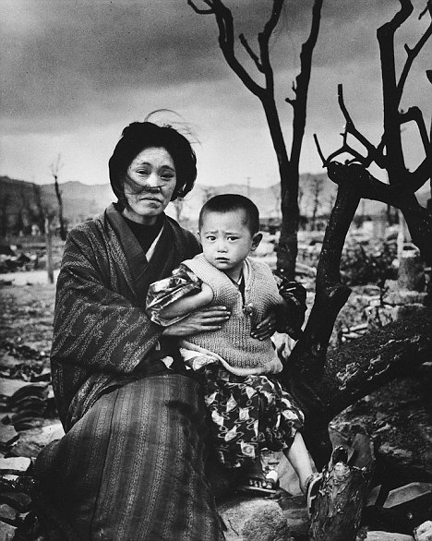 Apparently, in the minds of most Americans America can do no wrong. An act that would be perceived as profoundly immoral if any other nation were behind it, is seen as being quite acceptable and even laudable when it is America that sits in the driver’s seat. No matter how grossly immoral a particular action may be, when America is the actor that action is somehow magically transformed in light of America’s perceived exceptional greatness into something good, wholesome, and even holy — certainly nothing deserving of an apology.
I can think of no better example of this than America’s 1945 atomic bombing of the two high-density civilian population centers of Hiroshima and Nagasaki..
 America’s Nuclear Madness: Terrorism With A Vengeance (Part I) OpEd, By Robert Quinn, 12 Aug 13, ” The most effective way to destroy people is to deny and obliterate their own understanding of their history. — George Orwell
I tremble for my country when I reflect that God is just; that his justice cannot sleep forever. — Thomas Jefferson
This month marks the 68 th anniversary of the 1945 U.S. atomic bombing of the Japanese cities of Hiroshima and Nagasaki………..right-wing media made much of a Wikileaks-released diplomatic cable claiming to tell of plans President Obama had to apologize for America’s 1945 atomic bombing of Hiroshima and Nagasaki during his 2009 visit to Japan. Investors Business Daily castigated Obama for his alleged plans to “apologize” to Japan “for defending freedom” and “for winning with devastating finality the war Japan started.”The National Review Online, Rush Limbaugh, The Drudge Report, and Fox News, among other right-wing media outlets, followed Investor Business Daily’s lead, claiming that the only reason Obama’s planned apology failed to materialize is that Japan had the good sense to disapprove of the plan.
The White House denied that there ever was any plans to apologize to Japan for America’s WW II atomic decimation of Hiroshima and Nagasaki, and the Wikileaks cable bears this out. Following a meeting with Japan’s Vice Foreign Minister, the U.S. Ambassador to Japan cabled Secretary of State Clinton expressing Japan’s concern that a visit by Obama to Hiroshima, coming on the heels of Obama’s previously expressed commitment to a world free of nuclear weapons, would fuel speculation, particularly among anti-nuclear groups, whether an Obama apology might be in the offing. Japan worried that such speculation would play into the hands of these anti-nuclear groups, providing them with greater visibility and a stronger voice in their efforts to garner increasing public support for their anti-nuclear agenda. The diplomatic cable was sent, then, not to ward off a planned Obama apology as Obama’s detractors have claimed, but rather to ward off any speculation that such an apology might be in the works, and that an Obama visit to Hiroshima might serve to provoke. To this end, Japan’s foreign ministry recommended that both governments do what they can to keep all such speculation to a minimum, and that this could be accomplished by having Tokyo be the primary focus of Obama’s 2009 visit. End of story.
What if Obama actually did have plans to apologize to Japan on behalf of America for its atomic incineration of two Japanese high-density civilian population centers? What of it? What exactly is the crime in this? Might it just be that such an apology is in order, and long overdue? The media has given no consideration to this at all. Instead, the entire focus has been on whether Obama is guilty or not of having had plans to apologize for America. The right-wing conservative media assumed Obama’s guilt, the left-leaning liberal media came to his defense, and the mainstream media, where it wasn’t following the right wing’s deceptive lead, reported on the controversy. The important issue in all of this — the moral justification, or lack thereof, of America’s atomic bombing of Japan — was entirely ignored.
Is Apologizing When You’ve Said Or Done Something Detestable Un-American? Continue reading
Confusing nuclear data: Agencywide Documents Access and Management System (ADAMS).
Nuclear Energy Activist Toolkit #12: Finding Stuff in ADAMS Dave Lochbaum, director, Nuclear Safety Project August 13, 2013 In November 1999, the NRC discontinued providing information to local public document rooms near nuclear plants around the country in favor of an online electronic library it calls the Agencywide Documents Access and Management System (ADAMS).
Finding records in ADAMS is wicked easy.
Finding records one actually wants in ADAMS is often just wicked.
One can search by key word or phrase or date or docket and literally get up to 1,000 hits (ADAMS will only return 1,000 hits even when 1,000,000 records match the search criterion. This makes it easier for you to find the record of interest among the 1,000 hits – unless, of course, that record is among the hits not returned.)
To make finding stuff even “easier,” records can be viewed in ADAMS by folders for the day they were added to the electronic library. The very descriptive information provided for each record make it extremely easy to zero right in on stuff of particular interest.,,,,,,,
the absolute easiest way to find a record in ADAMS is to have a hard copy in your hand before you start searching. If so, read the hard copy and save yourself the wasted time and undue agony trying to find it in ADAMS even when equipped with its date, subject, addressee, etc.
Even for immortals, life is just too short to become an ADAMS aficionado.
There are times when the federal government should not award contracts to the lowest bidder. Like when it seeks an online document library that is not “electronic keep away.”
The UCS Nuclear Energy Activist Toolkit (NEAT) is a series of post intended to help citizens understand nuclear technology and the Nuclear Regulatory Commission’s processes for overseeing nuclear plant safety.
Nuclear Regulatory Commission’s false safety assumptions
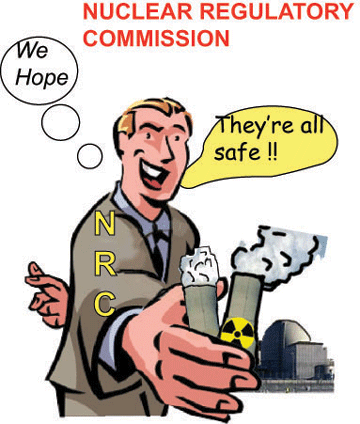 Nuclear Regulatory Commission Is Using Obviously Faulty Models to Pretend Crumbling Nuclear Reactors Are Safe By Washington’s Blog Global Research, August 12, 2013 Ignoring Basic Engineering Science Puts Us All At Risk
Faulty assumptions by America’s financial regulators led to the 2008 crash … and many other disastrous results.
Similarly, America’s main nuclear regulator – the Nuclear Regulatory Commission – made numerous assumptions before Fukushima that turned out to be totally false. For example, the NRC wrongly assumed: Continue reading
America’s official lies about the reasons for atomic bombing of Japanese cities


Regardless of the number of American lives Truman claims to have saved, the vast majority of Americans accept the official story as gospel. The indoctrinating media and sixty-eight years of propagandistic history texts from grammar school through high school did its job well. But, except for the fact of the bombs having been dropped, the official story is a lie. Not merely mistaken, but a lie.
In terms of moral justification, the official story no doubt provides a great deal of comfort to a great many Americans. Unfortunately, all indications are that this moral centerpiece of the official story just isn’t true. The truth, as it turns out, is so barbaric that it’s almost inconceivable..
America’s Nuclear Madness: Terrorism With A Vengeance (Part I) By Robert Quinn“ OpEdNews 8/11/2013 “………..The Official Story
Sixty-eight years ago, August 6, 1945, the United States dropped the first atomic bomb to ever be used in warfare on the civilian population of Hiroshima, Japan. Three days later a second atomic bomb was dropped on the civilian population of Nagasaki, Japan. All toll, nearly a quarter of a million civilian men, woman, children, and babies lost their lives in those blasts. Of those who survived the blasts, many were maimed for life and many more would later die slow, painful deaths due to radiation poisoning and various forms of cancer.
In Hiroshima, a city with a population of 290,000, the initial death count by the end of August 1945 was estimated at 100,000. By the end of 1950 the estimated death toll had risen, according to some estimates, to 200,000. In Nagasaki, a city with a population of 240,000, including 400 prisoners of war, it’s estimated that some 70,000 were killed by the initial blast, with 140,000 dead within the next five years.
The official story at the time was that Hiroshima and Nagasaki were military targets whose destruction was necessary to bring the war to an end. This was a lie. The American public was also told that leaflets were dropped warning the inhabitants of these cities of the impending destruction and that they should leave. This, too, was a lie. The official story tells of President Truman’s decision to go nuclear on Japan as a necessary last resort designed to hasten a Japanese surrender, thereby saving American soldiers the horrors of a ground invasion of the Japanese mainland. As we will see, this, too, was a lie.
The official story claims that dropping the bombs saved the lives of many thousands of American soldiers which otherwise most certainly would have been lost. In October 1945, two months after the bombs were dropped, Truman wrote in his diary: Continue reading
Nevada’s secret nuclear radiation guinea pigs
 “Nuclear Guinea Pigs”: Deadly Experiments and Contaminated Reality By Greg Guma Global Research, August 11, 2013 Half a century ago, on the spurious grounds that extreme sacrifices were required in the battle to prevent a communist takeover of the world, the US government decided to use the citizens of Nevada as nuclear guinea pigs.
Although atomic testing was pursued there for several years in the 1950s, notification would have alarmed area residents. As a result, they weren’t even advised to go indoors. Yet, according to declassified documents, some scientists studying the genetic effects of radiation at the time were already concerned about the health risks of fallout.
For most of those committed to the US nuclear program, the need to keep this type of research secret was a no-brainer. After all, if the public realized that the technology used to bomb Hiroshima and Nagasaki had led to experiments at home, early nuclear research – not to mention weapons deployment – might have met stronger opposition. The government badly wanted its nukes, and the scientists yearned to unlock the secrets of human mutation. Thus, an unholy alliance was struck. Continue reading
No military need for atomic bombing of Hiroshima and Nagasaki
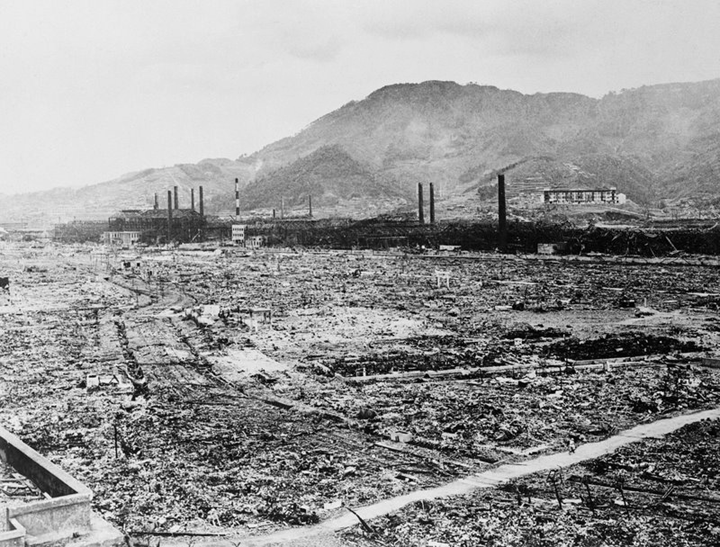 America’s Nuclear Madness: Terrorism With A Vengeance (Part I) By Robert Quinn” OpEdNews 8/11/2013 “………….Japan Had Already Been Defeated Prior To Dropping the Bombs After the war had ended, the U.S. Strategic Bombing Survey (a board consisting of more than 1,000 individuals, both military and civilian), was tasked by U.S. Secretary of War Henry Stimson with the examination and analysis of U.S. involvement in WW II. The Survey concluded in 1946 that “Japan would have surrendered even if the atomic bombs had not been dropped, even if Russia had not entered the war, and even if no invasion had been planned or contemplated.”
But it was not only with the advantage of hindsight that this conclusion was reached. General Eisenhower (Supreme Commander of allied forces in Europe) and General MacArthur (Supreme Commander of the U.S. Army in the Pacific) came to the same conclusion before the bombs were ever dropped. I don’t think there’s any question that both General Eisenhower and General MacArthur would have done whatever was necessary to spare their troops the horrors of a ground invasion. But the fact is that neither of them believed that a ground invasion of mainland Japan was necessary. Continue reading
UNSCEAR members protest against minimising health effects of Fukushima radiation
 Shocked UNSCEAR members in Belgium protest “It even goes back behind the lessons of Chernobyl and other studies.”
http://www.rtbf.be/info/societe/detail_les-delegues-belges-indignes-on-minimise-les-consequences-de-fukushima?id=8042566 English translation by Alex Rosen, M.D., Vice-chairman, German IPPNW Shocked UNSCEAR members in Belgium protest
A giant wall of ice – will it stop Fukushima radiation leak?
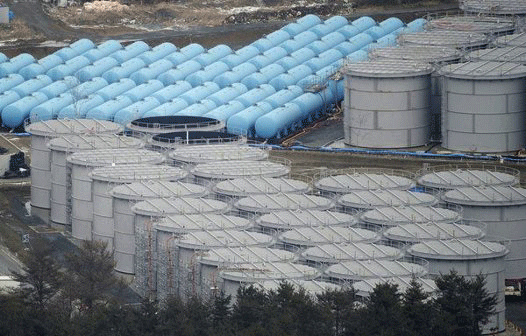 Can a giant ice wall stop Fukushima radiation from leaking into the sea? Grist, By Lisa Hymas Aug 9, 2013 “……..So now Tokyo Electric Power Company, or TEPCO, which owns the plant, has a plan to build an underground wall of frozen earth to stop the radioactive water leakage. NPR explains:
[T]o understand, you need to know the geography of Fukushima. There are three melted down reactors, and they’re all right on the coast. To the west, you have mountains. To the east, you have ocean. And so what’s happening is groundwater flows downhill. It flows down through the ruins of the plant and then flows out to the sea. …
So now, TEPCO has proposed literally creating a wall of ice around the plant. And what they’re talking about is not a wall above ground, but freezing the ground around the plant to stop water from flowing in. …
So the basic idea is that they run piping into the ground and they put coolant in the piping and that freezes the earth around the pipes, and it all sort of gradually forms together into a wall. This is something that civil engineers see sometimes, but it’s not that common. And certainly, the way they’re talking about using it in Fukushima is unprecedented. This wall will be nearly a mile around according to TEPCO. It would require more than 2 million cubic feet of soil to be frozen. But if it worked, then it may be the only way to keep water from flowing into the plant and contaminated water from flowing out.
The New York Times points out another challenge: “the wall will need to be consistently cooled using electricity at a plant vulnerable to power failures. The original disaster was brought on by an earthquake and tsunami that knocked out electricity.”…..
[The wall is] expected to cost between $300 million and $400 million. http://grist.org/news/can-an-ice-wall-stop-fukushima-radiation-from-leaking-into-the-sea/?utm_source=syndication&utm_medium=rss&utm_campaign=feed
1 This Month



26 September – International Day for the Total Elimination of Nuclear Weapons


PLEASE OPPOSE HR 8255 AND S.3639 – bills would accelerate satellite deployment, with no environmental review or safeguards – https://ncstd5li.quorum.us/campaign/169331/
To see nuclear-related stories in greater depth and intensity – go to https://nuclearinformation.wordpress.com
-
Archives
- September 2026 (257)
- August 2026 (330)
- July 2026 (355)
- June 2026 (287)
- May 2026 (306)
- April 2026 (356)
- March 2026 (251)
- February 2026 (267)
- January 2026 (308)
- December 2025 (358)
- November 2025 (359)
- October 2025 (375)
-
Categories
- 1
- 1 NUCLEAR ISSUES
- business and costs
- climate change
- culture and arts
- ENERGY
- environment
- health
- history
- indigenous issues
- Legal
- marketing of nuclear
- media
- opposition to nuclear
- PERSONAL STORIES
- politics
- politics international
- Religion and ethics
- safety
- secrets,lies and civil liberties
- spinbuster
- technology
- Uranium
- wastes
- weapons and war
- Women
- 2 WORLD
- ACTION
- AFRICA
- Atrocities
- AUSTRALIA
- Christina's notes
- Christina's themes
- culture and arts
- Events
- Fuk 2022
- Fuk 2023
- Fukushima 2017
- Fukushima 2018
- fukushima 2019
- Fukushima 2020
- Fukushima 2021
- general
- global warming
- Humour (God we need it)
- Nuclear
- RARE EARTHS
- Reference
- resources – print
- Resources -audiovicual
- Weekly Newsletter
- World
- World Nuclear
- YouTube
-
RSS
Entries RSS
Comments RSS
 nuclear-news