Bananas and radiation – the nuclear lobby’s favourite lie
When you eat a banana, your body’s level of Potassium-40 doesn’t increase. You just get rid of some excess Potassium-40. The net dose of a banana is zero.
Bananas aren’t really going to give anyone “a more realistic assessment of actual risk”, they’re just going to further distort the picture.
 Fukushima: Think Low Level Radiation Is Harmless? Think Again… UKIAH BLOG In Around the web on August 25, 2013Time to combat radiation threat From WASHINGTON’S BLOG
”…………Nuclear apologists pretend that people are exposed to more radiation from bananas than from Fukushima.
But unlike low-levels of radioactive potassium found in bananas – which our bodies have adapted to over many years – cesium-137 and iodine 131 are brand new, extremely dangerous substances.
The EPA explains:
The human body is born with potassium-40 [the type of radiation found in bananas] in its tissues and it is the most common radionuclide in human tissues and in food. We evolved in the presence of potassium-40 and our bodies have well-developed repair mechanisms to respond to its effects. The concentration of potassium-40 in the human body is constant and not affected by concentrations in the environment.
Wikipedia notes:
The amount of potassium (and therefore of 40K) in the human body is fairly constant because of homeostatsis, so that any excess absorbed from food is quickly compensated by the elimination of an equal amount.
It follows that the additional radiation exposure due to eating a banana lasts only for a few hours after ingestion, namely the time it takes for the normal potassium contents of the body to be restored by the kidneys. Continue reading
Even Miniscule Amounts of Radiation Can Be Dangerous
 Fukushima: Think Low Level Radiation Is Harmless? Think Again… UKIAH BLOG In Around the web on August 25, 2013Time to combat radiation threat From WASHINGTON’S BLOG Cutting through the Misinformation
In response to the news that mass quantities of highly-radioactive water are flowing from Fukushima into the Pacific Ocean – and that the radioactivity is spreading to North America – the usual suspects are saying that that low-level radiation won’t hurt anyone.
Indeed, some advocate intentionally dumping all of Fukushima’s radiation into the sea as a “safe” solution.
(And some folks are pretending that a little radiation is good for you.)
The truth is quite different.
Even Miniscule Amounts of Radiation Can Be Dangerous
A major 2012 scientific study proves that low-level radiation can cause huge health problems. Science Daily reports:
Even the very lowest levels of radiation are harmful to life, scientists have concluded in the Cambridge Philosophical Society’s journal Biological Reviews. Reporting the results of a wide-ranging analysis of 46 peer-reviewed studies published over the past 40 years, researchers from the University of South Carolina and the University of Paris-Sud found that variation in low-level, natural background radiation was found to have small, but highly statistically significant, negative effects on DNA as well as several measures of health.
The review is a meta-analysis of studies of locations around the globe …. “Pooling across multiple studies, in multiple areas, and in a rigorous statistical manner provides a tool to really get at these questions about low-level radiation.”
Mousseau and co-author Anders Møller of the University of Paris-Sud combed the scientific literature, examining more than 5,000 papers involving natural background radiation that were narrowed to 46 for quantitative comparison. The selected studies all examined both a control group and a more highly irradiated population and quantified the size of the radiation levels for each. Each paper also reported test statistics that allowed direct comparison between the studies.
The organisms studied included plants and animals, but had a large preponderance of human subjects. Each study examined one or more possible effects of radiation, such as DNA damage measured in the lab, prevalence of a disease such as Down’s Syndrome, or the sex ratio produced in offspring. For each effect, a statistical algorithm was used to generate a single value, the effect size, which could be compared across all the studies.
The scientists reported significant negative effects in a range of categories, including immunology, physiology, mutation and disease occurrence. The frequency of negative effects was beyond that of random chance…….
Radiation emitters Mixing Apples (External) and Oranges (Internal)
Fukushima: Think Low Level Radiation Is Harmless? Think Again… UKIAH BLOG In Around the web on August 25, 2013Time to combat radiation threat From WASHINGTON’S BLOG “…..Moreover, radioactive particles which end up inside of our lungs or gastrointestinal track, as opposed to radiation which comes to us from outside of our skin are much more dangerous than general exposures to radiation.
The National Research Council’s Committee to Assess the Scientific Information for the Radiation Exposure Screening and Education Program explains:
Radioactivity generates radiation by emitting particles. Radioactive materials outside the the body are called external emitters, and radioactive materials located within the body are called internal emitters.
Internal emitters are much more dangerous than external emitters. Specifically, one is only exposed to radiation as long as he or she is near the external emitter.
For example, when you get an x-ray, an external emitter is turned on for an instant, and then switched back off.
But internal emitters steadily and continuously emit radiation for as long as the particle remains radioactive, or until the person dies – whichever occurs first. As such, they are much more dangerous.
As the head of a Tokyo-area medical clinic – Dr. Junro Fuse, Internist and head of Kosugi Medical Clinic – said:
Risk from internal exposure is 200-600 times greater than risk from external exposure.
See this, this, this and this.
By way of analogy, external emitters are like dodgeballs being thrown at you. If you get hit, it might hurt. But it’s unlikely you’ll get hit again in the same spot.
Internal emitters – on the other hand – are like a black belt martial artist moving in really close and hammering you again and again and again in the exact same spot. That can do realdamage.
There are few natural high-dose internal emitters. Bananas, brazil nuts and some other foods contain radioactive potassium-40, but in extremely low doses. And – as explained above – our bodies have adapted to handle this type of radiation.
True, some parts of the country are at higher risk of exposure to naturally-occurring radium than others.
But the cesium which was scattered all over the place by above-ground nuclear tests and the Chernobyl and Fukushima accidents has a much longer half life, and can easily contaminate food and water supplies. As the New York Times notes:
Over the long term, the big threat to human health is cesium-137, which has a half-life of 30 years.
At that rate of disintegration, John Emsley wrote in “Nature’s Building Blocks” (Oxford, 2001), “it takes over 200 years to reduce it to 1 percent of its former level.”
It is cesium-137 that still contaminates much of the land in Ukraine around the Chernobyl reactor.
***
Cesium-137 mixes easily with water and is chemically similar to potassium. It thus mimics how potassium gets metabolized in the body and can enter through many foods, including milk.
As the EPA notes in a discussion entitled ” What can I do to protect myself and my family from cesium-137?”:
Cesium-137 that is dispersed in the environment, like that from atmospheric testing, is impossible to avoid.
Radioactive iodine can also become a potent internal emitter. As the Times notes:
Iodine-131 has a half-life of eight days and is quite dangerous to human health. If absorbed through contaminated food, especially milk and milk products, it will accumulate in the thyroid and cause cancer.
(In addition to spewing massive amounts of radioactive iodine 131, Fukushima also pumped out huge amounts of radioactive iodine 129 – which has a half-life of 15.7 million years. Fukushima has also dumped up to 900 trillion becquerels of radioactive strontium-90 – which is a powerful internal emitter which mimics calcium and collects in our bones – into the ocean.).
The bottom line is that there is some naturally-occurring background radiation, which can – at times – pose a health hazard (especially in parts of the country with high levels of radioactive radon or radium).
But cesium-137 and radioactive iodine – the two main radioactive substances being spewed by the leaking Japanese nuclear plants – are not naturally-occurring substances, and can become powerful internal emitters which can cause tremendous damage to the health of people who are unfortunate enough to breathe in even a particle of the substances, or ingest them in food or water.
Unlike low-levels of radioactive potassium found in bananas – which our bodies have adapted to over many years – cesium-137 and iodine 131 are brand new, extremely dangerous substances.
And unlike naturally-occurring internal emitters like radon and radium – whose distribution is largely concentrated in certain areas of the country – radioactive cesium and iodine, as well as strontium and other dangerous radionuclides, are being distributed globally through weapons testing and nuclear accidents.
Massive underground reservoir of radioactive water moves closer to Fukushima coast
 The turbine buildings at the Fukushima Dai-ichi plant are about 150 meters (500 feet) from the ocean. According to a Japan Atomic Energy Agency document, the contaminated underground water is spreading toward the sea at a rate of about 4 meters (13 feet) a month.
At that rate, “the water from that area is just about to reach the coast,” if it hasn’t already,
radioactive cesium levels in most fish caught off the Fukushima coast hadn’t declined in the year following the March 2011 disaster, suggesting that the contaminated water from the reactor-turbine areas is already leaking into the sea.
But TEPCO hasn’t provided the details he and other scientists need to further assess the situation.
Radioactive Groundwater at Fukushima Nears Pacific abc news, TOKYO August 23, 2013 (AP) By MARI YAMAGUCHI Associated Press Deep beneath Fukushima’s crippled nuclear power station, a massive underground reservoir of contaminated water that began spilling from the plant’s reactors after the 2011 earthquake and tsunami has been creeping slowly toward the Pacific.
Now, 2 1/2 years later, experts fear it is about to reach the ocean and greatly worsen what is fast becoming a new crisis at Fukushima: the inability to contain vast quantities of radioactive water.
The looming crisis is potentially far greater than the discovery earlier this week of a leak from a tank that stores contaminated water used to cool the reactor cores. That 300-ton (80,000-gallon) leak is the fifth and most serious from a tank since the March 2011 disaster, when three of the plant’s reactors melted down after a huge earthquake and tsunami knocked out the plant’s power and cooling functions.
But experts believe the underground seepage from the reactor and turbine building area is much bigger and possibly more radioactive, confronting the plant’s operator, Tokyo Electric Power Co., with an invisible, chronic problem and few viable solutions. Continue reading
Over ¥1 trillion cost for International Linear Collider,planned for Japan
Huge and growing area of tanks storing Fukushima’s radioactive water

 Radioactive Leaks in Japan Prompt Call for Overseas Help, Bloomberg, By Yuji Okada, Jacob Adelman & Peter Langan – Aug 21, 2013
“……..Toxic Sludge. Tepco was storing 330,000 tons of radioactive water as of Aug. 13 in tanks covering an area equal to 37 football fields, according to the company. The utility is clearing forest to make room for more tanks as it adds to the stored water at a rate of 400 tons a day after pumping it out from under the plant’s reactors, which melted down as a result of the March 2011 earthquake and tsunami.
The water is treated to remove some of the cesium particles before it is stored, which has left 480 filters clogged with the radioactive material at the site. Each weigh 15 tons and are warehoused in what the utility calls temporary storage, though it will take hundreds of years for the radiation to decay. Other radioactive contaminants remain in the water even after treatment. That includes strontium, which has been linked to bone cancers.
Besides radiated water, the site north of Tokyo has more than 73,000 cubic meters of contaminated concrete, 58,000 cubic meters of irradiated trees and undergrowth, and 157,710 gallons of toxic sludge, according to the utility.
’Biggest Concern’
Japan’s nuclear watchdog has ratcheted up alarm over the potential for more leaks of highly radioactive water from the hundreds of storage tanks at the Fukushima atomic plant.
The possibility of leaks from other tanks “is the biggest concern,” said Nuclear Regulation Authority Chairman Shunichi Tanaka at a press conference yesterday. “This will need to be handled carefully on the assumption that one incident could bring another.”
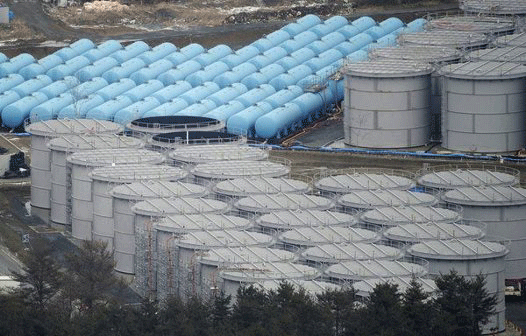
Late last night, Tepco said water leaking from the storage tank probably ran into the ocean, citing high radiation readings in a drainage ditch.
As much as 20 trillion becquerels of cesium and 10 trillion becquerels of strontium leaked into the ocean since May 2011, Tepco spokeswoman Mayumi Yoshida said today. The total amount of cesium and strontium is equivalent to about 100 times the annual limit on radiation from the plant to the ocean under normal conditions, according to calculations based on Tepco data……….
Leaking Tanks
Japan’s government has ordered an investigation into the safety of hundreds of other tanks storing contaminated water in Fukushima, the site of the world’s worst civilian nuclear disaster since the Chernobyl reactor exploded in 1986.
There are 226 tanks of similar bolted design to the leaking unit with the same 1,000-ton capacity at the site, said Tatsuya Shinkawa, director of the nuclear accident response office in the government’s Agency for Natural Resources and Energy, which called for the probe…… http://www.bloomberg.com/news/2013-08-21/tepco-shares-plunge-on-report-of-serious-radiated-water-leak.html
Dangers in removing Fukushima’s spent nuclear fuel rods
 Japanese gamble Armageddon in Last Ditch Fukushima Effort, Whiteout Press, August 20, 2013. Fukushima, Japan Japan gambles the world “……….For the past two years, there have been varying and sporadic reports, some official and some unofficial, describing how the Fukushima nuclear meltdown is anything but under control. In fact, millions of gallons of radioactive wastewater continue to spill out into the Pacific to this day. And while the reactors and their safety mechanisms continue to break down, the world comes closer and closer to global Armageddon.
To stop the complete and total meltdown of Japan’s nuclear reactors, authorities have proposed a dangerous plan. The biggest problem is Fukushima’s Reactor Number 4. The reactor’s cooling pool for spent nuclear rods is located on the top floor of the TEPCO building. And that building was heavily damaged by the 2011 quake. Due to its instability, authorities say they must move the 400 tons of spent fuel rods right away.
Spent fuel rod transfers occur on a fairly regular basis, but always under the most secure and controlled setting due to the potential nuclear catastrophe that would happen if just one spent rod is mishandled. In the case of Fukushima’s Reactor 4, officials will attempt to remove 1,300 spent fuel rods from a structurally unsafe building in a highly contaminated environment.
The problems and dangers
One nuclear fallout expert, Christina Consolo, spoke to RT News to answer the outlet’s questions regarding the situation in Fukushima. She detailed a list of potential problems authorities might encounter when they attempt to move the spent rods. Those potentially catastrophic hurdles include (from RT News):
- The racks inside the pool that contain this fuel were damaged by the explosion in the early days of the accident.
- Zirconium cladding which encased the rods burned when water levels dropped, but to what extent the rods have been damaged is not known, and probably won’t be until removal is attempted.
- Saltwater cooling has caused corrosion of the pool walls, and probably the fuel rods and racks.
- The building is sinking.
- The cranes that normally lift the fuel were destroyed.
- Computer-guided removal will not be possible; everything will have to be done manually.
- TEPCO cannot attempt this process without humans, which will manage this enormous task while being bombarded with radiation during the extraction and casking.
- The process of removing each rod will have to be repeated over 1,300 times without incident.
- Moving damaged nuclear fuel under such complex conditions could result in a criticality if the rods come into close proximity to one another, which would then set off a chain reaction that cannot be stopped.
What is most likely to go wrong?
When asked what the biggest potential dangers are in removing the damaged spent fuel rods, Christina Consolo replied, “The most serious complication would be anything that leads to a nuclear chain reaction. And as outlined above, there are many different ways this could occur. In a fuel pool containing damaged rods and racks, it could potentially start up on its own at anytime. TEPCO has been incredibly lucky that this hasn’t happened so far.”
She also expressed concern for the human workers that will have to submerse themselves into a highly radioactive environment and then perform extremely precise movements. Not only might their senses and thinking be affected, but their protective gear will make the entire operation somewhat clumsy.
“My second biggest concern would be the physical and mental fitness of the workers that will be in such close proximity to exposed fuel during this extraction process,” Consolo told RT News, “They will be the ones guiding this operation and will need to be in the highest state of alertness to have any chance at all of executing this plan manually and successfully. Many of their senses, most importantly eyesight, will be hindered by the apparatus that will need to be worn during their exposure to prevent immediate death from lifting compromised fuel rods out of the pool.” http://www.whiteoutpress.com/articles/q32013/japanese-gamble-armageddon-in-last-ditch-fukushima-effort/
First hand witness tells of government brainwashing on Fukushima radiation
those big US corporations actually asked for their people who were within 80 km (even 100 km) to evacuate. The Fukushima government had possession of the forecast chart of radiation levels in the air, but they didn’t publish them. On the contrary, they held a speaking tour to advocate that there was no need to worry about radiation.
 Natural News exclusive: Fukushima victim exposes Japanese government’s attempted bizarre brainwashing of radiation victims http://www.naturalnews.com/041720_Fukushima_radiation_Japanese_government_propaganda_brainwashing.html#ixzz2cjAxwtYH Wednesday, August 21, 2013 by Mike Adams, the Health Ranger Editor of NaturalNews.com
The following is a first-person account of the attempt by the Japanese government to brainwash victims of Fukushima radiation poisoning into believing radiation would not harm them if they simply “smile.” Natural News is the first U.S. news source to publish this account in English. The name of the original author is Uwamae Masako, who now lives in Taiwan after escaping Fukushima and leaving behind many friends and family members.
As you’ll see below, the Japanese government’s Fukushima Radiation Health Risk Advisor uses a hypnotic, droning speech pattern to try to convince his audience of absolutely bizarre quack science beliefs like “people who drink aren’t affected by radiation” or that “laughter will remove your radiation phobia.”
What follows is a true, firsthand account.
I’m a mother who has two kids. I lived in Koriyama, Fukushima. When the earthquake happened, I heard from the radio that the nuclear plant exploded. “We can’t go back to Koriyama anymore,” was the first thought came to my mind. Sendai, where my husband worked, was not a safe place, either. Although the distance between the nuclear plant and Sendai is about 120 km, the wind direction made it not safe there. Continue reading
“Pockets” of radioactive seawater will impact USA’s West Coast
West Coast of North America to Be Hit Hard by Fukushima Radiation (Excellent maps and animation) http://www.globalresearch.ca/west-coast-of-north-america-to-be-hit-hard-by-fukushima-radiation/5346470 By Washington’s Blog Global Research, August 21, 2013
Radiation Levels Will Concentrate in Pockets In Baja California and Other West Coast Locations
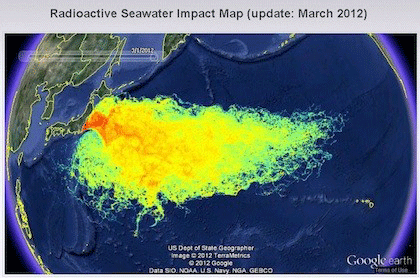
An ocean current called the North Pacific Gyre is bringing Japanese radiation to the West Coast of North America: While many people assume that the ocean will dilute the Fukushima radiation, a previously-secret 1955 U.S. government report concluded that the ocean may not adequately dilute radiation from nuclear accidents, and there could be “pockets” and “streams” of highly-concentrated radiation. Continue reading
Chris Busby explains impact of radioactive water on Fukushima coast
| Nevertheless, the sea-to-land effect is real. And anyone living within 1km of the coast to at least 200km north or south of Fukushima should get out. They should evacuate inland. It is not eating the fish and shellfish that gets you – it’s breathing.
|
Mainstream media’s deliberate lies and misinformation about renewable energy

Actually, Germany gets only about as much annual sun as Seattle or Alaska; its sunniest region gets less sun than almost anywhere in the lower 48 states. This underscores an important point: solar power works and competes not only in the sunniest places, but in some pretty cloudy places, too.
A pervasive pattern
The Fox Business example is not a singular incident. Some mainstream media around the world have a tendency to publish misinformed or, worse, systematically and falsely negative stories about renewable energy. Continue reading
Renewable energy creates many more jobs than there are in fossil fuel energy
Debunking the Renewables “Disinformation Campaign”, Mother Earth News, Despite vast evidence supporting the advancement of renewable energy, various media outlets insist on denying its progress, blurring the lines between inefficient reporting and deliberate lying. By Rocky Mountain Institute August 19, 2013 “……..a recent study commissioned by Germany’s Federal Environment Ministry found that the renewable energy sector provided around 382,000 jobs in 2011, up four percent in a year, and more than doubled in seven years. More jobs have been created than lost in Germany’s energy sector—plus any jobs gained as heavy industry moves to Germany for its competitive electricity.

Yet a myth persists that countries lose more jobs then they gain when they transition to renewables. This upside-down fantasy rests largely on a 2009 study from King Juan Carlos University in Spain, by an economist reportedly tied to ExxonMobil, the Heartland Institute, and the Koch brothers. His study asserted that, on average, every renewable energy job in Spain destroys 2.2 jobs in the broader Spanish economy. This story was picked up by news media around the world and is still promoted by U.S. anti-renewables groups. But its methodology and assumptions were promptly demolished by the National Renewable Energy Laboratory and the Spanish government, among others. A 2012 report for the International Labour Organization (ILO) even cites Spain, which built a renewable export industry, as a counterexample: “The green economy presents a good opportunity to increase competitiveness, promote the creation of quality employment and reduce the economy’s environmental impact,” says Joaquín Nieto, who heads the ILO Office in Madrid, especially “when Spain needs to kick-start its economy.” Sure enough, despite new electricity taxes and a halt to subsidies for new renewable projects, Spain’s latest solar projects continue to be built to compete without subsidy.
The disinformation campaign about job creation is not limited to Europe. A Cato Institute article claimed that if people believe a commitment to renewables will fuel job growth “we’re in a lot of trouble.” Yet in 2012 alone, more than 110,000 new U.S. clean-energy direct jobs were created, and in 2010, the U.S. had more jobs in the “clean economy” than in the fossil-fuel industries. The Bureau of Labor Statistics reports that direct employment in May 2012 totaled 181,580 for oil and gas extraction, 87,520 for coal mining, and 93,200 for iron and steel production. BLS doesn’t similarly classify solar or wind jobs, but reputable analysts have determined from bottom-up industry surveys that in September 2012, for example, the U.S. had 119,016 direct solar jobs (89 percent full-time, the rest at least half-time), up 27 percent in two years—more than in steel-making or coal-mining. Had you heard that before? Why not? …….. http://www.motherearthnews.com/renewable-energy/debunking-the-renewables-disinformation-campaign-zm0z1308zsal.aspx#axzz2cYi1w7VS
Highly radioactive since 1957 nuclear disaster, Windscale site to be cleaned up by robots
 Robots to Demolish Site of UK’s Worst Nuclear Incident at Sellafield http://www.ibtimes.co.uk/articles/499768/20130818/sellafield-nuclear-robots-destroy.htm By TOM PORTER: August 18, 2013 Giant robots will be used to destroy the part of the Sellafield nuclear plant that caught fire 56 years ago, spewing radioactive contamination around Britain and northern Europe.
The Windscale Pile One chimney at the Cumbria plant has been sealed and cut off since the 1957 disaster.
There is still highly charged material trapped inside the shaft of the 400ft chimney, and more than 10 tons of melted radioactive uranium fuel remains inside the structure itself.
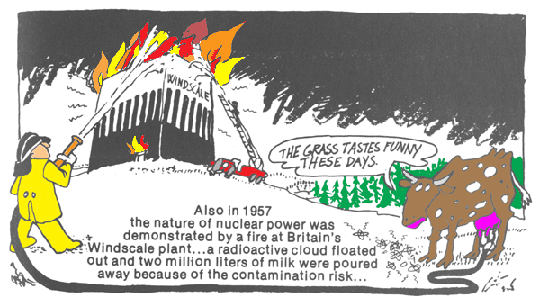
The reactor was built after World War II to make some of Britain’s first nuclear bombs, and then pressed into service to make tritium for an H-bomb, pushing the reactors beyond their limits and causing the blaze.
Workers at the plant were exposed to 150 times a safe lifetime’s dose of radiation, and for a month the government destroyed all milk produced within 200 miles of the site. Environmentalists and campaigners have since pointed to Sellafield as a warning of the potentially catastrophic effects of nuclear energy. Continue reading
Russia’s secret maze of underground radioactive trash tunnels
 A Secret Race for Abandoned Nuclear Material http://www.nytimes.com/2013/08/18/world/asia/a-secret-race-for-abandoned-nuclear-material.html?_r=0 By ELLEN BARRY August 17, 2013 Working in top secret over a period of 17 years, Russian and American scientists collaborated to remove hundreds of pounds of plutonium and highly
  enriched uranium — enough to construct at least a dozen nuclear weapons — from a remote Soviet-era nuclear test site in Kazakhstan that had been overrun by impoverished metal scavengers, according to a report released last week by the Belfer Center for Science and International Affairs at Harvard.
The report sheds light on a mysterious $150 million cleanup operation paid for in large part by the United States, whose nuclear scientists feared that terrorists would discover the fissile material and use it to build a dirty bomb.
Over the years, hints emerged that something extraordinarily dangerous had been left behind in a warren of underground tunnels — like the American aerial drones that circled over the site, looking for intruders, or the steel-reinforced concrete that was poured into tunnels and over stretches of earth.
Among the report’s new revelations is that the Soviet testers left behind components, including high-purity plutonium, that could have been used to build not just a dirty bomb but a “relatively sophisticated nuclear device,” an American official told the report’s authors. Continue reading
Film” Pandora’s Promise” spews out a stream of untruths,
The movie also illustrates that none of its five layman “converts” to pro-nuke views knows enough about nuclear plants or other energy solutions to evaluate them fairly. They only know the Nuclear Dream.

 A Nuclear Submariner Challenges a Pro-Nuclear Film NYT, By ANDREW C. REVKIN, 16 Aug 13 John Dudley Miller, a former nuclear engineering officer in the Navy with a doctorate in social psychology and a long career in journalism, sent this “Your Dot” critique of “Pandora’s Promise,” the new documentary defending nuclear power,
When I saw “Pandora’s Promise,” I didn’t believe a word of it. I served as a submarine nuclear engineering officer for my four-year stint in the Navy years ago. I qualified as an Engineering Officer of the Watch (a guy who’s in charge of the plant and its other technicians during four-hour shifts) on two different sub reactors. I know the truth about reactors, and the movie replaces it with the demonstrably false Nuclear Dream, a just-so mythical story claiming that nukes are safe, clean and cheap…..
the movie – It spews out a stream of untruths, for instance, telling us only that Chernobyl killed56 people. It leaves out that a United Nations World Health Organization agency predicts 16,000 more will die from Chernobyl cancers and that the European Environment Agency estimates 34,000 more. It omits that non-fatalthyroid cancer struck another 6,000, mostly children
Even the movie’s two reactor designers distort truth. Physicist Charles Till claims that fast-breeder reactors are inherently safe. Actually, they’re riskier than ordinary reactors. Hans Bethe, Manhattan Project scientist and Nobel laureate, calculated in 1956 that if a breeder’s liquid sodium coolant leaked out, it could melt in 40 seconds, become a small unintended atom bomb and spontaneously explode. (Modern designers believe breeders are more likely to melt down like Three Mile Island than to explode like Chernobyl.)
The breeder reactors EBR-1 in Idaho and Fermi-1 near Detroit partially melted. Several breeders have suffered sodium coolant fires, because sodium automatically burns in air and explodes in water. Continue reading
1 This Month



26 September – International Day for the Total Elimination of Nuclear Weapons


PLEASE OPPOSE HR 8255 AND S.3639 – bills would accelerate satellite deployment, with no environmental review or safeguards – https://ncstd5li.quorum.us/campaign/169331/
To see nuclear-related stories in greater depth and intensity – go to https://nuclearinformation.wordpress.com
-
Archives
- September 2026 (257)
- August 2026 (330)
- July 2026 (355)
- June 2026 (287)
- May 2026 (306)
- April 2026 (356)
- March 2026 (251)
- February 2026 (267)
- January 2026 (308)
- December 2025 (358)
- November 2025 (359)
- October 2025 (375)
-
Categories
- 1
- 1 NUCLEAR ISSUES
- business and costs
- climate change
- culture and arts
- ENERGY
- environment
- health
- history
- indigenous issues
- Legal
- marketing of nuclear
- media
- opposition to nuclear
- PERSONAL STORIES
- politics
- politics international
- Religion and ethics
- safety
- secrets,lies and civil liberties
- spinbuster
- technology
- Uranium
- wastes
- weapons and war
- Women
- 2 WORLD
- ACTION
- AFRICA
- Atrocities
- AUSTRALIA
- Christina's notes
- Christina's themes
- culture and arts
- Events
- Fuk 2022
- Fuk 2023
- Fukushima 2017
- Fukushima 2018
- fukushima 2019
- Fukushima 2020
- Fukushima 2021
- general
- global warming
- Humour (God we need it)
- Nuclear
- RARE EARTHS
- Reference
- resources – print
- Resources -audiovicual
- Weekly Newsletter
- World
- World Nuclear
- YouTube
-
RSS
Entries RSS
Comments RSS
 nuclear-news