How the nuclear lobby captured the University of Saskatchewan

 Follow the yellowcake road Nuclear power, tarsands extraction, and the co-option of the University of Saskatchewan Briar Patch magazine, BY D’ARCY HANDE • FEB 28, 2012 In 2011 the University of Saskatchewan went truly nuclear, realizing, in many respects, the loftiest ambitions of the uranium industry and its supporters within the provincial government and the university. On October 14, 2011, the University of Saskatchewan board of governors formally approved the incorporation of the Canadian Centre for Nuclear Innovation (CCNI) “to stimulate new research, development and training in advanced aspects of nuclear science and technology.”
Although the pieces seemed to come together in just a few short months, the game plan had been coalescing since Brad Wall’s Saskatchewan Party government was first elected in 2007 (read the full timeline here). Tracing corporate connections and developments behind the scenes shows how a coordinated strategy can be implemented largely outside public purview and beyond generally accepted public accountability…… Continue reading
Depleted Uranium spreads its dangerous radiation around the world
 Dangers and Health Effects of Depleted Uranium, Disabled World, 4 Sept 13 Thomas C. Weiss
Document Detail: Depleted Uranium (DU) is a waste product, one that is left over when uranium is enriched to create fissionable material for nuclear weapons and reactors. DU consists of uranium from which most of the fissionable isotopes, uranium 235 and 234, have been removed. DU contains 99.5% Uranium 238.
The term, ‘depleted,’ carries with it the implication that it is not particularly dangerous; however, DU is a chemically toxic and radioactive heavy metal and because of this it is potentially hazardous to a person’s health. It is believed by many that exposure to depleted uranium (DU), especially when a person inhales or ingests it as a particulate, causes severe and long-term health effects. The size and effect, as well as the political significance of it, remain in dispute at this time. DU is an extremely dense material, 1.7 times as dense as lead, and is also, ‘pyrophoric,’ and is combustible when it comes in contact with air.
DU is being used by the defense industry in the creation of armor piercing munitions and anti-tank projectiles, as well as in the manufacture of tank armor.
Around 17 nations are thought to have weapon systems containing DU in their arsenals to include: Continue reading
USA’s cover-up of effects of depleted uranium on US soldiers
The U.S. Army’s own contractor, Doug Rokke, who headed a clean up of depleted uranium (DU) after the first Gulf War stated, “Depleted uranium is a crime against God and humanity.” Mr. Rokke went on to state that when his crew went to the Gulf they were all very healthy people, yet after performing clean up operations, 30 members of his staff died and the majority of the others, to include Mr. Rokke himself, “developed serious health problems.
 The military is aware of depleted uranium’s harmful effects on the human genetic code.
The U.S. Military does not want the rest of the world to find out what we have done
Dangers and Health Effects of Depleted Uranium, Disabled World, Thomas C. Weiss, 4 Sept 13 “…….According to an article by Robert C. Koehler in 2007, the Veterans Administration presented figures of 205,000 soldiers who returned from wars in Iraq and Afghanistan. Of these soldiers, one-third have sought medical care for issues such as:
Perhaps the most compelling evidence of all is the sheer number of veterans of the Iraq and Afghanistan conflicts suffering physical ailments. In an April 12, 2007 article, Robert C. Koehler examined the issue:
- Malignant tumors (1,584)
- Mental disorders (73,157)
- Mystery conditions (67,743)
- Nervous system diseases (61,524)
- Musculoskeletal diseases (87,590)
- Digestive system diseases (63,002)
- Endocrinal and metabolic diseases (36,409)
Many times these conditions are lumped together under the convenient catch all heading of, ‘Gulf War Syndrome.’ It is very likely that at least some of these illnesses are caused by exposure to depleted uranium (DU). The effects of DU contamination may take up to 10 years to manifest and it is likely the number of veterans who will need medical care will be higher than from prior conflicts. Continue reading
The tricky but lucrative business of shutting down dead nuclear raectors
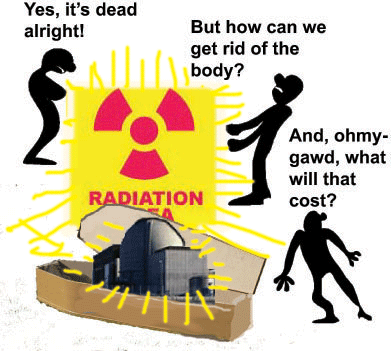 Nuclear Trashmen Gain From Record U.S. Reactor Shutdowns Bloomberg By Brian Wingfield – Sep 4, 2013 1:”……..Tricky Business The physical work involved in tearing down a nuclear plant takes about 10 years, according to John Hickman, a project manager in the U.S. Nuclear Regulatory Commission’s decommissioning branch. The agency gives reactor owners 60 years to complete decommissioning, which it defines as permanently removing a plant from service and reducing radioactivity enough for the property to be used for another purpose.
The NRC is now overseeing 14 commercial reactors that are in some phase of decommissioning, excluding those marked for closure in the last year. The first plant to deliver commercial power in the U.S. was a General Electric Co (GE).-designed unit near Fremont, California, which began service in 1957, according to the agency. It was also the first unit to be decommissioned, in 1963.
Razing a plant is tricky business. Radiation can seep into the concrete, pipes and metal of plant structures, and workers need to be able to break down the units without exposing themselves, or the public, to contamination. Plants often sit idle for decades before being torn down in order to let radioactive material decay. Continue reading
Depleted Uranium (DU) Health Concerns
Dangers and Health Effects of Depleted Uranium, Disabled World, Thomas C. Weiss, 4 Sept 13 “…………Health concerns and DU center around the effect on the human body of nano-sized ceramic particles of uranium oxide (U238) that are released into the air when DU munitions are used in battle. Dr. Rosalie Bertell presented a concise explanation of the potential dangers of exposure to depleted uranium (DU). Dr. Bertell stated, “Uranium oxide and its aerosol form are insoluble in water. The aerosol resists gravity, and is able to travel tens of kilometres in air. Once on the ground, it can be resuspended when the sand is disturbed by motion or wind. Once breathed in, the very small particles of uranium oxide, those which are 2.5 microns (one micron = one millionth of a meter) or less in diameter, could reside in the lungs for years, slowly passing through the lung tissue into the blood.” Continue reading
Wall of ice planned, to go underneath Fukushima nuclear plant
Japan to build $470M ice wall to prevent nuclear leaks http://www.cbsnews.com/8301-202_162-57601127/japan-to-build-$470m-ice-wall-to-prevent-nuclear-leaks/ 4 Sept 13, The Japanese government announced Tuesday that it will spend $470 million on a subterranean ice wall and other steps in a desperate bid to stop leaks of radioactive water from the crippled Fukushima nuclear plant after repeated failures by the plant’s operator.
The decision is widely seen as an attempt to show that the nuclear accident won’t be a safety concern just days before the International Olympic Committee chooses among Tokyo, Istanbul and Madrid as the host of the 2020 Olympics.

The Fukushima Dai-ichi plant has been leaking hundreds of tons of contaminated underground water into the sea since shortly after a massive 2011 earthquake and tsunami damaged the complex. Several leaks from tanks storing radioactive water in recent weeks have heightened the sense of crisis that the plant’s owner, Tokyo Electric Power Co., isn’t able to contain the problem. Continue reading
Big salt deposits suggested as dumping place for nuclear wastes

The reasonable thing to do is to stop making nuclear wastes

 Where On Earth Do We Put Spent Nuclear Fuel? Forbes, 29 Aug 13 If Nevada’s Harry Reid is right and Yucca Mountain is flattened, then what will happen to the nation’s 70,000-plus tons of nuclear waste? The Senate Majority Leader is adamant that such spent fuel from the country’s 102 nuclear plants will never find a permanent home in that area that is 90 miles outside of Las Vegas…….
Consider: the U.S. Department of Energy’s Waste Isolation Pilot Program (WIPP), a massive salt formation in southeastern New Mexico that has been accepting waste from nuclear weapons for 14 years. But it is not permitted to take in low-level spent fuel from commercial nuclear reactors.
As Conca explains, WIPP is 16 square miles of a 10,000-square mile, 2,000-foot thick salt layer. Those materials that are placed there are engulfed by the natural geology — the tightest rock on earth. The main obstacle, he adds, is the administrative changes necessary to allow the transport and disposal of spent fuel from the current interim sites to WIPP. Political resistance would also arise.
But massive salt formations are better repositories than the hard rock at Yucca Mountain, he insists, noting that rocks can fracture whereas salt does not. The best salt formations are in New Mexico and Texas.
Conca agrees that taking reprocessed nuclear fuel and using it in a nuclear power plant is less difficult than applying the same material to an atomic weapon. But WIPP changes the equation, he says, noting that, “there is so much uranium in the world that we don’t need to reprocess it. Mining the uranium is so much easier and so much cheaper than reprocessing it.”…..
Legally, Yucca Mountain remains a live topic but politically, it stands little chance of becoming permanent repository, especially because the Senate Majority Leader represents Nevada. But that debate over what to do with spent nuclear fuel has spawned some compelling ideas, some of which have been around for a while.
Reconciling the reprocessing fissures is likely to take decades. But broadening the use of massive salt deposits such as WIPP to include not just weapons-grade material but also radioactive fuel from commercial reactors would be an easier gulf to bridge.
Massive amounts of depleted uranium created by uranium enrichment
 Uranium Enrichment Creates Massive Amounts Of Depleted Uranium (DU) – Used In Weapons Of Mass Destruction
Strontium 90, another radioactive element discharging from Fukushima nuclear mess
Since June 2011 there have been further large discharges of strontium from Fukushima that have not been measured with precision.
Along with caesium-137, Sr-90 is one of the most important artificial radioactive isotopes released into the environment, with a half-life of 30 years. Strontium’s chemical behaviour is similar to that of calcium, and it can accumulate in organisms, especially in bone.
Fukushima accident raised levels of radioactive strontium off the east coast of Japan by up to a hundred times : http://phys.org/news/2013-06-fukushima-accident-radioactive-strontium-east.html#jCp Researchers from the Institute for Environmental Science and Technology (ICTA) and the Department of Physics of the Universitat Autònoma de Barcelona (UAB) have studied the spread of radioactive strontium in the coastal waters of eastern Japan during the three months following the Fukushima nuclear accident, which happened in March, 2011. The samples analysed show the impact of the direct release of radioactive materials into the Pacific Ocean, and indicate that the amount of strontium-90 discharged into the sea during those three months was between 90 and 900 Tbq (terabecquerels), raising levels by up to two orders of magnitude. The highest concentrations were found to the north of the Kuroshio current, which acts as a barrier preventing radioactive material from being carried to lower latitudes. Continue reading
Kazakhstan’s water imperilled by in situ leaching of uranium
Scientists studying the effects of ISL doubt how quickly mine sites can self-cleanse. This uncertainty appears to be little known to both Kazakhstan’s nuclear industry and fledgling environmentalists.
no site in the US has been entirely returned to pre-mining conditions
The cost of being the world’s No.1 uranium producer Kazakhstan’s industry has skyrocketed in the past 10 years. But what could that mean for the environment? Christian Science Monitor, By Ben Arnoldy, Staff writer / August 28, 2013 ASTANA, KAZAKHSTAN
If you make a toxic mess under one of the most isolated parts of the planet, does it matter if you don’t clean it up? Does it make a difference if that mess will be there for thousands of years? Scientists are asking those questions as Kazakhstan has steadily risen to become the world’s No. 1 uranium producer, surpassing such nations as the United States, Canada, and Australia, which require more cleanup.
Rather than employing miners to haul rock up to the surface, mine operators in Kazakhstan have embraced a newer – and generally cleaner – process by which a chemical solution is injected down a pipe to dissolve the underground uranium deposits and then is sucked back up to the surface.

This in situ leach (ISL) method avoids making a mess above ground, but leaves toxic levels of heavy metals in the ground water. In the US, companies using the method have tried for years and failed to return ground water to its pre-mining state. Continue reading
Radiation cancer danger greater for female astronauts than for men
The exposure limits for women are about 20 percent lower compared to men “largely due to additional cancer risk for woman from breast, ovarian, and uterine cancers,
 Female Astronauts Face Discrimination from Space Radiation Concerns, Astronauts Say, Space.com by Miriam Kramer, Staff Writer | August 27, 2013 Female astronauts have fewer opportunities to fly in space than men partially because of strict lifetime radiation exposure restrictions, astronauts say.
Both male and female astronauts are not allowed to accumulate a radiation dose that would increase their lifetime risk of developing fatal cancer by more than 3 percent. A six-month mission on the International Space Station exposes astronauts to about 40 times the average yearly dose of background radiation that a person would receive living on Earth, NASA spokesman William Jeffs said in an email .
.
While the level of risk allowed for both men and women in space is the same, women have a lower threshold for space radiation exposure than men, according to physiological models used by NASA. “Depending on when you fly a space mission, a female will fly only 45 to 50 percent of the missions that a male can fly,” Peggy Whitson, the former chief of NASA’s Astronaut Corps, said. “That’s a pretty confining limit in terms of opportunity. I know that they are scaling the risk to be the same, but the opportunities end up causing gender discrimination based on just the total number of options available for females to fly. [That’s] my perspective.” [Radiation Threat for Mars-Bound Astronauts (Video)]
NASA follows radiation exposure recommendations established by the National Council of Radiation Protection and Measurements. The exposure limits for women are about 20 percent lower compared to men “largely due to additional cancer risk for woman from breast, ovarian, and uterine cancers,” Jeffs told SPACE.com……..
“Depending on when you fly a space mission, a female will fly only 45 to 50 percent of the missions that a male can fly,” Peggy Whitson, the former chief of NASA’s Astronaut Corps, said. “That’s a pretty confining limit in terms of opportunity. I know that they are scaling the risk to be the same, but the opportunities end up causing gender discrimination based on just the total number of options available for females to fly. [That’s] my perspective.” [Radiation Threat for Mars-Bound Astronauts (Video)]
NASA follows radiation exposure recommendations established by the National Council of Radiation Protection and Measurements. The exposure limits for women are about 20 percent lower compared to men “largely due to additional cancer risk for woman from breast, ovarian, and uterine cancers,” Jeffs told SPACE.com…… http://www.space.com/22252-women-astronauts-radiation-risk.html
Fukushima’s most dangerous problem is ignored by mainstream media
Glowing Green with Outrage By Adam Smith OpEdNews Op Eds 8/27/2013 ”………Unfortunately the reality has been that the media have simply not been doing their job. The Tokyo Electric Power Company (Tepco) has been allowed to dictate the narrative of what is occurring with basically no oversight. It turns out that the site was never actually contained and radioactive water has been leaking with “no accurate figures for radiation levels.” You may say that since this issue is being reported by all major news organizations now, the media is doing their job albeit in a very tardy fashion.
However, that would be missing the reality that this leaking radiation water is the least of our worries vis-a-vis the plant. Much less reported by the media is what will be required by the clean-up crew to end this whole saga. Reliable old Reuters often provides the on-the-ground breaking scoops that our local media then report to us. Despite their well-deserved reputation, it seems that most media organizations have chosen to ignore their recent scoop about the dangers involved in the clean-up process.
 Essentially, Tepco needs to remove 1300 spent fuel rods, containing 14,000 times the amount of radiation dropped onto Japan in WWII, from a dilapidated, flooding, and collapsing power plant that still sits in an earthquake-prone location. The whole process will take about 40 years and cost about eleven billion dollars. Each rod weighs 660 pounds, is 15 feet long, and cannot get too close to each other or will trigger a chain-reaction. If exposed to air, they may also trigger a chain-reaction. Usually, when these rods are moved as part of normal operations, a sophisticated robot is used to guide the work and ensure accuracy down to millimeters. Due to the damage caused by the earthquake/tsunami, this is not possible and the cranes will be operated in a poisonously radioactive area by scared human hands with all of their limitations. These rods will be removed individually, one at a time, and a mistake on any of them could trigger an unstoppable chain-reaction…….. http://www.opednews.com/articles/Glowing-Green-with-Outrage-by-Adam-Smith-Cancer_Energy_Energy_Energy-130827-96.html
USA West Coast Tuna, Salmon and Herring contaminated by radiation?
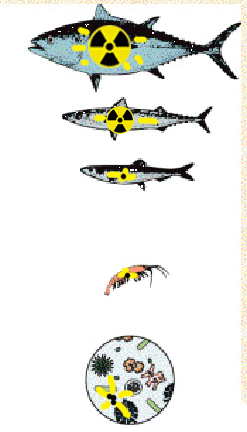 The bottom line – as nuclear experts said 4 days after the Japanese earthquake and tsunami – is that we all need to demand that fish be tested for radiation.
Is Fukushima Radiation Contaminating Tuna, Salmon and Herring On the West Coast of North America?
By Washington’s Blog Global Research, August 26, 2013 Demand that Fish Be Tested for Radiation
We’ve extensively documented that radioactivity from Fukushima is spreading to North America.
More than a year ago, 15 out of 15 bluefin tuna tested in California waters were contaminated with radioactive cesium from Fukushima.
Bluefin tuna are a wide-ranging fish, which can swim back and forth between Japan and North America in a year. But what about other types of fish?
Sockeye salmon also have a range spanning all of the way from Japan to Alaska, Canada, Washington and Oregon: Associated Press reports that both scientists and native elders in British Columbia say that sockeye numbers have plummeted:…….
Another example – pacific herring – is even more dramatic. Pacific herring is wide-ranging fish, spanning all the way from Japan to Southern California:
Every single pacific herring examined by a biologist in Canada was found to be hemorrhaging blood. As Ene News reports:
See also: Alexandra Morton via Vancouver 24 hrs, Vancouver 24 hrs, Alexandra Morton)
The Globe and Mail, Aug 13, 2013 (Emphasis Added):
Independent fisheries scientist Alexandra Morton is raising concerns about a disease she says is spreading through Pacific herring causing fish to hemorrhage. […] “Two days ago I did a beach seine on Malcolm Island [near Port McNeill on northern Vancouver Island] and I got approximately 100 of these little herring and they were not only bleeding from their fins, but their bellies, their chins, their eyeballs. […] “It was 100 per cent … I couldn’t find any that weren’t bleeding to some degree. And they were schooling with young sockeye [salmon]”
Sun News, Aug 12, 2013: Continue reading
USA’s Minuteman missiles – supremely dangerous – to the USA
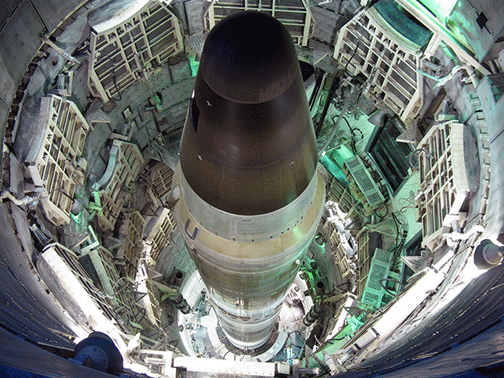 US nuclear weapons poised for catastrophe By James Carroll BOSTON GLOBE AUGUST 26, 2013
The vulnerability is there for all to see. The United States nuclear establishment has been wracked with problems for years. These are especially acute among thousands of officers at the controls of three bases where 450 Minuteman III missiles stand in buried silos on high alert.
In 2008, a Pentagon review found “a dramatic and unacceptable decline” in the way the Air Force was handling its nuclear mission. Senior officials were cashiered. Their replacements were ordered to fix the problems. They have failed to do so. What should be the most rigorously disciplined element in the US military is repeatedly found unworthy of its awesome responsibility. That’s a wake-up call, yet the nation sleeps on……..
supremely dangerous. The missiles are positioned in easily targeted fixed silos across a wide-open western landscape. They are poised for launch on moments’ notice less because of strategic necessity than because they are bound by the rule of “use them or lose them.” The scenario was conceived 50 years ago, under circumstances that are now forgotten. The land-based ICBMs, more than nuclear armed submarines or aircraft, have become the thread from which hangs the sword of accidental holocaust. Fail-safe “right procedures” are the only protection — yet current crews are proving incapable of following those procedures. Fail-safe is the joke that is not funny……… http://www.bostonglobe.com/opinion/2013/08/26/nuclear-tipped-missiles-posed-for-nightmare-holocaust/VZ3KQOUsAUFm4qfuchjmCI/story.html
How the West ignores the horror of depleted uranium weapons and their biological effects
 Last week, U.K. foreign secretary William Hague, said that the use of chemical weapons in Syria is “not something that a humane or civilized world can ignore.” Ironically, Western countries such as the U.K. and their allies have appeared to ignore the use of weapons that are equally vicious.
When “non-Westerners” make use of weapons of mass destruction, there is outrage and calls for military intervention from “the West,” but when “Westerners” themselves use them, it is totally permissible and the world can hardly react.
U.S. DEPLETED URANIUM AS MALICIOUS AS SYRIAN CHEMICAL WEAPONS HTTPS://CRAIGCONSIDINETCD.WORDPRESS.COM/2013/08/25/U-S-DEPLETED-URANIUM-AS-MALICIOUS-AS-SYRIAN-CHEMICAL-WEAPONS/ CRAIG CONSIDINE
By this time you have likely heard of the atrocity that recently took place in which over 1,000 Syrian civilians reportedly died at the hands of a chemical weapon attack. Seeing the video and images of dead or helpless Syrian civilians struggling for life reminds me of another terrible weapon of war – depleted uranium.
It is no secret that the U.S., with the assistance of OTHER GOVERNMENTS, used depleted uranium in the Gulf and Iraq War. A simple Google search of this topic can produce dozens and dozens of credible reports or stories to confirm these war crimes. For example, an important REPORT on Harvard University’s website discusses the fallout of depleted uranium contamination in Iraq. Dr. Souad N. Al-Azzawi, who authored the report after the GULF WAR, wrote that:
“DEPLETED URANIUM (DU) WEAPONRY HAS BEEN USED AGAINST IRAQ FOR THE FIRST TIME IN THE HISTORY OF RECENT WARS. THE MAGNITUDE OF THE COMPLICATIONS AND DAMAGE RELATED TO THE USE OF SUCH RADIOACTIVE AND TOXIC WEAPONS ON THE ENVIRONMENT AND THE HUMAN POPULATION MOSTLY RESULTS FROM THE INTENDED CONCEALMENT, DENIAL AND MISLEADING INFORMATION RELEASED BY THE PENTAGON ABOUT THE QUANTITIES, CHARACTERISTICS AND THE AREA’S IN IRAQ, IN WHICH THESE WEAPONS HAVE BEEN USED.”
Similarly, as Democracy Now! REPORTED in an interview with Al Jazeera reporter Dahr Jamail, ”the U.S. INVASION OF IRAQ has left behind a legacy of cancer and birth defects suspected of being caused by the U.S. military’s extensive use of depleted uranium and white phosphorus.” Democracy Now! wrote: Continue reading
1 This Month



26 September – International Day for the Total Elimination of Nuclear Weapons


PLEASE OPPOSE HR 8255 AND S.3639 – bills would accelerate satellite deployment, with no environmental review or safeguards – https://ncstd5li.quorum.us/campaign/169331/
To see nuclear-related stories in greater depth and intensity – go to https://nuclearinformation.wordpress.com
-
Archives
- September 2026 (257)
- August 2026 (330)
- July 2026 (355)
- June 2026 (287)
- May 2026 (306)
- April 2026 (356)
- March 2026 (251)
- February 2026 (267)
- January 2026 (308)
- December 2025 (358)
- November 2025 (359)
- October 2025 (375)
-
Categories
- 1
- 1 NUCLEAR ISSUES
- business and costs
- climate change
- culture and arts
- ENERGY
- environment
- health
- history
- indigenous issues
- Legal
- marketing of nuclear
- media
- opposition to nuclear
- PERSONAL STORIES
- politics
- politics international
- Religion and ethics
- safety
- secrets,lies and civil liberties
- spinbuster
- technology
- Uranium
- wastes
- weapons and war
- Women
- 2 WORLD
- ACTION
- AFRICA
- Atrocities
- AUSTRALIA
- Christina's notes
- Christina's themes
- culture and arts
- Events
- Fuk 2022
- Fuk 2023
- Fukushima 2017
- Fukushima 2018
- fukushima 2019
- Fukushima 2020
- Fukushima 2021
- general
- global warming
- Humour (God we need it)
- Nuclear
- RARE EARTHS
- Reference
- resources – print
- Resources -audiovicual
- Weekly Newsletter
- World
- World Nuclear
- YouTube
-
RSS
Entries RSS
Comments RSS
 nuclear-news