Pandora’s misleading spin about Integral Fast Nuclear Reactors (IFRs)
 Other Department of Energy studies showed that pyroprocessing, by generating large quantities of low-level nuclear waste and contaminated uranium, greatly increases the volume of nuclear waste requiring disposal, contradicting “Pandora’s Promise’s” claim it would reduce the amount of waste.
Scientist: Film hypes the promise of advanced nuclear technology By Edwin Lyman, CNN November 7, 2013 In his zeal to promote nuclear power, filmmaker Robert Stone inserted numerous half-truths and less-than-half-truths in his new documentary “Pandora’s Promise,” One of Stone’s more misleading allegations was that scientists at a U.S. research facility, the Argonne National Laboratory, were on the verge of developing a breakthrough technology that could solve nuclear power’s numerous problems when the Clinton administration and its allies in Congress shut the program in 1994 for purely political reasons.
Like the story of Pandora itself, the tale of the integral fast reactor (IFR) — or at least the version presented in the movie — is more myth than reality. In the final assessment, the concept’s drawbacks greatly outweighed its advantages. The government had sound reasons to stanch the flow of taxpayer dollars to a costly, flawed project that also was undermining U.S. efforts to reduce the risks of nuclear terrorism and proliferation around the world…….
What did “Pandora’s Promise” leave out? First, it does not clearly explain what a “fast reactor” is and how it differs from the water-cooled reactors in use today. Most operating reactors use a type of fuel called “low-enriched” uranium, which cannot be used directly to make a nuclear weapon and poses a low security risk. The spent fuel from these water-cooled reactors contains weapon-usable plutonium as a byproduct, but it is very hard to make into a bomb because it is mixed with uranium and highly radioactive fission products.
Fast reactors, on the other hand, are far more dangerous because they typically require fuels made from plutonium or “highly enriched” uranium that can be used to make nuclear weapons.
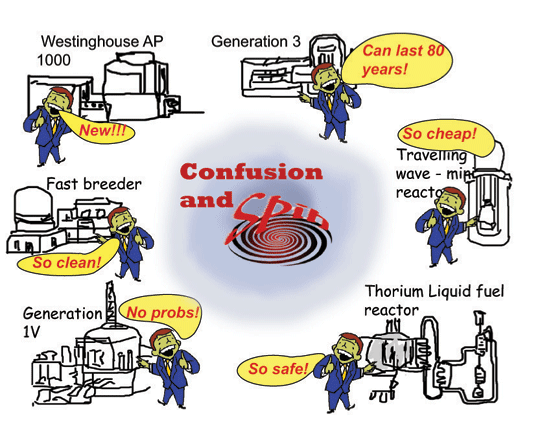
In fact, fast reactors can be operated as “breeders” that produce more plutonium than they consume. To produce the large quantities of plutonium needed to fuel fast reactors, spent fuel from conventional reactors has to be reprocessed — chemically processed to separate plutonium from the other constituents. Facilities that produce plutonium fuel must have strong protections against diversion and theft. All too often, however, security at such facilities is inadequate.
In the IFR concept, which was never actually realized in practice, reactor-spent fuel would be reprocessed using a technology called pyroprocessing, and the extracted plutonium would be fabricated into new fuel. IFR advocates have long asserted that pyroprocessing is not a proliferation risk because the plutonium it separates is not completely purified.
But a 2008 U.S. Department of Energy review — which confirmed many previous studies — concluded that pyroprocessing and similar technologies would “greatly reduce barriers to theft, misuse or further processing, even without separation of pure plutonium.” Continue reading
On Integral Fast Reactor and France “Pandora’s Promise” gets it wrong
Nuclear energy film overstates positives, underplays negatives By Ralph Cavanagh and Tom Cochran, CNN November 6, 2013 – “………The still-unrealized Integral Fast Reactor is the real star of the film, along with the nation of France, whose nuclear generation program is extolled as “one of the most inspiring stories ever” (“the trains are electric powered, they have clean air, and they have the cheapest electricity in Europe”). Nuclear power debates are the only places where you will ever see those at the conservative edge of the political spectrum argue that the United States should reorganize its economy to be more like France.
The Clinton administration killed the Integral Fast Reactor in 1994 because of concern over the potential diversion of the plutonium fuel by terrorists and non-nuclear weapon states of concern. Yet the film’s closing argument is that a “fourth-generation” reactor modeled on the Integral Fast Reactor will sweep the globe, burning waste created by the first three generations and “solving” the nagging problem of long-term disposal of nuclear waste. The film fails to mention that this would take hundreds to thousands of plutonium-fueled reactors operating over hundreds of years, resulting most likely in an increase in the releases of radioactivity to the environment as a consequence of operations by the Integral Fast Reactor’s fuel processing and fabricating facilities.
The film invokes Bill Gates as one of many forward-thinking new investors in nuclear innovation, but surely even Gates would recoil from the Integral Fast Reactor’s poor economic outlook compared to conventional reactors and the financial risks associated with building just one Integral Fast Reactor, let alone a global fleet of them. The film fails to acknowledge that the flagship fast reactor development efforts in the United States, France, Germany, Japan and Italy all failed, and that fast reactors were abandoned by both the U.S. and Soviet navies, hardly a strong selling point for resurrecting the Integral Fast Reactor program………..http://edition.cnn.com/2013/11/06/opinion/pandora-nuclear-energy-opinion-cavanagh-cochran/
Soon to begin – the dangerous process of removing nuclear fuel rods from Fukushima Unit no. 4
Unit 4 presented particular dangers because its entire stock of fuel rods was in the pool at the time of the accident.
If the operation goes as planned, attention will then focus on the massive challenges posed by Units 1, 2 and 3.
Tepco will not confirm the precise timing of the fuel rod operation but after so much public outrage at the company’s handling of the crisis so far, scrutiny of this latest episode will be intense.
Fukushima nuclear plant set for risky operation http://www.bbc.co.uk/news/science-environment-24843657 7 Nov 13 David Shukman A task of extraordinary delicacy and danger is about to begin at Japan’s Fukushima nuclear power station.
Engineers are preparing to extract the first of more than 1,000 nuclear fuel rods from one of the wrecked reactor buildings. This is seen as an essential but risky step on the long road towards stabilising the site.
The fuel rods are currently in a precarious state in a storage pool in Unit 4. This building was badly damaged by an explosion in March 2011 following the Great Tohoku earthquake and tsunami. Moving the rods to safety is a high priority but has only become possible after months of repair work and planning.

One senior official told me: “It’s going to be very difficult but it has to happen.” Continue reading
Examining the subject of radiation and cancer
 Experts debate ‘safe’ dose of radiation http://www.wnem.com/story/23813407/experts-debate-safe-dose-of-radiation Nov 06, 2013 By Kimberly Wright – email (RNN) – Is there such a thing as a safe dose of radiation? Some experts say no. Research shows that any dose of radiation increases an individual’s risk for the development of cancer.
Decades of research show clearly that any dose of radiation increases an individual’s risk for the development of cancer, according to the Physicians for Social Responsibility. The primary risk of radiation is cancer, according to the Environmental Protection Agency, with the higher the radiation dose, the greater the chance of developing cancer.
The chance of developing cancer, not the seriousness of the cancer, increases as the radiation dose goes up. It can be difficult to discern what causes cancer when it is detected, as cancers caused by radiation do not appear until years after the radiation exposure.
Some are more likely to develop cancer than others from radiation. Less likely,radiation can also cause genetic mutations and birth defects to a developing embryo or fetus. Fetuses are most susceptible to radiation exposure, following by infants, children, pregnant women and people with compromised immune systems, according to the Centers for Disease Control and Prevention. Fetuses are most sensitive between about eight to 15 weeks after conception. Continue reading
Fukushima Daiichi nuclear power plant will probably need a concrete tomb
Japan Nuclear Engineer: I don’t think they’ll ever get Fukushima’s melted cores; Will probably start covering reactors in concrete — German Expert: May encase areas in sarcophagus http://enenews.com/japan-nuclear-engineer-dont
November 4th, 2013
Helmholtz Special, 2012: Dr Walter Tromm is Spokesperson of the […] Nuclear Energy and Safety at the Karlsruhe Insititue of Technology, collaborates on international expert committees on the safety of nuclear reactors: “Debris and scrap metal are to be removed from the plant bit by bit in order to finally dismantle it and/or encase the areas with the highest degree of radioactivity in a sarcophagus.”

‘Fukushima‘ by Mark Willacy, book published July 1, 2013 (Excerpt): […] there was much -expert scepticism about whether the government’s 40-year road map would be achievable. ‘I also hope decommissioning can be completed in 40 years,’ said [nuclear-reactor engineer] Hiroaki Koide. ‘But I do not think it is possible.’ […] In an interview with me 20 months after the meltdowns, TEPCO also appeared to be backing away from its four-decade decommissioning road map, admitting that the task in front of the company was unprecedented. ‘We hope to accomplish it in 40 years as per our engineering schedule,’ said Junichi Matsumoto. ‘But we will need to develop manipulators and other jigs and containers to put the bits in.’ […] the gravest challenge would be locating and removing the melted cores inside reactors 1, 2 and 3. ‘I don’t think they can pick up the melted nuclear cores,’ said Koide.
‘Instead, they’ll probably start work to cover the reactors in a concrete sarcophagus. It will take them more than ten years to even begin this work. And then it will take decades to finish each sarcophagus.’
Nuclear fusion a far away dream, but will it be safe, anyway?
“the first wall”: any nuclear fusion facilities must be fitted with an internal container made up by a “first wall” that faces the space where the reaction takes place.
This wall will be exposed to neutronic radiation. It won’t take long for it to become radioactive and begin to erode. In time, it will have to be replaced by another wall if the fusion reactor is to remain in operation.
Where will the discarded containers end up? These “first walls” will be loaded with radioactivity. As fusion technology develops, this can become a problem.
 Nuclear Fusion: Is it as Safe as We Think? Dmitri Prieto http://www.havanatimes.org/?p=99809 4 Nov 13
HAVANA TIMES — It seems to me that we are not sufficiently aware of the risks surrounding a new, emerging technology. Producing energy through the fusion of light nuclei (such as deuterium and tritium, which are heavy, radioactive isotopes of hydrogen) is the dream of many physicists and technologists.
This is the process which takes place inside the sun, the stars and hydrogen bombs. The aim is to “domesticate” the thermonuclear reaction so that, on the one hand, it does not produce an explosion (like the 50-megaton hydrogen bomb detonated by the Soviets in the Arctic in 1961), and, on the other, the process stabilizes at a temperature in which the atomic nuclei can fuse and generate energy.
No fusion thermonuclear plant yet exists. Existing complexes are fission plants. I am referring to those that work on uranium and plutonium (like the Chernobyl and Fukushima nuclear power plants). Continue reading
With Fukushima’s emergency cleanup – it’s no time to be advocating new nuclear power!
nothing short of a full-on global presence will do. The bring-down of the fuel rods from Unit Four is a terrifying unknown. There’s no precedent for an operation of this scope, precision or potential fallout.
At very least it demands fullest possible attention from all the world’s best scientists and engineers. The global media must power through the Abe Administration’s crack-down on the flow of information. And we must all direct our full awareness to what is about to happen at Fukushima.
before anyone advocates MORE nuclear power, they should take a good long look at what’s going at Fukushima. And if they are claiming atomic expertise, maybe they should jump in to help.
 Global Warming vs Global Nuclear Radiation: Climate Scientists Dismiss Fukushima, Lobby for Nuclear Energy Global Research 4 Nov 13 Four climate scientists have made a public statement claiming nuclear power is an answer to global warming. Before they proceed, they should visit Fukushima, where the Tokyo Electric Power Company has moved definitively toward bringing down the some 1300 hot fuel rods from a pool at Unit Four.
Which makes this a time of global terror.
In response more than 150,000 petition signatures from www.nukefree.org and others will be delivered at the United Nations this Thursday, November 7, asking for a global response to this disaster.
Since March 11, 2011, fuel assemblies weighing some 400 tons, containing more than 1500 extremely radioactive fuel rods, have been suspended 100 feet in the air above Fukushima Daiichi’s Unit Four. “If you calculate the amount of cesium 137 in the pool, the amount is equivalent to 14,000 Hiroshima atomic bombs,” says Hiroaki Koide, assistant professor at Kyoto University Research Reactor Institute. Former US Department of Energy official Robert Alvarez, an expert on fuel pool fires, calculates potential fallout from Unit Four at ten times greater than what came from Chernobyl.
Tokyo Electric Power says it may start moving these fuel rods as early as November 8. Continue reading
Eastern European scientists’ studiesshed new light on Chernobyl nuclear radiation
 Perspectives on Chernobyl and Fukushima Health Effects: Journal of Health and Pollution, Vol 3 June 2013 What Can Be Learned From Eastern European Research?
Timothy Mousseau, PhD1
Revise inaccurate statement on Fukushima – 64 Japanese organisations ask UNSCEAR and UN General assembly
Statement: Japanese civil society requests that the reports of the United Nations Scientific Committee on Fukushima be revised
{Title corrected for accuracy – Arclight2011part2]
The United Nations Scientific Committee on the Effects of Atomic Radiation (UNSCEAR) is about to submit a report on Fukushima to the United Nations General Assembly.
Human Rights Now, along with 63 Japanese civil society organizations, has issued a statement requesting UNSCEAR, and the General Assembly Fourth Committee to revise the report and its finding from a human rights perspective.
The statement outlines the case for a more cautious approach to low level radiation exposure in order to help protect the most vulnerable people after the Fukushima nuclear accident.
UNSCEAR_Statement_Submission (PDF)
24 October 2013
Japanese civil society requests that the reports of the United Nations Scientific Committee on Fukushima be revised
1. Concern for the reports of the United Nations Scientific Committee
The United Nations Scientific Committee has inserted the results of investigations on the effects of radiation exposure from Fukushima Nuclear Power Plant Number 1 into its report, which will be submitted to the 68th session being held at the moment.
We, the undersigned civil society organizations in Japan express serious concern that the results of these investigations contain some problems in terms of objectivity, independence, and accuracy, and that the underestimation of the effects of radiation exposure could have negative effects on the human rights and protection of citizens.
We request that the United Nations Scientific Committee and the United Nations General Assembly Forth Committee revise the reports from a human rights perspective to protect the most vulnerable people based on careful and sufficient deliberations.
The parts of the reports which include the foremost concerns of Human Rights Now are outlined as follows: Continue reading
Is the World Health Organisation manipulating its own data to appease the nuclear industry?
It is shocking to see this report declare “no clear evidence” for any abnormality in rates of “spontaneous abortions”, “stillbirths”, or “congenital birth defects” anywhere in Iraq.
from ”damning evidence” to “no clear evidence” – extensive data manipulation must have taken place. How and why the data was manipulated to render such drastically different results remains unknown to us.
 The ultimate question to be answered is, how can this analysis, these results, and these conclusions be believed? In March, the same MoH reported ”damning evidence” of a rise in Iraq birth defects. Now in September, this new report must be viewed with extreme caution if not with suspicion and disbelief.
‘No clear evidence’ for rise in Iraqi birth defects http://www.aljazeera.com/indepth/opinion/2013/09/2013915141726303111.html A March finding of ‘damning evidence’ in the increase in cancers and other health issues was reversed by a new report. Mozhgan Savabieasfahani 16 Oct 13,
This joint investigation was initiated following widespread public alarm over unusual increases in poor reproductive and birth outcomes in Iraq after the US-led invasion. Across Iraq, increasing numbers of birth defects appear to be surfacing, including in Mosul, Al-Ramadi, Najaf, Fallujah, Basra, Hawijah, and Baghdad. In some provinces, cancers also are rising. Sterility, repeated miscarriages, stillbirths and severe birth defects – some not found in any medical books – are reported widely.
This explains why many public health scientists awaited the release of the WHO/MoH report on birth defects in Iraq.
‘Damning evidence’ In a BBC documentary which aired in March 2013, “Born under a bad sign”, a senior official of the MoH speaking on camera, said, “All studies done by the Ministry of Health prove with damning evidence that there has been a rise in birth defects and cancers” in Iraq.
During the same interview, two other MoH researchers confirmed that the situation with cancers and birth defects constitute a “big crisis” for the “next generation” of Iraqi children. In fact one researcher, pointing to a colour bar chart, said that cancers and birth defects are increasing simultaneously in three areas. As she pointed to the peaks in the figure, she named these areas “Nineveh, Anbar and Najaf”. Continue reading
Fukushima radiation alerting world to nuclear radiation danger in oceans
“In terms of the ocean, this is definitely an environmental catastrophe, and it’s still ongoing,”
”though contamination in the most seriously affected areas has been worse than a lot of things that have gone in the past, conscientious testing of seafood can help prevent it from becoming a human health disaster as well.”
“It also shows us that we have to redouble our efforts to fully understand the health consequences of the testing period, because that will help us prepare for the future consequences of Fukushima.”

Christina Macpherson’s websites & blogs
This article has a misleading title. The author does not “downplay” Fukushima radiation hazards. On the contrary, he is pointing out the seriousness of radioactive matter in the oceans, and how this has been ignored in the past
Scientists downplay Fukushima radiation hazards DW 25.10.2013 Julian Ryall, Tokyo Experts agree that the radiation from the Fukushima nuclear plant is an “environmental catastrophe,” but it is only a fraction of the fallout from atmospheric nuclear tests carried out in the 1950s and 1960s, they say…….
Tokyo Electric Power Co. confirmed Tuesday that radioactive cesium had again been detected about one kilometer offshore from the Fukushima nuclear plant, crippled in March 2011 by the Great East Japan Earthquake and the tsunami that it triggered……
People forget that the world we live in already has a lot of cesium-137 in the environment,” Dr. Mitsuo Aoyama, senior scientist in the Oceanography and Geochemistry Department of the Japan Meteorological Research Institute, told DW…….
Dr. Aoyama’s studies show that by 1970, an estimated 290 petabecquerels – an alarming 29 followed by 15 zeroes – of cesium fallout was in the north Pacific ocean from atmospheric weapons tests……
an ongoing study by the Woods Hole Oceanographic Institution, based in Massachusetts, shows that in 1990 the rate in the Black Sea stood at 52 becquerels per cubic meter, at 55 in the Irish Sea – a legacy of problems at Britain’s Sellafield nuclear plant – and at 125 in the Baltic. Continue reading
Growing world realisation that nuclear power is an economic disaster
Because of costs, the de facto “solution” is firstly to extend reactor operating lifetimes, then partly decommission and dismantle reactors when they are taken out of service, delaying the decontamination of nuclear sites, and pushing all costs into the future. Unfortunately and until the reactors are made safe, they by definition pose almost open-ended risks. These extend from “simple” accidents and technical malfunction, to operator errors, and to the risk of them becoming giant Dirty Bomb targets in civil war, international war, or terror attacks. Even the most extreme non-nuclear industrial risks, notably at “Seveso or Bhopal type” chemical facilities, are pale by comparison.
Nuclear Power Dirty Bomb The Market Oracle, Oct 28, 2013 By: Andrew_McKillop THE 100-YEAR CURSE Within the next 15 – 20 years as many as 100 industry standard Westinghouse-type 900 MW PWR pressurized water reactors, concentrated in the “old nuclear’ countries will have to be decommissioned, dismantled and their sites made safe – unless political deciders maintain the sinister farce of rubber stamping reactor operating lifetime extensions. The decontamination process could take as long as 100 years. In several countries, especially Germany, Switzerland and probably Japan the dangerous game of politically-decided reactor life extensions – to push back the date of final decommissioning – has already ended or is ending.
But when it does end, nuclear debt will go into overdrive from its already extreme high setting. Nuclear power is capital intensive, lives on subsidies, thrives on false hopes and dies in debt.

Putting a figure on how much the nuclear “decomm” story will cost and how long it will take is in fact impossible – and is signalled by the tell-tale anticipative action of nuclear friendly governments. One stark example is the UK, which now sets decomm as an activity that will only need to start at a generous, or foolhardy 30 or 40 years after the reactor was powered down and removed from the national power grid. Until then, the reactor can sit on the horizon as a contribution to national culture or something “in perfect safety of course”. Decomm periods could or might therefore be 100 years.
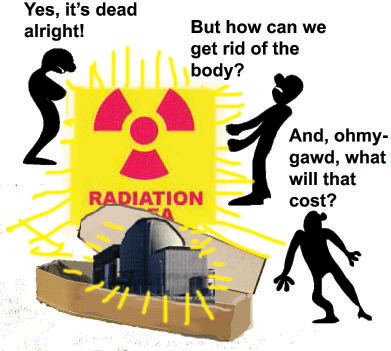 DECOMMISSIONING SAGAS As already noted above, there are no rules, standards and best practice in decommissioning, dismantling and “making safe” or “securing” the former sites of reactors. So there is no standard cost for getting rid of reactors. It is a case-by-case process. This alone prods the highly political decision to set a “delay” between reactor shut down, and decommissioning which as noted above, in the extreme UK case is now set at 30-40 years.
Before the final shut down, of course, reactor operating life extensions can squeeze some more power out of the reactor – and further delay the moment when it has to be decommissioned. Only idiots can pretend this does not expose the reactor to increased risks of accidents. Ask yourselves if you prefer to fly in a 40-year-old airplane, or a new one.
Real-life decomm sagas, as distinct from emergency dismantling following a serious or catastrophic accident as in the case of Three Mile Island, Chernobyl and Fukushima are always – always – a tale of vastly underestimated initial costs and timelines for decomm, followed by massive cost overruns and time overruns. Plenty of examples concern the now-quarter-century old projects, and longer, where initial cost estimates have been exceeded by actual spending by 5 or 10 times, and the decomm project’s time for completion multiplied by 3. And today the projects are not yet fully completed!…….. Continue reading
Unemployed Japanese tricked into dangerous jobs at Fukushima

 ‘Nuclear Slaves’ at Fukushima: Workers have debts paid off, forced to stay as ‘indentured servants’ — Foreign workers may soon be needed at plant, official reveals http://enenews.com/nuclear-slaves-at-fukushima-workers-have-debts-paid-off-forced-to-stay-as-indentured-servants-foreign-workers-may-soon-be-needed-at-plant-reveals-tepco-vp
Voice of Russia, Oct. 27, 2013: “Nuclear slaves” discovered at Fukushima […] An in-depth journalistic investigation uncovered that thousands of unemployed Japanese were tricked into working underpaid and highly dangerous jobs on the site of Fukushima’s nuclear disaster. […] Yakuza act as enforcers who keep the “nuclear slaves” from complaining or leaving their jobs. […] Reuters reports that “labor brokers” […] resort to “buying” laborers by paying off their debts and then forcing them to work in hazardous conditions until their debt to the “labor broker” is paid off. Such “employment schemes” are commonly referred to as “indentured servitude” and are a form of slavery […] Lake Barrett, a former US nuclear regulator and an advisor to Tepco, told the news agency that existing practices won’t be changed for Fukushima decontamination: “There’s been a century of tradition of big Japanese companies using contractors, and that’s just the way it is in Japan. You’re not going to change that overnight just because you have a new job here, so I think you have to adapt.”
Asahi Oct. 28, 2013: TEPCO President Naomi Hirose […] explained that it is getting difficult for the utility to secure sufficient manpower at the plant and that it was grappling with tasks the company was not familiar with.
AP,, Oct. 28, 2013: Hirose acknowledged that TEPCO is having trouble finding a stable pool of workers at the plant […] TEPCO Vice President Zengo Aizawa said […] that uncertainty remains over the long-term decommissioning process. “We are not sure about our long-term staffing situation during the upcoming process of debris removal, which requires different skills,” Aizawa told a news conference. Asked if the company may have to consider hiring foreign workers, he said TEPCO is open to that idea even though it’s not an immediate option. […] [Shunichi Tanaka, chairman of the NRA] called on Hirose to implement sweeping steps to safeguard workers from high doses of radiation and other troubles […]
Depleted uranium and nuclear wastes – the perfect opportunity for “dirty bombs”
 Nuclear Power Dirty Bomb The Market Oracle, Oct 28, 2013 By: Andrew_McKillop “……RECYCLE, REUSE AND DEFEND THE ECONOMY Nuclear waste business, as we know, is not business friendly and leads to the very basic reflex of simply dumping a considerable and growing part of the world’s unmanageable nuclear wastes from the current world fleet of around 436 operating civil reactors (depending on how many Japanese reactors are brought
  back into service). Proliferation risks are deliberately restricted to only conventional explosive nuclear weapons and their radioactive materials – totally ignoring both Depleted Uranium weapons using “recycled” nuclear wastes, and the potential future Dirty Bomb targets of active and “partly decommissioned” reactors lurking on the horizon. These with almost no possible doubt will be prime targets in coming civil wars and international wars. These nuclear war options are above all cheap, and of course very dirty.
Since the 1991 Gulf War 1 against Iraq, the war against Afghanistan starting in 2001, and the second war against Iraq of 2003 at least 2500 tons of Depleted Uranium weapons have been used by the US, UK and France in these “delightfully far away” over the horizon wars against lesser races and nations. Depleted Uranium ordnance, to date has caused a conservatively estimated 10 000 cancer deaths, and as many as 50 000 still-living cancer victims in Iraq and Afghanistan.
This has easily calculated economic consequences. When this concerns free market white democrat middle class consumers, the same types of cancers are costed at roughly $ 40 000 for a cancer death and $ 25 000-per-year for surviving cancer sufferers.
The “cute idea” of recycling nuclear wastes as DU ordnance has a cosy market-friendly smell, to some, but the economic damage that these filthy weapons generate smells a lot worse. Those who profit from misery and death will finally pay. The same weapons can be turned around and used on them……… http://www.marketoracle.co.uk/Article42864.html
Just under 100 years to clean up UK nuclear plant – if they’re lucky
The final decommissioning at Trawsfynydd and elsewhere depends on finding a safe long term solution for where to deposit the ILW as well as the High Level Waste (HLW) currently stored at Sellafield. This includes the spent nuclear fuel which was removed when the plant closed.
Trawsfynydd timeline
1959: Construction started
1965 to 1991: Electricity generation
1993 to 1995: Decommissioning starts – fuel removed and sent to Sellafield
1995 to 2016: Recovery of waste and preparations to put the plant into a ‘passively safe’ state
2020-26: Reduction in height of reactor buildings
2040s: Scheduled removal of Intermediate Level Waste to deep geological storage
2074: Final site clearance starts
2083: Site returned to pre-existing state

How do you close a nuclear power station? BBC By Steven Green 28 Oct 13 As the UK embarks on building what could be a new generation of nuclear power plants, work continues to decommission the first generation of nuclear power stations at sites including Trawsfynydd in Snowdonia which will take an estimated 90 years to complete. Continue reading
1 This Month



26 September – International Day for the Total Elimination of Nuclear Weapons


PLEASE OPPOSE HR 8255 AND S.3639 – bills would accelerate satellite deployment, with no environmental review or safeguards – https://ncstd5li.quorum.us/campaign/169331/
To see nuclear-related stories in greater depth and intensity – go to https://nuclearinformation.wordpress.com
-
Archives
- September 2026 (257)
- August 2026 (330)
- July 2026 (355)
- June 2026 (287)
- May 2026 (306)
- April 2026 (356)
- March 2026 (251)
- February 2026 (267)
- January 2026 (308)
- December 2025 (358)
- November 2025 (359)
- October 2025 (375)
-
Categories
- 1
- 1 NUCLEAR ISSUES
- business and costs
- climate change
- culture and arts
- ENERGY
- environment
- health
- history
- indigenous issues
- Legal
- marketing of nuclear
- media
- opposition to nuclear
- PERSONAL STORIES
- politics
- politics international
- Religion and ethics
- safety
- secrets,lies and civil liberties
- spinbuster
- technology
- Uranium
- wastes
- weapons and war
- Women
- 2 WORLD
- ACTION
- AFRICA
- Atrocities
- AUSTRALIA
- Christina's notes
- Christina's themes
- culture and arts
- Events
- Fuk 2022
- Fuk 2023
- Fukushima 2017
- Fukushima 2018
- fukushima 2019
- Fukushima 2020
- Fukushima 2021
- general
- global warming
- Humour (God we need it)
- Nuclear
- RARE EARTHS
- Reference
- resources – print
- Resources -audiovicual
- Weekly Newsletter
- World
- World Nuclear
- YouTube
-
RSS
Entries RSS
Comments RSS
 nuclear-news