Thorium nuclear reactors for military use, too, funded by USA and Chinese tax-payers
 SPECIAL REPORT-The U.S. government lab behind China’s nuclear power push Dec 20, 2013 Dec 20 (Reuters) – Scientists in Shanghai are attempting a breakthrough in nuclear energy: reactors powered by thorium, an alternative to uranium.
 The project is run by the Chinese Academy of Sciences, a government body with close military ties that coordinates the country’s science-and-technology strategy. The academy has designated thorium as a priority for China’s top laboratories. The program has a budget of $350 million. And it’s being spearheaded by the influential son of a former Chinese president.
But even as China bulks up its military muscle through means ranging from espionage to heavy spending, it is pursuing this aspect of its technology game plan with the blessing – and the help – of the United States. Read more »
Uranium internally received by soldiers – this is the key to the next court case
 A hearing would take two weeks in June 2014 This case will be critical!
We can win this case. The judge is interested in what happened. (So are we, so should you be). The radiation risk model and internal exposures, especially to Uranium is the key;
 Cancer, Nuclear Weapons and Dirty Tricks http://www.counterpunch.org/2013/12/20/cancer-nuclear-weapons-and-dirty-tricks/ by CHRIS BUSBY

The United Kingdom Veterans of the Atomic Atmospheric Testing in the Pacific and Australia have always maintained that they suffered harm, including cancer and leukemia. The government has consistently denied this.
Its argument is that except for very few of them, no-one received a radiation ‘dose’ significantly different from natural background. This was recently affirmed by the new Minister when she refused to concede that the test veterans were any different from any other ex-servicemen.
There have been two challenges. Continue reading
Edison and NRC have No plans for removing nuclear wastes from San Onofre plant

I have attended nearly every Nuclear Regulatory Commission hearing on San Onofre for nearly 20 years. For more than a decade we were told by Southern California Edison (with no objection from the NRC) that the waste problem was essentially solved because the waste would go to Yucca Mountain. But Yucca Mountain is an imperfect solution: Before the federal government stopped the project (or at least slowed it to a crawl), one of the last problems they could not be sure they had any good science about was “drip shields” which were to protect the fuel rods — that were to be permanently entombed at the site — from water dripping from above. The shape, material, thickness, and expected durability of the shields were all undecided, but my recollection is that the last design was an upside-down flattened out V shape made out of 4-inch thick titanium. And no one knew how long it would last, but 300 years was an outside estimate, or at least the hope. After that, good luck.
What the transport vehicles would look like, and whether they would use rail or roads or both, was all undecided when the project was stopped, despite 10s of billions of dollars having been spent.
Geologic storage, if we choose that route, will not be easy and will not be risk free. And we’re nowhere near it at this point. Continue reading
Sea level rise, storm surges, not factored in to NRC’s nuclear waste policy
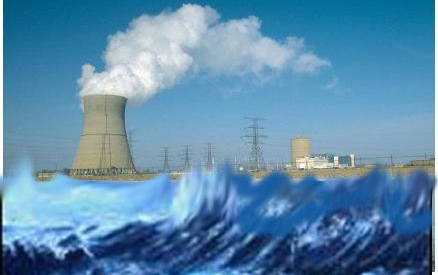 CCCL also argued that the discussion of sea level rise was insufficient. The DGEIS relied on dated sources that did not account for uncertainty in sea level rise projections and may underestimate risk. Also, the DGEIS merely looks at static sea level rise, which ignores risks due to more frequent and severe flooding. CCCL pointed to data showing that a number of coastal nuclear power plants potentially subject to sea level rise and storm surge, are located in highly populated areas of the country
Center For Climate Change Law December 19th, 2013 by Ethan Strell The Columbia Center for Climate Change Law (CCCL) submitted comments today on the United States Nuclear Regulatory Commission’s “Waste Confidence Draft Generic Environmental Impact Statement” (DGEIS), which concerns the storage of highly radioactive spent nuclear fuel at individual power plants beyond the duration of each plant’s operating license. CCCL’s comments focus on the DGEIS’s lack of analysis of how future climate conditions could affect the safety of these high level nuclear waste storage facilities.
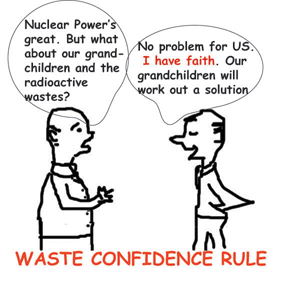 “Waste Confidence” refers to the Commission’s confidence that permanent disposal of nuclear waste can be accomplished when it is needed.
Currently, spent nuclear fuel is stored on-site at nuclear reactors beyond the duration of plants’ operating licenses. The Waste Confidence Rule stems from a 1976 petition by NRDC to halt the licensing of nuclear plants until the Commission could guarantee the permanent, safe disposal of spent nuclear fuel. Continue reading
Small Modular Nuclear Reactors (SMRs) raise saafety and security concerns
Potential fire and explosion hazards……
Potential flooding hazards:……
Limited access for conducting inspections of pressure vessels…
Safety and Security Concerns about Small Modular Reactors: NuScale’s Design http://allthingsnuclear.org/safety-and-security-concerns-about-small-modular-reactors-nuscales-design/ Ed Lyman, senior scientist December 17, 2013 Late last week the Department of Energy finally announced its decision to provide the small modular reactor (SMR) design NuScale with a matching grant of up to $226 million under its Licensing Technical Support program intended to speed the development of SMRs.
But the real news is not that DOE awarded a second grant under the program, but that it took so long to do so. NuScale, along with three other reactor vendors, originally applied for the funds in early 2012 with the expectation that two designs would receive grants. However, later that year DOE surprised many observers by only awarding a grant to one design, the Generation mPower.
Safety and Security Concerns
As discussed in detail in my September 2013 report “Small Isn’t Always Beautiful,” UCS has safety and security concerns about small modular reactors in general and about the NuScale design in particular
SMR vendors are pushing the Nuclear Regulatory Commission (NRC) to weaken its regulations regarding operator staffing, security staffing, and emergency planning, based on highly optimistic assertions that their reactors will be significantly safer than larger reactors. Continue reading
Japan’s state secrets law criminalises investigative journalism

 Japan enacts state secrets law late Friday night amid revolt — “It criminalizes investigative journalism” — Terrorism defined as “imposing one’s opinions on others”http://enenews.com/secrets-law-passes-late-friday-night-amid-revolt-mushrooming-opposition-it-criminalizes-investigative-journalism-terrorism-defined-as-imposing-ones-opinions-on-others-protesto
Japan Times, , Dec. 6, 2013: Following political turmoil that rocked the Diet over the past week, ruling block Upper House members finally enacted the contentious state secrets bill late Friday night. Earlier in the day, opposition parties intensified their protests in vain over a law that’s being criticizing for not creating an independent oversight body capable of preventing the government from hiding inconvenient information at its discretion.
Businessweek, Dec. 6, 2013: Prime Minister Shinzo Abe secured final passage of a bill granting Japan’s government sweeping powers to declare state secrets, a measure aimed at shoring up defense ties with the U.S. that prompted a public backlash and revolt by the opposition.
Asahi Shimbun, , Dec. 6, 2013: Kazuo Shii, chief of the Japanese Communist Party, described the ruling coalition’s behavior as “tyrannical, arrogant and disorderly.” The ruling coalition believed prolonging the Diet debate any longer could backfire, only fueling the mushrooming opposition to the bill, and lead to a further decline in approval ratings for Abe’s Cabinet and hold on power. An Asahi Shimbun survey taken between Nov. 30-Dec. 1 showed the Cabinet’s approval rating at 49 percent, dipping below 50 percent for the first time since he took power in December 2012. Officials in the Abe administration foresee the public eventually forgetting about the controversy, once the legislation is approved.
GlobalPost,, Dec. 6, 2013: Here are four disturbing ways the bill could be a democracy muzzler. It defines terrorism as imposing one’s opinions on others […] According to Article 12, terrorism is partially defined as an activity that forces “political and other principles or opinions on the state or other people.” In other words, throw up a rowdy anti-government protest, and the judiciary can find a reason to lock you away. It criminalizes investigative journalism […] Journalists can be prosecuted for “improperly accessing” classified documents or “conspiring” to leak them. Even asking an official to take a look at classified documents could constitute “conspiracy,” leading to up to five years in prison. “Instigating” the release of government secrets, meanwhile, carries up to 10 years in the dock. […] Basically, anything can be a secret […] administrators can make the opaque decisions to classify a document even if their work hardly relates to national security. That effectively allows them to hide any embarrassing piece of evidence, and then pursue the journalists and bloggers who make it public. […]
Highly dangerous and super expensive work to cover Chernobyl nuclear reactor
Workers can only spend a few hours at the reactor site before they reach the maximum radioactive exposure limit, and work is thus progressing at a snail’s pace
Despite the incredible lengths required to build the structure, it’s still only a band-aid

This Massive Steel Structure Will Entomb Chernobyl’s Reactor 4 (GREAT PHOTOS) http://www.gizmodo.com.au/2013/11/this-massive-steel-arch-will-entomb-chernobyls-reactor-4/ KELSEY CAMPBELL-DOLLAGHAN 30 NOVEMBER 2013 When an unexpected power surge sparked the world’s worst nuclear accident in Chernobyl, nearly a quarter of a million construction workers risked their lives to build an ad hoc “sarcophagus” of concrete around the stricken reactor. It was a stop-gap measure — and now, almost 30 years later, one of the biggest engineering projects in history is underway to protect it.
The BBC reports on the $US2 billion project to protect the decaying metal sarcophagus, using an even larger metal shield called the New Safe Confinement, or NSC. In simple terms, the NSC is a massive steel archway that is designed to protect the surrounding region if the 27-year-old sarcophagus eventually collapses. Continue reading
Yes Virginia, UNSCEAR DOES say that radiation causes child cancers
“It is not recommended to use the same generalizations used for adults when considering the risks and effects of radiation exposure during childhood,”
infants and children have smaller body diameters, and their organs are less shielded by overlying tissues, with the same exposure the doses to their internal organs is higher than that to an adult.
 Effects of radiation exposure of children, relief web 25 Nov 13 Report from UN Scientific Committee on the Effects of Atomic Radiation Published on 25 Oct 2013 — View Original Publication of Volume II of the UNSCEAR 2013 Report Risk following exposure to radiation differs for adults and children, says UNSCEAR report Vienna 24 October 2013 (UN Information Service) – “Doses received by children and adults from the same source of ionizing radiation can have differing impacts, and therefore, should be considered separately in order to predict risk following exposure more accurately for children,” was the main thrust of the report “Effects of radiation exposure of children” presented today at the United Nations headquarters in New York.
The report, which has been prepared by the United Nations Scientific Committee on the Effects of Atomic Radiation (UNSCEAR), has been in preparation over the last two years (since 2011) and was presented today to the UN General Assembly as part of the Report of the 60th session of UNSCEAR to the General Assembly. “Because of their anatomical and physiological differences, radiation exposure has a different impact on children compared with adults,” said Dr. Fred Mettler, Chair of the Expert Group on the UNSCEAR Report on Effects of Radiation Exposure of Children.
He presented the report as a valuable resource for the international medical and scientific community, because as such, children are generally assessed along with adults in epidemiological studies and comprehensive overviews of the effect of radiation on children are generally unavailable. The report highlights some important issues. For instance, for a given radiation dose, infants and children are more at risk than adults of developing a variety of tumours. This risk is, generally, not always immediate but extends later into life. Continue reading
PRISM – Power Reactor Innovative Small Module new nuclear magic gimmick
The plutonium stockpile poses enormous problems for the government. Not only is it highly radioactive and an immense potential danger to health, it is also a target for terrorist attacks and for anyone interested in stealing nuclear weapons-grade material.
The NDA’s report to DECC is understood to conclude that the Prism fast reactor is as credible as the two other options based on Mox fuel, even though GE-Hitachi has not yet built a commercial-scale plant for burning plutonium waste. DECC, however, has refused to release the report under a Freedom of Information request
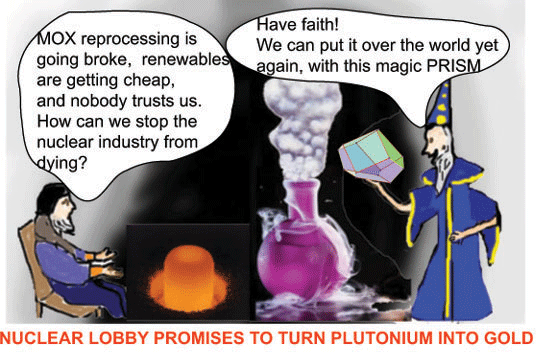
It is understood that the NDA has been impressed by proposals from GE-Hitachi to build a pair of its Prism fast reactors on the Sellafield site,
Revealed: UK Government’s radical plan to ‘burn up’ UK’s mountain of plutonium http://www.independent.co.uk/news/science/revealed-uk-governments-radical-plan-to-burn-up-uks-mountain-of-plutonium-8967535.html 28 Nove 13 A radical plan to dispose of Britain’s huge store of civil plutonium – the biggest in the world – by “burning” it in a new type of fast reactor is now officially one of three “credible options” being considered by the Government, The Independent understands. However, further delays have hit attempts to make a final decision on what to do with the growing plutonium stockpile which has been a recurring headache for successive governments over the past three decades.
The stock of plutonium, one of the most dangerous radioactive substances and the element of nuclear bombs, has already exceeded 100 tonnes and is likely to grow to as much as 140 tonnes by 2020, bolstered by a recent decision to include foreign plutonium from imported nuclear waste.
Ministers had pledged to resolve the plutonium problem in a public consultation but are sitting on a secret report by the Nuclear Decommissioning Authority (NDA) which is believed to confirm that there are now three “credible options” for dealing with the plutonium stored at the Sellafield nuclear reprocessing plant in Cumbria. Continue reading
What is really going on in the high risk operation at Fukushima Nuclear reactor No 4?
 Why TEPCO is Risking the Removal of Fukushima Fuel Rods. The Dangers of Uncontrolled Global Nuclear Radiation, Global Research, 24 Nov 13 By Yoichi Shimatsu After repeated delays since the summer of 2011, the Tokyo Electric Power Company has launched a high-risk operation to empty the spent-fuel pool atop Reactor 4 at the Dai-ichi (No.1) Fukushima Nuclear Power Plant.
The urgency attached to this particular site, as compared with reactors damaged in meltdowns, arises from several factors:
– over 400 tons of nuclear material in the pool could reignite
– the fire-damaged tank is tilting badly and may topple over sooner than later
– collapse of the structure could trigger a chain reaction and nuclear blast, and
– consequent radioactive releases would heavily contaminate much of the world.
The potential for disaster at the Unit 4 SFP is probably of a higher magnitude than suspected due to the presence of fresh fuel rods, which were delivered during the technical upgrade of Reactor 4 under completion at the time of the March 11, 2011 earthquake and tsunami. The details of that reactor overhaul by GE and Hitachi have yet to be disclosed by TEPCO and the Economy Ministry and continue to be treated as a national-security matter. Here, the few clues from whistleblowers will be pieced together to decipher the nature of the clandestine activity at Fukushima No.1. Continue reading
MOX nuclear fuel – the secret and so dangerous ingredient in the Fukushima No 4 nuclear cooling pond
The un-irradiated rods inside the Unit 4 spent-fuel pool are, in all probability, made of a new type of MOX fuel containing highly enriched plutonium.
 Why TEPCO is Risking the Removal of Fukushima Fuel Rods. The Dangers of Uncontrolled Global Nuclear Radiation, Global Research, 24 Nov 13 By Yoichi Shimatsu
“…….Mystery of MOX super-fuel A Mainichi Shimbun editorial mentions in passing that the Reactor 4 pool contains 202 fresh fuel assemblies.(3) The presence of new fuel rods was confirmed in the TEPCO press release, which described the first assembly lifted into the transfer cask as an “un-irradiated fuel rod.” Why were new rods being stored inside a spent-fuel pool, which is designed to hold expended rods? What threat of criticality do these fresh rods pose if the steel frame collapses or if crane operators drop one by accident onto other assemblies, as opposed to a spent rod?
Against the official silence and disinformation, a few whistleblowers have come forward with clues to answer these questions. Former GE nuclear worker Kei Sugaoka disclosed in a video interview that a joint team from Hitachi and General Electric was inside Reactor 4 at the time of the March 11, 2011 earthquake. By that fateful afternoon, the GE contractors were finishing the job of installing a new shroud, the heat-resistant metal shield lining the reactor interior.(4)
TEPCO inadvertently admitted to the presence of foreign contractors at Fukushima No.1 up until March 12, 2012, when the management ordered their evacuation in event of a massive explosion during the rapid meltdown of Reactor 2. So far, leaks indicate the presence of the GE team and of a Israeli nuclear security team with Magna BSP, a company based in Dimona.(5)
Another break came in April 2012, when a Japanese humor magazine published a brief interview of a Fukushima worker who disclosed that radioactive pieces of a broken shroud were left inside a device-storage pool at rooftop level behind the Reactor 4 spent-fuel pool.(6) This undoubtedly is the used shroud removed by the GE-H workers in February-March 2011.
A curious point here is that the previous shroud had been in use for only 15 months. Why would TEPCO and the Japanese government expend an enormous sum on a new lining when the existing one was still good for many years of service?
Obviously, the installation of a new shroud was not a mere replacement of a worn predecessor. It was an upgrade. The refit of Reactor 4 was, therefore, similar to the 2010 conversion of Reactor 3 to pluthermal or MOX fuel. The same model of GE Mark 1 reactor was being revamped to burn MOX fuel (mixed oxide of uranium and plutonium).
The un-irradiated rods inside the Unit 4 spent-fuel pool are, in all probability, made of a new type of MOX fuel containing highly enriched plutonium. If the frame collapses, triggering fire or explosion inside the spent-fuel pool, the plutonium would pulse powerful neutron bursts that may well possibly ignite distant nuclear power plants, starting with the Fukushima No.2 plant, 10 kilometers to the south…..
The upgrade of the Reactor 4 shroud may well have involved the test-fitting of some MOX rods, which abandoned on the floor next to the reactor when the tsunami reached shore. In other words, in early March 2011 crane operators completely filled space inside the spent-fuel pool with new MOX rods and then simply left casks of assemblies on the roof and lowered more into the basement. That is the simplest explanation for the damage to the structural integrity of the reactor building. GE is not about to disclose its role in this disaster………. http://www.globalresearch.ca/why-tepco-is-risking-the-removal-of-fukushima-fuel-rods-the-dangers-of-uncontrolled-global-nuclear-radiation/5359188…..http://www.globalresearch.ca/why-tepco-is-risking-the-removal-of-fukushima-fuel-rods-the-dangers-of-uncontrolled-global-nuclear-radiation/535918
Non Proliferation Treaty allows Iran to enrich uranium
 Legal right to enrich uranium for Iran http://www.tehrantimes.com/politics/112302-uranium-enrichment-is-a-right-hans-blix 23 Nov 13, TEHRAN — Hans Blix, the former director of the International Atomic Energy Agency, says his interpretation of Article IV of the nuclear Non-Proliferation Treaty is that uranium enrichment is a “right”.
The remarks by Blix come as Iran and the six major powers (the five permanent members of the UN Security Council plus Germany, known as the 5+1 group) are negotiating in Geneva.
The censorship of the true effects of depleted uranium
 A factor rarely mentioned is the potential effects of DU on children yet to be born to U.S. Iraq war veterans, who served in places like Fallujah, Basra and Najaf.
HORRIFIC EFFECTS OF DEPLETED URANIUM STILL CENSORED BY U.S. MILITARY, MEDIA HTTPS://AMERICANFREEPRESS.NET/?P=13599 NOVEMBER 03, 2013 BY RICHARD WALKER In a move seen by medical experts worldwide as an effort to suppress the truth about the horrors of depleted uranium (DU) munitions, the United Nations (UN) health arm, the World Health Organization (WHO), along with the Ministry of Health of Iraq (MoH) on September 13, 2013, produced a report that was not even authored, meaning no experts attached their names to it, on birth defects among Iraqi babies in which DU was not even considered a factor.
The report was published on the WHO website at a time when birth defects among Iraqi babies have been rising steadily, especially in areas like Najaf and Fallujah, where DU shells were used indiscriminately, killing and injuring large numbers of civilians. Some estimates for the 2003 death toll in Iraq put the civilian casualties in Fallujah as high as 75% to 80%. Continue reading
Ice wall around Fukushima – a 10,000 year science fiction story?
TV: Work at Fukushima plant to go on for 10,000 years? Nuclear Expert: “It’s longer than human history” (VIDEO) http://enenews.com/tv-work-at-fukushima-plant-could-go-on-for-next-10000-years-nuclear-expert-its-longer-than-human-history-video
Arirang’s ‘Prime Talk’,, August 30, 2013 (at 1:45 in):
Dr. Suh Kune-yull, Professor of Nuclear Engineering at Seoul National University: [Freezing the soil around Fukushima reactors] sounds more like a sci-fi story, science fiction. We call this permafrost — frosting the soil — for 50 years and as long as 10,000 years. It’s longer than human history, it’s just unrealistic.
Watch the broadcast here
Arirang’s ‘Prime Talk’, ’, August 30, 2013 (at 1:30 in):
Dr. Suh Kune-yull, Professor of Nuclear Engineering at Seoul National University: I call this permafrost which [is] really freezing the soil but to me sounds more like a science fiction because they have to be doing this for work at least 50 years and as long as 10,000 years. So I think they were probably going to give this up one of these months. […]
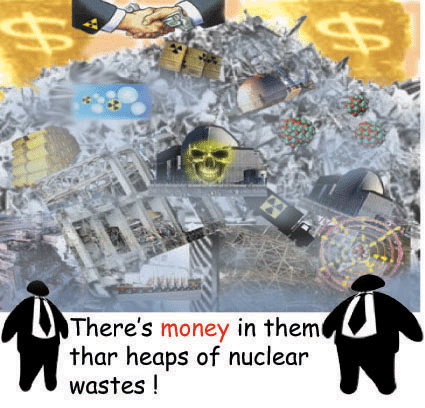
The coming epidemic of nuclear reactor shutdowns: where to put the wastes?
The NRC believes the fuel can be safely stored for at least 100 in casks. But the radioactive half life is 16 million years, with a defined hazardous life of 160 million years. The world will soon be dotted with these ad-hoc radioactive dumps.
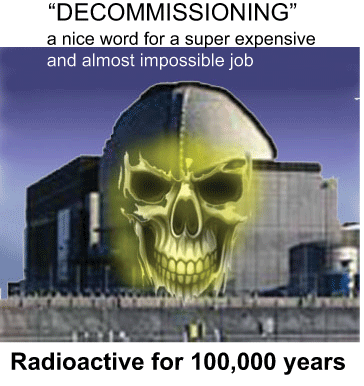 For aging nuclear reactors, a coming surge of shutdowns How safe will these ad-hoc radioactive dumps be?, Kevin Gray, SmartPlanet, 20 Nov 13
When it first fired up its twin reactors in 1973, the Zion nuclear power plant in Illinois — roughly 40 miles north of Chicago — was the largest in the world. It was a stunning work of technology that supplied electricity to some two million homes. And it could have easily lived on into the new century. But in 1998, its parent company, the energy giant Exelon Corp, turned off its lights and shuttered the facility rather than face some costly upgrades.For 12 years, Zion sat dormant on prime Lake Michigan shorefront as Exelon shelled out $10 million a year to maintain it and protect it with round-the-clock patrols of armed guards. By 2010, the facility had become home to drifting weeds and nesting falcons.
But that year, the federal government — in an arrangement never tried before — agreed to allow Exelon to transfer custody of the plant to EnergySolutions, a nuclear-waste storage outfit. The deal was worth a potential $1 billion in clean-up fees to EnergySolutions. It would be the largest nuclear power plant decommissioning ever undertaken in the United States. And it pledged to return the 375-acre site back to Exelon as grass and local shrubbery at the end of 10 years……..
EnergySolutions has spent the past year removing Zion’s fuel rods from a cooling pool and putting them into the canisters and casks for dry storage. The fuel, which is still about 400 degrees, can now be air cooled. Christian expects the company to begin moving the casks, via a heavy-haul rail, 100 yards south of the reactors by mid-October.
They will remain there until the feds come up with an alternative to Yucca Mountain. “Until we have a national repository open, this spent fuel has to stay where it is,” says Lawrence Boing, a nuclear decommissioning specialist at Argonne National Laboratory’s nuclear engineering division. “The big question now is what do we do with this stuff?” Continue reading
1 This Month



26 September – International Day for the Total Elimination of Nuclear Weapons


PLEASE OPPOSE HR 8255 AND S.3639 – bills would accelerate satellite deployment, with no environmental review or safeguards – https://ncstd5li.quorum.us/campaign/169331/
To see nuclear-related stories in greater depth and intensity – go to https://nuclearinformation.wordpress.com
-
Archives
- September 2026 (257)
- August 2026 (330)
- July 2026 (355)
- June 2026 (287)
- May 2026 (306)
- April 2026 (356)
- March 2026 (251)
- February 2026 (267)
- January 2026 (308)
- December 2025 (358)
- November 2025 (359)
- October 2025 (375)
-
Categories
- 1
- 1 NUCLEAR ISSUES
- business and costs
- climate change
- culture and arts
- ENERGY
- environment
- health
- history
- indigenous issues
- Legal
- marketing of nuclear
- media
- opposition to nuclear
- PERSONAL STORIES
- politics
- politics international
- Religion and ethics
- safety
- secrets,lies and civil liberties
- spinbuster
- technology
- Uranium
- wastes
- weapons and war
- Women
- 2 WORLD
- ACTION
- AFRICA
- Atrocities
- AUSTRALIA
- Christina's notes
- Christina's themes
- culture and arts
- Events
- Fuk 2022
- Fuk 2023
- Fukushima 2017
- Fukushima 2018
- fukushima 2019
- Fukushima 2020
- Fukushima 2021
- general
- global warming
- Humour (God we need it)
- Nuclear
- RARE EARTHS
- Reference
- resources – print
- Resources -audiovicual
- Weekly Newsletter
- World
- World Nuclear
- YouTube
-
RSS
Entries RSS
Comments RSS
 nuclear-news