NSA’s surreptitious infiltration of 1000s of computers
 Global Nuclear Insecurity http://majiasblog.blogspot.jp/2014/01/global-nuclear-insecurity.html 20 Jan 14
A story reported in The New York Times stopped me cold:
N.S.A. Devises Radio Pathway Into  Computershttp://www.nytimes.com/2014/01/15/us/nsa-effort-pries-open-computers-not-connected-to-internet.html?nl=todaysheadlines&emc=edit_th_20140115&_r=0
WASHINGTON — The National Security Agency has implanted software in nearly 100,000 computers around the world that allows the United States to conduct surveillance on those machines and can also create a digital highway for launching cyberattacks. While most of the software is inserted by gaining access to computer networks, the N.S.A. has increasingly made use of a secret technology that enables it to enter and alter data in computers even if they are not connected to the Internet, according to N.S.A. documents, computer experts and American officials.
The technology, which the agency has used since at least 2008, relies on a covert channel of radio waves that can be transmitted from tiny circuit boards and USB cards inserted surreptitiously into the computers. In some cases, they are sent to a briefcase-size relay station that intelligence agencies can set up miles away from the target.
Majia here: Holy Cow! Computers now can be hacked by radio waves that are miles from the target!I’m sure the technology must not be new since its being reported in the mainstream press.
What it does explain is why cybersecurity is now such a pressing issue. Remember when Richard Clark was warning about cyber-security threats? See here.
Think about it. Anyone with this technology could hack NUCLEAR PLANTS and CHEMICAL PLANTS and cause them to explode entirely remotely.
Both the Chinese and the Americans have the technology so no doubt Russia and Israel also have it.
We think we are so smart with our toys but all we’ve done is feed our most base and anti-social instincts.
Nuclear collusion by corporations, governments, and media
 Is Nuclear Experimentation Fascism? “…….Censorship and Suppression of Opposition Further fascism is evident through nuclear experimentation in the sense that it is a militaristic invention, put to use by engineering corporations that are linked with government entities, which also own news and information corporations. The GE/NBC corporation is the starkest, but not the only, example of this in the U.S.A. Being both the subject and reporter of news on the Fukushima Daiichi nuclear disaster, the GE/NBC corporation has placed itself in a clear conflict of interest. As the subsidiary of the failed nuclear reactor’s parent company, can you trust NBC News not to “spin’ glossy tales or omit details relating to the situation at Fukushima? Particularly details that might implicate GE in the chain of failings that caused the meltdown?
But news corporations are not the only parties able to censor or suppress information; government institutions have also closed ranks following the Fukushima disaster. As a prime example, the United States EPA (the supposed Environmental Protection Agency) went as far as disabling public access to radiation monitors in the wake of the Fukushima meltdown. Do they really believe what we can’t see won’t hurt us? Or is the EPA, as part of the US government, trying to avoid adverse political fallout?http://www.opednews.com/articles/Is-Nuclear-Experimentation-by-Ethan-Indigo-Smith-Fukushima_Nuclear-Cover-up_Nuclear-Meltdown_Nuclear-Waste-140122-627.html
Furthermore, the Fukushima disaster has led to a practical elimination of free speech and free reporting of information from within Japan. Japanese Prime Minister Shinzo Abe’s Designated Secrets Bill was arguably written for and because of the Fukushima disaster after authorities failed to manage the radioactive leaks and news spread around the globe. Since it could not contain the nuclear contamination, the Japanese government instead decided to contain information about it, creating laws that enable punishment of individuals for leaking or reporting information about their disastrous failure. Despite drawing criticism and protest at home and around the world, the Japanese parliament has since passed the law under which people convicted of leaking classified information will face 5 to 10 years in prison. http://www.opednews.com/articles/Is-Nuclear-Experimentation-by-Ethan-Indigo-Smith-Fukushima_Nuclear-Cover-up_Nuclear-Meltdown_Nuclear-Waste-140122-627.html
The harsh facts on U.S.S. Reagan’s sailors affected by Fukushima radiation
Is Nuclear Experimentation Fascism? OpEdNews 1/22/2014 By Ethan Indigo Smith (about the author) “…the crew of the U.S.S. Reagan. The U.S.S. Reagan was exposed to radiation after being redirected towards Japan to provide support immediately after the massive Tōhoku earthquake and tsunami off the coast of Japan.
According to an article in the New York Post, Senior Chief Michael Sebourn, a radiation-decontamination officer who tested the aircraft carrier for radiation found that “levels were incredibly dangerous and at one point, the radiation in the air measured 300 times higher than what was considered safe.” The article continues: “The former personal trainer has suffered a series of ailments, starting with severe nosebleeds and headaches and continuing with debilitating weakness” has lost 60 percent of the power in the right side of his body and his limbs have visibly shrunk.” As Senior Chief Michael Sebourn stated, “I’ve had four MRIs, and I’ve been to 20 doctors” No one can figure out what is wrong.” He has since retired from the Navy after 17 years of service.
And he is not alone. According to The Post, “crew members on the aircraft carrier and a half-dozen other support ships are battling cancers, thyroid disease, uterine bleeding and other ailments.” Of the 5,000 sailors on board, at least 70 have contracted some form of radiation sickness, and of those, “at least half” are suffering from some form of cancer,” said lawyer, Paul Garner, who is representing the sailors in a lawsuit against the operators of the Fukushima Daiichi energy plant. “We’re seeing leukemia, testicular cancer and unremitting gynecological bleeding requiring transfusions and other intervention,” said Garner.
In a Voice of Russia report, Mr. Garner elaborated: “it seems that there’s too many people at the same place at the same time without any family background or any reason to believe that they had these issues to now show up with these significant cancers and beyond. So we feel that time will tell in many instances”. especially, because they all had physicals and were all in top health.”
Navy sailor Lindsay Cooper, who was also present on the U.S.S. Reagan, stated that crew members suffered from excruciating diarrhea at the time. “People were s-“-tting themselves in the hallways,” Cooper recalled. “Two weeks after that, my lymph nodes in my neck were swollen. By July, my thyroid shut down.”
When asked about the U.S.S. Reagan’s ability to detect radiation early, sailor Cooper stated “we have a multimillion-dollar radiation-detection system, but” it takes time to be set up and activated”. She went on to describe that after being exposed, “we couldn’t go anywhere. Japan didn’t want us in port, Korea didn’t want us, Guam turned us away. We floated in the water for two and a half months” until Thailand took the stricken sailors in……..http://www.opednews.com/articles/Is-Nuclear-Experimentation-by-Ethan-Indigo-Smith-Fukushima_Nuclear-Cover-up_Nuclear-Meltdown_Nuclear-Waste-140122-627.html
Seven nuclear disasters. Who’s next?
Is Nuclear Experimentation Fascism? OpEdNews Op Eds 1/22/2014By Ethan Indigo Smith (about the author) opednews.com
“……..HANFORD, USA, 1943 — 1987
As an early “flagship’ nuclear experiment, many of the safety procedures and waste disposal practices employed at the Hanford site were completely inadequate. Although most of the reactors were shut down between 1964 and 1971, government documents have since confirmed that operations at the Hanford site released significant amounts of radioactive materials into the air and the Columbia River, which still threatens the health of residents and ecosystems today. Hanford is currently the most contaminated nuclear site in the United States, representing two-thirds of the nation’s high-level radioactive waste by volume. .
BIKINI ATOLL, NORTHERN PACIFIC OCEAN, 1946
The United States military undertook nuclear weapons tests at Bikini Atoll in mid-1946. At the request of the US military, Bikini’s 146 native residents agreed to temporarily evacuate the island so the United States government could begin testing atomic bombs for “the good of mankind and to end all world wars.” After “confused and sorrowful deliberation”, the Bikinians agreed to the relocation request, announcing “we will go believing that everything is in the hands of God.”
Most residents were moved by the military to Rongerik Atoll, 125 miles away. Only one-sixth the size of Bikini Atoll, no one lived on Rongerik because it had an inadequate water and food supply, however the United States Navy left the natives there with only a few weeks of food and water. Predictably, this soon proved to be insufficient and the Bikinians were left starving on Rongerik. (Read more: http://www.bikiniatoll.com/history.html)
As a series of large thermonuclear tests continued at Bikini Atoll into the 1950″s, the island was eventually rendered unfit for subsistence farming and fishing, and because of radioactive contamination still remains uninhabitable today. So much for the “temporary” evacuation of the Bikinians from their native island to help the United States “end all world wars.”
WINDSCALE FIRE, UK, 1957
The worst nuclear accident in Great Britain’s history, the core of the nuclear reactor at Windscale, Cumberland (now Sellafield, Cumbria) caught fire, releasing substantial amounts of radioactive contamination into the surrounding area. Caused by operators pushing the first-generation design of the Windscale facility beyond its intended limits, the fire burned for three days releasing radioactive material into the atmosphere that spread across the UK and Europe.
SANTA SUSANA, USA, 1959
A reactor at the Atomics International field laboratory in the Santa Susana Mountains, California, experienced a power surge and subsequently spewed radioactive gases into the atmosphere. According to a 2009 report from the Los Angeles Times, residents blame the facility for their health issues and say the site remains contaminated.
THREE MILE ISLAND, USA, 1979
The worst accident in U.S. commercial history, the Three Mile Island Unit 2 (TMI-2) reactor near Middletown (PA) partially melted down on March 28, 1979. A combination of equipment malfunctions, design-related problems and worker errors led to TMI-2″s partial meltdown and off-site releases of radioactivity. 14 years later, the clean up effort officially ended in December
CHERNOBYL, UKRAINE, 1986
Widely considered to have been the worst nuclear power plant accident in history, Chernobyl’s reactor four suffered a catastrophic power increase leading to explosions in its core. The explosion and resulting fire released large quantities of radioactive particles into the atmosphere, which spread over much of the western USSR (the then-Soviet Republic) and Europe.
ROCKY FLATS PLANT, USA 1987
Following insider reports of unsafe conditions, the Environmental Protection Agency (EPA) and the Federal Bureau of Investigation (FBI) found numerous violations of federal anti-pollution laws, including the contamination of water and soil. A grand jury report released following this incident criticized the Department of Energy and Rocky Flats contractors for “engaging in a continuing campaign of distraction, deception and dishonesty”, and noted that Rocky Flats had discharged pollutants, hazardous materials and radioactive matter into nearby creeks and water supplies for many years. But even the DOE itself acknowledged that Rocky Flats’ ground water was (at the time) the single greatest environmental hazard at any of its nuclear facilities.
The contamination levels at Rocky Flats itself, as measured by the United States government remain sealed records and have not been reported to the public. Clean-up was not declared complete until October 13, 2005 — 18 years later.
FUKUSHIMA DAIICHI, JAPAN 2011
The troubled Fukishima Daiichi nuclear plant in Japan has experienced a number of “incidents’ since its construction in 1971, culminating in total reactor failure when the plant was hit by a tsunami triggered by the Tōhoku earthquake. At the time of the disaster, the plant began releasing substantial amounts of radioactive materials making it the largest nuclear incident since the 1986 Chernobyl disaster and the second in history (with Chernobyl) to measure at Level 7 on the International Nuclear Event Scale. More than two years after the incident it was revealed that the plant is still leaking radioactive water into the Pacific Ocean, and despite the technical assistance of GE (the corporation that designed the failing reactor) the situation appears to keep deteriorating as time goes on.
WHO IS NEXT?
The way towards Nuclear Fascism- the Price Anderson Act
Is Nuclear Experimentation Fascism? 1/22/2014 By Ethan Indigo Smith (about the author) opednews.com
“….Today, the United States of America is fascist. So is China, Japan, Russia, France, England, Japan and every single nuclear nation.
Australia is de facto fascist, being a major extractor of uranium for the nuclear fuel chain.
The United States of America is fascist by way of one single act: The Price Anderson Nuclear Industries Indemnity Act. There are many more acts and laws that strengthen nuclear fascism in the United States, but The Price Anderson Act seals the deal. Its main purpose is to indemnify the nuclear industry against liability claims arising from nuclear incidents. And other countries have their own nuclear deals which also guarantee that those who profit from the nuclear industry are not held accountable for their work.
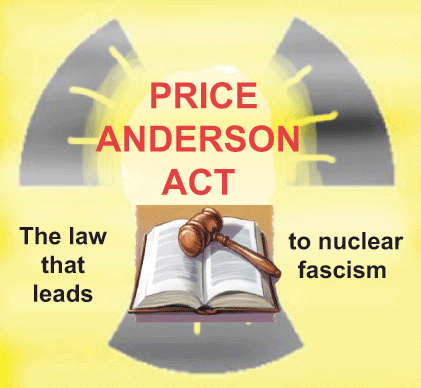
The Price Anderson Act illustrates the U.S.A.’s fascist trail, and that nuclear experiment cleared the way for it in the first place. The Act makes it so that nuclear power generation experiments can operate at all, otherwise no insurance corporation would insure them. The insurance companies that deal with nuclear experimentation only do so because the Act limits their responsibility in the event of an accident, such as the Fukushima meltdown. If there is an accident that costs more than the capped amount, insurance companies pay out up to and including their cap, and communities and governments foot the bill for the remaining clean up costs. Put simply”. they profit, you pay. Not to mention the non-financial costs of human and planetary health.
The Price Anderson Act endorses fascism in the United States, and in the bigger picture, nuclear experimentation guarantees fascism no matter what nation is doing the experimenting — whether Israel, China, Iran or the U.S. or Japan. The nuclear power industry could not survive without placing all the risk on the shoulders of taxpayers. And by doing so, the Price Anderson Act enables nuclear oligarchical fascists to make a fortune by endangering everyone and everything on the planet.
Even if nuclear facilities operated to their original design specifications rather than running components on extended operation (by years) and over-crammed fuel pools, as is the case today, the industry is still unworkable. But today, most if not all nuclear power generation experiments in the U.S.A. have fuel pools loaded with waste material beyond original design specifications, but the nuclear industry and its regulators seem content continuing down this path — and waiting for our grandchildren to figure out what to do with the mess they leave behind…. http://www.opednews.com/articles/Is-Nuclear-Experimentation-by-Ethan-Indigo-Smith-Fukushima_Nuclear-Cover-up_Nuclear-Meltdown_Nuclear-Waste-140122-627.html
The Mount Pelerin Society – home of Climate Science Denialism
Mont Pelerin Society Revealed As Home To Leading Pushers Of Climate Science Denial DESMOGBLOG.COM, GRAHAM READFEARN, 14 JAN 14 THERE’S a popular talking point coming from climate change denialists that all people who accept the science and the need to act on it are somehow blinded by faith.
In Australia, climate science contrarian columnists can barely touch their keyboards without typing out the words “global warming faith” or explaining how human-caused global warming is some sort of “new religion”.
This “climate religion” narrative often goes hand-in-hand with another favourite denialist talking point where climate scientists are only doing what they do because there’s a dollar in it.
Presumably the laws of physics, the melting ice sheets, the increasing risk of bushfires, the hottest decades on record and the acidifying oceans are also waiting for their cash…….
Among the notable members is Charles Koch (list excerpt here), the US oil billionaire who has been a Mont Pelerin Society member since 1970.
Charles and his brother David have used their charitable foundations to funnel tens of millions of dollars into free market think tanks which fight environmental protection and deny the dangers of human-caused climate change
The Mont Pelerin Society
The Mont Pelerin Society was established in 1947 by free market economist and philosopher Friedrich von Hayek……
DeSmogBlog has obtained a full list of the society’s members that includes senior representatives of many of the world’s foremost “free market” think tanks actively pushing back on proposed policy solutions to tackle climate change.
The list, from 2010, includes almost 500 people from 52 countries, with the bulk of members coming from the United States and the United Kingdom. The 70-page list includes private contact details. DeSmogBlog has decided to publish only extracts with contact details redacted…..
Mont Pelerin in the United States
The US cohort of Mont Pelerin members includes many senior staff associated with “free market” think tanks that have manufactured doubt about the science of human-caused climate change or the need to act quickly.
Alongside Charles Koch, DeSmogBlog’s document shows that Mont Pelerin Society members include senior staff, directors and associates from groups his family foundations have helped to fund. These include the Cato Institute, Heritage Foundation, the Acton Institute, the Reason Foundation and the American Enterprise Institute.
Other members include Wall Street Journal editor and columnist Mary O’Grady and John O’Sullivan, a columnist with the conservative National Review.
The UK and Mont Pelerin
Members of UK free market think tanks including The Adam Smith Institute, CIVITAS and the Institute of Economic Affairs have also gained membership with the Mont Pelerin Society.
Long-standing climate science sceptic Julian Morris is also listed as a member.
Another UK member is Linda Whetstone, the daughter of Antony Fisher who founded the influential UK neo-liberal think tank, the Institute of Economic Affairs.
Antony Fisher established the Atlas Economic Research Foundation – a vast network of about 400 think tanks around the world that share the ideals of limiting the power of government. Alejandro Chafuen, the current president of Atlas, is also listed as a 2010 Mont Pelerin Society member.
Global network
The Mont Pelerin Society got its name from the location of the very first meeting in Switzerland, and members continue to have ample chance to network in their annual meetings. …….
It should come as no surprise that the Mont Pelerin Society has more than its fair share of climate science deniers within its ranks.
Research has shown that belief in free market ideology is a predictor of the rejection of climate change science. This link was also revealed in Merchants of Doubt, a book by science historians Erik Conway and Naomi Oreskes.
About four out of every five climate denial books ever published, according to one study, have links to conservative and free market think tanks either through the authors or the publishers.
When it comes to efforts to block meaningful policy to tackle climate change, it seems free market groups and societies extolling their version of “freedom” are in fact a “ground zero” for climate science denial. http://www.desmogblog.com/2014/01/15/exclusive-mont-pelerin-society-revealed-home-leading-pushers-climate-science-denial
A thorough study planned to assess Fukushima radioactive isotopes in the Pacific occean
To trace the path of radiation through the ocean, researchers measure the amount of two tell-tale radioactive isotopes. They measure the levels of cesium-134, which has a short half-life—half of it decays every two years. The sole source of cesium-134 in the ocean is from Fukushima. They also measure cesium-137, an isotope that has been in the oceans for half a century, dispersed from atomic weapons testing in the 1960s. The ratio can tell them how much of the radiation is caused by isotopes coming from Japan.
Crowdsourced radiation monitoring website to measure Fukushima’s footprint http://www.boston.com/news/science/blogs/science-in-mind/2014/01/14/crowdsourced-radiation-monitoring-website-measure-fukushima-footprint/U1B4mLiqWbpkwfcS1YGaJM/blog.html
Ken Buesseler, a senior scientist at Woods Hole, announced Tuesday the launch ofourradioactiveocean.com, a website that will allow people and communities to propose sampling sites along the Pacific coast.
Buesseler is quick to point out that the levels of radiation exposure predicted by a number of models is well below the federal regulations for acceptable radiation exposure in drinking water. The expected radiation exposure in waters off the West Coast range from 1 to 30 Becquerels per cubic meter– far below the federal drinking water limit of 7,400 Becquerels per cubic meter.
He does not expect to find unsafe levels of radiation, but he thinks the levels should be measured to allay people’s fears and to contribute to science, allowing regulators and oceanographers to get a better handle on how ocean currents travel. He is specifically interested in parts of the northern United States and Alaska, because the radioactive isotopes are projected to arrive there first.
“Without data, it’s easy to speculate and alarm people,” Buesseler said. “I’m concerned about radioactivity being dangerous, but I want to know what those levels are, and my concern scales with those numbers. … I think we owe it to the public to make those measurements and I think it’s a pity our government hasn’t taken this on directly.” Continue reading
Small Modular Reactors – forlorn hope of beleaguered nuclear industry
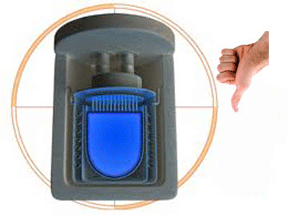 IEER REPORT: Small Modular Reactors a “Poor Bet” to Revive Failed Nuclear Renaissance in U.S. AUDIO: Light Water Designs of Small Modular Reactors: Facts and Analysis http://ieer.org/resource/nuclear-power/light-water-designs-of-small-modular-reactors-facts-and-analysis/By Dr. Arjun Makhijani
Download the report, updated September 2013
$90 Billion in Initial Manufacturing Order Book Needed, Requiring Massive Involvement by the Chinese or Taxpayer-Backed Federal Subsidies;
Major Implications Seen for Companies and SMR Test Sites in FL, MO, NC, OR, PA, SC, and TN.
WASHINGTON, D.C.///August 8, 2013///A shift to “small modular reactors” (SMRs) is unlikely to breathe new life into the increasingly moribund U.S. nuclear power industry, since SMRs will likely require tens of billions of dollars in federal subsidies or government purchase orders, create new reliability vulnerabilities, as well as serious concerns in relation to both safety and proliferation, according a report issued today by the nonprofit Institute for Energy and Environmental Research (IEER) think tank .
The IEER report has implications for SMR companies headquartered or with planned test sites in Florida, Missouri, North Carolina, Oregon, Pennsylvania, South Carolina, and Tennessee.
Titled “Light Water Designs of Small Modular Reactors: Facts and Analysis the IEER report focuses on light water reactor (LWR) SMR designs, the development and certification of which the U.S. Department of Energy (DOE) is already subsidizing at taxpayer expense. Continue reading
Small Modular Nuclear Reactors (JSMRs) irrelevant last ditch ploy of the failing nuclear industry
Small reactors just compound the waste problem because you generate more radioactive components (aside from all the nuclear fuel that turns into nuclear waste too) than a large nuclear reactor does per unit of energy generated. And placing them underground, while making them less tempting targets for terrorists, brings up issues of groundwater contamination and greater earthquake vulnerability in affected areas. The fact that you could use ground-source cooling to condense your cooling water a lot easier with these reactors is a benefit, so they aren’t completely a bad idea.
However, it should be made abundantly clear why some in the nuclear industry see these reactors as a way forward. As the article mentions, building large 1GW+ reactors has become an immensely risky undertaking from a financial perspective. Forget all the crap people harp on about Fukushima, the price tags on these reactors are the real killer. The new reactor under construction in Finland (Olkiluoto Unit 3) is coming in at 8.5B euros ($11.55B), or almost 3 TIMES it’s initial cost estimate. In dollar terms, that amounts to over $7.21 per watt!
http://en.wikipedia.org/wiki/Olkiluoto_Nuclear_Power_Plant
New reactors going up in the US are posting similar figures, although the massive web of government supports and insulation from market forces that the nuclear industry benefits from makes true cost figures for these reactors hard to pin down.
This is in the face of wind power getting INSTALLED for $1 – $2 per watt:
In short, the nuclear industry is scrambling for solutions before it becomes clear to everybody how irrelevant they are. Much like typewriters got really fancy and sophisticated in the 1990′s before going the way of the buggy whip and the rotary phone.
Advice to cardiologists to reduce radiation exposure
Cardiologists urged to reduce inappropriate radiation exposure, Medical Press 8 Jan 14 Cardiologists are being urged to reduce patient radiation exposure in a European Society of Cardiology (ESC) position paper which outlines doses and risks of common cardiology examinations for the first time. The paper is published today in the European Heart Journal.
Lead author, Dr Eugenio Picano, FESC, said: “Cardiologists today, are the true contemporary radiologists. Cardiology accounts for 40% of patient radiology exposure and equals more than 50 chest X-rays per person per year.”
He added: “Unfortunately, radiation risks are not widely known to all cardiologistsand patients and this creates a potential for unwanted damage that will appear as cancers, decades down the line. We need the entire cardiology community to be proactive in minimising the radiological friendly fire in our imaging labs.”
The paper lists doses and risks of the most common cardiology examinations for the first time. Computed tomography (CT), percutaneous coronary intervention (PCI), cardiac electrophysiology and nuclear cardiology deliver a dose equivalent to 750 chest X-rays (with wide variation from 100 to 2,000 chest X-rays) per procedure. These procedures are performed daily in all cardiology in- and out-patient departments, usually more than one procedure per admission. They are used for all forms of cardiac disease, from congenital to heart failure, but more intensively and frequently for ischemic heart disease.
PCI for dilation of coronary artery stenosis totals almost 1 million procedures per year in Europe. The additional lifetime risk of fatal and non-fatal cancer for one PCI ranges from 1 in 1000, to 1 in 100 for a healthy 50 year old man. Risks are 1.38 times higher in women and 4 times higher in children. Children’s higher risk is because their cells divide more quickly and they have more years in which to develop cancer.
Dr Picano said: “Even in the best centres, and even when the income of doctors is not related to number of examinations performed, 30 to 50% of examinations are totally or partially inappropriate according to specialty recommendations. When examinations are appropriate, the dose is often not systematically audited and therefore not optimised, with values which are 2 to 10 times higher than the reference, expected dose.”
The paper aims to reduce the unacceptably high rate of inappropriate examinations and reduce excessive doses in appropriate examinations. Dr Picano said: “In these hard economic times, 50% of the costly and risky advanced imaging examinations we do are for inappropriate indications. Politicians’ top priority should be to audit and cut down on useless and dangerous examinations.”…….http://medicalxpress.com/news/2014-01-cardiologists-urged-inappropriate-exposure.html
Uranium the real issue behind the Lockerbie bombing in 1988?
Bernt Carlsson lays down the lawThe man responsible for Namibia under international law, Assistant Secretary-General of the United Nations and UN Commissioner for Namibia, Bernt Carlsson, spoke about these prosecutions.
It was on his way to the signing of the agreement at UN headquarters in New York, that UN Commissioner for Namibia Bernt Carlsson became the highest profile victim of the Pan Am Flight 103 crash at Lockerbie on 21st December 1988.
Following Bernt Carlsson’s untimely death in the Lockerbie bombing, the case against URENCO was inexplicably dropped and no further prosecutions took place of the companies and countries that were in breach of the United Nations Council for Namibia Decree No. 1.
 The Downing of Flight 103 over Lockerbie: It was the Uranium, The Ecologist, Mystery continues to surround the 1988 downing of Panam Flight 103 at Lockerbie. Who did it, how, and why? UN Assistant Secretary-General and Commissioner for Namibia, Bernt Carlsson Died in the Crash By Patrick Haseldine, 7 Jan 14 Patrick Haseldine is a former British diplomat who was dismissed by the then foreign secretary, John Major, in August 1989. He is often referred to as the “Emeritus Professor of Lockerbie Studies”.
After 25 years study of the topic Patrick Haseldine reveals the shocking truth…….
United Nations Assistant Secretary-General and Commissioner for Namibia, Bernt Carlsson, was Lockerbie’s highest profile victim, yet the authorities and the media never mention him. Why?
As comedian Kenneth Williams used to say: “I think the answer lies in the soil.”
More specifically, I believe the answer lies in the processed uranium ore (Yellowcake) that was illegally extracted from Namibia in the period 1976 to 1989. A TV documentary film in March 1980 described succinctly what was going on: Continue reading
Both the land and the people suffer from uranium mining: its long term harm
Uranium mining: everything about it is negative http://www.nunatsiaqonline.ca/stories/article/65674uranium_mining_everything_about_it_is_negative/ Dale DewarWynard, Sask.3 Jan 14, “There is probably fairly low probability that mining will even occur” NUNATSIAQ NEWS Youth should be congratulated on tackling the issue of uranium mining in Nunavut.
Both sides sound as though they did their research thoroughly. Unfortunately the “economic benefit” argument is based upon promise and not fact. What little research that has been done does not support the argument for local benefit. The few unskilled jobs that go locally provide money that accrues to individuals, not communities. The government of Nunavut may benefit from royalties — but as Saskatchewan recently discovered, even that was banked in Switzerland to avoid taxes.
What kind of legacy does uranium mining leave? The natural situation can never be restored; 85 per cent of the nuclear radiation bound up in the rock will be left on the surface.
The industry speaks of “reclamation” but even that is more an unfulfilled promise than fact. The area can never be normal again. Mines in northern Saskatchewan still spill toxic tailings into waters bound for the Arctic Ocean. Mining in Niger (North Africa) has been going on since 1968 with not a whisper of reclamation. Two million tonnes of radioactive tailings were dumped into local surface waters in Gabon (also Africa.)
Containment in Australia recently ruptured and is still spreading into the surface waters of the surrounding Indigenous lands. The mining company in Navajo Territory in the south-western United States transferred its assets and then declared bankruptcy.
Reclamation, such as it is, is extremely expensive. Germany began reclamation of a collection of mines referred to as WISMUT in the 1990s —to date, close to twelve billion dollars have been spent and the job is not complete.
The tailings from a proposed mine in Tanzania expected to produce uranium for 20 years has a clean-up price tag of four billion dollars.
Given that uranium has only two end uses — nuclear power and nuclear bombs — no renaissance for the first and no desire for the second, there is probably fairly low probability that mining will even occur.
The industry and the argument will serve only to divide a community that needs to work together to tackle challenging times.
Thorium nuclear reactors produce just as much radioactive waste products as do uranium reactors
Reuters Breakout Series Focuses on China’s Interest in Thorium, The Energy Collective December 23, 2013 Reuters is running a series titled Breakout: Inside China’s Military Buildout. Installment number 6 is titled The U.S. government lab behind Beijing’s nuclear power push. The title is misleading; it is not about China’s world-leading, multibillion-dollar program. That program includes 29 large commercial nuclear plants currently under construction. Instead, the article focuses on a $350 million research program to evaluate the use of thorium as an alternative nuclear fission fuel source.
The Reuters piece includes a number of statements about the comparison between thorium and uranium that are debatable, at best, but whose source should be obvious to anyone that has been involved in any discussions with thorium advocates. It neglects the fact that uranium and thorium produce approximately the same mix of radioactive fission products. Systems using thorium need to pay just as much attention to decay heat removal as systems using uranium.
The article partially blames Admiral Rickover for the nuclear industry’s initial focus on uranium, without ever mentioning that the single most impressive use of thorium in an operating reactor took place under Admiral Rickover’s direction………
There is not a single mention in the article that Rickover’s Shippingport nuclear power plant was the site of the successful test of the Light Water Breeder Reactor (LWBR)between 1977 and 1982. That demonstration plant…..used a carefully engineered nuclear reactor core with uranium-233 as the fissile material and thorium-232 as fertile material…….detailed destructive post irradiation testing determined that the core contained about 2% more U-233 at the end of operation than it did at the beginning.
The sinister biological effects of uranium inside our bodies
 Uranium – the ‘demon metal’ that threatens us all, Ecologist, Chris Busby, 1st January 2014 Fatally flawed – the concept of ‘dose’ “………..We can go back now and ask about the health effects following the Hiroshima bombs. The increase in cancer in the group of Japanese survivors has been and still is the foundation of the current radiation risk model. Of course, the cancers have been correlated with the radiation dose, a huge acute sudden gamma ray dose from the A-bomb.
But what if ‘dose’ is not the correct quantity to predict or explain the cancers? What if the internal exposures to the fallout caused much bigger effects?
Then the ‘control group’, those who were not there at the time of the detonation would also be affected, and the differential cancer yield based on ‘dose’ would be meaningless. There is recent interest in this and in the link between the ‘black rain’ and the cancers.
I jump now to France in 2010 where I am at a big meeting on radiation and health at the University of Paris Sud. I talk with Dr Irina Guseva Canu who has spent several years studying the French Uranium workers. She can’t get her results published, could she cite me as a referee to the journals?
When her findings finally appear in the literature in a rather diluted form they show that the Uranium workers suffer excess risk of leukemia and lymphomas, and also heart disease.
The ‘doses’ are very low, but are not given, though by a forensic analysis of her three papers, they can be deduced. On the basis of the current risk model they are 2,500 times too small to account for the cancers.
There is plenty of other published work that points to the dangers of Uranium exposures, mainly from inhalation of dust particles. There is chromosome analysis of Gulf War Veterans, of New Zealand Test veterans, and of Uranium workers in Namibia. There are laboratory studies of genetic and genomic effects in cell cultures, and there are the cancer rates in North Carolina by Uranium content in soils.
How did the experts get it so wrong?
Apart from the ‘skullduggery argument’, here is a possible answer. There are two things about Uranium which were known since the 1960s but not assembled into a health hazard argument.
Perhaps because of the agreement signed between the WHO and the IAEA in 1959. Perhaps because the scientists in the area were mainly physicists and not interested in the biology of internal exposures. Who knows? Maybe no-one thought of it.
First, Uranium has enormous chemical affinity for DNA and binds to chromosomes. This was discovered in 1961 and ever since then Uranyl salts have been the electron-microscope stain of choice for imaging.
The reason they create such clear, sharp images is that Uranium has the highest atomic number (92) of any natural element. Its 92 electrons block the passage of the electron microscope beam.
But that’s not all they do. They also block gamma rays. The absorption of gamma radiation (natural background radiation) by any element is proportional to roughly the fifth power of the atomic number Z .
So clearly Uranium (like lead (Z = 82), but considerably more so) blocks the passage through the body (the oxygen in water has Z=8) of background gamma radiation.
Uranium in tissues acts as a gamma ray damage multiplier
The energy from the gamma rays, absorbed by the Uranium, is therefore converted into fast photoelectrons – and these smash through the nearest tissue. And of course, the nearest tissue is the DNA in the chromosomes and in mitochondria or any other tissue that the Uranium is bound to.
This idea, as an explanation for all the anomalous biological effects of Uranium was advanced by me first in the CERRIE conference in 2004 and next in a series of papers and reports from various conferences, and an outline can be found on the web. The theory was also reported in New Scientist in 2008 in How war debris could cause cancer.
So if you have Uranium inside you, a lot of it is on the DNA (nuclear scientists say its on the phosphate in the bones, but DNA is phosphate also). And it then acts as an antenna sitting on the DNA – converting background radiation into photoelectrons which smash up the chromosomes like an egg whisk.
Note that to do this the Uranium does not need to be radioactive – just to have a very heavy nucleus with a high atomic number. Of course all isotopes of Uranium are radioactive as well, but the main natural isotopes, U-238 and U-235, are only mildly so. Their health impacts are far, far greater than can be accounted for by its own emissions of radiation.
Hence the chromosome damage found in the miners, the test veterans and the Gulf veterans and the Chernobyl liquidators, all disproportionate by large multiples to their radiation doses…….http://www.theecologist.org/News/news_analysis/2205213/uranium_the_demon_metal_that_threatens_us_all.html
America dumped radioactive trash on the ocean floor
 Nuclear Waste Sits on Ocean Floor U.S. Has Few Answers on How to Handle Atomic Waste It Dumped in the Sea By JOHN R. EMSHWILLER and DIONNE SEARCEY WSJ Dec. 31, 2013 More than four decades after the U.S. halted a controversial ocean dumping program, the country is facing a mostly forgotten Cold War legacy in its waters: tens of thousands of steel drums of atomic waste.
From 1946 to 1970, federal records show, 55-gallon drums and other containers of nuclear waste were pitched into the Atlantic and Pacific at dozens of sites off California, Massachusetts and a handful of other states. Much of the trash came from government-related work, ranging from mildly contaminated lab coats to waste from the country’s effort to build nuclear weapons.
Federal officials have long maintained that, despite some leakage from containers, there isn’t evidence of damage to the wider ocean environment or threats to public health through contamination of seafood. But a Wall Street Journal review of decades of federal and other records found unanswered questions about a dumping program once labeled “seriously substandard” by a senior Environmental Protection Agency official: Continue reading
1 This Month



26 September – International Day for the Total Elimination of Nuclear Weapons


PLEASE OPPOSE HR 8255 AND S.3639 – bills would accelerate satellite deployment, with no environmental review or safeguards – https://ncstd5li.quorum.us/campaign/169331/
To see nuclear-related stories in greater depth and intensity – go to https://nuclearinformation.wordpress.com
-
Archives
- September 2026 (257)
- August 2026 (330)
- July 2026 (355)
- June 2026 (287)
- May 2026 (306)
- April 2026 (356)
- March 2026 (251)
- February 2026 (267)
- January 2026 (308)
- December 2025 (358)
- November 2025 (359)
- October 2025 (375)
-
Categories
- 1
- 1 NUCLEAR ISSUES
- business and costs
- climate change
- culture and arts
- ENERGY
- environment
- health
- history
- indigenous issues
- Legal
- marketing of nuclear
- media
- opposition to nuclear
- PERSONAL STORIES
- politics
- politics international
- Religion and ethics
- safety
- secrets,lies and civil liberties
- spinbuster
- technology
- Uranium
- wastes
- weapons and war
- Women
- 2 WORLD
- ACTION
- AFRICA
- Atrocities
- AUSTRALIA
- Christina's notes
- Christina's themes
- culture and arts
- Events
- Fuk 2022
- Fuk 2023
- Fukushima 2017
- Fukushima 2018
- fukushima 2019
- Fukushima 2020
- Fukushima 2021
- general
- global warming
- Humour (God we need it)
- Nuclear
- RARE EARTHS
- Reference
- resources – print
- Resources -audiovicual
- Weekly Newsletter
- World
- World Nuclear
- YouTube
-
RSS
Entries RSS
Comments RSS
 nuclear-news