The Coke Can Plutonium Experiment
On arrival at lecture halls, he would push his stand-in for plutonium into an empty Coke can he had sawn in half. During his talks, he would hold the can up so his audience could see it, and say the contents could incinerate a city. “A six-pack of these is a nuclear arsenal,” he would say.
 A World Awash in a Nuclear Explosive? TruthOut, 19 March 2014 12:24 By Douglas Birch and R. Jeffrey Smith, Center for Public Integrity | Report Washington #……..The Coke Can Experiment In the abstract, there’s plenty of alarm in official circles. “Just one nuclear weapon exploded in a city — be it New York or Moscow; Tokyo or Beijing; London or Paris — could kill hundreds of thousands of people,” President Barack Obama told the United Nations Security Council in September 2009. “And it would badly destabilize our security, our economies, and our very way of life.”
But Cochran has long criticized the effectiveness of one of Washington’s most costly and elaborate strategies to prevent such a catastrophe — a global effort to detect and capture illicit fissile materials at border crossings and major world ports.
Since 2003 the United States has spent more than $850 million on equipment and training for customs officials at 45 foreign ports so they can scan shipping containers to detect nuclear materials. It’s a daunting assignment. About 432 million shipping containers crisscrossed the oceans in 2009 alone. U.S. ports accept 15 million containers every year. Continue reading
Decades to solve problems of Thorium nuclear reactors
 South China Morning Post, 19 March 14 ……….Researchers working on the project said they were under unprecedented “war-like” pressure to succeed and some of the technical challenges they faced were difficult, if not impossible to solve in such a short period.
They would also probably face opposition from sections of the Chinese public after the nuclear disaster at Fukushima in Japan….One of the technical difficulties is that the molten salt produces highly corrosive chemicals such as fluoride that could damage the reactor.
The power plant would also have to operate at extremely high temperatures, raising concerns about safety. In addition, researchers have limited knowledge of how to use thorium.
“We are still in the dark about the physical and chemical nature of thorium in many ways,” said Li. “There are so many problems to deal with but so little time.”
Western countries such as the United States have experimented with thorium reactors but gave up on the technology because of the engineering difficulties………
One of the technical difficulties is that the molten salt produces highly corrosive chemicals such as fluoride that could damage the reactor.
The power plant would also have to operate at extremely high temperatures, raising concerns about safety. In addition, researchers have limited knowledge of how to use thorium.
“We are still in the dark about the physical and chemical nature of thorium in many ways,” said Li. “There are so many problems to deal with but so little time.”
Western countries such as the United States have experimented with thorium reactors but gave up on the technology because of the engineering difficulties……The thorium reactors would need years, if not decades, to overcome the corrosion issue and the stability of accelerator-driven plants was also in doubt, he said.
“These projects are beautiful to scientists, but nightmarish to engineers,” he said…….After the Fukushima nuclear disaster three years ago, the central government withheld approval for new nuclear plants.
Part of the resistance came from the public, as many people were worried that nuclear plants would cause more serious contamination than the pollution created by coal-fired stations, Gu said.
Government agencies such as the Ministry of Water Resources also opposed the construction of nuclear plants in land-locked areas over concerns that radioactive waste would worsen river pollution.
The censorship of research on Fukushima’s radiation releases
 Squelching Efforts to Measure Fukushima Meltdown By DAVID MCNEILL | THE CHRONICLE OF HIGHER EDUCATIONMARCH 16, 2014 TOKYO — In the chaotic, fearful weeks after the Fukushima nuclear crisis began, in March 2011, researchers
  struggled to measure the radioactive fallout unleashed on the public. Michio Aoyama’s initial findings were more startling than most. As a senior scientist at the Japanese government’s Meteorological Research Institute, he said levels of radioactive cesium 137 in the surface water of the Pacific Ocean could be 10,000 times as high as contamination after Chernobyl, the world’s worst nuclear accident.
Toxicologist finds high levels of cancer caused by uranium in water
 SA toxicologist’s study says higher uranium causes cancers in Malwa http://timesofindia.indiatimes.com/city/chandigarh/SA-toxicologists-study-says-higher-uranium-causes-cancers-in-Malwa/articleshow/32114888.cms Neel Kamal,TNN | Mar 16, 2014 FARIDKOT: Excessive presence of uranium in water in the Malwa region of Punjab is turning out disastrous for the residents of rural areas and is giving birth to cancer, neurological and birth abnormality. Taking leads from her study on the subject, South African clinical metal toxicologist Dr Carin Smit has confirmed that excess prevalence of uranium in human bodies is the biggest reason of cancer in Malwa region of Punjab. The Union and state government in the past had negated the affect of uranium in cancer incidence. Dr Smit had obtained hair samples of 149 children with deformities in 2009 and urine samples in 2010 and had sent these to Micro Trace mineral laboratory in German where it was established that excess prevalence of uranium has caused deformities. These children are being treated at Faridkot. As per Bhabha Atomic Research Center (BARC), the uranium level here have reached up to 1000 parts per billion(ppb) against permissible limit of 15ppb, she said.
 While visiting Baba Farid Centre for Special Children on Saturday, Dr Smit based her submission on a study carried out in Finland in the past and said, “Uranium toxicity is much more there as compared to Malwa region of Punjab but spray of fertilizers is filtered and eating habits are much more safe there, but in Punjab the use of fertilizers, pesticides is at much higher levels, which is leading to cancer and deformities among persons.”
Dr Carin finds faults in the state approach in tackling such an important issue with grave seriousness. She said, “Desiring to conduct a full study to establish excess uranium presence leading to cancer incidence, I had written to Punjab government in 2013 to provide infrastructure to conduct the study with Japanese scientists but an still waiting the government response.” Claiming that presently Punjab is passing through a bad phase on health and environment front, she accused the state government of not being serious to tackle the issue. She said despite knowing the seriousness of the issue, the state government is doing nothing to provide respite to people. “Though courts are serious but the governments are not and Punjab government is not providing proper findings to the court in one petition related to uranium giving birth to cancer in the state,” said Dr Pritpal singh and Amar Singh Azad of Baba Farid centre.
She said a study published recently in a research journal titled ‘Comparing metal concentration in the hair of cancer patients and healthy people living in Malwa region of Punjab’ by scientists from USA and Germany too had mentioned higher toxicity as reason for cancer.
Science finds damage to plants, animals, in Chernobyl and Fukushima

Radiation Facts and Myths
Many have claimed that wildlife is thriving in the highly-radioactive Chernobyl Exclusion Zone.
Some claim that a little radiation is harmless … or even good for you.
One of the main advisors to the Japanese government on Fukushimaannounced:
If you smile, the radiation will not affect you. If you do not smile, the radiation will affect you.
This theory has been proven by experiments on animals.
Are these claims true?
We Ask an Expert
To find out, Washington’s Blog spoke with one of the world’s leading experts on the effects of radiation on living organisms: Dr. Timothy Mousseau.
Dr. Mousseau is former Program Director at the National Science Foundation (in Population Biology), Panelist for the National Academy of Sciences’ panels on Analysis of Cancer Risks in Populations Near Nuclear Facilities and GAO Panel on Health and Environmental Effects from Tritium Leaks at Nuclear Power Plants, and a biology professor – and former Dean of the Graduate School, and Chair of the Graduate Program in Ecology – at the University of South Carolina.
For the past 15 years, Mousseau and another leading biologist – Anders Pape Møller – have studied the effects of radiation on birds and other organisms.

Mousseau has made numerous trips to the Chernobyl Exclusion Zone and Fukushima – making 896inventories at Chernobyl and 1,100 biotic inventories in Fukushima as of July 2013 – to test the effect of radiation on plants and animals.
On the third anniversary of the Fukushima disaster, we spoke with Dr. Mousseau about what he discovered regarding the effects of radiation on plants, animals … and people.
Question] How did you get into this field? Is it because you are an anti-nuclear activist?
[Mousseau] No.
I’m an activist, but not an anti-nuclear scientist. I’m an activist for evidence-based science policy. Continue reading
The role of genes in susceptibility to ionising radiation
 Genes Determine People’s Susceptibility to Radiation, Prison Planet, Washington’s Blog March 10, 2014
Children are much more vulnerable to radiation than full-grown adults.
And yet standards for “acceptable” levels of radiation exposure are based on the ridiculous assumption that everyone is a healthy man in his 20s … and that radioactive particles ingested into the body cause no more damage than radiation hitting the outside of the body.
Similarly, there is a lot of variation between adults in terms of susceptibility to radiation.
For example, Howard Hughes Medical Institute – the second-best endowed medical research foundation in the world – reported in 2009:
Howard Hughes Medical Institute researchers have identified a group of genes that influence a person’s sensitivity to radiation……..
he most widely-accepted and prestigious publication on radiation – the U.S. National Academy of Science’s 2006 report on Health Risks from Exposure to Low Levels of Ionizing Radiation: BEIR VII Phase 2 – includes an 11-page discussion on genetic vulnerability to radiation, concluding:
At the level of whole populations it is feasible that certain inherited combinations of common low-penetrance genes can result in the presence of subpopulations havingsignificantly different susceptibilities to spontaneous and radiation-associated cancer.
***
The key issue is … the extent to which genetic distortion of the distribution of this risk might lead to underprotection of an appreciable fraction of the population.
While the commonly-accepted, mainstream scientific consensus is that even low levels of radiation can cause cancer and other injury, governments world-wide have reacted to the Fukushima crisis byraising “acceptable” radiation levels. And see this.
http://www.prisonplanet.com/genes-determine-peoples-susceptibility-to-radiation.html
Dirty bomb could be made from uranium-233 recovered from thorium reactor
Birth deformities, cancers, in Libya as result of depleted uranium weapons

In Libya now being recorded by the WHO (world health organization), the highest deformation in fetuses inside Libya and reached 23% of newborns and also the high incidence of new forms of cancer that were not known among ordinary Libyans and now amounting to 18% of the total of cancers that have been diagnosed by the organization’s branch in Libya .
Despite this serious health disaster countries involved with NATO are now demanding that Libya pay them one billion seven hundred million dollars for their help in toppling the Gaddafi regime.
NATO War Crimes In Libya: Deformities of Newborns Because of Depleted Uranium Bombs http://libyanfreepress.wordpress.com/2014/02/28/nato-war-crimes-in-libya-deformities-of-newborns-because-of-depleted-uranium-bombs/ Libyans knew that depleted uranium was being used by NATO in their bombing raids and they were very concerned.
There is no doubt that NATO/US broke every agreement imposed by the Geneva Convention.
War crimes against humanity in Libya by NATO and its member countries is unmatched in the world. Continue reading
Refuting the exaggerated claims of the thorium nuclear lobby
Thorium and Nuclear Weapons – By Gordon Edwards There are many exaggerated claims made by promoters of thorium-based nuclear reactor technology as an alternative to the present generation of uranium based reactors.
One of those claims is that the use of thorium “fuel” instead of uranium fuel eliminates the threat of nuclear weapons proliferation because “thorium-fueled reactors” do not produce plutonium as a by product.
This claim is profoundly misleading. Continue reading
Thorium nuclear reactors (LFTRs) produce intensely radioactive wastes
 “……LFTRs are theoretically capable of a high fuel burn-up rate, but while this may indeed reduce the volume of waste, the waste is more radioactive due to the higher volume of radioactive fission products. The continuous fuel reprocessing that is characteristic of LFTRs will also produce hazardous chemical and radioactive waste streams, and releases to the environment will be unavoidable. Spent fuel from any LFTR will be intensely radioactive and constitute high level waste.
The reactor itself, at the end of its lifetime, will constitute high level waste.
The UK’s National Nuclear Laboratory (NNL) believes that considerable research, development and testing lies ahead before thorium fuels will be ready for operational use. As the NNL states, “Thorium reprocessing and waste management are poorly understood. The thorium fuel cycle cannot be considered to be mature in any area.” It estimates that 10-15 years work is required before thorium fuels will be ready for use in current reactor designs, and that their use in new types of reactor is at least 40 years away….”http://www.no2nuclearpower.org.uk/nuclearnews/NuClearNewsNo43.pdf
Small Modular Nuclear Reactors – the $90 billion gamble
Going nuclear-and small-with new type of reactor, 27 Jan 14 “……….recent report by the Institute for Energy and Environmental Research cast doubt on the idea that SMRs could help revive the nuclear industry.
The think tank said small reactors “still present enormous financial risks,” citing the sector’s tendency to overrun on costs. It said the four reactors under construction were in part subsidized by taxpayers. The report said the mass production of SMRs could require $90 billion, and migrating from reactors to smaller modules “is a financial risk shell game, not a reduction in risk.
Thorium nuclear reactors: radioactive wastes are a problem
Thorium Cycle questions and problems“……..Certainly the fission products from a Thorium reactor are a worry, Technetium-99 has a half life of 220,000 years, uranium-232 produces thallium-208 (a nasty wee gamma emitter), Selenium-79 (another gamma emitter with a 327,000 year half-life), evenThorium-232 is a problem with its half life of 14 Billion years (and while the T-232 isn’t a major worry, all the time during this 14 Billion years it will be decaying and producing stuff that is!)……”http://daryanenergyblog.wordpress.com/ca/part-8-msr-lftr/8-3-thorium-lftr/
Nuclear power destroying democracy in Japan. And Beyond?
 “Shock & Outrage”: Japan TV host reveals being told he cannot discuss nuclear power until pivotal Tokyo election ends — “Somebody needs to bring these issues into the media” — #2 in trending news http://enenews.com/shock-outrage-japan-tv-host-reveals-being-told-he-cannot-discuss-nuclear-power-until-pivotal-tokyo-election-ends-somebody-needs-to-bring-these-issues-into-the-media
TokyoReporter’s tweet, Jan. 22, 2014: Radio host Peter Barakan says broadcasters told him to avoid nuclear issues till after poll
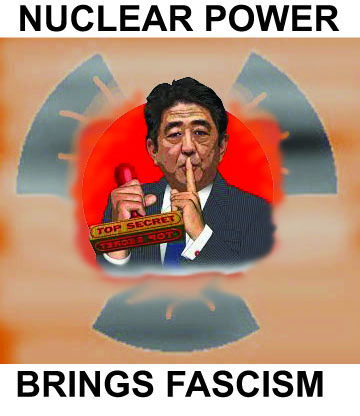
Nuclear Power Brings Fascism
 Is Nuclear Experimentation Fascism? OpEdNews Op Eds 1/22/2014 opednews.com By Ethan Indigo Smith Contributing Writer for Wake Up World “…..The United States was formerly one of the few anti-institutional, anti-oligarchical nations in the world, but we have succumbed to the oligarchical corporaculture that has been pushed for the last couple of hundred years, whether fused by labels like the divine rite of kings or by corporate personhood. The United States used to push for individual rights, but now we yield to violent fascism just like the rest of the intolerant world. Hell, we were once so anti-fascist and anti-oligarchy that it used to be illegal to do business in more than one American state, now the police and political system seems to only serve and protect business interests. But at what cost?
Imagine if this culture of anti-fascism were still the case, perhaps none of us would ever question our water supply, hijacked for a nuke plant or polluted by a petroleum conglomerate”.
Learning from History
Recent events at Fukushima have highlighted the uncontainable dangers of nuclear experimentation. If one examines trends, there are bound to be more accidents, spills and “unprecedented events’ within the nuclear industry.
The first nuclear power generation experiment began at Oak Ridge in 1948, and first massive one began in the Soviet city of Obninsk in 1954. In the 65 years that followed, there have been numerous known meltdowns at nuclear facilities around the world, as well as environmental, human and political destruction at other sites that did not (by luck only) experience full meltdown.
HANFORD, USA, 1943 — 1987…….
BIKINI ATOLL, NORTHERN PACIFIC OCEAN, 1946…….
WINDSCALE FIRE, UK, 1957….
SANTA SUSANA, USA, 1959…….
THREE MILE ISLAND, USA, 1979…….
CHERNOBYL, UKRAINE, 1986…..
ROCKY FLATS PLANT, USA 1987…..
FUKUSHIMA DAIICHI, JAPAN 2011….
WHO IS NEXT?
The list goes on. And while this is a short summary of some of the nuclear industry’s worst failings — both environmental and political — what it does not take into account that there are now over four hundred nuclear power generation experiments in operation worldwide, and more being built, each one representing another potential disaster. Now factor in the endless radioactive pollution and dumped material (buried and sunken near you) involved in the process even when things go “right’ (by nuclear industry standards) and you get a clearer view of the impact of nuclear experimentation.

Under the terms of current policy, the US Federal Government simply incurs the financial costs and burden of dealing with nuclear “events'”. and by the “Federal Government’ I mean the U.S. taxpayer.
Regimentation of Industry
Today, the United States of America is fascist. So is China, Japan, Russia, France, England, Japan and every single nuclear nation. Australia is de facto fascist, being a major extractor of uranium for the nuclear fuel chain. The United States of America is fascist by way of one single act: The Price Anderson Nuclear Industries Indemnity Act. There are many more acts and laws that strengthen nuclear fascism in the United States, but The Price Anderson Act seals the deal. Its main purpose is to indemnify the nuclear industry against liability claims arising from nuclear incidents. And other countries have their own nuclear deals which also guarantee that those who profit from the nuclear industry are not held accountable for their work………
Clearly nuclear experimentation does not co-exist alongside freedom of speech or transparent access to information. It can only exist in a fascist state, which suppresses information and opposition.
Severely Nationalistic Policies
The only part of the definition of fascism that nuclear experimentation does not technically fit is that nuclear experimentation operates on an international level, not just a nationalistic one. However it seems even nuclear disaster rings opportunity bells for nationalistic governments.
As reported by Bloomberg in 2013, “Japan will receive international help with the cleanup at the Fukushima atomic station once it joins an existing treaty that defines liability for accidents at nuclear plants, U.S. Energy Secretary Ernest Moniz said.” This means that the United States’ “offer” of assistance is conditional upon Japan signing onto an international convention known as the Convention on Supplementary Compensation for Nuclear Damage, designed only to protect US nuclear interests from liability in the event of an accident. The U.S. Government has lobbied for the international adoption of the convention for many years, and now it seems it has Japan over a barrell. Surely this political opportunism qualifies as “severely nationalistic’ behaviour. Yet it in the United States, it seems we can barely distinguish this kind of fascism from the actions of true democratic government…….
Nuclear experimentation is destructive on a level that supersedes our common understanding of time and space. The nuclear industry is risking the unriskable. Nuclear experimentation is political and it’s fascism. I’m only left to wonder”. did the institutions involved in nuclear experimentation design themselves according to the definition of fascism, or do they naturally fit the definition that perfectly?…..http://www.opednews.com/articles/Is-Nuclear-Experimentation-by-Ethan-Indigo-Smith-Fukushima_Nuclear-Cover-up_Nuclear-Meltdown_Nuclear-Waste-140122-627.html
Thorium is no solution to nuclear wastes
Thorium Fuel: No Panacea for Nuclear Power By Arjun Makhijani and Michele Boyd Institute for Energy and Environmental Research and Physicians for Social Responsibility
“…….Not a Waste Solution Proponents claim that thorium fuel significantly reduces the volume, weight, and long-term radiotoxicity of spent fuel. Using thorium in a nuclear reactor creates radioactive waste that proponents claim would only have to be isolated from the environment for 500 years, as opposed to the irradiated uranium-only fuel that remains dangerous for hundreds of thousands of years. This claim is wrong.
The fission of thorium creates long-lived fission products like technetium-99 (half-life over 200,000 years). While the mix of fission products is somewhat different than with uranium fuel, the same range of fission products is created. With or without reprocessing, these fission products have to be disposed of in a geologic repository.
If the spent fuel is not reprocessed, thorium-232 is very-long lived (half-life:14 billion years) and its decay products will build up over time in the spent fuel. This will make the spent fuel quite radiotoxic, in addition to all the fission products in it. It should also be noted that inhalation of a unit of radioactivity of thorium-232 or thorium-228 (which is also present as a decay product of thorium-232) produces a far higher dose, especially to certain organs, than the inhalation of uranium containing the same amount of radioactivity. For instance, the bone surface dose from breathing an amount (mass) of insoluble thorium is about 200 times that of breathing the same mass of uranium…..”http://ieer.org/wp/wp-content/uploads/2012/04/thorium2009factsheet.pdf
1 This Month



26 September – International Day for the Total Elimination of Nuclear Weapons


PLEASE OPPOSE HR 8255 AND S.3639 – bills would accelerate satellite deployment, with no environmental review or safeguards – https://ncstd5li.quorum.us/campaign/169331/
To see nuclear-related stories in greater depth and intensity – go to https://nuclearinformation.wordpress.com
-
Archives
- September 2026 (255)
- August 2026 (330)
- July 2026 (355)
- June 2026 (287)
- May 2026 (306)
- April 2026 (356)
- March 2026 (251)
- February 2026 (267)
- January 2026 (308)
- December 2025 (358)
- November 2025 (359)
- October 2025 (375)
-
Categories
- 1
- 1 NUCLEAR ISSUES
- business and costs
- climate change
- culture and arts
- ENERGY
- environment
- health
- history
- indigenous issues
- Legal
- marketing of nuclear
- media
- opposition to nuclear
- PERSONAL STORIES
- politics
- politics international
- Religion and ethics
- safety
- secrets,lies and civil liberties
- spinbuster
- technology
- Uranium
- wastes
- weapons and war
- Women
- 2 WORLD
- ACTION
- AFRICA
- Atrocities
- AUSTRALIA
- Christina's notes
- Christina's themes
- culture and arts
- Events
- Fuk 2022
- Fuk 2023
- Fukushima 2017
- Fukushima 2018
- fukushima 2019
- Fukushima 2020
- Fukushima 2021
- general
- global warming
- Humour (God we need it)
- Nuclear
- RARE EARTHS
- Reference
- resources – print
- Resources -audiovicual
- Weekly Newsletter
- World
- World Nuclear
- YouTube
-
RSS
Entries RSS
Comments RSS
 nuclear-news