Indian Uranium Corporation ordered to probe birth deformities near mines
 The health issue came to the attention of the High Court earlier this year after pictures of Jadugora’s deformed children appeared in the Indian press. The court in February ordered Uranium Corp. to produce documents that might shed light on the health issues. The court noted then that children living near the mines in Jadugora are “born with swollen heads, blood disorders and skeletal distortions.”
India Court Orders Uranium Corp. to Probe Deformities Near Mines Bloomberg By Rakteem Katakey and Tom Lasseter Aug 20, 2014 India’s sole uranium mining company is being ordered by a regional court to disclose radiation levels and the presence of any heavy metals in soil and water in a cluster of villages with reports of unusual numbers of deformed and sick children.
The order by the Jharkhand High Court also mandates thatUranium Corp. of India Ltd.explain how it ensures the safety of nearby civilian populations who may be exposed to its 193-acre (78-hectare) radioactive waste dump near the village of Jadugora in eastern India.
The move comes about a month after a Bloomberg News story chronicled the plight of parents living near the Uranium Corp. mines who are seeking answers to what’s sickening and killing so many of their kids. The story also reported that local residents routinely wander the unfenced dump sites and fish and bathe in a river that receives water flowing from the dumps, known as tailings ponds. The Bloomberg article was submitted to the judges of the High Court by Ananda Sen, the lawyer appointed by the court to review the case.
Uranium Corp. has denied its mining operations have anything to do with village health issues. In 2007, a survey of more than 2,100 households by an Indian physicians group found mothers in villages 1.5 miles from the mines reported congenital deformities more than 80 percent higher than the rates just 20 miles (32 kilometers) away, with reported child death rates from such abnormalities more than five times as high.
Independent Experts
Thorium lobby’s misinformation is hampering rare earths industry
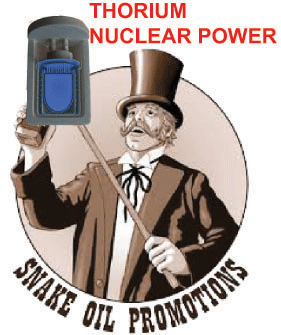 It’s anybody’s guess how long Thorium, with its “peacenik” aura, will take to get traction in corridors well-trodden by the US nuclear energy lobby, who have singularly shown zero interest in the blandishments of Thorium.
Thorium lobby thunder intent on hijacking rare earths’ coattails Investor Intel August 12, 2014 by Christopher Ecclestone Anyone in the Rare Earths space knows that Thorium frequently appears as an unwanted guest at the party. Explorers have worked on various ways to get around the issue. However there is a small group out there who we would call the “deniers”. They absolutely love Thorium. They are like Swedes liberated from the sauna in the dead of winter and would roll around in the stuff naked, if they could, to prove their commitment. While greater love hath no man to a chemical element than the Thorium crowd to their object of desire, the more measured amongst us realize that the mineral has been stuck for decades like a racehorse suffering a starting-gate malfunction.
What are we talking of here Continue reading
A nuclear boondoggle exposed – Small Modular Reactors (SMRs)
Report: New Nuclear Power Technology Would Siphon Resources Away From Renewable Energy, PROGRESS ILLINOIS Ellyn Fortino Friday August 8th, 2014, “…….one nuclear financing expert argues in a new report that SMRs, which have yet to be built in the United States, would be no cheaper than their larger counterparts. Mark Cooper, a senior fellow for economic analysis at theInstitute for Energy and the Environment at the Vermont Law School, also warns that SMR development would suck up funding that could otherwise be used for what he says are more attractive energy options like wind and solar.
“Large reactors have never been economically competitive and there is no reason to believe that smaller reactors will fare any better,” Cooper said. “Giving nuclear power a central role in climate change policy would not only drain away resources from the more promising alternatives, it would undermine the effort to create the physical and institutional infrastructure needed to support the emerging electricity systems based on renewables, distributed generation and intensive system and demand management.”………
Although SMRs would be smaller in size, “creating an assembly line for SMR technology would require a massive financial commitment,” Cooper writes in his report, “The Economic Failure of Nuclear Power and the Development of a Low-Carbon Electricity Future: Why Small Modular Reactors Are Part of the Problem, Not the Solution.”

He projects it would cost between $72 billion and $90 billion by 2020 to fund the development of just two SMR designs and assembly lines.
The estimated price tag to invest in SMRs is roughly equivalent to 75 percent of the total projected investment in U.S. electricity generation over the same time period, the report noted. It is also “substantially more” than what is expected to be spent on renewables, Cooper said.
“This massive commitment reinforces the traditional concern that nuclear power will crowd out the alternatives,” he added.
SMRs themselves would also cost more, not less, than larger reactors, according to the report.
“The higher costs result from: lost economies of scale in containment structures, dedicated systems for control, management and emergency response, and the cost of licensing and security; operating costs between one-fifth and one-quarter higher; and decommissioning costs between two and three times as high,” Cooper noted.
SMRs are up against greater challenges than previous technologies because they are “a radical new technology that its advocates would like to have treated in a very different way with respect to safety and licensing,” Cooper explained.
“They would like to deploy lots of reactors close to population centers. That’s the way they can make their economics work,” he continued. “And they need to relax safety … They’ve asked for a number of changes in safety to try to drive down the cost, and even then they cannot compete on costs.”……
the industry’s hype around SMRs is now fizzling, Cooper explained. The “unproven” SMR technology has already experienced setbacks in the marketplace, he said, pointing to recent announcements from Babcock & Wilcox and Westinghouse Electric Co., another small-reactor industry leader developing a 225-megawatt SMR.
Babcock & Wilcox said last month that it is slowing the development of and funding for its mPower technology because the company cannot find major investors for the effort. Westinghouse — after being passed up twice by the DOE for SMR cost-sharing agreements — announced in February that it is shifting its attention away from small-reactor technology because it does not have a customer base for SMRs.
“They are cutting back for simple reasons: They can’t find customers. They can’t find investors,” Cooper said. “In a market economy like ours, that is a death knell, and so they have slashed their commitment to small modular reactors……….”http://progressillinois.com/quick-hits/content/2014/05/18/report-new-nuclear-power-technology-would-siphon-resources-away-renewa
The collapse of the Small Modular Nuclear Reactor hype – ominous for the nuclear industry
Report: New Nuclear Power Technology Would Siphon Resources Away From Renewable Energy, PROGRESS ILLINOIS Ellyn Fortino Friday August 8th, 2014 “………With the industry currently unable to garner enough customer and investor interest around SMRs, it is trying to save nuclear power by making a “desperate attempt to undermine the alternatives, which are succeeding,” Cooper added.
The nuclear energy industry “says, ‘Look, just get rid of their subsides. Gerry-rig the market so that we can stay in business. Avoid policies that will let (alternatives) stay in business … and then we’ll have a level playing field.’ But of course it doesn’t look anything like a level playing field,” he said.
Over the past 60 years, the nuclear energy industry has collected 10 times more subsidies than what renewables have received, Cooper said. Government funding for SMR research and development currently represents the smallest subsidy out of many received by the nuclear power industry, he added.
He said the U.S. nuclear energy industry is grappling with a “fundamental conflict.” After failing to bring online 90 percent of new reactors as part of a “nuclear renaissance” suggested by nuclear power advocates in the early 2000s, the hope was that SMR technology would rescue the industry. And since that has yet to happen, the industry is “now struggling to save the aging reactors… simply because they cannot compete against the alternatives available.”

“The death of the small modular reactor hype really is emblematic of the fundamental conflict that’s going on in the industry,” he said. “The near term will decide, not just the fate of nuclear power, but the fundamental approach that we take to addressing the challenge of climate change.”
Looking ahead, Cooper said he questions nuclear power’s place in the emerging “integrated, two-way electricity system based on decentralized alternatives.” In such a system, an “inflexible source of supply like nuclear does not have value,” he said, adding that nuclear power “becomes a burden on the flexible system rather than a benefit.”
Nuclear power, Cooper said, is not a smart “economic proposition” or “portfolio asset” for a low-carbon electricity future.
“And looking carefully at the urgency of dealing with climate change, it’s also the most costly, most risky approach to climate change,” he stressed. http://progressillinois.com/quick-hits/content/2014/05/18/report-new-nuclear-power-technology-would-siphon-resources-away-renewa
Dr Helen Caldicott exposes the fallacies of the push for Small Modular Nuclear Reactors
Small Modular Reactors Huffington Post, Dr Helen Caldicott 08/07/2014 Now that the “nuclear renaissance” is dead following the Fukushima catastrophe, when one sixth of the world’s nuclear reactors closed, the nuclear corporations — Toshiba, Nu-Scale, Babcock and Wilcox, GE Hitachi, General Atomics, and the Tennessee Valley Authority — will not accept defeat.
Their new strategy is to develop small modular reactors (SMRs), allegedly free of the dangers inherent in large reactors: safety issues, high cost, proliferation risks and radioactive waste.
But these claims are fallacious, for the reasons outlined below.
Basically, there are three types of SMRs, which generate less than 300 megawatts of electricity compared with current 1,000-megawatt reactors.
1. Light-water reactors
These will be smaller versions of present-day pressurized water reactors, using water as the moderator and coolant, but with the same attendant problems as Fukushima and Three Mile Island. Built underground, they will be difficult to access in the event of an accident or malfunction.
Because they’re mass-produced (turnkey production), large numbers must be sold yearly to make a profit. This is an unlikely prospect, because major markets — China and India — will not buy U.S. reactors when they can make their own.
If safety problems arise, they all must be shut down, which will interfere substantially with electricity supply.
SMRs will be expensive because the cost per unit capacity increases with a decrease in reactor size. Billions of dollars of government subsidies will be required because Wall Street is allergic to nuclear power. To alleviate costs, it is suggested that safety rules be relaxed, including reducing security requirements, and reducing the 10-mile emergency planning zone to 1,000 feet.
2. Non-light-water designs
These include high-temperature gas-cooled reactors (HTGRs) or pebble-bed reactors. Five billion tiny fuel kernels consisting of high-enriched uranium or plutonium will be encased in tennis-ball-sized graphite spheres that must be made without cracks or imperfections — or they could lead to an accident. A total of 450,000 such spheres will slowly and continuously be released from a fuel silo, passing through the reactor core, and then recirculated 10 times. These reactors will be cooled by helium gas operating at high very temperatures (900 degrees C).
A reactor complex consisting of four HTGR modules will be located underground, to be run by just two operators in a central control room. Claims are that HTGRs will be so safe that a containment building will be unnecessary and operators can even leave the site (“walk-away-safe” reactors).
However, should temperatures unexpectedly exceed 1,600 degrees C, the carbon coating will release dangerous radioactive isotopes into the helium gas, and at 2,000 degrees C the carbon would ignite, creating a fierce, Chernobyl-type graphite fire.
If a crack develops in the piping or building, radioactive helium would escape, and air would rush in, also igniting the graphite.
Although HTGRs produce small amounts of low-level waste, they create larger volumes of high-level waste than conventional reactors.
Despite these obvious safety problems, and despite the fact that South Africa has abandoned plans for HTGRs, the U.S. Department of Energy has unwisely chosen the HTGR as the “next-generation nuclear plant.”
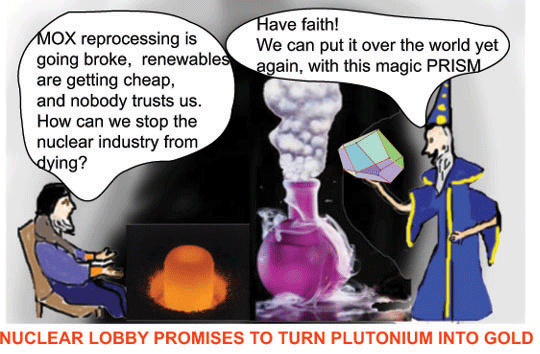
3. Liquid-metal fast reactors (PRISM)
It is claimed by proponents that fast reactors will be safe, economically competitive, proliferation-resistant, and sustainable.
They are fueled by plutonium or highly enriched uranium and cooled by either liquid sodium or a lead-bismuth molten coolant. Liquid sodium burns or explodes when exposed to air or water, and lead-bismuth is extremely corrosive, producing very volatile radioactive elements when irradiated.
Should a crack occur in the reactor complex, liquid sodium would escape, burning or exploding. Without coolant, the plutonium fuel could reach critical mass, triggering a massive nuclear explosion, scattering plutonium to the four winds. One millionth of a gram of plutonium induces cancer, and it lasts for 500,000 years. Extraordinarily, they claim that fast reactors will be so safe that they will require no emergency sirens, and that emergency planning zones can be decreased from 10 miles to 1,300 feet.
There are two types of fast reactors: a simple, plutonium-fueled reactor and a “breeder,” in which the plutonium-reactor core is surrounded by a blanket of uranium 238, which captures neutrons and converts to plutonium.
The plutonium fuel, obtained from spent reactor fuel, will be fissioned and converted to shorter-lived isotopes, cesium and strontium, which last 600 years instead of 500,000. The industry claims that this process, called “transmutation,” is an excellent way to get rid of plutonium waste. But this is fallacious, because only 10 percent fissions, leaving 90 percent of the plutonium for bomb making, etc.
Then there’s construction. Three small plutonium fast reactors will be grouped together to form a module, and three of these modules will be buried underground. All nine reactors will then be connected to a fully automated central control room operated by only three operators. Potentially, then, one operator could face a catastrophic situation triggered by loss of off-site power to one unit at full power, another shut down for refueling and one in startup mode. There are to be no emergency core cooling systems.
Fast reactors require a massive infrastructure, including a reprocessing plant to dissolve radioactive waste fuel rods in nitric acid, chemically removing the plutonium, and a fuel fabrication facility to create new fuel rods. A total of 15 to 25 tons of plutonium are required to operate a fuel cycle at a fast reactor, and just five pounds is fuel for a nuclear weapon.
Thus fast reactors and breeders will provide extraordinary long-term medical dangers and the perfect situation for nuclear-weapons proliferation. Despite this, the industry plans to market them to many countries.
Uranium exposure and skin cancer
 Study may help explain link between uranium exposure and skin cancer http://medicalxpress.com/news/2014-08-link-uranium-exposure-skin-cancer.html After years of delving deep into DNA and researching ways in which metal damage may lead to cancer, a team of researchers is taking a step back to look at the surface where one answer may have been all along. The varying health risks from exposure to natural uranium are well established, but Diane Stearns, professor of biochemistry at Northern Arizona University, and her team have been trying to determine if there is a link between uranium exposure and skin cancer, stating that skin may have been overlooked in the past.
In a recent article published in the Journal of Applied Toxicology, the NAU team shared results from a study that explored photoactivation of uranium as a means to increase its toxicity and ability to damage DNA.
“Our hypothesis is that if uranium is photoactivated by UV radiation it could be more harmful to skin than either exposure alone,” Stearns said.
Through the study, the team found that once uranium was present in the skin, exposure to UV radiation or sunlight could be chemically toxic and lead to cancerous lesions. The team members recommend that future risk assessments regarding cancer caused by uranium exposure include the possibility of photoactivation in skin.
They also propose that photoactivated uranium exposure could be even more harmful in cells that can’t repair the damage on their own. Stearns explained such cases are found in individuals with Xeroderma Pigmentosum or XP, a disease that causes extreme sensitivity to sunlight.
Through research into the XP cell lines, the team discovered regional relevance for the study. The disease is prevalent on the Navajo Nation, a site of historically high levels ofuranium mining and processing in the Southwest. The 2012 documentary Sun Kissed further piqued the researchers’ curiosity. The film cites the incidence of XP in the general population as one in 1 million, yet cases increase significantly to one in 30,000 in the Navajo population.
Stearns believes there may be implications that should be taken into consideration for a population like the Navajo community with carriers of XP mutations and relatively high exposure to uranium and the sun.
“We just want to make people aware that uranium exposure could contribute to skin cancer and could also be exacerbating XP,” Stearns said.
Stearns said as she looks to the future, she hopes to fine-tune her understanding of the photoactivation mechanism and how it is damaging DNA. “We have predicted the link but now we would like to study it step by step to establish an even stronger connection.”
Together with her Navajo students at NAU, she also hopes to determine whether the old uranium mines might explain the increase in cancer and what is being called a sudden emergence of XP on the Navajo Nation.
“I’ve had several Navajo students come to me because they found out I was doing uranium research and they had a relative who died of cancer and always wondered if it was uranium,” Stearns said. “It’s been a really personal way for them to see the value in scientific research because it can directly relate to their community.”
Massive, decaying, dangerous, weapons empire at Oak Ridge
Y-12: Poster child for a dysfunctional nuclear weapons complex Robert Alvarez, Bulletin of the Atomic Scientists 6 Aug 14 “……The United States halted production of new nuclear weapons in 1989, with the end of the Cold War. But the US nuclear weapons complex—composed of eight key facilities that have an annual budget exceeding $8 billion—has stumbled on, in the form of a massive, decaying empire that in many cases does its work poorly or dangerously, or both. The Y-12 National Security Complex is the poster child for much of what ails the weapons complex. Although Y-12 has not produced weapons for some 25 years, its annual budgets have increased by nearly 50 percent since 1997, to more than $1 billion a year.

For decades, the Energy Department—which manages the weapons complex through the National Nuclear Security Agency (NNSA)—has not been able to reconcile competing objectives at the 811-acre Y-12 site, whether they involve storage areas for HEU and other fissile materials, the restarting of old weapons facilities, environmental cleanup, the building of new weapons facilities, or the downsizing of the site. As a result, costs have significantly increased, and long-standing problems have continued, unresolved, for years that have run into decades. For every dollar spent to maintain and modernize the US nuclear weapons stockpile, nearly three dollars is spent “to provide the underlying infrastructure” for maintenance and modernization at Y-12.
Long-term secrecy and isolation have created a dangerous form of hoarding at Y-12; a panoply of severe hazards continues to build up, constantly awaiting ever more costly mitigation in the future. But the stark reality is that there are no more cans to kick down the road. Y-12 has inexorably caught up with its future. Its environmental and security problems are too threatening to leave unaddressed, and questions about its mission will have to be answered definitively in an age of budgetary austerity and relatively little need for new nuclear weapons…….
During its heyday, Y-12 produced some 1,000 CSAs per year. Now, its annual production capacity has dwindled to less than 100. Though the NNSA declares that Y-12 has multiple missions, including non-proliferation efforts that involve the downblending of HEU and the provision of fuel for the Navy’s nuclear-powered submarines, nearly 99 percent of its budget comes from funds dedicated to maintain the US nuclear weapons stockpile. More than anything, Y-12 serves to stockpile thousands of CSAs from discarded nuclear weapons, as well as depleted uranium, lithium, and other hazardous chemicals…….. the Government Accountability Office finds that “NNSA’s decision to retain many CSAs … poses significant challenges to Y-12’s ability to plan its disassembly workload.” Although exact numbers have been classified since the 1990s, there are likely several thousand excess CSAs, containing hundreds of tons of HEU, awaiting dismantlement at Y-12. ……
Around New Year’s Eve of 1996, a long-awaited vulnerability assessment of HEU storage at Energy Department sites was released. Y-12 had the most significant problems. Even though fires posed the greatest danger of radiation and chemical exposure to workers and the public, buildings, mostly constructed in the 1940’s, had deteriorated and had insufficient or non-existent fire-protection systems, despite the very real possibility of a truly catastrophic fire and resulting release of radiation. It wasn’t until 14 years later that a replacement facility for the aged wooden structure serving as the main HEU storage warehouse was opened; it cost five times the original construction estimate. That facility gained notoriety in August 2012, after nonviolent peace protestors, including an 84-year-old nun, penetrated its security barriers……..
From 1997 to 2006, there were 21 fires and explosions at Y-12 involving electrical equipment, glove boxes, pumps, waste containers, and nuclear and hazardous chemicals. Several resulted in worker injuries and destruction of property. ……….. In March 2014, a large portion of a concrete ceiling collapsedin a building that was once part of the weapons operation. It was a near miss: Foot-long concrete pieces bounced onto walkways and an area where welders had been working just a day before. …..
In April 2014, the NNSA released a “red team” report, led by the director of Oak Ridge National Laboratory, on the troubled UPF. The team’s most significant recommendation was to rethink a basic, “big-box” approach that would create a UPF to serve multiple functions in one structure. Instead, to hold the line at an estimated $6.5 billion for design and construction costs, the team recommended going back to the drawing board to effectively reduce the size and scope of the project. Meanwhile, in recognition of the growing hazards associated with a deteriorating infrastructure for storing “materials at risk,” the team recommended that greater emphasis should be given to safe consolidated storage of materials, deferred maintenance, and safety upgrading……….
Regardless of the wisdom of or need for an asteroid-protection program, the future of Y-12 should be focused on earthly realities: cleaning up the environment, decontamination and decommissioning of facilities, stabilizing nuclear and other hazardous materials, and the dismantlement of a large excess stockpile of weapons components. There is a very real need to replace the collapsing infrastructure at Y-12 with facilities that can accomplish these goals.
Protecting the planet from asteroids is a poor rationale for failing to deal with the environmental, safety, financial, and health challenges the Y-12 site poses to the people who live in the area, and to the country as a whole. http://thebulletin.org/y-12-poster-child-dysfunctional-nuclear-weapons-complex7361
The Future for Small Modular Nuclear Reactors s does not look promising
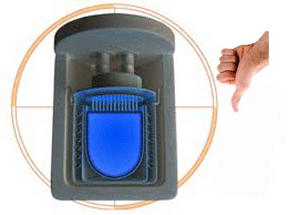 NuClear News August 14 “………The Future for SMRs does not look promising
Small Modular Nuclear Reactors in reality are far from safe
 nuClear News August 14, “…..Safety of SMRsdepend on convincing the US Nuclear Regulatory Commission to relax existing safety
Small Modular Nuclear Reactors the energy option that does not stack up economically
Economics of SMRs nuClear News, August 14 “……….Union of Concerned Scientist says just because these reactors are cheaper doesn’t mean to say they are cost effective.Conclusion on Nuclear Power – Not Economic Nor Safe
 The Truth About Nuclear Power – Part 30, Sowell’s Law Blog August 3, 2014
Subtitle: Conclusion on Nuclear Power Not Economic Nor Safe
This is the 30th and final chapter in the Truth About Nuclear Power series, (see links at end of article) at least for now. The TANP series was motivated by many conversations and digital exchanges via emails and online blogs over several years, in which most nuclear advocates advanced various statements about the advantages of nuclear power. Knowing that those statements were false, I answered many of the false statements.
For those who have read some of or the entire TANP series, this concluding article will serve as a review and provide (hopefully) further insight into the actual world of nuclear power. The article is in three parts: 1) the rosy claims of nuclear advocates, 2) questions raised by those rosy claims, and responses to the questions raised, and 3) an answer for why nations continue to build nuclear plants despite the serious and numerous disadvantages.
Part I of this article discusses nuclear advocates’ six primary claims, those being that nuclear power is 1) cheap, only 2 or 3 cents per kWh, 2) reliable, and 3) extremely safe; they insist that 4) the plants run for 60 years before needing replacement, and 5) cost only $2.5 to $4 billion per 1,000 MW plant. They also insist 6) the plants are built in only 4 years from groundbreaking to startup. None of that squares with what I know about nuclear plants.
Part II of this article addresses a series of questions about nuclear power, the answers to which led to many of the previous articles on TANP. The general form of the questions is, If what nuclear advocates say is really true, then Why (insert the question) is this also true? These questions are shown below:
1 Why has nuclear power achieved only 11 percent of world power production, after more than 5 decades of competition?
2 Why do small islands have zero nuclear power plants, but burn expensive oil or diesel resulting in power prices of 25 to 35 cents per kWh?
3 Why do nuclear utilities never, ever, ask for a rate decrease when they build a nuclear plant?
4 Why did France install nuclear plants to provide 85 percent of the country’s power, and no other country in the world followed their lead?
5 Why does France have higher electricity prices than does the US, even with France heavily subsidizing their electricity industry?
6 Why does nuclear power in the US require heavy subsidies from government – and almost total indemnity from costs of a massive radiation disaster?
7 Why are nuclear plants shutting down in the US, with owners saying they are losing money?
8 Why are there so many near-misses on meltdowns in US plants, every 3 weeks?
9 Why were there three serious meltdowns worldwide in just a bit more than 30 years? (Fukushima, Chernobyl, Three Mile Island)
10 Why are new reactor technologies being researched and developed?
Part III of this article poses, then answers, the additional question of Why do countries around the world continue to build nuclear power plants, in spite of all the obvious, documented, irrefutable disadvantages of nuclear power?
I Rosy Claims of Nuclear Advocates………
II A Series of Questions……….
………….Conclusion
Finally, it has been shown throughout the TANP series that nuclear power is not economic – many citations are documented. Nuclear power is not safe either – again many citations are documented. Despite this, many countries are building nuclear plants and plan to build even more. Their reasons to build nuclear may satisfy them, but it is very interesting to note why nuclear cannot compete in the US: the price of natural gas is too low. Many other countries, France included, also have vast resources of natural gas locked away in shale deposits that can be developed (as is the US) using directional drilling and hydraulic fracturing. Producing such gas reserves domestically would reduce the price of natural gas, perhaps far below the oil-based pricing currently prevailing.
As Germany reacted to the Fukushima disaster, declaring nuclear power a menace that will be shut down as soon as possible, other countries will very likely take the same decision. While not wishing any ill effects on anyone anywhere, only one more major disaster such as Fukushima meltdowns and radiation release, would tip the scales in balance of no more nuclear power. http://sowellslawblog.blogspot.com.au/2014/08/the-truth-about-nuclear-power-part-30.html
Safety problems in the idea for floating nuclear power reactors
 Floating Nuclear Power Plants Might Be the Future of Energy, VICE News, By Kayla RubleAugust 1, 2014 “…………Critics are concerned about some of the design aspects of this type of NPPs. Edwin Lyman, a senior global security scientist at Union of Concerned Scientists, told VICE News that a lot of what needs to be done to make these plants deployable is the opposite of what the industry needs to do to make their land-based facilities safer. He explained that having to build lighter reactors for use in the ocean and accessibility issues are concerns with the floating plants.
Discrimination against the victims of nuclear radiation
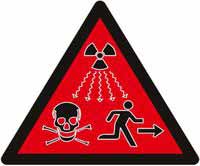 The Radiation That Makes People Invisible: A Global Hibakusha Perspective Robert Jacobs The Asia-Pacific Journal, Vol. 12, Issue 30, No. 1, August 3, 2014.
“…………Discrimination– People who may have been exposed to radiation often experience discrimination in their new homes and may become social pariahs. We first saw this dynamic with the hibakusha in Hiroshima and Nagasaki who found it very difficult to find marriage partners, since prospective spouses feared they would have malformed children, and found it difficult to find jobs since employers assumed that they would be chronically sick. Hibakusha children, moreover, often become the targets of bullying. It became very common to attempt to hide the fact that one’s family had been among those exposed to radiation.6
Many people are familiar with the story of Sadako who died at the age of twelve after being exposed to radiation from the nuclear attack on Hiroshima ten years earlier. Sasaki Sadako folded paper cranes in accordance with a Japanese tradition that someone who folds 1,000 paper cranes is granted a wish. Sadako’s story has become well known and children around the world fold paper cranes when they learn her story, many of which are sent to Hiroshima. While Sadako has become a symbol of the innocence of so many hibakusha, her father tried to hide this fact so that his family would not suffer discrimination and was upset that his daughter had become so famously afflicted.
Children whose families evacuated from Fukushima prefecture after the triple meltdowns at Tepco’s nuclear power plant frequently became victims of bullying at their new schools. Cars with Fukushima license plates were scratched when parked in other prefectures. Often this is the result of the natural fear of contamination that is associated with people exposed to a poison. In the Marshall Islands those who were evacuated from Rongelap and other atolls that became unlivable after being blanketed with radioactive fallout from the US Bravo test in 1954 have had to live as refugees on other atolls for several generations now, with no prospect of return home. The Marshall Islands have a very small amount of livable land and so being moved to atolls that traditionally belonged to others left them with no access to good soil and good locations for fishing and storing boats. They have had to live by the good graces of their new hosts, and endure being seen as interlopers.
Becoming medical subjects– Many people who have been exposed to radiation then become the subjects of medical studies, often with no information about the medical tests to which they are subjected, and frequently without provision of treatment by those conducting the tests. Hibakusha of the nuclear attacks on Hiroshima and Nagasaki became medical subjects of the Atomic Bomb Casualty Commission during the American occupation of Japan after World War Two. This study has continued to this day under the now jointly administered US-Japan Radiation Effects Research Foundation. In the early days of the study Japanese hibakusha had no choice about being subjected to the medical exams. An American military jeep would appear in front of their homes and they had to go in for an examination, whether it was a good time or not. Not only did they receive no information about the results of their tests but the US government provided no treatment.7 This has happened in many radiation-affected communities.
In 1966 a US nuclear bomber blew up in midair and the debris fell on the small village of Palomares, Spain. Four H-bombs fell from the plane, one into the sea, and three onto the small village. None exploded but two broke open and contaminated part of the town with plutonium and other radionuclides. To this day some of the residents of Palomares are taken to Madrid each year for a medical examination as the effects of exposure on their health is tracked. They have never been given any of the results of the tests nor informed if any illnesses they develop were related to their exposures. They are subjects, not participants in the gathering and assessing of the effects of radiation on their bodies. There is no doubt that such studies contribute data to scientific understanding of the health consequences of radiation exposures (the data itself is contentious for reasons cited below)8, however for those from whom the information is gathered, being studied but not informed reduces one’s sense of integrity and agency in one’s health maintenance. Many Pacific islanders exposed to radiation by the nuclear tests of the US, the UK and France had such experiences where they were examined and then sent off with no access to the results and no medical follow-up. Many report feeling as if the data had been harvested from them and at their expense.
Anxiety– Often those exposed to radiation are told that they have nothing to worry about. Their anxieties are belittled. Radiation is a very abstract and difficult thing to understand. It is imperceptible – tasteless, odorless, invisible – adding to uncertainty that people feel about whether they were exposed, how much they were exposed to, and whether they and their loved ones will suffer any health effects. The dismissal of their anxieties by medical and governmental authorities only compounds their anxiety. When other members of their community develop health problems, such as thyroid cancer and other illnesses years later it can cast a pall over their own sense of wellbeing for the rest of their lives.
Every time that they run a fever, every time that they experience stomach pains, nosebleeds, and other common ailments, this anxiety rears up and they think – this is it, it’s finally got me. These fears extend to their parents, their children and other loved ones. Every fever that a child runs triggers fears that one’s child will die. Sadako was healthy for nine years following her exposure to radiation when she was two years old in Hiroshima, then one day her neck suddenly began to swell and she was soon diagnosed with leukemia. This is the nightmare world that the parents of children exposed to radiation, or who even simply suspect radiation exposure, experience on a daily basis. Every ailment can rip them apart.
Radiophobia and blaming the victim– Since it is often the case that who is and isn’t exposed to dangerous levels of radiation, especially to internalized alpha emitting particles, is unknown, large numbers of people near a radiological incident of some kind worry about their health and the health of loved ones. Among this group, some have been exposed and some have not. The uncertainty is part of the trauma. Often, as is currently the case for the people of FukushimaNorthern Japan, all of these people are dismissed as having undue fear of radiation, and are often told that their health problems are simply the result of their own anxieties. In some cases that may be true, but it is beside the point.
For those who have experienced a nuclear catastrophe, who may have been removed from their homes and communities and lost those bonds and support systems, who are uncertain as to whether each flu or stomach ache is the harbinger of the end, and who cannot be certain that contamination from hard to find alpha emitting particles is still possible when their children play in the park, anxiety is the natural response. Regardless of whether it causes acute health problems, forces outside of their control have upended their lives. They now must live a life of uncertainty and often experience discrimination. Of course they are going to suffer from the anxiety that this situation produces. To blame them for this is to blame the victims and is a further form of traumatization.9……….http://japanfocus.org/-Robert-Jacobs/4157
Liquid Fluoride Thorium Reactor (LFTR) simply too dangerous -that’s why it was stopped
 Perhaps these technical problems can be overcome, but why would anyone bother to try, knowing in advance that the MSR plant will be uneconomic due to huge construction costs and operating costs, plus will explode and rain radioactive molten salt when (not if) the steam generator tubes leak. There are serious reasons the US has not pursued development of the thorium MSR process.
Reports are, though, that China has started a development program for thorium MSR, using technical information and assistance from ORNL. One hopes that stout umbrellas can be issued to the Chinese population that will withstand the raining down of molten, radioactive fluoride salt when one of the reactors explodes.
The Truth About Nuclear Power – Part 28 Subtitle: Thorium MSR No Better Than Uranium Process, Sowell’s law blog July 20, 2014
The irradiated community – Losses of homes, community and identity
The Radiation That Makes People Invisible: A Global Hibakusha Perspective Robert Jacobs The Asia-Pacific Journal, Vol. 12, Issue 30, No. 1, August 3, 2014.
“…………Losses of homes, community and identity–Areas that experience radioactive contamination often have to be abandoned by those who live there. The levels of radiation may be so high that continued habitation could be dangerous to health. In these cases people lose their homes, often permanently.
For communities that have to be abandoned, the bonds that have been built up and that sustain the wellbeing of the community disintegrate. Friends are separated, extended families are often separated, and schools are closed. People who have lived in the same place all of their lives have to make a fresh start, sometimes in old age, sometimes as children. The communal structures that sustained them are destroyed: shopkeepers who know them, neighbors who can be relied on, the simple familiarity of communities. What is lost when a person is no longer able to eat an apple from a tree planted by a parent or grandparent? Tony Hood, a former uranium miner from Gallup, New Mexico, spoke of the sense of loss when contemplating the necessity for his Navajo community to abandon their homes because of uranium contamination, “Our umbilical cords are buried here, our children’s umbilical cords are buried here. It’s like a homing device.”2
With the loss of community, many people lose their livelihood. This is especially true in places where many have been farmers, fishers or herders for generations. When someone who has only known farming is taken from the land they have tended, when fishers can no longer fish in areas where they understand the natural rhythms and habits of the fish, it can be impossible to start over. Often such people are forced to enter service positions or become dependent on state subsidies, further eroding their sense of self and wellbeing. Usually, those removed from their land because of contamination are placed into temporary housing. In Fukushima this has been the case for 100,000 who remain in temporary housing while hundreds of thousands of others who are not housed by the government have fled the area.3 In almost all cases the public housing provided to officially recognized victims proves not to be temporary, but becomes permanent.
Frequently, multigenerational families that have been living together for decades, find it impossible to remain together. This can remove care for the elderly, childcare for young families and further erodes the continuity of family identity, knowledge and support. Removal from land also is accompanied by the loss of a traditional diet. Those without access to the land and seas that have provided food for their families often begin a journey of dislocation and ill health. In some communities such as the small villages around the former Soviet nuclear test site in Kazakhstan, many people simply continue to live in dangerously contaminated homes. The state responsible for their exposures (the Soviet Union) no longer exists and neither the Russian nor Kazakh governments feel the responsibility to evacuate them or to provide health care for those with disabilities. Many live very traditional lives deriving most of their food from their own gardens and from livestock raised on their contaminated land. Many long-lived radionuclides simply cycle through this ecosystem and residents can be contaminated and recontaminated over generations.4
In Fukushima Prefecture the Japanese government proclaimed a 20km mandatory evacuation zone, while also designating a “suggested” evacuation zone from 20km to 30km. These zones do not directly reflect the dangers from radiation levels. In some of the mandatory evacuation areas the gamma levels are below those in parts of the suggested evacuation areas. Some areas where the plumes came down 50-80km away have even higher levels. The limits to mandatory evacuation areas reflect efforts to limit the direct liability of the government. Even today children live in areas where the radiation levels are too high for them to be allowed to play or spend significant time outdoors.5 http://japanfocus.org/-Robert-Jacobs/4157
Loss of traditional knowledge– In some remote places survival is dependent on centuries old understandings of the land. In Maralinga, Australia the areas where the British conducted nuclear tests between 1956 and 1963 are very difficult places to live. Traditional communities in these areas often have songs that hold and transmit essential knowledge about how to survive in such a harsh environment, such as where to find water, when to hunt specific animals, when to move to various locations. But can knowledge gathered over millennia be effectively applied to radiation disasters?
When the British relocated entire communities to areas hundreds of kilometers from their homes, the local knowledge chain was broken. It became impossible for the refugees to sustain a traditional life in areas where they had no knowledge of the rhythms of the land and animals. This removal from their lands led to ever increasing dependence on governmental assistance and severed what had been millennia of self-reliance. While self-reliance had been dramatically impacted by the brutal rule of the Australian government and its policies towards aboriginal peoples, the people living near the test site were still living on the land in the 1950s. Relocation led to the further erosion of community, familial and personal wellbeing………http://japanfocus.org/-Robert-Jacobs/4157
1 This Month



26 September – International Day for the Total Elimination of Nuclear Weapons


PLEASE OPPOSE HR 8255 AND S.3639 – bills would accelerate satellite deployment, with no environmental review or safeguards – https://ncstd5li.quorum.us/campaign/169331/
To see nuclear-related stories in greater depth and intensity – go to https://nuclearinformation.wordpress.com
-
Archives
- September 2026 (245)
- August 2026 (330)
- July 2026 (355)
- June 2026 (287)
- May 2026 (306)
- April 2026 (356)
- March 2026 (251)
- February 2026 (267)
- January 2026 (308)
- December 2025 (358)
- November 2025 (359)
- October 2025 (375)
-
Categories
- 1
- 1 NUCLEAR ISSUES
- business and costs
- climate change
- culture and arts
- ENERGY
- environment
- health
- history
- indigenous issues
- Legal
- marketing of nuclear
- media
- opposition to nuclear
- PERSONAL STORIES
- politics
- politics international
- Religion and ethics
- safety
- secrets,lies and civil liberties
- spinbuster
- technology
- Uranium
- wastes
- weapons and war
- Women
- 2 WORLD
- ACTION
- AFRICA
- Atrocities
- AUSTRALIA
- Christina's notes
- Christina's themes
- culture and arts
- Events
- Fuk 2022
- Fuk 2023
- Fukushima 2017
- Fukushima 2018
- fukushima 2019
- Fukushima 2020
- Fukushima 2021
- general
- global warming
- Humour (God we need it)
- Nuclear
- RARE EARTHS
- Reference
- resources – print
- Resources -audiovicual
- Weekly Newsletter
- World
- World Nuclear
- YouTube
-
RSS
Entries RSS
Comments RSS
 nuclear-news