Japan’s secret nuclear weapons program, helped by USA
Japan had a dual use nuclear program. The public program was to develop and provide unlimited energy for the country. But there was also a secret component, an undeclared nuclear weapons program that would allow Japan to amass enough nuclear material and technology to become a major nuclear power on short notice.
That secret effort was hidden in a nuclear power program that by March 11, 2011– the day the earthquake and tsunami overwhelmed the Fukushima Daiichi Nuclear Plant – had amassed 70 metric tons of plutonium. Like its use of civilian nuclear power to hide a secret bomb program, Japan used peaceful space exploration as a cover for developing sophisticated nuclear weapons delivery systems.


 US circumvented laws to help Japan accumulate tons of plutonium From National Security News Service By Joseph Trento, April 9th, 2012
The United States deliberately allowed Japan access to the United States’ most secret nuclear weapons facilities while it transferred tens of billions of dollars worth of American tax paid research that has allowed Japan to amass 70 tons of weapons grade plutonium since the 1980s, a National Security News Service investigation reveals. These activities repeatedly violated U.S. laws regarding controls of sensitive nuclear materials that could be diverted to weapons programs in Japan. The NSNS investigation found that the United States has known about a secret nuclear weapons program in Japan since the 1960s, according to CIA reports. Continue reading
Massively rich Koch brothers buy America’s political system
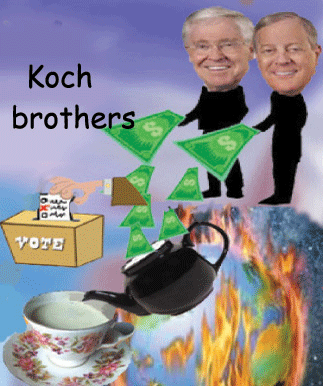 Together, Charles and David Koch control one of the world’s largest fortunes, which they are using to buy up our political system. But what they don’t want you to know is how they made all that money
For Koch, this license to pollute amounts to a perverse, hidden subsidy. The cost is borne by communities in cities like Port Arthur, Texas, where a Koch-owned facility produces as much as 2 billion pounds of petrochemicals every year. In March, Koch signed a consent decree with the Department of Justice requiring it to spend more than $40 million to bring this plant into compliance with the Clean Air Act.
The toxic history of Koch Industries is not limited to physical pollution. It also extends to the company’s business practices, which have been the target of numerous federal investigations, resulting in several indictments and convictions, as well as a whole host of fines and penalties.
And in one of the great ironies of the Obama years, the president’s financial-regulatory reform seems to benefit Koch Industries. The company is expanding its high-flying trading empire precisely as Wall Street banks – facing tough new restrictions, which Koch has largely escaped – are backing away from commodities speculation.
It is often said that the Koch brothers are in the oil business. That’s true as far as it goes – but Koch Industries is not a major oil producer. Instead, the company has woven itself into every nook of the vast industrial web that transforms raw fossil fuels into usable goods. Koch-owned businesses trade, transport, refine and process fossil fuels, moving them across the world and up the value chain until they become things we forgot began with hydrocarbons: fertilizers, Lycra, the innards of our smartphones.
The company controls at least four oil refineries, six ethanol plants, a natural-gas-fired power plant and 4,000 miles of pipeline. Until recently, Koch refined roughly five percent of the oil burned in America (that percentage is down after it shuttered its 85,000-barrel-per-day refinery in North Pole, Alaska, owing, in part, to the discovery that a toxic solvent had leaked from the facility, fouling the town’s groundwater). From the fossil fuels it refines, Koch also produces billions of pounds of petrochemicals, which, in turn, become the feedstock for other Koch businesses. In a journey across Koch Industries, what enters as a barrel of West Texas Intermediate can exit as a Stainmaster carpet.
Koch’s hunger for growth is insatiable: Since 1960, the company brags, the value of Koch Industries has grown 4,200-fold, outpacing the Standard & Poor’s index by nearly 30 times. On average, Koch projects to double its revenue every six years. Koch is now a key player in the fracking boom that’s vaulting the United States past Saudi Arabia as the world’s top oil producer, even as it’s endangering America’s groundwater. In 2012, a Koch subsidiary opened a pipeline capable of carrying 250,000 barrels a day of fracked crude from South Texas to Corpus Christi, where the company owns a refinery complex, and it has announced plans to further expand its Texas pipeline operations. In a recent acquisition, Koch bought Frac-Chem, a top provider of hydraulic fracturing chemicals to drillers. Thanks to the Bush administration’s anti-regulatory agenda – which Koch Industries helped craft – Frac-Chem’s chemical cocktails, injected deep under the nation’s aquifers, are almost entirely exempt from the Safe Drinking Water Act.
Koch is also long on the richest – but also the dirtiest and most carbon-polluting – oil deposits in North America: the tar sands of Alberta. The company’s Pine Bend refinery, near St. Paul, Minnesota, processes nearly a quarter of the Canadian bitumen exported to the United States – which, in turn, has created for Koch Industries a lucrative sideline in petcoke exports. Denser, dirtier and cheaper than coal, petcoke is the dregs of tar-sands refining. U.S. coal plants are largely forbidden from burning petcoke, but it can be profitably shipped to countries with lax pollution laws like Mexico and China. One of the firm’s subsidiaries, Koch Carbon, is expanding its Chicago terminal operations to receive up to 11 million tons of petcoke for global export. In June, the EPA noted the facility had violated the Clean Air Act with petcoke particulates that endanger the health of South Side residents. “We dispute that the two elevated readings” behind the EPA notice of violation “are violations of anything,” Koch’s top lawyer, Mark Holden, told Rolling Stone, insisting that Koch Carbon is a good neighbor.
Over the past dozen years, the company has quietly acquired leases for 1.1 million acres of Alberta oil fields, an area larger than Rhode Island. By some estimates, Koch’s direct holdings nearly double ExxonMobil’s and nearly triple Shell’s. In May, Koch Oil Sands Operating LLC of Calgary, Alberta, sought permits to embark on a multi-billiondollar tar-sands-extraction operation. This one site is projected to produce 22 million barrels a year – more than a full day’s supply of U.S. oil………
The Koch family’s lucrative blend of pollution, speculation, law-bending and self-righteousness stretches back to the early 20th century, when Charles’ father first entered the oil business. ……….
in the real world, Koch Industries has used its political might to beat back the very market-based mechanisms – including a cap-and-trade market for carbon pollution – needed to create the ownership rights for pollution that Charles says would improve the functioning of capitalism.
In fact, it appears the very essence of the Koch business model is to exploit breakdowns in the free market. Koch has profited precisely by dumping billions of pounds of pollutants into our waters and skies – essentially for free. It racks up enormous profits from speculative trades lacking economic value that drive up costs for consumers and create risks for our economy.
The Koch brothers get richer as the costs of what Koch destroys are foisted on the rest of us – in the form of ill health, foul water and a climate crisis that threatens life as we know it on this planet. Now nearing 80 – owning a large chunk of the Alberta tar sands and using his billions to transform the modern Republican Party into a protection racket for Koch Industries’ profits – Charles Koch is not about to see the light. Nor does the CEO of one of America’s most toxic firms have any notion of slowing down. He has made it clear that he has no retirement plans: “I’m going to ride my bicycle till I fall off.”
Obama lifts permissable levels of radiation in drinking water!
 Obama Approves Raising Permissible Levels of Nuclear Radiation in Drinking Water. Civilian Cancer Deaths Expected to Skyrocket http://www.globalresearch.ca/obama-approves-raising-permissible-levels-of-nuclear-radiation-in-drinking-water-civilian-cancer-deaths-expected-to-skyrocket/5331224
Rollback in Nuclear Radiation Cleanup By Global Research News, September 19, 2014 by Public Employees for Environmental Responsibility (PEER)
The White House has given final approval for dramatically raising permissible radioactive levels in drinking water and soil following “radiological incidents,” such as nuclear power-plant accidents and dirty bombs. The final version, slated for Federal Register publication as soon as today, is a win for the nuclear industry which seeks what its proponents call a “new normal” for radiation exposure among the U.S population, according Public Employees for Environmental Responsibility (PEER).
Issued by the Environmental Protection Agency, the radiation guides (called Protective Action Guides or PAGs) allow cleanup many times more lax than anything EPA has ever before accepted. These guides govern evacuations, shelter-in-place orders, food restrictions and other actions following a wide range of “radiological emergencies.” The Obama administration blocked a version of these PAGs from going into effect during its first days in office. The version given approval late last Friday is substantially similar to those proposed under Bush but duck some of the most controversial aspects:
In soil, the PAGs allow long-term public exposure to radiation in amounts as high as 2,000 millirems. This would, in effect, increase a longstanding 1 in 10,000 person cancer rate to a rate of 1 in 23 persons exposed over a 30-year period;
- In water, the PAGs punt on an exact new standard and EPA “continues to seek input on this.” But the thrust of the PAGs is to give on-site authorities much greater “flexibility” in setting aside established limits; and
- Resolves an internal fight inside EPA between nuclear versus public health specialists in favor of the former. The PAGs are the product of Gina McCarthy, the assistant administrator for air and radiation whose nomination to serve as EPA Administrator is taken up this week by the Senate.
- Despite the years-long internal fight, this is the first public official display of these guides. This takes place as Japan grapples with these same issues in the two years following its Fukushima nuclear disaster.
-
“This is a public health policy only Dr. Strangelove could embrace. If this typifies the environmental leadership we can expect from Ms. McCarthy, then EPA is in for a long, dirty slog,” stated PEER Executive Director Jeff Ruch, noting that the EPA package lacks a cogent rationale, is largely impenetrable and hinges on a series of euphemistic “weasel words.”
“No compelling justification is offered for increasing the cancer deaths of Americans innocently exposed to corporate miscalculations several hundred-fold.”
Reportedly, the PAGs had been approved last fall but their publication was held until after the presidential election. The rationale for timing their release right before McCarthy’s confirmation hearing is unclear.
Since the PAGs guide agency decision-making and do not formally set standards or repeal statutory requirements, such as the Safe Drinking Water Act and Superfund, they will go into full effect following a short public comment period. Nonetheless, the PAGs will likely determine what actions take place on the ground in the days, weeks, months and, in some cases, years following a radiological emergency.
The cargo Cult mentality of pro Thorium Nuclear Power Trolls
 Cargo cult….let’s see…unwillingness to accept criticism (tick), form into a clearly defined group (tick), hostility to outsiders (tick), paranoia (tick), assumption that authorities can’t be trusted or are somehow wrong/misinformed (tick), lengthy and committal indoctrination procedures (such as watching preposterously long you-tube videos…tick!), heavy focus on recruitment (tick), promise of some massive pay off at some ill-defined (and easily deferred) future date (tick)….do I need to go on?
Thorium Trolls Hypnotise Environmentalists by D. A. Ryan It is interesting how Thorium trolls always complain about ad-hominem comments when such personal attacks are the preferred tactic of Liquid Fluoride Thorium Reactor (LFTR) fans in responding to critics, is the pot calling the kettle black? And why is it you always run up huge blog strings attacking opponents? The (lftr)lady doth protest too much me thinks!
The vast majority of people contributing to LFTR research on these forums are merely cool-aid drinking bloggers, few have any relevant qualifications, nor experience. Even you’re deity Kirk lacks a PhD or indeed any relevant qualification in Nuclear physics. You cannot design a reactor over the internet, nobody will ever give them serious funding, licensing authorities will never sign off on anything and indeed you’re very tactics of trolling any attempt at a critique is precisely the sort of stuff to send sponsors running for the exit.
There are indeed some “real” scientist working on LFTR’s and Thorium research in general (oh! and btw Seaborg’s and Weinberg have been dead for over a decade! Material science has moved on significantly since then, check out chapter 3 of my post below). As an academic, I have access to the scientific literature, and the odd MSR related paper pops up from time to time (indicating that somebody somewhere is doing serious research on the topic…Kirk’s name’s never come up mind!), but the message from all of them is nowhere near as rosy as what you see on these blogs. I am reliably informed by people in the know (those being nuclear scientists with decades of experience in the field) that it would take many decades to get LFTR’s working and given the current level of research at present (concept stage), they cannot be sure that some hard and fast showstopper won’t emerge to kill the idea off in future. While I don’t identify any definite showstoppers in my post, I do note several potential directions from which one could appear.
http://daryanenergyblog.wordpress.com/ca/part-8-msr-lftr/
http://daryanenergyblog.wordpress.com/ca/
Like I said, its a blue sky idea that simply may not work, more research (in labs mind!) is needed to answer the many technical questions. Powerpoint and photoshopped images aren’t much use. Hence why I favour focusing on renewable technology which already exists and is cheaper than nuclear energy also.
http://daryanenergyblog.wordpress.com/2011/04/02/myth-iv-nuclear-power-is-cheaper-than-any-of-the-alternatives/
– $3 billion in funding in SA, got a reference for that? Last I heard the South Africans cancelled all such research and decided to focus on conventional LWR’s.
– The Chinese? They are raiding every bit of science worldwide that’s not bolted to the floor, so hardly a surprise. They are also trying out every possible idea they can. Why? because they are playing catch up with the west. If the idea works, in 30 years time they may have an alternative to western LWR’s (tho if you read my post you’ll see it will likely be a completely different beast to what LFTR bloggers are proposing). If not? well they get a couple of well trained post-graduates out of it and experience working with MS technology (useful for concentrated solar power tech!). Also, the bulk of Chinese thorium research is focused on existing gas cooled reactors, not LFTR’s, that’s more of a side show. Indeed as I recall from Zhang etal (2006) the Chinese HTR-PM (Gas cooled, not a MSR) will initially run on Uranium, tho backward compatibility with Thorium will be engineered into the design.
– My question tho, why is nobody in the Dept of energy worried about all this? Occum’s razor would say its likely because they know something the Chinese don’t (that they’re wasting their time!).
– If the MSR is such a great idea why did it only get 3 provisional’s, 1 observer and no signatories in the 2009 Gen IV report?
Cargo cult….let’s see…unwillingness to accept criticism (tick), form into a clearly defined group (tick), hostility to outsiders (tick), paranoia (tick), assumption that authorities can’t be trusted or are somehow wrong/misinformed (tick), lengthy and committal indoctrination procedures (such as watching preposterously long you-tube videos…tick!), heavy focus on recruitment (tick), promise of some massive pay off at some ill-defined (and easily deferred) future date (tick)….do I need to go on? http://www.joabbess.com/2011/10/26/thorium-trolls-hypnotise-environmentalists/#comment-107302
Kirk Sorenson – the Master of pro Thorium Spinology
Thorium Trolls Hypnotise Environmentalists http://www.joabbess.com/2011/10/26/thorium-trolls-hypnotise-environmentalists/#comment-107302 October 26th, 2011 Kirk Sorensen is apparently a one-man propaganda machine. His personal energy must be immense. He keeps turning up everywhere.
Never since the days of Tesla versus Edison has there been such an energy-related public communications coup.
He is a social media god. He has to be – he’s running an enterprise start-up marketing an unproven energy process.It appears that Bryony Worthington has been scooped up. But then she backed carbon offsetting andCarbon Capture and Storage. Can we ask if her judgment has improved lately ? And Friends of the Earthhave been hypnotised. Or maybe not. George Monbiot was taken in a while back.
From now on, I can predict British environmentalists from every sector of society to call for the development of the Thorium Fuel Cycle – although I think it’s a waste of time and resources, and in my view cannot be scaled up quickly enough to be of any use in dealing with the global energy crisis.
All we have so far is a massive, well-researched sales pitch. And Kirk Sorensen’s done his homework on networking the institutions. In fact, I think that’s all he’s capable of – talk. I sense he is a Master of Spinology.
Miracle energy sources are a never-ending source of humour and despair. Remember cold fusion ? Where’s that now ? Still in a test tube ? Burning seawater ? Are you serious ? Remember Carbon Capture and Storage ? Where’s that now – after all the hype ? And what about algae biodiesel ? Will theflow rates of output fuel ever be high enough ?
The Thorium Fuel Cycle is not all it’s cracked up to be.
The simplest solutions are the best. Ones that already exist and already work. We need to stop hoping for the future and live in the now. We already have all the technology we need to solve climate change and the energy crisis – gas and power. Renewable electricity. And renewable gas.
Environmental causes of cancer: dispelling the “inheritance myth”

 The Inheritance Myth Time to Talk Frankly About Cancer CounterPunch, by KRISTINE MATTIS SEPTEMBER 17, 2014 In a September 2014 article in the Journal of the American Medical Association, Dr. Mary-Claire King – the woman who first discovered the so-called breast cancer gene BRCA1 – and her colleagues suggested that all women should undergo routine medical screening for this gene as well as BRCA2. Of course, it seems reasonable that women should know if they carry these mutant allele forms of these genes, because the mutant genes confer a greater risk for breast cancer and ovarian cancer in women who have the mutants than in women who do not.
There has been some discussion about Dr. King’s proposal in newspapers and on the radio, but the dialogue inevitably has two tremendous pieces of the cancer puzzle missing: cause and prevention. In fact, too much cancer information tends to be myopic, neglecting to mention essential elements of the global portrait of cancer etiology. Conventional wisdom about cancer tends to end up promulgating misinformation and misinterpretations, not sound science. Dr. King’s piece, as well the highly publicized bi-annual Stand Up to Cancer celebrity charity telethon, which raises money for cancer treatment, have done nothing to provide more clear information to the public that could help avert this all-too-common but potentially highly preventable scourge that has caused suffering upon and taken the lives of so many of our friends and family.
First and foremost, it is important to emphasize that cancer is NOT heritable. Actor Piece Brosnan proclaimed on the aforementioned telethon that cancer was a “wretched inherited disease.” It certainly is wretched, but is not inherited nor is it really a single disease……..
the BRCA1 and BRCA2 mutant genes do not cause cancer; they merely make it more difficult for your cells to repair damage done to your DNA. When your cells are exposed to a cancer-causing agent (i.e., a carcinogen) such as ionizing radiation, certain natural and synthetic compounds, certain viruses, and some endocrine disrupting chemicals, to name a few, they have mechanisms to repair the damage that agent may cause to your DNA. But if the damage is too severe or widespread, or if the cell lacks that mechanism for repair, as in the case of those who have the “breast-cancer genes,” your risk of contracting cancer is increased.
It is basic scientific knowledge that cancer is not inheritable, but in light of the discovery of various genes that confer increased susceptibility to cancer, this fact is not always well understood by the population at large. Only 5-10% of people who contract any type of cancer have any sort of inherited genetic susceptibility. Therefore, the focus on inherited mutant alleles leaves out the majority 90-95% of people suffering from cancer. While it is true that the minority 5-10% who do have these mutant alleles have a much greater risk for disease than the rest of us, they do not have an inherent “predisposition” to cancer. Labeling these genes as “cancer genes” or even “genetic predispositions” is a terrible misnomer. These genes increase susceptibility to cancer when exposed to cancer causing agents……….
More and more we are learning that many of the over 80,000 synthetic chemicals that humans have constructed over the course of the last century or so not only directly cause DNA mutations that lead to cancer, but mimic estrogen in our bodies, which indirectly lead to cancer. These chemicals are in food we eat, the air we breathe, the water we drink, and the endless industrial products we produce and consume. They are quite often the products and processes of industry, and are not essential to maintain a comfortable life on this planet. In addition, the radiation we receive from sources such as diagnostic exams via x-ray, CT scan, and other radiologic medical procedures are being shown to contribute to excess cancers. For example, the UK Committee on Medical Aspects of Radiation in the Environment recently stated that one out of 2000 people will contract cancer due to abdominal CT scans – otherwise known as an iatrogenic cancer. This may seem a fairly small risk, unless you are that one person who has had an unnecessary CT scan and then is diagnosed with a preventable cancer because of it……
for some reason, this plain and simple fact that exposure to carcinogens can and does lead to cancer is always absent in the medical discussion of cancer. Part of the reason may be that medical practitioners are rarely, if ever, versed in environmental health, so they are not even educated about environmental toxicology and the myriad diseases caused by environmental exposures. But part of the reason is likely political and economic. Real biological causes of cancer seem to be verboten because scientists and scholars who speak these truths are condemned, defamed, and discredited by the powerful industrial public relations machine, which has multi-billions of dollars worth of revenue to protect, as it maintains the businesses and industries that introduce so many of the carcinogenic products in our world.
Another important clarification in discussing cancer is that diagnosis does not equal prevention. In an Orwellian twist of double-speak, health care professionals have delineated different forms of “prevention” and have decided that the diagnosis and screening for cancer is what they deem “secondary prevention.” In truth, diagnosis is not prevention at all and should not be termed as such. …….
When discussing cancer, the lack of conversation about our ubiquitous exposures to carcinogens is highly negligent. ……http://www.counterpunch.org/2014/09/17/time-to-talk-frankly-about-cancer/
Depleted uranium munitions threaten anyone near to them for a long period

Radiation Being Emitted by Consolidated Quantities of Concentrated “Depleted” Uranium Ammunition Not Yet Used in Battle Affects:
1. Workers in ammunition manufacturing facilities, military and civilian.
2. Truck drivers, both military and civilian who transport these munitions.
3. Anyone else military or civilian who must spend long hours in close proximity of
stockpiled concentrated “depleted” uranium ammunition.
4. Workers, military and civilian engaged in demilitarization of DU munitions.
A few examples of those who are likely to be at high risk are: anyone who sat on ammo boxes for long periods of time; pilots of A-10 Thunderbolt Warthogs and Apache Helicopters, as they sat right over their payloads of 30mm concentrated DU munitions while on sorties.
DU – You Don’t Have To Inhale Or Ingest It For It To Make You Sick, Veterans Today, by Elaine A. Hunter Concentrated “Depleted” Uranium Munitions Emit: Alpha + Beta + Gamma rays + Neutrons + X-rays, Can Wreak Havoc in the Human Body While Waiting to be Used in Battle!
From Multiple Horses’ Mouths: More, Much More on Ignored and Suppressed US Government and Military Data that Show the Threat of Harmful Effects of “Consolidated Quantities” of Concentrated “Depleted” Uranium (DU) Munitions
Heads up people concerned about the harmful effects of concentrated “depleted” uranium munitions, this is very important. This article is not an easy read. If you or anyone you know and love has been around “consolidated quantities” of concentrated “depleted” uranium (DU) munitions please read it anyway. They are a threat to the health of workers, military and civilian, national and international while they are in fabrication, transit or just sitting around waiting to be used in battle. The concentrated DU in munitions is not inert; it does not suddenly become radioactive only when it is fired in battle.
When I plugged in to what is broadcast on the internet, I was mystified that all the concern was about DU inhaled, ingested or embedded as fragments. Those aspects ARE important, without a doubt, and the most obvious. Yet unless the rest of the story is made known, the rest of the causes of illnesses and deaths of those exposed to concentrated DU will continue to be ignored. The rest of the story is this: it is not necessary for the munitions to be used in combat for them to make a person sick, even sick unto death…….. Continue reading
An insight onto the nuclear industry’s manipulations to shift their cost burdens
 Vendors adapt to financing role World Nuclear News, 5 September 2014 Nuclear power reactor vendors have been forced to adapt to the fact that governments are no longer willing to assume the financial risks associated with nuclear new build projects, Jerry Hopwood, vice president of product development at Candu Energy, said on 12 September….
Private sector models are difficult to execute for nuclear projects due to first-of-a-kind issues, their large capital requirement, long construction timescales and investor return expectations. But they can work within a positive framework of incentives – for example the UK’s contract for difference model, he said..
Several emerging markets are still developing state-owned models, but are incorporating mechanisms where risks are placed with the appropriate parties, such as nuclear initial public offerings and build-own-operate-transfer.
“Public-private partnership seems to be where the sector is going,” he said.
Public-private partnerships
This combination means a project is financed by both the government and a private investor, with the public share able to attract export credit. Such a model requires a power purchase agreement matched to debt obligations and the project risks are allocated between government agencies and private companies.
Regulatory and technology risks are “two separate sides to the same coin,” he said. Other risks include engineering, supply and project management; technical services; skilled labour and availability and rates; training and commissioning, and lifetime operational support.
Government sponsored financial incentives encourage private sector companies to take increased financial responsibility for nuclear new build projects.
These include contracts for difference and power purchase agreements, loan guarantees, export credits, carbon credits, and cost and schedule overruns.
“Vendors play a critical role in the success of the public-private partnership model by focusing on key areas, which are project risk reduction and regulatory feedback. No matter how the risks are allocated, if they are too high, you won’t get the financing,” he said…….
Collaboration
“Working closely with regulators, vendors can ensure that reactor designs meet safety and environmental standards before project deployment,” he said. “A vendor pre-project design review of a new nuclear power plant allows the regulatory body an opportunity to assess a design prior to any licensing activities and to identify potential issues that would require resolution.”
Further co-ordination between regulators, either bilaterally or through multi-lateral forums, such as MDEP [Multinational Design Evaluation Program], can help to harmonize views and mitigate risks. In that way a design qualified in the home country can be used elsewhere. We need regulatory cooperation across the world,” he said.
The success of future new build projects is “imperative” to ensure the long-term sustainability and growth of the industry, he said. “Failure is not an option.“……
Vendor-led financing is not sustainable in the long term, Hopwood said.
“I think it’s a sort of kick starting mechanism, a way to get projects going so that we start to have a track record,” he told World Nuclear News. “Whether it be in a big way or a small way, it’s showing vendor commitment and it’s getting some projects on the books and going and creating a track record and that’s the value of it and necessarily it must lead to more.”
“If we picture a world with many nuclear projects going ahead – there are 71 nuclear units under construction at the moment – the financing requirement is far more than any vendor or even any individual utility can finance, so financing has to come from aggregating from many sectors in order to have a flourishing nuclear industry. The demand for money is going to be so great that it will necessarily require us to seek out all sorts of funding, all kinds of capital formations,” he said. http://www.world-nuclear-news.org/NN-Vendors-adapt-to-financing-role-1509201401.html
At last – thorough research into cancers caused by world’s first atomic-bomb test
a sadness that still hangs over Tularosa.
“Whole families have died here,”
Decades After Nuclear Test, U.S. Studies Cancer Fallout http://online.wsj.com/articles/decades-after-nuclear-test-u-s-studies-cancer-fallout-1410802085
Examination Will Probe Radiation Exposure Near 1945 Trinity Blast in New MexicoBy
DAN FROSCH Write to Dan Frosch at dan.frosch@wsj.com Sept. 15, 2014 TULAROSA, N.M.—Nearly 70 years after the U.S. conducted the world’s first atomic-bomb test here in the New Mexico desert, federal researchers are slated to visit the state this month to begin studying whether some residents developed cancer due to the blast.
As part of the long anticipated project, scheduled to start Sept. 25, investigators with the National Cancer Institute will interview people who lived in the state around the time of the 1945 Trinity test and assess the effects of consuming food, milk and water that may have been contaminated by the explosion.
For years, residents of the rural, heavily Hispanic villages near the test site have claimed that a mysterious wave of cancer has swept through this dusty stretch of south-central New Mexico, decimating families and prompting calls for the government to determine whether radiation exposure played a role. Continue reading
Uncompetitive nuclear industry is rigging regulations and “spinning” media in order to survive
Killing the Competition
Exelon and Entergy see sustainable energy solutions—renewable energy, efficiency, conservation, etc.—as a long-term threat to
their profits. This is not because of excessive regulations or safety requirements on nuclear power: the industry has not had to implement a single safety upgrade due to the Fukushima meltdowns and faces less regulatory enforcement than it did twenty years ago. The closure of a record number of reactors since 2013 has exposed fundamental economic problems facing the industry, and a growing number of nuclear plants simply cannot compete with modern, efficient, cost-effective
energy resources.
The one big hurdle to the India-Japan nuclear deal
The hurdles to this deal emanate from Japan’s insistence that no reprocessing of spent fuel would be done in India, and that in the event of a nuclear test by India, the components supplied would be immediately returned to Japan.
The nuclear thorn in India-Japan ties http://www.thehindubusinessline.com/opinion/the-nuclear-thorn-in-indiajapan-ties/article6383865.ece?utm_source=RSS_Feed&utm_medium=RSS&utm_campaign=RSS_Syndication BHASKAR BALAKRISHNAN 5 SEPT 14 The recent visit to Japan by Prime Minister Narendra Modi has brought into focus the ongoing India-Japan negotiations on a civil nuclear agreement. This remains an item of unfinished business, though both sides have declared that it would be pursued with greater vigour. Exactly how important is this agreement in the context of India’s nuclear programme? What factors underlie the Japanese position? Continue reading
Depleted uranium as a carcinogen and genotoxin
 Malignant Effects: depleted uranium as a carcinogen and genotoxin http://www.bandepleteduranium.org/en/malignant-effects
A PDF version of Malignant Effects is available to download at the end of this article.
Executive summary
What is depleted uranium?
Depleted uranium (DU) is a by-product of the uranium enrichment process. It is used by a number of states in armour-piercing tank shells and bullets.
The use of DU weapons is controversial because DU is radioactive and chemically toxic. Its use can generate particles that can be inhaled or ingested. DU creates large quantities of contaminated wreckage and hotspots of persistent contamination that present a hazard to civilians long after conflict ends. Continue reading
$105 billion is the estimated cost of Fukushima nuclear clean-up
Better Market Your Uranium Someplace Else, Japan Appetite No Longer Huge as Before – Former PM Tells Australia Queensland Premier Campbell Newman International Business Times, By Esther Tanquintic-Misa | August 28,
“……….In the research made by Kenichi Oshima, environmental economics professor at Ritsumeikan University, and Masafumi Yokemoto, professor of environment policy at Osaka City University, they said the Fukushima Daiichi nuclear power plant tragedy will cost 11.08 trillion yen ($105 billion). The figure ballooned to include radiation clean-up and compensation to residents.
Specifically, the expenses will include
- 4.91 trillion yen ($47 billion) for compensation to residents in the affected area of the crippled Fukushima Daiichi nuclear plant
- 2.48 trillion yen ($23 billion) will be involved in the radiation cleanup of the territories
- 2.17 trillion yen to scrap the disaster-hit plant
- 1.06 trillion yen for the temporal storage of radioactive soil
Nevertheless, the researchers noted the amount still exclude costs for the final disposal of radioactive substances, compensation and plant decommissioning.
Oshima and Yokemoto said the cost will be shouldered by the Japanese people through taxes and utility bills.http://au.ibtimes.com/articles/564339/20140828/uranium-japan-appetite-kan-australia-queensland-newman.htm#.VADXudJdUnk
Saudi Arabia’s role in Ukraine crisis, and the ignorance of journalists

 Media Propaganda and the Ukraine Crises Paul Rogov, 25 Aug 14 “………..Coverage of the Ukrainian plight is cynical, if not insensitive. Many corporate journalists are simply uninformed about the region. Many of these journalists believe the war in the Ukraine will lead to “WWIII” and that it began with ousted former President Victor Yanukovych, when he fled on February 22nd. But this is incorrect.
The Ukrainian crises, an ethnic war of Slavic subjectivity, which began prior to the inception of the Soviet Union, extended through not one, but two World Wars, the collapse of a superpower and chaos of post-Soviet economies. In fact, it goes back to medieval times.
U.S. military analysts know, as NATO knows, that the entire Ukraine could be taken by Russian armed forces rather quickly. While the Ukraine conscripts its soldiers and security forces deteriorates in the Eastern region, the Ukrainian military are weak yet somehow mysterious “victorious” too—disembodied, yet possessing a well-guided singularity of purpose.
According to one article released on May 4th Fars News headlined “S. Arabia Relocating Takfiri Fighters from Syria to Ukraine.” Saudi Arabia sent extremist militants against Eastern Ukrainian freedom fighters. An unidentified Arab security official told Fars News that:
“A large number of terrorist Takfiri fighters in Syria, who bear Saudi and Chechnian nationalities and receive financial and military backup from the Saudi intelligence agency, have been transferred to the Ukrainian capital, Kiev, on several planes to help the Ukrainian army in its fight against the pro-Russian population. The forces have been immediately dispatched to Kramatosk city in Eastern Ukraine, and are now fighting beside the Ukrainian army forces against the pro-Russians under the name of militias who support the government.”
On top of Saudi Arabia’s involvement in the Ukraine (which no Western journalist talks about), Western corporate media bungled what happened in Odessa. There is no disputing that a Ukrainian extremist, right-wing group called Right Sector set the fires in Odessa of Trade Union buildings that senselessly burned alive and killed innocent people, while the U.S. State Department issued no statement that the deaths were due to Ukrainian fascists.
The Western corporate media is a collective failure as it constantly fails to realize that the Ukraine has never been a true European country. The same Western corporate media always presumes the Ukraine wants to be in all of its articles, where Ukrainian independence is concerned. Just pick up any major U.S. periodical or rather read off the Internet the presupposed rhetoric the Western corporate media utilizes.
The only time the Ukraine was tied “gloriously” to Europe in any concrete way was by its collaboration with Nazi Germany.
Russia, not too long ago, proclaimed that Ukraine’s assault in Slovyansk ended the chance for peace. Heads of State, Putin and Obama, as well as journalists are issuing statements and journalists are not citing their sources. This brings us to the issue of how the mainstream media is going to spin us right into a world war.
The questions that should be asked are numerous, but some examples would be: Who broke the story first that the Ukraine was heading for war? Who shot who first? Who burned alive who first? Isn’t it convenient how a right-wing coup occurred after “a democratically elected election”? Any form of slaughter in this case (and the prospects of U.S. or NATO involvement) is ridiculous and evil. How many more photos does one need to see of corpses for us to understand that the U.S. is in the shadows?
The Western corporate media have managed to evade talk of the money and the resources necessary for the Ukraine to even be considered a member of the E.U. and have totally hopped over the fact that the Ukraine’s ousted President Viktor Yanukovich secured “a $15 billion bailout from Russia in December 17th, 2013, offering respite for an economy heading ever closer to default but also drawing accusations he has sold his country out to its former Soviet master.”
The Ukrainian government is just as corrupt as its Russian counterpart, yet the U.S. government and the mainstream media does not seem to understand that the political and economic weakness of Ukraine itself. The Ukraine’s inability to put its house in order is a result of inner tensions within the political climate of the Ukraine……http://paulrogov.wordpress.com/2014/08/25/media-propaganda-and-the-ukraine-crises/
The presence of openly Nazi militias attacking ethnic Russians in Ukraine creates extreme anger in Russia
“The Russian Aggression Prevention Act” (RAPA): A Direct Path to Nuclear War with Russia The Russian Aggression Prevention Act”, introduced to Congress by U.S. Senator Bob Corker (R-Tenn.), will set the US on a path towards direct military conflict with Russia in Ukraine. Global Research, By Steven Starr , Senior Scientist, Physicians for Social Responsibility August 22, 2014
 “……………RAPA intensifies support for ethnic cleansing in Eastern Ukraine In Russia, Putin now is under intense domestic political pressure to send Russian forces into Eastern Ukraine, in order to stop the attacks by the Ukrainian military on the cities there, which were once part of the Soviet Union.These attacks have created an absolute humanitarian catastrophe.
On August 5, 2014, the Office of the United Nations High Commissioner for Refugees reported that740,000 Eastern Ukrainians had fled to Russia. They go there because Russia is close, and because most of the refugees are ethnic Russians, a fact that explains why the Russophobes in Kiev have been quite willing to indiscriminately bombard their cities.
What is taking place in Eastern Ukraine amounts to “ethnic cleansing,” the forced removal of ethnic Russians from Eastern Ukraine. This is a process that is fully supported by the US; RAPA would greatly enhance this support.
Ukrainian military forces have surrounded Donetsk – a city of almost one million people – and have for weeks conducted daily attacks against it using inaccurate multiple-launch rockets, heavy artillery fire, ballistic missiles carrying warheads with up to 1000 pounds of high explosive, and aerial bombardments. Water supplies, power plants, train stations, airports, bridges, highways, and schools have all been targeted, along with the general population. In Lugansk, a city of more than 440,000 people, a humanitarian crisis has been declared by its mayor, because the siege of the city has left it with little medicine, no fuel,intermittent power, and no water since August 3 (three weeks at the time of this writing).
After the separatists of Eastern Ukraine demanded autonomy from Kiev, and then reunion with Russia, the government in Kiev branded them as “terrorists”, and sent its military forces against them in what they euphemistically call an “anti-terrorist operation.” Framing the conflict this way makes it politically acceptable to refuse to negotiate with the separatists, and easier to justify in the US and Europe, which have grown accustomed to “the War on Terrorism.” However, the thousands of Ukrainians being killed and hundreds of thousands of being driven from their homes are just ordinary people, trying to live ordinary lives.
The New York Times reports the Ukrainian military strategy has been to bombard separatist-held cities and then send paramilitary forces to carry out “chaotic, violent assaults” against them. Many of the Ukrainian paramilitary forces were recruited from ultra-nationalist, neo-Nazi political parties; theAzov battalion flies the “Wolfs Hook” flag of Hitler’s SS divisions. Considering that more than 20 million Russians died fighting the Nazis during World War II, the presence of openly Nazi militias attacking ethnic Russians in Ukraine creates extreme anger in Russia……….http://www.globalresearch.ca/the-russian-aggression-prevention-act-rapa-a-direct-path-to-nuclear-war-with-russia/5397171
1 This Month



26 September – International Day for the Total Elimination of Nuclear Weapons


PLEASE OPPOSE HR 8255 AND S.3639 – bills would accelerate satellite deployment, with no environmental review or safeguards – https://ncstd5li.quorum.us/campaign/169331/
To see nuclear-related stories in greater depth and intensity – go to https://nuclearinformation.wordpress.com
-
Archives
- September 2026 (245)
- August 2026 (330)
- July 2026 (355)
- June 2026 (287)
- May 2026 (306)
- April 2026 (356)
- March 2026 (251)
- February 2026 (267)
- January 2026 (308)
- December 2025 (358)
- November 2025 (359)
- October 2025 (375)
-
Categories
- 1
- 1 NUCLEAR ISSUES
- business and costs
- climate change
- culture and arts
- ENERGY
- environment
- health
- history
- indigenous issues
- Legal
- marketing of nuclear
- media
- opposition to nuclear
- PERSONAL STORIES
- politics
- politics international
- Religion and ethics
- safety
- secrets,lies and civil liberties
- spinbuster
- technology
- Uranium
- wastes
- weapons and war
- Women
- 2 WORLD
- ACTION
- AFRICA
- Atrocities
- AUSTRALIA
- Christina's notes
- Christina's themes
- culture and arts
- Events
- Fuk 2022
- Fuk 2023
- Fukushima 2017
- Fukushima 2018
- fukushima 2019
- Fukushima 2020
- Fukushima 2021
- general
- global warming
- Humour (God we need it)
- Nuclear
- RARE EARTHS
- Reference
- resources – print
- Resources -audiovicual
- Weekly Newsletter
- World
- World Nuclear
- YouTube
-
RSS
Entries RSS
Comments RSS
 nuclear-news