Booker prize-winning author predicts climate reality will not be far from scenarios imagined in her post-apocalyptic fiction, Guardian, Fiona Harvey Environment correspondent, 31 May 2018
Climate change will bring a dystopian future reminiscent of one of her “speculative fictions”, with women bearing the brunt of brutal repression, hunger and war, the Booker prize-winning author Margaret Atwood is to warn.
“This isn’t climate change – it’s everything change,” she will tell an audience at the British Library this week. “Women will be directly and adversely affected by climate change.”
The author, whose landmark novel The Handmaid’s Tale has been turned into an acclaimed TV series depicting a dystopian future in which women are deprived of all rights and turned into breeding machines for men, predicts conflict, hardship and an increasing struggle for survival for women as climate change takes hold.
“More extreme weather events such as droughts and floods, rising sea levels that will destroy arable land, and disruption of marine life will all result in less food,” she explained before the event. “Less food will mean that women and children get less, as the remaining food supplies will be unevenly distributed, even more than they are.”
FT 27th May 2018 , The board of Japanese industrial giant Hitachi is “very finely
balanced” over the future of a £15bn nuclear power station it is
developing in Wales, as it prepares to meet on Monday in Tokyo for a
critical vote on the project.
On the agenda is the key issue of whether the
scheme should proceed under a proposed “tripartite” shareholding
structure, which would see the UK and Japanese governments take equity
stakes alongside Hitachi. Wylfa is seen as crucial for the future of
Britain’s energy security and also important for UK-Japan trade relations
as Brexit approaches.
An outline agreement setting out the principles of
the arrangement is understood to have been reached between the UK
government and Horizon, the Hitachi subsidiary company developing Wylfa. It
covers the initial two reactors to be built at the site, though there could
eventually be more.
People close to Hitachi said that, less than 24 hours
before the board meeting, it was difficult to predict which way the board
would lean. Just over two-thirds of the board’s members are outside
directors — an unusually high ratio for a Japanese company. While the
vote on the shareholding structure will mark a “critical milestone” for
Horizon, the ultimate fate of the project awaits another key decision,
according to people familiar with the project.
Full cost estimates for the
development will not be completed until the end of 2018, and the formal
agreement to invest in construction of the plant itself is not expected
until next year. That decision will hinge on whether Hitachi is satisfied
on a range of financial considerations, including capital cost and return
on investment. Another key factor is the strike price — the guaranteed
level at which the plant sells electricity — which is still subject to
discussion. The UK government is expected to back a price some £15 per
megawatt hour lower than the £92.50/MWh negotiated for the Hinkley Point C
nuclear plant that is under development by EDF. https://www.ft.com/content/f4f6ec74-61b7-11e8-90c2-9563a0613e56
Think Progress 25th May 2018 , The events of the past few days signal a worrying trend for the administration of President Donald Trump: The world will not hold its breath for the United States on issues of international politics and
security.
In trying to isolate his targets — Iran and North Korea — what Trump has so far done is push his allies away from the United States and closer to states he views as hostile. First, North Korea: That the talks in the lead up to the now-cancelled June summit to negotiate Pyongyang’s nuclear and ballistic missiles weren’t going well for the past week was obvious. North Korea balked at comments made by National Security Adviser John Bolton (who called for the “Libya model” of denuclearization) and Vice President Mike Pence (who flat out said North Korea might end up like Libya). https://thinkprogress.org/iran-north-korea-nuclear-issues-world-moves-on-without-us-4a380e4047d9/
Pessimism mounts ahead of historic Trump-Kim nuclear summit, Analysis by Stephen Collinson, CNN
May 23, 2018 Washington (CNN)President Donald Trump’s spur-of-the-moment decision to agree to a face-to-face meeting with North Korea leader Kim Jong Un represented an unprecedented opportunity, but also a huge risk, most recently highlighted by a case of cold feet on both sides.
Anticipation about the June 12 meeting in Singapore is turning to pessimism, as the complexity of the initiative, the stark divides between Washington and Pyongyang, and inconsistencies in the White House’s approach to the meeting all become clear.
First, the Kim government threatened to pull out, blaming the “repugnance” of national security adviser John Bolton and his nuclear disarmament schemes.
Now Trump has switched from dreaming of Nobel prizes to warning that there is a “very substantial chance” that the meeting will not happen next month.
Trump is also speculating that China’s President Xi Jinping, who he called a “world class poker player” on Tuesday, may be behind Kim’s new hard line.
The atmosphere has soured from the euphoric optimism with which Trump welcomed home three US prisoners from North Korea two weeks ago to doubt and uncertainty.
There seems a good chance that the challenge coins minted by the White House Communications Agency to commemorate the summit may get left on the shelf.
…….Tough talk from Trump and other members of the administration on what will happen to Kim if he doesn’t toe the US line may also risk alienating the North Koreans.
“This will only end like the Libyan model ended if Kim Jong Un doesn’t make a deal,” Vice President Mike Pence told Fox News on Monday.
Michael Green, who served as the top White House East Asia hand in the George W. Bush administration, said such rhetoric could play poorly in Pyongyang.
“The rhetoric matters, and we know the North Koreans are very sensitive and very insecure about any narrative about assassination,” Green told CNN’s Brian Todd……https://edition.cnn.com/2018/05/23/politics/donald-trump-north-korea-summit-stakes/index.html
This fact was one of the primary reasons for the Climate Leaders’ Summit: Women Kicking it on Climate, which was hosted on 16 and 17 May by Catherine McKenna, Canada’s Minister of Environment and Climate Change.
“I am privileged to work with so many fearless women who are climate leaders,” said McKenna on why she organized the summit. “We know women and girls are particularly at risk when it comes to climate change, and yet women are also at the forefront of bold climate leadership around the world. Together, women are turning ideas into solutions.”
The event brought together female climate leaders from around the world, with representatives from the public, private, academic and civil society sectors. The group focused on topics such as improving collaboration to find solutions to climate change, female empowerment and ensuring that women are represented in global conversations surrounding the environment.
As scientists have begun to understand the effects of climate change, it has become apparent that women are at greater risk, especially in the developing world. In many countries women are responsible for securing food, water and energy for cooking, heating and sustaining their families. This means that they depend on natural resources for their livelihoods, which are threatened by drought, uncertain rainfall and deforestation – all things that are exacerbated by climate change.
For this reason, one of the primary topics of the summit was the importance of sustainable development and clean growth. Especially important is giving women the tools they need to earn a better living and live themselves, and their families out of poverty.
While many issues were discussed, the main theme of the summit was the importance of women’s leadership, especially in combating climate change. Women in leadership roles were essential in creating the Paris Agreement, which includes a soon-to-be implemented Gender Action Plan that will ensure greater female participation in climate negotiations. But the greatest takeaway from the discussions was the importance of advocating for equal gender representation in leadership roles, whether it be in politics, business, or at the local level.
At the end of the summit the general feeling among the women involved was one of inspiration and empowerment. Tina Birmpili, the head of the United Nations Ozone Secretariat, was one of the women who participated. At the end of the experience she felt especially motivated to continue pushing for change.
“We need more women, not only in policymaking and environmental science but also in engineering and technological innovation,” said Birmpili. “Let the disproportionate effect climate change has on women, and the deeper understanding they consequently acquire day by day, be the driving force to catapult them to all positions they deserve to have in the fight against climate change.”
Gov. Phil Murphy has pledged an all-renewable energy future for New Jersey by 2050. He is to be commended.
But, that goal won’t be achieved by doling out $300 million annually to PSEG and Exelon to bail out the Salem/Hope Creek nukes in Salem County as proposed by a bill overwhelmingly approved by the Democratic-controlled New Jersey Legislature. Those millions would come from ordinary citizens paying their electric bill.
That’s money that could otherwise be used to implement a clean energy future that would pull the state’s energy needs away from climate-changing fossil fuels and nuclear energy, which generates thousands of pounds of lethal, highly radioactive waste — the exact same mix of poisons found in atomic bombs.
I’m adding my voice to the chorus of outrage that has risen against this preposterous ratepayer-funded bailout. We know what this is about. It’s a shell game to guarantee an unfair 18-percent annual return to investors on the backs of ratepayers. And it’s New Jersey money that the companies could use to prop up their out-of-state nukes.
PSE&G has reportedly agreed to pay a $39 million settlement to grid operators for allegedly violating bidding rules. Shall we go into Exelon’s Oyster Creek history of tritium leaks, airborne radiological releases that at times were beyond federal limits, safety issues related to metal fatigue, and destruction of Barnegat Bay?
These companies should not be rewarded with hard-earned New Jersey dollars.
I’m in agreement with the many arguments from a broad coalition of groups against the bailout, but I’d like to go further and bring health concerns to the forefront.
I’ve been involved in issues related to reducing reliance on nuclear power since the late 1980s. I have a long association with the Radiation and Public Health Project (RPHP), a nonprofit research group that tracks cancer rates around nuclear plants. I have also immersed myself in studying the effects of exposure to continuous low-level radiation, the type of which is emitted from nuclear plants.
An RPHP analysis of Centers for Disease Control data shows that before Salem/Hope Creek began operating, the cancer death rate in Salem County was slightly below the state average. As late as the mid-1980s, the county rate was 5 percent below the state. But since then, local rates have risen, and in the past decade, Salem county’s cancer death rate was 20 percent above the state — the highest rate of the 21 New Jersey counties. While this area of the state has other significant environmental hazards and a federal Superfund site, the cumulative effects from routinely released toxic radiation must be evaluated as a potential cause.
If Gov. Murphy still leans toward signing the Legislature’s hair-brained bill that would award annual corporate welfare checks to the behemoths of PSE&G and Exelon, then he, at least, should do a conditional veto. That veto should not only include the conditions suggested by the environmental community and other coalition members, but also go a step further.
Any bailout for the Salem/Hope Creek nuke plants must include an ironclad commitment for an early closure date, and a full decommissioning by plant workers once operations cease. This is fair and just; it places the public health and safety of citizens first, while securing long-term, well-paying employment for the workers who have the institutional intelligence to carry out the task of dismantling the reactor, and securing the highly radioactive waste that will remain deadly for tens of thousands of years.
New Jersey neglected over the past eight years to implement a strong clean-energy agenda, and is now having to choose its poison — fossil fuels or nukes — until renewables are firmly established as base load.
That’s a bitter pill that should not be made more difficult to swallow with money flowing out of ratepayer pockets and into corporate wallets.
The nuclear power plant near Richland shut down unexpectedly at 6:51 a.m. Friday.
The Columbia Generating Station’s main power transformers automatically disconnected from the grid, and the plant then automatically shut down, said John Dobken, spokesman for Energy Northwest… There is no risk to the public. …http://www.tri-cityherald.com/news/local/hanford/article211425994.html
Why nuclear power for African countries doesn’t make sense: The Conversation 15th May 2018
Over the last few years reports have surfaced of a range of African countries planning
nuclear power plants. At the moment, the only nuclear plant in operation in
Africa is South Africa’s Koeberg, producing 1.86GW of power. This,
according to some African leaders, is about to change.
Ugandan President Yoweri Museveni recently made the astonishing statement that his country is
planning 30GW of nuclear power by 2026. That equates to 16 times the
current total of nuclear energy on the entire African continent.
Uganda’s is only one of a number of countries interested in nuclear power.
Russia’s nuclear agency Rosatom has boasted that it’s concluded nuclear
power memoranda of understanding with Egypt, Kenya, Nigeria, Sudan and
Zambia. Uganda is also on the list. Most African countries suffer from
severe electricity shortages. The majority need to double their generating
capacity to meet current needs.
According to International Energy Agency
figures, Kenya, Sudan and Zambia are primarily dependent on hydroelectric
power. A 2.4GW nuclear plant would double their electricity production.
Nigeria’s dominant energy source is gas, and here it would take a 4.8GW
nuclear plant to double its capacity.
Many countries, including Egypt and Kenya, enjoy ample sunshine, making them ideal for solar power generation.
With the right incentives, these could drive an African energy generation
boom.
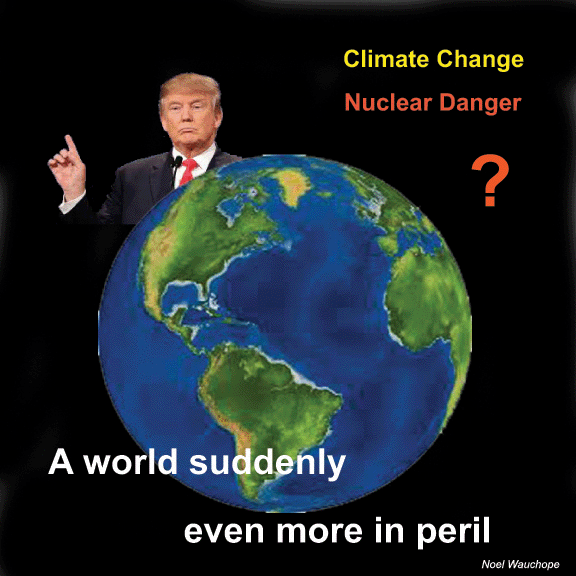
By ending the Iran deal, Trump has put America on the path to war, Guardian. Bernie Sanders 13 May 18 We need to try to talk with Iran’s government, seek a better relationship with the Iranian people, and a more constructive role for Iran in the region.
Last week, Donald Trump made one of the most reckless moves of his presidency:withdrawing from the Joint Comprehensive Plan of Action(JCPOA), also known as the Iran nuclear agreement. With this decision, the president discarded years of hard work by our diplomats, who had obtained an extremely rigorous set of restrictions and inspections guaranteeing that Iran would not obtain a nuclear weapon. He also slammed the door on a once-promising possibility of detente between the US and Iran.
It’s important to understand that the JCPOA is not just an agreement between the US and Iran, but one negotiated alongside our partners in the P5+1 – the UK, France, China, Russia and Germany – and endorsed by the United Nations security council. Trump’s withdrawal further deepens tensions with our most important democratic allies, France, the UK and Germany, who all continue to support the agreement and have consistently said that it is in their own national security interests to see it upheld.
Trump also rejected the advice of his own top national security officials like the joint chiefs chairman, Gen Joseph Dunford, and defense secretary, James Mattis, both of whom have repeatedly stated that staying in the agreement is in the national security interests of the US. Nuclear non-proliferation and national security professionals around the world share that assessment. Just as he has done on the issue of climate change with his withdrawal from the Paris climate accord, Trump has chosen to ignore the overwhelming expert consensus and sided instead with a small ideological faction, with disastrous consequences for our global security.
Withdrawing from the JCPOA also seriously harms the US’s ability to negotiate future non-proliferation agreements, such as one with North Korea. Why would any country in the world sign such an agreement with the US and make the tough concessions that any such agreement requires if they thought that a reckless president might simply discard that agreement a few years later? ……..
It is folly to imagine that, having unleashed these problems through the misuse of military force, we can solve them in the same way. Yet President Trump’s bellicose speech last week clearly seemed to shift American policy toward the same goal of regime change that underlay the Iraq war. Real American leadership, and real American power, is not shown by our ability to blow things up, but by our ability to bring parties together, to forge international consensus around shared problems, and then to mobilize that consensus to address those problems. That is what the JCPOA did. Unfortunately, President Trump has now chosen to put us on a very different, more dangerous path. https://www.theguardian.com/commentisfree/2018/may/14/nuclear-deal-trump-america-war
A top defector believes North Korea will never completely give up it’s nuclear weapons, SBS, 16 May 18
North Korea will never completely give up its nuclear weapons, a top defector said ahead of leader Kim Jong-un’s landmark summit with US President Donald Trump next month.
The current whirlwind of diplomacy and negotiations will not end with “a sincere and complete disarmament,” but with “a reduced North Korean nuclear threat,” said Thae Yong-ho, who fled his post as the North’s deputy ambassador to Britain in August 2016.
Nuclear transport support questioned Carluke Gazette 15 May 18Local MSP Claudia Beamish voiced concerns about the transportation of nuclear weapons during a recent Parliamentary debate. The issue was raised following the release of the report ‘Unready Scotland’ which analyses the gaps in the civil response to transport incidents involving nuclear weapons.
Convoys transporting high explosives and radioactive material travel between the Royal Naval Armaments Depot in Coulport and sites in England, which takes them through parts of South Lanarkshire, the Borders and Dumfries and Galloway. Ms Beamish questioned whether civil authorities such as the police, fire and rescue and local authorities are given enough support to ensure sufficient plans are in place to respond to emergencies of this nature. She said: “As a campaigner for nuclear disarmament I consider nuclear weapons morally unacceptable and internationally illegal. However this debate wasn’t about that.
It was about how safe their transportation is through our communities on our roads and railways. “My colleague Mark Ruskell MSP, who called for the debate, highlighted that generic risk assessments are relied upon by local authorities and information on managing hazards is only provided to the public near the Clyde Naval base but not to residents living near the route……..https://www.carlukegazette.co.uk/news/politics/nuclear-transport-support-questioned-1-4739756
Energy Live News 14th May 2018 , The UK Government has denied reports which claim it will guarantee loans
for Hitachi’s Horizon nuclear power project. The proposed nuclear
reactors to be installed at Wylfa – which will have a capacity of 3GW –
were given the green light by the UK’s nuclear regulators last year.
Japanese media reported Prime Minister Theresa May met the chairman of
Hitachi in London earlier this month to discuss the project. BEIS told ELN
the government “regularly engages with new nuclear developers” on a
range of issues, including financing, however, it “does not recognise the
reports”. A spokesperson added: “Nuclear power remains a crucial part
of the UK’s energy future but we have always been clear that this must be
delivered at the right price for consumers and taxpayers. “This principle
runs through all our engagement with any new build developers. These
discussions are commercially sensitive and we have no further details at
this time.” https://www.energylivenews.com/2018/05/14/uk-government-denies-guaranteeing-loans-for-hitachi-nuclear-project/
VA launches criminal investigation against whistleblowers, Washington Examiner, by Scott Davis, May 14, 2018 “……
The U.S. Office of the Special Counsel, or OSC, whose role is to protect whistleblowers from retaliation, has been on a virtual hiatus for the past two years. It is even less responsive now than it had been under previous administrations.
Recently, several whistleblowers at the Veterans Health Administration Member Services office in Atlanta did get a response from OSC, but not the one they were looking for. Instead of protecting the whistleblowers, OSC officials decided to take the side of the VA leadership.
They authorized VA to conduct an illegal criminal investigation into whistleblowers who had previously reported wrongdoing by VA management officials.
According to the VA Office of the Medical Inspector, or OMI, OSC contacted former Secretary David Shulkin on Feb. 13 for the purpose of investigating a complaint that several known VA whistleblowers, including myself, had violated the Computer Fraud and Abuse Act. That law was established to address criminal cyberactivity involving government computer systems, not to retaliate against whistleblowers who may have discovered and reported wrongdoing because of emails they received in the course of their jobs.
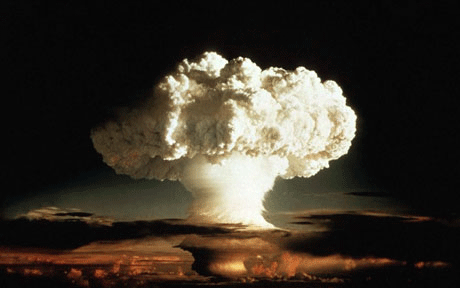
Just Security 11th May 2018 Two new reports from Pace University’s International Disarmament
Institute (one about Kiribati and the other focused on Fiji) detail the
humanitarian, human rights and environmental impacts of the Kiritimati and
Malden Island nuclear weapons tests.







 nuclear-news