UK Chancellor Osborne is two faced, pretending to support renewable energy
 Budget 2014: Osborne’s actions on renewables speak louder than his words
New housing may bring a rise in domestic installations, but the renewable energy industry still awaits a long-term plan Guardian, Richard Hiblen 21 March 14, There were few surprises for energy watchers in yesterday’s budget annoucement. We’d already heard about the chancellor’s proposed freeze in carbon price support (CPS) at £18 per tonne of CO2 from 2016 to 2019; no doubt it will be a welcome relief to the large coal power generators, and good news for energy-intensive industries. But it will surely have a detrimental effect on the growth of renewable energy.
George Osborne may well say there is no change in this government’s ambition for deployment of new renewable energy generation, but his actions speak louder than words. When there is a further £60m funding for innovation and adoption of carbon-capturing technologies, it points towards a reduction in emissions and meeting targets using fossil fuels rather than investing in a long-term renewable energy strategy.
There is further help for companies involved with oil and gas exploration in terms of tax reductions, which again signals a direction of travel away from a low carbon economy and the renewable energy industry. The focus for government seems to be in keeping the lights on at the lowest possible cost rather than building a sustainable future for our energy market.
Osborne may well think he is “committed to growth in low-carbon technologies” but this budget produced nothing to support that statement. It refers to a “levy control framework” being in place to achieve the necessary investment into meeting renewable energy targets, but freezing the CPS offers little to no incentive to invest……..http://www.theguardian.com/big-energy-debate/budget-2014-george-osborne-renewable-energyGuardian,
More solar and wind energy on Europe’s grid: EDF cuts nuclear production
EDF Curbs Nuclear Generation to Allow for Wind and Solar on Grid Bloomberg, By Tara Patel Mar 19, 2014 Electricite de France SA, the world’s biggest nuclear operator, is having to cut production from its reactors to accommodate higher European wind and solar output, potentially curbing future earnings from atomic power.
The utility, whose 58 French reactors account for about three-quarters of the country’s electricity production, can lower the output of a 1,000-megawatt plant by four-fifths in about 20 minutes, Dominique Miniere, deputy director of engineering and production at EDF, said today.
“Varying output is doable,” Miniere said at a press conference in Paris. While total production isn’t affected in the short term, “we are doing this more and more often.”……http://www.bloomberg.com/news/2014-03-19/edf-curbs-nuclear-generation-to-allow-for-wind-and-solar-on-grid.html
Glencore gets the prize for the most worker deaths
Mining is work, not war, why 26 deaths? There is a remarkable, grim and thoroughly unacceptable statistic on page 16 of Glencore’s 2013 annual report. (subscribers only) Financial Review 19 Mar 14
Ukraine crisis is not disturbing positive talks between Iran and West
 West Sees Unity on Iran Despite Crisis in Ukraine NYT, By ALISSA J. RUBIN and RICK GLADSTONE MARCH 18, 2014 VIENNA — Talks on a permanent nuclear agreement with Iran resumed in Vienna on Tuesday, heavily shadowed by the Ukraine crisis between the West and Russia. But European and American officials said their differences with the Kremlin had no effect on the unified position they all take aimed at ensuring the Iranians can never make atomic bombs……..
Michael Mann, a spokesman for Catherine Ashton, the European Union’s top foreign policy official, who is the lead negotiator for the P5-plus-1 group, told reporters that he had not seen “any negative effect” on the talks attributable to the Ukraine crisis……http://www.nytimes.com/2014/03/19/world/europe/iran-nuclear-talks.html?_r=0
Activists organising “Run Away From Nuclear” in Taipei
 Activists call for participation in anti-nuclear run, Taipei Times, By Lee I-chia Staff reporter, 19 Mar 14 A number of public figures, including a film director, performers and an Olympic bronze medalist, yesterday urged the public to participate in an anti-nuclear road run in Taipei slated for Saturday next week.
The event, dubbed “Run Away From Nuclear” (核輻大逃殺) and sponsored by the Anti-nuclear Alliance of Fathers, the Taiwan Environmental Protection Union and the Democratic Progressive Party, is a 5km road-running event that will begin at 7am from Ketagalan Boulevard. The run will simulate a mass of people escaping from radiation after a nuclear accident.
At a press conference yesterday, film director Ko I-chen (柯一正), actor Ralf Chiu (邱彥翔) and Chi Cheng (紀政), the 1968 Olympics bronze-medal winner in the women’s 80m hurdles, called for more people to sign up before registration ends tomorrow.
Also making the call was Hsu Wen-lin (許文麟), who uses a wheelchair after having broken his spine……http://www.taipeitimes.com/News/taiwan/archives/2014/03/19/2003586037
The world won’t survive a nuclear W.W.III.
 A Nuclear War Would Be Insane, OpEdNews 3/18/2014 By Dave Lefcourt Let’s get to the point fundamentally and unmistakably, a nuclear war would be insane.
Ever since the Cuban missile crisis in 1962, President Kennedy knew it and so did his counterpart Nikita Khrushchev in the Soviet Union. Even Stalin, probably the most brutal man ever never considered it.
That’s why in the cold war between the U.S. and the USSR, MAD, mutually assured destruction were the operative words and the primary reason a nuclear conflagration never occurred because such a war was unwinnable and to contemplate winning such a war was insane.
Yes tough guy Donald Rumsfeld as secretary of defense talked of using tactical bunker busting nuclear weapons but the use of any nuclear weapons began and ended with the U.S. dropping two atomic bombs on Japan in August 1945. Continue reading
The need for the West and Iran to negotiate in good faith
 Iran keeps its word – the west should do the same Ft.com By Javad Zarif, 18 Mar 14, Pursuing atomic weapons would put the country’s national security in jeopardy, writes Javad Zarif A
At last it seems realistic to hope for a resolution to the unnecessary crisis surrounding Iran’s peaceful nuclear programme. In large part that is because attitudes towards my country are changing. It is now recognised that Iranian scientists have mastered nuclear technology – and it is widely accepted that the knowledge we have attained cannot be wished away.
There is also a growing appreciation that Iran does not have any interest in nuclear weapons. True, we live in a volatile neighbourhood. Yet we have always been clear that pursuing nuclear weapons – or even being wrongly suspected of doing so – would put our national security in jeopardy. A
t last it seems realistic to hope for a resolution to the unnecessary crisis surrounding Iran’s peaceful nuclear programme. In large part that is because attitudes towards my country are changing. It is now recognised that Iranian scientists have mastered nuclear technology – and it is widely accepted that the knowledge we have attained cannot be wished away.
There is also a growing appreciation that Iran does not have any interest in nuclear weapons. True, we live in a volatile neighbourhood. Yet we have always been clear that pursuing nuclear weapons – or even being wrongly suspected of doing so – would put our national security in jeopardy…….http://www.ft.com/intl/cms/s/0/3c53cf60-ae8e-11e3-8e41-00144feab7de.html
Asia could become the epicentre of another nuclear catastrophe
 A need to address nuclear dangers, The Star, BY NOBUMASA AKIYAMA, SHAHRIMAN LOCKMAN, TANYA OGILVIE-WHITE, MANPREET SETHI, AND CHAN-HOON SHIN 19 March 14, There is no option but to cooperate, to prevent Asia from becoming an epicentre of another nuclear catastrophe.
IT’S no secret that nuclear dangers are mounting in Asia. Nuclear weapons arsenals are growing, nuclear power programmes are expanding, and fissile and radioactive materials – which could be used to target innocents anywhere – are used, stored and transported throughout our region, sometimes in insecure conditions.
It’s a discomfiting picture, and contrary to what sceptics would have us believe, it’s not an exaggerated one. We should be putting pressure on our political leaders to accept their responsibility to address our concerns before a nuclear catastrophe happens.
Next week, an opportunity exists for them to be pro-active in the face of nuclear dangers as leaders from around the world gather in the Netherlands at the world’s third Nuclear Security Summit to discuss and agree on actions that should be taken to reduce nuclear risks across the globe. What are these risks?
Let’s travel across the Asian nuclear landscape with our eyes wide open.
First stop: Pakistan, a nuclear-armed state with the world’s fastest growing nuclear arsenal and military stockpile of highly enriched uranium (HEU) and plutonium (Pu).
It is believed that there are sympathisers of extremist groups amongst its military, and a number of terrorist organisations operating from its soil.
The risks of nuclear sabotage and theft at Pakistan’s military and civilian sites must not be underestimated.
Heading south to India, the nuclear landscape is marginally better. New Delhi too is in the process of building its credible deterrence and the stockpile of weapons-usable HEU and Pu is growing.
India also has an ambitious nuclear power programme with twenty-one nuclear power reactors already operational, more being built, and also a new reprocessing facility at Kalpakkam……Onward to China…….the Korean peninsula……, Japan…. Despite the difficult political climate, there is no option but to cooperate, to prevent Asia from becoming an epicentre of another nuclear catastrophe.
Each state, whether it is a nuclear weapon state or not, should make extraordinary efforts to increase national accountability for their nuclear programmes according to accepted international benchmarks. http://www.thestar.com.my/News/Nation/2014/03/19/A-need-to-address-nuclear-dangers/
TruthOut reports on just one month’s environmental catastrophes
Fukushima remains on the forefront of many folks’ minds because it is an ongoing disaster, and its direct impact on our health is obvious. However, we tend to forget how much radiation has already been bombed into the oceans.
Those who have been bombed, however, haven’t forgotten.
Reporting on a World of Environmental Catastrophes – All in Just One Month
TruthOut, 17 March 2014 09:40By Dahr Jamail, Truthout | News Analysis March 2014
When all the trees have been cut down,
when all the animals have been hunted,
when all the waters are polluted,
when all the air is unsafe to breathe,
only then will you discover you cannot eat money.
– Cree Prophecy……..
A new study has confirmed that a magnitude 5.7 earthquake in Oklahoma – one of the state’s biggest man-made quakes – was caused by fracking-linked wastewater injections.
Water
Even the depths of the oceans are now at risk……… Continue reading
Large rally against nuclear power in Tokyo
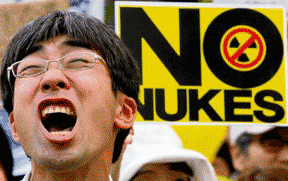 Japanese rally against nuclear power Sky News, March 15, 2014 Thousands of campaigners have rallied against nuclear power in Tokyo as the government and utilities move toward resumption of reactors in southern Japan.
More than 5000 protesters gathered at Hibiya Park in downtown Tokyo on Saturday to urge the government not to restart nuclear plants, as regulators review whether to let Kyushu Electric Power to restart two reactors at its Sendai power plant. Japan is prone to earthquakes. We have to seriously think about whether nuclear power is a good idea for Japan,’ said Masatoshi Harada, 60, as he joined fellow protesters at the park and later to march toward the Ginza shopping district.
‘This is an opportunity for Japan to drop nuclear power,’ he said.
Last week tens of thousands held a rally at the same site to voice fears about any reliance on nuclear power.
Saturday’s event came days after Japan marked the third anniversary of a 9.0-magnitude earthquake that struck northern Japan in March 11, 2011………. protesters argued that Japan can live without nuclear power as it has done so for many months.
All of the nation’s roughly 50 commercial nuclear reactors have remained offline due to tense public opposition to restarting them.
‘Nuclear plants have been closed, so you cannot say we cannot live without nuclear energy,’ anti-nuclear campaigner Junichi Okano said.http://www.skynews.com.au/world/article.aspx?id=958583
Avoiding Atomic Armageddon: Why we should not rejoin the nuclear bazaar
A Nuclear Colloquy: Lowry and Ford on “The Nuclear Bazaar”, New Paradigms Forum
Note:
Dr. David Lowry is an independent research policy consultant specializing in nuclear issues, working with politicians, NGOs and the media. He is a former director of the European Proliferation Information Centre [EPIC] in London. His text below, which he recently submitted to NPF, is the written version of his presentation to a workshop on “Challenging NPT-backed Nuclear Power Expansion” at the Campaign for Nuclear Disarmament (CND) annual conference in London on October 9, 2010.
Avoiding Atomic Armageddon:
Why we should not rejoin the nuclear bazaar
by Dr. David Lowry
The venerable veteran Labour politician, Tony Benn, who once was responsible for the British nuclear power programme when he was Technology Minister in the late 1960s, when recently asked by The Times if he had made any political mistakes in his life, responded:
“Yes, nuclear power: I was told it was, when I was in charge of it, that atomic energy was cheap, safe and peaceful. It isn’t.” (Times Magazine, 11 September 2010) Continue reading
Enormous amounts of radioactive wastes in Arctic seas
Russia announces enormous finds of radioactive waste and nuclear reactors in Arctic seas, Bellona, Enormous quantities of decommissioned Russian nuclear reactors and radioactive waste were dumped into the Kara Sea in the Arctic Ocean north of Siberia over a course of decades, according to documents given to Norwegian officials by Russian authorities and published in Norwegian media. Bellona had received in 2011 a draft of a similar report prepared for Russia’s Gossoviet, the State Council, for presentation at a meeting presided over by then-president Dmitry Medvedev on Russian environmental security.
The Russian state nuclear corporation Rosatom confirmed the figures in February of this year during a seminar it jointly held with Bellona in Moscow.
Bellona is alarmed by the extent of the dumped Soviet waste, which is far greater than was previously known – not only to Bellona, but also to the Russian authorities themselves…….http://bellona.org/news/uncategorized/2012-08-russia-announces-enormous-finds-of-radioactive-waste-and-nuclear-reactors-in-arctic-seas
Sloppy safety at New Mexico nuclear facility!
 Fed report slams safety lapses at New Mexico nuclear facility LA Times, By Joseph Serna March 15, 2014, Workers at a New Mexico nuclear waste storage facility that suffered an underground fire and radiation leak last month lack adequate safety training, oversight or a proper response plan for emergencies, a federal investigation has found.
In a report released Friday, Energy Department investigators faulted employees at the Waste Isolation Pilot Plant, or WIPP, near Carlsbad, for failing to maintain equipment and failing to correct procedures regulators have faulted before — issues that became apparent when a truck caught fire Feb. 5 followed by a radiation leak Feb. 14……..
WIPP’s continued closure could create a backup of defense nuclear waste. A federal treatment plant in Idaho and a laboratory in the San Francisco Bay Area both send their waste to the 2,150-foot-deep repository.
Steve Pearce, a Republican congressman who represents the New Mexico district that houses WIPP, said he expected the plant to address the shortcomings pointed out in the report.
“This transparent report highlights the sloppy procedures that caused the fire,” Pearce said in a statement. “New Mexicans expect and deserve to know the full truth. Fortunately, no one was seriously hurt, but it must never happen again.” http://www.latimes.com/nation/nationnow/la-na-nn-nuclear-safety-new-mexico-20140315,0,3056041.story
Nuclear power a danger to Orgeon
Nuclear power advocates, ‘cease and desist’ in light of dangers http://www.gazettetimes.com/news/opinion/mailbag/letter-nuclear-power-advocates-cease-and-desist-in-light-of/article_506a4674-ab45-11e3-8229-0019bb2963f4.htmlMy Kirk Nevin, Corvallis, 15 Mar 14 My impression, gained from talking to a fair number of my fellow Corvallis citizens, is that very few Oregonians think nuclear power has a future in our beautiful state.
For those who still harbor thoughts of producing electricity with nuclear facilities, I suggest you read the March 12 editorial on page A24 of the New York Times, “Fukushima’s Continuing Tragedy.”
The continuing tragedy is, of course, a reference to “the third anniversary of the triple disaster that struck eastern Japanese prefectures of Iwate, Miyagi and Fukushima: the earthquake, tsunami and the nuclear plant meltdowns in Fukushima.” The events killed almost 16,000 people, with many more still missing.
Oregon has an uncanny similarity to the Japanese area affected, with the same potential for earthquakes, tsunamis, and the inevitable nuclear meltdown.Message to the folks who are continuing to promote nuclear power in Oregon: Please cease and desist. You have no right to subject us to such a potential scenario of destruction and devastation in Corvallis. This is our home.
A big mistake to resurrect global nuclear technology
A Nuclear Colloquy: Lowry and Ford on “The Nuclear Bazaar”, New Paradigms Forum
Note:
Dr. David Lowry is an independent research policy consultant specializing in nuclear issues, working with politicians, NGOs and the media. He is a former director of the European Proliferation Information Centre [EPIC] in London. His text below, which he recently submitted to NPF, is the written version of his presentation to a workshop on “Challenging NPT-backed Nuclear Power Expansion” at the Campaign for Nuclear Disarmament (CND) annual conference in London on October 9, 2010.
Avoiding Atomic Armageddon:
Why we should not rejoin the nuclear bazaar
by Dr. David Lowry
The venerable veteran Labour politician, Tony Benn, who once was responsible for the British nuclear power programme when he was Technology Minister in the late 1960s, when recently asked by The Times if he had made any political mistakes in his life, responded:
“Yes, nuclear power: I was told it was, when I was in charge of it, that atomic energy was cheap, safe and peaceful. It isn’t.” (Times Magazine, 11 September 2010) Continue reading
1 This Month

petition to oppose the rapid increase of space-military industry threatening Jeju Island and the region.
[Petition by April 19th (KST)] Stop the joint military-Hanwha Systems-Jeju Provincial Government Sea Launch!

Chernobyl: The Lost Tapes – A good documentary on Chernobyl on SBS available On Demand for the next 3 weeks– https://www.sbs.com.au/ondemand/tv-program/chernobyl-the-lost-tapes/2352741955560

of the week–London Campaign for Nuclear Disarmament

Tell the Ukrainian Government to Drop Prosecution of Peace Activist Yurii Sheliazhenko
To see nuclear-related stories in greater depth and intensity – go to https://nuclearinformation.wordpress.com
-
Archives
- April 2026 (194)
- March 2026 (251)
- February 2026 (268)
- January 2026 (308)
- December 2025 (358)
- November 2025 (359)
- October 2025 (376)
- September 2025 (257)
- August 2025 (319)
- July 2025 (230)
- June 2025 (348)
- May 2025 (261)
-
Categories
- 1
- 1 NUCLEAR ISSUES
- business and costs
- climate change
- culture and arts
- ENERGY
- environment
- health
- history
- indigenous issues
- Legal
- marketing of nuclear
- media
- opposition to nuclear
- PERSONAL STORIES
- politics
- politics international
- Religion and ethics
- safety
- secrets,lies and civil liberties
- spinbuster
- technology
- Uranium
- wastes
- weapons and war
- Women
- 2 WORLD
- ACTION
- AFRICA
- Atrocities
- AUSTRALIA
- Christina's notes
- Christina's themes
- culture and arts
- Events
- Fuk 2022
- Fuk 2023
- Fukushima 2017
- Fukushima 2018
- fukushima 2019
- Fukushima 2020
- Fukushima 2021
- general
- global warming
- Humour (God we need it)
- Nuclear
- RARE EARTHS
- Reference
- resources – print
- Resources -audiovicual
- Weekly Newsletter
- World
- World Nuclear
- YouTube
-
RSS
Entries RSS
Comments RSS
 nuclear-news