No point in bombing Iran, even if they get a nuclear weapon

 Jimmy Carter: U.S. Shouldn’t Bomb Iran Even If They Get a Nuclear Weapon MediaIte, by Matt Wilstein , April 9th Former President Jimmy Carter joined MSNBC’sChris Matthews for an interview on Hardball Wednesday and made some news by saying he does not think the United States should bomb Iran even if they were to succeed in building an operational nuclear weapon. This statement differs not only from recent comments made by former Vice President Dick Cheney but also from the stated position of President Barack Obama.
“I never have felt that Israel had a capability militarily to go 1,200 miles or more and bomb Iran effectively and then return back to Israel,” said of Cheney’s suggestion that Israel could attack Iran unilaterally. “The only country on earth that has that capability would be the United States, and i don’t believe it’s appropriate for the United States to bomb Iran over this issue.”
When Matthews asked him if that position would apply even if Iran was in possession of a nuclear weapon, Carter replied, “Well, you know, if they got one nuclear weapon, Israel has, what, 300 or more, nobody knows exactly how many. And I know that every Iranian realizes that if they should try to use a nuclear weapon, Iran would be wiped off the face of the earth, which I think is so ridiculous, a self-destructive decision that they would not do it.”…….http://www.mediaite.com/tv/jimmy-carter-u-s-shouldnt-bomb-iran-even-if-they-get-a-nuclear-weapon/
Sickness and mortality due to ionising radiation
 When life becomes a shadow – after nuclear catastrophe, Ecologist Robert Jacobs 8th April 2014“…….Sickness and mortality
Sickness and even death are the results of exposure to radiation that people expect. It is important to know that there are many different ways that people can become ill after exposure to radiation.
When people are exposed to high levels of gamma radiation they can suffer from acute radiation sickness and death can come in a matter of days, weeks or months. Tens of thousands of people died of acute radiation sickness in Hiroshima and Nagasaki after they survived the nuclear attacks.
A nuclear weapon gives off a very large burst of gamma radiation that only lasts a very short time, but if the whole body is exposed to high levels it can cause illness and death relatively quickly.
For those who were not close to the detonation of a nuclear weapon, or within a short distance of a disaster like the Chernobyl or Fukushima disasters, illness is often the result of internalized alpha emitting particles. With nuclear detonations this comes down as ‘fallout’.
In the case of Chernobyl and Fukushima these came down over large areas as the plumes of the explosions there settled back to Earth. Alpha emitting particles cannot penetrate the skin like gamma radiation can, but rather are internalized through inhalation or swallowing or through cuts in the skin.
These particles don’t give off a large amount of radiation, but if they lodge in the body they continue to expose a small number of cells 24 hours a day often for the rest of a person’s life. This can result in cancers and immune disorders that develop later in life, sometimes a few years, sometimes after one or several decades.
Since the plumes of the three explosions at Fukushima deposited large amounts of alpha emitters across a large area, this is the primary danger to those living in the contaminated areas………http://www.theecologist.org/blogs_and_comments/Blogs/2351503/when_life_becomes_a_shadow_after_nuclear_catastrophe.html
American energy chief finds Japan’s nuclear safeguards inadequate
FirstEnergy nuclear chief finds Japan’s nuclear safeguards lacking after visiting Fukushima Tim Schooley Reporter–Pittsburgh Business Times, 8 April 14, “………Sena was one of a number of U.S.-based chief nuclear officers who visited Fukishima last September. He found the plant’s location was an issue……He told the audience the regulatory requirements are much stricter for nuclear power plants in the United States. That starts with the location requirements and the higher margin for safety U.S. plants must achieve for all types of environmental disasters…….Describing the industry here as under major cost pressures, Sena said the impact Fukushima has had on the American industry is a heightened awareness of just how big an environmental damage to prepare against…….
He also saw major cultural reasons for Japan’s nuclear nightmare at Fukushima, seeing a conformist culture and a technological arrogance that helped lead to a lack of training, licensing and emergency training in place for the country’s 50 nuclear plants.
None of those plants are in use now in Japan, which has few natural resources of its own. Japan is considering new energy options, including buying natural gas from Russia, he added. http://www.bizjournals.com/pittsburgh/blog/energy/2014/04/firstenergy-nuclear-chief-finds-japans-nuclear.html
Encouraging trends in use of renewable energy
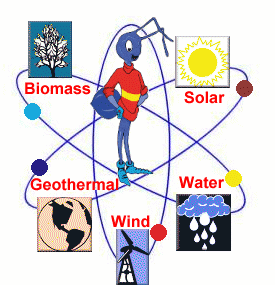 Greenpeace sees growth in renewable energy use http://www.upi.com/Business_News/Energy-Resources/2014/04/07/Greenpeace-sees-growth-in-renewable-energy-use/3041396879861/Greenpeace sees positive growth in green energy. By Daniel J. Graeber | April 7, 2014 LONDON, April 7 (UPI) –Environmental campaign group Greenpeace said Monday major world economies were showing an increase in renewable energy in their grids.
“Renewable energy has expanded, fallen in price and is ready to challenge traditional, polluting forms of energy,” Kaisa Kosonen, a senior political adviser for Greenpeace International, said in a statement.
A report from the Intergovernmental Panel on Climate Change found the burning of fossil fuels was a contributing factor to abnormal weather phenomena. Greenpeace said, with IPCC members set to convene Saturday in Berlin, the focus should be on renewable energy resources.
IPCC’s report showed the level of greenhouse gas emissions have increased since its 2007 report, though global solar power capacity has increased by a factor of 10 and wind capacity has increase threefold since then.
Demand dynamics, meanwhile, have shifted to Asian economies. Chinese coal consumption is changing in response to major pollution in cities, and host country Germany aims to use renewable energy for 80 percent of its energy demand by 2050.
Kosonen said there’s still time to “prevent catastrophic levels of global warming,” provided the renewable energy trends continue.
Never mind Fukushima, Obama’s USA determined to sell nuclear reactors
 Obama Administration Committed to U.S. Nuclear Energy Exports
 OilPrice, Sun, 06 April 2014 Despite the March 2011 destruction by a tsunami of Tokyo Electric Power Co.’s six reactor Fukushima Daiichi nuclear power and its ongoing pollution problems, the nuclear energy in the U.S. has weathered the storm, so to speak.
The U.S. Department of Commerce estimates the international marketplace for civil nuclear technology at $500 to $740 billion over the next ten years……
Where nuclear power works well, in early days in technocratic States
Why nuclear power worked once in France and might work again in China http://johnquiggin.com/2014/04/04/why-nuclear-power-worked-once-in-france-and-might-work-again-in-china/ April 4th, 2014 John Quiggin That’s the question I looked at a while back in this piece in the National Interest, which I was too busy to post about at the time. TNI’s headline, which I didn’t pick, is the more definitive ‘China Can Make Nuclear Power Work‘. The key point is that, when France embarked on a crash program to implement nuclear energy in the early 1970s, all the right ingredients were in place: a centralised state in which a skilled technocratic elite could push projects through without much regard to public opinion, the ability to fix on a single standardised design, low real interest rates and preferential access to capital, and the ability to fix pricing structures that eliminated much of the risk in the enterprise.
Over time, these factors were eroded, with the result that as the program progressed, the cost per megawatt of French nuclear plants tripled in real terms. As the Flamanville fiasco has shown, whatever the secret of French success 40 years ago, it has been well and truly lost now. And the picture is equally bleak for nuclear power in other developed countries. New nuclear power is far more expensive than renewables, even after making every possible allowance for the costs of intermittency, the various subsidies available, and so on. That’s why, despite the vast range of different policy settings and market structures in developed countries, the construction of new nuclear plants has been abandoned almost everywhere.
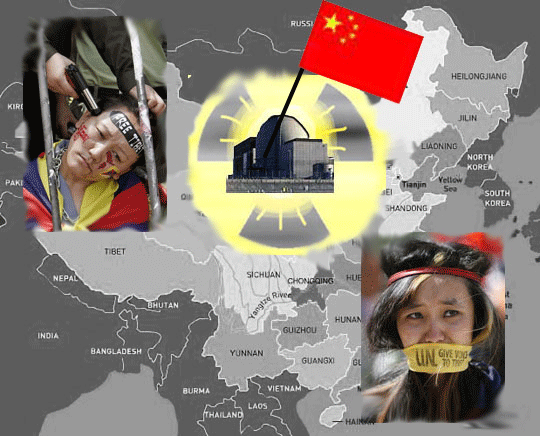
But China today looks, in many respects, like France in the 1970s, a technocratic state-capitalist society with the capacity to decide on, and implement, large scale projects with little regard to anyone who might object. If nuclear power can be made to work anywhere, it’s probably in China.
Obviously, pro-nuclear commenters like Hermit and Will Boisvert are welcome to have their say on this one.
Clean renewable energy a remedy for global warming and pollution
Opinion: Moving to clean, renewable energy would mitigate both climate change, pollution New Jersey Journal, By Tony Giordano, 6 April 14In the recent report of the Intergovernmental Panel on Climate Change (IPCC), climate scientists state that growing evidence has caused them to raise the certainty of man-made climate change to 95 percent. Though some people cling stubbornly to any sliver of uncertainty about climate change, 95 percent certainty is quite high for a cautious, conservative institution like science……….
These warnings aren’t alarmist academic musings. The warnings are based on reams of data gathered over many years and analyzed by many of the world’s leading scientists, who describe the evidence for these warnings as “overwhelming” and they say the science is #8220;unequivocal.” Accordingly, they call for immediate remedial action by governments around the world.
Some remedial actions would address several of these threats at once. For example, moving to clean, renewable energy would mitigate both climate change and pollution. For this reason, many scientists have endorsed proposals for a carbon fee to reduce greenhouse gas emissions that pollute the air and water and cause climate change. This is one thing our government can and should do — now. Governments in a number of other countries are ahead of us on this.
 Rather than despair over these foreboding threats, people can take a number of positive steps. History tells us that our government acts when masses of people demand action. In addition to reducing our personal footprint, the best thing we can do is demand immediate action from our elected representatives to address these dangers to all life on Earth.
Tony Giordano is an adjunct instructor at Brookdale Community College, a research consultant in social science and a volunteer member of Citizens’ Climate Lobby. http://www.nj.com/opinion/index.ssf/2014/04/opinion_humanity_depends_on_health_of_natural_world.html
Today’s energy system is simply unsustainable
Arvizu: Why the current energy system is unsustainable REneweconomy By Giles Parkinson on 4 April 2014
The first point is on cost, as renewables become a cheaper option than coal or gas; the other is on environmental impacts, as the world finally absorbs the impact of dirty coal generation; and the third is the arrival of new disruptive (and mostly renewable) technologies, such as rooftop solar and storage. But the most stunning piece of evidence is this: the industry spends only 0.3 per cent of its phenomenal revenues (in the trillions of dollars) on R&D. And even that money is spent by new players looking to bring new technologies to the market.
In an interview with RenewEconomy on the sidelines of the 2XEP energy efficiency conference in Sydney this week, Arvizu says he knows of no other incumbent industry that has spent so little on securing its future and on innovation, and was relying so much on the models of the past.
“The energy sector has the highest level of conservatism and the lowest level of risk taking,” Arvizu says. Change, via disruptive technologies such as solar and storage and other renewables, along with smart devices, is now upon it. But it will be fighting hard to resist change.
“We need to change the business model. We need new infrastructure, and brick by brick we will dismantle the old system and make a new one,” he says……….
“The future is much more promising than a lot of people expect,” Arvizu says, adding that even he is surprised at the pace of technological change and cost reduction.
He dismisses the protests of people who say that renewables are too expensive – in particular those like Bjorn Lomborg who insist that more research should take place (ironic given the industry’s low R&D commitment so far). “That’s just kicking the can down the road,” Arvizu says.
“If we are just talking about incremental changes to the existing system, we will never fully utilise the potential.”
It is, he says, a scary prospect for the incumbent utilities, who have enjoyed decades – nearly a century – of uninterrupted growth and extraordinary market power. And they are protected by layers and layers or regulation.
“We created this monster,” Arvizu says. “You often hear the words, ‘let the market decide’, but this is such a disingenuous argument in such a highly regulated market.
“The classic supply and demand equations do not work …. because what we’ve allowed the incumbents to create a set of highly regulated markets where they have tremendous market share, and there has been an alliance between public policy markets and incumbents, where reliable power supply has been exchanged for a high return on investment.
“But now we have other options in the market place, and in order to break into that market, they need to mature and they need an ecosystem around them.”
The key to change, he says, will come in power for the consumers, and the key to that will come in storage.
“If we had storage that was cost effective – you would very quickly be able to encourage the utilities to get on to the program. Once you have got the opportunity to say, I don’t need your electrons any more, that is when consumers will have the (market) power.”………
he notes, it is important that the new model be integrated with the old, in other words, the best of distributed generation must be merged with the best bits of the old centralized model.
This will be difficult, considering the regulatory hurdles, but it is important. And in the same way he dismissed the idea of “energy independence” for a country (focusing more on energy security), he’s also not sure why individuals would want to do the same.
“I don’t think we need to go to 100 per cent renewables, although I think we can,” he says. “And I don’t know why you would want to pay to be autonomous (off grid). The extra cost that it entails … to be isolated as an act of bravado is absurd, it is an interconnected world.” http://reneweconomy.com.au/2014/arvizu-why-the-current-energy-system-is-unsustainable-76176
Harvey Wasserman on the Nuclear Omnicide
 The Nuclear Omnicide http://www.opednews.com/articles/The-Nuclear-Omnicide-by-Harvey-Wasserman-Chernobyl_Fracking_Fukushima_Nuclear-Cover-up-140401-599.html By Harvey Wasserman 1 April 14 In the 35 years since the March 28, 1979, explosion and meltdown at Three Mile Island, fierce debate has raged over whether humans were killed there. In 1986 and 2011, Chernobyl and Fukushima joined the argument. Whenever these disasters happen, there are those who claim that the workers, residents and military personnel exposed to radiation will be just fine.
Of course we know better. We humans won’t jump into a pot of boiling water. We’re not happy when members of our species start dying around us. But frightening new scientific findings have forced us to look at a larger reality: the bottom-up damage that radioactive fallout may do to the entire global ecosystem.
When it comes to our broader support systems, the corporate energy industry counts on us to tolerate the irradiation of our fellow creatures, those on whom we depend, and for us to sleep through the point of no return.
Case in point is a new Smithsonian report on Chernobyl, one of the most terrifying documents of the atomic age.
Written by Rachel Nuwer, “Forests Around Chernobyl Aren’t Decaying Properly,” cites recent field studies in which the normal cycle of dead vegetation rotting into the soil has been disrupted by the exploded reactor’s radioactive fallout. “Decomposers — organisms such as microbes, fungi and some types of insects that drive the process of decay — have also suffered from the contamination,” Nuwer writes. “These creatures are responsible for an essential component of any ecosystem: recycling organic matter back into the soil.”
Put simply: The micro-organisms that form the active core of our ecological bio-cycle have apparently been zapped, leaving tree trunks, leaves, ferns and other vegetation to sit eerily on the ground whole, essentially in a mummified state.
Reports also indicate a significant shrinkage of the brains of birds in the region and negative impacts on the insect and wildlife populations.
Similar findings surrounded the accident at Three Mile Island. Within a year, a three-reporter team from the Baltimore News-American cataloged massive radiation impacts on both wild and farm animals in the area. The reporters and the Pennsylvania Department of Health confirmed widespread damage to birds, bees and large kept animals such as horses, whose reproductive rate collapsed in the year after the accident.
Other reports also documented deformed vegetation and domestic animals being born with major mutations, including a dog born with no eyes and cats with no sense of balance.
To this day, Three Mile Island’s owners claim no humans were killed by radiation there, an assertion hotly disputed by local downwinders.
Indeed, Dr. Alice Stewart established in 1956 that a single X-ray to a pregnant woman doubles the chance that her offspring will get leukemia. During the accident at Three Mile Island, the owners crowed that the meltdown’s radiation was equivalent “only” to a single X-ray administered to all area residents.
Meanwhile, if the airborne fallout from Three Mile Island and Chernobyl could do that kind of damage to both infants and the non-human population on land, how is Fukushima’s continuous gusher of radioactive water affecting the life support systems of our oceans?
In fact, samplings of 15 tuna caught off the coast of California indicate all were contaminated with fallout from Fukushima.
Instant as always, the industry deems such levels harmless. The obligatory comparisons to living in Denver, flying cross country and eating bananas automatically follow.
But what’s that radiation doing to the tuna themselves? And to the krill, the phytoplankton, the algae, amoeba and all the other microorganisms on which the ocean ecology depends?
Cesium and its Fukushima siblings are already measurable in Alaska and northwestern Canada. They’ll hit California this summer. The corporate media will mock those parents who are certain to show up at the beaches with radiation detectors. Concerns about the effect on children will be jovially dismissed. The doses will be deemed, as always, “too small to have any impact on humans.” Harvey Wasserman edits www.nukefree.org . His SOLARTOPIA! OUR GREEN-POWERED EARTH is at www.solartopia.org . The Solartopia Green Power & Wellness Show airs at www.progressiveradionetwork.com .
Rick Perry, the nuclear industry’s man in Texas, wants radioactive waste dump
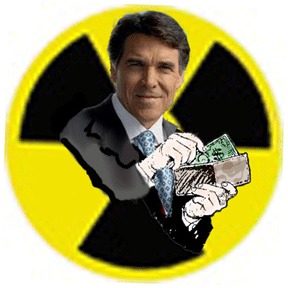
Bloomberg reports that Texas Governor Rick Perry is pushing for a high level radioactive waste dump in Texas.
Renewed anxiety over Barnsworth nuclear waste plume
Controversy remains over Barnsworth Nuclear Plume Barnwell, SC (WLTX) – A plume of a low level radioactive substance is traveling through the ground and has bubbled up in a creek in Barnwell, about an hour and a half from Columbia.
The plume has been there for some time, but new concern over how nuclear waste at a disposal site nearby has sparked debate and a court battle………
The 235 acre site has accepted low level nuclear waste for the past 43 years.
For the past 20 years, Energy Solutions and DHEC have monitored the plume of radioactive Tritium. The nuclear byproduct has traveled through groundwater and reached Mary’s Branch Creek near the disposal site.
“You have to keep in mind that low level does not mean low risk,” said Susan Corbett, Chairwoman of the South Carolina Sierra Club.
Court documents from a claim filed by the Sierra Club say nuclear waste was sometimes transported in paper and cardboard to the site years ago……..http://www.wltx.com/story/news/local/2014/03/31/tritium-plume-barnwell-site/7050761/
Another USA nuclear power plant of dubious safety
Waterford 3 nuclear plant in St. Charles Parish faces extra safety oversight By Littice Bacon-Blood, NOLA.com | The Times-Picayune The Waterford 3 nuclear power plant in St. Charles Parish will receive additional oversight from the Nuclear Regulatory Commission because it failed to ensure that an exhaust fan designed to cool diesel generators in an emergency would work. The NRC on Monday issued what it called a “white” finding, meaning the infraction ranks as a low to moderate safety risk.
The NRC evaluates regulatory performance at commercial nuclear power plants with a color-coded process that classifies findings as green, white, yellow or red, in order of increasing safety significance. While the Entergy plant, located inKillona, has taken corrective action, the finding still will result in increased inspections and regulatory oversight, the NRC reports.
Read the NRC Waterford 3 report……..
http://www.nola.com/business/index.ssf/2014/04/waterford_3_nuclear_plant_in_s.html
Call to keep renewable energy target, and close nuclear power – 30.000 Germans march
 GERMANY: As the German government comes close to completing its draft for a new Renewable Energy Act, intended to be implemented as soon as August, demonstrations in support of wind and renewables continue. Around 30,000 people took to the streets in seven major German cities to show their support for renewable energies and opposition against coal, nuclear and gas fracking on 22 March, reported environment and nature protection organisation Bund on the same day……..http://www.windpowermonthly.com/article/1286689/german-wind-protests-continue
Renewabl eenergy companies to be offered loan by USA govt
U.S. Energy Dept to offer loan aid to renewable energy companies By Ayesha Rascoe WASHINGTON, March 28 (Reuters) – The U.S. Energy Department will soon issue a plan to offer loan aid for renewable energy projects, Energy Secretary Ernest Moniz said on Friday, doubling down on investments that have drawn intense criticism over past government-backed business flops.
A department loan program funded by the 2009 economic stimulus law that backed solar, wind and geothermal projects was widely attacked by Republicans after the high-profile failure of solar panel manufacturer Solyndra.
Despite the bankruptcy of Solyndra and other recipients of department funds, the Obama administration has stressed that most of its energy investments have been successful, refusing to bow to calls to scrap its remaining loan programs…….
Moniz pointed to the success of utility-scale solar power plants backed by the department through the stimulus package as an example of what the administration hopes to continue to accomplish……. Solar power plants are now being built in the United States by private companies without federal loan aid.
“We want to fund some of the first movers that push the technology out there and then have the private sector expand it,” Moniz said……. http://af.reuters.com/article/energyOilNews/idAFL1N0MP22420140328?pageNumber=2&virtualBrandChannel=0
Solution to the “mystery plume” near nuclear test site
Mystery plume radar image near Nuclear Test Site – solved http://wattsupwiththat.com/2014/03/19/mystery-plume-radar-image-near-nuclear-waste-site-solved/ (Excellent pictures) March 19, 2014 by Anthony Watts
Occam’s Razor – the simplest explanation is most likely People ask me to look into weird things all the time. Since I operate a weather business that specifically offers weather radar analysis and tracking software, I got asked to look at this image from a Daily Mail article which claimed: Weather experts baffled by mystery plume on New Mexico radar near 1945 nuclear bomb test site I’ve seen images like this dozens of times before.
It is very likely a large swarm of birds taking off………..
1 This Month

petition to oppose the rapid increase of space-military industry threatening Jeju Island and the region.
[Petition by April 19th (KST)] Stop the joint military-Hanwha Systems-Jeju Provincial Government Sea Launch!

Chernobyl: The Lost Tapes – A good documentary on Chernobyl on SBS available On Demand for the next 3 weeks– https://www.sbs.com.au/ondemand/tv-program/chernobyl-the-lost-tapes/2352741955560

of the week–London Campaign for Nuclear Disarmament

Tell the Ukrainian Government to Drop Prosecution of Peace Activist Yurii Sheliazhenko
To see nuclear-related stories in greater depth and intensity – go to https://nuclearinformation.wordpress.com
-
Archives
- April 2026 (194)
- March 2026 (251)
- February 2026 (268)
- January 2026 (308)
- December 2025 (358)
- November 2025 (359)
- October 2025 (376)
- September 2025 (257)
- August 2025 (319)
- July 2025 (230)
- June 2025 (348)
- May 2025 (261)
-
Categories
- 1
- 1 NUCLEAR ISSUES
- business and costs
- climate change
- culture and arts
- ENERGY
- environment
- health
- history
- indigenous issues
- Legal
- marketing of nuclear
- media
- opposition to nuclear
- PERSONAL STORIES
- politics
- politics international
- Religion and ethics
- safety
- secrets,lies and civil liberties
- spinbuster
- technology
- Uranium
- wastes
- weapons and war
- Women
- 2 WORLD
- ACTION
- AFRICA
- Atrocities
- AUSTRALIA
- Christina's notes
- Christina's themes
- culture and arts
- Events
- Fuk 2022
- Fuk 2023
- Fukushima 2017
- Fukushima 2018
- fukushima 2019
- Fukushima 2020
- Fukushima 2021
- general
- global warming
- Humour (God we need it)
- Nuclear
- RARE EARTHS
- Reference
- resources – print
- Resources -audiovicual
- Weekly Newsletter
- World
- World Nuclear
- YouTube
-
RSS
Entries RSS
Comments RSS
 nuclear-news