Corporate investment in renewable energy is the goal for Business Renewables Resource Center
 Getting Fortune 500 To Invest Much More In Renewable Energy (VIDEO) Clean Technic a 23 April 14 Last week, RMI’s program to significantly scale the commitment by Fortune 500 companies to source renewable energy was chosen as one of six winners at the Bloomberg New Energy Finance Summit’s Finance for Resilience (“FiRe”) event. FiRe is designed to identify the best proposals to spur increased investment in renewables and scale them as quickly as possible.
RMI’s plan is to create a Business Renewables Resource Center that will help to double clean energy cash flows by 2019 by increasing clean energy procurement by large commercial and industrial companies. While the Center will initially focus on the U.S. market, the capability will effectively travel within these large corporations to other countries…. http://cleantechnica.com/2014/04/22/fortune-500-double-source-renewable-energy/#2QK86PoTqu7xtXtb.99
Let’s hope that the floating nuclear reactor is better than that other ‘safest design’ – the Titanic
 MIT wants nuclear reactors on the ocean? http://www.fudzilla.com/home/item/34522-mit-wants-nuclear-reactors-on-the-ocean by Nick Farrell 18 April 14, Sometimes it is best not to leave things to engineers
It used to be that silly thinks were designed by arts school graduates, but now it appears that engineers are having a crack at it. MIT have come up with what they think is a brilliant idea to stick a nuclear power plant on the ocean.
The cunning plan is to build a plant on a floating platform, moored in deep water several miles off the coast. They claim that it will be virtually immune to earthquakes, tsunamis and meltdowns. In deep water, tsunami waves aren’t large enough to cause significant damage, and earthquakes are not felt at all. MIT’s Jacopo Buongiorno said that floating the reactor on the ocean also gives the plant access to easy, passive cooling and an “infinite heat sink.”
Clearly, Buongiorno has not seen many disaster films, but we would have thought that the concept of humanity building an unsinkable anything went down with the Titanic. While deep water might be tsunami proof, it would not be immune to storms. While the in an emergency situation that sees the plant venting radioactive gasses into the ocean, rather than into the air one of the problems with the Fukushima leak was that radioactive sea water polluted huge chunks of the ocean.
Navajo art against uranium mining
Uranium mining should not be permitted.Daily Times, VENAYA YAZZIE, 17 April 14 “……..For the People’s Choice show I created an art piece specifically on the topic of uranium mining on the Navajo reservation, or as my people refer to the land of our ancestors – Dinétah. My Navajo tribe has endured many atrocities and triumphs since our forced exodus and return from Fort Sumner, in 1868. Yet, I believe the most terrible has been the disastrous effects of uranium mining on ancestral Navajo lands.
My painting which is titled ée’t’só: Roaming Monsters in Dinétah and Sodizin as Our Weapon, concerns the history of uranium mining in the 20th century, which shows that from 1944 to 1986 about four million tons of uranium ore was extracted throughout the reservation. Today, the Navajo reservation is riddled with 521 abandoned uranium mines, in the state of New Mexico alone there are 450. The disheartening fact is that most of these abandoned mines on the Navajo reservation have been declared contaminated sites and are no longer habitable. This fact alone is the reality that human rights to clean air, water and a healthy environment have been taken away. My hope is that this knowledge will not only bring awareness to the community, but also to the world that uranium mining should not be permitted……”
No more delays can be tolerated, to clean up Hanford’s radioactive pollution
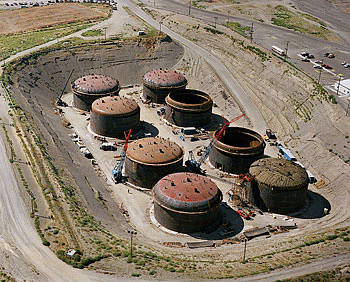 No more ‘wait and see’ at Hanford nuclear sitehttp://www.oregonlive.com/opinion/index.ssf/2014/04/no_more_wait_and_see_at_hanfor.html By Brett VandenHeuvel Recently, Washington Gov. Jay Inslee and Attorney General Bob Ferguson took a stand against the Department of Energy’s “wait and see” approach toward the cleanup of the Hanford nuclear site. Looking out for the best interest of the Northwest, they unveiled a plan to improve accountability of the cleanup of Hanford. Gov. Inslee created a deadline for Energy that requires waste is removed from leaky single-shell tanks by 2040 (26 years might seem like a long time, but beats not having a deadline at all) and presented a schedule to complete the waste treatment plant.
At the same time, Energy released a counterplan, full of empty promises, that doesn’t protect northwest communities or the Columbia River from the dangers of Hanford’s nuclear waste. Hanford is the most contaminated site in the western hemisphere, where the federal government produced plutonium to fuel our nation’s Cold War nuclear arsenal. Energy wants to develop milestones for cleanup on a rolling basis as technical issues are resolved.
We don’t have time to waste on Energy’s “wait and see” approach. Residents of the Tri-Cities depend on the Columbia River, just downstream from the Hanford nuclear site, for their drinking water. This area of the Columbia River, known as the Hanford reach, is the most productive spawning ground for endangered Chinook salmon on the Columbia River, producing 52 million juveniles every year. Public lands bordering the reach are home to 48 rare, threatened or endangered species. Leaving pollution in the leaking tanks, to slowly seep into the Columbia River, puts the water supply and salmon at risk.
And Energy doesn’t have a good track record when it comes dealing with the public’s concern in a timely fashion. For example, more than a year ago, Energy revealed that a double shell tank, AY-102, was leaking nuclear waste. They don’t plan to begin removing waste for two more years. That’s three years while we wait to see whether the tank can withstand the heat and corrosion of the waste inside.
Their plan fails to protect public health and was so inconsistent with public sentiment that Washington issued an administrative order requiring pumping of nuclear waste from AY-102 by September 2014.
Just days later, noxious gases at the tank farm sent workers to the hospital. The Hanford Advisory Board and watchdog groups like Columbia Riverkeeper and Hanford Challenge have brought concerns about worker safety at the tank farms to Energy’s attention. But it is obvious Energy is not taking the necessary steps to watch over their contractors and protect employees.
It seems like common sense: Energy needs to take more aggressive action to immobilize Hanford’s nuclear waste and to protect workers, tribes, citizens of the Northwest, and the environment. Later this month, we all have an opportunity and a responsibility to give the Energy our two cents about Hanford cleanup and to encourage Washington state to hold the Energy accountable for keeping nuclear waste out of the Columbia River. The Hanford State of the Site meetings are scheduled for 6pm April 16 at the Portland Doubletree and April 17 at the Hood River Best Western. See you there.
Brett VandenHeuvel is executive director of Columbia Riverkeeper
#IHeartRenewables Week Earth Day (Tuesday, April 22)
It is the week before Earth Day (Tuesday, April 22) and we are asking American wind power supporters to share why they love wind energy on Twitter and Facebook.
Similar to our #iheartwind week a couple months back, we are asking supporters to use the#iheartrenewables hashtag to tell your followers, your friends, everyone why you love wind power in the spirit of celebrating Earth Day and all the successes wind power has achieved so far.
You can participate in many ways, including:
- Simply telling everyone why you love wind power and other renewables. For ex:
#iheartrenewables b/c U.S.#windpower avoids enough carbon dioxide emissions a year to take the equivalent of 17 million cars off the road! - Taking a picture of yourself at a wind farm
- Taking a picture of yourself at work, at home, or anywhere and holding up a sign for why you “heart” renewables.
- You can even tell us why you support federal policy, like the Production Tax Credit or PTC, that encourages American wind power’s growth.
- There are a number of ways you can creatively show your support!
Some of our friends over at @SEIA, @ACORE, and elsewhere will be joining in on the fun as well.
Iberdrola Renewables already kicked things off with their tweet below of a wind farm using the #iheartrenewables hashtag. You can post @AWEA on Twitter by using our handle @AWEA. You can find our Twitter page here:
You can post on AWEA’s Facebook page here:
https://www.facebook.com/AmericanWindEnergyAssociation
Interested in telling your elected officials why love wind power year-round? Sign up to receive updates from AWEA’s Power of Wind advocacy network.
Also, don’t forget that WINDPOWER 2014 is happening May 5–8 this year in Las Vegas, Nevada. It’s not too late to sign-up!
UK’s defence heavies are bullying Scotland
Defenders of union come under fire over tactics, FT.com, 15 April 14 By George Parker, Political Editor Philip Hammond, defence secretary, on Tuesday concluded two weeks of heavy pounding by the British military on Alex Salmond, the Scots first minister, in the latest attempt to halt his advance ahead ofSeptember’s independence referendum.
If recent experience is repeated, Mr Salmond will emerge unscathed, leaving his opponents to dwell on the effectiveness, co-ordination and tone of the campaign to save the United Kingdom………
Meanwhile Mr Hammond has orchestrated a campaign in recent days, featuring former armed forces chiefs and the First Sea Lord Sir George Zambellas, warning that independence would jeopardise the security of Scotland and the rest of Britain……. http://www.ft.com/intl/cms/s/0/aa22fc54-c4ab-11e3-b2fb-00144feabdc0.html
The world’s terminal illnesses – climate change and nuclear weapons
Lawrence Wittner: Nuclear arms a terminal illness, Battle Creek EnquirerApr. 15, 2014 Your doctors are worried about your health — in fact, about your very survival.
No, they’re not necessarily your own personal physicians, but, rather, medical doctors around the world, represented by groups like International Physicians for the Prevention of Nuclear War (IPPNW).
As you might recall, that organization, composed of many thousands of medical professionals from all across the globe, won the Nobel Peace Prize in 1985 for exposing the catastrophic effects of nuclear weapons.
Well, what seems to be the problem today? The problem, as a new IPPNW report indicates, is that the world is showing growing symptoms of a terminal illness. Continue reading
Just off Fukushima coast – earthquake magnitude 4.9
Quake hits just off Fukushima plant, felt along 500 kilometer stretch of Japan coast — Seismic intensity of 4 on scale up to 7 — Camera shakes for about 1 minute (VIDEO) http://enenews.com/quake-hits-just-off-fukushima-plant-felt-along-500-kilometers-of-japan-coast-camera-shakes-for-about-1-minute-video?utm_source=feedburner&utm_medium=email&utm_campaign=Feed%3A+ENENews+%28Energy+News%29
Japan Meteorological Agency, Apr. 13, 2014:
Time: 18:16 JST
Date: Apr. 13, 2014
Depth: 60 km
Location: Fukushima-ken Oki
Coordinates: 37.3N 141.2E
Magnitude: 4.9
Seismic Intensity: 4 out of 7
[Centered 30 km east of Fukushima Daiichi]Watch video of the quake here (at 8:00 in, 2x speed)
Fukushima considered world’s worst nuclear accident
National Geographic: Fukushima considered world’s worst nuclear accident — Physician: Fukushima remains a “global health concern” — Kaku: “It’s so bad, they don’t even have a picture of melted core… the agony is unending” (VIDEO)
Asian Perspective Vol. 37, No. 4, Tilman A. Ruff, physician and Associate Professor in the Nossal Institute for Global Health at University of Melbourne, Oct.-Dec. 2013: A Public Health Perspective on the Fukushima Nuclear Disaster — The Fukushima nuclear disaster is far from over and remains a global health concern. While evacuations, sheltering, reducing intake of contaminated food, and other measures reduced radiation exposures, both the immediate and longer-term public health responses to the disaster leave major room for improvement. Commercially and institutionally, vested interests have undermined public health and safety. […]
National Geographic, Apr. 14, 2014: The meltdown at the Chernobyl power plant in 1986 made front-page news and, until Japan’s Fukushima disaster of 2011, was considered the world’s worst nuclear accident. […] Early estimates by the Associated Press (Dec. 16, 2000) were that the health of 3.4 million of Ukraine’s 50 million people was negatively affected, including 1.26 million children […]
Michio Kaku,Mar. 18, 2014 (at 1:18:00 in): The agony of 3 simultaneous meltdowns in Northern Japan […] The accident is not over at all. A small earthquake will send the accident starting all over again. You will realize that the reactor is so radioactive workers cannot even get in for more than just a few minutes at a time. […] The next thing they want to do is insert cameras into the water to see where the melting is. It’s so bad, they don’t even have a picture of the melted core. We know it’s 100 percent melted. […] The agony is unending. […] Japan said we will go nuclear because we have no oil or coal, but there is a price you have to pay — that is, you sell your soul to the devil.
UK urged to triple or quadruple renewable energy, after IPCC
 UN urges huge increase in green energy to avert climate disaster http://www.theguardian.com/environment/2014/apr/12/un-urges-increase-green-energy-avert-climate-disaster-uk
A report by the world’s leading authorities will expose a growing gulf between a Tory party intent on halting construction of more onshore windfarms and the world’s leading scientists, who see them as one of the cheapest ways to provide energy while at the same time saving the environment.
Mitigation of Climate Change, by the UN’s Intergovernmental Panel on Climate Change (IPCC), a panel of 200 scientists, will make it clear that by far the most realistic option for the future is to triple or even quadruple the use of renewable power plants. Only through such decisive action will carbon dioxide levels in the atmosphere be kept below the critical level of 480 parts per million (ppm), before the middle of the century. If levels go beyond this figure, the chances of curtailing global mayhem are poor, they will say.
The report – the third in a series by the IPCC designed to highlight the climate crisis now facing the planet – is intended as an urgent wake-up call to nations to commit around 1-2% of GDP in order to replace power plants that burn fossil fuels, the major cause of global warming, with renewable sources.
UK defence chiefs angry over Scotland’s ‘no nuclear’ policy
Defence chiefs go on attack over Nats’ ‘no nuclear’ policyALEX Salmond’s plan to scrap Trident after Scottish independence would put the UK’s nuclear deterrent in jeopardy, senior defence figures have warned. http://www.express.co.uk/news/uk/470464/Defence-chiefs-go-on-attack-over-Nats-no-nuclear-policy
Non nuclear States represented in Hiroshima, aim to eliminate nuclear weapons
Foreign ministers at nuclear summit urge world leaders to learn lessons from Japan atomic bombings Australia Network news, 13 Apr 2014,
Foreign ministers from a coalition of non-nuclear weapons states have urged world leaders to visit the Japanese cities of Hiroshima and Nagasaki to learn about the “catastrophic” effects of atomic bombing.
Australian Foreign Minister Julie Bishop represented Australia at a 12-nation summit in Hiroshima to discuss global efforts to eliminate nuclear weapons…..http://www.abc.net.au/news/2014-04-13/an-ministers-attend-nuclear-disarmament-talks-in-hiroshima/5386940
Fukushima radioactive leak was much worse than first stated by TEPCO
 TEPCO says Aug. water leak from tank was far more contaminated http://www.globalpost.com/dispatch/news/kyodo-news-international/140411/tepco-says-aug-water-leak-tank-was-far-more-contaminat Kyodo News International April 11, 2014 Tokyo Electric Power Co. said Friday that toxic water found to have leaked last August at one of the huge tanks at the accident-hit Fukushima Daiichi nuclear power plant was far more contaminated than initially announced.
After recalculating the radiation level, TEPCO said the water contained 280 million becquerels per liter of beta ray-emitting radioactive materials such as strontium-90, instead of 80 million becquerels.
A total of 300 tons of toxic water was found to have leaked at that time, part of which is believed to have flowed into the adjacent Pacific Ocean. The Nuclear Regulation Authority assessed the severity of the incident to be level 3 on an eight-point international scale.
TEPCO decided to review data on 173 water samples it took until last October, as it found readings may be lower than actual figures due to improper measurement.
As for 104 samples, TEPCO analyzed them again as it had kept them. But the utility did not have the remaining 69 samples, including the water that leaked, so it calculated the radiation level by using a theoretical formula.
TV broadcast on sickness among nuclear waste workers
 TV: “Far more serious than Feds letting on” at US nuclear site — Many workers in much worse shape than reported — Week-long nosebleeds, intense headaches, shaking, burning lungs, vomiting — Worker: Now I’m worrying… after two weeks I feel worse, not better (VIDEO) #Hanford http://enenews.com/tv-situation-nuclear-site-serious-feds-letting-many-workers-symptoms-worse-reported-week-long-nosebleeds-intense-headaches-shaking-burning-lungs-vomiting-worker-yesterday-worst-day-ive-worrie?utm_source=feedburner&utm_medium=email&utm_campaign=Feed%3A+ENENews+%28Energy+News%29
KING5 News Seattle,Apr. 8, 2014: An unprecedented string of unknown chemical vapor exposures has sent more than 2 dozen workers to the hospital of doctor since mid-March. […] We found the situation is far more serious than the Feds and the contractors are letting on. All of the employees were not and still are not back to work. And many have symptoms far worse than irritation. […] Right before coming to the interview, a doctor cauterized Becky’s nose to stop a week’s worth of nosebleeds. And Steve spent all of the day before throwing up. […] Her symptoms [have been] nosebleeds, intense headaches, sweats and shaking […] Steve deals with burning lungs and non-stop coughing — using inhalers and narcotics to cope. […] He’s still struggling to breathe […] Becky still has a really bad headache, but her biggest concern, this is a scary one, she’s not thinking clearly. She says she’s forgetting a lot of things and that’s really frightening to her. […] They aren’t the only ones. I’ve talked to others who say their lungs are burning, they don’t feel right, but they’ve been cleared to work, so they’re out on the job.
Becky Holland, health physics technician and 28-year veteran of the Hanford Site: “I felt kind of dizzy like I couldn’t walk. […] It was hard for me to get my nose to stop bleeding”
Steve Ellingson, health physics technician at Hanford: “Now I’m getting worried because this is two weeks and it’s not better. Yesterday was the worst day I’ve had. I’m getting worried that this may be the way that I am the rest of my life.”
USA’s Republicans’ hawkish bluster endangers the world
Thankfully, US-Russia cooperation on nuclear security will continue—for now. Since 1993, the United States has spent $1.6 billion on Cooperative Threat Reduction (known as the Nunn-Lugar pact), a program designed to increase safety and security at nuclear and chemical-weapons facilities of former Cold War antagonists. But last June, the pact expired after twenty years, and despite pledges from the Obama administration that work would continue “unfettered,” recent events in Ukraine have introduced enough friction into the relationship to cause alarm.
1 This Month

petition to oppose the rapid increase of space-military industry threatening Jeju Island and the region.
[Petition by April 19th (KST)] Stop the joint military-Hanwha Systems-Jeju Provincial Government Sea Launch!

Chernobyl: The Lost Tapes – A good documentary on Chernobyl on SBS available On Demand for the next 3 weeks– https://www.sbs.com.au/ondemand/tv-program/chernobyl-the-lost-tapes/2352741955560

of the week–London Campaign for Nuclear Disarmament


Tell the Ukrainian Government to Drop Prosecution of Peace Activist Yurii Sheliazhenko
To see nuclear-related stories in greater depth and intensity – go to https://nuclearinformation.wordpress.com
-
Archives
- April 2026 (194)
- March 2026 (251)
- February 2026 (268)
- January 2026 (308)
- December 2025 (358)
- November 2025 (359)
- October 2025 (376)
- September 2025 (257)
- August 2025 (319)
- July 2025 (230)
- June 2025 (348)
- May 2025 (261)
-
Categories
- 1
- 1 NUCLEAR ISSUES
- business and costs
- climate change
- culture and arts
- ENERGY
- environment
- health
- history
- indigenous issues
- Legal
- marketing of nuclear
- media
- opposition to nuclear
- PERSONAL STORIES
- politics
- politics international
- Religion and ethics
- safety
- secrets,lies and civil liberties
- spinbuster
- technology
- Uranium
- wastes
- weapons and war
- Women
- 2 WORLD
- ACTION
- AFRICA
- Atrocities
- AUSTRALIA
- Christina's notes
- Christina's themes
- culture and arts
- Events
- Fuk 2022
- Fuk 2023
- Fukushima 2017
- Fukushima 2018
- fukushima 2019
- Fukushima 2020
- Fukushima 2021
- general
- global warming
- Humour (God we need it)
- Nuclear
- RARE EARTHS
- Reference
- resources – print
- Resources -audiovicual
- Weekly Newsletter
- World
- World Nuclear
- YouTube
-
RSS
Entries RSS
Comments RSS
 nuclear-news