America’s nuclear radioactive trash just piles up, with no solution in sight
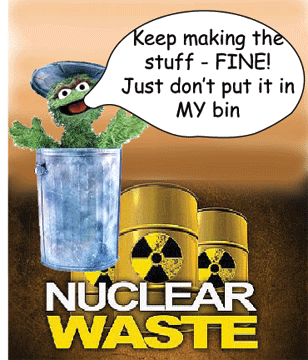 Weird trick to cure nuclear waste problem Augusta Chronicle Damon Cline | Sun, May 4 “…….The government still has no Plan B, but it keeps collecting waste fees at a rate of $750 million a year (the current repository fund balance is $31 billion). And the nation’s nuclear power plants churn out 2,000 tons of new high-level waste each year.
Georgia, home to the Vogtle and Hatch nuclear plants, holds more than 2,700 tons of it; South Carolina, home to four plants, is sitting on more than 4,900 tons. Combined, the two states have shoveled more than $2 billion down the Yucca Mountain hole.
Ironically, Obama’s home state of Illinois ranks No. 1 in nuclear waste, with more than 9,000 tons.
WITH USED-FUEL POOLS full, plant operators started to free up pool space for newer, “hotter” fuel assemblies by moving the oldest ones to “dry-cask storage” containers –150-ton steel-and-concrete “casks” that sit above ground. The air-cooled caks are designed to be earthquake-proof, hurricane-proof and capable of withstanding an attack from conventional weapons.
Southern Co.’s Plant Vogtle, one of the nation’s youngest plants, has just now hit its pool limit and is transitioning to a dry-cask system at a cost of about $200 million. That’s on top of the estimated $14 billion Vogtle’s co-owners are spending to build Units 3 and 4…
Solar Wind Energy Tower (SWET) – a radical idea for energy
A Skyscraper-Sized Solar-Wind Tower Could Become North America’s Tallest Structure, TODD WOODY, The Atlantic, MAY 1 2014 Can a 2,250-foot-high wind tunnel generate electricity more cheaply than coal?
“Our tower makes roughly about half the power of a traditional nuclear power plant,” Ronald Pickett, the chief executive of Solar Wind Energy Tower (SWET), the company behind the $1.5 billion project, told investors during a March conference call. “Enough to power a city of 700,000 to a million people.”
And the price of that carbon-free power would be cheaper than coal-fired electricity, he claimed. ……http://www.theatlantic.com/technology/archive/2014/05/can-a-2250-foot-high-solar-wind-tower-generate-electricity-cheaper-than-coal/361524/
The Fukushima nuclear crisis is not over, and will have global health implications
The impact of the nuclear crisis on global health Australian Medical Student Journal By Helen Caldicott in Volume 4, Issue 2 2014“……….The Great Eastern earthquake, measuring 9.0 on the Richter scale, and the ensuing massive tsunami on the east coast of Japan induced the meltdown of three nuclear reactors within several days. During the quake the external power supply was lost to the reactor complex and the pumps, which circulate up to one million gallons of water per minute to cool each reactor core, ceased to function. Emergency diesel generators situated below the plants kicked in but these were soon swamped by the tsunami. Without cooling, the radioactive cores in units 1, 2 and 3 began to melt within hours. Over the next few days, all three cores (each weighing more than 100 tonnes) melted their way through six inches of steel at the bottom of their reactor vessels and oozed their way onto the concrete floor of the containment buildings. At the same time the zirconium cladding covering thousands of uranium fuel rods reacted with water, creating hydrogen, which initiated hydrogen explosions in units 1, 2, 3 and 4.
Massive quantities of radiation escaped into the air and water – three times more noble gases (argon, xenon and krypton) than were released at Chernobyl, together with huge amounts of other volatile and non-volatile radioactive elements, including cesium, tritium, iodine, strontium, silver, plutonium, americium and rubinium. Eventually sea water was – and is still – utilized to cool the molten reactors.
Fukushima is now described as the greatest industrial accident in history.
The Japanese government was so concerned that they were considering plans to evacuate 35 million people from Tokyo, as other reactors including Fukushima Daiini on the east coast were also at risk. Thousands of people fleeing from the smoldering reactors were not notified where the radioactive plumes were travelling, despite the fact that there was a system in place to track the plumes. As a result, people fled directly into regions with the highest radiation concentrations, where they were exposed to high levels of whole-body external gamma radiation being emitted by the radioactive elements, inhaling radioactive air and swallowing radioactive elements. [2] Unfortunately, inert potassium iodide was not supplied, which would have blocked the uptake of radioactive iodine by their thyroid glands, except in the town of Miharu. Prophylactic iodine was eventually distributed to the staff of Fukushima Medical University in the days after the accident, after extremely high levels of radioactive iodine – 1.9 million becquerels/kg were found in leafy vegetables near the University. [3] Iodine contamination was widespread in leafy vegetables and milk, whilst other isotopic contamination from substances such as caesium is widespread in vegetables, fruit, meat, milk, rice and tea in many areas of Japan. [4]
The Fukushima meltdown disaster is not over and will never end. The radioactive fallout which remains toxic for hundreds to thousands of years covers large swathes of Japan and will never be “cleaned up.” It will contaminate food, humans and animals virtually forever. I predict that the three reactors which experienced total meltdowns will never be dissembled or decommissioned. TEPCO (Tokyo Electric Power Company) – says it will take at least 30 to 40 years and the International Atomic Energy Agency predicts at least 40 years before they can make any progress because of the extremely high levels of radiation at these damaged reactors.
This accident is enormous in its medical implications. It will induce an epidemic of cancer as people inhale the radioactive elements, eat radioactive food and drink radioactive beverages. In 1986, a single meltdown and explosion at Chernobyl covered 40% of the European land mass with radioactive elements. Already, according to a 2009 report published by the New York Academy of Sciences, over one million people have already perished as a direct result of this catastrophe. This is just the tip of the iceberg, because large parts of Europe and the food grown there will remain radioactive for hundreds of years……… [5]http://www.amsj.org/archives/3487
Judge orders halt against Powertech uranium license
Judge issues stay against Powertech uranium license http://rapidcityjournal.com/news/local/judge-issues-stay-against-powertech-uranium-license/article_caa4abb9-6082-5ffd-9da3-5b8a3754bc3d.html 30 April 14, Joe O’Sullivan Journal staff A panel of judges Wednesday issued a temporary stay against the operating license Powertech Uranium Corp. received earlier this month by the Nuclear Regulatory Commission.
The ruling, made by three administrative judges on the Atomic Safety and Licensing Board suspends the first official approval Powertech has gotten to operate its proposed Dewey-Burdock mine near Edgemont.
The stay, which both uranium supporters and opponents expected, will allow uranium opponents more time to make their case against the proposal.
Uranium at lowest prices since 2007
 Fall in uranium prices points to slow nuclear restart in Japan Forex, April 29th, 2014 by Adam Button | Uranium prices fell to long-term lows today with the front-month futures contract at the lowest since at least 2007. The FX market underestimates the importance of the planned restart of nuclear energy stations in Japan for the yen. …..The fall in uranium prices today comes after producer Cameco said they don’t expect price improvement in the near to medium term……http://www.forexlive.com/blog/2014/04/29/fall-in-uranium-prices-points-to-slow-nuclear-restart-in-japan/
Deception at the centre of the global nuclear industry
There are good reasons to believe that radiation doses were not – could not be – accurately measured, and that valuable science on the extensive negative health outcomes for radiation workers, derived particularly study of the vast army of Chernobyl liquidators, has not been properly addressed, and a thoroughgoing rethinking of the scientific orthodoxy of radiation sickness and of the global nuclear regulatory apparatus should precede any new wave of nuclear power plant construction.
 Japan joins nuclear horror show http://www.atimes.com/atimes/Japan/JAP-01-280414.html
By Peter Lee 28 April 14
This is an abstract of an article available for purchase here as an offprint.
For the nuclear bureaucrat, lying seems to be as essential and continuous a human process as breathing. I am not averse to the argument that a greater reliance on nuclear energy, despite its massive risks, might provide an alternative future preferable to being cooked to death by greenhouse gases.
But I must say that I do not think that nuclear energy should be in the hands of the current crew under the current system.
The nuclear agenda is largely in control of the legacy nuclear powers, whose dominance is enshrined in the imbalanced arrangement of the Non-Proliferation Treaty and its creature, the International Atomic Energy Agency (IAEA). The United States and Russia, in particular, are nuclear horror shows when it comes to the waste, haste, shortcuts, and accidents inseparable from the birth of nuclear science in the crisis atmosphere of a world war and ensuing Cold War.
Neither of these nations, I would aver, is particularly interested in a new, more conservative model of radiation risk baselining that might impose onerous economic, political, and public health costs on their governments.
The Japanese government (which, under Prime Minister Abe is set on nuclear power as a strategic national initiative) and Tokyo Electric Power Corporation (TEPCO) are pretty much cut from the same cloth.
Prime Minister Abe, in order to secure a key Japanese government priority, the 2020 Olympics, had this exchange with the IOC in September 2013 about the situation at the crippled nuclear power station at Fukushima:
Let me assure you the situation is under control,” [Abe] said.
“It has never done or will do any damage to Tokyo.” ….
It appears that Abe’s “under control” assurances were based, at worst, on shaky assurances from TEPCO that the Japanese government was in no mood to question in the crucial run up to the awarding of the Olympic bid, or at best upon the rather unsophisticated idea that TEPCO would contain the contaminated water in tanks, so it wouldn’t reach the harbor, until some other more permanent solution got worked out.Lots and lots of tanks.
The 1,000 tanks [already “approaching capacity”] hold 440,000 tons of contaminated water. Some 4,500 to 5,000 workers, about 1,500 more than a half year ago, are trying to double the capacity by 2016. [1]
The permanent solution has been slow in coming.
Add to the burgeoning storage tank farm the problems of radiation-averse contract workers hastily constructing and piping tanks and the inevitable problems of leaks, mis-routing, and overflows. Add the difficulty in getting the balky liquid processing system up and running. Add the challenges of trying out the new science of freezing a gigantic underground wall of ice to keep water from the ocean. Add the fact that 400 tons of groundwater flow through the site every day, and after TEPCO struck a deal with the local fishermen to dump 100 TPD into the ocean, it turns out that the water might be too contaminated to dump, anyway.There are many ways to describe the contaminated water situation at Fukushima. “Under control” is not the most accurate. “Fighting a holding action for the next 30-40 years” as the physics of radionucleide decay ineluctably reduces the danger (and Abe and his promises to take responsibility have entered LDP Valhalla) is perhaps a better description.
“Abe lied Tokyo’s way into the 2020 Olympics” is also not complete hyperbole. With this context, it is not terribly surprising that lawyers for sailors on the aircraft carrier USS Ronald Reagan consider TEPCO a target-rich environment for the lawsuits they are filing to claim redress for TEPCO’s alleged negligence in the matter of the plume of radioactive material that the Ronald Reagan sailed under and, thanks to the unfortunate circumstance of the downwash of a snowstorm, into, while conducting relief operations off the east coast of Japan after the earthquake and tsunami of March 2011.
Report on “A treaty banning nuclear weapons“
A treaty banning nuclear weapons http://www.article36.org/nuclear-weapons/a-treaty-banning-nuclear-weapons/ April 28, 2014
Ahead of the 2014 NPT Preparatory Committee, Article 36 and Reaching Critical Will have published a joint report entitled “A treaty banning nuclear weapons“. The paper explores the development of a legal framework for the prohibition and elimination of nuclear weapons.
Despite the growing recognition of the risk of a nuclear weapons detonation, nuclear-armed states and those in military alliances with them continue to rely upon and invest in nuclear weapons. However, the renewed focus on the humantiarian consequences of nuclear weapons has opened space for consideration of the most appropriate political and legal responses to the existence of nuclear weapons.
The ban treaty approach discussed in this paper can bridge the gap between long-held aspirations for nuclear disarmament and the seemingly intractable legal and political landscape that exists today.A new legal instrument could provide a framework for the prohibition and elimination of nuclear weapons. While participation of all states would be welcomed, such a treaty could be developed even without the participation of the nuclear-armed states and would still have significant impact in both normative as well as well practical terms.
The paper looks at possible principles and provisions of such a framework; how it could be accomplished; and its potential normative and practical impacts.
Published in April 2014 by Article 36 and Reaching Critical Will
Written by Ray Acheson, Thomas Nash, and Richard Moyes
The aftermath of Fukushima nuclear accident – worse than a war zone
“People in Fukushima look calm but are more depressed, accepting their situation,” Nahr was quoted as saying during an interview in Tokyo.
The Swiss-born photographer, who grew up in Hong King, added that people in Japan are still reluctant to discuss the Fukushima disaster even three years after the incident. He recollects how shocked he was to see the destruction in the areas surrounding the nuclear power plant and thousands of evacuees forced to leave their homes and belongings in 2011.
“Everything looked calm on the surface, but you could see fear in their faces,” Nahr said.
The photographer, who continued to return to Fukushima despite the radiation contamination, claims the pursuit of money and superiority in the country’s energy sector led Japan to the disaster.
Last ditch effort for uranium mining
Talvivaara wants uranium license, but needs to avoid bankruptcy first http://www.mining.com/talvivaara-wants-uranium-license-but-needs-to-avoid-bankruptcy-first-67426/ Cecilia Jamasmie | April 28, 2014 Finnish nickel miner Talvivaara (LON:TALV), which is seeking permission to begin uranium operations in the eastern region of Sotkamo, has made last-minute changes to its application as it no longer considers the project a priority.
The company, struggling to avoid bankruptcy, told Yle the firm and its staff were “quite hard-pressed now,” so they didn’t want to “take on any more strain if it can be avoided.”
The cash-strapped miner, scheduled to post results on Wednesday, added it was no longer able to afford paying the guarantees required if operations were to begin.
The news caused investors to panic, with a few shareholders selling their holdings On Monday, which sent the stock price down 11.1% to 6.735p.
Talvivaara’s announcement comes on the hills of a series of radioactive leaks at its nickel mine, followed by a suspension of operations and a filing for corporate reorganization.
The firm faces a US$139,000 penalty unless it complies by mid-May.
Nuclear industry never gives up on its gimmicks and pleas for tax-payer money
John Licata writes, in The Motley Fool April 27, 2014“……..The problem with the floating reactor idea or land-based SMR version is most investors are hard-pressed to fork over money needed for a nuclear build-out that could cost billions of dollars and take over a decade to complete. That very problem is today plaguing the land-based mPower SMR program of The Babcock & Wilcox Co. (NYSE: BWC ) .
 Also, although the reactors would have a constant cooling source in the ocean water, I’d like to see studies that show that sea life is not disrupted. Then there is always the issue with security and power lines to the mainland which needs to be addressed…..
without the government’s complete commitment to support nuclear power via legislation and a much needed expedited certification process, the idea of a floating SMR plant will be another example of wasted energy innovation that could simply get buried at sea.

Nuclear investment? Decommissioning will be a bonanza
“……..you don’t just put up a closed sign and walk away from a nuclear plant. These giant facilities need to be decommissioned. And that’s where companies like Fluor come into play. Fluor just won a joint bid to decommission 12 nuclear sites in the United Kingdom. The 14 year contract is worth nearly $12 billion……Keep an eye on “the other side” of the nuclear power market because there’s plenty of money to be made cleaning up old messes.
Canadian Council calling for transparency on plans for nuclear power
 Pickering council calls for more transparency on nuclear plans Politicians ask for release of all reports, annual public meetings DurhamRegion.com By Jillian Follert PICKERING — Pickering politicians want more transparency around plans to operate the local nuclear facility beyond its design life.
On April 22, Pickering council unanimously passed a motion from Councillor Jennifer O’Connell that calls on Ontario Power  Generation to release all studies and documents that support the case for extending operations, as well as hold annual public meetings to report on the safety of the facility and answer questions from the public.
Coun. O’Connell compared the nuclear plant to city bridges, which require increased scrutiny as they age.
“They’re designed for a lifespan for a very specific reason, they can’t last forever,” she said.
OPG wants to operate the Pickering nuclear plant until 2020, which is beyond its design life of 210,000 hours.
The Canadian Nuclear Safety Commission will be holding a hearing on the request May 7 in Ottawa. http://www.durhamregion.com/news-story/4485458-pickering-council-calls-for-more-transparency-on-nuclear-plans/
Promising investement future for solar energy in Sub Saharan Africas
 Investors in solar energy eye sub-Saharan Africa Ghana is currently hosting a two-day Sub-Saharan Africa Solar Conference organized by independent business media company Magenta Global. World Bulletin / News Desk 24 April 14
Investors in energy from Germany, Canada, China and South Africa have descended on Ghanaian capital Accra to explore ways of providing solar energy to sub-Saharan Africa.
“The growth in the power sector in sub-Saharan Africa is likely to be somewhere between 60 and 80 gigawatts over the next ten years, and solar is going to form 10 to 15 percent of the overall increase in energy mix across sub-Saharan Africa,” Douglas Coleman, project director for Mere Power Nzema Limited, told Anadolu Agency. The company is developing a 155MWP grid connected solar photovoltaic (PV) power plant in Ghana. The solar PV plant will consist of over 630,000 solar modules situated on 452 acres of land.
The plant, according to the company, will be the largest in Africa. It will cost approximately $350 million and is expected to begin electricity production in 2015.
“If the legal, regulatory and political frameworks are in place, there is certainly sufficient global capital with an appetite for investment in this sector in sub-Saharan Africa,” said Coleman……http://www.worldbulletin.net/todays-news/134626/investors-in-solar-energy-eye-sub-saharan-africa
Obama waived $millions in fees for new nuclear reactors
 Critics decry ‘sweetheart’ loan deal for new nuclear plants Midwest Energy News 04/22/2014 by Ken Paulman
NUCLEAR: In what critics dub a “sweetheart deal,” documents show the Obama administration waived millions of dollars in loan fees for two new nuclear reactors.(Greenwire)
SOLAR: Minnesota lawmakers are expected to vote today on legislation that would prevent homeowners associations from banning solar panels, and a convent in Green Bay begins work on what will be one of the state’s largest solar arrays. (Midwest Energy News, Green Bay Press-Gazette)
***SPONSORED LINK: Located in the heart of Chicago, Coalition: Energy is the Midwest’s energy and cleantech hub, bringing together innovators, investors, entrepreneurs, NGOs and executives in a dynamic coworking environment. Check here for more information and upcoming events.***
COAL: An Ohio utility says it needs more time to find a buyer for its coal plants, and coal mining company with operations in Indiana declares bankruptcy. (Platts, Indiana Public Media)
CLIMATE: How Keystone XL stacks up to EPA carbon rules in terms of impact on emissions.(New York Times)……….
TRANSPORTATION: Some star athletes are shunning luxury SUVs for more fuel-efficient rides. (New York Times)
TECHNOLOGY: Ohio State students win a $100,000 prize for developing a battery that runs on potassium and air. (Columbus Business First)
MEDIA: EPA Administrator Gina McCarthy talks about the Obama administrations climate efforts on the Daily Show. (Comedy Central)
COMMENTARY: How wind turbines compare to other bird killers, how Wisconsin would benefit from a carbon tax, and why Michigan should “follow the military’s lead to advance a 21st century energy sector.” (Bloomberg, Milwaukee Journal Sentinel, Detroit News) http://www.midwestenergynews.com/2014/04/22/dd-critics-decry-sweetheart-loan-deal-for-new-nuclear-plants/
New technology brings renewable energy’s challenge to the old power systems
Renewables changing the nature of power Crikey, GUY RUNDLE | APR 22, 2014 New technology has dramatically increased the possibilities of renewable energy. But the material revolution challenges those who want to preserve the existing relations of production, consumption and energy.
Halfway through April this year, scientists at Harvard and MIT announced something extraordinary: they had found a way to create solar cells that can store accumulated energy from sunlight, and then — with no more than a burst of afew photons, release that energy....(registered readers only) http://www.crikey.com.au/2014/04/22/rundle-renewables-changing-the-nature-of-power-and-manufacturing/?wpmp_switcher=mobile
1 This Month

petition to oppose the rapid increase of space-military industry threatening Jeju Island and the region.
[Petition by April 19th (KST)] Stop the joint military-Hanwha Systems-Jeju Provincial Government Sea Launch!

Chernobyl: The Lost Tapes – A good documentary on Chernobyl on SBS available On Demand for the next 3 weeks– https://www.sbs.com.au/ondemand/tv-program/chernobyl-the-lost-tapes/2352741955560

of the week–London Campaign for Nuclear Disarmament

Tell the Ukrainian Government to Drop Prosecution of Peace Activist Yurii Sheliazhenko
To see nuclear-related stories in greater depth and intensity – go to https://nuclearinformation.wordpress.com
-
Archives
- April 2026 (194)
- March 2026 (251)
- February 2026 (268)
- January 2026 (308)
- December 2025 (358)
- November 2025 (359)
- October 2025 (376)
- September 2025 (257)
- August 2025 (319)
- July 2025 (230)
- June 2025 (348)
- May 2025 (261)
-
Categories
- 1
- 1 NUCLEAR ISSUES
- business and costs
- climate change
- culture and arts
- ENERGY
- environment
- health
- history
- indigenous issues
- Legal
- marketing of nuclear
- media
- opposition to nuclear
- PERSONAL STORIES
- politics
- politics international
- Religion and ethics
- safety
- secrets,lies and civil liberties
- spinbuster
- technology
- Uranium
- wastes
- weapons and war
- Women
- 2 WORLD
- ACTION
- AFRICA
- Atrocities
- AUSTRALIA
- Christina's notes
- Christina's themes
- culture and arts
- Events
- Fuk 2022
- Fuk 2023
- Fukushima 2017
- Fukushima 2018
- fukushima 2019
- Fukushima 2020
- Fukushima 2021
- general
- global warming
- Humour (God we need it)
- Nuclear
- RARE EARTHS
- Reference
- resources – print
- Resources -audiovicual
- Weekly Newsletter
- World
- World Nuclear
- YouTube
-
RSS
Entries RSS
Comments RSS
 nuclear-news