Fukushima resident still can’t return home 10 years after nuclear disaster
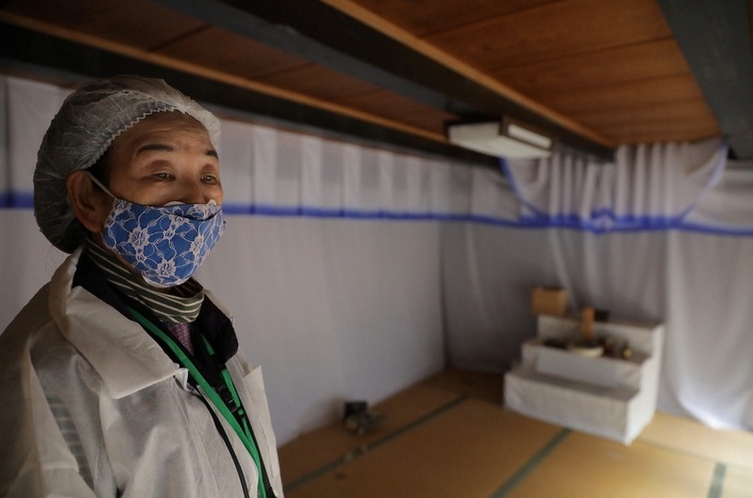
Yasuko Sasaki is seen at her house in the town of Namie, Fukushima Prefecture, on Feb. 1, 2021.
March 3, 2021
FUKUSHIMA — Yasuko Sasaki’s house lies just 30 kilometers away from the Fukushima Daiichi Nuclear Power Station, where a meltdown took place following the 2011 Great East Japan Earthquake and tsunami. On Feb. 1, Sasaki temporarily returned to clean up leaves that had fallen on the grave at the back of the property.
Once a month, the 66-year-old visits her house in the Tsushima district in the Fukushima Prefecture town of Namie from the prefectural village of Otama — 50 kilometers away — where she is currently evacuated to. It has been almost 10 years since she became unable to live at her own residence.
Due to high radiation levels, Tsushima was designated a “difficult to return” zone, where restrictions for entering are in place, and people are barred from living there. Homes without their owners living in them have been ransacked by wild animals. While Sasaki has been away, wild animals chewed up stuffed turtle and bird specimens kept at her house. She continues to clean her house so that she “can return at any time.”
In the grave are the bones of her husband Kenji, who died of illness at age 57 in February 2011, just before the disaster struck the area, her youngest son Shinji, who passed away at 21 due to cancer in August the same year, and her parents-in-law. Sasaki was born in Yokohama, south of Tokyo, and married her husband and moved to the Tsushima district when she was 33. The couple raised their two children in the house, using mountain stream water in everyday life and boiling the bath with firewood.
“The memories that I have of spending time together with my family are here and only here. I want to come home while I can move my body,” Sasaki explained. A calendar at her house still shows March 2011, when the earthquake and tsunami hit.
The Reconstruction Design Council in response to the Great East Japan Earthquake, an advisory panel to the prime minister, deemed that “recovery from the devastating disaster will not be completed until Fukushima soil recovers.” The government has set up Specified Reconstruction and Revitalization Bases within difficult-to-return zones and is carrying out decontamination work and developing infrastructure so that people can reside in the area once again. It aims to lift evacuation orders for the bases in between 2022 and 2023.
However, the areas designated as reconstruction bases are limited. In the Tsushima district, a 153-hectare space surrounding the town hall’s Tsushima branch is designated — just 1.6% of the whole district. Of the 532 households in the district at the time of the disaster, 80% including Sasaki’s house are not included in the reconstruction base area, and there are no prospects for these people to be able to return to their homes.
Sasaki said, “Everything’s still the same, even 10 years after the (nuclear) disaster. I wonder for how many more years I’ll have to continue cleaning (my house).”
https://mainichi.jp/english/articles/20210302/p2a/00m/0na/012000c
Japan undecided on timing, method of Fukushima water release

Storage tanks for treated contaminated water are seen at Fukushima Daiichi nuclear power plant in Okuma town, Fukushima prefecture.
March 3, 2021
Japanese authorities are undecided on how and when to discharge radioactive water from the devastated Fukushima nuclear plant into the sea or air, amid heightened environmental and public safety concerns from its neighboring countries, including South Korea.
“The exact timing on when the government will decide on the method and the period is yet to be decided,” said a Japanese government official Wednesday.
“We are still evaluating the situation. But it’s true that there are limits to the storage space of the tanks, and the government consider it as a task that cannot be delayed,” the official said, reiterating Tokyo’s stance to release the contaminated water, which has been filtered to reduce radioactivity.
The remarks came during a press briefing organized by the Japanese Embassy in South Korea, as next week marks the 10-year anniversary of the devastating earthquake and tsunami on March 11, 2011, that hit the Fukushima area and caused a meltdown of the three nuclear reactors. Attending the event was officials from the Agency for Natural Resources and Energy, Tokyo Electric Power, the state-run operator of the plant, and Japan’s Ministry of Foreign Affairs.
The liquid, which includes water used cool the power station, was contaminated after the nuclear disaster, and Tokyo has been pushing to release more than 1 million metric tons of treated water it has collected at the thousands of tanks at the site since 2011, as the storage capacity is set to run out by summer of 2022. But such a plan has sparked strong opposition and environmental worries among the public in both South Korea and Japan.
The water is being processed through the Advanced Liquid Processing System, or ALPS, to remove most of the dangerous radioactive materials, except for the traces of tritium, a radioactive substance which is still in the water — albeit at low level, according to Tokyo.
Last November, Japan was set to make a final decision on the water — either between disposing in the sea or vaporizing and releasing it into the air — as both were considered the most “realistic options,” but it has been delayed amid fierce backlash from local residents, the local fishery and agriculture industry and neighboring countries.
The authorities said that relevant decision will be made in consultation with local residents, industry personnel and neighboring countries through diplomatic channels. It also stressed it would carry out safety inspections of the release with the International Atomic Energy Agency, and provide transparent, scientific information to its neighbors as well.
If Japan decides to discharge the water, it will likely be dumped as early as summer of 2022 when the storage reaches full capacity.
But the official raised a possibility on the delay of the discharge, considering the filling up of the tank — which includes groundwater and rain that seeps into the plant — inside the storage has slowed down, due to relatively low precipitation in 2020.
“The period as to when the water will be completely filled will depend on the level of rain and typhoons this year,” the official said. “We will review the plan considering such situation.”
Farmers in Fukushima plant indigo to rebuild devastated town
March 2, 2021
MINAMISOMA, Japan — Because of radiation released by the Fukushima nuclear plant disaster a decade ago, farmers in nearby Minamisoma weren’t allowed to grow crops for two years.
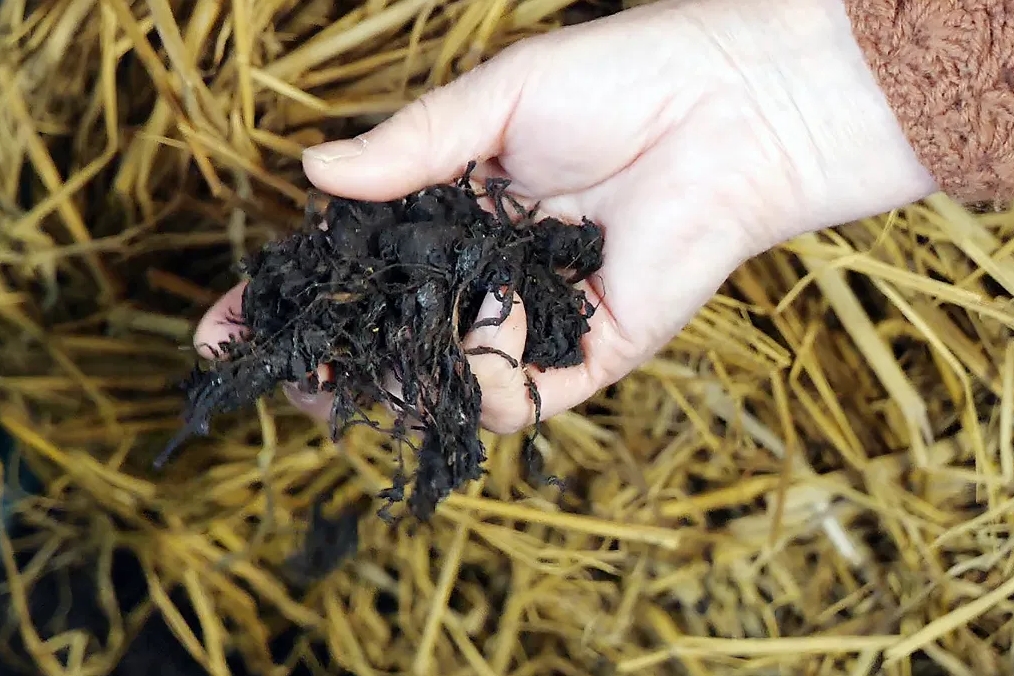
After the restriction was lifted, two farmers, Kiyoko Mori and Yoshiko Ogura, found an unusual way to rebuild their lives and help their destroyed community. They planted indigo and soon began dying fabric with dye produced from the plants.
“Dyeing lets us forget the bad things” for a while, Mori said. “It’s a process of healing for us.”
The massive earthquake and tsunami on March 11, 2011, caused three of the reactors at the nuclear plant to melt and wrecked more than just the farmers’ livelihoods. The homes of many people in Minamisoma, about 20 kilometers (12 miles) from the plant, were destroyed by the tsunami. The disaster killed 636 town residents, and tens of thousands of others left to start new lives.
Mori and Ogura believed that indigo dyeing could help people in the area recover.
Mori said they were concerned at first about consuming locally grown food, but felt safe raising indigo because it wouldn’t be eaten. They checked the radiation level of the indigo leaves and found no dangerous amount.
Ten years after the disaster, Mori and Ogura are still engaged in indigo dyeing but have different missions.
To Mori, it has become a tool for building a strong community in a devastated town and for fighting unfounded rumors that products from Fukushima are still contaminated. She favors the typical indigo dyeing process that requires some chemical additives.
But Ogura has chosen to follow a traditional technique that uses fermentation instead as a way to send a message against dangers of modern technology highlighted by nuclear power.
Mori formed a group called Japan Blue which holds workshops that have taught indigo dyeing to more than 100 people each year. She hopes the project will help rebuild the dwindling town’s sense of community.
Despite a new magnitude 7.3 earthquake that recently hit the area, the group did not cancel its annual exhibition at a community center that served as an evacuation center 10 years ago.
“Every member came to the exhibition, saying they can clean up the debris in their houses later,” Mori said.
Ogura, who is not a member of the group, feels that a natural process is important because the nuclear accident showed that relying on advanced technology for efficiency while ignoring its negative aspects can lead to bad consequences.
“I really suffered during the nuclear accident,” Ogura said. “We escaped frantically in the confusion. I felt I was doing something similar again” by using chemicals.
“We seek too much in the way of many varieties of beautiful colors created with the use of chemicals. We once thought our lives were enriched by it, but I started feeling that wasn’t the case,” she said. “I want people to know what the real natural color looks like.”
Organic indigo dyes take more time and closer attention. Ogura first ferments chopped indigo leaves with water for a month and then mixes the result with lye which is formed on the surface of a mixture of hot water and ashes. It has to be kept at about 20 degrees C (68 degrees F) and stirred three times a day.
Part of the beauty of the process, Ogura says, is that it’s hard to predict what color will be produced.
With the support of city officials, Ogura started making silk face masks dyed with organic indigo.
She used to run an organic restaurant where she served her own vegetables before the disaster, but now runs a guesthouse with her husband in which visitors can try organic indigo dyeing.
Just 700 meters (2,300 feet) from Ogura’s house, countless black bags filled with weakly contaminated debris and soil are piled along the roadside. They have been there since after the disaster, according to Ogura’s husband, Ryuichi. Other piles are scattered around the town.
“The government says it’s not harmful to leave them there. But if they really think it’s not harmful, they should take them to Tokyo and keep them near them,” he said.
The radiation waste stored in the town is scheduled to be moved to a medium-term storage facility by March next year, a town official said.
https://www.startribune.com/farmers-in-fukushima-plant-indigo-to-rebuild-devastated-town/600029579/
No recognition of administrative negligence after nuclear accident
March 1, 2021
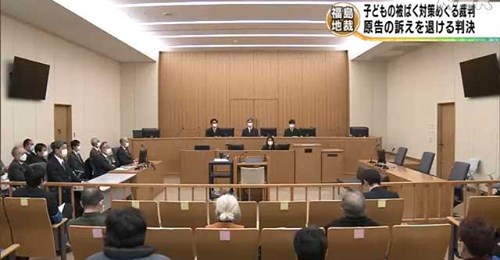
The Fukushima District Court has ruled against the plaintiffs in a lawsuit filed by parents and children who lived in the prefecture at the time of the accident at Tokyo Electric Power Company’s Fukushima No. 1 nuclear power plant, claiming that measures were not taken to avoid radiation exposure to their children.
One hundred and sixty parents and children who lived in the prefecture at the time of the nuclear accident were seeking 100,000 yen per person in damages from the government and the prefecture, claiming that they suffered mental anguish due to the lack of measures to avoid radiation exposure after the accident.
The plaintiffs, parents and children, claimed that they were exposed to unnecessary radiation and continue to suffer from health concerns, while the government and the prefecture countered that they were not exposed to unnecessary radiation.
In his ruling on March 1, Judge Toji Endo of the Fukushima District Court pointed out that the fact that the government did not immediately disclose the prediction of radioactive material diffusion calculated by the system called “SPEEDI” was “not unreasonable as it was in accordance with the operation method stipulated in the national guidelines at that time.
In addition, the court rejected the plaintiff’s claim that the government and the prefectural government did not immediately evacuate the children en masse, pointing out that “the indicators for evacuation in the disaster prevention guidelines at the time of the nuclear accident were standardized for children with high sensitivity to radiation and were reasonable in light of international standards.
This is the first time that a court has ruled on the government’s response to a nuclear accident, while most of the cases involving nuclear accidents hold the government responsible for the occurrence of the accident.
After the verdict was handed down, Sumio Konno, the representative of the plaintiffs’ group, said, “I am not convinced at all. What did the court examine? I thought it was an unfair judgment.
https://www3.nhk.or.jp/lnews/fukushima/20210301/6050013639.html?fbclid=IwAR2NhcNi11pOTolqGWmW0AWFc_kOBVS9oRQFCUjlMsjFmlargJGPncNYSwM
Decades-long challenge to scrap Fukushima plant by 2051 in a bind
March 1, 2021
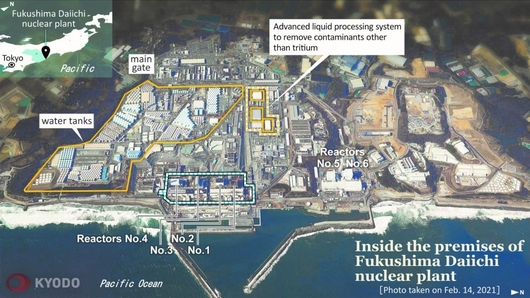
The decades-long challenge to scrap the Fukushima Daiichi nuclear plant, crippled by the massive earthquake and tsunami disaster that struck northeastern Japan in 2011, is becoming more complex as recent remote-controlled probes have highlighted just how damaged the reactors are.
Tokyo Electric Power Company Holdings Inc., operator of the six-reactor nuclear complex, aims to scrap the plant between 2041 and 2051. But critics have cast doubts on the schedule, citing not only the extremely high radiation levels, but problems associated with delayed probes and underdeveloped robots and other technology needed to extract an estimated nearly 900 tons of melted fuel debris.
Decommissioning of the plant, scene of the world’s worst nuclear accident since the 1986 Chernobyl disaster, is crucial for Japan if it wants to stick to using nuclear power safely and show the world that the nuclear crisis is under control.
“It is likely that the roadmap will not be completed as scheduled,” said Tetsuro Tsutsui, a member of the Citizens’ Commission on Nuclear Energy, a group comprising academics and nuclear experts.
He added the “melted debris is mixed with fractured parts of buildings and concrete material and is highly radioactive, making it hard for robots to clear the debris.”
The scrapping of the plant involves the daunting decision on how to dispose of the huge amount of radioactive waste left as a byproduct. This has been made worse as no municipality offered to become the final disposal site when the plant was operating.
Following a magnitude-9.0 earthquake and subsequent tsunami that hit the plant on March 11, 2011, Nos. 1 to 3 reactors at the Fukushima Daiichi plant suffered meltdowns, while hydrogen explosions damaged the buildings housing the Nos. 1, 3 and 4 reactors.
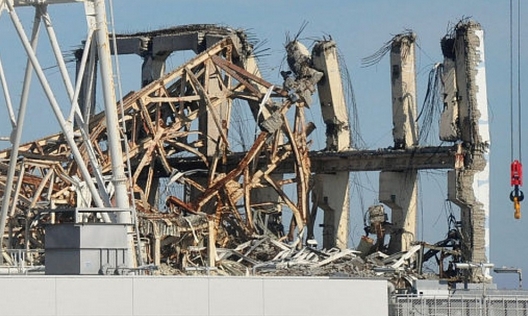
Photo taken on Nov. 12, 2011, shows the No. 3 reactor building at the Fukushima Daiichi nuclear power plant in Fukushima Prefecture, northeastern Japan, which was damaged by an explosion after the March 11 earthquake and tsunami.
Due to the instability of renewable energy, Japan projects atomic power will remain one of its major power sources, accounting for 20 to 22 percent of its total electricity generation in fiscal 2030. It may further push the emissions-free nuclear power as it aims to become carbon neutral in 2050.
Of the 33 reactors in Japan, excluding those set to be scrapped, just four are currently in operation, partly because they need to clear stricter safety regulations following the Fukushima accident.
Tsutsui, a former petrochemical complex engineer, points to how the risk of extracting debris has become “clearer” compared to when the roadmap was first compiled in December 2011. With that in mind, he urged the government to act responsibly and review the roadmap.
“Nearly 10 years have passed following the Fukushima accident but with respect to the long decommissioning process, we are still hovering around the start line. We have a long journey ahead,” said Fukushima Gov. Masao Uchibori in a recent briefing.
“The most difficult step is the safe and stable retrieval of the debris but we don’t know what state it is in,” he added.
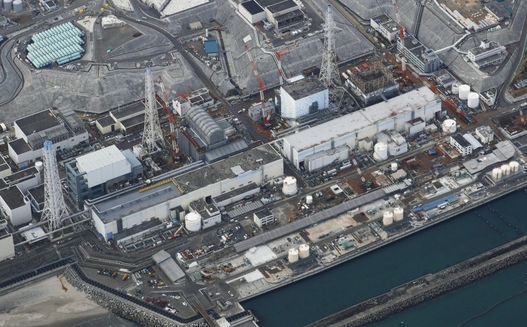
Fukushima Daiichi nuclear complex on Feb. 21, 2018. From right, No. 1, No. 2, No. 3 and No. 4 reactors.
Despite the use of computer simulations and small-scale internal probes using remote cameras, data is scarce about the exact locations and other details of the melted fuel — crucial information to determine the retrieval methods and develop the appropriate technology and robots.
Robotic probes at the Nos. 2 and 3 units have captured images of large amounts of material that appear to be melted fuel, but attempts so far have been unsuccessful at the No. 1 unit.
TEPCO opted to start the fuel removal at the No. 2 unit as it has the best grasp of the internal conditions there but no time frame has been set for the two other units.
In a setback for retrieval efforts, the company said in late December removing melted fuel from the No. 2 unit would be delayed from its initial starting period in 2021 by at least a year as the coronavirus pandemic has stalled the development in Britain of a robotic arm to be used for the extraction.
That robotic arm, however, can only extract a few grams of melted fuel debris at a time. To completely remove the hundreds of tons of melted fuel from the reactor larger machinery is required, experts say.
In another development that may affect the decommissioning process, a Nuclear Regulation Authority study group said in January a high concentration of radioactive cesium is likely to have accumulated in the lids of the containment vessels for the No. 2 and No. 3 reactors.
The regulator’s findings in a new interim report draft on the Fukushima accident came as a shock because it was previously believed that most of the radioactive material remained at the bottom of the reactors in the form of melted nuclear fuel debris.
While industry minister Hiroshi Kajiyama has acknowledged the “delays” and “difficulties in making predictions,” he insisted the overall decommissioning process is making “steady progress.” The government and TEPCO say they will stick to the current roadmap.
TEPCO, whose biggest shareholder is the Japanese government, has not given an estimate of the costs for the debris removal, which would add to the 8 trillion yen ($75 billion) already forecast for the decommissioning process.
The utility and the government have also been grappling with the buildup of radioactive water, which is generated in the process of cooling the meltdown reactors.
Part of the water is stored inside massive tanks set up inside the premises, having gone through a system that removes various radioactive materials except tritium, which is difficult to separate from water.
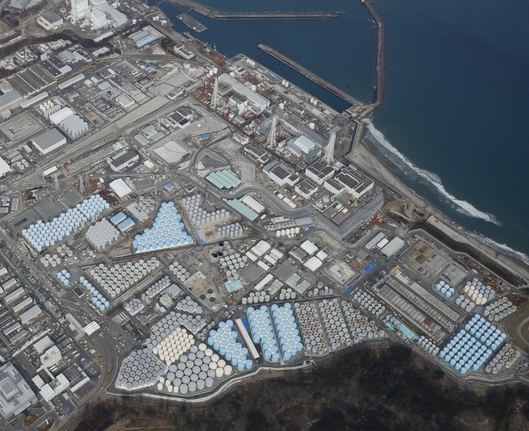
Tanks containing treated water including radioactive tritium are stored on the premises of the Fukushima Daiichi nuclear complex on Feb. 21, 2018.
The government is considering dumping the water into the Pacific after diluting it to a radiation level below the legal limit, saying the tanks are filling up. It says space is needed to store debris once it is extracted from the damaged reactors.
But discharging the water remains a sensitive issue especially for the local fishing industry struggling to revive its business following the accident. Neighbors South Korea and China as well as U.N. human rights experts have expressed caution about the discharge.
Releasing it into the ocean could lead to a continued ban on exports from this area or an introduction of new export restrictions, observers say.
According to Yasuro Kawai, another member of the commission, the government’s decision to release treated water into the sea is in fact the government’s attempt to minimize the impact of the Fukushima crisis and say dismantling work is on track.
“But the roadmap is nothing but pie in the sky,” he said.
The commission says it is more logical to keep the debris inside the reactors than to retrieve it and suggests constructing a shield around the reactors and postpone taking out the melted fuel until 100 years or 200 years later when radioactive activity levels have decreased.
1. Figures for the 10th anniversary of the Fukushima disaster: Fukushima Daiichi
An article from ACRO translated by Hervé Courtois
February 22, 2021
As we approach the tenth anniversary of the nuclear disaster at the Fukushima power plant, here is a numerical assessment based on the media, official sites and the 2,700 articles on this site. Updates will be made regularly.
Situation at the Fukushima Daiichi nuclear plant
The latest report from the Ministry of Industry on the progress of work at the Fukushima dai-ichi power plant dates from December 24, 2020 and was put online in English on January 28, 2021 (direct link https://www.meti.go.jp/english/earthquake/nuclear/decommissioning/pdf/mp202012.pdf).
See the damaged nuclear power plant
Two fixed webcams, installed in 2014, allow to have the nuclear power plant live. https://www.tepco.co.jp/en/hd/decommission/progress/about/livecamera/index-e.html
It is possible to take a virtual tour in English and Japanese of the Fukushima dai-ichi nuclear power plant (direct link : https://www.tepco.co.jp/en/insidefukushimadaiichi/index-e.html). But the images and documents do not seem to have been updated since February 2020. Some balance sheets date back to 2018.
As we have already reported, TEPCO has put online on its website (in Japanese and English : https://photo.tepco.co.jp/en/date/2020-e/202012-e/201222_01e.html) hundreds of aerial photos of the crashed Fukushima dai-ichi power plant taken in March 2011. Fukushima’s blog has extracted a selection of them from its website and has made a video montage of the 714 photos http://www.fukushima-blog.com/2020/12/photos-aeriennes-de-fukushima-daiichi-de-mars-2011.html. However, some of the photos are partially blurred, as if there was some secret, while unblurred aerial views are available since the very beginning of the disaster on the cryptome.org website.
Status of nuclear reactors
TEPCO has a digital timeline in English with the main events related to reactor safety and dismantling. https://www4.tepco.co.jp/en/decommissiontraject/index-e.html
The portal in English for dismantling works ; https://www.tepco.co.jp/en/hd/decommission/index-e.html
The page in English concerning the removal of fuel from swimming pools ; https://www.tepco.co.jp/en/hd/decommission/progress/removal/index-e.html
Reactor n°4
The vessel was empty on March 11, 2011 and there was no core meltdown, but a hydrogen explosion destroyed the reactor building. The hydrogen came from the neighboring reactor No. 3 via the common discharge stack.
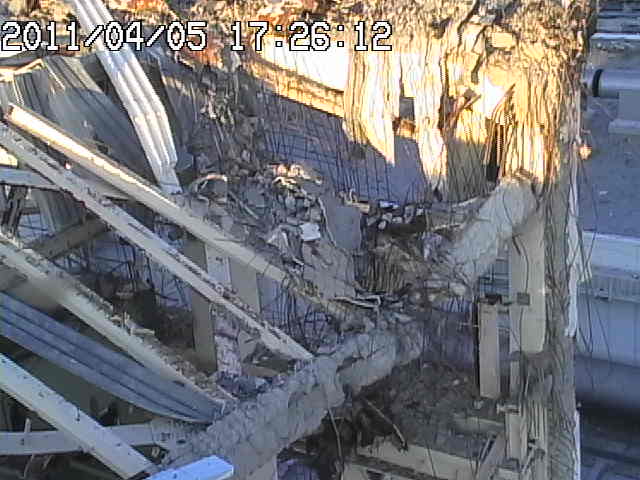
The upper part of the reactor building was dismantled, the debris removed, and a new structure was built to remove the fuel from the pool, which has been empty since December 2014. Since then, the work has been stopped because the reactor is no longer a threat.
The map with some ambient dose rate values dates from 2016. https://www4.tepco.co.jp/en/nu/fukushima-np/f1/surveymap/images/sv-u4-20160630-e.pdf
Reactor n°3
There was a core meltdown and a hydrogen explosion destroyed the reactor building. All the debris in the upper part of the building was removed with the help of remote-controlled devices. A new building with a cylindrical roof was constructed. The removal of fuel began in April 2019, four years later than originally planned. The operations proved to be more complicated than expected, but they completed by the end of February 2021.
There were 566 assemblies in the pool (52 new, all removed, and 514 used). Some were damaged by falling debris. TEPCO’s dedicated page is here in English https://www7.tepco.co.jp/responsibility/decommissioning/action/spent_fuel/unit3-e.html. A video presentation of the operations, here in English https://youtu.be/iTDuc4Gq-0c
There would be, in this reactor, between 188 and 394 tons of corium (a highly radioactive mixture of molten fuel and debris), with a nominal value of 364 tons. The latter contains MOX fuel, based on plutonium. TEPCO has estimated that the recovery of corium from two reactors 2 and 3 will take 12 years and cost 1,370 billion yen (11.5 billion euros). In 2017, TEPCO had published photos taken inside the containment of this reactor, under the vessel, and a video: https://photo.tepco.co.jp/en/date/2017/201707-e/170719-01e.html & https://youtu.be/nDsjwCdtzHM
Since September 2020, the Nuclear Regulatory Authority has resumed its investigations to understand the course of the triple nuclear accident at the Fukushima dai-ichi power plant. This includes visits to the accident reactors, despite the high ambient radiation levels. It has brought back videos:
– Including this one, of Unit 3 taken on September 18, 2020, which shows the dilapidated state of the reactor building, almost 10 years after the accident: https://youtu.be/2ogtUCOnQDg
– And of Unit 2 on October 8, 2020 : https://youtu.be/xgN2kCOrn9k
– And of Unit 1 on October 9, 2020 : https://www.youtube.com/watch?v=7KX-mmwh93c&list=PLmEL1pMVzxvfOzFQXY-josH28sjv1zACb
During these visits, the Nuclear Regulatory Authority discovered very high dose rates, of the order of 10 Sv/h, above the protection slabs of reactors 2 and 3 http://www.asahi.com/ajw/articles/14071742. A lethal dose in one hour on site. It estimates that the slab of Reactor 3 contains about 30 petabecquerels (1015 Bq) of cesium-137. This will complicate the dismantling work.
Reactor n°2
There was a core meltdown, but the reactor building is whole. Ambient radiation is particularly high in this reactor, making access to humans very difficult. A delegation from the Nuclear Regulatory Authority went to visit the interior of the reactor building for the first time since the accident, but it had to turn around prematurely because of the dose rates that reached 11 to 12 mSv/h on the fifth level. This would be due, in particular, to suspended radioactive dust, which is surprising after so many years. Even higher dose rates, of the order of 10 Sv/h, were measured above the protection slabs of reactors 2 and 3. The Regulatory Authority estimates that the slab of Reactor 2 contains about 20 to 40 petabecquerels (1015 Bq) of cesium-137.
TEPCO has not begun to remove spent fuel from the pool, which contains 615 assemblies. This is now planned around 2024 and 2026 because of the ambient dose levels in the reactor building. Images were published in June 2020 https://photo.tepco.co.jp/en/date/2020-e/202006-e/200610-01e.html

The company sent several robots into the containment to locate the corium, this mixture of molten fuel and debris. There would be between 189 and 390 tons of corium in this reactor, with a nominal value of 237 tons. For more information http://www.fukushimaminponews.com/news.html?id=739. Several series of images have been put online by the company. One clearly sees the corium and a fuel assembly element that has fallen to the bottom of the containment:

TEPCO had sent a robot in contact with the corium in February 2019. The images were impressive :
The authorities hoped to be able to begin the removal of the corium before the 10th anniversary. This was the goal set in December 2011. But the technology has yet to be developed and the ambitions had already been revised downwards in 2019: it was only a matter of recovering a few grams of corium from reactor No. 2 in 2021. In December 2020, TEPCO announced a delay of at least one year in the start of operations, officially due to the COVID-19 epidemic in the United Kingdom. The articulated arm of a robot, which must collect the corium, is being developed jointly by Veolia Nuclear Solutions in the United Kingdom and Mitsubishi Heavy Industries in Japan.
TEPCO dismantled half of the chimney common to Reactors 1 and 2, which was 120 m high https://photo.tepco.co.jp/en/date/2020-e/202004-e/200429-01e.html. The work turned out to be more complex than expected, in particular due to a calculation error on the height of the crane. The chimney being highly contaminated, the work was carried out by remote-controlled machines.
Reactor n°1
There was a core meltdown and a hydrogen explosion destroyed the reactor building. This building had been covered with a new structure in 2011, which was completely dismantled in November 2016 https://photo.tepco.co.jp/en/date/2016/201611-e/161110-01e.html. TEPCO began to remove the debris from the upper part of the reactor, and then rebuilt a new structure to empty the fuel pool. Since then, the company has not been very prolific about the progress of the work.
On the other hand, the removal of spent fuel from the pool of reactor No. 1 has been delayed: at best, it will be 2027, or even 2028. The first date envisaged for beginning this withdrawal was 2018… The cost of these operations has not been estimated because the company does not yet know how to go about it. In the meantime, TEPCO has covered this pool to protect it with air bags https://photo.tepco.co.jp/date/2020/202006-j/200611-01j.html:
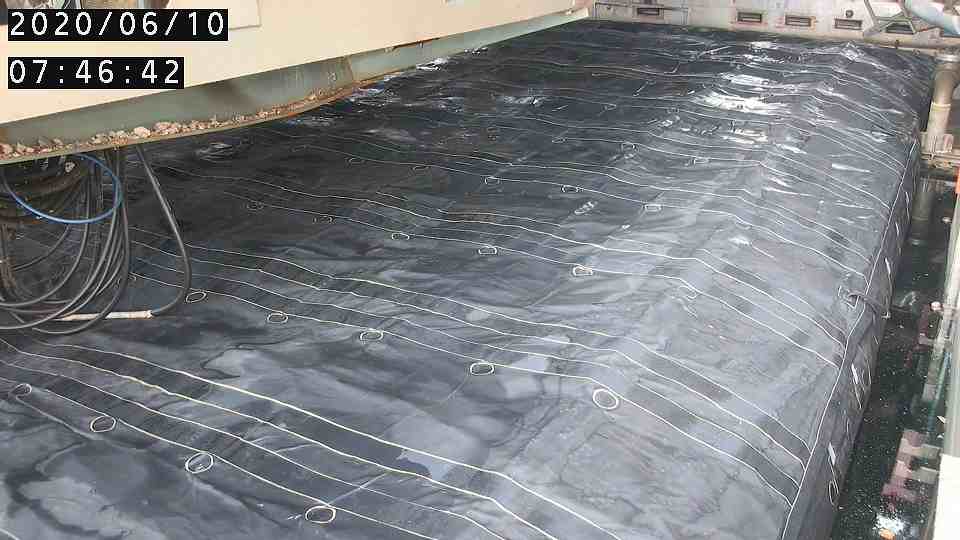
The hydrogen explosion fractured the concrete slab 12 m in diameter and 60 cm thick which is particularly contaminated in reactors 2 and 3. Very high dose rates had been recorded in 2017, up to 2.2 Sv/h, i.e. a lethal dose in a few hours on site. For the broken slab of reactor No. 1, there would be “only” about 0.16 petabecquerels of cesium-137.
There would be between 232 and 357 tons of corium in this reactor, with a nominal value of 279 tons. For more information: http://www.fukushimaminponews.com/news.html?id=739
Réacteurs 5 et 6
Les réacteurs 5 et 6 étaient arrêtés et partiellement déchargés le 11 mars 2011. Comme un générateur diesel de secours était encore fonctionnel, cela a permis d’éviter la fusion du cœur. Ces réacteurs sont maintenant entièrement déchargés et vont être démantelés.
Contaminated water
In 2011, the water injected to cool the reactors ended up overflowing and causing the greatest marine radioactive pollution in history. In April 2011, it was the contaminated water from Reactor No. 2 discharged into the sea via an underground gallery. And, in May 2011, it was the turn of Reactor No. 3.
TEPCO estimated that 520 m3 of highly radioactive water, or 4,700 terabecquerels (1 terabecquerel represents one million million becquerels) or 20,000 times the annual discharge authorization, was released in April. More precisely, there were 2,800 terabecquerels of iodine-131, 940 terabecquerels of cesium-134 and as many of cesium-137. This release alone would deserve to be classified at level 5 or 6 on the international INES scale. The IRSN had estimated that it was 20 times higher.

The year 2013 was marked by a series of scandals following the late discovery of a leak from a contaminated water tank and discharges into the sea. The authorities reacted and the Prime Minister of the time had declared before the International Olympic Committee that the situation was under control. In 2021, the situation is still not under control and the Olympics could be cancelled because of the pandemic…
The other major challenge facing TEPCO is the contaminated water that continues to accumulate.
Summary of the situation
Fuel that has melted and pierced the tanks must always be cooled. To this end, TEPCO injects about 70 m3 of water per day into each of reactors 1, 2, and 3 (see the balance sheet dated February 8, 2021 https://www.tepco.co.jp/en/hd/decommission/information/newsrelease/watermanagement/pdf/2021/watermanagement_20210208-e.pdf). This water becomes highly contaminated on contact with the molten fuel and seeps into the basements of the reactor and turbine buildings where it mixes with the water from the water tables that seeps in.
After the strong earthquake of February 13, 2021 https://fukushima.eu.org/fort-seisme-a-fukushima-pas-dalerte-au-tsunami/, TEPCO noticed that the level of water in the containments of reactors 1 and 3 had dropped https://www.tepco.co.jp/en/hd/newsroom/announcements/archives/2021/20210214_01.html.

The cracks have probably widened and the company may be forced to increase the injected flow rate. For Reactor 2, it is not known because the sensors were removed to prepare for the removal of the corium.
At the beginning of the disaster, underground infiltrations amounted to about 400 m3 per day and this contaminated water had to be stored in tanks. Conversely, the water in the basement, heavily contaminated, leaked to the water table and then to the ocean.
To reduce groundwater infiltration, TEPCO pumps into the water table upstream of the reactors, before this water is contaminated and releases it directly into the ocean. It has also built a barrier along the entire coastline and also pumps groundwater at the foot of the reactors. Some of this water is partially decontaminated and released into the ocean. Another part, too contaminated, is mixed with the water pumped from the basements of the reactors to be put into tanks after treatment, while waiting for a better solution. This flow is of the order of 5 m3/d according to the report dated February 8, 2021 https://www.tepco.co.jp/en/hd/decommission/information/newsrelease/groundwaterdrain_transition/pdf/2021/groundwaterdrain_20210208-e.pdf (between 3 (source https://www.tepco.co.jp/en/hd/decommission/information/newsrelease/groundwaterdrain_transition/pdf/2021/groundwaterdrain_20210118-e.pdf) and 8 m3/d (source https://www.tepco.co.jp/en/hd/decommission/information/newsrelease/groundwaterdrain_transition/pdf/2021/groundwaterdrain_20210107-e.pdf) in the previous reports available here https://www.tepco.co.jp/en/hd/decommission/information/newsrelease/groundwaterdrain_transition/2021-e.html).
The last barrier put in place is the freezing of the ground all around the 4 accident reactors, over 1.4 km in order to stop infiltration. After many setbacks, the frost has been over since November 2017. It has reduced the infiltrations, but not stopped them. The implementation of the frozen wall cost taxpayers 34.5 billion yen (265 million euros) to which must be added more than a billion yen (8 million euros) per year for electricity.

Since then, infiltration has been less than 100 m3/d (see the balance sheet of February 8, 2021 https://www.tepco.co.jp/en/hd/decommission/information/newsrelease/groundwaterdrain_transition/pdf/2021/groundwaterdrain_20210208-e.pdf), except in the case of heavy rainfall.
Flows and stocks
TEPCO pumps the water contained in the basements of the reactor and turbine buildings of the 4 accident reactors to avoid overflows. As this water is highly contaminated, it is treated and then stored in tanks on the power plant site. Some of it is re-injected for cooling. Here is the water circuit at the Fukushima daï-ichi power plant, as represented by TEPCO https://www.tepco.co.jp/en/hd/decommission/information/newsrelease/watermanagement/document-e.html:

The last one of February 8, 2021 reports a surplus to be stored of 90 m3/d https://www.tepco.co.jp/en/hd/decommission/information/newsrelease/groundwaterdrain_transition/pdf/2021/groundwaterdrain_20210208-e.pdf. It rose to more than 350 m3/d in the fall of 2020 and even 600 m3/d when the typhoons passed in October 2019. In 2019, the Ministry of Industry reported an increase in water storage from 50,000 to 60,000 m3/d per year (source https://www.meti.go.jp/english/earthquake/nuclear/decommissioning/pdf/20200203_current_status.pdf). Here it appears that it has accumulated 1.243 million cubic meters of contaminated water TEPCO has a dedicated portal for treated contaminated water https://www.tepco.co.jp/en/decommission/progress/watertreatment/index-e.html# . There are 1061 tanks on the power plant site, 1018 of which contain water treated by the ALPS plant. In another 29 tanks there is water where only caesium and strontium have beenn “filtered”. There is also about 4,800 m3 of untreated water in the basements of the reactors (as of February 8, 2021 https://www.tepco.co.jp/en/hd/decommission/information/newsrelease/watermanagement/pdf/2021/watermanagement_20210208-e.pdf).
TEPCO estimates that it will no longer have room on the site of its power plant to put in new tanks from 2022. The preferred option is discharge into the sea.
What to do with this treated water?
After considering several unrealistic options, the authorities are gradually restricting the options to the discharge of treated water into the ocean, which is not a surprise. Prior to any treatment, the balance sheet shows a concentration of 65 MBq/L in the pumped water https://www.tepco.co.jp/en/hd/decommission/information/newsrelease/watermanagement/pdf/2021/watermanagement_20210208-e.pdf.
With its ALPS station, TEPCO then removes 62 radioelements. And, officially, only tritium (radioactive hydrogen) remains in this water, because it is difficult to remove it. Since this element is released by all nuclear facilities, there must have been more problems, except for a few bad rumors …
However, as discovered in September 2018 , a large portion of the stock (currently about 72%) has not been adequately treated, and residual concentrations for some elements exceed the maximum concentrations allowed for discharge at sea https://www.japantimes.co.jp/news/2018/08/19/national/alps-system-fukushima-no-1-plant-failing-remove-tritium-toxic-cooling-water/.
The chart below, taken from the TEPCO portal shows that for 6% of the stock, the residual contamination for 7 major radioelements is 100 times higher than what is allowed for discharge https://www4.tepco.co.jp/en/decommission/progress/watertreatment/index-e.html. It is between 10 and 100 times for 15% of the stock.
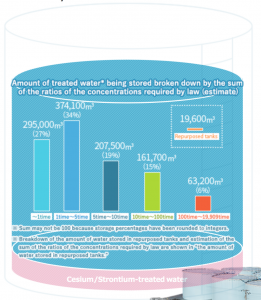
Repurposed tanks” are tanks that contained partially treated contaminated water, where only strontium-90 had been removed. This water having been treated, the tanks are reused for water fully treated by the ALPS plant. But, as explained by TEPCO in this document (https://www4.tepco.co.jp/en/decommission/progress/watertreatment/images/200827.pdf), there was still sludge at the bottom of the tank which significantly raised the contamination of the water! These tanks are therefore counted separately in the above chart.
TEPCO is committed to treating a second time the water that exceeds the discharge authorizations and has started tests in September 2020. And it was only then that the company recognized that there were other radioelements that were not removed, such as carbon-14 https://fukushima.eu.org/wp-content/uploads/2020/09/200910.pdf. This element was never measured or mentioned in the results published by the company, without disturbing the Japanese nuclear regulatory authority or the IAEA, which ruled on the management of contaminated water https://www.iaea.org/newscenter/pressreleases/iaea-reviews-management-of-water-stored-at-fukushima-daiichi-nuclear-power-station. However, carbon-14 will not be removed for all that…
Tests conducted by TEPCO show that the process can lower the residual concentration of contaminated water below the release thresholds, with the exception of tritium https://www.tepco.co.jp/en/decommission/progress/watertreatment/images/201116.pdf. In fact, this is not really a novelty, since part of the stock had already been properly treated. The high residual contaminations were due to bad practices (economy on ion exchange resins, poor monitoring…). TEPCO offers no guarantee that its practices will improve and the Japanese government refuses any independent measurement of the water it wishes to discharge into the ocean http://www.tepco.co.jp/en/decommission/progress/watertreatment/images/tankarea_en.pdf.
Tritium contamination, which is not removed, is, on average, 730,000 Bq/L and thus exceeds the maximum allowable concentration for ocean discharge, which is 60,000 Bq/L. TEPCO therefore wants to dilute this water before discharge to one-fortieth of the limit, i.e. 1,500 Bq/L. In addition, the inventory of tritium in the tanks would be 860 TBq, which is well above the annual discharge limit of 22 TBq. TEPCO therefore wants to spread its releases over about 30 years to meet this limit https://www7.tepco.co.jp/wp-content/uploads/handouts_200324_01-e.pdf.
By way of comparison, the authorization to discharge tritium into the sea at Areva’s La Hague plant is 18,500 TBq for tritium alone, and actual discharges in recent years have varied between 11,600 and 13,400 TBq per year http://www.areva.com/activities/liblocal/docs/BG%20aval/Recyclage/La%20hague/2015/Rapport-environnement-LH-2014.pdf. The stock of tritium in the Fukushima tanks therefore represents two and a half weeks of discharges at La Hague. The total stock, with what remains in the fuels, is two months… This is enough to make the Japanese authorities jealous, and they are happy to point out the tritium releases from many other nuclear installations around the world (page 13 of this report from the Ministry of Industry https://www.meti.go.jp/english/earthquake/nuclear/decommissioning/pdf/20200210_alps_sum.pdf):
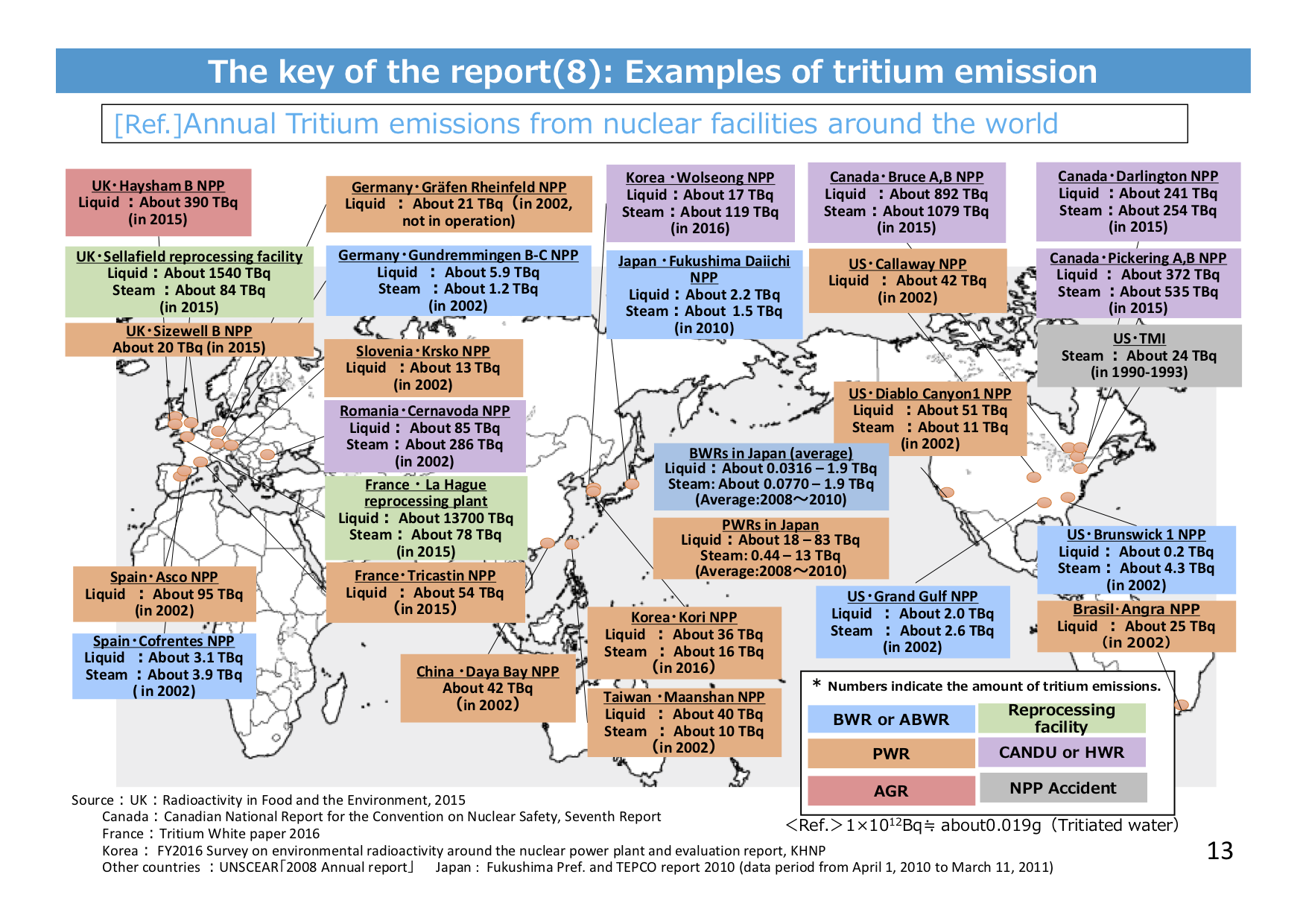
This map does not mention any releases in Japan! In particular, it does not mention the expected discharges from the Japanese reprocessing plant at Rokkashô-mura. The target value there is 9,700 TBq per year for tritium (source http://kakujoho.net/npt/tritm6f.html#ref1). But, the plant has never started…
This was not enough to convince the people of Fukushima, who are, for the most part, opposed to dumping in the ocean. By June 2020, 17 municipalities in Fukushima had also taken a stand against it http://www.fukushimaminponews.com/news.html?id=1013, as had the fishing industry https://fukushima.eu.org/lindustrie-de-la-peche-a-fukushima-fermement-opposee-au-rejet-en-mer-de-leau-partiellement-decontaminee/. Even Baskut Tuncak, UN Special Rapporteur since 2014 on the human rights implications of the environmentally sound management and disposal of hazardous substances and wastes, took part in a panel discussion. During the public consultation, 4,011 opinions were tabled and almost all were opposed to the rejection. As a result, the government decided to postpone announcing its decision http://www.asahi.com/ajw/articles/13866474.
On January 28, 2021, the Japanese Ministry of Industry opened a special page dedicated to the management of the water treated by the ALPS plant https://www.meti.go.jp/english/earthquake/nuclear/decommissioning/atw.html, which is less detailed than its last report dated December 2020 https://www.meti.go.jp/english/earthquake/nuclear/decommissioning/pdf/mp202012.pdf. A photo of this water is available on this page:

Feeling better?
8% of Japanese consumers still hesitate to buy Fukushima food products
At their own risk and peril. There is no acceptable safe threshold when it comes to radioactive contamination.
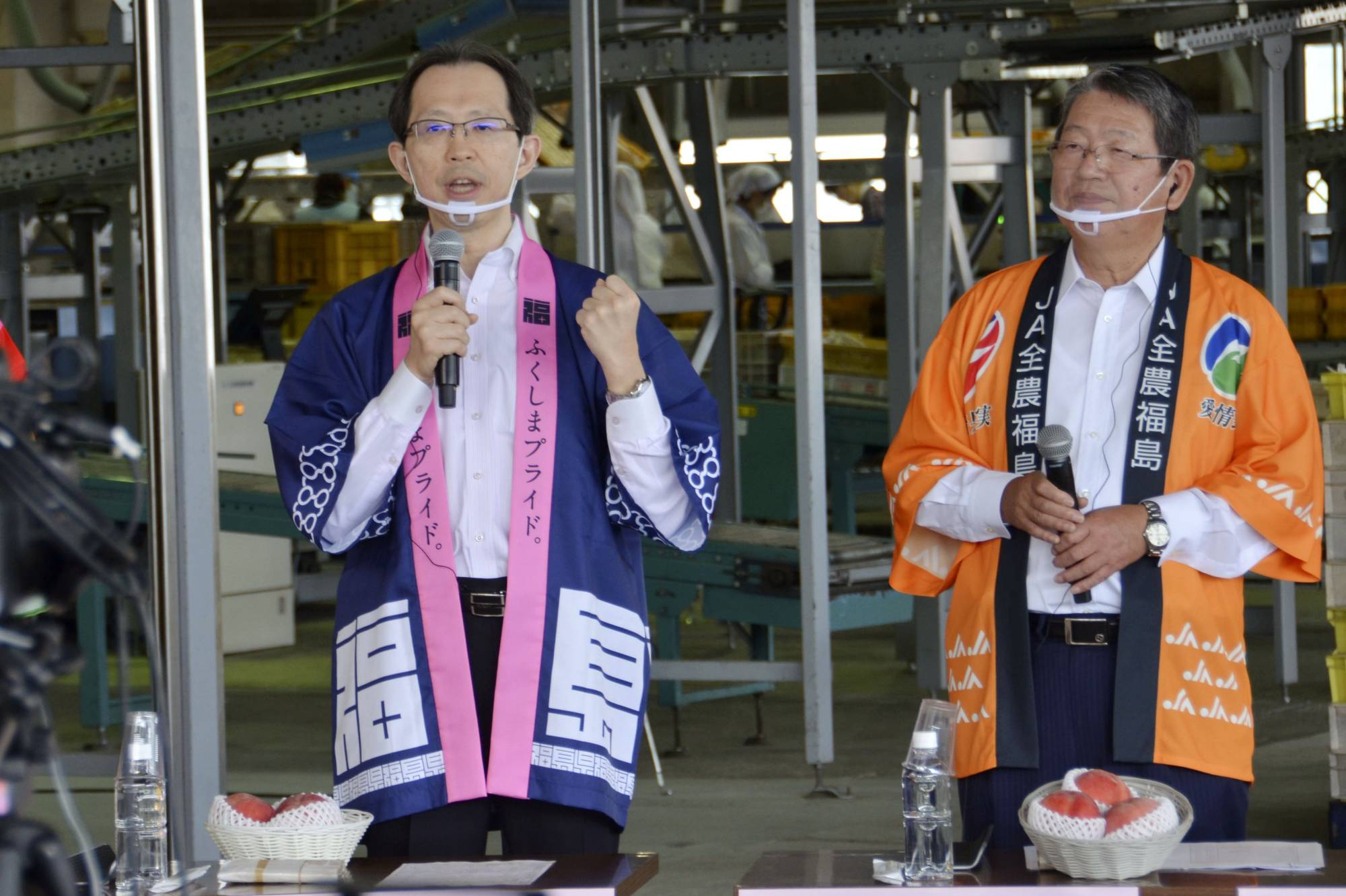
Fukushima Gov. Masao Uchibori (left) promotes peaches from the prefecture in the city of Fukushima in July.
Feb 28, 2021
About 8.1% of consumers in Japan still hesitate to buy food products from Fukushima Prefecture almost 10 years after the March 2011 nuclear disaster, a survey by the Consumer Affairs Agency has shown.
Although the figure is the lowest since the survey started in February 2013, the finding is “very regrettable,” Shinji Inoue, minister for consumer affairs and food safety, said after the survey was released Friday. “Safety has been secured” for produce from Fukushima, he added.
The latest survey, the 14th of its kind, was carried out online on Jan. 15-19, with answers received from 5,176 people in their 20s to 60s mainly in the Tokyo metropolitan area.
The share of respondents who hesitate to buy food products from Fukushima has been on the decline since hitting 19.6% in the August 2014 survey, and fell below 10% for the first time in the latest survey.
Fukushima is home to Tokyo Electric Power Company Holdings Inc.’s Fukushima No. 1 plant, the site of the triple meltdown disaster triggered by the Great East Japan Earthquake and tsunami.
According to the survey, the share of respondents who hesitate to buy food products from Iwate, Miyagi or Fukushima prefectures dropped to a record low of 6.1%, down from 6.4% in the previous poll in February 2020. The three prefectures were hit hardest in the disaster.
A record high 62.1% of respondents said they do not know that checks for radioactive substances have been conducted on food products from disaster areas. The figure has been rising since standing at 22.4% in the first survey.
An official said the agency will continue efforts to not only boost the share of people who are aware of radiation checks but also offer all of the information available about radioactive substances in food products.https://www.japantimes.co.jp/news/2021/02/28/national/fukushima-products-survey/
Tepco finishes nuclear fuel removal from Fukushima reactor pool
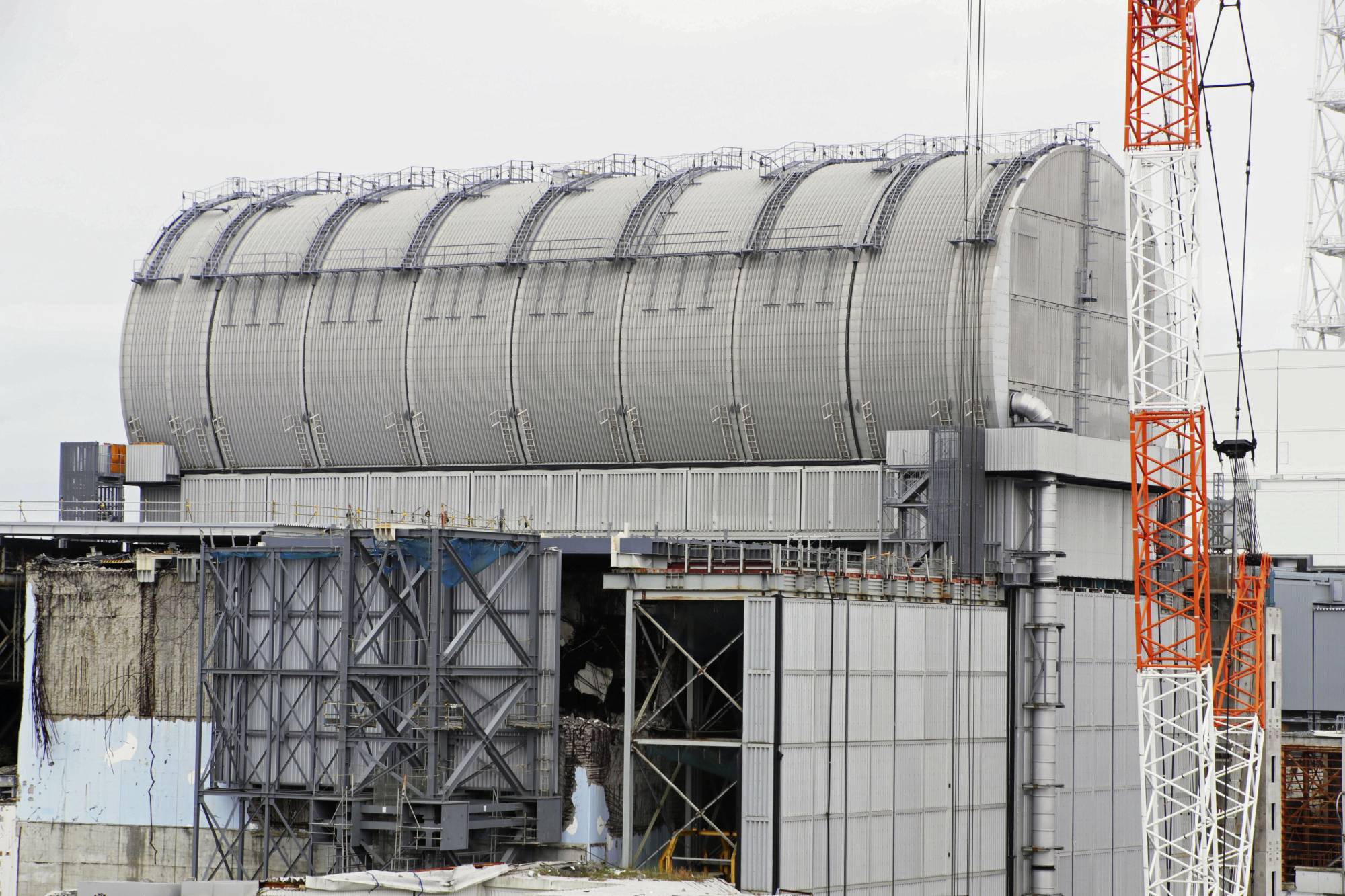
The Fukushima No. 1 nuclear plant’s No. 3 reactor
Feb 28, 2021
Tokyo Electric Power Company Holdings Inc. said Sunday it has removed all 566 nuclear fuel assemblies from the spent fuel pool of the No. 3 reactor at its Fukushima No. 1 plant.
It is the first time that fuel removal has been completed for any of the three reactors that suffered meltdowns in the March 2011 accident at the plant in Fukushima Prefecture.
The fuel removal operation at the No. 3 reactor began in April 2019.
On Sunday, the company using remote control devices moved the last six assemblies to a common storage facility within the plant premises. A large covering was placed over the upper part of the No. 3 reactor building to prevent radioactive substances from being scattered.
Tepco planned to start the fuel removal from the No. 3 reactor building as early as late 2014, but delayed the schedule repeatedly as it faced difficulty getting rid of debris left by the explosion in the building.
The operation also took more time than expected due to machinery malfunction issues.
The removal of 1,533 fuel assemblies from the No. 4 reactor building was completed in December 2014.
Tepco aims to finish pulling all fuel assemblies out of other reactor buildings by the end of 2031, including the No. 1 building, where a lot of debris is scattered about, and the No. 2 building, where radiation levels are particularly high.https://www.japantimes.co.jp/news/2021/02/28/national/tepco-fukushima-no-1-radiation-3-11-tsunami-earthquakes-fukushima/
All spent fuel finally removed from reactor at Fukushima plant

Steel frames remain exposed on the wall facing north at the No. 3 reactor building at the Fukushima No. 1 nuclear plant, showing the impact from a hydrogen explosion in March 2011.
February 28, 2021
Hazardous work to remove all spent nuclear fuel from a reactor storage pool at the crippled Fukushima No. 1 nuclear plant was finally completed Feb. 28, Tokyo Electric Power Co. said.
It marked the first time for any of the storage pools at the three stricken reactors to be emptied out, and came less than two weeks before the 10th anniversary of the triple meltdown at the nuclear complex in Fukushima Prefecture northeast of Tokyo.
The two-year effort involved the removal of all the 566 spent fuel units left in the pool in the No. 3 reactor’s building.
Completion of the removal work at the No. 3 reactor building, severely damaged by a hydrogen explosion during the meltdown, eased concerns about the overall safety of the embattled plant.

The No. 3 reactor’s storage pool is situated on an upper floor of the building, posing a danger due to fears of another powerful earthquake damaging the structure and jeopardizing TEPCO’s ability to cool them.
Spent fuel needs to be kept cool as it emits high levels of radiation and decaying heat.
The utility planned to move the spent fuel from the No. 3 reactor’s pool to a shared pool for storage on the grounds of the plant to ensure the spent fuel can be safely managed.
The removal work got under way in April 2019 after rubble and other debris were cleared away. A special crane with a robotic arm was used to lift the spent fuel.
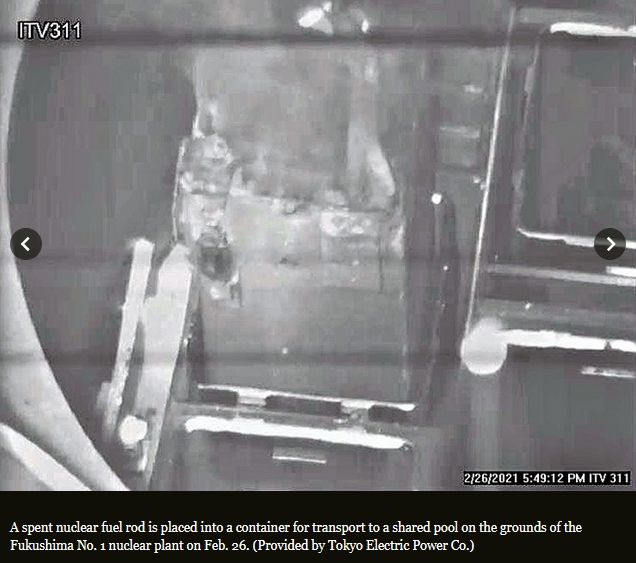
Operators worked remotely during the removal process from an operational center 500 meters away because of high radiation readings inside the reactor building.
The work was marred by a flurry of malfunctions in the equipment and the crane soon after the project got started.
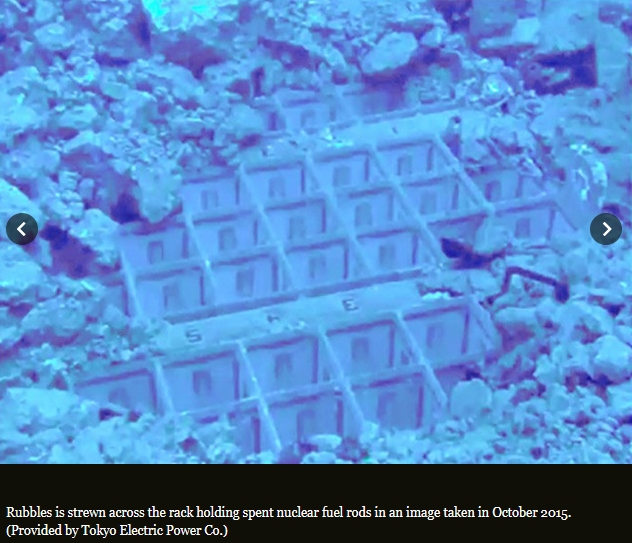
The challenge was further complicated by rubble and debris in the pool that distorted the handles of some of the spent fuel units.
During the last stretch of the removal work, operators picked up the pace by working in shifts around the clock.
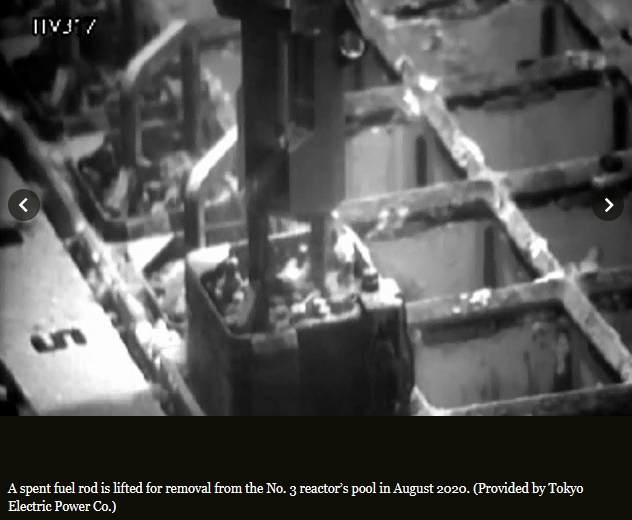
The remaining six units were transferred to the shared pool on Feb. 28. The development came roughly three years after the government and TEPCO announced an initial roadmap for the work in December 2011.
The removal of spent fuel from the No. 4 reactor building was completed in late 2014. The No. 4 reactor had been shut down for maintenance prior to the disaster triggered by the Great East Japan Earthquake and tsunami in 2011.
With regard to the No. 1 and No. 2 reactors, which went in meltdown after the quake and tsunami disaster knocked out cooling systems, a combined 1,000 spent fuel units remain in their storage pools.
TEPCO is aiming at starting the removal work at the two reactors in fiscal 2024 or beyond.
Apart from the spent fuel, 800 to 900 tons of melted nuclear fuel remain in the No. 1 through No. 3 reactors.
INTERVIEW: Kan Had Not Assumed Nuclear Accident before 2011

Februay 27, 2021 Tokyo, Feb. 27 (Jiji Press)–Looking back at the March 2011 nuclear accident, former Japanese Prime Minister Naoto Kan said he had thought that a nuclear accident would never occur in Japan and admitted that he was wrong in the assumption.
“Before the disaster, I had thought that a nuclear accident would not take place, but I was wrong,” Kan, a lawmaker of the main opposition Constitutional Democratic Party of Japan, told Jiji Press in a recent interview. “(Japan) should scrap all nuclear plants,” he said.
“I feel grave responsibility for the death of many elderly people and people suffering illnesses when they took refuge in the early stages of the accident,” said Kan, who was prime minister at the time of the triple meltdown accident at Tokyo Electric Power Company Holdings Inc.’s <9501> Fukushima No. 1 plant, stricken by the March 2011 earthquake and tsunami.
“The biggest problem” that the government faced in addressing the nuclear accident was that “correct information did not come” from TEPCO, the former Nuclear and Industrial Safety Agency or the former Nuclear Safety Commission.
On his much-criticized visit to the stricken plant in Fukushima Prefecture, northeastern Japan, on the day after the accident, Kan said he made the visit as he thought that he would not be able to capture the situation at the plant. https://jen.jiji.com/jc/eng?g=eco&k=2021022700560
Fukushima disaster: Is TEPCO nuclear plant still a safety risk?
Ten years after the Fukushima nuclear disaster, the Tokyo Electric Power Co. has been criticized for failing to learn safety lessons.

A seismograph at the Fukushima Daiichi plant malfunctioned during a recent earthquake
Februay 26, 2021
Tokyo Electric Power Company (TEPCO), the operator of the Fukushima Dai-ichi nuclear power plant, is facing renewed criticism that it has failed to learn the lessons of the 2011 disaster there.
Next month marks the 10-year anniversary of the massive earthquake and tsunami that caused meltdowns in three nuclear reactors.
Opponents of nuclear power and other civic groups are calling for greater transparency in TEPCO’s operations. They cite a number of issues as evidence that TEPCO is still falling short of its responsibilities, including a significant security breach recently at one of the company’s plants.
It was discovered in early February that an employee at TEPCO’s Kashiwazaki-Kariwa nuclear plant in northern Japan had used a colleague’s identity card to enter the central control room after misplacing his own pass.
The incident, which happened five months earlier, was not reported to the Nuclear Regulation Authority (NRA) until a quarterly meeting in late January on the grounds that it was not considered a major breach of security.
The NRA disagreed and concluded that the unauthorized entry by the worker into the nerve center of the plant “affected security.” TEPCO was ordered to make improvements.
Fukushima’s earthquake problem
The fallout from that incident was worsened after a serious earthquake on February 13 shook northeast Japan, including the Fukushima nuclear plant.
Seismologists said the magnitude 7.3 tremor was the largest to strike Japan since April 2011 and was actually the latest aftershock from the Great East Japan Earthquake nearly a decade ago.
TEPCO admitted a short while later that seismometers installed in two of the reactor buildings broke down last year and had not been repaired.
In addition, a report to the NRA confirmed that the earthquake caused radioactive water to slosh over the edges of containment tanks at the site, while the water level around two of the reactors has fallen.
That could indicate that the tremor enlarged existing fissures in the surrounding concrete or created new ones, enabling the escape of water that is needed to keep the reactors cool and prevent the release of more radioactivity into the atmosphere.
A hard-hitting editorial in the Asahi newspaper after the security breach at the Niigata plant said the incident “raised doubts” about TEPCO’s “fitness to operate nuclear power plants.”
“The utility must thoroughly reexamine every conceivable issue and raise its workers’ safety awareness to prevent missteps, once and for all,” it added.
In a statement issued to DW, TEPCO said it was “addressing” the issue of the malfunctioning seismometers, which may have failed in July due to heavy rain.
“We are now working to restore the system as soon as we can,” the company said.
TEPCO excuses ‘not acceptable’
Hajime Matsukubo, secretary general of the Tokyo-based Citizens’ Nuclear Information Centre, said the excuses of a company charged with decommissioning four damaged reactors that caused the second-worst nuclear disaster in history are “not acceptable.”
“The way that the company is managing things suggests to me that they have not learned their lessons from the March 2011 disaster,” he said.
This 2011 TV image shows the aftermath of an explosion at the plant
“TEPCO says it is ready, for example, to resume operations at the Kashiwazaki-Kariwa plant, but now we have this very serious security breach,” he added.
“I agree that the company has made great strides with the technology that is being developed to contain the situation at the Fukushima plant and to decommission those damaged reactors, but there are too many human errors creeping into their operations,” said Matsukubo.
“They cannot fully manage these sites and, I would say, they do not have the capabilities to manage nuclear facilities.”
Azby Brown, lead researcher for the nuclear monitoring organization Safecast Japan, agrees that the company has made progress in the decommissioning work, but says that errors keep cropping up.
“A lot of things they are doing very well, because this is a hugely challenging operation, so we have to give them credit for that, but there are still some gaping holes that management really needs to plug if they want to begin to rebuild public trust,” he said.
“They have all the appropriate security regulations in place, but then we see things like this happening,” he said. “It’s almost as if there is an institutional allergy to transparency and informing the regulators immediately a problem occurs and then addressing that problem. And that is not helping their reputation at all.”
Increase in radiation
The company’s errors have immediate implications, he says, as monitoring equipment installed at sea off the plant detected a small increase in highly radioactive caesium in the days after the earthquake, indicating that water had indeed escaped from the site and was dispersing into the ocean.
And that coincided with the announcement that a black rockfish caught off the prefecture by a fishermen’s collective had caesium levels five times above the government’s permitted levels.
Local fishermen, whose livelihoods were devastated by the nuclear accident, have been carrying out limited test fishing since June 2012 and had been hoping this year to resume small-scale shipments of fish to market if they were able to prove to inspectors that all the fish being caught were safe to consume.
The revelations surrounding TEPCO’s latest problems is unlikely to reassure the public that produce from much of northeast Japan is safe to buy.
https://www.dw.com/en/fukushima-disaster-is-tepco-nuclear-plant-still-a-safety-risk/a-56713519
Last 6 assemblies Stored in Containers; Nuclear Fuel Removal from Unit 3 Pool at Fukushima Daiichi Nuclear Power Plant to End

Nuclear fuel being lifted by a fuel handling machine. A monitor screen shows a lot of small debris in the pool, at Tokyo Electric Power Co.’s Fukushima Daiichi Nuclear Power Plant in Okuma, Fukushima Prefecture, April 15, 2019.
February 26, 2021
The Tokyo Electric Power Company (TEPCO) stored the last six nuclear fuels in special containers in the spent fuel pool at the Unit 3 reactor of the Fukushima Daiichi Nuclear Power Plant on April 26. Although the work began in April 2019, it will be completed earlier than the target of the end of March 2021. A total of 566 nuclear fuels, 514 spent and 52 unused, were stored in the pool. (Shinichi Ogawa)
This is the second reactor to have nuclear fuel removed from its spent fuel pool, following the Unit 4 reactor (1,535 nuclear fuels) which finished in December 2014. This is the first time for Units 1-3, which suffered a core meltdown (meltdown).
The initial plan was to start removing the nuclear fuel from the Unit 3 reactor by the end of 2002, but the high radiation dose became a barrier to the work. A dome-shaped cover was installed on top of the building to prevent radioactive materials from spreading outside. TEPCO had indicated plans to start removing the radioactive materials in November 2006, but due to a series of problems with cranes and other equipment, the work was postponed for inspection and replacement of parts.
According to the plan presented by the government and TEPCO, the removal of nuclear fuel from the pool is scheduled to start in FY2015-28 for Unit 1 (392 nuclear fuels) and in FY2012-26 for Unit 2 (615 nuclear fuels).
Radiation criteria sow confusion for evacuees

Workers decontaminate a road in a special reconstruction district in the town of Futaba, Fukushima Prefecture, in October. | FUKUSHIMA MINPO
February 26, 2021
Traffic was lighter on the Joban Expressway in the Futaba district in Fukushima Prefecture during the New Year holiday, with people avoiding traveling back to see their relatives due to the novel coronavirus pandemic.
Roadside signs show the radiation levels of areas near the no-go zones put in place after meltdowns in 2011 at the Fukushima No. 1 nuclear plant, reflecting the fact that, even after 10 years, Fukushima residents are unable to return to their homes.
The no-go zones, which are considered uninhabitable for the foreseeable future due to high radiation levels, stretch through six Fukushima towns and villages: Tomioka, Okuma, Futaba, Namie, Katsurao and Iitate. Parts of those zones are now designated as special reconstruction districts, where the government will concentrate its decontamination efforts so that residents can return to their homes in the future.
A decade after the tsunami-triggered nuclear disaster, decontaminating the areas damaged by the fallout is a crucial part of the reconstruction that will pave the way for evacuees to come back to their homes and resume the life they had before the disaster.
But two figures of radiation exposure levels — 20 millisieverts a year and 1 millisievert a year — that the government provides as safety criteria are causing confusion among residents, triggering criticism of what could be called a double standard.
One of the criteria for the government to lift evacuation orders is whether the area’s annual cumulative radiation level has become 20 millisieverts or below, based on a recommendation from the nongovernmental International Commission on Radiological Protection.
When there is a nuclear disaster similar to that at the Fukushima No. 1 nuclear power plant, the ICRP recommends that annual radiation exposure should be limited to between 20 to 100 millisieverts immediately after the disaster. It then recommends the exposure is lowered to between 1 to 20 millisieverts during the reconstruction period.
As the minimum recommended exposure level right after a disaster, the 20 millisieverts mark became the radiation level yardstick for the central government to order the evacuation of a certain area after the nuclear meltdowns.
Meanwhile, the government has set up a long-term decontamination goal of reducing the radiation levels of contaminated areas to an annual 1 millisievert and below. This is to keep a lifetime exposure level below 100 millisievert — the level at which it starts to affect one’s health.
Therefore, the government stipulated the annual 1 millisievert exposure level in its reconstruction policy plan for Fukushima approved by the Cabinet in July 2012. The Environment Ministry aims to keep radiation levels in the special reconstruction district under 1 millisievert as a long-term goal.
However, the no-go zones had been above 50 millisieverts on an annual basis immediately after the nuclear meltdowns. The radiation level is on the decline with natural attenuation of radioactive cesium as well as weathering effects, but there are still patches with high radiation levels.
Even within the no-go zones, there is no easy way to carry out decontamination. Typically it is done by mowing lawns, raking up fallen leaves, washing down roads and other surfaces with a high-pressure water hose, and wiping off the walls and roofs of buildings and housing.
“It’s not easy to bring down radiation levels to 1 millisievert or below just with decontamination,” said an Environment Ministry official in charge.
In Article 1 of the radiation decontamination legislation established after the nuclear disaster, it is stipulated that the purpose of decontamination is to “minimize the health risks of radioactive exposure as much as possible.”
Despite the criteria for easing evacuation orders and the long-term goal on bringing down radiation levels, it is unclear how the government can lower radiation levels to 1 millisievert after evacuation orders are lifted for no-go zones.
The two figures are creating a confusion among local residents, who are torn between the desire to return to their homes and concerns over the radiation level.
“I won’t feel safe until annual radiation levels are below 1 millisievert,” one resident said, while another said, “Can you say for sure that an annual exposure of 20 millisieverts won’t affect our health in the future?”
https://www.japantimes.co.jp/news/2021/02/26/national/fukushima-radiation-criteria/
Quake shifts 53 water tanks at Fukushima plant
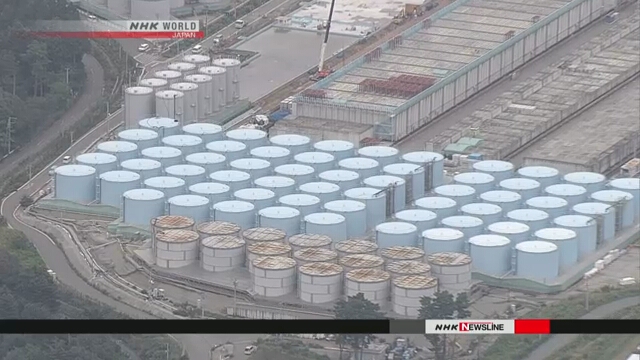
February 26, 2021
The operator of the crippled Fukushima Daiichi nuclear power plant says it has found that 53 tanks storing radioactive wastewater were shifted from their original locations by a powerful earthquake earlier this month. But it says there have been no leaks from the tanks.
Tokyo Electric Power Company inspected 1,074 tanks after a magnitude-7.3 quake struck off the coast of Fukushima Prefecture on February 13.
TEPCO discovered that 53 tanks had moved from their original locations by 3 to 19 centimeters.
TEPCO treats the water used to cool molten nuclear fuel at the damaged reactors before storing it in tanks. But the water still contains radioactive substances.
The company says it also found that five sections of piping connecting the tanks shifted more than the limit recommended by the manufacturer.
But it says it has so far found no cracks or other abnormalities in the piping. It plans to conduct further examinations.
TEPCO also laid out a plan to repair two seismometers at the No.3 reactor building next month.
It came to light on Monday that the devices went out of order partly because of heavy rain last July. As a result, they were unable to collect data when the quake struck.
Fukushima poll: 74% say nuclear disaster work not promising

A cemetery in a district in Namie, Fukushima Prefecture, on Jan. 20 is surrounded by solar panels installed on former farmland after the evacuation order was lifted.
February 24, 2021
Only 19 percent of residents in Fukushima Prefecture believe the work to decommission the crippled Fukushima No. 1 nuclear plant is showing “promise” nearly 10 years after the triple meltdown, a survey showed.
Seventy-four percent of respondents in the telephone survey said the situation was “not promising” at Tokyo Electric Power Co.’s nuclear plant.
The survey, jointly conducted by The Asahi Shimbun and Fukushima Broadcasting Co. on Feb. 20 and 21, is the 11th since the Great East Japan Earthquake and tsunami caused the nuclear disaster in March 2011.
The first was conducted in September 2011, followed by surveys on February or March every year from 2012.
The central government and TEPCO have set a goal of completing the decommissioning work “in 30 to 40 years,” but their efforts so far have been hit with various problems and delays.
Although evacuation orders have been lifted, many residents who fled the disaster have not returned to their homes near the plant. Still, the government plans to entice people to move into municipalities around the nuclear plant.
According to the survey, 21 percent of respondents viewed the new settlement policy as “promising” for revitalizing the area, compared with 72 percent who said it was “not promising.”
One constant problem in the decommissioning work is the continual stream of contaminated water that must be stored in tanks at the site of the plant.
With space running out, the government’s policy is to treat the water and dump it into the sea, even though the process will not remove all radioactive substances.
Thirty-five percent of respondents approved this policy, up from 31 percent in the 2020 survey, while 53 percent opposed the policy, down from 57 percent.
However, 87 percent of respondents said they were worried about damage caused by rumors over the dumping of the water into the sea, such as overexaggerated claims about the effects. Of them, 48 percent were “greatly” worried while 39 percent were worried “to a certain degree.”
The government continues to hold explanatory briefings about the water-dumping policy at local sites, but the effort has not reduced the people’s concerns.
The respondents were also asked whether the government should be held responsible for failing to prevent the nuclear disaster from occurring. Eighty-four percent agreed, including 33 percent who said the state has “great responsibility” and 51 percent who cited “a certain degree of responsibility.”
Forty-five percent of respondents in their 60s and 44 percent aged 70 or older said the government was “greatly responsible.”
Twenty-eight percent of respondents gave high marks to the government’s response so far to the nuclear disaster, while 50 percent had low evaluations.
As for TEPCO, 39 percent said the utility has acted responsibly over the 10 years since the accident, compared with 43 percent who said, “It hasn’t.”
And only 32 percent of respondents said the country has learned lessons from the nuclear accident, while 57 percent said it has not.
All nuclear reactors in Japan were shut down following the Fukushima disaster. Much tougher safety standards were established, and some reactors have been brought back online.
Sixteen percent of the Fukushima residents approved restarts of nuclear plants while 69 percent said they should remain offline.
Nationwide, 32 percent were in favor of the restarts and 53 percent were against, according to a phone survey conducted on Feb. 13 and 14 that showed opposition is higher in Fukushima Prefecture.

Half of the Fukushima respondents said restoration of the prefecture was on track, including 3 percent who said “greatly” and 47 percent who said “to a certain degree.”
In the 2012 survey, 7 percent said restoration was on track. The ratio jumped to 36 percent in 2016.
In the 2019 survey, conducted a year after most of the decontamination work was completed in the prefecture, the figure increased to 52 percent, but it has since remained at around the same level.
Sixteen percent of respondents said they feel “great” anxiety over the effects of radioactive materials released in the accident on themselves and their families, while 48 percent felt a “certain degree” of anxiety.
The overall ratio of 64 percent was down from 91 percent in September 2011 and 68 percent in 2016. But the latest figure was up from 56 percent in 2020.
By sex, 69 percent of female respondents and 59 percent of males felt anxious about the radioactive fallout.
In addition, 79 percent of all respondents were worried that the public will lose interest in the plight of the victims of the nuclear accident. Of them, 34 percent were “greatly” worried and 45 percent were worried “to a certain degree.” Nineteen percent were not worried very much or not at all.
Fifty percent think the image of Fukushima Prefecture has been restored to the pre-disaster level, but only 4 percent “largely” believe this is the case.
The overall figure has improved from 30 percent in the 2016 survey.
But the nationwide survey on Feb. 13 and 14 showed that only 40 percent believe that Fukushima Prefecture’s image has been restored.
The survey used home phone numbers for voters in Fukushima Prefecture, excluding some areas, selected at random by computer. It received valid responses from 1,049, or 54 percent, of the 1,955 voters contacted.
1 This Month

5 March -Online – Reversing nuclearization:
From nuclear weapons in Belarus and NATO host countries to a European-Nuclear-Weapon Free Zone
11am-12:30pm Eastern Time USA / 5pm-6:30pm CET

of the week – Advocating for a
nuclear free beach – https://www.samuellawrencefoundation.org/
The Samuel Lawrence Foundation advocates for a Nuclear Waste Free Beach at San Onofre, join us and take action!

10 March A LIVE WEBINAR THE REAL EFFECTS OF NUCLEAR POWER
What the Industry Isn’t Telling Us
1:00 PM Mountain, 2 pm Central, 3 pm Eastern. Live on the Keepers of the Water Facebook page


18 March Webinar @ 1 PM EST: An Assessment of SMR Projects: The Case of Canada
register for the zoom:
https://us02web.zoom.us/webinar/register/WN_o8BIIOUvQ2ONJR1nta65DQ#/registration

of the week – STOP SMALL MODULAR REACTORS IN CANADA
To see nuclear-related stories in greater depth and intensity – go to https://nuclearinformation.wordpress.com
-
Archives
- March 2026 (38)
- February 2026 (268)
- January 2026 (308)
- December 2025 (358)
- November 2025 (359)
- October 2025 (376)
- September 2025 (258)
- August 2025 (319)
- July 2025 (230)
- June 2025 (348)
- May 2025 (261)
- April 2025 (305)
-
Categories
- 1
- 1 NUCLEAR ISSUES
- business and costs
- climate change
- culture and arts
- ENERGY
- environment
- health
- history
- indigenous issues
- Legal
- marketing of nuclear
- media
- opposition to nuclear
- PERSONAL STORIES
- politics
- politics international
- Religion and ethics
- safety
- secrets,lies and civil liberties
- spinbuster
- technology
- Uranium
- wastes
- weapons and war
- Women
- 2 WORLD
- ACTION
- AFRICA
- Atrocities
- AUSTRALIA
- Christina's notes
- Christina's themes
- culture and arts
- Events
- Fuk 2022
- Fuk 2023
- Fukushima 2017
- Fukushima 2018
- fukushima 2019
- Fukushima 2020
- Fukushima 2021
- general
- global warming
- Humour (God we need it)
- Nuclear
- RARE EARTHS
- Reference
- resources – print
- Resources -audiovicual
- Weekly Newsletter
- World
- World Nuclear
- YouTube
-
RSS
Entries RSS
Comments RSS
 nuclear-news