Japan’s METI says it’s ‘safe’ to dump radioactive water from Fukushima nuclear disaster into ocean

Dangerous radioactive hot particles span the globe
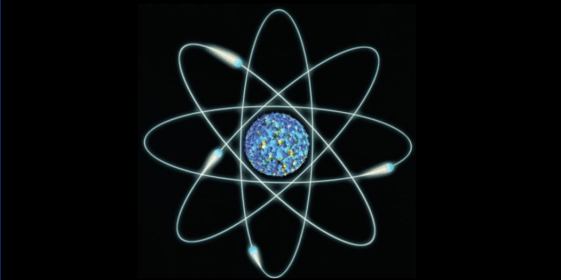
Citizen scientists are uncovering risks that governments would rather cover up
By Cindy Folkers
When reactors exploded and melted down at the Fukushima nuclear power complex in March 2011, they launched radioactivity from their ruined cores into the unprotected environment. Some of this toxic radioactivity was in the form of hot particles (radioactive microparticles) that congealed and became airborne by attaching to dusts and traveling great distances.
However, the Fukushima disaster is only the most recent example of atomic power and nuclear weapons sites creating and spreading these microparticles. Prior occurrences include various U.S. weapons sites and the ruined Chernobyl reactor. While government and industry cover up this hazard, community volunteer citizen science efforts – collaborations between scientists and community volunteers – are tracking the problem to raise awareness of its tremendous danger in Japan and across the globe.
After the Fukushima nuclear disaster began, one highly radioactive specimen, a particle small enough to inhale or ingest, was found in a private home where it should not have been, hundreds of miles from its source, in a vacuum cleaner bag containing simple house dust.
This “high activity radioactively-hot dust particle” came from a house in Nagoya, Japan – after it had traveled 270 miles from Fukushima. The only radioactive particle found in the home’s vacuum cleaner bag, it was an unimaginably minuscule part of the ruined radioactive core material from Fukushima – many times smaller than the width of a human hair. We know it came from Fukushima because it contained cesium-134, meaning that the particle came from a recent release, and we know it is a piece of core material specifically because it was so radioactive that it could not have come from any other material.
 (Image courtesy of Arnie Gundersen/Fairewinds)
Most of the particle’s radioactivity came from cesium-134 and cesium-137. By the time it was collected, some of the particle’s radioactivity, mostly from iodine-131, had already decayed. Named “corium” by scientists, it was still thousands of times more radioactive (5,200,000,000,000,000 disintegrations per second per kilogram — that’s 5.2 quadrillion more than the average activity (26,000 disintegrations per second per kilogram) found in dust and soil samples collected through community volunteer efforts from across Japan — with a focus on areas around Fukushima — since the 2011 nuclear disaster began. By way of comparison, in the U.S., average soil and dust activity is thousands of times lower.
Due to privacy concerns, we are not permitted to know the identities of the Nagoya residents who participated in the dust sampling collection and in whose home the particle was found. Nor do we know how many people lived in the home; if there were children or babies present; or pets; or pregnant women. And we will never know if there were any other radioactive microparticles in the home that did not make it into that vacuum cleaner bag.
We do not know how the particle got there. No one in the home (nor the vacuum cleaner) had any connection to the Fukushima reactors or the exclusion zone. Was the particle transported by a car tire into their city? On someone’s shoes? Did it fly in through a window after being lofted by air currents? Did it arrive by a combination of forces? We do not know if other particles like this travelled just as far in all directions, or who may have taken a breath at just the wrong moment, so that a similar microparticle might be lodged in their lungs.
We do know the residents in Nagoya were notified about the particle’s presence, and that if it had been inhaled or ingested, it could have proven lethal over time. This corium particle would have destroyed tissue near it, potentially threatening the function of any organ that tissue was part of. But the particle’s additional danger would come from what it didn’t destroy – that is tissue that is damaged but survives and can go on to mutate into cancer or non-cancer diseases.
 A map showing the distance between Nagoya, where the radioactive “hot particle” was found, and Fukushima.
We also know that had scientists and citizens not worked together to collect samples, we would never have known a microparticle of corium existed at all at a distance so far away from the Fukushima meltdowns. If the presence of this particle – and its potential for inhalation – had gone unnoticed, any calculations of the doses to residents of this home would have been significantly underestimated. And while the Nagoya particle may simply be an outlier, it shows how inaccurate radiation risk assessment has turned out to be. All of these microparticles, even ones less radioactive, may pose significant health risks inside the body that are currently uncalculated.
Citizen and scientists collaborations show us that radioactive microparticles are a worldwide problem. Yet action by public health advocates and government officials has been slow to nonexistent in recognizing this danger, much less working to protect people against exposure from it. Detecting radioactive microparticles is extremely difficult, in part because detecting them and proving their danger requires specialized techniques and equipment. But this is no excuse for governments to ignore the problem altogether as they continue to do. When experts tell us what our risks are from radiation exposure, risks from these microparticles remain unaccounted for in every country in the world. Speculation swirls around these particles and whether the rapid-onset cancers occurring in Japan are possibly due to their presence.
Radioactive particles across the globe
Collections of various samples (home air filters, vehicle engine intake filters, soils, samples of dust from vacuum cleaner bags) have revealed radioactive microparticles from Fukushima made it as far as Seattle, WA and Portland, OR in the U.S.,and to the Western coast of Canada.
Not surprisingly, microparticles in Japan were much more radioactive than those that made their way to the U.S. and contained more varied radioisotopes, thus posing a much greater health risk. In the case of some filters in Japan, contamination was high enough to be classified as “radioactive waste.”
In addition to catastrophic releases from nuclear power facilities, these particles come from atomic detonations, other nuclear industry processes such as mining and atomic fuel fabrication, and nuclear facility releases of radioactivity, as well as leaking atomic waste dumps. Nuclear workers, First Nations Tribes, and local residents have submitted samples for testing around such facilities. Particles have been detected in the environment and in house dusts in communities around weapons facilities in Los Alamos, NM; Hanford, WA; and Rocky Flats, CO. Thorium, plutonium, and uranium from nuclear facilities were found “outside of radiation protection zones,” including workplaces, workers’ homes and cars. “Given the small respirable size of these radioactive microparticles, they are a potential source of internal exposure from inhalation or ingestion,” according to Dr. Marco Kaltofen of Worcester Polytechnic Institute.
 A traditional sacred Japanese shrine, whose backdrop is covered bags of radioactively contaminated soil. (Photo courtesy of Arnie Gundersen/Fairewinds)
In some cases, radioactive particle releases can be higher from nuclear power catastrophes than disasters at atomic bomb facilities. In 1986, Chernobyl also released radioactive particles that still contaminate the environment today. . Forest fires are spreading them further. Current community volunteer citizen science efforts are underway in the environs of the Santa Susana Field Laboratory (SSFL) – a former reactor test site adjacent to Simi Valley, CA – and the site of several unanticipated and unmonitored nuclear releases, a meltdown, and the November 2018 Woolsey forest fire.
Similar work is being carried out in Pike County, OH, host to a uranium enrichment facility for military and civilian nuclear reactors that has spread radioactive contamination to a nearby middle school, the grounds of which have now been quarantined. The U.S. Department of Energy hid the school contamination for two years, prompting public outrage and calls for health investigations into the high incidence of local childhood disease.
Ignoring danger to human health, environment
The U.S. Nuclear Regulatory Commission (NRC) currently has an existing 10-mile emergency planning radius around commercial nuclear power reactors, a zone the NRC does not place around other nuclear facilities. This 10-mile zone is not large enough to account for exposures that often occur well outside of it.
While the NRC is aware of the radioactive microparticle threat, its dose models fail to provide the extensive, detailed calculations required to actually protect anyone working at or living near these sites. Since radioactive microparticles remain a threat for generations after a catastrophe begins, the NRC should account for continuing exposure to communities and their people for the decades or centuries it takes for such materials to be safe for human or animal exposure.
The author wishes to thank Arnie and Maggie Gundersen at Fairewinds Energy Education for technical and editorial input. Cindy Folkers is the radiation and health specialist at Beyond Nuclear.
Headline photo: “3S0578” by Billy and Lynn is licensed under CC BY-NC-ND 2.0
Work at reactors to be suspended during 2020 Games

Fukushima Workers Battle Leukemia – and Bureaucracy

November 13, 2019
Editor’s Note
The March 2011 tsunami, and the subsequent meltdown of three reactors at the Fukushima nuclear power plant, has had a devastating impact on Japan. Eight years later, and most journalists – in Japan and abroad – have forgotten about the story. But for many, the struggle continues.
This is especially true of workers who helped assist in the cleanup effort at Fukushima. Some Fukushima workers have contracted severe diseases – including cancer and leukemia – since their work concluded. The government of Japan has even certified that some cases are a result of recovery work. But workers who are fighting for their lives also find themselves fighting the system. Tokyo Electric (TEPCO), which led the recovery effort, refuses to admit any connection between the cleanup work and subsequent diseases in workers. And many insurance companies are pointing to the fine print in private insurance contracts stating they don’t cover accidents at nuclear facilities.
Unseen Japan has been pleased to partner with photojournalist Hiro Ugaya (烏賀陽弘道) to translate his interviews with evacuees and former evacuees, and to document the ongoing struggle of the victims of this tragedy.
We previously published Hiro’s interview with a mother in the city of Minamisoma. In this installment, we share the first part of Hiro’s interview with Mr. Ikeda (pseudonym), a Fukushima nuclear reactor cleanup volunteer who now finds himself fighting two uphill battles.
(Translation from an article originally published on Note.mu. Translation by Jay, Editor/Publisher, Unseen Japan. All photos used with permission of Hiro Ugaya.)
Ikeda’s Story
For this installment of the Fukushima Report, I visited Northern Kyushu City in Fukuoka prefecture. I departed from Tokyo and flew west, in the direction opposite Fukushima.
I went to Fukuoka, which is quite far from Fukushima. That’s where the leukemia-stricken Ikeda Kazuya (age 44; pseudonym) has lived since participating in the Daichi Nuclear Reactor reconstruction efforts. I had visited Ikeda once in 2017 to hear his story. Among all my interviews here in the Fukushima Report, it’s the one that’s reverberated the loudest.
Mr. Ikeda volunteered to participate in the restoration work at the Fukushima Daiichi nuclear power plant. By trade, he’s an independent welder. In March 2011, when so many people died due to the tsunami, he looked at the report of the death of a small child and thought, “I need to do something useful for Tohoku” [Editor: the region of Japan hit by the tsunami]. He asked permission from his boss and threw himself into the reconstruction effort. The interior of the heavy machinery room of Reactor 4 butts up against the nuclear fuel rod pool.
 Mr. Ikeda during Fukushima cleanup.
But in 2013, Mr. Ikeda came down with leukemia.
Mr. Ikeda is one of the first cancer patients that the country recognizes as a work-related accident connected to the Fukushima Daiichi nuclear power plant. Two Fukushima workers contracted leukemia (bone marrow cancer), and one contracted thyroid cancer. The first case of leukemia was recognized in October 2015. The second was recognized in August 2016. The third person, who had thyroid cancer, was certified in December 2016.
As of May 2019, there are six patients in the country whose cases have been recognized as occupational accidents caused by work at the Fukushima Daiichi nuclear power plant. To tell the truth, I was quite surprised that the country recognized them as occupational accidents. Judging from the history of pollution diseases, such as Minamata disease and Itai-itai disease, I predicted the government would probably prevaricate and not admit a causal relationship. But the government admitted it readily (employing a lot of rhetoric, of course, such as “This is not an admission of a scientific, causal relationship”).
From a global and historical perspective, the admission is rare. In the Three Mile Island nuclear accident (1979) in the US, more than 2000 lawsuits have been filed, but no relationship between health damage and exposure has been admitted in even a single case. The state government naturally won’t admit it, and the courts don’t either.
Due to this admission, the assertion that “the radiation leakage from the Fukushima Daiichi nuclear accident is mild enough not to damage health” fell apart.
In the Chernobyl nuclear accident in the former Soviet Union, the first to suffer serious harm were the so-called “Liquidators,” the firefighters and soldiers who were the first responders. Nearly 5,000 people died. Naturally, people who are close to radiation-intensive sites will become seriously ill. The same phenomenon occurred in the Fukushima Daiichi nuclear power plant accident.
While the case was recognized as a workplace injury, Mr. Ikeda filed a lawsuit against Tokyo Electric (TEPCO), which ran the restoration project. That’s because TEPCO doesn’t “recognize a causal relationship between Mr. Ikeda’s leukemia and exposure to radiation at the Fukushima Daiichi nuclear power plant.”
I’ve long found it mysterious that not a single TV station, weekly newspaper, web media or other news outlet has done an article on those like Mr. Ikeda who contracted deadly diseases from the nuclear reactor recovery work. Since the government’s announcement certifying them as workplace injuries, there’s been dead silence. Those affected can’t be heard in their own voices.
For a nuclear accident to occur and three reactors to meltdown (even at Three Mile Island and Chernobyl, two such past events, only one reactor melted down) is an event of worldwide and historic proportions. In addition, 200,000 people becoming refugees from the area is a war-level crisis. In addition, there’s the damage toll on six people, starting with Mr. Ikeda, who’ve contracted fatal diseases. I can’t think of any news that’s more important to record in the annals of history than the actual voices of these victims.
The silence of the mass media in the face of such a reality astonishes me. I ‘m tempted to think they all, through some shared intent, decided to suppress the story.
If Mr. Ikeda refuses interviews, I’d get that. But that’s not the case. Since the legal proceeding began, Mr. Ikeda has traveled from Kitakyushu to the Tokyo District Court once every few months. He leaves the courthouse, after which there’s a public briefing session. I also went there and was granted leave to interview people.
If other reporters did this, they could hear Mr. Ikeda’s story too.
I try and attend whenever there’s a court session. In Tokyo, Mr. Ikeda is busy with supporters and lawyers, so he doesn’t have time to interview. So I went to his home in Kitakyushu, where I soaked up his story. This was in March 2017 – two years ago.
During that time, every time I met Mr. Ikeda and talked with him, I realized he was recovering little by little. Let’s talk about what’s happened since. It was April 2019 when I flew back to Kitakyushu again.
This time, Mr. Ikeda pointed out something important. People who work in nuclear facilities such as nuclear power plants are not covered by private insurance, even if they have an accident or get sick. It’s in the so-called “disclaimer.”
If if you can’t work and fall into hard times, unless the country certifies it as a workplace accident, there’s no path to salvation. For subcontractors who are not in-house employees, TEPCO and other electric power companies have denied any compensation or even causality.
People who engaged in the dangerous work of recovering the nuclear power plant post-meltdown have been left naked and defenseless. And few people notice it. Even insurance companies don’t care. I want to fix this abnormality.
Here’s what Mr. Ikeda told me.
A Return to Normalcy?
 A set of fishing lures at the Ikeda home. For Mr. Ikeda and his kids, fishing is an important family pastime.
It’s been two years since I’ve seen you. When I last saw you, you told me, “I have to make memories with my kids,” and you’d planned to go skiing or fishing or whatnot in spite of your illness. I heard that and thought, “This is someone who’s truly prepared to die.”
I think, before, I had contracted leukemia, and I’d thought, it’ll probably recur again. But recently I’ve come to think more in terms of doing things for my kids’ future. Things like helping my kids with their hobbies, or helping my wife develop their potential. Kids can’t grow without their parents’ cooperation. In hobbies, or in sports.
What hobbies do your kids have?
Fishing, mostly. Baseball, golf, track & field.
Your eldest does track and field, right?
Since middle school. Some say he should do baseball as well because he’s so physically gifted.
Is it a local public middle school? Or a private school somewhere that focuses on sports?
Nah, we’re in the sticks (laughs). There are no private schools that are big on sports.
You said you’re a baseball coach. What do you coach?
I’m a scorer. I volunteer. And I help develop the kids.
You must get up early. Do you go on away trips? Isn’t that tough?
Several middle schools gather together and we drive. We can fit seven kids in a minivan. The kids love riding like that.
How’s your body?
It’s fine. There are times I get tired, but the kids are enjoying themselves, so I’m like, it’s fine. On days when there’s no practice, I play catch with kids from the team. No matter how hard I toss it, those kids laugh at me. “You’re slow!”
Two Battles for Fukushima Workers
Do you have to go to the hospital regularly?
I go to Kitakyushu Medical Center once a month. Get blood drawn. It’s to check if there’s any recurrence. The doctor tells me, “Don’t go back to work yet.” I became depressed and started going to the psychiatric clinic once a week.
You told me last time that you had to take gritty pills that were like marble chocolate.
Yeah, I did. They had antibacterial agents. I take about six a day now.
(He takes out the pills and shows them to me)
Wow, there are a lot.
Taking depression meds is tough. I lost my cool with my wife during these last two months. So I consulted a doctor, and he switched me to Chinese medicine.
You were in the middle of leukemia treatments when you became depressed, right?
I mean, I thought I’d die during leukemia treatment. I was certified Level 2 on my disability card. [Editor: disability cards, which enable their holders to additional assistance, are classified levels 1 through 6.]
They gave me medical morphine after because the pain was so bad. I felt like my body was floating off of the bed. After I asked them to stop, my stomach got really sore for seven hours.
The Diagnosis
It was December 2013 when Mr. Ikeda noticed an abnormality in his body. It started with cold-like symptoms. Eventually, he was too winded to climb the stairs at the construction site.
The next month, January 2014, he received a blood test using an “ionizing radiation screening” (a screening received after returning from a workplace exposure to radiation). That night, a doctor called him. “This may be leukemia.” 20% of the venous blood in his body was teeming with cells.
When surgeons opened a hole in the lumbar spine and examined it, they found his bone marrow was 70-80% cancer cells. Doctors told him in January 2014 that “Your cancer is spreading gradually,” and he was swiftly admitted to the Kitakyushu Medical Center.
He was hospitalized for seven months. His red blood cells and platelets declined. he had to have over 50 blood transfusions. In August 2014, he underwent an “autologous peripheral blood transplant” to transplant his healthy blood components. In order to reduce his immune strength, doctors isolated him in a sterile room. He couldn’t come face to face with his family.
The side effects of the anti-cancer drugs combined with the fear of death drove him to the brink. When he says he’s being treated for depression, it’s a consequence of that period.
He underwent an ionizing radiation screening in September 2013. Doctors found no abnormalities. The canceration of hematopoietic cells progressed rapidly in the following 3 months.
Experts say that the incubation period of leukemia (time from exposure to onset) is two years. Mr. Ikeda’s case matches that. And the five-year survival rate for leukemia is around 30%. His doctor said, “If you’d waited two weeks, it’d have been too late.”
“No One Will Listen”
 Mr. Ikeda’s son running track.
There are six people, including yourself, who have been certified as workplace accidents due to cancer or death from overwork in the recovery work of the Fukushima Daiichi nuclear power plant accident. Any contact from them?
No, none. I’ve caught sight of the wife of one of the Fukushima workers who died from overwork (karoshi) at rallies in Tokyo.
It seems that TEPCO employees and primary subcontractors who got sick will receive 30 million yen [around USD $274,000]. But in return, they can’t sue. That’s what my lawyer emphasized at trial. But that offer doesn’t extend to us (second-tier subcontractors).
The owner who hired me also had business owner insurance. Just in case we have an industrial accident. However, we found out later that it wasn’t valid in nuclear facilities, such as nuclear power plants. The insurance companies say it’s too dangerous a place to cover via employer insurance. And yet TEPCO denies responsibility for my leukemia.
That’s what you’re contesting in court.
That’s right. They’re denying everything. They say it was too low of a dose to bear any relationship. In the previous trial, TEPCO says I developed leukemia due to smoking, drinking, and a vegetable deficiency. That took me aback (laughs). They talk to us like we’re alcoholics.
When I petition to declare this an industrial accident, I was interviewed by the Labor Standards Control Board. I didn’t know quite what was happening, so when they asked me about my health, I was straight and said, “I drink two beers a day,” and “I smoke 20 cigarettes a day.” TEPCO must have requested disclosure of the Labor Board’s data. Who knows where they got “vegetable deficiency” (laughs). They’re just making stuff up.
Do you have a timeframe for a ruling?
No, not yet. We’re on the 11th round of oral arguments. The last one was in January and the next one’s July. We’re getting our strategy in order.
What evidence is TEPCO presenting to refute you?
Search for the stories of scholars who kowtow to the government, you’ll find it (laughs).
Who’s providing testimony, besides you?
There are various people I think.
TEPCO won’t recognize the causal relationship between your leukemia and radiation exposure, correct?
If they did, it’ll become a serious obstacle to future nuclear power policy. I was the first person certified, and there’ve been a number since. So there has to be a causal relationship, right?
What total dose did you receive?
A total of 19.8 millisieverts. Others received more. TEPCO is terrible. It’d be better if they just copped to it.
“Others Will End Up Like Me”
Why do you think TEPCO should admit responsibility?
When this happens to someone else, this won’t be any guarantee, but it’ll give them peace of mind, you know? I mean, it’s not like you can tell people, “Don’t help with recovery efforts.” Other industries offer insurance – who’s going to guarantee workers who enter a nuclear facility if the employer’s primary insurance won’t? That’s what I want to tell people.
Fukushima workers who entered the facility had no idea their employer’s primary insurance wouldn’t cover it.
Yep, yep…We ask who’s going to cover this, but TEPCO is the only company that makes people work in an environment not covered by insurance. People will think, “If TEPCO won’t guarantee it, why should I take the risk?”
That’s what I want to say, to communicate to the world. But no one will listen….If workers have the right to insurance, they know they can get compensation if something happens. I mean, that’s how the old coal miners thought. “I’ going into a dangerous place, but, well, at least I have insurance.”
Is work accident insurance insufficient?
It’s not a matter of it being insufficient. I want to see a proper system established for the people who come after me. Unskilled workers like me have these jobs like nuclear power plant cleanup shoved on them. If something happens, and you’re a TEPCO employee, you’re covered. The rest of us are kicked to the curb. It makes me sick. Many of us have no idea who’ll take care of things if something happens.
The company that hired me took out high premiums for us to have round the clock coverage. It covers us even when we’re in dorm rooms outside of works hours from aftershocks and tsunamis. However, they didn’t know the insurance wasn’t applicable inside of a nuclear facility. The CEO complained, and a rep came and apologized.
I heard that they changed that text from small print to large print after my case was certified.
So there are gaps in the current system?
That’s what I want people to know. I want the media and others to know. And I want people who enter a nuclear facility to work to know this as well. Private insurance won’t cover you if something happens. Do people think that’s right? If I don’t say something, others will end up like me.
https://unseenjapan.com/fukushima-workers-leukemia-bureaucracy/
As Fukushima food export barriers fall, Japan aims to persuade China

Hotspots in East Tokyo’s Mizumoto Park


Fukushima to Become Solar, Wind Hub Using Farmland Tainted by Radiation

An update from Fukushima, and the challenges that remain there
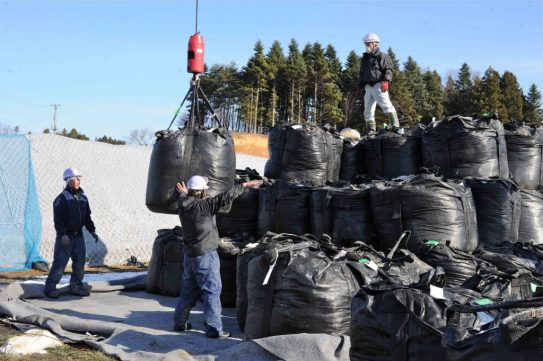
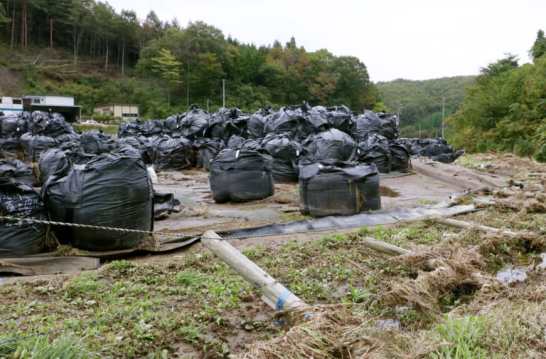
Workers stack bags of soil collected during Fukushima decontamination and cleanup operations, 2011.
November 11, 2019
After more than eight years, Japan is still struggling with aftermath of the 2011 Fukushima nuclear disaster. The Japanese government and nuclear industry have not solved the many technical, economic, and socio-political challenges brought on by the accident. More worrying, they continue to put special interests ahead of the public interest, exacerbating the challenges and squandering public trust. The longer these issues remain unsolved, the more difficult it will be to restore this trust.
Technical challenges. The most difficult challenge is, of course, the decommissioning of the Fukushima Daiichi reactors. It would take too long to describe all of the technical challenges of the decommissioning operations, but two recent events are instructive of the overall difficulties.
The first is the dismantlement of the joint exhaust stack for units one and two. This stack stands 120 meters tall and is at risk of collapse because of fractures in its pillars. It was also heavily contaminated by the venting of radioactive gases during the accident. So the stack must come down, and the operation to deconstruct it must be done remotely from the stack itself to avoid exposing workers to dangerous radiation. According to the Tokyo Electric Power Company (TEPCO), the operation was supposed to be simple: cut down the top of the tower using special remote-controlled equipment, slicing pieces from the top of the chimney one by one and guiding them down by crane. Originally, the operation was supposed to start in March 2019, but TEPCO deployed an operation tower that was about three meters too short for the task, meaning it needed to rebuild the tower before starting. The cutting operation began on August 1, but the project has already faced numerous additional delays because of technical difficulties that include malfunctions of the crane, the camera on the cutting machine (which is needed to monitor the operation), the saws of the cutting machine, and both the main generator and sub-generators. The operation was supposed to finish by the end of 2019 but will now drag on until at least March 2020.
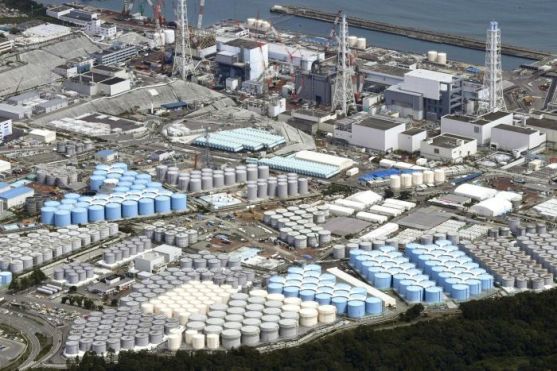
The second technical problem, which is much more serious than the first, is the management of contaminated water. The water is continuously injected into the reactors to cool the fuel debris, and then treated to remove most—though not all—of the radioactive materials. The so-called “treated water” is being stored on site and amounts to about 1.1 million tons, with several hundred tons being added every day. According to TEPCO, the total tank capacity to store treated water will be approximately 1.37 million tons by the end of 2020, but the volume of treated water will exceed storage capacity by 2022. A subcommittee of the Ministry of Economy, Trade, and Industry recommended that the treated water, which still contains tritium, should be released into the sea once the radioactive concentration is below the standard agreed beforehand. The agreed standard between TEPCO and the local fishing industry association is 1,500 becquerels per liter (Bq/l), which is far below the drinking water standard for tritium water of 10,000 Bq/l set by the World Health Organization. An additional condition of release, however, is that all other radioactive substances besides tritium must be removed below a detectable limit or in line with regulatory standards. Unfortunately, in August 2019 news outlets reported that some radioactive materials such as iodine 129 were not completely removed and that their concentration levels were above the regulatory standards.
Most recently, the super typhoon Hagibis hit the eastern part of Japan, which includes Fukushima prefecture and the area affected by the nuclear accident. TEPCO reported irregular readings from sensors monitoring water at the Fukushima Daiichi plant but did not confirm whether any radioactive water leaked into the sea. In addition, according to the Tamura city government, some bulk bags filled with soil collected from decontamination operations were swept into a river during the typhoon on October 12. The bags were among 2,667 that have been temporarily stored at a site in the city. The Ministry of the Environment later confirmed that total of 11 bags were swept away and found downstream. Thankfully, there was no evidence that any of the contaminated soil leaked out. But this wasn’t the first time an incident like this has happened. In September 2015, several hundred bags were swept downstream during flooding caused by tropical storm Etau. The recurring close calls reveal the ongoing vulnerabilities of the Fukushima and associated sites. The contaminated soil will need to be stored for at least 30 years, and the risk of possible leakage remains if a larger and stronger typhoon, or a tsunami, hits the region again.
Economic challenges. In December 2016, the Ministry of Trade, Economy, and Industry’s committee for reforming TEPCO published its latest estimate for total accident costs, including decommissioning the reactors, compensation, and decontamination of the land. The total cost was estimated at almost 22 trillion yen ($188 billion), which was twice as much as the previous estimate of 11 trillion yen ($96 billion). More recent estimates have put the figure even higher—up to 80 trillion yen ($736 billion) over 40 years.
According to the legal scheme established by the ministry, TEPCO and other nuclear utilities will pay about 20 trillion yen of the total accident costs. But now the rest (2 trillion yen) will be footed by Japanese taxpayers. The 2016 report was the first time that the Japanese government admitted that tax money would be spent for the Fukushima accident costs.
The government’s lack of transparency in agreeing to this scheme is a source of ongoing concern, not least because the taxpayer burden could balloon if total costs go up, or if the nuclear utilities cannot pay off the debt. The government has given no clear explanation why and how much tax money will be spent to cover the total accident costs. To make matters worse, the power utilities are passing on part of the accident cleanup costs to customers by increasing their electricity rates, but without disclosing the amount.
This exceptionally high cost may have influenced the future economic competitiveness of nuclear power. At present, no utility has announced plans to build new reactors or to replace existing reactors.
Socio-political challenges. On September 19, 2019, three former top executives of TEPCO were found not guilty of criminal negligence for their roles in the disaster, which resulted in the death of 44 and the injury of 13 others. The Tokyo district court ruled that it was not realistic for the former executives to have prevented the triple core meltdown because they were not able to predict all possible tsunami scenarios. This was the only criminal case so far involving TEPCO officials and, although they were found not guilty, the case revealed new facts regarding the tsunami predictions. A 2008 TEPCO internal study, based on a 2002 report by a government panel, concluded that a wave of up to 15.7 meters could hit the plant after a magnitude 8.3 earthquake, overwhelming the Fukushima site, which sits 10 meters above sea level. The findings were reported to the TEPCO executives, but they did not act to take measures against such high-tsunami scenarios. The court decision was totally unsatisfactory to the public, especially for the victims in Fukushima who were forced to leave their homes. For them, it is now clear that the accident was preventable and that no one at TEPCO will be held accountable for their lack of action to prevent it.
Although the criminal case was highly symbolic, it is not the only legal one involving TEPCO and Fukushima. More than 100,000 evacuees have filed about 30 different civil lawsuits seeking compensation from TEPCO and the government. Several district courts have ruled that TEPCO could have predicted and prevented the nuclear crisis and have awarded millions of dollars in damages to the evacuees.
TEPCO isn’t the only utility with a public relations problem. On September 27, 2019, the Kansai Electric Power Company held a press conference to disclose that 20 of its employees, including top executives, received inappropriate payments and gifts worth a total of $2.9 million from a senior local government official in Takahama, a town that hosts one of the company’s four nuclear power plants. This has become the biggest scandal since the 2011 Fukushima accident and has exposed the collusive relationship between the utility companies and local public officials as well as the connection between the utilities and local construction companies, which may have benefited from favorable contracts for necessary safety upgrades at the nuclear plants. In October, the chairman, executive vice president, and three executive directors resigned, while the president of the company stepped down from his position as the head of the powerful Federation of Electric Power Companies of Japan. Although Kansai Electric Power Company planned to restart units one and two of its Takahama nuclear plant earlier this year, that plan is now on hold indefinitely.
These two recent events show that social and political problems persist even eight years after the Fukushima accident. According to the latest public polling conducted in 2018 by Japan Atomic Energy Relations Organization, a utility-sponsored pro-nuclear organization, only 6.7 percent of the public think nuclear industry organizations are trustworthy or somewhat trustworthy (a decline from 7 percent in 2017), and only 7.9 percent of the public think the government is trustworthy or somewhat trustworthy (a decline from 9.2 percent in 2017).
Lessons not learned. The ongoing technical, economic, and socio-political problems demonstrate that the nuclear power industry and the Japanese government haven’t learned their lesson from the Fukushima accident, which is that transparency is the key to public trust. It is true that the quantity of information about cleanup has increased substantially over the years. But transparency means that the utilities and the government need to disclose information that the public needs, even when it is not favorable to them. One solution, which they have so far been unwilling to accept, would be to establish a truly independent third party to oversee their activities. Lack of such an independent oversight organization is one of the main causes for not taking alternative and possibly better, more appropriate measures over the last eight years.
https://thebulletin.org/2019/11/an-update-from-fukushima-and-the-challenges-that-remain-there/#
Inspectors find 41 cracks in the grounds of Fukushima nuclear plant: local media

Nuclear regulator says cost-cutting culture creating mistakes, delays at Fukushima plant

S. Korea, Russia agree to put radiation detectors on ferries

Labor shortage cited for Fukushima N-plant errors

Japan accused of trying to justify nuclear dump
10 More Years for Japan’s Reconstruction Agency to Aid Fukushima Nuclear Disaster Recovery


Dozens of bags of radioactive waste still missing in Fukushima three weeks after intense typhoon
-
Archives
- February 2026 (199)
- January 2026 (308)
- December 2025 (358)
- November 2025 (359)
- October 2025 (376)
- September 2025 (258)
- August 2025 (319)
- July 2025 (230)
- June 2025 (348)
- May 2025 (261)
- April 2025 (305)
- March 2025 (319)
-
Categories
- 1
- 1 NUCLEAR ISSUES
- business and costs
- climate change
- culture and arts
- ENERGY
- environment
- health
- history
- indigenous issues
- Legal
- marketing of nuclear
- media
- opposition to nuclear
- PERSONAL STORIES
- politics
- politics international
- Religion and ethics
- safety
- secrets,lies and civil liberties
- spinbuster
- technology
- Uranium
- wastes
- weapons and war
- Women
- 2 WORLD
- ACTION
- AFRICA
- Atrocities
- AUSTRALIA
- Christina's notes
- Christina's themes
- culture and arts
- Events
- Fuk 2022
- Fuk 2023
- Fukushima 2017
- Fukushima 2018
- fukushima 2019
- Fukushima 2020
- Fukushima 2021
- general
- global warming
- Humour (God we need it)
- Nuclear
- RARE EARTHS
- Reference
- resources – print
- Resources -audiovicual
- Weekly Newsletter
- World
- World Nuclear
- YouTube
-
RSS
Entries RSS
Comments RSS
 nuclear-news