Robots’ limitations exposed in search for melted nuclear fuel in Fukushima

OKUMA, Fukushima — In an attempt to minimize the risk to humans during the search for melted nuclear fuel at the Fukushima No. 1 Nuclear Power Plant, robots have also been deployed to help out with the task.
However, the robots have also encountered some problems. For instance, a Toshiba Corp. robot that was sent in to clear away deposited material inside the containment vessel of the No. 2 reactor failed to clear away much material, and within approximately two hours, its camera had broken.
According to Takahiro Kimoto of plant operator Tokyo Electric Power Co. (TEPCO), “The radiation inside the containment vessel was so intense that the images transmitted back from a camera attached to the robot were pitch black.” This was somewhat disappointing for the team working at the No. 2 reactor because by losing their robotic “eye” inside the containment vessel, they were unable to make the progress they were hoping for.
On Feb. 16, a “scorpion robot” was sent into the containment vessel. The intention of the mission was to locate melted nuclear fuel. However, deposited materials inside the vessel meant that the robot became stuck and was unable to move any further.
In the end, images from directly underneath the nuclear reactor were obtained not from the robot, but by “human means,” on Jan. 30. By using a pipe and a camera, the team was able to confirm the presence of holes in the platform. They also discovered brown and black deposited material, which appeared to be melted nuclear fuel. Therefore, some might say that “human methods” are more effective than robots in a mission of this nature.
According to TEPCO, “This was the first probe of its kind in the world. We were able to collect sufficient data.” However, critics would argue that six years have passed since the outbreak of the Fukushima nuclear disaster in 2011, and yet the exact situation regarding melted nuclear fuel at the site is still unclear.
Looking ahead, further difficulties are anticipated at both the No. 1 and No. 3 reactors, where in the past, there have been hydrogen explosions. This is mainly because there are several meters of contaminated water underneath the containment vessels, and the radiation levels are stronger than at the No. 2 reactor.
There are plans to insert a robot inside the No. 1 reactor in March, but a date has not yet been set for the No. 3 reactor. Satoshi Okada of the nuclear power plant maker Hitachi-GE Nuclear Energy, which oversees the search at the No. 1 reactor, states, “In order to deal with the problem of melted nuclear fuel, we must first ascertain exactly how and where the melted fuel has been scattered inside the reactors.”
In summer 2017, TEPCO and the government will look into ways of withdrawing the melted nuclear fuel from the site, with the aim of commencing extraction work in 2021 — exactly 10 years after the initial disaster.
The Three Mile Island Disaster in the U.S. in 1979 will provide some kind of reference for TEPCO and the government, because in that particular case, the removal of melted nuclear fuel started 11 years after the initial accident. However, the situation at Fukushima appears to be more complicated than at Three Mile Island, because in the case of the latter accident, melted nuclear fuel was retained within pressure containers. Conversely, in the case of Fukushima, some of the material has seeped through the pressure containers.
With regard to the government and TEPCO’s decommissioning work, Nuclear Regulation Authority Chairman Shunichi Tanaka states, “It is still early to talk in such an optimistic way. At the moment, we are still feeling around in the dark.”
Time will tell as to whether the current plan for removing melted nuclear fuel from the No. 1 power plant is a realistic possibility or just a pipe dream.
http://mainichi.jp/english/articles/20170227/p2a/00m/0na/016000c
Search for melted nuclear fuel at Fukushima plant’s No. 2 reactor faces obstacles

Although nearly six years have passed since the nuclear disaster at the Fukushima No. 1 Nuclear Power Plant in 2011, the search for the melted nuclear fuel inside the plant continues.
The operators of the plant, Tokyo Electric Power Co. (TEPCO), deployed over 800 workers inside the No. 2 reactor at the No. 1 plant between December 2016 and February 2017 — but so far, they have been unable to identify the location of the melted nuclear fuel.
TEPCO also plans to conduct studies inside the No. 1 and No. 3 reactors, but they are surely headed for a rough road as the search for the melted nuclear fuel continues to be extremely difficult. It is likely that struggles in that search will have a negative effect on the government and TEPCO’s target of completing the Fukushima decommissioning work between 2041 and 2051.
Apart from humans, robots have also been involved in the search. In the case of the No. 2 reactor for example, robots have been used in the following way.
The mission to get a good look inside the No. 2 reactor containment vessel had four steps; first, workers would drill a hole measuring 11.5 centimeters in diameter into the containment vessel wall, allowing robots to enter the vessel; then workers would insert a pipe with a camera into the hole so that the situation inside the vessel could be observed; a cleaning robot would then be sent inside the vessel to clear away any sediment in the way for the next robot; and finally a self-propelled, scorpion-shaped robot would travel to the area directly below the nuclear reactor, in search of the melted fuel. However, a number of unexpected problems emerged along the way.
Heavy machinery giant IHI Corp.’s Keizo Imahori, 38, who oversaw the mechanical boring of the containment vessel in December 2016, explains that, “A number of unexpected dents were found on the floor of the nuclear reactor building.” This was a surprising discovery for Imahori and his team. The presence of the dents meant that it would be difficult for machines to get sufficiently close to the necessary areas to drill a hole, which in turn has a detrimental effect on the entire search for melted nuclear fuel.
As an emergency measure, 1-meter by 1-meter iron sheets were used to cover the dents, but workers involved in laying the sheets were exposed to extra radiation because of this additional work.
In addition to the dents, the No. 1 to No. 3 reactors at the Fukushima plant, which first started operating in the 1970s, had many parts that have undergone repair work not reflected in their original construction plans. It was impossible to check such changes in the structure beforehand due to high levels of radiation.
There was another problem — the machines could not be attached to the side of the containment vessel, which meant workers were unable to carry out drilling work. This was caused by the containment vessel’s paint peeling away. The problem was solved after workers peeled off the paint by hand, but this also caused them to be exposed to more radiation.
The hole-boring process at the No. 2 reactor took approximately 20 days to complete — during which, workers involved in the project were exposed to approximately 4.5 millisieverts of radiation on average. Based on national guidelines, many companies involved in decommissioning work set the annual upper radiation dose at 20 millisieverts for their workers. Therefore, workers can only be involved in this project up to five times before their level of radiation exposure exceeds the limit. However, as Imahori points out, “We have no way of knowing the situation unless we actually go in there.”
Nevertheless, in order to ensure that highly-skilled professionals with expert knowledge in nuclear power plants continue to be involved in the search for the melted nuclear fuel, it is necessary to use robots as much as possible to reduce the amount of radiation to which humans are exposed.
At the same time, with the Fukushima No. 1 Nuclear Power Plant being somewhat like a “burning house,” manpower is also required to make effective progress with the search. Yasuo Hirose, of IHI Corp., states, “If we completely rely on robots for the decommissioning work, they will not be able to deal with any unexpected problems. The decommissioning process is likely to be a very long task.”
http://mainichi.jp/english/articles/20170227/p2a/00m/0na/011000c
Proud workers at Fukushima No. 1 nuke plant risk deadly radiation danger

Workers examine the inside of the No. 2 reactor containment vessel at the Fukushima No. 1 Nuclear Power Plant on Jan. 30, 2017.
Tokyo Electric Power Co. (TEPCO) has failed to grasp the entire picture of melted fuel possibly accumulating inside the container vessel of the No. 2 reactor at the Fukushima No. 1 Nuclear Power Plant. The radiation levels inside the vessel are extremely high, to the extent a human could be killed in less than a minute, and even a robot designed to conduct a probe inside went down quckly.
The Mainichi Shimbun visited the disaster-stricken plant late last year ahead of the sixth anniversary of the nuclear meltdowns at the facility in March.
On the early morning of Dec. 24, 2016, a group of 26 workers assembled at a building housing the No. 2 reactor when it was still dark outside. The workers were from heavy machinery giant IHI Corp. and other companies engaged in disaster recovery work. On top of their protective Tyvek suits, they were wearing special protective ponchos. They also had four-layer gloves on, with plastic tape wrapped around their wrists. The outfit made them sweat though it was the middle of winter.
In order for TEPCO to move ahead with decommissioning work on the No. 1 through No. 3 reactors at the plant, the utility needs to find out how much melted nuclear fuel lies inside the facilities, and where, in the aftermath of the meltdown of 1,496 fuel rods. The 26 workers were tasked with drilling a hole measuring 11.5 centimeters in diameter in the No. 2 reactor’s container vessel to open the way for the probe robot, using a remotely controlled machine.
Ryosuke Ishida, 28, an employee of a related company in Hokkaido, was in charge of removing the machinery that was used in the drilling work. In order to ward off the severely high radiation, he was wearing a lead jacket weighing 10 kilograms on top of his already tightly sealed protective gear. Each worker was allowed only five minutes for their task to keep their radiation exposure doses to no more than 3 millisieverts a day. The dosimeters they were carrying with them were set to beep when the radiation level reached 1.5 to 2 millisieverts, with an additional alarm set to go off when radiation doses hit every one-fifth of those levels.
Ishida’s dosimeter beeped just under a minute after he stepped inside the No. 2 reactor building. “Is it beeping already?” he thought to himself. The radiation levels vary greatly depending on where one stands inside the facility. Although Ishida had got a firm grasp on where the hot spots were during pre-training, he found himself “inadvertently standing on highly radioactive spots as I was focused on work.”
While trying to calm himself down, Ishida sped up his manual work. Alas, a machine component for turning a bolt fell off and rolled on the floor. “Damn, I’m running out of time,” he thought. His full face mask went all white as he sweated physically and emotionally, blocking his view. By the time he finished picking up the fallen component and wrapped up his work, he was sweating all over his body.
“It’s a battle against radiation at the site,” Ishida recalled. He added, though, “Because nobody else wants to do the job, I find it all the more worthwhile and take pride in it.”
http://mainichi.jp/english/articles/20170227/p2a/00m/0na/007000c
Local servicemen may have radiation poisoning from Fukushima
“In January, TEPCO urged the court to dismiss the case, citing that it is a political matter that could impact international relations.”
With a class action lawsuit pending, hundreds of Navy sailors say they can’t get the help they need

Navy servicemember seeks treatment for alleged radiation poisoning following Operation Tomodachi.
“Right now, I know I have problems, but I’m afraid of actually finding out how bad they really are,” said William Zeller, a 33-year-old active-duty Navy servicemember living in San Diego. He’s one of the 4,500 sailors who were aboard the USS Ronald Reagan during Operation Tomodachi, a humanitarian aid mission sent to Japan the day after a tsunami triggered the 2011 Fukushima Daiichi nuclear meltdown.
“I know there’s something wrong,” Zeller said. “I’ve got many other people around me telling me I don’t look good, and I need to get checked out. While I am a workaholic, it’s a distraction.”
Zeller is only one of 318 sailors (and counting) who have joined a billion-dollar class action lawsuit filed in 2012 against the nuclear generators’ operating company, Tokyo Electric Power Company, or TEPCO, for injuries allegedly caused by radiation exposure.
The lawsuit argues TEPCO is financially responsible for the sailors’ medical care because the operating company, admittedly, did not inform the Japanese government of the meltdown. In turn, the Japanese government unknowingly misinformed the U.S. Navy of potential dangers of anchoring off the coast of Japan where the ship was engulfed in a plume of radiation for several hours.
“Everywhere we went we had to carry [gas masks] on our hips,” Zeller said. “We were turning on news networks, and we could see how we were right in the plume. You could taste the metallic air.”
In the six years since Fukushima, Zeller has only sought medical attention from the Navy since the care is financially covered.
“The military health system is a process, putting it politely,” he said, explaining how it took four years to learn he had abnormal bone growth, nerve damage and what he believes is irritable bowel syndrome, all of which began a year after Operation Tomodachi. His weight fluctuates 20 to 30 pounds within a month, and he’s unendingly fatigued.
“Before I went [on the USS Ronald Reagan], I used to be a martial arts instructor,” he said. “I used to go on regular bike rides. I hiked. I was in very good shape. Now, I wear a breathing machine when I go to sleep because I have respiratory problems. I literally just go to work and go home now. I don’t have the energy or the pain threshold to deal with anything else.”
Considering the Veterans Association’s inability to treat members in a timely or efficient manner, Zeller’s lawyer, Paul Garner, said VA care is not an option. Instead, they’re hopeful that a fund set up by former Japanese Prime Minister Junichiro Koizumi will come to fruition.
Koizumi announced the creation of the fund while visiting 10 affected sailors, including Zeller, in San Diego in May. Koizumi said he expects to raise $2 million by a March 31 cutoff date. The plan is to then transfer the money to the U.S. to supplement the sailor’s medical bills at, according to Garner, some of the best care centers across the country.

However, Garner knows $2 million won’t be enough to cover every need, especially since some sailors have reported symptoms appearing in their children who were born after Operation Tomodachi.
“I have no idea if it’s caused by the radiation that I was exposed to on the Reagan, but I don’t know that it’s not,” said Jason F., who was also on board the USS Ronald Reagan but didn’t want to share his last name while he’s still active duty. His breathing is audible over the phone, as if climbing several sets of stairs, but he’s tucking his three-year-old daughter into bed at their San Diego home.
“That’s standard breathing for me,” he said. “I don’t know what to do about it. She has difficulty breathing too,” he said of his daughter, who was born in 2013. “She snores like a grown man.”
Jason is 36 years old, in shape, never smoked a day in his life and didn’t have trouble breathing until after his time on the USS Ronald Reagan. His respiratory difficulties have aggrandized since 2011, peaking during a 2016 deployment where the doctors told him the contrasting temperatures were to blame and gave him an inhaler to puff on. It took a formal request to fly him off the ship to receive medical treatment in Bahrain, where he was told he had a 60 percent chance of tuberculosis and a 40 percent chance of lung cancer. He has since been diagnosed with asthma by an outside specialist, although the treatments aren’t working.
“It’s difficult for them to figure out,” Jason said. “I mean, how many patients have they had that are exposed to radiation? And are they trained for that?”
When Zeller mentioned radiation exposure to doctors at the Navy, he said he was told it was interesting, if acknowledged at all.
Lung cancer is one of several cancers associated with high radiation exposure, according to the U.S. Nuclear Regulatory Commission website, as well as leukemia, which several sailors have been diagnosed with. Bloody noses, rectal and gynecological bleeding, weakness and ulcers, are also symptoms reported by the sailors and are signs of radiation poisoning, according to the Scripps Health website.
In 2014, the Department of Defense published a report acknowledging that radiation exposure can cause such medical issues, but that the exposure levels were too low and the symptoms appeared too soon to make a connection.
While Zeller and Jason hope for financial support either from Koizumi’s fund or by winning the lawsuit, they want support for the others affected.
“I’m experiencing symptoms, but it’s not just for me,” Zeller said. “It’s for the individuals who are way worse than me and to bring attention to them… They have tumors, cancers, birth defects in their children, some individuals have mass muscle fatigue where their entire half of their body isn’t functional anymore, and they are stuck in wheelchairs. I am currently on the better end.”
The sailors are waiting for a decision from the 9th Circuit Court of Appeals determining whether the lawsuit will continue in the United States or in Japan, if at all.
In January, TEPCO urged the court to dismiss the case, citing that it is a political matter that could impact international relations.
Jason said the lawsuit is about more than money, specifically when it comes to his daughter’s future.
“I just want accountability,” he said. “I want her taken care of. Whatever that takes.”
SIX YEARS AFTER: 60 percent say Fukushima evacuees bullied

A man living outside Fukushima Prefecture writes, “When I said that I came from Fukushima, I was told, ‘You are an evacuee, aren’t you?’ I cannot forget that.”
More than 60 percent of current or former evacuees from the Fukushima nuclear crisis said they were victims of bullying or discrimination in areas they evacuated to or witnessed or heard of such incidents, according to a new survey.
The survey, released Feb. 26, was conducted jointly by The Asahi Shimbun and Akira Imai, professor of local governments’ policies at Fukushima University, in January and February.
“It is probably the first time that the actual conditions of ‘bullying evacuees’ became clear in large quantities and concretely,” Imai said. “The recognition that evacuees are victims of the nuclear accident is not shared in society. That is leading to the bullying.”
The series of surveys started in June 2011, three months after an accident occurred at the Fukushima No. 1 nuclear power plant due to the Great East Japan Earthquake and tsunami.
In the latest survey, the sixth, The Asahi Shimbun and Imai sent a questionnaire in late January to 348 people who had replied to the series of surveys.
Of these, 184 people of 18 prefectures, including Fukushima Prefecture, gave valid responses. Of the 184, 147 were still evacuees.
The latest survey asked for the first time whether they were bullied or discriminated due to the fact that they evacuated because of the nuclear accident. Thirty-three of the 184, or 18 percent, said that they or their family members became victims of bullying or discrimination.
In addition, 81 of the 184, or 44 percent, replied that they saw or heard of those actions around them.
In a section in which respondents can freely describe their experiences or opinions, a 35-year-old woman wrote, “I was told, ‘Why do you work despite the fact that you have money. I felt sad, wondering whether I have no right to work.”
A 59-year-old man wrote, “When I bought in bulk, I was told, ‘Oh! An evacuee.’”
Meanwhile, 60 of the 184 respondents, or 33 percent, responded that they have neither been victims of bullying or discrimination nor have they seen or heard of any acts.
A 48-year-old woman wrote, “Superiors or colleagues in my workplace in the area where I have evacuated have treated me normally. I have been able to encounter good people.”
The survey also asked the 147 respondents, who are still evacuees, whether they think they are unwilling to tell people around them the fact that they are evacuating. Sixty-one, or 41 percent, replied that they think so.
In the free description section, a 49-year-old woman wrote, “I have the anxiety that talking (with other people) will lead to discussing compensation money.” A 31-year-old woman wrote, “I have a concern that my children could be bullied.”
Meanwhile, 50 of the 147 respondents, or 34 percent, replied that they don’t have that anxiety about telling people. In addition, 26 of the 147 people, or 18 percent, answered that they don’t know whether they think so or not.
A 56-year-old man wrote, “I dare not tell people who do not know that I am evacuating. I cannot move my life forward if I continue to say that I am an evacuee.”
Currently, about 80,000 people are living in and outside Fukushima Prefecture as evacuees.
http://www.asahi.com/ajw/articles/AJ201702260027.html
A man living outside Fukushima Prefecture writes, “When I said that I came from Fukushima, I was told, ‘You are an evacuee, aren’t you?’ I cannot forget that.”
SIX YEARS AFTER: Fukushima port welcomes fishing boats back for 1st time since 2011
Kurumi Sugita:
“This is too cruel.
Why play with local people’s strong desire to believe in the back-to-normal dream?
This desire is in the heart of all the people who love their hometown and want to recover the ordinary life before the nuclear accident.
If you mention the contamination, you are regarded almost as an enemy to the back-to-normal reconstruction efforts. This is how you destroy the solidarity, and it has been going on since 6 years. People’s heart bleed in this cruel situation and contradictions.”

Fishing boats return to Ukedo fishing port in Namie, Fukushima Prefecture, on Feb. 25.
NAMIE, Fukushima Prefecture–Fishing boats returned to their home port on Feb. 25 for the first time in six years since the Great East Japan Earthquake, tsunami and accident at the Fukushima No. 1 nuclear power plant wreaked havoc here.
The Ukedo fishing port, located seven kilometers north of the nuclear plant, was destroyed by the tsunami caused by the powerful earthquake in March 2011. In addition, nearby areas of the sea were contaminated by radioactive substances discharged from the crippled plant.
Since then, the reconstruction of the port has started and the work is ongoing.
On Feb. 25, 26 fishing boats entered the port to prepare for the start of the fishing season of “kounago,” or young fish of “ikanago” (Japanese sand lance), in mid-March. Fishing is scheduled to resume in waters that are more than 10 km from the nuclear plant.
“This is the first step to return to my life as a fisherman,” said a smiling Ichiro Takano, 69, a third-generation fisherman.
15,550 Bq / kg radioactive cesium school rooftop sludge in Chiba prefecture

Noda city (Noda-shi on the map) is located in Chiba prefecture, at the northern doorstep of Tokyo.
Noda City announced on January 24 that more than 15,550 Becquerel of radioactive cesium exceeded the criteria of designated waste (more than 8,000 bq per 1 kilogram) from the rooftop sludge of Municipal Nittsuka Elementary School. It is the first time that sludge exceeded the standard value in the city. The city already removed the sludge, in accordance with procedures as specified waste based on the Special Measures Law.
In response to the high radiation dose measurements found in Kashiwa city public property site this month, the city started inspection of sludge etc. and dose measurement at 300 public facilities. The country’s decontamination standard is 0.23 microsieverts per hour with a measurement height of 1 meter (50 centimeters for children-related facilities), but the city has independently set the measurement height to be a more severe 5 cm. There are no places that have exceeded city standards so far.
Meanwhile, on the 14th and 15th, they measured sludge on the roof of 12 elementary and junior high schools that were the subjects of solar panel roofing projects. As a result, they found doses exceeding city standards at five schools, up to 0.85 micro-Sievert was measured. City removed the sludge and checked radioactive cesium concentration. Only the sludge of Yotsuka-sho, had concentration of cesium exceeding the standard value of designated waste.
The removed sludge is temporarily stored at a temporary storage place surrounded by containers on the city hall premises. Approximately 5 cubic meters of targeted waste is treated, and four schools sludge which cesium concentration was found within the standard value were treated as general waste.
Translated from Japanese by Hervé Courtois
Fukushima nuclear plant still plagued by tainted water 6 years after meltdowns

Workers bring in a new water tank, right, as a replacement for an old contaminated water tank at TEPCO’s No. 1 nuclear power plant in the town of Okuma in Fukushima Prefecture on Feb. 24, 2017
OKUMA, Fukushima — With two weeks to go until the sixth anniversary of the disaster at Tokyo Electric Power Co. (TEPCO)’s Fukushima No. 1 Nuclear Power Plant here, the Mainichi Shimbun visited the plant on Feb. 24, obtaining a first-hand view of working conditions and the persisting problem of tainted water.
The number of areas on the plant site requiring full face masks has decreased considerably, and the overall working environment has improved greatly. However, the issue of having to replace the tanks that hold radioactively contaminated water lingers.
Dealing with contaminated water requires significant manpower. According to TEPCO, about half of the approximately 6,000 people working daily at the No. 1 nuclear power plant are involved in handling contaminated water.
There are roughly 1,000 tanks of contaminated water inside the No. 1 plant site, forming a forest of containers with nowhere else to go.

A worker makes checks with a hammer on an impermeable wall near TEPCO’s No. 4 reactor in the town of Okuma in Fukushima Prefecture on Feb. 24, 2017
During the immediate aftermath of the nuclear disaster in 2011, a considerable number of tanks known as flanges were placed within the site. However, as concerns continue to grow about contaminated water leaking from these tanks due to dilapidation, TEPCO has taken action and is working on dismantling them.
Although covering the ground at the No. 1 plant with concrete has made it possible to work in about 90 percent of the site without a protective uniform, all those working near the old tanks must wear full face masks and Tyvek suits as the tanks once held highly contaminated water. Wearing this kind of protective clothing makes the work much harder to perform — as it can be difficult to breathe — and it is physically exhausting, even in the middle of winter.
Hiroshi Abe, 55, of Shimizu Corp. — the company overseeing the dismantling work — states, “As we work toward recovery from the disaster, we want to ensure that all workers are protected from radiation exposure and injuries.”
Presently, the level of radiation in the vicinity of the buildings housing the No. 1, No. 2, and No. 3 reactors is high. During the Mainichi Shimbun’s visit to the site on Feb. 24, the radiation level near the No. 3 reactor was found to be more than 300 microsieverts per hour, and near the No. 2 reactor building, it was discovered to be 137.6 microsieverts per hour.

A radiation measuring device shows a reading of 137.6 microsieverts per hour near TEPCO’s No. 2 reactor in the town of Okuma in Fukushima Prefecture on Feb. 24, 2017.
Furthermore, an “ice wall,” which was built to restrict the flow of contaminated water underground, has not been as effective as initially expected.
A spokesman for TEPCO, Takahiro Kimoto, who accompanied the Mainichi Shimbun on this visit, said, “Nearly six years have passed since the disaster. Our decommissioning work is now about to enter the main stage of extracting melted fuel.”
However, with TEPCO and the government’s decommissioning work set to continue until around 2041-2051, there is still a long way to go until they can reach the “main stage.”
http://mainichi.jp/english/articles/20170225/p2a/00m/0na/010000c
February 2017: 184 Thyroid Cancer Suspected/Confirmed (1 Additional Case)
Highlights:
- One more case of suspected thyroid cancer was diagnosed by cytology since the last report.
- No additional surgeries since the last report: the number of confirmed cancer cases remains at 145 (101 in the first round and 44 in the second round)
- Total number of confirmed/suspected thyroid cancer diagnosed (excluding a single case of benign tumor) is 184 (115 in the first round and 69 in the second round)
- The second round screening data is still not final (confirmatory examination still ongoing).
- Thyroid Examination Evaluation Subcommittee will be convened in May or June 2017 to evaluate the results of the second round screening.
On February 20, 2017, less than two months since the last report, the 26th Oversight Committee for Fukushima Health Management Survey convened in Fukushima City, Fukushima Prefecture. Among other information, the Oversight Committee released the latest results (as of December 31, 2016) of the second and third rounds of the Thyroid Ultrasound Examination (TUE). Official English translation of the results will be posted here. The narrative below presents basic facts of TUE and its current results in perspective, including information covered during the committee meeting and the subsequent press conference.
Overview
As of December 31, 2016, there is only 1 more case with cancer or suspicion of cancer from the second round, making a grand total of 184 (185 including the single case of post-surgically confirmed benign nodule) for the first and second round screening results combined. The number of surgically confirmed cancer cases, excluding the aforementioned case of benign nodule, did not change from the previous report (101 from the first round and 44 from the second round), and the remaining 38 (14 from the first round and 24 from the second round) continue to be under observation.
The second round screening (the first Full-Scale screening) was originally scheduled to be conducted from April 2014 through March 2016, and the primary examination (with the participation rate of 70.9% and the progress rate of 100.0%), is essentially complete. But the confirmatory examination (with the participation rate of 79.5% and the progress rate of 95.0%) is still ongoing.
The third round screening (the second Full-Scale Screening) began on May 1, 2016 and is scheduled to run through March 2018–the end of Fiscal Year 2018. As of December 31, 2016, 87,217 out of the survey population of 336,623 residents have participated in the ongoing primary examination at the participation rate of 25.9%. The confirmatory examination began on October 1, 2016, with the participation rate of 29.6% so far.
Full-Scale Screening (first and second)
To be conducted every 2 years until age 20 and every 5 years after age 20, the Full-Scale screening began with the second round screening (the first Full-Scale Screening) in April 2014, including those who were born in the first year after the accident. There are 381,282 eligible individuals born between April 2, 1992 and April 1, 2012. As of December 31, 2016, 270,489 actually participated in the primary examination.
The participation rate remained the same as 3 months earlier at 70.9% but lower than 81.7% from the first round screening. Results of the primary examination have been finalized in 270,468 participants, and 2,226 (increased by 4 since the last Oversight Committee meeting) turned out to require the confirmatory examination.
The confirmatory examination is still ongoing for the second round. Of 2,226 requiring the confirmatory examination, 1,770 have participated at the participation rate of 79.5% (increased from the previous 75.8% but still lower than 92.8% from the first round screening). So far 1,681 have received final results including 95 that underwent fine needle aspiration cytology (FNAC) which revealed 69 cases suspicious for cancer.
Confirmation of thyroid cancer requires pathological examination of the resected thyroid tissue obtained during surgery. There has been no additional surgical case since the last reporting. As of December 31, 2016, 44 underwent surgery and 43 were confirmed to have papillary thyroid cancer. One remaining case was confirmed to have “other thyroid cancer” according to the classification in the seventh revision of Japan’s unique thyroid cancer diagnostic guidelines. A specific diagnosis was not revealed, but it has been reported as a differentiated thyroid cancer that is not known to be related to radiation exposure and it is allegedly neither poorly differentiated thyroid cancer nor medullary cancer.
The third round screening or the second Full-Scale Screening has covered 87,217 or 25.9% of the survey population of 336,623. The primary examination results have been finalized in 71,083 or 81.5% of the participants, revealing 483 to require the confirmatory examination. Results of the confirmatory examination have been finalized in 64 of 143 (29.6%) that have been examined. FNAC was conducted in one person with a negative result: No cancer case has been diagnosed from the third round as of now.
Confusing issues
Conducted every 2 years up to age 20, the TUE transitions at age 25 to milestone screenings to be conducted every 5 years. Some residents are beginning to participate in the age 25 milestone screening, and if they have never participated in the TUE, their milestone screening results will be added to the second round screening results. Thus the number of the second round screening participants is expected to increase even though the screening period technically ended in March 2016.
However, the third round screening survey population excludes the age 25 milestone screening participants: their results will be tallied up separately.
Also in some cases, confirmatory examinations from the second and third rounds might be simultaneously ongoing, or there could be significant delays in conducting confirmatory examinations due to logistical issues such as the lack of manpower. A two-year screening period originally designed for subsequent rounds of the Full-Scale Screening is essentially spread over a longer time period, overlapping with the next round of screening. A precise interpretation of results from each round of screening might be nearly impossible.
A newly diagnosed case in the second round
In the second round, only 1 case was newly diagnosed by FNAC with suspicion of cancer. It is a female from Koriyama-City who was 17 years old at the time of the March 2011 disaster. Her first round screening result was A1.
Prior diagnostic status of the cases newly diagnosed with cancer in the second round
Of 69 total cases suspected or confirmed with cancer in the second round, 32 were A1, 31 were A2, and 5 were B in the first round. One remaining case never underwent the first round screening (no information such as age, sex or place or residence, is available regarding this case).
Thirty-two cases that were A1 in the first round, by definition, had no ultrasound findings of cysts or nodules, whereas 7 of 31 cases that were previously diagnosed as A2 had nodules with the remaining 24 being cysts. All 5 cases that were previously diagnosed as B were nodules, and at least 2 of them had undergone the confirmatory examination in the first round.
This means 56 (32 “A1” and 24 “A2 cysts”)of 69 cases had no nodules detected by ultrasound in the first round which could have developed into cancer. This is 81% of the second round cases suspected or confirmed with cancer. It has been speculated by some that these 56 cases were new onset since the first round, suggesting the cancer began to form in 2 to 3 years after the first round screening, conflicting with the common notion that thyroid cancer in general is slow growing.
Akira Ohtsuru, the head of the TUE, explained that even though some of the small nodules are very easy to detect by ultrasound, exceptions arise when 1) the border of the lesion is ambiguous, 2) the density of the lesion is so low that it blends into the normal tissue, or 3) the lesion resembles the normal tissue. Thus, it is not because the nodules newly formed since the first round screening, but because the nodules were simply not detected even though they were there, that cases which previously had no nodules are now being diagnosed with cancer. Ohtsuru said that when such previously undetected nodules become relatively large enough to become detectable by ultrasound, they might look as if they suddenly appeared. Ohtsuru added that nodules that have already been detected by ultrasound do not to appear to grow very rapidly in general.
This is a better, more legitimate explanation than the previous ones he offered that stated the nodules were present in the first round albeit invisible. However, 56 out of 69 cases seem like a lot to be explained by this.
An issue of the female to male ratio
The female to male ratio of cancer cases warrants a special attention. For thyroid cancer, the female to male ratio is nearly 1:1 in the very young, but it is known to increase with age and decrease with radiation exposure. (See below Slide 2 in this post for more information). In the second round, the female to male ratio has been ranging from 1.19:1 to 1.44:1 overall, but the FY2015 municipalities have consistently shown a higher number of males than females with the most recent female to male ratio of 0.7:1.
What Ohtsuru said about the the female to male ratio boils down to the following:
The female to male ratio for thyroid cancer is influenced by the reason for diagnosis and the age. When the confirmatory examination of the second round screening is completed, the data will be analyzed by adjusting for age and participation rates by sex. The female to male ratio in Japan’s cancer registry data, including all ages, is around 3:1, but it used to be bigger at 4:1 or 6:1 in the 1980’s and earlier. In Fukushima, the TUE was conducted in asymptomatic youth around puberty–a different condition than the cancer registry. Yet even in the cancer registry, the female to male ratio tends to be close to 1:1 up to the puberty. Autopsy data of occult thyroid cancer in individuals who died of causes other than thyroid cancer show the female to male ratio of 1:1 or smaller (more males) in adults. This fact indicates that thyroid cancer screening would yield the female to male ratio close to 1:1 even in adults. Thus, it is scientifically expected that thyroid cancer screening in general leads to a smaller female to male ratio.
He is claiming that thyroid cancer diagnosed by cancer screening before becoming symptomatic–as opposed to symptomatic thyroid cancer diagnosed clinically–is expected to show the female to male ratio near 1:1 or smaller, i.e., as many males are diagnosed as females, or more males are diagnosed than females.
To say the least, calling extrapolation from autopsy data to screening “scientific” seems a bit of a stretch. Furthermore, Ohtsuru’s claim does not add up scientifically. South Korea, where active screening increased the incidence of thyroid cancer, did not observe a smaller female to male ratio as shown in the table of thyroid cancer incidence by sex and age group compiled from Ahn et al. (2016). It is obvious the female incidence is much higher than the male incidence without actually calculating the ratio.
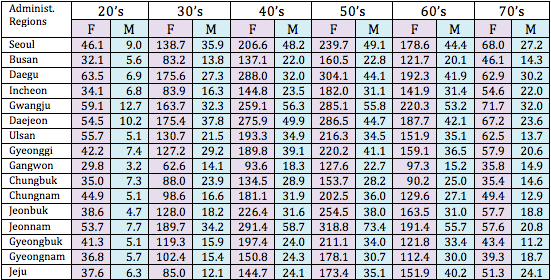 |
|
Thyroid cancer incidence by sex and age group per 100,000
in the 16 administrative regions in Korea
Compiled from Supplementary Tables 2 & 3 in Ahn et al. (2016) Thyroid Cancer Screening in South Korea Increases Detection of Papillary Cancers with No Impact on Other Subtypes or Thyroid Cancer Mortality (link)
|
Furthermore, Ohtsuru’s claim that the female to male ratio tends to be close to 1:1 up to the puberty in the cancer registry is not corroborated by the actual data. The table below was compiled from the National estimates of cancer incidence based on cancer registries. The number of thyroid cancer cases for each sex was listed side-by-side for each year and age group. Then a total from 2000 to 2012 was tallied for each sex and age group to obtain the female to male ratio, because the number of cases varies from year to year. Even without knowing exactly which age range Ohtsuru meant by “up to the puberty,” it is clear that the female to male ratio is not at all close to 1:1.
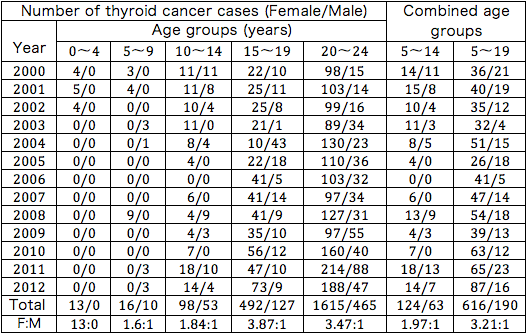 |
|
The number of thyroid cancer cases by sex and age group from 2000 to 2012
Compiled from the National estimates of cancer incidence based on cancer registries in Japan (link)
|
According to this study, the female to male ratio peaks at puberty and declines with age, as excerpted below:
The increased F:M ratio in thyroid cancer incidence does not remain static with age. Female predominance peaks at puberty. […] This pattern occurs as the thyroid cancer incidence begins to increase at an earlier age in females than in males, leading to a rise in the F:M ratio. The ratio starts to decline as the male incidence rate begins to increase and, concurrently, the rate of increase in female incidence rate slows down. The steady decrease in F:M ratio with age continues, and the peak male rate does not occur until between 65 and 69 years of age, compared with the earlier peak female rate between 45 and 49 years of age, just before the mean age of menopause at 50 years.
An issue of the participation rate
The primary examination participation rate of 70.9% in the second round screening is lower than 81.7% in the first round. Most notable is the participation rate of the oldest age group: 52.7% for ages 16-18 (age at exposure) in the first round plummeted to 25.7% for ages 18-22 (age at examination) in the second round. It is 6.6% for ages 18-24 (age at examination) for the ongoing third round so far.
Younger age groups in school have maintained pretty high participation rates thanks to the school-based screening. The older age group often leave the prefecture for college or jobs, and it becomes increasingly difficult to get them to participate, especially with their interests fading in their busy lives.
The status of the new third-party committee
The “international, third-party, neutral, scientific, up-to-date and evidence-based” expert committee proposed by Chairman Hokuto Hoshi at the last committee meeting is being discussed at the prefectural level in consultation with the central government. The prefectural official admitted that the plan was to establish an independent entity that will offer, from a neutral standpoint, latest knowledge of thyroid cancer needed by the Oversight Committee.
A committee member Tamami Umeda from the Ministry of Health, Labour and Welfare elaborated on her vision of the third-party committee as an entity to review and organize the latest clinical and epidemiological knowledge and studies. It would be separate from the Thyroid Examination Evaluation Subcommittee that is intended to evaluate and analyze the status of the TUE, including the evaluation of radiation effects. (Note: In reality, the Thyroid Examination Evaluation Subcommittee has been far from being effective in analyzing the TUE data due to lack of information released by Fukushima Medical University on the premise of protecting personal clinical data).
Explaining that international organizations frequently separate a scientific review process from discussions relating to policy making in order to maintain neutrality, Umeda said she thought a similar process might be useful for the Fukushima Health Management Survey. This comment drew questions from committee members as well as the press about the status of the Oversight Committee itself: Is it a policy-making body? Is it not scientific enough?
It would make more sense to invite experts to join the Thyroid Examination Evaluation Subcommittee to incorporate knowledge gained from the latest research on thyroid cancer. Why it has to be an “international” committee is unclear other than to say that it was recommended by the Organizing Committee of 5th International Expert Symposium in Fukushima on Radiation and Health, including Shunichi Yamashita. A former chair to the Oversight Committee, Yamashita resigned from the position in March 2013 amid controversies surrounding “secret meetings.” Although no longer involved with the Oversight Committee, he has maintained ties with the Survey as Founding Senior Director of the Radiation Medical Science Center for the Fukushima Health Management Survey, the Office of International Cooperation for the Survey.
http://fukushimavoice-eng2.blogspot.fr/2017/02/fukushima-thyroid-examination-february.html
Agency to probe reasons behind underpricing of Fukushima items

Prices of agricultural products and foodstuffs from Fukushima Prefecture declined after the nuclear plant accident in March 2011, and almost six years later, have yet to recover to pre-disaster levels.
Now the government is seeking to ascertain why these items are still being sold at lower prices, suspecting that wholesalers are deliberately underpricing products being shipped from the prefecture.
The Reconstruction Agency will survey wholesalers’ purchase prices of Fukushima-made food products, according to sources.
The agency believes crops and other items grown in the prefecture are being undersold because of the negative effects of groundless rumors stemming from the accident at the Fukushima No. 1 nuclear power plant. The latest decision is aimed at preventing the spread of those rumors.
The agency’s plan is expected to be included in a draft revision of the Law on Special Measures for the Reconstruction and Revitalization of Fukushima, to be submitted during the current Diet session.
Since the Great East Japan Earthquake and tsunami on March 11, 2011, triggered the nuclear accident, Fukushima-made foodstuffs have been shipped only after their radioactivity levels are confirmed to be below safety standards.
The levels for those agricultural and other products typically fall below detectable levels, meaning most foodstuffs from Fukushima Prefecture are completely safe to eat.
Despite the fact, trading prices of rice and beef produced in the prefecture are still nearly 10 percent lower than national averages, according to the agency.
The agency suspects that the prices have not recovered to their pre-disaster levels not only because consumers tend to avoid Fukushima-made articles, but also because they are “purchased at unreasonably low rates” at the time of shipping.
When prices to wholesalers of food products grown in the prefecture are lower than pre-disaster rates, farmers can be compensated for the difference by Tokyo Electric Power Co., operator of the Fukushima No. 1 nuclear plant.
“Some wholesalers may knock down the price, misusing the compensation system,” said a source at the Reconstruction Agency.
To prevent the abuse of the compensation system, the special measures law will be amended to include a plan to conduct “a survey to make clear why they (Fukushima-made products) are suffering from sluggish sales.”
Based on the revised law, the agency will survey the prices farmers are selling their crops for to wholesalers, how much consumers are paying for the agricultural products and other trading prices of foodstuffs from Fukushima Prefecture.
After identifying the reason for the lower prices, the agency will offer instructions and advice to wholesalers and other related parties.
http://www.asahi.com/ajw/articles/AJ201702150001.html

Pics from Fukushima robots not enough to devise fuel-removal plan for reactor 2: Tepco

Members of the media take in the No. 1 reactor at the Fukushima No. 1 power plant in Fukushima Prefecture on Thursday.
OKUMA, FUKUSHIMA PREF. – While a recent investigation found what may be melted nuclear fuel rods in reactor No. 2 containment vessel at the Fukushima No. 1 plant, that information isn’t nearly enough to devise an effective method for removing it, the chief of the plant told reporters during a media tour Thursday.
“We put in cameras and robots and obtained valuable images, though they were partial . . . but it’s still unclear what is really going on there,” said Shunji Uchida, who became chief of the crippled plant last July. “We first need to know the situation of the debris.”
Last month, the utility inserted a 10.5-meter rod with a camera on its tip into a hole in the No. 2 reactor’s primary containment vessel and discovered black lumps sticking to the grating directly underneath the suspended pressure vessel, which holds the core.
Tepco claims it is still unsure whether the lumps are really melted fuel that burned through the bottom of the pressure vessel. Although it is still years away from actually trying to remove the fuel, Tepco, the government and related parties are planning to decide on a basic strategy this summer and go into more detail next year.
Uchida described last month’s surveillance operation as “just peeking.”
Engineers are playing with the idea of refilling the primary containment vessel with water during debris cleanup operations to reduce the intensity of the radiation, but since the PCV was probably damaged during the meltdown crisis in March 2011, the water that’s being pumped in 24/7 to keep the fuel cool is just leaking back out.
According to past analyses, some of the melted fuel rods penetrated the pressure vessel and fell into the containment vessel surrounding it after the March 11 quake and tsunami caused a station blackout at the plant, crippling all cooling functions.
Dr. Caldicott on Fukushima: “Decommission or Cleaning Up? It’s Fantasy!”

Podcast: Download
This Week’s Featured Interview:
- Dr. Helen Caldicott on why Fukushima will never be able to be cleaned up; the devastating health impacts of radiation; and why the 2020 Tokyo Olympics are a really really bad idea.
- Dr. Caldicott Links:
Fukushima: No End in Sight

KGO Radio: Host Pat Thurston recently interviewed Arnie Gundersen, chief engineer for Fairewinds Energy Education on KGO radio to discuss the latest challenging news from Japan about the Fukushima Daiichi atomic power reactor including the high levels of radiation emanating from the reactors, all the failed robotic expeditions, where we should go from here, as well as how ongoing radioactive releases from the Fukushima Daiichi site may be impacting the west coast of the United States.
https://soundcloud.com/fairewinds-energy/february-9-2017-arnie-gunderson
BBC Newsday: BBC Radio interviewed nuclear engineer Arnie Gundersen to discuss TEPCO’s attempts to send a special robot into Fukushima Daiichi Reactor #2 in Japan to investigate the obstacles in the way of TEPCO’s progress determining the location and condition of the atomic fuel. Unfortunately even this specially designed robot failed in its attempt to clear the path for additional investigations as the nuclear radioactivity was so high, it shut down the robots before they could complete their mission.
Enviro News: The astronomical radiation readings at Fukushima Daiichi Reactor #2 of 530 Sv/hr complicate the already complex task of decommissioning the plant. These levels are so radioactive that a human would be dead within a minute of exposure and specially designed robots can only survive for about 2 hours. Fairewinds chief engineer Arnie Gundersen says that the best solution would be to entomb the reactors, similar to the sarcophagus entombing Chernobyl, for at least 100-years, otherwise the radiation level that workers would be exposed to is simply too dangerous.
Read the whole article here
Are the meltdowns at Fukushima Daiichi over? The answer is no. Made all the more prevalent a year out from it’s initial release by the recent robotic expeditions into Reactor #2 which gave us a clearer picture on just how deadly the radiation levels are, watch Chief Engineer and nuclear expert Arnie Gundersen inform viewers on what’s going on at the Japanese nuclear meltdown site, Fukushima Daiichi. As the Japanese government and utility owner Tokyo Electric Power Company push for the quick decommissioning and dismantling of this man-made disaster, the press and scientists need to ask, “Why is the Ukrainian government waiting at least 100 years to attempt to decommission Chernobyl, while the Japanese Government and TEPCO claim that Fukushima Daiichi will be decommissioned and dismantled during the next 30 years?”
Like so many big government + big business controversies, the answer has nothing to do with science, and everything to do with politics and money. To understand Fukushima Daiichi, you need to follow the money.
http://www.fairewinds.org/newsletter-archive//no-end-in-sight
Fukushima nuclear disaster evacuees ‘pressured’ to return to contaminated homes, says Greenpeace
Even though radiation levels in a village near the site of the Fukushima nuclear disaster still exceed international guidelines, its evacuated residents are being coerced to return, according to a Greenpeace report.

Residents from the Japanese ghost village of Iitate will be allowed to return to their former homes at the end of March – the first time since they were forced to flee the Fukushima nuclear disaster in 2011. That’s the date the Japanese government has set to lift evacuation orders.
But according to environmental organization Greenpeace, it’s uncertain whether many will want to. Greenpeace says tests it has carried out on homes in Iitate show that despite decontamination, radiation levels are still dangerously high – but that’s not stopping the Japanese governmenment from pressuring evacuees from returning, under threat of losing financial support.
Those who refuse to go back to their former homes, and are dependent on the Japanese government’s financial help, are faced with a dilemma. After a year from when an area is declared safe again to live in, evacuated residents will see their compensation payments terminated by the government.
Radiation ‘comparable with Chernobyl’
The nuclear disaster led to more than 160,000 people being evacuated and displaced from their homes. Of these, many tens of thousands are still living in temporary accommodation six years on.
The village of Iitate, lying northwest of the destroyed reactors at Fukushima Daiichi power plantand from which 6,000 citizens had to be evacuated, was one of the most heavily contaminated following the nuclear disaster.

Government employees monitor radiation at a day-care center in Iitate in 2011
Around 75 per cent of Iitate is mountainous forest, an integral part of residents’ lives before the nuclear accident.
But according to Greenpeace’s report, published on Tuesday, radiation levels in these woods are “comparable to the current levels within the Chernobyl 30km exclusion zone – an area that more than 30 years after the accident remains formally closed to habitation.”
Put another way, Greenpeace said that in 2017, there clearly remains a radiological emergency within Iitate – defining emergency thus: “If these radiation levels were measured in a nuclear facility, not Iitate, prompt action would be required by the authorities to mitigate serious adverse consequences for human health and safety, property or the environment.”
The environmental organization says decontamination efforts have primarily focused on the areas immediately around peoples’ homes, in agricultural fields and in 20-meter strips along public roads.
But these efforts ended up generating millions of tons of nuclear waste – these now lie at thousands of locations across the prefecture, but they haven’t reduced the level of radiation in Iitate “to levels that are safe,” says Greenpeace.
‘Normalizing’ nuclear disaster?
The organization has accused the Japanese government of trying “to normalize a nuclear disaster, creating the myth that just years after the widespread radioactive contamination caused by the nuclear accident of 11 March 2011, people’s lives and communities can be restored and reclaimed.
“By doing so, it hopes, over time, to overcome public resistance to nuclear power.”
Greenpeace also lambasted the government for leaving unanswered what it calls a critical question for those trying to decide whether to return or not: what radiation dose will they be subjected to, not just in one year but over decades or a lifetime?

Greenpeace says Japan’s government wants to restore public confidence in nuclear power at the cost of harming residents
“Until now the Japanese government has exclusively focused on annual radiation exposure and not the potential radiation dose rates returning citizens could potentially face over their entire lifetime,” says Greenpeace.
Greenpeace, which has been monitoring Iitate since 2011, carried out its latest survey in November 2016
It found that the average radiation dose range for Iitate beginning from March 2017 over a 70-year lifetime was between 39 millisieverts (mSv) and 183mSv – and that’s not including natural radiation exposure expected over a lifetime, or the exposure received in the days, weeks and months following the March 2011 nuclear disaster.
That exceeds yearly guidelines set by the International Commission on Radiological Protection (ICRP) when added up over a 70-year period – it puts the maximum recommended radiation exposure at 1mSv annually.
Greenpeace says: “The highly complex radiological emergency situation in Iitate, and with a high degree of uncertainty and unknown risks, means that there is no return to normal in Iitate, Fukushima prefecture.”
It has called on the Japanese government to cease its return policy, and to provide full financial support to evacuees, and “allow citizens to decide whether to return or relocate free from duress and financial coercion.”
According to Greenpeace, “for the more than 6,000 citizens of Iitate, this is a time of uncertainty and anxiety.”
Heinz Smital, nuclear physicist and radiation expert at Greenpeace Germany, and part of the team taking measurements at Iitate, told DW the residents were faced with a very difficult situation.
“If you decide to live elsewhere [and not return to Iitate], then you don’t have money, you’re sometimes not welcomed in another area so you are forced to leave, because people say, ‘you’re not going back but you could go back,'” he said. “But for people who go back, they have contaminated land, so how can they use the fields for agriculture?”
He urged the Japanese government to more involve those affected in the decision-making process and not try to give an impression that things are “going back to normal.”
“It’s a violation of human rights to force people into such a situation because they haven’t done anything wrong, it’s the operator of the power plant responsible for the damage it caused,” said Smital.
“It’s very clear that there’s very serious damage to the property and the lifestyle of the people but the government doesn’t care about this.”
Stand in solidarity Defend the human rights of Fukushima survivors

Disasters like Chernobyl and Fukushima remind the world how dangerous nuclear power is. But right now, the nuclear industry is trying to downplay the risks of a nuclear disaster. In Fukushima radiation exposure is still a very real threat despite failed “decontamination”.
The Japanese government is set to lift evacuation orders in heavily contaminated areas around Fukushima. It will cut compensation and housing support to survivors, who are still struggling six years later.
Their basic rights to health, housing, and environment are being violated. The government is desperately trying to minimize the disaster at the expense of survivors in an attempt to revive the dying nuclear industry and suffocate other cleaner energy sources. We must say no!
Sign now to demand the government provides fair compensation, housing support, and is fully transparent about the radiation risks.
We’ll deliver your signature to the Prime Minister so he hears the global wave of resistance against nuclear!
https://act.greenpeace.org/page/6288/petition/1?_ga=1.23785721.2131293321.1485515415
1 This Month

of the week – Shut Down Drone Warfare!


Tell the Ukrainian Government to Drop Prosecution of Peace Activist Yurii Sheliazhenko

Petition to revoke the licensing of the Near Surface Nuclear Disposal Facility (NSDF) at Chalk River. https://www.ourcommons.ca/petitions/en/Petition/Details?Petition=e-7247
To see nuclear-related stories in greater depth and intensity – go to https://nuclearinformation.wordpress.com
-
Archives
- April 2026 (114)
- March 2026 (251)
- February 2026 (268)
- January 2026 (308)
- December 2025 (358)
- November 2025 (359)
- October 2025 (376)
- September 2025 (257)
- August 2025 (319)
- July 2025 (230)
- June 2025 (348)
- May 2025 (261)
-
Categories
- 1
- 1 NUCLEAR ISSUES
- business and costs
- climate change
- culture and arts
- ENERGY
- environment
- health
- history
- indigenous issues
- Legal
- marketing of nuclear
- media
- opposition to nuclear
- PERSONAL STORIES
- politics
- politics international
- Religion and ethics
- safety
- secrets,lies and civil liberties
- spinbuster
- technology
- Uranium
- wastes
- weapons and war
- Women
- 2 WORLD
- ACTION
- AFRICA
- Atrocities
- AUSTRALIA
- Christina's notes
- Christina's themes
- culture and arts
- Events
- Fuk 2022
- Fuk 2023
- Fukushima 2017
- Fukushima 2018
- fukushima 2019
- Fukushima 2020
- Fukushima 2021
- general
- global warming
- Humour (God we need it)
- Nuclear
- RARE EARTHS
- Reference
- resources – print
- Resources -audiovicual
- Weekly Newsletter
- World
- World Nuclear
- YouTube
-
RSS
Entries RSS
Comments RSS
 nuclear-news