I will not run away even if people say I am a “walking rumor mill”.

June 11, 2022
I think I might have to close down the store.
In December 2012, when asked by Guntaro Managi, 46, a lawyer visiting from Tokyo, to become a plaintiff leader, Takashi Nakajima, 66, who runs a local fish supermarket in Soma City, Fukushima Prefecture, could not give an immediate answer. I might have to close down the store,” he said.
Immediately after the Great East Japan Earthquake, supermarkets were packed with people every day in search of water and food. They cooked rice from stores they had left over, negotiated to buy fish from frozen warehouses at markets, and carried water in bleached kettles. Some people came from far away by bicycle or on foot due to lack of gasoline. 1,500 people a day formed a long line. While stores in the area were closed, they worked desperately to secure foodstuffs so as not to let the local people starve to death.
After the accident at TEPCO’s Fukushima Daiichi nuclear power plant, the fishing industry in Fukushima was forced to suspend operations. Both the fish brokers and the retailers’ association, of which Mr. Nakajima is the president, were in dire straits because they could not get local fish. We have no choice but to hang ourselves,” he said. Such voices came in on a daily basis. With the help of a lawyer, he filed a direct claim for damages with Tokyo Electric Power Company (TEPCO), but the company was slow to take action.
Sales down 30%, living on a pension with his wife without pay
It was then that he was asked to become the leader of the plaintiffs’ group in a lawsuit seeking compensation from TEPCO and the central government. His wife Kazumi, 66, told him, “Everyone is going to hang themselves. My son will teach you how to cut fish. I’ll teach my son how to cut fish, and we’ll take care of the restaurant. The fact that the lawyers had told him, “We are prepared to win even if it costs us our own money,” also crossed his mind. We can’t just run away.
Meetings of the plaintiffs’ group, lawsuits, negotiations with the government and TEPCO…. He began to leave the restaurant frequently. Due in part to the nuclear accident, sales have dropped by 30% at best, and now he and his wife live on a pension without pay.
As the head of the plaintiffs’ group, he was prepared to face criticism from those around him for continuing to complain about the damage. I was very angry when I was told by neighbors that I was a “walking rumor mill. However, his determination to have TEPCO and the national government admit responsibility for the nuclear accident and apologize, and to help victims other than the plaintiffs, was unwavering.
The government’s efforts to restart the nuclear power plants will not end with the court’s decision.
More than 11 years have passed since the accident, and more than 100 plaintiffs have died. Mr. Nakashima cannot forget Mitsuo Takagi, then 71, a ramen shop owner in Minamisoma, Fukushima Prefecture, who committed suicide in 2003. In court, he said, “I was happy when my children came to the store with their families. Now that the area has been designated as an evacuation zone, I can’t even open that store. Do you understand my frustration? There was no suicide note.
There was no suicide note,” Nakajima said. I believe that the Supreme Court’s decision will recognize the government’s responsibility. I wanted my friends who passed away to hear this. The government is now trying to restart the nuclear reactors. The ruling is not the end of the matter. The plaintiffs’ group will not disband and will continue to fight until we hand over to the next generation a society in which nuclear accidents will never happen again.
Fukushima lawsuit: “Give back our livelihood, give back our community! The lawsuit was filed on March 11, 2013 under the slogan “Give back our livelihoods, give back our community! The lawsuit was filed on March 11, 2013 under the slogan “Give back our livelihood, give back our community! The Fukushima District Court (Kanazawa Hideki, presiding judge) in the first trial held the government liable for one-half of TEPCO’s damages, but the Sendai High Court (Ueda Satoshi, presiding judge) in the second trial found the government’s liability equal to that of TEPCO and doubled the amount of damages to 1.01 billion yen. The high court decision expands the area covered by the “loss of hometown” compensation, which was only allowed in the difficult-to-return zone under the government’s “Interim Guidelines” for compensation standards. The court also approved compensation for victims in the Fukushima and Aizu regions and parts of Tochigi and Miyagi prefectures that are outside the evacuation zone.
On April 17, the Supreme Court’s Second Petty Bench will issue a unified decision on whether the government is liable for damages in four lawsuits filed by victims of the nuclear power plant accident in Fukushima, Gunma, Chiba, and Ehime prefectures against TEPCO and the government. Ahead of the ruling, which could have a tremendous impact on the approximately 30 class action lawsuits filed nationwide, we asked the plaintiffs in the four lawsuits about the past 11 years and what the future holds.
https://www.tokyo-np.co.jp/article/182747?rct=national&fbclid=IwAR2NuOz8_wblQXnJ4Ol7SryV1nCGWAXlBlKwKSg6TBCEwWnQiC-S7s9ASio
Government OKs reopening of Fukushima village section to residents in June

June 3, 2022
Fukushima – More than a decade since the March 2011 nuclear disaster, some registered residents of part of a Fukushima village made off-limits by high radiation levels can finally return home after the government decided Friday to lift evacuation orders on June 12.
While some areas around stations and rail tracks had their so-called “difficult-to-return” zone classification lifted, it is the first time for the classification to be lifted to host permanent residents again.
A 0.95 square kilometer part of Katsurao, located near the defunct Fukushima No. 1 nuclear power plant, will have the designation lifted, the government’s nuclear emergency response headquarters and the Reconstruction Agency agreed in a joint meeting.
The move comes after national and local governments decided in May that the area’s radiation decontamination and infrastructural developments had progressed enough to reopen.
“This is a big step toward the restoration of the village,” said Mayor Hiroshi Shinoki in a statement. “The lifting is not a goal, but a start.”
The entirety of Katsurao became off-limits after the nuclear crisis triggered by an enormous earthquake and tsunami on March 11, 2011, with evacuation orders for most of the village lifted on June 12, 2016.
Of the 30 registered households and 82 residents in the relevant part of Katsurao, just four households totaling eight people have expressed an intention to return, according to the village government.
Currently, around 337 sq. km of land in six municipalities of Fukushima Prefecture, including Katsurao, Okuma and Futaba, is still subject to the difficult-to-return zone classification.
At Friday’s meeting, Prime Minister Fumio Kishida said he intends to “move ahead with work to lift restrictions and further accelerate Fukushima’s recovery.”
Among the five other Fukushima municipalities inside the zone, Futaba and Okuma are set to have restrictions partially lifted from June onward, while the other three can expect partial removals in spring 2023.
However, more than 90% of the difficult-to-return zone in the prefecture will remain under the classification, and there is no concrete timetable for when it will be completely accessible again.
Areas reopening after Fukushima nuclear disaster need sustained gov’t support

June 10, 2022
Evacuation orders that have been in place since the 2011 Fukushima Daiichi Nuclear Power Station disaster are set to be lifted in part of the Fukushima Prefecture village of Katsurao, one of the so-called difficult-to-return zones, on June 12.
Difficult-to-return zones, which people are forbidden from entering in principle due to high radiation levels, have been left behind in the recovery process. The latest move marks the first time that people will be able to live in one of these areas since the meltdowns triggered by the March 2011 Great East Japan Earthquake and tsunami.
The central parts of six difficult-to-return towns and villages including Katsurao have been designated as “zones for reconstruction and recovery,” and the national government has been carrying out decontamination work there. The part of the village of Katsurao set to reopen for living is one of such zones, finally marking a step forward more than 11 years after the accident.
However, of the 82 people in 30 households registered in that part of Katsurao, at this stage only eight people in four households have expressed their intention to return.
Evacuation orders were lifted in 2016 for other parts of Katsurao that fell outside the difficult-to-return zone, five years after the onset of the disaster. Another six years have passed since then, and residents have apparently become hesitant to return.
Through next spring, it is expected to become possible for people to permanently return to designated reconstruction and recovery zones in five remaining towns and villages including the towns of Futaba and Okuma, which the crippled nuclear power station straddles.
Many residents, however, are reluctant to return as those areas face an uncertain future. While local bodies are planning to secure medical care and attract commercial facilities into the areas, there is a need to steadily prepare such a living environment.
Besides worries about the future, an additional source of concern for people is that decontamination work in areas outside the specified reconstruction and recovery zones has yet to commence.
The government promised to create an environment enabling all residents wanting to return to do so in the 2020s. But the only places outside the restoration and recovery zones that the government has decided to decontaminate are returning residents’ homes and their vicinities. It has not revealed how it plans to handle other land and homes.
If the scope of decontamination work is not fixed, there will likely be many residents unable to decide whether they can return with peace of mind. The government needs to quickly present a course of action.
The road to recovery of the difficult-to-return zones is still far off. An official at Katsurao Murazukuri Kosha, a public corporation that is promoting the revival of the village, stressed, “First, it’s important to properly support the lives of people who have returned. We want to move forward one step at a time from there.”
The government has a responsibility to accomplish the revitalization of Fukushima. It must listen to the voices of residents, and continue to offer sustained support.
https://mainichi.jp/english/articles/20220610/p2a/00m/0op/013000c
No to Fukushima discharge

TEPCO’s former management forced to indict former management.
Just a travesty of justice: The designated attorney requested an on-site inspection at the appeal hearing, but the trial concluded today without such an inspection.

June 6, 2022
The appeal trial for the mandatory prosecution of three former TEPCO executives over the accident at the Fukushima Daiichi Nuclear Power Plant, in which they were acquitted at the first trial, concluded today without an on-site inspection.
Former TEPCO Chairman Tsunehisa Katsumata and three other former TEPCO executives were indicted on charges of manslaughter in connection with the nuclear accident.
The first trial court acquitted them in 2019 on the grounds that “it is not recognized that they could have predicted the occurrence of a huge tsunami,” and the designated lawyer acting as the prosecutor appealed the verdict.
At the appeal hearing held today at the Tokyo High Court, the designated lawyer pointed out that “the three could and should have foreseen the tsunami,” based on the “long-term assessment” issued by the government’s earthquake headquarters before the disaster. He argued that the first trial court’s decision to deny the reliability of the long-term assessment was erroneous.
The defense, on the other hand, argued for acquittal on the grounds that “there was no error in the first trial.
The designated attorney requested an on-site inspection at the appeal hearing, but the trial concluded today without such an inspection.
https://newsdig.tbs.co.jp/articles/-/63459?display=1
Three former TEPCO executives to be sentenced on appeal in December-January, or forced prosecution for nuclear accident.

June 6, 2022
On June 6, the Tokyo High Court (presided over by Keisuke Hosoda) held the third hearing of an appeal against three former TEPCO executives who were indicted on charges of manslaughter and death for negligence in connection with the 2011 Fukushima Daiichi Nuclear Power Plant accident and failure to take tsunami countermeasures. The designated attorney acting as the prosecutor requested that the Tokyo District Court ruling acquitting the three be reversed, and the defense reiterated its plea of not guilty at the conclusion of the trial. The verdict is expected in December or January next year.
The three defendants are Tsunehisa Katsumata, 82, former chairman; Ichiro Takekuro, 76, former vice president; and Sakae Mutoh, 71, former vice president. The main point of contention, as in the first trial, is whether the three defendants were able to foresee the occurrence of the giant tsunami and whether they were able to take measures to prevent the accident.
Designated Lawyer: “The First-Instance Judgment is Wrong
The district court ruling in 2007 rejected the reliability of the “long-term evaluation” of earthquake forecasts released by the government in 2002, and ruled that the earthquake was not foreseeable enough to shut down the plant.
On the day of the hearing, the designated attorney appealed that the first instance decision was erroneous, citing the example of the reliability of the long-term assessment being recognized in a civil court ruling on liability for the accident. He stated, “If reliability is recognized, the validity of the first instance judgment will be overturned from the bottom up.”
The defense, on the other hand, countered that the fact-finding process in a criminal trial is different from that in a civil trial, and that “this is no basis for holding that the first-instance decision was erroneous.
According to the representatives of the families of the victims in the criminal trial, the high court explained after the conclusion of the trial that it would set the date for the verdict in December or January of next year.
https://www.asahi.com/articles/ASQ666G1BQ66UTIL01Z.html?fbclid=IwAR2xTS7IOPmNLwpMZsg1IPg8jscudVShWhxI-2n1YH2o2dQA2qi5h-kX2Ck
Appeal Hearings End for 3 Ex-TEPCO Execs over 2011 Meltdowns

June 6, 2022
Tokyo, June 6 (Jiji Press)–Tokyo High Court concluded on Monday hearings for three former executives of Tokyo Electric Power Company Holdings Inc. <9501> in an appeal trial over the 2011 meltdowns at its Fukushima No. 1 nuclear plant.
The three are former Chairman Tsunehisa Katsumata, 82, and former executive vice presidents Sakae Muto, 71, and Ichiro Takekuro, 76. The court is likely to issue its verdict in December or the following month, according to an attorney in the trial.
The trio came under mandatory indictment on charges of professional negligence resulting in death and injury over the unprecedented triple meltdown at TEPCO’s Fukushima No. 1 plant in northeastern Japan and were acquitted in the first trial.
In the first trial, hearings were held 37 times, while only three hearings took place for the appeal, including the first one in November last year.
Lawyers appointed to act as prosecutors had asked judges to conduct on-site inspections and demanded former senior officials of the Japan Meteorological Agency testify about the government’s long-term assessments of earthquake and tsunami risks.
TEPCO issues 1st apology from president for nuclear accident
Face value skin-deep apology: So sorry that we destroyed your life, your health and your living environment but happy that the court gave us only a chump change damages compensation to be paid for all of that.

June 6, 2022
FUTABA, Fukushima Prefecture–Tokyo Electric Power Co. apologized to a group of plaintiffs who won a damages suit against the utility for the first time under the name of its president.
“We sincerely apologize to you for upending your lives and causing irreparable mental and physical damage with the nuclear disaster,” TEPCO President Tomoaki Kobayakawa said in the statement.
The apology was read by Kazuyoshi Takahara, representative of the utility’s Fukushima Revitalization Headquarters in Futaba, Fukushima Prefecture, to some of the plaintiffs who visited on June 5. He bowed after reading the statement.
Kobayakawa was not among the TEPCO officials who received them.
The apology followed the Supreme Court’s decision in March that upheld the Sendai High Court’s order for the utility to pay more compensation to the victims than outlined in the central government’s guidelines.
Naoko Kanai, who heads the group’s secretariat, said, “I would like to accept the apology and want to believe the words reflect the company’s determination to make efforts to restore the lives of the residents.”
But Tomio Kokubun, a deputy leader of the plaintiff group, blasted the absence of the TEPCO president when offering the apology.
“It shows a lack of common sense, given that the company caused an accident of such magnitude,” he said.
The group of 216 plaintiffs sued the company for the “loss of their hometowns” after they were ordered to evacuate when the triple meltdown unfolded in March 2011 following the Great East Japan Earthquake and tsunami.
The lawsuit was among about 30 similar lawsuits brought against TEPCO.
TEPCO apologizes for the first time in the name of its president to the plaintiffs in the evacuees’ lawsuit

June 5, 2022
On June 5, TEPCO apologized in the name of President Tomoaki Kobayakawa to the plaintiffs in a class action lawsuit filed by residents evacuated from the Fukushima Daiichi Nuclear Power Plant accident seeking compensation for the “loss of their hometown,” saying that the accident “ruined their lives and caused irreparable damage both physically and mentally. This is the first time that TEPCO has apologized to the plaintiffs of a class action lawsuit in the name of its president.
The apology was made in Futaba-cho, Fukushima Prefecture, where TEPCO’s Fukushima reconstruction headquarters is located, after the Supreme Court ruled in March that TEPCO should pay compensation in excess of the national standard. However, President Kobayakawa did not visit the site, and Kazuyoshi Takahara, the head of the Fukushima Reconstruction Headquarters, said, “The accident has caused great damage to our irreplaceable lives and hometowns. He read out a letter of apology and bowed his head.
Naoko Kanai, 56, secretary general of the plaintiffs’ group, said, “We would like to accept your sincere apology with all sincerity. We believe that these words are a pledge to spare no effort to restore the lives of local residents without the arrogance of a large corporation.
https://www.asahi.com/articles/ASQ6566MSQ65UGTB00C.html?iref=pc_photo_gallery_bottom
TEPCO apologizes to evacuees of nuclear power plant after losing lawsuit: “The accident ruined my life”

June 5, 2022
In response to the final decision in a lawsuit filed by evacuees of TEPCO’s Fukushima Daiichi Nuclear Power Plant, TEPCO met with the plaintiffs on June 5 at an industrial exchange center in Futaba-machi, Fukushima Prefecture, and told them, “The accident has caused great damage to our irreplaceable lives and hometowns, and we are deeply sorry that your lives have been ruined and that you have suffered irreparable damage to your bodies and minds. The accident has caused irreparable damage to your lives and hometowns, and has wrecked your lives and caused irreversible physical and mental damage. I am truly sorry.
Kazuyoshi Takahara, representative of TEPCO’s Fukushima headquarters, read the letter of apology in the name of President Tomoaki Kobayakawa and handed it to the plaintiffs. Atsuo Hayakawa, 82, the head of the plaintiffs’ group, received the letter and demanded, “I want you to investigate the cause and responsibility for the failure to prevent the accident based on objective facts.
https://www.tokyo-np.co.jp/amp/article/181741?fbclid=IwAR2hQcp5pXdFFb8l989S0AFW8wObAlmwrsSaYgzmn-H4tJ2Q1JoIlBR7kK0
Court orders TEPCO to pay 73.5 million yen over Fukushima crisis

June 2, 2022
FUKUSHIMA, Japan (Kyodo) — A Japanese court on Thursday ordered the operator of the crippled Fukushima Daiichi nuclear power plant to pay a total of 73.5 million yen ($566,000) in compensation to current and former residents of Tamura City in the west of the complex hit by the March 2011 disaster for emotional distress.
But the 525 plaintiffs, who sought 11 million yen per person in damages from both Tokyo Electric Power Company Holdings Inc. and the Japanese government, are considering appealing the ruling, some of them said in a press conference.
The Koriyama branch of the Fukushima District Court recognized the plaintiffs’ claim that they were anguished by losing previous joy, such as picking nearby wild plants and forging community ties, but dismissed the case against the state.
Presiding Judge Yohei Motomura noted that a government organization’s assessment released in 2002 of danger posed by possible quake-induced tsunami for the nuclear complex lacked accuracy, but it was still difficult for the state to foresee the magnitude of tsunami that hit the plant.
“Even if the government had exercised its regulatory authority and had TEPCO take countermeasures, it could not have been possible to prevent the tsunami from triggering the accident,” the judge said, awarding 2 million yen to each plaintiff.
Given that the plaintiffs had received compensation in the form of a monthly consolation fee of 100,000 yen from TEPCO through August 2012, the court ruled that most of the damages awarded in its ruling have already been paid.
A devastating earthquake and tsunami in Japan’s northeast on March 11, 2011, triggered reactor meltdowns at the nuclear complex and sent plumes of radioactive material in the air.
Some areas of Tamura sit within a radius of 20- to 30-kilometers from the plant and were designated as emergency evacuation preparation zones the next month in the event of a worsened situation. The designation was lifted in September 2011.
Similar cases have been filed across Japan accusing the company and government of negligence over safety concerns about the plant.
https://mainichi.jp/english/articles/20220602/p2g/00m/0na/053000c
Fukushima District Court Orders TEPCO to Pay Compensation, Finding No Liability on the Part of the State

June 02, 2022
525 residents of the former emergency evacuation preparation zone in the Miyakoji district of Tamura City, Fukushima Prefecture, have filed a lawsuit against the government and TEPCO, claiming that they lost community ties and suffered emotional distress as a result of the accident at TEPCO’s Fukushima No. 1 nuclear power plant. On April 2, the Koriyama Branch of the Fukushima District Court ruled in a lawsuit filed by 525 residents of the former emergency evacuation preparation zone in the Miyakoji district of Tamura City, Fukushima Prefecture, seeking a total of approximately 6 billion yen in damages from the government and TEPCO. The judge, Yohei Motomura, ordered TEPCO to pay approximately 7,350,000,000 yen in compensation. The court did not find the government liable.
Judge Motomura awarded approximately 1.2 billion yen in compensation to the residents for the anxiety caused by exposure to radiation and the emotional distress caused by the long-term evacuation. He calculated the amount of compensation by subtracting approximately 1.13 billion yen that the residents had already received. The court did not find that the government had foreseeability.
According to the complaint, the plaintiffs had been enjoying gathering wild vegetables and mushrooms for their livelihood, but the nuclear power plant accident caused them to lose their connection to the natural environment of the area.
After the verdict, Nobuyuki Imaizumi, 74, a plaintiff, said, “I have been working for eight whole years, and it is very disappointing that the government is not found responsible. As long as there are plaintiffs, we will fight until the end. Plaintiffs’ attorney Hiroyasu Hayashi expressed his intention to appeal, saying, “Given the current amount of money, there will be an extremely large number of plaintiffs who will appeal.
https://www.jiji.com/jc/article?k=2022060200741&g=soc&fbclid=IwAR33nh5nPAc5SeW_7vxHOlZOjo-ChhRWGJVjvxFaFhwWSaNbyjb8DwUMeHA
Sapporo District Court orders Hokkaido Electric Power Co. not to operate Tomari Nuclear Power Plant

May 31, 2022
The Sapporo District Court has ruled that Hokkaido Electric Power Company (HEPCO) should not operate the Tomari Nuclear Power Plant in the village of Tomari in the Goshi region of Hokkaido, following a lawsuit by local residents and others claiming that the plant is not safe enough against earthquakes and tsunami.
The court ruled that Hokkaido Electric Power Company’s Tomari Nuclear Power Plant reactors No. 1 through No. 3 should be banned from operation, claiming that they are not safe enough. The court ruled in favor of the plaintiffs, claiming that the plant was “unsafe” and demanded that it be banned and decommissioned.
The plaintiffs argued that “the existence of an active fault that could cause a major earthquake was not taken into account, and that the current tsunami protection system is inadequate to prevent tsunamis. The plaintiffs argued that “there is an active fault that causes major earthquakes, but the shaking was not anticipated, and the current levees cannot prevent tsunamis.
At 3:00 p.m. on March 31, the Sapporo District Court handed down its decision, in which Judge Tetsuya Taniguchi ordered Hokkaido Electric Power Co. to stop operating the Tomari Nuclear Power Plant.
The court did not approve the decommissioning of the plant or the removal of spent nuclear fuel, which the plaintiffs had demanded.
All three units of the Tomari Nuclear Power Plant have been out of operation for 10 years since Unit 3 stopped power generation in 2012 for routine inspections. The plant has been in a state of shutdown for 10 years.
https://www3.nhk.or.jp/sapporo-news/20220531/7000047050.html?fbclid=IwAR2wXLrDKnrR0zQ9KKN3zK2m2t_hYMXgKWht4aF3BFt9dtpZu03kLmUy0vM
Nuke contaminated water from Fukushima may be out of sight, but should never be out of one’s mind

May 30, 2022
In 2011, the “3/11” earthquake in Japan caused the meltdown of the Fukushima Daiichi Nuclear Power Plant reactor core, unleashing enormous amounts of radioactive material. The operator of the plant, Tokyo Electric Power Company (TEPCO), decided to pour in seawater to cool the reactor and contain the leakage. And because the used seawater became highly contaminated with radioactive material, TEPCO had to put it in storage tanks. A decade on, the nuclear contaminated water generated by the Fukushima Daiichi Nuclear Power Plant are about 150 tons per day in 2021, and will reach the upper limit of the storage tank capacity of 1.37 million tons in the spring of 2023.
According to estimates by the Japan Center for Economic Research, it will cost 50-70 trillion yen (about $400-550 billion) to scrap and decontaminate the reactor, the bulk of which goes to the treatment of contaminated water. So in April 2021, the Japanese government announced that the problem of increasing amounts of nuclear contaminated wastewater would be addressed by dumping it into the sea. On May 18, 2022, the Japan Atomic Energy Regulatory Commission granted initial approval for TEPCO’s ocean dumping plan.
After the Fukushima nuclear accident, the Japanese government set up the “Nuclear Damage Compensation and Decommissioning Facilitation Corporation” (NDF), which is an official agency with 50.1 percent of TEPCO’s voting rights, in order to prevent TEPCO from going bankrupt. In other words, TEPCO is now under direct jurisdiction and control of the Japanese government. It is not hard to see that both TEPCO and the Japanese government are the masterminds behind the nuclear contaminated water dumping plan, because for them, this is the most expedient, cost-effective and trouble-saving way. Japan would need to spend only 3.4 billion yen (about $27 million) according to this plan. But the threat to nature, the environment and human life as a result of such reckless actions was probably never on their minds.
Nuclear contaminated water is not nuclear treated water
Monitoring data collected in 2012 showed that the concentration of Cesium in the waters near Fukushima was 100,000 becquerels per cubic meter, which is 100 times higher than what was detected in the Black Sea after the Chernobyl nuclear leak. Ten years later in 2021, 500 becquerels of radioactive elements per kilogram of weight could still be detected in the flat scorpionfish caught by Japanese fishermen off the coast of Fukushima Prefecture, or five times higher than Japan’s own standards. In the 11 years since the nuclear disaster, one or two thyroid cancer cases have been reported for every 60,000 children in Fukushima Prefecture, much higher than the normal rate.
The Japanese government and TEPCO have repeatedly claimed that nuclear contaminated water is “safe” to be dumped into the ocean because it would go through the multi-nuclide removal system (Advanced Liquid Processing System, ALPS). But it is only the radioactive substance called “Tritium” that has reached this standard. And what Japan doesn’t say is that, even after treatment, the water still contains other radioactive substances such as Strontium 90 and Carbon 14 that cause genetic mutation in the ecosystem. Since the release of the ALPS-related report, the Japanese government has not held any briefings or hearings for the public. And in order to justify the dumping plan, the Japanese government contacted citizen and groups to ask them to stop using the words “nuclear contaminated water”, and use “nuclear treated water” instead. Vigorous public relations (PR) efforts have also been carried out to whitewash the plan. In the 2021 budget of the Japanese Reconstruction Agency, PR expenses related to the Fukushima nuclear accident have increased to 2 billion yen (around $16 million), over four times than the previous year figure. The money has been used on professional teams to weaken and remove negative public opinion in Japan and abroad about the nuclear contaminated water through various propaganda programs.
Furthermore, TEPCO’s track records for handling the nuclear accident have been filled with deception and distortion. In 2007, TEPCO admitted that it had tampered with data and concealed potential safety hazards in a total of 199 regular inspections of 13 reactors in its nuclear power plants since 1977, including the cooling system failure in the Fukushima nuclear accident. One week after the 2011 nuclear accident when experts had already made the judgment that the cores of Units 1 to 3 of the Fukushima Daiichi Nuclear Power Plant had melted, the company still refused to announce the truth to the public, and instead chose to use “core damage,” a term that was significantly less alarming. With a past so bad it is hard to make one believe that TEPCO will dump “safe” nuclear contaminated water into the sea.
Waves of opposition at home and abroad
The Japanese government has so far failed to provide sufficient and credible explanations on the legitimacy of the nuclear contaminated water dumping plan, the reliability of nuclear contaminated water data, the effectiveness of the purification devices, and the uncertainty of the environmental impact. To promote the plan under such circumstances has only brought about wide criticism and questions by various communities in Japan and beyond.
Up to 70 percent of the people in Fukushima Prefecture have expressed opposition to the dumping plan. Konno Toshio, former president of Fukushima University, was opposed to advancing the ocean dumping plan without prior understanding at home and abroad, because this plan could affect future generations and must be treated with great caution. The fishery cooperatives and local councils in Miyagi Prefecture, which is adjacent to Fukushima Prefecture, believe that the dumping of nuclear contaminated water into the ocean may affect the safety of local aquatic products and cause significant economic losses to related industries. Already, 180,000 people in Japan have signed the petition to the Japanese government to adopt disposal options other than ocean dumping.
Vladimir Kuznetsov, academician at the Russian Academy of Natural Sciences, said that radioactive substances in the nuclear contaminated water can only be partially filtered, and the treated water still contains extremely dangerous radionuclides, which will pollute marine life and spread to the entire ocean through fish migration. This will gravely harm the global marine environment and cause serious harm to the health of people in the periphery. According to a research model established by GEOMAR Helmholtz Centre for Ocean Research Kiel, half of the Pacific Ocean will be polluted in less than 57 days if nuclear contaminated water is dumped at the speed announced by Japan.
Voices of justice
Japan’s ocean dumping plan of nuclear contaminated water is a serious threat to the marine environment, and it damages marine interests of the neighbors and other littoral countries. It also violates multiple international conventions such as the United Nations Convention on the Law of the Sea, the Convention on Assistance in Nuclear Accidents or Radiation Emergencies, and the Convention on Nuclear Safety as well as principles of the international law. Many countries, including China, have expressed concern over or opposition to it.
The Russian Foreign Ministry issued a statement criticizing the Japanese government for not consulting with or providing any related information to its neighbors when the decision was made, and expressing grave concern over Japan’s dumping of nuclear polluted water into the ocean. The South Korean Foreign Ministry summoned the Japanese ambassador to Seoul to make a serious protest against Japan’s unilateral decision while large crowds gathered in front of the Japanese embassy to protest. The International Atomic Energy Agency (IAEA) has launched an assessment of Japan’s plan.
The spokesperson of the Chinese Ministry of Foreign Affairs has repeatedly pointed out that Japan’s dumping of nuclear contaminated water into the ocean is extremely irresponsible, and demanded that Japan fully consult with neighboring countries, other stakeholders, and relevant international institutions to find a proper way to dispose of the nuclear contaminated water, before which the dumping into the ocean shall not be initiated.
The ocean is a treasure for all mankind and our home for survival. It is essential for sustainable development and our future. To dump nuclear contaminated water from Fukushima into the ocean is a major issue that bears on the environment for human survival and health, it is not just Japan’s internal affairs. Although keenly aware of the grave harm to the global marine environment caused by the dumping of such water into the sea, Japan has attempted to push through the plan without exhausting all other safe methods. Such an opaque and irresponsible approach is unacceptable, let alone trusted by countries in the region and the larger international community.
Fukushima citizens’ group urges TEPCO to “stop construction of facilities to discharge contaminated water into the ocean without understanding and agreement” and to Governor Uchibori, “Do not agree to the prior consent request
May 25, 2022
On May 25th, members of the Fukushima citizens’ group “Don’t Pollute the Sea Anymore! Citizens’ Council” and other members visited the Fukushima branch office of TEPCO’s Fukushima Reconstruction Headquarters and the Fukushima Prefectural Government on the morning of May 25 to submit a written request to TEPCO. They again demanded that TEPCO “stop construction of facilities for discharging contaminated water into the ocean without understanding and agreement” and that Fukushima Prefecture “not agree to the request for prior consent. Although there is still no consent from Fukushima Prefecture and there are voices of opposition, TEPCO is steadily preparing for the oceanic discharge as “construction work that does not require permission. Upon receiving the request, TEPCO asked the interviewer to leave the room to exchange opinions, but no concrete response was given. While the voices of the people are being ignored, the time for Governor Masao Uchibori to make a decision is approaching.

The “clean sea” cannot be promised.
The letter of request to TEPCO asks for five points.
(1) Stop the full-scale construction of facilities for discharging contaminated water into the ocean without understanding and agreement.
(2) Disclosure of all information, including the concentration and total amount of all radioactive nuclides to be discharged.
(3) Establish drastic measures for contaminated water, such as groundwater sealing, as soon as possible.
(4) Hold explanations and public hearings in Fukushima Prefecture and throughout Japan.
(5) Cancellation of the statement made by the director of the Nuclear Energy Center and an apology.
The group also calls on Fukushima Prefecture Governor Masao Uchibori to address the following four points.
(1) Refrain from agreeing to prior consent for oceanic discharge without understanding and agreement.
(2) Make the government and TEPCO disclose all information, including the concentration and total amount of all radionuclides to be released.
(3) Demand that the government and TEPCO establish measures to prevent contaminated water, such as groundwater sealing.
4) Demand that the government and TEPCO hold explanations and public hearings in Fukushima Prefecture and throughout Japan.
At the Fukushima branch office of TEPCO’s Fukushima Reconstruction Headquarters, Mr. Tsuyoshi Shibano of the Fukushima Public Relations Department received the written request. Four representatives from citizens’ groups took part in the exchange of opinions, but TEPCO allowed only a “head shot” to the interviewers. TEPCO asked the reporters to leave the room, saying, “We do not allow interviews in the exchange of opinions,” “We cannot speak frankly when reporters are present,” and “We do so in other situations as well. When reporters asked for interviews, they were told that they would not begin unless they left the room. According to those present, TEPCO did not make any specific comments in response to the request.
The request to TEPCO included “rescinding and apologizing for the statement made by the director of the Nuclear Energy Center,” a protest against the statement he made when he visited the TEPCO headquarters on June 13 to request the cancellation of the June construction start. When a mother who participated in the protest asked TEPCO to “promise to leave a clean sea for our children,” the director of the Nuclear Energy Center replied, “I can’t promise you that. This mother shouted “Don’t make fun of Fukushima” in front of the TEPCO headquarters. In her written request, she demanded a cancellation and an apology in a strong tone, saying, “This shows a corporate culture of ignoring residents without regard for responsibility for the nuclear accident. TEPCO’s response was limited to saying that they had not been able to confirm what she had said.


The “Promise to the Fishermen’s Federation” is heavy.
At the Fukushima Prefectural Government, Shigeru Ito, Director of the Nuclear Safety Division, responded to the four requests as follows.
The Minister of Economy, Trade and Industry also said, “We will keep our promise. The Minister of Economy, Trade and Industry has also said that he will keep his promise, and we will make sure that he keeps his word.
The Minister said, “We have asked TEPCO to reconsider the safety of the water, since there is a possibility that radioactive materials other than the 64 nuclides may be detected in the water. We are asking TEPCO to reconsider the safety of the water, as there is a possibility that radioactive materials other than the 64 nuclides will be detected.
The frozen soil barrier wall has a certain degree of water interception capacity, but it has been in use for some time. We are demanding that the government and TEPCO urgently study ways to reduce the generation of contaminated water itself to near zero.
The prefectural government will also request that the government and TEPCO provide an opportunity to explain the situation to the residents of the prefecture.
The citizens’ group said, “The time to make demands to the government and TEPCO has passed. We will not make it in time unless we have a concrete plan. It is difficult for the prefecture to hold explanatory meetings and public hearings. We will convey our request to the national government and TEPCO.
A woman from Minamisoma City said, “Even with ALPS treatment and dilution, the water is still ‘contaminated water. If a person is instructed by a doctor to cut back on salt, does it mean that he or she has cut back on salt if he or she adds hot water to miso soup and drinks it all? Isn’t it the same thing?
A woman who retired from a prefectural school and is now teaching Japanese in Vietnam said, “This is not just a Fukushima problem, but a global problem. Seawater travels around the world in a few years. It is not just a rumor, but an actual damage to the world. I want everyone’s voices to be properly conveyed to the national government and TEPCO.
A man who had worked at the nuclear power plant for many years said, “It is strange that Governor Uchibori does not oppose the discharge of water into the ocean and is doing the government’s bidding. Fukushima Prefecture is not a subcontractor of the national government. If contaminated water is discharged into the ocean, it will cause real damage. If you have money to dig undersea tunnels, increase the number of tanks.
After the meeting, Mr. Ito, who was interviewed after the meeting, said, “The ‘request for prior consent’ submitted to the prefectural government is not an examination of the pros and cons of the ocean discharge plan, but rather a confirmation of the safety aspects of the facility plan and the radiation effects on the surrounding area, which must be discussed within the framework of the safety assurance agreement. If we can scientifically confirm that there are no safety issues, there will be fewer options for not obtaining prior consent. As for when the Nuclear Regulatory Commission will respond to the “prior consent request,” he said, “We would like to make a decision after the Nuclear Regulatory Commission approves the plan and we see what the public has to say about the plan.


The people of the prefecture have not forgiven you.
Don’t pollute the sea any more! Chiyo Oda, co-chair of the Citizens’ Council, appealed to reporters at a press conference held at the Fukushima Prefectural Government Press Club.
The other day at a protest in Tokyo, I was asked, “Do the people of Fukushima allow the discharge of contaminated water into the ocean?” I was asked, ‘Do the people of Fukushima allow the discharge of contaminated water into the ocean? They said, ‘We haven’t heard much opposition from the press either. I would like to ask the Fukushima press. We are really worried. We don’t want contaminated water to be discharged into the sea. Please report our voices in the newspapers and on TV. We are really worried. We want you to stop. I don’t want people to think that the people of Fukushima have forgiven us. Please help us.”
Mr. Oda read out the written request both at TEPCO and at the Fukushima prefectural office, but his voice and hands were shaking. He was nervous, of course, but he was also trembling with anger. No matter how much he voiced his opposition, he was ignored. The construction of facilities for the offshore discharge was steadily underway, claiming that the work did not require prior approval. The local media also did not take up our voices of opposition head-on…. It was only natural that he felt the need to vent his anger at the press club.
When I pointed this out to TEPCO, they said, ‘That’s just a lie. When I pointed this out to TEPCO, they said, ‘That’s like marking the ocean. Do they think that will reassure us? As the company that caused the nuclear accident, I don’t feel that they are taking any responsibility at all.
It’s upsetting to be lumped together as a company that is ‘concerned about rumors. If they are so concerned about reputational rumors, they should just stop discharging their waste into the ocean, which would spread contamination.
Kazuyoshi Sato, a member of the Iwaki City Council, also a co-chairman, said, “The government and TEPCO think that the fishermen will give up. I think that if we add some more to the so-called “reputational measures,” the All Fishermen’s Federation will give in and the Fukushima Prefectural Fishermen’s Federation will give in as well. They are disregarding the meaning of the ocean in the ecosystem, or rather, they lack imagination,” he said. He then emphasized, “The people of the prefecture have no ‘understanding’ of the situation.
The people of Fukushima Prefecture do not ‘understand,’ and they do not want to be told that they were complicit in the discharge of contaminated water into the ocean.
Members of the citizens’ group bowed their heads at TEPCO, in front of prefectural officials, and at the press club. Nevertheless, the plan to discharge contaminated water into the ocean is steadily moving forward under the guise that it will interfere with the decommissioning work (removal of fuel debris). The voices of the people are always ignored. But we will still speak out.
http://taminokoeshimbun.blog.fc2.com/blog-entry-652.html?fbclid=IwAR01KGHyaom1xxsBYyWQex07JY3sAziwRhLberOInkX3aG5twyry8PIAEMg
1 This Month
To see nuclear-related stories in greater depth and intensity – go to https://nuclearinformation.wordpress.com/
12 February – Webinar The Big Push: New Nuclear Projects in Canada
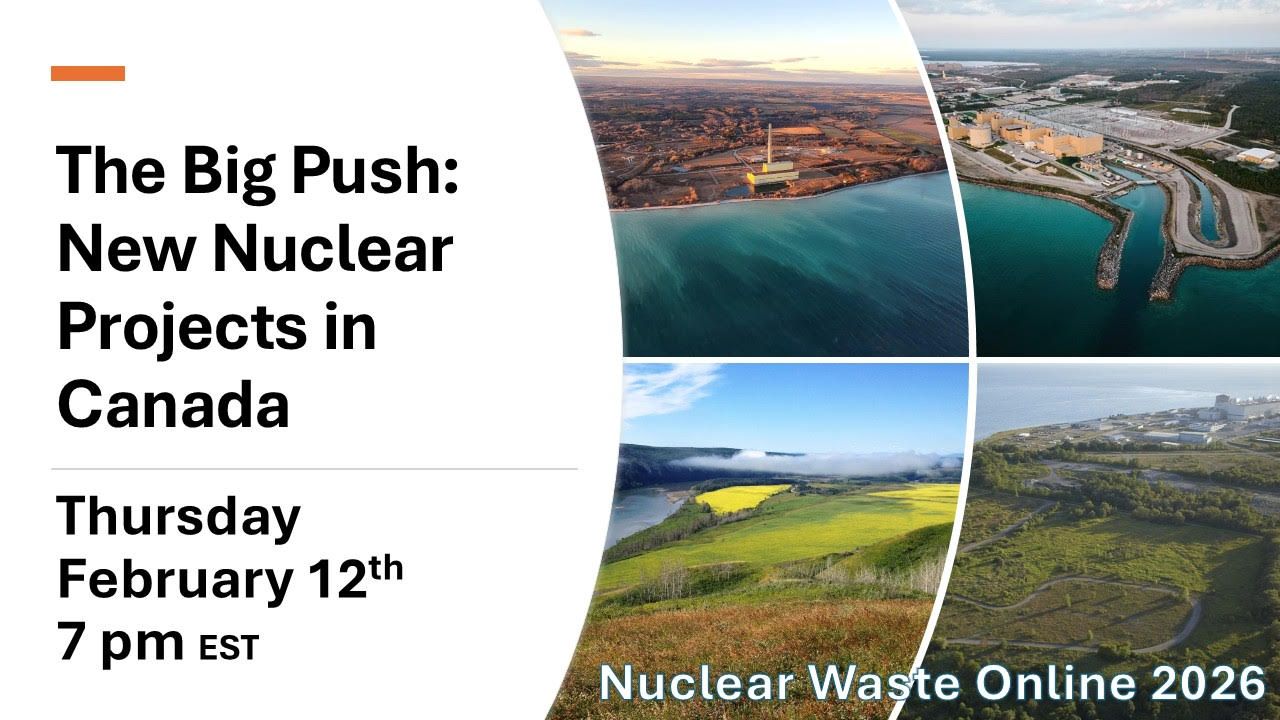
Thursday, February 12, 7 pm Eastern | 2nd of 4 sessions in the 2026 Nuclear Waste Online webinar series
Join a webinar on the push for new nuclear generation in Canada. Go to Northwatch.org to register or use the registration link https://us02web.zoom.us/webinar/register/WN_ZfWOf1GITqSRIZX8CB-A9w
-
Archives
- February 2026 (127)
- January 2026 (308)
- December 2025 (358)
- November 2025 (359)
- October 2025 (376)
- September 2025 (258)
- August 2025 (319)
- July 2025 (230)
- June 2025 (348)
- May 2025 (261)
- April 2025 (305)
- March 2025 (319)
-
Categories
- 1
- 1 NUCLEAR ISSUES
- business and costs
- climate change
- culture and arts
- ENERGY
- environment
- health
- history
- indigenous issues
- Legal
- marketing of nuclear
- media
- opposition to nuclear
- PERSONAL STORIES
- politics
- politics international
- Religion and ethics
- safety
- secrets,lies and civil liberties
- spinbuster
- technology
- Uranium
- wastes
- weapons and war
- Women
- 2 WORLD
- ACTION
- AFRICA
- Atrocities
- AUSTRALIA
- Christina's notes
- Christina's themes
- culture and arts
- Events
- Fuk 2022
- Fuk 2023
- Fukushima 2017
- Fukushima 2018
- fukushima 2019
- Fukushima 2020
- Fukushima 2021
- general
- global warming
- Humour (God we need it)
- Nuclear
- RARE EARTHS
- Reference
- resources – print
- Resources -audiovicual
- Weekly Newsletter
- World
- World Nuclear
- YouTube
-
RSS
Entries RSS
Comments RSS
 nuclear-news